Environmental Ethics 
By:- Pankaj Singh Chandel
Importance of Environment 
• In the world of business, industry and commerce, environment factors play a 
significant role. When global ecological systems are disturbed by certain 
abnormal activities of human beings and industrial organizations, it can lead 
to unfavorable consequences. 
• It is therefore necessary for business and industry to be sensitive to the 
dominance of ecosystem on the physical environment.
• It is not sufficient for business to be profit oriented alone, it should also take 
into consideration that growth and development does not impair the health 
and welfare of the people. 
• Business is morally bound to serve its customers not only by delivering 
quality products and services but also ensure appropriate considerations 
towards their welfare . 
• There should be no compromise or conflict between economic cause of 
business and social welfare.
Environmental preservation: role of stakeholders 
– The stakeholders are: 
• The Public, 
• The Media, 
• Environmental Groups, 
• Corporations, and 
• The Government
Future outlook on environment 
• Environmentalism in the 21st century can be characterized by 
three principles that serve as bases for continued activism and 
policy formulation. 
1. Public – Private partnerships 
2. International cooperation 
3. Sustainable development
Innovative business responses to environmental regulations 
There are several reasons why those managing business are becoming increasingly conscious of 
environmental issues: 
• For management morale 
• To cut waste 
• Benefits arising from pollution prevention 
• Advantages of taking a proactive stance towards environmental regulation 
• Green design’ of products 
• Production of environment-friendly products, packages and processes 
• Eco-labelling 
• Savings through pollution prevention measures 
• Increased fear of environmental damage 
• Coordination with environmental advocacy groups and government regulators
Waste management and pollution control 
Environmental damage through industrial activity can be of two 
types: 
1.Depletion of Natural Resources 
2.Degradation of the Natural Resources
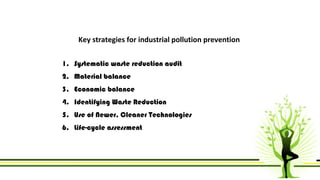
Key strategies for industrial pollution prevention 
1. Systematic waste reduction audit 
2. Material balance 
3. Economic balance 
4. Identifying Waste Reduction 
5. Use of Newer, Cleaner Technologies 
6. Life-cycle assessment
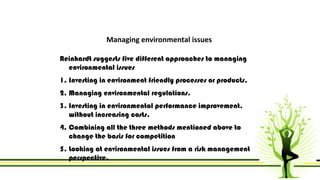
Managing environmental issues 
Reinhardt suggests five different approaches to managing 
environmental issues 
1. Investing in environment friendly processes or products. 
2. Managing environmental regulations. 
3. Investing in environmental performance improvement, 
without increasing costs. 
4. Combining all the three methods mentioned above to 
change the basis for competition 
5. Looking at environmental issues from a risk management 
perspective.
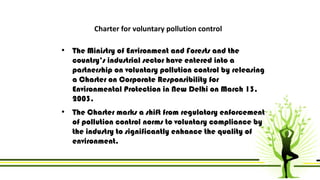
Charter for voluntary pollution control 
• The Ministry of Environment and Forests and the 
country’s industrial sector have entered into a 
partnership on voluntary pollution control by releasing 
a Charter on Corporate Responsibility for 
Environmental Protection in New Delhi on March 13, 
2003. 
• The Charter marks a shift from regulatory enforcement 
of pollution control norms to voluntary compliance by 
the industry to significantly enhance the quality of 
environment.
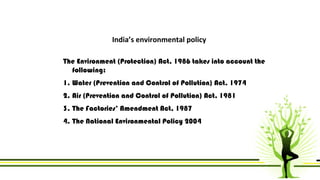
India’s environmental policy 
The Environment (Protection) Act, 1986 takes into account the 
following: 
1. Water (Prevention and Control of Pollution) Act, 1974 
2. Air (Prevention and Control of Pollution) Act, 1981 
3. The Factories’ Amendment Act, 1987 
4. The National Environmental Policy 2004

Environmental protection by pankaj

  • 1.
    Environmental Ethics By:-Pankaj Singh Chandel
  • 2.
    Importance of Environment • In the world of business, industry and commerce, environment factors play a significant role. When global ecological systems are disturbed by certain abnormal activities of human beings and industrial organizations, it can lead to unfavorable consequences. • It is therefore necessary for business and industry to be sensitive to the dominance of ecosystem on the physical environment.
  • 3.
    • It isnot sufficient for business to be profit oriented alone, it should also take into consideration that growth and development does not impair the health and welfare of the people. • Business is morally bound to serve its customers not only by delivering quality products and services but also ensure appropriate considerations towards their welfare . • There should be no compromise or conflict between economic cause of business and social welfare.
  • 4.
    Environmental preservation: roleof stakeholders – The stakeholders are: • The Public, • The Media, • Environmental Groups, • Corporations, and • The Government
  • 5.
    Future outlook onenvironment • Environmentalism in the 21st century can be characterized by three principles that serve as bases for continued activism and policy formulation. 1. Public – Private partnerships 2. International cooperation 3. Sustainable development
  • 6.
    Innovative business responsesto environmental regulations There are several reasons why those managing business are becoming increasingly conscious of environmental issues: • For management morale • To cut waste • Benefits arising from pollution prevention • Advantages of taking a proactive stance towards environmental regulation • Green design’ of products • Production of environment-friendly products, packages and processes • Eco-labelling • Savings through pollution prevention measures • Increased fear of environmental damage • Coordination with environmental advocacy groups and government regulators
  • 7.
    Waste management andpollution control Environmental damage through industrial activity can be of two types: 1.Depletion of Natural Resources 2.Degradation of the Natural Resources
  • 8.
    Key strategies forindustrial pollution prevention 1. Systematic waste reduction audit 2. Material balance 3. Economic balance 4. Identifying Waste Reduction 5. Use of Newer, Cleaner Technologies 6. Life-cycle assessment
  • 9.
    Managing environmental issues Reinhardt suggests five different approaches to managing environmental issues 1. Investing in environment friendly processes or products. 2. Managing environmental regulations. 3. Investing in environmental performance improvement, without increasing costs. 4. Combining all the three methods mentioned above to change the basis for competition 5. Looking at environmental issues from a risk management perspective.
  • 10.
    Charter for voluntarypollution control • The Ministry of Environment and Forests and the country’s industrial sector have entered into a partnership on voluntary pollution control by releasing a Charter on Corporate Responsibility for Environmental Protection in New Delhi on March 13, 2003. • The Charter marks a shift from regulatory enforcement of pollution control norms to voluntary compliance by the industry to significantly enhance the quality of environment.
  • 11.
    India’s environmental policy The Environment (Protection) Act, 1986 takes into account the following: 1. Water (Prevention and Control of Pollution) Act, 1974 2. Air (Prevention and Control of Pollution) Act, 1981 3. The Factories’ Amendment Act, 1987 4. The National Environmental Policy 2004