Introduction 
to REDD+ 
EU REDD Facility Introduction to REDD+ 
EUREDD 
Briefing Facility 
1 What is REDD+? 
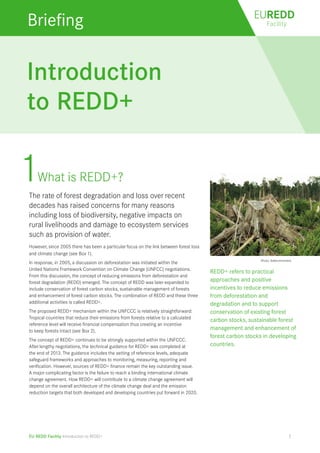
The rate of forest degradation and loss over recent 
decades has raised concerns for many reasons 
including loss of biodiversity, negative impacts on 
rural livelihoods and damage to ecosystem services 
such as provision of water. 
However, since 2005 there has been a particular focus on the link between forest loss 
and climate change (see Box 1). 
In response, in 2005, a discussion on deforestation was initiated within the 
United Nations Framework Convention on Climate Change (UNFCC) negotiations. 
From this discussion, the concept of reducing emissions from deforestation and 
forest degradation (REDD) emerged. The concept of REDD was later expanded to 
include conservation of forest carbon stocks, sustainable management of forests 
and enhancement of forest carbon stocks. The combination of REDD and these three 
additional activities is called REDD+. 
The proposed REDD+ mechanism within the UNFCCC is relatively straightforward: 
Tropical countries that reduce their emissions from forests relative to a calculated 
reference level will receive financial compensation thus creating an incentive 
to keep forests intact (see Box 2). 
The concept of REDD+ continues to be strongly supported within the UNFCCC. 
After lengthy negotiations, the technical guidance for REDD+ was completed at 
the end of 2013. The guidance includes the setting of reference levels, adequate 
safeguard frameworks and approaches to monitoring, measuring, reporting and 
verification. However, sources of REDD+ finance remain the key outstanding issue. 
A major complicating factor is the failure to reach a binding international climate 
change agreement. How REDD+ will contribute to a climate change agreement will 
depend on the overall architecture of the climate change deal and the emission 
reduction targets that both developed and developing countries put forward in 2020. 
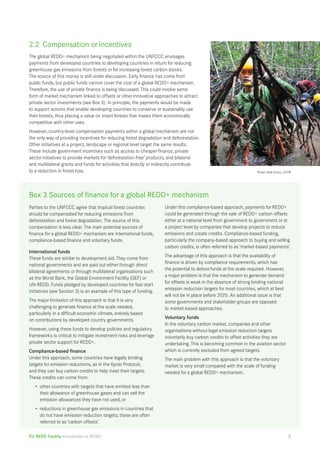
Photo: Aidenvironment 
REDD+ refers to practical 
approaches and positive 
incentives to reduce emissions 
from deforestation and 
degradation and to support 
conservation of existing forest 
carbon stocks, sustainable forest 
management and enhancement of 
forest carbon stocks in developing 
countries. 
1
EU REDD Facility Introduction to REDD+ 
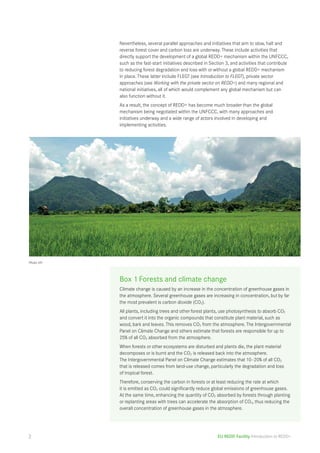
Photo: EFI 
Nevertheless, several parallel approaches and initiatives that aim to slow, halt and 
reverse forest cover and carbon loss are underway. These include activities that 
directly support the development of a global REDD+ mechanism within the UNFCCC, 
such as the fast-start initiatives described in Section 3, and activities that contribute 
to reducing forest degradation and loss with or without a global REDD+ mechanism 
in place. These latter include FLEGT (see Introduction to FLEGT), private sector 
approaches (see Working with the private sector on REDD+) and many regional and 
national initiatives, all of which would complement any global mechanism but can 
also function without it. 
As a result, the concept of REDD+ has become much broader than the global 
mechanism being negotiated within the UNFCCC, with many approaches and 
initiatives underway and a wide range of actors involved in developing and 
implementing activities. 
Box 1 Forests and climate change 
Climate change is caused by an increase in the concentration of greenhouse gases in 
the atmosphere. Several greenhouse gases are increasing in concentration, but by far 
the most prevalent is carbon dioxide (CO2). 
All plants, including trees and other forest plants, use photosynthesis to absorb CO2 
and convert it into the organic compounds that constitute plant material, such as 
wood, bark and leaves. This removes CO2 from the atmosphere. The Intergovernmental 
Panel on Climate Change and others estimate that forests are responsible for up to 
25% of all CO2 absorbed from the atmosphere. 
When forests or other ecosystems are disturbed and plants die, the plant material 
decomposes or is burnt and the CO2 is released back into the atmosphere. 
The Intergovernmental Panel on Climate Change estimates that 10–20% of all CO2 
that is released comes from land-use change, particularly the degradation and loss 
of tropical forest. 
Therefore, conserving the carbon in forests or at least reducing the rate at which 
it is emitted as CO2 could significantly reduce global emissions of greenhouse gases. 
At the same time, enhancing the quantity of CO2 absorbed by forests through planting 
or replanting areas with trees can accelerate the absorption of CO2, thus reducing the 
overall concentration of greenhouse gases in the atmosphere. 
2
Box 2 How REDD+ works 
The principle underlying REDD+ is that, since CO2 is emitted 
when forests are damaged or destroyed, reducing the rate of 
deforestation or forest degradation would result in less CO2 
being emitted. Deforestation refers to complete loss of forests 
and forest degradation refers to damage to forests by, for 
example, logging. 
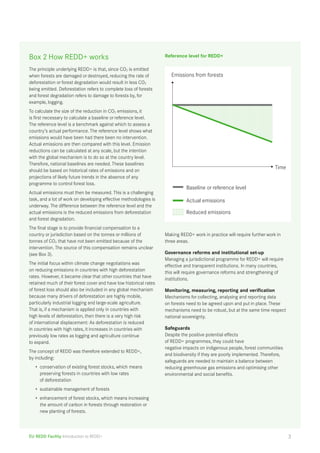
To calculate the size of the reduction in CO2 emissions, it 
is first necessary to calculate a baseline or reference level. 
The reference level is a benchmark against which to assess a 
country’s actual performance. The reference level shows what 
emissions would have been had there been no intervention. 
Actual emissions are then compared with this level. Emission 
reductions can be calculated at any scale, but the intention 
with the global mechanism is to do so at the country level. 
Therefore, national baselines are needed. These baselines 
should be based on historical rates of emissions and on 
projections of likely future trends in the absence of any 
programme to control forest loss. 
Actual emissions must then be measured. This is a challenging 
task, and a lot of work on developing effective methodologies is 
underway. The difference between the reference level and the 
actual emissions is the reduced emissions from deforestation 
and forest degradation. 
The final stage is to provide financial compensation to a 
country or jurisdiction based on the tonnes or millions of 
tonnes of CO2 that have not been emitted because of the 
intervention. The source of this compensation remains unclear 
(see Box 3). 
The initial focus within climate change negotiations was 
on reducing emissions in countries with high deforestation 
rates. However, it became clear that other countries that have 
retained much of their forest cover and have low historical rates 
of forest loss should also be included in any global mechanism 
because many drivers of deforestation are highly mobile, 
particularly industrial logging and large-scale agriculture. 
That is, if a mechanism is applied only in countries with 
high levels of deforestation, then there is a very high risk 
of international displacement: As deforestation is reduced 
in countries with high rates, it increases in countries with 
previously low rates as logging and agriculture continue 
to expand. 
The concept of REDD was therefore extended to REDD+, 
by including: 
• conservation of existing forest stocks, which means 
preserving forests in countries with low rates 
of deforestation 
• sustainable management of forests 
• enhancement of forest stocks, which means increasing 
the amount of carbon in forests through restoration or 
new planting of forests. 
EU REDD Facility Introduction to REDD+ 
Time 
Reference level for REDD+ 
Emissions from forests 
Baseline or reference level 
Actual emissions 
Reduced emissions 
Making REDD+ work in practice will require further work in 
three areas. 
Governance reforms and institutional set-up 
Managing a jurisdictional programme for REDD+ will require 
effective and transparent institutions. In many countries, 
this will require governance reforms and strengthening of 
institutions. 
Monitoring, measuring, reporting and verification 
Mechanisms for collecting, analysing and reporting data 
on forests need to be agreed upon and put in place. These 
mechanisms need to be robust, but at the same time respect 
national sovereignty. 
Safeguards 
Despite the positive potential effects 
of REDD+ programmes, they could have 
negative impacts on indigenous people, forest communities 
and biodiversity if they are poorly implemented. Therefore, 
safeguards are needed to maintain a balance between 
reducing greenhouse gas emissions and optimising other 
environmental and social benefits. 
3
2 REDD+ in practice 
A functional REDD+ mechanism, whether the global 
mechanism being negotiated within the UNFCCC 
or another initiative aimed at achieving the same 
goals, has two main aspects: reducing emissions and 
providing compensation or incentives. 
The complexity surrounding REDD+ means that the mechanism must be able to 
function in a highly complex and dynamic environment. 
2.1 Reducing emissions 
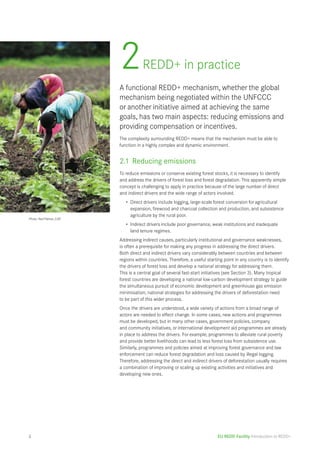
To reduce emissions or conserve existing forest stocks, it is necessary to identify 
and address the drivers of forest loss and forest degradation. This apparently simple 
concept is challenging to apply in practice because of the large number of direct 
and indirect drivers and the wide range of actors involved. 
• Direct drivers include logging, large-scale forest conversion for agricultural 
expansion, firewood and charcoal collection and production, and subsistence 
agriculture by the rural poor. 
• Indirect drivers include poor governance, weak institutions and inadequate 
land tenure regimes. 
Addressing indirect causes, particularly institutional and governance weaknesses, 
is often a prerequisite for making any progress in addressing the direct drivers. 
Both direct and indirect drivers vary considerably between countries and between 
regions within countries. Therefore, a useful starting point in any country is to identify 
the drivers of forest loss and develop a national strategy for addressing them. 
This is a central goal of several fast-start initiatives (see Section 3). Many tropical 
forest countries are developing a national low-carbon development strategy to guide 
the simultaneous pursuit of economic development and greenhouse gas emission 
minimisation; national strategies for addressing the drivers of deforestation need 
to be part of this wider process. 
Once the drivers are understood, a wide variety of actions from a broad range of 
actors are needed to effect change. In some cases, new actions and programmes 
must be developed, but in many other cases, government policies, company 
and community initiatives, or international development aid programmes are already 
in place to address the drivers. For example, programmes to alleviate rural poverty 
and provide better livelihoods can lead to less forest loss from subsistence use. 
Similarly, programmes and policies aimed at improving forest governance and law 
enforcement can reduce forest degradation and loss caused by illegal logging. 
Therefore, addressing the direct and indirect drivers of deforestation usually requires 
a combination of improving or scaling up existing activities and initiatives and 
developing new ones. 
EU REDD Facility Introduction to REDD+ 
Photo: Neil Palmer, CIAT 
4
2.2 Compensation or incentives 
The global REDD+ mechanism being negotiated within the UNFCCC envisages 
payments from developed countries to developing countries in return for reducing 
greenhouse gas emissions from forests or for increasing forest carbon stocks. 
The source of this money is still under discussion. Early finance has come from 
public funds, but public funds cannot cover the cost of a global REDD+ mechanism. 
Therefore, the use of private finance is being discussed. This could involve some 
form of market mechanism linked to offsets or other innovative approaches to attract 
private sector investments (see Box 3). In principle, the payments would be made 
to support actions that enable developing countries to conserve or sustainably use 
their forests, thus placing a value on intact forests that makes them economically 
competitive with other uses. 
However, country-level compensation payments within a global mechanism are not 
the only way of providing incentives for reducing forest degradation and deforestation. 
Other initiatives at a project, landscape or regional level target the same results. 
These include government incentives such as access to cheaper finance, private 
sector initiatives to provide markets for ‘deforestation-free’ products, and bilateral 
and multilateral grants and funds for activities that directly or indirectly contribute 
to a reduction in forest loss. Photo: Kate Evans, CIFOR 
Box 3 Sources of finance for a global REDD+ mechanism 
Parties to the UNFCCC agree that tropical forest countries 
should be compensated for reducing emissions from 
deforestation and forest degradation. The source of this 
compensation is less clear. The main potential sources of 
finance for a global REDD+ mechanism are international funds, 
compliance-based finance and voluntary funds. 
International funds 
These funds are similar to development aid. They come from 
national governments and are paid out either through direct 
bilateral agreements or through multilateral organisations such 
as the World Bank, the Global Environment Facility (GEF) or 
UN-REDD. Funds pledged by developed countries for fast-start 
initiatives (see Section 3) is an example of this type of funding. 
The major limitation of this approach is that it is very 
challenging to generate finance at the scale needed, 
particularly in a difficult economic climate, entirely based 
on contributions by developed country governments. 
However, using these funds to develop policies and regulatory 
frameworks is critical to mitigate investment risks and leverage 
private sector support for REDD+. 
Compliance-based finance 
Under this approach, some countries have legally binding 
targets for emission reductions, as in the Kyoto Protocol, 
and they can buy carbon credits to help meet their targets. 
These credits can come from: 
• other countries with targets that have emitted less than 
their allowance of greenhouse gases and can sell the 
emission allowances they have not used, or 
• reductions in greenhouse gas emissions in countries that 
do not have emission reduction targets; these are often 
referred to as ‘carbon offsets’. 
EU REDD Facility Introduction to REDD+ 
Under this compliance-based approach, payments for REDD+ 
could be generated through the sale of REDD+ carbon offsets 
either at a national level from government to government or at 
a project level by companies that develop projects to reduce 
emissions and create credits. Compliance-based funding, 
particularly the company-based approach to buying and selling 
carbon credits, is often referred to as ‘market-based payments’. 
The advantage of this approach is that the availability of 
finance is driven by compliance requirements, which has 
the potential to deliver funds at the scale required. However, 
a major problem is that the mechanism to generate demand 
for offsets is weak in the absence of strong binding national 
emission reduction targets for most countries, which at best 
will not be in place before 2020. An additional issue is that 
some governments and stakeholder groups are opposed 
to market-based approaches. 
Voluntary funds 
In the voluntary carbon market, companies and other 
organisations without legal emission reduction targets 
voluntarily buy carbon credits to offset activities they are 
undertaking. This is becoming common in the aviation sector 
which is currently excluded from agreed targets. 
The main problem with this approach is that the voluntary 
market is very small compared with the scale of funding 
needed for a global REDD+ mechanism. 
5
EU REDD Facility Introduction to REDD+ 
2.3 A phased approach to implementation 
A long-term goal of the REDD+ mechanism under negotiation 
is that countries would be compensated after results have 
been achieved, according to the actual emission reductions 
achieved relative to the agreed baseline; this approach 
is known as payment for results. To receive payments for 
results, each country will require an institutional framework 
for REDD+, within which it can develop baselines, agree upon 
methodologies, monitor and report on progress and make and 
receive compensation payments. Developing this institutional 
framework and formulating a national strategy for reducing 
emissions are often referred to as ‘REDD+ readiness’. 
Most of the work in achieving REDD+ lies between the initial 
readiness step and the final goal of full implementation 
and payment for results. Mechanisms must be developed 
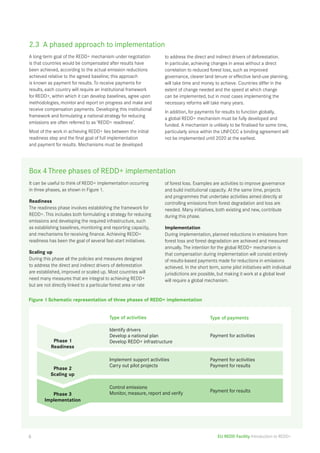
Figure 1 Schematic representation of three phases of REDD+ implementation 
Type of activities Type of payments 
Payment for activities 
Payment for results 
Payment for results 
Implement support activities 
Carry out pilot projects 
Control emissions 
Monitor, measure, report and verify 
Phase 1 
Readiness 
Phase 2 
Scaling up 
Identify drivers 
Develop a national plan 
Develop REDD+ infrastructure 
Phase 3 
Implementation 
to address the direct and indirect drivers of deforestation. 
In particular, achieving changes in areas without a direct 
correlation to reduced forest loss, such as improved 
governance, clearer land tenure or effective land-use planning, 
will take time and money to achieve. Countries differ in the 
extent of change needed and the speed at which change 
can be implemented, but in most cases implementing the 
necessary reforms will take many years. 
In addition, for payments for results to function globally, 
a global REDD+ mechanism must be fully developed and 
funded. A mechanism is unlikely to be finalised for some time, 
particularly since within the UNFCCC a binding agreement will 
not be implemented until 2020 at the earliest. 
Box 4 Three phases of REDD+ implementation 
of forest loss. Examples are activities to improve governance 
and build institutional capacity. At the same time, projects 
and programmes that undertake activities aimed directly at 
controlling emissions from forest degradation and loss are 
needed. Many initiatives, both existing and new, contribute 
during this phase. 
Implementation 
During implementation, planned reductions in emissions from 
forest loss and forest degradation are achieved and measured 
annually. The intention for the global REDD+ mechanism is 
that compensation during implementation will consist entirely 
of results-based payments made for reductions in emissions 
achieved. In the short term, some pilot initiatives with individual 
jurisdictions are possible, but making it work at a global level 
will require a global mechanism. 
It can be useful to think of REDD+ implementation occurring 
in three phases, as shown in Figure 1. 
Readiness 
The readiness phase involves establishing the framework for 
REDD+. This includes both formulating a strategy for reducing 
emissions and developing the required infrastructure, such 
as establishing baselines, monitoring and reporting capacity, 
and mechanisms for receiving finance. Achieving REDD+ 
readiness has been the goal of several fast-start initiatives. 
Scaling up 
During this phase all the policies and measures designed 
to address the direct and indirect drivers of deforestation 
are established, improved or scaled up. Most countries will 
need many measures that are integral to achieving REDD+ 
but are not directly linked to a particular forest area or rate 
6
3 Current activities 
3.1 REDD+ fast-start initiatives 
While negotiations on a global REDD+ mechanism continue within the UNFCCC, 
many intergovernmental and multilateral early-action initiatives aimed at funding 
and developing REDD+ programmes are underway. These tend to focus on readiness 
and scaling up. By the end of 2013, approximately USD 4.5 billion of funding has been 
pledged for these activities. 
Several of these initiatives support readiness activities, including the development of 
national strategies for addressing drivers and the establishment of REDD+ institutions 
for monitoring, measuring, reporting and verification. Examples are the Forest Carbon 
Partnership Facility (FCPF) administered by the World Bank, the UN-REDD Programme 
and a range of bilateral initiatives. 
Box 5 Fast-start initiatives for REDD+ 
REDD+ Partnership 
The REDD+ Partnership was launched in early 2010 as a 
follow-up to the Copenhagen negotiations, and to build on 
the momentum created. More than 70 countries are in the 
partnership. Among those involved are all the developed 
countries that have pledged fast-start finance and all the 
developing countries interested in implementing REDD+. 
The aims of the partnership are to support the commitments 
made in Copenhagen and to improve coordination of fast-start 
financing for REDD+. The partnership helps advance 
discussions about how REDD+ will work and develop and test 
approaches for delivering REDD+ results. The partnership does 
not disburse funding directly. 
www.reddpluspartnership.org 
UN-REDD 
The United Nations Collaborative Programme on REDD, 
launched in September 2008, is a collaboration of three 
UN agencies: Food and Agriculture Organization (FAO), 
UN Environment Programme (UNEP) and UN Development 
Programme (UNDP). The UN-REDD Programme supports 
18 nationally led REDD+ processes and promotes the informed 
and meaningful involvement of all stakeholders, including 
indigenous people and other forest-dependent communities, 
in national and international REDD+ implementation. 
The programme has an approved budget of USD 168.7 million. 
www.un-redd.org 
Forest Carbon Partnership Facility (FCPF) 
The FCPF is a partnership of 44 developing and 14 developed 
countries, including nine countries in the EU, the European 
Union, NGOs and the private sector. It is administered by the 
World Bank. The FCPF includes a Readiness Fund through 
which it provide grants and technical assistance for countries 
EU REDD Facility Introduction to REDD+ 
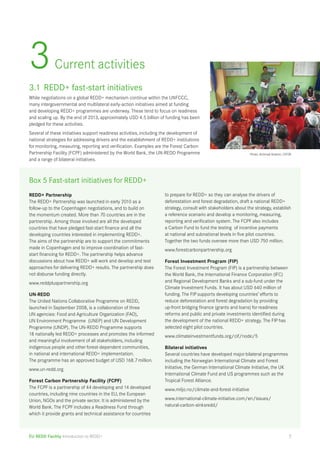
Photo: Achmad Ibrahim, CIFOR 
to prepare for REDD+ so they can analyse the drivers of 
deforestation and forest degradation, draft a national REDD+ 
strategy, consult with stakeholders about the strategy, establish 
a reference scenario and develop a monitoring, measuring, 
reporting and verification system. The FCPF also includes 
a Carbon Fund to fund the testing of incentive payments 
at national and subnational levels in five pilot countries. 
Together the two funds oversee more than USD 750 million. 
www.forestcarbonpartnership.org 
Forest Investment Program (FIP) 
The Forest Investment Program (FIP) is a partnership between 
the World Bank, the International Finance Corporation (IFC) 
and Regional Development Banks and a sub-fund under the 
Climate Investment Funds. It has about USD 640 million of 
funding. The FIP supports developing countries’ efforts to 
reduce deforestation and forest degradation by providing 
up-front bridging finance (grants and loans) for readiness 
reforms and public and private investments identified during 
the development of the national REDD+ strategy. The FIP has 
selected eight pilot countries. 
www.climateinvestmentfunds.org/cif/node/5 
Bilateral initiatives 
Several countries have developed major bilateral programmes 
including the Norwegian International Climate and Forest 
Initiative, the German International Climate Initiative, the UK 
International Climate Fund and US programmes such as the 
Tropical Forest Alliance. 
www.miljo.no/climate-and-forest-initiative 
www.international-climate-initiative.com/en/issues/ 
natural-carbon-sinksredd/ 
7
Other fast-start initiatives provide financial support for implementing activities to 
reduce deforestation and forest degradation. Examples of these initiatives are the 
World Bank Forest Investment Program (FIP) and bilateral programmes such as the 
Norwegian International Climate and Forest Initiative and the German International 
Climate Initiative. 
3.2 Other activities 
It has become apparent that REDD+ initiatives in isolation will not be sufficient 
to reduce deforestation and forest degradation. Rather, a variety of actors, activities 
and initiatives will be needed. 
Fortunately, many initiatives and activities are underway that are contributing to 
the goal of slowing, halting and reversing forest loss. Increasingly, those involved 
are seeing the value of collaborating and supporting each other. These include 
international initiatives such as FLEGT and private sector activities, as well 
as national government programmes, international development aid, and 
community and NGO approaches. 
4 Resources 
Within the European Commission, the Directorate General for Climate Action 
leads on REDD+, with the involvement of the Directorates General for the 
Environment and for Development and Cooperation. 
http://ec.europa.eu/dgs/clima/mission/index_en.htm 
The EU REDD Facility supports REDD+ policy implementation. It is supported by 
the EU and EU member states. The Facility is hosted by the European Forest Institute. 
www.euredd.efi.int 
The UNFCCC has a REDD Web Platform with information and updates 
on the official process. http://unfccc.int/methods_science/redd/items/4531.php 
Several databases are being developed to make information on REDD+ easily 
accessible. The REDD+ Partnership is developing a global database that can be 
accessed from its website. www.reddpluspartnership.org. 
Many organisations provide summaries of REDD+ activities and updates on its 
progress. The REDD Desk is a collaborative resource for REDD+ information, news 
and analysis to meet the needs of diverse stakeholders. www.redddesk.org 
Proforest developed four briefings that introduce REDD+ and explain the links between 
FLEGT and REDD+ and with other forest initiatives. 
• Introduction to FLEGT 
• Introduction to REDD+ 
Funded by the European Union and the 
Governments of France, Germany, Ireland, 
Spain and the United Kingdom 
• Linking FLEGT and REDD+ 
• Working with the private sector on REDD+ 
This is the second of the four briefings, Introduction to REDD+. REDD+ stands for reducing 
emissions from deforestation and forest degradation plus conserving forests, sustainably 
managing forests and enhancing forest carbon stocks. REDD+ is a proposed international 
mechanism to provide incentives for developing countries to protect and restore their forest 
carbon stocks. FLEGT stands for forest law enforcement, governance and trade. The FLEGT Action 
Plan is a European Union initiative to address the problem of illegal logging and related trade. 
This briefing was developed by Proforest, with input from EFI and officials of the European Union 
and EU member states, and produced with the assistance of the European Union. The contents 
are the sole responsibility of the authors and can in no way be taken to represent the views 
of the European Union. 
© European Forest Institute, Proforest 2014 
Photo: Kate Evans, CIFOR

Pro forest - introduction to redd

  • 1.
    Introduction to REDD+ EU REDD Facility Introduction to REDD+ EUREDD Briefing Facility 1 What is REDD+? The rate of forest degradation and loss over recent decades has raised concerns for many reasons including loss of biodiversity, negative impacts on rural livelihoods and damage to ecosystem services such as provision of water. However, since 2005 there has been a particular focus on the link between forest loss and climate change (see Box 1). In response, in 2005, a discussion on deforestation was initiated within the United Nations Framework Convention on Climate Change (UNFCC) negotiations. From this discussion, the concept of reducing emissions from deforestation and forest degradation (REDD) emerged. The concept of REDD was later expanded to include conservation of forest carbon stocks, sustainable management of forests and enhancement of forest carbon stocks. The combination of REDD and these three additional activities is called REDD+. The proposed REDD+ mechanism within the UNFCCC is relatively straightforward: Tropical countries that reduce their emissions from forests relative to a calculated reference level will receive financial compensation thus creating an incentive to keep forests intact (see Box 2). The concept of REDD+ continues to be strongly supported within the UNFCCC. After lengthy negotiations, the technical guidance for REDD+ was completed at the end of 2013. The guidance includes the setting of reference levels, adequate safeguard frameworks and approaches to monitoring, measuring, reporting and verification. However, sources of REDD+ finance remain the key outstanding issue. A major complicating factor is the failure to reach a binding international climate change agreement. How REDD+ will contribute to a climate change agreement will depend on the overall architecture of the climate change deal and the emission reduction targets that both developed and developing countries put forward in 2020. Photo: Aidenvironment REDD+ refers to practical approaches and positive incentives to reduce emissions from deforestation and degradation and to support conservation of existing forest carbon stocks, sustainable forest management and enhancement of forest carbon stocks in developing countries. 1
  • 2.
    EU REDD FacilityIntroduction to REDD+ Photo: EFI Nevertheless, several parallel approaches and initiatives that aim to slow, halt and reverse forest cover and carbon loss are underway. These include activities that directly support the development of a global REDD+ mechanism within the UNFCCC, such as the fast-start initiatives described in Section 3, and activities that contribute to reducing forest degradation and loss with or without a global REDD+ mechanism in place. These latter include FLEGT (see Introduction to FLEGT), private sector approaches (see Working with the private sector on REDD+) and many regional and national initiatives, all of which would complement any global mechanism but can also function without it. As a result, the concept of REDD+ has become much broader than the global mechanism being negotiated within the UNFCCC, with many approaches and initiatives underway and a wide range of actors involved in developing and implementing activities. Box 1 Forests and climate change Climate change is caused by an increase in the concentration of greenhouse gases in the atmosphere. Several greenhouse gases are increasing in concentration, but by far the most prevalent is carbon dioxide (CO2). All plants, including trees and other forest plants, use photosynthesis to absorb CO2 and convert it into the organic compounds that constitute plant material, such as wood, bark and leaves. This removes CO2 from the atmosphere. The Intergovernmental Panel on Climate Change and others estimate that forests are responsible for up to 25% of all CO2 absorbed from the atmosphere. When forests or other ecosystems are disturbed and plants die, the plant material decomposes or is burnt and the CO2 is released back into the atmosphere. The Intergovernmental Panel on Climate Change estimates that 10–20% of all CO2 that is released comes from land-use change, particularly the degradation and loss of tropical forest. Therefore, conserving the carbon in forests or at least reducing the rate at which it is emitted as CO2 could significantly reduce global emissions of greenhouse gases. At the same time, enhancing the quantity of CO2 absorbed by forests through planting or replanting areas with trees can accelerate the absorption of CO2, thus reducing the overall concentration of greenhouse gases in the atmosphere. 2
  • 3.
    Box 2 HowREDD+ works The principle underlying REDD+ is that, since CO2 is emitted when forests are damaged or destroyed, reducing the rate of deforestation or forest degradation would result in less CO2 being emitted. Deforestation refers to complete loss of forests and forest degradation refers to damage to forests by, for example, logging. To calculate the size of the reduction in CO2 emissions, it is first necessary to calculate a baseline or reference level. The reference level is a benchmark against which to assess a country’s actual performance. The reference level shows what emissions would have been had there been no intervention. Actual emissions are then compared with this level. Emission reductions can be calculated at any scale, but the intention with the global mechanism is to do so at the country level. Therefore, national baselines are needed. These baselines should be based on historical rates of emissions and on projections of likely future trends in the absence of any programme to control forest loss. Actual emissions must then be measured. This is a challenging task, and a lot of work on developing effective methodologies is underway. The difference between the reference level and the actual emissions is the reduced emissions from deforestation and forest degradation. The final stage is to provide financial compensation to a country or jurisdiction based on the tonnes or millions of tonnes of CO2 that have not been emitted because of the intervention. The source of this compensation remains unclear (see Box 3). The initial focus within climate change negotiations was on reducing emissions in countries with high deforestation rates. However, it became clear that other countries that have retained much of their forest cover and have low historical rates of forest loss should also be included in any global mechanism because many drivers of deforestation are highly mobile, particularly industrial logging and large-scale agriculture. That is, if a mechanism is applied only in countries with high levels of deforestation, then there is a very high risk of international displacement: As deforestation is reduced in countries with high rates, it increases in countries with previously low rates as logging and agriculture continue to expand. The concept of REDD was therefore extended to REDD+, by including: • conservation of existing forest stocks, which means preserving forests in countries with low rates of deforestation • sustainable management of forests • enhancement of forest stocks, which means increasing the amount of carbon in forests through restoration or new planting of forests. EU REDD Facility Introduction to REDD+ Time Reference level for REDD+ Emissions from forests Baseline or reference level Actual emissions Reduced emissions Making REDD+ work in practice will require further work in three areas. Governance reforms and institutional set-up Managing a jurisdictional programme for REDD+ will require effective and transparent institutions. In many countries, this will require governance reforms and strengthening of institutions. Monitoring, measuring, reporting and verification Mechanisms for collecting, analysing and reporting data on forests need to be agreed upon and put in place. These mechanisms need to be robust, but at the same time respect national sovereignty. Safeguards Despite the positive potential effects of REDD+ programmes, they could have negative impacts on indigenous people, forest communities and biodiversity if they are poorly implemented. Therefore, safeguards are needed to maintain a balance between reducing greenhouse gas emissions and optimising other environmental and social benefits. 3
  • 4.
    2 REDD+ inpractice A functional REDD+ mechanism, whether the global mechanism being negotiated within the UNFCCC or another initiative aimed at achieving the same goals, has two main aspects: reducing emissions and providing compensation or incentives. The complexity surrounding REDD+ means that the mechanism must be able to function in a highly complex and dynamic environment. 2.1 Reducing emissions To reduce emissions or conserve existing forest stocks, it is necessary to identify and address the drivers of forest loss and forest degradation. This apparently simple concept is challenging to apply in practice because of the large number of direct and indirect drivers and the wide range of actors involved. • Direct drivers include logging, large-scale forest conversion for agricultural expansion, firewood and charcoal collection and production, and subsistence agriculture by the rural poor. • Indirect drivers include poor governance, weak institutions and inadequate land tenure regimes. Addressing indirect causes, particularly institutional and governance weaknesses, is often a prerequisite for making any progress in addressing the direct drivers. Both direct and indirect drivers vary considerably between countries and between regions within countries. Therefore, a useful starting point in any country is to identify the drivers of forest loss and develop a national strategy for addressing them. This is a central goal of several fast-start initiatives (see Section 3). Many tropical forest countries are developing a national low-carbon development strategy to guide the simultaneous pursuit of economic development and greenhouse gas emission minimisation; national strategies for addressing the drivers of deforestation need to be part of this wider process. Once the drivers are understood, a wide variety of actions from a broad range of actors are needed to effect change. In some cases, new actions and programmes must be developed, but in many other cases, government policies, company and community initiatives, or international development aid programmes are already in place to address the drivers. For example, programmes to alleviate rural poverty and provide better livelihoods can lead to less forest loss from subsistence use. Similarly, programmes and policies aimed at improving forest governance and law enforcement can reduce forest degradation and loss caused by illegal logging. Therefore, addressing the direct and indirect drivers of deforestation usually requires a combination of improving or scaling up existing activities and initiatives and developing new ones. EU REDD Facility Introduction to REDD+ Photo: Neil Palmer, CIAT 4
  • 5.
    2.2 Compensation orincentives The global REDD+ mechanism being negotiated within the UNFCCC envisages payments from developed countries to developing countries in return for reducing greenhouse gas emissions from forests or for increasing forest carbon stocks. The source of this money is still under discussion. Early finance has come from public funds, but public funds cannot cover the cost of a global REDD+ mechanism. Therefore, the use of private finance is being discussed. This could involve some form of market mechanism linked to offsets or other innovative approaches to attract private sector investments (see Box 3). In principle, the payments would be made to support actions that enable developing countries to conserve or sustainably use their forests, thus placing a value on intact forests that makes them economically competitive with other uses. However, country-level compensation payments within a global mechanism are not the only way of providing incentives for reducing forest degradation and deforestation. Other initiatives at a project, landscape or regional level target the same results. These include government incentives such as access to cheaper finance, private sector initiatives to provide markets for ‘deforestation-free’ products, and bilateral and multilateral grants and funds for activities that directly or indirectly contribute to a reduction in forest loss. Photo: Kate Evans, CIFOR Box 3 Sources of finance for a global REDD+ mechanism Parties to the UNFCCC agree that tropical forest countries should be compensated for reducing emissions from deforestation and forest degradation. The source of this compensation is less clear. The main potential sources of finance for a global REDD+ mechanism are international funds, compliance-based finance and voluntary funds. International funds These funds are similar to development aid. They come from national governments and are paid out either through direct bilateral agreements or through multilateral organisations such as the World Bank, the Global Environment Facility (GEF) or UN-REDD. Funds pledged by developed countries for fast-start initiatives (see Section 3) is an example of this type of funding. The major limitation of this approach is that it is very challenging to generate finance at the scale needed, particularly in a difficult economic climate, entirely based on contributions by developed country governments. However, using these funds to develop policies and regulatory frameworks is critical to mitigate investment risks and leverage private sector support for REDD+. Compliance-based finance Under this approach, some countries have legally binding targets for emission reductions, as in the Kyoto Protocol, and they can buy carbon credits to help meet their targets. These credits can come from: • other countries with targets that have emitted less than their allowance of greenhouse gases and can sell the emission allowances they have not used, or • reductions in greenhouse gas emissions in countries that do not have emission reduction targets; these are often referred to as ‘carbon offsets’. EU REDD Facility Introduction to REDD+ Under this compliance-based approach, payments for REDD+ could be generated through the sale of REDD+ carbon offsets either at a national level from government to government or at a project level by companies that develop projects to reduce emissions and create credits. Compliance-based funding, particularly the company-based approach to buying and selling carbon credits, is often referred to as ‘market-based payments’. The advantage of this approach is that the availability of finance is driven by compliance requirements, which has the potential to deliver funds at the scale required. However, a major problem is that the mechanism to generate demand for offsets is weak in the absence of strong binding national emission reduction targets for most countries, which at best will not be in place before 2020. An additional issue is that some governments and stakeholder groups are opposed to market-based approaches. Voluntary funds In the voluntary carbon market, companies and other organisations without legal emission reduction targets voluntarily buy carbon credits to offset activities they are undertaking. This is becoming common in the aviation sector which is currently excluded from agreed targets. The main problem with this approach is that the voluntary market is very small compared with the scale of funding needed for a global REDD+ mechanism. 5
  • 6.
    EU REDD FacilityIntroduction to REDD+ 2.3 A phased approach to implementation A long-term goal of the REDD+ mechanism under negotiation is that countries would be compensated after results have been achieved, according to the actual emission reductions achieved relative to the agreed baseline; this approach is known as payment for results. To receive payments for results, each country will require an institutional framework for REDD+, within which it can develop baselines, agree upon methodologies, monitor and report on progress and make and receive compensation payments. Developing this institutional framework and formulating a national strategy for reducing emissions are often referred to as ‘REDD+ readiness’. Most of the work in achieving REDD+ lies between the initial readiness step and the final goal of full implementation and payment for results. Mechanisms must be developed Figure 1 Schematic representation of three phases of REDD+ implementation Type of activities Type of payments Payment for activities Payment for activities Payment for results Payment for results Implement support activities Carry out pilot projects Control emissions Monitor, measure, report and verify Phase 1 Readiness Phase 2 Scaling up Identify drivers Develop a national plan Develop REDD+ infrastructure Phase 3 Implementation to address the direct and indirect drivers of deforestation. In particular, achieving changes in areas without a direct correlation to reduced forest loss, such as improved governance, clearer land tenure or effective land-use planning, will take time and money to achieve. Countries differ in the extent of change needed and the speed at which change can be implemented, but in most cases implementing the necessary reforms will take many years. In addition, for payments for results to function globally, a global REDD+ mechanism must be fully developed and funded. A mechanism is unlikely to be finalised for some time, particularly since within the UNFCCC a binding agreement will not be implemented until 2020 at the earliest. Box 4 Three phases of REDD+ implementation of forest loss. Examples are activities to improve governance and build institutional capacity. At the same time, projects and programmes that undertake activities aimed directly at controlling emissions from forest degradation and loss are needed. Many initiatives, both existing and new, contribute during this phase. Implementation During implementation, planned reductions in emissions from forest loss and forest degradation are achieved and measured annually. The intention for the global REDD+ mechanism is that compensation during implementation will consist entirely of results-based payments made for reductions in emissions achieved. In the short term, some pilot initiatives with individual jurisdictions are possible, but making it work at a global level will require a global mechanism. It can be useful to think of REDD+ implementation occurring in three phases, as shown in Figure 1. Readiness The readiness phase involves establishing the framework for REDD+. This includes both formulating a strategy for reducing emissions and developing the required infrastructure, such as establishing baselines, monitoring and reporting capacity, and mechanisms for receiving finance. Achieving REDD+ readiness has been the goal of several fast-start initiatives. Scaling up During this phase all the policies and measures designed to address the direct and indirect drivers of deforestation are established, improved or scaled up. Most countries will need many measures that are integral to achieving REDD+ but are not directly linked to a particular forest area or rate 6
  • 7.
    3 Current activities 3.1 REDD+ fast-start initiatives While negotiations on a global REDD+ mechanism continue within the UNFCCC, many intergovernmental and multilateral early-action initiatives aimed at funding and developing REDD+ programmes are underway. These tend to focus on readiness and scaling up. By the end of 2013, approximately USD 4.5 billion of funding has been pledged for these activities. Several of these initiatives support readiness activities, including the development of national strategies for addressing drivers and the establishment of REDD+ institutions for monitoring, measuring, reporting and verification. Examples are the Forest Carbon Partnership Facility (FCPF) administered by the World Bank, the UN-REDD Programme and a range of bilateral initiatives. Box 5 Fast-start initiatives for REDD+ REDD+ Partnership The REDD+ Partnership was launched in early 2010 as a follow-up to the Copenhagen negotiations, and to build on the momentum created. More than 70 countries are in the partnership. Among those involved are all the developed countries that have pledged fast-start finance and all the developing countries interested in implementing REDD+. The aims of the partnership are to support the commitments made in Copenhagen and to improve coordination of fast-start financing for REDD+. The partnership helps advance discussions about how REDD+ will work and develop and test approaches for delivering REDD+ results. The partnership does not disburse funding directly. www.reddpluspartnership.org UN-REDD The United Nations Collaborative Programme on REDD, launched in September 2008, is a collaboration of three UN agencies: Food and Agriculture Organization (FAO), UN Environment Programme (UNEP) and UN Development Programme (UNDP). The UN-REDD Programme supports 18 nationally led REDD+ processes and promotes the informed and meaningful involvement of all stakeholders, including indigenous people and other forest-dependent communities, in national and international REDD+ implementation. The programme has an approved budget of USD 168.7 million. www.un-redd.org Forest Carbon Partnership Facility (FCPF) The FCPF is a partnership of 44 developing and 14 developed countries, including nine countries in the EU, the European Union, NGOs and the private sector. It is administered by the World Bank. The FCPF includes a Readiness Fund through which it provide grants and technical assistance for countries EU REDD Facility Introduction to REDD+ Photo: Achmad Ibrahim, CIFOR to prepare for REDD+ so they can analyse the drivers of deforestation and forest degradation, draft a national REDD+ strategy, consult with stakeholders about the strategy, establish a reference scenario and develop a monitoring, measuring, reporting and verification system. The FCPF also includes a Carbon Fund to fund the testing of incentive payments at national and subnational levels in five pilot countries. Together the two funds oversee more than USD 750 million. www.forestcarbonpartnership.org Forest Investment Program (FIP) The Forest Investment Program (FIP) is a partnership between the World Bank, the International Finance Corporation (IFC) and Regional Development Banks and a sub-fund under the Climate Investment Funds. It has about USD 640 million of funding. The FIP supports developing countries’ efforts to reduce deforestation and forest degradation by providing up-front bridging finance (grants and loans) for readiness reforms and public and private investments identified during the development of the national REDD+ strategy. The FIP has selected eight pilot countries. www.climateinvestmentfunds.org/cif/node/5 Bilateral initiatives Several countries have developed major bilateral programmes including the Norwegian International Climate and Forest Initiative, the German International Climate Initiative, the UK International Climate Fund and US programmes such as the Tropical Forest Alliance. www.miljo.no/climate-and-forest-initiative www.international-climate-initiative.com/en/issues/ natural-carbon-sinksredd/ 7
  • 8.
    Other fast-start initiativesprovide financial support for implementing activities to reduce deforestation and forest degradation. Examples of these initiatives are the World Bank Forest Investment Program (FIP) and bilateral programmes such as the Norwegian International Climate and Forest Initiative and the German International Climate Initiative. 3.2 Other activities It has become apparent that REDD+ initiatives in isolation will not be sufficient to reduce deforestation and forest degradation. Rather, a variety of actors, activities and initiatives will be needed. Fortunately, many initiatives and activities are underway that are contributing to the goal of slowing, halting and reversing forest loss. Increasingly, those involved are seeing the value of collaborating and supporting each other. These include international initiatives such as FLEGT and private sector activities, as well as national government programmes, international development aid, and community and NGO approaches. 4 Resources Within the European Commission, the Directorate General for Climate Action leads on REDD+, with the involvement of the Directorates General for the Environment and for Development and Cooperation. http://ec.europa.eu/dgs/clima/mission/index_en.htm The EU REDD Facility supports REDD+ policy implementation. It is supported by the EU and EU member states. The Facility is hosted by the European Forest Institute. www.euredd.efi.int The UNFCCC has a REDD Web Platform with information and updates on the official process. http://unfccc.int/methods_science/redd/items/4531.php Several databases are being developed to make information on REDD+ easily accessible. The REDD+ Partnership is developing a global database that can be accessed from its website. www.reddpluspartnership.org. Many organisations provide summaries of REDD+ activities and updates on its progress. The REDD Desk is a collaborative resource for REDD+ information, news and analysis to meet the needs of diverse stakeholders. www.redddesk.org Proforest developed four briefings that introduce REDD+ and explain the links between FLEGT and REDD+ and with other forest initiatives. • Introduction to FLEGT • Introduction to REDD+ Funded by the European Union and the Governments of France, Germany, Ireland, Spain and the United Kingdom • Linking FLEGT and REDD+ • Working with the private sector on REDD+ This is the second of the four briefings, Introduction to REDD+. REDD+ stands for reducing emissions from deforestation and forest degradation plus conserving forests, sustainably managing forests and enhancing forest carbon stocks. REDD+ is a proposed international mechanism to provide incentives for developing countries to protect and restore their forest carbon stocks. FLEGT stands for forest law enforcement, governance and trade. The FLEGT Action Plan is a European Union initiative to address the problem of illegal logging and related trade. This briefing was developed by Proforest, with input from EFI and officials of the European Union and EU member states, and produced with the assistance of the European Union. The contents are the sole responsibility of the authors and can in no way be taken to represent the views of the European Union. © European Forest Institute, Proforest 2014 Photo: Kate Evans, CIFOR