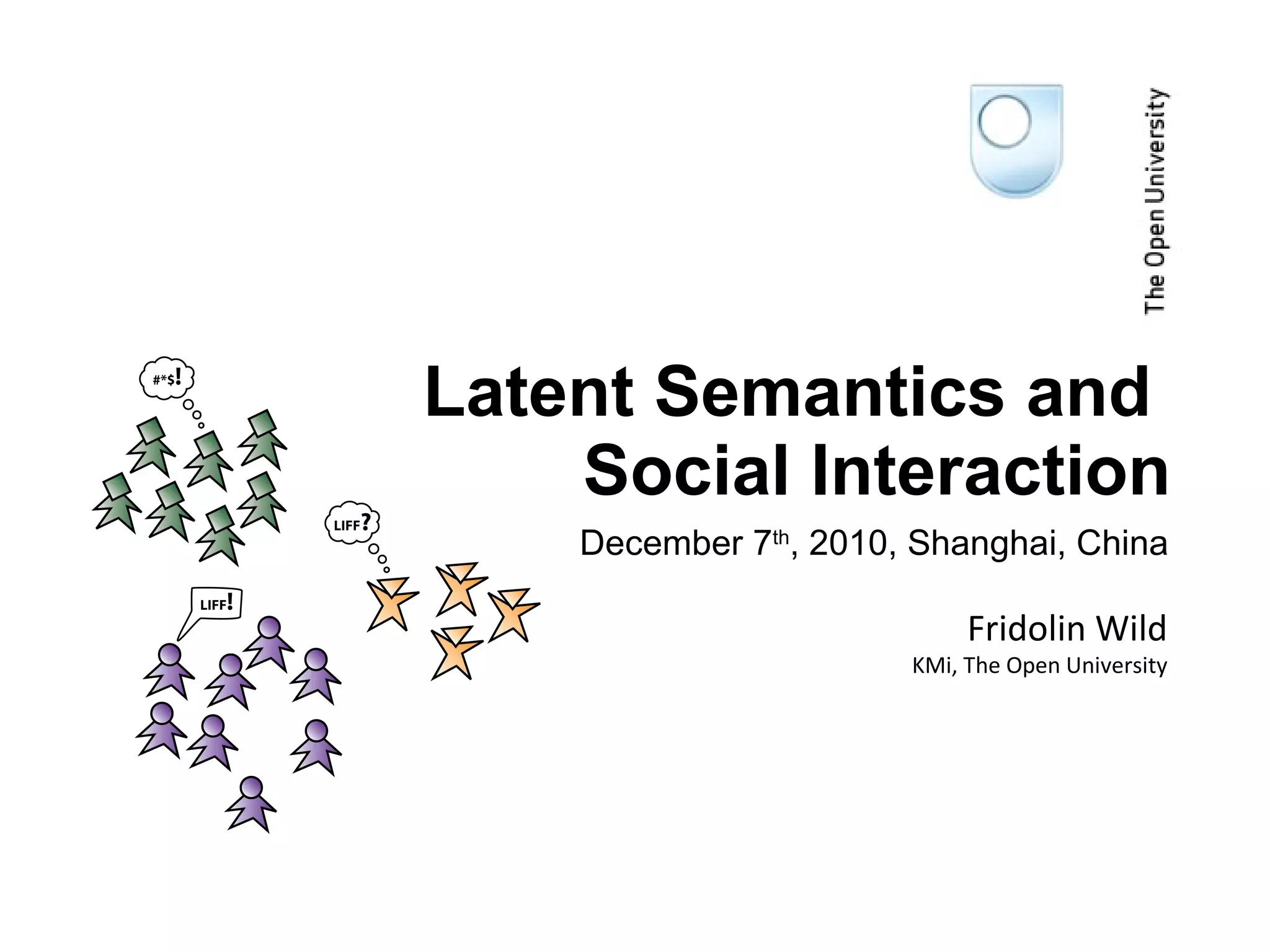

December 7 th , 2010, Shanghai, China Latent Semantics and  Social Interaction Fridolin Wild KMi, The Open University
Outline Context & Framing Theories Latent Semantic Analysis (LSA) (Social) Network Analysis (S/NA) Meaningful Interaction Analysis (MIA) Outlook: Analysing Practices
Context & Theories
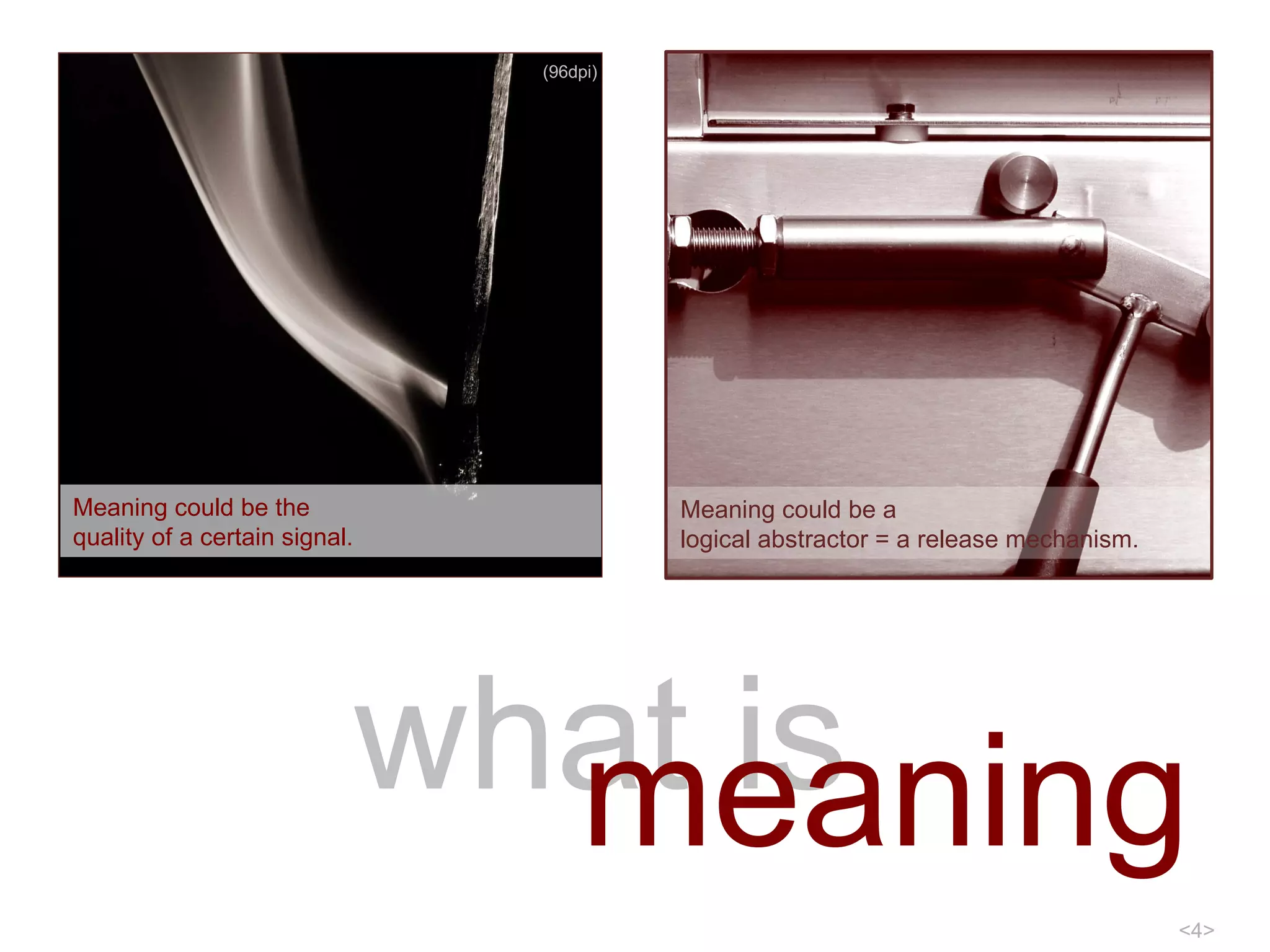
Information what is  Meaning could be the  quality of a certain signal. Meaning could be a  logical abstractor = a release mechanism. (96dpi) meaning
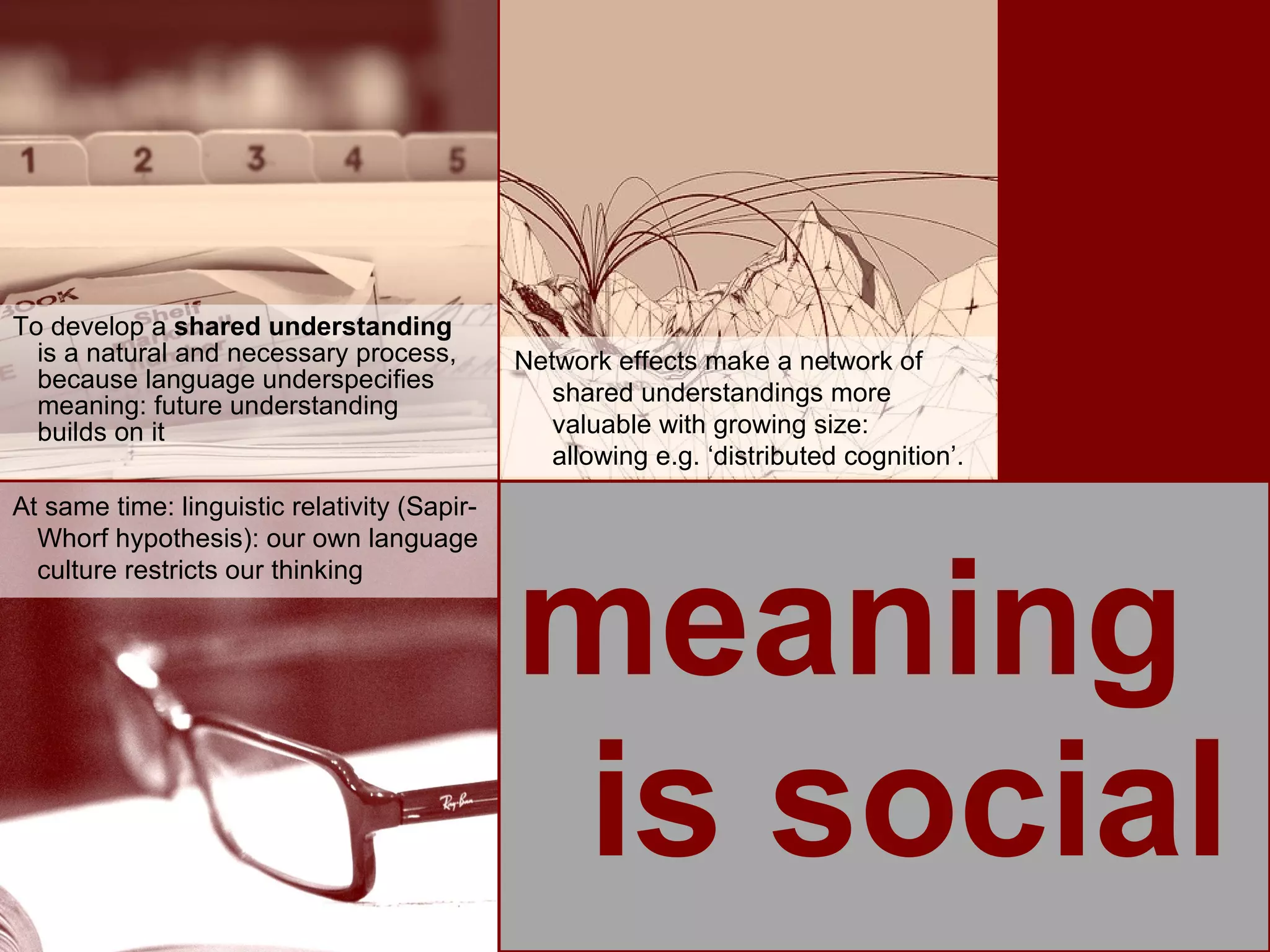
meaning  is social To develop a  shared understanding  is a natural and necessary process, because language underspecifies meaning: future understanding  builds on it Network effects make a network of shared understandings more valuable with growing size:  allowing e.g. ‘distributed cognition’. At same time: linguistic relativity (Sapir-Whorf hypothesis): our own language culture restricts our thinking
 
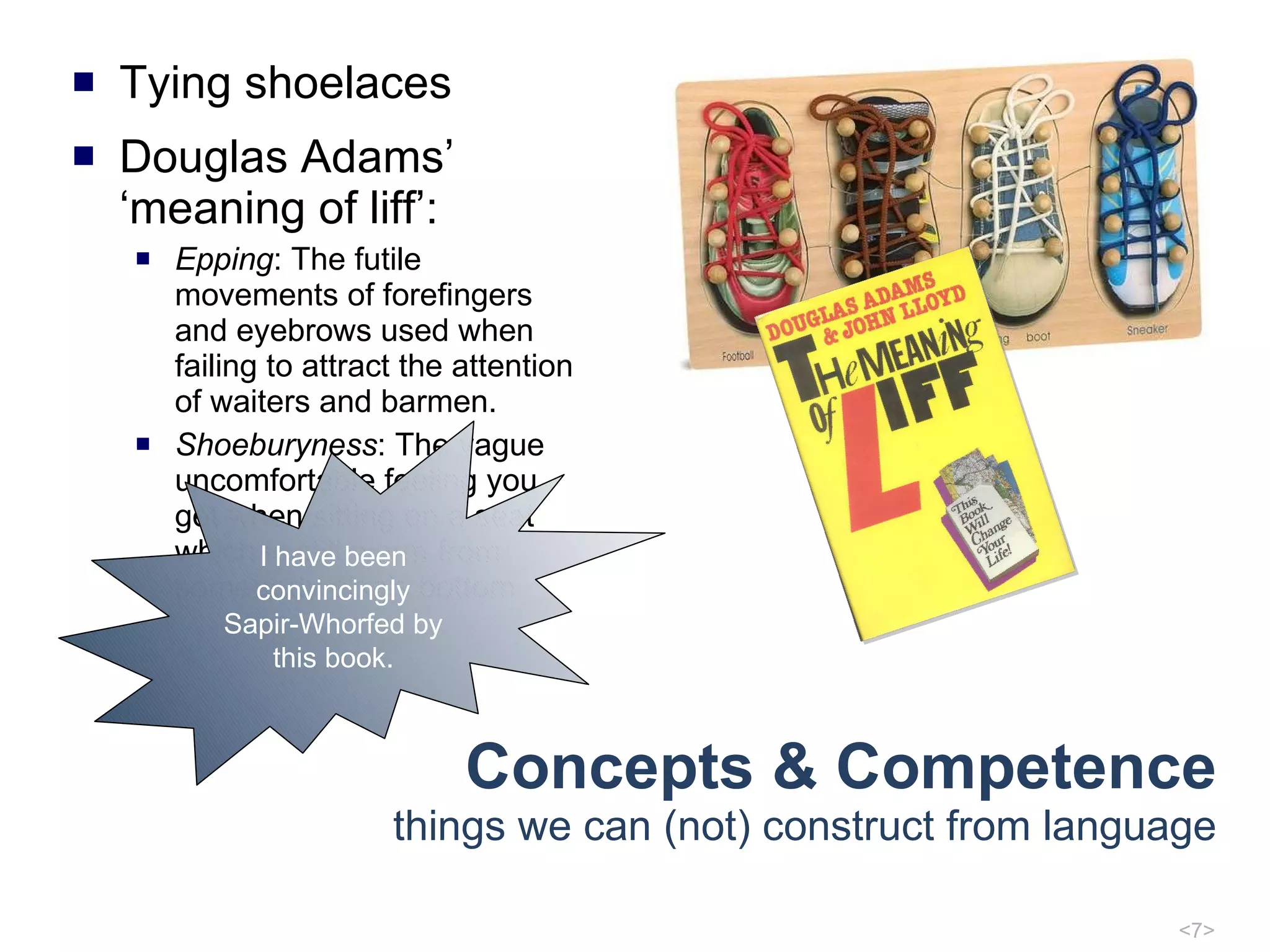
Concepts & Competence things we can (not) construct from language Tying shoelaces Douglas Adams’ ‘meaning of liff’: Epping : The futile movements of forefingers and eyebrows used when failing to attract the attention of waiters and barmen. Shoeburyness : The vague uncomfortable feeling you get when sitting on a seat which is still warm from somebody else's bottom I have been convincingly Sapir-Whorfed by this book.
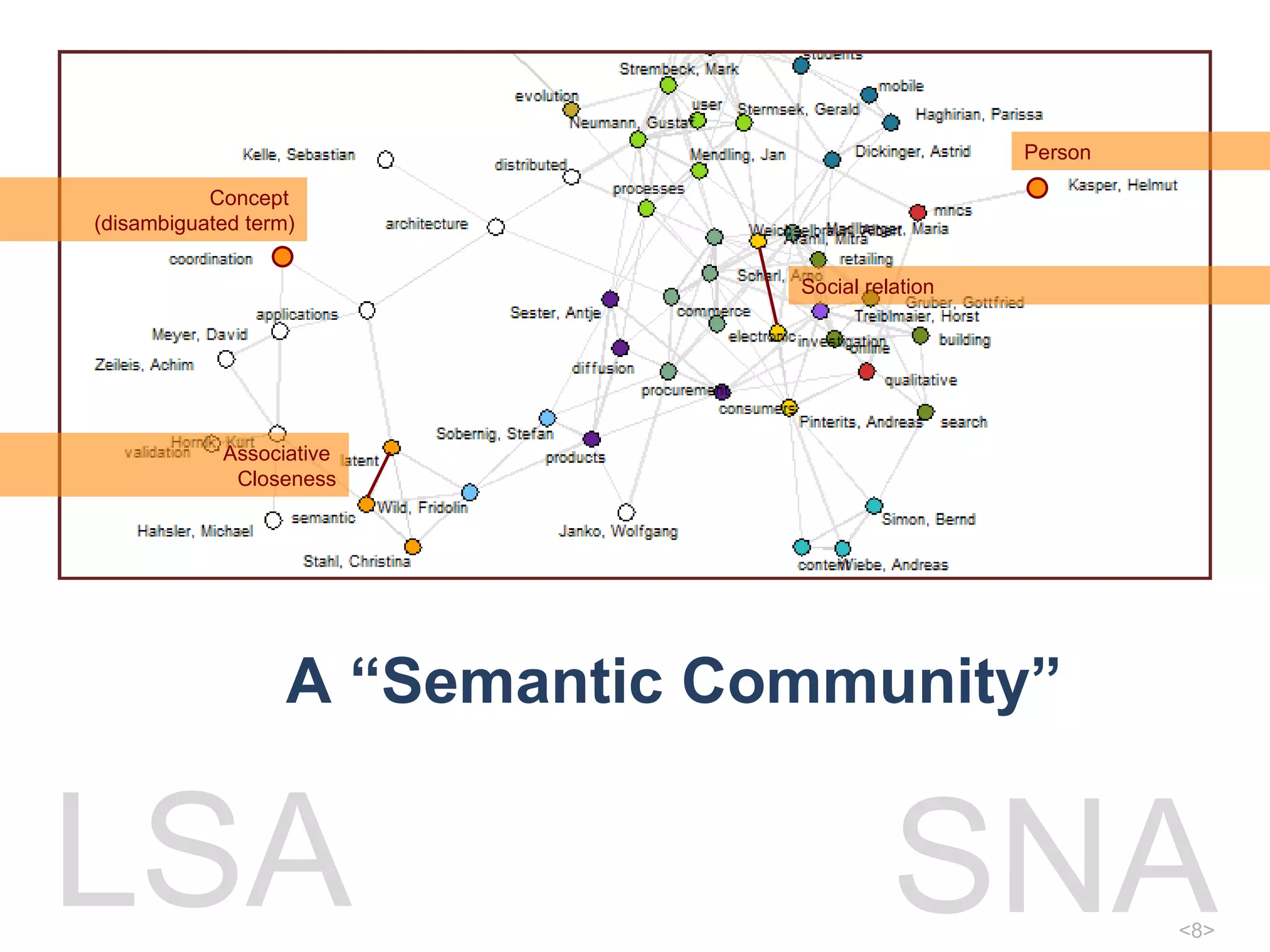
A “Semantic Community” LSA SNA Associative  Closeness Concept  (disambiguated term) Person Social relation
LSA
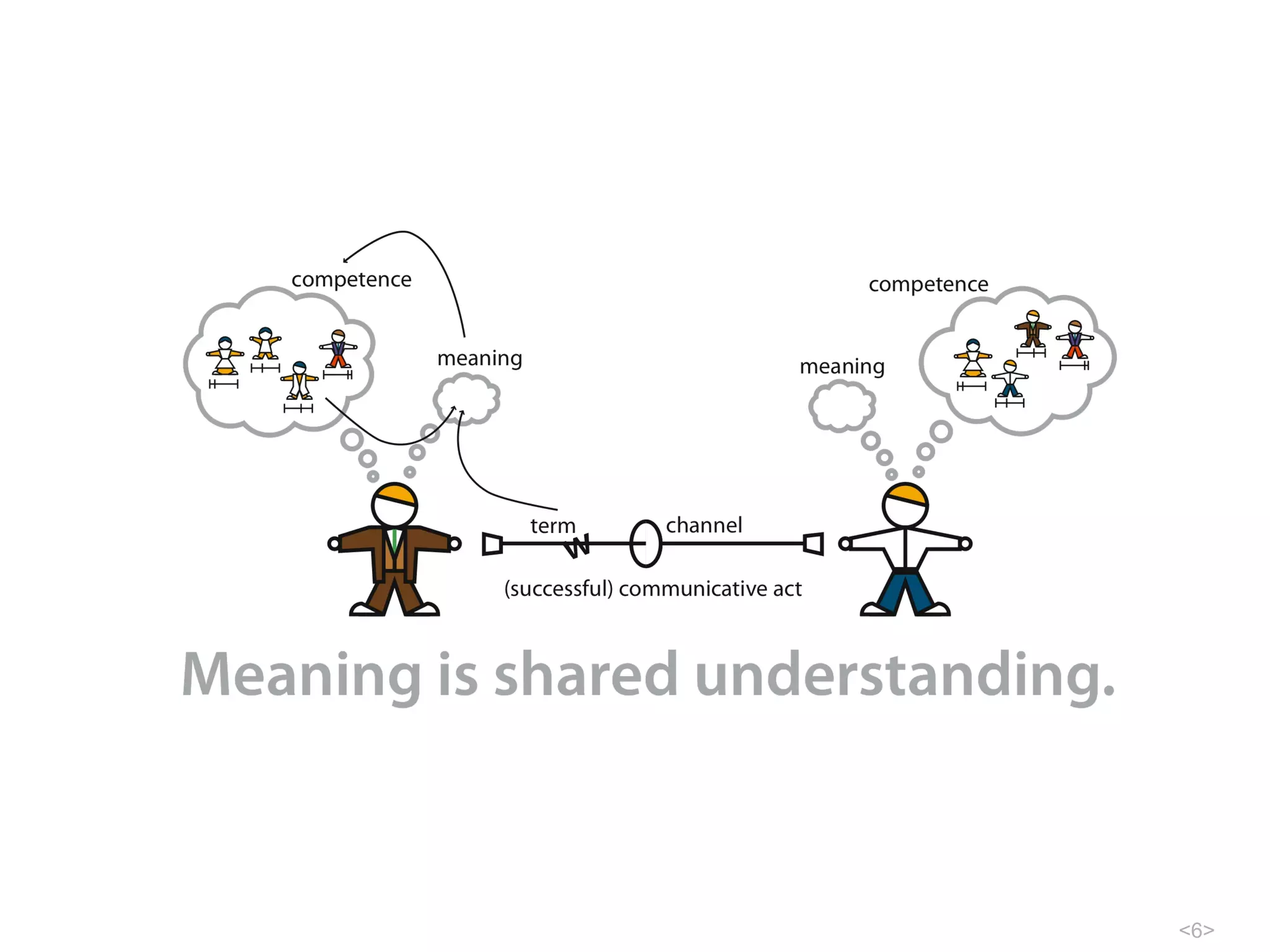
Latent Semantic Analysis Two-Mode factor analysis of the co-occurrences in the  terminology Results in a latent-semantic vector space “ Humans learn word meanings and how to combine them into passage meaning through experience with ~paragraph unitized verbal environments.”  “ They don’t remember all the separate words of a passage; they remember  its overall gist or meaning.”  “ LSA learns by ‘reading’ ~paragraph unitized texts that represent the environment.” “ It doesn’t remember all the separate words of a text it; it remembers  its overall gist or meaning.” -- Landauer, 2007
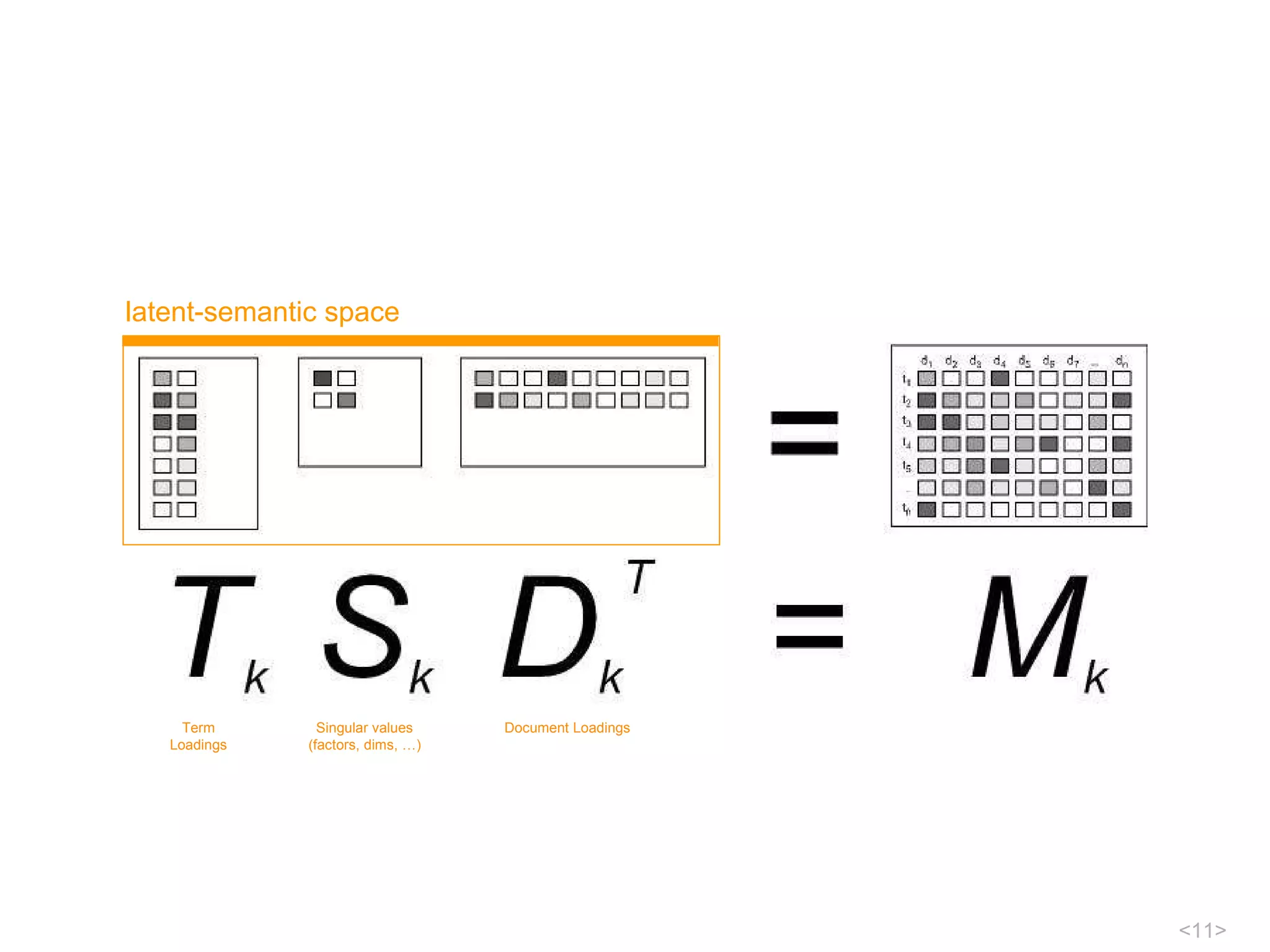
latent-semantic space Singular values (factors, dims, …) Term Loadings Document Loadings
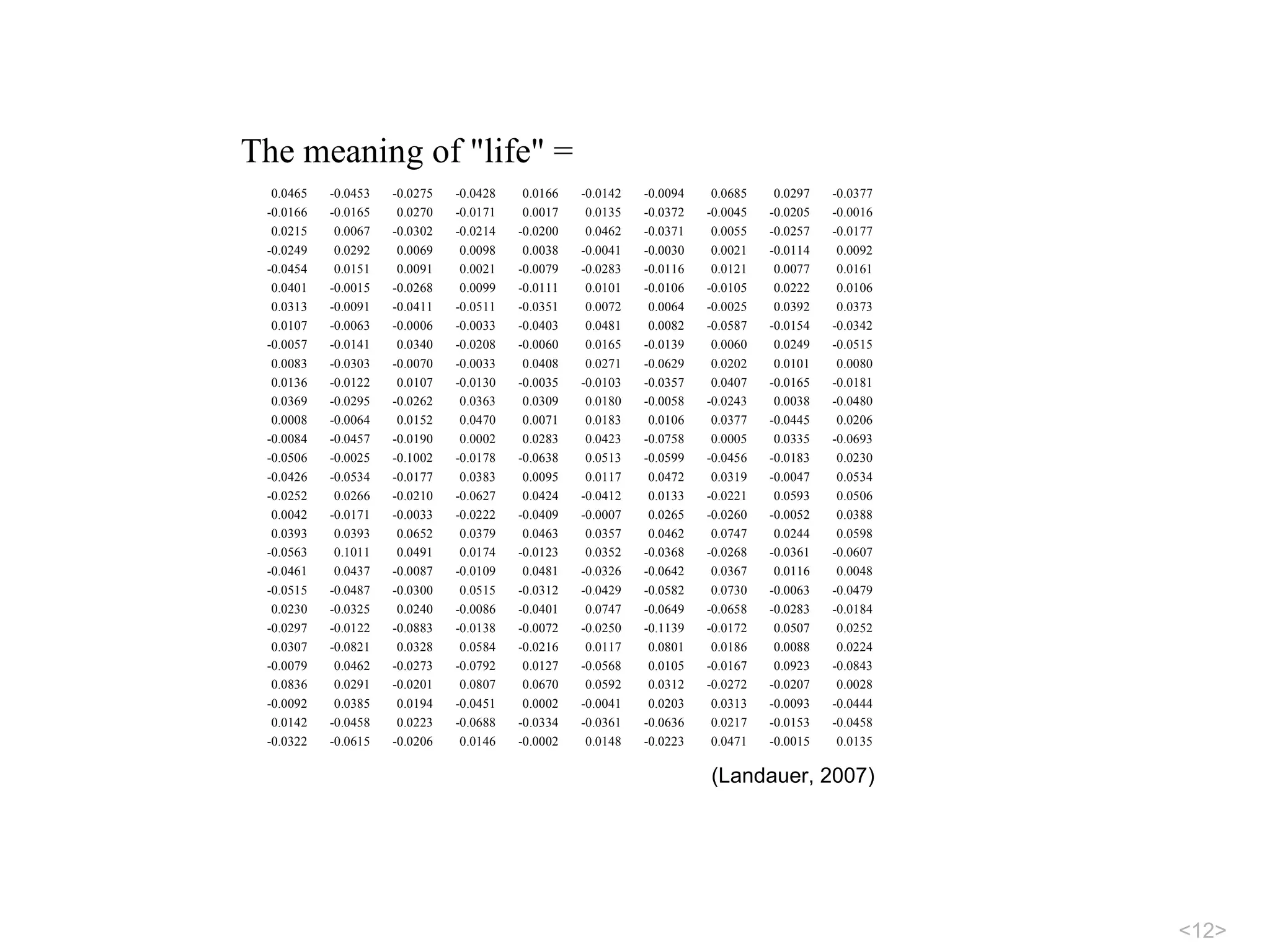
(Landauer, 2007)
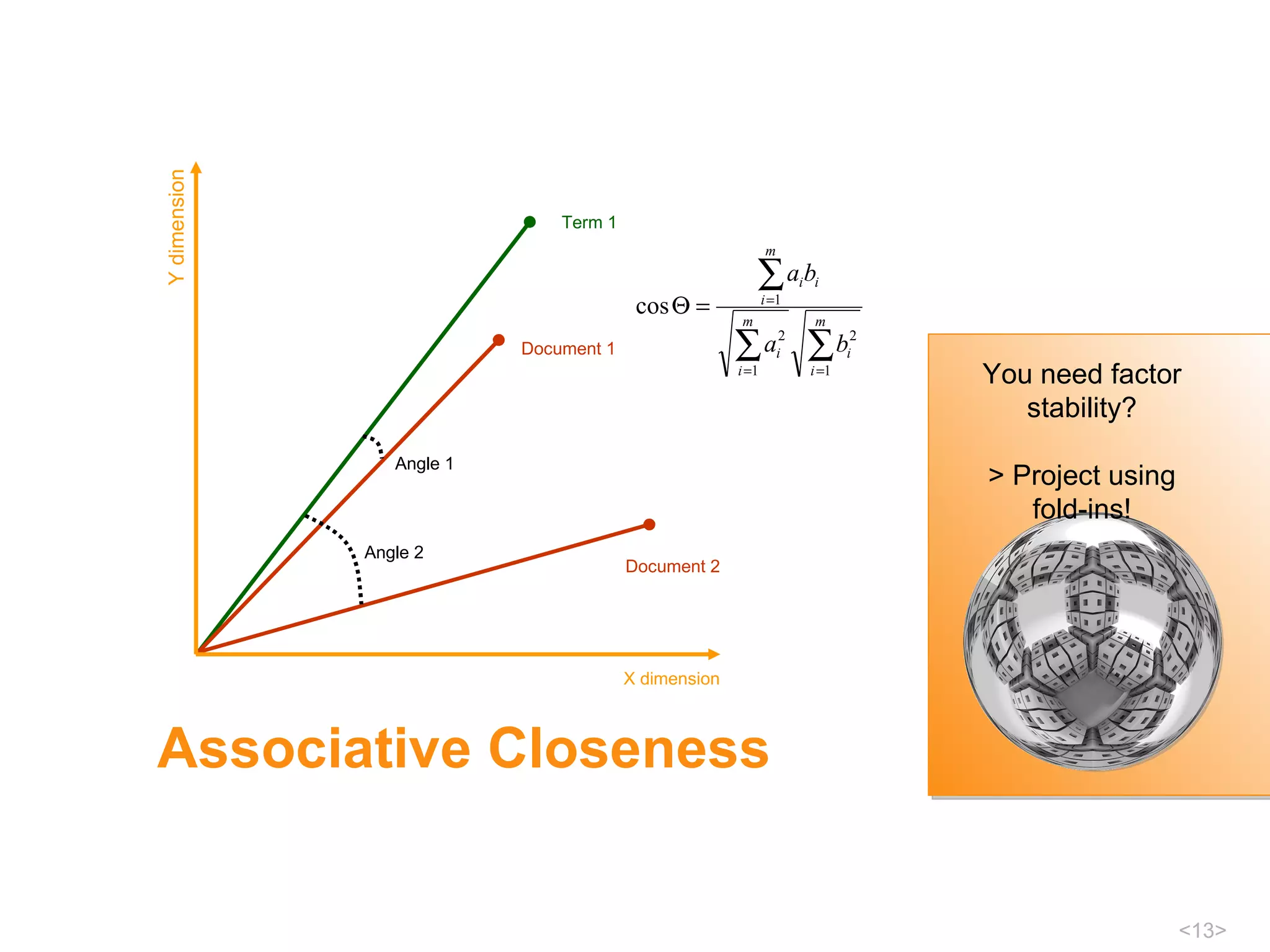
Associative Closeness You need factor stability? > Project using fold-ins! Term 1 Document 1 Document 2 Angle 2 Angle 1 Y dimension X dimension
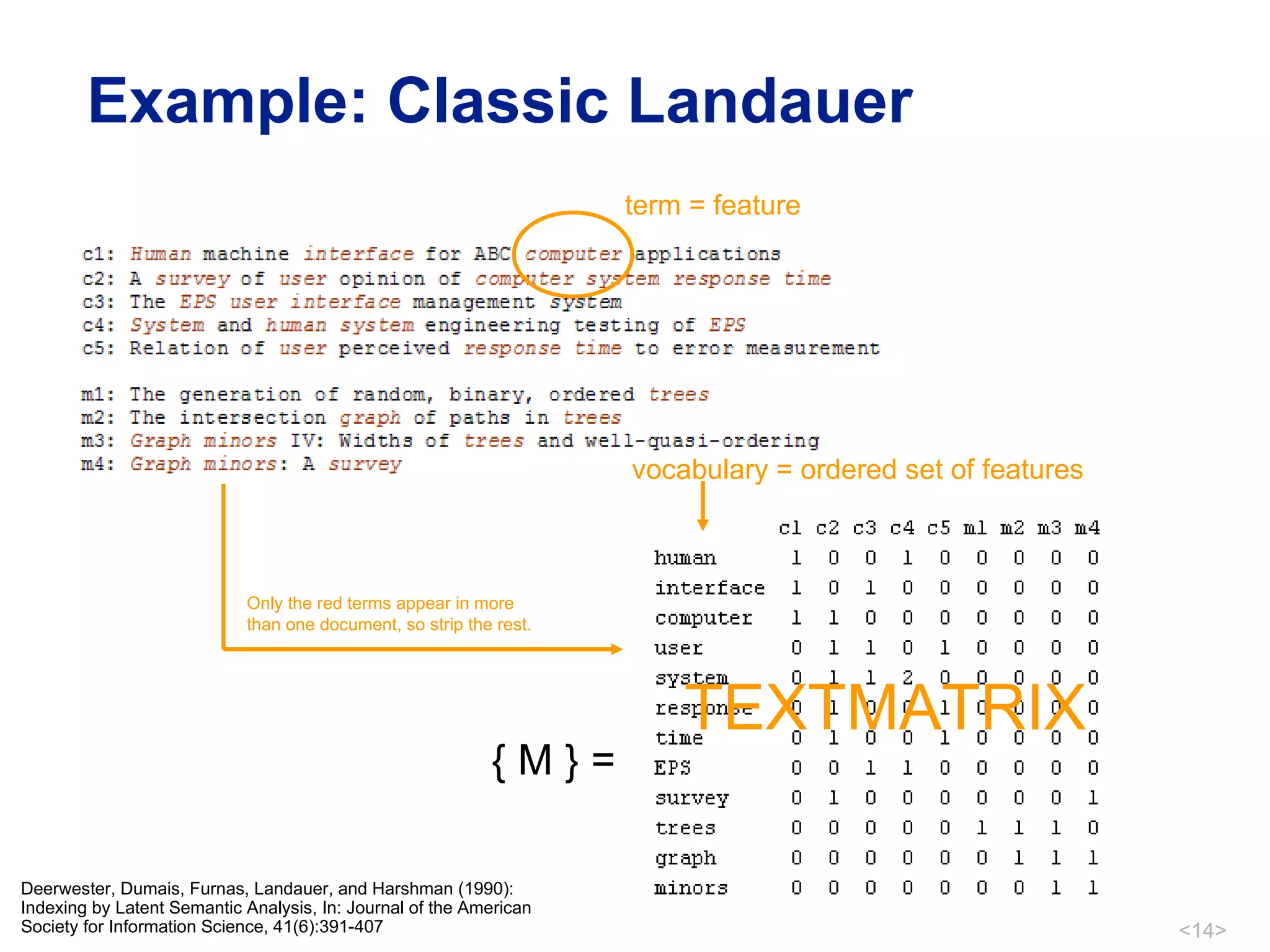
Example: Classic Landauer { M } =  Deerwester, Dumais, Furnas, Landauer, and Harshman (1990):  Indexing by Latent Semantic Analysis, In: Journal of the American  Society for Information Science, 41(6):391-407 Only the red terms appear in more  than one document, so strip the rest. term = feature vocabulary = ordered set of features TEXTMATRIX
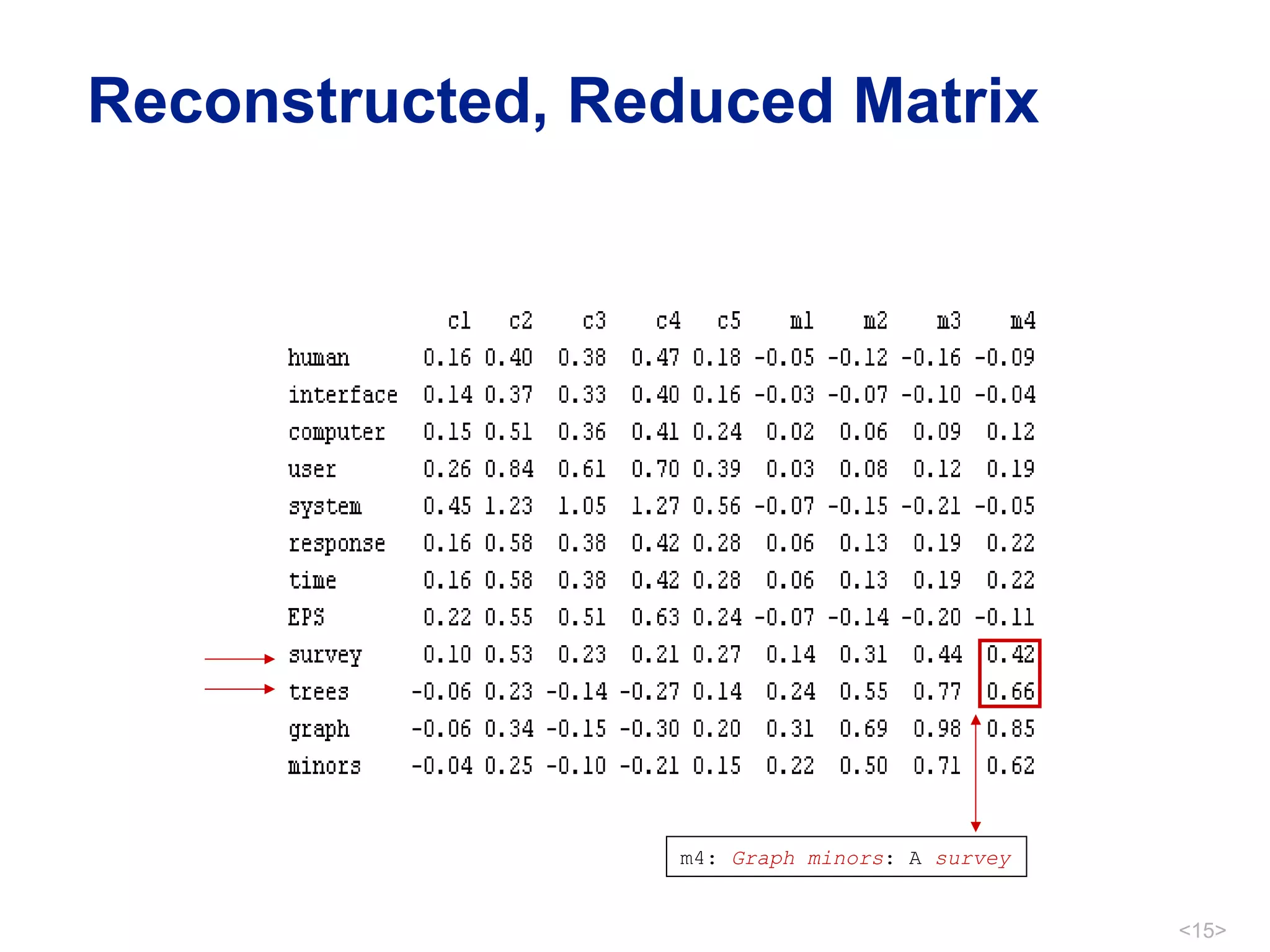
Reconstructed, Reduced Matrix m4:  Graph   minors : A  survey
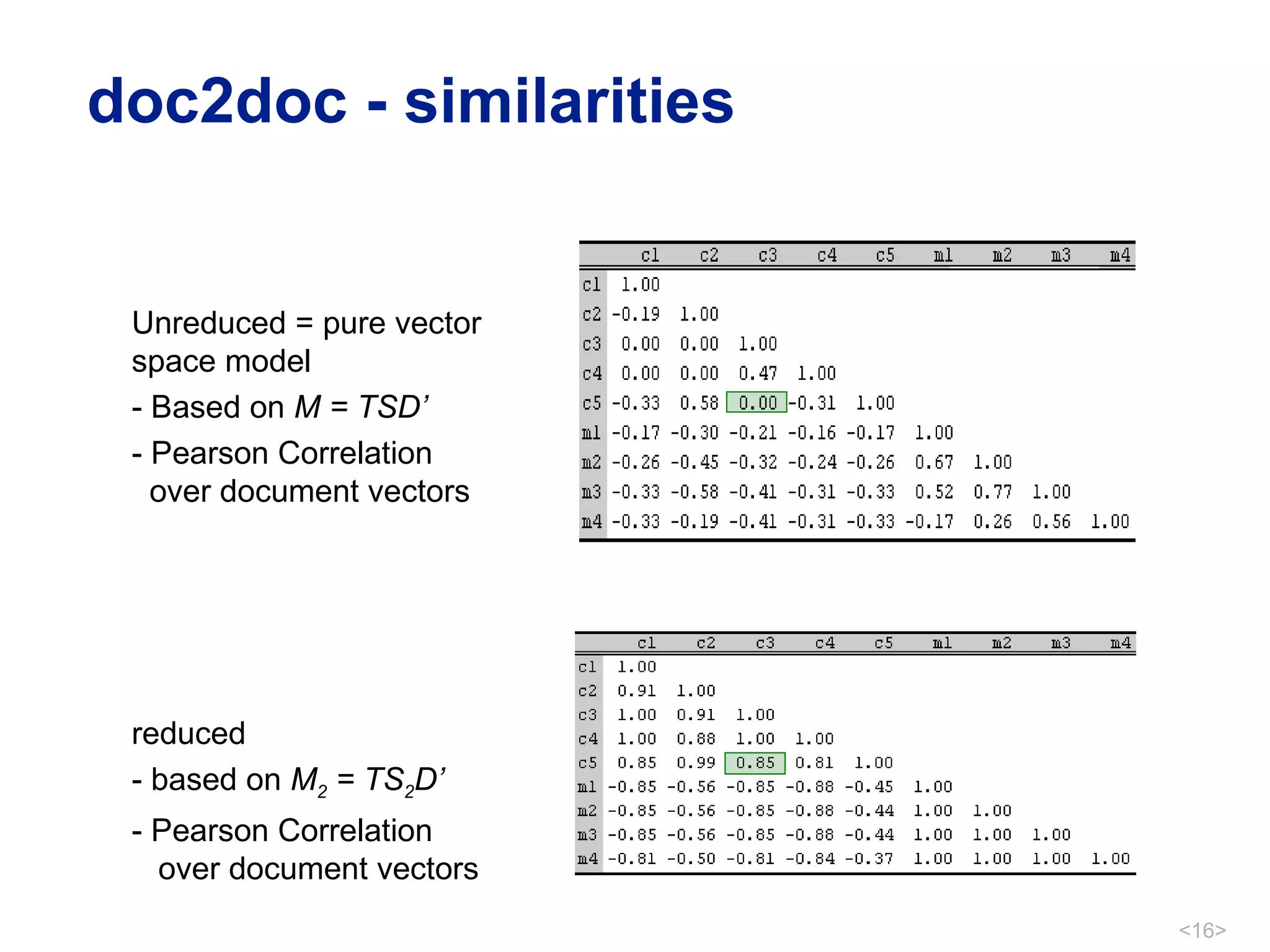
doc2doc - similarities Unreduced = pure vector space model - Based on  M = TSD’ - Pearson Correlation   over document vectors reduced - based on  M 2  = TS 2 D’ - Pearson Correlation    over document vectors
(S)NA
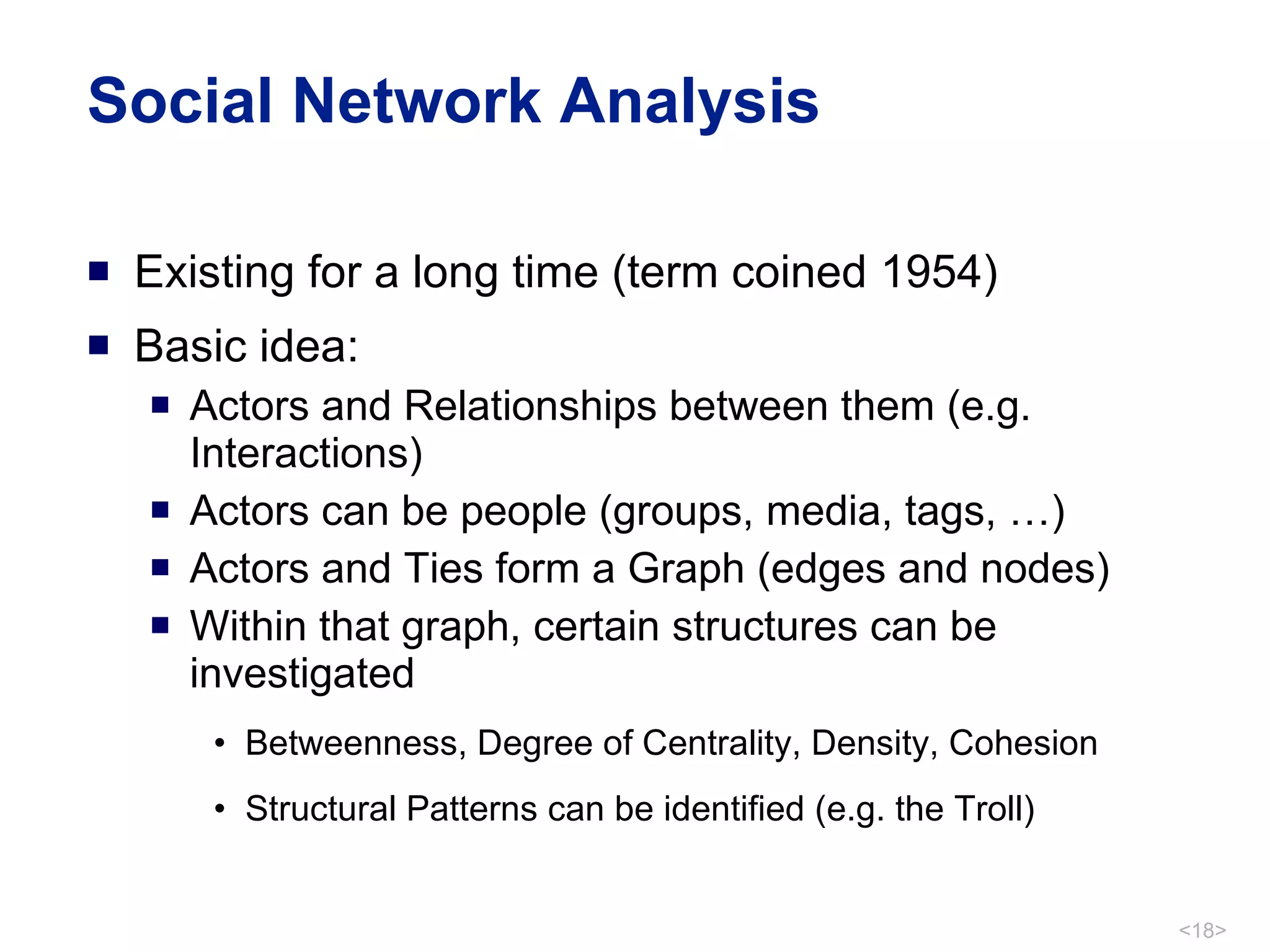
Social Network Analysis Existing for a long time (term coined 1954) Basic idea: Actors and Relationships between them (e.g. Interactions) Actors can be people (groups, media, tags, …) Actors and Ties form a Graph (edges and nodes) Within that graph, certain structures can be investigated  Betweenness, Degree of Centrality, Density, Cohesion Structural Patterns can be identified (e.g. the Troll)
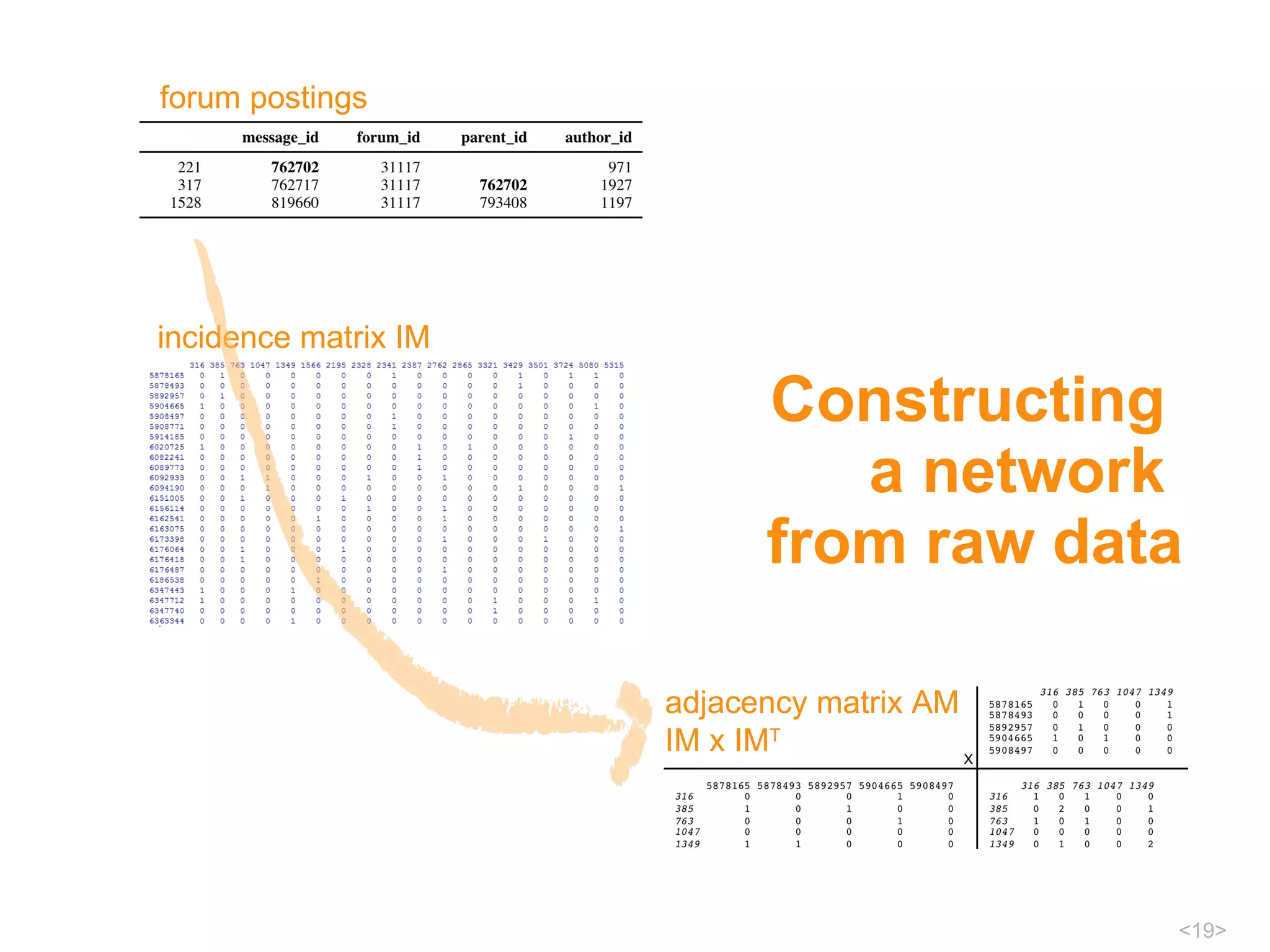
Constructing  a network  from raw data forum postings incidence matrix IM adjacency matrix AM IM x  IM T
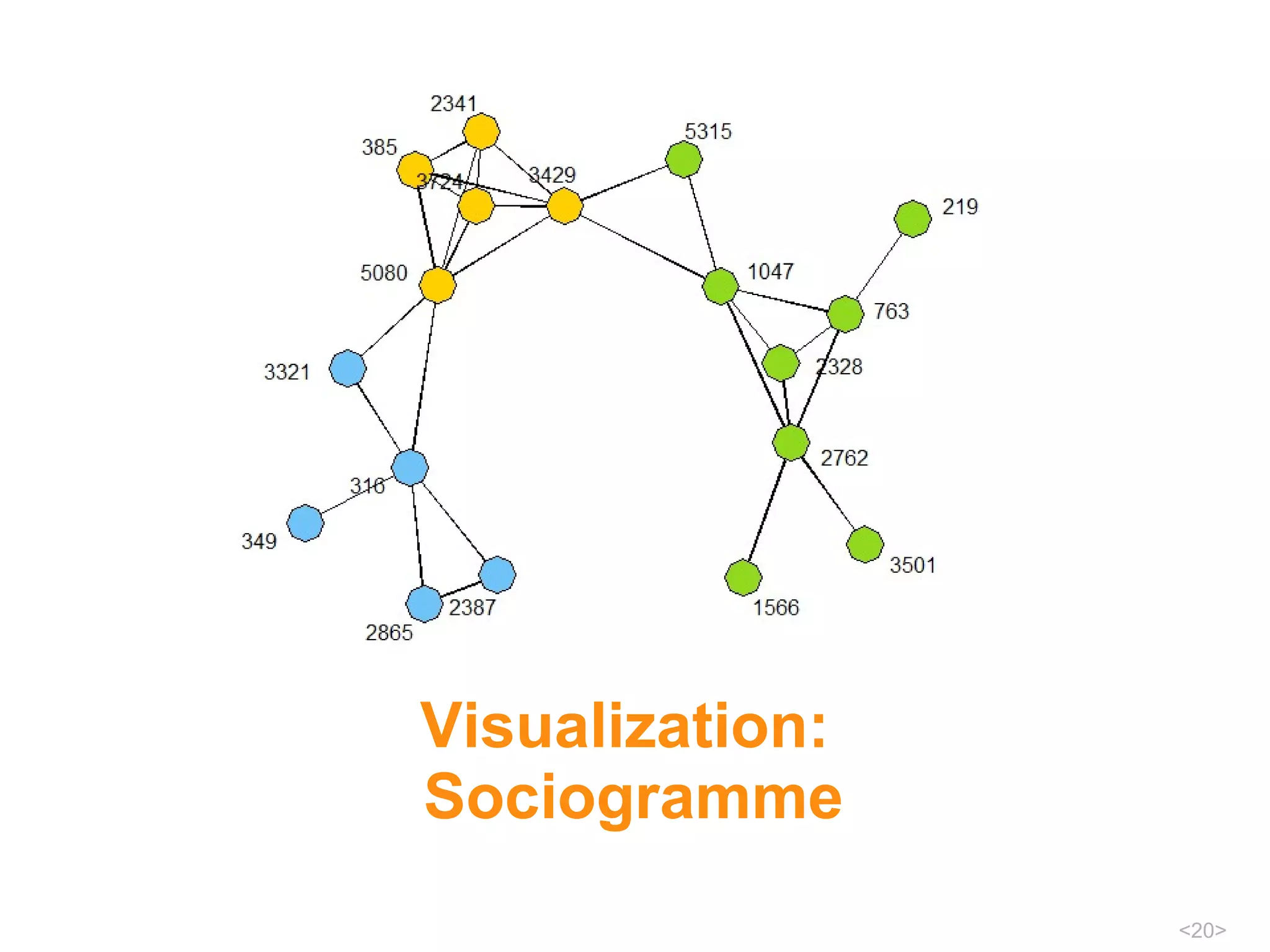
Visualization:  Sociogramme
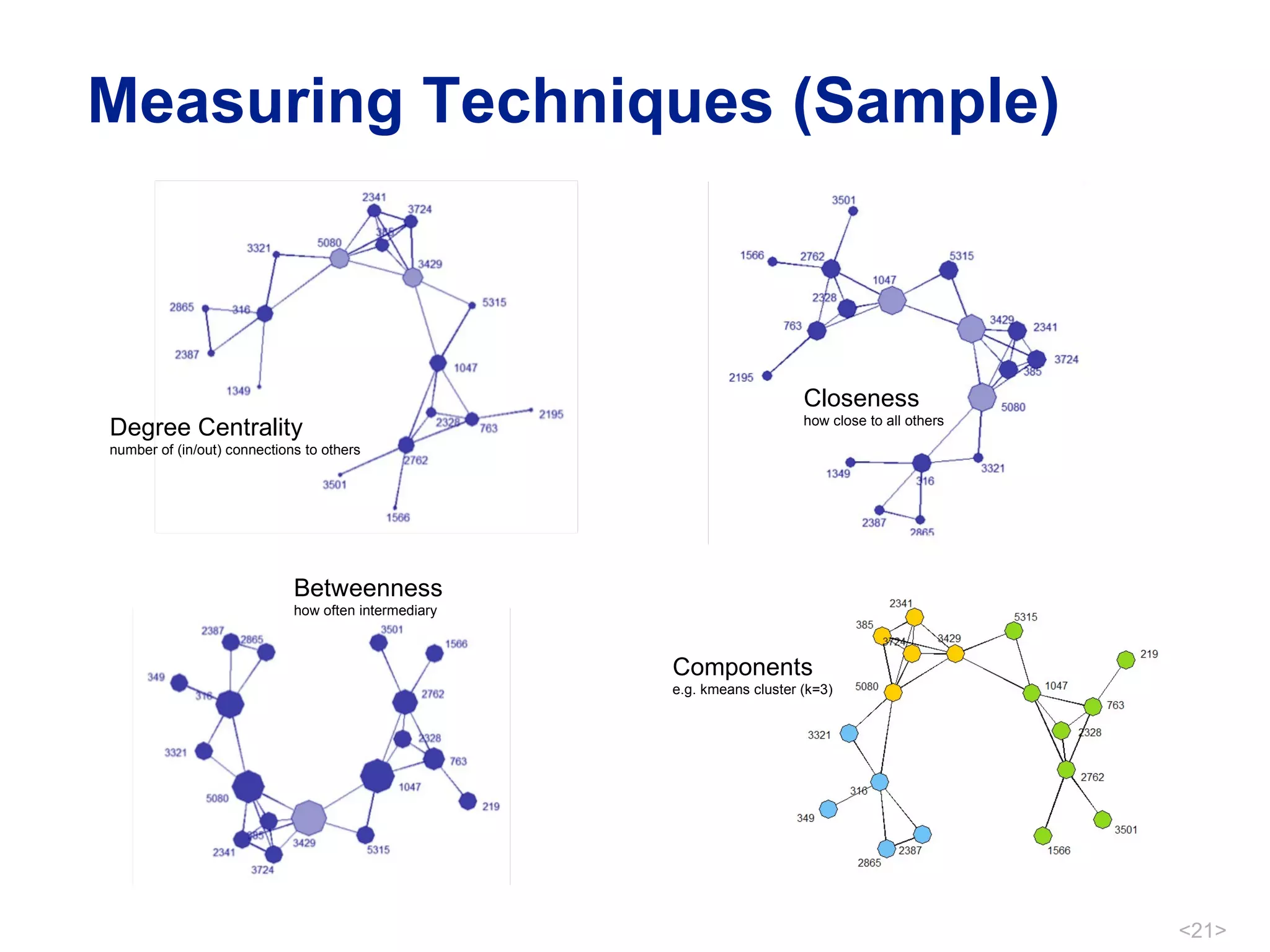
Measuring Techniques (Sample) Degree Centrality number of (in/out) connections to others Closeness how close to all others Betweenness how often intermediary Components e.g. kmeans cluster (k=3)
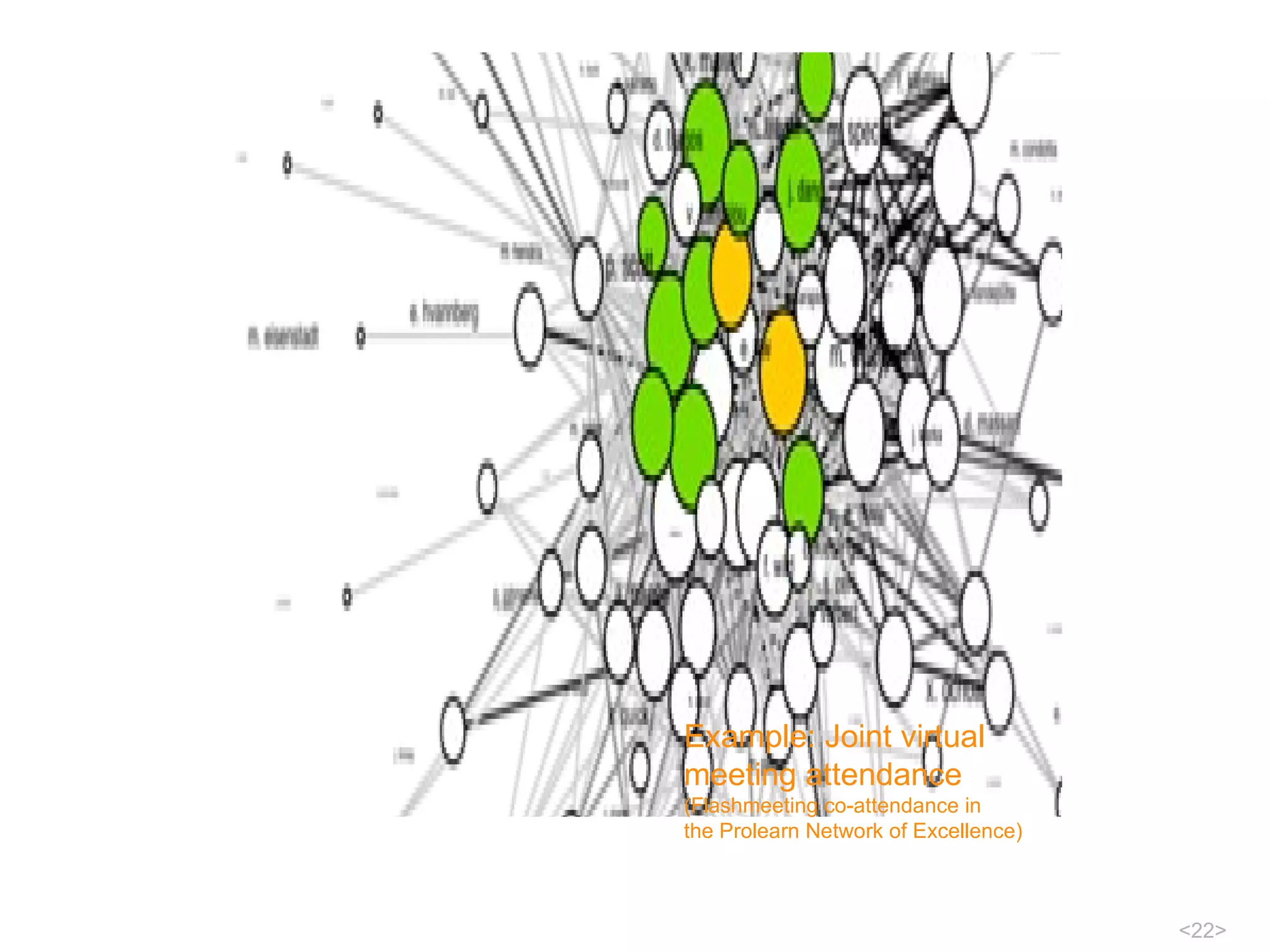
Example: Joint virtual  meeting attendance (Flashmeeting co-attendance in  the Prolearn Network of Excellence)
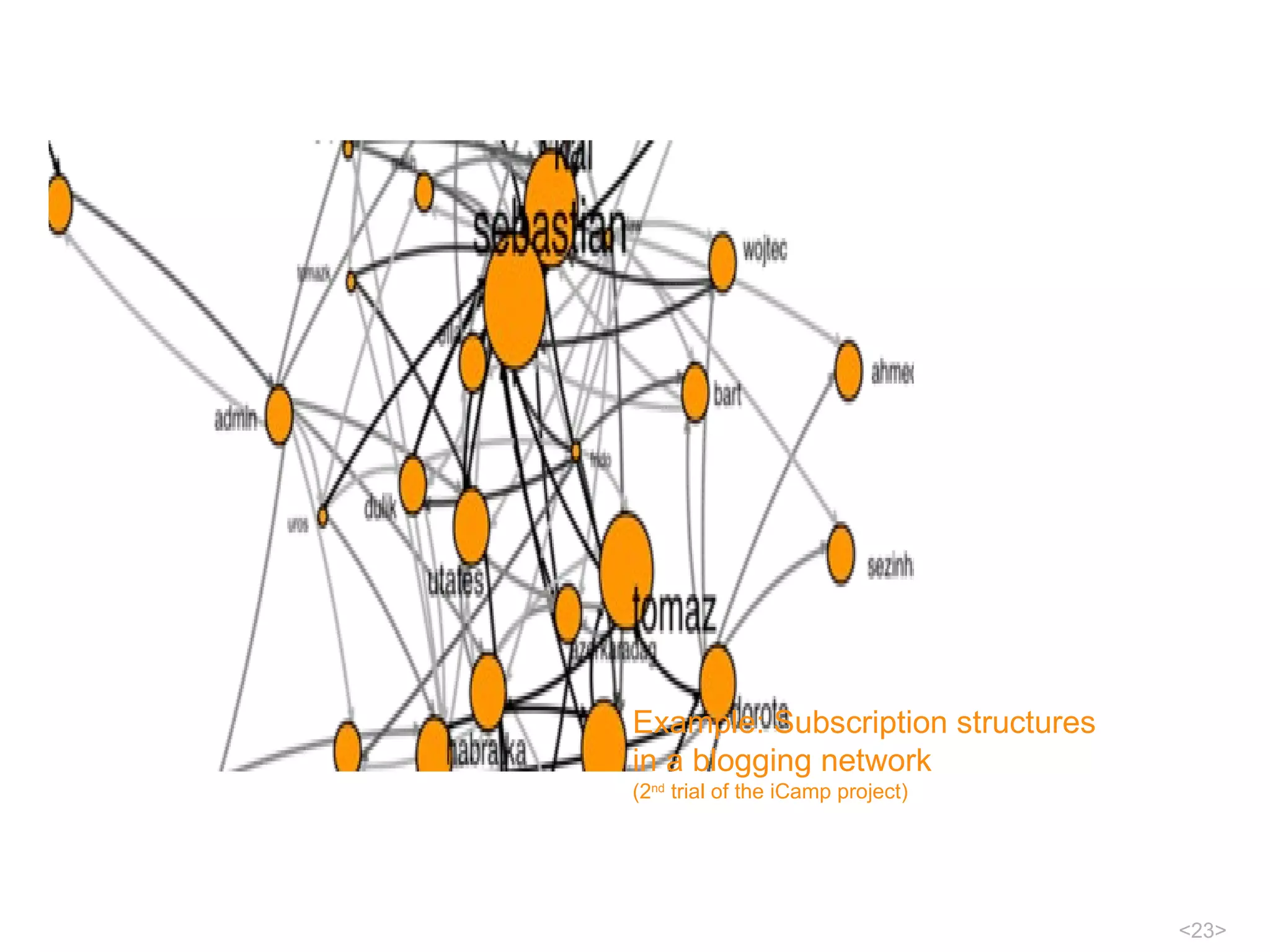
Example: Subscription structures  in a blogging network  (2 nd  trial of the iCamp project)
MIA
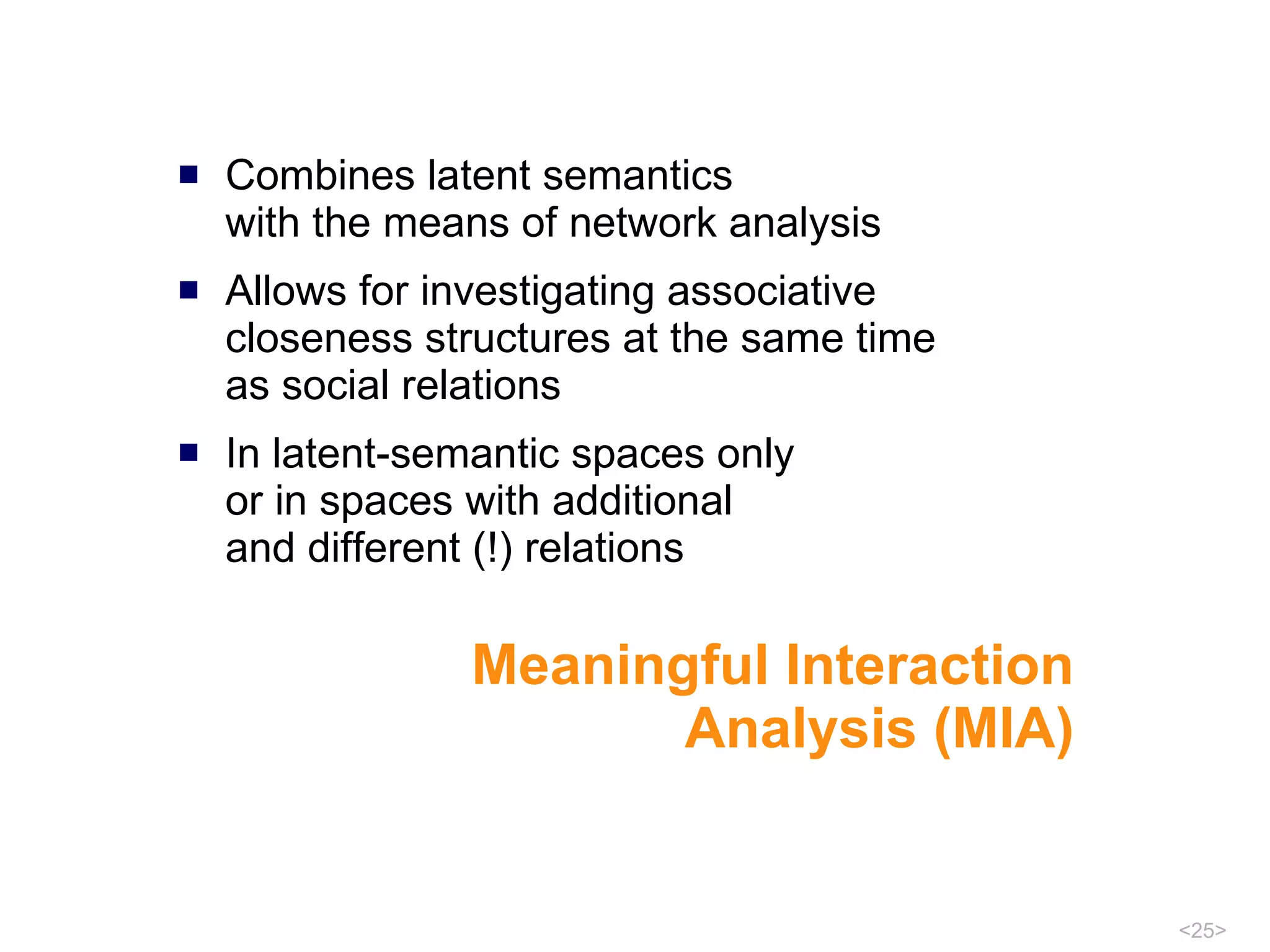
Meaningful Interaction Analysis (MIA) Combines latent semantics  with the means of network analysis Allows for investigating associative closeness structures at the same time  as social relations  In latent-semantic spaces only or in spaces with additional  and different (!) relations
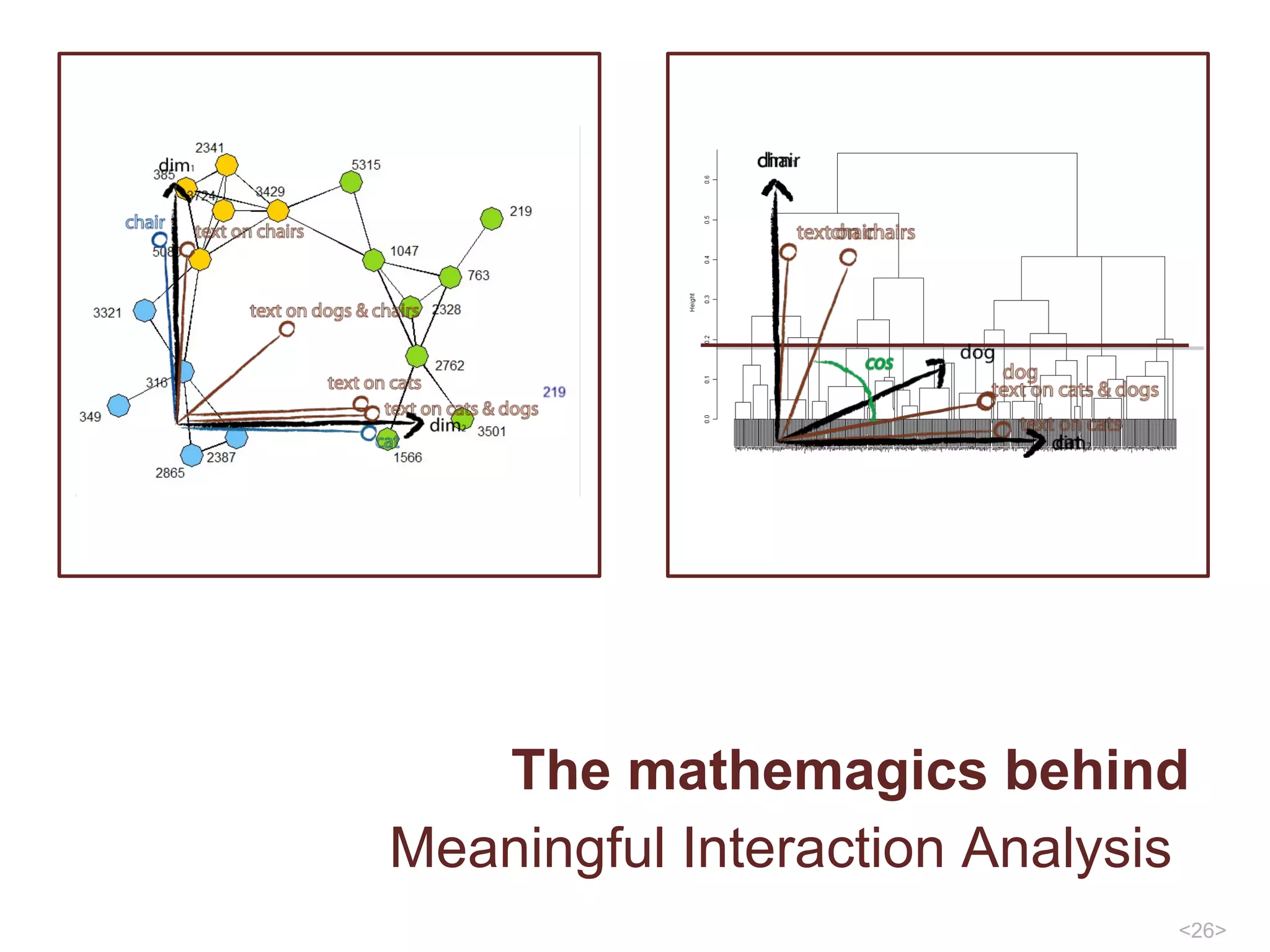
The mathemagics behind Meaningful Interaction Analysis
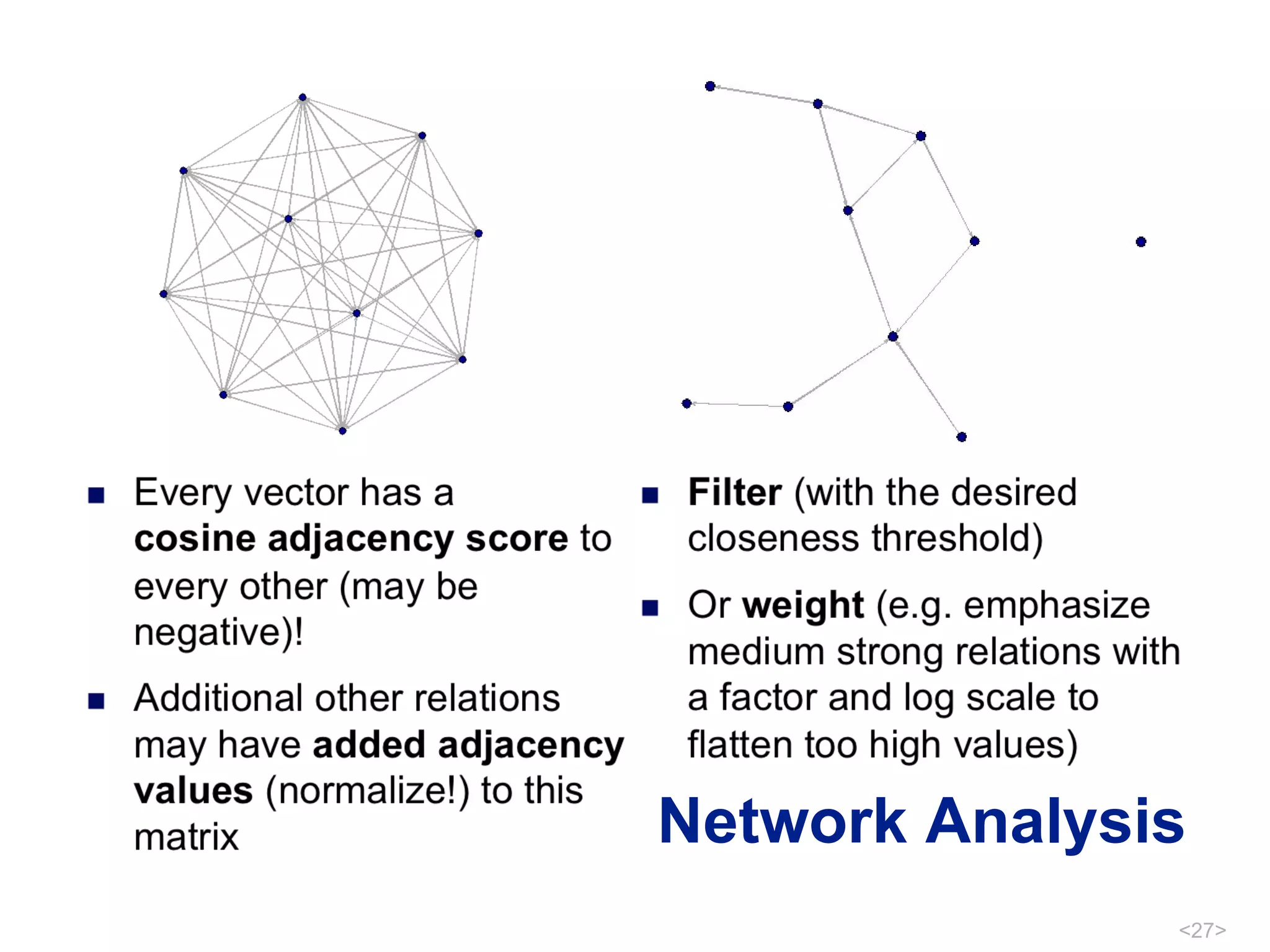
Network Analysis
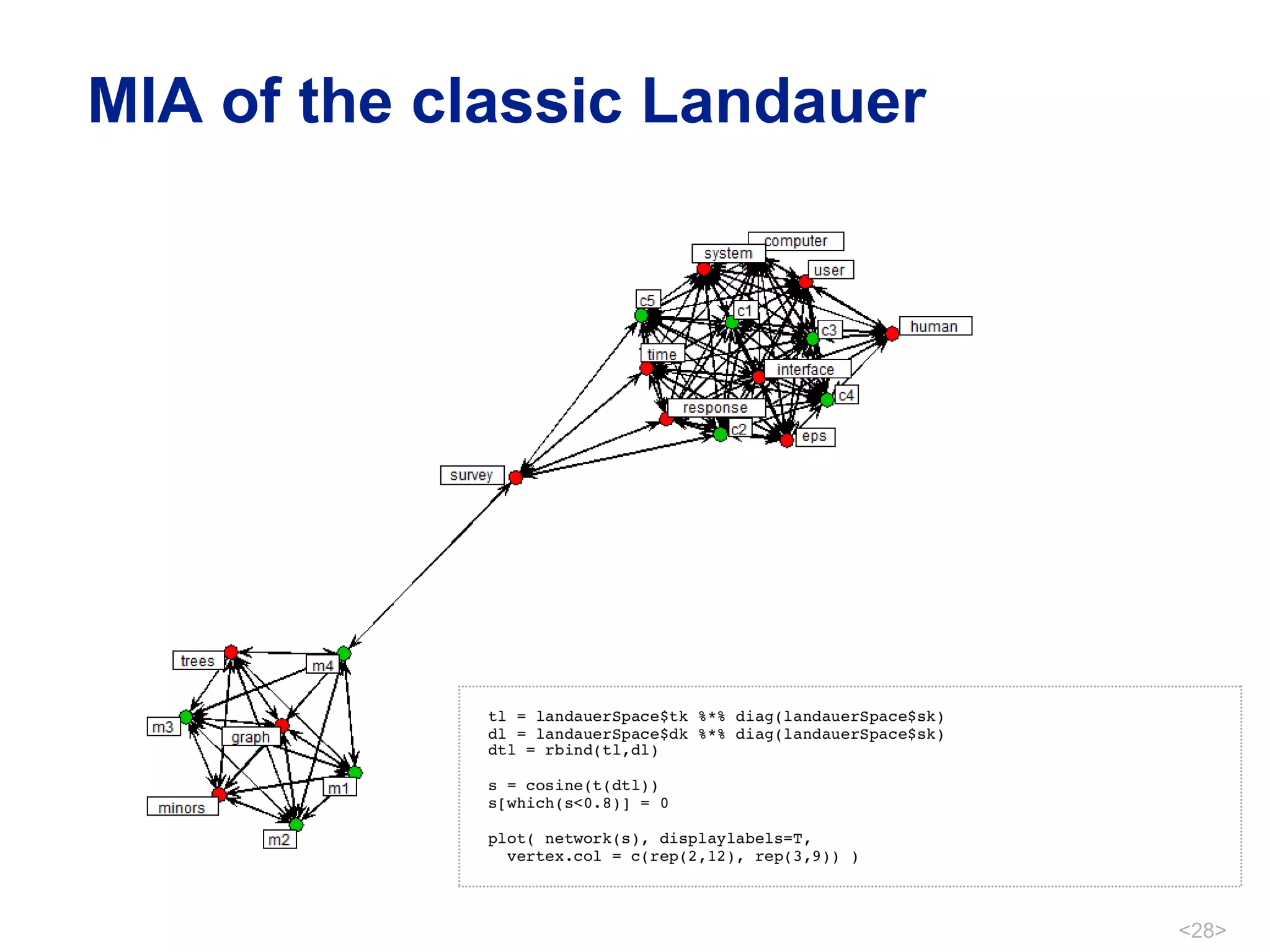
MIA of the classic Landauer


Applications
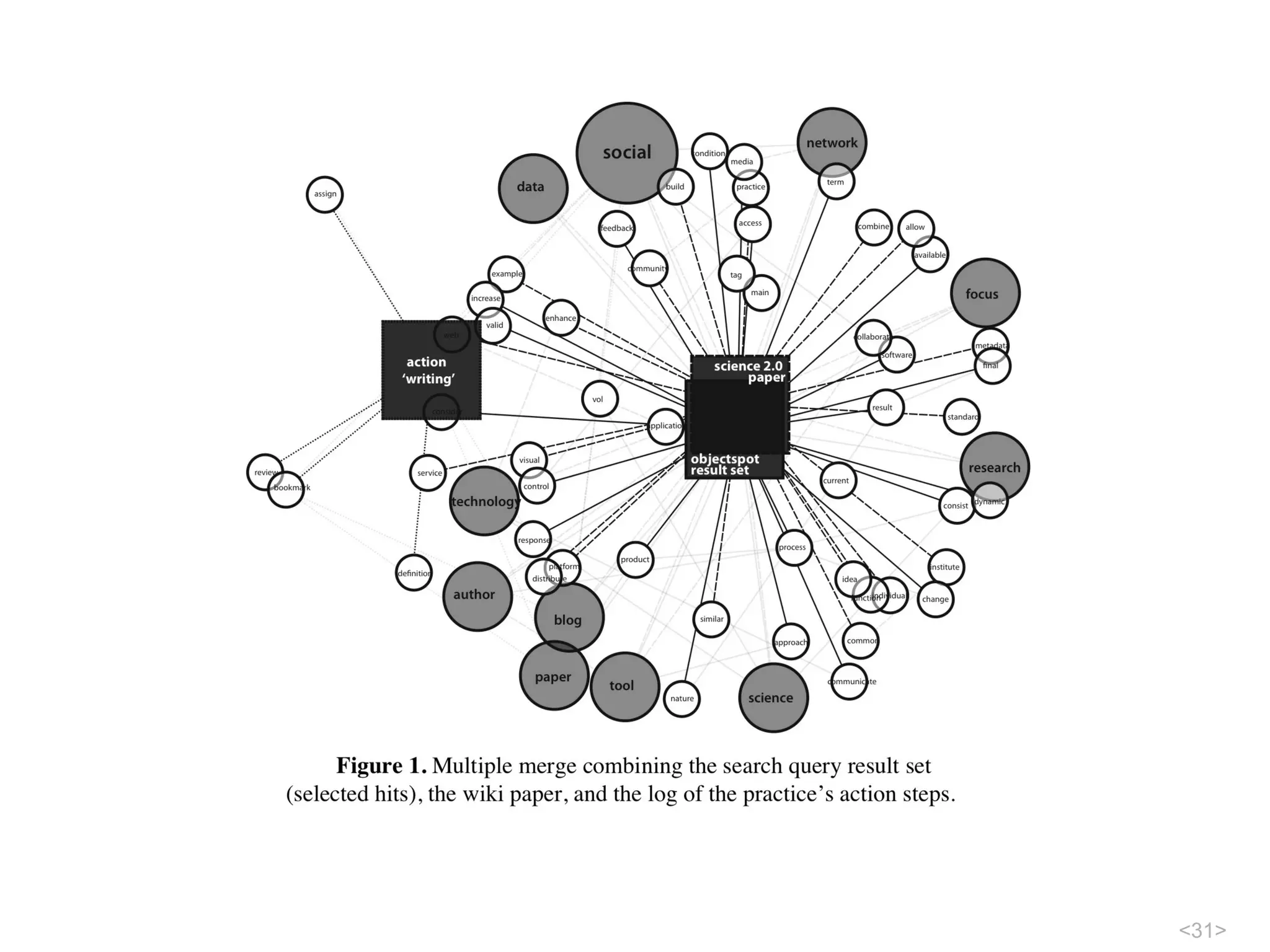
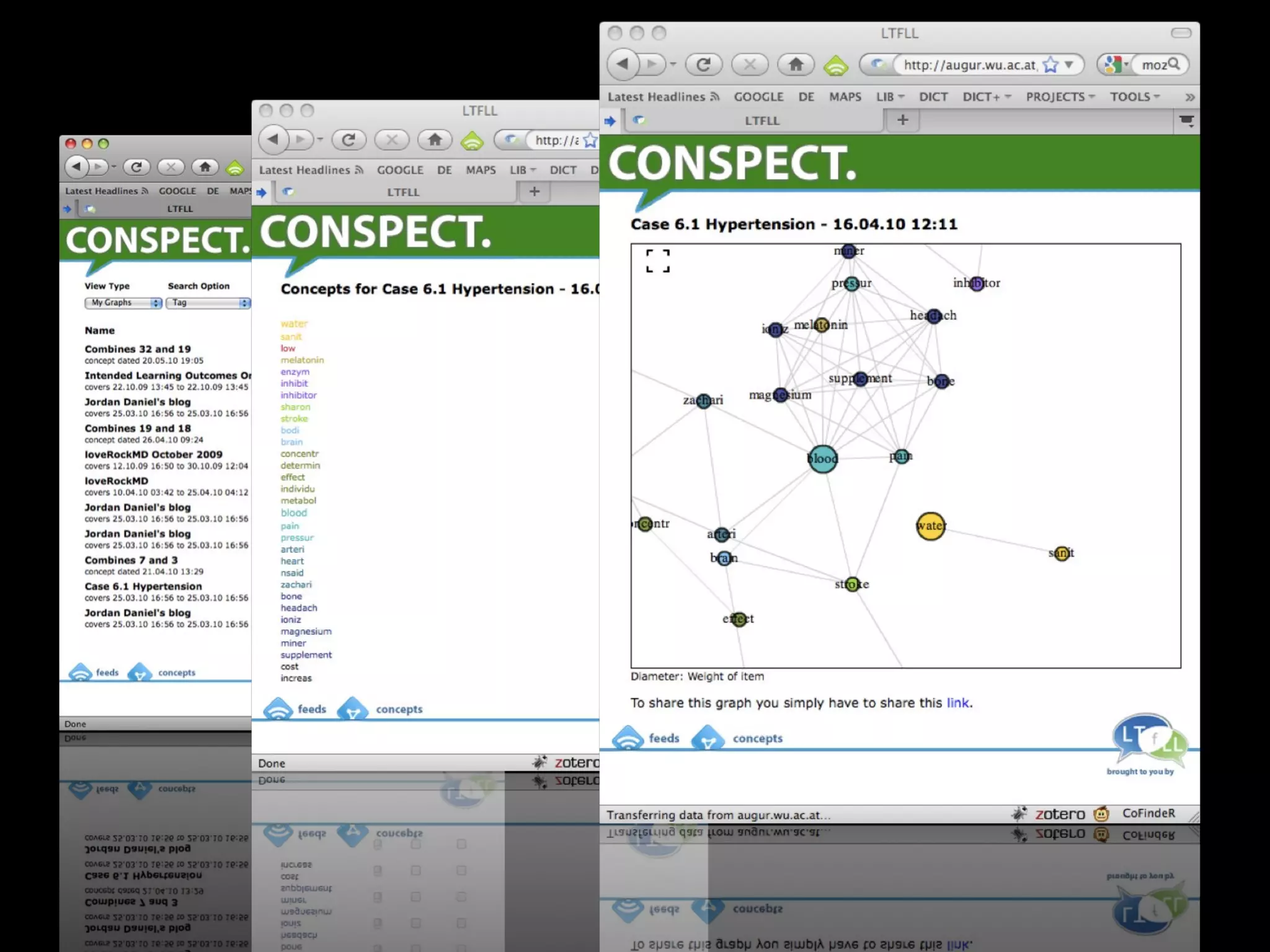
Capturing traces in text: medical student case report
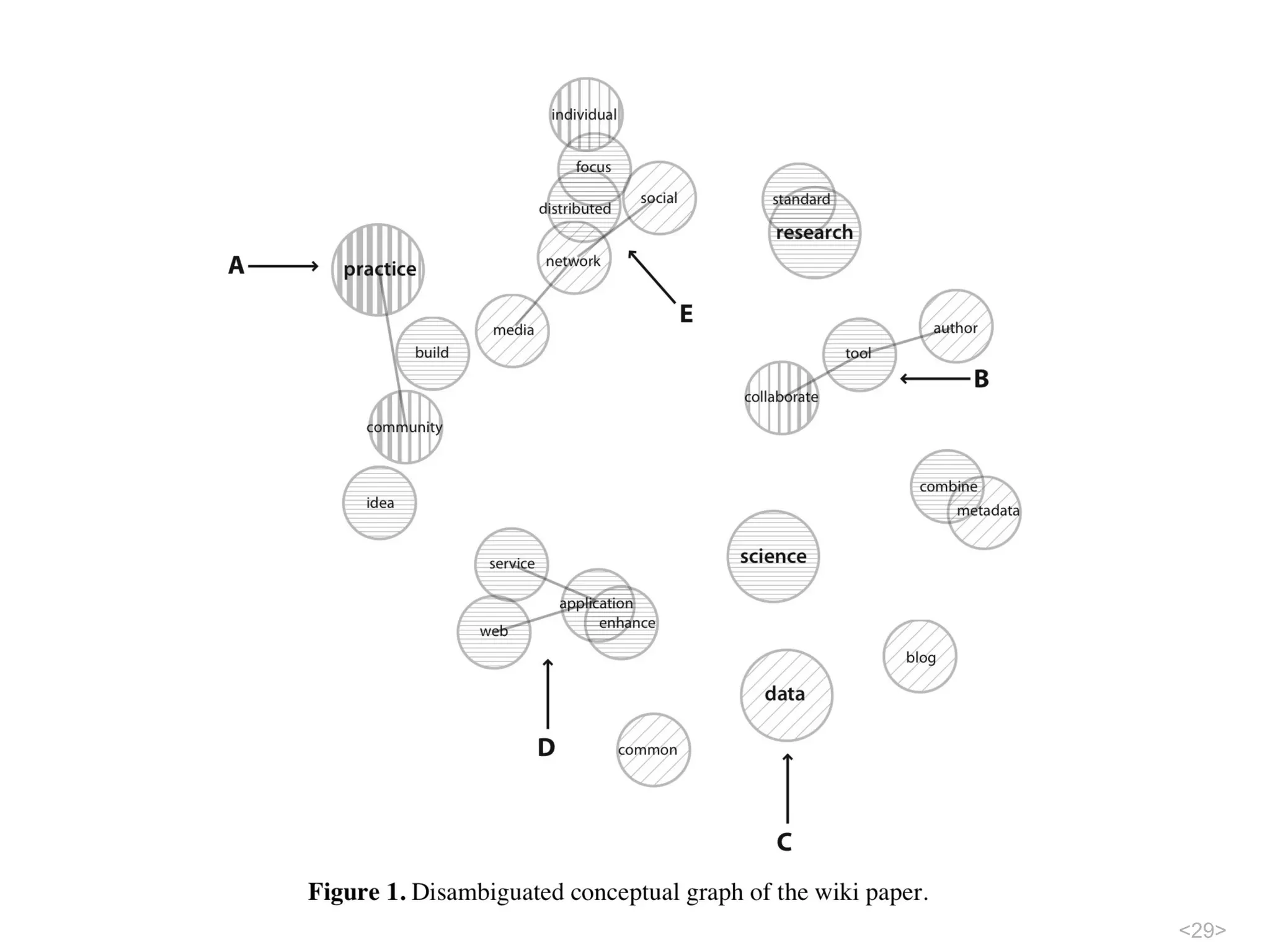
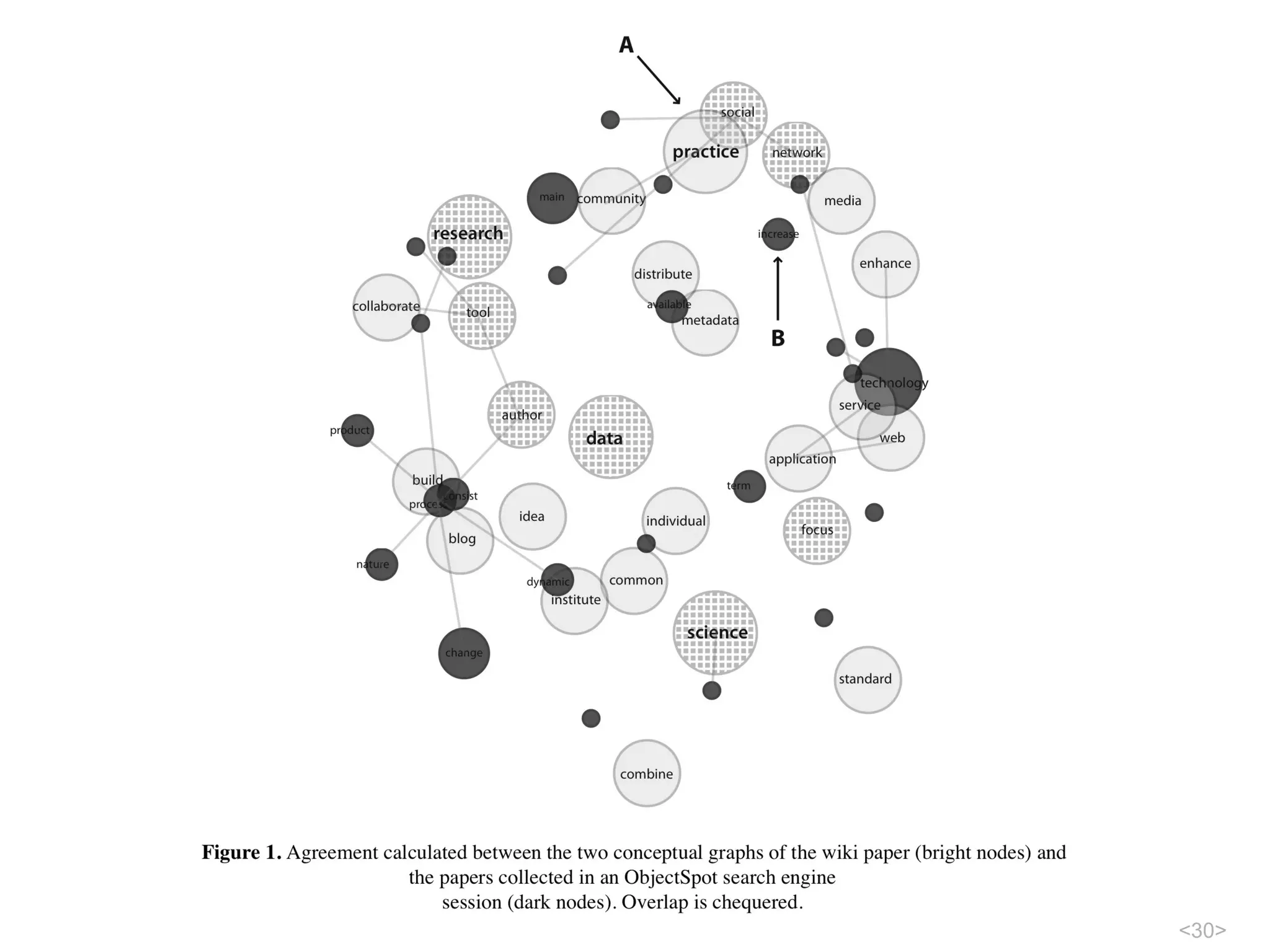
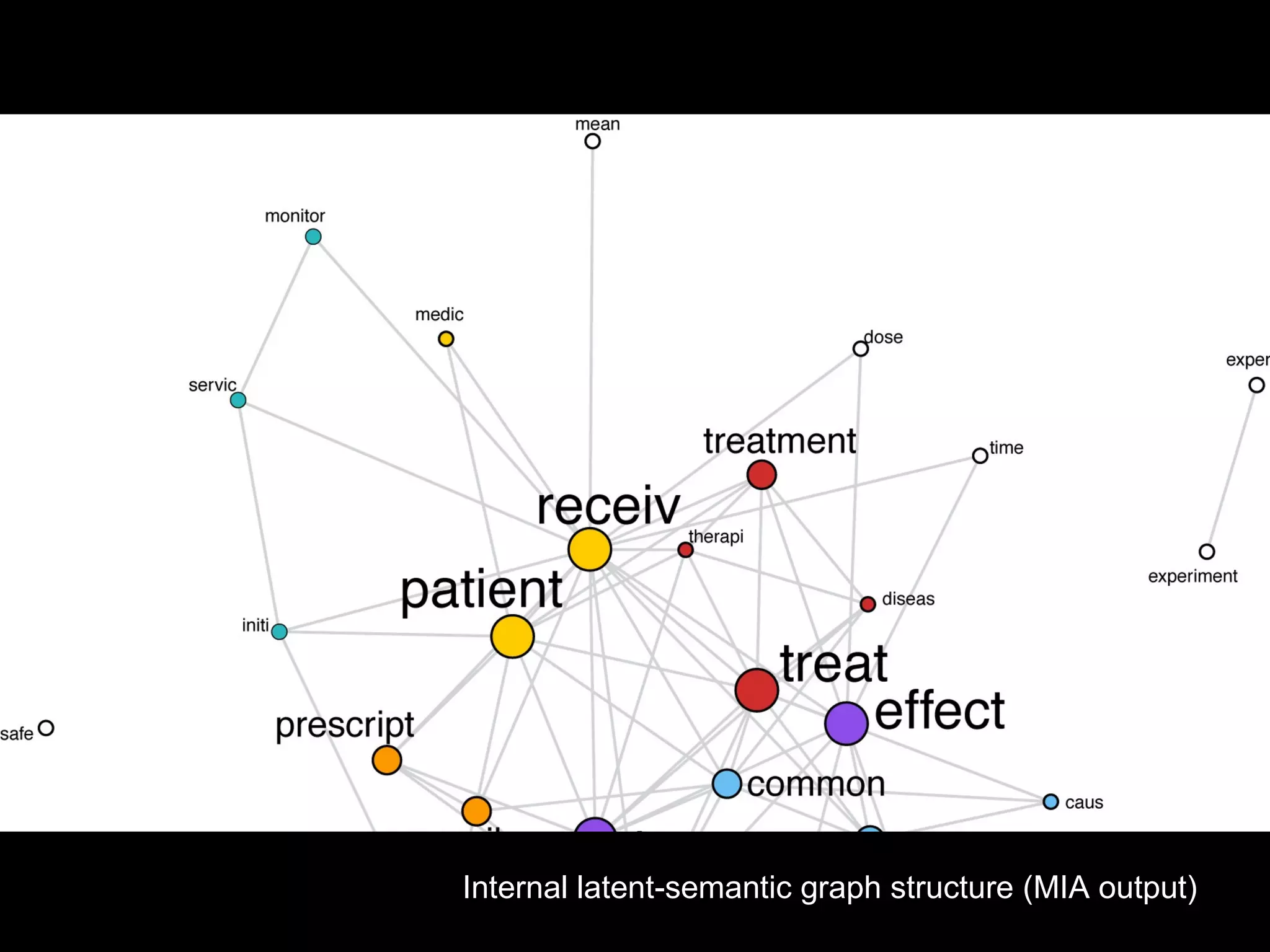
Internal latent-semantic graph structure (MIA output)
 
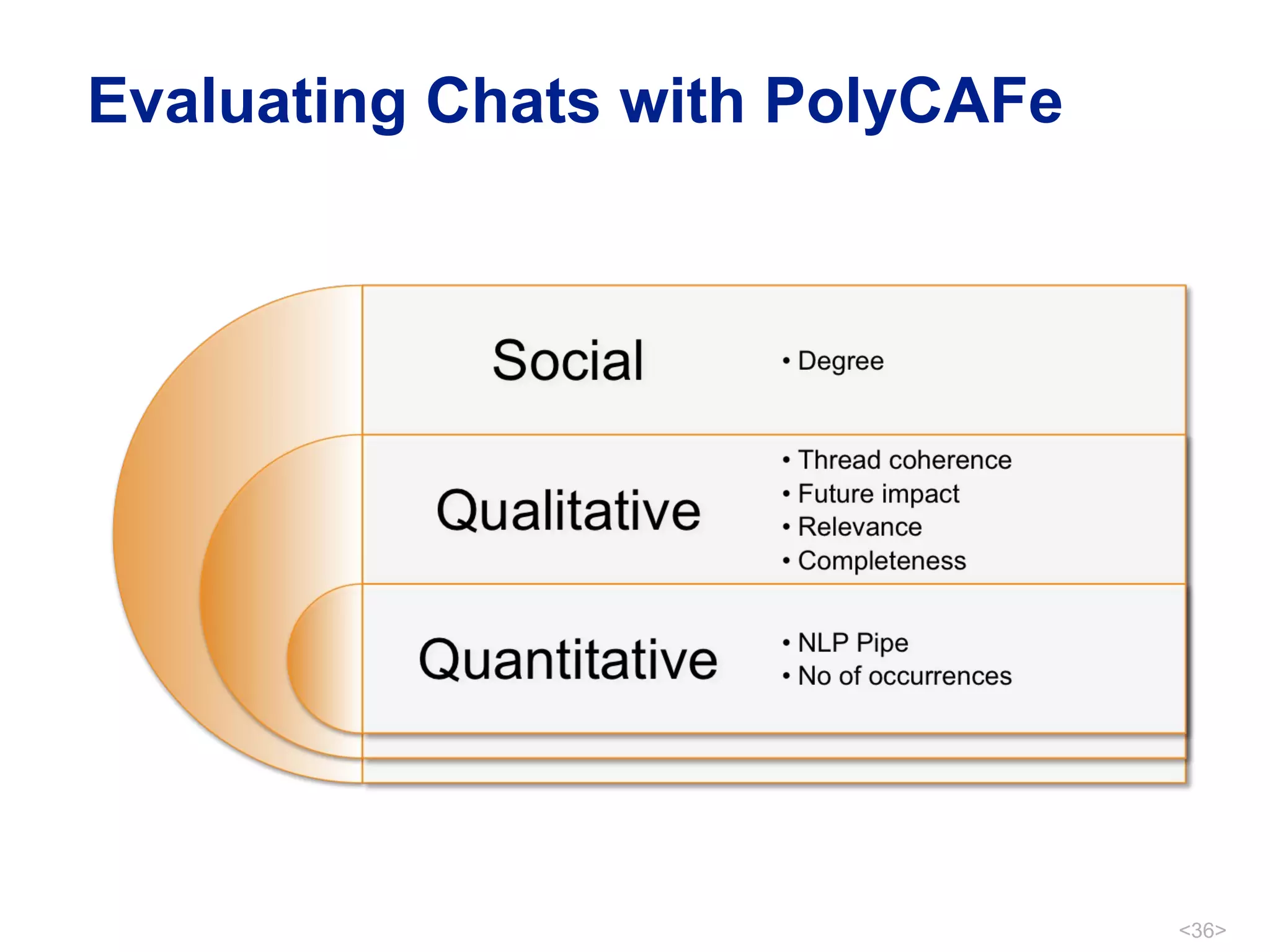
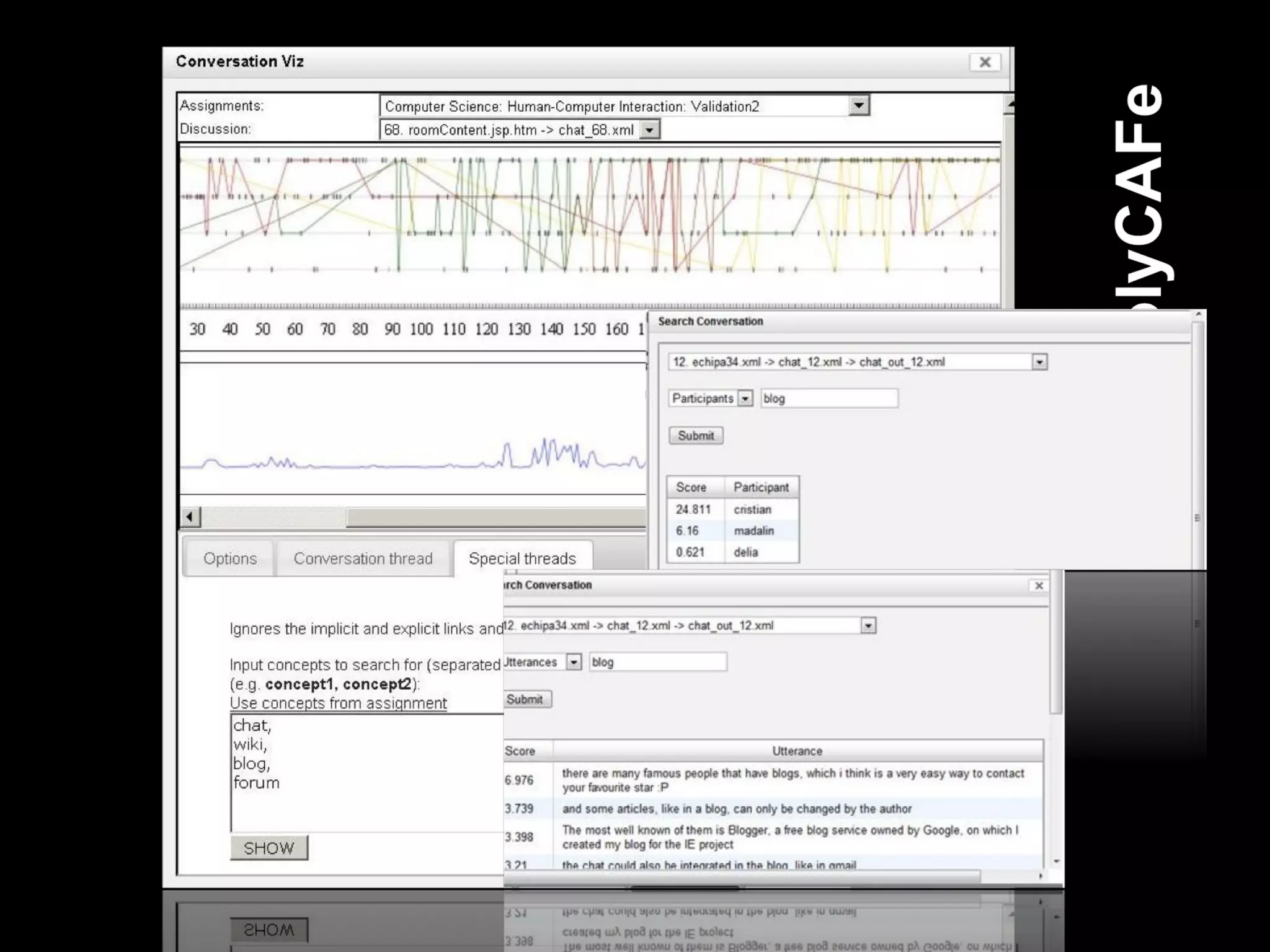
Evaluating Chats with PolyCAFe
 
Conclusion
Conclusion Both LSA and SNA alone are not sufficient for a modern representation theory MIA provides one possible  bridge between them It is a powerful technique And it is simple to use (in R)
#eof.
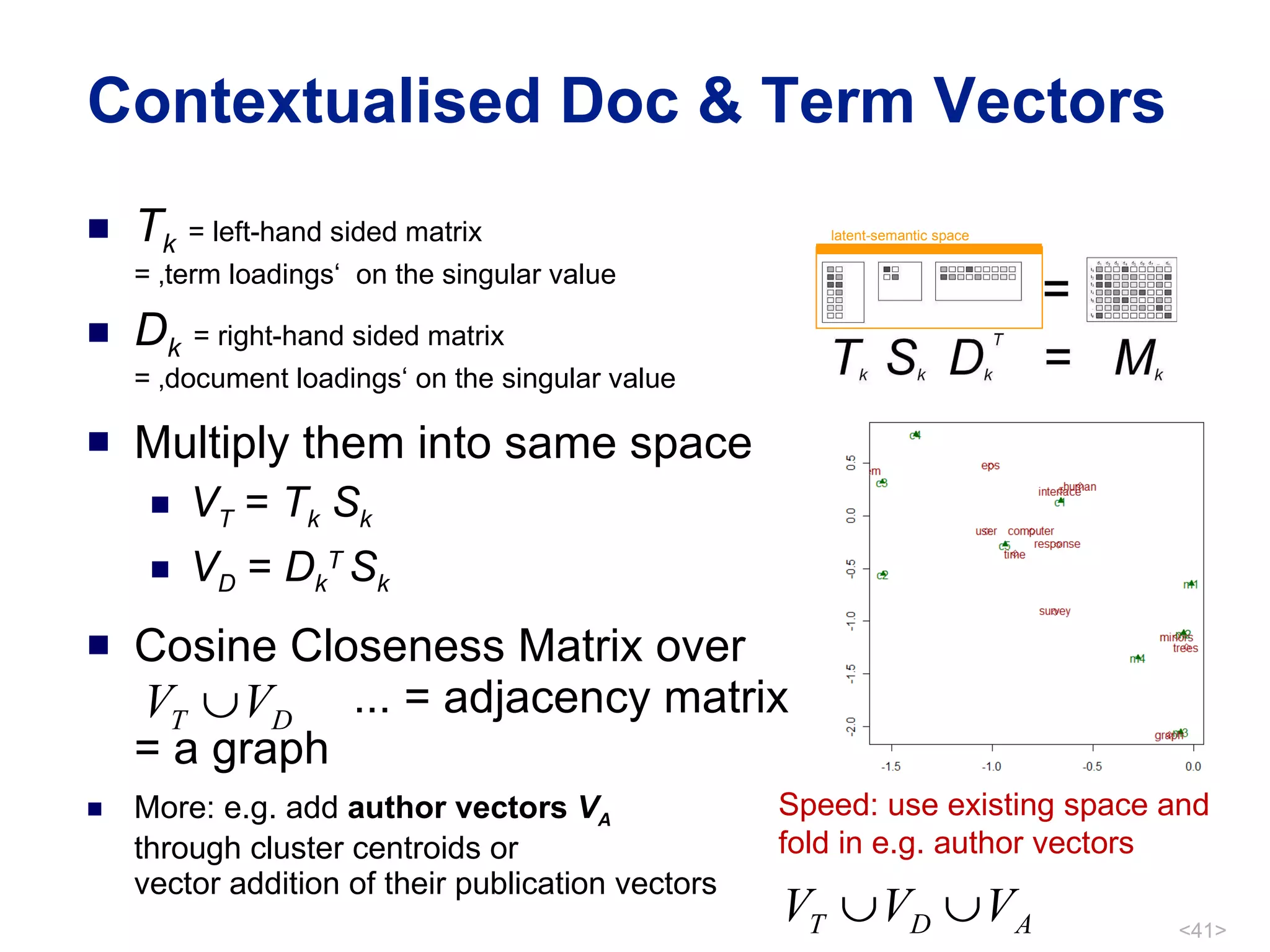
Contextualised Doc & Term Vectors T k   = left-hand sided matrix  = ‚term loadings‘  on the singular value D k   = right-hand sided matrix  = ‚document loadings‘ on the singular value Multiply them into same space V T  =  T k  S k V D  =  D k T   S k Cosine Closeness Matrix over     ... = adjacency matrix = a graph More: e.g. add  author vectors  V A   through cluster centroids or  vector addition of their publication vectors Speed: use existing space and fold in e.g. author vectors latent-semantic space
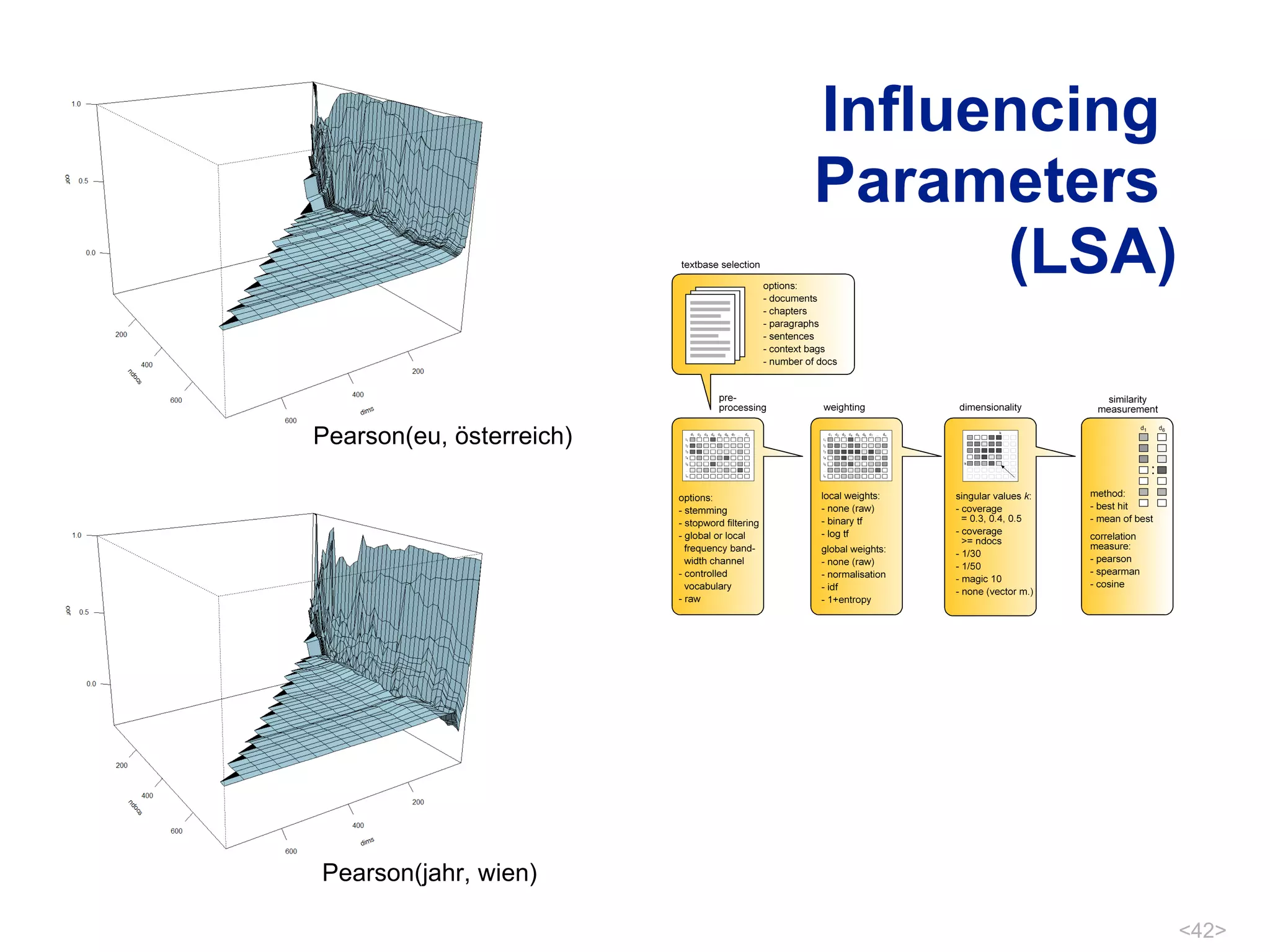
Influencing  Parameters  (LSA) Pearson(eu, österreich) Pearson(jahr, wien)

Meaningful Interaction Analysis

  • 1.
    December 7 th, 2010, Shanghai, China Latent Semantics and Social Interaction Fridolin Wild KMi, The Open University
  • 2.
    Outline Context &Framing Theories Latent Semantic Analysis (LSA) (Social) Network Analysis (S/NA) Meaningful Interaction Analysis (MIA) Outlook: Analysing Practices
  • 3.
  • 4.
    Information what is Meaning could be the quality of a certain signal. Meaning could be a logical abstractor = a release mechanism. (96dpi) meaning
  • 5.
    meaning issocial To develop a shared understanding is a natural and necessary process, because language underspecifies meaning: future understanding builds on it Network effects make a network of shared understandings more valuable with growing size: allowing e.g. ‘distributed cognition’. At same time: linguistic relativity (Sapir-Whorf hypothesis): our own language culture restricts our thinking
  • 6.
  • 7.
    Concepts & Competencethings we can (not) construct from language Tying shoelaces Douglas Adams’ ‘meaning of liff’: Epping : The futile movements of forefingers and eyebrows used when failing to attract the attention of waiters and barmen. Shoeburyness : The vague uncomfortable feeling you get when sitting on a seat which is still warm from somebody else's bottom I have been convincingly Sapir-Whorfed by this book.
  • 8.
    A “Semantic Community”LSA SNA Associative Closeness Concept (disambiguated term) Person Social relation
  • 9.
  • 10.
    Latent Semantic AnalysisTwo-Mode factor analysis of the co-occurrences in the terminology Results in a latent-semantic vector space “ Humans learn word meanings and how to combine them into passage meaning through experience with ~paragraph unitized verbal environments.” “ They don’t remember all the separate words of a passage; they remember its overall gist or meaning.” “ LSA learns by ‘reading’ ~paragraph unitized texts that represent the environment.” “ It doesn’t remember all the separate words of a text it; it remembers its overall gist or meaning.” -- Landauer, 2007
  • 11.
    latent-semantic space Singularvalues (factors, dims, …) Term Loadings Document Loadings
  • 12.
  • 13.
    Associative Closeness Youneed factor stability? > Project using fold-ins! Term 1 Document 1 Document 2 Angle 2 Angle 1 Y dimension X dimension
  • 14.
    Example: Classic Landauer{ M } = Deerwester, Dumais, Furnas, Landauer, and Harshman (1990): Indexing by Latent Semantic Analysis, In: Journal of the American Society for Information Science, 41(6):391-407 Only the red terms appear in more than one document, so strip the rest. term = feature vocabulary = ordered set of features TEXTMATRIX
  • 15.
    Reconstructed, Reduced Matrixm4: Graph minors : A survey
  • 16.
    doc2doc - similaritiesUnreduced = pure vector space model - Based on M = TSD’ - Pearson Correlation over document vectors reduced - based on M 2 = TS 2 D’ - Pearson Correlation over document vectors
  • 17.
  • 18.
    Social Network AnalysisExisting for a long time (term coined 1954) Basic idea: Actors and Relationships between them (e.g. Interactions) Actors can be people (groups, media, tags, …) Actors and Ties form a Graph (edges and nodes) Within that graph, certain structures can be investigated Betweenness, Degree of Centrality, Density, Cohesion Structural Patterns can be identified (e.g. the Troll)
  • 19.
    Constructing anetwork from raw data forum postings incidence matrix IM adjacency matrix AM IM x IM T
  • 20.
  • 21.
    Measuring Techniques (Sample)Degree Centrality number of (in/out) connections to others Closeness how close to all others Betweenness how often intermediary Components e.g. kmeans cluster (k=3)
  • 22.
    Example: Joint virtual meeting attendance (Flashmeeting co-attendance in the Prolearn Network of Excellence)
  • 23.
    Example: Subscription structures in a blogging network (2 nd trial of the iCamp project)
  • 24.
  • 25.
    Meaningful Interaction Analysis(MIA) Combines latent semantics with the means of network analysis Allows for investigating associative closeness structures at the same time as social relations In latent-semantic spaces only or in spaces with additional and different (!) relations
  • 26.
    The mathemagics behindMeaningful Interaction Analysis
  • 27.
  • 28.
    MIA of theclassic Landauer
  • 29.
  • 30.
  • 31.
  • 32.
  • 33.
    Capturing traces intext: medical student case report
  • 34.
    Internal latent-semantic graphstructure (MIA output)
  • 35.
  • 36.
  • 37.
  • 38.
  • 39.
    Conclusion Both LSAand SNA alone are not sufficient for a modern representation theory MIA provides one possible bridge between them It is a powerful technique And it is simple to use (in R)
  • 40.
  • 41.
    Contextualised Doc &Term Vectors T k = left-hand sided matrix = ‚term loadings‘ on the singular value D k = right-hand sided matrix = ‚document loadings‘ on the singular value Multiply them into same space V T = T k S k V D = D k T S k Cosine Closeness Matrix over ... = adjacency matrix = a graph More: e.g. add author vectors V A through cluster centroids or vector addition of their publication vectors Speed: use existing space and fold in e.g. author vectors latent-semantic space
  • 42.
    Influencing Parameters (LSA) Pearson(eu, österreich) Pearson(jahr, wien)