Ontology-Based Analyze of Chat Conversations.  An Urban Development Case Stefan Trausan-Matu “ Politehnica" University of Bucharest  and Romanian Academy Research Institute for Artificial Intelligence Bucharest, Romania stefan.trausan@cs.pub.ro  http://www.racai.ro/~trausan
ontologies in use form social groups social groups form ontologies in use (Chris Tweed) 10 March 2009 Towntology Final Conference, Liege
Philosophical paradigms in knowledge construction Cognitive science :  “ knowledge is in the mind of individual persons ”  (Cyc, WordNet, FrameNet, Mikrokosmos, Sowa  … ) -  ontologies Socio-cultural :  “ knowledge is social, is in communities where people enter in dialogs ”  (Vygotsky,  Engestr ö m , Stahl  … ) –  folksonomies – social groups 10 March 2009 Towntology Final Conference, Liege
Examples of paradigm change From Intelligent Tutoring Systems to Computer Supported Collaborative Learning Web2.0 is the Social Web, not the Semantic Web 10 March 2009 Towntology Final Conference, Liege
Why a socio-cultural paradigm? Cognitive science and artificial intelligence problems Natural language understanding Considering socio-cultural issues (including urbanism) Supporting dialogism Group knowledge construction Conflict resolution Reaching common meaning through dialog A theoretical foundation for the Social Web 10 March 2009 Towntology Final Conference, Liege
Natural language understanding Rhetorics – the systematic usage of synonyms Ex. (WordNet): car, auto, automobile, machine, motorcar or closely related words Ex. (WordNet): car => cruiser, police cruiser, patrol car, police car, prowl car, squad car Ambiguity  Ex. (WordNet): car, railcar, railway car, railroad car Word senses depend on context, evolve in time and differ geographically  Metaphors – “stocks are very sensitive creatures” 10 March 2009 Towntology Final Conference, Liege
The Social Web Folksonomies Social Networks Discussion forums Chat conferences 10 March 2009 Towntology Final Conference, Liege
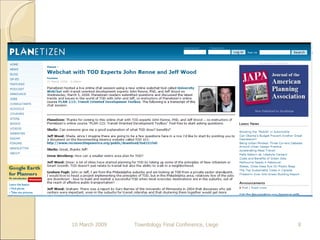
10 March 2009 Towntology Final Conference, Liege
Knowledge building in (small) groups Start from a common ground: General ontology Domain ontology Linguistic practices Rhetoric Pragmatics  Debate, negotiation – dialogue New concepts are build 10 March 2009 Towntology Final Conference, Liege
Dialogism – Mikhail Bakhtin “…  Any true understanding is dialogic in nature” (Voloshinov-Bakhtin, 1973) Real life dialog should be the considered, not only written text (as Saussure recommended) Utterances (not sentences) should be the unit of analysis Carnivalesque Speech genres Inter-animation of voices Polyphony  10 March 2009 Towntology Final Conference, Liege
Polyphony – a system for the analysis of chat logs Used in several CSCL projects: Virtual Math Teams – NSF project, Drexel University, US (Trausan-Matu & Rebedea, 2009) K-Teams – Romanian CNSIS project LTfLL – FP7 IST project It may be used for any domain 10 March 2009 Towntology Final Conference, Liege
Language Technology for Lifelong Learning (LTfLL) EU FP7 Project, 2008-2011 Netherlands, France, United Kingdom, Germany, Romania, Bulgaria Technologies considered: Chat (conversation) analysis Latent Semantic Analysis Ontologies (semantics) Folksonomies Semantic Social Networks Corpus linguistics 10 March 2009 Towntology Final Conference, Liege
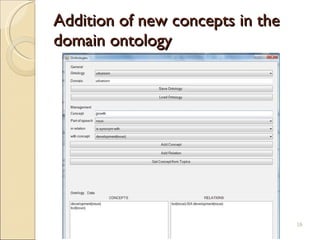
Polyphony  Topic identification Based on WordNet+domain ontology New concepts may be added in the domain ontology Discourse identification – polyphonic model (Trausan-Matu, Stahl & Sarmiento, 2006) Graphical visualization of the chat Evaluation of the contributions of the participants 10 March 2009 Towntology Final Conference, Liege
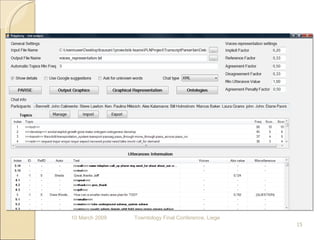
Identification of Chat Topics XML or HTML chat logs Tokenization Stop-words, emoticons and usual abbreviations ( :) , :D , brb, thx, …) are eliminated Semantic distances identified using WordNet and the domain ontology Pattern (cue phrases) analysis 10 March 2009 Towntology Final Conference, Liege
10 March 2009 Towntology Final Conference, Liege
Addition of new concepts in the domain ontology 10 March 2009 Towntology Final Conference, Liege
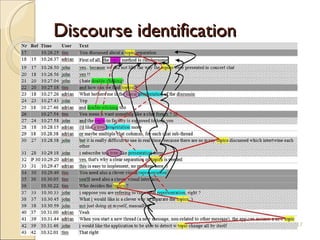
Discourse identification 10 March 2009 Towntology Final Conference, Liege
Implicit Links Discovering Text mining techniques: Pattern (cue phrases) analysis Co - reference  analysis Lexical chains Heuristics 10 March 2009 Towntology Final Conference, Liege
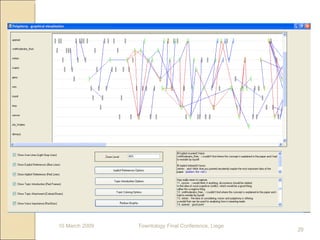
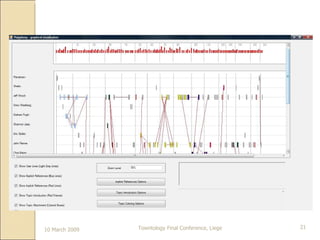
Graphical Representation of the Conversation For each  participant  in the chat, there is a separate horizontal line in the representation Each  utterance  is placed in the line corresponding to the issuer of that utterance, according to the emission time The  explicit references  among utterances are depicted using blue connecting lines The  implicit references  (deduced by the system) are represented using other colour (red or green).  T he  strength  of each utterance  is represented as a b a r chart. 10 March 2009 Towntology Final Conference, Liege
10 March 2009 Towntology Final Conference, Liege
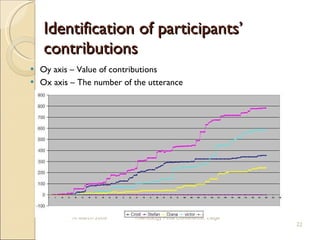
Identification of participants’ contributions Oy axis – Value of contributions Ox axis – The number of the utterance 10 March 2009 Towntology Final Conference, Liege
Conclusions and future directions There are a need and a possibility for the integration of ontologies with social knowledge building The importance of context and negotiation: Usage of perspectives in ontologies 10 March 2009 Towntology Final Conference, Liege

Ontology-Based Analyze of Chat Conversations. An Urban Development Case

  • 1.
    Ontology-Based Analyze ofChat Conversations. An Urban Development Case Stefan Trausan-Matu “ Politehnica" University of Bucharest and Romanian Academy Research Institute for Artificial Intelligence Bucharest, Romania stefan.trausan@cs.pub.ro http://www.racai.ro/~trausan
  • 2.
    ontologies in useform social groups social groups form ontologies in use (Chris Tweed) 10 March 2009 Towntology Final Conference, Liege
  • 3.
    Philosophical paradigms inknowledge construction Cognitive science : “ knowledge is in the mind of individual persons ” (Cyc, WordNet, FrameNet, Mikrokosmos, Sowa … ) - ontologies Socio-cultural : “ knowledge is social, is in communities where people enter in dialogs ” (Vygotsky, Engestr ö m , Stahl … ) – folksonomies – social groups 10 March 2009 Towntology Final Conference, Liege
  • 4.
    Examples of paradigmchange From Intelligent Tutoring Systems to Computer Supported Collaborative Learning Web2.0 is the Social Web, not the Semantic Web 10 March 2009 Towntology Final Conference, Liege
  • 5.
    Why a socio-culturalparadigm? Cognitive science and artificial intelligence problems Natural language understanding Considering socio-cultural issues (including urbanism) Supporting dialogism Group knowledge construction Conflict resolution Reaching common meaning through dialog A theoretical foundation for the Social Web 10 March 2009 Towntology Final Conference, Liege
  • 6.
    Natural language understandingRhetorics – the systematic usage of synonyms Ex. (WordNet): car, auto, automobile, machine, motorcar or closely related words Ex. (WordNet): car => cruiser, police cruiser, patrol car, police car, prowl car, squad car Ambiguity Ex. (WordNet): car, railcar, railway car, railroad car Word senses depend on context, evolve in time and differ geographically Metaphors – “stocks are very sensitive creatures” 10 March 2009 Towntology Final Conference, Liege
  • 7.
    The Social WebFolksonomies Social Networks Discussion forums Chat conferences 10 March 2009 Towntology Final Conference, Liege
  • 8.
    10 March 2009Towntology Final Conference, Liege
  • 9.
    Knowledge building in(small) groups Start from a common ground: General ontology Domain ontology Linguistic practices Rhetoric Pragmatics Debate, negotiation – dialogue New concepts are build 10 March 2009 Towntology Final Conference, Liege
  • 10.
    Dialogism – MikhailBakhtin “… Any true understanding is dialogic in nature” (Voloshinov-Bakhtin, 1973) Real life dialog should be the considered, not only written text (as Saussure recommended) Utterances (not sentences) should be the unit of analysis Carnivalesque Speech genres Inter-animation of voices Polyphony 10 March 2009 Towntology Final Conference, Liege
  • 11.
    Polyphony – asystem for the analysis of chat logs Used in several CSCL projects: Virtual Math Teams – NSF project, Drexel University, US (Trausan-Matu & Rebedea, 2009) K-Teams – Romanian CNSIS project LTfLL – FP7 IST project It may be used for any domain 10 March 2009 Towntology Final Conference, Liege
  • 12.
    Language Technology forLifelong Learning (LTfLL) EU FP7 Project, 2008-2011 Netherlands, France, United Kingdom, Germany, Romania, Bulgaria Technologies considered: Chat (conversation) analysis Latent Semantic Analysis Ontologies (semantics) Folksonomies Semantic Social Networks Corpus linguistics 10 March 2009 Towntology Final Conference, Liege
  • 13.
    Polyphony Topicidentification Based on WordNet+domain ontology New concepts may be added in the domain ontology Discourse identification – polyphonic model (Trausan-Matu, Stahl & Sarmiento, 2006) Graphical visualization of the chat Evaluation of the contributions of the participants 10 March 2009 Towntology Final Conference, Liege
  • 14.
    Identification of ChatTopics XML or HTML chat logs Tokenization Stop-words, emoticons and usual abbreviations ( :) , :D , brb, thx, …) are eliminated Semantic distances identified using WordNet and the domain ontology Pattern (cue phrases) analysis 10 March 2009 Towntology Final Conference, Liege
  • 15.
    10 March 2009Towntology Final Conference, Liege
  • 16.
    Addition of newconcepts in the domain ontology 10 March 2009 Towntology Final Conference, Liege
  • 17.
    Discourse identification 10March 2009 Towntology Final Conference, Liege
  • 18.
    Implicit Links DiscoveringText mining techniques: Pattern (cue phrases) analysis Co - reference analysis Lexical chains Heuristics 10 March 2009 Towntology Final Conference, Liege
  • 19.
    Graphical Representation ofthe Conversation For each participant in the chat, there is a separate horizontal line in the representation Each utterance is placed in the line corresponding to the issuer of that utterance, according to the emission time The explicit references among utterances are depicted using blue connecting lines The implicit references (deduced by the system) are represented using other colour (red or green). T he strength of each utterance is represented as a b a r chart. 10 March 2009 Towntology Final Conference, Liege
  • 20.
    10 March 2009Towntology Final Conference, Liege
  • 21.
    10 March 2009Towntology Final Conference, Liege
  • 22.
    Identification of participants’contributions Oy axis – Value of contributions Ox axis – The number of the utterance 10 March 2009 Towntology Final Conference, Liege
  • 23.
    Conclusions and futuredirections There are a need and a possibility for the integration of ontologies with social knowledge building The importance of context and negotiation: Usage of perspectives in ontologies 10 March 2009 Towntology Final Conference, Liege