Fuel supply system
Thebasic fuel supply system in a petrol engine consists of a fuel tank, fuel lines,
fuel pump, fuel filters, air cleaner, carburetor and inlet manifold. The
system responsible for preparing the correct mixture of air and fuel, and
directing this mixture to each of the cylinders is known as "Induction System.
Types of fuel supply systems:
1. Gravity system
2. Pressure system
3. Vacuum system
4. Pump system
5. Fuel injection system
3.
Fuel–tank
• It ismade of galvanized MS sheet and is fast and under the
chassis with straps nuts and bolts with rubber packing in
between.
• The tank usually coated with lead tin alloy inside the tank to
protect against corrosion.
• Petrol connection is taken at the bottom sometimes a fine wire
gauge strainer is also fitted in it so that petrol leaving the tank
is free from coarse suspended impurities.
4.
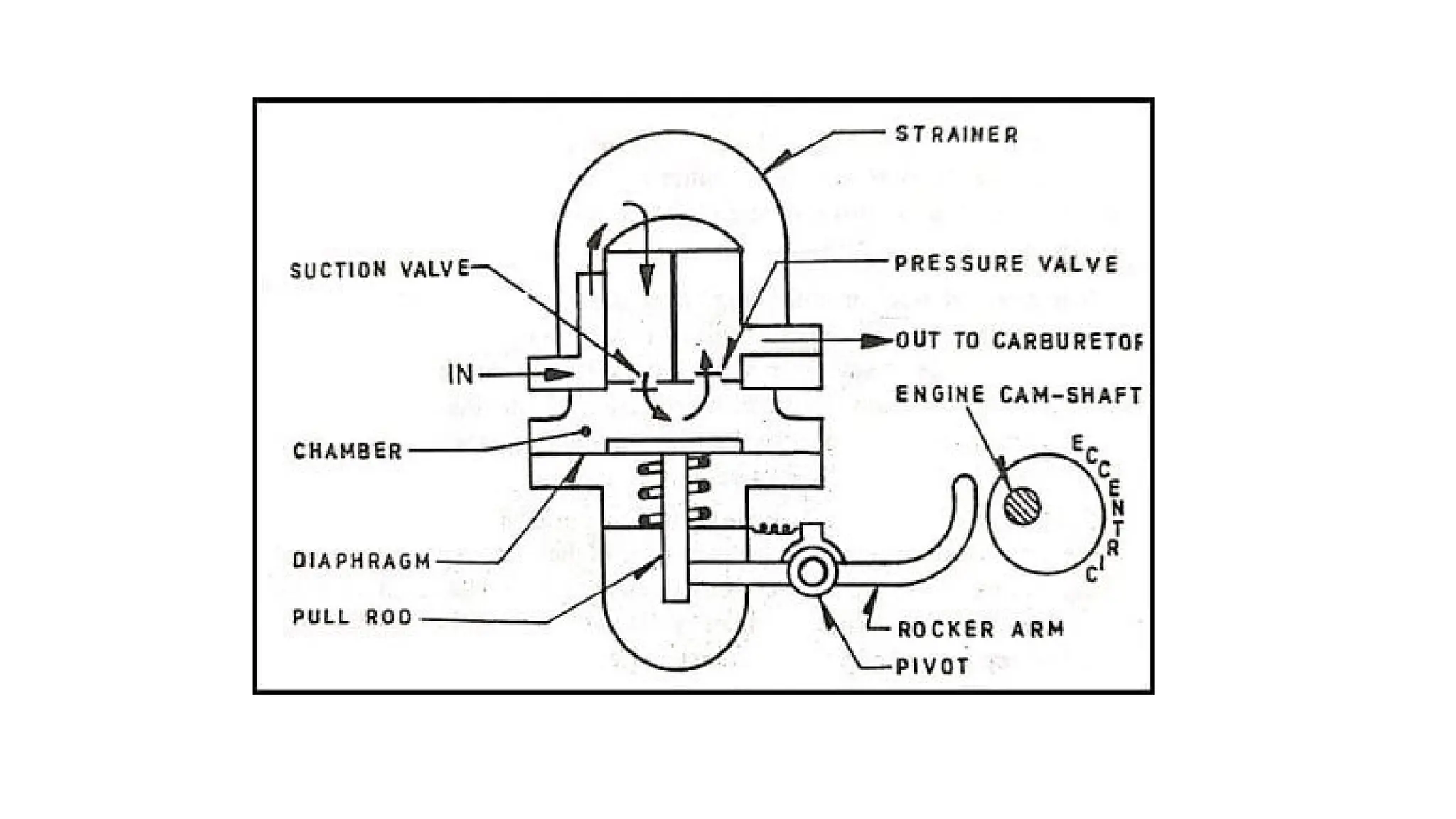
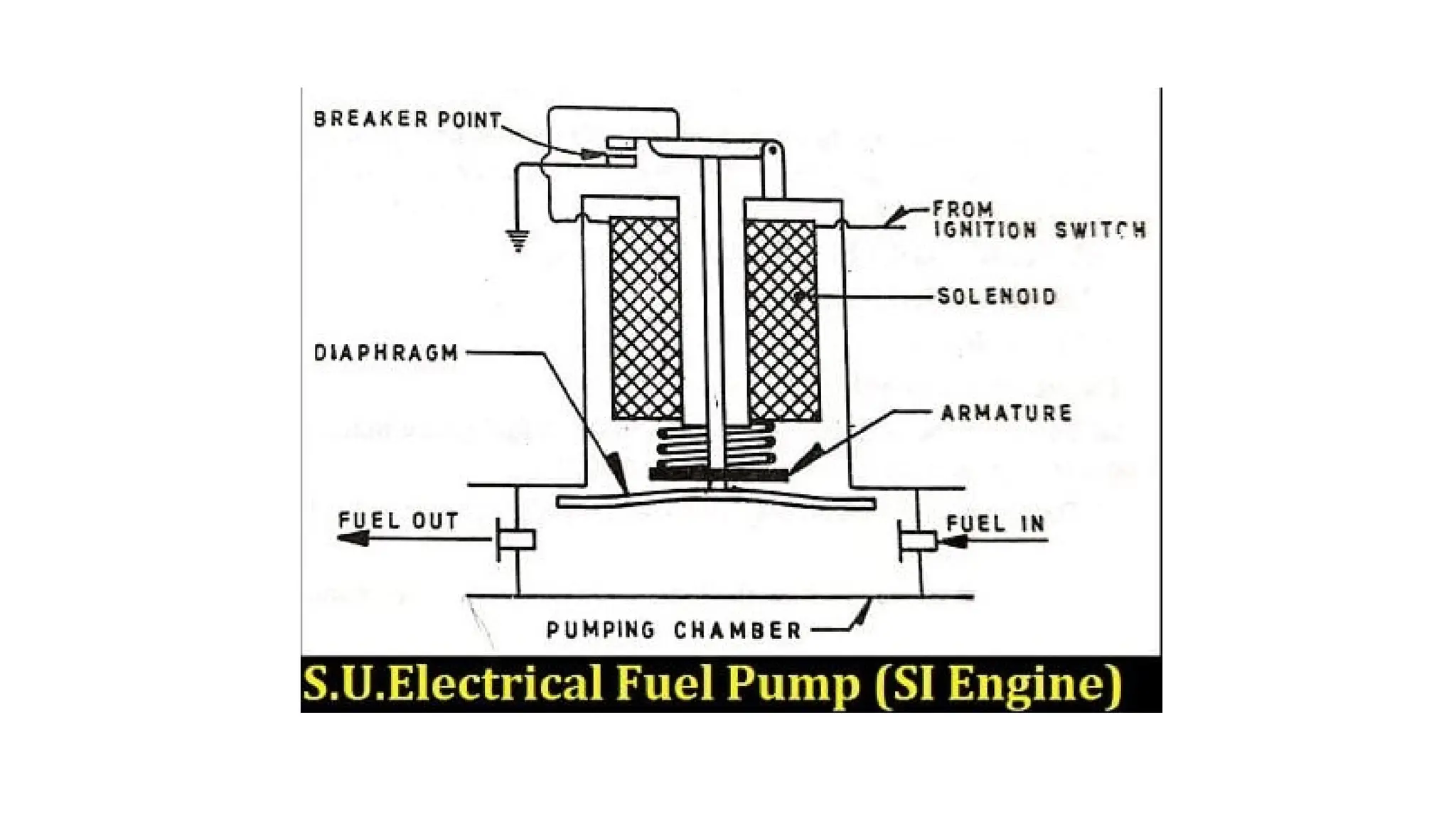
Fuel pumps
• Thefunction of the fuel pump is to pump fuel from the tank and feed it
to the carburetor.
• These pumps are designed to pump a sufficient quantity of fuel at all
working conditions so that the pipeline always remains filled up with
fuel at all working conditions failing which these are chances of vapor
lock usually called airlock in the pipeline.
• Two main types of pumps generally used are
1. A C Mechanical pump
2. S U Electrical pump
7.
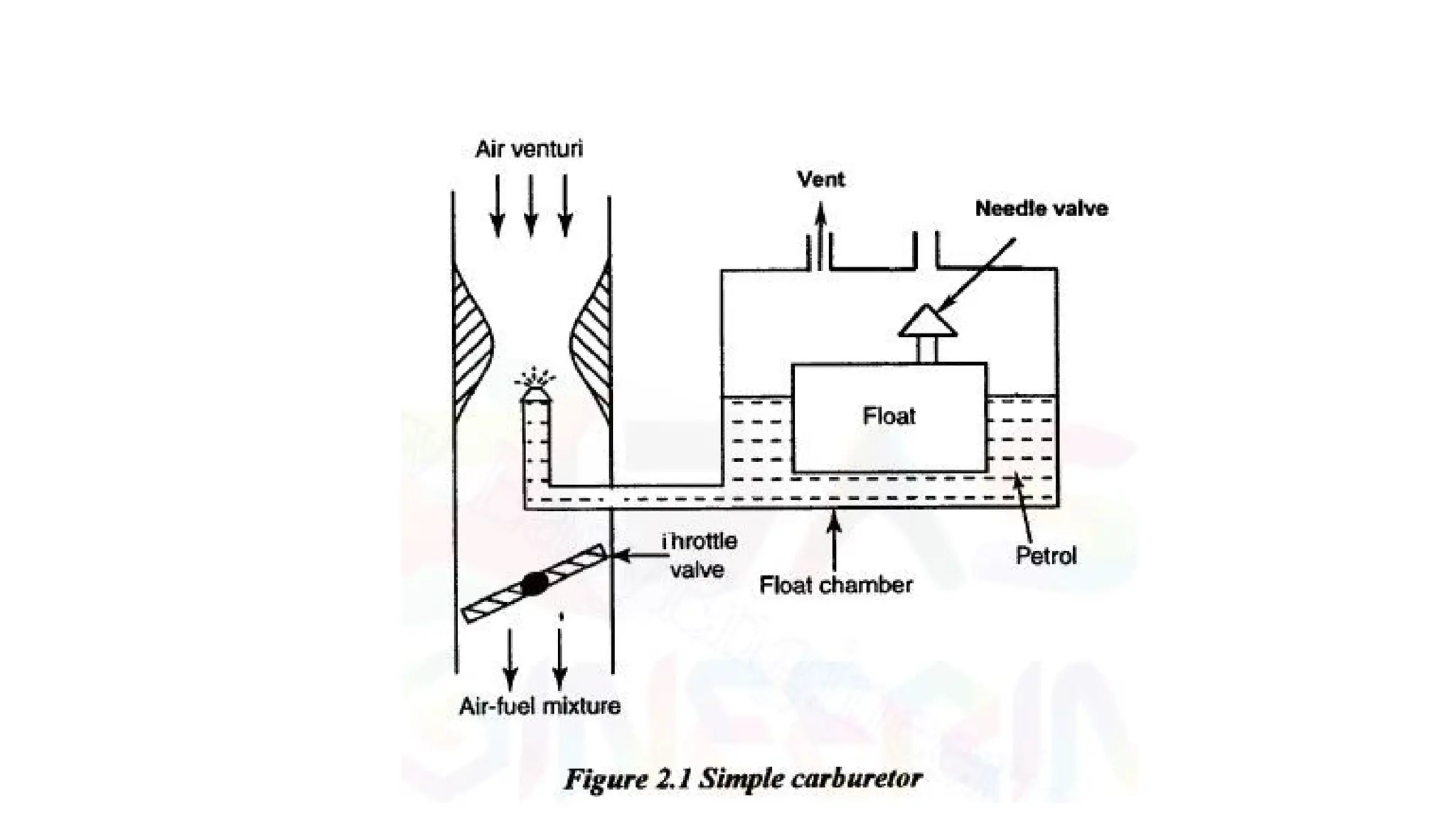
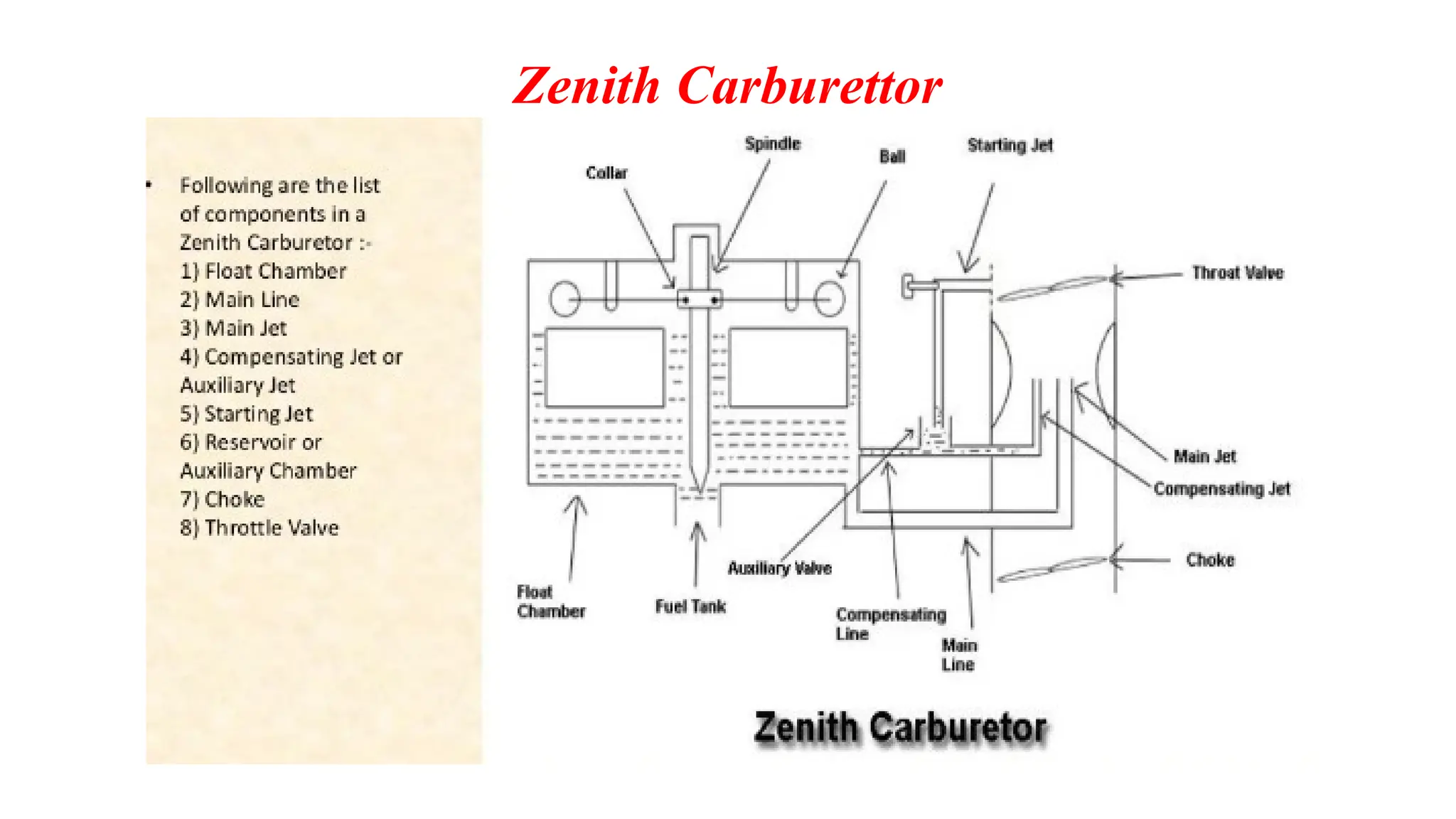
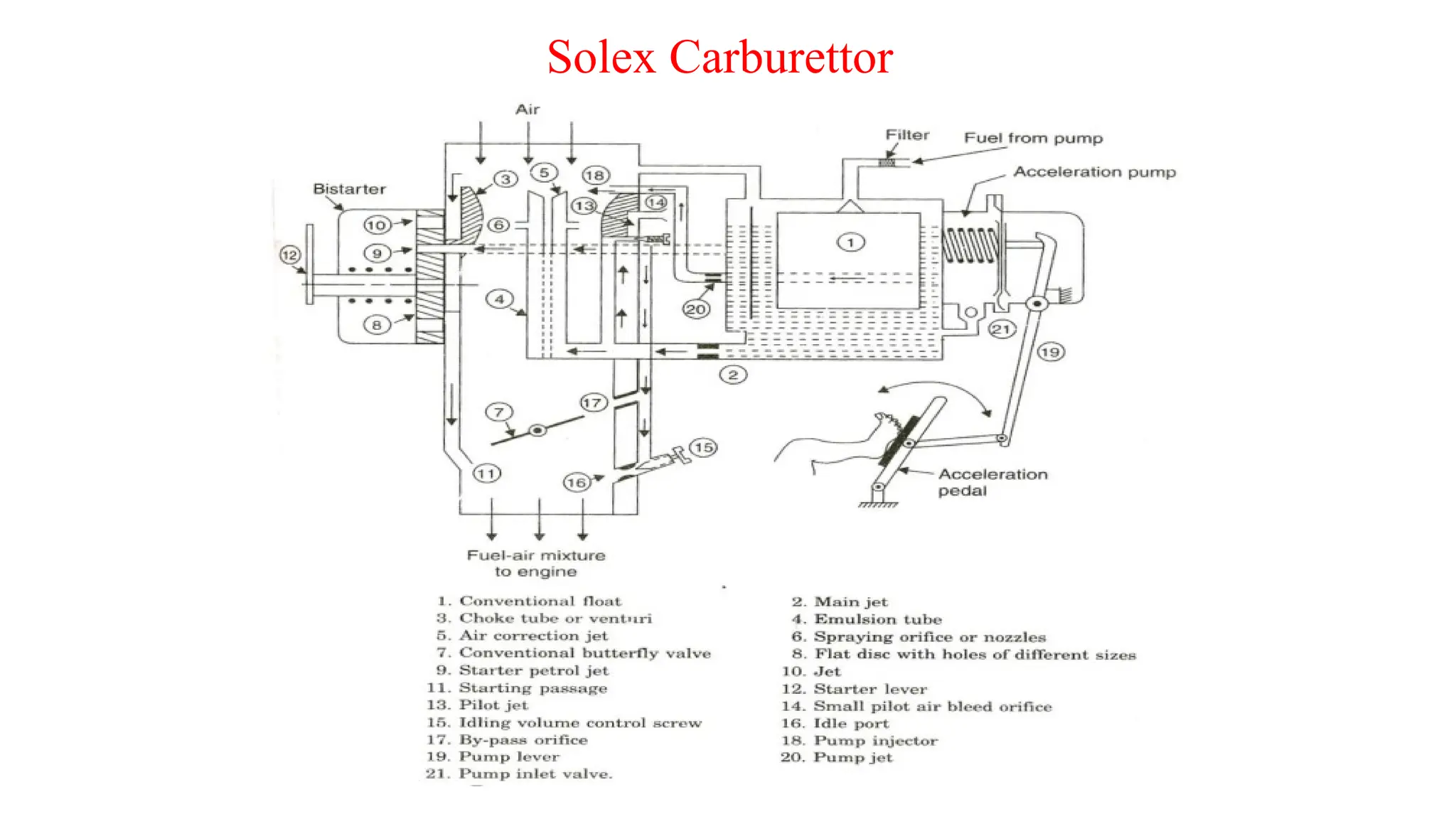
Carburettors
Carburetor is thedevice that mixes petrol and air in correct
proportions and supplies to the combustion chamber in right
quantity.
• A Carburetor atomizes, vaporizes and mixes the petrol in correct
proportions with air as required by the engine and supplies the
right quantity of the mixture to the engine.
9.
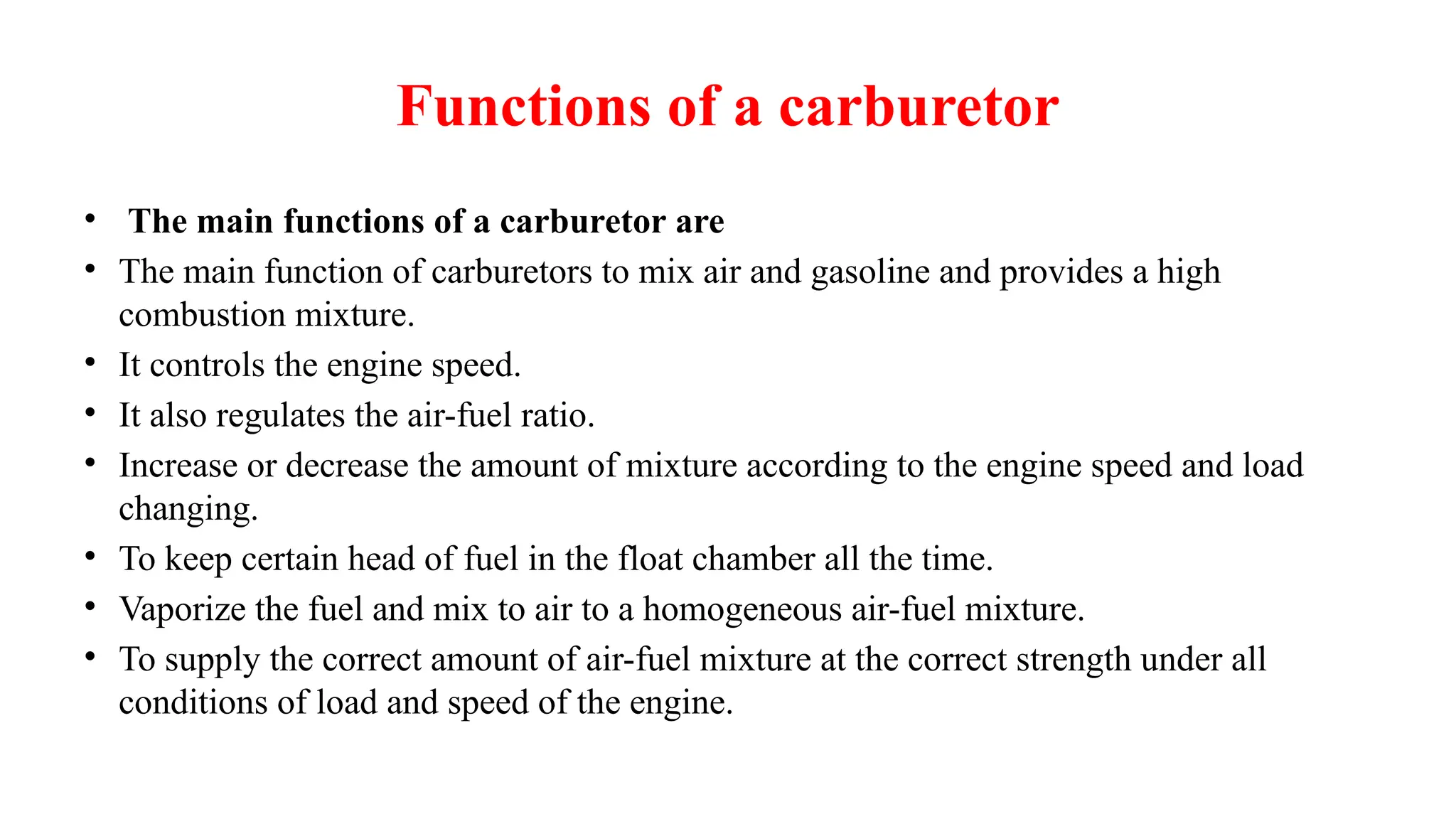
Functions of acarburetor
• The main functions of a carburetor are
• The main function of carburetors to mix air and gasoline and provides a high
combustion mixture.
• It controls the engine speed.
• It also regulates the air-fuel ratio.
• Increase or decrease the amount of mixture according to the engine speed and load
changing.
• To keep certain head of fuel in the float chamber all the time.
• Vaporize the fuel and mix to air to a homogeneous air-fuel mixture.
• To supply the correct amount of air-fuel mixture at the correct strength under all
conditions of load and speed of the engine.
10.
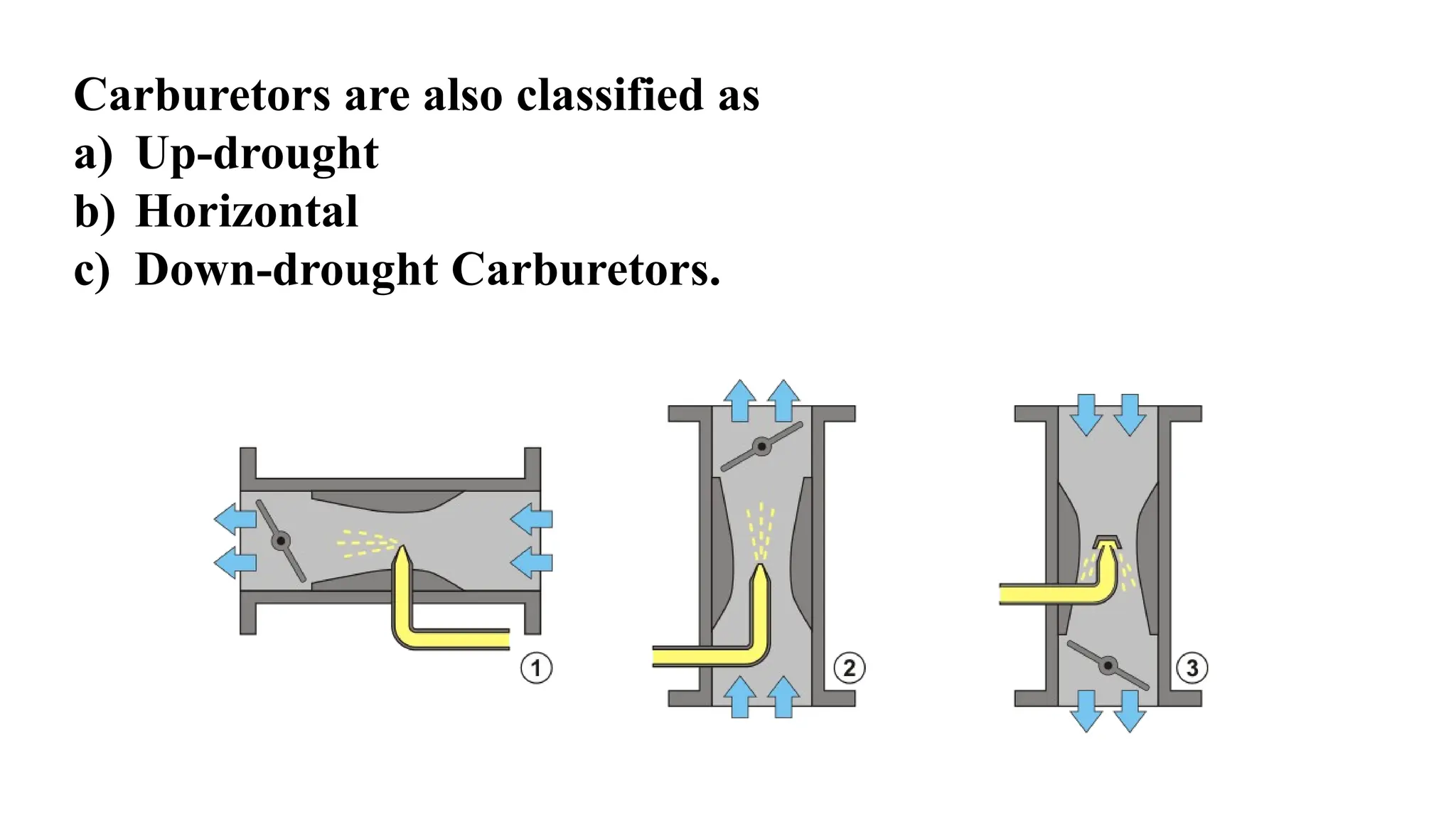
Carburetors are alsoclassified as
a) Up-drought
b) Horizontal
c) Down-drought Carburetors.
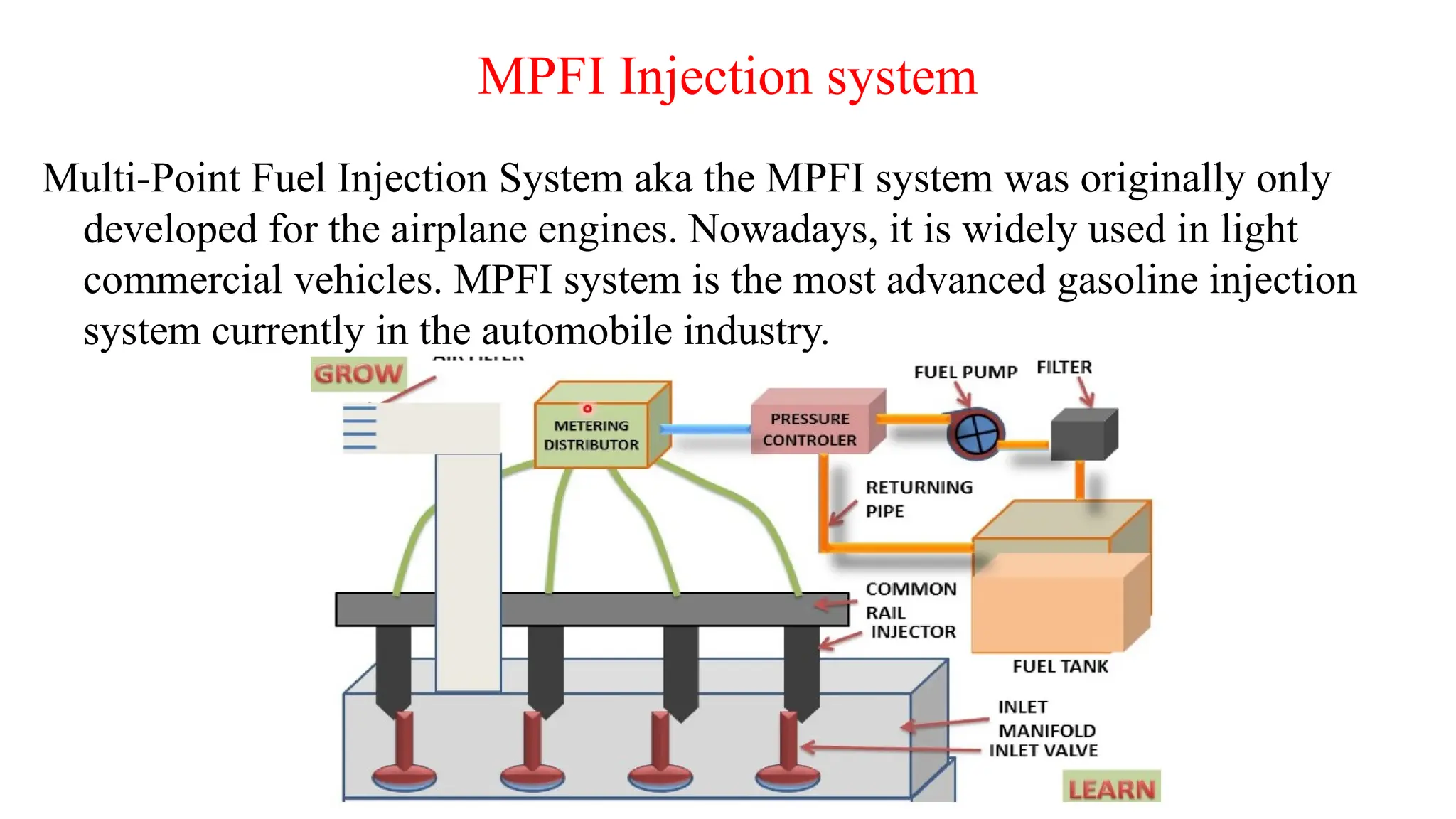
MPFI Injection system
Multi-PointFuel Injection System aka the MPFI system was originally only
developed for the airplane engines. Nowadays, it is widely used in light
commercial vehicles. MPFI system is the most advanced gasoline injection
system currently in the automobile industry.
14.
Air cleaners
The aircleaner not only cleans the air by removing the dust and dirt particles but
also muffles the noise resulting from the intake of air through the carburettor
• In addition, the air cleaner acts as a flame arrester in case the engine backfires
through the carburettor.
• Backfiring occurs at certain times due to the ignition of the air-fuel mixture in
the cylinder before the intake valve closes. When this happens, there is a
momentary flask-back through the carburettor. The air cleaner prevents this
flame from spreading through the carburettor and possibly igniting the petrol
fumes outside the engine.
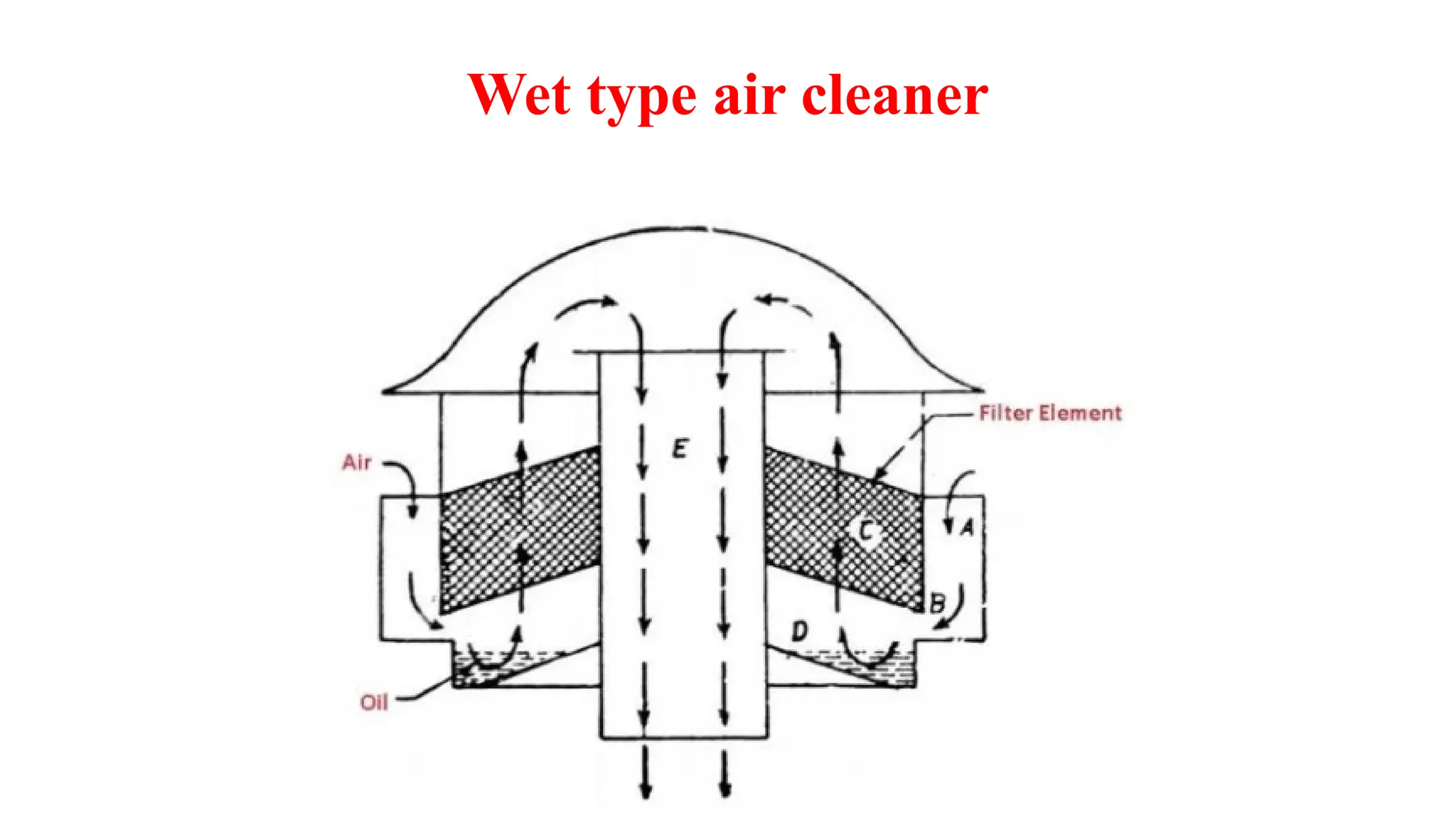
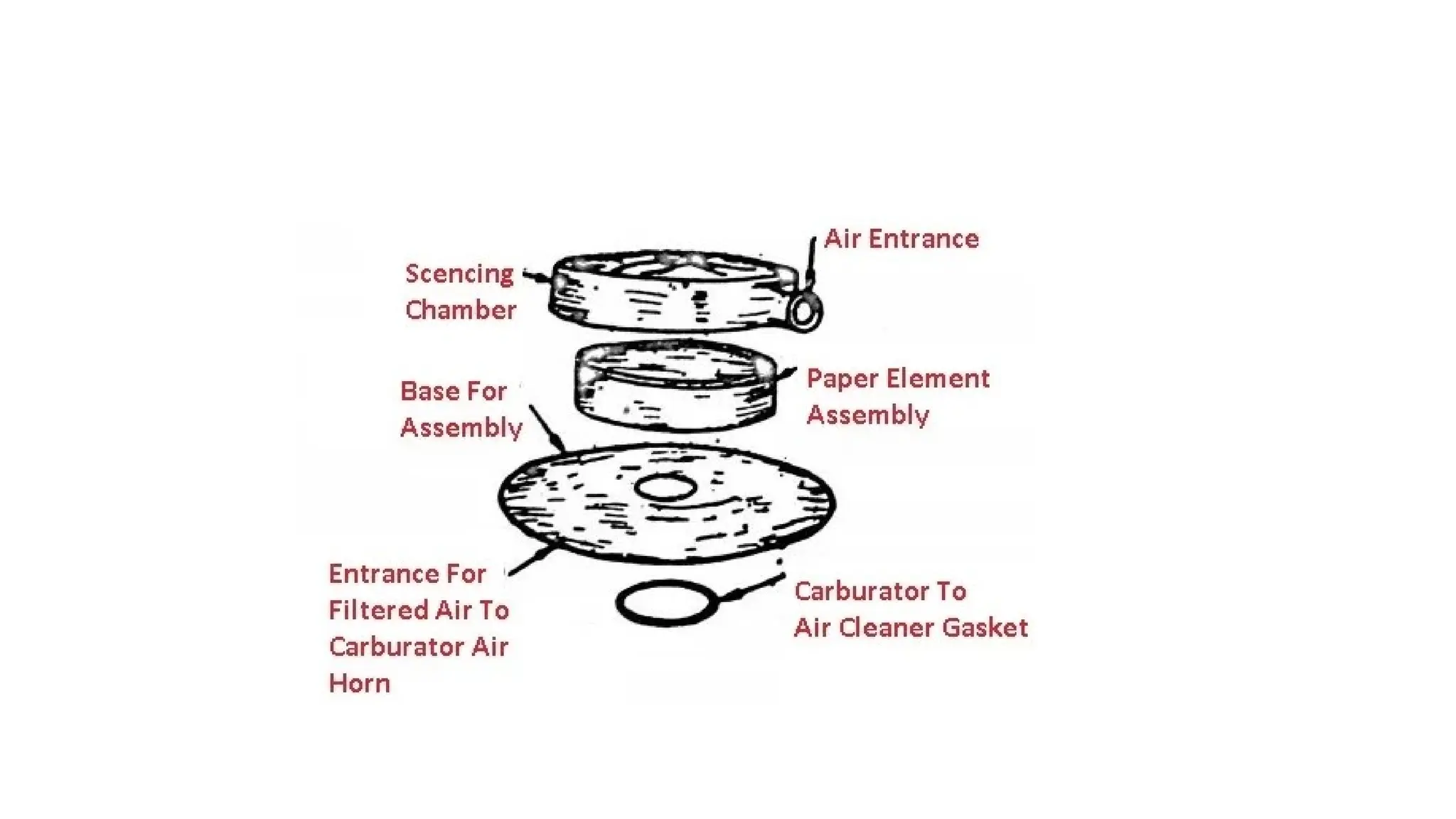
• Types of Air Cleaners in Engine
• Oil bath type air cleaner or wet type air cleaner
• Dry-type air cleaner
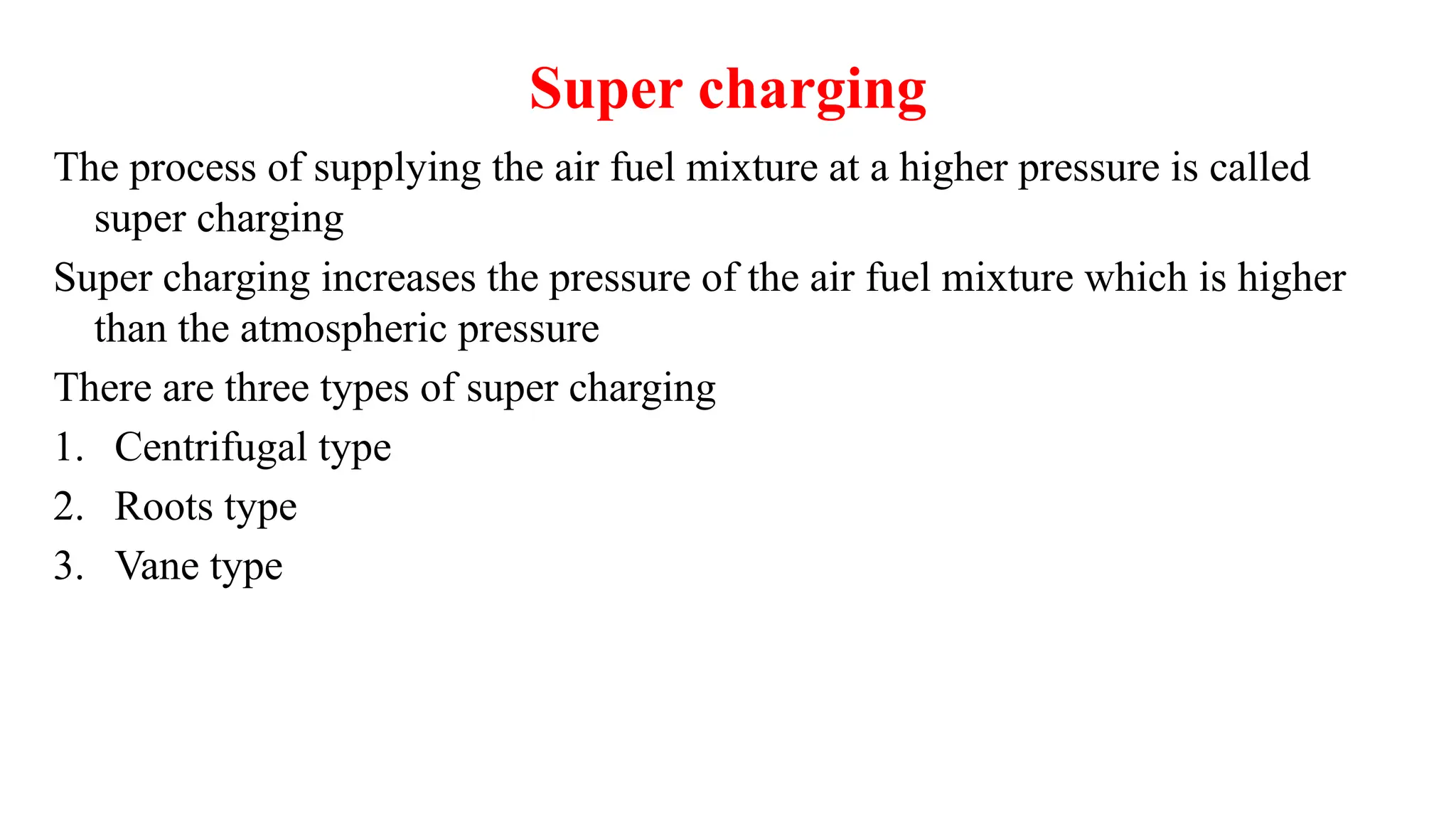
Super charging
The processof supplying the air fuel mixture at a higher pressure is called
super charging
Super charging increases the pressure of the air fuel mixture which is higher
than the atmospheric pressure
There are three types of super charging
1. Centrifugal type
2. Roots type
3. Vane type
18.
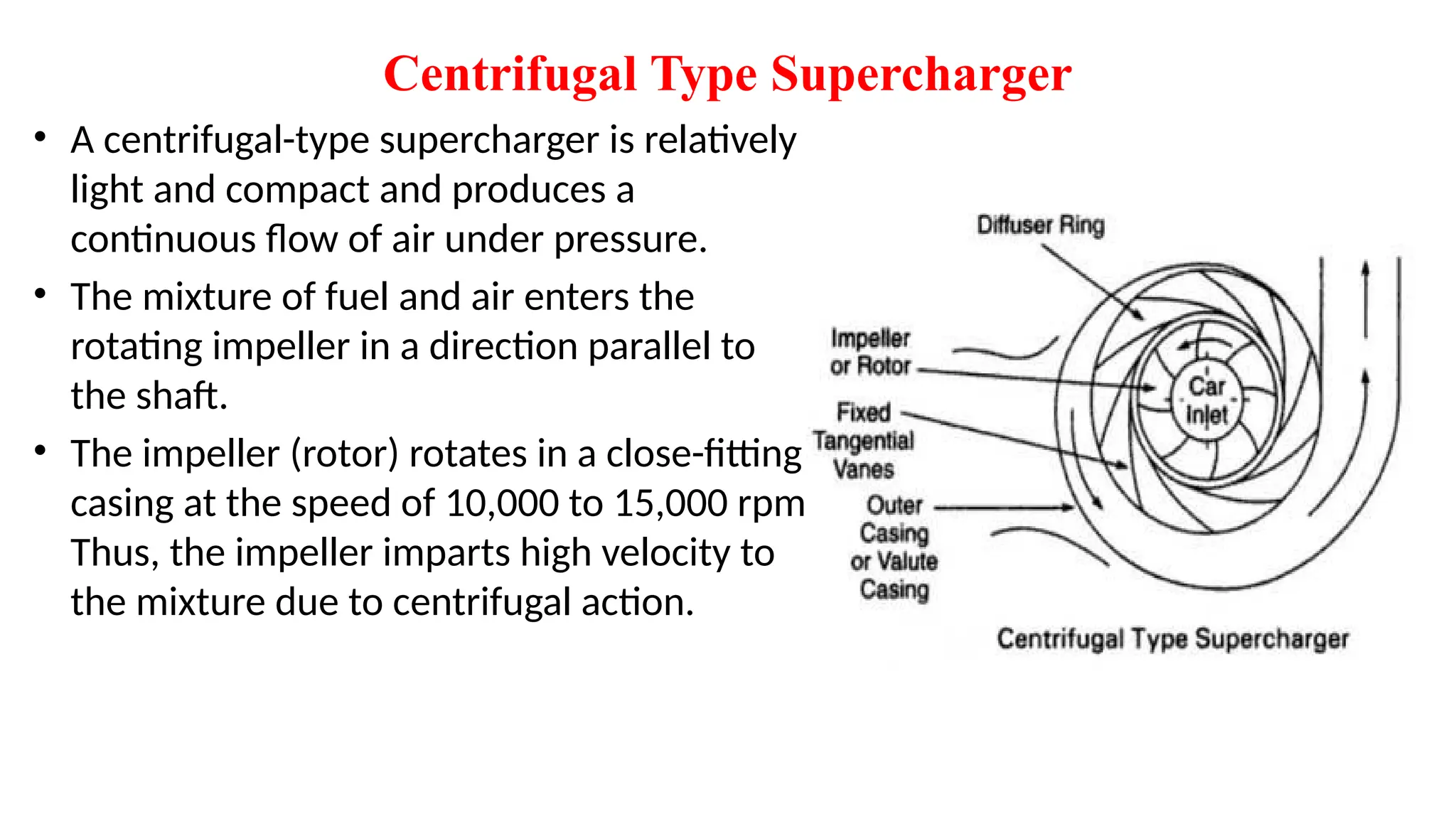
Centrifugal Type Supercharger
•A centrifugal-type supercharger is relatively
light and compact and produces a
continuous flow of air under pressure.
• The mixture of fuel and air enters the
rotating impeller in a direction parallel to
the shaft.
• The impeller (rotor) rotates in a close-fitting
casing at the speed of 10,000 to 15,000 rpm.
Thus, the impeller imparts high velocity to
the mixture due to centrifugal action.
19.
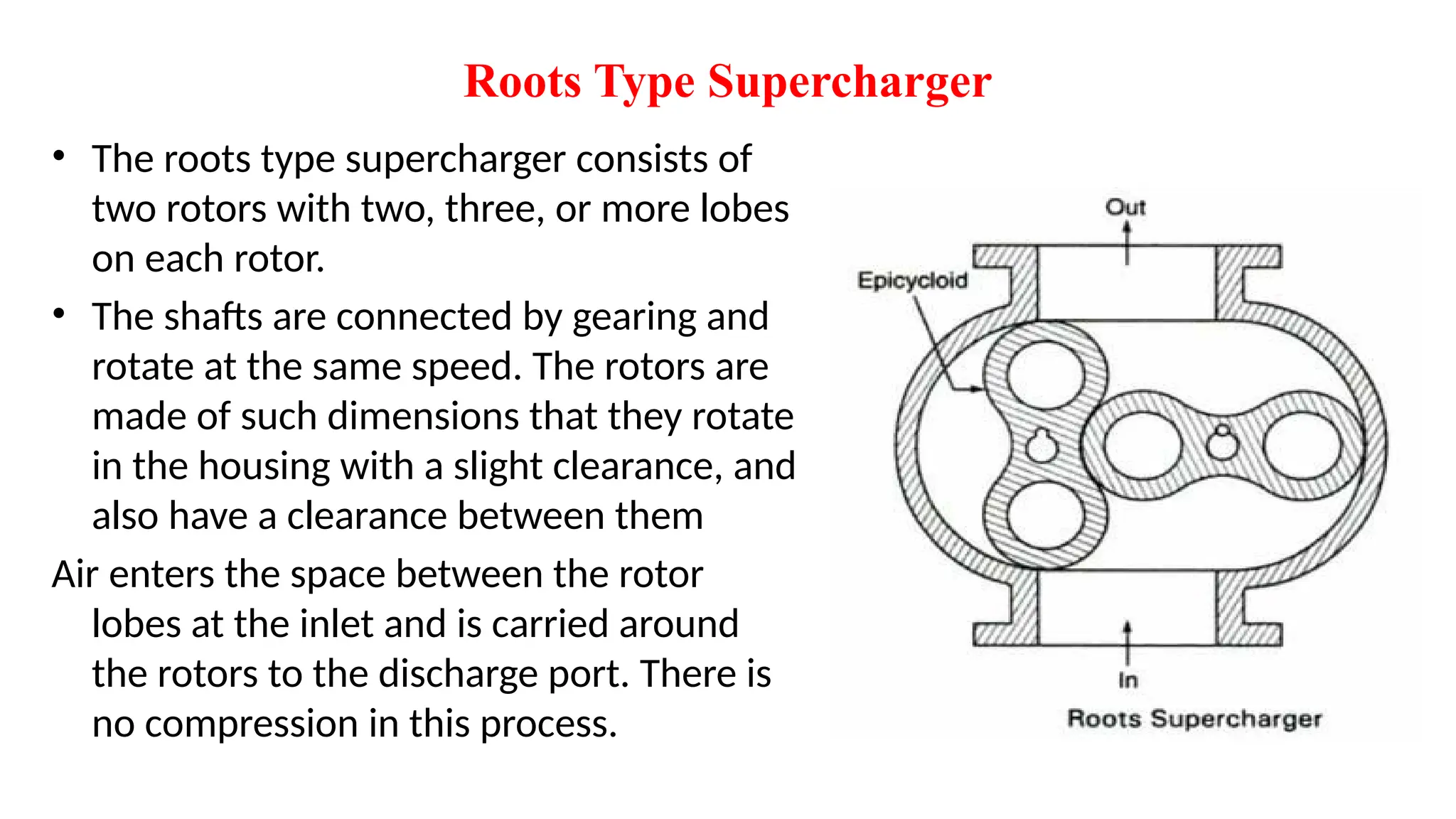
Roots Type Supercharger
•The roots type supercharger consists of
two rotors with two, three, or more lobes
on each rotor.
• The shafts are connected by gearing and
rotate at the same speed. The rotors are
made of such dimensions that they rotate
in the housing with a slight clearance, and
also have a clearance between them
Air enters the space between the rotor
lobes at the inlet and is carried around
the rotors to the discharge port. There is
no compression in this process.
20.
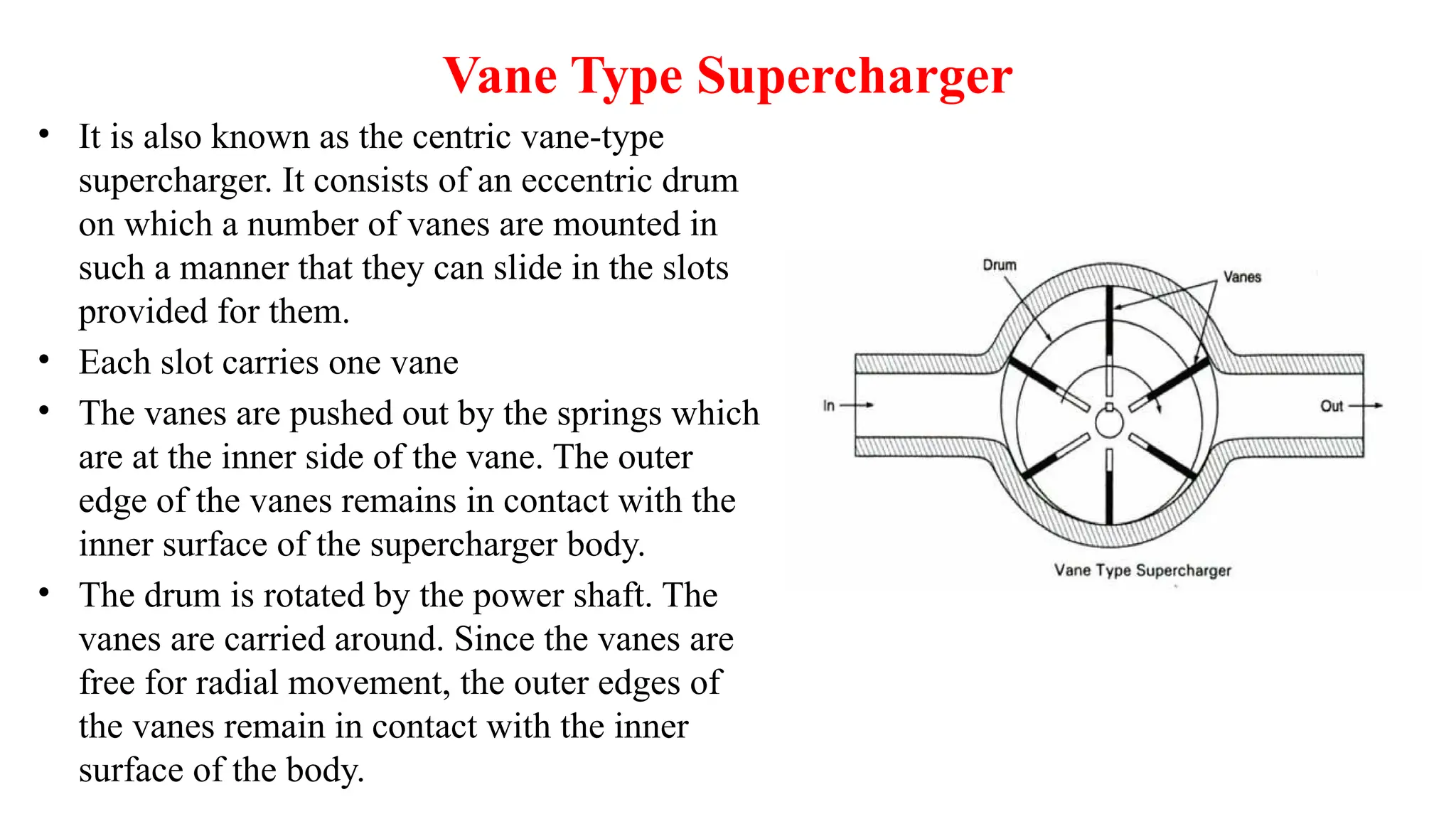
Vane Type Supercharger
•It is also known as the centric vane-type
supercharger. It consists of an eccentric drum
on which a number of vanes are mounted in
such a manner that they can slide in the slots
provided for them.
• Each slot carries one vane
• The vanes are pushed out by the springs which
are at the inner side of the vane. The outer
edge of the vanes remains in contact with the
inner surface of the supercharger body.
• The drum is rotated by the power shaft. The
vanes are carried around. Since the vanes are
free for radial movement, the outer edges of
the vanes remain in contact with the inner
surface of the body.
21.
Fuel supply systemin CI engines
• The fuel supply system of a diesel engine can be called as the heart of
the engine, since the engine performance directly depends upon the
proper functioning of this system—which must supply, meter, inject and
atomize the fuel.
• Fuel injection systems are manufactured with great accuracy, hence
they are costlier.
• Fuel will flow either because of gravity or fuel feed pump, which is
provided to supply fuel through the filter to the injection pump. Which
pumps the fuel to the injectors which are provided in the cylinder heads.
22.
Fuel injection system
•The function of fuel injection system is to inject proper quantity of fuel into
the engine cylinders at the correct tome and at predetermined rate. These
systems may be classified into two systems.
• Solid injection system
• Air injection system
• In the solid injection system only the liquid fuel is injected, whereas in the
air injection system liquid fuel is injected along with compressed air.
• The air injection system is less reliable, less efficient and requires an air
compressor for supplying air at 7 Mpa or higher pressure. Due to which
reasons it become obsolete.
23.
Fuel injection system
Twotypes of solid injection systems are in use
1. common rail fuel injection system
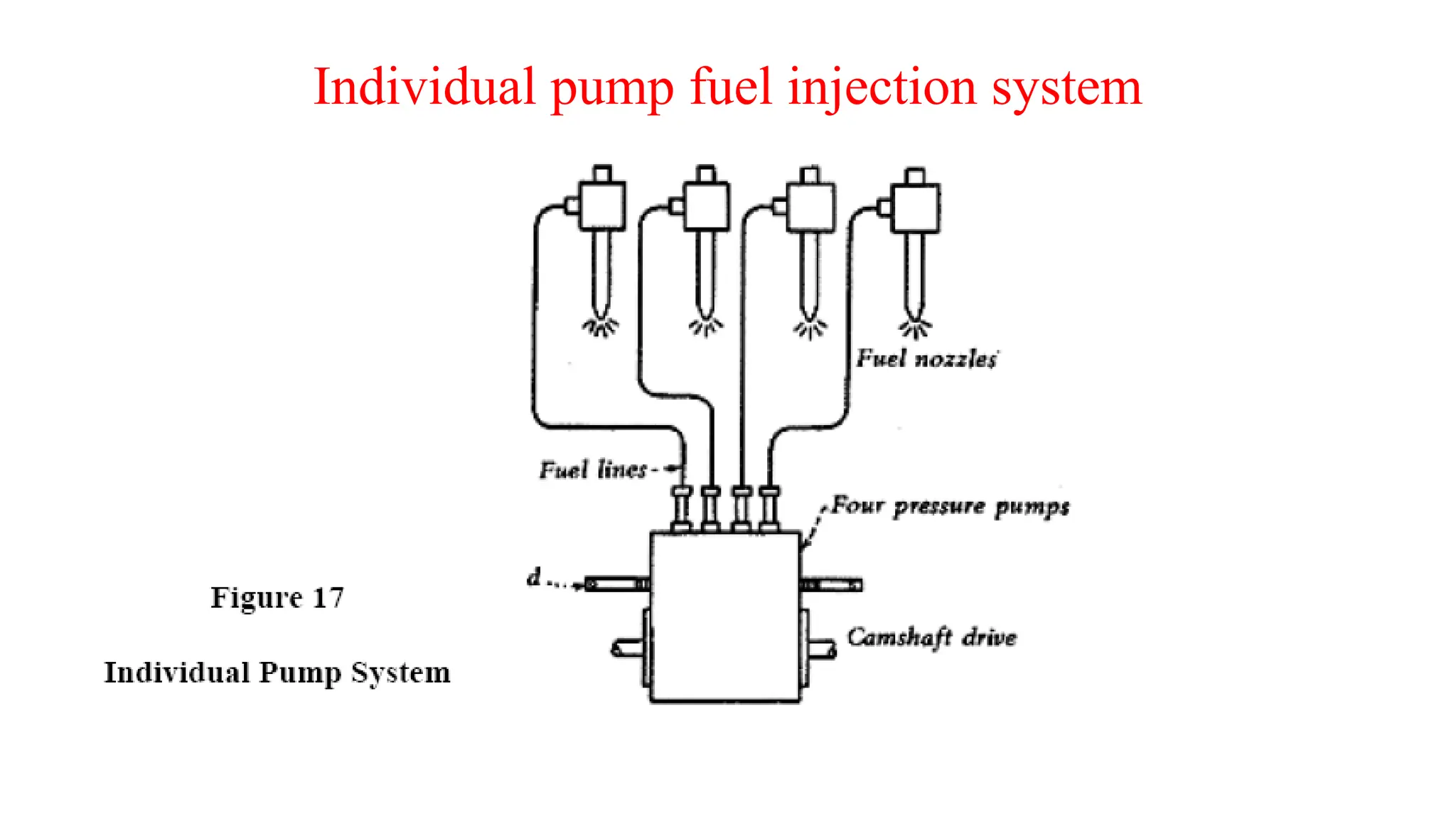
2. Individual pump fuel injection system
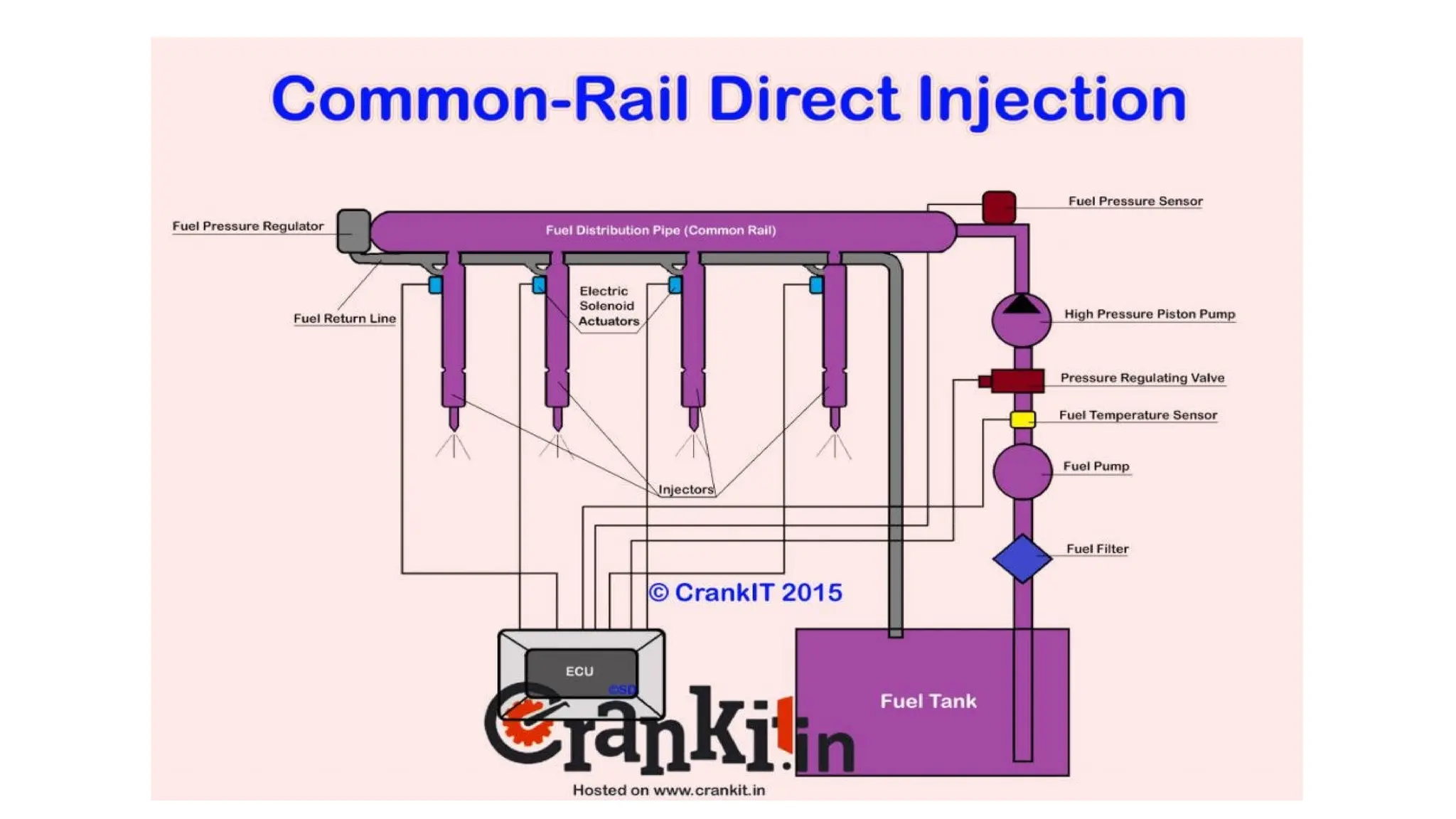
Most modern engine fuel systems use an advanced technology known as CRDI or
Common Rail Direct Injection. Besides, both petrol and diesel engines use a
common ‘fuel rail,’ which supplies the fuel to injectors.
• In individual pump injection system fuel will flow from the storage tank to
filters to low pressure pumps. This low pressure pump pumps the fuel to 4
separate metering and pressure pumps.
• These separate metering and pressure pumps will pump the fuel to individual
injectors which are provided in the cylinder heads. These are used in large slow
speed engines.
Fuel injection pump
•Fuel injection pump (FIP) is the device used in the diesel engine for pumping
the fuel to the injectors and it also helps to distribute and meter the supply of
fuel to all injectors. The other function of the FIP is to pump the correct
quantity of fuel at the right time (Just before the piston reaches TDC during
compression stroke) and within a specified duration.
• In ECU-controlled vehicles, the fuel injection pump is only used to pressurize
the fuel line as the distribution of fuel is controlled with the help of electric
injectors and ECU units.
• The fuel injection pumps are driven with the help of a crankshaft or by the
camshaft.
• different types of fuel injection pumps used in diesel engines:-
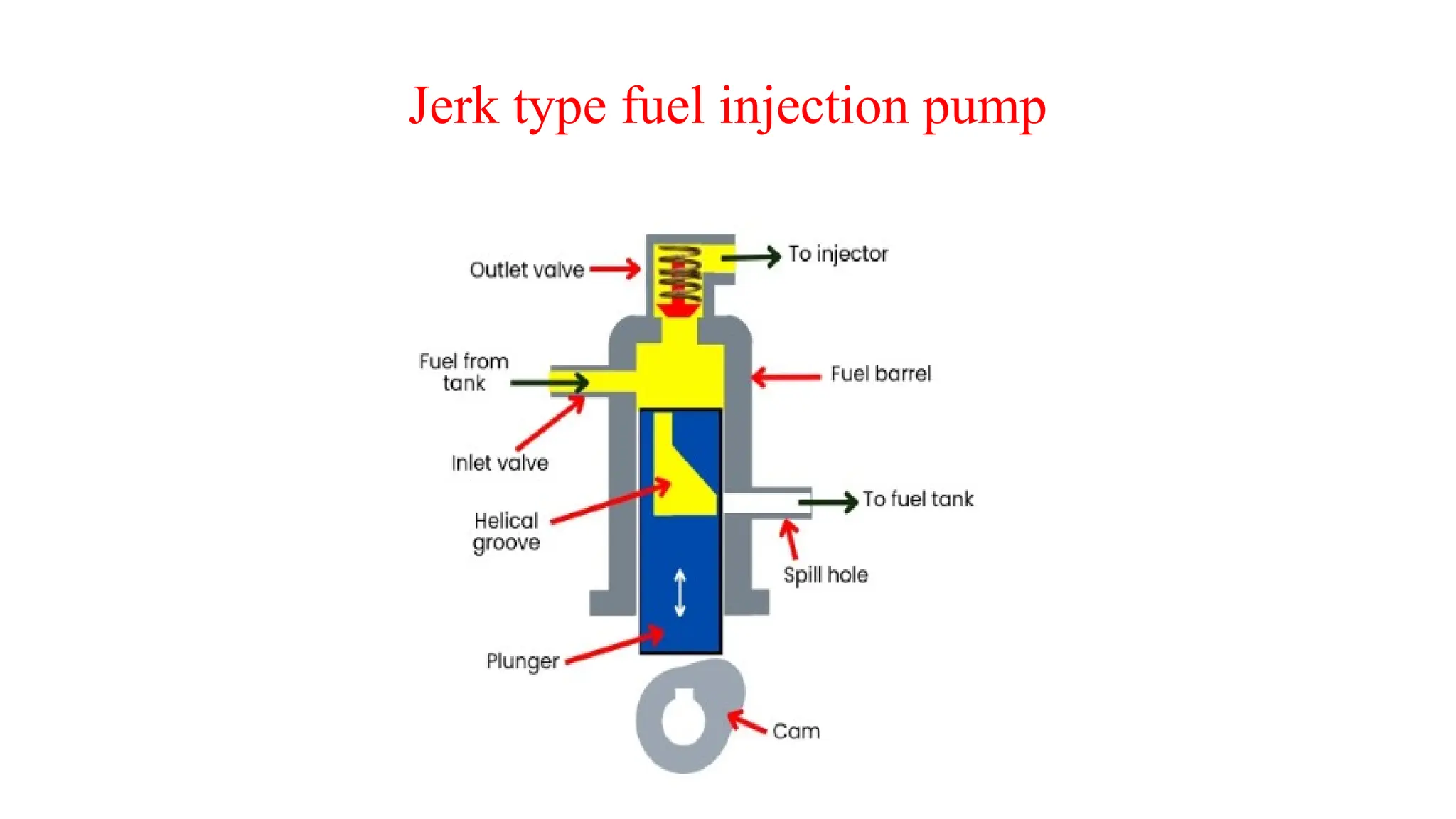
1. Inline fuel injection pump or jerk type fuel injection pump
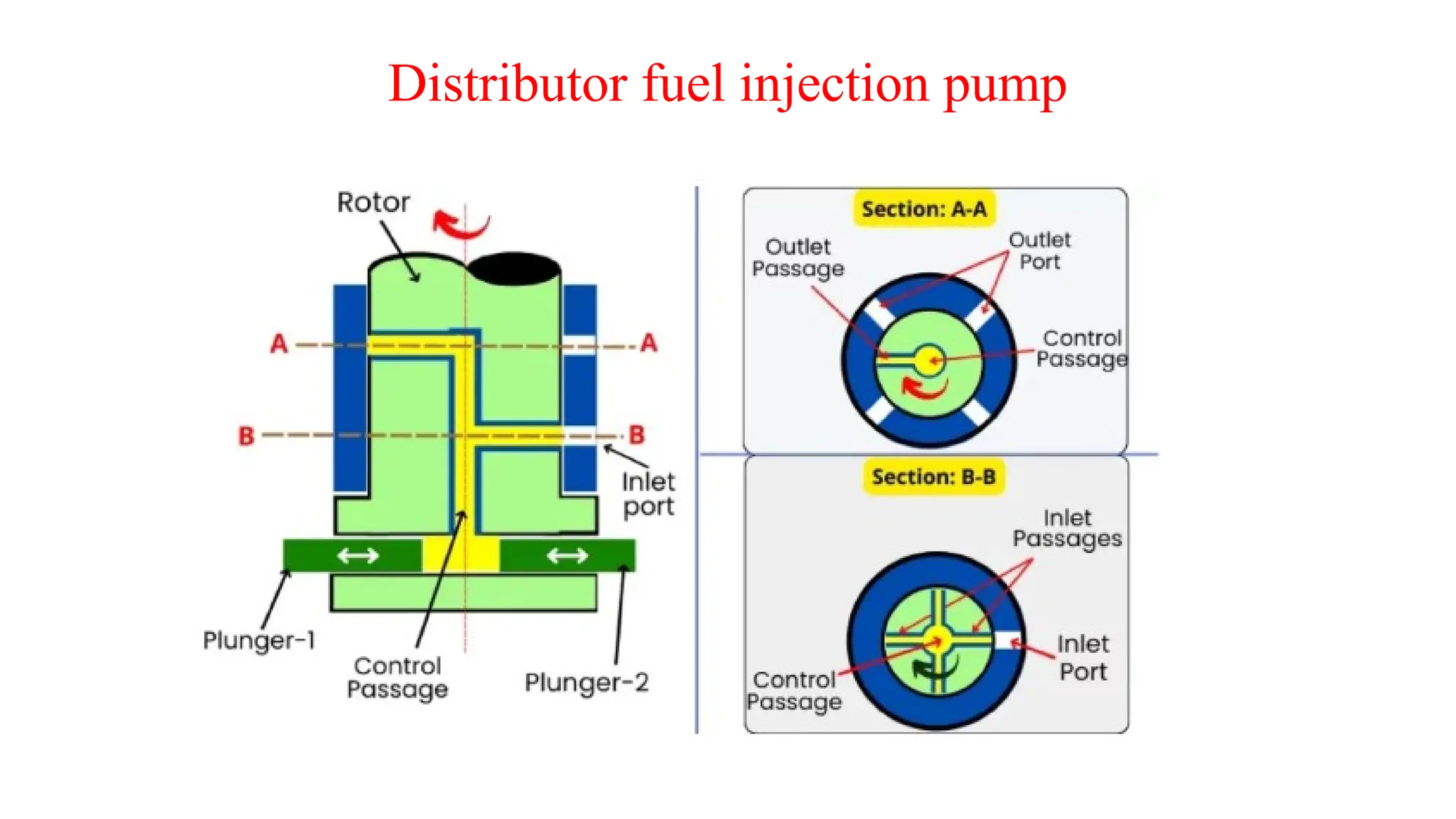
2. Distributor fuel injection pump.
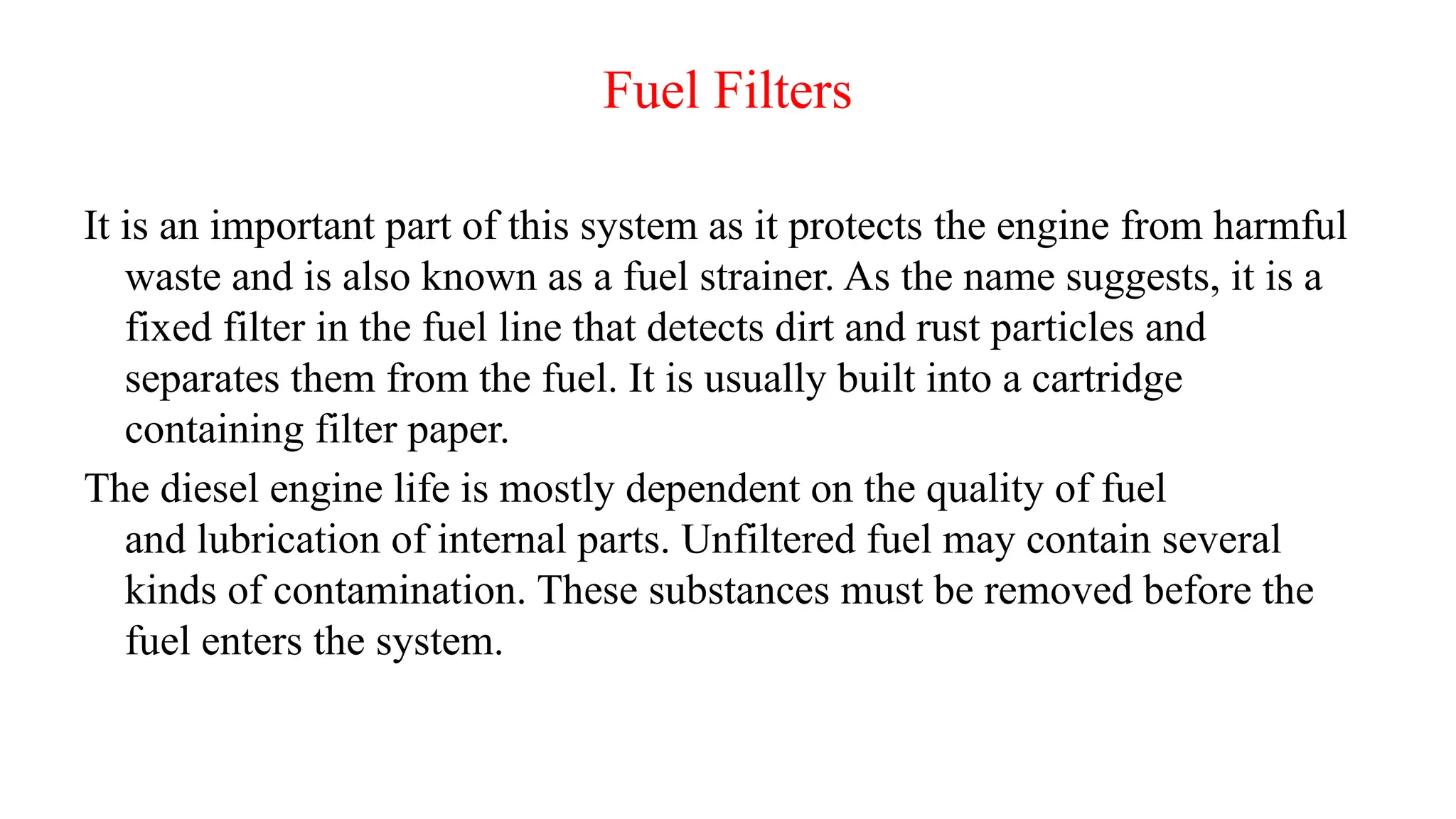
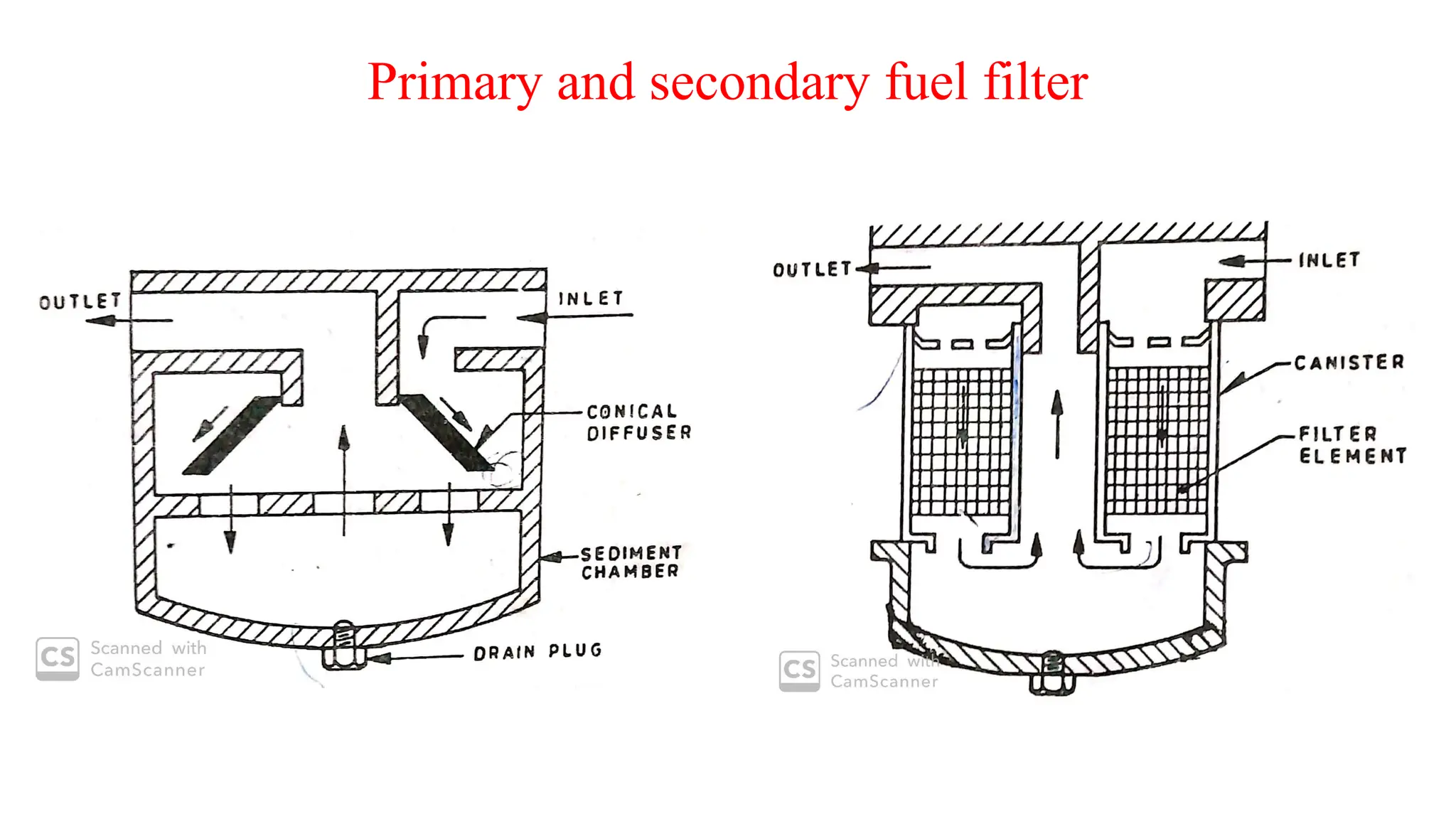
Fuel Filters
It isan important part of this system as it protects the engine from harmful
waste and is also known as a fuel strainer. As the name suggests, it is a
fixed filter in the fuel line that detects dirt and rust particles and
separates them from the fuel. It is usually built into a cartridge
containing filter paper.
The diesel engine life is mostly dependent on the quality of fuel
and lubrication of internal parts. Unfiltered fuel may contain several
kinds of contamination. These substances must be removed before the
fuel enters the system.
Fuel feed pump
Thefunction of feed pump is to deliver the fuel from the fuel tank
to fuel injection pump through the fuel filter. The feed pump is
attached to the injection pump and driven by its camshaft.
• Where is fuel feed pump mounted in diesel engine?
• Specific designs vary, but in the most common configuration,
these pumps are mounted on the side of the injection pump and
driven by the camshaft, either directly or via a pushrod.
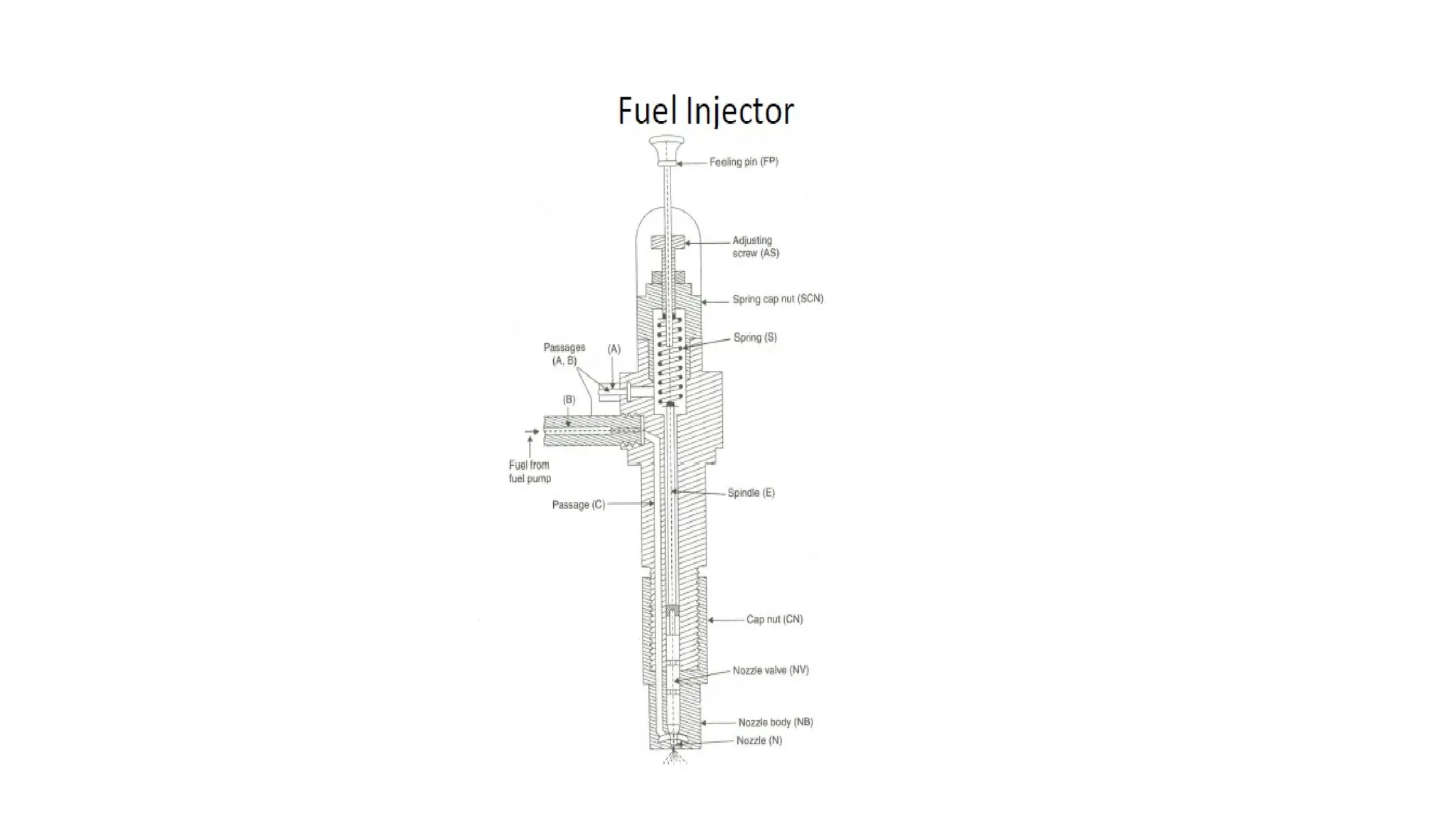
33.
• It consistof a nozzle valve(NV) fitted in the nozzle body (NB). The nozzle
valve is held on its seat by a spring ‘S’ which exerts pressure through
spindle E. ‘AS’ is the adjusting screw by which nozzle valve lift can be
adjusted. Usually the nozzle valve is set to lift at 135 to 175 bars pressure.
FP is the feeling pin which indicates whether valve is working properly or
not
• The fuel under pressure from the fuel pump enters the injector through the
passages B and C and lifts the nozzle valve. The fuel travels down nozzle
N and injected into the engine cylinder in the form of fine spray. Then the
pressure of the oil falls, the nozzle valve occupies its seat under the spring
force and fuel supply is cut off. Any leakage of fuel accumulated above the
valve is led to the fuel tank through passage A. The leakage occurs when
the nozzle valve is worn out.