PREPARED BY: ENGR. C. DULLAS
INTRODUCTION
 Control systems are an integral part of modern
society. Numerous applications are all around us:
The rockets fire, and the space shuttle lifts off to
earth orbit; in splashing cooling water, a metallic
part is automatically machined; a self-guided
vehicle delivering material to workstations in an
aerospace assembly plant glides along the floor
seeking its destination. These are just a few
examples of the automatically controlled systems
that we can create.
Intended Learning
Outcomes
A. Define a control system and describe some
applications.
B. Describe the basic features and configurations of
control systems.
C. Describe control systems analysis and design
objectives.
D. Describe a control system’s design process.
Chapter 1:
Introduction to Control Systems
 Control engineering is based on the foundations of feedback theory
and linear system analysis, and it generates the concepts of network
theory and communication theory. Accordingly, control engineering is
not limited to any engineering discipline but is applicable to
aeronautical, chemical, mechanical, environmental, civil, and electrical
engineering.
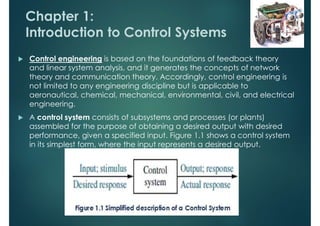
 A control system consists of subsystems and processes (or plants)
assembled for the purpose of obtaining a desired output with desired
performance, given a specified input. Figure 1.1 shows a control system
in its simplest form, where the input represents a desired output.
Chapter 1:
Introduction to Control Systems
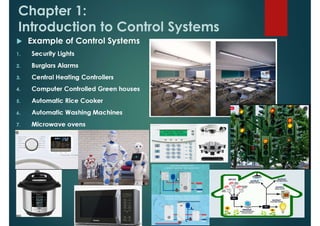
 Example of Control Systems
1. Security Lights
2. Burglars Alarms
3. Central Heating Controllers
4. Computer Controlled Green houses
5. Automatic Rice Cooker
6. Automatic Washing Machines
7. Microwave ovens
Chapter 1:
Introduction to Control Systems
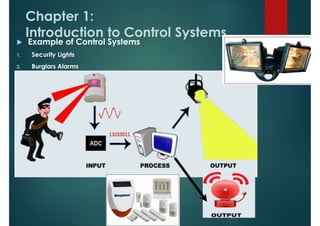
 Example of Control Systems
1. Security Lights
2. Burglars Alarms
Chapter 1:
Introduction to Control Systems
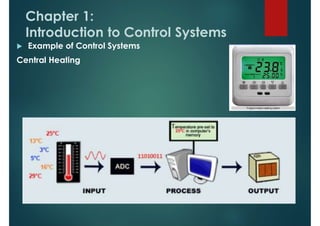
 Example of Control Systems
Central Heating
Chapter 1:
Introduction to Control Systems
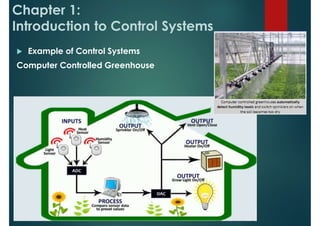
 Example of Control Systems
Computer Controlled Greenhouse
Chapter 1:
Introduction to Control Systems
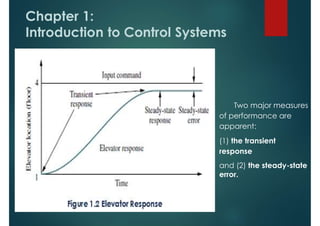
Two major measures
of performance are
apparent:
(1) the transient
response
and (2) the steady-state
error.
Chapter 1:
Introduction to Control Systems
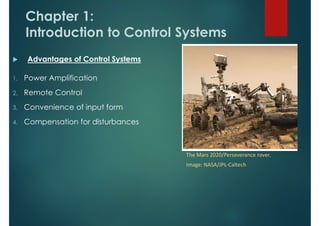
 Advantages of Control Systems
1. Power Amplification
2. Remote Control
3. Convenience of input form
4. Compensation for disturbances
The Mars 2020/Perseverance rover.
Image: NASA/JPL-Caltech
Chapter 1:
Introduction to Control Systems
 Classification of Control Systems
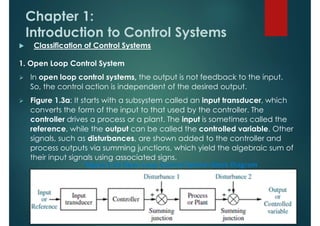
1. Open Loop Control System
 In open loop control systems, the output is not feedback to the input.
So, the control action is independent of the desired output.
 Figure 1.3a: It starts with a subsystem called an input transducer, which
converts the form of the input to that used by the controller. The
controller drives a process or a plant. The input is sometimes called the
reference, while the output can be called the controlled variable. Other
signals, such as disturbances, are shown added to the controller and
process outputs via summing junctions, which yield the algebraic sum of
their input signals using associated signs.
Chapter 1:
Introduction to Control Systems
 Classification of Control Systems
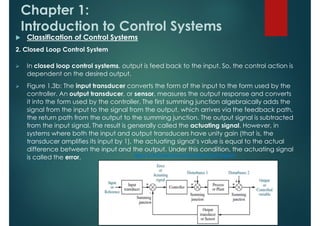
2. Closed Loop Control System
 In closed loop control systems, output is feed back to the input. So, the control action is
dependent on the desired output.
 Figure 1.3b: The input transducer converts the form of the input to the form used by the
controller. An output transducer, or sensor, measures the output response and converts
it into the form used by the controller. The first summing junction algebraically adds the
signal from the input to the signal from the output, which arrives via the feedback path,
the return path from the output to the summing junction. The output signal is subtracted
from the input signal. The result is generally called the actuating signal. However, in
systems where both the input and output transducers have unity gain (that is, the
transducer amplifies its input by 1), the actuating signal’s value is equal to the actual
difference between the input and the output. Under this condition, the actuating signal
is called the error.
Chapter 1:
Introduction to Control Systems
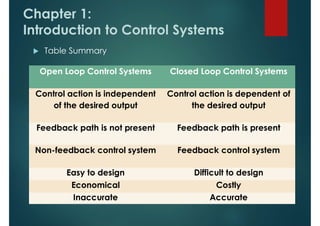
 Table Summary
Open Loop Control Systems Closed Loop Control Systems
Control action is independent
of the desired output
Control action is dependent of
the desired output
Feedback path is not present Feedback path is present
Non-feedback control system Feedback control system
Easy to design Difficult to design
Economical Costly
Inaccurate Accurate
Chapter 1:
Introduction to Control Systems
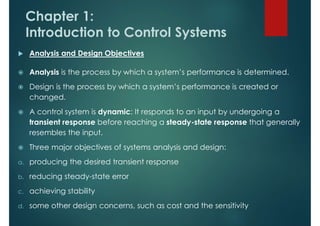
 Analysis and Design Objectives
 Analysis is the process by which a system’s performance is determined.
 Design is the process by which a system’s performance is created or
changed.
 A control system is dynamic: It responds to an input by undergoing a
transient response before reaching a steady-state response that generally
resembles the input.
 Three major objectives of systems analysis and design:
a. producing the desired transient response
b. reducing steady-state error
c. achieving stability
d. some other design concerns, such as cost and the sensitivity
Chapter 1:
Introduction to Control Systems
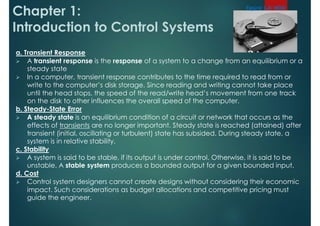
a. Transient Response
 A transient response is the response of a system to a change from an equilibrium or a
steady state
 In a computer, transient response contributes to the time required to read from or
write to the computer’s disk storage. Since reading and writing cannot take place
until the head stops, the speed of the read/write head’s movement from one track
on the disk to other influences the overall speed of the computer.
b. Steady-State Error
 A steady state is an equilibrium condition of a circuit or network that occurs as the
effects of transients are no longer important. Steady state is reached (attained) after
transient (initial, oscillating or turbulent) state has subsided. During steady state, a
system is in relative stability.
c. Stability
 A system is said to be stable, if its output is under control. Otherwise, it is said to be
unstable. A stable system produces a bounded output for a given bounded input.
d. Cost
 Control system designers cannot create designs without considering their economic
impact. Such considerations as budget allocations and competitive pricing must
guide the engineer.
Chapter 1:
Introduction to Control Systems
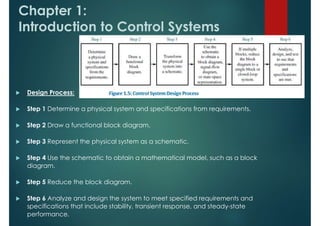
 Design Process:
 Step 1 Determine a physical system and specifications from requirements.
 Step 2 Draw a functional block diagram.
 Step 3 Represent the physical system as a schematic.
 Step 4 Use the schematic to obtain a mathematical model, such as a block
diagram.
 Step 5 Reduce the block diagram.
 Step 6 Analyze and design the system to meet specified requirements and
specifications that include stability, transient response, and steady-state
performance.
Chapter 1:
Introduction to Control Systems
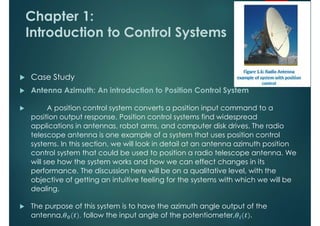
 Case Study
 Antenna Azimuth: An introduction to Position Control System
 A position control system converts a position input command to a
position output response. Position control systems find widespread
applications in antennas, robot arms, and computer disk drives. The radio
telescope antenna is one example of a system that uses position control
systems. In this section, we will look in detail at an antenna azimuth position
control system that could be used to position a radio telescope antenna. We
will see how the system works and how we can effect changes in its
performance. The discussion here will be on a qualitative level, with the
objective of getting an intuitive feeling for the systems with which we will be
dealing.
 The purpose of this system is to have the azimuth angle output of the
antenna, 𝟎 , follow the input angle of the potentiometer, 𝒊 .
Chapter 1:
Introduction to Control Systems
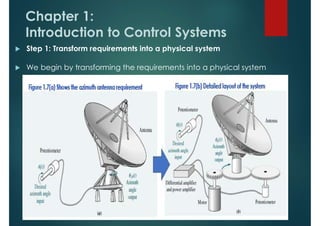
 Step 1: Transform requirements into a physical system
 We begin by transforming the requirements into a physical system
Chapter 1:
Introduction to Control Systems
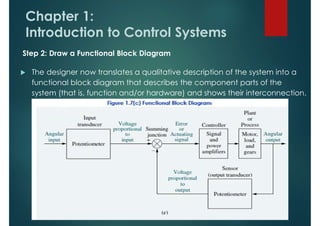
Step 2: Draw a Functional Block Diagram
 The designer now translates a qualitative description of the system into a
functional block diagram that describes the component parts of the
system (that is, function and/or hardware) and shows their interconnection.
Chapter 1:
Introduction to Control Systems
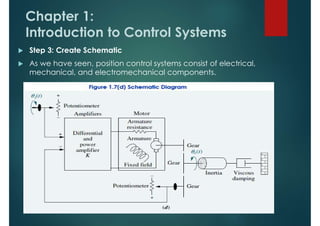
 Step 3: Create Schematic
 As we have seen, position control systems consist of electrical,
mechanical, and electromechanical components.
Chapter 1:
Introduction to Control Systems
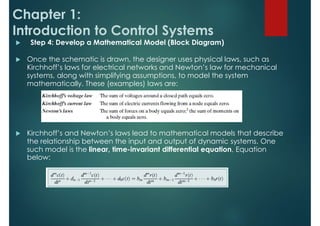
 Step 4: Develop a Mathematical Model (Block Diagram)
 Once the schematic is drawn, the designer uses physical laws, such as
Kirchhoff’s laws for electrical networks and Newton’s law for mechanical
systems, along with simplifying assumptions, to model the system
mathematically. These (examples) laws are:
 Kirchhoff’s and Newton’s laws lead to mathematical models that describe
the relationship between the input and output of dynamic systems. One
such model is the linear, time-invariant differential equation, Equation
below:
Chapter 1:
Introduction to Control Systems
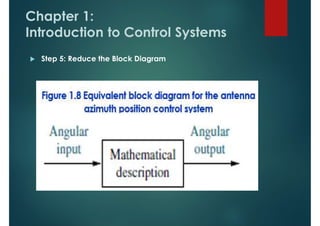
 Step 5: Reduce the Block Diagram
Chapter 1:
Introduction to Control Systems
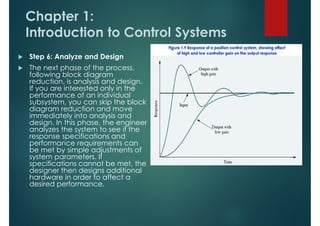
 Step 6: Analyze and Design
 The next phase of the process,
following block diagram
reduction, is analysis and design.
If you are interested only in the
performance of an individual
subsystem, you can skip the block
diagram reduction and move
immediately into analysis and
design. In this phase, the engineer
analyzes the system to see if the
response specifications and
performance requirements can
be met by simple adjustments of
system parameters. If
specifications cannot be met, the
designer then designs additional
hardware in order to affect a
desired performance.
Chapter 1:
Introduction to Control Systems
Next Topic:
LAPLACE TRANSFORM

ME416A_Module 1.pdf

  • 1.
  • 2.
    INTRODUCTION  Control systemsare an integral part of modern society. Numerous applications are all around us: The rockets fire, and the space shuttle lifts off to earth orbit; in splashing cooling water, a metallic part is automatically machined; a self-guided vehicle delivering material to workstations in an aerospace assembly plant glides along the floor seeking its destination. These are just a few examples of the automatically controlled systems that we can create.
  • 3.
    Intended Learning Outcomes A. Definea control system and describe some applications. B. Describe the basic features and configurations of control systems. C. Describe control systems analysis and design objectives. D. Describe a control system’s design process.
  • 4.
    Chapter 1: Introduction toControl Systems  Control engineering is based on the foundations of feedback theory and linear system analysis, and it generates the concepts of network theory and communication theory. Accordingly, control engineering is not limited to any engineering discipline but is applicable to aeronautical, chemical, mechanical, environmental, civil, and electrical engineering.  A control system consists of subsystems and processes (or plants) assembled for the purpose of obtaining a desired output with desired performance, given a specified input. Figure 1.1 shows a control system in its simplest form, where the input represents a desired output.
  • 5.
    Chapter 1: Introduction toControl Systems  Example of Control Systems 1. Security Lights 2. Burglars Alarms 3. Central Heating Controllers 4. Computer Controlled Green houses 5. Automatic Rice Cooker 6. Automatic Washing Machines 7. Microwave ovens
  • 6.
    Chapter 1: Introduction toControl Systems  Example of Control Systems 1. Security Lights 2. Burglars Alarms
  • 7.
    Chapter 1: Introduction toControl Systems  Example of Control Systems Central Heating
  • 8.
    Chapter 1: Introduction toControl Systems  Example of Control Systems Computer Controlled Greenhouse
  • 9.
    Chapter 1: Introduction toControl Systems Two major measures of performance are apparent: (1) the transient response and (2) the steady-state error.
  • 10.
    Chapter 1: Introduction toControl Systems  Advantages of Control Systems 1. Power Amplification 2. Remote Control 3. Convenience of input form 4. Compensation for disturbances The Mars 2020/Perseverance rover. Image: NASA/JPL-Caltech
  • 11.
    Chapter 1: Introduction toControl Systems  Classification of Control Systems 1. Open Loop Control System  In open loop control systems, the output is not feedback to the input. So, the control action is independent of the desired output.  Figure 1.3a: It starts with a subsystem called an input transducer, which converts the form of the input to that used by the controller. The controller drives a process or a plant. The input is sometimes called the reference, while the output can be called the controlled variable. Other signals, such as disturbances, are shown added to the controller and process outputs via summing junctions, which yield the algebraic sum of their input signals using associated signs.
  • 12.
    Chapter 1: Introduction toControl Systems  Classification of Control Systems 2. Closed Loop Control System  In closed loop control systems, output is feed back to the input. So, the control action is dependent on the desired output.  Figure 1.3b: The input transducer converts the form of the input to the form used by the controller. An output transducer, or sensor, measures the output response and converts it into the form used by the controller. The first summing junction algebraically adds the signal from the input to the signal from the output, which arrives via the feedback path, the return path from the output to the summing junction. The output signal is subtracted from the input signal. The result is generally called the actuating signal. However, in systems where both the input and output transducers have unity gain (that is, the transducer amplifies its input by 1), the actuating signal’s value is equal to the actual difference between the input and the output. Under this condition, the actuating signal is called the error.
  • 13.
    Chapter 1: Introduction toControl Systems  Table Summary Open Loop Control Systems Closed Loop Control Systems Control action is independent of the desired output Control action is dependent of the desired output Feedback path is not present Feedback path is present Non-feedback control system Feedback control system Easy to design Difficult to design Economical Costly Inaccurate Accurate
  • 14.
    Chapter 1: Introduction toControl Systems  Analysis and Design Objectives  Analysis is the process by which a system’s performance is determined.  Design is the process by which a system’s performance is created or changed.  A control system is dynamic: It responds to an input by undergoing a transient response before reaching a steady-state response that generally resembles the input.  Three major objectives of systems analysis and design: a. producing the desired transient response b. reducing steady-state error c. achieving stability d. some other design concerns, such as cost and the sensitivity
  • 15.
    Chapter 1: Introduction toControl Systems a. Transient Response  A transient response is the response of a system to a change from an equilibrium or a steady state  In a computer, transient response contributes to the time required to read from or write to the computer’s disk storage. Since reading and writing cannot take place until the head stops, the speed of the read/write head’s movement from one track on the disk to other influences the overall speed of the computer. b. Steady-State Error  A steady state is an equilibrium condition of a circuit or network that occurs as the effects of transients are no longer important. Steady state is reached (attained) after transient (initial, oscillating or turbulent) state has subsided. During steady state, a system is in relative stability. c. Stability  A system is said to be stable, if its output is under control. Otherwise, it is said to be unstable. A stable system produces a bounded output for a given bounded input. d. Cost  Control system designers cannot create designs without considering their economic impact. Such considerations as budget allocations and competitive pricing must guide the engineer.
  • 16.
    Chapter 1: Introduction toControl Systems  Design Process:  Step 1 Determine a physical system and specifications from requirements.  Step 2 Draw a functional block diagram.  Step 3 Represent the physical system as a schematic.  Step 4 Use the schematic to obtain a mathematical model, such as a block diagram.  Step 5 Reduce the block diagram.  Step 6 Analyze and design the system to meet specified requirements and specifications that include stability, transient response, and steady-state performance.
  • 17.
    Chapter 1: Introduction toControl Systems  Case Study  Antenna Azimuth: An introduction to Position Control System  A position control system converts a position input command to a position output response. Position control systems find widespread applications in antennas, robot arms, and computer disk drives. The radio telescope antenna is one example of a system that uses position control systems. In this section, we will look in detail at an antenna azimuth position control system that could be used to position a radio telescope antenna. We will see how the system works and how we can effect changes in its performance. The discussion here will be on a qualitative level, with the objective of getting an intuitive feeling for the systems with which we will be dealing.  The purpose of this system is to have the azimuth angle output of the antenna, 𝟎 , follow the input angle of the potentiometer, 𝒊 .
  • 18.
    Chapter 1: Introduction toControl Systems  Step 1: Transform requirements into a physical system  We begin by transforming the requirements into a physical system
  • 19.
    Chapter 1: Introduction toControl Systems Step 2: Draw a Functional Block Diagram  The designer now translates a qualitative description of the system into a functional block diagram that describes the component parts of the system (that is, function and/or hardware) and shows their interconnection.
  • 20.
    Chapter 1: Introduction toControl Systems  Step 3: Create Schematic  As we have seen, position control systems consist of electrical, mechanical, and electromechanical components.
  • 21.
    Chapter 1: Introduction toControl Systems  Step 4: Develop a Mathematical Model (Block Diagram)  Once the schematic is drawn, the designer uses physical laws, such as Kirchhoff’s laws for electrical networks and Newton’s law for mechanical systems, along with simplifying assumptions, to model the system mathematically. These (examples) laws are:  Kirchhoff’s and Newton’s laws lead to mathematical models that describe the relationship between the input and output of dynamic systems. One such model is the linear, time-invariant differential equation, Equation below:
  • 22.
    Chapter 1: Introduction toControl Systems  Step 5: Reduce the Block Diagram
  • 23.
    Chapter 1: Introduction toControl Systems  Step 6: Analyze and Design  The next phase of the process, following block diagram reduction, is analysis and design. If you are interested only in the performance of an individual subsystem, you can skip the block diagram reduction and move immediately into analysis and design. In this phase, the engineer analyzes the system to see if the response specifications and performance requirements can be met by simple adjustments of system parameters. If specifications cannot be met, the designer then designs additional hardware in order to affect a desired performance.
  • 24.
  • 25.