PERMUTATIONS
Review
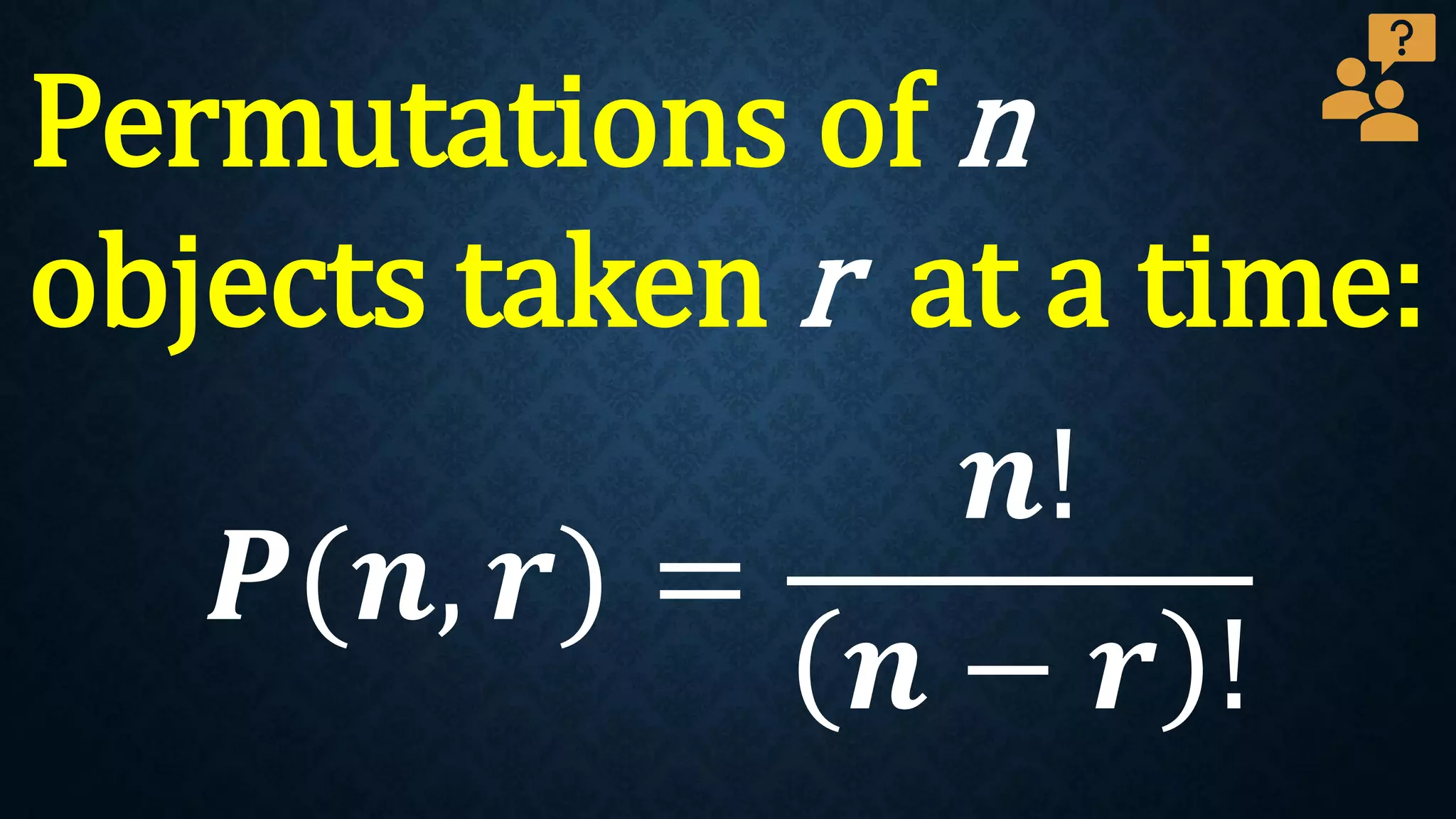
Permutations of n
objects taken r at a time:
𝑷(𝒏, 𝒓) =
𝒏!
𝒏 − 𝒓 !
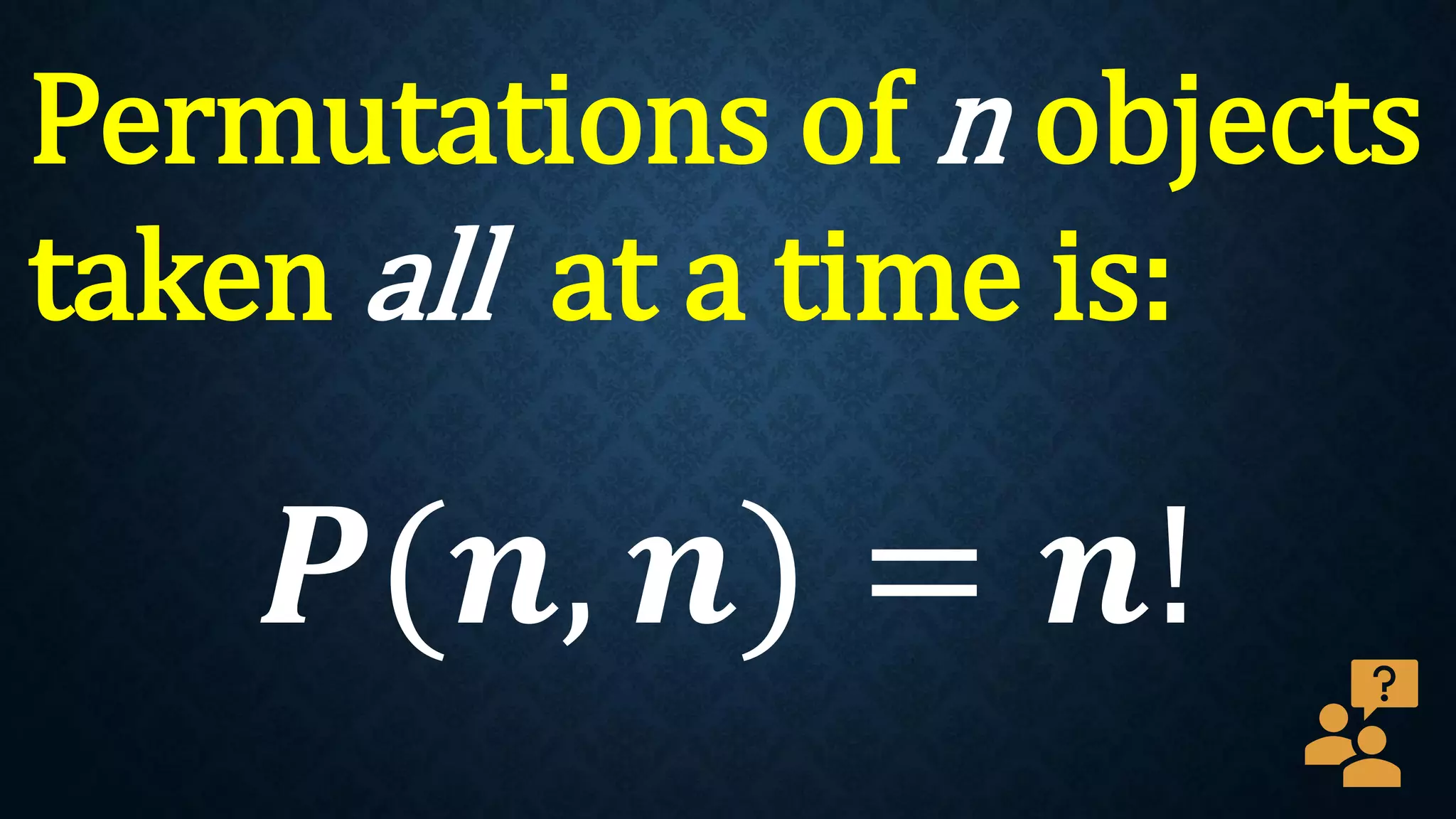
Permutations of n objects
taken all at a time is:
𝑷(𝒏, 𝒏) = 𝒏!
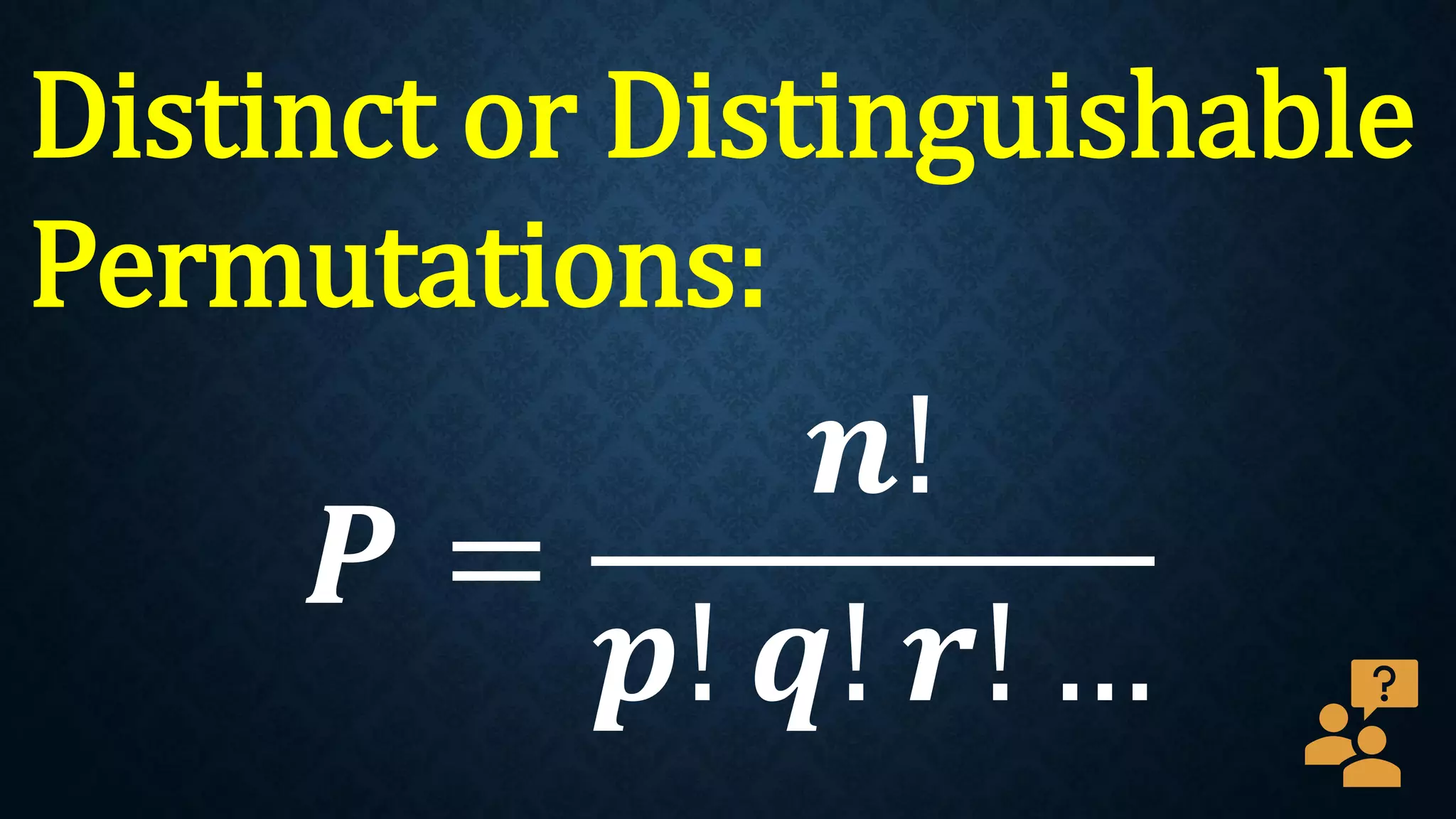
Distinct or Distinguishable
Permutations:
𝑷 =
𝒏!
𝒑! 𝒒! 𝒓! …
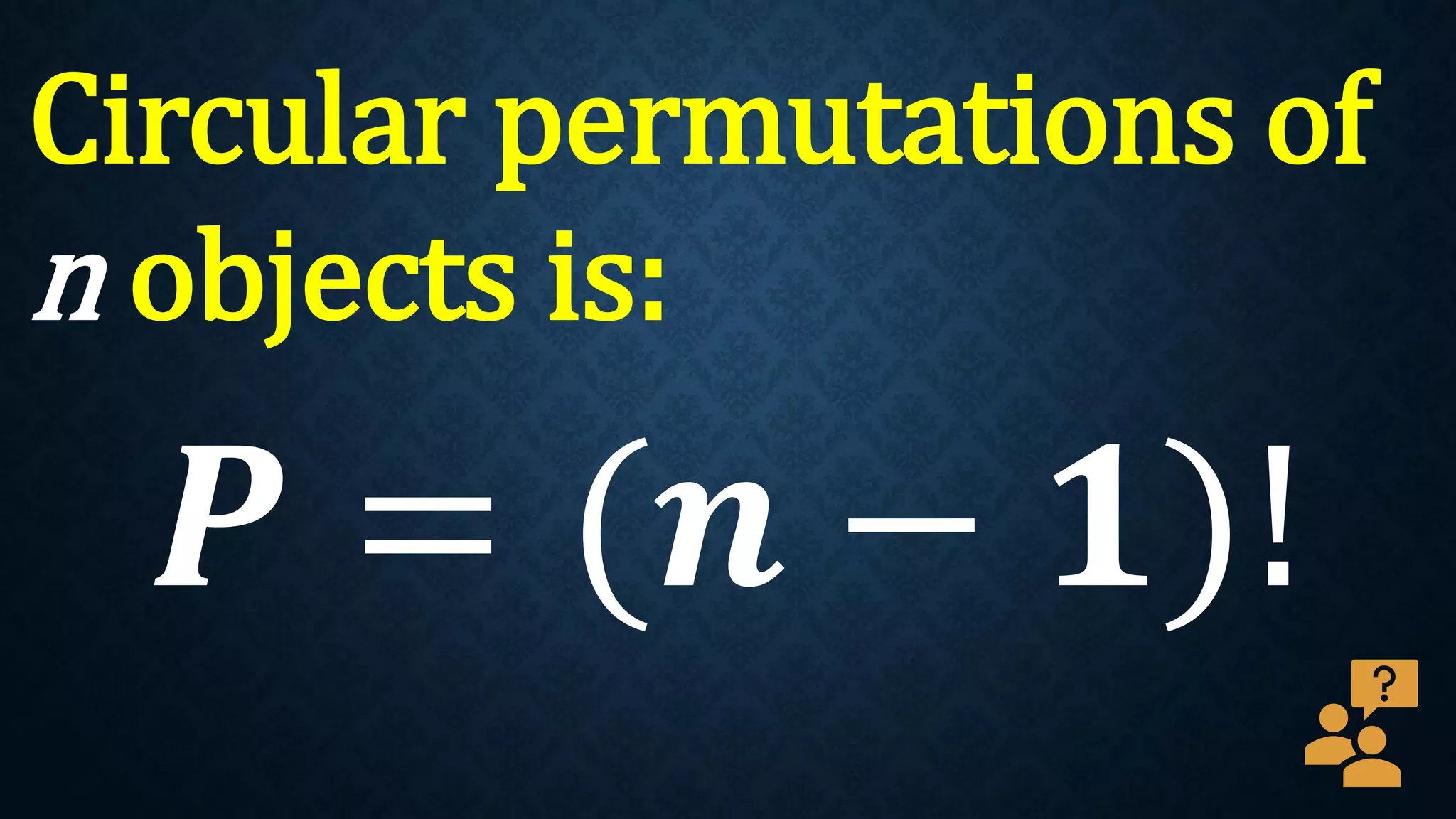
Circular permutations of
n objects is:
𝑷 = (𝒏 − 𝟏)!
Problems
1.) Ten runners join in a
race. In how many possible
ways can they be arranged
as 1st , 2nd , and 3rd placers?
2.) In how many ways
can Aling Rosa arrange
6 potted plants in a
row?
3.) Suppose that in a certain
association, there are 12 elected
members of the Board of Directors.
In how many ways can a president,
a vice president, a secretary, and a
treasurer be selected from the
board?
4.) In how many ways can
you place 9 different
books on a shelf if there is
space enough for only 5
books?
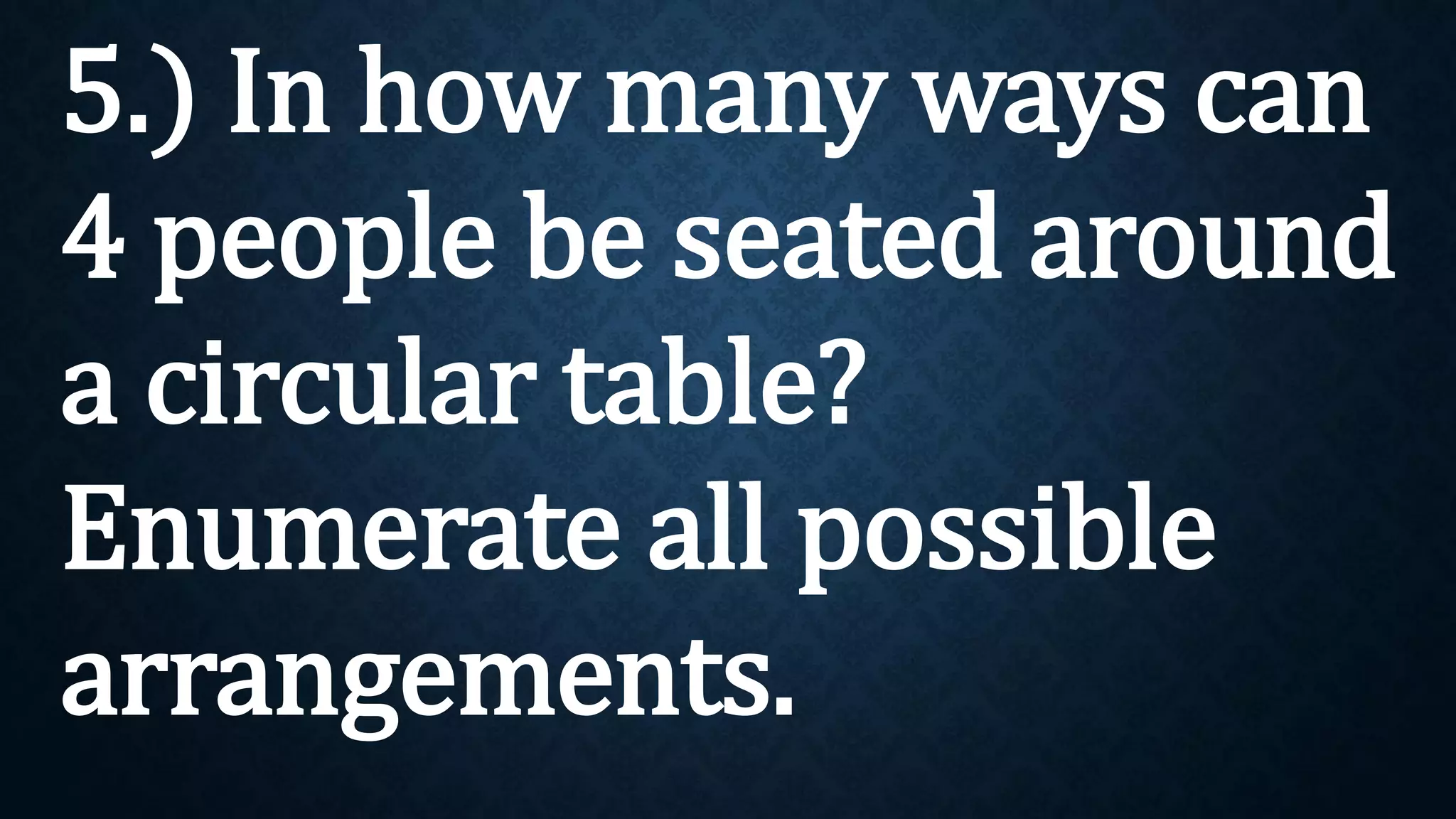
5.) In how many ways can
4 people be seated around
a circular table?
Enumerate all possible
arrangements.
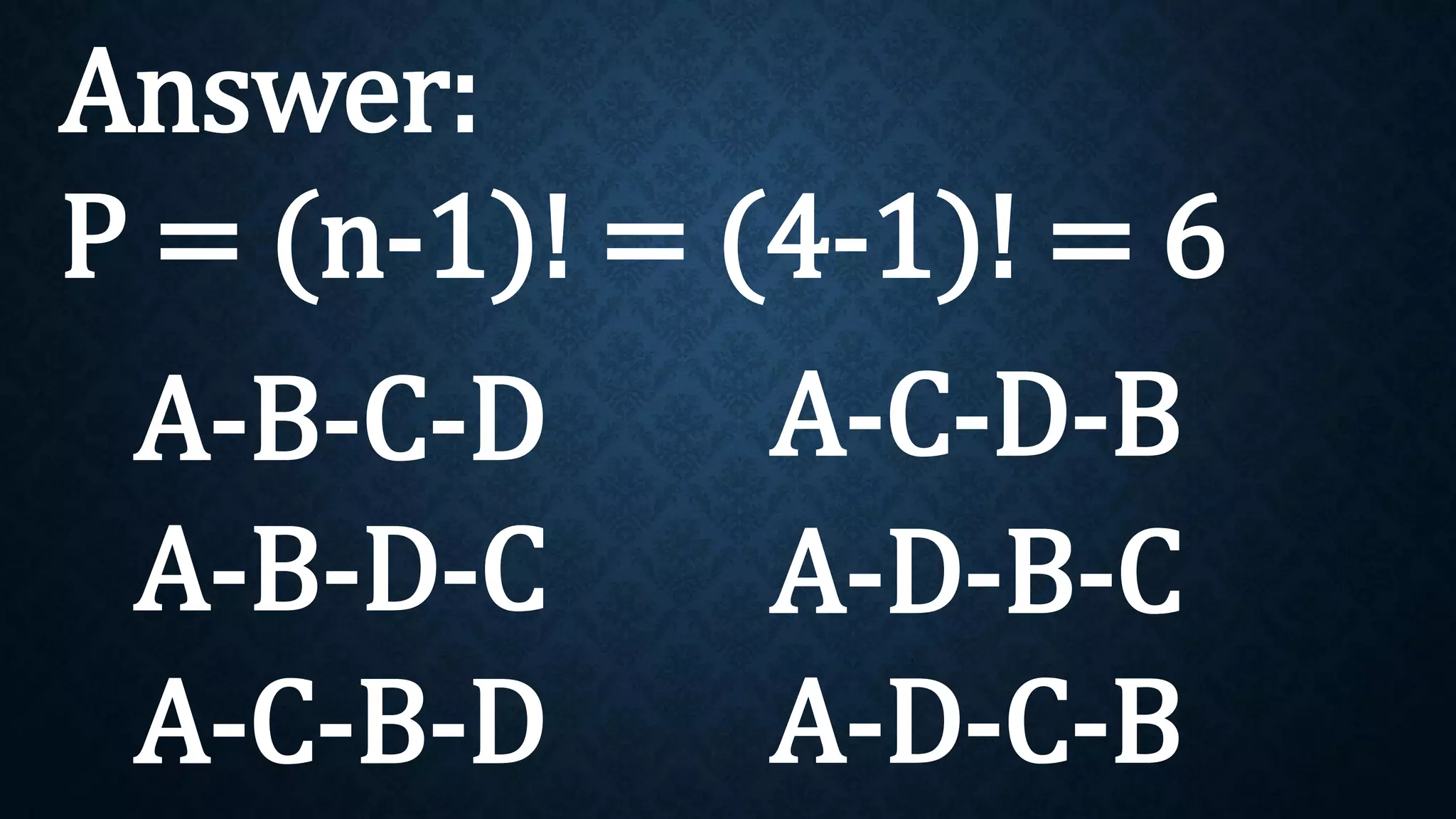
Answer:
P = (n-1)! = (4-1)! = 6
A-B-C-D
A-B-D-C
A-C-B-D
A-C-D-B
A-D-B-C
A-D-C-B
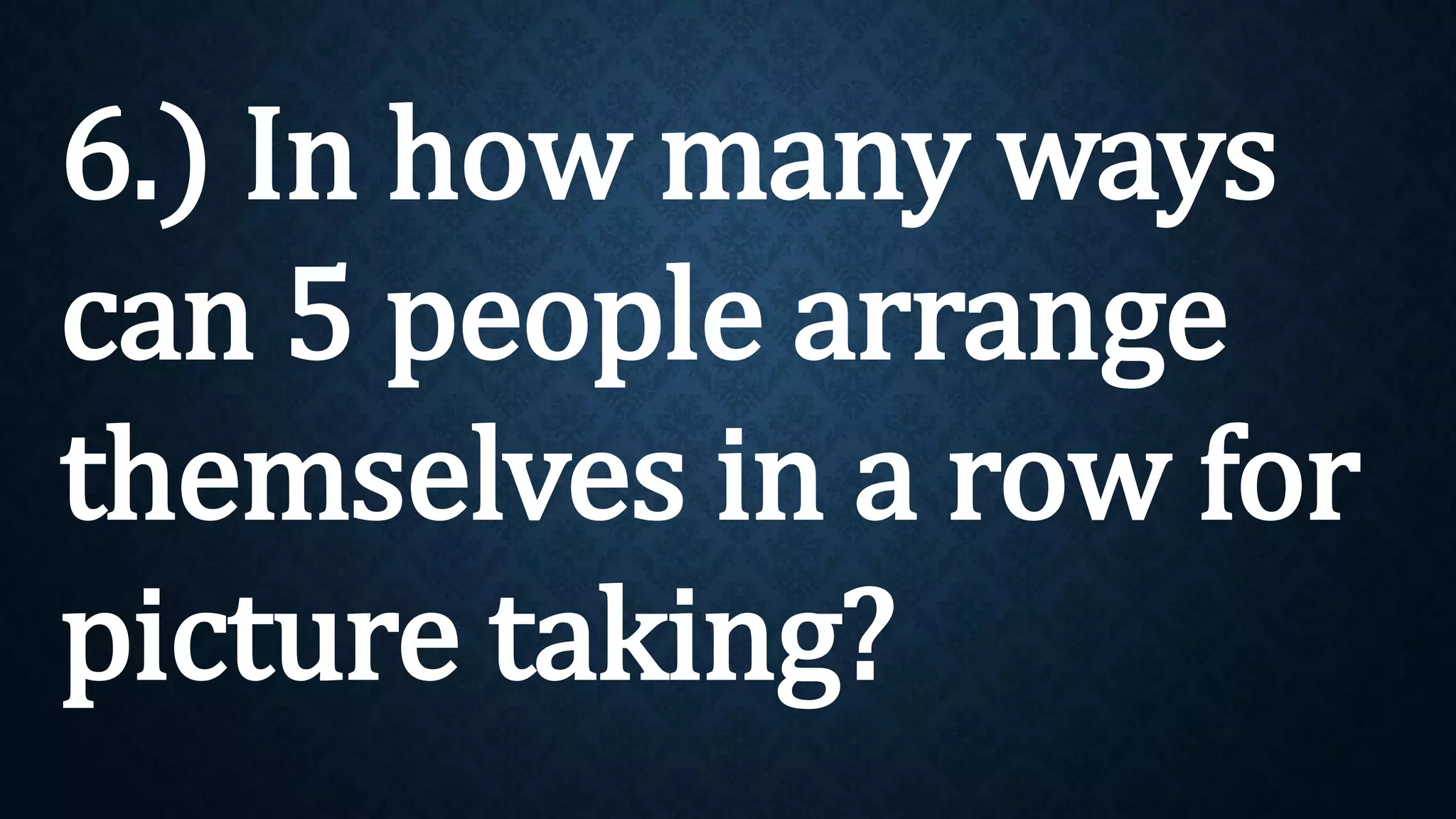
6.) In how many ways
can 5 people arrange
themselves in a row for
picture taking?
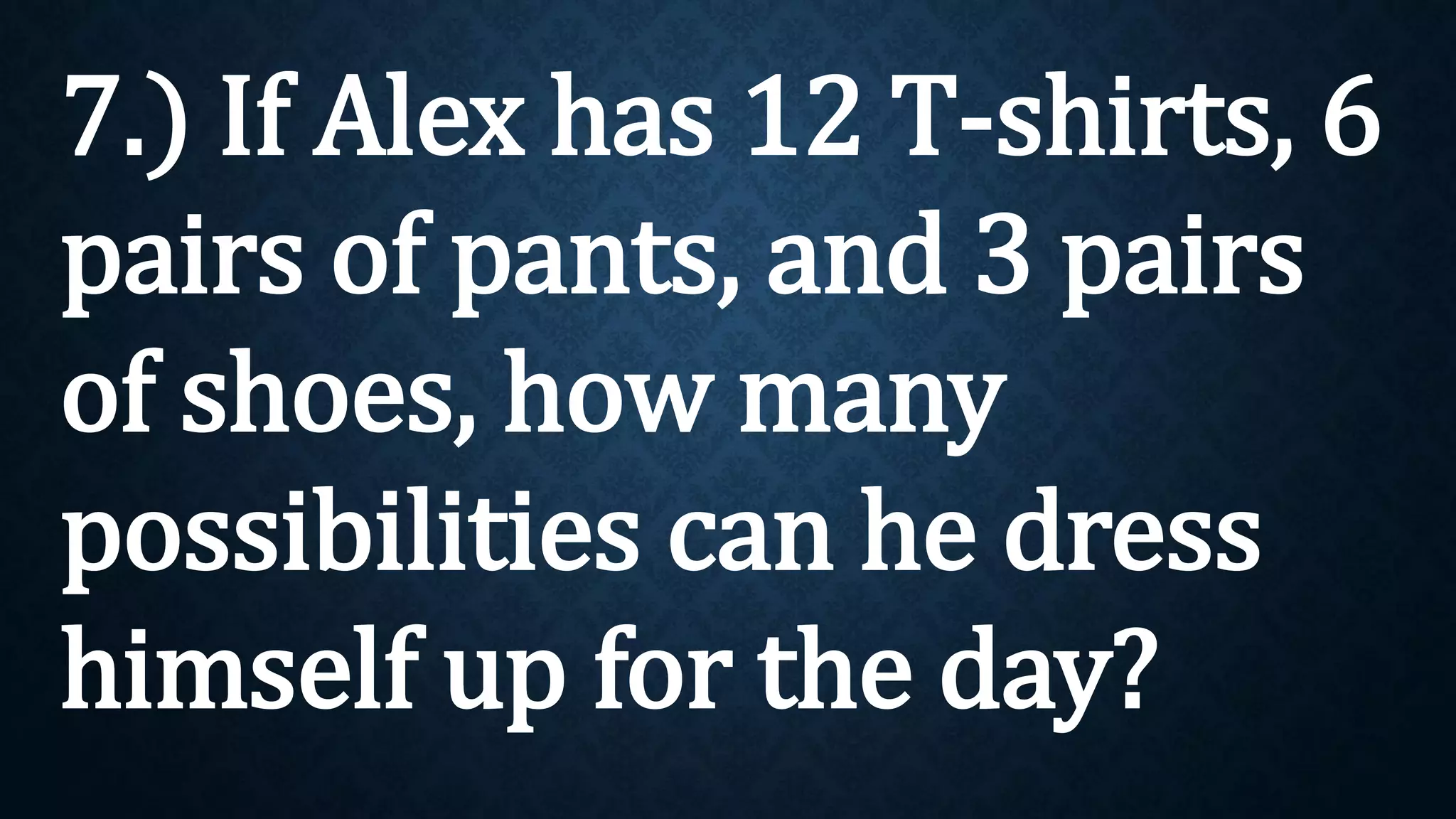
7.) If Alex has 12 T-shirts, 6
pairs of pants, and 3 pairs
of shoes, how many
possibilities can he dress
himself up for the day?
8.) A dress-shop has 8 new
dresses that she wants to
display in the window. If the
display window has 5
mannequins, in how many
ways can she dress them up?
9.) If there are 10 people
and only 6 chairs are
available, in how many
ways can they be seated?
10.) Five couples want to have
their pictures taken. In how
many ways can they arrange
themselves in a row if:
a. couples must stay together.
b. couples may stand anywhere.
11.) There are 4 different
Mathematics books and 5 different
Science books. In how many ways
can the books be arranged on a shelf
if:
a. there are no restrictions.
b. if they must be placed alternately.
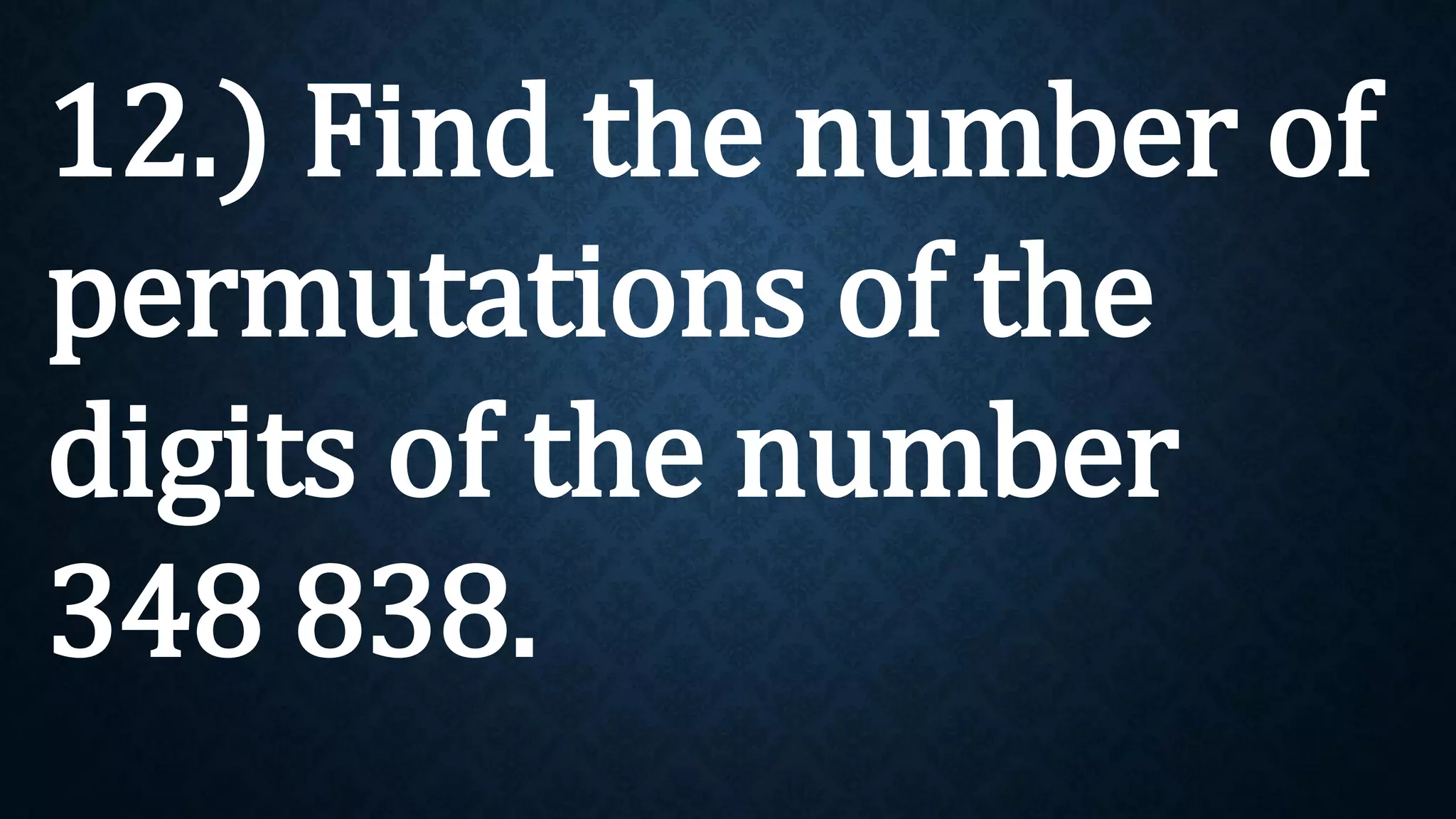
12.) Find the number of
permutations of the
digits of the number
348 838.
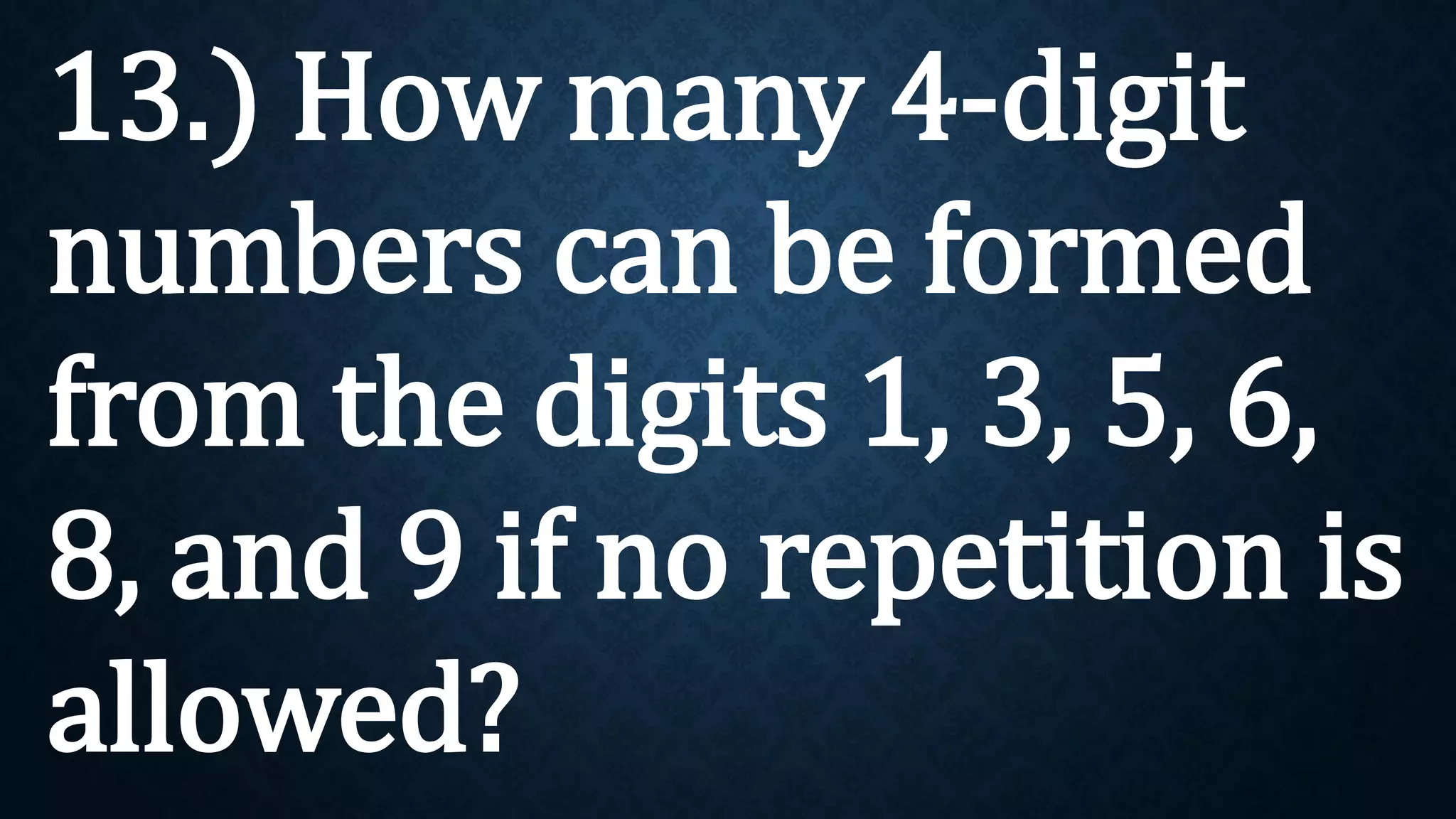
13.) How many 4-digit
numbers can be formed
from the digits 1, 3, 5, 6,
8, and 9 if no repetition is
allowed?
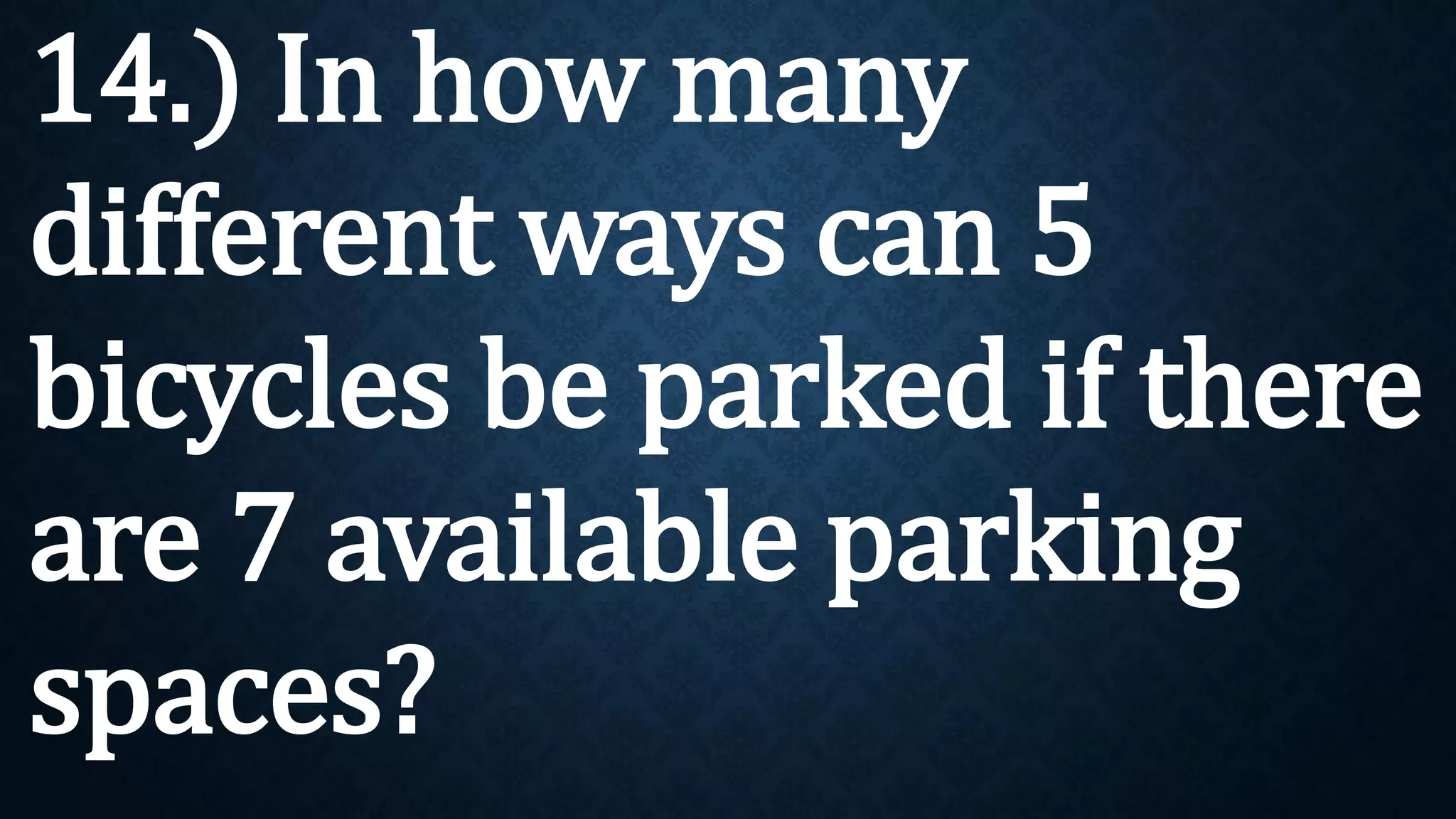
14.) In how many
different ways can 5
bicycles be parked if there
are 7 available parking
spaces?
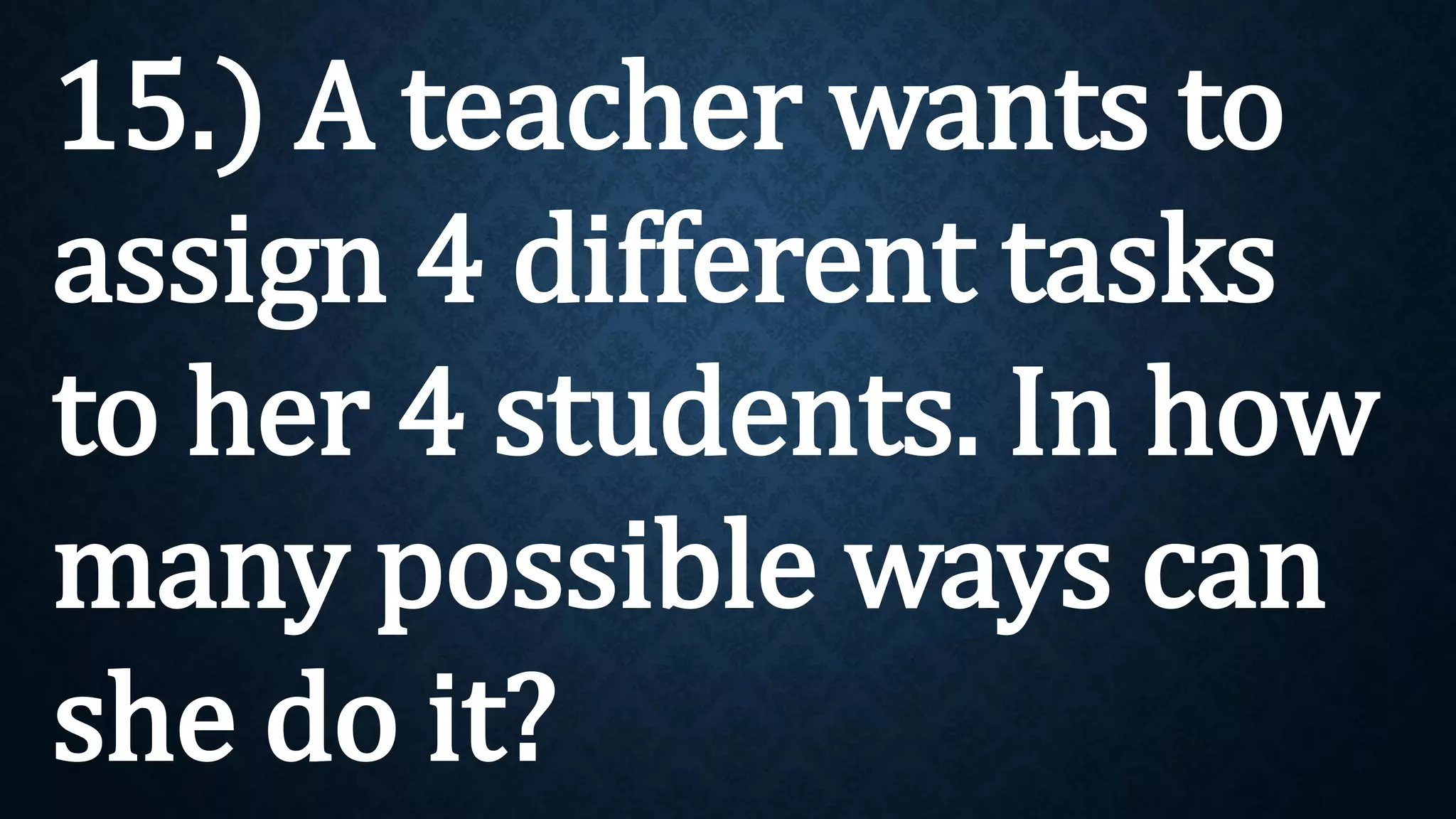
15.) A teacher wants to
assign 4 different tasks
to her 4 students. In how
many possible ways can
she do it?
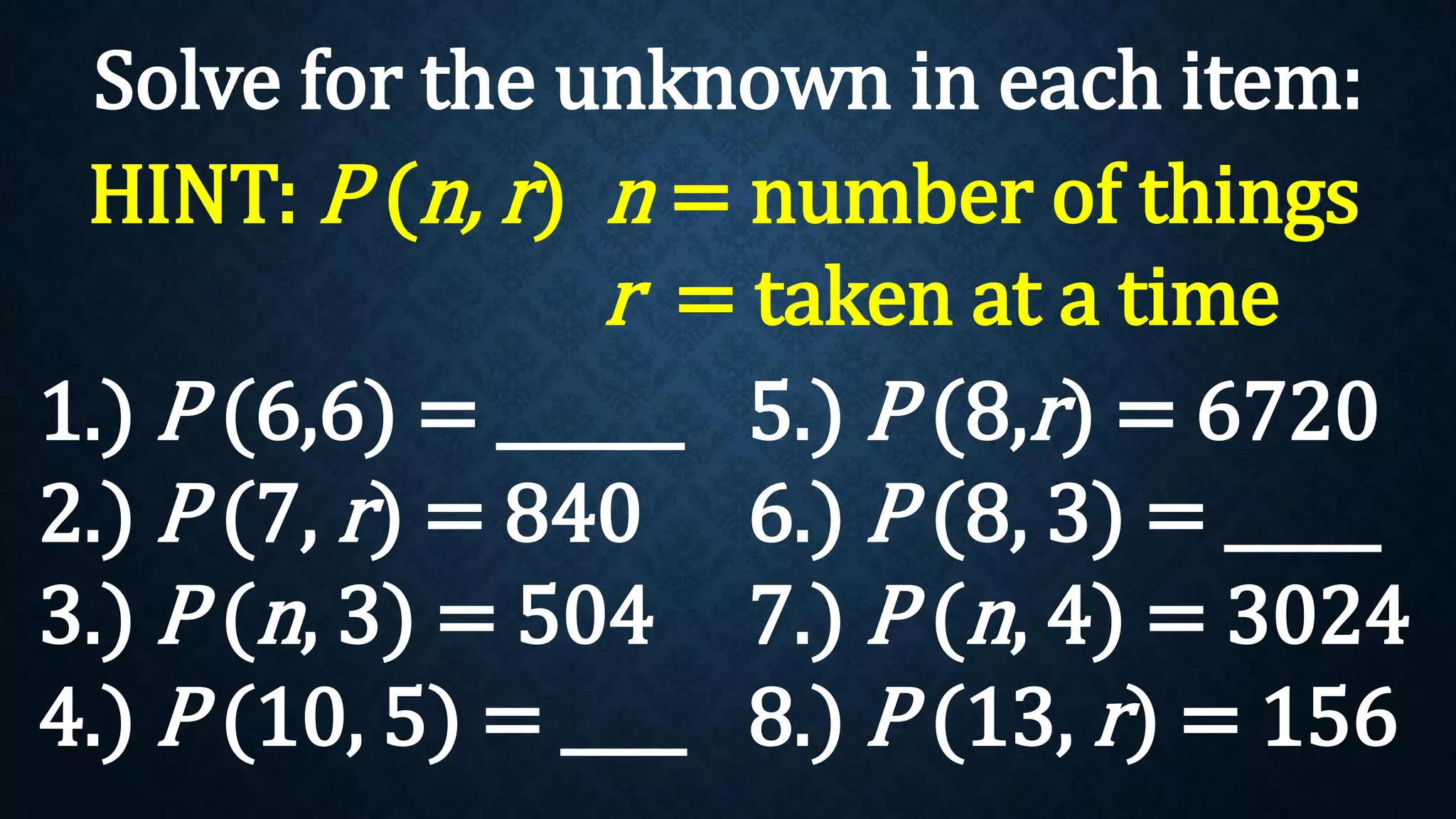
Solve for the unknown in each item:
1.) P (6,6) = ______
2.) P (7, r) = 840
3.) P (n, 3) = 504
4.) P (10, 5) = ____
HINT: P (n, r) n = number of things
r = taken at a time
5.) P (8,r) = 6720
6.) P (8, 3) = _____
7.) P (n, 4) = 3024
8.) P (13, r) = 156
COMBINATIONS
Suppose you were assigned by
your teacher to be the leader
of your group for your project.
You were given the freedom to
choose 4 of your classmates to
be your group mates.
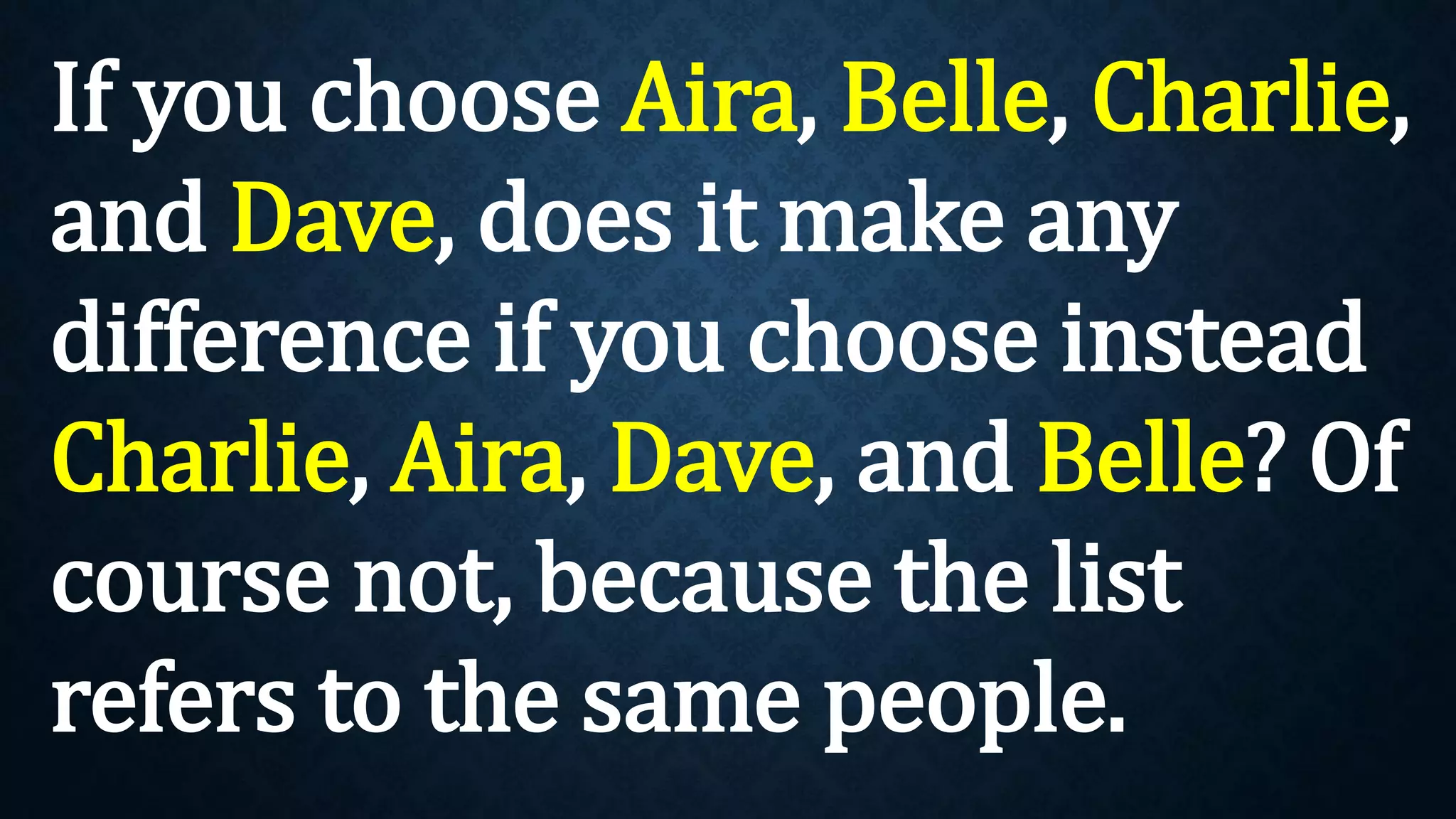
If you choose Aira, Belle, Charlie,
and Dave, does it make any
difference if you choose instead
Charlie, Aira, Dave, and Belle? Of
course not, because the list
refers to the same people.
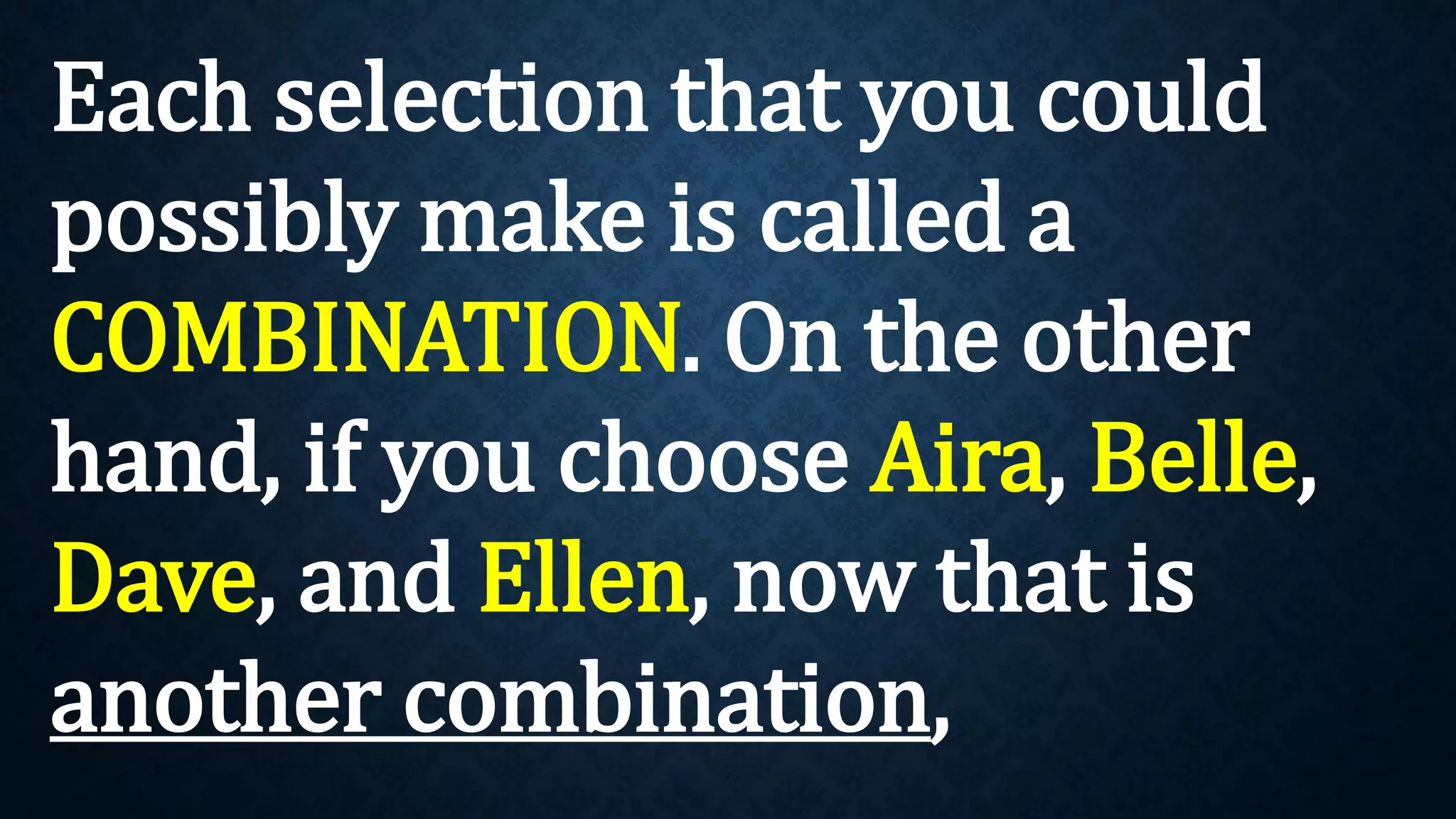
Each selection that you could
possibly make is called a
COMBINATION. On the other
hand, if you choose Aira, Belle,
Dave, and Ellen, now that is
another combination,
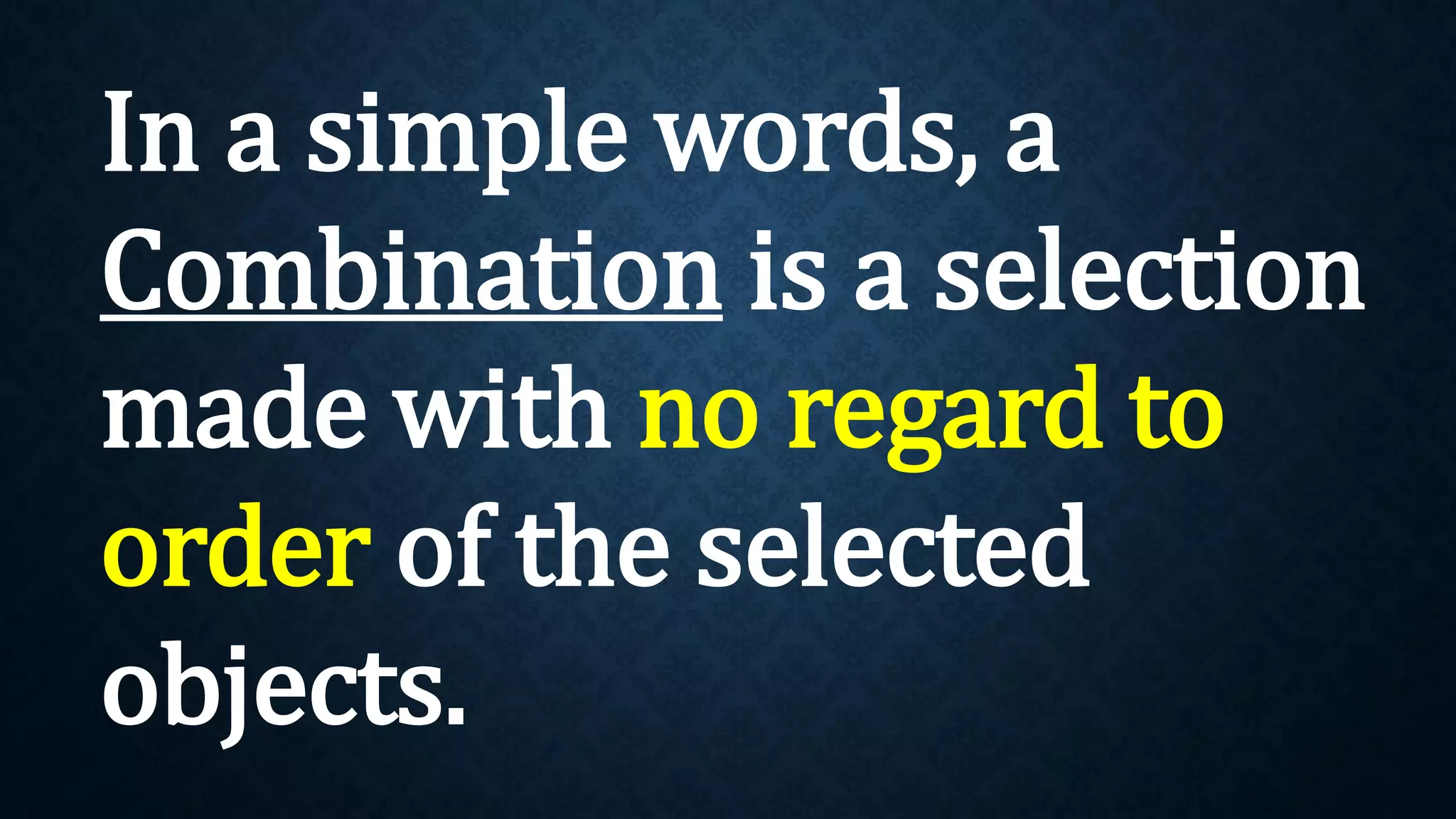
In a simple words, a
Combination is a selection
made with no regard to
order of the selected
objects.
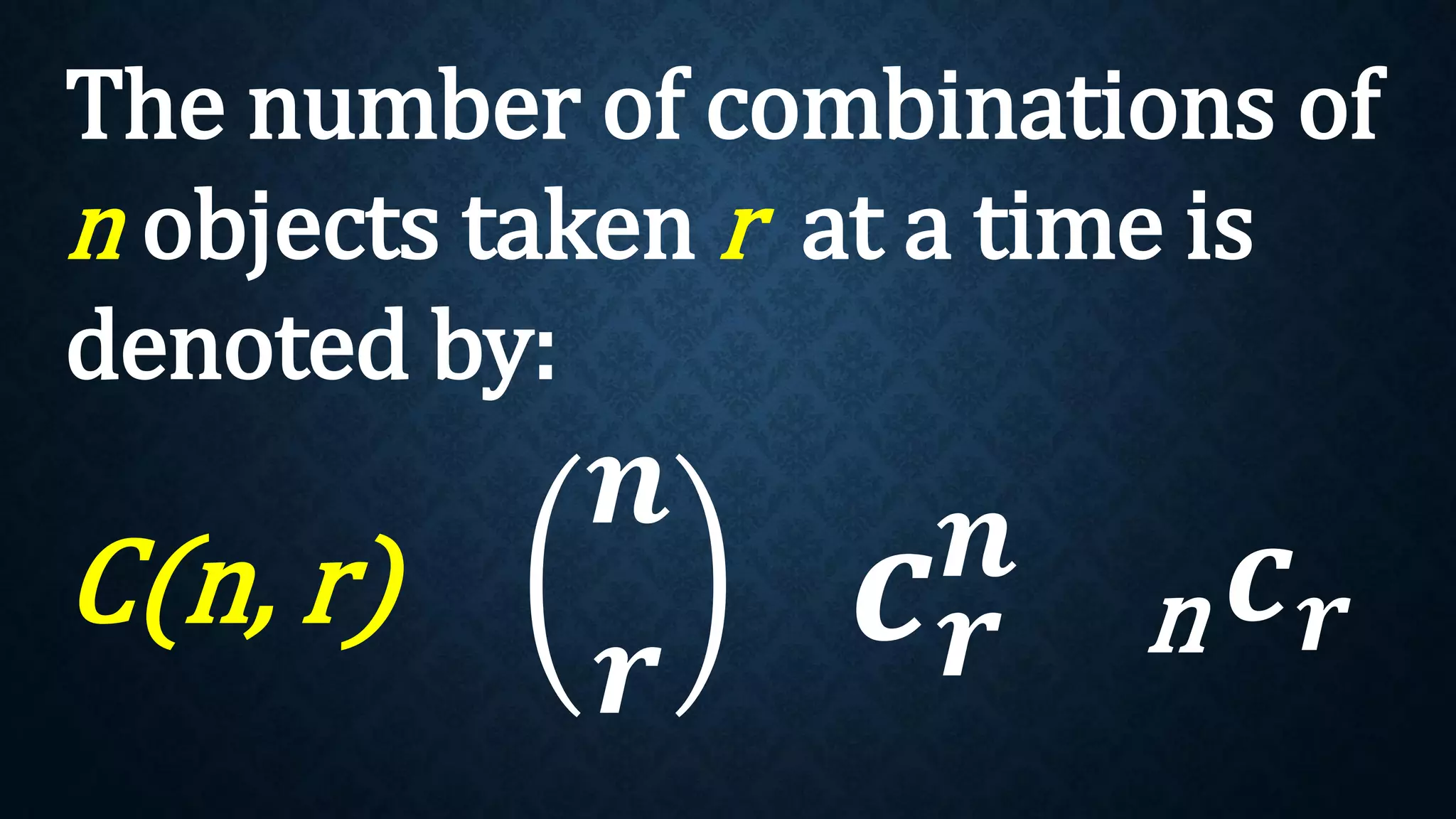
The number of combinations of
n objects taken r at a time is
denoted by:
C(n, r)
𝒏
𝒓
𝒄𝒓
𝒏 𝒄𝒓
n
How do we find the
number of combinations
of n objects taken r at a
time?
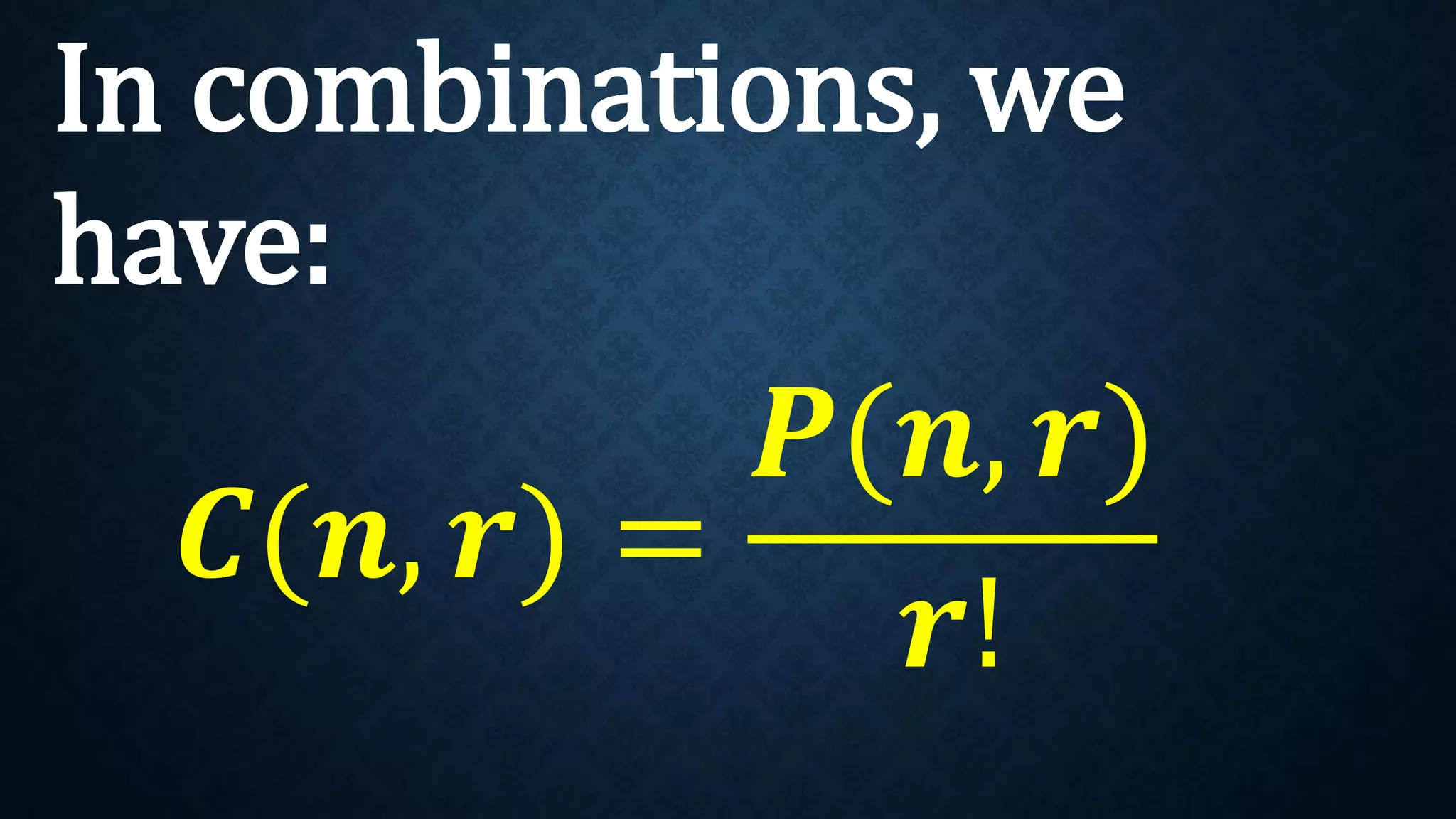
In combinations, we
have:
𝑪(𝒏, 𝒓) =
𝑷(𝒏, 𝒓)
𝒓!
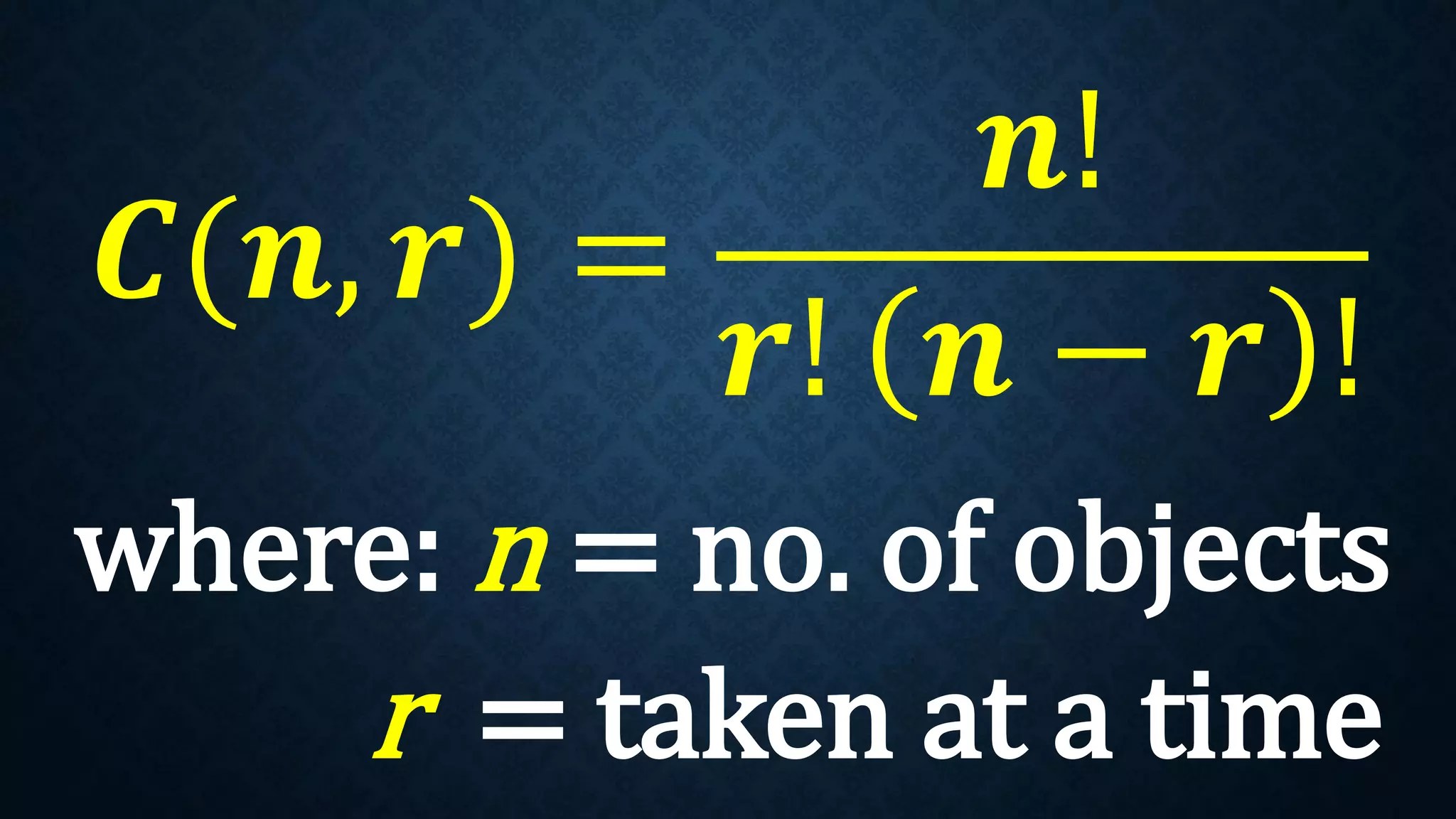
𝑪(𝒏, 𝒓) =
𝒏!
𝒓! 𝒏 − 𝒓 !
where: n = no. of objects
r = taken at a time
Illustration #1
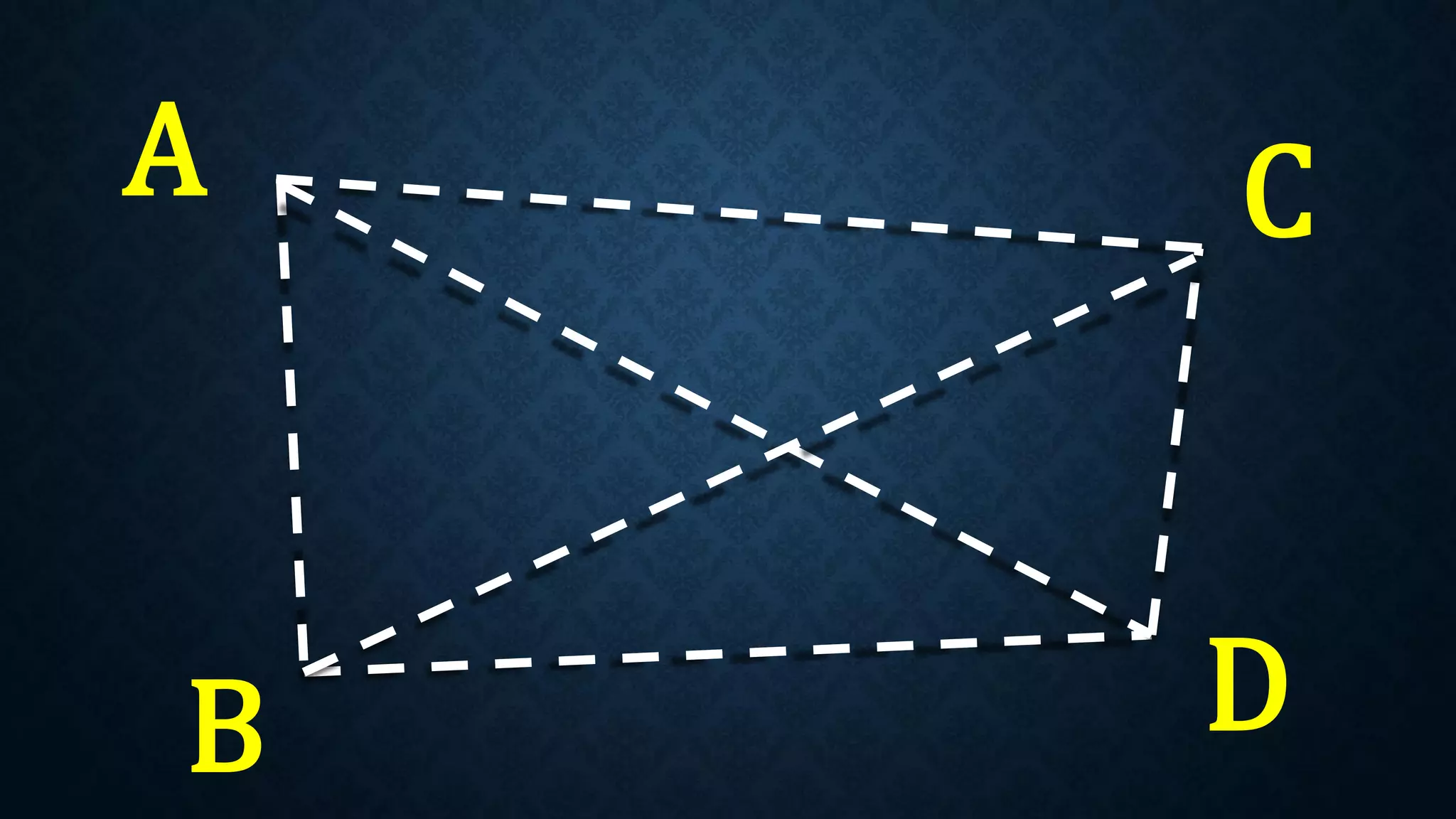
Suppose now, that you are
asked to form different
triangles out of 4 points
plotted, say, A, B, C, and D, of
which no three are collinear.
A
B
C
D
We can see that △ ABC is the
same as △ BCA and △ CBA.
In the same manner,
△ BCD is the same as
△ CBD and △ DBC.
This is another illustration
of combination. The
different triangles that can
be formed are △ ABC , △
ABD , △ BCD , and △ CDA.
Thus, there are
only 4
COMBINATIONS
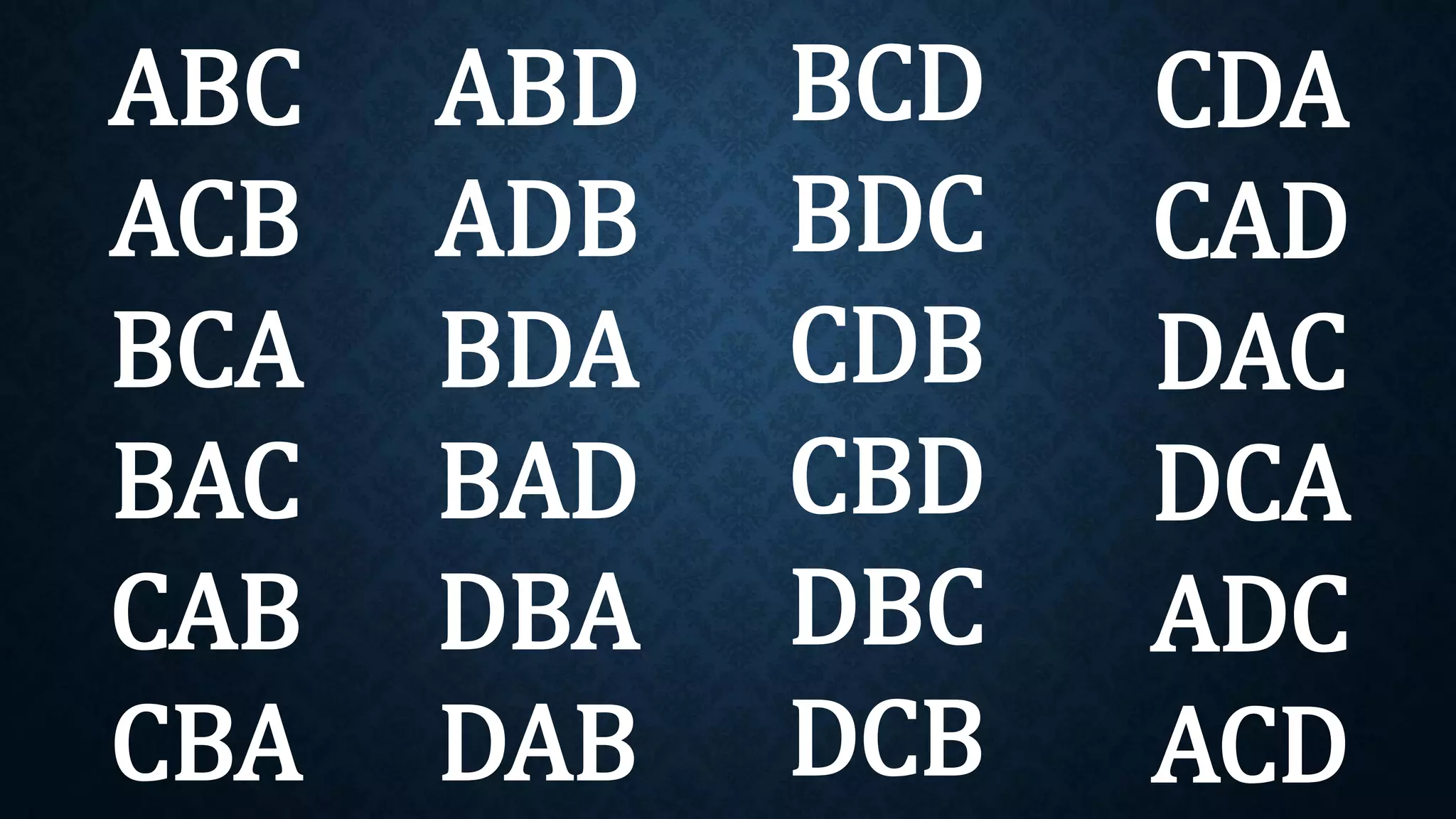
Consider this:
If order of the letters is
important, then we have
the following:
ABC
ACB
BCA
BAC
CAB
CBA
ABD
ADB
BDA
BAD
DBA
DAB
BCD
BDC
CDB
CBD
DBC
DCB
CDA
CAD
DAC
DCA
ADC
ACD
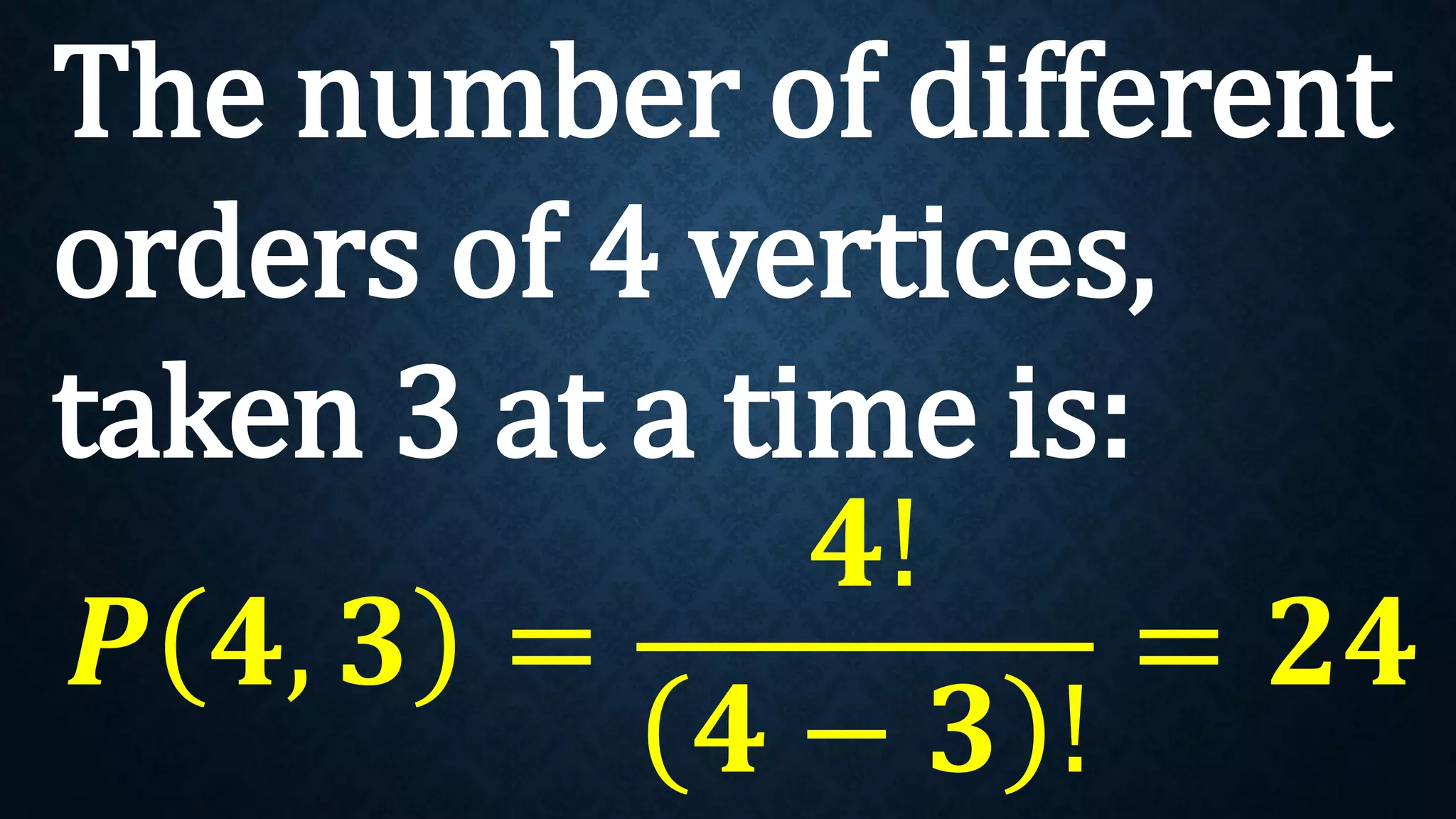
The number of different
orders of 4 vertices,
taken 3 at a time is:
𝑷 𝟒, 𝟑 =
𝟒!
𝟒 − 𝟑 !
= 𝟐𝟒
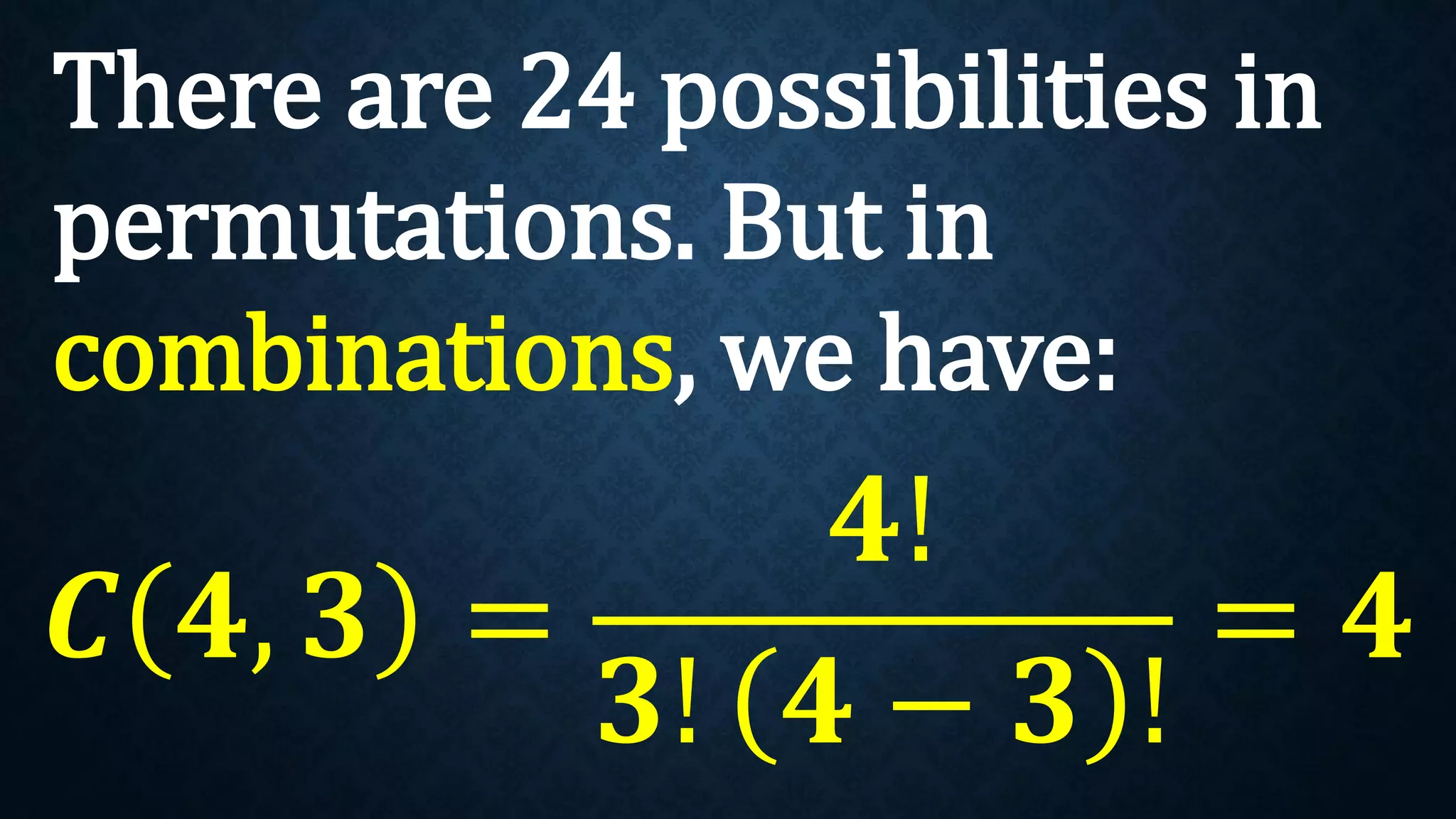
There are 24 possibilities in
permutations. But in
combinations, we have:
𝑪 𝟒, 𝟑 =
𝟒!
𝟑! 𝟒 − 𝟑 !
= 𝟒
Illustration #2
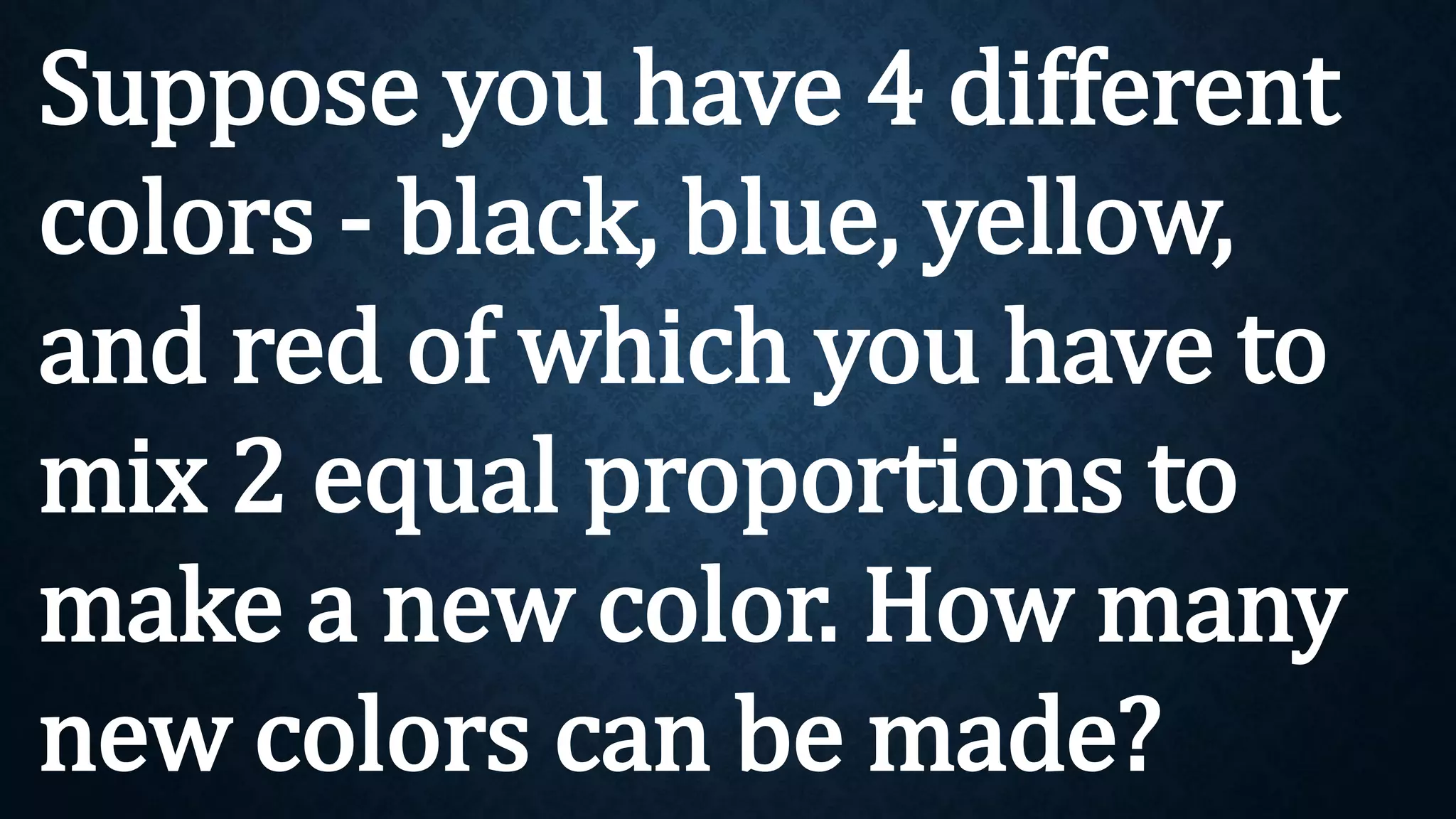
Suppose you have 4 different
colors - black, blue, yellow,
and red of which you have to
mix 2 equal proportions to
make a new color. How many
new colors can be made?
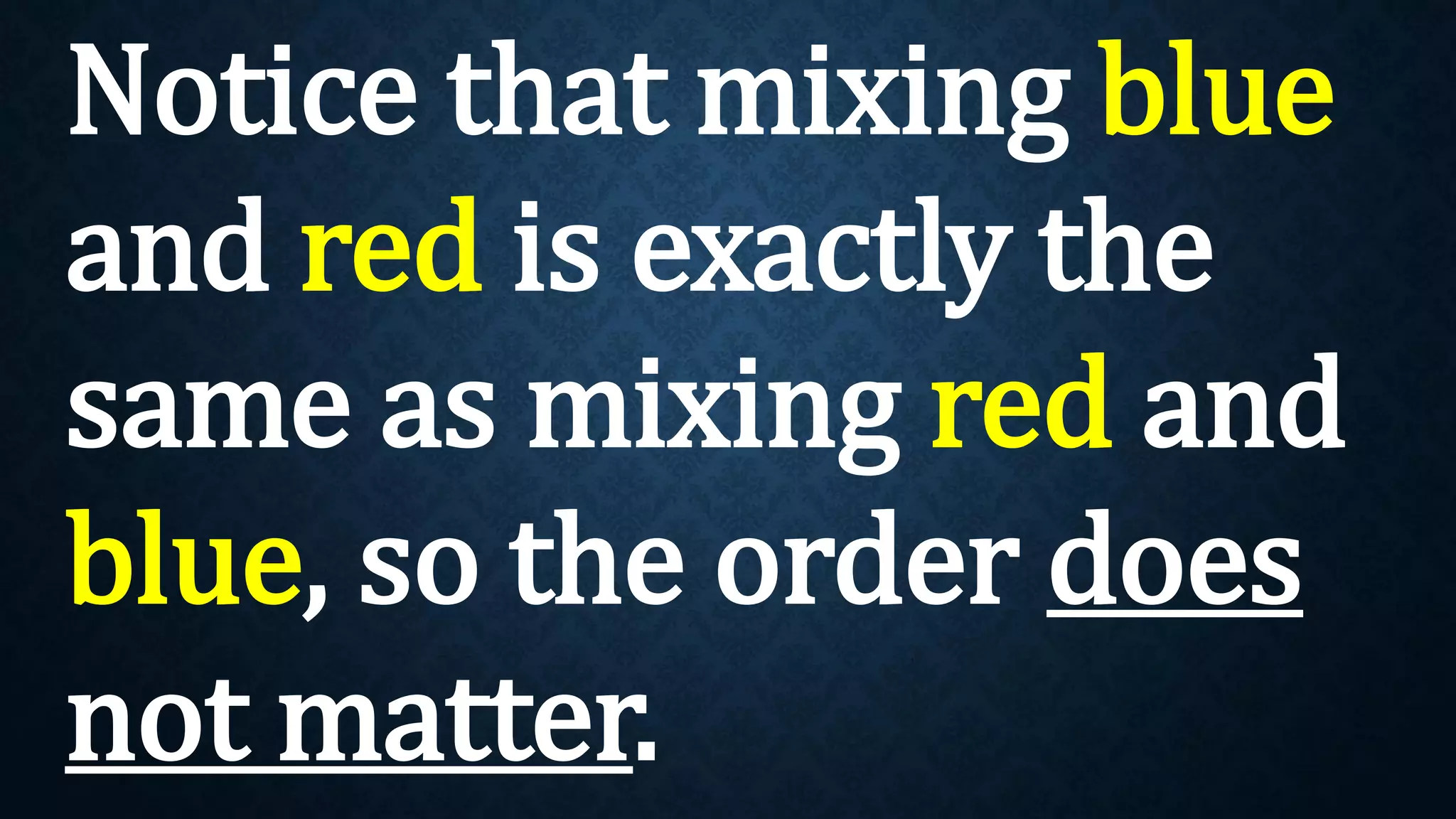
Notice that mixing blue
and red is exactly the
same as mixing red and
blue, so the order does
not matter.
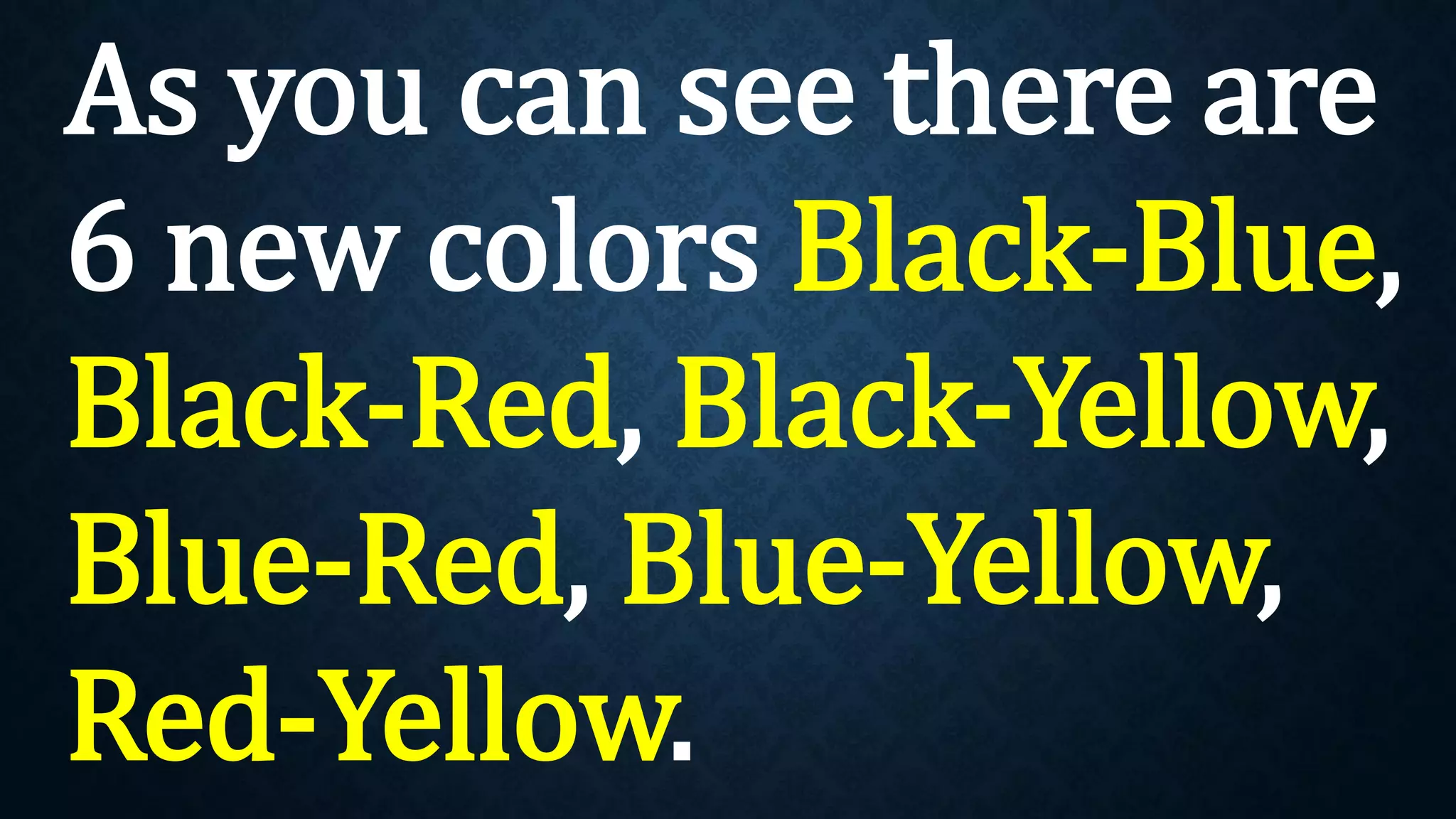
As you can see there are
6 new colors Black-Blue,
Black-Red, Black-Yellow,
Blue-Red, Blue-Yellow,
Red-Yellow.
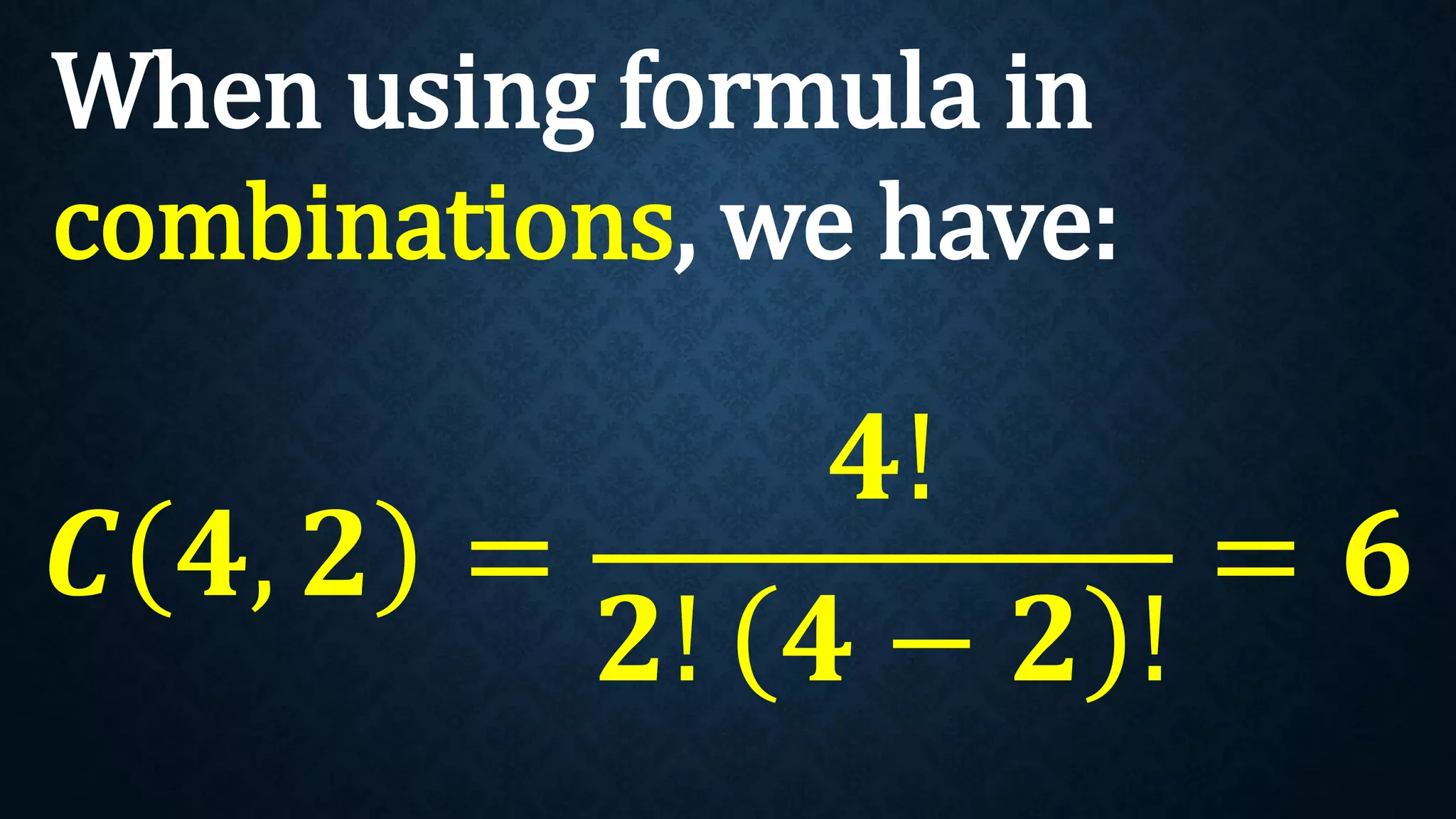
When using formula in
combinations, we have:
𝑪 𝟒, 𝟐 =
𝟒!
𝟐! 𝟒 − 𝟐 !
= 𝟔
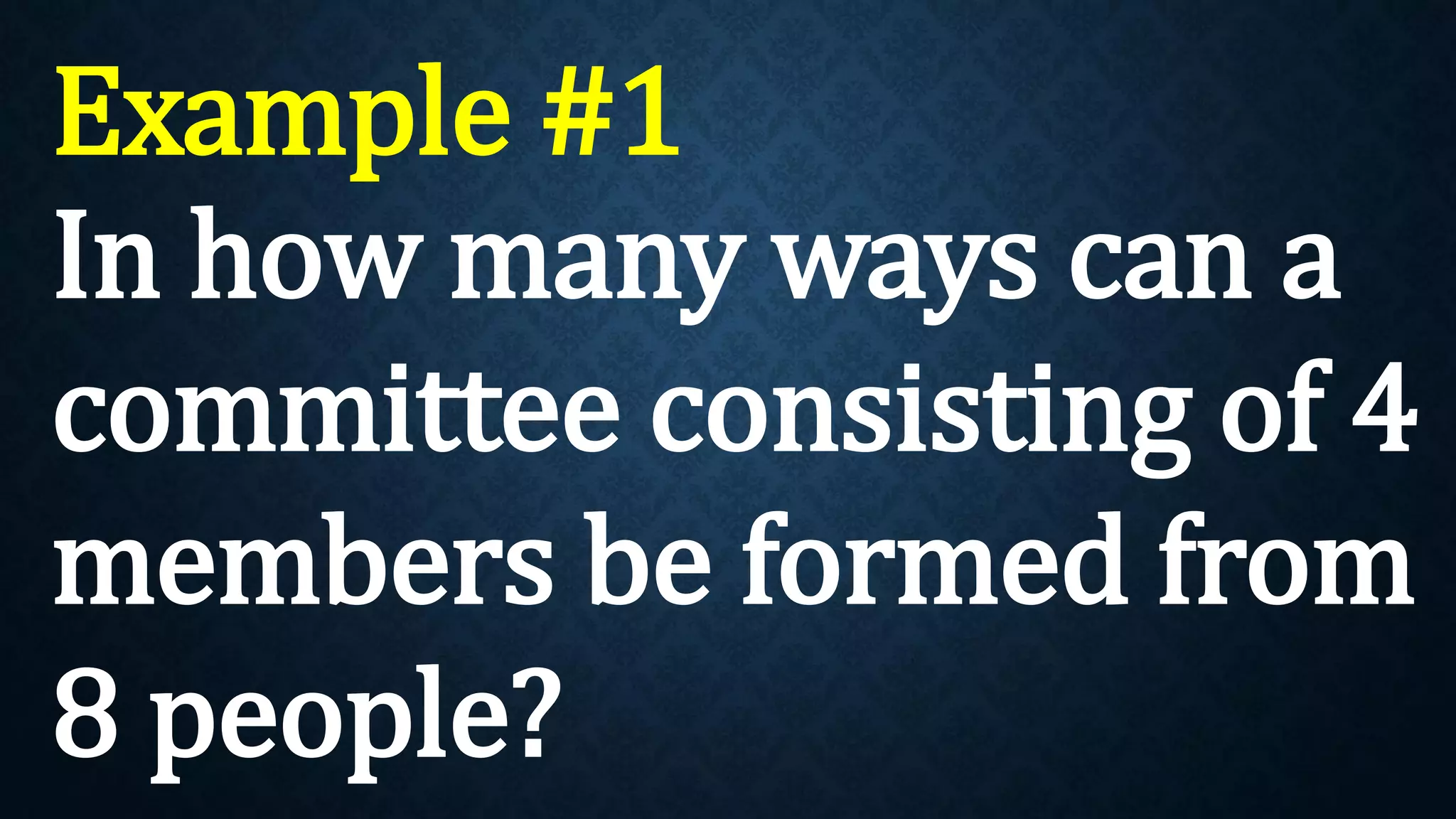
Example #1
In how many ways can a
committee consisting of 4
members be formed from
8 people?
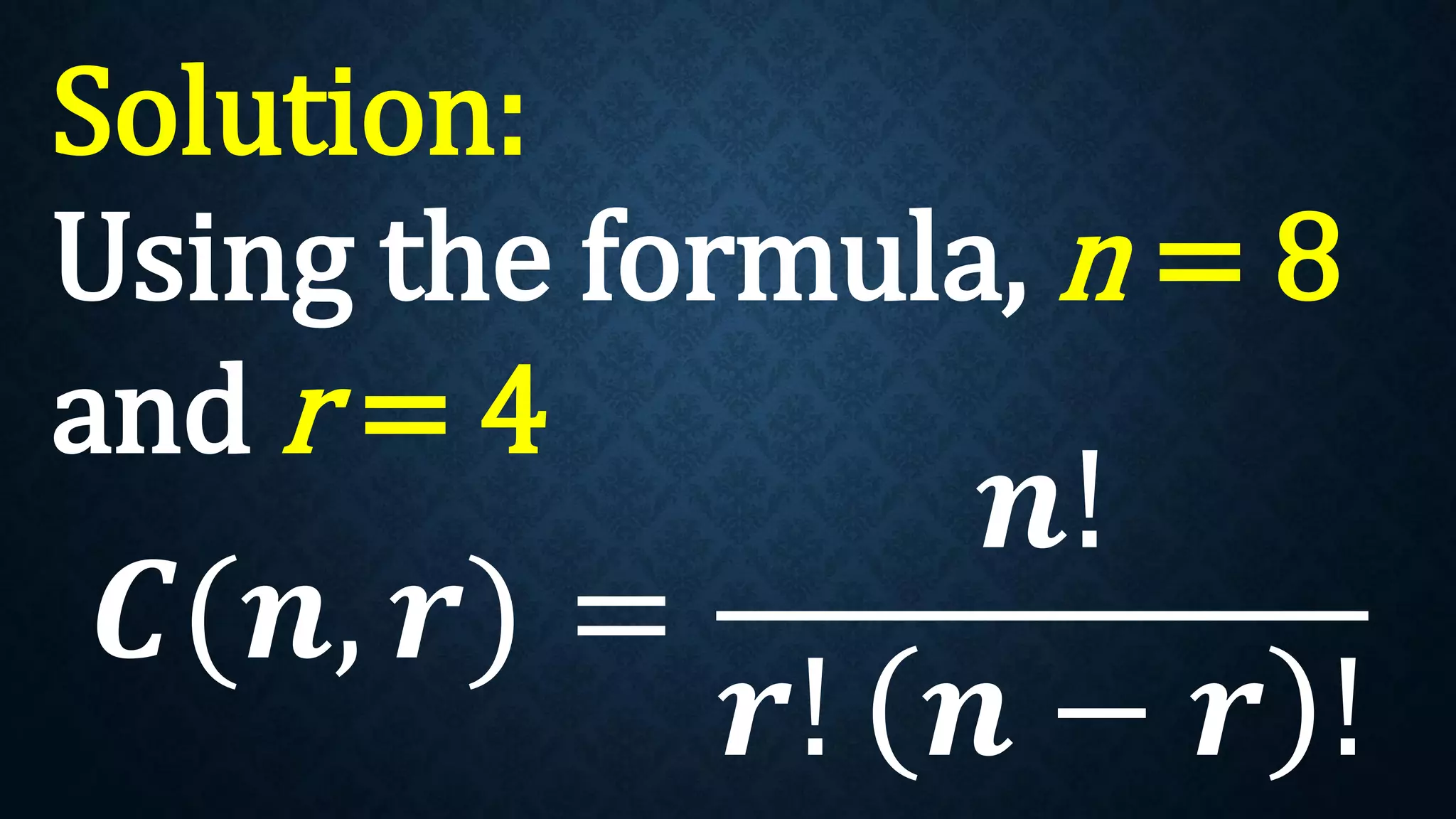
Solution:
Using the formula, n = 8
and r = 4
𝑪(𝒏, 𝒓) =
𝒏!
𝒓! 𝒏 − 𝒓 !
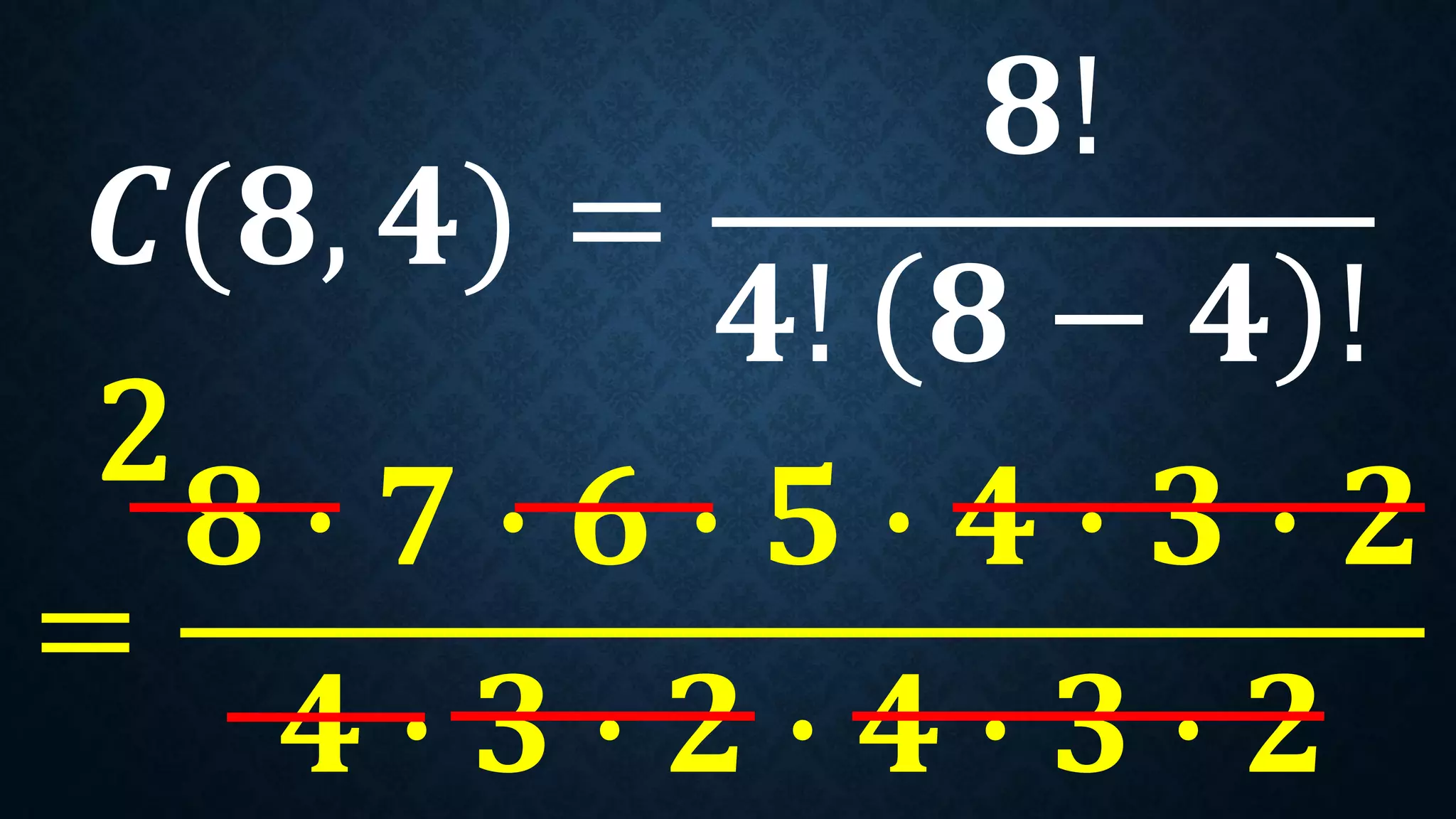
𝑪(𝟖, 𝟒) =
𝟖!
𝟒! 𝟖 − 𝟒 !
=
𝟖 ∙ 𝟕 ∙ 𝟔 ∙ 𝟓 ∙ 𝟒 ∙ 𝟑 ∙ 𝟐
𝟒 ∙ 𝟑 ∙ 𝟐 ∙ 𝟒 ∙ 𝟑 ∙ 𝟐
2
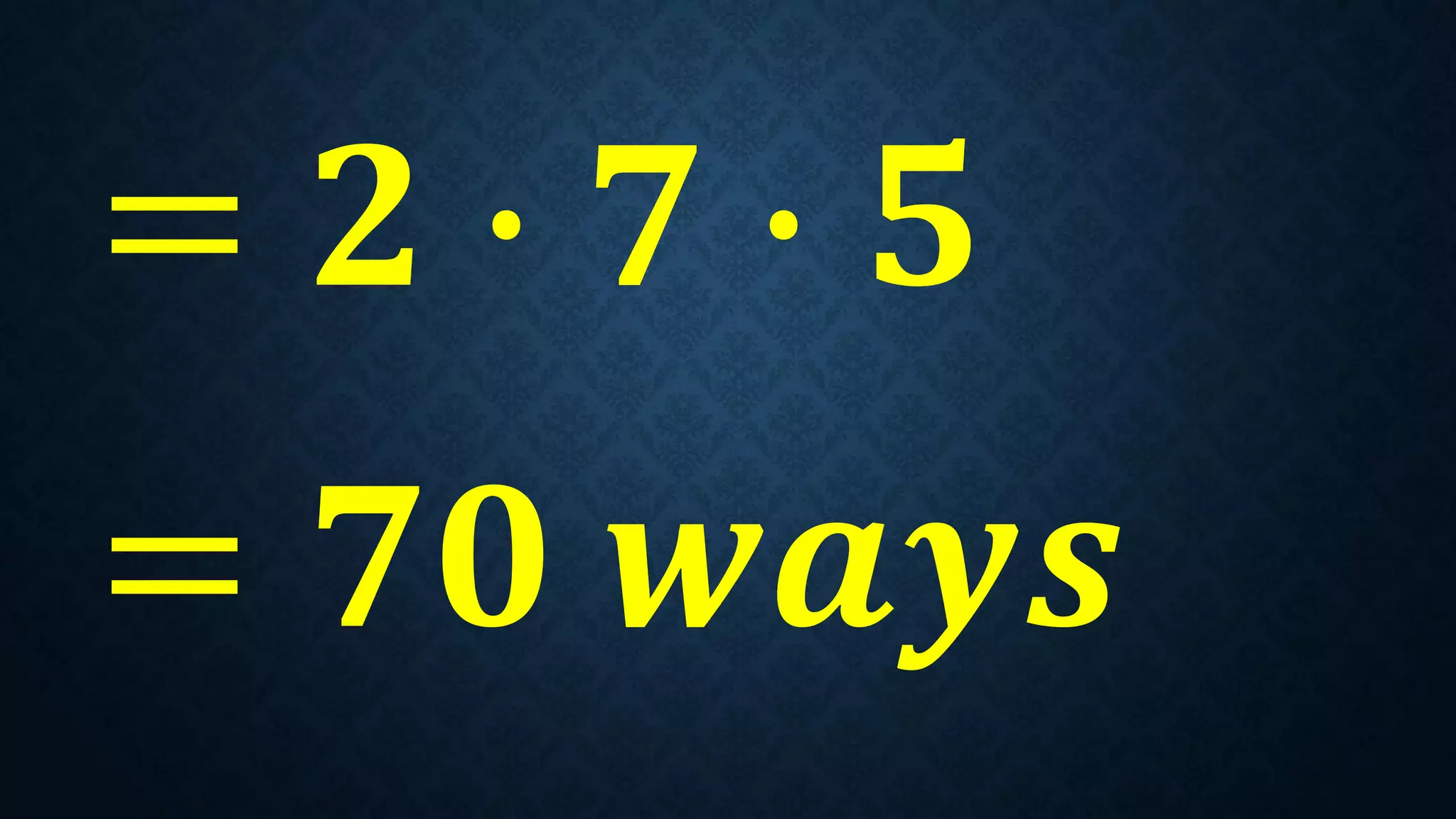
= 𝟐 ∙ 𝟕 ∙ 𝟓
= 𝟕𝟎 𝒘𝒂𝒚𝒔
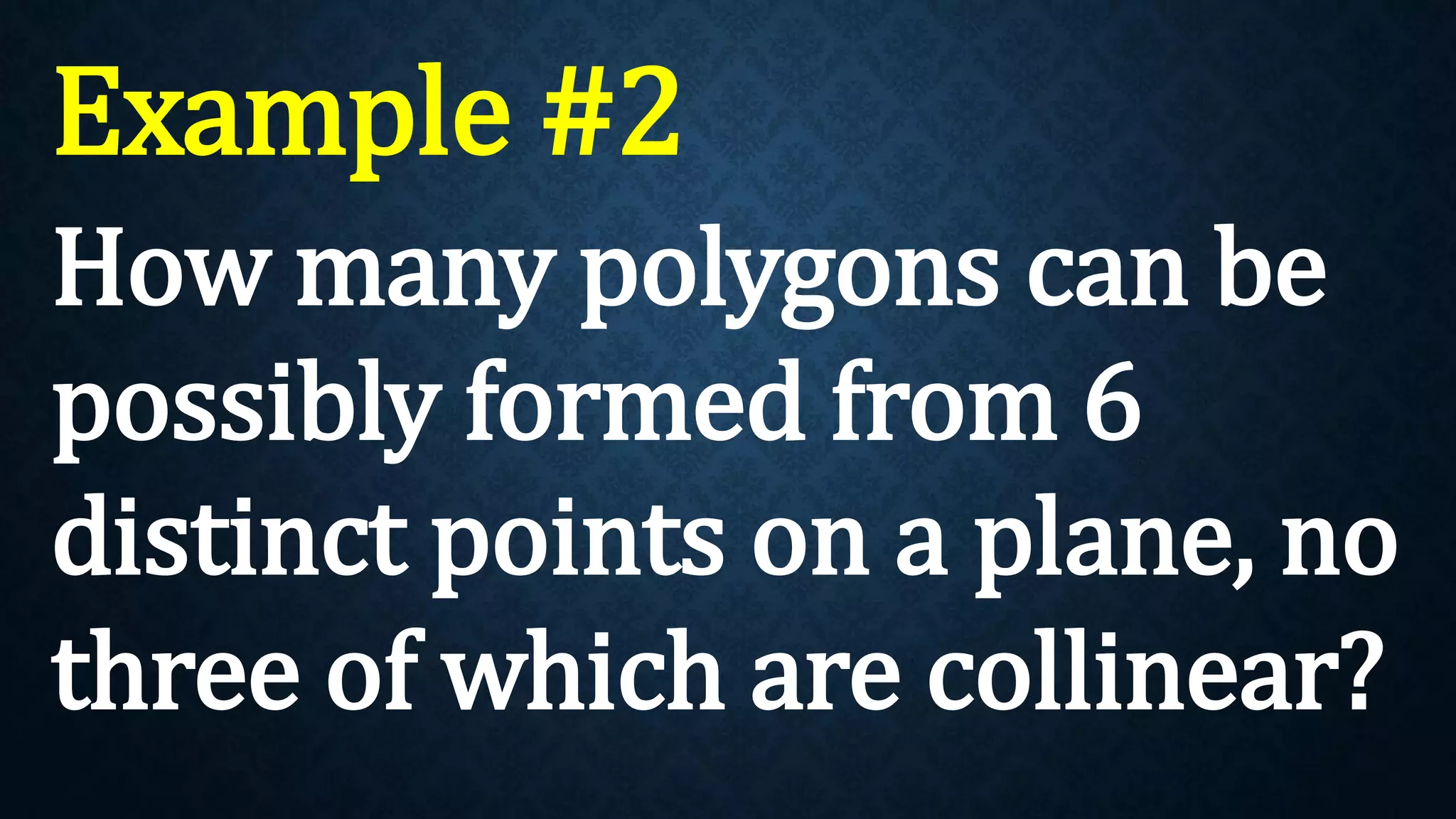
Example #2
How many polygons can be
possibly formed from 6
distinct points on a plane, no
three of which are collinear?
Solution:
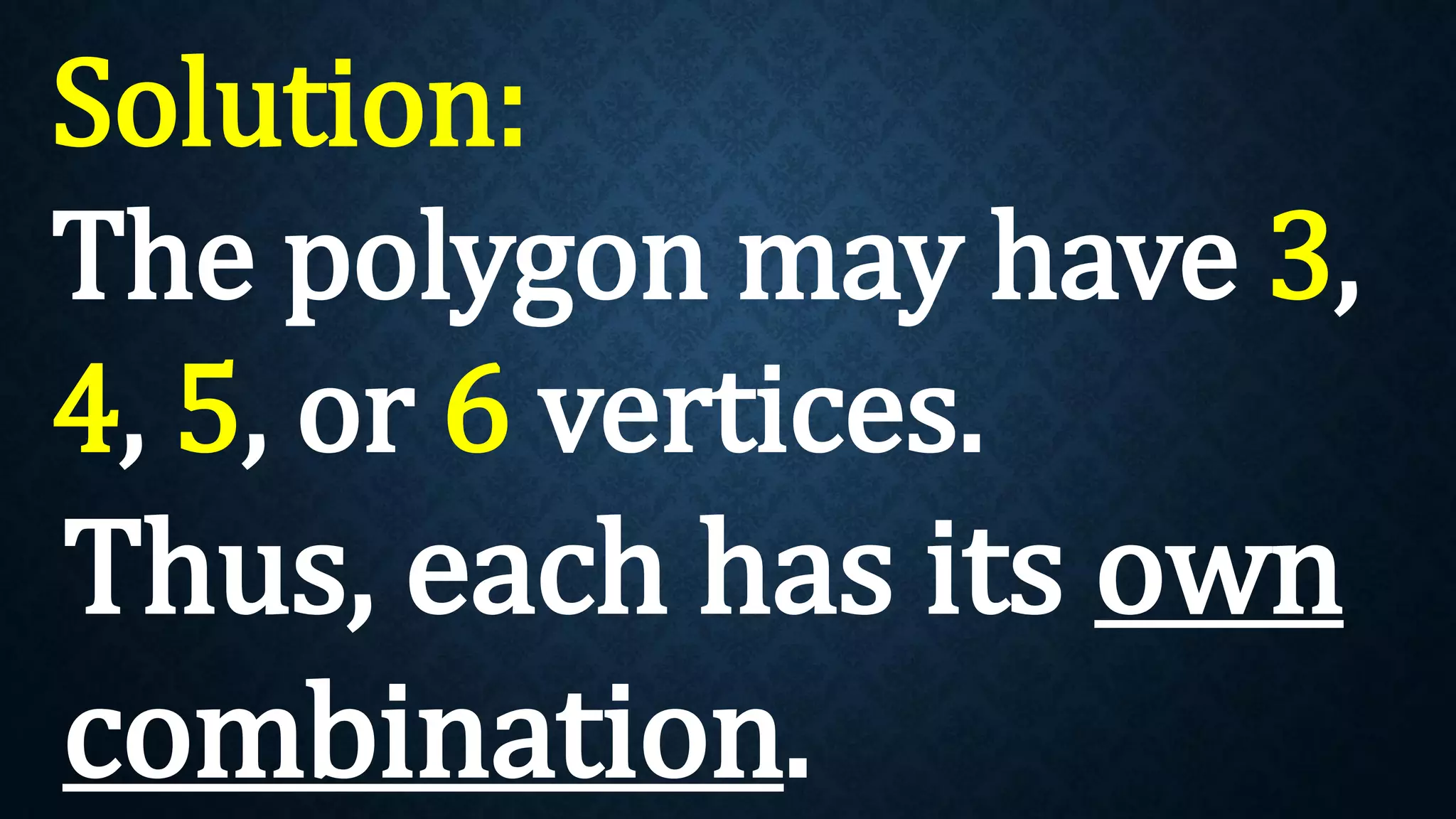
The polygon may have 3,
4, 5, or 6 vertices.
Thus, each has its own
combination.
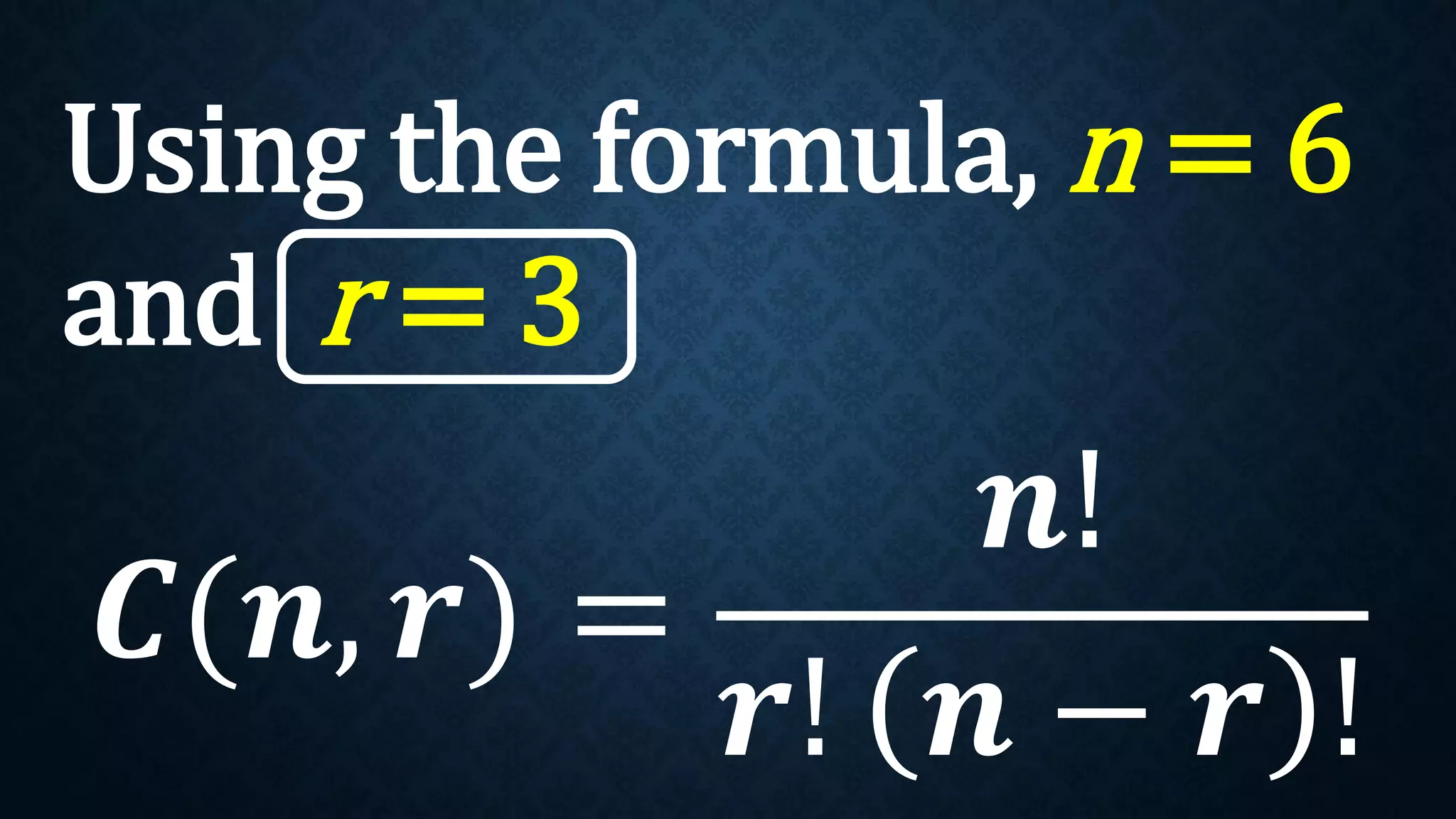
Using the formula, n = 6
and r = 3
𝑪(𝒏, 𝒓) =
𝒏!
𝒓! 𝒏 − 𝒓 !
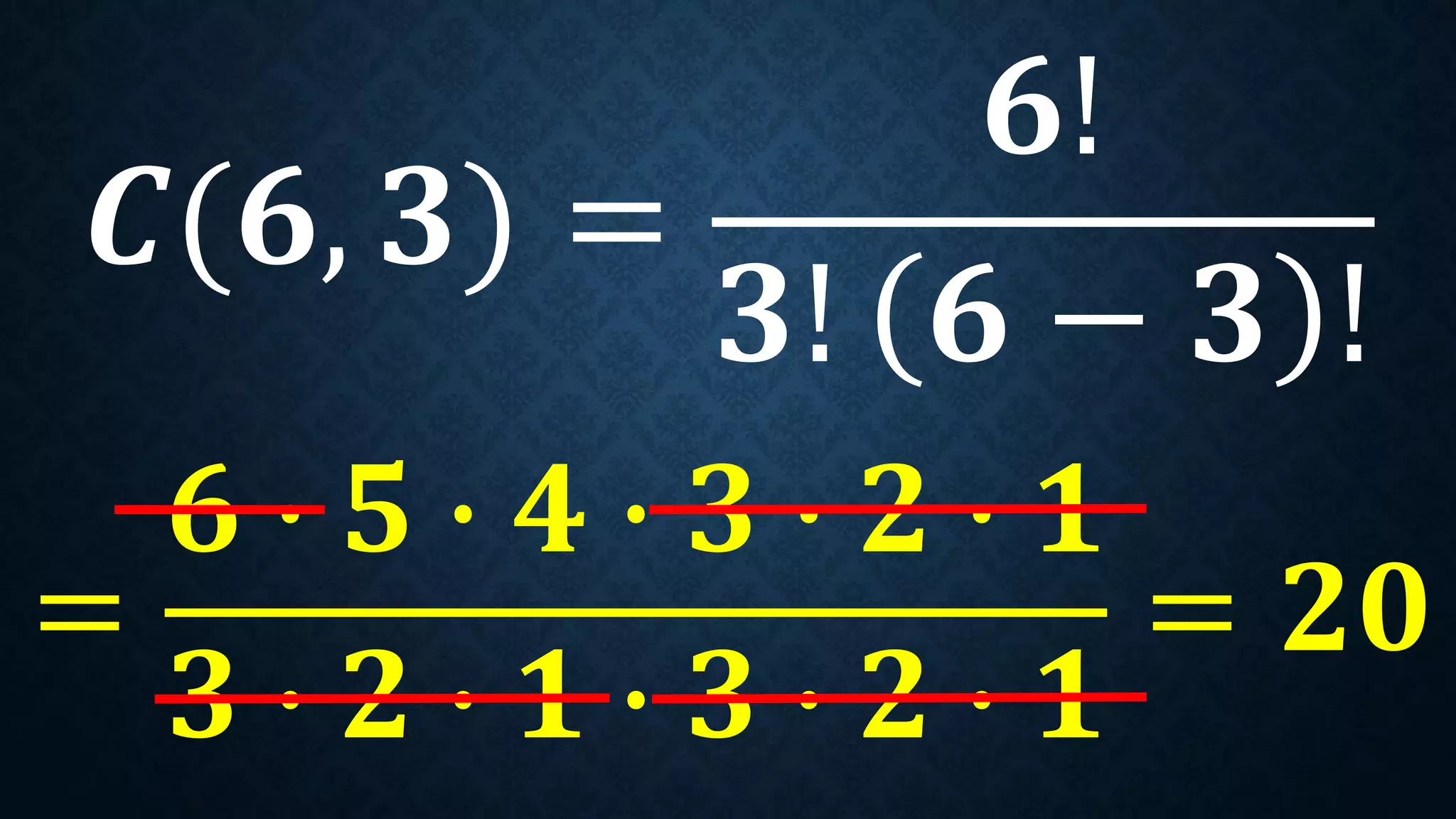
𝑪(𝟔, 𝟑) =
𝟔!
𝟑! 𝟔 − 𝟑 !
=
𝟔 ∙ 𝟓 ∙ 𝟒 ∙ 𝟑 ∙ 𝟐 ∙ 𝟏
𝟑 ∙ 𝟐 ∙ 𝟏 ∙ 𝟑 ∙ 𝟐 ∙ 𝟏
= 𝟐𝟎
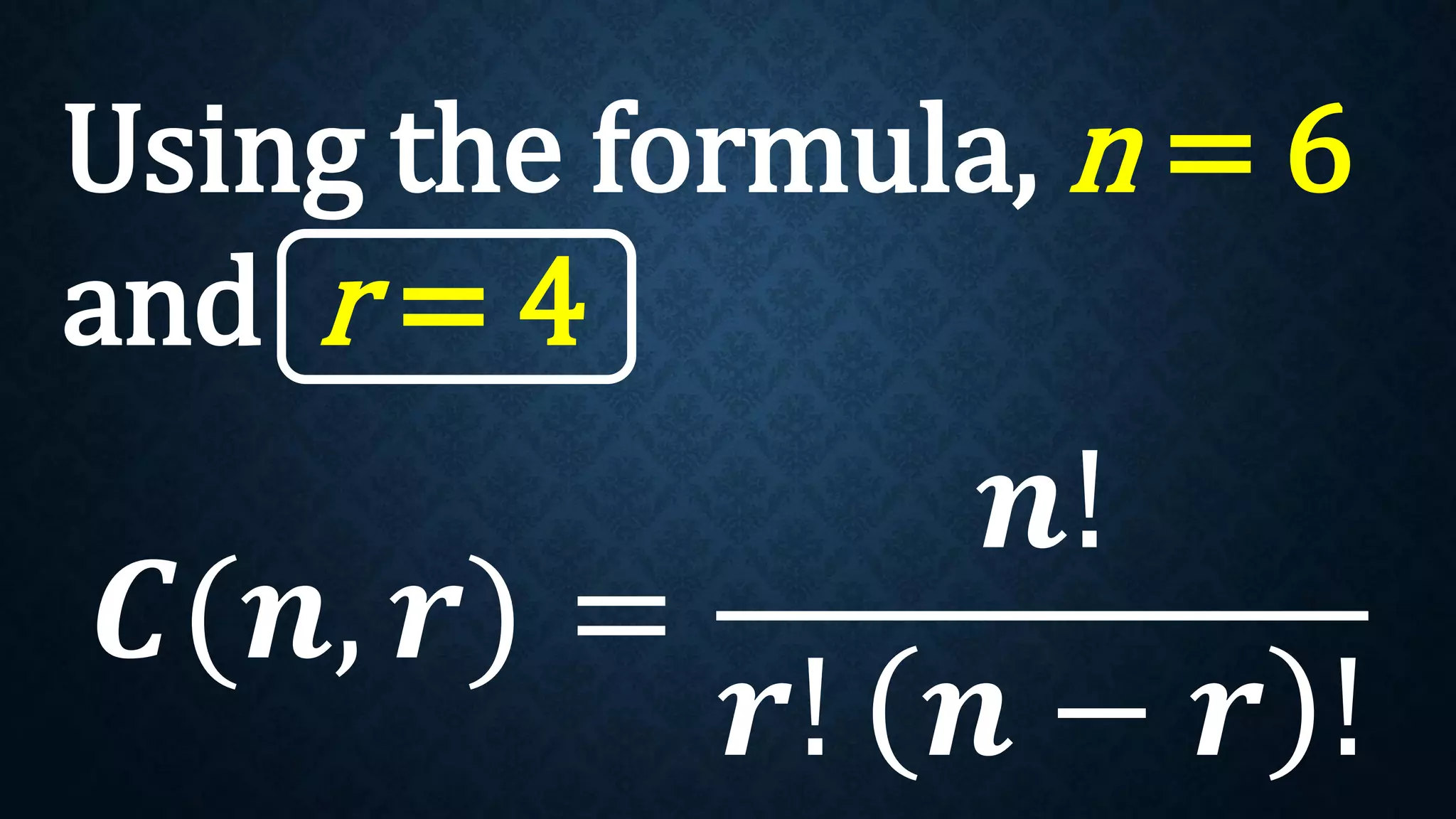
Using the formula, n = 6
and r = 4
𝑪(𝒏, 𝒓) =
𝒏!
𝒓! 𝒏 − 𝒓 !
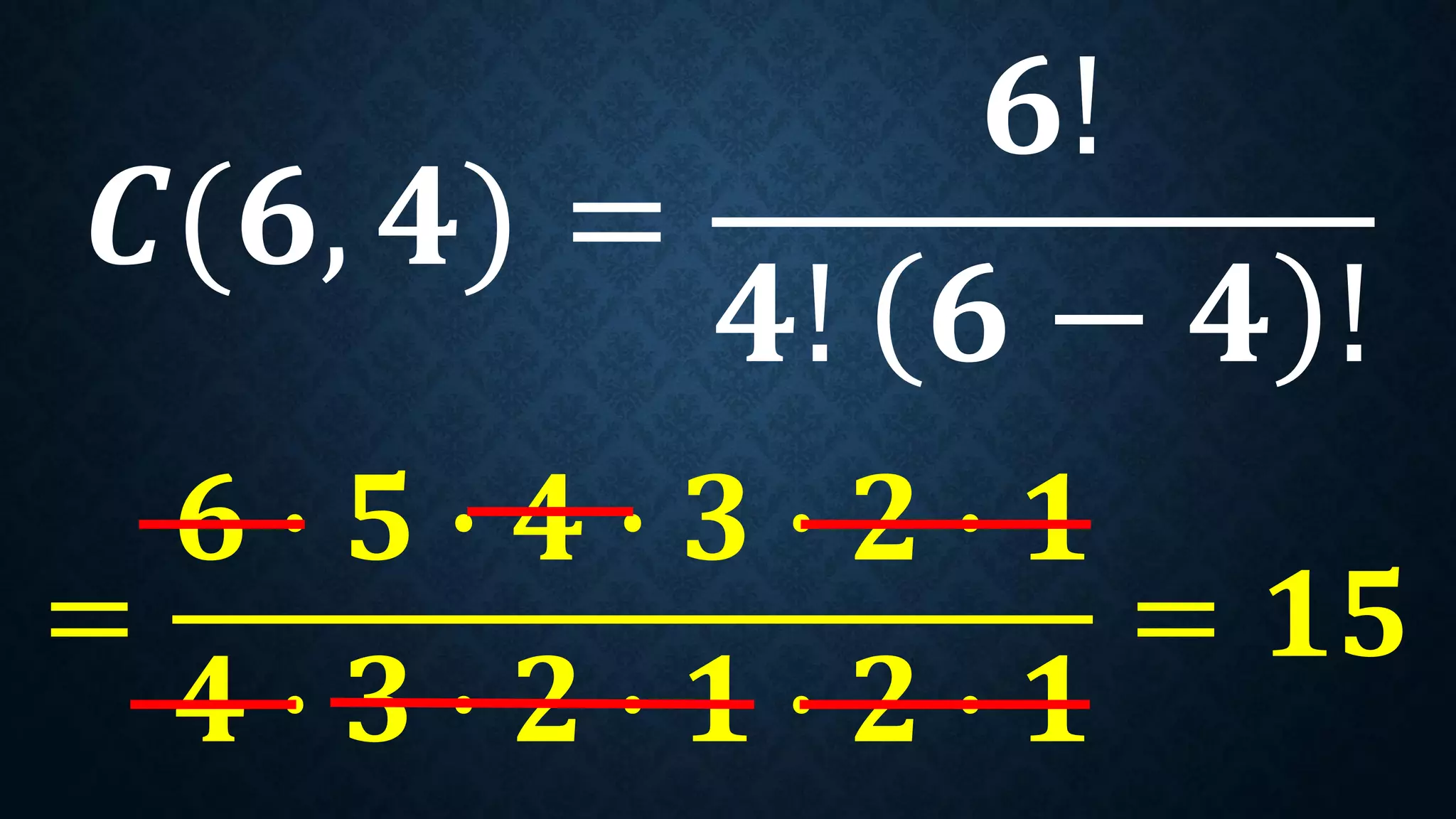
𝑪(𝟔, 𝟒) =
𝟔!
𝟒! 𝟔 − 𝟒 !
=
𝟔 ∙ 𝟓 ∙ 𝟒 ∙ 𝟑 ∙ 𝟐 ∙ 𝟏
𝟒 ∙ 𝟑 ∙ 𝟐 ∙ 𝟏 ∙ 𝟐 ∙ 𝟏
= 𝟏𝟓
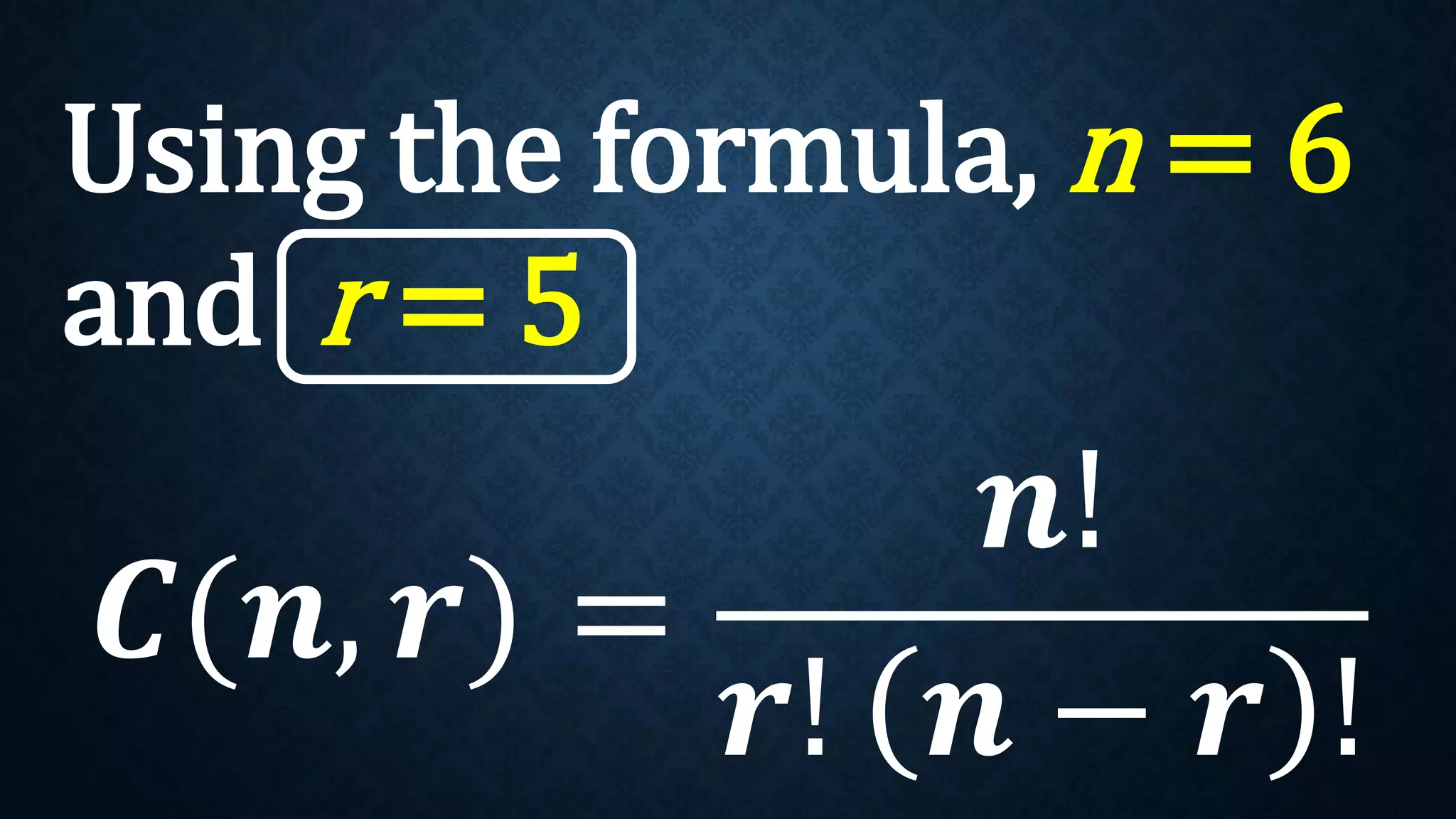
Using the formula, n = 6
and r = 5
𝑪(𝒏, 𝒓) =
𝒏!
𝒓! 𝒏 − 𝒓 !
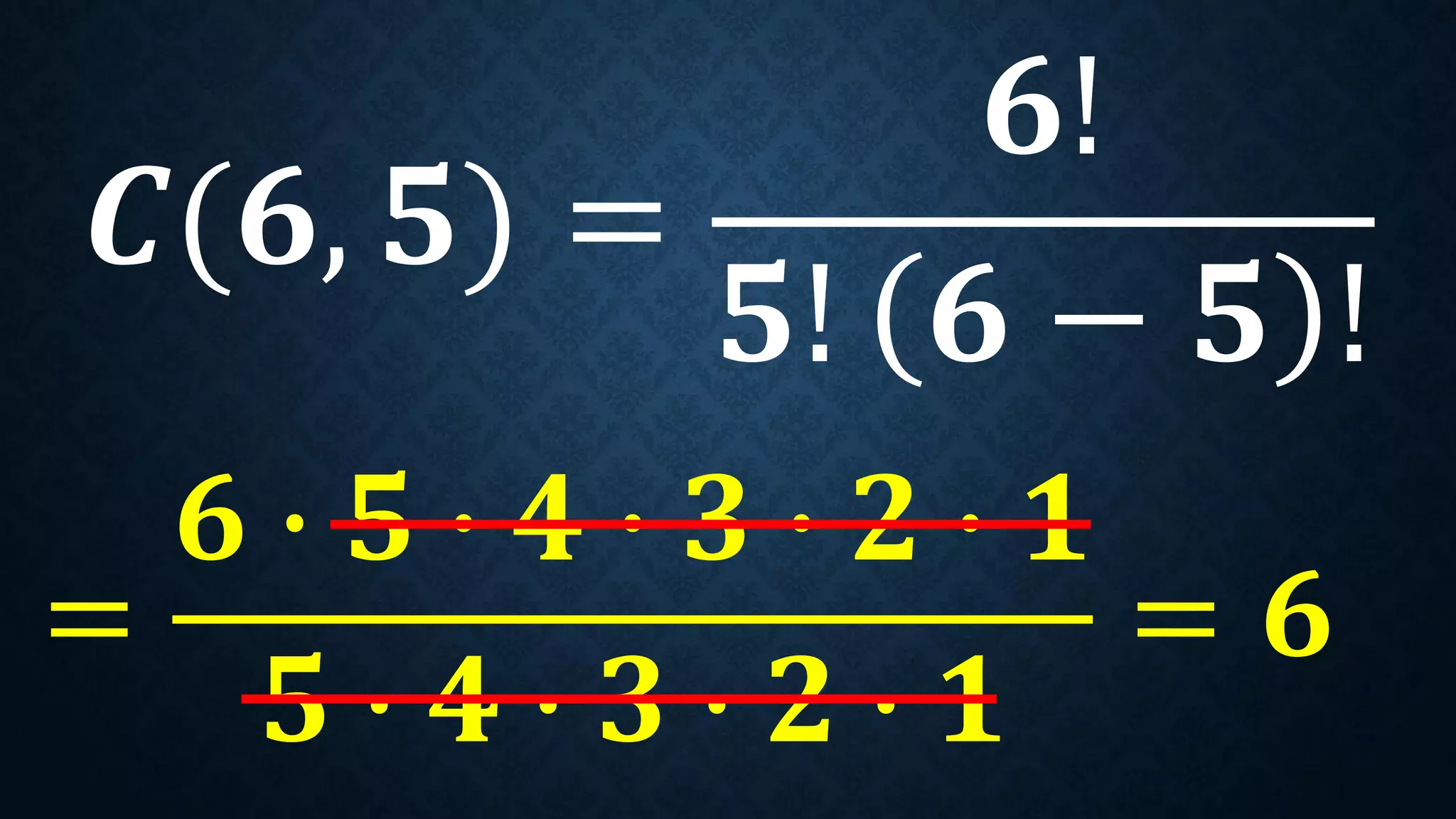
𝑪(𝟔, 𝟓) =
𝟔!
𝟓! 𝟔 − 𝟓 !
=
𝟔 ∙ 𝟓 ∙ 𝟒 ∙ 𝟑 ∙ 𝟐 ∙ 𝟏
𝟓 ∙ 𝟒 ∙ 𝟑 ∙ 𝟐 ∙ 𝟏
= 𝟔
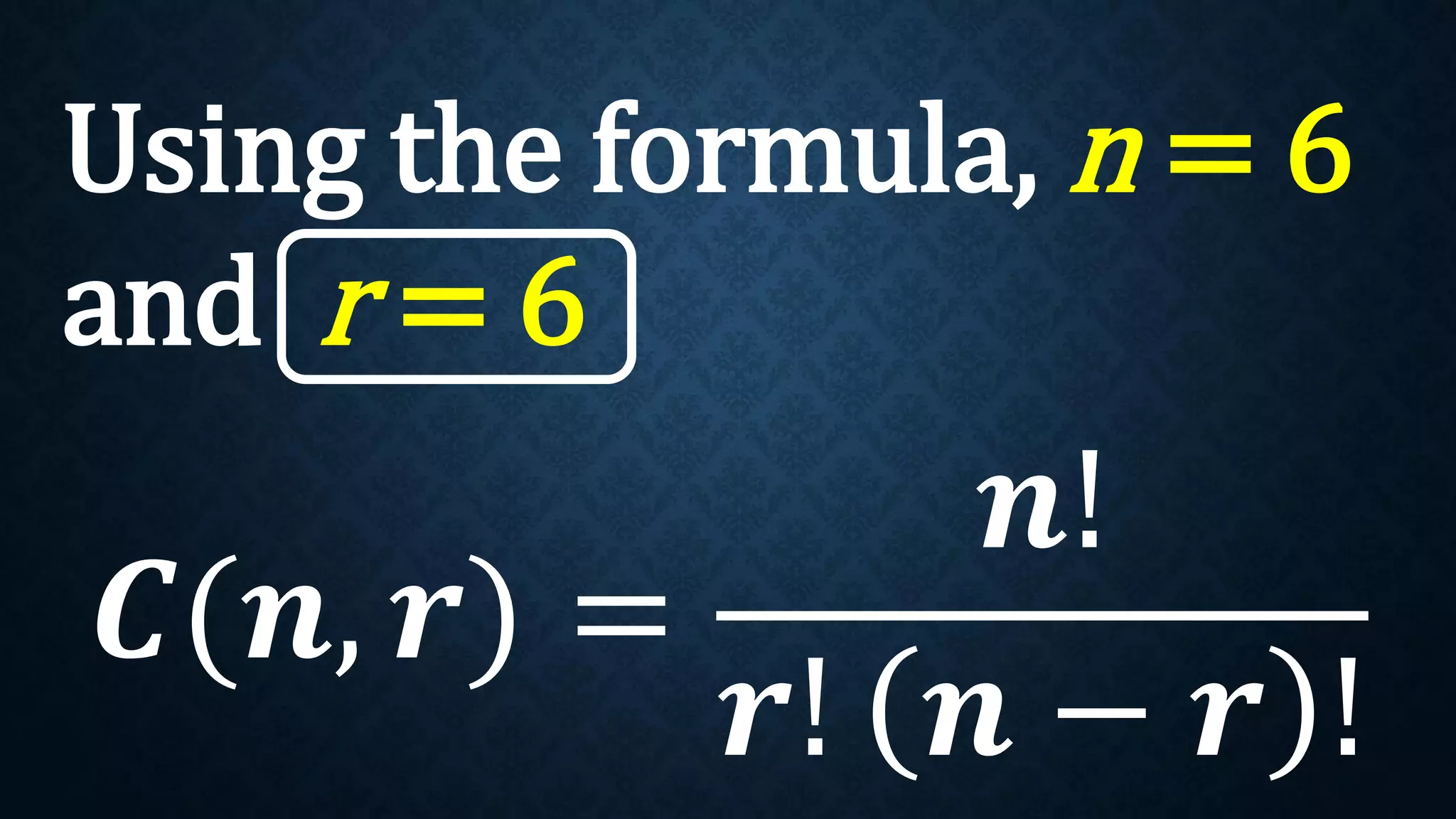
Using the formula, n = 6
and r = 6
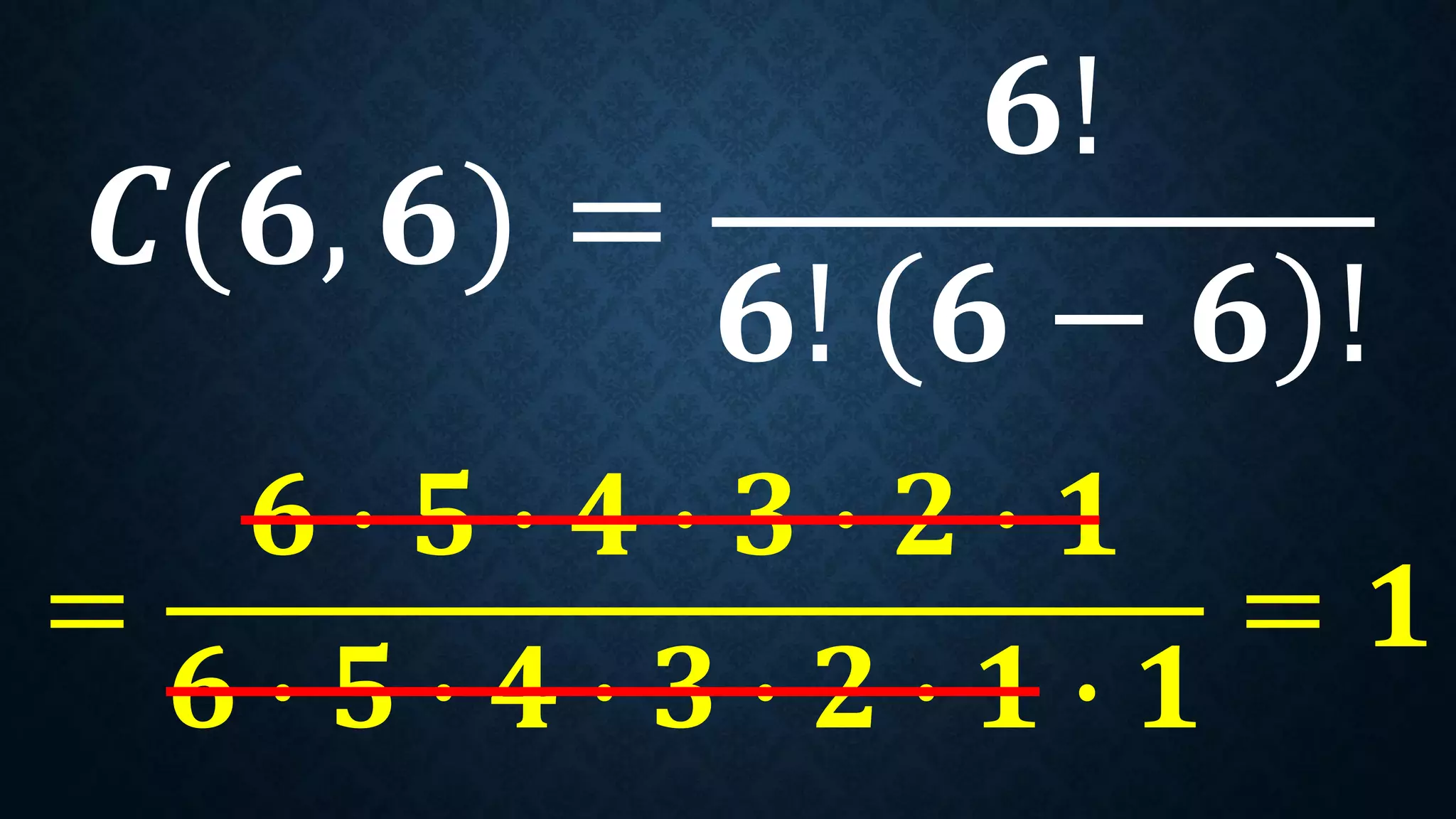
𝑪(𝒏, 𝒓) =
𝒏!
𝒓! 𝒏 − 𝒓 !
𝑪(𝟔, 𝟔) =
𝟔!
𝟔! 𝟔 − 𝟔 !
=
𝟔 ∙ 𝟓 ∙ 𝟒 ∙ 𝟑 ∙ 𝟐 ∙ 𝟏
𝟔 ∙ 𝟓 ∙ 𝟒 ∙ 𝟑 ∙ 𝟐 ∙ 𝟏 ∙ 𝟏
= 𝟏
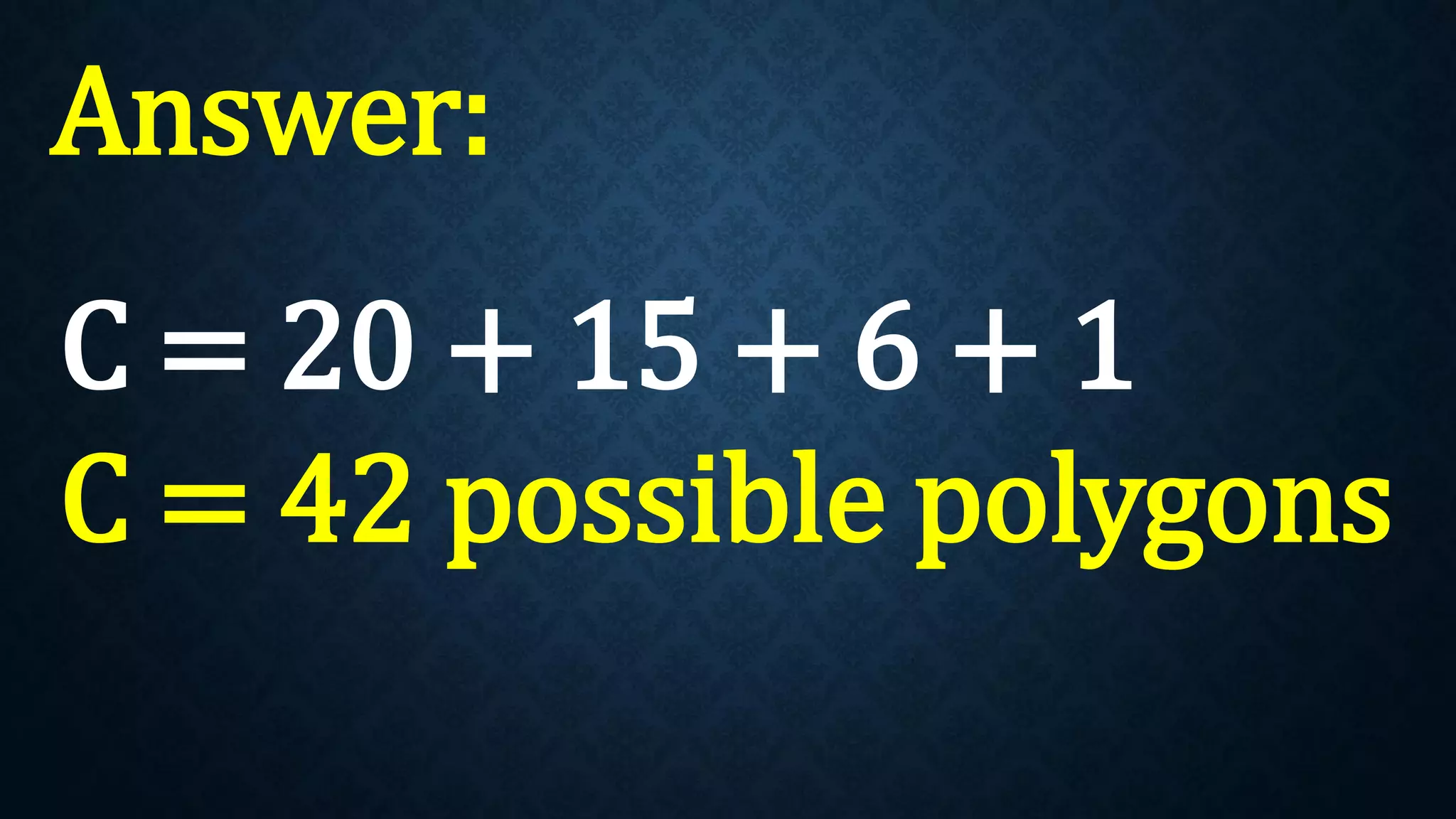
Answer:
C = 20 + 15 + 6 + 1
C = 42 possible polygons
Activity #1
Perfect Combinations
Study the following
situations. Then answer
the questions that follow:
Instruction
Identify which situations
illustrate PERMUTATION
and which illustrate
COMBINATION.
1.) Determining the top
three winners in a
Science Quiz Bee.
2.) Forming lines from
six given points with no
three of which are
collinear.
3.) Forming triangles
from 7 given points with
no three of which are
collinear.
4.) Four people posing
for pictures.
5.) Assembling a jigsaw
puzzle.
6.) Choosing 2
household chores
to do before dinner.
7.) Selecting 5
basketball players out
of 10 team members for
the different positions.
8.) Choosing three of
your classmates to
attend your party.
9.) Picking 6 balls
from a basket of
12 balls.
10.) Forming a
committee of 5
members from 20
people.
Activity #2
Flex That Brains!
Analyze the following
combinations. Then answer
the questions that follow:
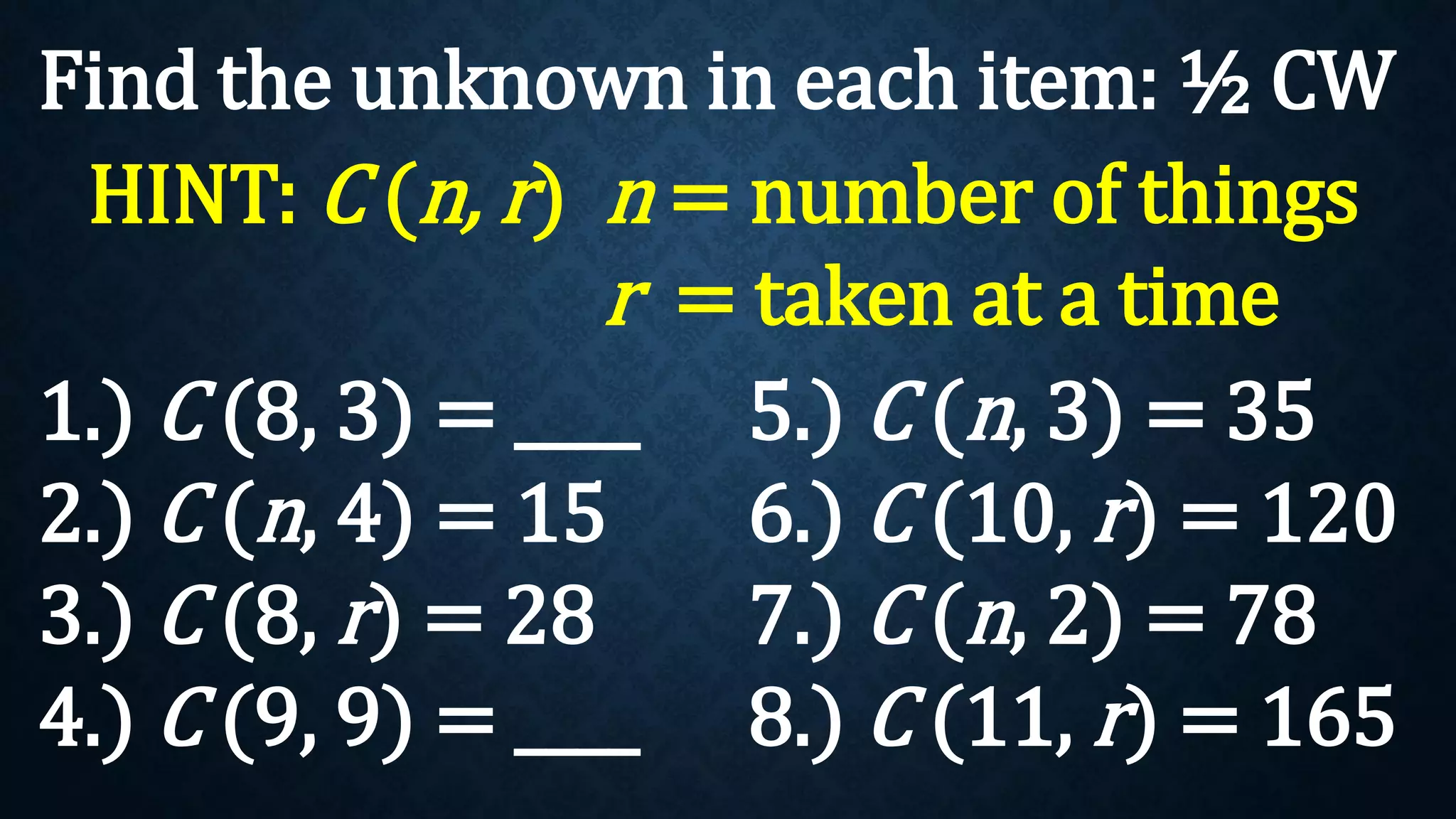
Find the unknown in each item: ½ CW
1.) C (8, 3) = ____
2.) C (n, 4) = 15
3.) C (8, r) = 28
4.) C (9, 9) = ____
HINT: C (n, r) n = number of things
r = taken at a time
5.) C (n, 3) = 35
6.) C (10, r) = 120
7.) C (n, 2) = 78
8.) C (11, r) = 165
Activity #3
Choose Wisely, Choose Me
Solve the following problems
completely in a ½ crosswise of
paper. Do not copy the problem.
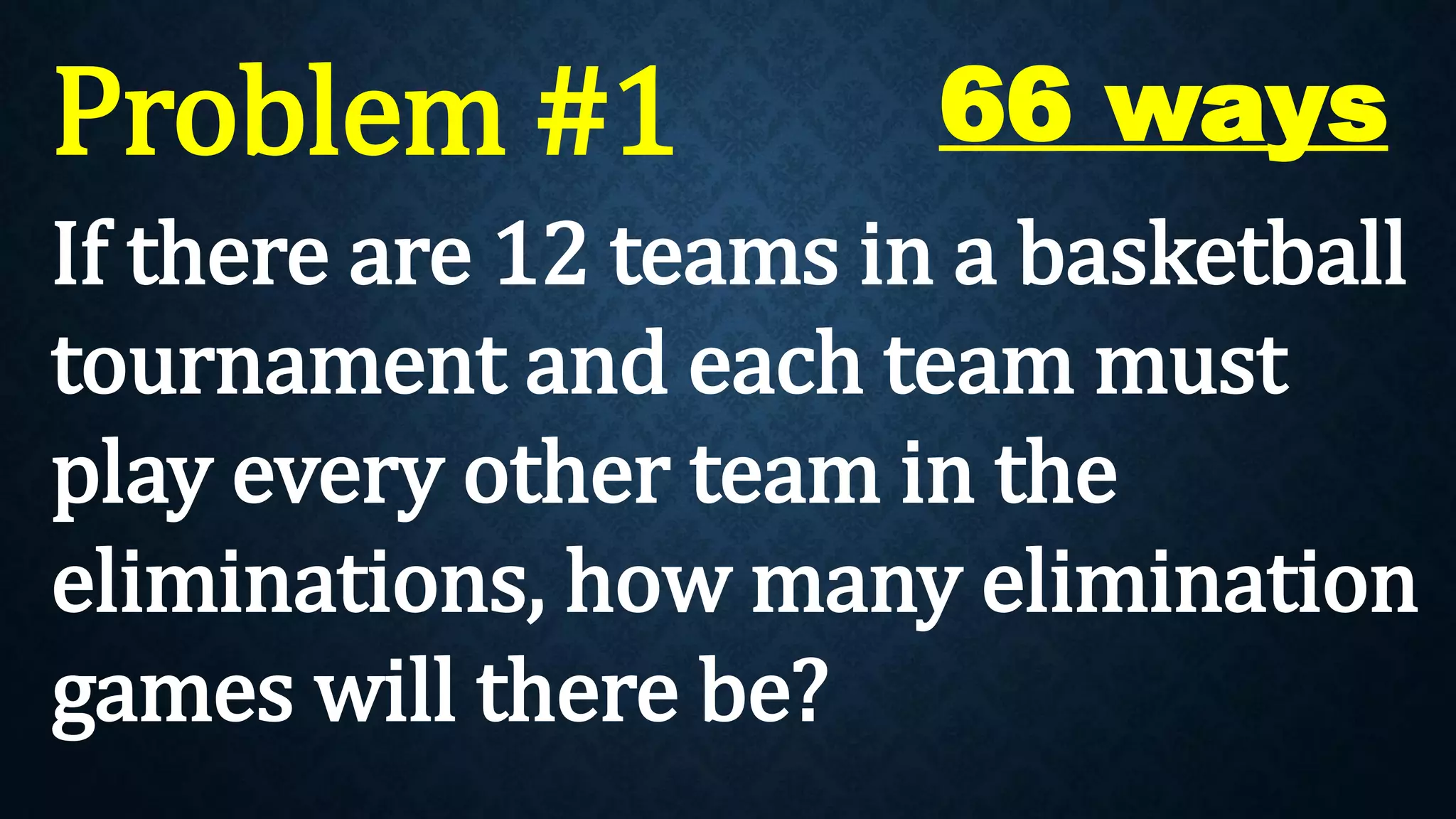
Problem #1
If there are 12 teams in a basketball
tournament and each team must
play every other team in the
eliminations, how many elimination
games will there be?
66 ways
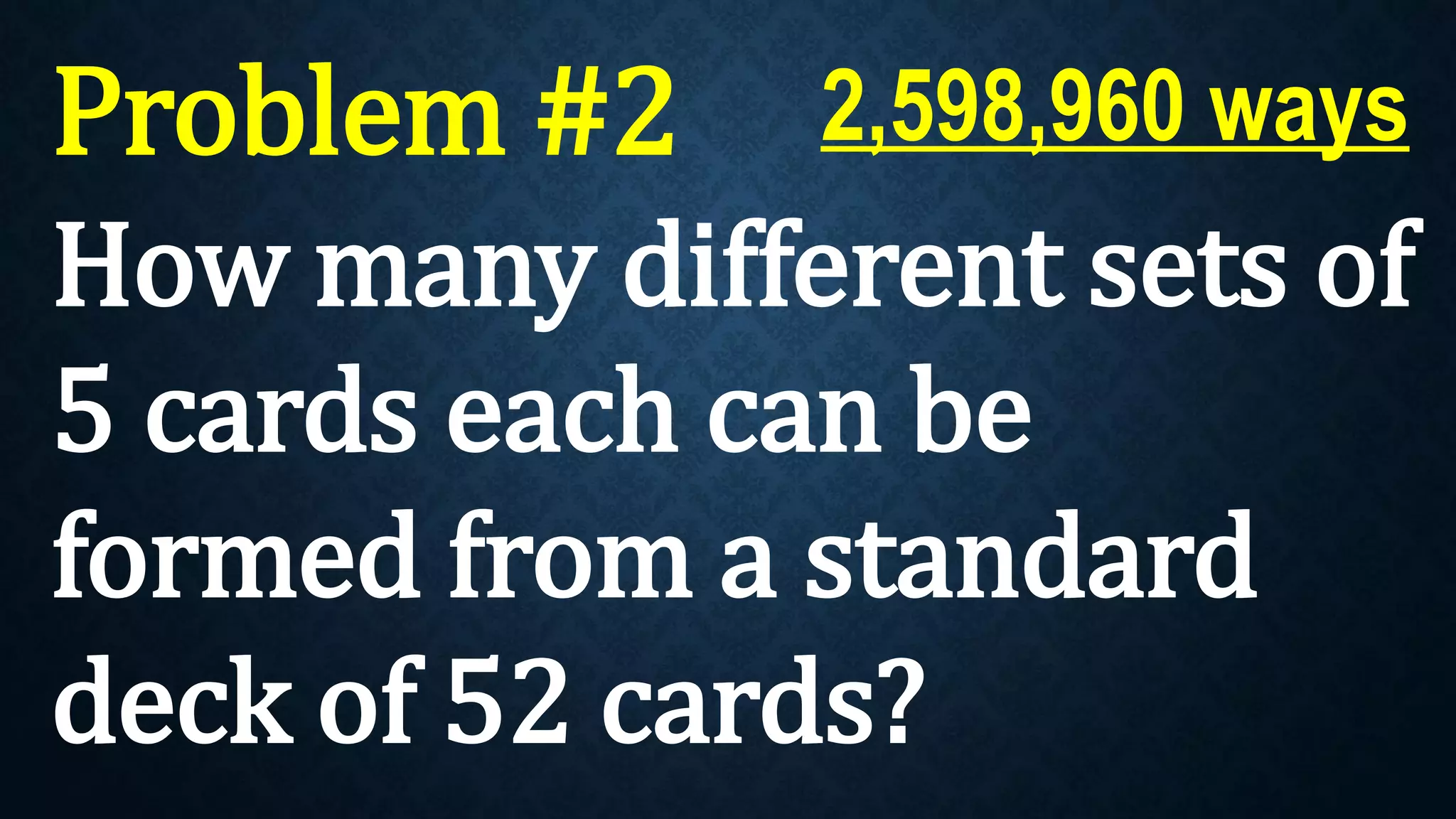
Problem #2
How many different sets of
5 cards each can be
formed from a standard
deck of 52 cards?
2,598,960 ways
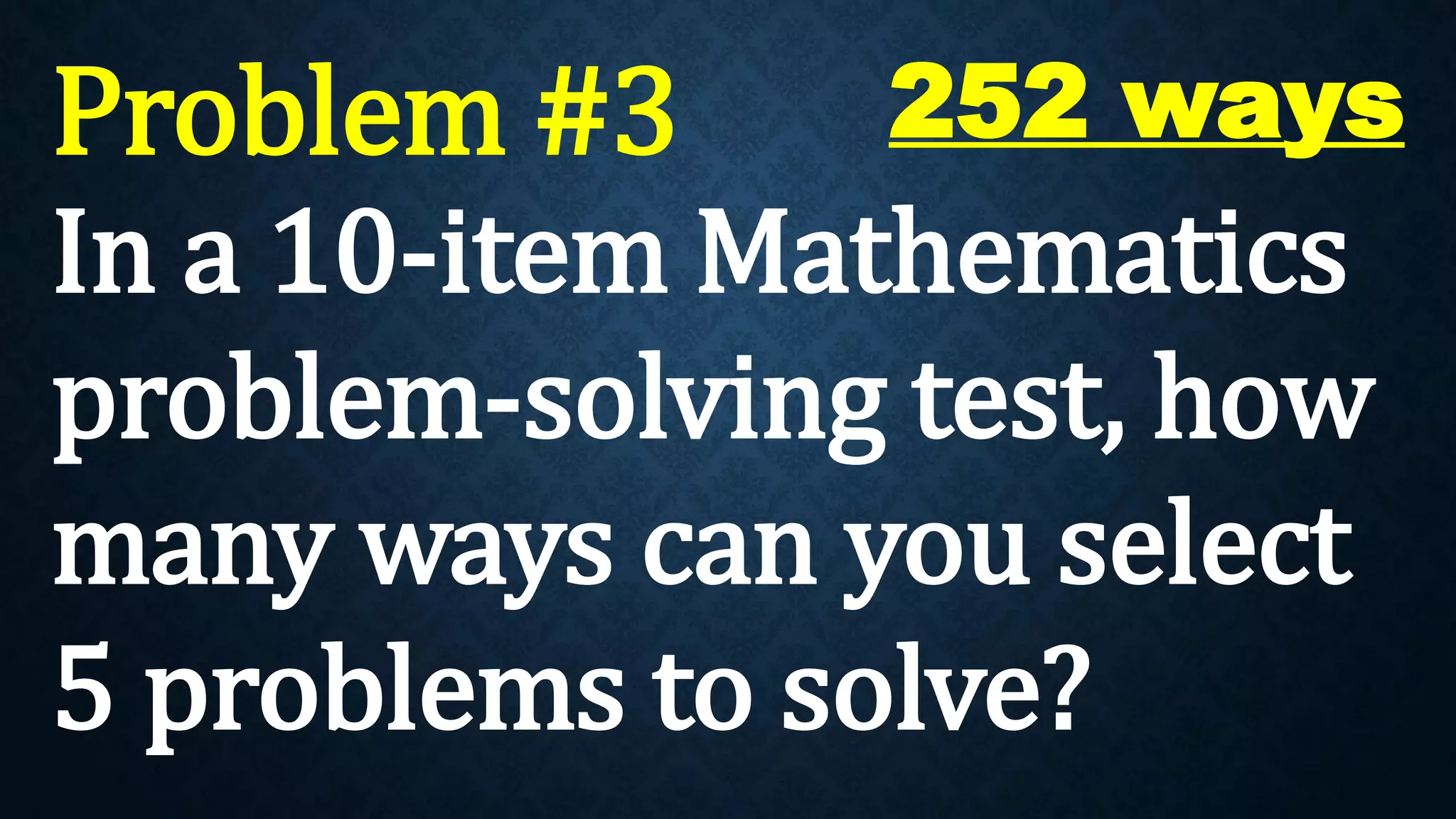
Problem #3
In a 10-item Mathematics
problem-solving test, how
many ways can you select
5 problems to solve?
252 ways

PERMUTATION-COMBINATION.pdf

  • 1.
  • 2.
  • 3.
    Permutations of n objectstaken r at a time: 𝑷(𝒏, 𝒓) = 𝒏! 𝒏 − 𝒓 !
  • 4.
    Permutations of nobjects taken all at a time is: 𝑷(𝒏, 𝒏) = 𝒏!
  • 5.
  • 6.
    Circular permutations of nobjects is: 𝑷 = (𝒏 − 𝟏)!
  • 7.
  • 8.
    1.) Ten runnersjoin in a race. In how many possible ways can they be arranged as 1st , 2nd , and 3rd placers?
  • 9.
    2.) In howmany ways can Aling Rosa arrange 6 potted plants in a row?
  • 10.
    3.) Suppose thatin a certain association, there are 12 elected members of the Board of Directors. In how many ways can a president, a vice president, a secretary, and a treasurer be selected from the board?
  • 11.
    4.) In howmany ways can you place 9 different books on a shelf if there is space enough for only 5 books?
  • 12.
    5.) In howmany ways can 4 people be seated around a circular table? Enumerate all possible arrangements.
  • 13.
    Answer: P = (n-1)!= (4-1)! = 6 A-B-C-D A-B-D-C A-C-B-D A-C-D-B A-D-B-C A-D-C-B
  • 14.
    6.) In howmany ways can 5 people arrange themselves in a row for picture taking?
  • 15.
    7.) If Alexhas 12 T-shirts, 6 pairs of pants, and 3 pairs of shoes, how many possibilities can he dress himself up for the day?
  • 16.
    8.) A dress-shophas 8 new dresses that she wants to display in the window. If the display window has 5 mannequins, in how many ways can she dress them up?
  • 17.
    9.) If thereare 10 people and only 6 chairs are available, in how many ways can they be seated?
  • 18.
    10.) Five coupleswant to have their pictures taken. In how many ways can they arrange themselves in a row if: a. couples must stay together. b. couples may stand anywhere.
  • 19.
    11.) There are4 different Mathematics books and 5 different Science books. In how many ways can the books be arranged on a shelf if: a. there are no restrictions. b. if they must be placed alternately.
  • 20.
    12.) Find thenumber of permutations of the digits of the number 348 838.
  • 21.
    13.) How many4-digit numbers can be formed from the digits 1, 3, 5, 6, 8, and 9 if no repetition is allowed?
  • 22.
    14.) In howmany different ways can 5 bicycles be parked if there are 7 available parking spaces?
  • 23.
    15.) A teacherwants to assign 4 different tasks to her 4 students. In how many possible ways can she do it?
  • 24.
    Solve for theunknown in each item: 1.) P (6,6) = ______ 2.) P (7, r) = 840 3.) P (n, 3) = 504 4.) P (10, 5) = ____ HINT: P (n, r) n = number of things r = taken at a time 5.) P (8,r) = 6720 6.) P (8, 3) = _____ 7.) P (n, 4) = 3024 8.) P (13, r) = 156
  • 25.
  • 26.
    Suppose you wereassigned by your teacher to be the leader of your group for your project. You were given the freedom to choose 4 of your classmates to be your group mates.
  • 27.
    If you chooseAira, Belle, Charlie, and Dave, does it make any difference if you choose instead Charlie, Aira, Dave, and Belle? Of course not, because the list refers to the same people.
  • 28.
    Each selection thatyou could possibly make is called a COMBINATION. On the other hand, if you choose Aira, Belle, Dave, and Ellen, now that is another combination,
  • 29.
    In a simplewords, a Combination is a selection made with no regard to order of the selected objects.
  • 30.
    The number ofcombinations of n objects taken r at a time is denoted by: C(n, r) 𝒏 𝒓 𝒄𝒓 𝒏 𝒄𝒓 n
  • 31.
    How do wefind the number of combinations of n objects taken r at a time?
  • 32.
    In combinations, we have: 𝑪(𝒏,𝒓) = 𝑷(𝒏, 𝒓) 𝒓!
  • 33.
    𝑪(𝒏, 𝒓) = 𝒏! 𝒓!𝒏 − 𝒓 ! where: n = no. of objects r = taken at a time
  • 34.
  • 35.
    Suppose now, thatyou are asked to form different triangles out of 4 points plotted, say, A, B, C, and D, of which no three are collinear.
  • 36.
  • 37.
    We can seethat △ ABC is the same as △ BCA and △ CBA. In the same manner, △ BCD is the same as △ CBD and △ DBC.
  • 38.
    This is anotherillustration of combination. The different triangles that can be formed are △ ABC , △ ABD , △ BCD , and △ CDA.
  • 39.
    Thus, there are only4 COMBINATIONS
  • 40.
    Consider this: If orderof the letters is important, then we have the following:
  • 41.
  • 42.
    The number ofdifferent orders of 4 vertices, taken 3 at a time is: 𝑷 𝟒, 𝟑 = 𝟒! 𝟒 − 𝟑 ! = 𝟐𝟒
  • 43.
    There are 24possibilities in permutations. But in combinations, we have: 𝑪 𝟒, 𝟑 = 𝟒! 𝟑! 𝟒 − 𝟑 ! = 𝟒
  • 44.
  • 45.
    Suppose you have4 different colors - black, blue, yellow, and red of which you have to mix 2 equal proportions to make a new color. How many new colors can be made?
  • 48.
    Notice that mixingblue and red is exactly the same as mixing red and blue, so the order does not matter.
  • 49.
    As you cansee there are 6 new colors Black-Blue, Black-Red, Black-Yellow, Blue-Red, Blue-Yellow, Red-Yellow.
  • 50.
    When using formulain combinations, we have: 𝑪 𝟒, 𝟐 = 𝟒! 𝟐! 𝟒 − 𝟐 ! = 𝟔
  • 51.
    Example #1 In howmany ways can a committee consisting of 4 members be formed from 8 people?
  • 52.
    Solution: Using the formula,n = 8 and r = 4 𝑪(𝒏, 𝒓) = 𝒏! 𝒓! 𝒏 − 𝒓 !
  • 53.
    𝑪(𝟖, 𝟒) = 𝟖! 𝟒!𝟖 − 𝟒 ! = 𝟖 ∙ 𝟕 ∙ 𝟔 ∙ 𝟓 ∙ 𝟒 ∙ 𝟑 ∙ 𝟐 𝟒 ∙ 𝟑 ∙ 𝟐 ∙ 𝟒 ∙ 𝟑 ∙ 𝟐 2
  • 54.
    = 𝟐 ∙𝟕 ∙ 𝟓 = 𝟕𝟎 𝒘𝒂𝒚𝒔
  • 55.
    Example #2 How manypolygons can be possibly formed from 6 distinct points on a plane, no three of which are collinear?
  • 56.
    Solution: The polygon mayhave 3, 4, 5, or 6 vertices. Thus, each has its own combination.
  • 57.
    Using the formula,n = 6 and r = 3 𝑪(𝒏, 𝒓) = 𝒏! 𝒓! 𝒏 − 𝒓 !
  • 58.
    𝑪(𝟔, 𝟑) = 𝟔! 𝟑!𝟔 − 𝟑 ! = 𝟔 ∙ 𝟓 ∙ 𝟒 ∙ 𝟑 ∙ 𝟐 ∙ 𝟏 𝟑 ∙ 𝟐 ∙ 𝟏 ∙ 𝟑 ∙ 𝟐 ∙ 𝟏 = 𝟐𝟎
  • 59.
    Using the formula,n = 6 and r = 4 𝑪(𝒏, 𝒓) = 𝒏! 𝒓! 𝒏 − 𝒓 !
  • 60.
    𝑪(𝟔, 𝟒) = 𝟔! 𝟒!𝟔 − 𝟒 ! = 𝟔 ∙ 𝟓 ∙ 𝟒 ∙ 𝟑 ∙ 𝟐 ∙ 𝟏 𝟒 ∙ 𝟑 ∙ 𝟐 ∙ 𝟏 ∙ 𝟐 ∙ 𝟏 = 𝟏𝟓
  • 61.
    Using the formula,n = 6 and r = 5 𝑪(𝒏, 𝒓) = 𝒏! 𝒓! 𝒏 − 𝒓 !
  • 62.
    𝑪(𝟔, 𝟓) = 𝟔! 𝟓!𝟔 − 𝟓 ! = 𝟔 ∙ 𝟓 ∙ 𝟒 ∙ 𝟑 ∙ 𝟐 ∙ 𝟏 𝟓 ∙ 𝟒 ∙ 𝟑 ∙ 𝟐 ∙ 𝟏 = 𝟔
  • 63.
    Using the formula,n = 6 and r = 6 𝑪(𝒏, 𝒓) = 𝒏! 𝒓! 𝒏 − 𝒓 !
  • 64.
    𝑪(𝟔, 𝟔) = 𝟔! 𝟔!𝟔 − 𝟔 ! = 𝟔 ∙ 𝟓 ∙ 𝟒 ∙ 𝟑 ∙ 𝟐 ∙ 𝟏 𝟔 ∙ 𝟓 ∙ 𝟒 ∙ 𝟑 ∙ 𝟐 ∙ 𝟏 ∙ 𝟏 = 𝟏
  • 65.
    Answer: C = 20+ 15 + 6 + 1 C = 42 possible polygons
  • 66.
    Activity #1 Perfect Combinations Studythe following situations. Then answer the questions that follow:
  • 67.
    Instruction Identify which situations illustratePERMUTATION and which illustrate COMBINATION.
  • 68.
    1.) Determining thetop three winners in a Science Quiz Bee.
  • 69.
    2.) Forming linesfrom six given points with no three of which are collinear.
  • 70.
    3.) Forming triangles from7 given points with no three of which are collinear.
  • 71.
    4.) Four peopleposing for pictures. 5.) Assembling a jigsaw puzzle.
  • 72.
    6.) Choosing 2 householdchores to do before dinner.
  • 73.
    7.) Selecting 5 basketballplayers out of 10 team members for the different positions.
  • 74.
    8.) Choosing threeof your classmates to attend your party.
  • 75.
    9.) Picking 6balls from a basket of 12 balls.
  • 76.
    10.) Forming a committeeof 5 members from 20 people.
  • 77.
    Activity #2 Flex ThatBrains! Analyze the following combinations. Then answer the questions that follow:
  • 78.
    Find the unknownin each item: ½ CW 1.) C (8, 3) = ____ 2.) C (n, 4) = 15 3.) C (8, r) = 28 4.) C (9, 9) = ____ HINT: C (n, r) n = number of things r = taken at a time 5.) C (n, 3) = 35 6.) C (10, r) = 120 7.) C (n, 2) = 78 8.) C (11, r) = 165
  • 79.
    Activity #3 Choose Wisely,Choose Me Solve the following problems completely in a ½ crosswise of paper. Do not copy the problem.
  • 80.
    Problem #1 If thereare 12 teams in a basketball tournament and each team must play every other team in the eliminations, how many elimination games will there be? 66 ways
  • 81.
    Problem #2 How manydifferent sets of 5 cards each can be formed from a standard deck of 52 cards? 2,598,960 ways
  • 82.
    Problem #3 In a10-item Mathematics problem-solving test, how many ways can you select 5 problems to solve? 252 ways