Thermodynamics
PREPARED BY: Engr. Yuri G. Melliza
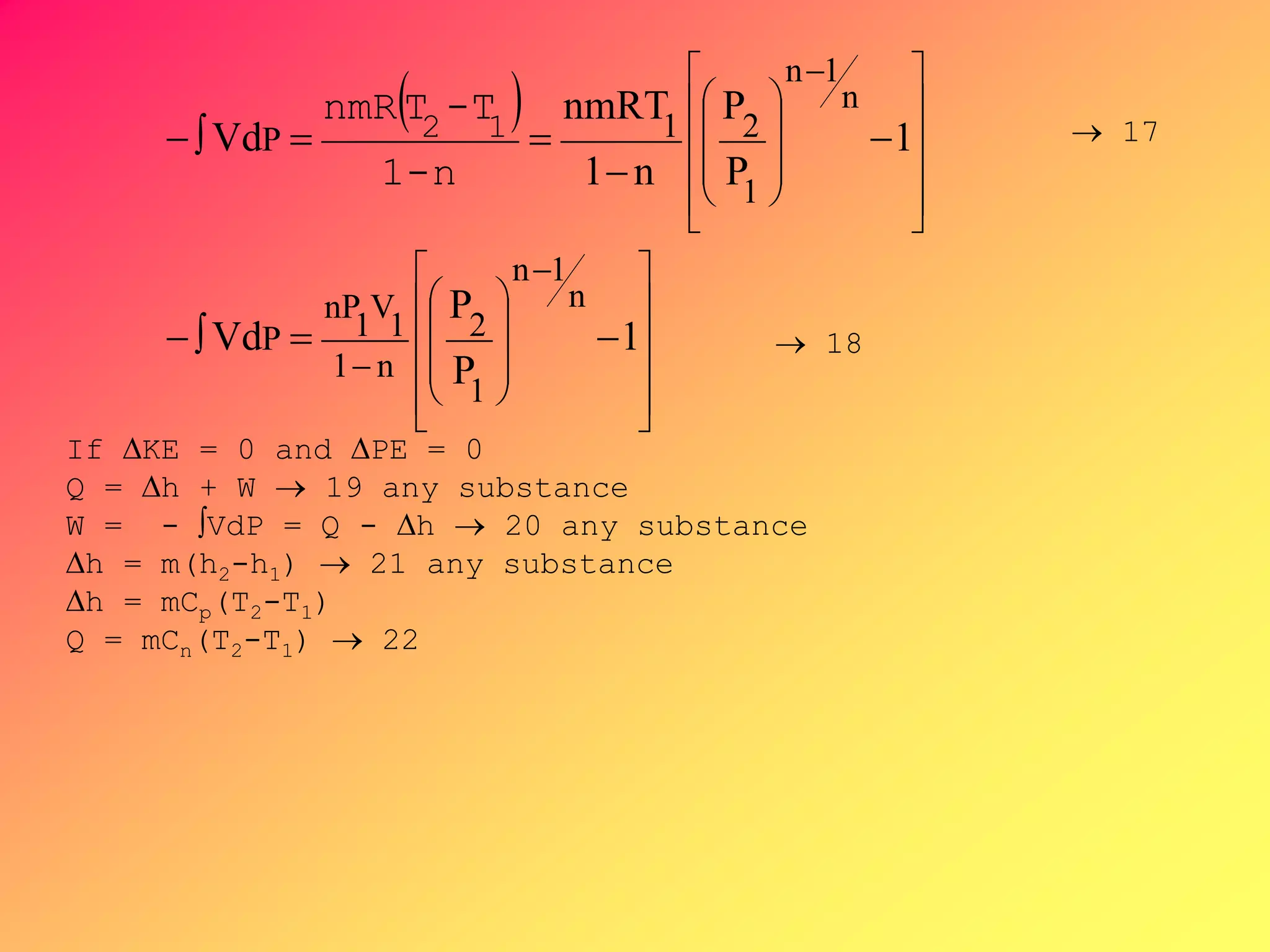
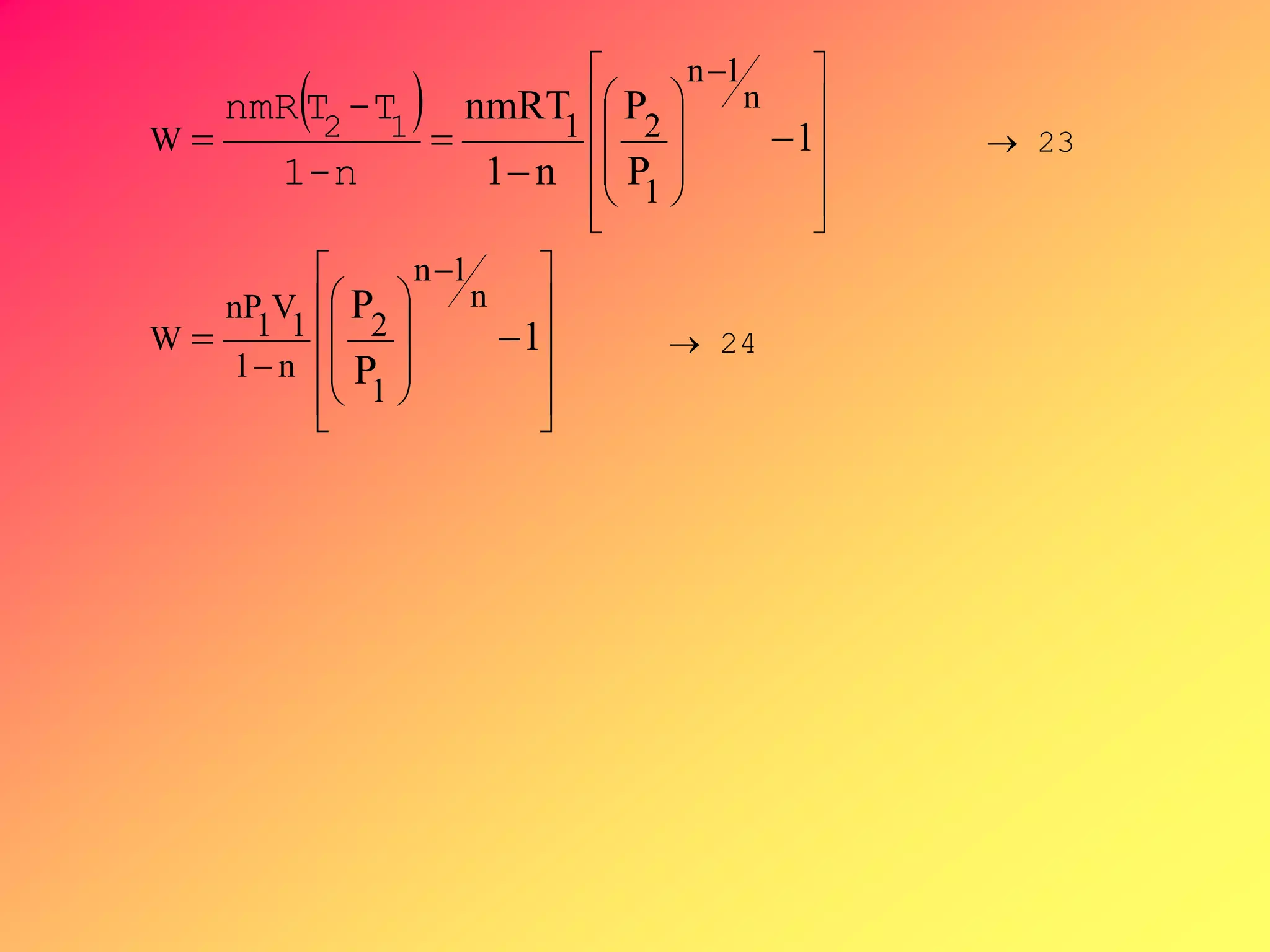
THERMODYNAMICS
It a science that deals with energy transformation, the transformation of heat into
work or vice versa. It was derived from a Greek word “therme” that means Heat and
“dynamis” that means Strength.
SYSTEM: Is that portion in the universe, an atom, a galaxy, a certain quantity of
matter or a certain volume in space in which one wishes to study. It is a region en-
closed by an specified boundary, that may be imaginary, fixed or moving.
OPEN SYSTEM: A system open to matter flow or a system in which there is an
exchange of mass between the system and the surroundings.
CLOSED SYSTEM: A system closed to matter flow or a system in which there’s no
exchange of mass between the system and the surroundings.
Closed System: Piston in Cylinder
boundary
Open System: Steam turbine
steam in
steam out
Work
boundary
SURROUNDING OR ENVIRONMENT: It is the region all about the system.
WORKING SUBSTANCE: A substance responsible for the transformation of energy.
example: steam in a steam turbine, water in a water pump
PURE SUBSTANCE: A substance that is homogeneous in nature and is homoge-
neous, or a substance that is not a mixture of different specie, or a substance that
does not undergo chemical reaction.
PROPERTY: It is a characteristic quality of a certain substance.
INTENSIVE PROPERTY: Property that is independent of the mass of a system.
EXTENSIVE PROPERTY: Property that is dependent upon the mass of the system
and are total values such as volume and total internal energy.
PROCESS: It is simply a change of state of a substance. If certain property of a
substance is changed, it is said to have undergone a process.
CYCLE: It is a series of two or more processes in which the final and the initial
state are the same.
ADIABATIC SYSTEM: A system that is impervious to heat. A system (open or closed)
in which heat cannot cross its boundary.
PHASES OF A SUBSTANCE
A. Solid phase
B. Liquid phase
C. Gaseous or Vapor phase
SPECIFIC TERMS TO CHARACTERIZED PHASE TRANSITION:
1. Vaporization: Change from liquid to vapor
2. Condensation: Change from vapor to liquid
3. Freezing: Change from liquid to solid
4. Melting: Change from solid to liquid
5. Sublimation: Change from solid directly to vapor without passing the liquid
state.
MASS: It is the absolute quantity of matter in it.
m – mass, kg
VELOCITY: It is the distance per unit time.
sec
m
t
d
v 
where:
v – velocity in m/sec
d – distance in meters
t – time in sec
ACCELERATION: It is the rate of change of velocity with respect to time.
2
sec
m
dt
dv
a 
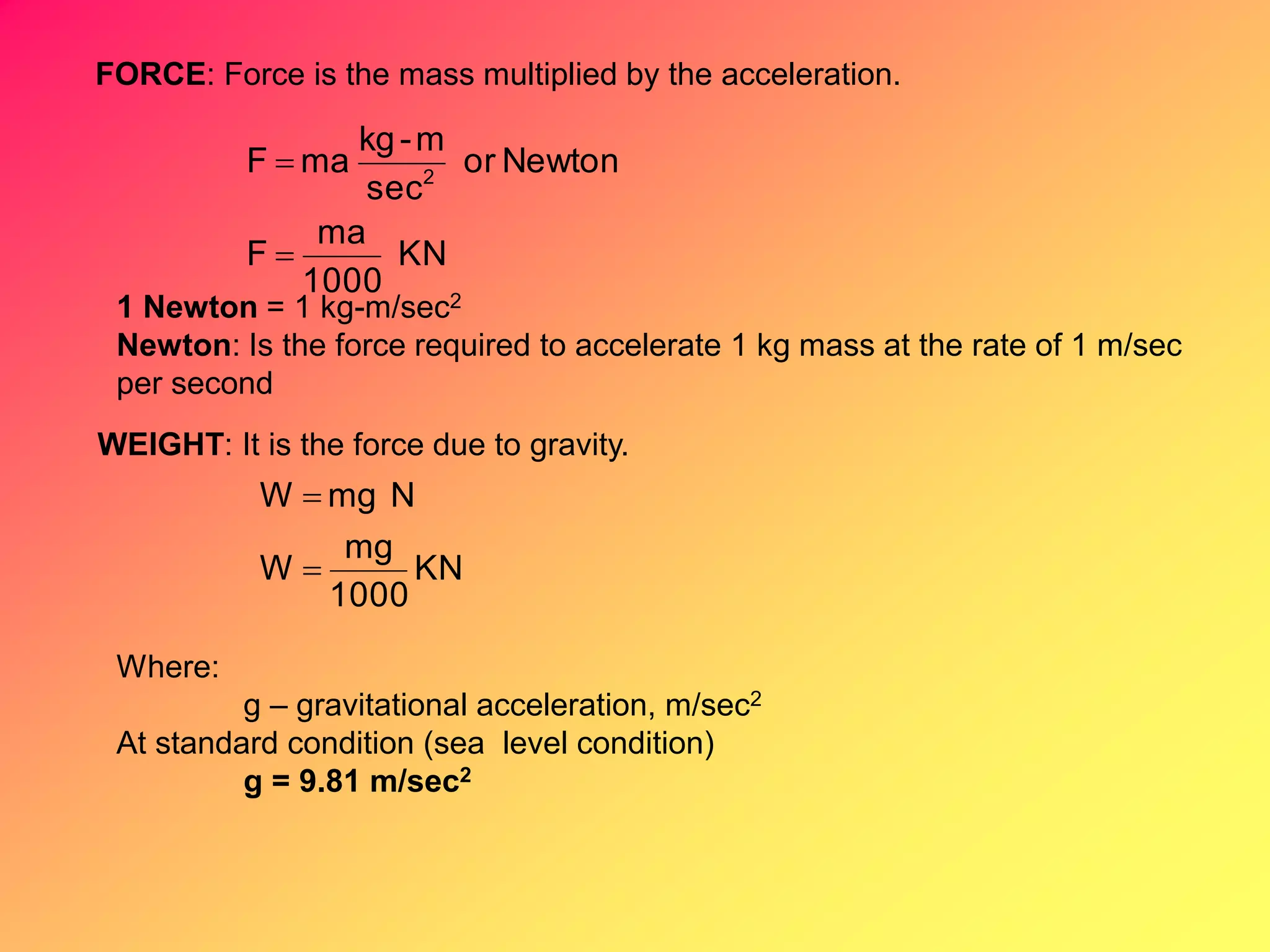
FORCE: Force is the mass multiplied by the acceleration.
KN
1000
ma
F
Newtonor
sec
m-kg
maF 2


1 Newton = 1 kg-m/sec2
Newton: Is the force required to accelerate 1 kg mass at the rate of 1 m/sec
per second
WEIGHT: It is the force due to gravity.
KN
1000
mg
W
NmgW


Where:
g – gravitational acceleration, m/sec2
At standard condition (sea level condition)
g = 9.81 m/sec2
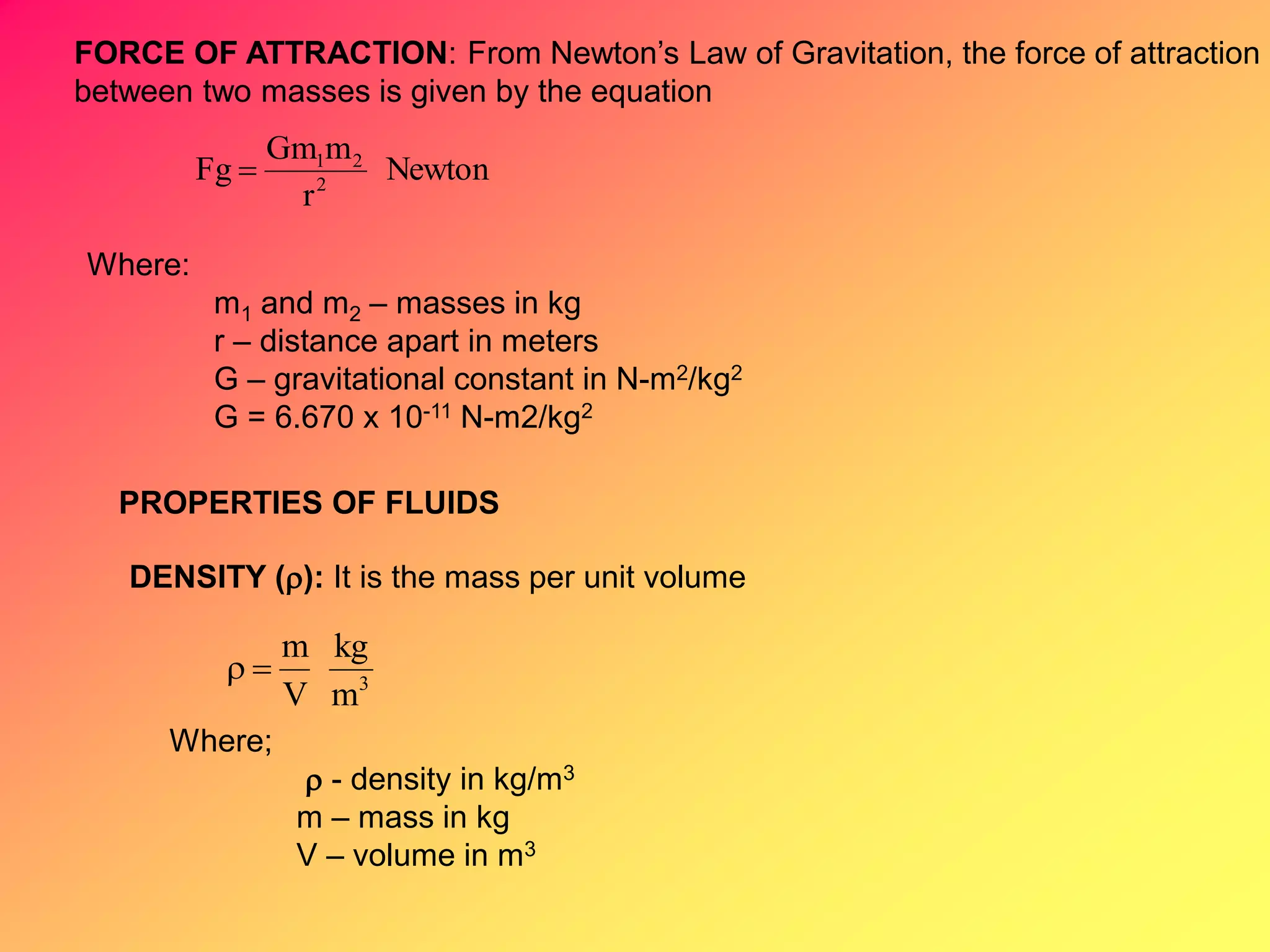
FORCE OF ATTRACTION: From Newton’s Law of Gravitation, the force of attraction
between two masses is given by the equation
Newton
r
mGm
Fg 2
21

Where:
m1 and m2 – masses in kg
r – distance apart in meters
G – gravitational constant in N-m2/kg2
G = 6.670 x 10⁻¹¹ N-m2/kg2
PROPERTIES OF FLUIDS
DENSITY (): It is the mass per unit volume
3
m
kg
V
m

Where;
 - density in kg/m3
m – mass in kg
V – volume in m3
SPECIFIC VOLUME (): It is the volume per unit mass or the reciprocal of its
density.
3
m
KN
1000
g
V1000
mg
V
W 

Where:
 - specific volume in m3/kg
SPECIFIC GRAVITY OR RELATIVE DENSITY
1. For liquids it is the ratio of its density to that of water at standard
temperature and pressure.
2. For gases it is the ratio of its density to that of either air or hydrogen
at some specified temperature and pressure.
SPECIFIC WEIGHT (): It is the weight per unit volume.
kg
3m1
m
V


Where:
 - specific weight in KN/m3
AH
G
G
w
L
L
S:GasesFor
SLiquidsFor





: Where:
At standard Condition
w = 1000 kg/m3
w = 9.81 KN/m3
VISCOSITY: It is a property of a fluid that determines the amount of its
resistance to shearing stress.
a. Absolute or Dynamic viscosity
 - dynamic viscosity in N-sec/m2
b. Kinematic viscosity
 - kinematic viscosity in m2/sec
TEMPERATURE: It is the measure of the intensity of heat.
Fahrenheit Scale
Freezing Point = 32F
Boiling Point = 212 F
Centigrade or Celsius Scale
Freezing Point = 0C
Boiling Point = 100C
CONVERSION FORMULAS
32C8.1F
8.1
32F
C



460FR
273CK


KPaor
m
KN
A
F
P 2

ABSOLUTE SCALE
PRESSURE: Pressure is defined as the normal component of a force per
unit area.
If a force dF acts normally on an infinitesimal area dA, the intensity of pres-
sure is equal to
dA
dF
P 
where;
P – pressure, KPa
F- force KN
A – area, m2
1 KPa = 1 KN/m2
1MPa = 1000 KPa
PASCAL’S LAW: At any point in a homogeneous fluid at rest the pressures are
the same in all directions.
x
y
z
A
B
C

P1 A1
P2 A2
P3 A3
Fx = 0 and Fy = 0
P1A1 – P3A3 sin  = 0  1
P2A2 – P3A3cos  = 0  2
From Figure:
A1 = A3sin   3
A2 = A3cos   4
Eq. 3 to Eq. 1
P1 = P3
Eq. 4 to Eq. 2
P2 = P3
Therefore:
P1 = P2 = P3
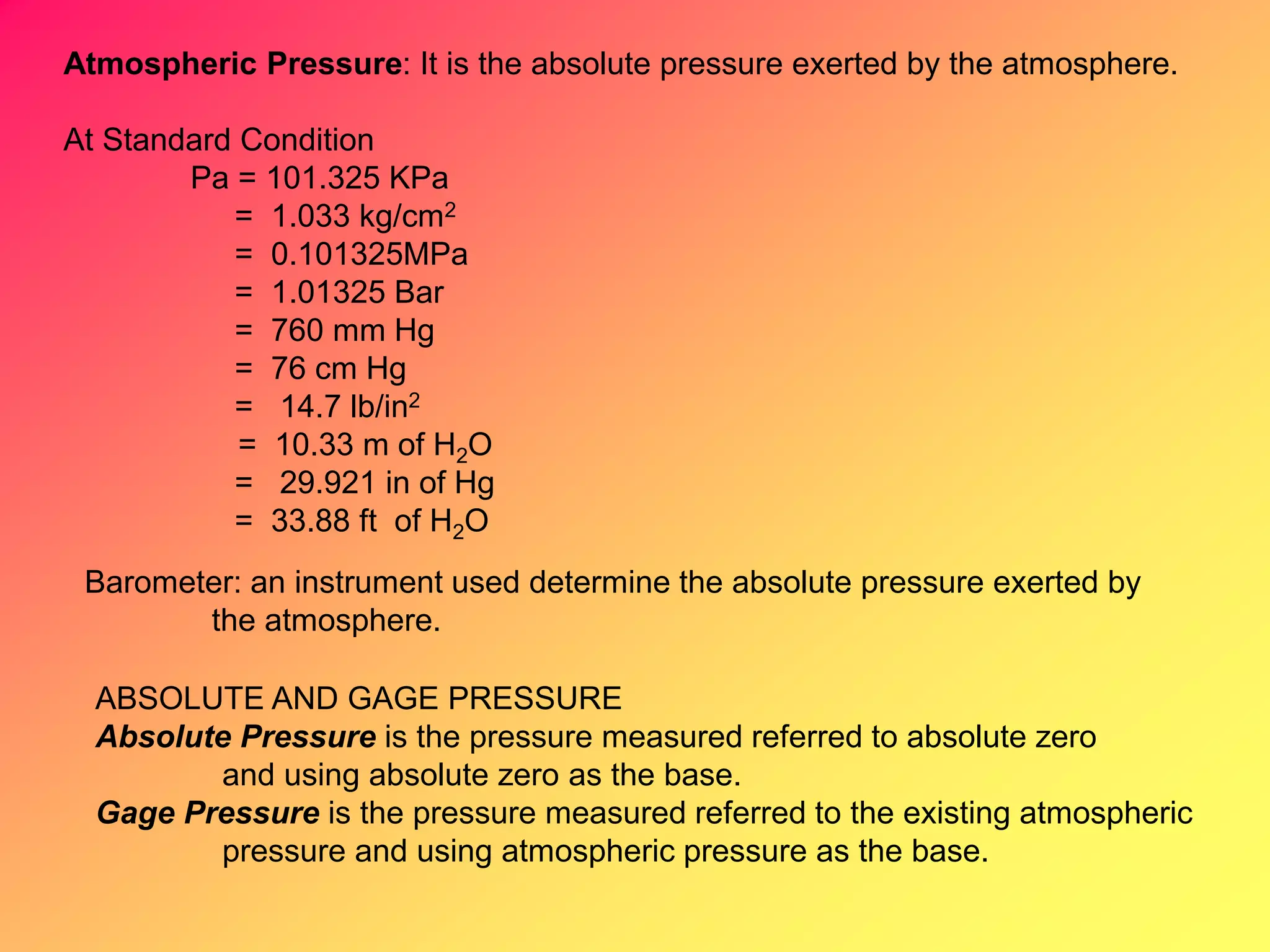
Atmospheric Pressure: It is the absolute pressure exerted by the atmosphere.
At Standard Condition
Pa = 101.325 KPa
= 1.033 kg/cm2
= 0.101325MPa
= 1.01325 Bar
= 760 mm Hg
= 76 cm Hg
= 14.7 lb/in2
= 10.33 m of H2O
= 29.921 in of Hg
= 33.88 ft of H2O
Barometer: an instrument used determine the absolute pressure exerted by
the atmosphere.
ABSOLUTE AND GAGE PRESSURE
Absolute Pressure is the pressure measured referred to absolute zero
and using absolute zero as the base.
Gage Pressure is the pressure measured referred to the existing atmospheric
pressure and using atmospheric pressure as the base.
Atmospheric Pressure
Absolute Zero
Pgage
Pvacuum
Pabs
Pabs
Pabs = Pa – Pvacuum
Pabs = Pa + Pgage
VARIATION OF PRESSURE WITH ELEVATION
(P + dP) A
(P) A
dh
W
Fx = 0
(P + dP)A – PA – W = 0
PA + dPA – PA = W
dPA = W
W = dV
dV = Adh
dPA = - Adh
dP = - dh
Note: Negative sign is used because
Pressure decreases as elevation in-
creases and increases as elevation
decreases
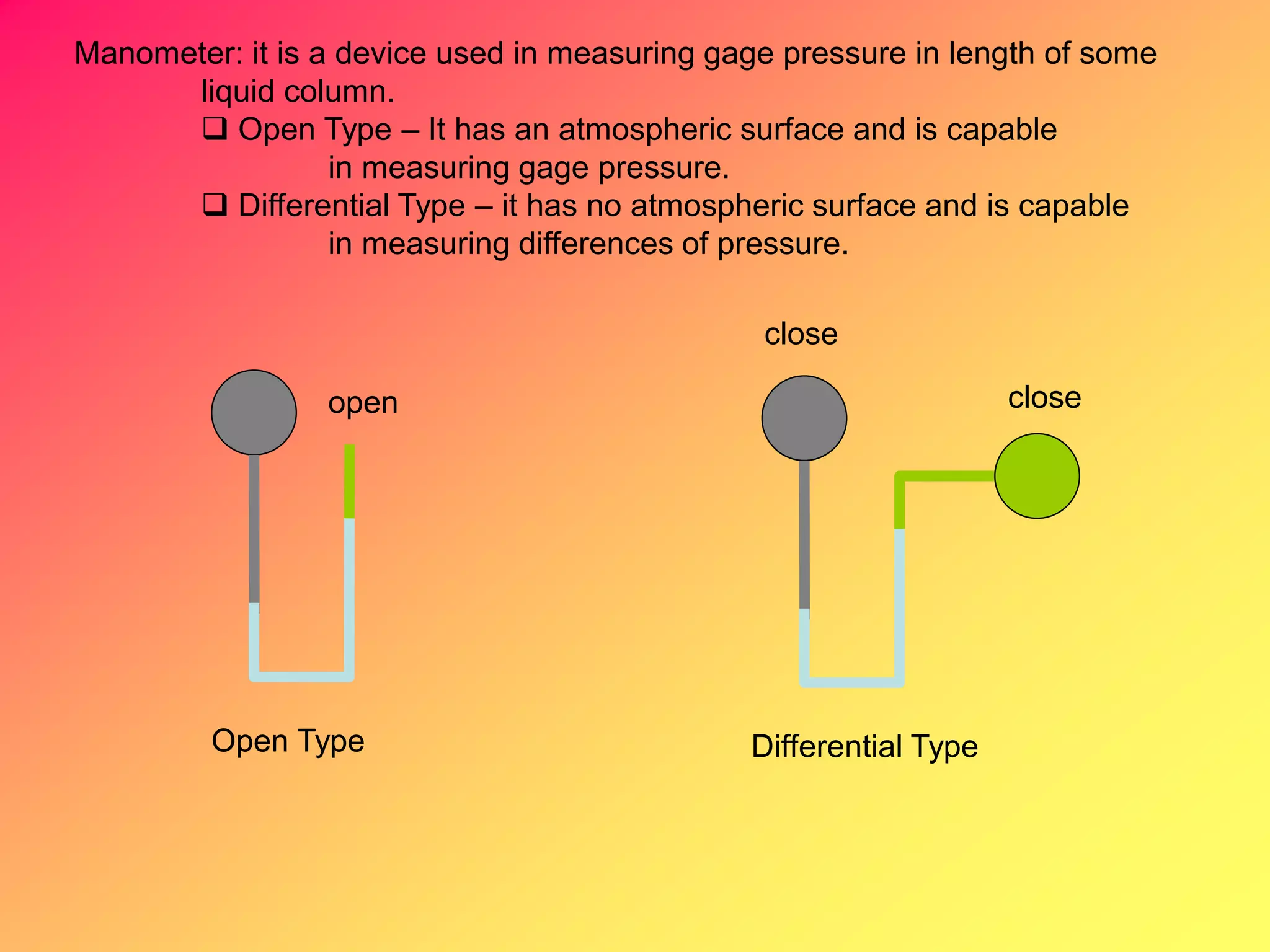
Manometer: it is a device used in measuring gage pressure in length of some
liquid column.
 Open Type – It has an atmospheric surface and is capable
in measuring gage pressure.
 Differential Type – it has no atmospheric surface and is capable
in measuring differences of pressure.
open
Open Type
close
close
Differential Type
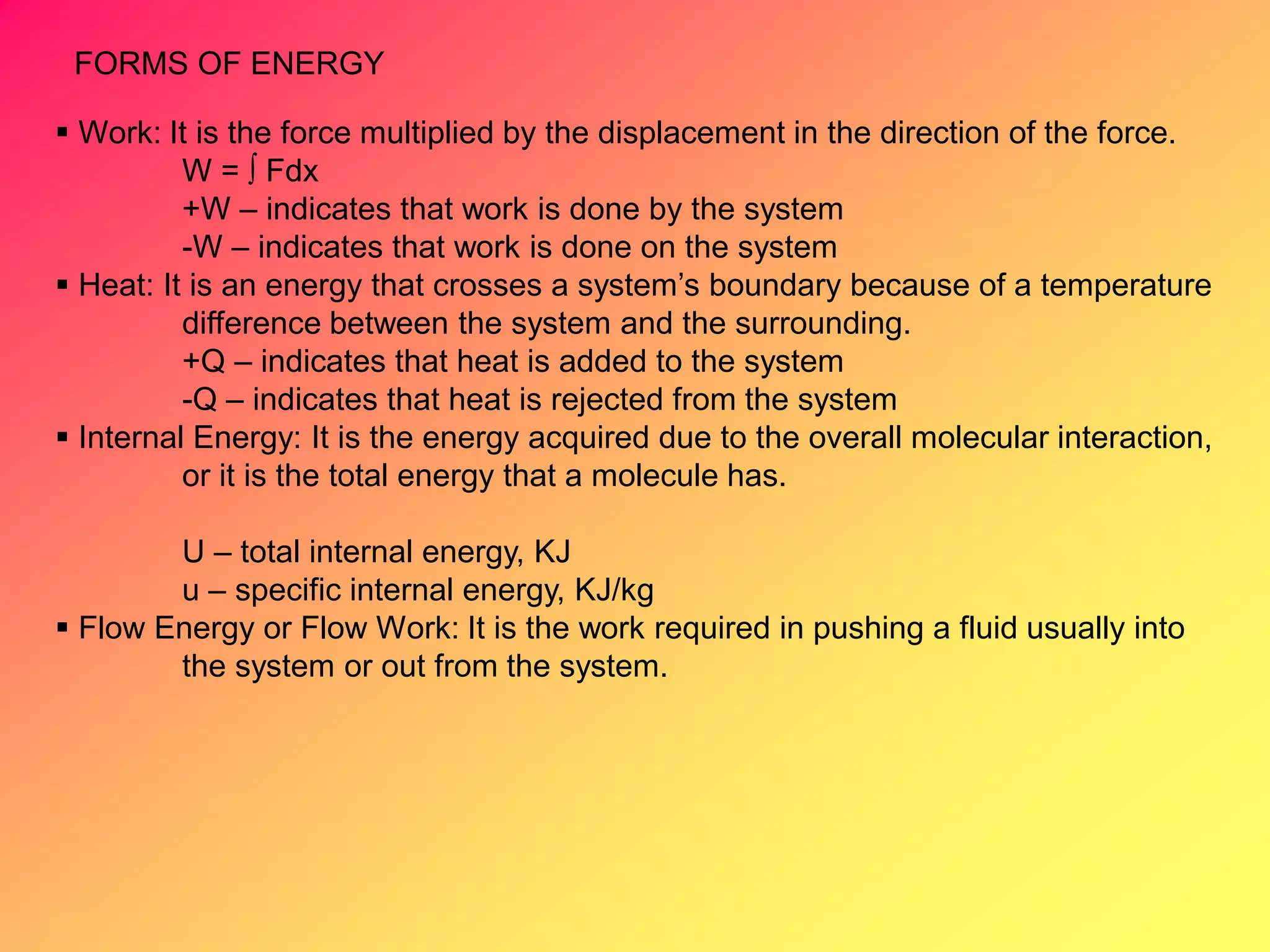
FORMS OF ENERGY
 Work: It is the force multiplied by the displacement in the direction of the force.
W =  Fdx
+W – indicates that work is done by the system
-W – indicates that work is done on the system
 Heat: It is an energy that crosses a system’s boundary because of a temperature
difference between the system and the surrounding.
+Q – indicates that heat is added to the system
-Q – indicates that heat is rejected from the system
 Internal Energy: It is the energy acquired due to the overall molecular interaction,
or it is the total energy that a molecule has.
U – total internal energy, KJ
u – specific internal energy, KJ/kg
 Flow Energy or Flow Work: It is the work required in pushing a fluid usually into
the system or out from the system.
System or
Control volume
P1
A1
L1
P2
A2
L2
Ef1 = F1L1 = P1A1L1
A1L1 = V1
Ef1 = P1V1
Ef2 = F2L2 = P2A2L2
A2L2 = V2
Ef2 = P2V2
Ef = Ef2 – Ef1
Ef = P2V2 – P1V1 KJ
Ef = (PV)
Ef = Ef2 – Ef1
Ef = P22 – P11 KJ/kg
Ef = (P )
Where:
P – pressure in KPa
V – volume in m3
 - specific volume in m3/kg
 Kinetic Energy: It is the energy or the work required due to the motion of a
body or a system.
kg
KJ
)1000(2
vv
KE
KJ
)1000(2
vv
mKE
Joules
2
vv
mvdvmKE
dt
dx
dvmdx
dt
dv
mdxmaKE
FdxKE
2
1
2
2
2
1
2
2
2
1
2
1
2
2
2
1
2
1
2
1
2
1











Where:
m – mass in kg
v – velocity in m/sec
m m
F
x
1 2
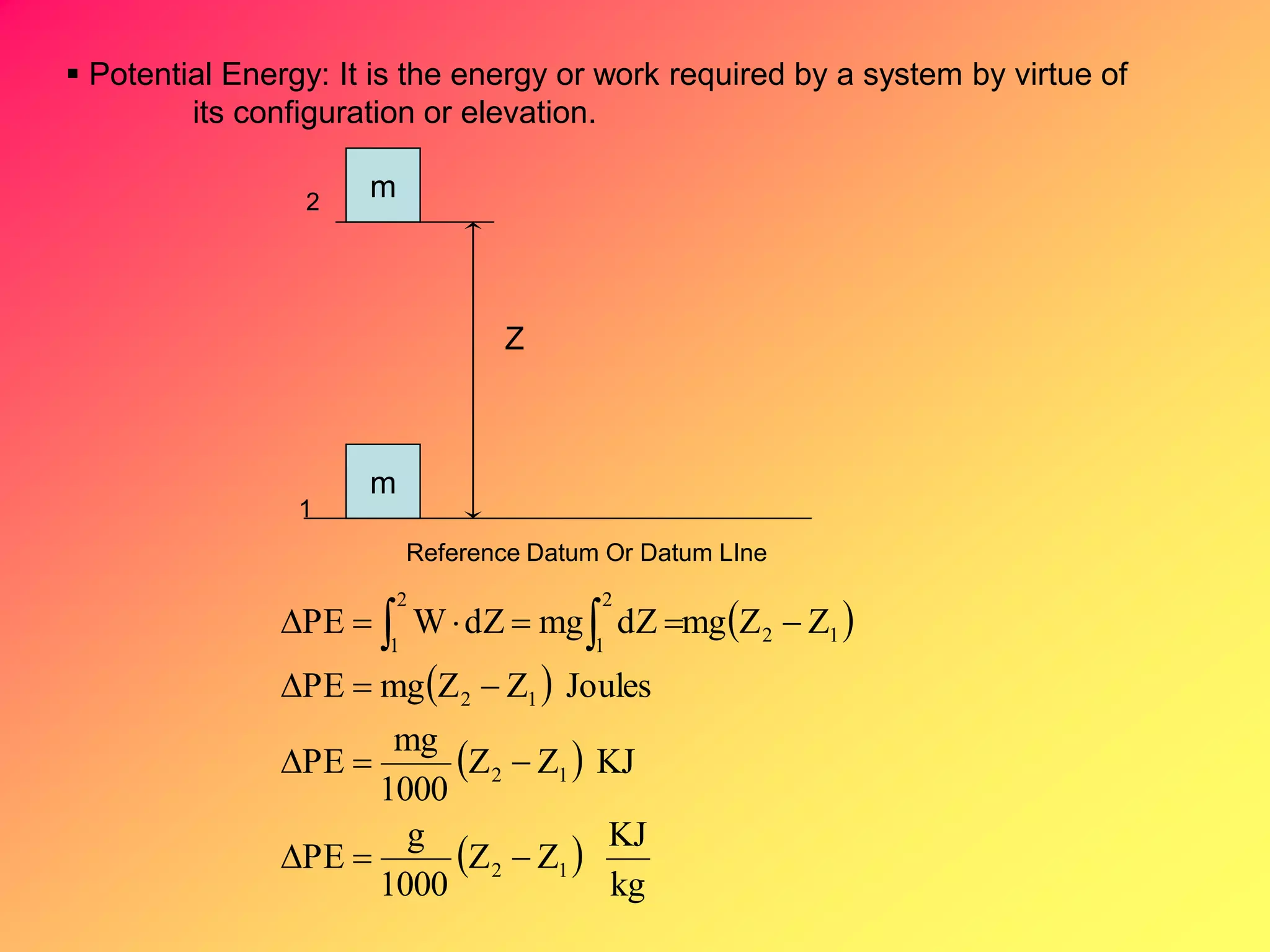
 Potential Energy: It is the energy or work required by a system by virtue of
its configuration or elevation.
m
m
1
2
Reference Datum Or Datum LIne
Z
 
 
 
 
kg
KJ
ZZ
1000
g
PE
KJZZ
1000
mg
PE
JoulesZZmgPE
ZZmgdZmgdZWPE
12
12
12
2
1
12
2
1



  
 Enthalpy: It a thermodynamic property that is equal to the sum
of the internal energy and the flow energy of a substance.
h = U + PV
2
22
1
11
222111
21
vAvA
vAvA
mm





LAW OF CONSERVATION OF MASS: Mass is indestructible. In applying
this law we must except nuclear processes during which mass is converted
into energy.
Verbal Form: Mass Entering – Mass Leaving = change of mass stored within
the system
Equation Form: m1 – m2 = m
For an Open System (steady state, steady flow system) the m = 0.
m = 0
m1 m2
m1 – m2 = 0
m1 = m2
For one dimensional flow, the mass rate of flow entering or leaving a system is


Av
Avm where:
m – mass flow rate, kg/sec
A – cross sectional area, m2
v- velocity, m/sec
 - density, kg/m3
 - specific volume, m3/kg
PROPERTIES OF PURE SUBSTANCE
a - sub-cooled liquid
b - saturated liquid
c - saturated mixture
d - saturated vapor
e - superheated vapor
Considering that the system is heated at constant
pressure where P = 101.325 KPa, the 100C is the
saturation temperature corresponding to 101.325 KPa,
and 101.325 KPa is the saturation pressure correspon-
ding 100C.
P P P
P
P
Q
30°C
100°C
100°C 100°C
T100°C
(a) (b) (c) (d) (e)
Q Q Q Q
Saturation Temperature (tsat) - is the highest temperature at a given pressure in which
vaporization takes place.
Saturation Pressure (Psat) - is the pressure corresponding to the temperature.
Sub-cooled Liquid - is one whose temperature is less than the saturation temperature
corresponding to the pressure.
Compressed Liquid - is one whose pressure is greater than the saturation pressure
corresponding to the temperature.
Saturated Liquid - a liquid at the saturation temperature
Saturated Vapor - a vapor at the saturation temperature
Saturated Mixture - a mixture of liquid and vapor at the saturation temperature.
Superheated Vapor - a vapor whose temperature is greater than the saturation temperature.
a
b c d
e
T

F
Saturated Vapor
Saturated Vapor
30°C
100°C
t 100°C
Saturated Mixture
P = C
Critical Point
T- Diagram
a
b c d
e
T
S
F
Saturated Vapor
Saturated Vapor
30°C
100°C
t 100°C
Saturated Mixture
P = C
Critical Point
T-S Diagram
F(critical point)- at the critical point the temperature and pressure is unique.
For Steam: At Critical Point, P = 22.09 MPa; t = 374.136C
a
b c d
e
T
S
F
Saturated Vapor
Saturated Vapor
ta
tsat
te
Saturated Mixture
P = C
Critical Point
T-S Diagram
tsat - saturation temperature corresponding the pressure P
ta - sub-cooled temperature which is less than tsat
te - superheated vapor temperature that is greater than tsat
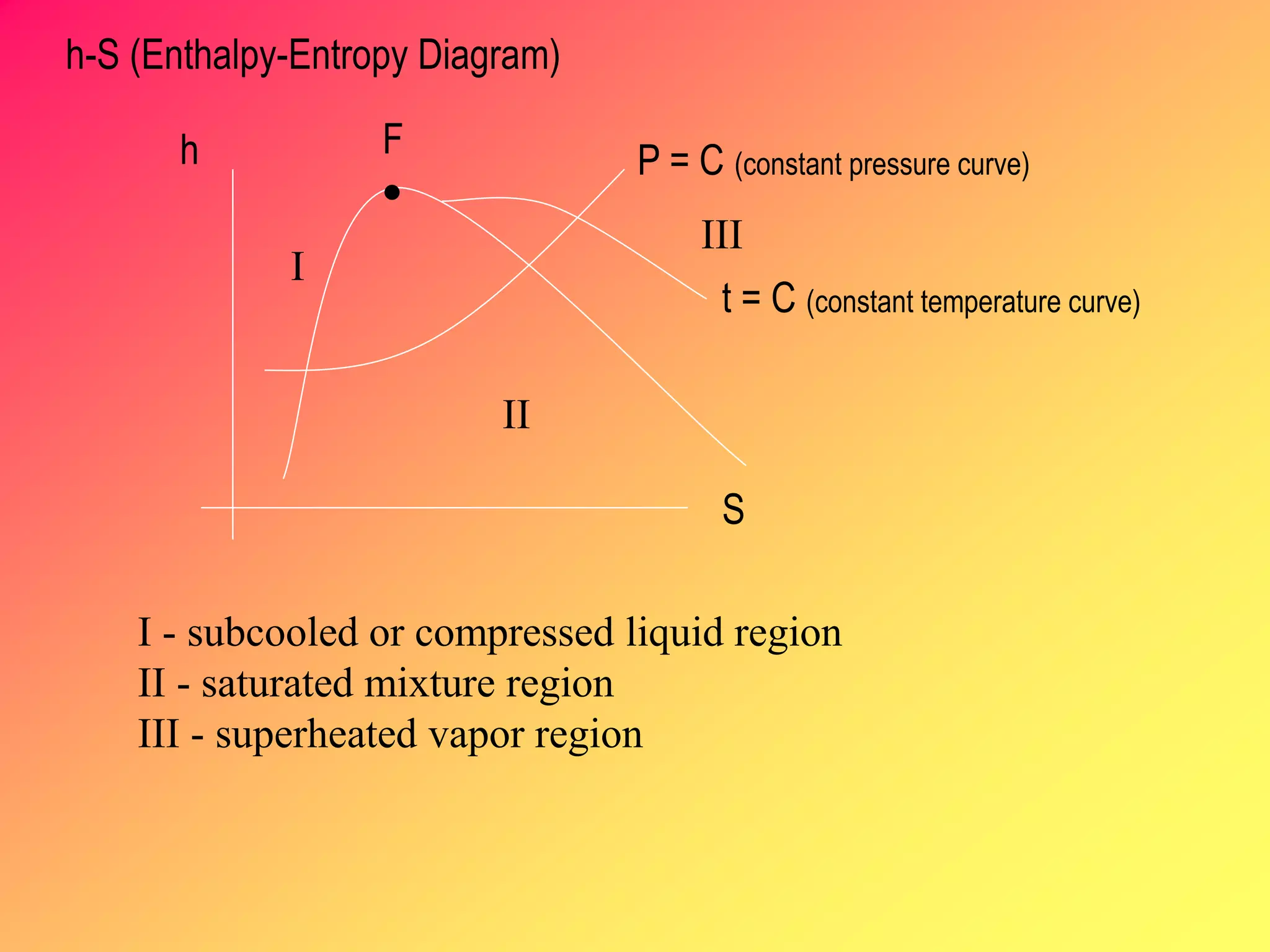
h-S (Enthalpy-Entropy Diagram)
h
S
t = C (constant temperature curve)
P = C (constant pressure curve)
F

I
II
III
I - subcooled or compressed liquid region
II - saturated mixture region
III - superheated vapor region
Quality (x):
Lv
v
Lv
v
mmm
m
m
mm
m
x




Where:
mv – mass of vapor
mL – mass of liquid
m – total mass
x- quality
The properties at saturated liquid, saturated vapor, superheated
vapor and sub-cooled or compressed liquid can be determined
from tables. But for the properties at saturated mixture (liquid
and vapor) they can be determined by the equation
rc = rf + x(rfg)
rfg = rg – rf
Where: r stands for any property (, U, h and S)
rg – property at saturated vapor (from table)
rf – property at saturated liquid
Note: The properties at siub-cooled or compressed liquid is
approximately equal to the properties at saturated liquid
corresponding the sub-cooled temperature.
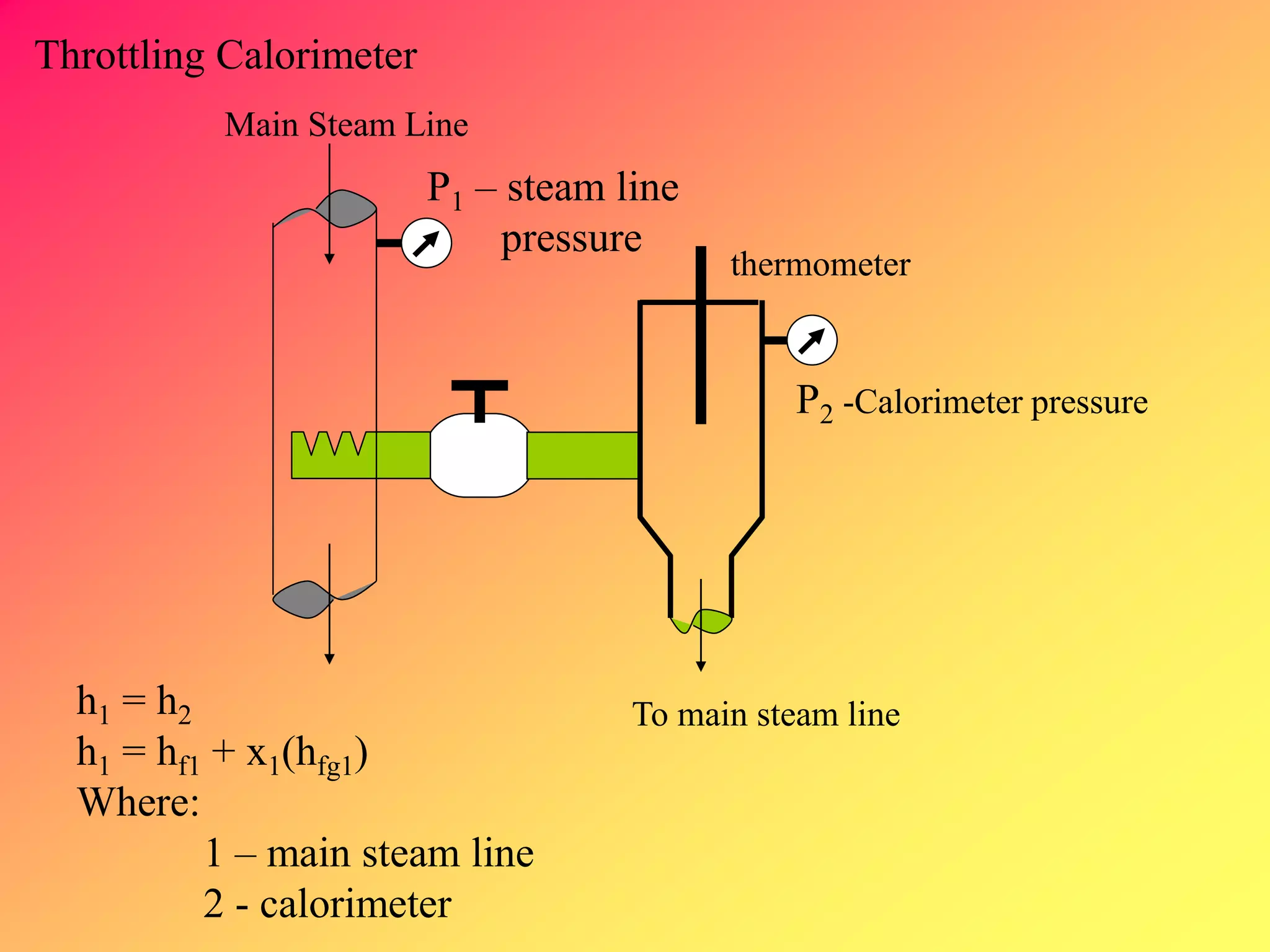
Throttling Calorimeter
Main Steam Line
P1 – steam line
pressure
To main steam line
P2 -Calorimeter pressure
h1 = h2
h1 = hf1 + x1(hfg1)
Where:
1 – main steam line
2 - calorimeter
thermometer
P1
P2
1
2
T
S
h = C
T-S Diagram Throttling Process
P1 – steam line pressure
P2 – calorimeter pressure
KJ)T-(TmC)t-mC(tQ
m,massthegConsiderin
kg
KJ
)T-(TC)t-C(tQ
tionintegraby
CdTCdTdQ
dT
dQ
dt
dQ
C
1212
1212




Zeroth Law of Thermodynamics:
If two bodies are in thermal equilibrium with a third body, they are in thermal
equilibrium with each other and hence their temperatures are equal.
Specific Heat:
It is the amount of heat required to raise the temperature of a 1 kg mass 1C or
1K.
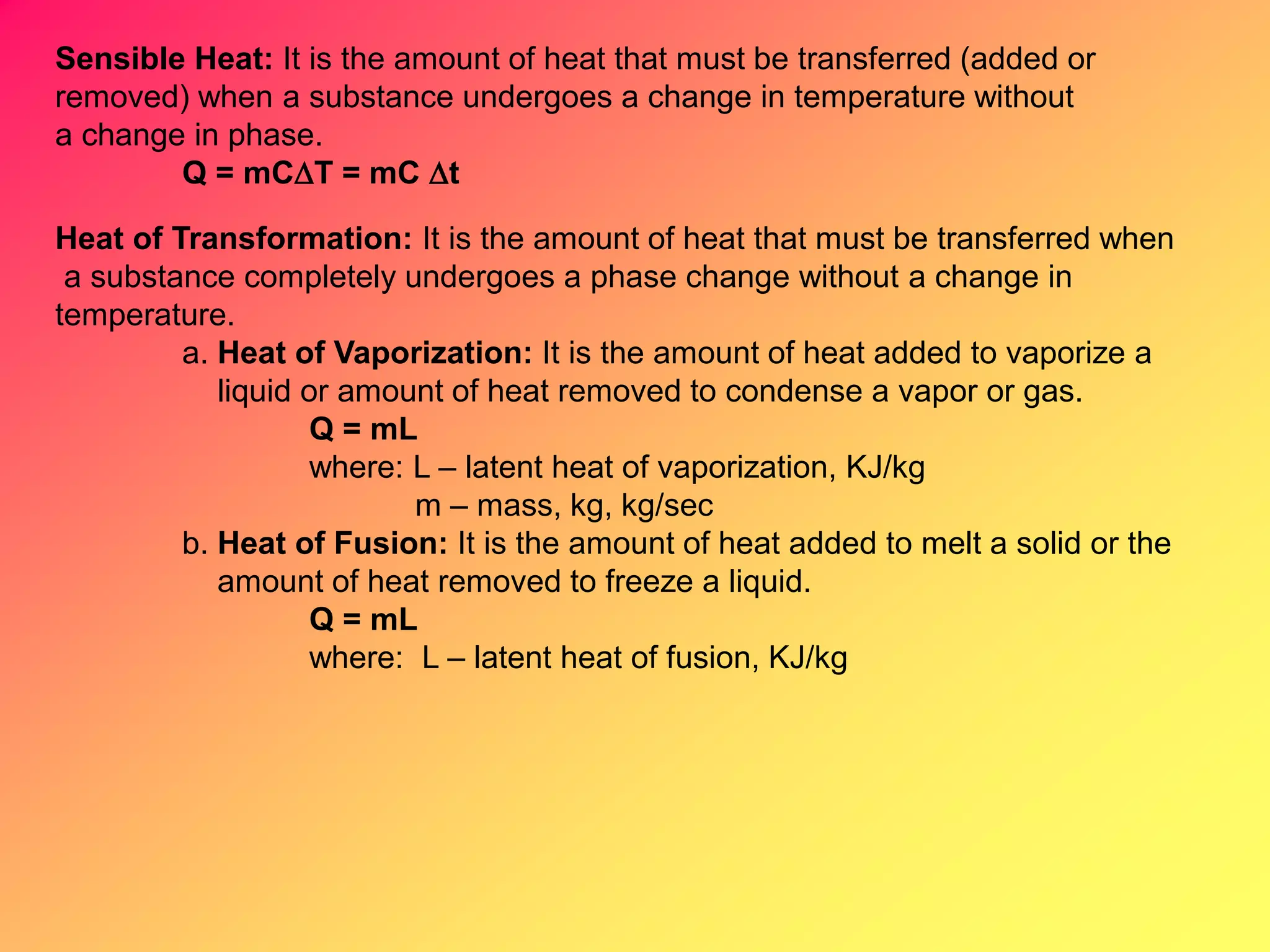
Heat of Transformation: It is the amount of heat that must be transferred when
a substance completely undergoes a phase change without a change in
temperature.
a. Heat of Vaporization: It is the amount of heat added to vaporize a
liquid or amount of heat removed to condense a vapor or gas.
Q = mL
where: L – latent heat of vaporization, KJ/kg
m – mass, kg, kg/sec
b. Heat of Fusion: It is the amount of heat added to melt a solid or the
amount of heat removed to freeze a liquid.
Q = mL
where: L – latent heat of fusion, KJ/kg
Sensible Heat: It is the amount of heat that must be transferred (added or
removed) when a substance undergoes a change in temperature without
a change in phase.
Q = mCT = mC t
THE FIRST LAW OF THERMODYNAMICS (The Law of Conservation of (Energy)
“Energy can neither be created nor destroyed but can only be
converted from one form to another.”
Verbal Form:
Energy Entering – Energy Leaving = Change of Energy stored in the
system
Equation Form:
E1 – E2 = Es
1. First Corollary of the First Law: Application of first Law to a Closed System
U
Q
W For a Closed System (Non FlowSystem),
PV, KE and PE are negligible, therefore
the changeof stored energy Es = U
Q – W = U  1
Q = U + W  2
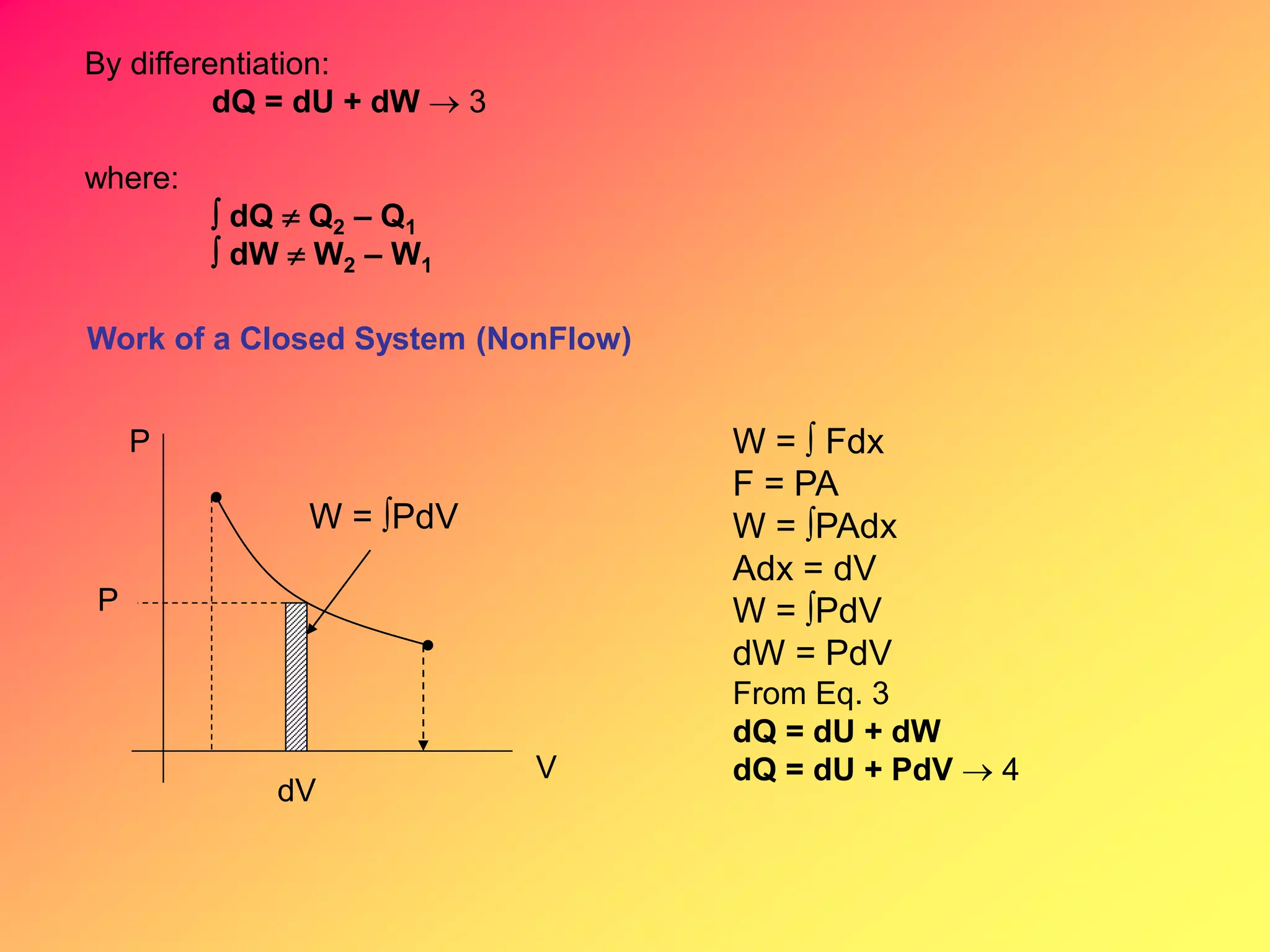
By differentiation:
dQ = dU + dW  3
where:
 dQ  Q2 – Q1
 dW  W2 – W1
Work of a Closed System (NonFlow)
P
V
W = PdV
P
dV
W =  Fdx
F = PA
W = PAdx
Adx = dV
W = PdV
dW = PdV
From Eq. 3
dQ = dU + dW
dQ = dU + PdV  4
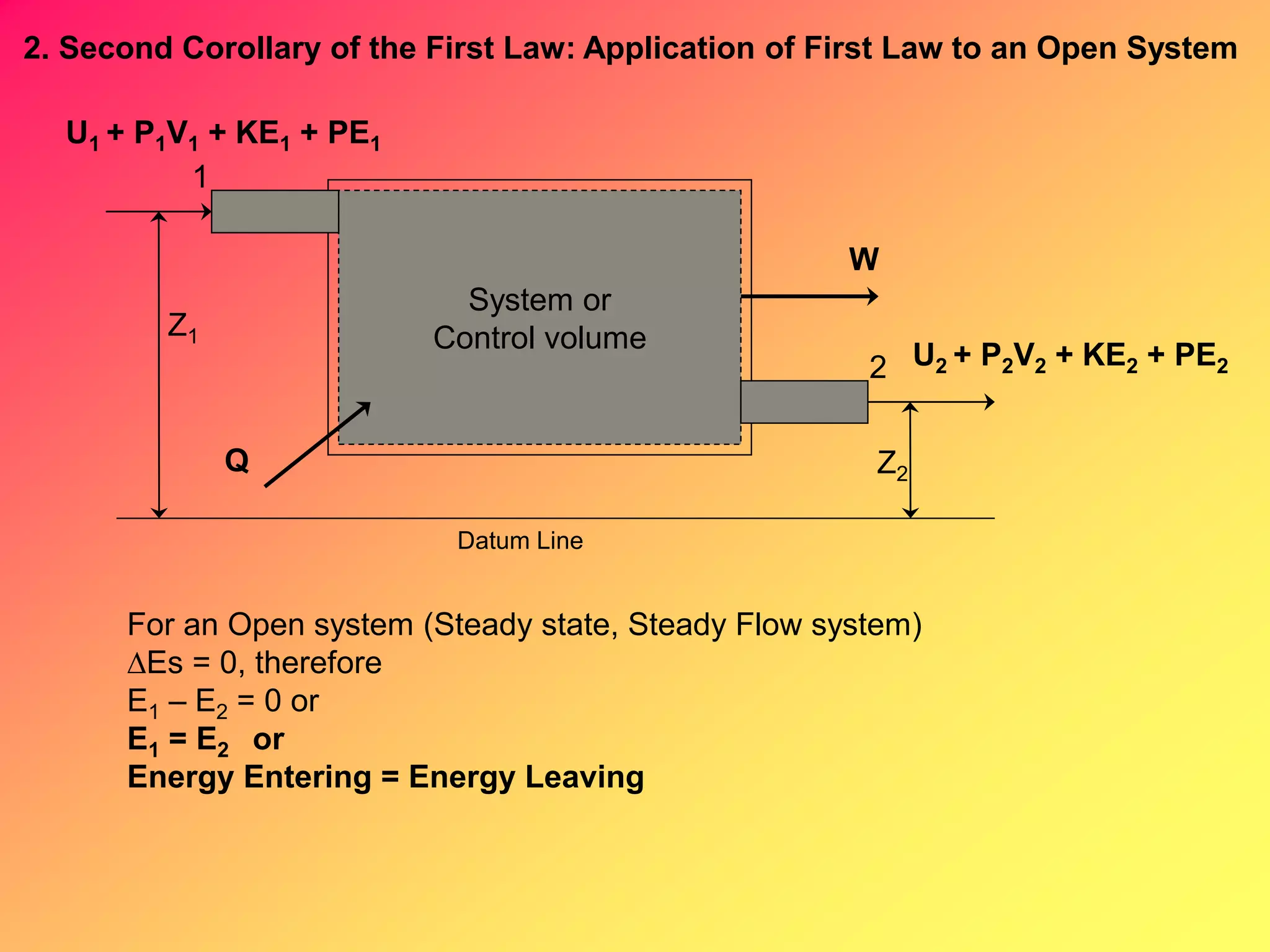
2. Second Corollary of the First Law: Application of First Law to an Open System
System or
Control volume
Datum Line
Q
W
1
2
U1 + P1V1 + KE1 + PE1
U2 + P2V2 + KE2 + PE2
For an Open system (Steady state, Steady Flow system)
Es = 0, therefore
E1 – E2 = 0 or
E1 = E2 or
Energy Entering = Energy Leaving
Z1
Z2
U1 + P1V1 + KE1 + PE1 + Q = U2 + P2V2 + KE2 + PE2 + W  1
Q = (U2 – U1) + (P2V2 – P1V1) + (KE2 – KE1) + (PE2 – PE1) + W  2
Q = U + (PV) + KE + PE + W  3
By differentiation
dQ = dU + d(PV) + dKE + dPE + dW  4
But  dQ  Q2 – Q1 and  dW  W2 – W1
Enthalpy (h)
h = U + PV
dh = dU + d(PV)  5
dh = dU + PdV + VdP  6
But: dQ = dU + PdV
dh = dQ + VdP  7
From Eq. 3
Q = h + KE + PE + W  8
dQ = dh + dKE + dPE + dW  9
dQ = dU + PdV + VdP + dKE + dPE + dW  10
dQ = dQ + VdP + dKE + dPE + dW
0 = VdP + dKE + dPE + dW
dW = -VdP - dKE - dPE  11
By Integration
W = - VdP - KE - PE  12
If KE = 0 and PE = 0
Q = h + W  13
W = Q - h  14
W = - VdP  15
IDEAL OR PERFECT GAS
Prepared By: Engr Yuri G. Melliza
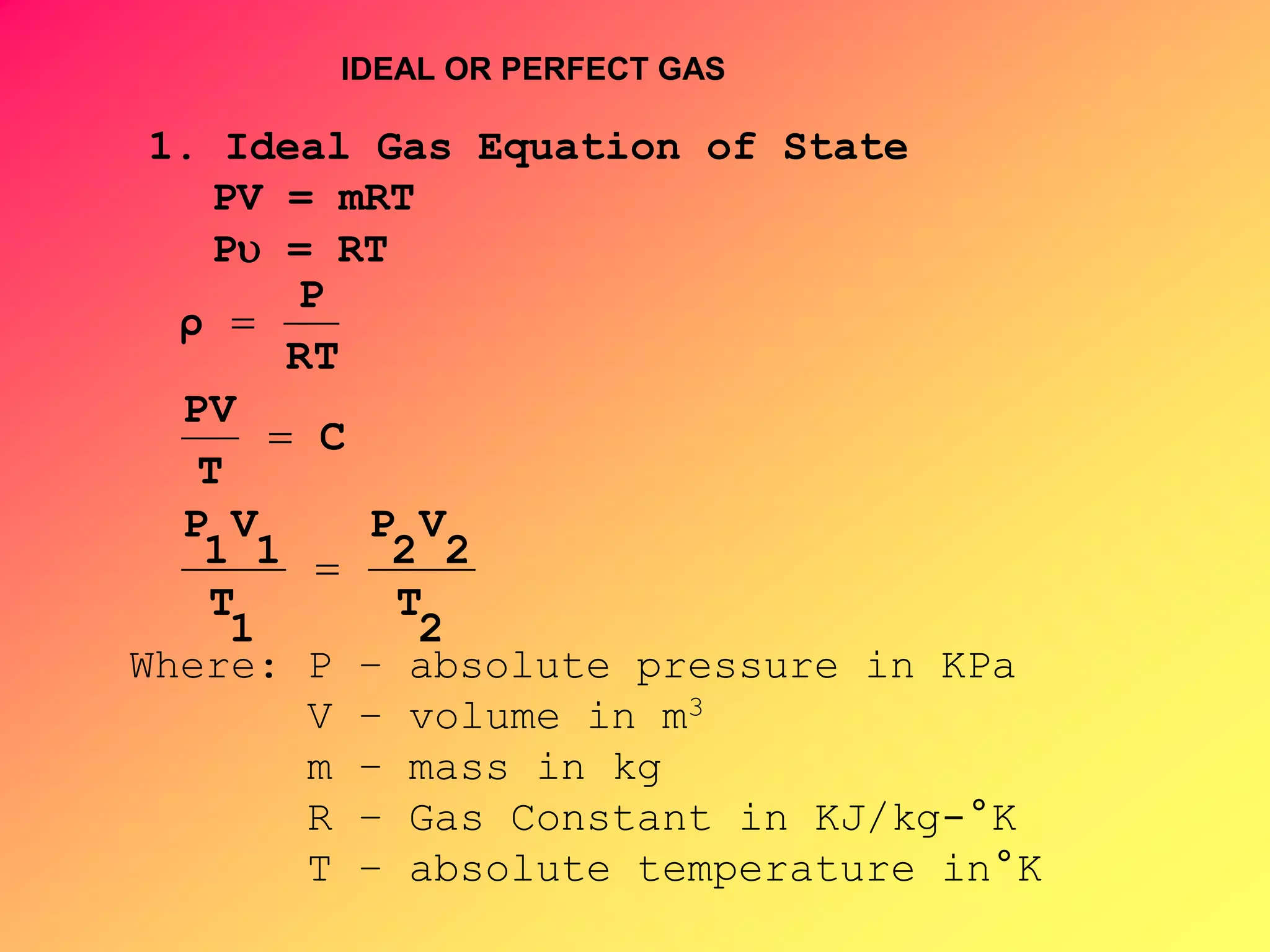
1. Ideal Gas Equation of State
PV = mRT
P = RT
2
T
2
V
2
P
1
T
1
V
1
P
C
T
PV
RT
P
ρ



Where: P – absolute pressure in KPa
V – volume in m3
m – mass in kg
R – Gas Constant in KJ/kg-°K
T – absolute temperature in°K
IDEAL OR PERFECT GAS
2. Gas Constant
K-
m
kg
KJ
8.3143R
K-kg
KJ
M
R
R




Where:
R- Gas Constant in KJ/kg-K
K
m
kg
KJ
constantgasuniversalR


M – Molecular weight kg/kgm
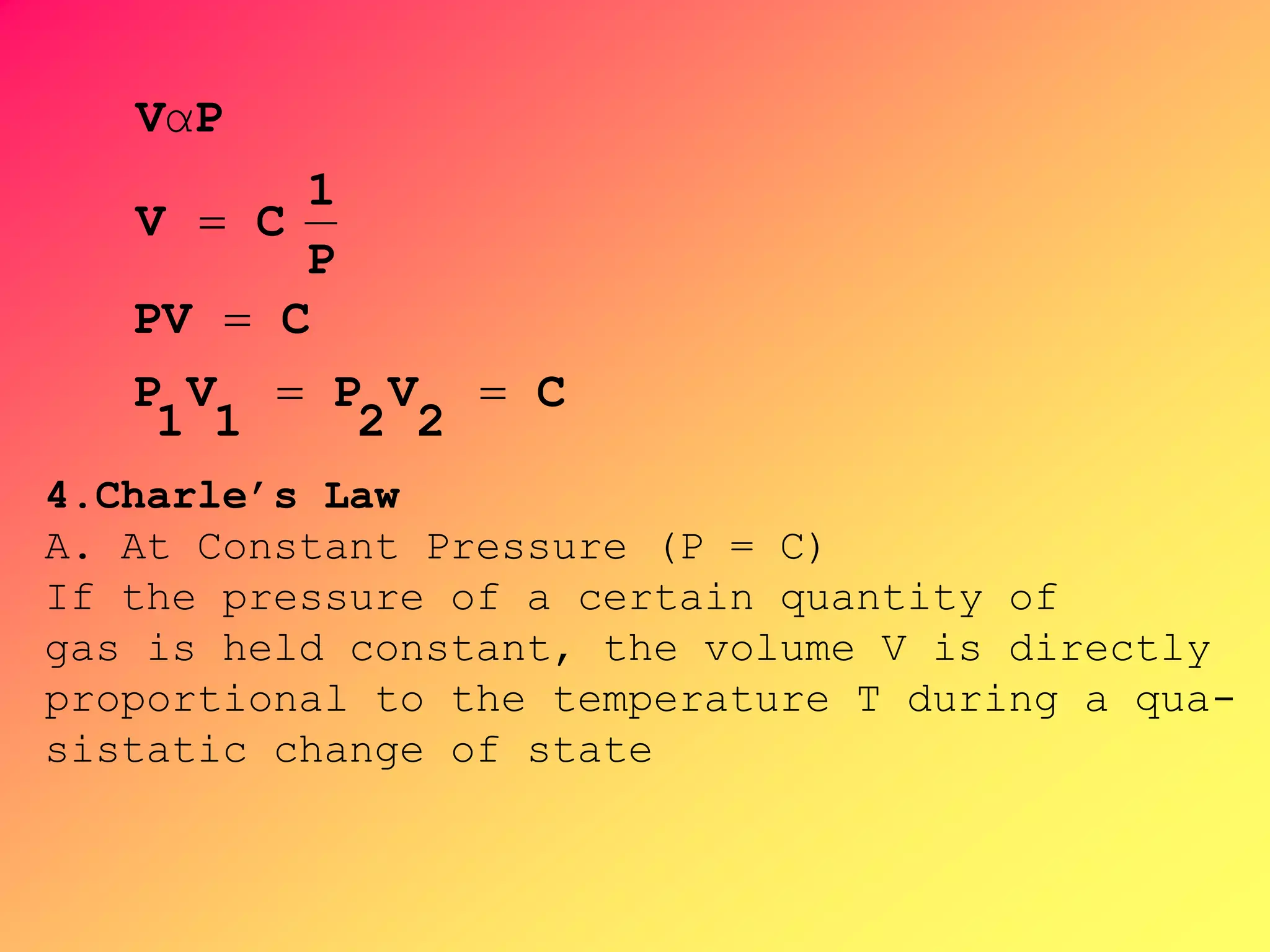
3. Boyle’s Law
If the temperature of a certain quantity of
gas is held constant the volume V is inver-
sely proportional to the absolute pressure P.
C
2
V
2
P
1
V
1
P
CPV
P
1
CV
PV



α
4.Charle’s Law
A. At Constant Pressure (P = C)
If the pressure of a certain quantity of
gas is held constant, the volume V is directly
proportional to the temperature T during a qua-
sistatic change of state
2
2
1
1
T
V
T
V
C
T
V
T;CV;TαV


B. At Constant Volume (V = C)
If the volume of a certain quantity of gas is
held constant, the pressure P varies directly
as the absolute temperature T.
2
2
1
1
T
P
T
P
C
T
P
;TCPTαP

;
5. Avogadro’s Law
All gases at the same temperature and
pressure have the same number of molecules
per unit of volume, and it follows that the
specific weight  is directly proportional to
its molecular weight M.
  M
6.Specific Heat
Specific Heat or Heat Capacity is the amount
of heat required to raise the temperature of
a 1 kg mass 1C or 1K
A. SPECIFIC HEAT AT CONSTANT PRESSURE (Cp)
From: dh = dU + PdV + VdP
but dU + VdP = dQ ; therefore
dh = dQ + VdP  1
but at P = C ; dP = O; therefore
dh = dQ  2
and by integration
Q = h  3
considering m,
h = m(h2 - h1)  4
Q = h = m (h2 - h1)  5
From the definition of specific heat, C = dQ/T
Cp = dQ /dt  6
Cp = dh/dT, then
dQ = CpdT  7
and by considering m,
dQ = mCpdT  8
then by integration
Q = m Cp T  9
but T = (T2 - T1)
Q = m Cp (T2 - T1)  10
B SPECIFIC HEAT AT CONSTANT VOLUME (Cv)
At V = C, dV = O, and from dQ = dU + PdV
dV = 0, therefore
dQ = dU  11
then by integration
Q = U  12
then the specific heat at constant volume
Cv is;
Cv = dQ/dT = dU/dT  13
dQ = CvdT  14
and by considering m,
dQ = mCvdT  15
and by integration
Q = mU  16
Q = mCvT  17
Q = m(U2 - U1)  18
Q = m Cv(T2 - T1) 19
From:
h = U + P and P = RT
h = U + RT  20
and by differentiation,
dh = dU + Rdt  21
but dh =CpdT and dU = CvdT,
therefore
CpdT = CvdT + RdT  22
and by dividing both sides of the
equation by dT,
Cp = Cv + R  23
7. Ratio Of Specific Heats
k = Cp/Cv  24
k = dh/du  25
k = h/U  26
From eq. 32,
Cp = kCv  27
substituting eq. 27 to eq. 24
Cv = R/k-1  28
From eq. 24,
Cv = Cp/k  29
substituting eq. 29 to eq. 24
Cp = Rk/k-1  30
8. Entropy Change (S)
Entropy is that property of a substance that
determines the amount of randomness and disorder
of a substance. If during a process, an amount of
heat is taken and is by divided by the absolute
temperature at which it is taken, the result is
called the ENTROPY CHANGE.
dS = dQ/T  31
and by integration
S = ∫dQ/T  32
and from eq. 39
dQ = TdS  33
GAS MIXTURE
 Total Mass of a mixture
inn 
m
m
x i
i 
imm 
 Mass Fraction
 Total Moles of a mixture
n
n
y i
i 
 Mole Fraction
Where:
m – total mass of a mixture
mi – mass of a component
n – total moles of a mixture
ni – moles of a component
xi – mass fraction of a component
yi - mole fraction of a component
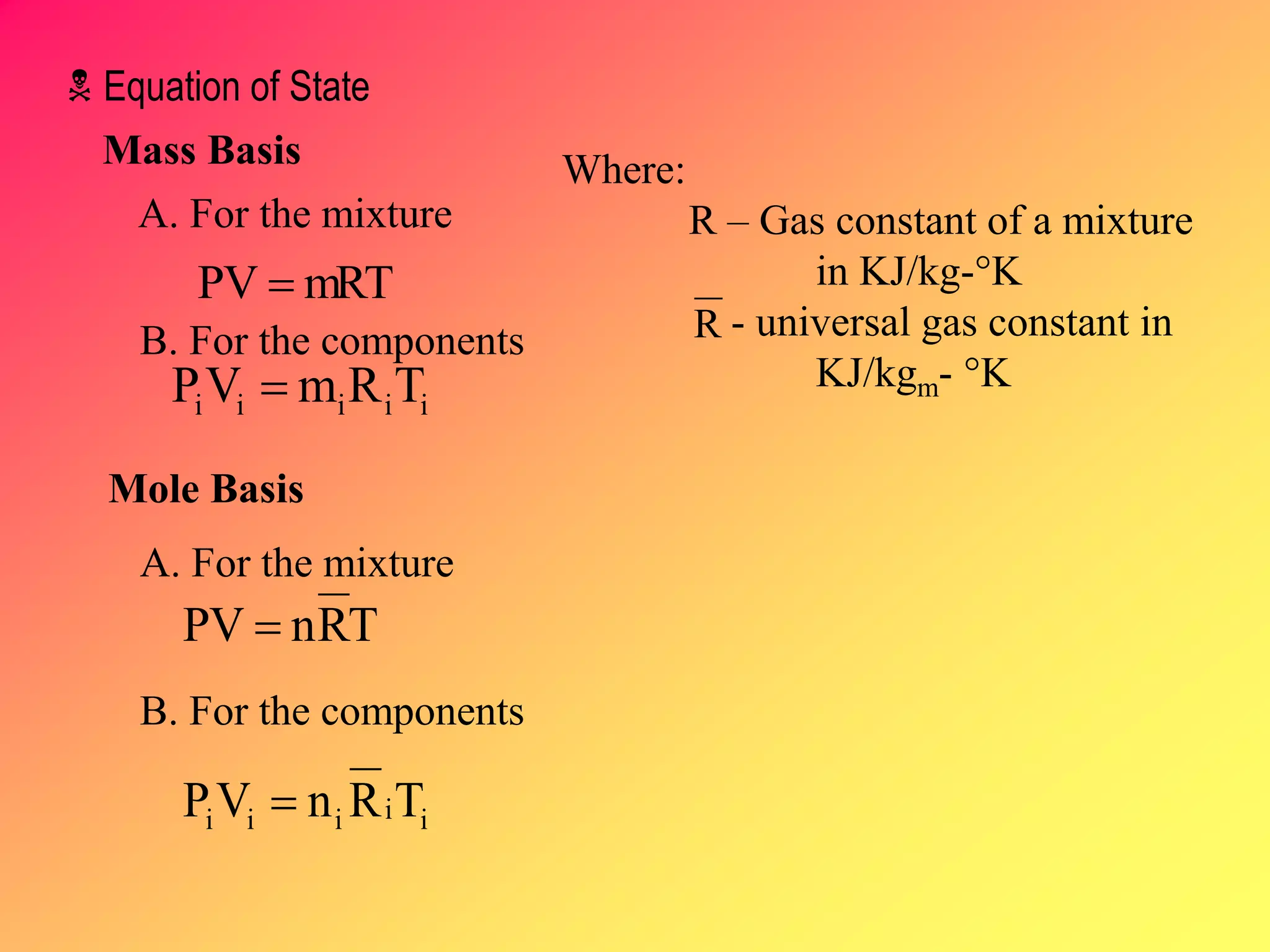
 Equation of State
Mass Basis
A. For the mixture
iiiii TRmVP 
mRTPV 
TRnPV 
B. For the components
iiiii TRnVP 
Mole Basis
A. For the mixture
B. For the components
Where:
R – Gas constant of a mixture
in KJ/kg-K
- universal gas constant in
KJ/kgm- K
R
 AMAGAT’S LAW
The total volume of a mixture V is equal to the volume occupied by each
component at the mixture pressure P and temperature T.
1
n1
V1
2
n2
V2
3
n3
V3
P,T
P = P1 = P2 = P3
T = T1 = T2 = T3
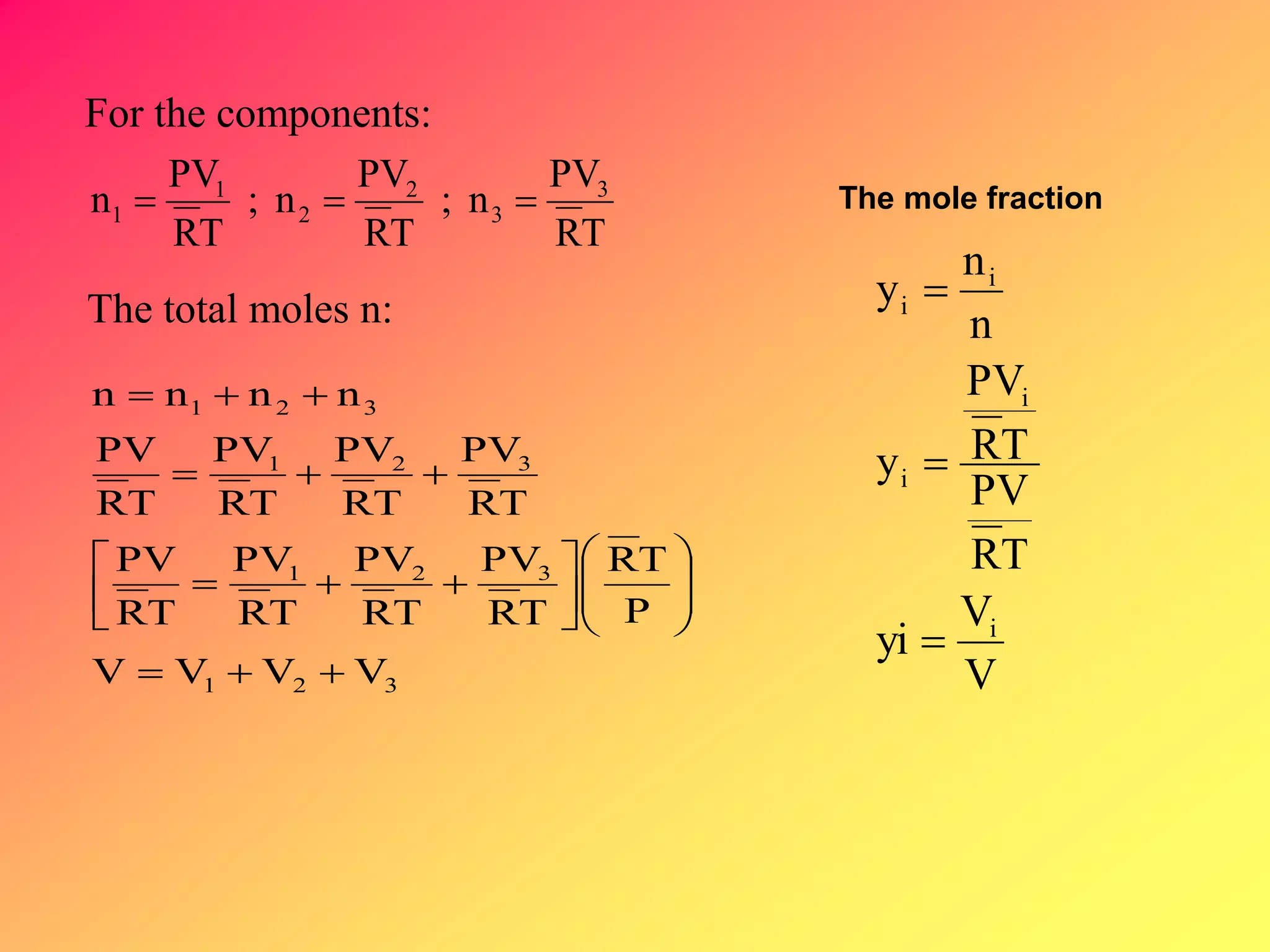
For the components:
TR
PV
n;
TR
PV
n;
TR
PV
n 3
3
2
2
1
1 
321
321
321
321
VVVV
P
TR
TR
PV
TR
PV
TR
PV
TR
PV
TR
PV
TR
PV
TR
PV
TR
PV
nnnn


















The total moles n:
V
V
yi
TR
PV
TR
PV
y
n
n
y
i
i
i
i
i



The mole fraction
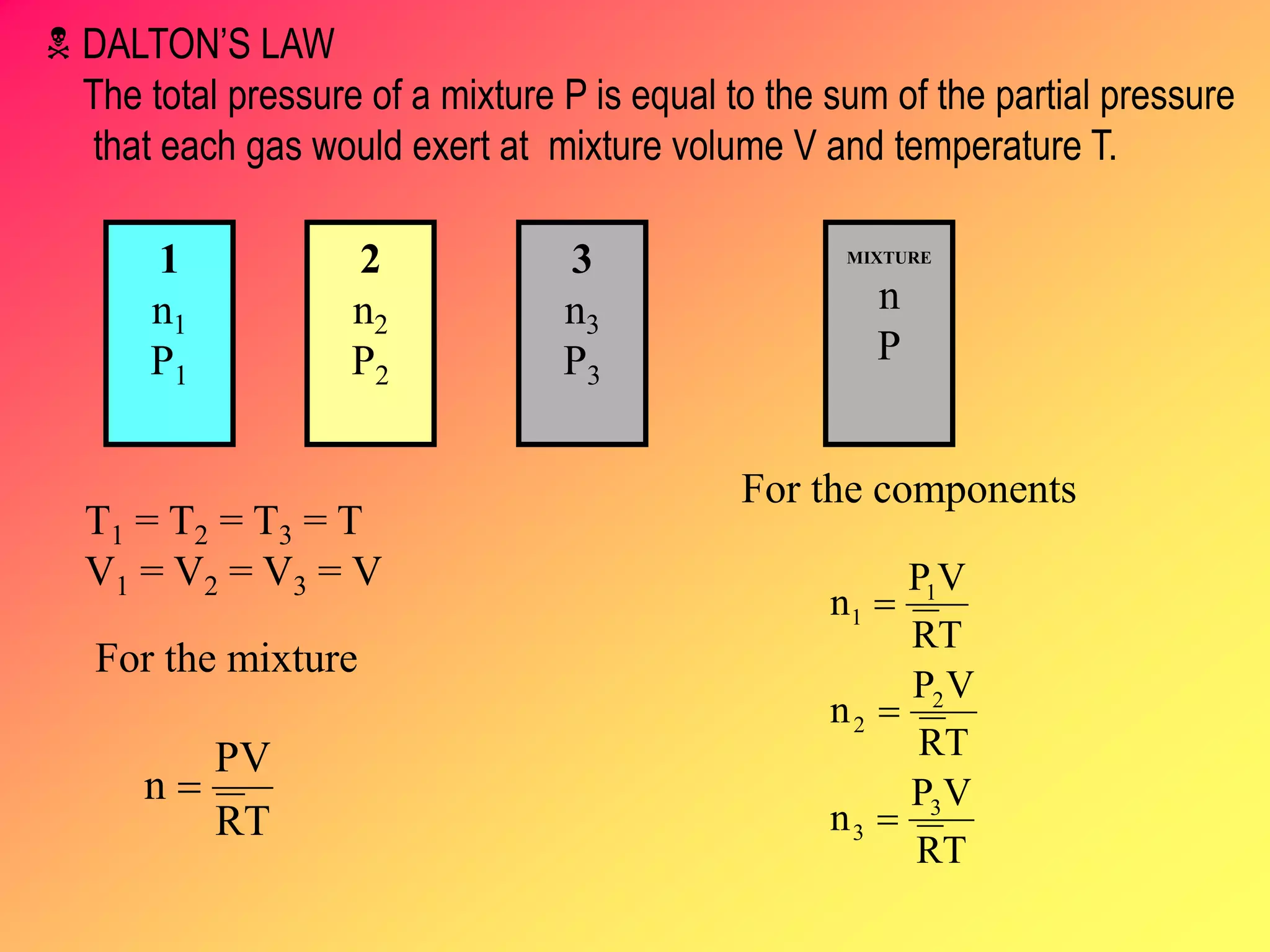
 DALTON’S LAW
The total pressure of a mixture P is equal to the sum of the partial pressure
that each gas would exert at mixture volume V and temperature T.
1
n1
P1
2
n2
P2
3
n3
P3
MIXTURE
n
P
T1 = T2 = T3 = T
V1 = V2 = V3 = V
For the mixture
For the components
TR
VP
n
TR
VP
n
TR
VP
n
3
3
2
2
1
1



TR
PV
n 
321
321
321
321
PPPP
V
TR
TR
VP
TR
VP
TR
VP
TR
PV
TR
VP
TR
VP
TR
VP
TR
PV
nnnn


















The total moles n: The mole fraction:
P
P
yi
TR
PV
TR
VP
y
n
n
y
i
i
i
i
i



 Molecular Weight of a mixture
R
R
M
MyM ii


M
R
R
RxR ii


 Gas Constant of a mixture
 Specific Heat of a mixture
RCC
CxC
CxC
vp
viiv
piip



 Ratio of Specific Heat
u
h
C
C
k
v
p



 Gravimetric and Volumetric Analysis
Gravimetric analysis gives the mass fractions of the components
in the mixture. Volumetric analysis gives the volumetric or molal fractions
of the components in the mixture.
i
i
i
i
i
ii
ii
i
M
x
M
x
y
My
My
x




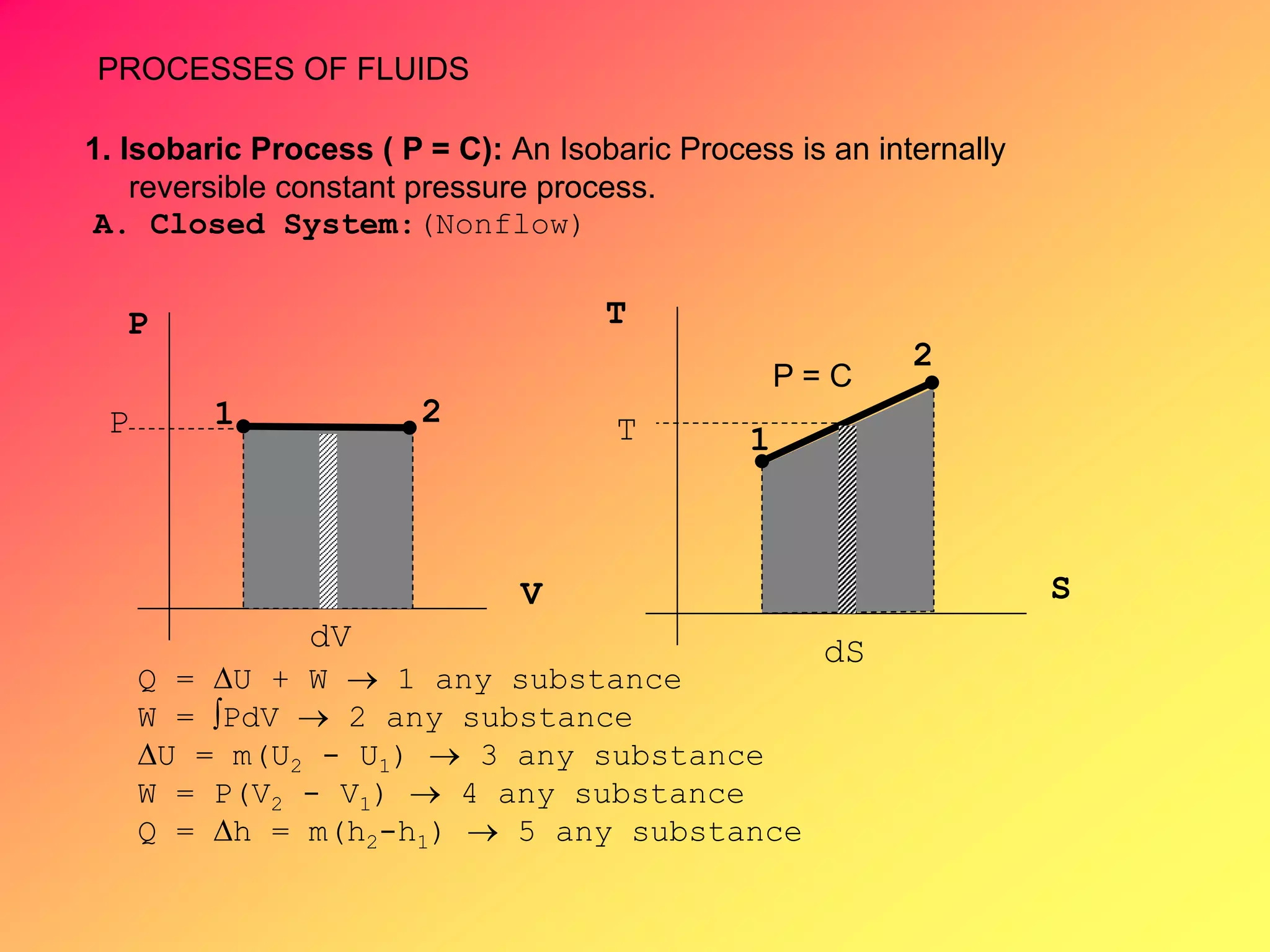
1. Isobaric Process ( P = C): An Isobaric Process is an internally
reversible constant pressure process.
A. Closed System:(Nonflow)
P
V
21P
dV
Q = U + W  1 any substance
W = PdV  2 any substance
U = m(U2 - U1)  3 any substance
W = P(V2 - V1)  4 any substance
Q = h = m(h2-h1)  5 any substance
T
S
1
2
dS
T
P = C
PROCESSES OF FLUIDS
For Ideal Gas:
PV = mRT
W =mR(T2-T1)  5
U = mCv(T2-T1)  6
Q = h = mCP (T2-T1)  7
Entropy Change
S = dQ/T  8 any substance
dQ = dh
For Ideal Gas
dh = mCPdT
S = dQ/T
S = mCP dT/T
S = mCP ln(T2/T1)  9
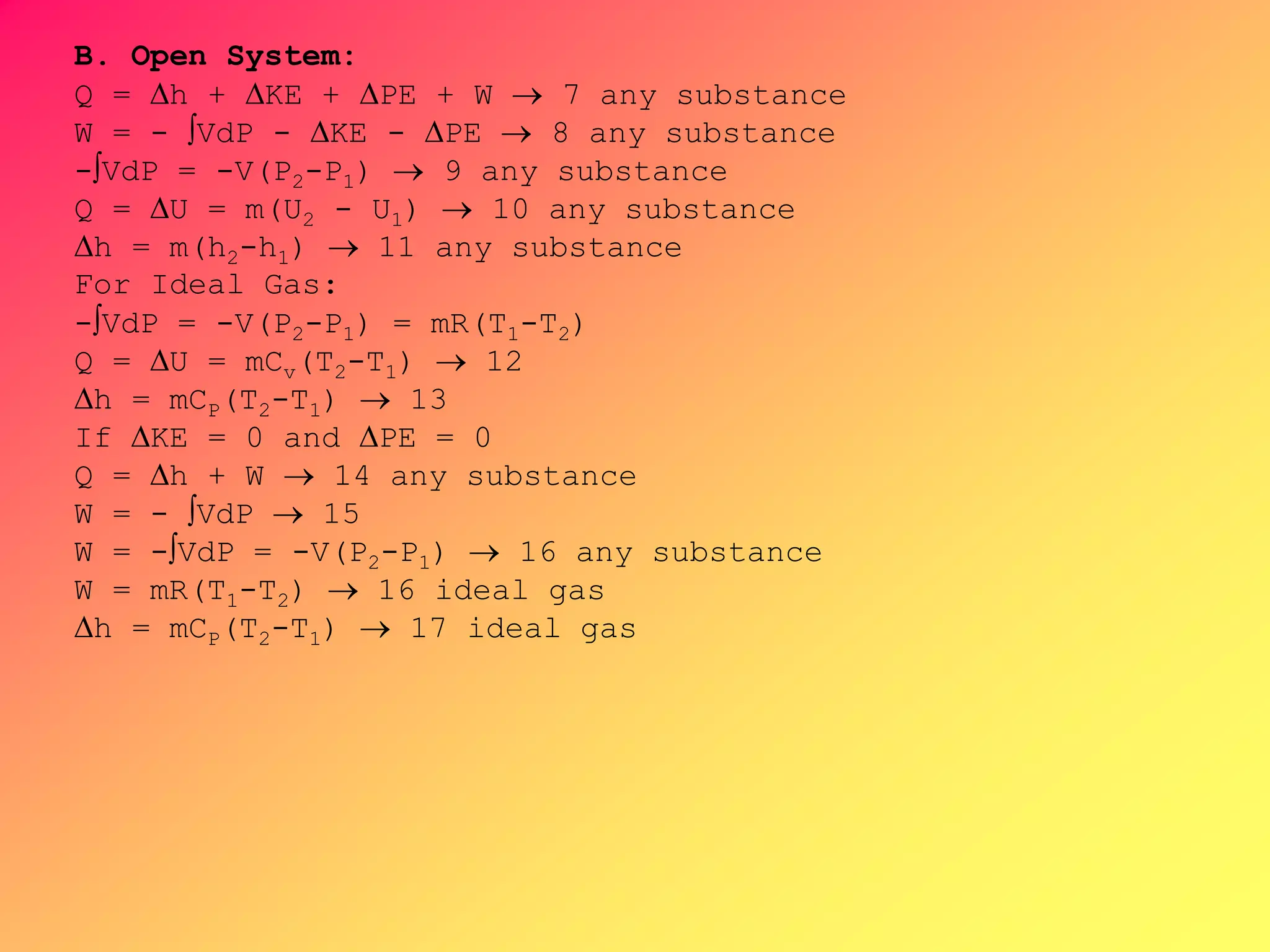
B. Open System:
Q = h + KE + PE + W  10 any substance
W = - VdP - KE - PE  11 any substance
- VdP = 0
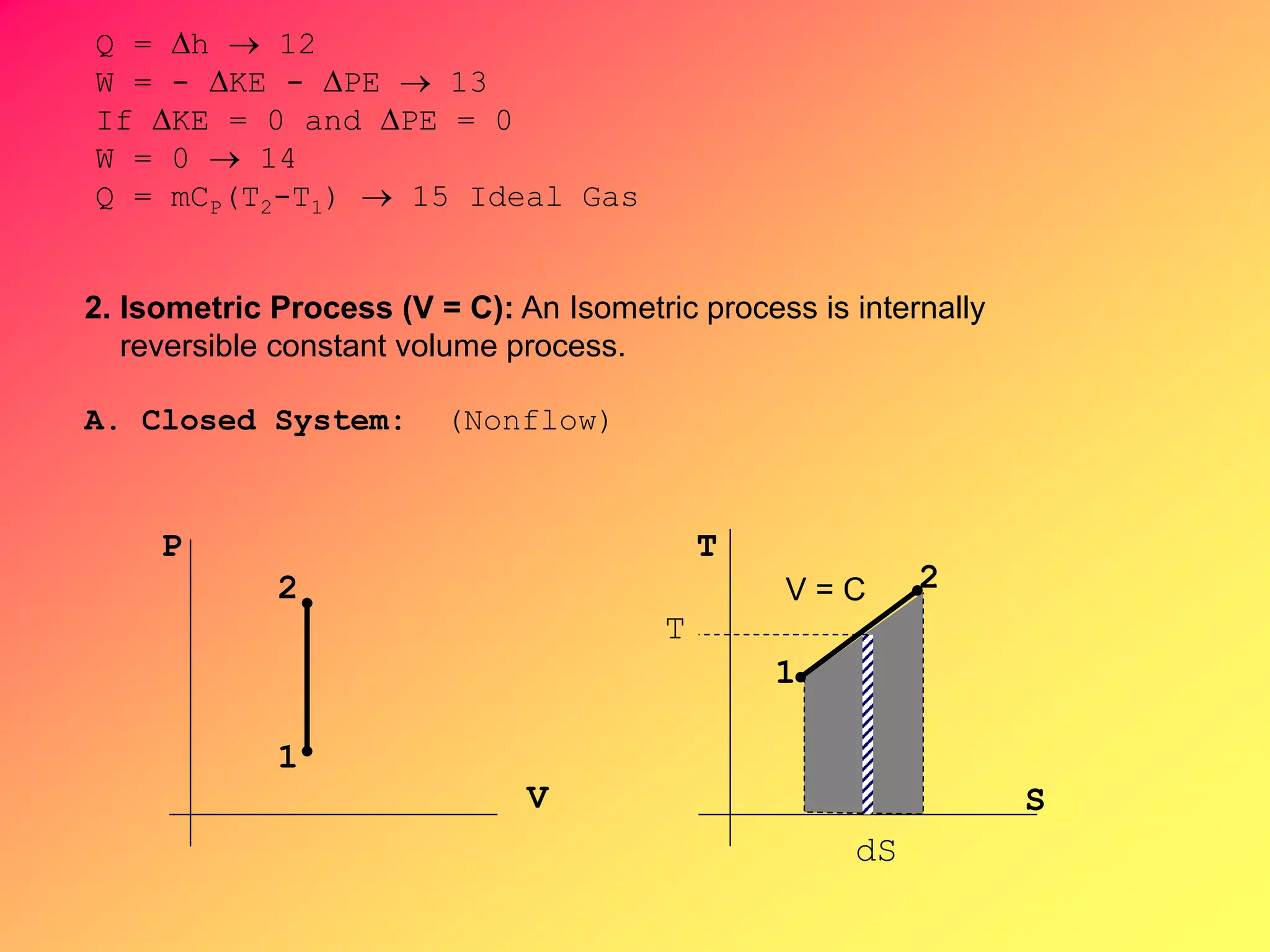
Q = h  12
W = - KE - PE  13
If KE = 0 and PE = 0
W = 0  14
Q = mCP(T2-T1)  15 Ideal Gas
2. Isometric Process (V = C): An Isometric process is internally
reversible constant volume process.
A. Closed System: (Nonflow)
P
V
1
2
T
S
T
dS
1
2V = C
Q = U + W  1 any substance
W = PdV at V = C; dV = 0
W = 0
Q = U = m(U2 - U1)  2 any substance
h = m(h2-h1)  3 any substance
For Ideal Gas:
Q = U = mCv(T2-T1)  4
h = mCP(T2-T1)  5
Entropy Change:
S = dQ/T  6 any substance
dQ = dU
dU = mCvdT for ideal gas
S = dU/T = mCvdT/T
S = mCv ln(T2/T1)  6
B. Open System:
Q = h + KE + PE + W  7 any substance
W = - VdP - KE - PE  8 any substance
-VdP = -V(P2-P1)  9 any substance
Q = U = m(U2 - U1)  10 any substance
h = m(h2-h1)  11 any substance
For Ideal Gas:
-VdP = -V(P2-P1) = mR(T1-T2)
Q = U = mCv(T2-T1)  12
h = mCP(T2-T1)  13
If KE = 0 and PE = 0
Q = h + W  14 any substance
W = - VdP  15
W = -VdP = -V(P2-P1)  16 any substance
W = mR(T1-T2)  16 ideal gas
h = mCP(T2-T1)  17 ideal gas
3. Isothermal Process(T = C): An Isothermal process is a reversible
constant temperature process.
A. Closed System (Nonflow)
dS
T
S
T
1 2
P
V
1
2P
dV
PV = C or
T = C
Q = U + W  1 any substance
W = PdV  2 any substance
U = m(U2 - U1)  3 any substance
For Ideal Gas:
dU = mCv dT; at T = C ; dT = 0
Q = W  4
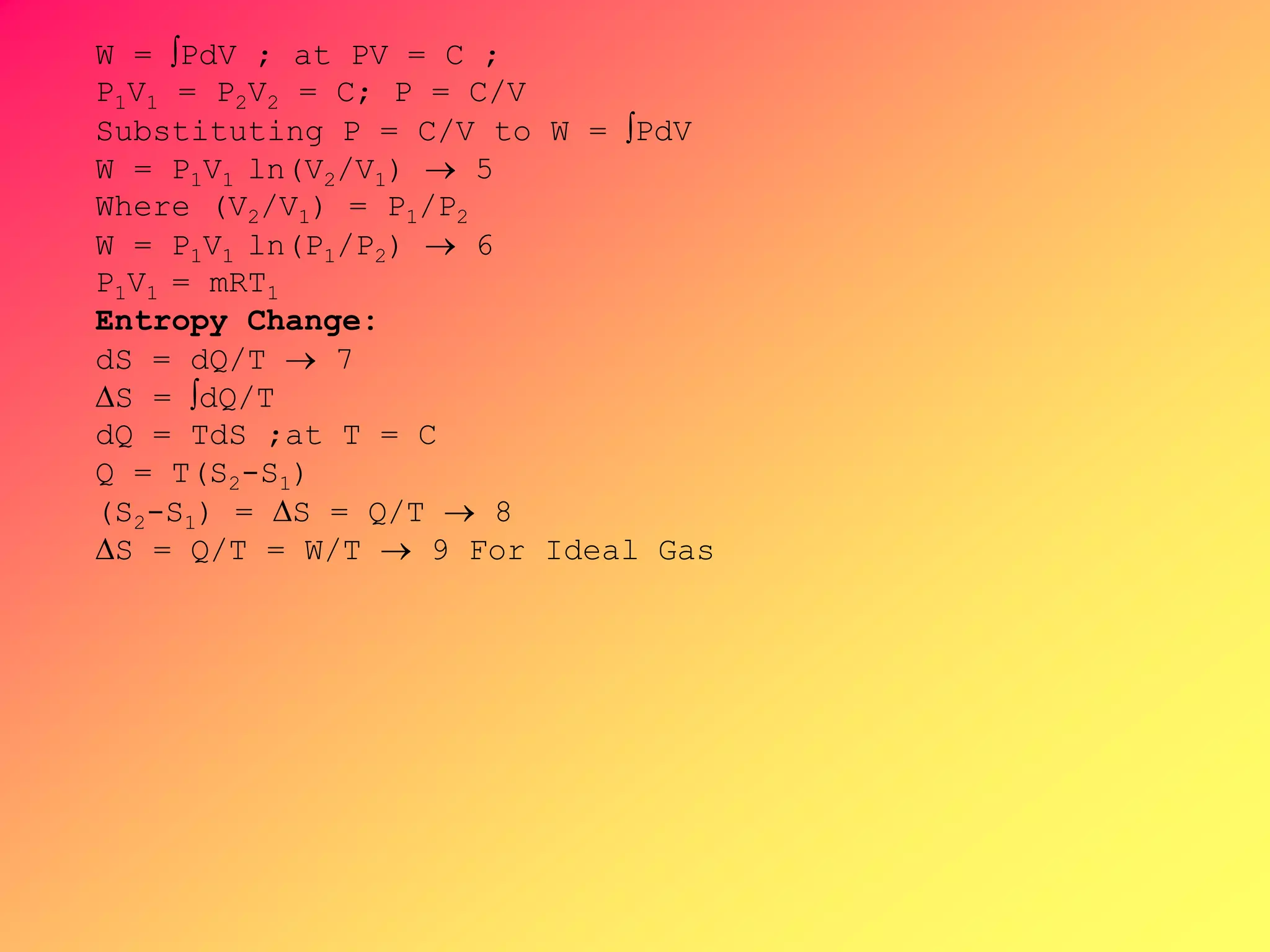
W = PdV ; at PV = C ;
P1V1 = P2V2 = C; P = C/V
Substituting P = C/V to W = PdV
W = P1V1 ln(V2/V1)  5
Where (V2/V1) = P1/P2
W = P1V1 ln(P1/P2)  6
P1V1 = mRT1
Entropy Change:
dS = dQ/T  7
S = dQ/T
dQ = TdS ;at T = C
Q = T(S2-S1)
(S2-S1) = S = Q/T  8
S = Q/T = W/T  9 For Ideal Gas
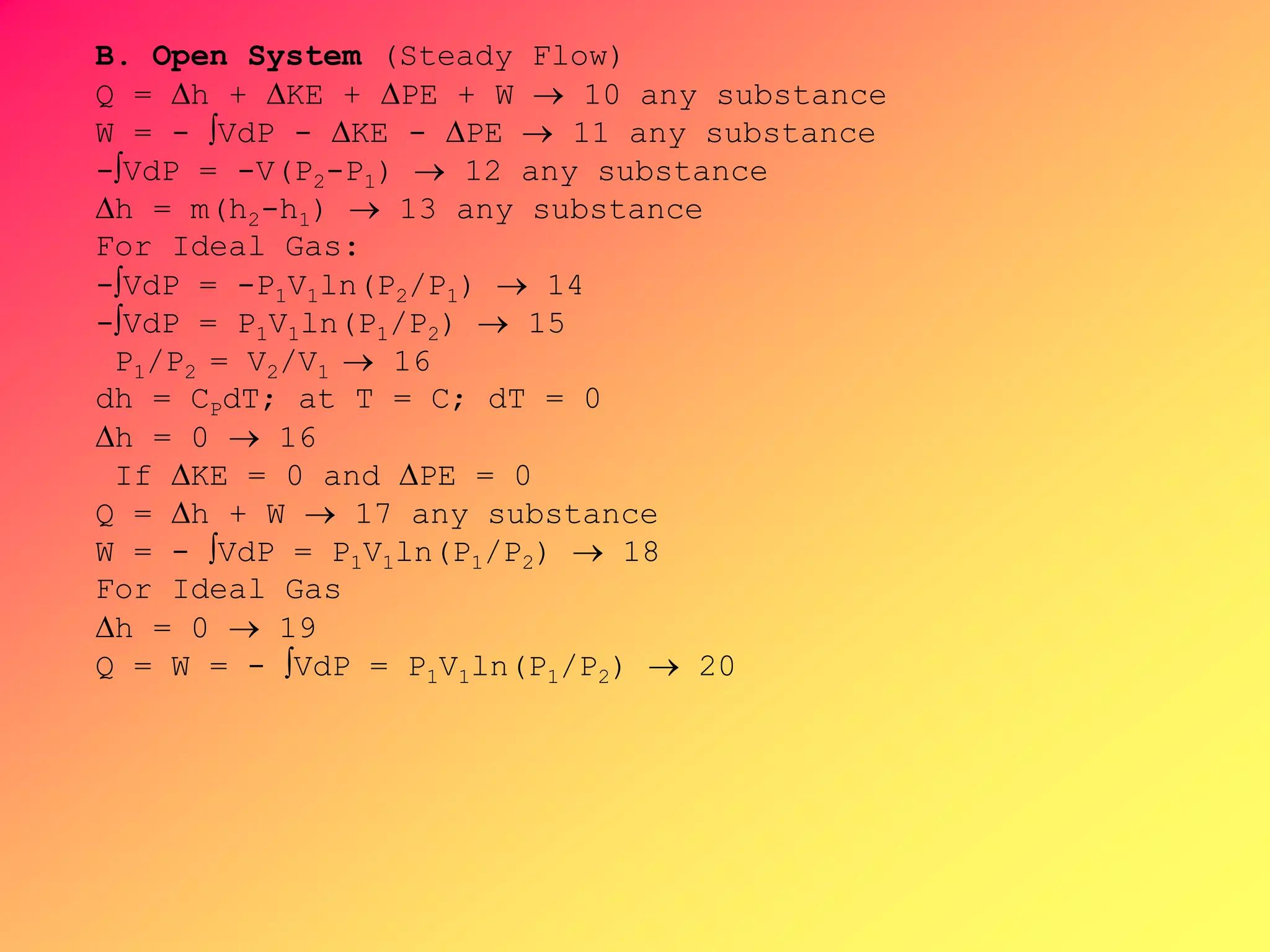
B. Open System (Steady Flow)
Q = h + KE + PE + W  10 any substance
W = - VdP - KE - PE  11 any substance
-VdP = -V(P2-P1)  12 any substance
h = m(h2-h1)  13 any substance
For Ideal Gas:
-VdP = -P1V1ln(P2/P1)  14
-VdP = P1V1ln(P1/P2)  15
P1/P2 = V2/V1  16
dh = CPdT; at T = C; dT = 0
h = 0  16
If KE = 0 and PE = 0
Q = h + W  17 any substance
W = - VdP = P1V1ln(P1/P2)  18
For Ideal Gas
h = 0  19
Q = W = - VdP = P1V1ln(P1/P2)  20
4. Isentropic Process (S = C): An Isentropic Process is an internally
“Reversible Adiabatic” process in which the entropy remains constant
where S = C and PVk = C for an ideal or perfect gas.
For Ideal Gas
1k
2V
1Vk
1k
1P
2P
1T
2T
k
2V2Pk
1V1Pand
2T
2V2P
1T
CkPVandC






















1V1P
T
PV
Using
A. Closed System (Nonflow)
T
S
1
2
P
V
1
2
dV
P
S = C or
PVk = C
Q = U + W  1 any substance
W = PdV  2 any substance
U = m(U2 - U1)  3 any substance
Q = 0  4
W = - U = U = -m(U2 - U1)  5
For Ideal Gas
U = mCV(T2-T1)  6
From PVk = C, P =C/Vk, and substituting P =C/Vk
to W = ∫PdV, then by integration,
 











 





















 


















1
P
P
k1
1
P
P
k1
mRT
k1
k
1k
1
21
V
1
P
k
1k
1
21
PdV
-k1
T-TmR
PdV
V-PVP
PdVW
12
1122  7
 8
 9
Q = 0
Entropy Change
S = 0
S1 = S2
B. Open System (Steady Flow)
Q = h + KE + PE + W  10 any substance
W = - VdP - KE - PE  11 any substance
h = m(h2-h1)  12 any substance
Q = 0
W = -h - KE - PE  13
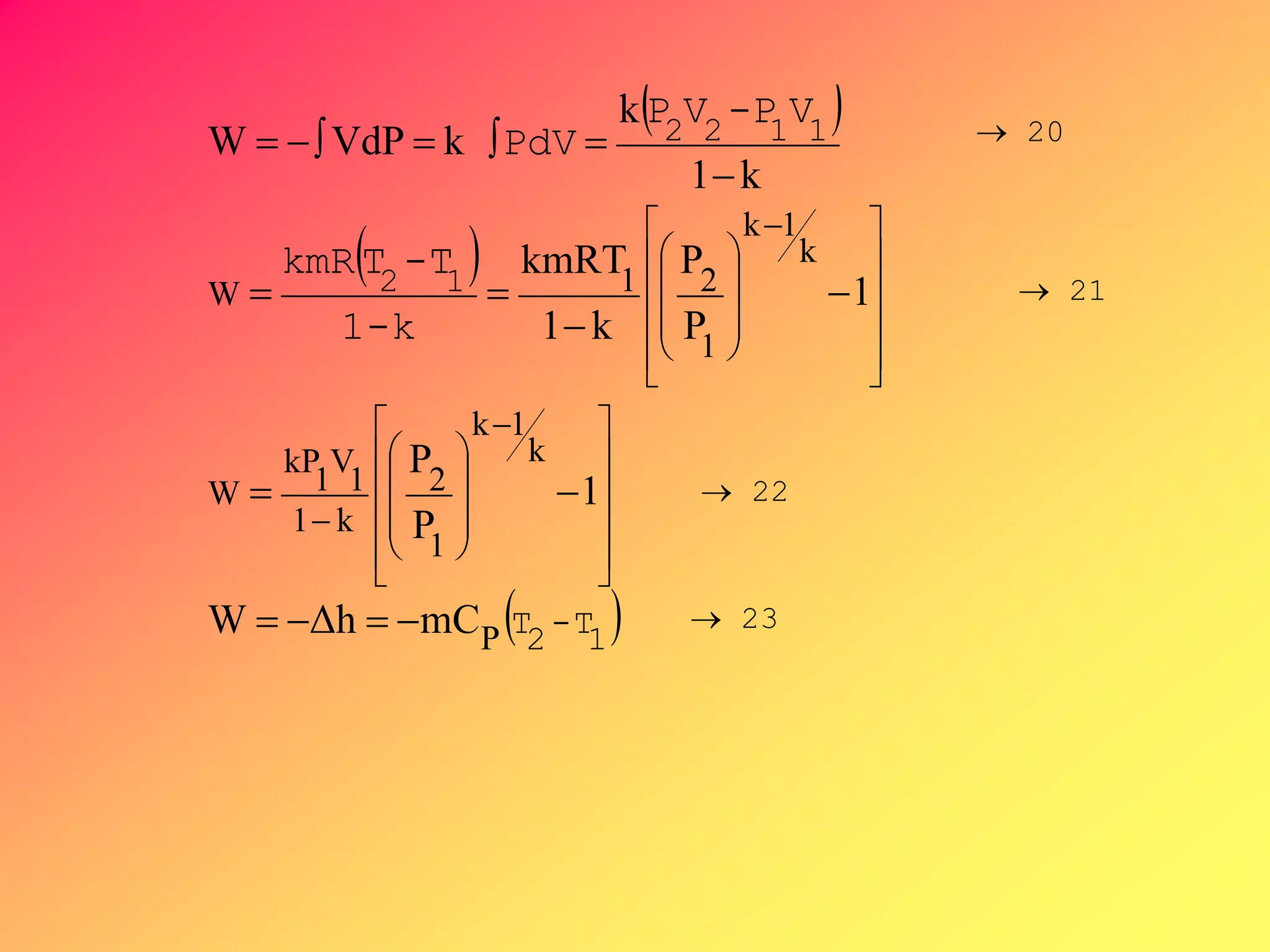
From PVk = C ,V =[C/P]1/k, substituting V to
-∫VdP, then by integration,
 
 











 






















 

















1
P
P
Vd
1
P
P
k1
kmRT
Vd
k1
k
VdP
kVdP
k
1k
1
2
k1
1
V
1
kP
P
k
1k
1
21P
-k1
T-TkmR
V-PVP
PdV
12
1122  14
 15
 16
If KE = 0 and PE = 0
0 = h + W  17 any substance
W = - VdP = - h  18 any substance
h = m(h2-h1)  19 any substance
Q = 0
 
 
 1T-2T
12
1122
-k1
T-TkmR
V-PVP
PdV
P
k
1k
1
2
k1
1
V
1
kP
W
k
1k
1
21W
mChΔW
1
P
P
1
P
P
k1
kmRT
k1
k
kVdPW


















 






















 










 20
 22
 21
 23
P
V
dP
V
Area = -VdP
S = C
1n
2V
1Vn
1n
1P
2P
1T
2T
n
2V2Pn
1V1Pand
2T
2V2P
1T
CnPVandC






















1V1P
T
PV
Using
5. Polytropic Process ( PVn = C): A Polytropic Process is an
internally reversible process of an Ideal or Perfect Gas in which
PVn = C, where n stands for any constant.
A. Closed System: (Nonflow)
Q = U + W  1
W = PdV  2
U = m(U2 - U1)  3
Q = mCn(T2-T1)  4
U = m(U2 - U1)  5
P
V
1
2
dV
P
PVn = C
T
S
2
1
dS
T
PVn = C
K-kg
KJ
or
C-kg
KJ
heatspecificpolytropicC
n1
nk
CC
n
vn











From PVn = C, P =C/Vn, and substituting
P =C/Vn to W = ∫PdV, then by integration,
 











 





















 


















1
P
P
n1
W
1
P
P
n1
mRT
W
n1
n
1n
1
21
V
1
P
n
1n
1
21
PdV
n-1
T-TmR
PdV
V-PVP
PdVW
12
1122
Entropy Change
dS = dQ/T
dQ = mCndT
S = mCnln(T2/T1)
 6
 8
 9
 10
B. Open System (Steady Flow)
Q = h + KE + PE + W  11
W = - VdP - KE - PE  12
h = m(h2-h1)  13
Q = mCn(T2-T1)  14
dQ = mCn dT
W = Q - h - KE - PE  15
From PVn = C ,V =[C/P]1/n, substituting V to
-∫VdP, then by integration,
 
n1
n
VdP
nVdP



1122
V-PVP
PdV
 16
 











 






















 














1
P
P
Vd
1
P
P
n1
nmRT
Vd
n
1n
1
2
n1
1
V
1
nP
P
n
1n
1
21P
n-1
T-TnmR 12
If KE = 0 and PE = 0
Q = h + W  19 any substance
W = - VdP = Q - h  20 any substance
h = m(h2-h1)  21 any substance
h = mCp(T2-T1)
Q = mCn(T2-T1)  22
 17
 18
 











 






















 














1
P
P
1
P
P
n1
nmRT
n
1n
1
2
n1
1
V
1
nP
W
n
1n
1
21W
n-1
T-TnmR 12
 24
 23
6. Isoenthalpic or Throttling Process: It is a steady - state, steady
flow process in which Q = 0; PE = 0; KE = 0; W = 0 and the
enthalpy remains constant.
h1 = h2 or h = C
Throttling valve
Main steam line
thermometer
Pressure Gauge
Pressure Gauge
To main steam line
Throttling Calorimeter
Irreversible or Paddle Work
m
W
Q
U
Wp
Q = U + W - Wp
where: Wp - irreversible or paddle work
Second Law of
THERMODYNAMICS
• Second Law of Thermodynamics
• Kelvin – Planck Statement
• Carnot engine
• Carnot Refrigerator
• Sample Problems
Second Law of Thermodynamics:
Whenever energy is transferred, the level of
energy cannot be conserved and some
energy must be permanently reduced to a
lower level.
When this is combined with the first law of
thermodynamics, the law of energy conservation, the
statement becomes:
Whenever energy is transferred, energy
must be conserved, but the level of energy
cannot be conserved and some energy must
be permanently reduced to a lower level.
Kelvin-Planck statement of the Second Law:
No cyclic process is possible whose sole result
is the flow of heat from a single heat reservoir
and the performance of an equivalent amount
of work.
For a system undergoing a cycle:
The net heat is equal to the net work.
QW 
  dWdQ Where:
W - net work
Q - net heat
CARNOT CYCLE
Nicolas Leonard Sadi Carnot 1796-1832
1.Carnot Engine
Processes:
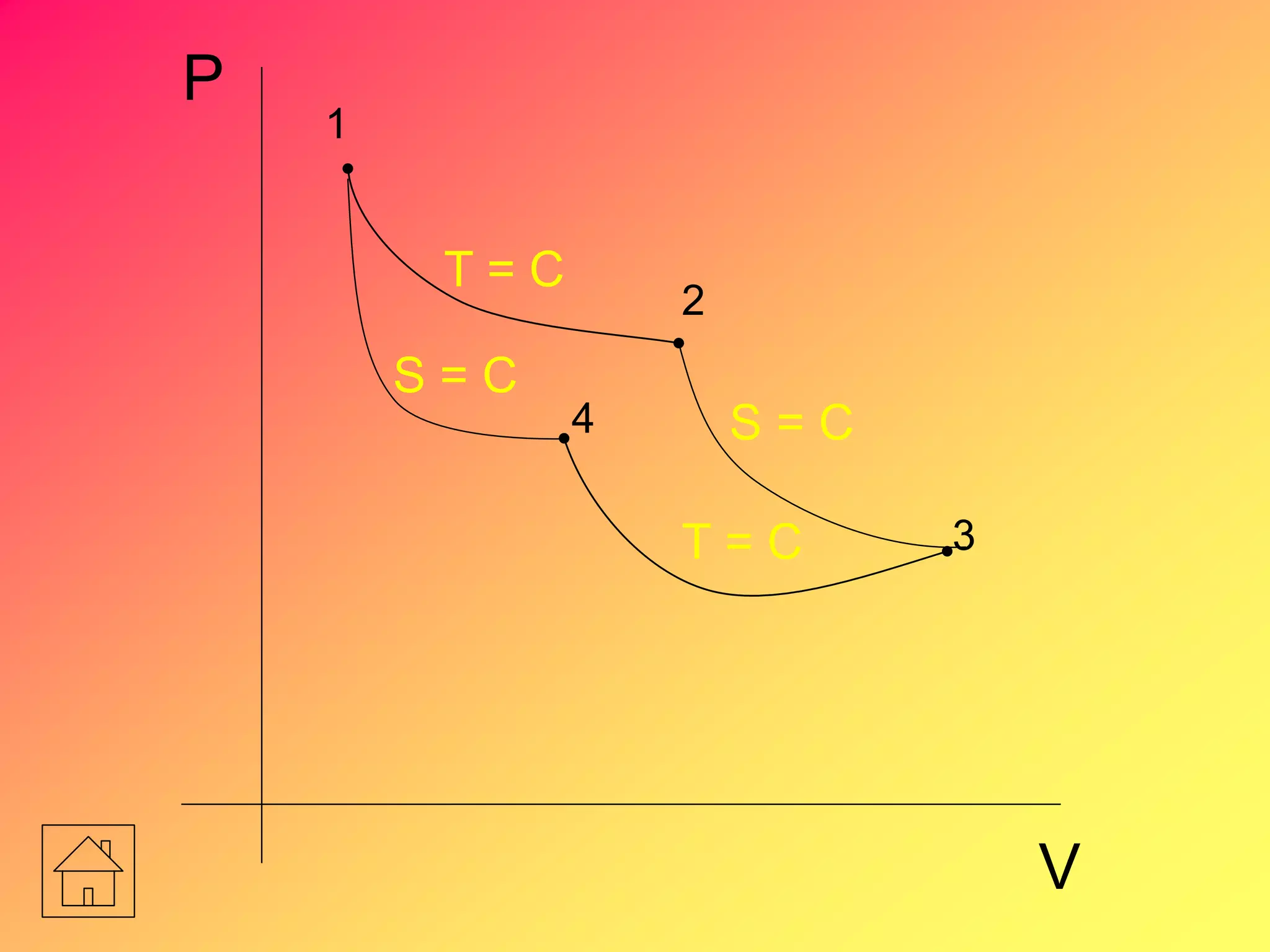
1 to 2 - Heat Addition (T = C)
2 to 3 - Expansion (S = C)
3 to 4 - Heat Rejection (T = C)
4 to 1 - Compression (S = C)
PV Diagram
TS Diagram
P
V
2
1
3
4
T = C
S = C
S = C
T = C
T
S
21
34
T H
T L
Q A
Q R
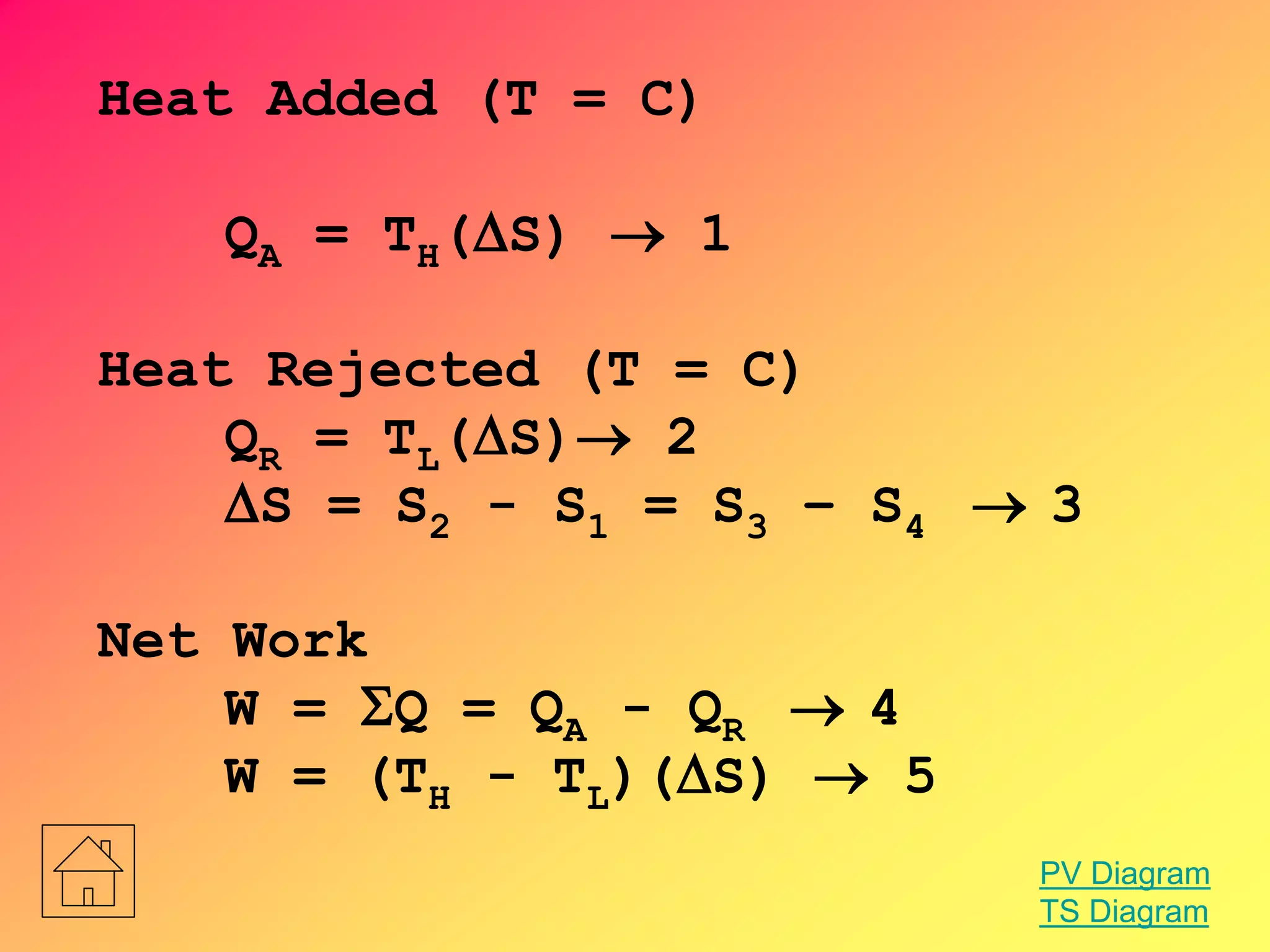
Heat Added (T = C)
QA = TH(S)  1
Heat Rejected (T = C)
QR = TL(S) 2
S = S2 - S1 = S3 – S4  3
Net Work
W = Q = QA - QR  4
W = (TH - TL)(S)  5
PV Diagram
TS Diagram
%100x
AQ
RQ
1e
%100x
AQ
RQAQ
e
%100x
AQ
W
e




 6
 7
 8
PV Diagram
TS Diagram
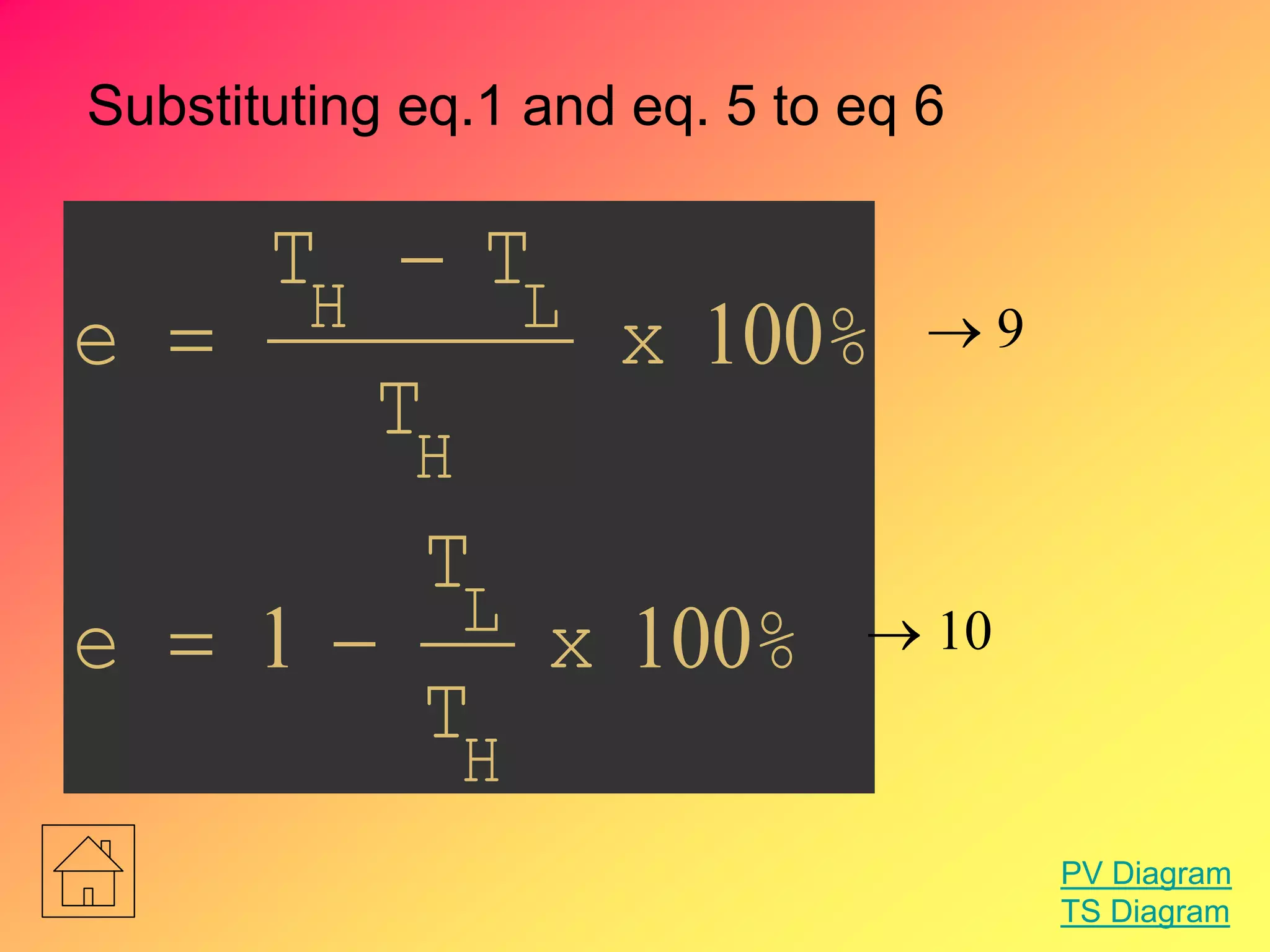
Substituting eq.1 and eq. 5 to eq 6
%x
T
T
e
%x
T
TT
e
H
L
H
LH
1001
100


  9
 10
PV Diagram
TS Diagram
TH
TL
W
QA
QR
E
Carnot Engine
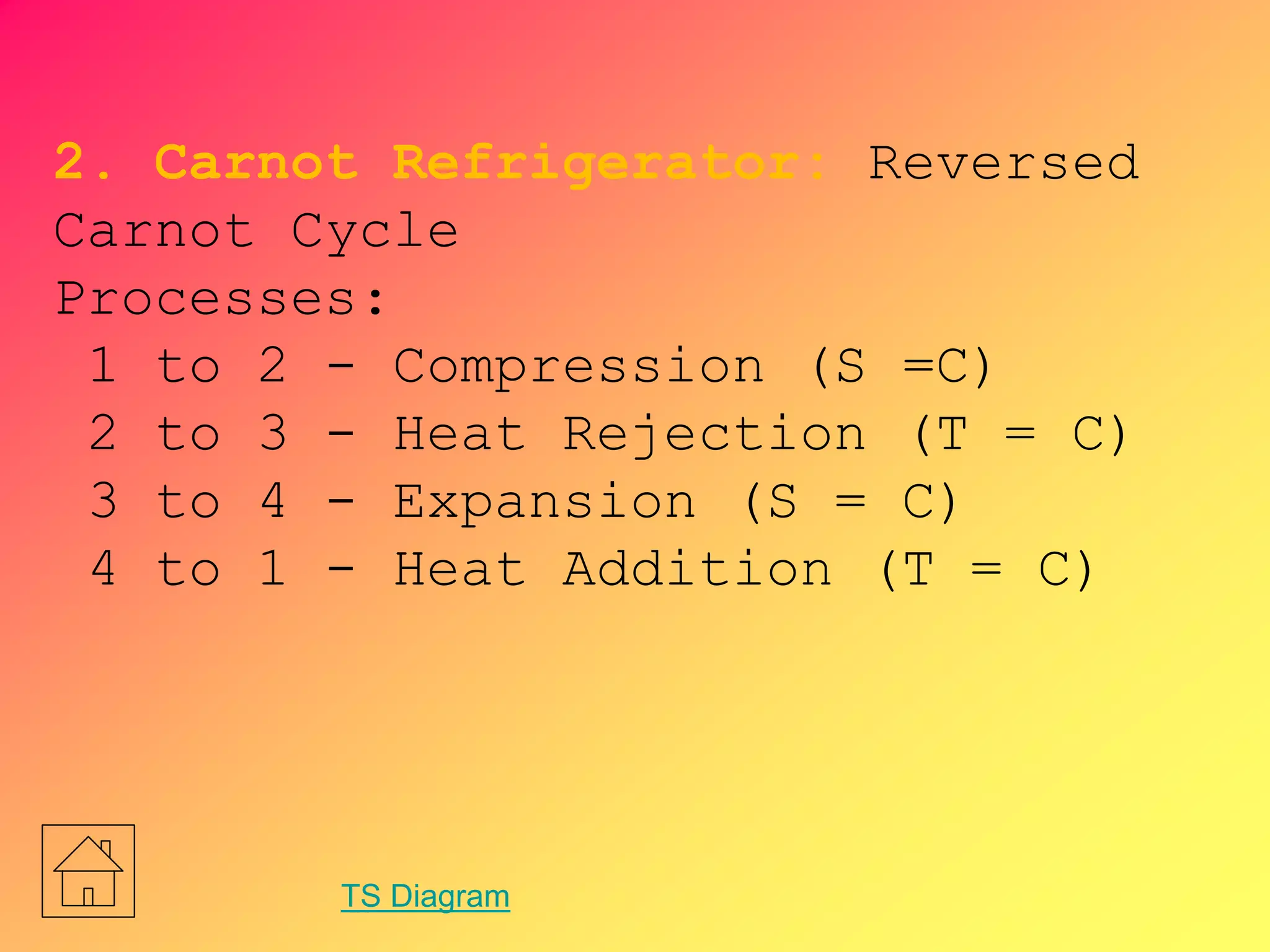
2. Carnot Refrigerator: Reversed
Carnot Cycle
Processes:
1 to 2 - Compression (S =C)
2 to 3 - Heat Rejection (T = C)
3 to 4 - Expansion (S = C)
4 to 1 - Heat Addition (T = C)
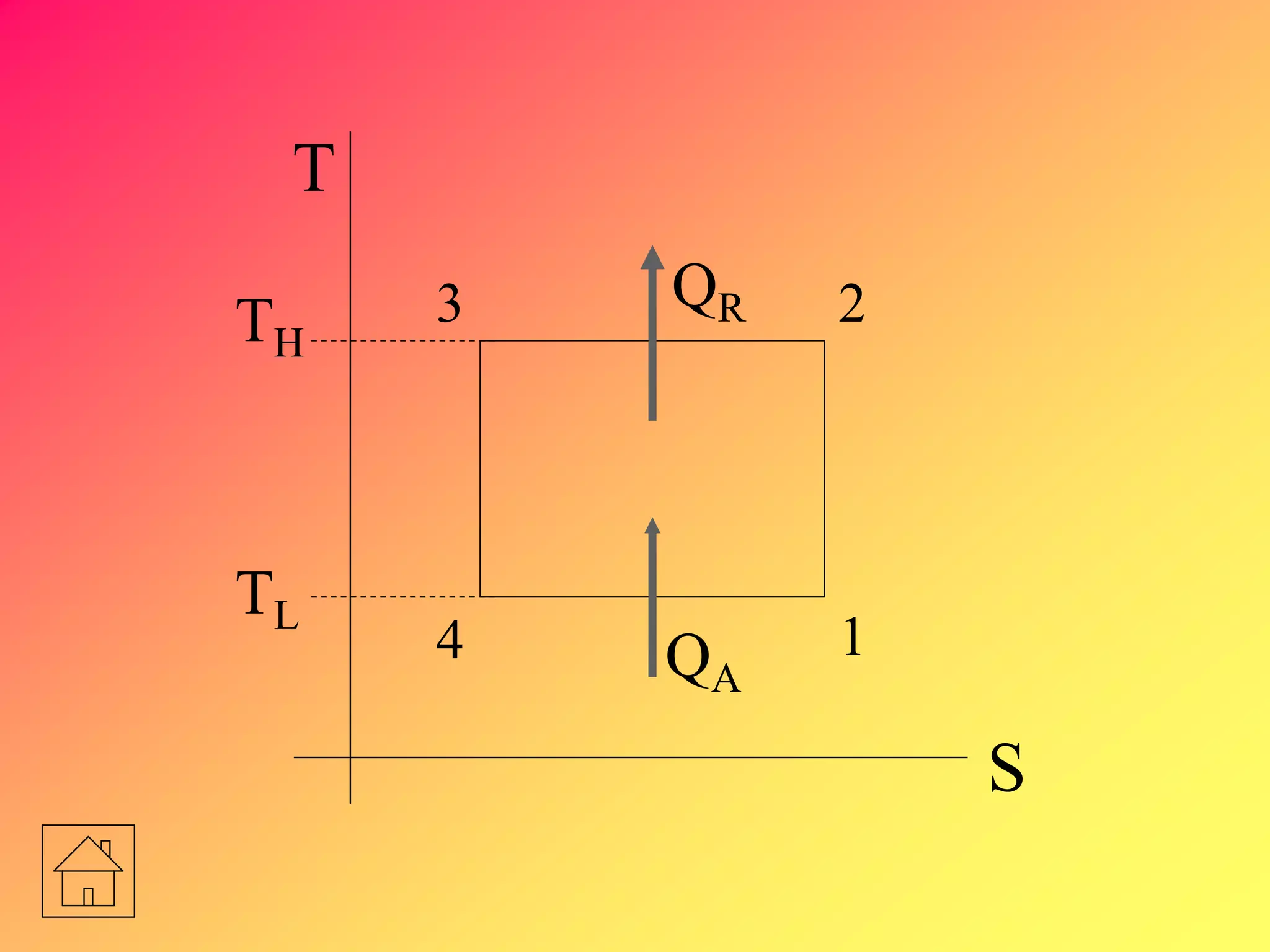
TS Diagram
QR
QA
1
2
4
3
S
T
TH
TL
Heat Added (T = C)
QA = TL(S)  1
Heat Rejected (T = C)
QR = TH(S) 2
S = S1 - S4 = S2 - S3  3
Net Work
W = Q 4
W = QR - QA  5
W = (TH - TL)(S)  6
TS Diagram
Coefficient of Performance
(COP)
LTHT
LT
COP
W
AQ
COP


  7
 8
TS Diagram
Tons of Refrigeration
211 KJ/min = 1 TR
3. Carnot Heat Pump:A heat pump
uses the same components as the
refrigerator but its purpose is
to reject heat at high energy
level.
Performance Factor
(PF)
AR
R
R
QQ
Q
PF
W
Q
PF


  10
 11
1COPPF
LT
HT
1PF
AQ
RQ
1PF
LTHT
HT
PF





 12
 13
 14
 15
TH
TL
W
QA
QR
R
Carnot Refrigerator
A Carnot engine operating between 775 K and
305K produces 54 KJ of work. Determine the
change of entropy during heat addition.
TH = 775 K ; TL = 305 K
W = 54 KJ
TS Diagram
TH
TL
W
QA
QR
E
K
KJ
0.015
775
89.04
T
Q
S-S
)S-(STQ
KJ89.04
0.606
54
e
W
Q
Q
W
e
0.606
775
305775
T
TT
e
H
A
12
12HA
A
A
H
LH










A Carnot heat engine rejects 230 KJ of
heat at 25C. The net cycle work is 375 KJ.
Determine the cycle thermal efficiency and
the cycle high temperature .
Given:
QR = 230 KJ
TL = 25 + 273 = 298K
W = 375 KJ
TL = 298K
TH
WE
QR = 230 KJ
QA
K87.783
772.0
605
)S-(S
Q
T
KKJ/-0.772)S-(S
KKJ/772.0)SS(
)SS(298230
)SS(SS
)SS(TQ
)SS(TQ
62.0
605
375
QA
W
e
KJ605QA
)230375(QWQ
QQW
12
A
H
12
34
34
1234
34LR
12HA
RA
RA











A Carnot engine operates between temperature
reservoirs of 817C and 25C and rejects 25 KW to
the low temperature reservoir. The Carnot engine
drives the compressor of an ideal vapor compres-
sion refrigerator, which operates within pressure
limits of 190 KPa and 1200 Kpa. The refrigerant is
ammonia. Determine the COP and the refrigerant
flow rate.(4; 14.64 kg/min)
TH = 817 + 273 = 1090 K
TL = 25 + 273 = 298 K
QR = 25 KW
Internal Combustion
Engine Cycle
• The OTTO CYCLE
• The DIESEL CYCLE
• The DUAL CYCLE
INTERNAL
COMBUSTION
ENGINE
By. Engr. Yuri G. Melliza
Internal Combustion Engine
Cycle
Air Standard Cycle
 Otto Cycle
 Diesel Cycle
 Dual Cycle
Otto Cycle
Inventor: Nikolaus Otto (1832 – 1891)
Processes:
1 to 2: Isentropic Compression (S = C)
2 to 3: Constant Volume Heat Addition
(V = C)
3 to 4: Isentropic Expansion (S = C)
4 to 1: Constant volume Heat Rejection
(V = C)
P V Diagram
P
V
1
4
3
2
S = C
S = C
VDCVD
T S Diagram
T
S
1
4
3
2
V = C
V = C
QR
QA
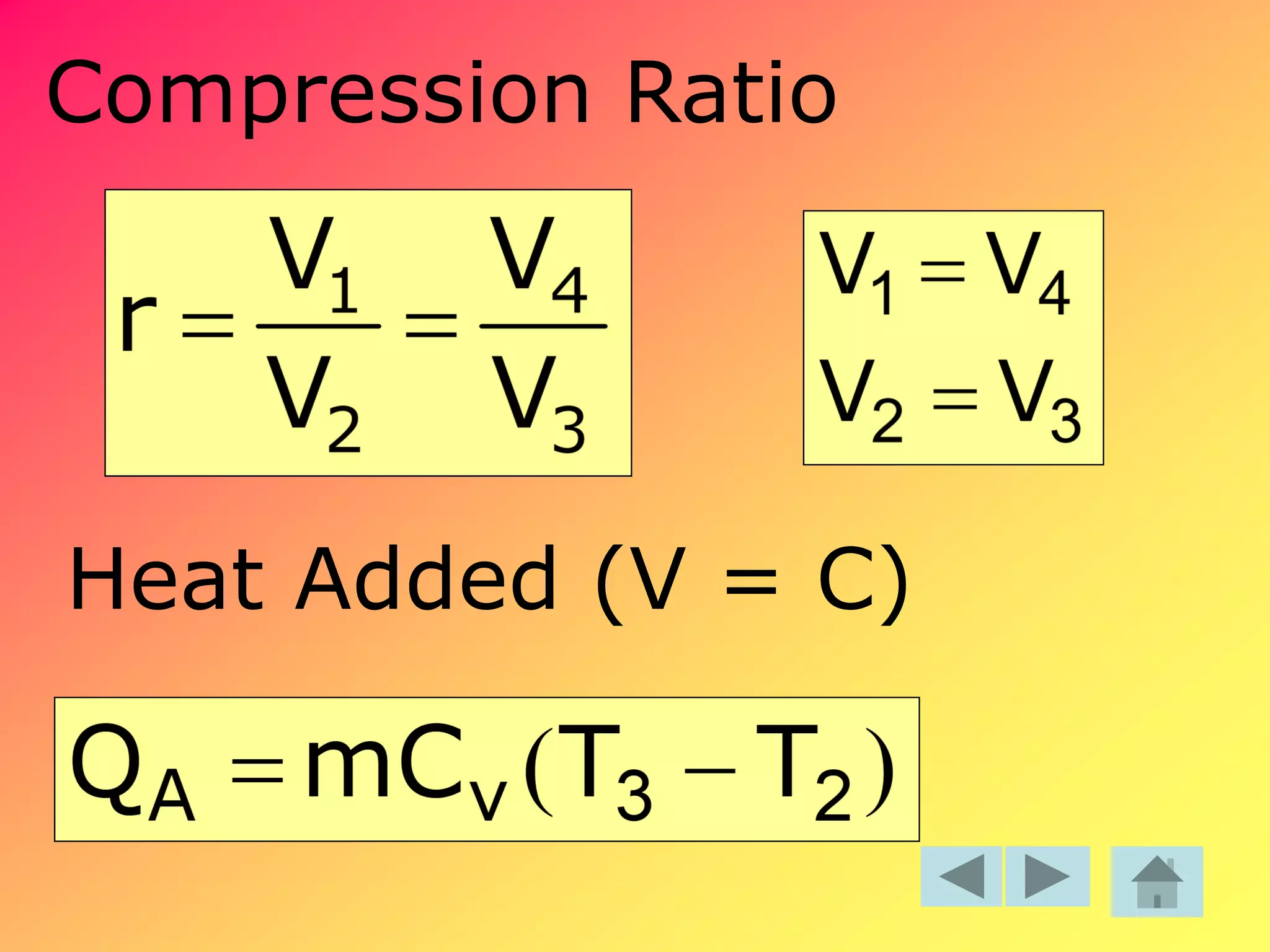
Compression Ratio
Heat Added (V = C)
Heat Rejected (V = C)
Net Work
Thermal Efficiency
100%x
Q
Q
-1e
100%x
Q
Q-Q
e
100%x
Q
W
e
A
R
A
RA
A















100%x
(r)
1
-1e
100%x
TT
TT
e
1-k


















23
14
1
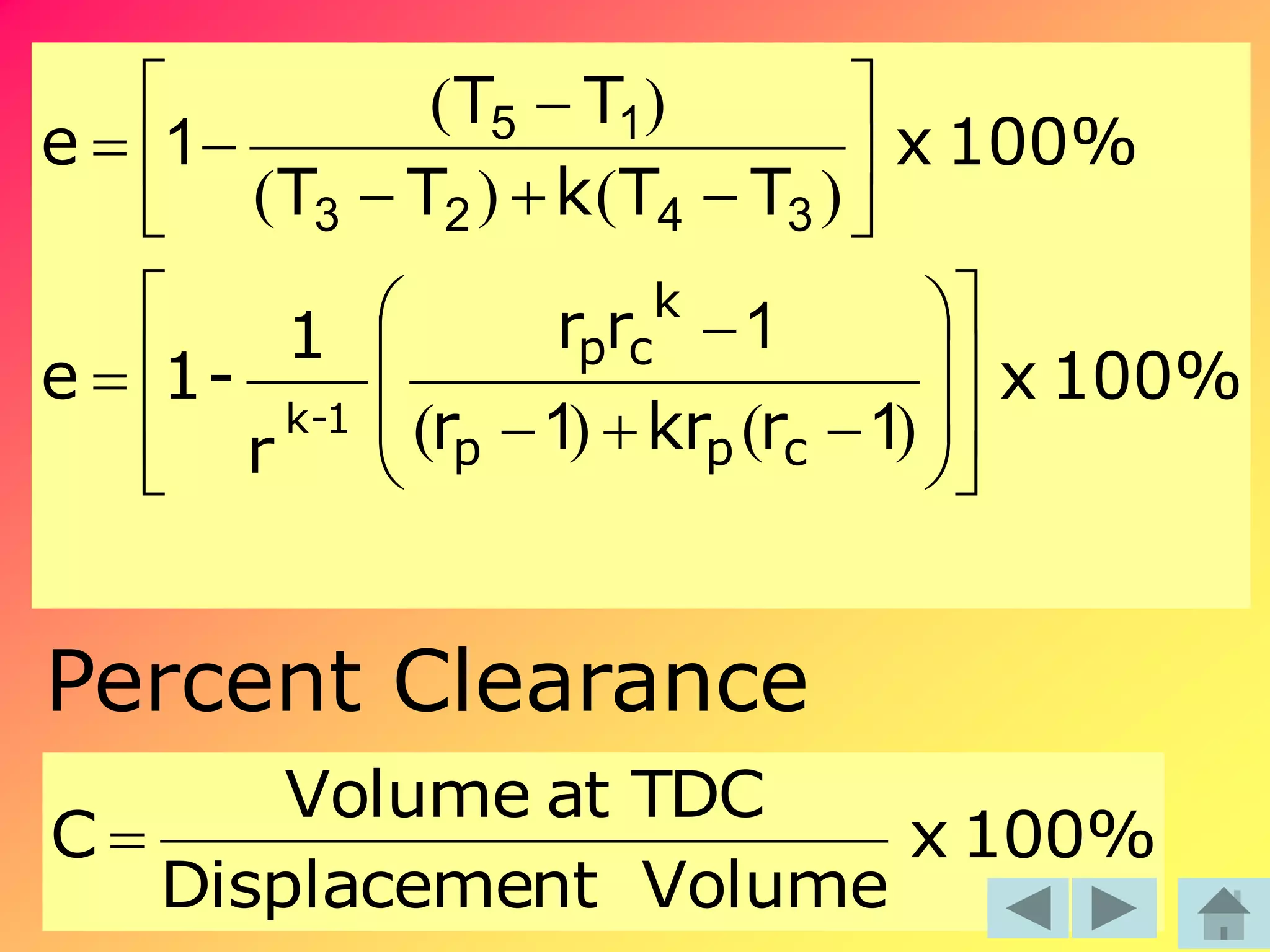
Percent Clearance
100%x
lumeVontDisplaceme
TDCatVolume
C 
C
C
r
CVV
100%x
V
V
C
D2
D
2




1
KPa
V
W
P
D
m 
Mean Effective Pressure
W VD Pm
KJ m3 Kpa
KJ/kg m3/kg Kpa
KW m3/se
c
KPa
kg
m
V
mVVV
3
D
3
D
)(
)(
21
21


Diesel Cycle
Inventor: Rudolf Christian Karl Diesel
(1858-1913)
Processes:
1 to 2: Isentropic compression (S = C)
2 to 3: Constant Pressure Heat Addition
(P = C)
3 to 4: Isentropic Expansion (S = C)
4 to 1: Constant Volume Heat Rejection
(V = C)
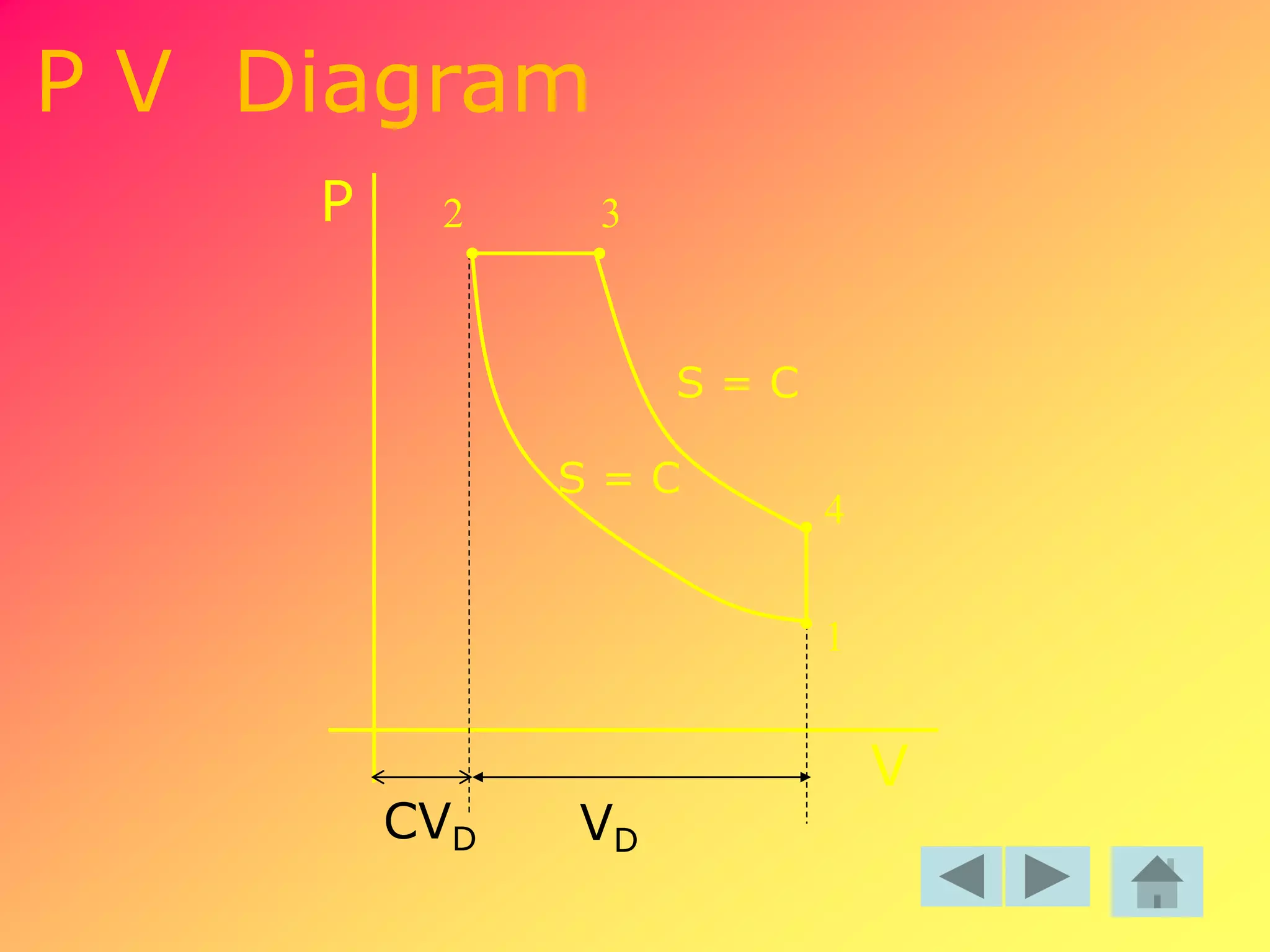
P V Diagram
P
V
1
4
32
S = C
S = C
VDCVD
T S Diagram
T
S
1
4
3
2
V = C
P = C
QR
QA
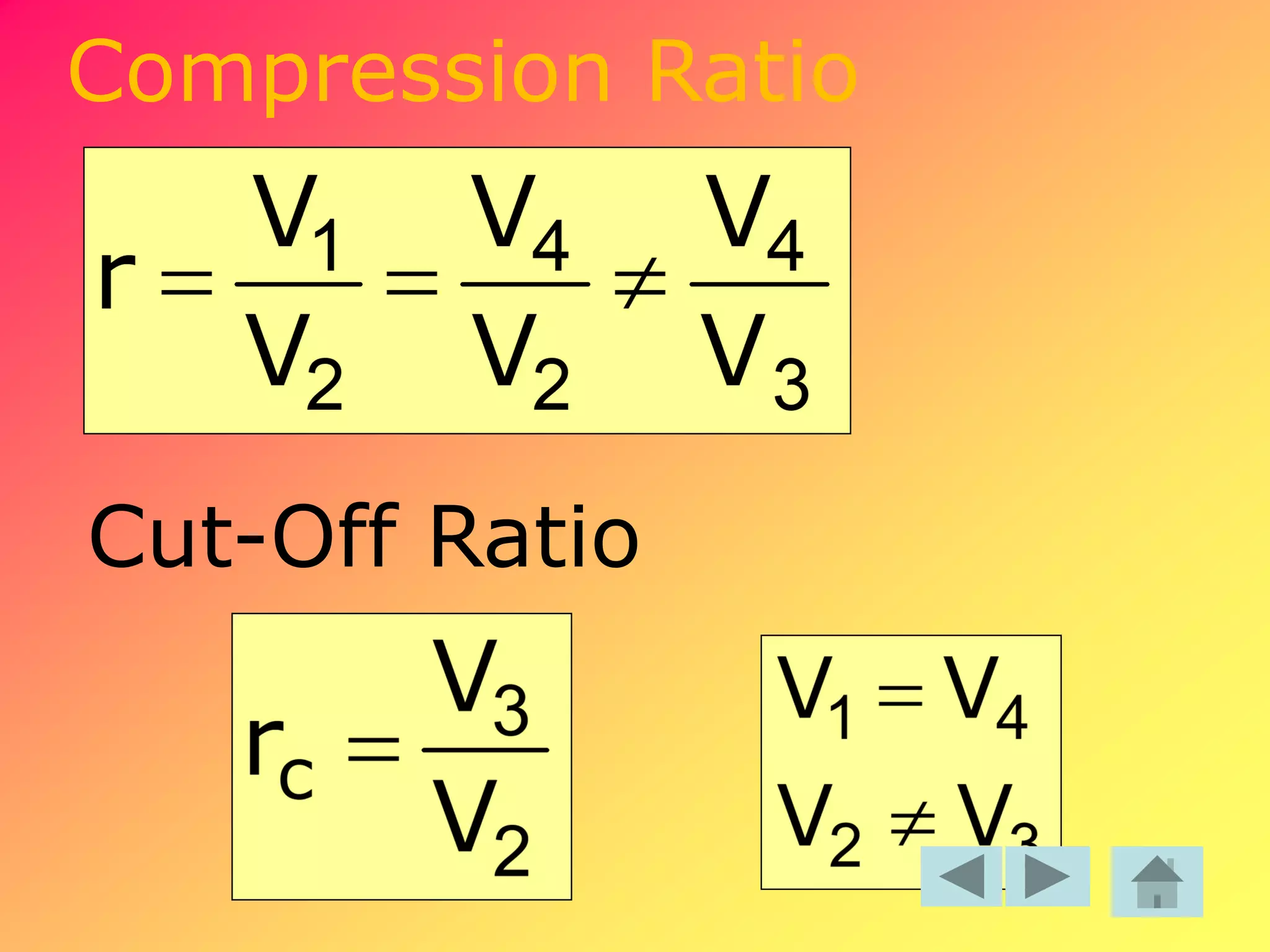
Compression Ratio
Cut-Off Ratio
Heat Added (P = C)
Heat Rejected (V = C)
Net Work
Thermal Efficiency
100%x
Q
Q
-1e
100%x
Q
Q-Q
e
100%x
Q
W
e
A
R
A
RA
A















100%x
rk
r
r
1
-1e
100%x
TTk
TT
e
c
k
c
1-k




























1
1
1
23
14
(
)(
)(
Percent Clearance
100%x
lumeVontDisplaceme
TDCatVolume
C 
C
C
r
CVV
100%x
V
V
C
D2
D
2




1
KPa
V
W
P
D
m 
Mean Effective Pressure
W VD Pm
KJ m3 Kpa
KJ/kg m3/kg Kpa
KW m3/se
c
KPa
kg
m
V
mVVV
3
D
3
D
)(
)(
21
21


Dual Cycle
Processes:
1 to 2: Isentropic compression (S = C)
2 to 3: Constant Volume Heat Addition
QA1(V = C)
3 to 4: Constant Pressure Heat addition
QA2(P = C)
4 to 5: Isentropic Expansion (S = C)
5 to 1: Constant Volume Heat Rejection
(V = C)
PV Diagram
P
V
1
3
2
5
S = C
S = C
4
TS Diagram
T
S
5
3
2
4
1
V = C
P = CQA1
QA2
QR
Cut-Off RatioCompression Ratio
Pressure Ratio
Heat Added
Net Work
Heat Rejected
Thermal Efficiency
100%x
Q
Q
-1e
100%x
Q
Q-Q
e
100%x
Q
W
e
A
R
A
RA
A















100%x
rkrr
rr
r
1
-1e
100%x
TTkTT
TT
e
cpp
k
cp
1-k 



























)()(
)()(
)(
11
1
1
3423
15
Percent Clearance
100%x
lumeVontDisplaceme
TDCatVolume
C 
C
C
r
CVV
100%x
V
V
C
D2
D
2




1
W VD Pm
KJ m3 Kpa
KJ/kg m3/kg Kpa
KW m3/se
c
KPa
KPa
V
W
P
D
m 
Mean Effective Pressure
kg
m
V
mVVV
3
D
3
D
)(
)(
21
21


Stirling and Ericsson Cycle:
A. Stirling cycle: For Regenerator
Processes:
1 to 2 – Constant Temperature Heat Addition (Volume Increases)
2 to 3 - Constant Volume
3 to 4 - Constant Temperature Heat Rejection (Volume Decreases)
4 to 1 - Constant Volume
T
S
1 2
34
QA
QR
V = C V = C
P
V
1
2
3
4
QA
QR
T = C
T = C
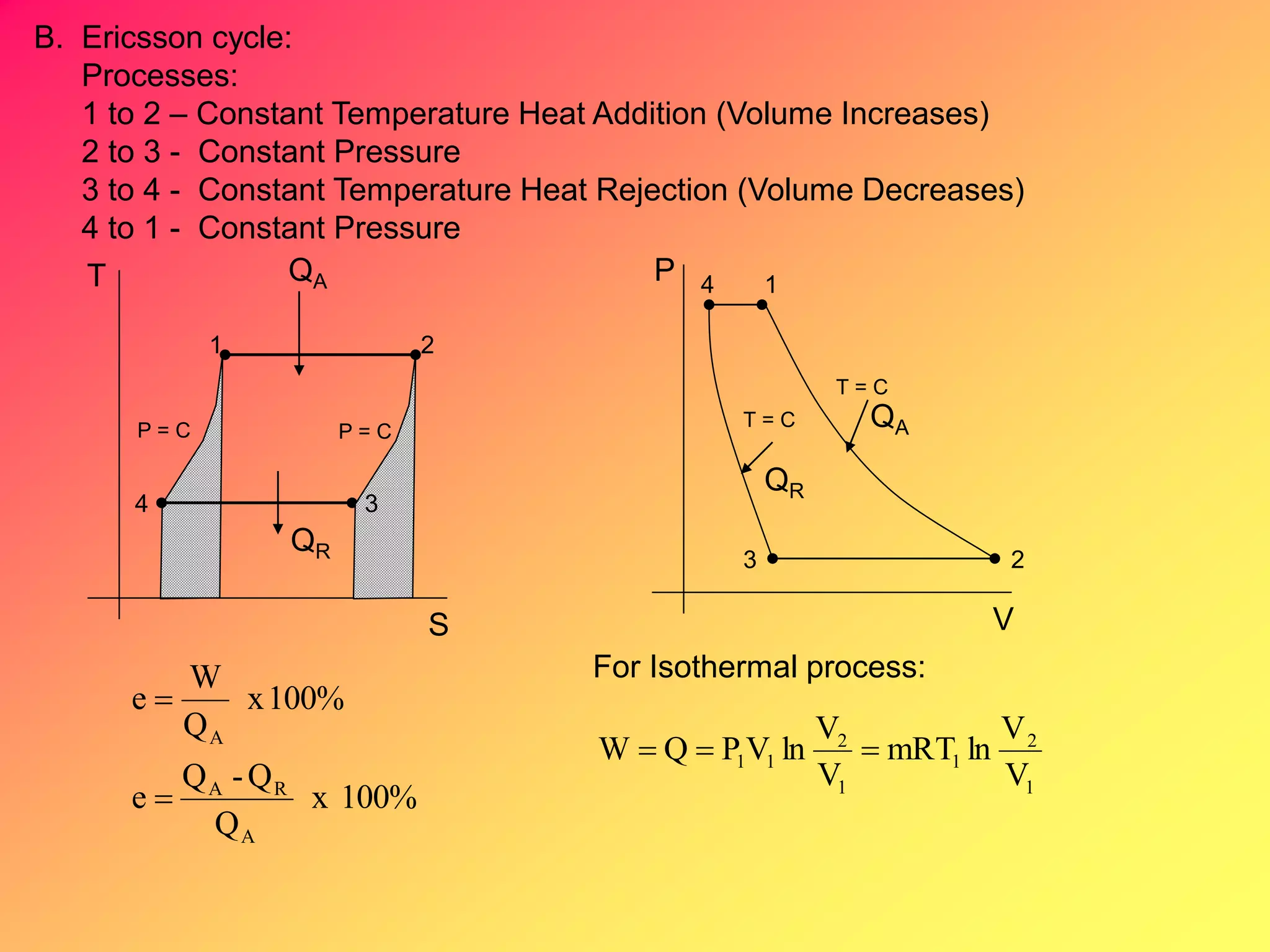
B. Ericsson cycle:
Processes:
1 to 2 – Constant Temperature Heat Addition (Volume Increases)
2 to 3 - Constant Pressure
3 to 4 - Constant Temperature Heat Rejection (Volume Decreases)
4 to 1 - Constant Pressure
T
S
1 2
34
QA
QR
P = C P = C
V
P 1
23
4
QA
QR
T = C
T = C
100%x
Q
Q-Q
e
100%x
Q
W
e
A
RA
A


1
2
1
1
2
11
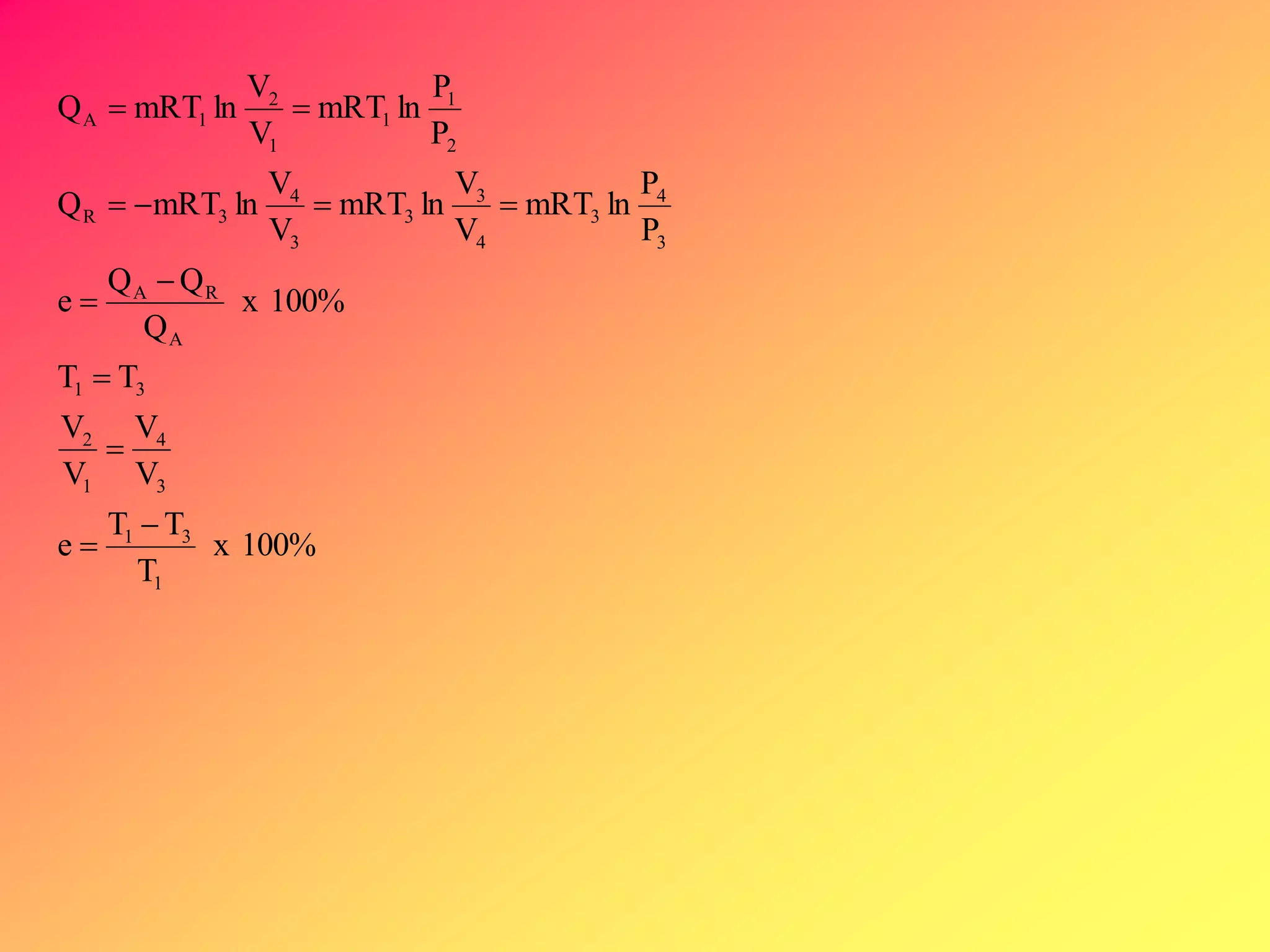
V
V
lnmRT
V
V
lnVPQW 
For Isothermal process:
100%x
T
TT
e
V
V
V
V
TT
100%x
Q
QQ
e
P
P
lnmRT
V
V
lnmRT
V
V
lnmRTQ
P
P
lnmRT
V
V
lnmRTQ
1
31
3
4
1
2
31
A
RA
3
4
3
4
3
3
3
4
3R
2
1
1
1
2
1A








Vapor Power Cycle
RANKINE CYCLE
Processes:
1 to 2 - Expansion (S = C)
2 to 3 - Heat Rejection (P = C)
3 to 4 - Compression or Pumping (S = C)
4 to 1 - Heat Addition (P = C)
Boiler or Steam
Generator
Turbine
Condenser
Pump
WP
QA
QR
Wt
1
2
3
4
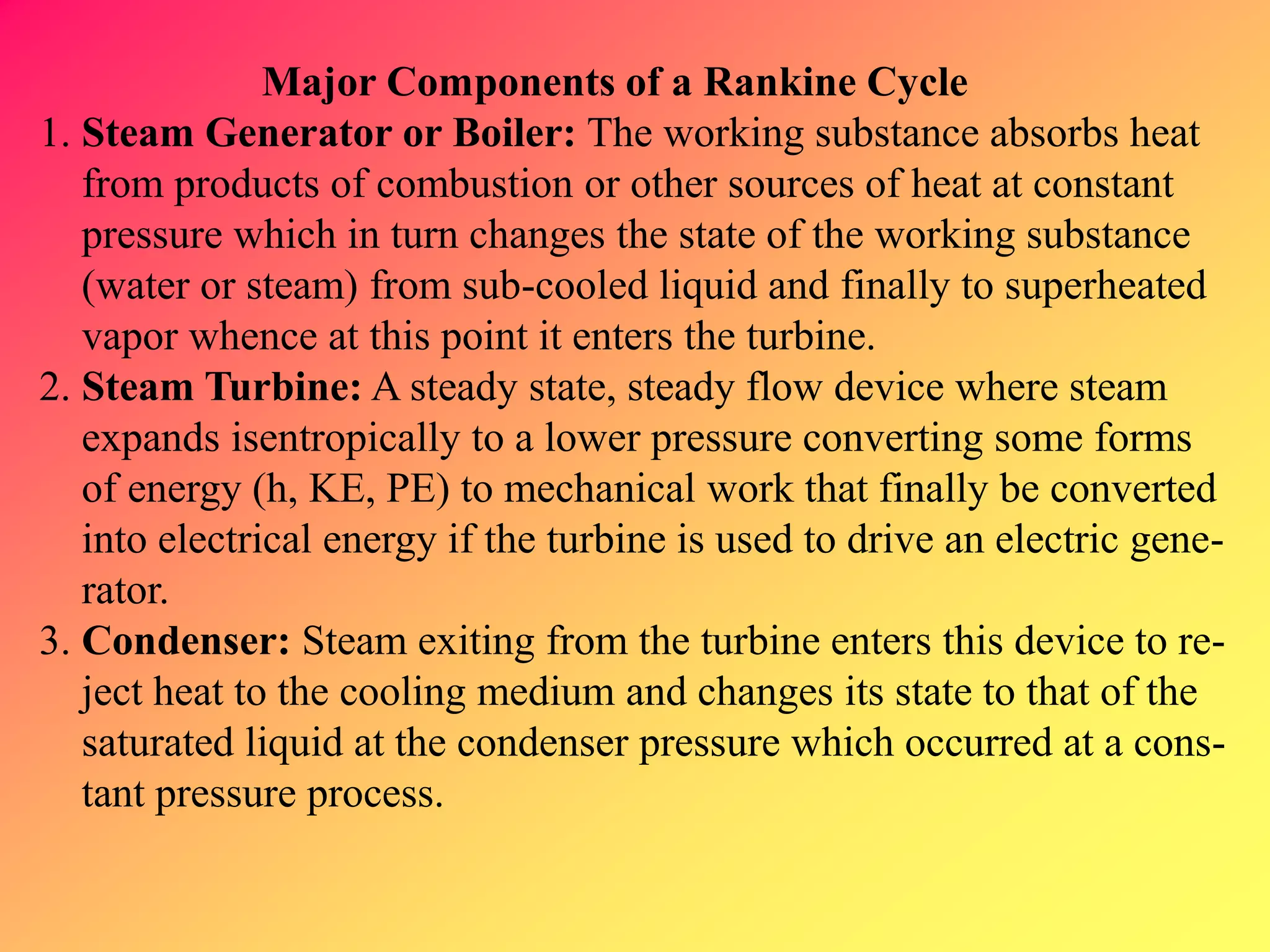
Major Components of a Rankine Cycle
1. Steam Generator or Boiler: The working substance absorbs heat
from products of combustion or other sources of heat at constant
pressure which in turn changes the state of the working substance
(water or steam) from sub-cooled liquid and finally to superheated
vapor whence at this point it enters the turbine.
2. Steam Turbine: A steady state, steady flow device where steam
expands isentropically to a lower pressure converting some forms
of energy (h, KE, PE) to mechanical work that finally be converted
into electrical energy if the turbine is used to drive an electric gene-
rator.
3. Condenser: Steam exiting from the turbine enters this device to re-
ject heat to the cooling medium and changes its state to that of the
saturated liquid at the condenser pressure which occurred at a cons-
tant pressure process.
4. Pump: It is also a steady state, steady flow machine where the
condensate leaving the condenser at lower pressure be pumped
back to the boiler in an isentropic process in order to raise the
pressure of the condensate to that of the boiler pressure.
h
S S
T
3
4
2
1
3
4
1
2
P1
P2
P1
P2
4’
2’
2’
4’
Turbine Work
a) Ideal Cycle
Wt = (h1 - h2) KJ/kg
Wt = ms(h1 - h2) KW
b) Actual Cycle
Wt’ = (h1 - h2’) KJ/kg
Wt’ = ms(h1 - h2’) KW
where: ms - steam flow rate in kg/sec
Turbine Efficiency
100%x
hh
hh
η
100%x
W
W
tη
21
2'1
t
t
t'




Pump Work
a) Ideal Cycle
WP = (h4 - h3) KJ/kg
WP = ms(h4 - h3) KW
b) Actual Cycle
WP’ = (h4’ - h3) KJ/kg
WP’ = ms(h4’ - h3) KW
Pump Efficiency
100%x
hh
hh
η
100%x
W
W
η
34'
34
p
p'
p
p




Heat Rejected
a) Ideal Cycle
QR = (h2 - h3) KJ/kg
QR = ms(h2 - h3) KW
QR = ms(h2 - h3) KW = mwCpw(two - twi) KW
b) Actual Cycle
QR = (h2’ - h3) KJ/kg
QR = ms(h2’ - h3) KW = mwCpw(two - twi) KW
Where: mw - cooling water flow rate in kg/sec
twi - inlet temperature of cooling water inC
two - outlet temperature of cooling water inC
Cpw - specific heat of water in KJ/kg- C or KJ/kg-K
Cpw = 4.187 KJ/kg- C or KJ/kg- K
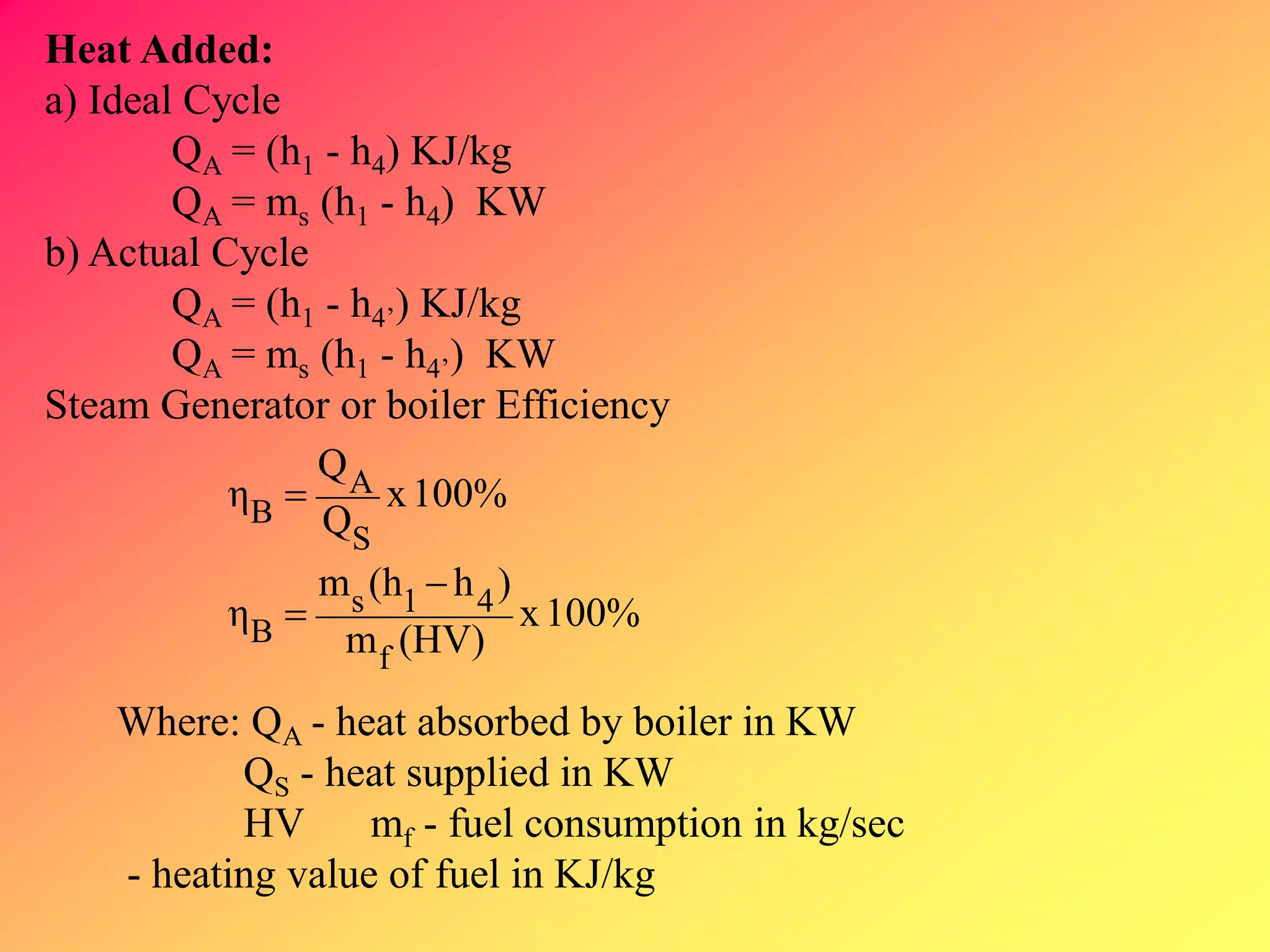
Heat Added:
a) Ideal Cycle
QA = (h1 - h4) KJ/kg
QA = ms (h1 - h4) KW
b) Actual Cycle
QA = (h1 - h4’) KJ/kg
QA = ms (h1 - h4’) KW
Steam Generator or boiler Efficiency
100%x
(HV)m
)h(hm
η
100%x
Q
Q
η
f
41s
B
S
A
B



Where: QA - heat absorbed by boiler in KW
QS - heat supplied in KW
HV mf - fuel consumption in kg/sec
- heating value of fuel in KJ/kg
THERMAL EFFICIENCY
A. For the Ideal Cycle
%100x
Q
WW
e
%100x
AddedHeat
Network
e
A
pt 


B. For the Actual Cycle
%100x
Q
WW
e
%100x
AddedHeatActual
NetworkActual
e
'A
'p't 


Steam Rate
KW-sec
kg
ProducedKW
rateFlowSteam
SR 
Heat Rate
KW-sec
KJ
ProducedKW
SuppliedHeat
HR 
Reheat Cycle
A steam power plant operating on a reheat cycle improves the thermal
efficiency of a simple Rankine cycle plant. After partial expansion of
the steam in the turbine, the steam flows back to a section in the boiler
which is the re-heater and it will be reheated almost the same to its
initial temperature and expands finally in the turbine to the con-
denser pressure.
Reheater
QA
WP
QR
Wt
1 kg
1 2 3
4
56
Regenerative Cycle
In a regenerative cycle, after partial expansion of the steam in the
turbine, some part of it is extracted for feed-water heating in an open or
close type feed-water heater. The bled steam heats the condensate from
the condenser or drains from the previous heater causing a decrease in
heat absorbed by steam in the boiler which result to an increase in
thermal efficiency of the cycle.
QA
WP1
QR
Wt
1 kg
1
2
3
456
7
WP2
m
Reheat-Regenerative Cycle
For a reheat - regenerative cycle power plant, part of the steam is re-
heated in the re-heater and some portion is bled for feed-water heating
to an open or closed type heaters after its partial expansion in the
turbine. It will result to a further increase in thermal efficiency of the
plant.
QA
WP1
QR
Wt
1 kg
1
2
4
5678
WP2
m
2
3
1-m
1-m
For a 1 kg basis of circulating steam, m is the fraction of steam
extracted for feed-water heating as shown on the schematic diagram
above, where the reheat and bled steam pressure are the same.

ME 12 F1 MODULE (Thermodynamics 1)

  • 1.
  • 2.
    THERMODYNAMICS It a sciencethat deals with energy transformation, the transformation of heat into work or vice versa. It was derived from a Greek word “therme” that means Heat and “dynamis” that means Strength. SYSTEM: Is that portion in the universe, an atom, a galaxy, a certain quantity of matter or a certain volume in space in which one wishes to study. It is a region en- closed by an specified boundary, that may be imaginary, fixed or moving. OPEN SYSTEM: A system open to matter flow or a system in which there is an exchange of mass between the system and the surroundings. CLOSED SYSTEM: A system closed to matter flow or a system in which there’s no exchange of mass between the system and the surroundings. Closed System: Piston in Cylinder boundary Open System: Steam turbine steam in steam out Work boundary
  • 3.
    SURROUNDING OR ENVIRONMENT:It is the region all about the system. WORKING SUBSTANCE: A substance responsible for the transformation of energy. example: steam in a steam turbine, water in a water pump PURE SUBSTANCE: A substance that is homogeneous in nature and is homoge- neous, or a substance that is not a mixture of different specie, or a substance that does not undergo chemical reaction. PROPERTY: It is a characteristic quality of a certain substance. INTENSIVE PROPERTY: Property that is independent of the mass of a system. EXTENSIVE PROPERTY: Property that is dependent upon the mass of the system and are total values such as volume and total internal energy. PROCESS: It is simply a change of state of a substance. If certain property of a substance is changed, it is said to have undergone a process. CYCLE: It is a series of two or more processes in which the final and the initial state are the same. ADIABATIC SYSTEM: A system that is impervious to heat. A system (open or closed) in which heat cannot cross its boundary. PHASES OF A SUBSTANCE A. Solid phase B. Liquid phase C. Gaseous or Vapor phase
  • 4.
    SPECIFIC TERMS TOCHARACTERIZED PHASE TRANSITION: 1. Vaporization: Change from liquid to vapor 2. Condensation: Change from vapor to liquid 3. Freezing: Change from liquid to solid 4. Melting: Change from solid to liquid 5. Sublimation: Change from solid directly to vapor without passing the liquid state. MASS: It is the absolute quantity of matter in it. m – mass, kg VELOCITY: It is the distance per unit time. sec m t d v  where: v – velocity in m/sec d – distance in meters t – time in sec ACCELERATION: It is the rate of change of velocity with respect to time. 2 sec m dt dv a 
  • 5.
    FORCE: Force isthe mass multiplied by the acceleration. KN 1000 ma F Newtonor sec m-kg maF 2   1 Newton = 1 kg-m/sec2 Newton: Is the force required to accelerate 1 kg mass at the rate of 1 m/sec per second WEIGHT: It is the force due to gravity. KN 1000 mg W NmgW   Where: g – gravitational acceleration, m/sec2 At standard condition (sea level condition) g = 9.81 m/sec2
  • 6.
    FORCE OF ATTRACTION:From Newton’s Law of Gravitation, the force of attraction between two masses is given by the equation Newton r mGm Fg 2 21  Where: m1 and m2 – masses in kg r – distance apart in meters G – gravitational constant in N-m2/kg2 G = 6.670 x 10⁻¹¹ N-m2/kg2 PROPERTIES OF FLUIDS DENSITY (): It is the mass per unit volume 3 m kg V m  Where;  - density in kg/m3 m – mass in kg V – volume in m3
  • 7.
    SPECIFIC VOLUME ():It is the volume per unit mass or the reciprocal of its density. 3 m KN 1000 g V1000 mg V W   Where:  - specific volume in m3/kg SPECIFIC GRAVITY OR RELATIVE DENSITY 1. For liquids it is the ratio of its density to that of water at standard temperature and pressure. 2. For gases it is the ratio of its density to that of either air or hydrogen at some specified temperature and pressure. SPECIFIC WEIGHT (): It is the weight per unit volume. kg 3m1 m V   Where:  - specific weight in KN/m3
  • 8.
    AH G G w L L S:GasesFor SLiquidsFor      : Where: At standardCondition w = 1000 kg/m3 w = 9.81 KN/m3 VISCOSITY: It is a property of a fluid that determines the amount of its resistance to shearing stress. a. Absolute or Dynamic viscosity  - dynamic viscosity in N-sec/m2 b. Kinematic viscosity  - kinematic viscosity in m2/sec TEMPERATURE: It is the measure of the intensity of heat. Fahrenheit Scale Freezing Point = 32F Boiling Point = 212 F Centigrade or Celsius Scale Freezing Point = 0C Boiling Point = 100C
  • 9.
    CONVERSION FORMULAS 32C8.1F 8.1 32F C    460FR 273CK   KPaor m KN A F P 2  ABSOLUTESCALE PRESSURE: Pressure is defined as the normal component of a force per unit area. If a force dF acts normally on an infinitesimal area dA, the intensity of pres- sure is equal to dA dF P  where; P – pressure, KPa F- force KN A – area, m2 1 KPa = 1 KN/m2 1MPa = 1000 KPa
  • 10.
    PASCAL’S LAW: Atany point in a homogeneous fluid at rest the pressures are the same in all directions. x y z A B C  P1 A1 P2 A2 P3 A3 Fx = 0 and Fy = 0 P1A1 – P3A3 sin  = 0  1 P2A2 – P3A3cos  = 0  2 From Figure: A1 = A3sin   3 A2 = A3cos   4 Eq. 3 to Eq. 1 P1 = P3 Eq. 4 to Eq. 2 P2 = P3 Therefore: P1 = P2 = P3
  • 11.
    Atmospheric Pressure: Itis the absolute pressure exerted by the atmosphere. At Standard Condition Pa = 101.325 KPa = 1.033 kg/cm2 = 0.101325MPa = 1.01325 Bar = 760 mm Hg = 76 cm Hg = 14.7 lb/in2 = 10.33 m of H2O = 29.921 in of Hg = 33.88 ft of H2O Barometer: an instrument used determine the absolute pressure exerted by the atmosphere. ABSOLUTE AND GAGE PRESSURE Absolute Pressure is the pressure measured referred to absolute zero and using absolute zero as the base. Gage Pressure is the pressure measured referred to the existing atmospheric pressure and using atmospheric pressure as the base.
  • 12.
  • 13.
    VARIATION OF PRESSUREWITH ELEVATION (P + dP) A (P) A dh W Fx = 0 (P + dP)A – PA – W = 0 PA + dPA – PA = W dPA = W W = dV dV = Adh dPA = - Adh dP = - dh Note: Negative sign is used because Pressure decreases as elevation in- creases and increases as elevation decreases
  • 14.
    Manometer: it isa device used in measuring gage pressure in length of some liquid column.  Open Type – It has an atmospheric surface and is capable in measuring gage pressure.  Differential Type – it has no atmospheric surface and is capable in measuring differences of pressure. open Open Type close close Differential Type
  • 15.
    FORMS OF ENERGY Work: It is the force multiplied by the displacement in the direction of the force. W =  Fdx +W – indicates that work is done by the system -W – indicates that work is done on the system  Heat: It is an energy that crosses a system’s boundary because of a temperature difference between the system and the surrounding. +Q – indicates that heat is added to the system -Q – indicates that heat is rejected from the system  Internal Energy: It is the energy acquired due to the overall molecular interaction, or it is the total energy that a molecule has. U – total internal energy, KJ u – specific internal energy, KJ/kg  Flow Energy or Flow Work: It is the work required in pushing a fluid usually into the system or out from the system.
  • 16.
    System or Control volume P1 A1 L1 P2 A2 L2 Ef1= F1L1 = P1A1L1 A1L1 = V1 Ef1 = P1V1 Ef2 = F2L2 = P2A2L2 A2L2 = V2 Ef2 = P2V2 Ef = Ef2 – Ef1 Ef = P2V2 – P1V1 KJ Ef = (PV) Ef = Ef2 – Ef1 Ef = P22 – P11 KJ/kg Ef = (P ) Where: P – pressure in KPa V – volume in m3  - specific volume in m3/kg
  • 17.
     Kinetic Energy:It is the energy or the work required due to the motion of a body or a system. kg KJ )1000(2 vv KE KJ )1000(2 vv mKE Joules 2 vv mvdvmKE dt dx dvmdx dt dv mdxmaKE FdxKE 2 1 2 2 2 1 2 2 2 1 2 1 2 2 2 1 2 1 2 1 2 1            Where: m – mass in kg v – velocity in m/sec m m F x 1 2
  • 18.
     Potential Energy:It is the energy or work required by a system by virtue of its configuration or elevation. m m 1 2 Reference Datum Or Datum LIne Z         kg KJ ZZ 1000 g PE KJZZ 1000 mg PE JoulesZZmgPE ZZmgdZmgdZWPE 12 12 12 2 1 12 2 1      
  • 19.
     Enthalpy: Ita thermodynamic property that is equal to the sum of the internal energy and the flow energy of a substance. h = U + PV
  • 20.
    2 22 1 11 222111 21 vAvA vAvA mm      LAW OF CONSERVATIONOF MASS: Mass is indestructible. In applying this law we must except nuclear processes during which mass is converted into energy. Verbal Form: Mass Entering – Mass Leaving = change of mass stored within the system Equation Form: m1 – m2 = m For an Open System (steady state, steady flow system) the m = 0. m = 0 m1 m2 m1 – m2 = 0 m1 = m2 For one dimensional flow, the mass rate of flow entering or leaving a system is   Av Avm where: m – mass flow rate, kg/sec A – cross sectional area, m2 v- velocity, m/sec  - density, kg/m3  - specific volume, m3/kg
  • 21.
    PROPERTIES OF PURESUBSTANCE a - sub-cooled liquid b - saturated liquid c - saturated mixture d - saturated vapor e - superheated vapor Considering that the system is heated at constant pressure where P = 101.325 KPa, the 100C is the saturation temperature corresponding to 101.325 KPa, and 101.325 KPa is the saturation pressure correspon- ding 100C. P P P P P Q 30°C 100°C 100°C 100°C T100°C (a) (b) (c) (d) (e) Q Q Q Q
  • 22.
    Saturation Temperature (tsat)- is the highest temperature at a given pressure in which vaporization takes place. Saturation Pressure (Psat) - is the pressure corresponding to the temperature. Sub-cooled Liquid - is one whose temperature is less than the saturation temperature corresponding to the pressure. Compressed Liquid - is one whose pressure is greater than the saturation pressure corresponding to the temperature. Saturated Liquid - a liquid at the saturation temperature Saturated Vapor - a vapor at the saturation temperature Saturated Mixture - a mixture of liquid and vapor at the saturation temperature. Superheated Vapor - a vapor whose temperature is greater than the saturation temperature. a b c d e T  F Saturated Vapor Saturated Vapor 30°C 100°C t 100°C Saturated Mixture P = C Critical Point T- Diagram
  • 23.
    a b c d e T S F SaturatedVapor Saturated Vapor 30°C 100°C t 100°C Saturated Mixture P = C Critical Point T-S Diagram F(critical point)- at the critical point the temperature and pressure is unique. For Steam: At Critical Point, P = 22.09 MPa; t = 374.136C
  • 24.
    a b c d e T S F SaturatedVapor Saturated Vapor ta tsat te Saturated Mixture P = C Critical Point T-S Diagram tsat - saturation temperature corresponding the pressure P ta - sub-cooled temperature which is less than tsat te - superheated vapor temperature that is greater than tsat
  • 25.
    h-S (Enthalpy-Entropy Diagram) h S t= C (constant temperature curve) P = C (constant pressure curve) F  I II III I - subcooled or compressed liquid region II - saturated mixture region III - superheated vapor region
  • 26.
    Quality (x): Lv v Lv v mmm m m mm m x     Where: mv –mass of vapor mL – mass of liquid m – total mass x- quality The properties at saturated liquid, saturated vapor, superheated vapor and sub-cooled or compressed liquid can be determined from tables. But for the properties at saturated mixture (liquid and vapor) they can be determined by the equation rc = rf + x(rfg) rfg = rg – rf Where: r stands for any property (, U, h and S) rg – property at saturated vapor (from table) rf – property at saturated liquid Note: The properties at siub-cooled or compressed liquid is approximately equal to the properties at saturated liquid corresponding the sub-cooled temperature.
  • 27.
    Throttling Calorimeter Main SteamLine P1 – steam line pressure To main steam line P2 -Calorimeter pressure h1 = h2 h1 = hf1 + x1(hfg1) Where: 1 – main steam line 2 - calorimeter thermometer
  • 28.
    P1 P2 1 2 T S h = C T-SDiagram Throttling Process P1 – steam line pressure P2 – calorimeter pressure
  • 29.
    KJ)T-(TmC)t-mC(tQ m,massthegConsiderin kg KJ )T-(TC)t-C(tQ tionintegraby CdTCdTdQ dT dQ dt dQ C 1212 1212     Zeroth Law ofThermodynamics: If two bodies are in thermal equilibrium with a third body, they are in thermal equilibrium with each other and hence their temperatures are equal. Specific Heat: It is the amount of heat required to raise the temperature of a 1 kg mass 1C or 1K.
  • 30.
    Heat of Transformation:It is the amount of heat that must be transferred when a substance completely undergoes a phase change without a change in temperature. a. Heat of Vaporization: It is the amount of heat added to vaporize a liquid or amount of heat removed to condense a vapor or gas. Q = mL where: L – latent heat of vaporization, KJ/kg m – mass, kg, kg/sec b. Heat of Fusion: It is the amount of heat added to melt a solid or the amount of heat removed to freeze a liquid. Q = mL where: L – latent heat of fusion, KJ/kg Sensible Heat: It is the amount of heat that must be transferred (added or removed) when a substance undergoes a change in temperature without a change in phase. Q = mCT = mC t
  • 31.
    THE FIRST LAWOF THERMODYNAMICS (The Law of Conservation of (Energy) “Energy can neither be created nor destroyed but can only be converted from one form to another.” Verbal Form: Energy Entering – Energy Leaving = Change of Energy stored in the system Equation Form: E1 – E2 = Es 1. First Corollary of the First Law: Application of first Law to a Closed System U Q W For a Closed System (Non FlowSystem), PV, KE and PE are negligible, therefore the changeof stored energy Es = U Q – W = U  1 Q = U + W  2
  • 32.
    By differentiation: dQ =dU + dW  3 where:  dQ  Q2 – Q1  dW  W2 – W1 Work of a Closed System (NonFlow) P V W = PdV P dV W =  Fdx F = PA W = PAdx Adx = dV W = PdV dW = PdV From Eq. 3 dQ = dU + dW dQ = dU + PdV  4
  • 33.
    2. Second Corollaryof the First Law: Application of First Law to an Open System System or Control volume Datum Line Q W 1 2 U1 + P1V1 + KE1 + PE1 U2 + P2V2 + KE2 + PE2 For an Open system (Steady state, Steady Flow system) Es = 0, therefore E1 – E2 = 0 or E1 = E2 or Energy Entering = Energy Leaving Z1 Z2
  • 34.
    U1 + P1V1+ KE1 + PE1 + Q = U2 + P2V2 + KE2 + PE2 + W  1 Q = (U2 – U1) + (P2V2 – P1V1) + (KE2 – KE1) + (PE2 – PE1) + W  2 Q = U + (PV) + KE + PE + W  3 By differentiation dQ = dU + d(PV) + dKE + dPE + dW  4 But  dQ  Q2 – Q1 and  dW  W2 – W1 Enthalpy (h) h = U + PV dh = dU + d(PV)  5 dh = dU + PdV + VdP  6 But: dQ = dU + PdV dh = dQ + VdP  7 From Eq. 3 Q = h + KE + PE + W  8 dQ = dh + dKE + dPE + dW  9 dQ = dU + PdV + VdP + dKE + dPE + dW  10 dQ = dQ + VdP + dKE + dPE + dW 0 = VdP + dKE + dPE + dW dW = -VdP - dKE - dPE  11 By Integration W = - VdP - KE - PE  12
  • 35.
    If KE =0 and PE = 0 Q = h + W  13 W = Q - h  14 W = - VdP  15
  • 36.
    IDEAL OR PERFECTGAS Prepared By: Engr Yuri G. Melliza
  • 37.
    1. Ideal GasEquation of State PV = mRT P = RT 2 T 2 V 2 P 1 T 1 V 1 P C T PV RT P ρ    Where: P – absolute pressure in KPa V – volume in m3 m – mass in kg R – Gas Constant in KJ/kg-°K T – absolute temperature in°K IDEAL OR PERFECT GAS
  • 38.
    2. Gas Constant K- m kg KJ 8.3143R K-kg KJ M R R     Where: R-Gas Constant in KJ/kg-K K m kg KJ constantgasuniversalR   M – Molecular weight kg/kgm 3. Boyle’s Law If the temperature of a certain quantity of gas is held constant the volume V is inver- sely proportional to the absolute pressure P.
  • 39.
    C 2 V 2 P 1 V 1 P CPV P 1 CV PV    α 4.Charle’s Law A. AtConstant Pressure (P = C) If the pressure of a certain quantity of gas is held constant, the volume V is directly proportional to the temperature T during a qua- sistatic change of state
  • 40.
    2 2 1 1 T V T V C T V T;CV;TαV   B. At ConstantVolume (V = C) If the volume of a certain quantity of gas is held constant, the pressure P varies directly as the absolute temperature T. 2 2 1 1 T P T P C T P ;TCPTαP  ;
  • 41.
    5. Avogadro’s Law Allgases at the same temperature and pressure have the same number of molecules per unit of volume, and it follows that the specific weight  is directly proportional to its molecular weight M.   M 6.Specific Heat Specific Heat or Heat Capacity is the amount of heat required to raise the temperature of a 1 kg mass 1C or 1K A. SPECIFIC HEAT AT CONSTANT PRESSURE (Cp) From: dh = dU + PdV + VdP but dU + VdP = dQ ; therefore dh = dQ + VdP  1
  • 42.
    but at P= C ; dP = O; therefore dh = dQ  2 and by integration Q = h  3 considering m, h = m(h2 - h1)  4 Q = h = m (h2 - h1)  5 From the definition of specific heat, C = dQ/T Cp = dQ /dt  6 Cp = dh/dT, then dQ = CpdT  7 and by considering m, dQ = mCpdT  8 then by integration Q = m Cp T  9 but T = (T2 - T1) Q = m Cp (T2 - T1)  10
  • 43.
    B SPECIFIC HEATAT CONSTANT VOLUME (Cv) At V = C, dV = O, and from dQ = dU + PdV dV = 0, therefore dQ = dU  11 then by integration Q = U  12 then the specific heat at constant volume Cv is; Cv = dQ/dT = dU/dT  13 dQ = CvdT  14 and by considering m, dQ = mCvdT  15 and by integration Q = mU  16 Q = mCvT  17 Q = m(U2 - U1)  18 Q = m Cv(T2 - T1) 19
  • 44.
    From: h = U+ P and P = RT h = U + RT  20 and by differentiation, dh = dU + Rdt  21 but dh =CpdT and dU = CvdT, therefore CpdT = CvdT + RdT  22 and by dividing both sides of the equation by dT, Cp = Cv + R  23
  • 45.
    7. Ratio OfSpecific Heats k = Cp/Cv  24 k = dh/du  25 k = h/U  26 From eq. 32, Cp = kCv  27 substituting eq. 27 to eq. 24 Cv = R/k-1  28 From eq. 24, Cv = Cp/k  29 substituting eq. 29 to eq. 24 Cp = Rk/k-1  30
  • 46.
    8. Entropy Change(S) Entropy is that property of a substance that determines the amount of randomness and disorder of a substance. If during a process, an amount of heat is taken and is by divided by the absolute temperature at which it is taken, the result is called the ENTROPY CHANGE. dS = dQ/T  31 and by integration S = ∫dQ/T  32 and from eq. 39 dQ = TdS  33
  • 47.
    GAS MIXTURE  TotalMass of a mixture inn  m m x i i  imm   Mass Fraction  Total Moles of a mixture n n y i i   Mole Fraction Where: m – total mass of a mixture mi – mass of a component n – total moles of a mixture ni – moles of a component xi – mass fraction of a component yi - mole fraction of a component
  • 48.
     Equation ofState Mass Basis A. For the mixture iiiii TRmVP  mRTPV  TRnPV  B. For the components iiiii TRnVP  Mole Basis A. For the mixture B. For the components Where: R – Gas constant of a mixture in KJ/kg-K - universal gas constant in KJ/kgm- K R
  • 49.
     AMAGAT’S LAW Thetotal volume of a mixture V is equal to the volume occupied by each component at the mixture pressure P and temperature T. 1 n1 V1 2 n2 V2 3 n3 V3 P,T P = P1 = P2 = P3 T = T1 = T2 = T3
  • 50.
    For the components: TR PV n; TR PV n; TR PV n3 3 2 2 1 1  321 321 321 321 VVVV P TR TR PV TR PV TR PV TR PV TR PV TR PV TR PV TR PV nnnn                   The total moles n: V V yi TR PV TR PV y n n y i i i i i    The mole fraction
  • 51.
     DALTON’S LAW Thetotal pressure of a mixture P is equal to the sum of the partial pressure that each gas would exert at mixture volume V and temperature T. 1 n1 P1 2 n2 P2 3 n3 P3 MIXTURE n P T1 = T2 = T3 = T V1 = V2 = V3 = V For the mixture For the components TR VP n TR VP n TR VP n 3 3 2 2 1 1    TR PV n 
  • 52.
  • 53.
     Molecular Weightof a mixture R R M MyM ii   M R R RxR ii    Gas Constant of a mixture  Specific Heat of a mixture RCC CxC CxC vp viiv piip     Ratio of Specific Heat u h C C k v p   
  • 54.
     Gravimetric andVolumetric Analysis Gravimetric analysis gives the mass fractions of the components in the mixture. Volumetric analysis gives the volumetric or molal fractions of the components in the mixture. i i i i i ii ii i M x M x y My My x    
  • 56.
    1. Isobaric Process( P = C): An Isobaric Process is an internally reversible constant pressure process. A. Closed System:(Nonflow) P V 21P dV Q = U + W  1 any substance W = PdV  2 any substance U = m(U2 - U1)  3 any substance W = P(V2 - V1)  4 any substance Q = h = m(h2-h1)  5 any substance T S 1 2 dS T P = C PROCESSES OF FLUIDS
  • 57.
    For Ideal Gas: PV= mRT W =mR(T2-T1)  5 U = mCv(T2-T1)  6 Q = h = mCP (T2-T1)  7 Entropy Change S = dQ/T  8 any substance dQ = dh For Ideal Gas dh = mCPdT S = dQ/T S = mCP dT/T S = mCP ln(T2/T1)  9 B. Open System: Q = h + KE + PE + W  10 any substance W = - VdP - KE - PE  11 any substance - VdP = 0
  • 58.
    Q = h 12 W = - KE - PE  13 If KE = 0 and PE = 0 W = 0  14 Q = mCP(T2-T1)  15 Ideal Gas 2. Isometric Process (V = C): An Isometric process is internally reversible constant volume process. A. Closed System: (Nonflow) P V 1 2 T S T dS 1 2V = C
  • 59.
    Q = U+ W  1 any substance W = PdV at V = C; dV = 0 W = 0 Q = U = m(U2 - U1)  2 any substance h = m(h2-h1)  3 any substance For Ideal Gas: Q = U = mCv(T2-T1)  4 h = mCP(T2-T1)  5 Entropy Change: S = dQ/T  6 any substance dQ = dU dU = mCvdT for ideal gas S = dU/T = mCvdT/T S = mCv ln(T2/T1)  6
  • 60.
    B. Open System: Q= h + KE + PE + W  7 any substance W = - VdP - KE - PE  8 any substance -VdP = -V(P2-P1)  9 any substance Q = U = m(U2 - U1)  10 any substance h = m(h2-h1)  11 any substance For Ideal Gas: -VdP = -V(P2-P1) = mR(T1-T2) Q = U = mCv(T2-T1)  12 h = mCP(T2-T1)  13 If KE = 0 and PE = 0 Q = h + W  14 any substance W = - VdP  15 W = -VdP = -V(P2-P1)  16 any substance W = mR(T1-T2)  16 ideal gas h = mCP(T2-T1)  17 ideal gas
  • 61.
    3. Isothermal Process(T= C): An Isothermal process is a reversible constant temperature process. A. Closed System (Nonflow) dS T S T 1 2 P V 1 2P dV PV = C or T = C Q = U + W  1 any substance W = PdV  2 any substance U = m(U2 - U1)  3 any substance For Ideal Gas: dU = mCv dT; at T = C ; dT = 0 Q = W  4
  • 62.
    W = PdV; at PV = C ; P1V1 = P2V2 = C; P = C/V Substituting P = C/V to W = PdV W = P1V1 ln(V2/V1)  5 Where (V2/V1) = P1/P2 W = P1V1 ln(P1/P2)  6 P1V1 = mRT1 Entropy Change: dS = dQ/T  7 S = dQ/T dQ = TdS ;at T = C Q = T(S2-S1) (S2-S1) = S = Q/T  8 S = Q/T = W/T  9 For Ideal Gas
  • 63.
    B. Open System(Steady Flow) Q = h + KE + PE + W  10 any substance W = - VdP - KE - PE  11 any substance -VdP = -V(P2-P1)  12 any substance h = m(h2-h1)  13 any substance For Ideal Gas: -VdP = -P1V1ln(P2/P1)  14 -VdP = P1V1ln(P1/P2)  15 P1/P2 = V2/V1  16 dh = CPdT; at T = C; dT = 0 h = 0  16 If KE = 0 and PE = 0 Q = h + W  17 any substance W = - VdP = P1V1ln(P1/P2)  18 For Ideal Gas h = 0  19 Q = W = - VdP = P1V1ln(P1/P2)  20
  • 64.
    4. Isentropic Process(S = C): An Isentropic Process is an internally “Reversible Adiabatic” process in which the entropy remains constant where S = C and PVk = C for an ideal or perfect gas. For Ideal Gas 1k 2V 1Vk 1k 1P 2P 1T 2T k 2V2Pk 1V1Pand 2T 2V2P 1T CkPVandC                       1V1P T PV Using
  • 65.
    A. Closed System(Nonflow) T S 1 2 P V 1 2 dV P S = C or PVk = C Q = U + W  1 any substance W = PdV  2 any substance U = m(U2 - U1)  3 any substance Q = 0  4 W = - U = U = -m(U2 - U1)  5
  • 66.
    For Ideal Gas U= mCV(T2-T1)  6 From PVk = C, P =C/Vk, and substituting P =C/Vk to W = ∫PdV, then by integration,                                                         1 P P k1 1 P P k1 mRT k1 k 1k 1 21 V 1 P k 1k 1 21 PdV -k1 T-TmR PdV V-PVP PdVW 12 1122  7  8  9 Q = 0
  • 67.
    Entropy Change S =0 S1 = S2 B. Open System (Steady Flow) Q = h + KE + PE + W  10 any substance W = - VdP - KE - PE  11 any substance h = m(h2-h1)  12 any substance Q = 0 W = -h - KE - PE  13 From PVk = C ,V =[C/P]1/k, substituting V to -∫VdP, then by integration,
  • 68.
                                                             1 P P Vd 1 P P k1 kmRT Vd k1 k VdP kVdP k 1k 1 2 k1 1 V 1 kP P k 1k 1 21P -k1 T-TkmR V-PVP PdV 12 1122  14  15  16 If KE = 0 and PE = 0 0 = h + W  17 any substance W = - VdP = - h  18 any substance h = m(h2-h1)  19 any substance Q = 0
  • 69.
        1T-2T 12 1122 -k1 T-TkmR V-PVP PdV P k 1k 1 2 k1 1 V 1 kP W k 1k 1 21W mChΔW 1 P P 1 P P k1 kmRT k1 k kVdPW                                                        20  22  21  23
  • 70.
  • 71.
    1n 2V 1Vn 1n 1P 2P 1T 2T n 2V2Pn 1V1Pand 2T 2V2P 1T CnPVandC                       1V1P T PV Using 5. Polytropic Process( PVn = C): A Polytropic Process is an internally reversible process of an Ideal or Perfect Gas in which PVn = C, where n stands for any constant.
  • 72.
    A. Closed System:(Nonflow) Q = U + W  1 W = PdV  2 U = m(U2 - U1)  3 Q = mCn(T2-T1)  4 U = m(U2 - U1)  5 P V 1 2 dV P PVn = C T S 2 1 dS T PVn = C K-kg KJ or C-kg KJ heatspecificpolytropicC n1 nk CC n vn           
  • 73.
    From PVn =C, P =C/Vn, and substituting P =C/Vn to W = ∫PdV, then by integration,                                                         1 P P n1 W 1 P P n1 mRT W n1 n 1n 1 21 V 1 P n 1n 1 21 PdV n-1 T-TmR PdV V-PVP PdVW 12 1122 Entropy Change dS = dQ/T dQ = mCndT S = mCnln(T2/T1)  6  8  9  10
  • 74.
    B. Open System(Steady Flow) Q = h + KE + PE + W  11 W = - VdP - KE - PE  12 h = m(h2-h1)  13 Q = mCn(T2-T1)  14 dQ = mCn dT W = Q - h - KE - PE  15 From PVn = C ,V =[C/P]1/n, substituting V to -∫VdP, then by integration,   n1 n VdP nVdP    1122 V-PVP PdV  16
  • 75.
                                                        1 P P Vd 1 P P n1 nmRT Vd n 1n 1 2 n1 1 V 1 nP P n 1n 1 21P n-1 T-TnmR 12 If KE = 0 and PE = 0 Q = h + W  19 any substance W = - VdP = Q - h  20 any substance h = m(h2-h1)  21 any substance h = mCp(T2-T1) Q = mCn(T2-T1)  22  17  18
  • 76.
                                                        1 P P 1 P P n1 nmRT n 1n 1 2 n1 1 V 1 nP W n 1n 1 21W n-1 T-TnmR 12  24  23
  • 77.
    6. Isoenthalpic orThrottling Process: It is a steady - state, steady flow process in which Q = 0; PE = 0; KE = 0; W = 0 and the enthalpy remains constant. h1 = h2 or h = C Throttling valve Main steam line thermometer Pressure Gauge Pressure Gauge To main steam line Throttling Calorimeter
  • 78.
    Irreversible or PaddleWork m W Q U Wp Q = U + W - Wp where: Wp - irreversible or paddle work
  • 79.
    Second Law of THERMODYNAMICS •Second Law of Thermodynamics • Kelvin – Planck Statement • Carnot engine • Carnot Refrigerator • Sample Problems
  • 80.
    Second Law ofThermodynamics: Whenever energy is transferred, the level of energy cannot be conserved and some energy must be permanently reduced to a lower level. When this is combined with the first law of thermodynamics, the law of energy conservation, the statement becomes: Whenever energy is transferred, energy must be conserved, but the level of energy cannot be conserved and some energy must be permanently reduced to a lower level.
  • 81.
    Kelvin-Planck statement ofthe Second Law: No cyclic process is possible whose sole result is the flow of heat from a single heat reservoir and the performance of an equivalent amount of work. For a system undergoing a cycle: The net heat is equal to the net work. QW    dWdQ Where: W - net work Q - net heat
  • 82.
    CARNOT CYCLE Nicolas LeonardSadi Carnot 1796-1832 1.Carnot Engine Processes: 1 to 2 - Heat Addition (T = C) 2 to 3 - Expansion (S = C) 3 to 4 - Heat Rejection (T = C) 4 to 1 - Compression (S = C) PV Diagram TS Diagram
  • 83.
    P V 2 1 3 4 T = C S= C S = C T = C
  • 84.
  • 85.
    Heat Added (T= C) QA = TH(S)  1 Heat Rejected (T = C) QR = TL(S) 2 S = S2 - S1 = S3 – S4  3 Net Work W = Q = QA - QR  4 W = (TH - TL)(S)  5 PV Diagram TS Diagram
  • 86.
  • 87.
    Substituting eq.1 andeq. 5 to eq 6 %x T T e %x T TT e H L H LH 1001 100     9  10 PV Diagram TS Diagram
  • 88.
  • 89.
    2. Carnot Refrigerator:Reversed Carnot Cycle Processes: 1 to 2 - Compression (S =C) 2 to 3 - Heat Rejection (T = C) 3 to 4 - Expansion (S = C) 4 to 1 - Heat Addition (T = C) TS Diagram
  • 90.
  • 91.
    Heat Added (T= C) QA = TL(S)  1 Heat Rejected (T = C) QR = TH(S) 2 S = S1 - S4 = S2 - S3  3 Net Work W = Q 4 W = QR - QA  5 W = (TH - TL)(S)  6 TS Diagram
  • 92.
  • 93.
    Tons of Refrigeration 211KJ/min = 1 TR 3. Carnot Heat Pump:A heat pump uses the same components as the refrigerator but its purpose is to reject heat at high energy level.
  • 94.
  • 95.
  • 96.
  • 97.
    A Carnot engineoperating between 775 K and 305K produces 54 KJ of work. Determine the change of entropy during heat addition. TH = 775 K ; TL = 305 K W = 54 KJ TS Diagram
  • 98.
  • 99.
  • 100.
    A Carnot heatengine rejects 230 KJ of heat at 25C. The net cycle work is 375 KJ. Determine the cycle thermal efficiency and the cycle high temperature . Given: QR = 230 KJ TL = 25 + 273 = 298K W = 375 KJ
  • 101.
    TL = 298K TH WE QR= 230 KJ QA K87.783 772.0 605 )S-(S Q T KKJ/-0.772)S-(S KKJ/772.0)SS( )SS(298230 )SS(SS )SS(TQ )SS(TQ 62.0 605 375 QA W e KJ605QA )230375(QWQ QQW 12 A H 12 34 34 1234 34LR 12HA RA RA           
  • 102.
    A Carnot engineoperates between temperature reservoirs of 817C and 25C and rejects 25 KW to the low temperature reservoir. The Carnot engine drives the compressor of an ideal vapor compres- sion refrigerator, which operates within pressure limits of 190 KPa and 1200 Kpa. The refrigerant is ammonia. Determine the COP and the refrigerant flow rate.(4; 14.64 kg/min) TH = 817 + 273 = 1090 K TL = 25 + 273 = 298 K QR = 25 KW
  • 103.
    Internal Combustion Engine Cycle •The OTTO CYCLE • The DIESEL CYCLE • The DUAL CYCLE
  • 104.
  • 105.
    Internal Combustion Engine Cycle AirStandard Cycle  Otto Cycle  Diesel Cycle  Dual Cycle
  • 106.
    Otto Cycle Inventor: NikolausOtto (1832 – 1891) Processes: 1 to 2: Isentropic Compression (S = C) 2 to 3: Constant Volume Heat Addition (V = C) 3 to 4: Isentropic Expansion (S = C) 4 to 1: Constant volume Heat Rejection (V = C)
  • 107.
  • 108.
  • 109.
  • 110.
    Heat Rejected (V= C) Net Work
  • 111.
  • 112.
  • 113.
    C C r CVV 100%x V V C D2 D 2     1 KPa V W P D m  Mean EffectivePressure W VD Pm KJ m3 Kpa KJ/kg m3/kg Kpa KW m3/se c KPa kg m V mVVV 3 D 3 D )( )( 21 21  
  • 114.
    Diesel Cycle Inventor: RudolfChristian Karl Diesel (1858-1913) Processes: 1 to 2: Isentropic compression (S = C) 2 to 3: Constant Pressure Heat Addition (P = C) 3 to 4: Isentropic Expansion (S = C) 4 to 1: Constant Volume Heat Rejection (V = C)
  • 115.
    P V Diagram P V 1 4 32 S= C S = C VDCVD
  • 116.
  • 117.
  • 118.
    Heat Added (P= C) Heat Rejected (V = C)
  • 119.
  • 120.
  • 121.
  • 122.
    C C r CVV 100%x V V C D2 D 2     1 KPa V W P D m  Mean EffectivePressure W VD Pm KJ m3 Kpa KJ/kg m3/kg Kpa KW m3/se c KPa kg m V mVVV 3 D 3 D )( )( 21 21  
  • 123.
    Dual Cycle Processes: 1 to2: Isentropic compression (S = C) 2 to 3: Constant Volume Heat Addition QA1(V = C) 3 to 4: Constant Pressure Heat addition QA2(P = C) 4 to 5: Isentropic Expansion (S = C) 5 to 1: Constant Volume Heat Rejection (V = C)
  • 124.
  • 125.
  • 126.
  • 127.
  • 128.
  • 129.
  • 130.
  • 131.
    C C r CVV 100%x V V C D2 D 2     1 W VD Pm KJm3 Kpa KJ/kg m3/kg Kpa KW m3/se c KPa KPa V W P D m  Mean Effective Pressure kg m V mVVV 3 D 3 D )( )( 21 21  
  • 140.
    Stirling and EricssonCycle: A. Stirling cycle: For Regenerator Processes: 1 to 2 – Constant Temperature Heat Addition (Volume Increases) 2 to 3 - Constant Volume 3 to 4 - Constant Temperature Heat Rejection (Volume Decreases) 4 to 1 - Constant Volume T S 1 2 34 QA QR V = C V = C P V 1 2 3 4 QA QR T = C T = C
  • 141.
    B. Ericsson cycle: Processes: 1to 2 – Constant Temperature Heat Addition (Volume Increases) 2 to 3 - Constant Pressure 3 to 4 - Constant Temperature Heat Rejection (Volume Decreases) 4 to 1 - Constant Pressure T S 1 2 34 QA QR P = C P = C V P 1 23 4 QA QR T = C T = C 100%x Q Q-Q e 100%x Q W e A RA A   1 2 1 1 2 11 V V lnmRT V V lnVPQW  For Isothermal process:
  • 142.
  • 143.
    Vapor Power Cycle RANKINECYCLE Processes: 1 to 2 - Expansion (S = C) 2 to 3 - Heat Rejection (P = C) 3 to 4 - Compression or Pumping (S = C) 4 to 1 - Heat Addition (P = C) Boiler or Steam Generator Turbine Condenser Pump WP QA QR Wt 1 2 3 4
  • 144.
    Major Components ofa Rankine Cycle 1. Steam Generator or Boiler: The working substance absorbs heat from products of combustion or other sources of heat at constant pressure which in turn changes the state of the working substance (water or steam) from sub-cooled liquid and finally to superheated vapor whence at this point it enters the turbine. 2. Steam Turbine: A steady state, steady flow device where steam expands isentropically to a lower pressure converting some forms of energy (h, KE, PE) to mechanical work that finally be converted into electrical energy if the turbine is used to drive an electric gene- rator. 3. Condenser: Steam exiting from the turbine enters this device to re- ject heat to the cooling medium and changes its state to that of the saturated liquid at the condenser pressure which occurred at a cons- tant pressure process.
  • 145.
    4. Pump: Itis also a steady state, steady flow machine where the condensate leaving the condenser at lower pressure be pumped back to the boiler in an isentropic process in order to raise the pressure of the condensate to that of the boiler pressure. h S S T 3 4 2 1 3 4 1 2 P1 P2 P1 P2 4’ 2’ 2’ 4’
  • 146.
    Turbine Work a) IdealCycle Wt = (h1 - h2) KJ/kg Wt = ms(h1 - h2) KW b) Actual Cycle Wt’ = (h1 - h2’) KJ/kg Wt’ = ms(h1 - h2’) KW where: ms - steam flow rate in kg/sec Turbine Efficiency 100%x hh hh η 100%x W W tη 21 2'1 t t t'    
  • 147.
    Pump Work a) IdealCycle WP = (h4 - h3) KJ/kg WP = ms(h4 - h3) KW b) Actual Cycle WP’ = (h4’ - h3) KJ/kg WP’ = ms(h4’ - h3) KW Pump Efficiency 100%x hh hh η 100%x W W η 34' 34 p p' p p    
  • 148.
    Heat Rejected a) IdealCycle QR = (h2 - h3) KJ/kg QR = ms(h2 - h3) KW QR = ms(h2 - h3) KW = mwCpw(two - twi) KW b) Actual Cycle QR = (h2’ - h3) KJ/kg QR = ms(h2’ - h3) KW = mwCpw(two - twi) KW Where: mw - cooling water flow rate in kg/sec twi - inlet temperature of cooling water inC two - outlet temperature of cooling water inC Cpw - specific heat of water in KJ/kg- C or KJ/kg-K Cpw = 4.187 KJ/kg- C or KJ/kg- K
  • 149.
    Heat Added: a) IdealCycle QA = (h1 - h4) KJ/kg QA = ms (h1 - h4) KW b) Actual Cycle QA = (h1 - h4’) KJ/kg QA = ms (h1 - h4’) KW Steam Generator or boiler Efficiency 100%x (HV)m )h(hm η 100%x Q Q η f 41s B S A B    Where: QA - heat absorbed by boiler in KW QS - heat supplied in KW HV mf - fuel consumption in kg/sec - heating value of fuel in KJ/kg
  • 150.
    THERMAL EFFICIENCY A. Forthe Ideal Cycle %100x Q WW e %100x AddedHeat Network e A pt   
  • 151.
    B. For theActual Cycle %100x Q WW e %100x AddedHeatActual NetworkActual e 'A 'p't   
  • 152.
    Steam Rate KW-sec kg ProducedKW rateFlowSteam SR  HeatRate KW-sec KJ ProducedKW SuppliedHeat HR  Reheat Cycle A steam power plant operating on a reheat cycle improves the thermal efficiency of a simple Rankine cycle plant. After partial expansion of the steam in the turbine, the steam flows back to a section in the boiler which is the re-heater and it will be reheated almost the same to its initial temperature and expands finally in the turbine to the con- denser pressure.
  • 153.
    Reheater QA WP QR Wt 1 kg 1 23 4 56 Regenerative Cycle In a regenerative cycle, after partial expansion of the steam in the turbine, some part of it is extracted for feed-water heating in an open or close type feed-water heater. The bled steam heats the condensate from the condenser or drains from the previous heater causing a decrease in heat absorbed by steam in the boiler which result to an increase in thermal efficiency of the cycle.
  • 154.
    QA WP1 QR Wt 1 kg 1 2 3 456 7 WP2 m Reheat-Regenerative Cycle Fora reheat - regenerative cycle power plant, part of the steam is re- heated in the re-heater and some portion is bled for feed-water heating to an open or closed type heaters after its partial expansion in the turbine. It will result to a further increase in thermal efficiency of the plant.
  • 155.
    QA WP1 QR Wt 1 kg 1 2 4 5678 WP2 m 2 3 1-m 1-m For a1 kg basis of circulating steam, m is the fraction of steam extracted for feed-water heating as shown on the schematic diagram above, where the reheat and bled steam pressure are the same.