THERMODYNAMICS
By. Engr. Yuri G. Melliza
Thermodynamics is a science that deals with
energy transformation, the conversion of one form
of energy to another. This word was derived from a
Greek Word “Therme” that means heat and
“Dynamis” that means strength.
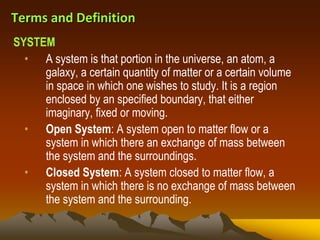
Terms and Definition
• A system is that portion in the universe, an atom, a
galaxy, a certain quantity of matter or a certain volume
in space in which one wishes to study. It is a region
enclosed by an specified boundary, that either
imaginary, fixed or moving.
• Open System: A system open to matter flow or a
system in which there an exchange of mass between
the system and the surroundings.
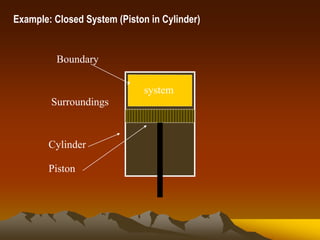
• Closed System: A system closed to matter flow, a
system in which there is no exchange of mass between
the system and the surrounding.
SYSTEM
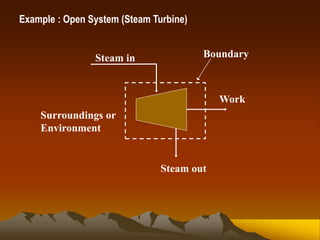
Example : Open System (Steam Turbine)
Steam in
Steam out
Work
Boundary
Surroundings or
Environment
Example: Closed System (Piston in Cylinder)
system
Boundary
Surroundings
Cylinder
Piston
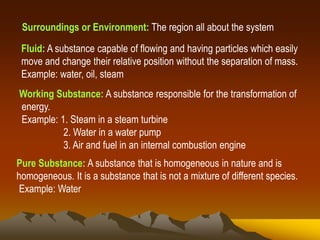
Surroundings or Environment: The region all about the system
Fluid: A substance capable of flowing and having particles which easily
move and change their relative position without the separation of mass.
Example: water, oil, steam
Working Substance: A substance responsible for the transformation of
energy.
Example: 1. Steam in a steam turbine
2. Water in a water pump
3. Air and fuel in an internal combustion engine
Pure Substance: A substance that is homogeneous in nature and is
homogeneous. It is a substance that is not a mixture of different species.
Example: Water
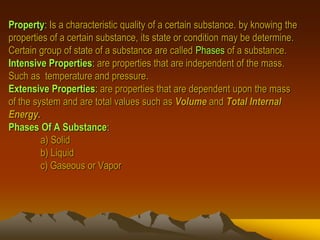
Property: Is a characteristic quality of a certain substance. by knowing the
properties of a certain substance, its state or condition may be determine.
Certain group of state of a substance are called Phases of a substance.
Intensive Properties: are properties that are independent of the mass.
Such as temperature and pressure.
Extensive Properties: are properties that are dependent upon the mass
of the system and are total values such as Volume and Total Internal
Energy.
Phases Of A Substance:
a) Solid
b) Liquid
c) Gaseous or Vapor
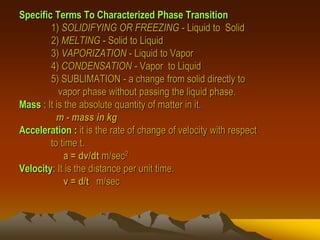
Specific Terms To Characterized Phase Transition
1) SOLIDIFYING OR FREEZING - Liquid to Solid
2) MELTING - Solid to Liquid
3) VAPORIZATION - Liquid to Vapor
4) CONDENSATION - Vapor to Liquid
5) SUBLIMATION - a change from solid directly to
vapor phase without passing the liquid phase.
Mass : It is the absolute quantity of matter in it.
m - mass in kg
Acceleration : it is the rate of change of velocity with respect
to time t.
a = dv/dt m/sec2
Velocity: It is the distance per unit time.
v = d/t m/sec
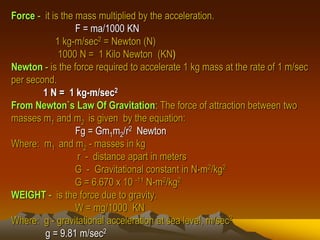
Force - it is the mass multiplied by the acceleration.
F = ma/1000 KN
1 kg-m/sec2 = Newton (N)
1000 N = 1 Kilo Newton (KN)
Newton - is the force required to accelerate 1 kg mass at the rate of 1 m/sec
per second.
1 N = 1 kg-m/sec2
From Newton`s Law Of Gravitation: The force of attraction between two
masses m1 and m2 is given by the equation:
Fg = Gm1m2/r2 Newton
Where: m1 and m2 - masses in kg
r - distance apart in meters
G - Gravitational constant in N-m2/kg2
G = 6.670 x 10 -11 N-m2/kg2
WEIGHT - is the force due to gravity.
W = mg/1000 KN
Where: g - gravitational acceleration at sea level, m/sec2
g = 9.81 m/sec2
3
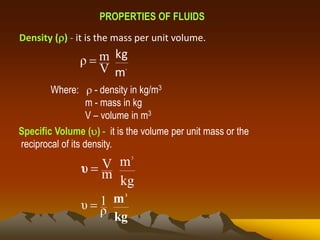
m
kg
V
mρ 
PROPERTIES OF FLUIDS
Where:  - density in kg/m3
m - mass in kg
V – volume in m3
Specific Volume () - it is the volume per unit mass or the
reciprocal of its density.
kg
m
m
V
3
υ 
kg
m3
ρ
1υ 
Density () - it is the mass per unit volume.
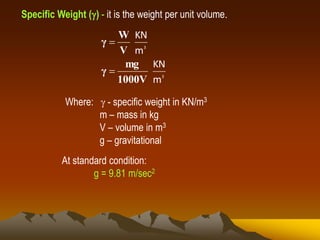
Specific Weight () - it is the weight per unit volume.
3
3
m
KN
m
KN
1000V
mg
γ
V
W
γ


Where:  - specific weight in KN/m3
m – mass in kg
V – volume in m3
g – gravitational
At standard condition:
g = 9.81 m/sec2
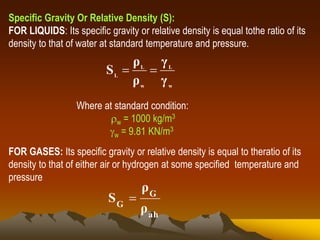
Specific Gravity Or Relative Density (S):
FOR LIQUIDS: Its specific gravity or relative density is equal tothe ratio of its
density to that of water at standard temperature and pressure.
w
L
w
L
L
γ
γ
ρ
ρ
S 
FOR GASES: Its specific gravity or relative density is equal to theratio of its
density to that of either air or hydrogen at some specified temperature and
pressure
ah
G
G
ρ
ρ
S 
Where at standard condition:
w = 1000 kg/m3
w = 9.81 KN/m3
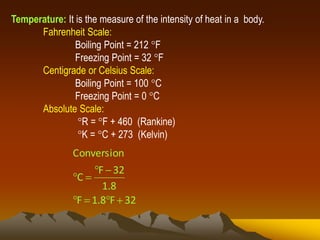
Temperature: It is the measure of the intensity of heat in a body.
Fahrenheit Scale:
Boiling Point = 212 F
Freezing Point = 32 F
Centigrade or Celsius Scale:
Boiling Point = 100 C
Freezing Point = 0 C
Absolute Scale:
R = F + 460 (Rankine)
K = C + 273 (Kelvin)
32F8.1F
8.1
32F
C
Conversion



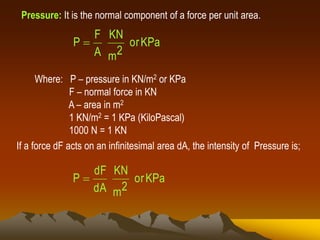
Pressure: It is the normal component of a force per unit area.
KPaor
2m
KN
A
F
P 
Where: P – pressure in KN/m2 or KPa
F – normal force in KN
A – area in m2
1 KN/m2 = 1 KPa (KiloPascal)
1000 N = 1 KN
If a force dF acts on an infinitesimal area dA, the intensity of Pressure is;
KPaor
2m
KN
dA
dF
P 
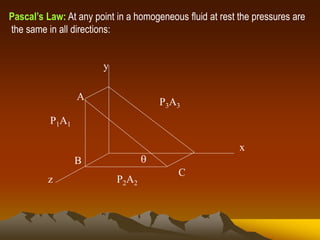
Pascal’s Law: At any point in a homogeneous fluid at rest the pressures are
the same in all directions:
y
x
z
A
B
C

P1A1
P2A2
P3A3
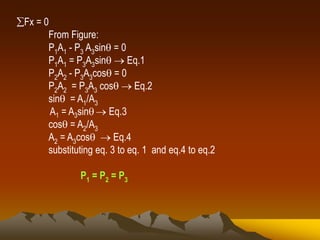
Fx = 0
From Figure:
P1A1 - P3 A3sin = 0
P1A1 = P3A3sin  Eq.1
P2A2 - P3A3cos = 0
P2A2 = P3A3 cos  Eq.2
sin = A1/A3
A1 = A3sin  Eq.3
cos = A2/A3
A2 = A3cos  Eq.4
substituting eq. 3 to eq. 1 and eq.4 to eq.2
P1 = P2 = P3
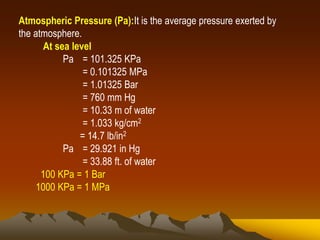
Atmospheric Pressure (Pa):It is the average pressure exerted by
the atmosphere.
At sea level
Pa = 101.325 KPa
= 0.101325 MPa
= 1.01325 Bar
= 760 mm Hg
= 10.33 m of water
= 1.033 kg/cm2
= 14.7 lb/in2
Pa = 29.921 in Hg
= 33.88 ft. of water
100 KPa = 1 Bar
1000 KPa = 1 MPa
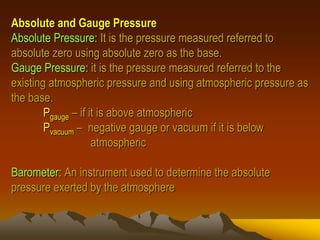
Absolute and Gauge Pressure
Absolute Pressure: It is the pressure measured referred to
absolute zero using absolute zero as the base.
Gauge Pressure: it is the pressure measured referred to the
existing atmospheric pressure and using atmospheric pressure as
the base.
Pgauge – if it is above atmospheric
Pvacuum – negative gauge or vacuum if it is below
atmospheric
Barometer: An instrument used to determine the absolute
pressure exerted by the atmosphere
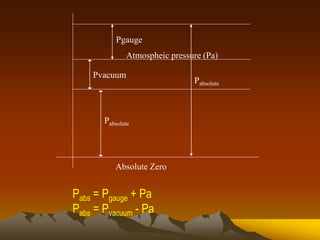
Atmospheic pressure (Pa)
Absolute Zero
Pvacuum
Pgauge
Pabsolute
Pabsolute
Pabs = Pgauge + Pa
Pabs = Pvacuum - Pa
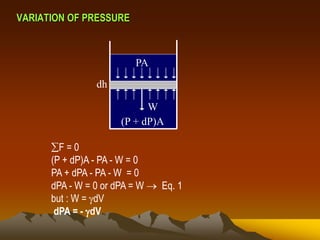
VARIATION OF PRESSURE
PA
(P + dP)A
W
dh
F = 0
(P + dP)A - PA - W = 0
PA + dPA - PA - W = 0
dPA - W = 0 or dPA = W  Eq. 1
but : W = dV
dPA = - dV
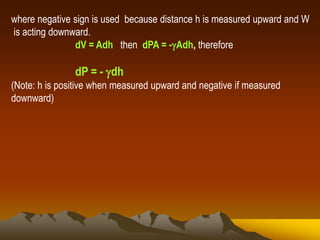
where negative sign is used because distance h is measured upward and W
is acting downward.
dV = Adh then dPA = -Adh, therefore
dP = - dh
(Note: h is positive when measured upward and negative if measured
downward)
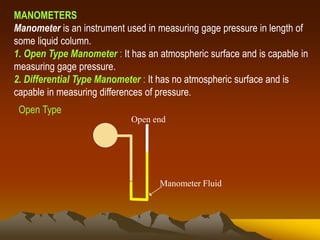
MANOMETERS
Manometer is an instrument used in measuring gage pressure in length of
some liquid column.
1. Open Type Manometer : It has an atmospheric surface and is capable in
measuring gage pressure.
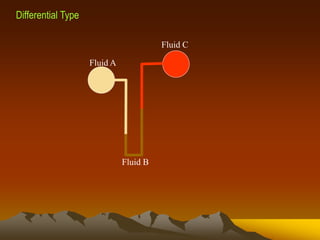
2. Differential Type Manometer : It has no atmospheric surface and is
capable in measuring differences of pressure.
Open Type
Open end
Manometer Fluid
Differential Type
Fluid A
Fluid B
Fluid C
Second Law of
THERMODYNAMICS
• Second Law of Thermodynamics
• Kelvin – Planck Statement
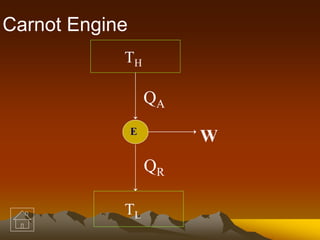
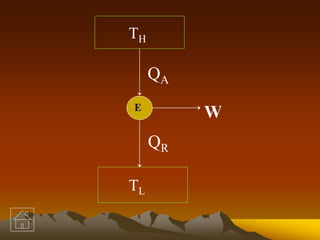
• Carnot engine
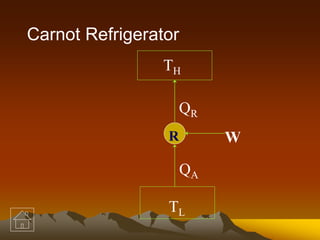
• Carnot Refrigerator
• Sample Problems
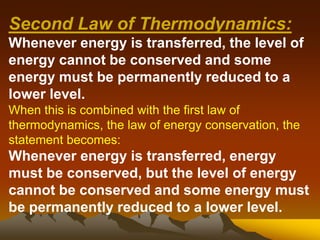
Second Law of Thermodynamics:
Whenever energy is transferred, the level of
energy cannot be conserved and some
energy must be permanently reduced to a
lower level.
When this is combined with the first law of
thermodynamics, the law of energy conservation, the
statement becomes:
Whenever energy is transferred, energy
must be conserved, but the level of energy
cannot be conserved and some energy must
be permanently reduced to a lower level.
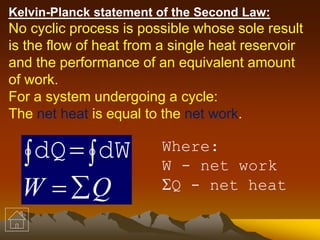
Kelvin-Planck statement of the Second Law:
No cyclic process is possible whose sole result
is the flow of heat from a single heat reservoir
and the performance of an equivalent amount
of work.
For a system undergoing a cycle:
The net heat is equal to the net work.
QW 
  dWdQ Where:
W - net work
Q - net heat
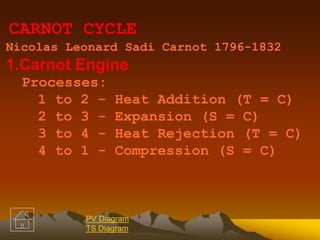
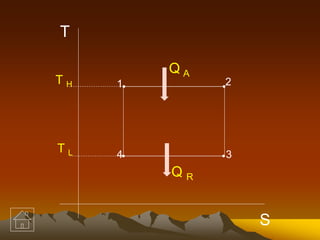
CARNOT CYCLE
Nicolas Leonard Sadi Carnot 1796-1832
1.Carnot Engine
Processes:
1 to 2 - Heat Addition (T = C)
2 to 3 - Expansion (S = C)
3 to 4 - Heat Rejection (T = C)
4 to 1 - Compression (S = C)
PV Diagram
TS Diagram
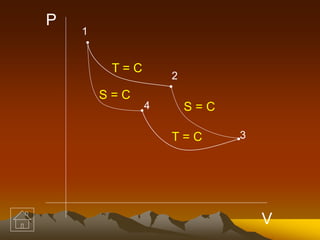
P
V
2
1
3
4
T = C
S = C
S = C
T = C
T
S
21
34
T H
T L
Q A
Q R
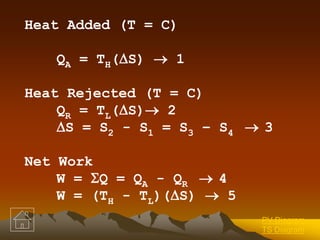
Heat Added (T = C)
QA = TH(S)  1
Heat Rejected (T = C)
QR = TL(S) 2
S = S2 - S1 = S3 – S4  3
Net Work
W = Q = QA - QR  4
W = (TH - TL)(S)  5
PV Diagram
TS Diagram
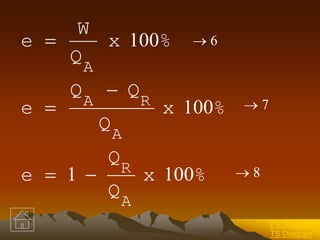
%x
Q
Q
e
%x
Q
QQ
e
%x
Q
W
e
A
R
A
RA
A
1001
100
100



  6
 7
 8
PV Diagram
TS Diagram
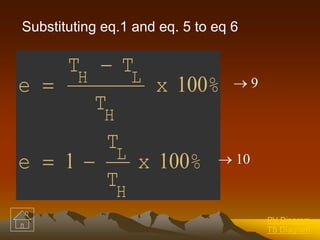
Substituting eq.1 and eq. 5 to eq 6
%x
T
T
e
%x
T
TT
e
H
L
H
LH
1001
100


  9
 10
PV Diagram
TS Diagram
TH
TL
W
QA
QR
E
Carnot Engine
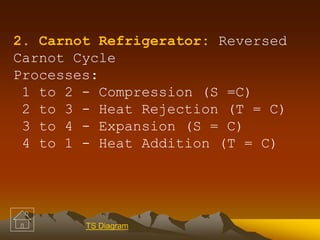
2. Carnot Refrigerator: Reversed
Carnot Cycle
Processes:
1 to 2 - Compression (S =C)
2 to 3 - Heat Rejection (T = C)
3 to 4 - Expansion (S = C)
4 to 1 - Heat Addition (T = C)
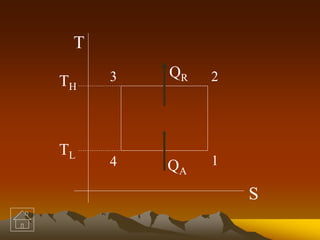
TS Diagram
QR
QA
1
2
4
3
S
T
TH
TL
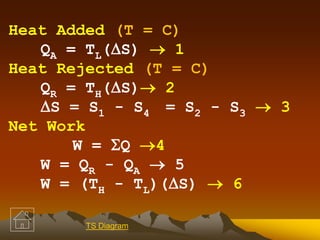
Heat Added (T = C)
QA = TL(S)  1
Heat Rejected (T = C)
QR = TH(S) 2
S = S1 - S4 = S2 - S3  3
Net Work
W = Q 4
W = QR - QA  5
W = (TH - TL)(S)  6
TS Diagram
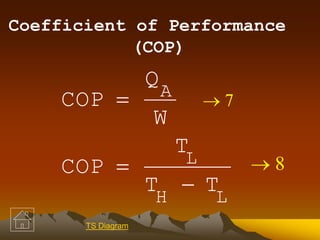
Coefficient of Performance
(COP)
LH
L
A
TT
T
COP
W
Q
COP


  7
 8
TS Diagram
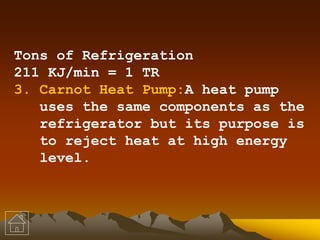
Tons of Refrigeration
211 KJ/min = 1 TR
3. Carnot Heat Pump:A heat pump
uses the same components as the
refrigerator but its purpose is
to reject heat at high energy
level.
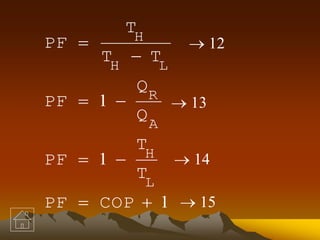
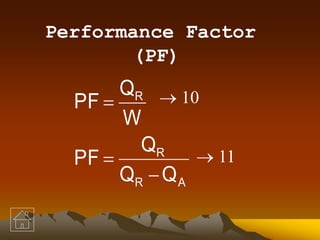
Performance Factor
(PF)
AR
R
R
QQ
Q
PF
W
Q
PF


  10
 11
1
1
1





COPPF
T
T
PF
Q
Q
PF
TT
T
PF
L
H
A
R
LH
H
 12
 13
 14
 15
TH
TL
W
QA
QR
R
Carnot Refrigerator
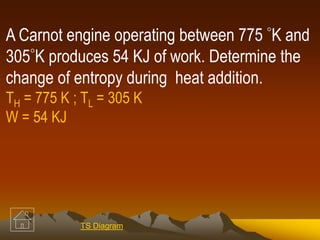
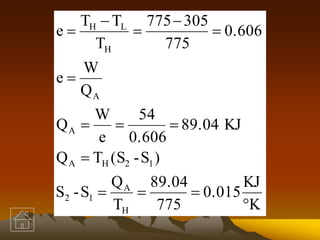
A Carnot engine operating between 775 K and
305K produces 54 KJ of work. Determine the
change of entropy during heat addition.
TH = 775 K ; TL = 305 K
W = 54 KJ
TS Diagram
TH
TL
W
QA
QR
E
K
KJ
0.015
775
89.04
T
Q
S-S
)S-(STQ
KJ89.04
0.606
54
e
W
Q
Q
W
e
0.606
775
305775
T
TT
e
H
A
12
12HA
A
A
H
LH










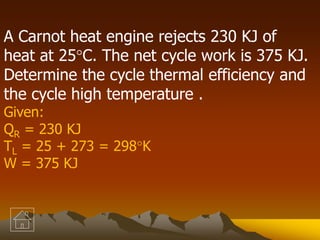
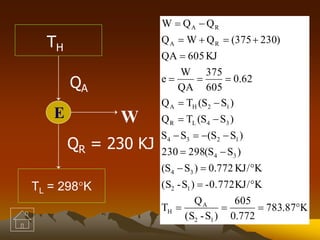
A Carnot heat engine rejects 230 KJ of
heat at 25C. The net cycle work is 375 KJ.
Determine the cycle thermal efficiency and
the cycle high temperature .
Given:
QR = 230 KJ
TL = 25 + 273 = 298K
W = 375 KJ
TL = 298K
TH
WE
QR = 230 KJ
QA
K87.783
772.0
605
)S-(S
Q
T
KKJ/-0.772)S-(S
KKJ/772.0)SS(
)SS(298230
)SS(SS
)SS(TQ
)SS(TQ
62.0
605
375
QA
W
e
KJ605QA
)230375(QWQ
QQW
12
A
H
12
34
34
1234
34LR
12HA
RA
RA











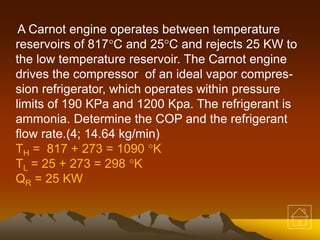
A Carnot engine operates between temperature
reservoirs of 817C and 25C and rejects 25 KW to
the low temperature reservoir. The Carnot engine
drives the compressor of an ideal vapor compres-
sion refrigerator, which operates within pressure
limits of 190 KPa and 1200 Kpa. The refrigerant is
ammonia. Determine the COP and the refrigerant
flow rate.(4; 14.64 kg/min)
TH = 817 + 273 = 1090 K
TL = 25 + 273 = 298 K
QR = 25 KW

Chapter 1(terms and definition)

  • 1.
    THERMODYNAMICS By. Engr. YuriG. Melliza Thermodynamics is a science that deals with energy transformation, the conversion of one form of energy to another. This word was derived from a Greek Word “Therme” that means heat and “Dynamis” that means strength.
  • 2.
    Terms and Definition •A system is that portion in the universe, an atom, a galaxy, a certain quantity of matter or a certain volume in space in which one wishes to study. It is a region enclosed by an specified boundary, that either imaginary, fixed or moving. • Open System: A system open to matter flow or a system in which there an exchange of mass between the system and the surroundings. • Closed System: A system closed to matter flow, a system in which there is no exchange of mass between the system and the surrounding. SYSTEM
  • 3.
    Example : OpenSystem (Steam Turbine) Steam in Steam out Work Boundary Surroundings or Environment
  • 4.
    Example: Closed System(Piston in Cylinder) system Boundary Surroundings Cylinder Piston
  • 5.
    Surroundings or Environment:The region all about the system Fluid: A substance capable of flowing and having particles which easily move and change their relative position without the separation of mass. Example: water, oil, steam Working Substance: A substance responsible for the transformation of energy. Example: 1. Steam in a steam turbine 2. Water in a water pump 3. Air and fuel in an internal combustion engine Pure Substance: A substance that is homogeneous in nature and is homogeneous. It is a substance that is not a mixture of different species. Example: Water
  • 6.
    Property: Is acharacteristic quality of a certain substance. by knowing the properties of a certain substance, its state or condition may be determine. Certain group of state of a substance are called Phases of a substance. Intensive Properties: are properties that are independent of the mass. Such as temperature and pressure. Extensive Properties: are properties that are dependent upon the mass of the system and are total values such as Volume and Total Internal Energy. Phases Of A Substance: a) Solid b) Liquid c) Gaseous or Vapor
  • 7.
    Specific Terms ToCharacterized Phase Transition 1) SOLIDIFYING OR FREEZING - Liquid to Solid 2) MELTING - Solid to Liquid 3) VAPORIZATION - Liquid to Vapor 4) CONDENSATION - Vapor to Liquid 5) SUBLIMATION - a change from solid directly to vapor phase without passing the liquid phase. Mass : It is the absolute quantity of matter in it. m - mass in kg Acceleration : it is the rate of change of velocity with respect to time t. a = dv/dt m/sec2 Velocity: It is the distance per unit time. v = d/t m/sec
  • 8.
    Force - itis the mass multiplied by the acceleration. F = ma/1000 KN 1 kg-m/sec2 = Newton (N) 1000 N = 1 Kilo Newton (KN) Newton - is the force required to accelerate 1 kg mass at the rate of 1 m/sec per second. 1 N = 1 kg-m/sec2 From Newton`s Law Of Gravitation: The force of attraction between two masses m1 and m2 is given by the equation: Fg = Gm1m2/r2 Newton Where: m1 and m2 - masses in kg r - distance apart in meters G - Gravitational constant in N-m2/kg2 G = 6.670 x 10 -11 N-m2/kg2 WEIGHT - is the force due to gravity. W = mg/1000 KN Where: g - gravitational acceleration at sea level, m/sec2 g = 9.81 m/sec2
  • 9.
    3 m kg V mρ  PROPERTIES OFFLUIDS Where:  - density in kg/m3 m - mass in kg V – volume in m3 Specific Volume () - it is the volume per unit mass or the reciprocal of its density. kg m m V 3 υ  kg m3 ρ 1υ  Density () - it is the mass per unit volume.
  • 10.
    Specific Weight ()- it is the weight per unit volume. 3 3 m KN m KN 1000V mg γ V W γ   Where:  - specific weight in KN/m3 m – mass in kg V – volume in m3 g – gravitational At standard condition: g = 9.81 m/sec2
  • 11.
    Specific Gravity OrRelative Density (S): FOR LIQUIDS: Its specific gravity or relative density is equal tothe ratio of its density to that of water at standard temperature and pressure. w L w L L γ γ ρ ρ S  FOR GASES: Its specific gravity or relative density is equal to theratio of its density to that of either air or hydrogen at some specified temperature and pressure ah G G ρ ρ S  Where at standard condition: w = 1000 kg/m3 w = 9.81 KN/m3
  • 12.
    Temperature: It isthe measure of the intensity of heat in a body. Fahrenheit Scale: Boiling Point = 212 F Freezing Point = 32 F Centigrade or Celsius Scale: Boiling Point = 100 C Freezing Point = 0 C Absolute Scale: R = F + 460 (Rankine) K = C + 273 (Kelvin) 32F8.1F 8.1 32F C Conversion   
  • 13.
    Pressure: It isthe normal component of a force per unit area. KPaor 2m KN A F P  Where: P – pressure in KN/m2 or KPa F – normal force in KN A – area in m2 1 KN/m2 = 1 KPa (KiloPascal) 1000 N = 1 KN If a force dF acts on an infinitesimal area dA, the intensity of Pressure is; KPaor 2m KN dA dF P 
  • 14.
    Pascal’s Law: Atany point in a homogeneous fluid at rest the pressures are the same in all directions: y x z A B C  P1A1 P2A2 P3A3
  • 15.
    Fx = 0 FromFigure: P1A1 - P3 A3sin = 0 P1A1 = P3A3sin  Eq.1 P2A2 - P3A3cos = 0 P2A2 = P3A3 cos  Eq.2 sin = A1/A3 A1 = A3sin  Eq.3 cos = A2/A3 A2 = A3cos  Eq.4 substituting eq. 3 to eq. 1 and eq.4 to eq.2 P1 = P2 = P3
  • 16.
    Atmospheric Pressure (Pa):Itis the average pressure exerted by the atmosphere. At sea level Pa = 101.325 KPa = 0.101325 MPa = 1.01325 Bar = 760 mm Hg = 10.33 m of water = 1.033 kg/cm2 = 14.7 lb/in2 Pa = 29.921 in Hg = 33.88 ft. of water 100 KPa = 1 Bar 1000 KPa = 1 MPa
  • 17.
    Absolute and GaugePressure Absolute Pressure: It is the pressure measured referred to absolute zero using absolute zero as the base. Gauge Pressure: it is the pressure measured referred to the existing atmospheric pressure and using atmospheric pressure as the base. Pgauge – if it is above atmospheric Pvacuum – negative gauge or vacuum if it is below atmospheric Barometer: An instrument used to determine the absolute pressure exerted by the atmosphere
  • 18.
    Atmospheic pressure (Pa) AbsoluteZero Pvacuum Pgauge Pabsolute Pabsolute Pabs = Pgauge + Pa Pabs = Pvacuum - Pa
  • 19.
    VARIATION OF PRESSURE PA (P+ dP)A W dh F = 0 (P + dP)A - PA - W = 0 PA + dPA - PA - W = 0 dPA - W = 0 or dPA = W  Eq. 1 but : W = dV dPA = - dV
  • 20.
    where negative signis used because distance h is measured upward and W is acting downward. dV = Adh then dPA = -Adh, therefore dP = - dh (Note: h is positive when measured upward and negative if measured downward)
  • 21.
    MANOMETERS Manometer is aninstrument used in measuring gage pressure in length of some liquid column. 1. Open Type Manometer : It has an atmospheric surface and is capable in measuring gage pressure. 2. Differential Type Manometer : It has no atmospheric surface and is capable in measuring differences of pressure. Open Type Open end Manometer Fluid
  • 22.
  • 23.
    Second Law of THERMODYNAMICS •Second Law of Thermodynamics • Kelvin – Planck Statement • Carnot engine • Carnot Refrigerator • Sample Problems
  • 24.
    Second Law ofThermodynamics: Whenever energy is transferred, the level of energy cannot be conserved and some energy must be permanently reduced to a lower level. When this is combined with the first law of thermodynamics, the law of energy conservation, the statement becomes: Whenever energy is transferred, energy must be conserved, but the level of energy cannot be conserved and some energy must be permanently reduced to a lower level.
  • 25.
    Kelvin-Planck statement ofthe Second Law: No cyclic process is possible whose sole result is the flow of heat from a single heat reservoir and the performance of an equivalent amount of work. For a system undergoing a cycle: The net heat is equal to the net work. QW    dWdQ Where: W - net work Q - net heat
  • 26.
    CARNOT CYCLE Nicolas LeonardSadi Carnot 1796-1832 1.Carnot Engine Processes: 1 to 2 - Heat Addition (T = C) 2 to 3 - Expansion (S = C) 3 to 4 - Heat Rejection (T = C) 4 to 1 - Compression (S = C) PV Diagram TS Diagram
  • 27.
    P V 2 1 3 4 T = C S= C S = C T = C
  • 28.
  • 29.
    Heat Added (T= C) QA = TH(S)  1 Heat Rejected (T = C) QR = TL(S) 2 S = S2 - S1 = S3 – S4  3 Net Work W = Q = QA - QR  4 W = (TH - TL)(S)  5 PV Diagram TS Diagram
  • 30.
  • 31.
    Substituting eq.1 andeq. 5 to eq 6 %x T T e %x T TT e H L H LH 1001 100     9  10 PV Diagram TS Diagram
  • 32.
  • 33.
    2. Carnot Refrigerator:Reversed Carnot Cycle Processes: 1 to 2 - Compression (S =C) 2 to 3 - Heat Rejection (T = C) 3 to 4 - Expansion (S = C) 4 to 1 - Heat Addition (T = C) TS Diagram
  • 34.
  • 35.
    Heat Added (T= C) QA = TL(S)  1 Heat Rejected (T = C) QR = TH(S) 2 S = S1 - S4 = S2 - S3  3 Net Work W = Q 4 W = QR - QA  5 W = (TH - TL)(S)  6 TS Diagram
  • 36.
  • 37.
    Tons of Refrigeration 211KJ/min = 1 TR 3. Carnot Heat Pump:A heat pump uses the same components as the refrigerator but its purpose is to reject heat at high energy level.
  • 38.
  • 39.
  • 40.
  • 41.
    A Carnot engineoperating between 775 K and 305K produces 54 KJ of work. Determine the change of entropy during heat addition. TH = 775 K ; TL = 305 K W = 54 KJ TS Diagram
  • 42.
  • 43.
  • 44.
    A Carnot heatengine rejects 230 KJ of heat at 25C. The net cycle work is 375 KJ. Determine the cycle thermal efficiency and the cycle high temperature . Given: QR = 230 KJ TL = 25 + 273 = 298K W = 375 KJ
  • 45.
    TL = 298K TH WE QR= 230 KJ QA K87.783 772.0 605 )S-(S Q T KKJ/-0.772)S-(S KKJ/772.0)SS( )SS(298230 )SS(SS )SS(TQ )SS(TQ 62.0 605 375 QA W e KJ605QA )230375(QWQ QQW 12 A H 12 34 34 1234 34LR 12HA RA RA           
  • 46.
    A Carnot engineoperates between temperature reservoirs of 817C and 25C and rejects 25 KW to the low temperature reservoir. The Carnot engine drives the compressor of an ideal vapor compres- sion refrigerator, which operates within pressure limits of 190 KPa and 1200 Kpa. The refrigerant is ammonia. Determine the COP and the refrigerant flow rate.(4; 14.64 kg/min) TH = 817 + 273 = 1090 K TL = 25 + 273 = 298 K QR = 25 KW