Verbal autopsy
04-02-2020 Dr.Aman Bansal 1
Content
• Need for mortality data collection
• Methods to identify causes of
deaths
• Definition
• Objective
• Need
• Uses
• Users
• Historical background
• Need and demand of
standardization
• Components of 2007 WHO VA
questionnaire
• Automated interpretation of VA
• WHO 2016 VA Standards
• MDR
• CDR
04-02-2020 Dr.Aman Bansal 2
Mortality surveillance
• It has two components –
1. To count all the deaths
2. To ascertain the cause of death
in all of them or a representative subsample
04-02-2020 Dr.Aman Bansal 3
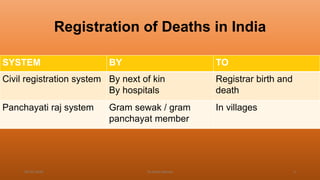
Registration of Deaths in India
SYSTEM BY TO
Civil registration system By next of kin
By hospitals
Registrar birth and
death
Panchayati raj system Gram sewak / gram
panchayat member
In villages
04-02-2020 Dr.Aman Bansal 4
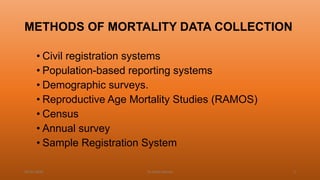
METHODS OF MORTALITY DATA COLLECTION
• Civil registration systems
• Population-based reporting systems
• Demographic surveys.
• Reproductive Age Mortality Studies (RAMOS)
• Census
• Annual survey
• Sample Registration System
04-02-2020 Dr.Aman Bansal 5
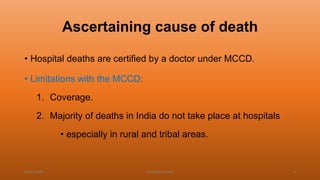
Ascertaining cause of death
• Hospital deaths are certified by a doctor under MCCD.
• Limitations with the MCCD:
1. Coverage.
2. Majority of deaths in India do not take place at hospitals
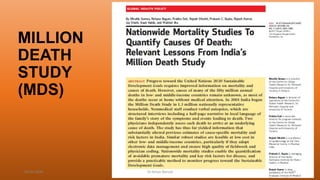
• especially in rural and tribal areas.
04-02-2020 Dr.Aman Bansal 6
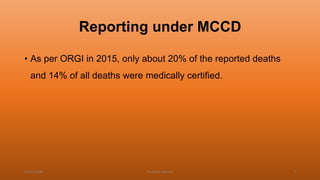
Reporting under MCCD
• As per ORGI in 2015, only about 20% of the reported deaths
and 14% of all deaths were medically certified.
04-02-2020 Dr.Aman Bansal 7
04-02-2020 Dr.Aman Bansal 8
NEED FOR MORTALITY DATA COLLECTION
• Reliable data on the levels and causes of mortality are
cornerstones for building a solid evidence base for
• health policy
• planning
• monitoring and evaluation.
04-02-2020 Dr.Aman Bansal 9
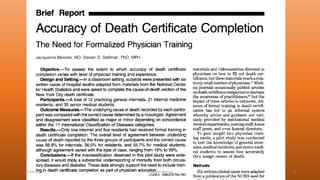
14 (3), 154-62 May-Jun 2001 PMID: 11467144
Cause of Death Reporting Systems in India: A Performance Analysis
P Mahapatra 1, P V Chalapati Rao
04-02-2020 Dr.Aman Bansal 10
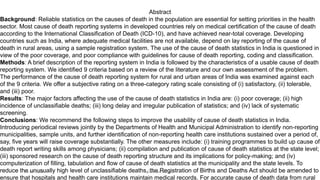
Abstract
Background: Reliable statistics on the causes of death in the population are essential for setting priorities in the health
sector. Most cause of death reporting systems in developed countries rely on medical certification of the cause of death
according to the International Classification of Death (ICD-10), and have achieved near-total coverage. Developing
countries such as India, where adequate medical facilities are not available, depend on lay reporting of the cause of
death in rural areas, using a sample registration system. The use of the cause of death statistics in India is questioned in
view of the poor coverage, and poor compliance with guidelines for cause of death reporting, coding and classification.
Methods: A brief description of the reporting system in India is followed by the characteristics of a usable cause of death
reporting system. We identified 9 criteria based on a review of the literature and our own assessment of the problem.
The performance of the cause of death reporting system for rural and urban areas of India was examined against each
of the 9 criteria. We offer a subjective rating on a three-category rating scale consisting of (i) satisfactory, (ii) tolerable,
and (iii) poor.
Results: The major factors affecting the use of the cause of death statistics in India are: (i) poor coverage; (ii) high
incidence of unclassifiable deaths; (iii) long delay and irregular publication of statistics; and (iv) lack of systematic
screening.
Conclusions: We recommend the following steps to improve the usability of cause of death statistics in India.
Introducing periodical reviews jointly by the Departments of Health and Municipal Administration to identify non-reporting
municipalities, sample units, and further identification of non-reporting health care institutions sustained over a period of,
say, five years will raise coverage substantially. The other measures include: (i) training programmes to build up cause of
death report writing skills among physicians; (ii) compilation and publication of cause of death statistics at the state level;
(iii) sponsored research on the cause of death reporting structure and its implications for policy-making; and (iv)
computerization of filling, tabulation and flow of cause of death statistics at the municipality and the state levels. To
reduce the unusually high level of unclassifiable deaths, the Registration of Births and Deaths Act should be amended to
ensure that hospitals and health care institutions maintain medical records. For accurate cause of death data from rural
04-02-2020 Dr.Aman Bansal 11
Verbal Autopsy
• Verbal autopsy is a method used to ascertain the cause of a death
based on an interview with next of kin or other caregivers.
• The interview is done using a standardized questionnaire that elicits
information on :
signs
symptoms
medical history
circumstances preceding death.
04-02-2020 Dr.Aman Bansal 12
MAIN OBJECTIVE
• Is to describe the causes of death at the community level
• Where civil registration and death certification systems are
weak
and
• Where most people die at home without having had contact with
the health system.
04-02-2020 Dr.Aman Bansal 13
Need of Verbal Autopsy
• VA has become a primary source of information
 about causes of death in populations lacking vital
registration and medical certification.
• It has become an essential public health tool
 for obtaining a reasonable direct estimation of the cause
structure of mortality at population level,
04-02-2020 Dr.Aman Bansal 14
Components of a standard VA instrument
• Questionnaire,
• List of causes of death
• Sets of diagnostic criteria for assigning causes of death.
04-02-2020 Dr.Aman Bansal 15
USES
• First, it has been primarily used as a research tool
• longitudinal population studies
• intervention research
• epidemiological studies.
• Second, it has become a source of cause of death statistics
• to meet the demand for population-level cause specific
mortality data to be used in policy, planning, priority setting
and benchmarking.
• to be used for monitoring progress and evaluating what
works and what does not.
04-02-2020 Dr.Aman Bansal 16
Application of VA
• Clinical trials and large-scale epidemiological studies
• Demographic surveillance systems
• National sample surveillance systems
• Household surveys
04-02-2020 Dr.Aman Bansal 17
USERS
• Researchers
• Epidemiologists
• Global-level decision-makers
• National and sub-national decision-makers
• Health system managers
04-02-2020 Dr.Aman Bansal 18
Limitation of VA
• Although it may not be an accurate method for attributing
causes of death at the individual level
• VA cannot ascertain all causes of death and, as many validation
studies have shown.
04-02-2020 Dr.Aman Bansal 19
Historical background
04-02-2020 Dr.Aman Bansal 20
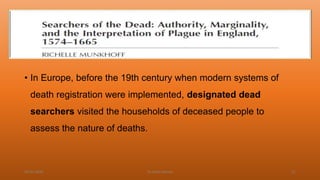
• In Europe, before the 19th century when modern systems of
death registration were implemented, designated dead
searchers visited the households of deceased people to
assess the nature of deaths.
04-02-2020 Dr.Aman Bansal 21
• As an alternative, in the 1950s and 60s in Asia and Africa,
systematic interviews by physicians were used to determine
causes of death.
• Workers at the Narangwal project in India labelled this new
technique “verbal autopsy”
04-02-2020 Dr.Aman Bansal 22
• The interest of WHO in VA (formerly “lay reporting”) of health
data was first demonstrated in a publication by Dr. Yves Biraud
in 1956.
• During the 1970s, WHO encouraged the use of lay reporting of
health information by people with no medical training, leading to
development in 1975 of lay reporting forms (WHO 1978).
04-02-2020 Dr.Aman Bansal 23
• Since the late 1970s and early 80s when the following
questionnaires first emerged
• Reproductive Age Mortality Studies (RAMOS),
• MATLAB (Bangladesh)
• NIAKHAR (Senegal),
04-02-2020 Dr.Aman Bansal 24
• The past two decades have seen a proliferation of interest,
research and development in all aspects of the VA process,
including
• VA data-collection systems,
• VA questionnaires’ content and format,
• Cause of death assignment process,
• Coding and tabulation of causes of death,
• Validation of VA instruments.
04-02-2020 Dr.Aman Bansal 25
Needs and demands for standardization
04-02-2020 Dr.Aman Bansal 26
WHO_2007 VA standards tools included
• Verbal autopsy questionnaires for three age groups
• under four weeks
• four weeks to 14 years
• 15 years and above
• Cause of death certification and coding resources consistent
with the ICD-10
• A cause-of-death list for VA mapped according to the ICD-10
04-02-2020 Dr.Aman Bansal 27
Automated interpretation of VA
• Currently, the two most commonly used programs are the
• InterVA method developed by the Umea University (Sweden)
• Tariff method (SmartVA) developed by the Institute of Health
Metrics and Evaluation (USA).
04-02-2020 Dr.Aman Bansal 28
• To facilitate the application of the two commonly used and publicly
available automated methods for interpreting VA
• To allow comparison the causes of death data determined by these
methods comparative analysis of these commonly used automated
methods of VA interpretation,
04-02-2020 Dr.Aman Bansal 29
04-02-2020 Dr.Aman Bansal 30
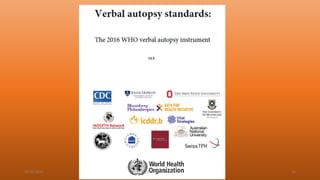
• The 2016 version of the WHO verbal autopsy instrument is
suitable for routine use.
• Based on the 2012 instrument, experiences with the interim
2014 version
• questions have been added or edited to facilitate the use of
the publicly available analytical software
04-02-2020 Dr.Aman Bansal 31
• The questions allow for responses with a simple yes or no
answer, multiple choice, or a duration in some instances.
• This approach makes the instrument usable with analytical
software that assigns causes of death
04-02-2020 Dr.Aman Bansal 32
2016 WHO VA instrument
• It is intended to allow for simple and inexpensive identification
of causes of death in places where no other routine system is in
place and will serve the needs of countries’ civil registration and
vital statistics (CRVS) systems.
• Independently, this instrument can also be used in research and
disease specific programmes
• Intended for strengthening national vital statistics systems
04-02-2020 Dr.Aman Bansal 33
• The systematic application of the 2016 WHO VA instrument will
facilitate the application of VA in routine surveillance of vital events
and introduce more consistency and crosscomparability of VA-derived
mortality data.
• The application of the 2016 Instrument in routine use and research
with its standardized international set of questions will facilitate the
compilation of larger databases that finally would provide the
evidence for stepwise improvement of VA questionnaires
internationally, and become a basis for continuous development of
analytical methods.
04-02-2020 Dr.Aman Bansal 34
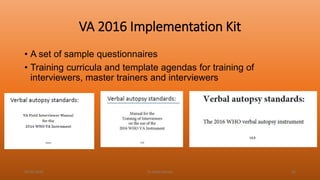
VA 2016 Implementation Kit
• A set of sample questionnaires
• Training curricula and template agendas for training of
interviewers, master trainers and interviewers
04-02-2020 Dr.Aman Bansal 35
Sections of the 2016 WHO VA instrument
04-02-2020 Dr.Aman Bansal 36
• 1. Preset HIV-Malaria mortality and season
• 2. Information on the respondent and background about
interview;
• 3. Information about the deceased and vital registration;
• Information on the deceased
• Civil registration numbers.
• 4. History of injury/accidents;
04-02-2020 Dr.Aman Bansal 37
• 5. Health history;
• Duration of illness
• Medical history associated with final illness
• General signs and symptoms associated with final illness
• Signs and symptoms associated with pregnancy and women
• Neonatal and child history, signs and symptoms
• Health service utilization
• Background and context
• Death certificate with cause of death.
• 6. Open narrative (text field).
• Check list of additional items to record in the narrative open
space.
04-02-2020 Dr.Aman Bansal 38
Sample questionnaires are provided for three age groups
• Under four weeks
• 4 weeks-11 years,
• 12 years and above.
04-02-2020 Dr.Aman Bansal 39
• To develop an adequate instrument for application in large-
scale surveillance, the VA instrument needs to have a system
that synergizes with other national mechanisms that are already
in place.
• A permanent team that conducts Verbal autopsies on a
representative sample of deaths is likely the most feasible way.
04-02-2020 Dr.Aman Bansal 40
VA interviewer
• Typically it would take at least five VA interviews to become confident
in doing VA interviews.
• The name of the interviewer and date, time and duration of the
interview should also be retained in the database
04-02-2020 Dr.Aman Bansal 41
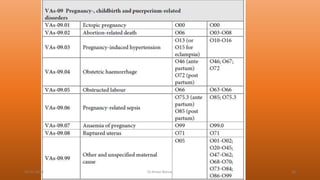
Appendix 1: 2016 cause of death list for verbal
autopsy with corresponding ICD-10 codes
(identical with 2014)
04-02-2020 Dr.Aman Bansal 42
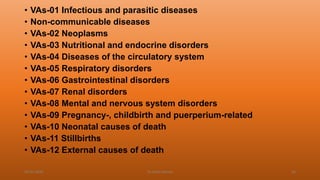
• VAs-01 Infectious and parasitic diseases
• Non-communicable diseases
• VAs-02 Neoplasms
• VAs-03 Nutritional and endocrine disorders
• VAs-04 Diseases of the circulatory system
• VAs-05 Respiratory disorders
• VAs-06 Gastrointestinal disorders
• VAs-07 Renal disorders
• VAs-08 Mental and nervous system disorders
• VAs-09 Pregnancy-, childbirth and puerperium-related
• VAs-10 Neonatal causes of death
• VAs-11 Stillbirths
• VAs-12 External causes of death
04-02-2020 Dr.Aman Bansal 43
04-02-2020 Dr.Aman Bansal 44
04-02-2020 Dr.Aman Bansal 45
The WHO Verbal Autopsy (VA) Reference Group
• It was established at the first meeting of the WHO Reference
Group on Global Health Statistics, 9–10 December 2013.
• Chaired by Daniel Chandramohan of the London School of
Hygiene and Tropical Medicine,
• The group brought together experts in this field to support WHO
in the development of WHO VA standards.
• The working group was re-constituted as a WHO VA Reference
Group (VARG), which convened for the first time in Seoul,
South Korea at the annual meeting of the WHO Family of
International Classifications (WHO-FIC) Network in October
2018.
04-02-2020 Dr.Aman Bansal 46
VARG supports and advises WHO regarding
• Development and maintenance of WHO VA standards and respective VA instrument with
evidence from the field;
• Standards and recommendations for VA training and implementation;
• Advancement of methods and tools for assigning causes of death from VA interviews;
• Use of the causes of death data determined by VA;
• Use of the VA causes of death data as a complement to medically certified cause of death
data;
• Quality assessment and assurance of VA data;
• Methods for comparing and evaluating VA results, including causes of death distribution
estimated by different VA instruments.
04-02-2020 Dr.Aman Bansal 47
VERBAL AUTOPSY IN INDIA
04-02-2020 Dr.Aman Bansal 48
• Until December 1998, cause of death data for rural areas used to be
collected under the Survey of Cause of Death Rural scheme, from a
sample of villages by lay diagnosis and reporting system.
• From January 1999, a cause of death component was merged with
the SRS.
• After an initial pilot, in 2001, the Government of India initiated a
process of doing verbal autopsy (VA) of about 45,000 deaths (0.5% of
all annual deaths) identified under SRS every year.
04-02-2020 Dr.Aman Bansal 49
MILLION
DEATH
STUDY
(MDS)
04-02-2020 Dr.Aman Bansal 50
• One of the largest studies of premature mortality in the world.
• In collaboration with the Registrar General of India, the MDS will
monitor nearly 14 million people in 2.4 million nationally
representative households in India between 1998-2014.
• Any deaths that occur in these households during this period
will be assigned a probable cause, as determined by a method
called verbal autopsy.
• The results for the leading causes of death in India will be
provided to governments, research agencies, and media as
they become available so that they can take action against
preventable deaths.
04-02-2020 Dr.Aman Bansal 51
• Full-time, non-medical field workers were trained
• to record written narratives from families or other reliable informants in
the local language describing the events that preceded the death.
• In addition, answers to standard questions about key symptoms were
also recorded.
• These records were then scanned and randomly sent to two of 130 trained
physicians,
• who independently assigned a probable underlying cause of death to
each case.
• In cases where the physicians did not agree on the cause of death, the
conflicting physicians were given the other physician’s notes, and cases
were anonymously reviewed again.
• Further disagreements were resolved by the opinion of a third, senior
physician.
04-02-2020 Dr.Aman Bansal 52
Concerns with VA under MDS
• India’s mortality data being managed by an international agency.
• This is in keeping with a global concern about data privacy and
protection and a movement toward safeguarding national data.
• Other concerns with the existing system are the 5–6 years delay in the
release of reports and the shrinking number of deaths within the
existing sampling units due to declining mortality rates.
• This impacts the ability and precision of the system to generate
state-level estimates and estimation of maternal mortality
04-02-2020 Dr.Aman Bansal 53
Mortality in India Established through
Verbal Autopsies
MINErVA
04-02-2020 Dr.Aman Bansal 54
MINErVA
MINErVA
04-02-2020 Dr.Aman Bansal 55
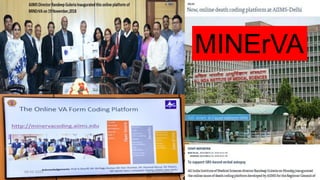
• As of August 2019, departments of community medicine of 25
government and private medical colleges from across the
country are part of the MINErVA network and have together
enrolled 804 physician coders.
• The MINErVA Technical Advisory Group consists of
• Public health experts
• Clinicians
• Social scientists
• Statisticians
• Nominees from ORGI
• Ministry of Health and Family Welfare
• WHO
• Indian Council of Medical Research.
04-02-2020 Dr.Aman Bansal 56
Two online IT platforms
• A training platform (http:// causeofdeathindia.com)
• which is in public domain meant for training of physicians in
ascertaining cause of death from Vas and
• A coding platform (http://minervacoding.aiims.edu)
• which is for network members to code deaths identified
under SRS based on the VA forms.
04-02-2020 Dr.Aman Bansal 57
• The MINErVA network will work to strengthen the mortality
surveillance system in India by
• Ensuring timeliness of data collection and availability
• Improving the quality of VA
• Its coding by leveraging information technology in the
process of data collection and coding.
• This development also means that the system has moved from
a “study” to a “surveillance” mode.
04-02-2020 Dr.Aman Bansal 58
USE OF VERBAL AUTOPSY BY HEALTH WORKERS IN U5 CHILDREN
04-02-2020 Dr.Aman Bansal 59
CRITICAL APPRAISAL
• India has committed itself to SDG’s
• SDGs have specific targets for deaths in specific age groups (infant
and neonatal), pregnancy-related deaths, and deaths due to specific
diseases such as NCDs, tuberculosis, or malaria.
• Having a robust mortality surveillance system is not a luxury but an
essential prerequisite for any country that is interested in improving
the health of its citizens.
04-02-2020 Dr.Aman Bansal 60
CRITICAL APPRAISAL
• However, the Ministry of Health presently does not have an adequate
stake in the current mortality surveillance system despite being its
prime user.
• An effective mechanism needs to be put in place for better
harmonization between the Ministries of Health and Home Affairs.
• In the long term, we should integrate civil registration with the
primary health-care system and conduct VAs on all nonhospital
deaths.
• This has a great transformative potential in making mortality
indicators useful for monitoring the health of the nation.
04-02-2020 Dr.Aman Bansal 61
• THANK YOU
04-02-2020 Dr.Aman Bansal 62

Verbal autopsy

  • 1.
  • 2.
    Content • Need formortality data collection • Methods to identify causes of deaths • Definition • Objective • Need • Uses • Users • Historical background • Need and demand of standardization • Components of 2007 WHO VA questionnaire • Automated interpretation of VA • WHO 2016 VA Standards • MDR • CDR 04-02-2020 Dr.Aman Bansal 2
  • 3.
    Mortality surveillance • Ithas two components – 1. To count all the deaths 2. To ascertain the cause of death in all of them or a representative subsample 04-02-2020 Dr.Aman Bansal 3
  • 4.
    Registration of Deathsin India SYSTEM BY TO Civil registration system By next of kin By hospitals Registrar birth and death Panchayati raj system Gram sewak / gram panchayat member In villages 04-02-2020 Dr.Aman Bansal 4
  • 5.
    METHODS OF MORTALITYDATA COLLECTION • Civil registration systems • Population-based reporting systems • Demographic surveys. • Reproductive Age Mortality Studies (RAMOS) • Census • Annual survey • Sample Registration System 04-02-2020 Dr.Aman Bansal 5
  • 6.
    Ascertaining cause ofdeath • Hospital deaths are certified by a doctor under MCCD. • Limitations with the MCCD: 1. Coverage. 2. Majority of deaths in India do not take place at hospitals • especially in rural and tribal areas. 04-02-2020 Dr.Aman Bansal 6
  • 7.
    Reporting under MCCD •As per ORGI in 2015, only about 20% of the reported deaths and 14% of all deaths were medically certified. 04-02-2020 Dr.Aman Bansal 7
  • 8.
  • 9.
    NEED FOR MORTALITYDATA COLLECTION • Reliable data on the levels and causes of mortality are cornerstones for building a solid evidence base for • health policy • planning • monitoring and evaluation. 04-02-2020 Dr.Aman Bansal 9
  • 10.
    14 (3), 154-62May-Jun 2001 PMID: 11467144 Cause of Death Reporting Systems in India: A Performance Analysis P Mahapatra 1, P V Chalapati Rao 04-02-2020 Dr.Aman Bansal 10
  • 11.
    Abstract Background: Reliable statisticson the causes of death in the population are essential for setting priorities in the health sector. Most cause of death reporting systems in developed countries rely on medical certification of the cause of death according to the International Classification of Death (ICD-10), and have achieved near-total coverage. Developing countries such as India, where adequate medical facilities are not available, depend on lay reporting of the cause of death in rural areas, using a sample registration system. The use of the cause of death statistics in India is questioned in view of the poor coverage, and poor compliance with guidelines for cause of death reporting, coding and classification. Methods: A brief description of the reporting system in India is followed by the characteristics of a usable cause of death reporting system. We identified 9 criteria based on a review of the literature and our own assessment of the problem. The performance of the cause of death reporting system for rural and urban areas of India was examined against each of the 9 criteria. We offer a subjective rating on a three-category rating scale consisting of (i) satisfactory, (ii) tolerable, and (iii) poor. Results: The major factors affecting the use of the cause of death statistics in India are: (i) poor coverage; (ii) high incidence of unclassifiable deaths; (iii) long delay and irregular publication of statistics; and (iv) lack of systematic screening. Conclusions: We recommend the following steps to improve the usability of cause of death statistics in India. Introducing periodical reviews jointly by the Departments of Health and Municipal Administration to identify non-reporting municipalities, sample units, and further identification of non-reporting health care institutions sustained over a period of, say, five years will raise coverage substantially. The other measures include: (i) training programmes to build up cause of death report writing skills among physicians; (ii) compilation and publication of cause of death statistics at the state level; (iii) sponsored research on the cause of death reporting structure and its implications for policy-making; and (iv) computerization of filling, tabulation and flow of cause of death statistics at the municipality and the state levels. To reduce the unusually high level of unclassifiable deaths, the Registration of Births and Deaths Act should be amended to ensure that hospitals and health care institutions maintain medical records. For accurate cause of death data from rural 04-02-2020 Dr.Aman Bansal 11
  • 12.
    Verbal Autopsy • Verbalautopsy is a method used to ascertain the cause of a death based on an interview with next of kin or other caregivers. • The interview is done using a standardized questionnaire that elicits information on : signs symptoms medical history circumstances preceding death. 04-02-2020 Dr.Aman Bansal 12
  • 13.
    MAIN OBJECTIVE • Isto describe the causes of death at the community level • Where civil registration and death certification systems are weak and • Where most people die at home without having had contact with the health system. 04-02-2020 Dr.Aman Bansal 13
  • 14.
    Need of VerbalAutopsy • VA has become a primary source of information  about causes of death in populations lacking vital registration and medical certification. • It has become an essential public health tool  for obtaining a reasonable direct estimation of the cause structure of mortality at population level, 04-02-2020 Dr.Aman Bansal 14
  • 15.
    Components of astandard VA instrument • Questionnaire, • List of causes of death • Sets of diagnostic criteria for assigning causes of death. 04-02-2020 Dr.Aman Bansal 15
  • 16.
    USES • First, ithas been primarily used as a research tool • longitudinal population studies • intervention research • epidemiological studies. • Second, it has become a source of cause of death statistics • to meet the demand for population-level cause specific mortality data to be used in policy, planning, priority setting and benchmarking. • to be used for monitoring progress and evaluating what works and what does not. 04-02-2020 Dr.Aman Bansal 16
  • 17.
    Application of VA •Clinical trials and large-scale epidemiological studies • Demographic surveillance systems • National sample surveillance systems • Household surveys 04-02-2020 Dr.Aman Bansal 17
  • 18.
    USERS • Researchers • Epidemiologists •Global-level decision-makers • National and sub-national decision-makers • Health system managers 04-02-2020 Dr.Aman Bansal 18
  • 19.
    Limitation of VA •Although it may not be an accurate method for attributing causes of death at the individual level • VA cannot ascertain all causes of death and, as many validation studies have shown. 04-02-2020 Dr.Aman Bansal 19
  • 20.
  • 21.
    • In Europe,before the 19th century when modern systems of death registration were implemented, designated dead searchers visited the households of deceased people to assess the nature of deaths. 04-02-2020 Dr.Aman Bansal 21
  • 22.
    • As analternative, in the 1950s and 60s in Asia and Africa, systematic interviews by physicians were used to determine causes of death. • Workers at the Narangwal project in India labelled this new technique “verbal autopsy” 04-02-2020 Dr.Aman Bansal 22
  • 23.
    • The interestof WHO in VA (formerly “lay reporting”) of health data was first demonstrated in a publication by Dr. Yves Biraud in 1956. • During the 1970s, WHO encouraged the use of lay reporting of health information by people with no medical training, leading to development in 1975 of lay reporting forms (WHO 1978). 04-02-2020 Dr.Aman Bansal 23
  • 24.
    • Since thelate 1970s and early 80s when the following questionnaires first emerged • Reproductive Age Mortality Studies (RAMOS), • MATLAB (Bangladesh) • NIAKHAR (Senegal), 04-02-2020 Dr.Aman Bansal 24
  • 25.
    • The pasttwo decades have seen a proliferation of interest, research and development in all aspects of the VA process, including • VA data-collection systems, • VA questionnaires’ content and format, • Cause of death assignment process, • Coding and tabulation of causes of death, • Validation of VA instruments. 04-02-2020 Dr.Aman Bansal 25
  • 26.
    Needs and demandsfor standardization 04-02-2020 Dr.Aman Bansal 26
  • 27.
    WHO_2007 VA standardstools included • Verbal autopsy questionnaires for three age groups • under four weeks • four weeks to 14 years • 15 years and above • Cause of death certification and coding resources consistent with the ICD-10 • A cause-of-death list for VA mapped according to the ICD-10 04-02-2020 Dr.Aman Bansal 27
  • 28.
    Automated interpretation ofVA • Currently, the two most commonly used programs are the • InterVA method developed by the Umea University (Sweden) • Tariff method (SmartVA) developed by the Institute of Health Metrics and Evaluation (USA). 04-02-2020 Dr.Aman Bansal 28
  • 29.
    • To facilitatethe application of the two commonly used and publicly available automated methods for interpreting VA • To allow comparison the causes of death data determined by these methods comparative analysis of these commonly used automated methods of VA interpretation, 04-02-2020 Dr.Aman Bansal 29
  • 30.
  • 31.
    • The 2016version of the WHO verbal autopsy instrument is suitable for routine use. • Based on the 2012 instrument, experiences with the interim 2014 version • questions have been added or edited to facilitate the use of the publicly available analytical software 04-02-2020 Dr.Aman Bansal 31
  • 32.
    • The questionsallow for responses with a simple yes or no answer, multiple choice, or a duration in some instances. • This approach makes the instrument usable with analytical software that assigns causes of death 04-02-2020 Dr.Aman Bansal 32
  • 33.
    2016 WHO VAinstrument • It is intended to allow for simple and inexpensive identification of causes of death in places where no other routine system is in place and will serve the needs of countries’ civil registration and vital statistics (CRVS) systems. • Independently, this instrument can also be used in research and disease specific programmes • Intended for strengthening national vital statistics systems 04-02-2020 Dr.Aman Bansal 33
  • 34.
    • The systematicapplication of the 2016 WHO VA instrument will facilitate the application of VA in routine surveillance of vital events and introduce more consistency and crosscomparability of VA-derived mortality data. • The application of the 2016 Instrument in routine use and research with its standardized international set of questions will facilitate the compilation of larger databases that finally would provide the evidence for stepwise improvement of VA questionnaires internationally, and become a basis for continuous development of analytical methods. 04-02-2020 Dr.Aman Bansal 34
  • 35.
    VA 2016 ImplementationKit • A set of sample questionnaires • Training curricula and template agendas for training of interviewers, master trainers and interviewers 04-02-2020 Dr.Aman Bansal 35
  • 36.
    Sections of the2016 WHO VA instrument 04-02-2020 Dr.Aman Bansal 36
  • 37.
    • 1. PresetHIV-Malaria mortality and season • 2. Information on the respondent and background about interview; • 3. Information about the deceased and vital registration; • Information on the deceased • Civil registration numbers. • 4. History of injury/accidents; 04-02-2020 Dr.Aman Bansal 37
  • 38.
    • 5. Healthhistory; • Duration of illness • Medical history associated with final illness • General signs and symptoms associated with final illness • Signs and symptoms associated with pregnancy and women • Neonatal and child history, signs and symptoms • Health service utilization • Background and context • Death certificate with cause of death. • 6. Open narrative (text field). • Check list of additional items to record in the narrative open space. 04-02-2020 Dr.Aman Bansal 38
  • 39.
    Sample questionnaires areprovided for three age groups • Under four weeks • 4 weeks-11 years, • 12 years and above. 04-02-2020 Dr.Aman Bansal 39
  • 40.
    • To developan adequate instrument for application in large- scale surveillance, the VA instrument needs to have a system that synergizes with other national mechanisms that are already in place. • A permanent team that conducts Verbal autopsies on a representative sample of deaths is likely the most feasible way. 04-02-2020 Dr.Aman Bansal 40
  • 41.
    VA interviewer • Typicallyit would take at least five VA interviews to become confident in doing VA interviews. • The name of the interviewer and date, time and duration of the interview should also be retained in the database 04-02-2020 Dr.Aman Bansal 41
  • 42.
    Appendix 1: 2016cause of death list for verbal autopsy with corresponding ICD-10 codes (identical with 2014) 04-02-2020 Dr.Aman Bansal 42
  • 43.
    • VAs-01 Infectiousand parasitic diseases • Non-communicable diseases • VAs-02 Neoplasms • VAs-03 Nutritional and endocrine disorders • VAs-04 Diseases of the circulatory system • VAs-05 Respiratory disorders • VAs-06 Gastrointestinal disorders • VAs-07 Renal disorders • VAs-08 Mental and nervous system disorders • VAs-09 Pregnancy-, childbirth and puerperium-related • VAs-10 Neonatal causes of death • VAs-11 Stillbirths • VAs-12 External causes of death 04-02-2020 Dr.Aman Bansal 43
  • 44.
  • 45.
  • 46.
    The WHO VerbalAutopsy (VA) Reference Group • It was established at the first meeting of the WHO Reference Group on Global Health Statistics, 9–10 December 2013. • Chaired by Daniel Chandramohan of the London School of Hygiene and Tropical Medicine, • The group brought together experts in this field to support WHO in the development of WHO VA standards. • The working group was re-constituted as a WHO VA Reference Group (VARG), which convened for the first time in Seoul, South Korea at the annual meeting of the WHO Family of International Classifications (WHO-FIC) Network in October 2018. 04-02-2020 Dr.Aman Bansal 46
  • 47.
    VARG supports andadvises WHO regarding • Development and maintenance of WHO VA standards and respective VA instrument with evidence from the field; • Standards and recommendations for VA training and implementation; • Advancement of methods and tools for assigning causes of death from VA interviews; • Use of the causes of death data determined by VA; • Use of the VA causes of death data as a complement to medically certified cause of death data; • Quality assessment and assurance of VA data; • Methods for comparing and evaluating VA results, including causes of death distribution estimated by different VA instruments. 04-02-2020 Dr.Aman Bansal 47
  • 48.
    VERBAL AUTOPSY ININDIA 04-02-2020 Dr.Aman Bansal 48
  • 49.
    • Until December1998, cause of death data for rural areas used to be collected under the Survey of Cause of Death Rural scheme, from a sample of villages by lay diagnosis and reporting system. • From January 1999, a cause of death component was merged with the SRS. • After an initial pilot, in 2001, the Government of India initiated a process of doing verbal autopsy (VA) of about 45,000 deaths (0.5% of all annual deaths) identified under SRS every year. 04-02-2020 Dr.Aman Bansal 49
  • 50.
  • 51.
    • One ofthe largest studies of premature mortality in the world. • In collaboration with the Registrar General of India, the MDS will monitor nearly 14 million people in 2.4 million nationally representative households in India between 1998-2014. • Any deaths that occur in these households during this period will be assigned a probable cause, as determined by a method called verbal autopsy. • The results for the leading causes of death in India will be provided to governments, research agencies, and media as they become available so that they can take action against preventable deaths. 04-02-2020 Dr.Aman Bansal 51
  • 52.
    • Full-time, non-medicalfield workers were trained • to record written narratives from families or other reliable informants in the local language describing the events that preceded the death. • In addition, answers to standard questions about key symptoms were also recorded. • These records were then scanned and randomly sent to two of 130 trained physicians, • who independently assigned a probable underlying cause of death to each case. • In cases where the physicians did not agree on the cause of death, the conflicting physicians were given the other physician’s notes, and cases were anonymously reviewed again. • Further disagreements were resolved by the opinion of a third, senior physician. 04-02-2020 Dr.Aman Bansal 52
  • 53.
    Concerns with VAunder MDS • India’s mortality data being managed by an international agency. • This is in keeping with a global concern about data privacy and protection and a movement toward safeguarding national data. • Other concerns with the existing system are the 5–6 years delay in the release of reports and the shrinking number of deaths within the existing sampling units due to declining mortality rates. • This impacts the ability and precision of the system to generate state-level estimates and estimation of maternal mortality 04-02-2020 Dr.Aman Bansal 53
  • 54.
    Mortality in IndiaEstablished through Verbal Autopsies MINErVA 04-02-2020 Dr.Aman Bansal 54
  • 55.
  • 56.
    • As ofAugust 2019, departments of community medicine of 25 government and private medical colleges from across the country are part of the MINErVA network and have together enrolled 804 physician coders. • The MINErVA Technical Advisory Group consists of • Public health experts • Clinicians • Social scientists • Statisticians • Nominees from ORGI • Ministry of Health and Family Welfare • WHO • Indian Council of Medical Research. 04-02-2020 Dr.Aman Bansal 56
  • 57.
    Two online ITplatforms • A training platform (http:// causeofdeathindia.com) • which is in public domain meant for training of physicians in ascertaining cause of death from Vas and • A coding platform (http://minervacoding.aiims.edu) • which is for network members to code deaths identified under SRS based on the VA forms. 04-02-2020 Dr.Aman Bansal 57
  • 58.
    • The MINErVAnetwork will work to strengthen the mortality surveillance system in India by • Ensuring timeliness of data collection and availability • Improving the quality of VA • Its coding by leveraging information technology in the process of data collection and coding. • This development also means that the system has moved from a “study” to a “surveillance” mode. 04-02-2020 Dr.Aman Bansal 58
  • 59.
    USE OF VERBALAUTOPSY BY HEALTH WORKERS IN U5 CHILDREN 04-02-2020 Dr.Aman Bansal 59
  • 60.
    CRITICAL APPRAISAL • Indiahas committed itself to SDG’s • SDGs have specific targets for deaths in specific age groups (infant and neonatal), pregnancy-related deaths, and deaths due to specific diseases such as NCDs, tuberculosis, or malaria. • Having a robust mortality surveillance system is not a luxury but an essential prerequisite for any country that is interested in improving the health of its citizens. 04-02-2020 Dr.Aman Bansal 60
  • 61.
    CRITICAL APPRAISAL • However,the Ministry of Health presently does not have an adequate stake in the current mortality surveillance system despite being its prime user. • An effective mechanism needs to be put in place for better harmonization between the Ministries of Health and Home Affairs. • In the long term, we should integrate civil registration with the primary health-care system and conduct VAs on all nonhospital deaths. • This has a great transformative potential in making mortality indicators useful for monitoring the health of the nation. 04-02-2020 Dr.Aman Bansal 61
  • 62.
    • THANK YOU 04-02-2020Dr.Aman Bansal 62

Editor's Notes

  • #5 As per the annual report of CRS for 2015, the number of registered deaths reached 6.27 million in 2015 as against an estimated 8.25 million deaths (an estimated three‑fourths of all deaths) with 40% being institutional under the Mandatory reporting of births and deaths to the registrar of births and deaths by their next of kin or by hospitals, under the Civil Registration System (CRS). In addition, deaths in villages are reported by Gram Sewaks/Gram Panchayat Members through the Panchayati Raj system
  • #6 No matter what method is used to identify deaths, care must be taken to ensure that all deaths are identified and none are missed. Methods to identify causes of deaths in general population The Sample Registration System (SRS) was started in 1969 as an admission of impossibility of counting all the births and deaths.[2] As the name indicates, under this system, we cover a “representative sample” of India that is spread over all the states wherein an active surveillance for demographic events – births and deaths – are conducted on a continuous basis. This generates birth and death rates for all states and the country on an annual basis. Despite starting as a temporary measure, it has continued for about half a century as we are still far from achieving universal birth and death registration
  • #7 Ascertaining cause of death is much more complex. Hospital deaths are certified by a doctor, and the certificate is sent to the Municipality or District Registrar of Deaths under the system known as medical certification of causes of death (MCCD). “Lay Reporting of Cause of Death” as reported at the time of registration by the next of kin is of questionable validity.
  • #8 Moreover, states such as Uttar Pradesh, Haryana, and Jammu and Kashmir did not report any deaths at all under this scheme thereby leading to regional disparity
  • #9 The other challenge rests with the quality of certification by doctors. It has been well‑documented that doctors do not correctly record cause of death.[5] Common causes reported are cardiac arrest or respiratory failure, which are mechanisms of dying and not the underlying cause. This is because doctors do not understand the importance of correctly recording this information nor are they trained properly for it, as it is not the job of any specific department. Filling of the death certificate is delegated to the lowest rung, often trainee interns. No wonder, certification is done poorly
  • #13 The cause of death, or the sequence of causes that led to death, are assigned based on the data collected using the VA questionnaire and any other available information. Rules and guidelines, algorithms or computer programs, may assist in interpreting the information collected using the VA questionnaire to determine the cause of death
  • #15 In settings where the majority of deaths occur at home and where civil registration systems do not function, there is little chance that deaths occurring away from health facilities will be recorded and the cause of death certified. As a partial solution to this problem,
  • #16 The VA process consists of several steps, and many factors can influence the cause specific mortality fractions estimated through this process
  • #18 Because vital registration coverage has not significantly improved in developing countries, VA methods have been mainly applied in the following data collection systems: A simplified VA instrument coupled with automated methods to ascertain causes of death can be a stepping-stone to increase the coverage of operational and representative civil and vital registration systems.
  • #19 Potential users of data generated using VA include communities, health care planners and managers, researchers, global decision-makers and donors. While there is a degree of overlap, these users have different perspectives on the uses of mortality data, which have an impact on the desirable characteristics of VA instruments Researchers, epidemiologists and global-level decision-makers want VA data to inform burden of disease estimation and program evaluation, comparable cause of death estimates over time and across countries. National and sub-national decision-makers and health system managers require cause of death data for planning, budgeting and resource allocation for monitoring and reporting to donors implying that VA data needs to be actionable and program relevant
  • #22 The need for lay reporting of causes of death remained in LMIC where there was a lack of medical capacity to produce death certificates for the population.
  • #25 several other questionnaires have been developed for use in research settings and in national or large-scale regional surveys
  • #27 In 2007, needs and demands for standardization led to the development and publication of the WHO_2007 VA standard tools, which many researchers have adopted
  • #29 Over the past years, efforts have been made to develop and implement software programs for automated interpretation of VA data to generate computer-based diagnosis of causes of death However, these two programs are based on slightly different versions of VA questionnaires. So far, it is not clear which of these two methods perform better and whether they complement each other, despite several comparative studies
  • #30 the WHO VA instrument was updated in 2016 to include all input variables required for the optimum performance of these two software programs.
  • #31 The review included VA research studies that used either physician certified VA (PCVA) or automated analytical software to assign the cause of death
  • #32 and in collaboration with the authors of the different analytical software for assigning the cause of death InterVA, SmartVA previously known as Tariff – simplified PHMRC, and InsilicoVA. The 2016 instrument is based on the 2012 version of the WHO verbal autopsy instrument that had been designed to become suitable for routine use Compared to the 2007 instrument, numbers of conditions and questions had been reduced, based on evidence from the field and expert reviews
  • #36 VA Field Interviewer Manual - with instructions for every question and some more general information Manual for Training of Interviewers - to conduct a full training for interviewers
  • #37 The 2016 VA instrument contains both common sections and specific sections appropriate to both the age and sex of the deceased.
  • #39 Section 1 collects information about the prevalence of malaria and HIV in the area where the deceased lived and whether death occurred in rainy or dry season. This information is essential for selecting the appropriate algorithm used by some software for assigning the cause of death. In most settings this information will be pre-completed by study staff or supervisors. Section 2 collects information about the respondent, consent if required in certain contexts and time the VA interview was started. Section 3 contains key identifying and socio-demographic information and data fields necessary for the management of completed forms. Section 4 provides essential information for assigning the cause of death due to accidental and intentional injuries. Application and implementation of the 2016 WHO VA instrument 12 Section 5 contains several sub-sections that collect information required for assigning causes of death. Section 5a) has questions to determine the duration of the final illness; 5b) history known past or present diseases that would give clues to the causes of death; 5c) contains symptoms and sings that are relevant for all deaths; 5d) contains symptoms and signs specific to maternal deaths; 5e) contains symptoms and sings relevant for neonatal and child deaths; and 5f) contains questions about the utilisation of health services and contextual factors. Section 5g has fields for recording information from a medical certificate of cause of death if this is available. Section 6 is an open narrative text field that allows for comments and adding additional information. This section is particularly useful for quality control and for providing additional information for physician assessment of the cause of death if needed. While its use is optional, it is recommended that this question be asked, even if it is not recorded, in order to complete the checklist of some indicators (section 6a) that are required for assigning causes of death using Tariff 2.0.
  • #40 5.3.1 Sample VA questionnaire 1: death of a child aged under four weeks Sample VA questionnaire 1 is designed to determine causes of early neonatal deaths, late neonatal deaths, perinatal deaths and stillbirths. In addition to a “signs and symptoms noted during the final illness” list, the questionnaire contains questions concerning the history of the pregnancy, delivery, the condition of the baby soon after birth, and the mother’s health and contextual factors. 5.3.2 Sample VA questionnaire 2: death of a child aged four weeks to 11 years Sample VA questionnaire 2 is designed to ascertain the major causes of post-neonatal child mortality (i.e. starting from the fourth week of life), as well as causes of death that may be seen through 11 years of age. Questionnaire 2 includes all the common sections and questions described above, as well as questions related to causes of death in children aged four weeks to 11 months. The skip pattern is indicated by references to the next question. 5.3.3 Sample VA questionnaire 3: death of a person aged 12 years and above Sample VA questionnaire 3 is designed to identify all major causes of death among adolescents and adults (i.e. starting at age 12), including deaths related to pregnancy and childbirth. Questionnaire 3 includes a section for all female deaths, in addition to the above mentioned common sections and questions. Some projects may be interested only in particular age categories of death, such as perinatal, maternal, child or adult deaths. In this case, the relevant subset of questions can be extracted from the list of indicators of the 2016 WHO VA instrument. The three age-group specific questionnaires in the appendices for three age groups (under four weeks; 4weeks-11 years, 12 years and above) may serve as examples here.
  • #50 SRS (Sample Registration System) is the single most important source of data on annual demographic indicators including causes of death in India.
  • #51 This was done with technical support from the Centre for Global Health Research (CGHR), University of Toronto. MoU was signed with the ORGI to cover about 1 million estimated deaths till 2014 and this initiative was named the “Million Death Study.” This resulted in the availability of mortality estimates for India which also contributed to national and global disease burden estimates. Unquestionably, these estimates also promoted evidence‑based policy decisions,
  • #55 These concerns resulted in ORGI initiating a process of identification of a national technical partner, which finally ended with the selection of AIIMS. Subsequently, AIIMS established a Technical Support Unit to improve and facilitate the process of VAs for deaths recorded under SRS. This support extends to all facets of the process, including revision and standardization of data collection instruments, training of census supervisors, part‑time enumerators in the conduct of VA, streamlining the data collection, transmission and analysis of data as well as enrolling and training an adequate number of doctors for assigning cause of death based on reading of the VA form. Recognizing the scale of the task and the need to have nationwide and multilingual representation, AIIMS, New Delhi, along with other medical colleges/institutes in states setup the MINErVA network
  • #57 The involvement of the departments of community medicine of the network partner institutions will be mutually beneficial and strengthen the departments as well.
  • #58 Two online IT platforms have been created as a part of the network – a training platform (http:// causeofdeathindia.com) which is in public domain meant for training of physicians in ascertaining cause of death from Vas and a coding platform (http://minervacoding.aiims.edu) which is for network members to code deaths identified under SRS based on the VA forms.
  • #59 Surveillance is an essential national public health function and indigenization of the system augurs well for its future sustainability. However, the ultimate purpose of surveillance is the use of data for policies and programs.