Regenerative Organizations
Growing prosperity, celebrating community,
enhancing the health of all species for all time

             John Hardman, Ph.D.
                   Founder
     jhardman@regenerativeorganizations.com
       http://regenerativeorganizations.com
                                                   © 2009 Regenerative Organizations
Two core premises:
• Behaviors may drive change, but they can only be as
  effective as our awareness, understanding, and skill in
  working with the systems in which they operate.

• We need to focus as much attention on the causal level of
  our consciousness as we do on the effects produced by our
  behaviors. This is where truly regenerative change is made
  possible.

This requires a mindset willing to radically redesign itself
before it can truly restore the present or redesign the
future.
                                                   © 2009 Regenerative Organizations
© 2009 Regenerative Organizations
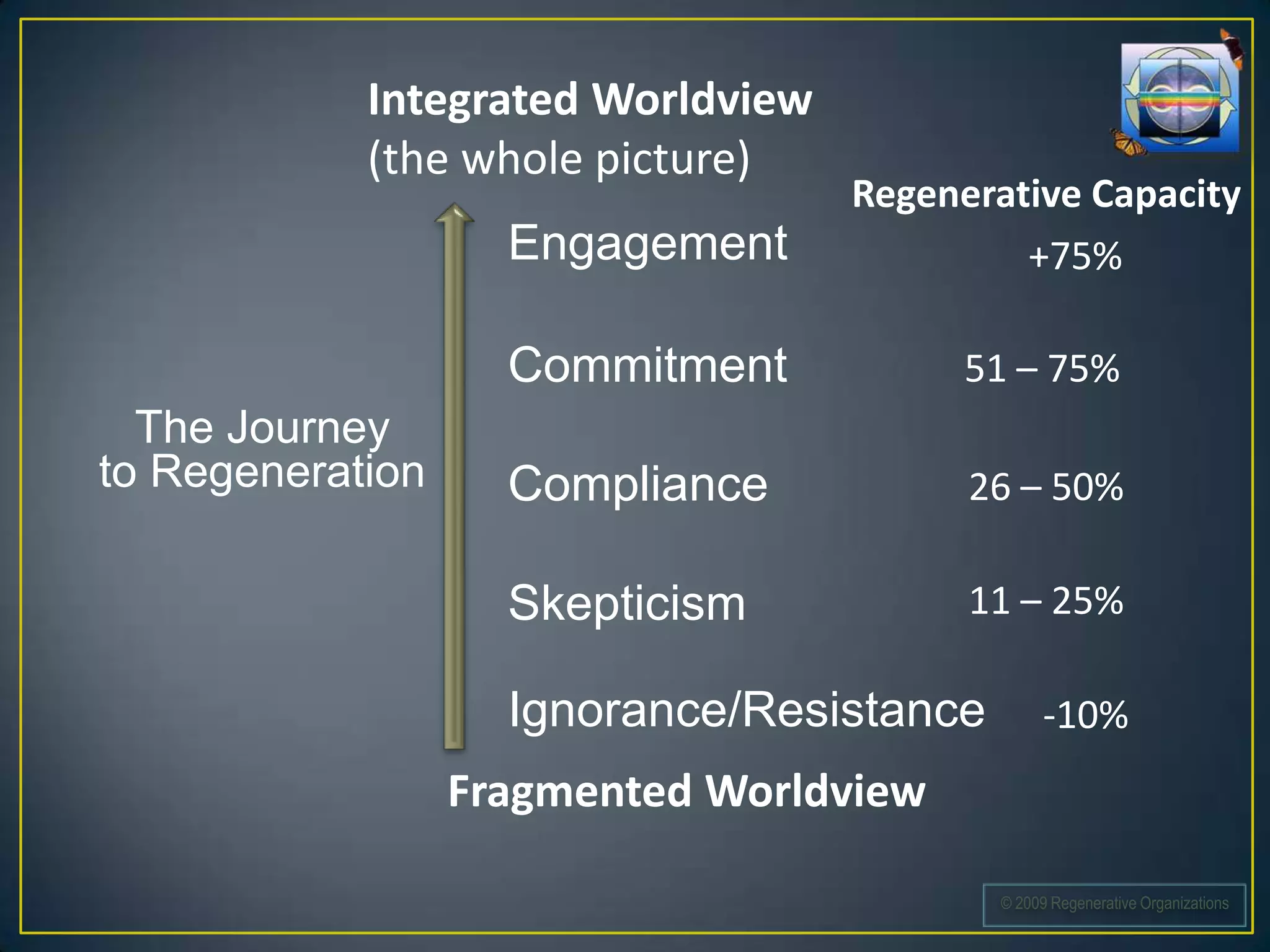
Integrated Worldview
            (the whole picture)
                                   Regenerative Capacity
                    Engagement              +75%

                    Commitment           51 – 75%
  The Journey
to Regeneration     Compliance           26 – 50%

                    Skepticism           11 – 25%

                    Ignorance/Resistance         -10%
                  Fragmented Worldview

                                           © 2009 Regenerative Organizations
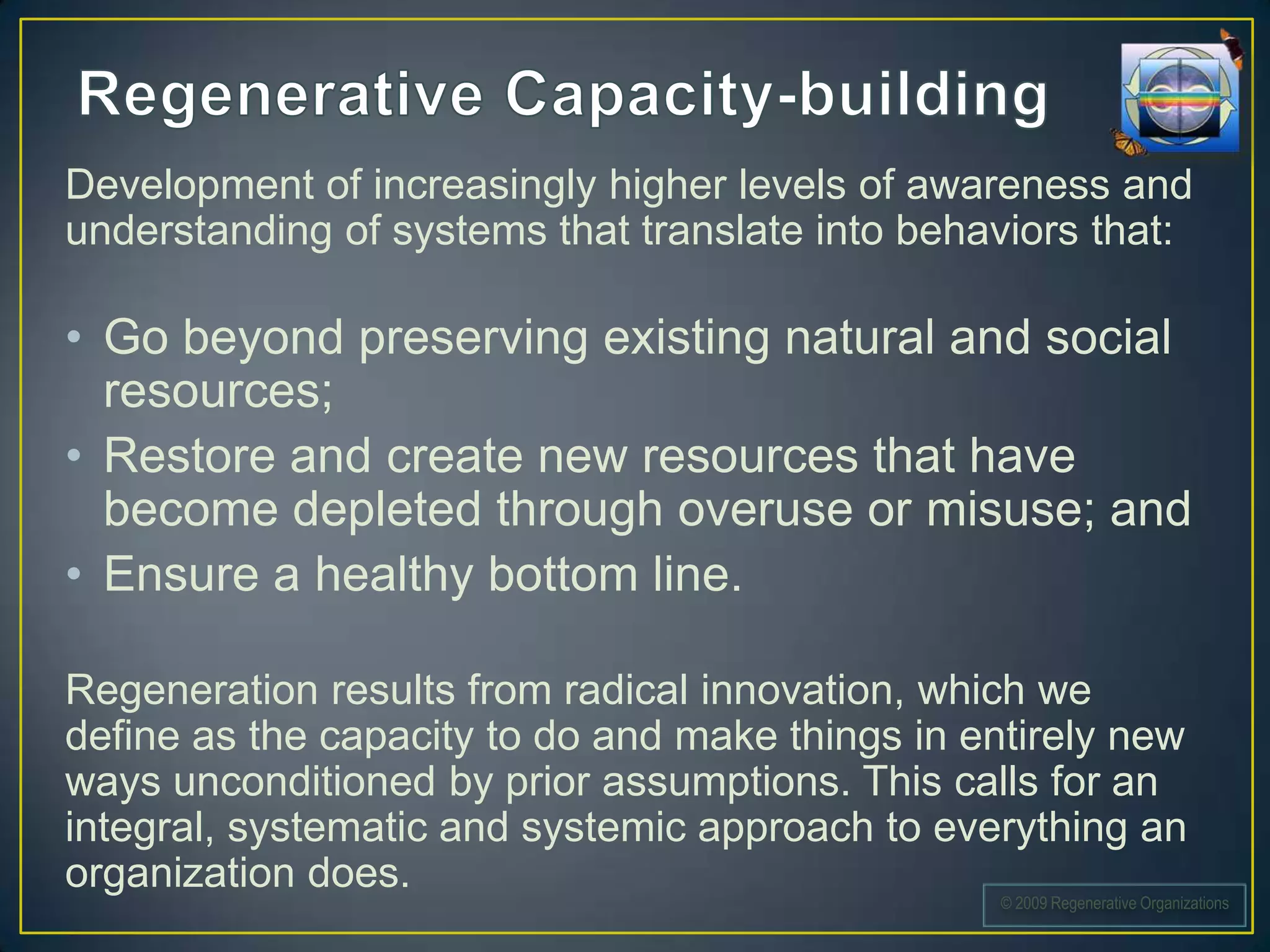
Development of increasingly higher levels of awareness and
understanding of systems that translate into behaviors that:

• Go beyond preserving existing natural and social
  resources;
• Restore and create new resources that have
  become depleted through overuse or misuse; and
• Ensure a healthy bottom line.

Regeneration results from radical innovation, which we
define as the capacity to do and make things in entirely new
ways unconditioned by prior assumptions. This calls for an
integral, systematic and systemic approach to everything an
organization does.
                                                  © 2009 Regenerative Organizations
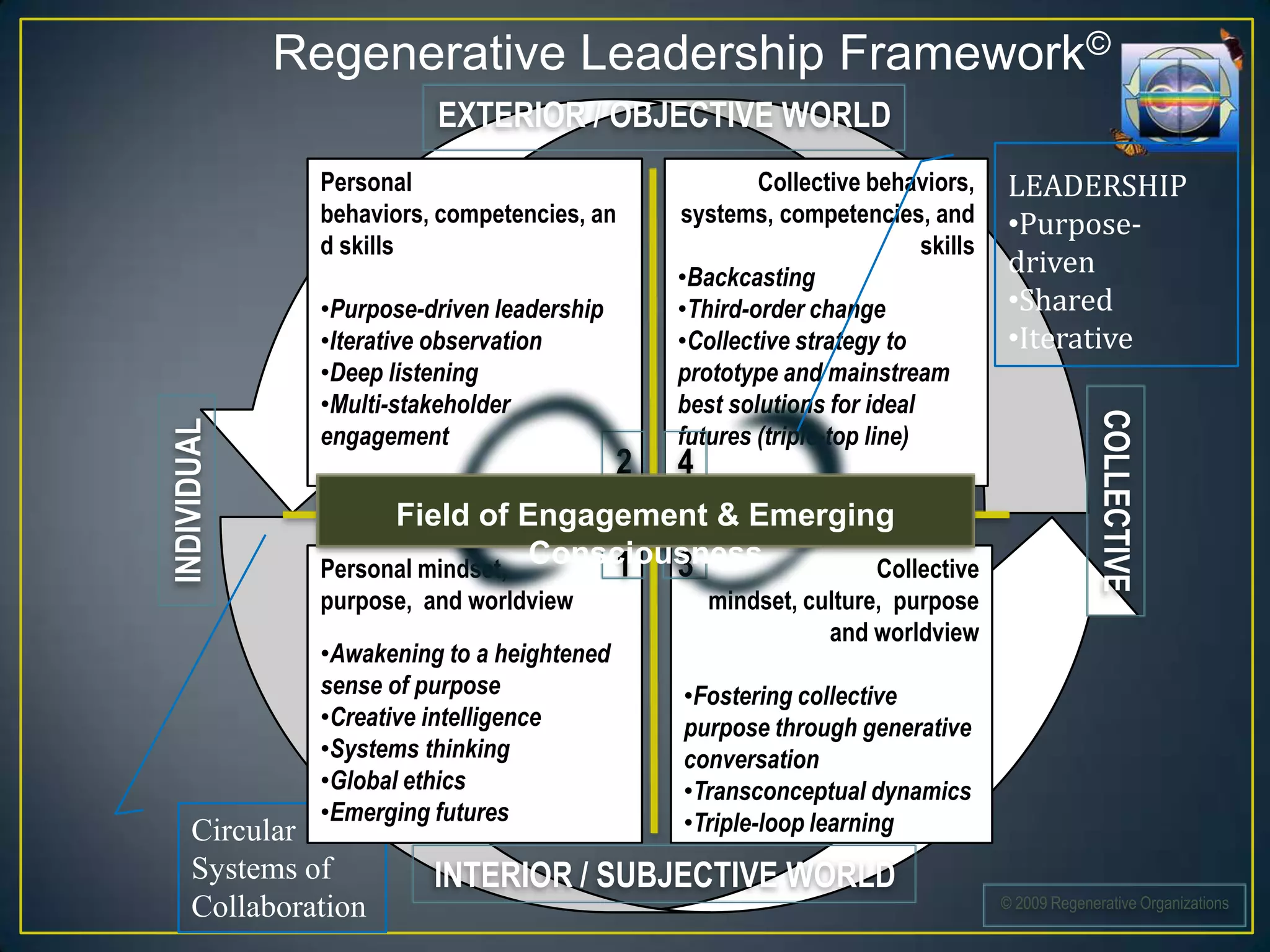
Regenerative Leadership Framework©
                        EXTERIOR / OBJECTIVE WORLD
              Personal                                 Collective behaviors,       LEADERSHIP
              behaviors, competencies, an      systems, competencies, and          •Purpose-
              d skills                                                   skills
                                               •Backcasting
                                                                                   driven
              •Purpose-driven leadership       •Third-order change                 •Shared
              •Iterative observation           •Collective strategy to             •Iterative
              •Deep listening                  prototype and mainstream
              •Multi-stakeholder               best solutions for ideal


                                                                                               COLLECTIVE
INDIVIDUAL


              engagement                       futures (triple-top line)
                                           2   4
                    Field of Engagement & Emerging
              Personal mindset,
                                Consciousness
                                    1 3          Collective
              purpose, and worldview               mindset, culture, purpose
                                                              and worldview
              •Awakening to a heightened
              sense of purpose                 •Fostering collective
              •Creative intelligence           purpose through generative
              •Systems thinking                conversation
              •Global ethics                   •Transconceptual dynamics
              •Emerging futures                •Triple-loop learning
     Circular
     Systems of         INTERIOR / SUBJECTIVE WORLD
     Collaboration                                                                © 2009 Regenerative Organizations
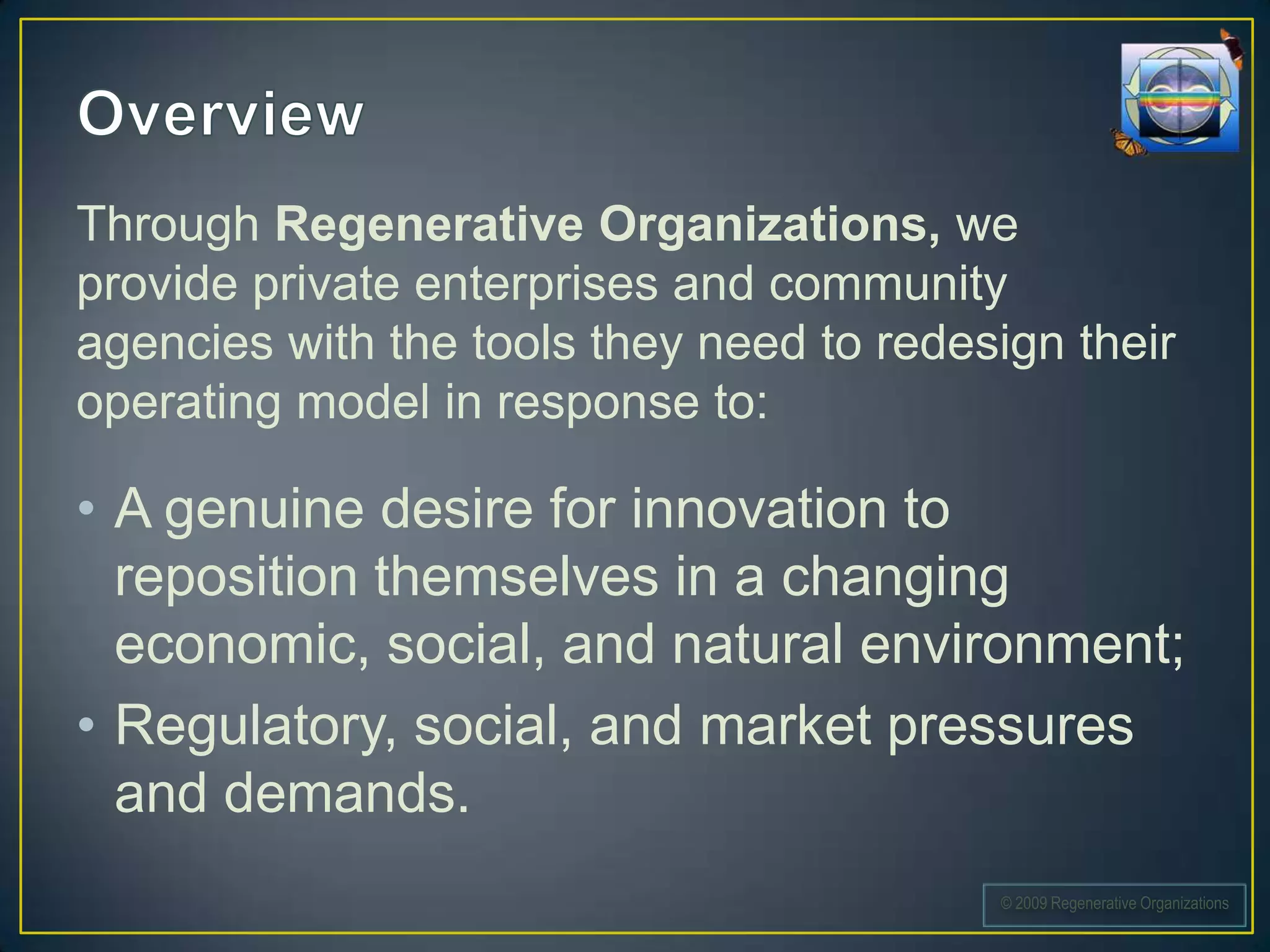
Through Regenerative Organizations, we
provide private enterprises and community
agencies with the tools they need to redesign their
operating model in response to:

• A genuine desire for innovation to
  reposition themselves in a changing
  economic, social, and natural environment;
• Regulatory, social, and market pressures
  and demands.
                                          © 2009 Regenerative Organizations
• Business
  •Small, medium and large enterprises
• Community
  • Nonprofits, NGOs, Cities, Regions
• Education
  • Universities and schools


                                   © 2009 Regenerative Organizations
The regenerative capacity-building process is designed
to help our clients and students:

• Fully understand where they are
• Envision where they want to go
• Design the best plan to get there
• Implement and conduct mid-course
  corrections
• Assess the regenerative and
  sustainability quality of results.
                                           © 2009 Regenerative Organizations
• Regenerative Strategic Planning
  • ‘Desirable Futures’ Vision development
  • Baseline Data Collection and Benchmarking
    (assessment, analysis, measurement, reporting)
  • Policy development

• Regenerative Coaching, Education and Training
  • Executives
  • Line Managers
  • Teams
                                        © 2009 Regenerative Organizations
• Situational Analysis
  • Regenerative Capacity Index
  • Sustainability Change Agentry Self-assessment
  • Sustainability Assessment (S-CORE)

• Strategic
  Planning, Implementation, Evaluation
  •   Backcasting Visioning Process
  •   Regenerative Leadership Coaching
  •   Green Six Sigma Team Building
  •   ISIS Sustainability Accelerator
      (Compass, Pyramid, Amoeba, Stratesphere)
                                                    © 2009 Regenerative Organizations
‘Profitability?’

Over 5 year period, 75% projected expansion of
sustainable business development and investing in
the U.S.:

2009       USD20 B
2011       USD28 B (estimated)
2014       USD35 B (projected)
(See Sustainability: The Next 3 to 5 years [Enviance])
                                            © 2009 Regenerative Organizations
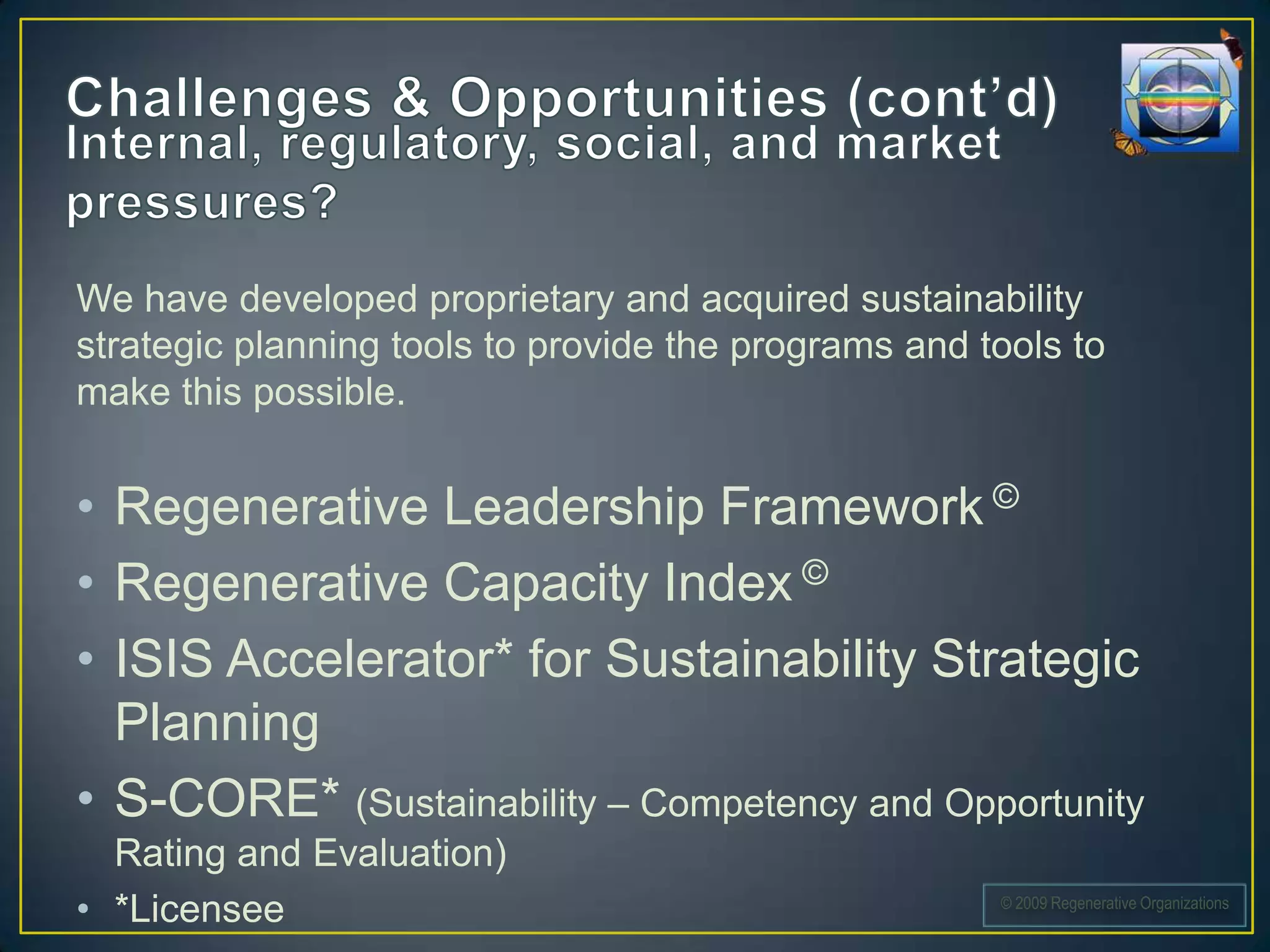
We have developed proprietary and acquired sustainability
strategic planning tools to provide the programs and tools to
make this possible.


• Regenerative Leadership Framework ©
• Regenerative Capacity Index ©
• ISIS Accelerator* for Sustainability Strategic
  Planning
• S-CORE* (Sustainability – Competency and Opportunity
  Rating and Evaluation)
• *Licensee                                           © 2009 Regenerative Organizations
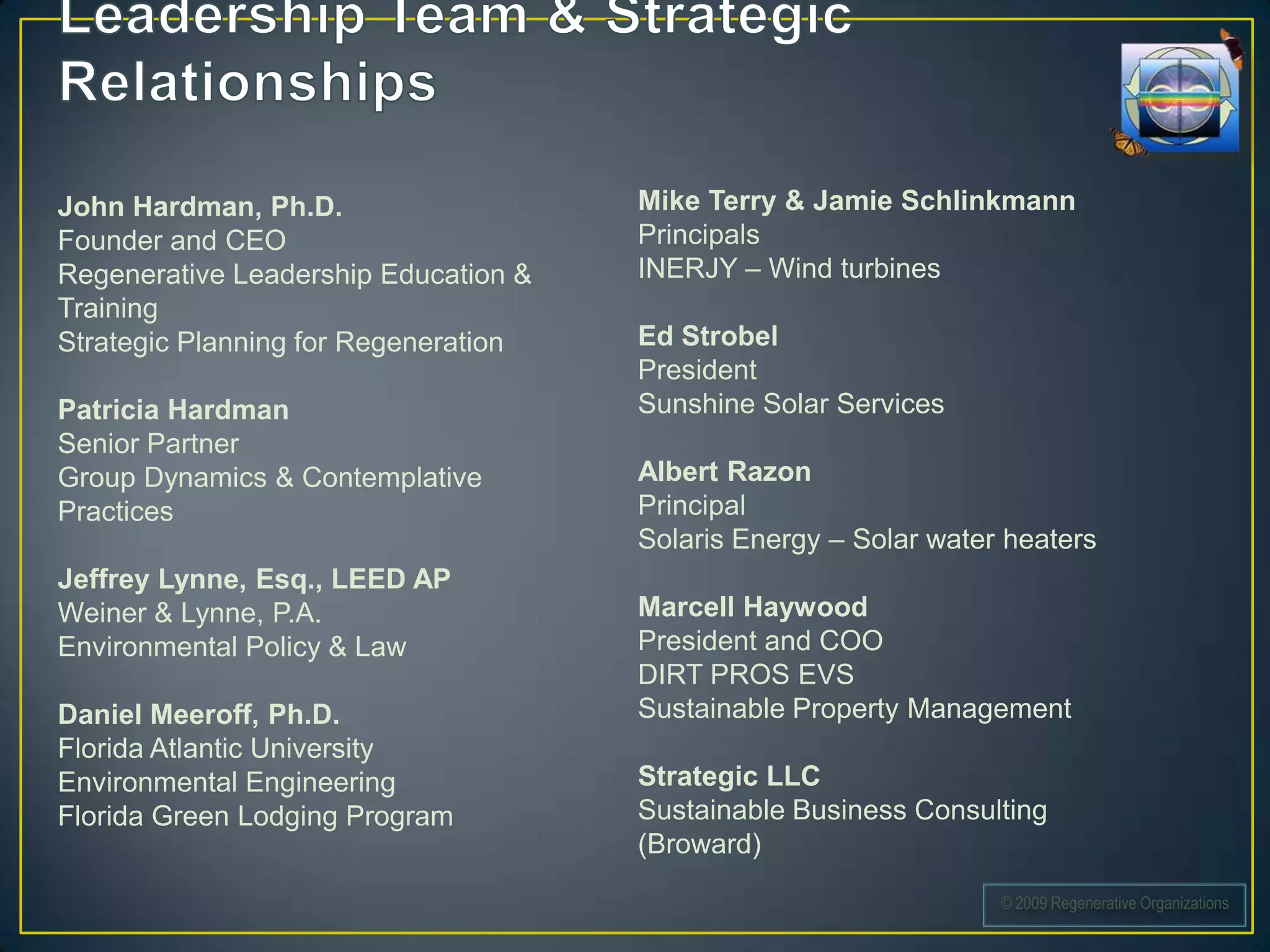
John Hardman, Ph.D.                   Mike Terry & Jamie Schlinkmann
Founder and CEO                       Principals
Regenerative Leadership Education &   INERJY – Wind turbines
Training
Strategic Planning for Regeneration   Ed Strobel
                                      President
Patricia Hardman                      Sunshine Solar Services
Senior Partner
Group Dynamics & Contemplative        Albert Razon
Practices                             Principal
                                      Solaris Energy – Solar water heaters
Jeffrey Lynne, Esq., LEED AP
Weiner & Lynne, P.A.                  Marcell Haywood
Environmental Policy & Law            President and COO
                                      DIRT PROS EVS
Daniel Meeroff, Ph.D.                 Sustainable Property Management
Florida Atlantic University
Environmental Engineering             Strategic LLC
Florida Green Lodging Program         Sustainable Business Consulting
                                      (Broward)
                                                                  © 2009 Regenerative Organizations
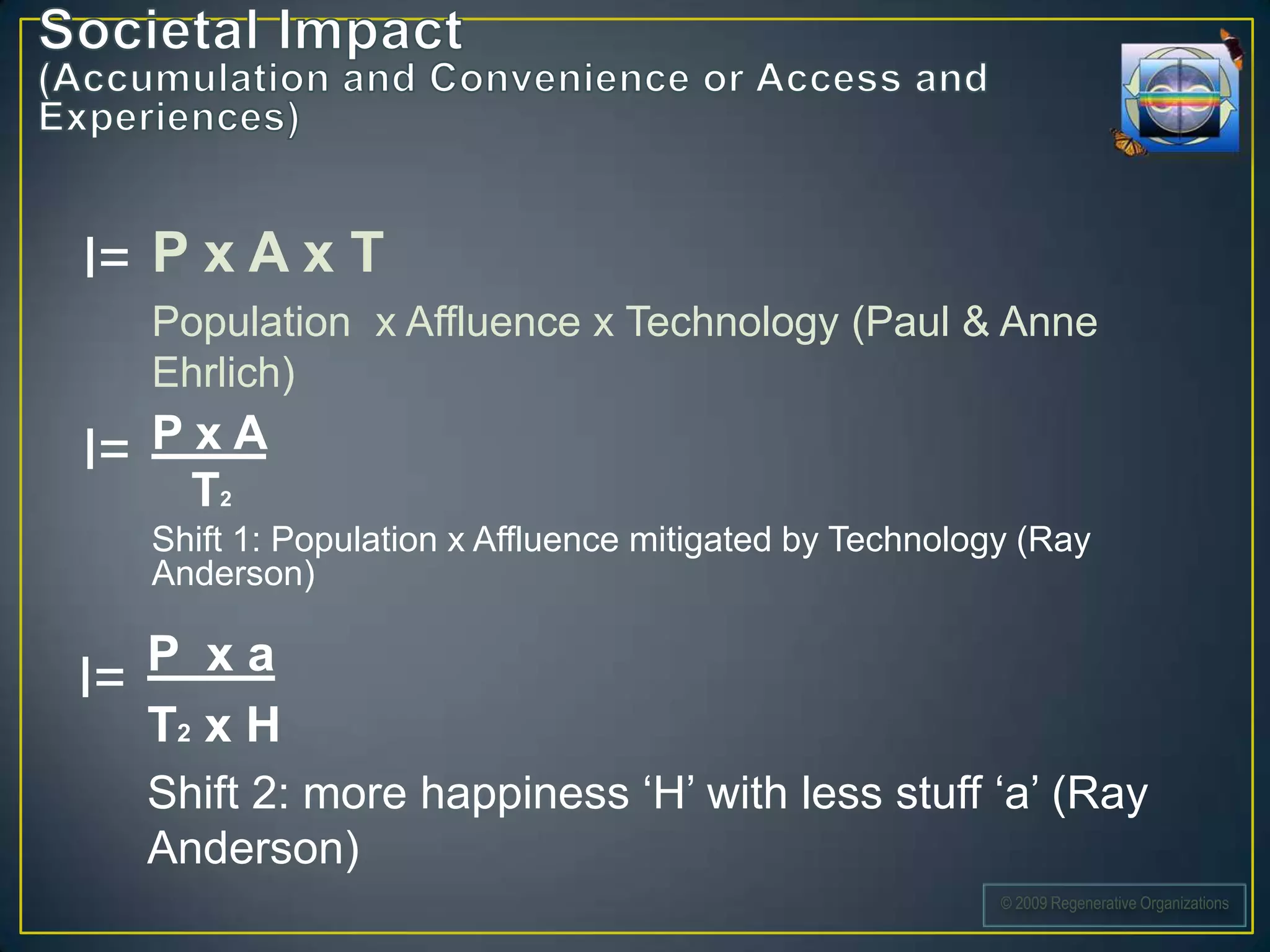
I= P x A x T
   Population x Affluence x Technology (Paul & Anne
   Ehrlich)
I= P x A
     T2
   Shift 1: Population x Affluence mitigated by Technology (Ray
   Anderson)


I= P x a
  T2 x H
  Shift 2: more happiness ‘H’ with less stuff ‘a’ (Ray
  Anderson)
                                                         © 2009 Regenerative Organizations
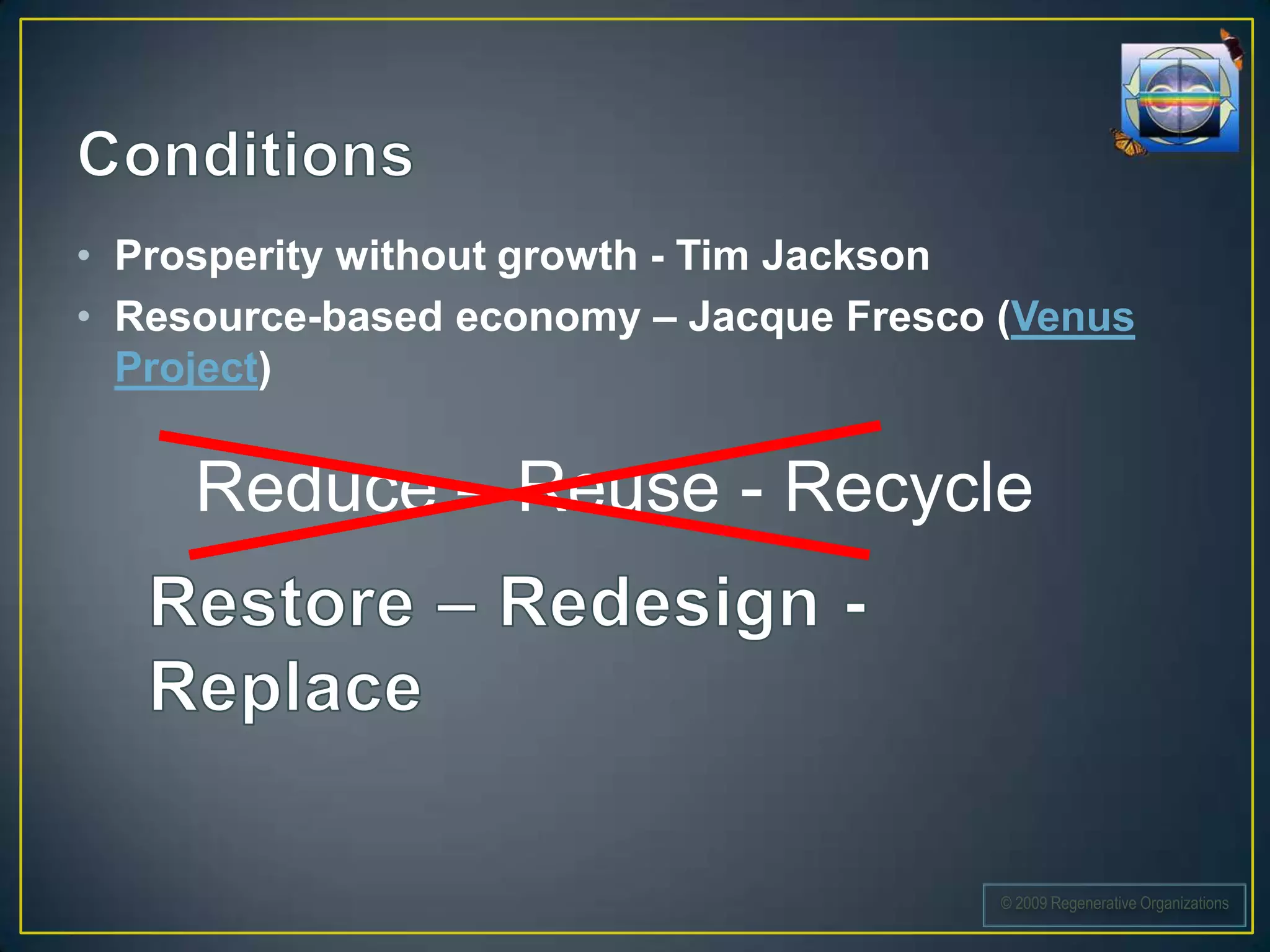
• Prosperity without growth - Tim Jackson
• Resource-based economy – Jacque Fresco (Venus
  Project)


     Reduce – Reuse - Recycle


                                         © 2009 Regenerative Organizations
© 2009 Regenerative Organizations
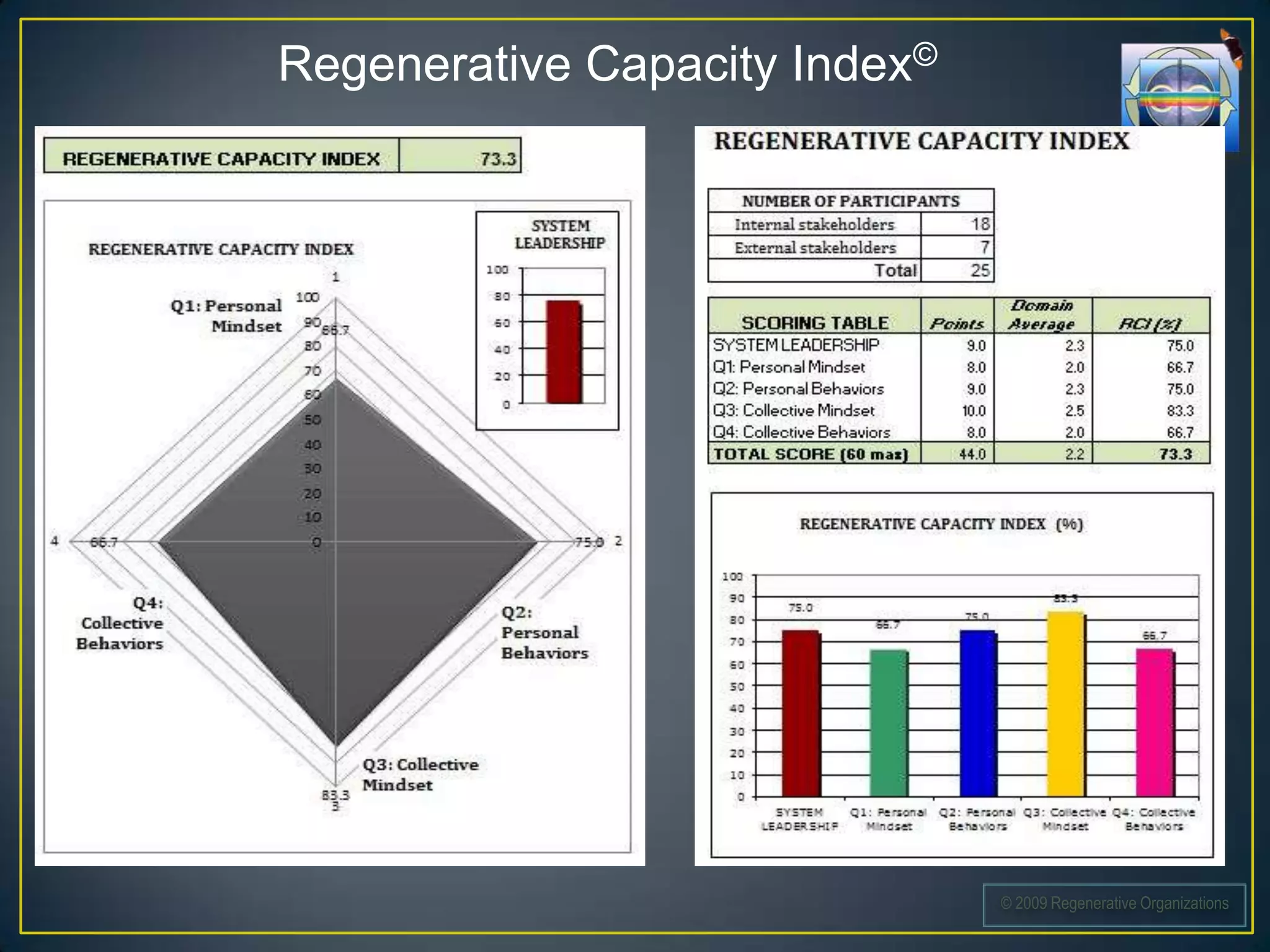
Regenerative Capacity Index©


                               © 2009 Regenerative Organizations
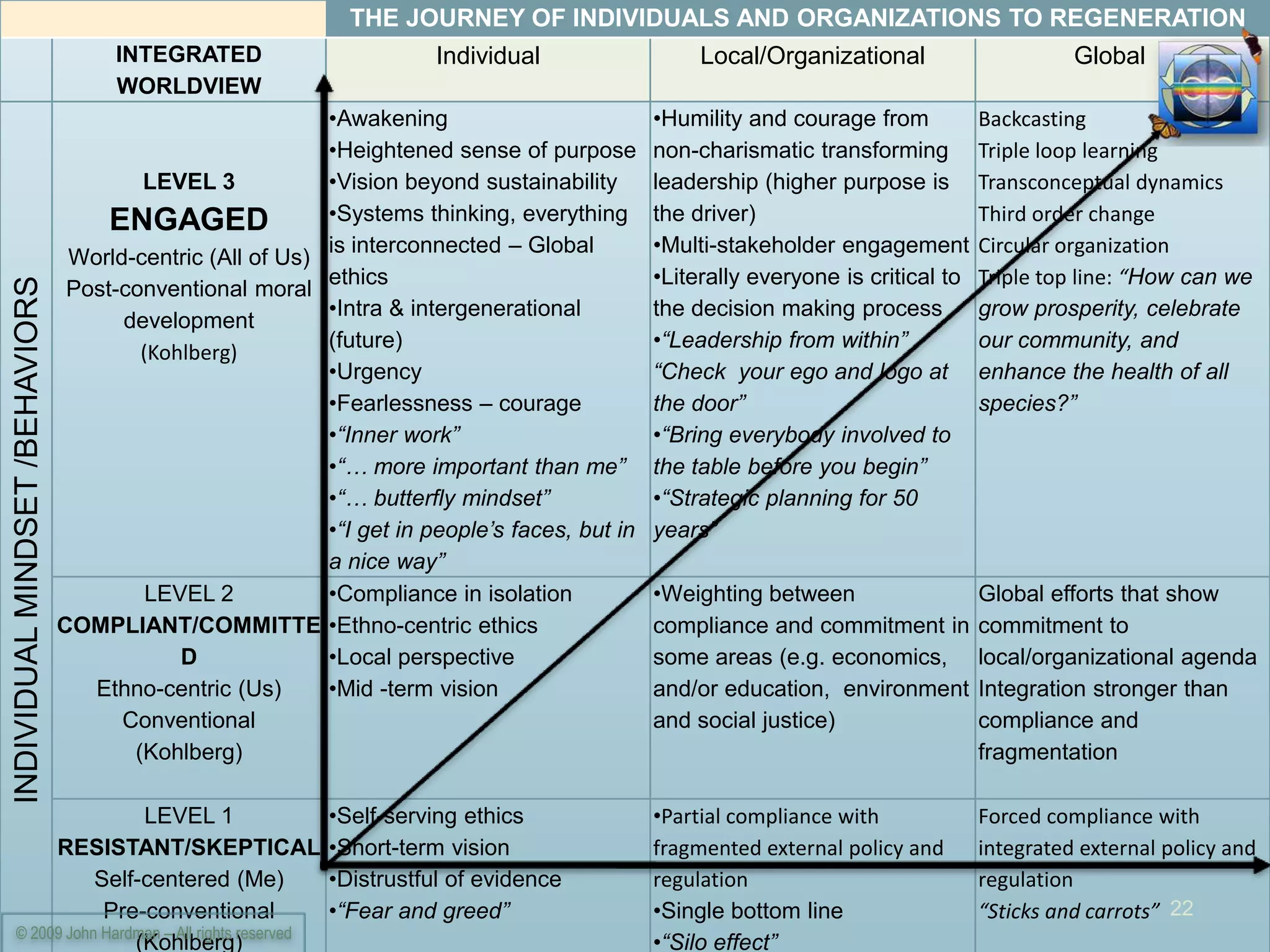
THE JOURNEY OF INDIVIDUALS AND ORGANIZATIONS TO REGENERATION
                                      INTEGRATED                       Individual                   Local/Organizational                        Global
                                      WORLDVIEW
                                                           •Awakening                          •Humility and courage from           Backcasting
                                                           •Heightened sense of purpose        non-charismatic transforming         Triple loop learning
                                        LEVEL 3            •Vision beyond sustainability       leadership (higher purpose is        Transconceptual dynamics
                                     ENGAGED               •Systems thinking, everything       the driver)                          Third order change
                                                           is interconnected – Global          •Multi-stakeholder engagement        Circular organization
                                 World-centric (All of Us)
                                                           ethics                              •Literally everyone is critical to   Triple top line: “How can we
INDIVIDUAL MINDSET /BEHAVIORS


                                 Post-conventional moral
                                                           •Intra & intergenerational          the decision making process          grow prosperity, celebrate
                                      development
                                                           (future)                            •“Leadership from within”            our community, and
                                        (Kohlberg)
                                                           •Urgency                            “Check your ego and logo at          enhance the health of all
                                                           •Fearlessness – courage             the door”                            species?”
                                                           •“Inner work”                       •“Bring everybody involved to
                                                           •“… more important than me”         the table before you begin”
                                                           •“… butterfly mindset”              •“Strategic planning for 50
                                                           •“I get in people’s faces, but in   years”
                                                           a nice way”
                                         LEVEL 2           •Compliance in isolation            •Weighting between                   Global efforts that show
                                COMPLIANT/COMMITTE •Ethno-centric ethics                       compliance and commitment in         commitment to
                                            D              •Local perspective                  some areas (e.g. economics,          local/organizational agenda
                                   Ethno-centric (Us)      •Mid -term vision                   and/or education, environment        Integration stronger than
                                      Conventional                                             and social justice)                  compliance and
                                       (Kohlberg)                                                                                   fragmentation

                  LEVEL 1                                   •Self-serving ethics               •Partial compliance with             Forced compliance with
      RESISTANT/SKEPTICAL                                   •Short-term vision                 fragmented external policy and       integrated external policy and
            Self-centered (Me)                              •Distrustful of evidence           regulation                           regulation
                                                                                                                                       © 2009 Regenerative Organizations
             Pre-conventional                               •“Fear and greed”                  •Single bottom line                  “Sticks and carrots” 22
 © 2009 John Hardman – All rights reserved
                 (Kohlberg)                                                                    •“Silo effect”
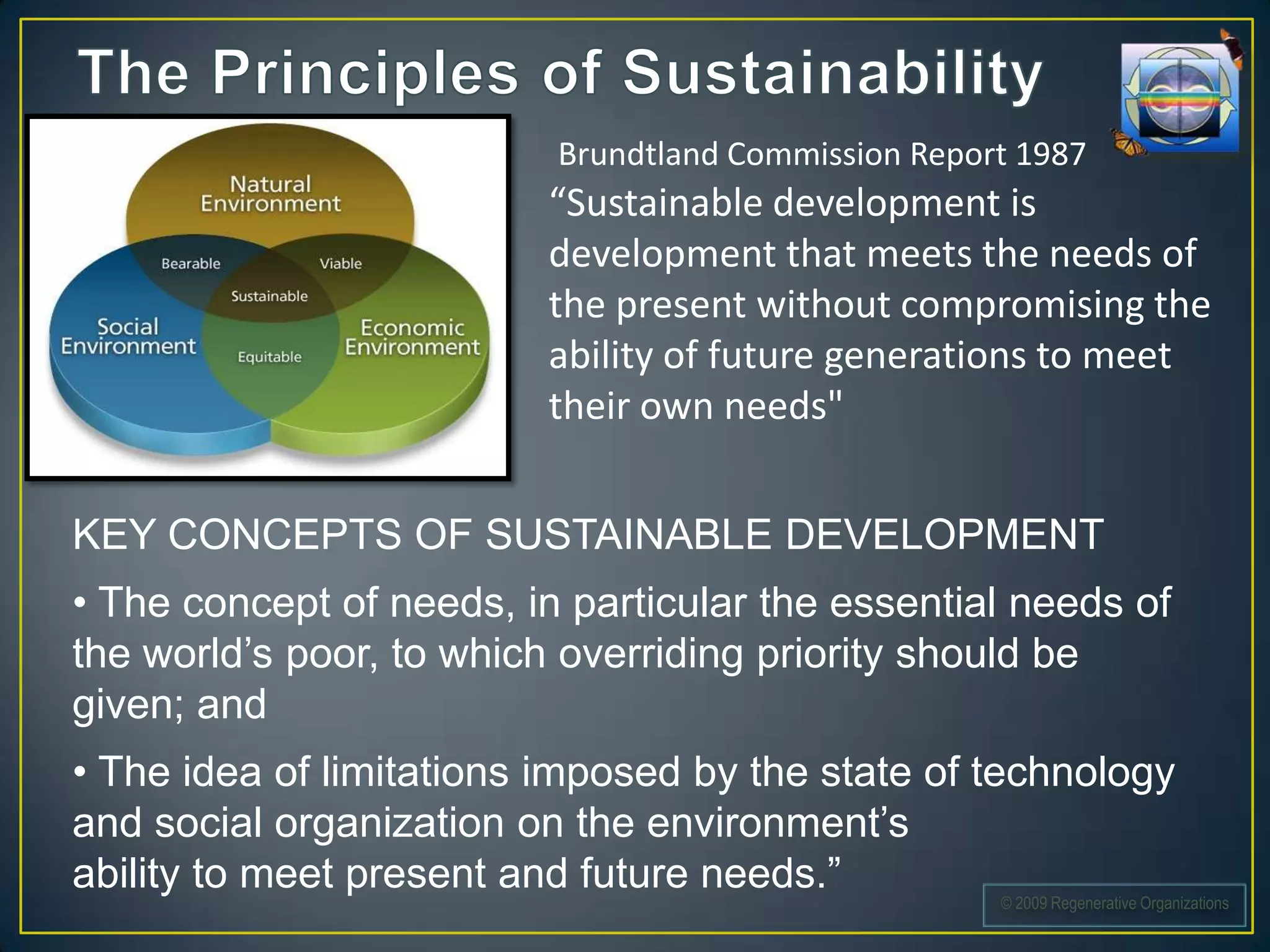
Brundtland Commission Report 1987
                          “Sustainable development is
                          development that meets the needs of
                          the present without compromising the
                          ability of future generations to meet
                          their own needs"


KEY CONCEPTS OF SUSTAINABLE DEVELOPMENT
• The concept of needs, in particular the essential needs of
the world’s poor, to which overriding priority should be
given; and
• The idea of limitations imposed by the state of technology
and social organization on the environment’s
ability to meet present and future needs.”
                                                     © 2009 Regenerative Organizations
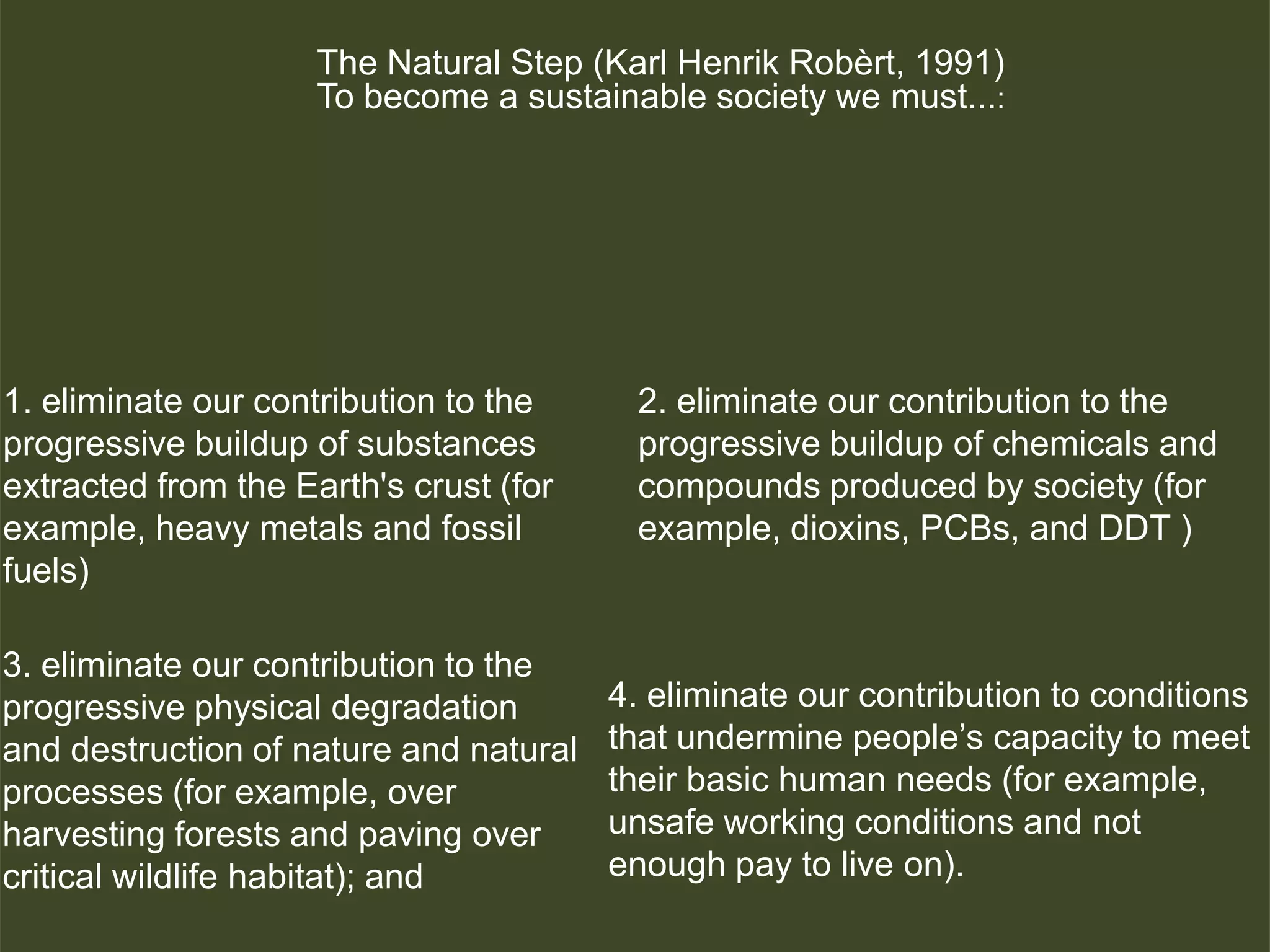
The Natural Step (Karl Henrik Robèrt, 1991)
                     To become a sustainable society we must...:


1. eliminate our contribution to the     2. eliminate our contribution to the
progressive buildup of substances        progressive buildup of chemicals and
extracted from the Earth's crust (for    compounds produced by society (for
example, heavy metals and fossil         example, dioxins, PCBs, and DDT )
fuels)

3. eliminate our contribution to the
progressive physical degradation        4. eliminate our contribution to conditions
and destruction of nature and natural   that undermine people’s capacity to meet
processes (for example, over            their basic human needs (for example,
harvesting forests and paving over      unsafe working conditions and not
critical wildlife habitat); and         enough pay to live on).
                                                                  © 2009 Regenerative Organizations
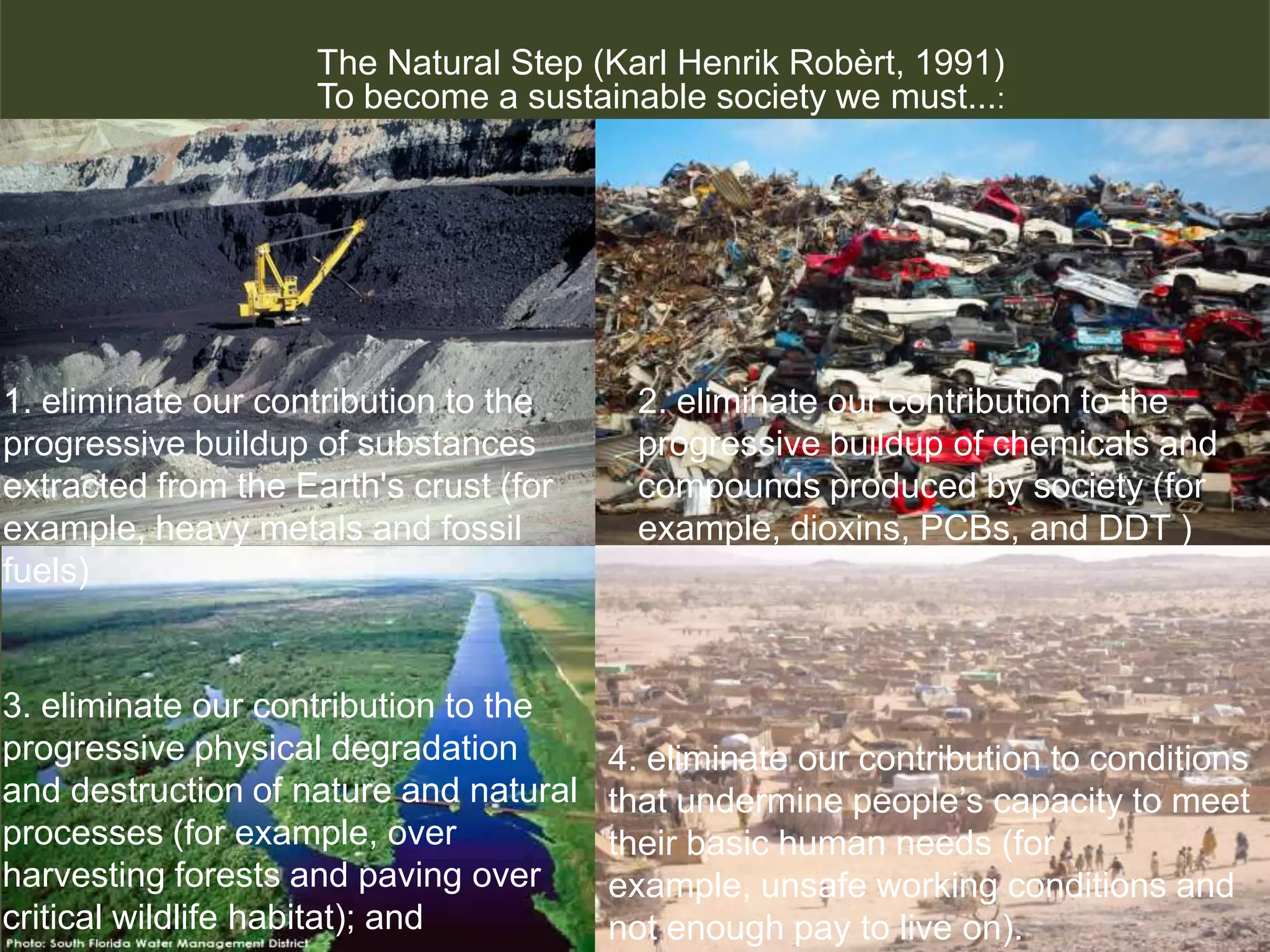
The Natural Step (Karl Henrik Robèrt, 1991)
                     To become a sustainable society we must...:


1. eliminate our contribution to the     2. eliminate our contribution to the
progressive buildup of substances        progressive buildup of chemicals and
extracted from the Earth's crust (for    compounds produced by society (for
example, heavy metals and fossil         example, dioxins, PCBs, and DDT )
fuels)


3. eliminate our contribution to the
progressive physical degradation        4. eliminate our contribution to conditions
and destruction of nature and natural   that undermine people’s capacity to meet
processes (for example, over            their basic human needs (for
harvesting forests and paving over      example, unsafe working conditions and
critical wildlife habitat); and         not enough pay to live on).
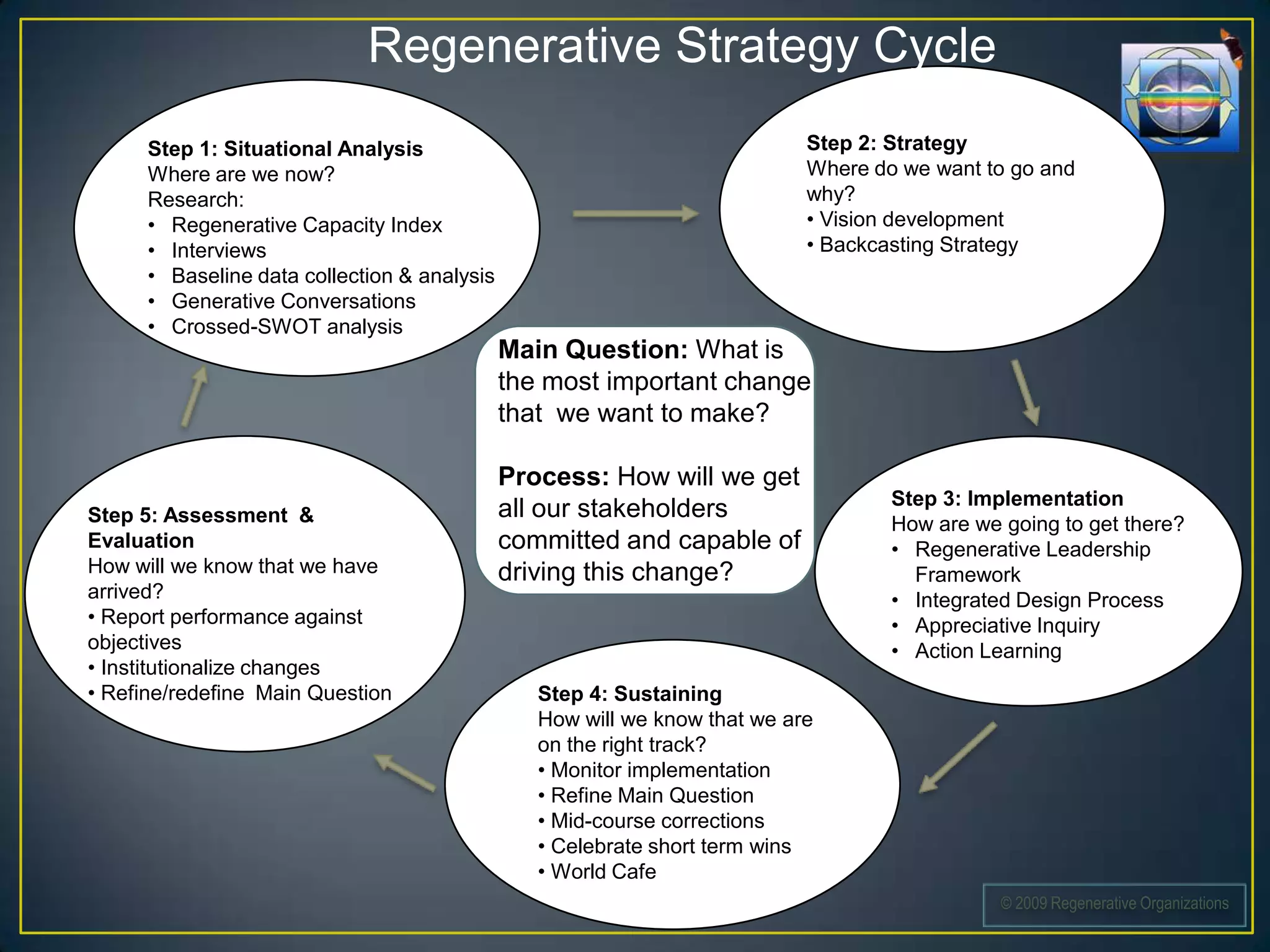
Regenerative Strategy Cycle
      Step 1: Situational Analysis                                          Step 2: Strategy
      Where are we now?                                                     Where do we want to go and
      Research:                                                             why?
      • Regenerative Capacity Index                                         • Vision development
      • Interviews                                                          • Backcasting Strategy
      • Baseline data collection & analysis
      • Generative Conversations
      • Crossed-SWOT analysis
                                              Main Question: What is
                                              the most important change
                                              that we want to make?

                                              Process: How will we get
                                                                                    Step 3: Implementation
Step 5: Assessment &                          all our stakeholders
                                                                                    How are we going to get there?
Evaluation                                    committed and capable of              • Regenerative Leadership
How will we know that we have                 driving this change?                    Framework
arrived?                                                                            • Integrated Design Process
• Report performance against                                                        • Appreciative Inquiry
objectives                                                                          • Action Learning
• Institutionalize changes
• Refine/redefine Main Question                  Step 4: Sustaining
                                                 How will we know that we are
                                                 on the right track?
                                                 • Monitor implementation
                                                 • Refine Main Question
                                                 • Mid-course corrections
                                                 • Celebrate short term wins
                                                 • World Cafe
                                                                                               © 2009 Regenerative Organizations
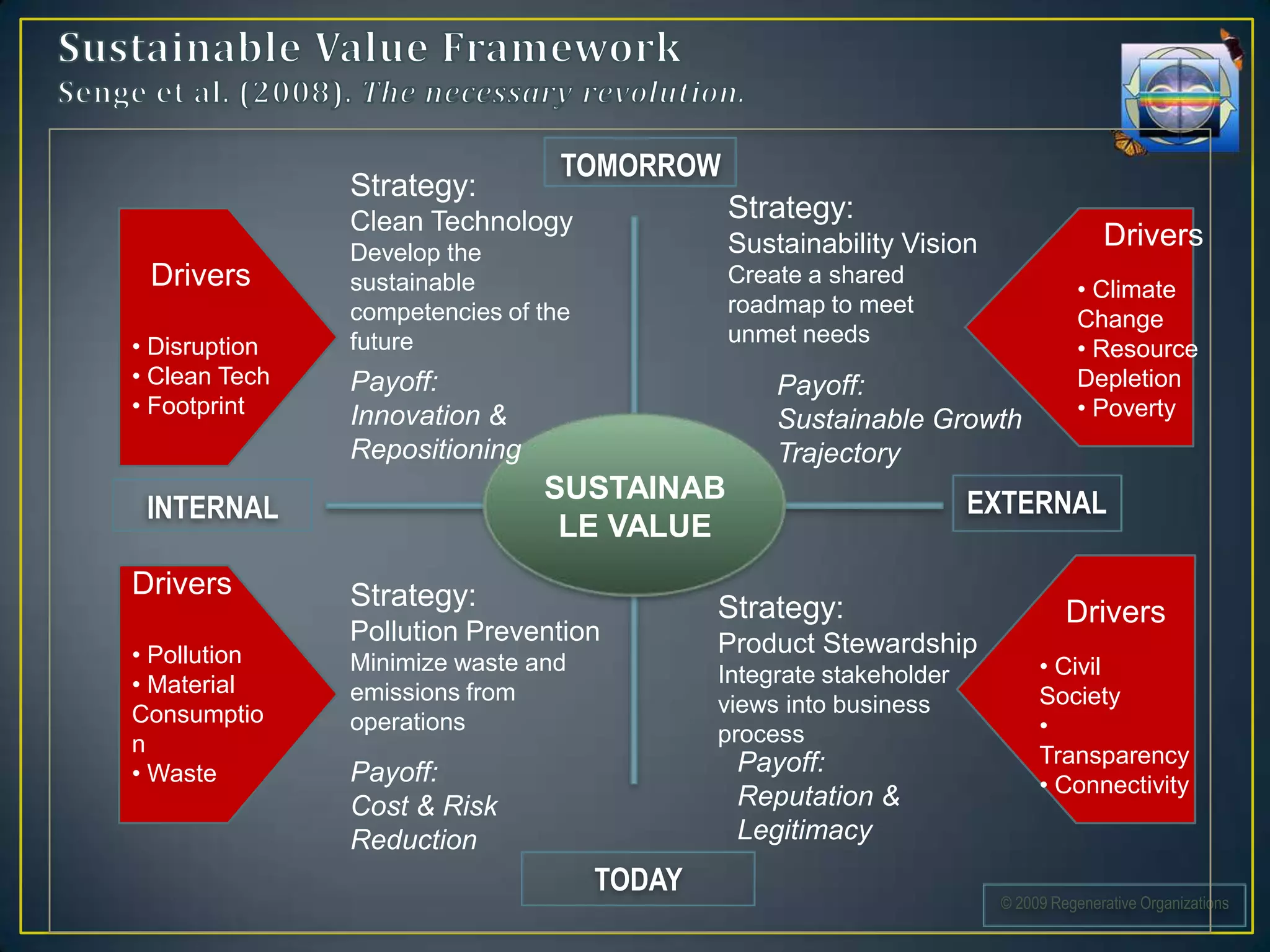
TOMORROW
               Strategy:
               Clean Technology              Strategy:
               Develop the                   Sustainability Vision                  Drivers
 Drivers       sustainable                   Create a shared
                                                                                 • Climate
               competencies of the           roadmap to meet
                                                                                 Change
               future                        unmet needs
• Disruption                                                                     • Resource
• Clean Tech   Payoff:                            Payoff:                        Depletion
• Footprint    Innovation &                                                      • Poverty
                                                  Sustainable Growth
               Repositioning                      Trajectory
                               SUSTAINAB                             EXTERNAL
 INTERNAL
                                LE VALUE
Drivers        Strategy:                     Strategy:                         Drivers
               Pollution Prevention          Product Stewardship
• Pollution    Minimize waste and                                          • Civil
• Material                                   Integrate stakeholder
               emissions from                views into business           Society
Consumptio     operations                                                  •
n                                            process
                                              Payoff:                      Transparency
• Waste        Payoff:                                                     • Connectivity
               Cost & Risk                    Reputation &
               Reduction                      Legitimacy
                                     TODAY
                                                                      © 2009 Regenerative Organizations
"Conventional Construction Silos " and "Green Campus Stakeholders" diagrams originally
   published in Smart by Nature: Schooling for Sustainability by Michael K. Stone/Center for
   Ecoliteracy. © Copyright 2009 Center for Ecoliteracy. Reprinted with permission. All rights
   reserved. For more information, visit www.ecoliteracy.org.
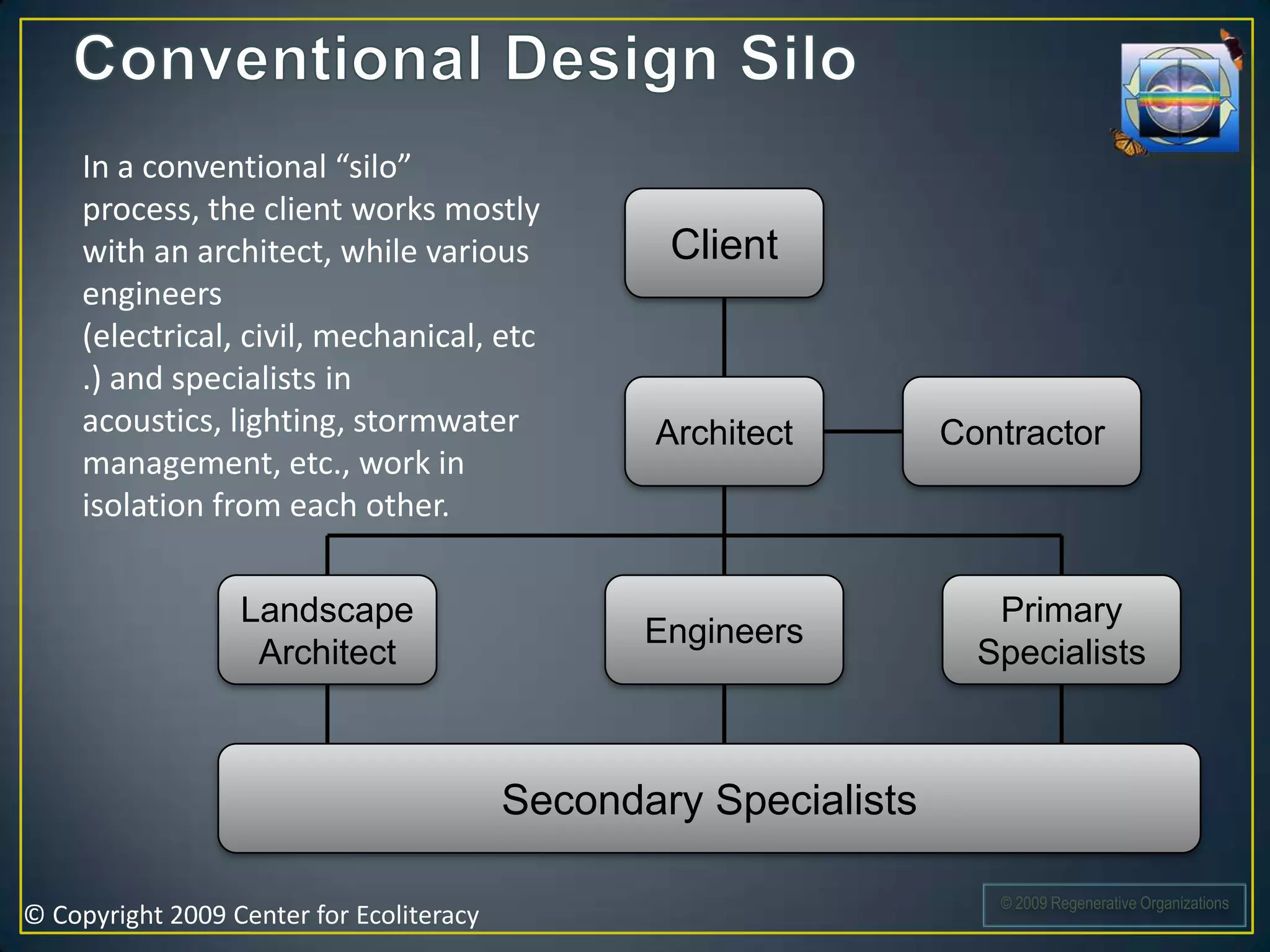
In a conventional “silo”
     process, the client works mostly
     with an architect, while various             Client
     engineers
     (electrical, civil, mechanical, etc
     .) and specialists in
     acoustics, lighting, stormwater             Architect        Contractor
     management, etc., work in
     isolation from each other.

                  Landscape                                          Primary
                                                 Engineers
                   Architect                                        Specialists


                                          Secondary Specialists

                                                                     © 2009 Regenerative Organizations
© Copyright 2009 Center for Ecoliteracy
Specialist
                                                          s
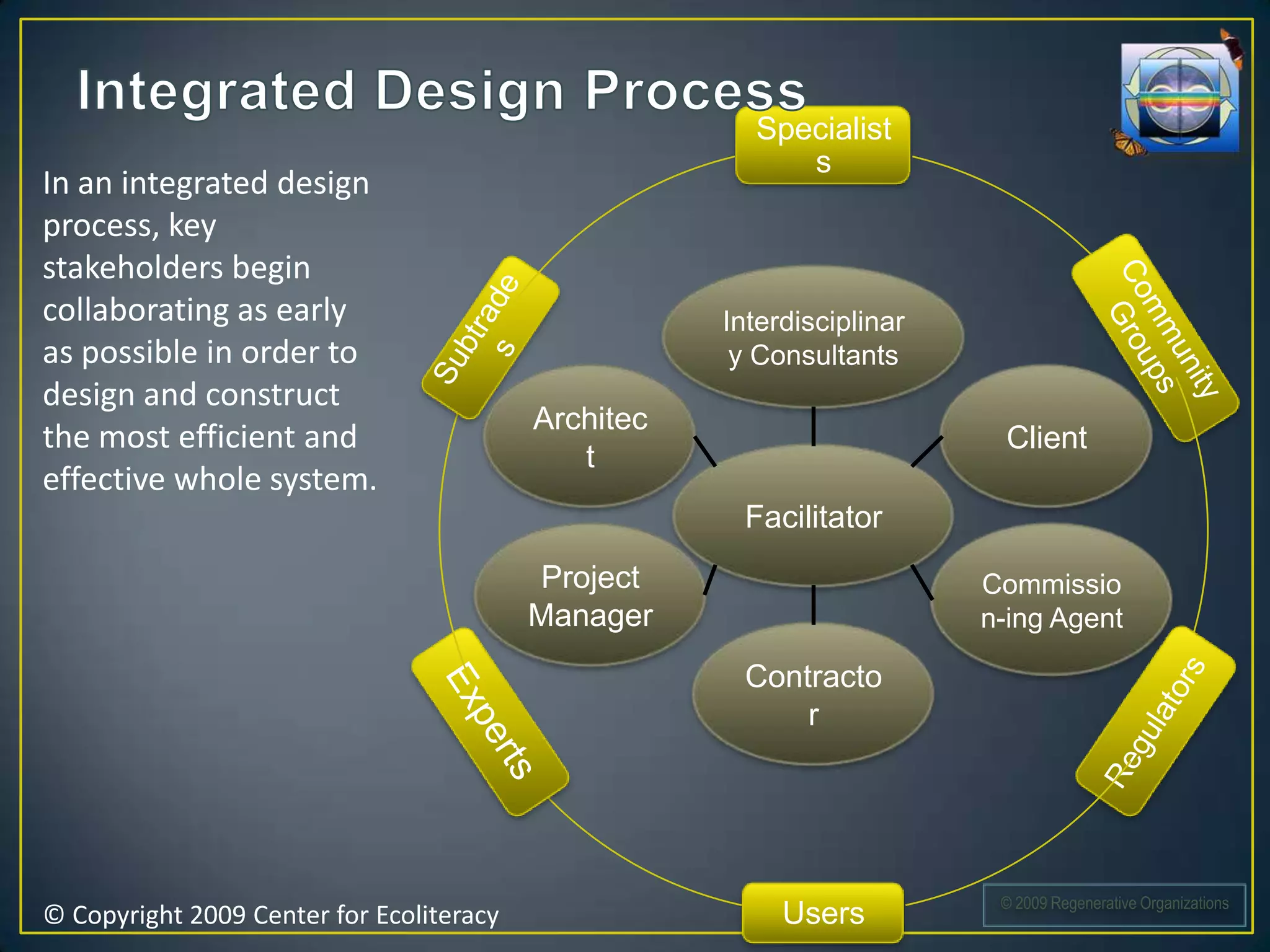
In an integrated design
process, key
stakeholders begin
collaborating as early                               Interdisciplinar
as possible in order to                               y Consultants
design and construct
                                          Architec
the most efficient and                                                   Client
                                             t
effective whole system.
                                                      Facilitator
                                          Project                       Commissio
                                          Manager                       n-ing Agent

                                                      Contracto
                                                          r


                                                                         © 2009 Regenerative Organizations
© Copyright 2009 Center for Ecoliteracy                   Users
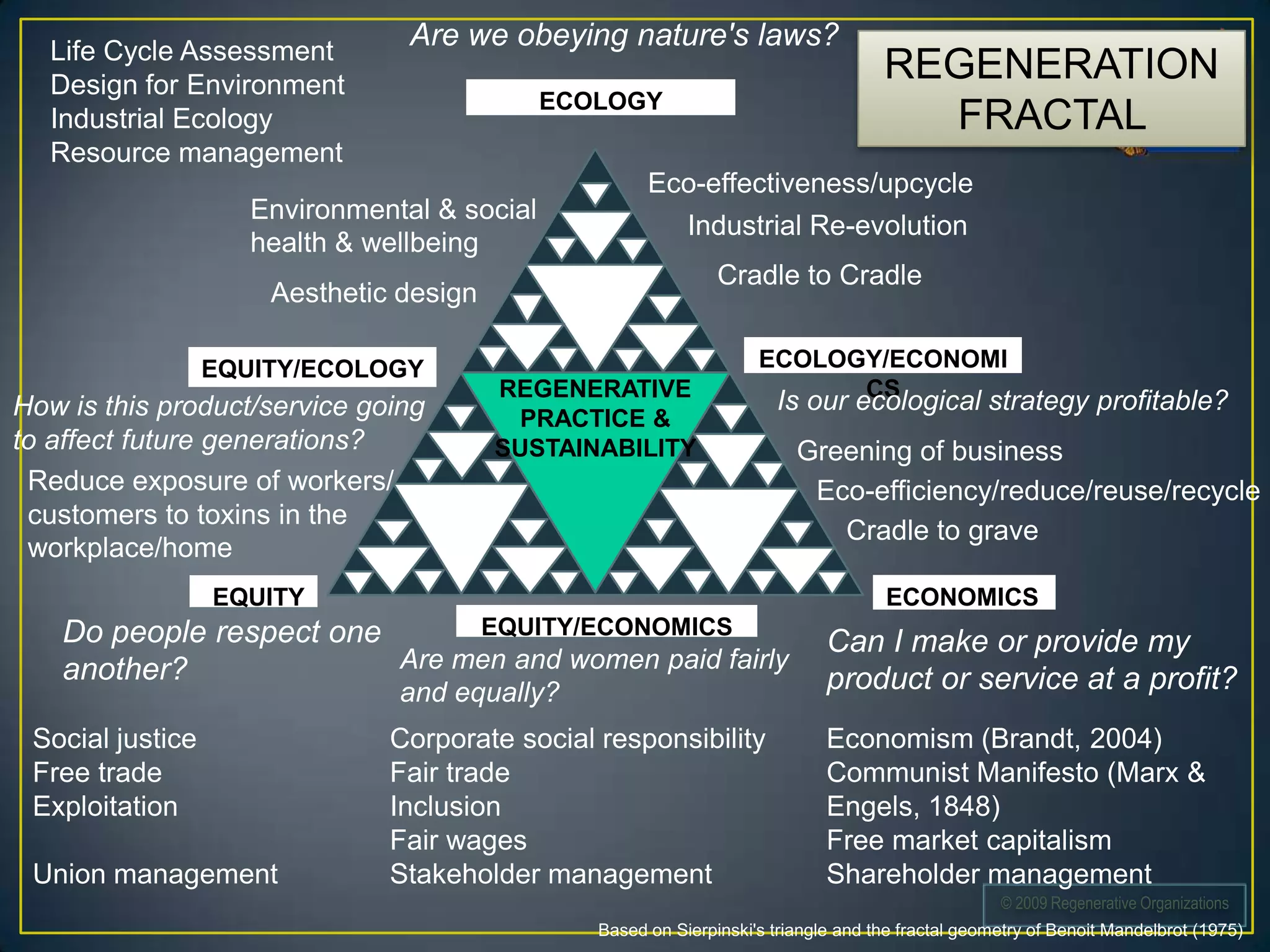
Life Cycle Assessment
                                 Are we obeying nature's laws?
   Design for Environment
                                                                                     REGENERATION
                                              ECOLOGY
   Industrial Ecology                                                                  FRACTAL
   Resource management
                                                       Eco-effectiveness/upcycle
                     Environmental & social
                                                            Industrial Re-evolution
                     health & wellbeing
                                                                Cradle to Cradle
                      Aesthetic design

                  EQUITY/ECOLOGY                                     ECOLOGY/ECONOMI
                                         REGENERATIVE                      CS
How is this product/service going                                      Is our ecological strategy profitable?
                                          PRACTICE &
to affect future generations?            SUSTAINABILITY                   Greening of business
 Reduce exposure of workers/                                               Eco-efficiency/reduce/reuse/recycle
 customers to toxins in the
                                                                             Cradle to grave
 workplace/home
                  EQUITY                                                              ECONOMICS
   Do people respect one      EQUITY/ECONOMICS
                                                                              Can I make or provide my
   another?              Are men and women paid fairly
                                and equally?                                  product or service at a profit?
 Social justice                Corporate social responsibility                Economism (Brandt, 2004)
 Free trade                    Fair trade                                     Communist Manifesto (Marx &
 Exploitation                  Inclusion                                      Engels, 1848)
                               Fair wages                                     Free market capitalism
 Union management              Stakeholder management                         Shareholder management
                                                                                                    © 2009 Regenerative Organizations
                                                 Based on Sierpinski's triangle and the fractal geometry of Benoit Mandelbrot (1975)
© 2009 Regenerative Organizations
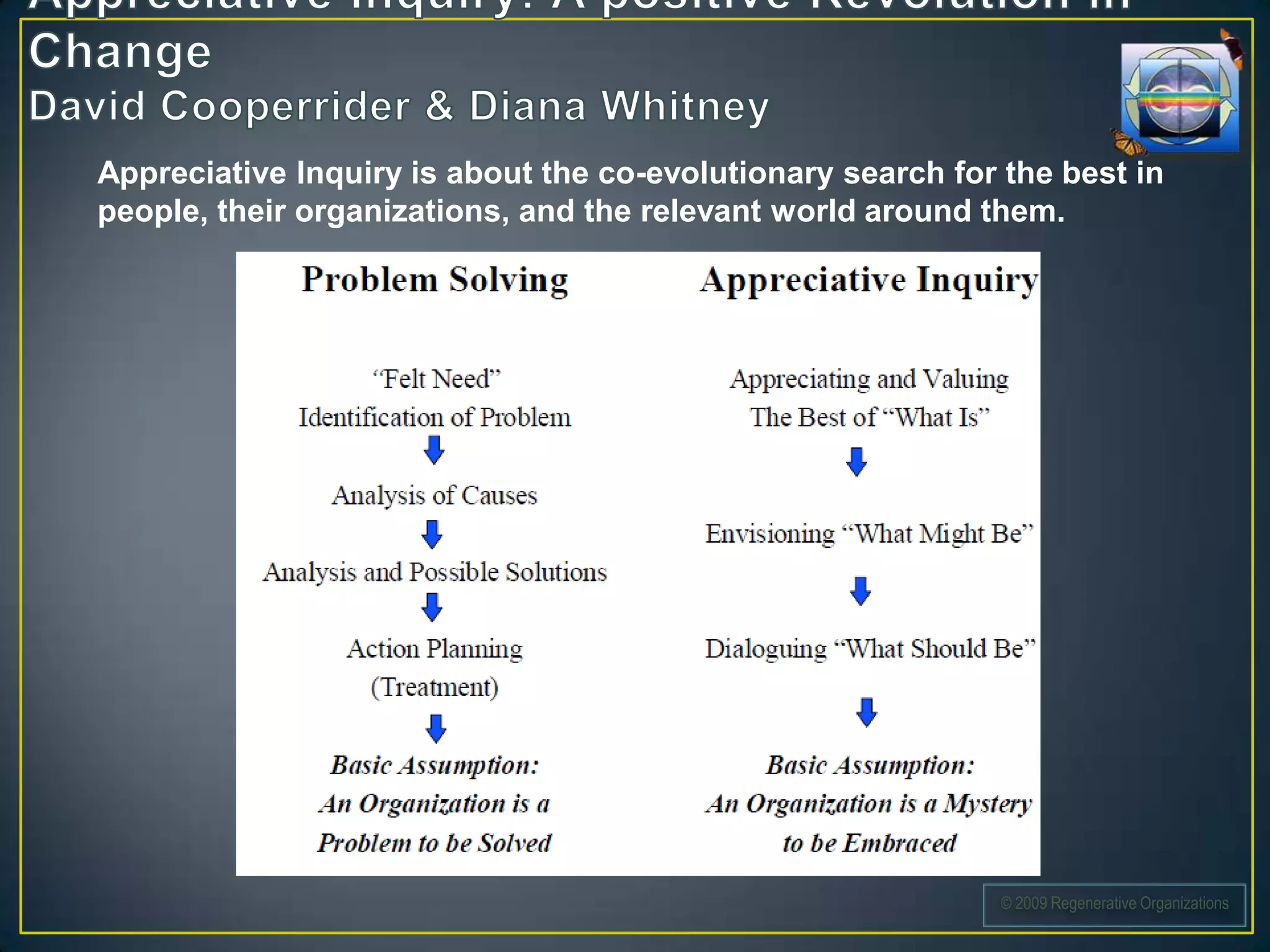
Appreciative Inquiry is about the co-evolutionary search for the best in
people, their organizations, and the relevant world around them.


                                                            © 2009 Regenerative Organizations
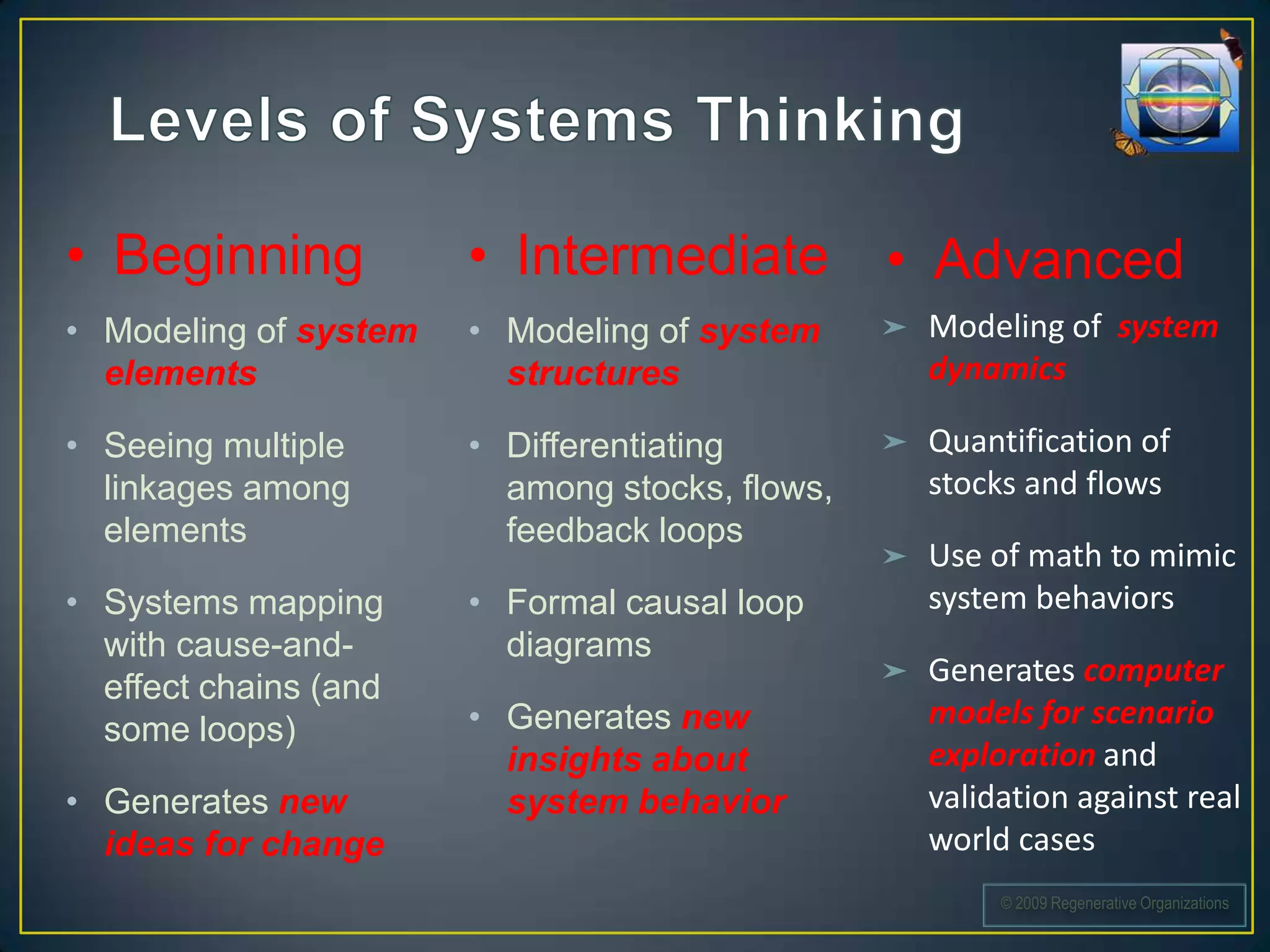
• Beginning            • Intermediate           • Advanced
• Modeling of system   • Modeling of system     ➤   Modeling of system
  elements               structures                 dynamics

• Seeing multiple      • Differentiating        ➤   Quantification of
  linkages among         among stocks, flows,       stocks and flows
  elements               feedback loops
                                                ➤   Use of math to mimic
• Systems mapping      • Formal causal loop         system behaviors
  with cause-and-        diagrams
                                                ➤   Generates computer
  effect chains (and
  some loops)          • Generates new              models for scenario
                         insights about             exploration and
• Generates new          system behavior            validation against real
  ideas for change                                  world cases
                                                         © 2009 Regenerative Organizations

Rl slideshare

  • 1.
    Regenerative Organizations Growing prosperity,celebrating community, enhancing the health of all species for all time John Hardman, Ph.D. Founder jhardman@regenerativeorganizations.com http://regenerativeorganizations.com © 2009 Regenerative Organizations
  • 2.
    Two core premises: •Behaviors may drive change, but they can only be as effective as our awareness, understanding, and skill in working with the systems in which they operate. • We need to focus as much attention on the causal level of our consciousness as we do on the effects produced by our behaviors. This is where truly regenerative change is made possible. This requires a mindset willing to radically redesign itself before it can truly restore the present or redesign the future. © 2009 Regenerative Organizations
  • 3.
    © 2009 RegenerativeOrganizations
  • 4.
    © 2009 RegenerativeOrganizations
  • 5.
    Integrated Worldview (the whole picture) Regenerative Capacity Engagement +75% Commitment 51 – 75% The Journey to Regeneration Compliance 26 – 50% Skepticism 11 – 25% Ignorance/Resistance -10% Fragmented Worldview © 2009 Regenerative Organizations
  • 6.
    Development of increasinglyhigher levels of awareness and understanding of systems that translate into behaviors that: • Go beyond preserving existing natural and social resources; • Restore and create new resources that have become depleted through overuse or misuse; and • Ensure a healthy bottom line. Regeneration results from radical innovation, which we define as the capacity to do and make things in entirely new ways unconditioned by prior assumptions. This calls for an integral, systematic and systemic approach to everything an organization does. © 2009 Regenerative Organizations
  • 7.
    Regenerative Leadership Framework© EXTERIOR / OBJECTIVE WORLD Personal Collective behaviors, LEADERSHIP behaviors, competencies, an systems, competencies, and •Purpose- d skills skills •Backcasting driven •Purpose-driven leadership •Third-order change •Shared •Iterative observation •Collective strategy to •Iterative •Deep listening prototype and mainstream •Multi-stakeholder best solutions for ideal COLLECTIVE INDIVIDUAL engagement futures (triple-top line) 2 4 Field of Engagement & Emerging Personal mindset, Consciousness 1 3 Collective purpose, and worldview mindset, culture, purpose and worldview •Awakening to a heightened sense of purpose •Fostering collective •Creative intelligence purpose through generative •Systems thinking conversation •Global ethics •Transconceptual dynamics •Emerging futures •Triple-loop learning Circular Systems of INTERIOR / SUBJECTIVE WORLD Collaboration © 2009 Regenerative Organizations
  • 8.
    Through Regenerative Organizations,we provide private enterprises and community agencies with the tools they need to redesign their operating model in response to: • A genuine desire for innovation to reposition themselves in a changing economic, social, and natural environment; • Regulatory, social, and market pressures and demands. © 2009 Regenerative Organizations
  • 9.
    • Business •Small, medium and large enterprises • Community • Nonprofits, NGOs, Cities, Regions • Education • Universities and schools © 2009 Regenerative Organizations
  • 10.
    The regenerative capacity-buildingprocess is designed to help our clients and students: • Fully understand where they are • Envision where they want to go • Design the best plan to get there • Implement and conduct mid-course corrections • Assess the regenerative and sustainability quality of results. © 2009 Regenerative Organizations
  • 11.
    • Regenerative StrategicPlanning • ‘Desirable Futures’ Vision development • Baseline Data Collection and Benchmarking (assessment, analysis, measurement, reporting) • Policy development • Regenerative Coaching, Education and Training • Executives • Line Managers • Teams © 2009 Regenerative Organizations
  • 12.
    • Situational Analysis • Regenerative Capacity Index • Sustainability Change Agentry Self-assessment • Sustainability Assessment (S-CORE) • Strategic Planning, Implementation, Evaluation • Backcasting Visioning Process • Regenerative Leadership Coaching • Green Six Sigma Team Building • ISIS Sustainability Accelerator (Compass, Pyramid, Amoeba, Stratesphere) © 2009 Regenerative Organizations
  • 13.
    ‘Profitability?’ Over 5 yearperiod, 75% projected expansion of sustainable business development and investing in the U.S.: 2009 USD20 B 2011 USD28 B (estimated) 2014 USD35 B (projected) (See Sustainability: The Next 3 to 5 years [Enviance]) © 2009 Regenerative Organizations
  • 14.
    We have developedproprietary and acquired sustainability strategic planning tools to provide the programs and tools to make this possible. • Regenerative Leadership Framework © • Regenerative Capacity Index © • ISIS Accelerator* for Sustainability Strategic Planning • S-CORE* (Sustainability – Competency and Opportunity Rating and Evaluation) • *Licensee © 2009 Regenerative Organizations
  • 15.
    John Hardman, Ph.D. Mike Terry & Jamie Schlinkmann Founder and CEO Principals Regenerative Leadership Education & INERJY – Wind turbines Training Strategic Planning for Regeneration Ed Strobel President Patricia Hardman Sunshine Solar Services Senior Partner Group Dynamics & Contemplative Albert Razon Practices Principal Solaris Energy – Solar water heaters Jeffrey Lynne, Esq., LEED AP Weiner & Lynne, P.A. Marcell Haywood Environmental Policy & Law President and COO DIRT PROS EVS Daniel Meeroff, Ph.D. Sustainable Property Management Florida Atlantic University Environmental Engineering Strategic LLC Florida Green Lodging Program Sustainable Business Consulting (Broward) © 2009 Regenerative Organizations
  • 16.
    I= P xA x T Population x Affluence x Technology (Paul & Anne Ehrlich) I= P x A T2 Shift 1: Population x Affluence mitigated by Technology (Ray Anderson) I= P x a T2 x H Shift 2: more happiness ‘H’ with less stuff ‘a’ (Ray Anderson) © 2009 Regenerative Organizations
  • 17.
    • Prosperity withoutgrowth - Tim Jackson • Resource-based economy – Jacque Fresco (Venus Project) Reduce – Reuse - Recycle © 2009 Regenerative Organizations
  • 18.
    © 2009 RegenerativeOrganizations
  • 19.
    © 2009 RegenerativeOrganizations
  • 20.
    © 2009 RegenerativeOrganizations
  • 21.
    Regenerative Capacity Index© © 2009 Regenerative Organizations
  • 22.
    THE JOURNEY OFINDIVIDUALS AND ORGANIZATIONS TO REGENERATION INTEGRATED Individual Local/Organizational Global WORLDVIEW •Awakening •Humility and courage from Backcasting •Heightened sense of purpose non-charismatic transforming Triple loop learning LEVEL 3 •Vision beyond sustainability leadership (higher purpose is Transconceptual dynamics ENGAGED •Systems thinking, everything the driver) Third order change is interconnected – Global •Multi-stakeholder engagement Circular organization World-centric (All of Us) ethics •Literally everyone is critical to Triple top line: “How can we INDIVIDUAL MINDSET /BEHAVIORS Post-conventional moral •Intra & intergenerational the decision making process grow prosperity, celebrate development (future) •“Leadership from within” our community, and (Kohlberg) •Urgency “Check your ego and logo at enhance the health of all •Fearlessness – courage the door” species?” •“Inner work” •“Bring everybody involved to •“… more important than me” the table before you begin” •“… butterfly mindset” •“Strategic planning for 50 •“I get in people’s faces, but in years” a nice way” LEVEL 2 •Compliance in isolation •Weighting between Global efforts that show COMPLIANT/COMMITTE •Ethno-centric ethics compliance and commitment in commitment to D •Local perspective some areas (e.g. economics, local/organizational agenda Ethno-centric (Us) •Mid -term vision and/or education, environment Integration stronger than Conventional and social justice) compliance and (Kohlberg) fragmentation LEVEL 1 •Self-serving ethics •Partial compliance with Forced compliance with RESISTANT/SKEPTICAL •Short-term vision fragmented external policy and integrated external policy and Self-centered (Me) •Distrustful of evidence regulation regulation © 2009 Regenerative Organizations Pre-conventional •“Fear and greed” •Single bottom line “Sticks and carrots” 22 © 2009 John Hardman – All rights reserved (Kohlberg) •“Silo effect”
  • 23.
    Brundtland Commission Report1987 “Sustainable development is development that meets the needs of the present without compromising the ability of future generations to meet their own needs" KEY CONCEPTS OF SUSTAINABLE DEVELOPMENT • The concept of needs, in particular the essential needs of the world’s poor, to which overriding priority should be given; and • The idea of limitations imposed by the state of technology and social organization on the environment’s ability to meet present and future needs.” © 2009 Regenerative Organizations
  • 24.
    The Natural Step(Karl Henrik Robèrt, 1991) To become a sustainable society we must...: 1. eliminate our contribution to the 2. eliminate our contribution to the progressive buildup of substances progressive buildup of chemicals and extracted from the Earth's crust (for compounds produced by society (for example, heavy metals and fossil example, dioxins, PCBs, and DDT ) fuels) 3. eliminate our contribution to the progressive physical degradation 4. eliminate our contribution to conditions and destruction of nature and natural that undermine people’s capacity to meet processes (for example, over their basic human needs (for example, harvesting forests and paving over unsafe working conditions and not critical wildlife habitat); and enough pay to live on). © 2009 Regenerative Organizations
  • 25.
    The Natural Step(Karl Henrik Robèrt, 1991) To become a sustainable society we must...: 1. eliminate our contribution to the 2. eliminate our contribution to the progressive buildup of substances progressive buildup of chemicals and extracted from the Earth's crust (for compounds produced by society (for example, heavy metals and fossil example, dioxins, PCBs, and DDT ) fuels) 3. eliminate our contribution to the progressive physical degradation 4. eliminate our contribution to conditions and destruction of nature and natural that undermine people’s capacity to meet processes (for example, over their basic human needs (for harvesting forests and paving over example, unsafe working conditions and critical wildlife habitat); and not enough pay to live on).
  • 26.
    Regenerative Strategy Cycle Step 1: Situational Analysis Step 2: Strategy Where are we now? Where do we want to go and Research: why? • Regenerative Capacity Index • Vision development • Interviews • Backcasting Strategy • Baseline data collection & analysis • Generative Conversations • Crossed-SWOT analysis Main Question: What is the most important change that we want to make? Process: How will we get Step 3: Implementation Step 5: Assessment & all our stakeholders How are we going to get there? Evaluation committed and capable of • Regenerative Leadership How will we know that we have driving this change? Framework arrived? • Integrated Design Process • Report performance against • Appreciative Inquiry objectives • Action Learning • Institutionalize changes • Refine/redefine Main Question Step 4: Sustaining How will we know that we are on the right track? • Monitor implementation • Refine Main Question • Mid-course corrections • Celebrate short term wins • World Cafe © 2009 Regenerative Organizations
  • 27.
    TOMORROW Strategy: Clean Technology Strategy: Develop the Sustainability Vision Drivers Drivers sustainable Create a shared • Climate competencies of the roadmap to meet Change future unmet needs • Disruption • Resource • Clean Tech Payoff: Payoff: Depletion • Footprint Innovation & • Poverty Sustainable Growth Repositioning Trajectory SUSTAINAB EXTERNAL INTERNAL LE VALUE Drivers Strategy: Strategy: Drivers Pollution Prevention Product Stewardship • Pollution Minimize waste and • Civil • Material Integrate stakeholder emissions from views into business Society Consumptio operations • n process Payoff: Transparency • Waste Payoff: • Connectivity Cost & Risk Reputation & Reduction Legitimacy TODAY © 2009 Regenerative Organizations
  • 28.
    "Conventional Construction Silos" and "Green Campus Stakeholders" diagrams originally published in Smart by Nature: Schooling for Sustainability by Michael K. Stone/Center for Ecoliteracy. © Copyright 2009 Center for Ecoliteracy. Reprinted with permission. All rights reserved. For more information, visit www.ecoliteracy.org.
  • 29.
    In a conventional“silo” process, the client works mostly with an architect, while various Client engineers (electrical, civil, mechanical, etc .) and specialists in acoustics, lighting, stormwater Architect Contractor management, etc., work in isolation from each other. Landscape Primary Engineers Architect Specialists Secondary Specialists © 2009 Regenerative Organizations © Copyright 2009 Center for Ecoliteracy
  • 30.
    Specialist s In an integrated design process, key stakeholders begin collaborating as early Interdisciplinar as possible in order to y Consultants design and construct Architec the most efficient and Client t effective whole system. Facilitator Project Commissio Manager n-ing Agent Contracto r © 2009 Regenerative Organizations © Copyright 2009 Center for Ecoliteracy Users
  • 31.
    Life Cycle Assessment Are we obeying nature's laws? Design for Environment REGENERATION ECOLOGY Industrial Ecology FRACTAL Resource management Eco-effectiveness/upcycle Environmental & social Industrial Re-evolution health & wellbeing Cradle to Cradle Aesthetic design EQUITY/ECOLOGY ECOLOGY/ECONOMI REGENERATIVE CS How is this product/service going Is our ecological strategy profitable? PRACTICE & to affect future generations? SUSTAINABILITY Greening of business Reduce exposure of workers/ Eco-efficiency/reduce/reuse/recycle customers to toxins in the Cradle to grave workplace/home EQUITY ECONOMICS Do people respect one EQUITY/ECONOMICS Can I make or provide my another? Are men and women paid fairly and equally? product or service at a profit? Social justice Corporate social responsibility Economism (Brandt, 2004) Free trade Fair trade Communist Manifesto (Marx & Exploitation Inclusion Engels, 1848) Fair wages Free market capitalism Union management Stakeholder management Shareholder management © 2009 Regenerative Organizations Based on Sierpinski's triangle and the fractal geometry of Benoit Mandelbrot (1975)
  • 32.
    © 2009 RegenerativeOrganizations
  • 33.
    Appreciative Inquiry isabout the co-evolutionary search for the best in people, their organizations, and the relevant world around them. © 2009 Regenerative Organizations
  • 34.
    • Beginning • Intermediate • Advanced • Modeling of system • Modeling of system ➤ Modeling of system elements structures dynamics • Seeing multiple • Differentiating ➤ Quantification of linkages among among stocks, flows, stocks and flows elements feedback loops ➤ Use of math to mimic • Systems mapping • Formal causal loop system behaviors with cause-and- diagrams ➤ Generates computer effect chains (and some loops) • Generates new models for scenario insights about exploration and • Generates new system behavior validation against real ideas for change world cases © 2009 Regenerative Organizations