Knowing in Practice: Enacting a Collective
          Capability in Distributed Organizing
                                                       Wanda J. Orlikowski
        Sloan School of Management. MIT (E53-325}. 50 Memorial Drive. Cambridge. Massachusetts 02142
                                               wanda@mil.edu


                                                                        global product development? In this paper. I wish to ex-
Abstract                                                                plore a possible explanation—an explanation which rests
In this paper, I outline a perspective on knowing in practice           on and elaborates on the premise that effective distributed
which highlights the essential role of human action In knowing
                                                                        organizing is an enacted capability constituted in the ev-
how to get things done in complex organizational work. The
                                                                        eryday practices of global product development activities.
perspective suggests that knowing is not a static embedded ca-
pability or stable disposition o actors, but rather an ongoing
                                                                        Such an explanation leads away from the focus on or-
social accomplishment, constituted and reconstituted as actors          ganizational knowledge occupying much of the contem-
engage the world in practice. In interpreting the findings of an        porary discourse on knowledge management, and to-
empirical study conducted in a geographically dispersed high-           wards a focus on organizational knowing as emerging
tech organization. I suggest that the competence to do global           from the ongoing and situated actions of organizational
product development is both collective and distributed,                 members as they engage the world. It is an explanation
grounded in the everyday practices of organizational members.           grounded in what it is people do every day to get their
I conclude by discussing some of the research implications of           work done.
a perspective on organizational knowing in practice.
(Distributed Competence; Geographically Distributed Organizing: Know-
                                                                           My focus on organizational knowing rather than knowl-
ing: Organizational Knowledge: Organizing Practices)                    edge is informed by the sociological work of Giddens
                                                                        (1984) and the anthropological studies of Lave (1998),
                                                                        Hutchins(1991. 1995). and Suchman (1987). In these ac-
                                                                        counts, individuals are understood to act knowledgeably
                                                                        as a routine part of their everyday activity. They are seen
                                                                        to be purposive and teflexive. continually and routinely
With the ititensification of globalization, acceleration in             monitoring the ongoing flow of action—their own and
the rate of change, and expansion in the use of informa-                that of others—and the social and physical contexts in
tion technology, particular attention is being focused on               which their activities are constituted. As Giddens notes,
the opportunities and difficulties associated with sharing              such activities suggest an '"immense knowledgeability in-
knowledge and transferring "best practices" within and                  volved in the conduct of everyday life" (Giddens and
across organizations (Leonard-Barton 1995. Btown and                    Pierson 1998. p. 90). My intention here is to use the lens
Duguid 1998. Davenport and Prusak 1998). Such a focus                   of organizational knowing to understand how members
on knowledge and knowledge management is particularly                   of global product development organizations generate
acute in the context of global product development, where               and sustain knowledgeability in their distributed opera-
the development and delivery of timely and innovative                   tions.
products across heterogeneous cultures, locales, and mar-                  The conceptual argument developed here was elabo-
kets are critical and ongoing challenges. Dealing effec-                rated through an empirical study I conducted into the
tively with such challenges requires more than just good                product development activities of a large, globally dis-
 ideas, strong leaders, and extensive resources; it also re-            persed, high-tech organization which I call Kappa, ln
quires a deep competence in what may be labeled "dis-                   what follows, I first lay out the key elements of current
 tributed organizing"—the capability of operating effec-                perspectives on knowledge before developing my per-
 tively across the temporal, geographic, political, and                 spective on organizational knowing, i then explore this
 cultural boundaries routinely encountered in global                    perspective on knowing in terms of the field study I con-
 operations.                                                            ducted within Kappa. While organizational knowing ap-
   What constitutes effective distributed organizing in                 pears particularly relevant to the distributed organizing of


 1047-7039/02/1303/0249/$O5.O0                                                           ORGANtZATiON SCIENCE, © 2002 INFORMS
 1526-5455 electronic ISSN                                                              Vol. 13, No. 3, May-June 2002, pp. 249-273
WANDA J. ORLIKOWSKI         Knowing in Practice


 global product development, such a capability may also            Brown and Duguid (1998), while they share with Tsou-
 be salient in many other organizational activities. I thus      kas (1996) a view of knowledge as emergent, depart from
 conclude the paper by examining the broader implications       his integrationist focus by retaining a distinction between
 for organizational research of a perspective on organiza-      types of knowledge. In particular, they adapt Ryle's
 tional knowing.                                                (1949) articulation of "knowing that" and "knowing how"
                                                                to argue that "know-how" is different from "know-what"
                                                                in its dispositional character. Thus, know-how is "the par-
 Perspectives on Organizational                                 ticular ability to put know-what into practice" (Brown
 Knowledge                                                      and Duguid 1998. p. 91). As such, it is a capability em-
 The question of knowledge has long occupied philoso-           bedded in particular communities of practice (Brown and
 phers and sociologists of science, but it is only relatively   Duguid 1998. p. 95). This allows know-how to be easily
 recently that organizational researchers have become in-       moved within and among communities with similar prac-
 terested in this topic. Indeed, "knowledge" has become         tices, but makes it "sticky" or difficult to move across
 the watchword of contemporary organizations, and re-           communities of practice (Brown and Duguid 1998, pp.
 search interest in knowledge, knowledge-based organi-          100-102). Recognition of the "stickiness'" of know-how
 zations, and knowledge management has accelerated              has led to various proposals for facilitating knowledge
 (Kogut and Zander 1992. Starbuck 1992, Nonaka and              sharing across communities of practice, such as: devel-
 Takeuchi 1995. Tsoukas 1996. Teece 1998). Two distinct         oping boundary practices (Wenger 1998), engaging
 perspectives on organizational knowledge are currently         knowledge brokers (Brown and Duguid 1998), using
 discernable. One proposes that organizations have differ-      boundary objects (Star 1989, Henderson 1991. Carlile
ent types of knowledge, and that identifying and exam-          1998). and participating in cross-community communi-
 ining these will lead to more effective means for gener-       cation forums (Boland and Tenkasi 1995).
ating, sharing, and managing knowledge in organizations.
                                                                   Much has been leamed, and much will continue to be
Tsoukas (1996, p. 13) characterizes such a perspective as
                                                                learned, from the two perspectives on organizational
"taxonomic." with researchers developing classifications
                                                                knowledge discussed above. Significant portions of this
of knowledge and then using these to examine the various
                                                                work, however, treat knowledge as either a thing (to be
strategies, routines, and techniques through which differ-
                                                                captured, stored, transmitted, etc.) or a disposition
ent types of knowledge are created, codified, converted,
                                                                (whether individual or collective) resulting in "objectivist
transferred, and exchanged (Nelson and Winter 1982,
                                                                reification" on the one hand or "subjectivist reduction"
Leonard-Baiton 1992, Hedlund 1994, Nonaka 1994.
                                                                on the other. Taylor makes a similar point about mles
Nonaka and Takeuchi 1995. Winter 1987. Teece 1998,
                                                                (1993, pp. 57-58, emphasis added):
Hansen 1999). Many of these knowledge classifications
take as their starting point the distinction made by Polanyi       In its operation, the rtile exists in the practice it 'guides.' . . .
(1967) between tacit and explicit knowing. This classic            |T]he practice not only fulfills the rules, but also gives it con-
distinction is then typically used to elaborate additional         crete shape in particular situalions. . . . In fact, whal this reci-
knowiedge dichotomies, for example, local vs. universal.           procily shows is ihal the 'rule' lies essentially in the practice.
codified vs. uncodified. canonical vs. noncanonical. pro-          The rule is what is animating the practice at any given time, not
cedural vs. declarative, and know-how vs. know-what.               some formulation behind il, inscribed in our thoughts or our
                                                                   brains or our genes or whatever. That is why the rule is, at any
   Some researchers have been critical of a purely taxo-           given time, what the practice has made it.
nomic perspective, arguing that it reifies knowledge by
treating it as a stock or set of discrete elements. Further-       Substituting "knowledge" for "mle" in the above quote
more. Tsoukas (1996, p. 14) observes that a taxonomic           highlights the difference between a view of knowledge as
perspective does not recognize that "tacit and explicit         separate entity, static property, or stable disposition em-
knowledge are mutually constituted . . . [essentially] in-      bedded in practice, and a view of knowledge as "at any
separable." In particular, he argues that tacit knowledge       given time, what the practice has made it." The latter view
"is the necessary component of all knowledge; it is not         sees knowledge as enacted—every day and over time—
made up of discrete beans which may be ground, lost or          in people's practices. It leads us to understand knowledge
reconstituted." Along with others (Boland and Tenkasi           and practice as reciprocally constitutive, so that it does
1995. Davenport and Prusak 1998, Cook and Brown                 not make sense to talk about either knowledge or practice
1999), he argues instead for an integrated approach that        without the other. It suggests there may be value in a
affords a view of organizationai knowledge as processual,       perspective that does not treat these as separate or sepa-
dispersed, and "inherently indeterminate" (1996, p. 22).        rable, a perspective that focuses on the knowledgeability


250                                                                  ORGANIZATION SCIENCK/VOI. 13. No. 3. May-Jtjne 2OQ2
WANDA J. ORLIKOWSKI            Knowing in Practice


of action, that is on knowing (a verb connoting action,                language . . . [whichi converted the child's knowing-in-
doing, practice) rather than knowledge (a noun connoting               action to knowledge-in-ixcUon" (1983. p. 59).
things, elements, facts, processes, dispositions).                        In a recent paper. Cook and Brown (1999) introduce
   The increased interest within organizational studies in             the notion of knowing into the discourse on organiza-
social theories emphasizing practice provides some con-                tional knowledge, while maintaining the conventional
ceptual grounding for the development of a practice-                   distinction between tacit and explicit forms of knowledge.
based perspective on organizational knowing. I develop                 While this recognition of knowing is helpful, it neverthe-
one such possibility here, and then elaborate it by drawing            less assumes that tacit knowledge is distinct and separable
on tiiy empirical study of a global product development                from knowing, and thus action. The perspective I adopt
organization. I see this perspective as complementing, not             here rests on an alternative assumption—that tacit knowl-
substituting for. the perspectives on organizational                   edge is a form of "knowing." and thus inseparable from
knowledge discussed above, I believe it can highlight                  action because it is constituted through such action.
some aspects of organizational knowledgeability that may                  The primary role of action in the process of knowing
be overlooked in our tendency to privilege knowledge at                is evident in Ryle's (1949) claim that knowledge is es-
the expense of knowing.                                                sentially a "knowing how,"" a capacity to perform or act
                                                                       in particular circumstances. Using an example of a boy
                                                                       playing chess, he suggests that the boy can be said to
A Perspective on Knowing in Practice                                   "know how"" to play chess if his action displays the rules
Both Ryle (1949) and Polanyi (1967) emphasize A      v                 of chess, even if he cannot recite them. Similarly, Polanyi
in their writings. While the distinction between knowing                (1967) points to the tacit knowing that is evident in our
and knowledge may seem like a subtle and inconsequen-                   ability to recognize faces in a crowd or to ride bicycles
tial lexical shift. I believe it has substantial conceptual             even as we cannot articulate precisely how it is that we
implications. In particular, it may lead us to miss a funda-            do these. Thus, we recognize the "knowing how"' (the
mental aspect of Schon's (1983, p. 49) observation—based                capacity to play chess or ride a bicycle) by observing the
on his field work but informed by Ryle and Poianyi—                     practice (chess-playing or bicycle-riding). However, the
that "our knowing is in our action." Schon examined the                 practice has no meaning apart from the "knowing how"
practice of five professions and argued that the skillful               that constitutes it. Remove the "knowing how" of playing
practice exhibited by the professionals did not consist of              chess from the practice, and we no longer have anything
applying some a priori knowledge to a specific decision                 recognizable as chess-playing practice. The two are in-
or action, but rather of a kind of knowing that was in-                 separable as Ryle (1949, p. 32) notes:
herent in their action. As he puts it (1983, p. 49):
                                                                          . . . 'ihinking what I am doing' does noi connote 'both thinking
   When we go about ihe spontaneous, intuitive performance of             what to do and doing it." When I do something intelligently . . .
   the actions of everyday life, we show ourselves to be knowl-           I am doing one thing and not two. My perfonnance has a special
   edgeable in a special way. Often we cannot say whal it is lhat         procedure or manner, not special antecedents.
   we know. . . . Our knowing is ordinarily tacit, implicit in our
   pattern of action and in our feel for the stuff with which we are
                                                                       This mutual constitution of knowing and practice—while
   dealing. It seems right to say that our knowing is in our action.   hard to conceptualize in our conventional theoretical
                                                                       frameworks—is a key premise underpinning Giddens'
  What is highlighted in Schon's observation is the es-                (1984) theory of structuration. Maturana and Varela's
sential role of human agency in knowledgeable perfor-                  (1989) notion of autopoiesis. and Lewontin's (I995)con-
mance. Maturana and Varela (1998, pp. 27, 29) similarly                structionist biology. It is also effectively depicted in
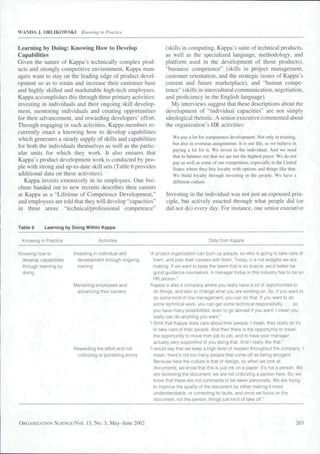
define knowing as "effective action." and write that "all              Escher"s (1948) lithograph Drawing Hands (see Figure
doing is knowing, and all knowing is doing."" When we                   1), where the right hand draws the left hand even as the
focus primarily on knowledge, we lose the centrality of                left hand draws the right hand.
action in knowledgeability. Schon (1983) suggests that                     Recent work in cognitive anthropology has reinforced
the tendency to slip from a focus on knowing to that of                the essentially mutual constitution of knowing and prac-
knowledge is deeply rooted in our theoretical enterprise               tice. Based on extensive field work, Lave (1988) and
as we attempt to develop (and test) theories that make                 Hutchins (1991. 1995) have found that cognition in prac-
sense of (or predict) effective action. He cites the example           tice (or "in the wild" as Hutchins evocatively puts it) is
of researchers studying how children leam to play with                 a culturally situated and ongoing social activity. In a se-
wooden blocks, observing that as the researchers viewed                ries of studies that examined math-problem-solving ac-
the children's actions they were "cotnpelled to invent a               tivities in adults, Lave (1988) persuasively shows that


 ORGANIZATION SCIENCH/VOI.         13, No. 3, May-June 2002                                                                               251
WANDA J. ORLIKOWSKI            Knowing in Practice


 Figure 1     M. C, Escher's "Drawing Hands"


':& 2001 Cordon Art B.V. - Baarn - Holland. All rights reserved


competence in math is not some abstract knowledge that               Giddens (1984. p. 4) defines human knowledgeability
individuals either do or do not have, but a "knowledge-           as "inherent within the ability to 'go on' within the rou-
in-practice." a situated knowing constituted by a person          tines of social life." Such ability to "go on" is inseparable
acting in a particular .setting and engaging aspects of the       from human agency, where agency is the capacity of hu-
self, the body, and the physical and social worlds (Lave          mans to "choose to do otherwise." Knowledgeability or
 1988. pp. 180-181). Based on her studies. Lave writes            knowing-in-practice is continually enacted through peo-
that "knowledge is not primarily a factual commodity or           ple's everyday activity: it does not exist "out there" (in-
compendum of facts, nor is an expert knower an ency-              corporated in external objects, routines, or systems) or "in
clopedia. Instead knowledge takes on the character of a           here" (inscribed in human brains, bodies, or communi-
process of knowing" (1988. p. 175). Spender (1996b, p.            ties). Rather, knowing is an ongoing social accomplish-
64) similarly observes that: "knowledge is less about truth       ment, constituted and reconstituted in everyday practice.
and reason and more about the practice of intervening             As such, knowing cannot be understood as stable or en-
knowledgeably and purposefully in the world."                     during. Because it is enacted in the moment, its existence


252                                                                    ORGANIZATION SCIENCE/VOI.     13, No. 3. May-June 2002
WANDA J. ORLIKOWSKI        Knowing in Practice


is virtual, its status provisional. Knowing how to ride a       as they change their practices. People improvise new
bicycle, recognize faces, play basketball, make fine flutes     practices as they invent, slip into, or leam new ways of
(Cook and Yanow 1996), or launch and recover planes             interpreting and experiencing the world. For example.
on an aircraft carrier (Weick and Roberts 1993) are ca-         Schon (1983) shows that situated practice often involves
pabilities generated through action. They emerge from the       reflection and experimentation, and how through such in-
situated and ongoing interrelationships of context (time        the-moment reconstruction of thought and action, know-
and place), activity stream, agency (intentions, actions),      ing may be altered. Similarly, Barrett (1998) and Weick
and structure (normative, authoritative, and interpretive).     (1993) argue that improvisation in practice is a powerful
Because these capabilities are continually generated in         means of increasing organizational innovation, leaming,
recurrent action, continuity is achieved and preserved as       and change. Thus, when people change their practices,
people interpret and experience their doing as "the same"       their knowing changes. From such a perspective, people
over time and across contexts (Lave 1988. p. 187). Thus,        leam to know differently as they use whatever means,
as we bicycle to work every day, we begin to take for           motivation, and opportunity they have at hand to reflect
granted that we "know how" to ride a bicycle, and lose          on, experiment with, and improvise their practices. The
sight of the way in which our "knowing how" is an active        Hungarian soldiers did this once they found a map and
and recurrent accomplishment.                                   began to use it.
    People's ongoing engagement in social practices, and           While examinations of knowing have examined a va-
thus their reproduction of the knowing generated in those       riety of settings, most have focused on the work practices
practices, is how they reconstitute knowledgeability over       of individuals (Suchman 1987, Lave 1988, Orr 1996) or
time and across contexts. Continuity of competence, of          that of focal groups proximate in time and space (Weick
skillful practice, is thus achieved not given. It is a recur-   and Roberts 1993, Hutchins 1995, Pentland 1995. Cook
rently but nevertheless situated and enacted accomplish-        and Yanow 1996). Little is known about the process of
ment which cannot simply be presumed. The status of             knowing in complex organizations that are also geograph-
competence is more provisional—because it is always to          ically distributed. In such contexts, knowing in practice
be achieved—than we tend to assume when we treat it as          is constituted by the ongoing activities of diverse and dis-
given. This is made clear in the accounts of deadly or          tributed individuals. The inherent complexity, multiplic-
expensive accidents described by Weick (1993. 1996)             ity, and dispersion of such settings complicates how we
and Weick and Roberts (1993), where apparently com-             think about and study organizational knowing. It suggests
petent practitioners (firefighters, pilots, and aircraft car-   the importance of examining how people in their ongoing
rier crew) were unable to reproduce skilled performances        practices constitute knowing how to engage in distributed
in certain circumstances. It is also evident in the example     organizing.
recounted by Weick (1987) of the Hungarian soldiers lost           Existing approaches to studying distributed organizing
in a snowstorm in the Alps who eventually found their           tend to focus on the importance of knowledge transfer
way back to camp by discovering a map of the Pyrenees.          across boundaries, and the value of generating a set of
Before they found the map, the soldiers could not be said       "best practices" that can be propagated through the dis-
to "know how" to get out of the Alps. As they themselves        persed operations. A view of knowing as enacted in prac-
reported: "we considered ourselves lost and waited for          tice does not view competence as something to be "trans-
 the end" (Weick 1987, p. 222). Yet, once they had found        ferred," and suggests that the very notion of "best
 the map, the soldiers were able to enact a collective com-     practices" is problematic. When practices are defined as
 petence that got them out of the Alps. As an officer de-       the situated recurrent activities of human agents, they
 scribed: "And then one of us found a map in his pocket.        cannot simply be spread around as if they were fixed and
That calmed us down. We pitched camp, lasted out the            static objects. Rather, competence generation may be
 snowstorm, and then with the map we discovered our             seen to be a process of developing people's capacity to
 bearings. And here we are" {1987, p, 222). The "knowing        enact what we may term "useful practices"—with use-
 how" to find their way back to camp which the soldiers         fulness seen to be a necessarily contextual and provi-
 displayed after their discovery of the map was a situa-        sional aspect of situated organizational activity.
 tionally enacted capability—constituted through reading
                                                                   In the research study described below, I explore the
 the map, using it to calm themselves and make sense of
                                                                globally dispersed, product development work of a large
 their surroundings, and then beginning to take purposive
                                                                and successful multinational organization (Kappa). The
 action towards finding a way out of the mountains.
                                                                empirical insights suggest a central role for practices that
   As people continually reconstitute their knowing over        produce and sustain a collective and distributed knowing
time and across contexts, they also modify their knowing        within the global organization. Such a focus on practices


ORGANIZATION SCIENCE/VOI.     13, No. 3, May-June 2002                                                                  253
WANDA J. ORLIKOWSKI              Knowing in Practice


has not been central to current research on either global                 soak up our cuslomers' needs, get a bit closer to the end user.
product development or organizational knowledge. Be-                      That way they can influence the direction our development takes
cause it may be a valuable perspective for understanding                  by having that knowledge. So thoie are the two main advan-
a range of organizational activities, it is the focus of my               tages, 1 think—the sourcing of competence and the proximity
                                                                          to the markets that we sell in.
attention here.
                                                                       Not only are the units globally dispersed, but many of the
Research Setting and Methods                                           engineers working in product development embody this
                                                                       geographic and cultural diversity. One subproject man-
 Kappa is a large software company headquartered in The
                                                                       ager pointed to himself as an example of Kappa's glob-
 Netherlands, and producing a small range of sophisticated
                                                                       alization: "My situation is quite typical for Kappa engi-
 and highly integrated systems software products.' In
                                                                       neers—I am a Greek working in Finland for a Dutch
  1998, it earned $8 billion in revenues, these revenues hav-
                                                                       company and using English to do my work." In total,
 ing grown nearly 15% on average since 1990, One of its
                                                                       some 2,000 engineers work in these 15 DUs. with each
 primary products is a specialized operating system (VOS)
                                                                       DU employing on average 150 software engineers (the
 installed on the mainframe computers of aboul 200 major
                                                                       smallest unit employs 15 engineers, the largest 800). Each
customers around the world. Kappa holds close to 40%
                                                                       DU is organized in terms of a matrix, with each engineer
share of this market. Given increasing competitive pres-
                                                                       participating in both a local deveiopment structure (e.g.,
sures, changing customer requirements, and continuing
                                                                       the Palo Alto DU), as well as a global product manage-
technology advances, new releases of the VOS product
                                                                       ment structure (e.g., the PO-98 organization developing
are produced every two to three years. These product de-
                                                                       the VOS-98 product). Each DU operates as a cost center
velopment efforts are accomplished through temporary
                                                                       with its own cost structure, and every year product man-
global project groups (known as Product Organizations
                                                                       agers in each PO contract for the engineering talent lo-
or POs) lasting from 18 to 24 months in duration, and
                                                                       cated within the DUs,
each involving the dedicated services of a few hundred
software engineers. Because of the complexity of the                      At the time of my study. Kappa had an enviable record
product development effort and the need to ensure con-                 of completing projects on time and generally satisfying
tinuity of customers' operations in the meantime, there                customer requirements. However, recent mergers in its
are at any one time within Kappa multiple temporary                    sector were increasing competitive pressure to reduce the
project groups managing different versions of the com-                 time-to-market of new products, and accelerating demand
pany's products. For example, when I was conducting my                 for more customizable features in the software. While
study in 1998, there were three POs in place to manage                 switching costs for customers of the VOS products were
the VOS product: one to maintain the currently installed               high, customers were becoming increasingly interested in
version (PO-97), one to complete development and test-                 capabilities that utilized the Internet and the Java lan-
ing of the next version of the product (PO-98), and one                guage. VOS, written in a proprietary software language,
to plan the design and development of the after-the-next               was not compatible with the Internet, and Kappa was un-
version of the product (PO-99).                                        der some pressure to tind ways to bridge existing func-
                                                                       tionality to the Internet, even as it attempted to develop
   Kappa's product development activities are distributed              a new generation of Internet-based VOS products.
across multiple local Development Units (known as
DUs). These DUs are located in 15 different locations                     My field study focused on the everyday work practices
spread over five continents. One senior executive ex-                  of Kappa's temporary product organizations and was con-
plained the rationale for Kappa's highly distributed prod-             ducted during six months in 1998. I spent time at five
uct development as follows:                                            local development units as well as Kappa's headquarters,
                                                                       interviewing a range of players associated with the VOS
  Doing product development from a distributed perspective—            product: software engineers (involved in planning, de-
  this is a strenglh of Kappa. I think it is something we have         sign, development, testing, and maintenance); DU staff
  managed quite well. . . . the advantages are obvious. There are
                                                                       (involved in quality assurance, career development, proj-
  several ones: first of all, you get access to resources wherever
                                                                       ect budgeting, and infrastructure support); DU managers,
  it is. Holland is a pretty small country and our universities just
  don't turn out the number of engineers that Kappa needs of the       project managers working for POs; and senior Kappa ex-
  right quality. So you get access to good people if you choose        ecutives (see Table 1 for details). I conducted 78 inter-
  your locations wisely. Another advantage is proximity to the         views in total, representing approximately 10% of all
  markets. The DUs work with our local companies and sit close         Kappa personnel involved with VOS product develop-
  to the marketing people. They can provide technical saies sup-       ment activities. Interviews lasted from 45 minutes to over
  pon, ean intiuence the sales process, and in doing so they also      three hours in length, and were conducted one-on-one


254                                                                        ORGANIZATION SCIENCE/VO1.          13, No. 3, May-June 2002
WANDA J. ORLIKOWSKI         Knowing in Practice


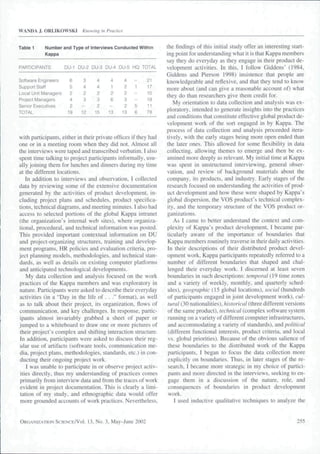
Table 1    Number and Type of Interviews Conducted Within        the findings of this initial study offer an interesting start-
           Kappa                                                 ing point for understanding what it is that Kappa members
                                                                 say they do everyday as they engage in their product de-
PARTICIPANTS          DU-1 DU-2 DU-3 DU-4 DU-5 HQ TOTAL          velopment activities. In this. I follow Giddens' (1984,
                                                                 Giddens and Pierson 1998) insistence that people are
Software Engineers      6    3      4     4       4 - 2 1        knowledgeable and reflexive, and that they tend to know
Support Staff           5    4      4      1    2   1   17       more about (and can give a reasonable account oO what
Local Unit Managers     2    2      2     2       2 - 1 0        they do than researchers give them credit for.
Project Managers        4    3      3     6     3   -   19
                                                                    My orientation to data collection and analysis was ex-
Senior Executives       2   -       2    -      2   5   11
                                                                 ploratory, intended to generate insights into the practices
TOTAL                  19   12     15    13    13   6   78
                                                                 and conditions that constitute effective global product de-
                                                                 velopment work of the sort engaged in by Kappa. The
                                                                 process of data collection and analysis proceeded itera-
with participants, either in their private offices if they had   tively. with the early stages being more open ended than
one or in a meeting room when they did not. Almost all           the later ones. This allowed for some flexibility in data
the interviews were taped and transcribed verbatim. 1 also       collecting, allowing themes to emerge and then be ex-
spent time talking to project participants informally, usu-      amined more deeply as relevant. My initial time at Kappa
ally joining them for lunches and dinners during my time         was spent in unstructured interviewing, general obser-
at the different locations.                                      vation, and review of background materials about the
    In addition to interviews and observation, I collected       company, its products, and industry. Early stages of the
data by reviewing some of the extensive documentation            research focused on understanding the activities of prod-
generated by the activities of product development, in-          uct development and how these were shaped by Kappa's
cluding project plans and schedules, product specifica-          global dispersion, the VOS product's technical complex-
tions, technical diagrams, and meeting minutes. I also had       ity, and the temporary structure of the VOS product or-
access to selected portions of the global Kappa intranet         ganizations.
(the organization's intemal web sites), where organiza-             As I came to better understand the context and com-
tional, procedural, and technical information was posted.        plexity of Kappa's product development, I became par-
This provided important contextual informalion on DU             ticularly aware of the importance of boundaries that
and project-organizing structures, training and develop-         Kappa members routinely traverse in their daily activities.
ment programs, HR policies and evaluation criteria, pro-         In their descriptions of their distributed product devel-
ject planning models, methodologies, and technical stan-         opment work. Kappa participants repeatedly referred to a
dards, as well as details on existing computer platforms         number of different boundaries that shaped and chal-
and anticipated technological developments.                      lenged their everyday work. I discerned at least seven
    My data collection and analysis focused on the work          boundaries in such descriptions: temporal (19 time zones
practices of the Kappa members and was exploratory in            and a variety of weekly, monthly, and quarterly sched-
nature. Participants were asked to describe their everyday       ules), geographic (15 global locations), social (hundreds
activities (in a "Day in the life of . . ." format), as well     of participants engaged in joint development work), cul-
as to talk about their project, its organization, fiows of       tural (30 nationalities), historical (three different versions
communication, and key challenges. In response, partic-          of the same product), technical (complex software system
 ipants almost invariably grabbed a sheet of paper or            running on a variety of different computer infrastructures,
jumped to a whiteboard to draw one or more pictures of           and accommodating a variety of standards), and political
 their project's complex and shifting interaction structure.     (different functional interests, product criteria, and local
 In addition, participants were asked to discuss their reg-      vs. global priorities). Because of the obvious salience of
 ular use of artifacts (software tools, communication me-        these boundaries to the distributed work of the Kappa
 dia, project plans, methodologies, standards, etc.) in con-     participants, I began to focus the data collection more
 ducting their ongoing project work.                             explicitly on boundaries. Thus, in later stages of the re-
    I was unable to participate in or observe project activ-     search, I became more strategic in my choice of partici-
 ities directly, thus my understanding of practices comes        pants and more directed in the interviews, seeking to en-
 primarily from interview data and from the traces of work       gage them in a discussion of the nature, role, and
 evident in project documentation. This is clearly a limi-       consequences of boundaries in product development
 tation of my study, and ethnographic data would offer           work.
 more grounded accounts of work practices. Nevertheless,            I used inductive qualitative techniques to analyze the


ORGANIZATION SCIENCEA/O1.        13, No. 3, May-June 2002                                                                  255
WANDA J. ORLIKOWSKI         Knowing in Practice


data (Agar 1980. Eisenhardt 1989, Glaser and Strauss               I shared my preliminary findings on the repertoire of
 1967, Strauss and Corbin 1990). informed by my focus           practices with a broad sample of Kappa members—en-
on practices and knowledgeability while remaining alert         gineers, unit and product managers, executives—and
to emerging ideas. Analysis consisted of multiple read-         these discussions generated additional details which elab-
ings of the interview transcripts, field notes, and docu-       orated and sharpened my interpretations and yielded ad-
mentation, and the identification of activities and issues      ditional insights.
that related to everyday product development work. The
literature on organizational knowledge and knowing fo-
cused some of my analysis here. For example, Kogut and
Zander's (1996) discussion of "what [firmsj know how            Knowing How to Do Global Product
to do" highlighted the importance of such conditions as         Development in Kappa
shared identity, convergent expectations, common com-
                                                                  In terms of conventional measures of profitability and
munication codes, and situated Ieaming.
                                                                  market leadership. Kappa is, and has been for a number
   The empirical success of Kappa suggests that a host of         of decades, a highly successful organization. Part of
elements—strategic, technological, financial, political,          Kappa's success clearly depends on its technical creativ-
and cultural—-are central to its ongoing accomplishment           ity, its strategic positioning, its leadership, and its cus-
of effective product development. Indeed, the data re-           tomer relations. However, I argue here that another im-
vealed the critical role of a number of these. I could not        portant aspect of Kappa's success is grounded in the
focus on all of them here, and instead chose to explore          everyday practices through which Kappa members con-
the theoretical thesis that knowing is an enacted capabil-        stitute a collective competence in knowing how to deliver
ity. Consequently, in analyzing my data I paid careful            innovative yet complex products in a timely fashion. We
attention to how members of Kappa described and made
                                                                 can begin to understand this aspect of Kappa's "knowing
sense of the activities they engaged in to accomplish their
                                                                 how" to do global product development work by exam-
work. By the word "activities," I mean what members
                                                                 ining the everyday practices of its members as they re-
actually did every day as part of their complex and dis-
                                                                 currently enact ways of dealing with the temporal, geo-
tributed product development work. Because these ac-
                                                                 graphic, political, cultural, technical, and social boundaries
counts of everyday product development work revealed
                                                                 they routinely encounter in their work. In particular, they
the salience of a multiplicity of boundaries that Kappa
members deal with daily, I concentrated my data analysis         deal with these boundaries through knowing how to nav-
on those specific activities that Kappa members associ-          igate (i.e., articulate, attend to. engage with) as well as
ated with their descriptions of boundaries.                      negotiate (i.e., redefine, reconstruct) them.
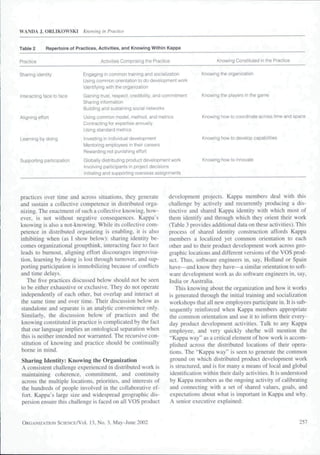
                                                                     Through the data analysis I identified a repertoire of
   This analysis generated a set of recurring themes that
referred to the activities engaged in to traverse the bound-     practices that when engaged in by Kappa members can
aries of time, space, culture, history, technology, and poli-    be seen to constitute, dynamically and recurrently over
tics which Kappa members routinely encountered in their          time, what we may call Kappa's competence in distrib-
work. I then reexamined the data in terms of these sets          uted organizing (see Table 2 for an overview of these
of activity themes, paying particular attention to how they      practices and their associated activities). The first two of
comprised particular practices associated with boundary          these practices—sharing identity and interacting face to
work. The unit of analysis in these considerations was          face—constitute a knowing of the organization and the
social practice, defined as recurrent, materially bounded.       players in it. For Kappa members, these two kinds of
and situated social action engaged in by members of a            knowing generate a knowing how to be coherent, com-
community—in this case, the members of Kappa's VOS               mitted, and cooperative across a variety of spatial, tem-
produci development operations. Practices are engaged in         poral, and political boundaries. The next three practices—
by individuals as part of the ongoing structuring pro-           aligning effort, learning by doing, and supporting partic-
cesses through which institutions and organizations are          ipation—constitute knowing how to coordinate on com-
produced and reproduced. They are thus both individual           plex projects, knowing how to develop capabilities for
(because performed by actors in their everyday action)           doing product development, and knowing how to inno-
and institutional (because they shape and are shaped by          vate within global operations. For Kappa members, these
organizational norms and structures). I aggregated and           three kinds of knowing generate a knowing how to be
clustered activities into what may be seen as a repertoire      consistent, competent, and creative across a variety of
of practices routinely performed by Kappa members in             technical, geographic, historical, and cultural boundaries.
their globally distributed product development work.
                                                                  As Kappa members draw on and use this repertoire of


256                                                                  ORGANIZATION SCIBNCE/VOI. 13, No. 3, May-June 2(X)2
WANDA J. ORLIKOWSKI          Knowing in Practice


Table 2      Repertoire of Practices, Activities, and Knowing Within Kappa


Practice                              Activities Comprising the Practice                     Knowing Constituted in the Practice


Sharing identity             Engaging in common training and socialization           Knowing the organization
                             Using common orientation to do deveiopment work
                             Identifying with the organization

Interacting face to face     Gaining trust, respect, credibiiity, and commitment     Knowing the players in the game
                             Sharing information
                             Building and sustaining social networks

Aligning effort              Using common model, method, and metrics                  Knowing how to coordinate across time and space
                             Contracting for expertise annuaiiy
                             Using standard metrics

Learning by doing             Investing in individual development                     Knowing how to develop capabilities
                              Mentoring employees in their careers
                              Rewarding not punishing effort

Supporting participation      Giobaiiy distributing product development work          Knowing how to innovate
                              Involving participants in project decisions
                              Initiating and supporting overseas assignments


practices over time and across situations, they generate               development projects. Kappa members deal with this
and sustain a collective competence in distributed orga-               challenge by actively and recurrently producing a dis-
nizing. The enactment of such a collective knowing, how-               tinctive and shared Kappa identity with which most of
ever, is not without negative consequences. Kappa's                    them identify and through which they orient their work
knowing is also a not-knowing. While its collective com-               (Table 3 provides additional data on these activities). This
petence in distributed organizing is enabling, it is also              process of shared identity construction affords Kappa
inhibiting when (as I show below): sharing identity be-                members a localized yet common orientation to each
comes organizational groupthink. interacting face to face              other and to their product development work across geo-
leads to burnout, aligning effort discourages improvisa-               graphic locations and different versions of the VOS prod-
tion, learning by doing is lost through turnover, and sup-             uct. Thus, software engineers in, say. Holland or Spain
porting participation is immobilizing because of conflicts             have—and know they have—a similar orientation to soft-
and time delays.                                                       ware development work as do software engineers in, say,
   The five practices discussed below should not be seen               India or Australia.
to be either exhaustive or exclusive. They do not operate                  This knowing about the organization and how it works
independently of each other, but overlap and interact at               is generated through the initial training and socialization
the same time and over time. Their discussion below as                 workshops that all new employees participate in. It is sub-
standalone and separate is an analytic convenience only.               sequently reinforced when Kappa members appropriate
Similarly, the discussion below of practices and the                   the common orientation and use it to inform their every-
knowing constituted in practice is complicated by the fact             day product development activities. Talk to any Kappa
that our language implies an ontological separation when               employee, and very quickly she/he will mention the
this is neither intended nor warranted. The recursive con-              "Kappa way" as a critical element of how work is accom-
stitution of knowing and practice should be continually                 plished across the distributed locations of their opera-
borne in mind.
                                                                        tions. The "Kappa way" is seen to generate the common
Sharing Identity: Knowing the Organization                              ground on which distributed product development work
A consistent challenge experienced in distributed work is               is structured, and is for many a means of local and global
maintaining coherence, commitment, and continuity                       identification within their daily activities. It is understood
across the multiple locations, priorities, and interests of             by Kappa members as the ongoing activity of calibrating
the hundreds of people involved in the collaborative ef-                and connecting with a set of shared values, goals, and
fort. Kappa's large size and widespread geographic dis-                 expectations about what is important in Kappa and why.
persion ensure this challenge is faced on all VOS product               A senior executive explained:


 ORGANIZATION SctBNCE/Vol. 13, No. 3, May-June 2002                                                                                257
WANDA J. ORLIKOWSKI               Knowing in Practice


 Tabfe 3        Sharing Identity Within Kappa

  Knowing in Practice                      Activities                                                Data from Kappa

 Knowing the                  Creating a common orientation            "We ail learn the Kappa way of doing things."
  organization through          through participating in
  sharing a Kappa               common training and
  identity                      socialization v/orkshops
                              Appropriating and using a                i reaiiy see that I am working for Kappa and not with this DU or this
                               common orientation to getting            product. We have the same way of working everywhere. Of course, here
                               globai product development               we do it in the German way, but it is the same. Kappa has managed
                               work done                                somehow to do, to create, a common spirit among all the units."
                              Reinforcing one's connection to            think what Kappa has managed to do is that everyone feels connected.
                               Kappa by identifying with the            Everyone feels that they belong to Kappa, . . . that you're a part of this
                               organization                             big family."


      Tiie way we work in Kappa is the same across locations be-                  Very few companies can compete with Kappa for one simple
      cause we're always shooling for the one goal, and that is to                reason, and that is the loyalty of its people to the company. And
      have a successful project. That's the bottom line. And people               that you can't buy.
      strive for that. We may differ somciimes on how to get to that
      goal. Bur the common goal of a successful product and a good                Kogut and Zander (1996). as well as Dutton et al.
      product so our cuslomer doesn't holler at us, is pretty much.            (1994. p. 254), note that strong identification with an or-
      I think, viewed by everybody as really impotianl. And so                 ganization increases cooperation among members and di-
      whether the Americans want to go, you know, A. B. C. D to                rects additional effort towards tasks contributing to co-
      get there, or the Germans want to go A, F, E, D—^as long as              workers and the organization. Such a positive relationship
      they come to that common goal, that's fine. And they do. It's            was quite evident in Kappa's product development activ-
      the Kappa way.
                                                                               ities. Through enacting a shared identity and a common
                                                                               orientation to their work. Kappa members constitute an
   The sense of participating in a "Kappa way" of doing
                                                                               ongoing and collective knowing how to do global product
things was widely shared across all levels of the organi-
                                                                               development work within their distributed organization.
zation, from senior executive to recent recruit, and across
                                                                               By continuing to engage in these ongoing practices.
all Kappa locations. Belief in and ongoing engagement
                                                                               Kappa members reinforce the value of their shared iden-
in a common way of doing things shaped engineers' ex-
                                                                              tity, which further helps them to establish connections
pectations and actions towards each other and their prod-
                                                                               with and orientations to each other, however distant in
uct development tasks, thus helping to constitute and re-
                                                                              time or space they may be.
constitute the common Kappa way of doing product
development work over time and space, history and lo-                             While the ongoing enactment of a shared identity is
cale. This is evident in the comments of a software en-                       critical to the conduct of global product development
gineer:                                                                       work, it is not without risks. The "same frame of mind"
                                                                              quoted above may also lead to an organizational form of
   When I travel to different DUs and participate In different meet-          groupthink with less fiexibility around change. Kogut and
   ings, I know everybody has the same frame of mind that we are              Zander (1996, p. 515) note that shared identity "also im-
   working on. Eventually in the end we are all working for Kappa.            poses the weighty costs of ruling out alternative ways to
   Of course, in some cases you want to have the best for your
                                                                              organize and to exploit new avenues of development."
   local organization. But in the end. we always keep in mind the
                                                                              Indeed. Kappa is currently faced with having to migrate
   overall picture—that we are working for Kappa. I see that ev-
   erywhere.
                                                                              many of its products and approaches to a new form of
                                                                              software development (object-oriented) utilizing a new
Common identification by members of the "Kappa way"                           technology platform (the Internet). This change is proving
provides the basis for a continued and evolving sense of                      quite difficult for Kappa, given its considerable past suc-
trust, respect, and loyalty that is evident throughout the                    cesses with an established approach. A senior executive
organization and which significantly facilitates the con-                     commented:
duct of complex and distributed product development                              The higgest challenge is changing from how we are currently
work. One PO manager noted:                                                      working, and that feeling of security in what we are doing. With


258                                                                                ORGANIZATION SCIENCH/VOI. 13, No. 3. May-June 2002
WANDA J. ORLIKOWSKI            Knowing in Practice


  the persons we have in the organization, it is quite hard to give   also building the social connections that facilitate distrib-
  up something that has worked now for 20 years. It is a paradox,     uted working:
  isn't il, that people have to give up what they feel most secure
                                                                         These face-to-face meetings are very effective for letting us hear
  about to in fact secure their future.
                                                                         about the other subprojects. So we see what their risks and their
A shared identity has the dual nature noted by Geertz                    problems are. to see if that may apply to us. . . . It is also very
(1973)—that a model of reality is also a mo(/e//or reality.              effective in building relations between the subprojects. in case
In Kappa's case, ongoing enactment of a shared identity,                 we need a favor, or something like that. Thai is helpful.
even as it enables a particularly powerful understanding
                                                                      Comments by project managers from all three of the POs
and way of acting in the world, may constrain movement
                                                                      dealing with the VOS products echo the view that face-
away from such understanding and acting when it be-
                                                                      to-face interaction generates a knowing of each other and
comes the exclusive source of motivation, identification,
                                                                      each others' commitments that helps to get things done
attention, and action.
                                                                      across distance. Two project managers noted:
Interacting Face to Face: Knowing the Piayers in the                     You can't resolve everything over the phone. It is important to
Game                                                                     have that personal relationship as well, which you achieve by
Kappa's projects typically involve the participation of                  meeting each other, and then it makes it a lot easier when you
hundreds of software engineers located around the world.                 communicate through e-mail or the phone.
Moreover, the participation of individuals on a project is
                                                                         Once you have face-to-facc meetings—and we have them once
not fixed or static, but decided through a series of work                a month, rotating them around: United Stales. Canada. Mexico,
assignment contracts that are negotiated annually be-                    Holland. Japan—you begin to form these relationships . . . and
tween a product organization and the distributed design                  that helps to cement commitment.-;. 1 mean, if somebody tells
units. There is thus a considerable social boundary to be                me on the pbone 'I am going to make it on time." this has a
dealt with as engineers and managers work jointly with                   different level of quality than if I meet this person and he tells
hundreds of different people located in many different                   me in front of my face 'I am going to make it.' So the level of
parts of the world.                                                      commitment that you get is totally different.
   Everyone I talked to within Kappa commented that one               One Kappa executive gave an instance of how face-to-
of the ways they deal with this challenge is by engaging              face interaction afforded a knowing of each other that was
in extensive social interaction—despite the highly dis-               critical when particularly difficult decisions needed to be
tributed nature of their product development operations.
                                                                      made:
Such engagement in recurrent face-to-face interaction
seems particularly useful in this context because it enacts              For example, on a project, we will have one view in Holland.
an ongoing and evolving knowing of the shifting set of                   and one view here [in Australia). And we will be talking on the
                                                                         phone, and talking about lots of stuff, but we will not come to
players in the game, thus building and sustaining impor-
                                                                         a conclusion. To come to a conclusion, someone needs to stand
tant social networks that support the doing of distributed
                                                                         up in front of the group and say. 'Here is the deal, here is why
work. It is by working with and through such social net-                 it is important, we need this function, and we are going to do
works that Kappa metnbers navigate and negotiate many                    it.' And then people will back down, and everyone will agree
of the challenges of working across temporal, geographic,                that it is important. If you don't seethe person talking, you don't
cultural, and political boundaries (Table 4 provides ad-                 see the idea. People send a message with their face and every-
ditional data on these activities).                                      thing. If you see the person, you see the power in that person,
    Kappa members emphasized the importance of face-                     and that helps to create a frame that you can make sense in. I
                                                                         don't see that we can do it the same way on the phone.
 to-face communication for establishing and sustaining so-
 cial relationships which are seen to be essential in global          The ongoing practice of face-to-face interaction allows
 product development work within Kappa. One senior PO                 Kappa members to constitute a sense of knowing their
 manager noted:                                                       colleagues, of knowing their credibility in and commit-
   Tlie easiest way to get things done in Kappa is to have a good     ment to specific issues, and of knowing how to collabo-
   network. If you have a good network, you can get anything          rate with them to get things done in a globally dispersed
   done. If you don't have that, you are going to have a tough time   and complex product development environment.
   in our distributed environmenl. A lot of influence happens in         However, this practice of face-to-face interaction in a
   the network. So moving around and meeting people extends the       globally distributed organization does not come without
   network, and that is promoted within Kappa, and that is good.
                                                                      consequences. One cost—as a project manager put it—is
Another PO manager gave an example of how face-to-                    "tons of travel." and the accompanying need to justify
face contact affords leaming about other projects while               considerable travel expenses. A DU staff member gave


ORGANIZATION SCIENCE/VOI.          13, No. 3, May-June 2002                                                                                    259
WANDA J. ORLIKOWSKI             Knowing in Practice


Table 4      Interacting Face to Face Within Kappa

  Knowing in Practice                    Activities                                                  Data from Kappa

Knowing the players in      Gaining and assessing trust,               "A big upfront effort of any project is to get to know the peopie, i am not a
 the game through            respeot, credibiiity, and                   believer in videoconferencing. So we spent a good week in the United
 interacting face to         commitment                                  Kingdom getting to know each other. We had our differences, but it
 face                                                                    became a very open relationship. And that is what we try to do, keep a
                                                                         very open relationship. From a work perspective that is very important."
                                                                       "Meeting people, for instance, is a key to understanding them."
                            Sharing information                        "Ours is a very complicated product, so you have to ask about things, and
                                                                         discuss things, and negotiate things, and for that you need a face-to-face
                                                                         meeting. It is aiways easier to exchange information eye to eye, as I iike
                                                                         to say."
                            Building social relationships with         "I think in this complicated world, when you build such big and complex
                             otfiers                                      systems, I think that physical presence is a must. . , even for engineers.
                                                                          If you think that engineers can go without wining and dining, you are
                                                                          wrong. You have to have that tor team building. You can't replace that
                                                                          with videoconferencing."
                                                                       "We are very distributed by nature and so you need to make personal
                                                                         contact. I have found personal contacts essential. I have always
                                                                         experienced that the communication is then much more open, and the
                                                                         peopie dare to say what is going on. So, there is simply no choice but to
                                                                         go there personaliy and make the contacts."


an example of how Kappa's commitment to having peo-                               I travel a lot. and it's tough to keep going lo Europe. For a long
ple get to know each other face to face created a problem                         lime [in the early phases of the project] I would be like, you
with Kappa's extemal auditor. One project had experi-                             know, gone for a week every month. That was tough, especially
enced a change in leadership midway through the product                           as I have a wife and kid.
deveiopment effort. As soon as the new project manager                         Another project manager recounted a period where he
took over, he went on a trip to all the development units                      temporarily relinquished some of his responsibilities as a
where work on his project was being done, so that he                           way to cope with his emotional exhaustion:
could "meet ali the people working on the subprojects."
The auditor, however, had difficulty accepting this reason                        We started ramping the project up in June. We got to full speed
for the travel:                                                                   by August and ihen the stress got to me. and I got out in October
                                                                                  because I wasn't sleeping at nights. So I became a deputy project
  This auditor kept wanting to see a report of the work done on                   manager, and Belh and me. we kind of swapped positions. I was
  the trip. And we tried to tell him 'No, these were not working                  still on the project but she did all the traveling and took on the
  meetings, but meetings to get to know tbe people,' Bui in his                   pressure of the project. This continued on until about May, and
  view, this was travel on company expense, and if it was on                      then in June Ihe next year 1 was back as project manager.
  company expense, tbere sbould be a visible benefit. And we
  said, 'Yes, there i.s a visible benefii—the project manager now              While knowing one's colleagues in the dispersed arena
  knows al! those people." He simply couldn't accept that the only             of global product development operations is a tremendous
  purpose for the travel was communication. But that's what we                 advantage to the organization, it is only achieved with
  do, even tfiougb it's sometimes difficult to explain to outsiders.           some not inconsequential negative consequences for
                                                                               members. Managing the discrepancy between organiza-
  While travel expenses are an obvious cost, what is less
                                                                               tional benefit and individual cost is an important chal-
obvious is the physical and emotional wear and tear on
                                                                               lenge for Kappa's form of distributed organizing.
Kappa members who do such extensive travel to maintain
face-to-face interaction. HR managers are particularly                        Aligning Effort: Knowing How to Coordinate Across
concerned about the risk of individual burnout incurred                       Time and Space
by the toll of ongoing travel. Many VOS project members                       Kappa's products are highly complex and integrated tech-
reported increased stress and decreased family time. One                      nical systems that involve millions of lines of software
United States-based project manager noted that:                               code and thousands of modules. These systems need to


260                                                                                 ORG.^NEZATION SciENCF./Vol. 13. No. 3. May-June 2002
WANDA J. ORLIKOWSKI         Knowing in Practice


work seamlessly with each other, reflect evolving tech-            planning and methodology tools in facilitating distributed
nical standards and customer requirements, and be com-             work:
patible with the previous generation of products that are              [Distributed development] is a challenge, and il's a lol of co-
still operating on customers' computers. Developing such               ordination and everything is based on a number of basic prin-
systems successfully demands effective and ongoing co-                 ciples. We use a common process methodology which everyone
ordination.                                                            knows becau.se it's part of the basic educational package when
   Within Kappa, such aligning of products, projects, and              software engineers start to work here. And then we have coor-
                                                                       dination wilhin ihis framework, done al all levels of the project
people across time and space is accomplished through
                                                                       to get all the different software pieces together for the system
two key activities: the consistent and widespread use of               at Ihe same time. There are the technical standards and coor-
a proprietary project management model, its planning                   dination documents where you describe impacts on different
tool, and structured systems development methodology;                  parts of the system and all the different organizations in.spect
and the annual contracting for work via standard metrics               those documents and agree to them. And then each different
("kilomanhours") between product organizations (POs)                   subproject can plan their work accordingly and implement tbe
and local development units (DUs). Through their on-                   solutions. And in tbe overall project coordination, you plan on
                                                                       specific dates when whal function.s should be available, so the
going use of such models, tools, methodologies, con-
                                                                       differenl subprojects go ahead and design and test tbeir function
tracts, and metrics. Kappa members constitute a knowing
                                                                       by a specific date. And then everything comes together.
how to coordinate their global product development ac-
tivities across the multiple boundaries of time, space,               On an annual basis, product managers of each PO ne-
technology, and history that characterize Kappa's VOS               gotiate with the DUs for the work (planning, develop-
product development effort (Table 5 provides additional             ment, maintenance) its software engineers will perform
data on these activities).                                          that year on each product. A senior PO-99 manager ex-
  A senior executive commented on the role of project               plained what this entails:


Table 5     Aligning Effort Within Kappa

  Knowing in Practice                Activities                                           Data from Kappa


Knowing how to           Using a common project             "This project management model really works quite well. It is a good
 coordinate through       management model, planning          umbrella, a good foundation for doing this work. And all the DUs use it
 aligning effort over     tool, and structured soflv^^are     along with the common processing methodologies. So if I said, here's Ihe
 time and space           development methodology             content of a project coming out cf feasibility study, and here is my project
                                                              spec, everyone will know what I am talking about. It's a unifying process
                                                              and methodoiogy that helps us run projects."
                         Negotiating and contracting for    "The assignment of people tc work is contracted every year. Sc someone
                          engineers tc work on projects       decides that there wili be this new release of softvi/are. And then all the
                          via annual assignment               different DUs that own people are asked to give, at each ievel, people to
                          contracts                           be involved in the project. So DUs have given project managers lo the
                                                              project to work at a very high level to coordinate all the activities across
                                                              Kappa. At a lower level, this department here receives an assignment
                                                              from a project to do a certain amount of work here. And then we add
                                                              people here to do that project. So at each level, the assignment of people
                                                              gets lower, and lower, and lower. And peopie are added by the line to
                                                              whatever work needs to be done at that level."
                         Using a standard metric            "What happens is that on an annual basis we work with the product
                          ("kilomanhours") for assigning      manager to make a kind of agreement,. . . this is the amount of
                          and allocating personnel tc         kilomanhours you get for this amount of money. . . . It's based on
                          project work                        expectations of work that is coming in. And based on that you make a
                                                              plan for the year because we know that we have this requirement for new
                                                              project assignments and that requirement to maintain an ongoing
                                                              project."
                                                            "Once we have agreed the contract for manhours with each DU each year,
                                                              then that is the rules for how we work."


 ORGANtZATiON SctENCE/Vol. 13, No. 3, May-June 2002                                                                                        261
WANDA .1. ORLIKOWSKI               Knawins in Practice


      Every year we make a plan, whal we call an operational plan,           early stage, this is tbe scope, this is feasible, tbis is wbat we are
      and there we state what is our vision and mission, and our strat-      going to do, and tbis is wbat it costs now. Tben we can execute
      egies and goals for the product. . . . So tbe operational plan is      on this.
      one controlling document for us. The budgel is another one.
      When we have the budget tben we make agreements witb tbe
                                                                              Ongoing use of the project management model, the
      different international DUs. We say, OK. we want tbe French
                                                                           planning tool, and common systems development meth-
      DU to do tbis many manhours—yes, we call il manhours. un-
      fortunately—and that's what we would like to buy from the
                                                                          odology, as well as the negotiated assignments and con-
      French witb this competence and in (his time period.                tracts, allow Kappa project managers and software engi-
                                                                          neers to collectively and repeatedly align themselves with
From the perspective of a DU manager, the annual ne-                      their dynamic and distributed product development work.
gotiation over work is experienced as follows:                            These activities enact an ongoing and evolving knowing
   What a PO does is they send down an assignment—it's called             how to coordinate product development work over time
   an assignment spec. And the assignment spec specifies exactly          (both of the current product and past generations), politics
   the dates and functions they want delivered. And then wbal we          (the different and dynamic technical standards and cus-
   return back is a project spec. This is all documented in Kappa's       tomer requirements), and geography (the distributed lo-
   methodology for managing projects And in tbe project spec we           cations where engineering work is actually done).
   specify whether we can deliver all these functions by the dates.
                                                                             Plans, methodologies, tools, contracts, and metrics fa-
   We look at things like wbat competence we bave available, tbe
   other projects going on, tbe complexity of tbe functions, and
                                                                          cilitate coordination by reducing uncertainty and vari-
   tbat type of tbing. And tbere are times tbat we actually bave to       ability. Such use, however, can aiso dampen improvisa-
   write an assignment out to other DUs if we don't have all the          tion. When Kappa members use the plans, methods, and
   resources here. Like, for example, we may borrow resources             metrics to focus their attention and guide their work ac-
   from India or Spain. So we're responsible for trying to find the       tivities, they also inadvertently discount ideas and activ-
   resources if we don't have it all in our organization.                 ities not expressible in the vocabulary of the plans, meth-
                                                                          ods, and metrics in use. This makes Kappa vulnerable to
   Most of the VOS product development efforts extend
                                                                          shifts in software development paradigms. Indeed, as
for a duration of 18 to 24 months. The scope of each of
                                                                          mentioned, such a shift is currently underway within the
the projects is typically defined in the range of 300 to 400
                                                                          industry, and Kappa's dependence on its proprietary suite
kilomanhours, and involves hundreds of software engi-
                                                                          of project management and software development ap-
neers across the 15 distributed DU locations. The division
                                                                          proaches is constraining its shift to a new generation of
of work across these locations is accomplished through a
hierarchical decomposition of the project into subproj-                   software platforms which rely on a different infrastructure
ects. with each DU usually taking responsibility for one                  (the Internet), a different programming language (Java).
or more subprojects. For example, one project manager                     and different software development methodologies
for the VOS-98 product explained:                                         (object-oriented, agent-based, and parallel deveiopment).
                                                                          One project manager commented about Kappa's current
  For VOS-98, we have 12 subsystems. And the people are noi               project management model:
  co-located. So. Gennany develops one part, France another,
  here in Holland a third part. Canada the fourth. Spain tbe fifth.
                                                                             1 ihink it helps us, but tbe drawback is tbat the limit has been
  Japan tbe sixtb, and so on. Each of these subprojects specializes
                                                                             bit now of the capacity of tbat model. And our model is not
  in sometbing. a specific function or feature . . . and witb one
                                                                             today suitable for the future. It is wbal we call here a waterfall
  exception, each subproject resides witbin a DU. Tbe exception
                                                                             model of software development. It is sequential. Bul what we
  is [name of function] wbicb itself has three subprojects, two in
                                                                             need now is a new model and a new methodology for parallel
  India, and one in tbe Uniied States.
                                                                             development.
This project manager went on to explain how important
use of Kappa's project management model and method-                       As is well known, organizational success and familiarity
ology were in aligning these subprojects:                                 tend to breed complacency (Starbuck 1989). While
                                                                          Kappa is not immune to these dangers, the need for
  All tbese subprojects are running in parallel and we need to
                                                                          change was recognized by Kappa members throughout
  coordinate tbe results from all of tbem. The project model and
  methodology helps a lot. It helps us lo write documents and             the organization and at all levels. The challenge remains
  build models in a more structured way so tbat we can sbare              to change work and management practices effectively
  these across the locations and get comments on them. . . . We           without undermining the ongoing coordination of com-
  develop requirement specs, development sketches, implemen-              plex product development activities over time, geogra-
  tation proposals, tecbnical reports, everything that tells us at an     phy, history, and politics.


262                                                                            ORGANiZATiON SCIENCE/VOI. 13, No. 3, May-June 2002
WANDA J. ORLIKOWSKI        Knowing in Practice


Learning by Doing: Knowing How to Develop                          (skills in computing. Kappa's suite of technical products,
Capabilities                                                       as well as the specialized language, methodology, and
Given the nature of Kappa's technically complex prod-              platform used in the development of those products),
ucts and strongly competitive environment. Kappa man-              "business competence" (skills in project management,
agers want to stay on the leading edge of product devel-           customer orientation, and the strategic issues of Kappa's
opment so as to retain and increase their customer base            current and future marketplace), and "human compe-
and highly skilled and marketable high-tech employees.             tence"' (skills in intercultural communication, negotiation,
Kappa accomplishes this through three primary activities:          and proficiency in the English language).
investing in individuals and their ongoing skill develop-             My interviews suggest that these descriptions about the
ment, mentoring individuals and creating opportunities             development of "individual capacities" are not simply
for their advancement, and rewarding developers' effort.           ideological rhetoric. A senior executive commented about
Through engaging in such activities. Kappa members re-             the organization's HR activities:
currently enact a knowing how to develop capabilities
which generates a steady supply of skills and capabilities            We pay a lol for competence development. Not only in training,
for both the individuals themselves as well as the partic-            but also in overseas assignments. It is our life, so we believe in
ular units for which they work. It also ensures that                  paying a lot for it. We inve.sl in the individual. And we need
Kappa's product development work is conducted by peo-                 lhat to balance out tbai we are not tbe bighest payer. We do not
                                                                      pay as well a.s some of our competitors, especially in tbe United
ple with strong and up-to-date skill sets (Table 6 provides
                                                                      States wberc they buy loyalty with options and tbings like tbat.
additional data on these activities).
                                                                      We build loyalty tbrougb investing in the people. We bave a
   Kappa invests extensively in its employees. One bro-               different culture.
chure handed out to new recruits describes their careers
at Kappa as a "Lifetime of Competence Development,"                Investing in the individual was not just an espoused prin-
and employees are told that they will develop "capacities"         ciple, but actively enacted through what people did (or
in three areas: "technical/professional competence"                did not do) every day. For instance, one senior executive


Table 6     Learning by Doing Within Kappa

 Knowing in Practice                Activities                                           Data from Kappa

Knowing how to          Investing in individual skiii      "A project organization can burn up people, so who is going to take care of
 develop capabilities     development through ongoing        them, and plan their careers with them. Today, it is not widgets we are
 through learning by      training                           making. If we want lo keep the talent that is so scarce, we'd better be
 doing                                                       good guidance ccunseiors. A manager today in this industry has to be an
                                                             HR person."
                        Mentoring employees and            "Kappa is aiso a company where you reaiiy have a iot of opportunities to
                         advancing their careers             do things, and also to change what you are working on. So, if you want to
                                                             do some kind of line management, you can do that. If you want to do
                                                             some technical work, you can get some technical responsibility. . . . so
                                                             you have many possibilities, even to go abroad if you want. I mean you
                                                             really can do anything you want."
                                                           "I think that Kappa does care about their people. I mean, they really do try
                                                              to take care of their people. And then there is the opportunity to travel,
                                                              tbe opportunity to move from job to job, and to have your manager
                                                              actually very supportive of you doing that. And I really like that."
                        Rewarding the effort and not       "I would say that we keep a high level of respect throughout the company. I
                         criticizing or punishing errors      mean, there's not too many people that come off as being arrogant.
                                                              Because here the culture is that of design, so when we look at
                                                              documents, we know that this is just ink on a paper. It's not a person. We
                                                              are reviewing the document, we are not criticizing a person here. So, we
                                                              know that these are not comments to be taken personally. We are trying
                                                              to improve the quality of the document by either making it more
                                                              understandabie, or correcting its faults, and once we focus on the
                                                              document, not the person, things just kind of take off."


ORGANIZATION SCIENCE/VOI. 13, No. 3, May-June 2002                                                                                     263
WANDA J. ORLIKOWSKI                Knowing in Practice


noted that there was no policy within Kappa to lay off                      So. last year we bad one person tbai was recommended from
employees:                                                                  anotber DU wbo wanted to come on an ex-pal contract. . . And
                                                                            we took him bul we said, 'We will consider you for subproject
      In Kappa, we don't have the mentality to hire and fire. We care       leader, but first you bave to run tbrougb the project cycle in
      for our employees quite a bit. We are not jusi seeing tbem as         design, so tbai you know whal you are talking about.' And he
      producers, but tbey are people we also want to care for.              did. He did design and testing on a subsystem for VOS-98. And
                                                                            be is now that subproject leader for VOS-99, and it has turned
This commitment to employees is widely acknowledged                         out lo be very good. Because now he really exactly knows what
by Kappa members, as a software engineer noted:                             he's talking about, and wbat has lo be done.
   Here I know I have job security. . . . Kappa is a good company.
                                                                         Reinforcing this supportive learning environment is an
   . . . They don't treat you like they do in [name of competitor],
   where you can be kicked out ihe next day.                             attitude of tolerance towards unanticipated or unavoid-
                                                                         able errors, as a project manager observed:
A large component of line managers" regular duties in-
                                                                            1 think it is important that we allow people to make mistakes
volved working with individuals to assist their career                      without killing them. Kappa is very good at doing that. We
planning and guide their skill development. An HR man-                      reinforce positive behavior and don'l kill negative accomplish-
ager explained that because an overemphasis on project                      ments.
goals may come at the expense of the employees' inter-
ests. Kappa engages in a separate process of employee                    One DU had instituted a campaign they labeled "steal
development and mentoring:                                               with pride" as a way to increase the reuse of software
                                                                         modules and to defend against the "not invented here"
  If I'm a projecl manager, I may be grinding tbis person down           syndrome. This campaign included both incentives and
  to work 70 hours per week so as to get the project done on time.       procedures that enabled software designers to learn from
  So I couldn't care less after this project is over if tbis person
                                                                         each others' (and their own) prior work, rather than al-
  leaves. But from our organization perspective, that is a critical
                                                                         ways trying to invent something new (a common value
  factor. So we have to have competence managers wbo will look
  out for tbe person because the traditional project managers may        in the broader software design culture). One project man-
  not do it.                                                             ager noted that "we have to counter the hero mentality
                                                                         where everybody wants to put his personal stamp on the
Employees participate in such development and mentor-                    system, to put his own little Cadillac in the code." And
ing activities as: meeting with designated "competence                   they do so by creating incentives for sharing software
managers" to plan and develop their careers, promoting                   modules with others, supporting the reuse of software
their advancement through requesting challenging and/or                  modules through the creation of guidelines, templates,
overseas assignments, and electing not to leave the or-                  and repositories, and awarding annual prizes to the group
ganization even in the face of (often multiple and lucra-                that displays the most "inventiveness" in reusing existing
tive) offers from Kappa's competitors. Software engi-                    software.
neers clearly value the career opportunities that are made                  Through a series of activities that comprise training,
available to them within Kappa, as evident in the follow-                developing, mentoring, and rewarding individuals. Kappa
ing comment by a United States software engineer:                        members enact a knowing how to develop skills and ex-
  [Kappal has a lendency to build up ils people. . . . they are really   periences that advances both their own capabilities as
  interested in continuing your education. I mean not in clay pol-       well as those of the organization. One potential negative
  tery, but as far as technology is concemed. If tbere is emerging       consequence of this leaming practice is that despite
  technoiogy in your area, or tbere is a growth ladder in the area,      Kappa's efforts, talented employees leave the organiza-
  they will train you to move up this ladder, or train you to take       tion and take with them years of invested development,
  in this new tecbnology. instead of saying, "OK, you have               experience, and expertise. This risk of losing personnel
  worked ten bours today, now go bome and go to Barnes &                 is becoming more acute in the current technological en-
  Noble and buy a book, and read abou! this new technology stuff         vironment where Internet startups are offering lucrative
  on your own."
                                                                         compensation packages and ownership options. A PO
  Within Kappa there is also a strong emphasis on pro-                   manager explained the issue:
moting learning by doing through providing supporting                      We are in a situation with a ferocious market demand for good
environments within which people can experience new                        software people, who can get much belter paid elsewbere. So
activities. A DU manager noted that:                                       how do we keep tbeni? In my view it is values. We bave to be
                                                                           really explicit, what are the values we bave at Kappa.
  We always say tbai lu manage a new subproject, you al least
  have to bave tbe experience once as a designer in Ihe project.         A senior executive similarly commented that:


264                                                                          ORGANIZATION SCIENCEA'OI.          13, No. 3, May-June 2002
WANDA J. ORLIKOWSKI               Knowing in Practice


  A key challenge for us is how do we recruit and retain lop lalent           the ability to change because you bave lo constantly adapt to a
  in a large company like Kappa. Tbere will always be smaller                 slightly differenl perspective.
  companies that will pop up like a cork above us, so we bave to
                                                                               Engaging the participation of hundreds of people from
  find other ways and other tbings with which to attract and keep
                                                                            around the world requires activities that support such par-
  good people—like leading-edge technology, creative environ-
                                                                            ticipation, and product development work within Kappa
  ment, participative culture, truly global company. You also have
                                                                            is premised on including project members in design de-
  to pay a salary lhat is fair and equitable, bul I think il is difficult
  for us to survive jusl by paying ver>' high salaries.
                                                                            cisions and giving them a voice in project deliberations.
                                                                            A software engineer and project manager observed, re-
While Kappa has traditionally succeeded in recruiting and                   spectively:
retaining skilled individuals by investing in them, it re-                    People bave a possibility to cooperate here, contribute to tbe
mains an open question whether this strategy will work                        decisions. So tbat it's not just managers who sit in a locked
equally effectively in the new Internet-based technolog-                      room, and tben the only tbing you get is the white smoke lo say
ical environment and the opportunities proffered by an                        we have a decision. No, people can actually contribute to, take
entrepreneurial business context.                                             pan in, the decision-making process bere.
                                                                               Tbere is a lot of dialogue and open communications, involving
Supporting Participation: Knowing How to Innovate                              people in decisions, not just dictating tbis is the way it is, but
Producing technically complex products, while essential,                       engaging people in discussions and dialogue, and talking to peo-
is not sufficient for success in the fast-paced and com-                       ple, which in some case drags out ibe decision process, but it
petitive environment in which Kappa operates. The prod-                        gives them tbe buy-in and tbe loyalty to tbe company.
ucts also have to be innovative. Generating and sustaining                  Kappa members understand that such dialogue and inclu-
a high level of innovativeness in product development is                    sion requires being able to deal with the cultural and lan-
a significant challenge for any organization; it is even                    guage boundaries that arise when people representing 30
more so in the case of a highly distributed organization                    different nationalities work on a single project. They at-
such as Kappa with its multiple constituencies, priorities,                 tend to and engage with such boundaries by activities that
and interests.                                                              include holding seminars on cross-cultural communica-
   This challenge is addressed within Kappa through the                     tion, rotating meeting locations so people can experience
deliberate dispersion of product development activities to                  each others' environments, and endeavoring to use a sin-
geographically distributed parts of the world, accompa-                     gle language (English) in project communication—
nied by the active integration of the distributed expertise                 whether conducted face to face, on the phone, via paper,
and experience through ongoing project participation and                    or in electronic channels.
overseas work assignments. These three activities are                          Another activity that facilitates distributed innovation
seen by Kappa members to significantly foster innovation                    is the opportunity offered to employees to take overseas
and creativity (Table 7 provides additional data on these                   work assignments, or what is known as going "on con-
activities).                                                                tract" or "expatriate." Such overseas assignments involve
   The first activity is the distribution of Kappa's product                members living and working in other Kappa locations for
development work around the world. One senior execu-                        periods ranging from three months to a few years. From
tive explained the organizational benefits of distribution:                 the organization's perspective, overseas assignments arc
                                                                            expensive, both financially and logistically. Initially, they
   It costs 5 to 10% more to work in a distributed organization,
                                                                            involve an elaborate and often complex matching process
   but it means you will also be exposed to new ideas all tbe time.
                                                                            to find an appropriate assignment for the employee based
   It is easy to gel blind to your paradigm. Being di.stributed and
                                                                            on his/her experience and requests as well as the oppor-
   diverse avoids tbat. . .. Also, being distributed is beneficial be-
   cause you can bave smaller units, and they can be a little more
                                                                            tunities and requirements of the various DUs. Then, they
   efficient. So, instead of this massive elephant that has a bard
                                                                             require the actual relocation of the employee and hi.s/her
   time to tum. you have lots of small units thai can move quickly.          whole family to the new site, as well as support for se-
   It allows us to be flexible and to jump in any direction.                curing work permits, transportation, accommodation,
                                                                             schooling, and annual trips back to the home location.
This view was echoed by DU managers, as one com-                             Despite the effort and cost. Kappa executives clearly see
mented:                                                                      overseas assignments as a critical investment in building
                                                                             the innovative capacity of their organization. As one ex-
   In terms of our distributed organization and tbe way we operate
                                                                             plained:
   it is tbai we are working with a very valuable structure being in
   so many different cultures and baving so many different per-                Having people on contract is very expensive, but we justify tbe
   spectives and ideas coming in. So working like this gives you               cost tbrougb competence development. Every experience, any-


ORGANIZATION SCIENCE/VOI. 13, No. 3, May-June 2tX)2                                                                                             265
WANDA J. ORLIKOWSKI             Knowing in Practice


Table 7      Supporting Participation Within Kappa

  Knowing in Practice                   Activities                                                  Data from Kappa

Knowing iiow to             Distributing product development         "A distributed organization, I think is very beneficial. First of all, we get
 innovate tinrough           work globally                             different market views, we can do easy benchmarking with fhe different
 supporting broad                                                      [DUj organizations. We don't have one organization doing the same thing
 participation                                                         if has been doing for 10 years. It is hard fo change an organization that
                                                                       has worked the way if has always done. If you get a distributed
                                                                       organization, you gef a lot of competition amongsf the design units in
                                                                       terms of who has fhe besf quality and fhe highest producfivify."
                                                                     "One advanfage from a DU poinf of view of being disfributed is that we are
                                                                        working with many differenl producf development units. If each DU was
                                                                        only working within one product unit, then cross-ferfilizaticn wouldn't
                                                                        happen. This way helps creativity, helps exchanging best pracfices,
                                                                        helps create fhis Kappa culfure in a very strong way."
                            Involving all participants in            "Basically in Kappa, everything is negotiated. . . . If is very important that
                              design deoisions on projects              dialogue happens, that we understand what you are missing, so we can
                                                                        deal with fhe issues. But there has to be a dialogue. That's really where
                                                                        fhe frusf issue comes in, so you can have fhaf dialogue."
                           Initiating and supporting                 'I've jusf finished fbis project, so I'm kind of moving on. I'm actually going
                             overseas work assignments                  fo Holland on contract for a year and a half. And thaf will help me change
                                                                        my focus, because I'll be focusing more on software quality for fhe
                                                                        projecf. And fhaf's differenf from whaf I was doing here."
                                                                     •| fhink what aftracts and maintains our people is more than money, I fhink
                                                                        Kappa, being a global company, has a lot to offer, and you can move
                                                                        from Australia to Hungary and it is basically fhe same culture, fhe same
                                                                       fools, it's the same way of working. So you will hit fhe ground running if
                                                                       you move from one DU fo anofher, and people like fhat."


   where in the world is something that builds up tbe competence                basic knowiedge of tbe compretence and tbey can bring it back
   witbin Kappa, even (hough it is costly. For you to go anywhere,              [here.
   it will broaden you, it will make you more knowledgeable, more
                                                                             A software engineer explained why she had chosen to
   experienced, and so we pay for it. We believe tbat wben you
   share with me and I sbare with you. then we both become more
                                                                             take an overseas assignment:
   knowledgeable than we were before. Tbat is tbe culture we bave               i applied to come on assignmeni bere as ! wanted to do some-
   in Kappa, and it s one of our strengths.                                    (hing differenl. I had been working in maintenance for a long
                                                                                time and I needed a new cballenge. And it has been very chal-
   Kappa encourages expatriate work as a way for indi-                          lenging here because i never bad to deal witb real customers
                                                                                before, and now I have to talk lo tbem ail tbe time. I'm learning
viduals to share resources and expertise across the orga-
                                                                                a lot.
nization. For example, someone going to a DU as an ex-
patriate may bring with her/him skills and techniques to                       Through the variety of activities that allow them to
share with the local engineers. One DU manager ex-                          work inclusively with, within, and across geographic lo-
plained that he was sent as an expatriate to Mexico for a                   cations and cultural differences. Kappa members consti-
year to help open up a small local development unit there.                  tute a knowing how to innovate by leveraging the global
In other instances, people become expatriates so as to                      dispersion and diversity of the organization. However.
learn new skills and techniques that they can take back                     this also has its downside, in that the effort to be inclusive
to share within their local DUs. One project manager                        runs the risk of fragmentation, time delays, and conflict
noted:                                                                      over priorities. A senior executive observed:
                                                                                Tbe fundamental tbing aboul tbe design organizations is tbat
  We deveiop a competence in one location and then we ask peo-                  tbey are located in different places. And as mucb as it is very
  ple to come tbere to iearn. So tbey come to tbe one project for               nice to have these organizations lhat are diverse, they also some-
  a coupie of months or something like lhat, and work together                  limes puil in different directions. And the big challenge is to
  in one place. So then when tbey go back bome, tbey bave tbe                   bring tbem together.


266                                                                               ORGANIZATION SCIENCE/VOI.           13, No. 3, May-June 2002
WANDA J. ORLIKOWSKI            Knowing in Practice


A project manager noted the temporal cost of making                   situationally enacted capability inseparable from the prac-
decisions in a diverse and dispersed organization:                    tices that constitute it recurrently over time. I articulated
                                                                      a repertoire of five such practices—sharing identity, in-
  Tbere's a lot of negotiation and discussion, so it takes lime
                                                                      teracting face to face, aligning effort, leaming by doing,
  before the decisions are made. And I tbink it can take sometimes
                                                                      and supporting participation—that allow Kappa to rou-
  longer to make decisions in the project.
                                                                      tinely and repeatedly enact a collective competence in
A subproject manager expressed a concern about man-                   complex and distributed product development work. And
aging conflicts across units:                                         to do so effectively.
  Any change in requirements is always evaluated against the             This repertoire of practices is not proposed as exclusive
  needs of ail the subsystems, so we may get into figbts about        or exhaustive. On the contrary, the practices should be
  priorities. For example, we may be trying to decrease lead times    understood as interdependent—overlapping and inter-
  while anotber unit may b)c worrying about quality. So tbey may      secting through the specific activities engaged in by in-
  not feei ibe same sense of urgency thai we do. But quality in a     dividuals. For example, when Kappa members engage in
  product that no one buys has no value.                              specialized training, they are developing their individual
                                                                      capabilities, building their social networks through face-
while a senior DU manager observed:                                   to-face interaction while also participating in the repro-
  Our diversity is an asset to tbis company, because tbe value it     duction of Kappa's shared identity. Similarly, the reper-
  brings is tbat each unit bas its own way of innovating. Tbey        toire of practices identified here is not exhaustive, as there
  each have tbeir own ideas. Now, that's a positive and a negative.   is always the potential for new practices to be added or
  The positive i.s, we get a lot of different ideas which is very     existing ones to be modified over time. While the current
  important. . . . But sometimes when you bave multiple ideas,        repertoire must be seen as open-ended, the particular
  you aiso need to be ready to accept tbe fact that, yes, we bave     practices articulated here offer interesting insights into
  to choose from tbese ideas, and sometimes tbings wiil not go        why these five practices should be especially relevant to
  the way you want. So you aiso bave to be compromising. It has       the accomplishment of distributed organizing, ln partic-
  to he a give and take. And sometimes we get refusal to accept       ular, I argue that the salience of these practices lies in
  some positions from a few people.                                   their capacity to help Kappa members navigate and ne-
                                                                      gotiate the multiple boundaries through which they con-
Kappa members strongly believe that their dispersed or-
                                                                      stitute their distributed product development work.
ganization and its attendant diversity is an invaluable
strength. To date, these benefits appear to outweigh the                 Consider first the practice of sharing identity. The on-
costs of inefficiency and risk of fragmentation. Neverthe-            going generation and reinforcement of a strong Kappa
less, as the industry experiences a technological shift and           identity and "Kappa way of doing things" allows mem-
competition increases, it is unclear whether the negative             bers to intemalize and identify with a common way of
consequences of extensive dispersion and diversity will               thinking about and engaging in their product development
remain a controllable consequence of doing globally dis-              work. This facilitates the communication and coordina-
tributed product development work.                                    tion of hundreds of product developers across time {19
                                                                      time zones) and space (15 geographic locations). It allows
                                                                      these developers to share a common vocabulary despite
Discussion                                                            their 30 different nationalities and to have a common
I have suggested that the empirical success of Kappa in-              framework for making sense of each others" technical re-
dicates a collective competence in knowing how to de-                 quirements and political priorities. Knowing the organi-
liver timely, innovative, and complex products in a global            zation through the process of shared identity construction
organization. Spender {1996a. p. 58) has observed that                does not guarantee that all the temporal, geographic, tech-
the core competencies of a system "emerge from its ac-                nical, cultural, and political boundaries will be effectively
tivity." In my data analysis and discussion above. I have             crossed. However, it does offer some guidelines for ar-
attempted to show that this is the case for Kappa, where              ticulating, attending to, and engaging with (i.e., navigat-
the knowing how to do complex global product devel-                   ing) these boundaries, while also providing some com-
opment is not attributable to any one thing such as a par-            mon ground if any redefinition or reconstruction (i.e.,
ticular technology or infrastructure, or any particular               negotiation) of boundaries is deemed appropriate. For ex-
strategy or leader, or any specific set of design or pro-             ample, a senior project manager explained how some of
duction skills. All of these are important of course, but             these boundaries in the form of deadlines, functional re-
                                                                      quirements, and technical priorities are dealt with:
so is the knowing that is enacted through the everyday
and ongoing work of Kappa members. This aspect of                        in general, we try to be flexible and satisfy everybody, but part
Kappa's competence is an ongoing accomplishment, a                       of it is also for us to try to understand tbeir needs. How critical


ORGANIZATION SCIENCE/VOI.         13, No. 3, May-June 2002                                                                                 267
WANDA J. ORLIKOWSKI              Knowing in Practice


   is the time frame? How far do we really bave Io stretcb to add        metrics allow for the initial attending to and engaging
   some functionality? Can it wait six montbs? Because of the            with the boundaries of history (three versions of product),
   resources we have, we need to bave overlap between the proj-          time (various phases of the system development project),
   ects so that we are running paraliei projects at the same lime.
                                                                         geography (multiple locations of product development
   And tbat means that very often, if you stretcb one project and
                                                                         activity), and technology (different standards that need to
   add on some extra functionality, it means that tbe next project
                                                                         be accommodated in the product). It also allows for flex-
   cannot start up as expected. So it's very much compromising,
   trying to understand whal is needed from all the points of view,
                                                                         ibility in negotiating these boundaries if deadlines, pri-
   bow critical things are for these different projects, and then try-   orities, technologies, or resources should change. For ex-
   ing to satisfy everybody's needs in the best way that's possible.     ample, a DU manager noted that modification to
                                                                         assignments was an ongoing effort:
   The practice of interacting face to face allows Kappa
members to get to know each other through the building                      Here in our DU we bave a pool of resources and you discuss
and maintenance of strong social networks that generate                     and negotiate with tbe competence managers on wbat peopie
trust, respect, and commitment. This builds Kappa's so-                     wiil work on wbicb projects. And that's an ongoing activity,
ciai capital, which provides the foundation for ongoing                     you can say, because it's dynamic. It's not the case tbat all these
interaction and sharing of information. The strong ties                     resources are assigned at the beginning of tbe year and that
generated by such a knowing of the players in the game                      during the year it will always be tbe same persons. Tbe people
                                                                            can change. We do extra work if something new comes in, or
facilitates the doing of product development work across
                                                                            other peopie are off sick or on boiiday, for instance, or if we
various technologies, geographic regions, multiple time
                                                                            bire new people, or people go off to other jobs, like management
zones, and ethnic differences. It allows for product de-                    positions, or they ieave. Those tbings bappen.
velopers to call on each other for help, advice, or ideas
at any time and in any place. Because they trust and re-
                                                                         In this example we see how the recurrent practice of
spect each other, these developers know they can depend
                                                                         aligning effort through a common plan, method, and met-
on one another, regardless of the situation. Consider these
                                                                         rics allows for the flexible movement of people and reas-
comments by two PO managers:
                                                                         signment of their effort to various projects and products,
   1 have been in many botspots over the years, but 1 bave always        and across time and technologies.
   been able to find guys tbai would put more than 1509^ to belp            The practice of learning by doing within Kappa
   out. and tbat you wiil not see in most Nortb American compa-          generates a knowing how to develop the capabilities of
   nies.                                                                 product developers (and thus, collectively of Kappa) by
    I know one of tbe subproject leaders in Palo Aito, and be called     providing individuals with ongoing education and devel-
   me because be needed a resource bere in Amsterdam. And he             opment, actively mentoring their careers, promoting from
   needed an assignment specification very quickly. And so I just        within, and offering rewards (not punishments) for work
   wrote him the standard assignment spec lhat our resources per-        done and risks taken. This extensive and intensive in-
   son bere would be used lo receiving. I jusl filled il out for him,    vestment in employees strengthens Kappa's human cap-
   and tben senl it to bim so he couid add his specific informalion.     ital and provides the basis for Kappa's capacity to navi-
   I was just making it easier for him to get it done quickly.           gate social, historical, and technical boundaries. By
In these observations, we see that the social network sus-               developing the software development expertise of its em-
tained through Kappa's practice of face-to-face interac-                 ployees, it allows their participation and collaboration on
tion enables members to deal effectively with some of the                large distributed product development efforts. It further
technical, geographic, temporal, and political boundaries                develops their depth of experience, thus generating the
they encounter in their work.                                            organizational memory needed to manage three different
   The practice of aligning effort allows the Kappa mem-                 versions of the same product. This accomplishment is
bers and their managers to coordinate their activities and               technically complex (because of the need to preserve the
allocate their resources across time, geography, project                 integrity of al! three versions separately while accom-
phase, and product version. By using common project                      modating evolving technical standards), and historically
management models and methodologies, and relying on                      challenging (because of the need to retain backward com-
standard contracts and metrics to annually assign devel-                 patibility and interoperability across the versions).
opers to work on projects. Kappa members are able to                        The practice of supporting participation ensures that a
make sense of (and modify if necessary) who is working                   multiplicity of voices and ideas is represented in discus-
on what part of which system, where, when, and how.                      sions, deliberations, and decision processes. This gener-
The common language of the project management model                      ates a knowing how to innovate because of the creativity
as well as the standard resource assignment contracts and                that is promoted through allowing a diversity of ideas and


268                                                                           ORGANIZATION SCIENCE/VOI.           13, No. 3, May-June 2002
WANDA J. ORLIKOWSKI             Knowing in Practice


experiences to be expressed and then shared. This diver-               stop there is to miss an important aspect of Kappa's or-
sity is leveraged through deliberately distributing product            ganizational success, and that is that every day, thousands
development work across the world, engaging the partic-                of Kappa software engineers around the world go to work
ipation of dispersed members in ongoing product devel-                 and knowingly do what they do to get the complex job
opment work, and sharing disparate experiences by fa-                  of distributed product development done. Their skills,
cilitating personnel reassignments across global                       their leaders, the infrastructure, the corporate mission—
locations. Such a practice enables the crossing of tem-                these are all essential ingredients, but they are not suffi-
poral, geographic, technical, and political boundaries, be-            cient. To be successful. Kappa also has to collectively
cause it provides for the distribution, and then the inte-             know how to do distributed product development and re-
gration, of ideas and experiences. Kappa members                       peatedly enact this competence over time. I have argued
believe this allows the whole to be greater than the sum               that this capability for effective distributed organizing is
of the parts. As one senior executive explained;                       both a collective and distributed competence, grounded
   This is one of the tenets of wbal we believe in—tbat our diver-     in the everyday practices of global product development
   sity is our strength. When it comes to product development, we      activities. As such, it can usefully be understood as an
   strongly beiieve that by baving these diverse organizations come    enacted capability—not a static property or stable dis-
   up with tbeir own initiatives and innovative ideas and putting      position—but a situated and ongoing accomplishment
   tbem together, that that is our strength. And it also keeps the     that emerges from people's everyday actions.
   people interested because tbey bave an opponuniiy for a lot
   more thinking and innovation.
                                                                          I have emphasized the enacted aspect of knowing how
                                                                       to do global product development because it has not been
A PO manager similarly noted that their distributed or-                well represented in much of the current organizational
ganization engendered the flexibility to change and be                 literature. To the extent that the organizational literature
flexible in the face of changing technology and compet-                examines knowledge in global product development, it
itive challenges:                                                      has emphasized one of two perspectives: how knowledge
   The way we as design organizations operate in so many different     can be captured, represented, codified, transferred, and
   cultures gives us an opportunity in terms of being able to change   exchanged; or how knowledge that is distributed among
   at quite a fast pace. Because it gives you tbe constant mode of
                                                                       individuals and embedded in their work practices can be
   ibinking ibat you must constantly adapt to different ideas and
   different technologies and different requirements that change.
                                                                       integrated and shared with others. Despite their differ-
   So tbat gives us a valuable structure.                              ences, both perspectives share a common focus on or-
                                                                       ganizational knowiedge, whether this is seen as a stock
   Through engaging in these practices, members of                     or resource to be created and managed, or whether it is
Kappa are able to knowledgeably navigate and negotiate                 seen to be a product of dispositions and collective prac-
the multiple boundaries that they routinely encounter in               tice. While these perspectives on organizational knowl-
their daily work-^boundaries of time, space, culture,
                                                                       edge have provided and continue to provide important
technology, history, and politics. However, navigating
                                                                       insights, what tends to get overlooked by such perspec-
and negotiating these boundaries, as we saw, also has the
                                                                       tives is the importance of ongoing and situated action. I
potential to generate unanticipated negative conse-
                                                                       believe a perspective on organizational knowing comple-
quences—"the brighter the light, the darker the shadow."
                                                                       ments the existing perspectives on knowledge by insisting
So. even as Kappa focuses so intently on developing and
sustaining its collective competence in distributed orga-              on the essential role of human agency in accomplishing
nizing, it also incurs a variety of risks that could lead it           knowledgeable work.
to fail. Through its ongoing practices. Kappa will need to                A perspective on organizational knowing has allowed
develop additional capabilities to preclude or dilute such             us to understand how distributed global product devel-
negative consequences as organizational rigidity, emo-                 opment work is accomplished through the everyday prac-
tional and physical exhaustion, limited improvisation,                 tices of an organization's members. This perspective fur-
loss of skilled talent, fragmentation, time delays, and con-           ther suggests that because knowing is constituted and
flicts in priorities and interests.                                    reconstituted every day in practice, it is necessarily pro-
                                                                       visional. Recognizing knowing as an enacted and provi-
Implications                                                           sional capability means that it is inappropriate to treat
Kappa is, and has been for decades, a highly successful                knowledgeability as given and stable, as always ready-
and innovative organization. Much of this success is cer-              to-hand. In particular, it suggests that continuity of com-
tainly attributable to powerful leaders, competitive strat-            petence—whether individual or collective—is never
egies, sophisticated technological and production infra-               given, only achieved. This has important implications for
structures, and excellent engineering skills. However, to              how we think about organizational capabilities, as well


ORGANIZATION SCIENCEA'OI.          13. No. 3, May-June 2002                                                                    269
WANDA J. ORLIKOWSKI          Knowing in Practice


as activities such as distributed work, knowledge sharing,       such, it is a socially constituted competence, and thus
and transfer of best practices.                                  collective, distributed, and emergent. This view resem-
   A view of organizational knowing as an enacted ca-            bles Tsoukas (1996. p. 13) constructionist claim that be-
pability suggests that core competencies or capabilities of      cause firms are '"decentered systems," their knowledge "is
the organization are not fixed or given properties, em-          not self-contained; it is inherently indeterminate and con-
bodied in human resources, financial assets, technological       tinually reconfiguring." For Tsoukas, such a view raises
artifacts, or infrastructural capital. Rather, they are con-     the question of how organizations integrate their distrib-
stituted every day in the ongoing and situated practices         uted knowledge and deal with its continual emergence.
of the organization's members. This offers an altemative         The findings from the Kappa study suggest that the an-
interpretation of competence. The conventional view is           swer may lie at the level of situated practices. Tsoukas'
that competencies are stable properties of particular in-        {1996, p. 16) acknowledges the importance of human ac-
dividuals or units that can be invoked as needed in dif-         tion for organizational knowledge, but does not explicitly
ferent situations. Thus, when skillful performance does          locate agents' emergent and distributed knowledgeability
not ensue, commentators seek explanations in the failure         in their recurrent practices. The perspective on organi-
of those properties ("human error") or breakdowns in the         zational knowing may thus offer additional insights to
system ("equipment malfunction"). If. however, skillful          Tsoukas" notion of the firm as a distributed knowledge
performance is seen as an active accomplishment, its             system.
presence is not presumed and its absence is not sought in           In their discussion of a knowledge-based view of the
the failure of the parts. In contrast, when skillful perfor-     firm, Kogut and Zander (1996) highlight the central role
mance is seen to lie in the dynamic engagement of indi-          of shared identity. They argue that "Firms provide a sense
viduals with the world at hand at a particular time and          of community by which discourse, coordination, and
place, both its presence and absence are understood as           learning are structured by identity" (1996, p. 503), Dutton
emerging from situated practices. The focus then is on           et al. (1994) similarly argue that members' attachments
understanding the conditions (e.g.. human, social, struc-        to and identification with their work organizations sig-
tural, financial, technological, infrastructural) under          nificantly enhances their willingness to cooperate with
which skillful performance is more and less likely to be         others, perform at a higher standard, and contribute more
enacted.                                                         frequently and more freely towards organizational goals.
   The focus on skillful performance resonates with the          The study of Kappa's distributed knowing suggests some
rich examples of machine design, flute making, and paper         interesting overlaps in my empirically grounded condi-
handling offered by Cook and Brown (1999). Their ex-             tions for effective distributed knowing and those identi-
planation for the success of the designers, craftspeople,        fied by Kogut and Zander, and Dutton and colleagues. In
and engineers is grounded in what they see as the dy-            particular, seeing knowing as on ongoing accomplish-
namic interaction of the knowledge (both explicit and            ment raises an important question about the link between
tacit) possessed by the actors and the knowing that is an        knowing and identity. Organizational identity has been
aspect of their work. As suggested earlier, such a sepa-         proposed as the shared set of beliefs about what the or-
ration of tacit knowledge from knowing in action is dif-         ganization is (Dutton et al. 1994). But to the extent that
ferent from the perspective I propose here. I would sug-         knowing "what the organization is" is enacted in practice,
gest instead that it is through their recurrent practices that   we might usefully begin to think about identity as an on-
the designers, craftspeople, and engineers constitute and        going accomplishment, enacted and reinforced through
reconstitute their knowledgeability in machine design,           situated practices. Contemporary work on identity con-
flute making, and paper handling. Take away the practice         struction and reinvention (Albert et al. 2000, Gioia et al.
of doing machine design, flute making, and paper han-            2000, Schult/. et al. 2000) has much to offer a perspective
dling, and there is no tacit knowledge and no collective         on organizational knowing, presenting opportunities for
competence in these areas. Cook and Brown (1999, p.              exploring the recursive relationship between identity and
397) end their paper by noting that "we need radically to        knowing as both emerge through practice.
rethink what is needed to create and support 'core com-             Kogut and Zander (1996. p. 509) pose the additional
petencies.'" The knowing in practice perspective articu-         problem of "how to communicate from highly specialized
lated here may offer a starting point for such a reconcep-       bases of expertise to provide instructions and tools that
tualization.                                                     arc employable by large numbers of people." The per-
  The perspective on organizational knowing locates the          spective on organizational knowing has implications for
capability for effective distributed organizing in the ev-       this problem and for the general interest in "knowledge
eryday practices of giobal product development work. As          transfer" and the sharing of "best practices" in a variety


270                                                                  ORGANIZATION SCIENCE/VOI.    13, No. 3. May-June 2002
WANDA J. ORLIKOWSKI         Knowing in Practice


of contexts, including global product development. As           make a number of important contributions to our under-
noted, because knowing is inseparable from its constitut-       standing of knowledge as an organizational asset and as
ing practice it cannot be "transferred" or moved. At best,      embedded in human resources. However, these perspec-
what can be transferred or moved here is data or infor-         tives also appear to privilege knowledge-as-object or
mation, and even then, as Kogut and Zander note, such           knowledge-as-disposition over knowing-as-doing. In
transfer necessarily "entails innovation and disagree-          contrast, I have argued that paying attention to organi-
ment" (1996, p. 509). Similarly, "best practices" cannot        zational knowing might complement our understanding
simply be shared or transferred. Leaving aside the prob-        of organizational effectiveness by highlighting the essen-
lematic notion of who decides what "best" means, prac-          tial role of situated action in constituting knowing in prac-
tices are, by definition, situationally constituted. They are   tice, ln particular, we might leam some useful insights
not discrete objects to be exchanged or stable processes        about capabilities if we also focus on what peopie do, and
to be packaged and transported to other domains. Prac-          how they do it. rather than focusing primarily on infra-
tices are generated through people's everyday action. It        structure, objects, skills, or dispositions. Understanding
thus may be more effective to think about the problem           organizational knowing in practice may get us closer to
posed by Kogut and Zander as a problem not of transfer          an understanding of organizational life as "continually
but of developing people's capacity to enact—in their           contingently reproduced by knowledgeable human
own particular local situations—"useful" rather then            agents—that's what gives it fixity and that's what also
"best" practices. The notion of "useful practices" suggests     produces change" (Giddens and Pierson 1998, p. 90).
the necessarily contextual and provisional nature of such
practices and the organizational knowing that they con-         Acknowledgments
stitute. It is a reminder that our knowing cannot be as-        The author is grateful to the members of the Kappa Corporalion wSio par-
sumed, only ongoingly achieved.                                 ticipated in this research. She would like to thank Bruce Kogut and the
                                                                anonymous reviewers for their very helpful comments in her revisions of
   There is currently considerable interest in facilitating     this paper. This work was supported by the Initiative on Inventing Orga-
knowledge sharing across communities through the use            nizations of the 21st Cenlury at the Massachusetts Institute of Technology.
of various intermediaries such as boundary objects (Star
 1989. Henderson 1991, Carlile 1998), translators and           Endnote
knowledge brokers (Brown and Duguid 1998), boundary             'Names of ihe firm, its organizational units, products, and locations
practices (Wenger 1998). and cross-community commu-             bave all been disguised.
nication forums (Boiand and Tenkasi 1995). Such inter-          References
mediaries—whether humans or artifacts—are seen as               Agar. M. H. 1980. The Professional Stranger: An Informal Introduc-
necessary because these scholars view knowledge, par-                tion to Ethnography. Academic Press, New York.
ticularly know-how, as "embedded in" or "stuck to" par-         Albert. S., B. E. Ashforth, J. E. Dutton. 2000. Organizational identity
ticular situated practices. A focus on organizational                and identification: Cbarting new walers and building new bridges.
knowing, however, suggests that the notion of stickiness,            Acad. Management      Rev. 25(1) 13-17.
at least as it applies to "knowing how," may need revi-         Barrett, F. J. 1998. Creativiiy and improvisation in ja/z and organiza-
sion. The "knowing how" that is constituted in practice               tions: Implications for organizational learning. Organ. Sci. 9 605-
is not effectively understood as '"stuck" in or to that prac-         622.
                                                                Boland. R. J., R. V. Tenkasi. 1995. Perspective making and perspective
tice. That would be like saying that the words of this
                                                                      taking: In communities of knowing. Organ. .Sci. 6 350-372.
sentence are "stuck" to it, when in fact they constitute it.
                                                                     .       . D. Tc'eni, 1994. Designing information technology to sup-
Instead. I have proposed that "knowing how" and practice              port distributed cognition. Organ. Sci. 5 456-475.
are mutually constitutive. Thus, sharing "knowing how"          Brewer, T. 1997. Managing knowledge. Inform. Tech. J. 3 10-29.
eannot be seen as a problem of knowledge transfer or a          Brown, J. S.. P. Duguid. 1991. Organizational leaming and commu-
process of disembedding "sticky" knowledge from one                   nilies-of-practice: Toward a unified view of working, learning,
community of practice and embedding it in another—                    and innovation. Organ. Sci. 2 40-57.
with or without the mediating help of boundary objects,              ,         . 1998. Organizing knowledge. California Management
boundary practices, brokers, or forums. Rather, sharing               «cv. 40(3)90-111.
"knowing how" can be seen as a process of enabling oth-              .        . 2001. Structure and spontaneity: Knowiedge and organi-
ers to learn the practice that entails the "knowing how."             zation. I. Nonaka and D. Teece, eds. Managing Industrial Knowl-
It is a process of helping others develop the ability to              edge. Sage Publications, Thousand Oaks. CA.
enact—in a variety of contexts and conditions—the               Carlile, P. 1998. From transfer to iransformation: Working through
                                                                      knowledge boundaries in product develupmenl. Working paper.
knowing in practice.
                                                                      MIT Center for Innovation in Product Development. Cambridge,
  The existing perspectives on organizational knowledge               MA.


ORGANIZATION SCIENCE/VOI.     13, No. 3, May-June 2002                                                                                271
WANDA J. ORLIKOWSKI               Knowing in Practice


Cook, S. D. N., J. S. Brown. 1999. Bridging epistemologies: The gen-        Lewontin, R. 1995. Genes, environment, and organisms. R. Silvers, ed.
     erative dance between organizational knowledge and organiza-                  Hidden Histories of Science. New York Review of Botiks Pub-
     tional knowing. Organ. Sci. 10(4) 381^00.                                     lisbers. New York.
     . D. Yanow. 1996. Culture and organizational leaming. M. D.            March, J. G. 1991. Exploration and exploitation in organizational
     Cohen and L. S. Sproull. eds. Organizational Learning. Sage                   leaming. Organ. Sci. 2(1) 71-87.
     Publications, Tbousand Oaks. CA.                                       Maturana. H. R., F. J. Varela. 1998. The Tree of Knowledge: The Bio-
Davenport. T. H.. L. Prusak. 1998. Working Knowledge: How Orga-                    logical Roots of Human Understanding, revised ed. Shambhala
     nizations Manage What They Know. Harvard Business Scbool                      Publications, Boston. MA.
     Press, Boston, MA.                                                     Miles, M. B.. A. M. Huberman. 1984. Qualitative Data Analysis: A
Dutton, J. E., J. M. Dukerich. 1991. Keeping an eye on the mirror:                Sourcehook of New Methods. Sage Publications, Newbury Park.
     Image and identity in organizational adaptation. Acad. Manage-               CA.
     ment J. 34(3)517-554.                                                  Nelson. R., S. Winter. 1982. An Evolutionary Theory of Economic
      .       , C. V. Harquail. 1994. Organizational images and member             Change. Harvard University Press. Cambridge. MA.
      identification. Admin. Sci. Quart. 39 239-263.                        Nonaka, I. 1994. A dynamic tbeory of organizationai knowledge crea-
Eisenhardt, K. M. 1989. Building theories from case study researcb.               tion. Organ. Sci. 5 14-37.
      Acad. Management Rev. 14 532-550.                                           , H. Takeuchi. 1995. The Knowledge Creating Company: How
Geertz, C. 1973. The Interpretation of Cultures. Basic Books. New                 Japanese Companies Create the Dynamics of innovation. Oxford
      York.                                                                       University Press, New York.
Giddens, A. 1984. The Constitution of Society: Outline of the Theory        Orr. J. 1996. Talking About Machines: An Ethnography of a Modern
      of Structure. University of Califomia Press, Berkeley, CA.                  Joh. ILP Press, Ithaca. NY.
    ', C. Pierson. 1998. Conversations with Anthony Giddens: Making         Pentland. B. 1995. Information systems and organizational ieaming:
      Sen.se of Modernity. Stanford University Press, Stanford, CA.               The social epistemology of organizational knowledge .systems.
Gioia, D. A., M. Scbultz. K. G. Corley. 2000. Organizational identity,            Accounting. Management and Inform. Tech. 5 1-21.
      image, and adaptive instability. Acad. Management Rev. 25(1)          Polanyi, M. 1967. The Tacit Dimension. Doubleday, New York.
      63-81.                                                                Ryle, G. 1949. The Concept of Mind. Hutchcson, London, UK.
Glaser, B. G., A. L. Strauss. 1967. The Discovery of Grounded Theory:       Schon. D. A. 1983. The Refiective Practitioner. Basic Books, New
      Strategies for Qualitative Research. Aldine Publishing Co., New             York.
      York.                                                                 Scbultz. M.. M. J. Hatch, M. H. Larsen. 2000. The Expressive Orga-
Hansen, M. T. 1999. The search-transfer problem: The role of weak                 nization. Oxford University Press. New York.
      ties in sbaring knowledge across organization subunits. Admin.
                                                                            Spender, J.-C. 1996a. Making knowledge the basis of a dynamic tbeory
      Sci. Quart. 44 82-111.
                                                                                  of tbe (irm. Strategic Management J. 17 45-62.
Hedlund, G. 1994. A model of knowledge management and the/V-form
                                                                                 . 1996b. Organizational knowledge, learning, and memory: Tbree
      corporation. Strutegic Management J. 15 73-90.
                                                                                  concepts in search of a theory. / Organ. Change 9 63-78.
Henderson. K. 1991. Flexible sketcbes and inflexible databases: Visual
                                                                            Star, S. L. 1989. The struclure of ill-struclured solutions: Boundary
      communication, conscription devices, and boundary objects in de-
                                                                                  objects and heterogeneous distributed problem solving. M. Huhns
      sign engineering. Sci.. Tech., Human Values 16(4) 4 4 8 ^ 7 3 .
                                                                                  and L. Gasser, eds. Readings in Distributed Artificial Intelligence.
Hutcbins, E. 1991. Organizing work by adaptation. Organ. Sci. 2 4-
                                                                                  Morgan Kaufman. Menlo Park, CA.
      39.
                                                                                 , J. Griesemer. 1989. Institutional ecology, 'translations,' and
     . 1995. Cognition in the Wild. MIT Press, Cambridge. MA.
                                                                                  boundary objects: Amateurs and professionals in Berkeley's Mu-
Kogut, B., U. Zander. 1992. Knowledge of tbe tirm. combinative ca-
                                                                                  seum of Vertebrate Zoology 901-9?.9. Social Stud. Sci. 19387-
      pabilities and tbe replication of tecbnology. Organ. Sci. 5 383-
      397.                                                                       420.
     ,       . 1996. Wbat firms do? Coordination, identity, and learning.   Starbuck. W. H. 1989. Why organizations run into crises . .. and some-
              . Sc/. 7 502-518.                                                   times survive them. K. Laudon and J. Tumer, eds. Information
Lave. J. 1988. Cognition in Practice. Cambridge University Press,                 Technology and Management Strategy. Prentice Hall. Englewood
      Cambridge, U.K.                                                            Cliffs. NJ, 11-33.
     , E. Wenger. 1991. Situated Leaming: Legitimate Peripheral Par-             . 1992. Leaming by knowledge-intensive firms. J. Management
      ticipation. Cambridge University Press, New York.                          Stud. 29 713-740.
Leonard-Barton, D. 1990. A dual methodology for case studies: Syn-          Strauss, A., J. Corbin. 1990. Basics of Qualitative Research: Grounded
     ergistic use of a longitudinal single site with replicated multiple          Theory. Procedures, and Techniques. Sage, Newbury Park, CA.
      sites. Organ. Sci. 1 248-266.                                         Sucbman. L. A. 1987, Plans and Situated Actions: The Problem of
     . 1992. Core capabilities and core rigidities: A paradox in man-            Human Machine Communication. University of Cambridge Press.
     aging new product development. Strategic Management J. 13                   Cambridge, U.K.
      111-125.                                                                   . 1996. Supporting articulation work. R. Kling. ed. Computeri-
     . 1995. Weilsprings of Knowledge: Building atid Sustaining the              zation and Controversy, 2nd ed. Academic Press, San Diego, CA,
     Sources of Innovation. Harvard Business Scbool Press. Boston,               407^23.
     MA.                                                                    Taylor, C. 1993. To follow a rule . . . C. Calboun, E. LiPuma. and M.


272                                                                               ORGANIZATION SCIENCEA'OI.           13, No. 3, May-June 2002
WANDA J. ORLIKOWSKI            Knowing in Practice


    Postone, eds. Bourdieu: Critical Perspectives. University of Chi-         . 1995. Sensemaking in Organizations. Sage, Thousand Oaks. CA.
    cago Press, Chicago, IL, 45-60.                                           . 1996. Prepare your organization to fight fires. Han'ard Bus. Rev.
Teece, D. J. 1998. Capturing value from knowledge assets. California          74(3) 143-148.
    Management Rev. 40(3) 55-76.                                              , K. Roberts. 1993. Collective mind in organizations: Heedful in-
Tsoukas, H. 1996. The firm as a distributed knowledge system: A con-          terrelating on flight decks. Admin. .Sci. Quart. 38 357-381.
     ^inicUon'i^i appronch. Strategic Management J. 17 11-25.                 , F. Westley. 1995. Organizational leaming: Affirming an oxy-
                                                                               moron. S. R. Clegg, C. Hardy, and W, R. Nord, eds. Handbook
von Hippel, E. 1994. "Sticky information' and tbe locus of problem
                                                                              of Organization Studies. Sage Publications, Thousand Oaks, CA.
    solving: Implications for innovation. Management Sci. 40 4 2 9 -
                                                                              440-458.
    439.
                                                                         Wenger, E. 1998. Communities of Practice: Learning. Meaning, and
Weick, K. E. 1979. The Social Psychology of Organizing. Addison-
                                                                             Identity. Cambridge University Press, Cambridge. U.K.
    Wesley, Reading, MA.
                                                                         Winter. S. 1987. Knowledge and competence as strategic assets. D. J.
    . 1987. Substitutes for strategy. D. J. Teece, ed. The Competitive       Teece, ed. The Competitive Challenge: Strategies for Innovation
    Challenge: Strategies for Innovation and Renewal. Ballinger Pub-         and Renewal. Ballinger Publisbing. Cambridge, MA.
     tisbing, Cambridge. MA, 221-233.                                    Zander, U., B. Kogut. 1995. Knowledge and the speed of transfer and
     . 1993. The collapse of sensemaking in organizations: Tbe Mann           imitation of organizational capabilities: An empirical test. Organ.
     Gulch disaster. Admin. Sci. Quart. 38 628-652.                          Sci. 6 76-92.

Accepted by Bruce Kogut.


ORGANIZATION SCIENCEA'OI. 13, No. 3, May-June 2002                                                                                          273
Orlikowski 2002

Orlikowski 2002

  • 1.
    Knowing in Practice:Enacting a Collective Capability in Distributed Organizing Wanda J. Orlikowski Sloan School of Management. MIT (E53-325}. 50 Memorial Drive. Cambridge. Massachusetts 02142 wanda@mil.edu global product development? In this paper. I wish to ex- Abstract plore a possible explanation—an explanation which rests In this paper, I outline a perspective on knowing in practice on and elaborates on the premise that effective distributed which highlights the essential role of human action In knowing organizing is an enacted capability constituted in the ev- how to get things done in complex organizational work. The eryday practices of global product development activities. perspective suggests that knowing is not a static embedded ca- pability or stable disposition o actors, but rather an ongoing Such an explanation leads away from the focus on or- social accomplishment, constituted and reconstituted as actors ganizational knowledge occupying much of the contem- engage the world in practice. In interpreting the findings of an porary discourse on knowledge management, and to- empirical study conducted in a geographically dispersed high- wards a focus on organizational knowing as emerging tech organization. I suggest that the competence to do global from the ongoing and situated actions of organizational product development is both collective and distributed, members as they engage the world. It is an explanation grounded in the everyday practices of organizational members. grounded in what it is people do every day to get their I conclude by discussing some of the research implications of work done. a perspective on organizational knowing in practice. (Distributed Competence; Geographically Distributed Organizing: Know- My focus on organizational knowing rather than knowl- ing: Organizational Knowledge: Organizing Practices) edge is informed by the sociological work of Giddens (1984) and the anthropological studies of Lave (1998), Hutchins(1991. 1995). and Suchman (1987). In these ac- counts, individuals are understood to act knowledgeably as a routine part of their everyday activity. They are seen to be purposive and teflexive. continually and routinely With the ititensification of globalization, acceleration in monitoring the ongoing flow of action—their own and the rate of change, and expansion in the use of informa- that of others—and the social and physical contexts in tion technology, particular attention is being focused on which their activities are constituted. As Giddens notes, the opportunities and difficulties associated with sharing such activities suggest an '"immense knowledgeability in- knowledge and transferring "best practices" within and volved in the conduct of everyday life" (Giddens and across organizations (Leonard-Barton 1995. Btown and Pierson 1998. p. 90). My intention here is to use the lens Duguid 1998. Davenport and Prusak 1998). Such a focus of organizational knowing to understand how members on knowledge and knowledge management is particularly of global product development organizations generate acute in the context of global product development, where and sustain knowledgeability in their distributed opera- the development and delivery of timely and innovative tions. products across heterogeneous cultures, locales, and mar- The conceptual argument developed here was elabo- kets are critical and ongoing challenges. Dealing effec- rated through an empirical study I conducted into the tively with such challenges requires more than just good product development activities of a large, globally dis- ideas, strong leaders, and extensive resources; it also re- persed, high-tech organization which I call Kappa, ln quires a deep competence in what may be labeled "dis- what follows, I first lay out the key elements of current tributed organizing"—the capability of operating effec- perspectives on knowledge before developing my per- tively across the temporal, geographic, political, and spective on organizational knowing, i then explore this cultural boundaries routinely encountered in global perspective on knowing in terms of the field study I con- operations. ducted within Kappa. While organizational knowing ap- What constitutes effective distributed organizing in pears particularly relevant to the distributed organizing of 1047-7039/02/1303/0249/$O5.O0 ORGANtZATiON SCIENCE, © 2002 INFORMS 1526-5455 electronic ISSN Vol. 13, No. 3, May-June 2002, pp. 249-273
  • 2.
    WANDA J. ORLIKOWSKI Knowing in Practice global product development, such a capability may also Brown and Duguid (1998), while they share with Tsou- be salient in many other organizational activities. I thus kas (1996) a view of knowledge as emergent, depart from conclude the paper by examining the broader implications his integrationist focus by retaining a distinction between for organizational research of a perspective on organiza- types of knowledge. In particular, they adapt Ryle's tional knowing. (1949) articulation of "knowing that" and "knowing how" to argue that "know-how" is different from "know-what" in its dispositional character. Thus, know-how is "the par- Perspectives on Organizational ticular ability to put know-what into practice" (Brown Knowledge and Duguid 1998. p. 91). As such, it is a capability em- The question of knowledge has long occupied philoso- bedded in particular communities of practice (Brown and phers and sociologists of science, but it is only relatively Duguid 1998. p. 95). This allows know-how to be easily recently that organizational researchers have become in- moved within and among communities with similar prac- terested in this topic. Indeed, "knowledge" has become tices, but makes it "sticky" or difficult to move across the watchword of contemporary organizations, and re- communities of practice (Brown and Duguid 1998, pp. search interest in knowledge, knowledge-based organi- 100-102). Recognition of the "stickiness'" of know-how zations, and knowledge management has accelerated has led to various proposals for facilitating knowledge (Kogut and Zander 1992. Starbuck 1992, Nonaka and sharing across communities of practice, such as: devel- Takeuchi 1995. Tsoukas 1996. Teece 1998). Two distinct oping boundary practices (Wenger 1998), engaging perspectives on organizational knowledge are currently knowledge brokers (Brown and Duguid 1998), using discernable. One proposes that organizations have differ- boundary objects (Star 1989, Henderson 1991. Carlile ent types of knowledge, and that identifying and exam- 1998). and participating in cross-community communi- ining these will lead to more effective means for gener- cation forums (Boland and Tenkasi 1995). ating, sharing, and managing knowledge in organizations. Much has been leamed, and much will continue to be Tsoukas (1996, p. 13) characterizes such a perspective as learned, from the two perspectives on organizational "taxonomic." with researchers developing classifications knowledge discussed above. Significant portions of this of knowledge and then using these to examine the various work, however, treat knowledge as either a thing (to be strategies, routines, and techniques through which differ- captured, stored, transmitted, etc.) or a disposition ent types of knowledge are created, codified, converted, (whether individual or collective) resulting in "objectivist transferred, and exchanged (Nelson and Winter 1982, reification" on the one hand or "subjectivist reduction" Leonard-Baiton 1992, Hedlund 1994, Nonaka 1994. on the other. Taylor makes a similar point about mles Nonaka and Takeuchi 1995. Winter 1987. Teece 1998, (1993, pp. 57-58, emphasis added): Hansen 1999). Many of these knowledge classifications take as their starting point the distinction made by Polanyi In its operation, the rtile exists in the practice it 'guides.' . . . (1967) between tacit and explicit knowing. This classic |T]he practice not only fulfills the rules, but also gives it con- distinction is then typically used to elaborate additional crete shape in particular situalions. . . . In fact, whal this reci- knowiedge dichotomies, for example, local vs. universal. procily shows is ihal the 'rule' lies essentially in the practice. codified vs. uncodified. canonical vs. noncanonical. pro- The rule is what is animating the practice at any given time, not cedural vs. declarative, and know-how vs. know-what. some formulation behind il, inscribed in our thoughts or our brains or our genes or whatever. That is why the rule is, at any Some researchers have been critical of a purely taxo- given time, what the practice has made it. nomic perspective, arguing that it reifies knowledge by treating it as a stock or set of discrete elements. Further- Substituting "knowledge" for "mle" in the above quote more. Tsoukas (1996, p. 14) observes that a taxonomic highlights the difference between a view of knowledge as perspective does not recognize that "tacit and explicit separate entity, static property, or stable disposition em- knowledge are mutually constituted . . . [essentially] in- bedded in practice, and a view of knowledge as "at any separable." In particular, he argues that tacit knowledge given time, what the practice has made it." The latter view "is the necessary component of all knowledge; it is not sees knowledge as enacted—every day and over time— made up of discrete beans which may be ground, lost or in people's practices. It leads us to understand knowledge reconstituted." Along with others (Boland and Tenkasi and practice as reciprocally constitutive, so that it does 1995. Davenport and Prusak 1998, Cook and Brown not make sense to talk about either knowledge or practice 1999), he argues instead for an integrated approach that without the other. It suggests there may be value in a affords a view of organizationai knowledge as processual, perspective that does not treat these as separate or sepa- dispersed, and "inherently indeterminate" (1996, p. 22). rable, a perspective that focuses on the knowledgeability 250 ORGANIZATION SCIENCK/VOI. 13. No. 3. May-Jtjne 2OQ2
  • 3.
    WANDA J. ORLIKOWSKI Knowing in Practice of action, that is on knowing (a verb connoting action, language . . . [whichi converted the child's knowing-in- doing, practice) rather than knowledge (a noun connoting action to knowledge-in-ixcUon" (1983. p. 59). things, elements, facts, processes, dispositions). In a recent paper. Cook and Brown (1999) introduce The increased interest within organizational studies in the notion of knowing into the discourse on organiza- social theories emphasizing practice provides some con- tional knowledge, while maintaining the conventional ceptual grounding for the development of a practice- distinction between tacit and explicit forms of knowledge. based perspective on organizational knowing. I develop While this recognition of knowing is helpful, it neverthe- one such possibility here, and then elaborate it by drawing less assumes that tacit knowledge is distinct and separable on tiiy empirical study of a global product development from knowing, and thus action. The perspective I adopt organization. I see this perspective as complementing, not here rests on an alternative assumption—that tacit knowl- substituting for. the perspectives on organizational edge is a form of "knowing." and thus inseparable from knowledge discussed above, I believe it can highlight action because it is constituted through such action. some aspects of organizational knowledgeability that may The primary role of action in the process of knowing be overlooked in our tendency to privilege knowledge at is evident in Ryle's (1949) claim that knowledge is es- the expense of knowing. sentially a "knowing how,"" a capacity to perform or act in particular circumstances. Using an example of a boy playing chess, he suggests that the boy can be said to A Perspective on Knowing in Practice "know how"" to play chess if his action displays the rules Both Ryle (1949) and Polanyi (1967) emphasize A v of chess, even if he cannot recite them. Similarly, Polanyi in their writings. While the distinction between knowing (1967) points to the tacit knowing that is evident in our and knowledge may seem like a subtle and inconsequen- ability to recognize faces in a crowd or to ride bicycles tial lexical shift. I believe it has substantial conceptual even as we cannot articulate precisely how it is that we implications. In particular, it may lead us to miss a funda- do these. Thus, we recognize the "knowing how"' (the mental aspect of Schon's (1983, p. 49) observation—based capacity to play chess or ride a bicycle) by observing the on his field work but informed by Ryle and Poianyi— practice (chess-playing or bicycle-riding). However, the that "our knowing is in our action." Schon examined the practice has no meaning apart from the "knowing how" practice of five professions and argued that the skillful that constitutes it. Remove the "knowing how" of playing practice exhibited by the professionals did not consist of chess from the practice, and we no longer have anything applying some a priori knowledge to a specific decision recognizable as chess-playing practice. The two are in- or action, but rather of a kind of knowing that was in- separable as Ryle (1949, p. 32) notes: herent in their action. As he puts it (1983, p. 49): . . . 'ihinking what I am doing' does noi connote 'both thinking When we go about ihe spontaneous, intuitive performance of what to do and doing it." When I do something intelligently . . . the actions of everyday life, we show ourselves to be knowl- I am doing one thing and not two. My perfonnance has a special edgeable in a special way. Often we cannot say whal it is lhat procedure or manner, not special antecedents. we know. . . . Our knowing is ordinarily tacit, implicit in our pattern of action and in our feel for the stuff with which we are This mutual constitution of knowing and practice—while dealing. It seems right to say that our knowing is in our action. hard to conceptualize in our conventional theoretical frameworks—is a key premise underpinning Giddens' What is highlighted in Schon's observation is the es- (1984) theory of structuration. Maturana and Varela's sential role of human agency in knowledgeable perfor- (1989) notion of autopoiesis. and Lewontin's (I995)con- mance. Maturana and Varela (1998, pp. 27, 29) similarly structionist biology. It is also effectively depicted in define knowing as "effective action." and write that "all Escher"s (1948) lithograph Drawing Hands (see Figure doing is knowing, and all knowing is doing."" When we 1), where the right hand draws the left hand even as the focus primarily on knowledge, we lose the centrality of left hand draws the right hand. action in knowledgeability. Schon (1983) suggests that Recent work in cognitive anthropology has reinforced the tendency to slip from a focus on knowing to that of the essentially mutual constitution of knowing and prac- knowledge is deeply rooted in our theoretical enterprise tice. Based on extensive field work, Lave (1988) and as we attempt to develop (and test) theories that make Hutchins (1991. 1995) have found that cognition in prac- sense of (or predict) effective action. He cites the example tice (or "in the wild" as Hutchins evocatively puts it) is of researchers studying how children leam to play with a culturally situated and ongoing social activity. In a se- wooden blocks, observing that as the researchers viewed ries of studies that examined math-problem-solving ac- the children's actions they were "cotnpelled to invent a tivities in adults, Lave (1988) persuasively shows that ORGANIZATION SCIENCH/VOI. 13, No. 3, May-June 2002 251
  • 4.
    WANDA J. ORLIKOWSKI Knowing in Practice Figure 1 M. C, Escher's "Drawing Hands" ':& 2001 Cordon Art B.V. - Baarn - Holland. All rights reserved competence in math is not some abstract knowledge that Giddens (1984. p. 4) defines human knowledgeability individuals either do or do not have, but a "knowledge- as "inherent within the ability to 'go on' within the rou- in-practice." a situated knowing constituted by a person tines of social life." Such ability to "go on" is inseparable acting in a particular .setting and engaging aspects of the from human agency, where agency is the capacity of hu- self, the body, and the physical and social worlds (Lave mans to "choose to do otherwise." Knowledgeability or 1988. pp. 180-181). Based on her studies. Lave writes knowing-in-practice is continually enacted through peo- that "knowledge is not primarily a factual commodity or ple's everyday activity: it does not exist "out there" (in- compendum of facts, nor is an expert knower an ency- corporated in external objects, routines, or systems) or "in clopedia. Instead knowledge takes on the character of a here" (inscribed in human brains, bodies, or communi- process of knowing" (1988. p. 175). Spender (1996b, p. ties). Rather, knowing is an ongoing social accomplish- 64) similarly observes that: "knowledge is less about truth ment, constituted and reconstituted in everyday practice. and reason and more about the practice of intervening As such, knowing cannot be understood as stable or en- knowledgeably and purposefully in the world." during. Because it is enacted in the moment, its existence 252 ORGANIZATION SCIENCE/VOI. 13, No. 3. May-June 2002
  • 5.
    WANDA J. ORLIKOWSKI Knowing in Practice is virtual, its status provisional. Knowing how to ride a as they change their practices. People improvise new bicycle, recognize faces, play basketball, make fine flutes practices as they invent, slip into, or leam new ways of (Cook and Yanow 1996), or launch and recover planes interpreting and experiencing the world. For example. on an aircraft carrier (Weick and Roberts 1993) are ca- Schon (1983) shows that situated practice often involves pabilities generated through action. They emerge from the reflection and experimentation, and how through such in- situated and ongoing interrelationships of context (time the-moment reconstruction of thought and action, know- and place), activity stream, agency (intentions, actions), ing may be altered. Similarly, Barrett (1998) and Weick and structure (normative, authoritative, and interpretive). (1993) argue that improvisation in practice is a powerful Because these capabilities are continually generated in means of increasing organizational innovation, leaming, recurrent action, continuity is achieved and preserved as and change. Thus, when people change their practices, people interpret and experience their doing as "the same" their knowing changes. From such a perspective, people over time and across contexts (Lave 1988. p. 187). Thus, leam to know differently as they use whatever means, as we bicycle to work every day, we begin to take for motivation, and opportunity they have at hand to reflect granted that we "know how" to ride a bicycle, and lose on, experiment with, and improvise their practices. The sight of the way in which our "knowing how" is an active Hungarian soldiers did this once they found a map and and recurrent accomplishment. began to use it. People's ongoing engagement in social practices, and While examinations of knowing have examined a va- thus their reproduction of the knowing generated in those riety of settings, most have focused on the work practices practices, is how they reconstitute knowledgeability over of individuals (Suchman 1987, Lave 1988, Orr 1996) or time and across contexts. Continuity of competence, of that of focal groups proximate in time and space (Weick skillful practice, is thus achieved not given. It is a recur- and Roberts 1993, Hutchins 1995, Pentland 1995. Cook rently but nevertheless situated and enacted accomplish- and Yanow 1996). Little is known about the process of ment which cannot simply be presumed. The status of knowing in complex organizations that are also geograph- competence is more provisional—because it is always to ically distributed. In such contexts, knowing in practice be achieved—than we tend to assume when we treat it as is constituted by the ongoing activities of diverse and dis- given. This is made clear in the accounts of deadly or tributed individuals. The inherent complexity, multiplic- expensive accidents described by Weick (1993. 1996) ity, and dispersion of such settings complicates how we and Weick and Roberts (1993), where apparently com- think about and study organizational knowing. It suggests petent practitioners (firefighters, pilots, and aircraft car- the importance of examining how people in their ongoing rier crew) were unable to reproduce skilled performances practices constitute knowing how to engage in distributed in certain circumstances. It is also evident in the example organizing. recounted by Weick (1987) of the Hungarian soldiers lost Existing approaches to studying distributed organizing in a snowstorm in the Alps who eventually found their tend to focus on the importance of knowledge transfer way back to camp by discovering a map of the Pyrenees. across boundaries, and the value of generating a set of Before they found the map, the soldiers could not be said "best practices" that can be propagated through the dis- to "know how" to get out of the Alps. As they themselves persed operations. A view of knowing as enacted in prac- reported: "we considered ourselves lost and waited for tice does not view competence as something to be "trans- the end" (Weick 1987, p. 222). Yet, once they had found ferred," and suggests that the very notion of "best the map, the soldiers were able to enact a collective com- practices" is problematic. When practices are defined as petence that got them out of the Alps. As an officer de- the situated recurrent activities of human agents, they scribed: "And then one of us found a map in his pocket. cannot simply be spread around as if they were fixed and That calmed us down. We pitched camp, lasted out the static objects. Rather, competence generation may be snowstorm, and then with the map we discovered our seen to be a process of developing people's capacity to bearings. And here we are" {1987, p, 222). The "knowing enact what we may term "useful practices"—with use- how" to find their way back to camp which the soldiers fulness seen to be a necessarily contextual and provi- displayed after their discovery of the map was a situa- sional aspect of situated organizational activity. tionally enacted capability—constituted through reading In the research study described below, I explore the the map, using it to calm themselves and make sense of globally dispersed, product development work of a large their surroundings, and then beginning to take purposive and successful multinational organization (Kappa). The action towards finding a way out of the mountains. empirical insights suggest a central role for practices that As people continually reconstitute their knowing over produce and sustain a collective and distributed knowing time and across contexts, they also modify their knowing within the global organization. Such a focus on practices ORGANIZATION SCIENCE/VOI. 13, No. 3, May-June 2002 253
  • 6.
    WANDA J. ORLIKOWSKI Knowing in Practice has not been central to current research on either global soak up our cuslomers' needs, get a bit closer to the end user. product development or organizational knowledge. Be- That way they can influence the direction our development takes cause it may be a valuable perspective for understanding by having that knowledge. So thoie are the two main advan- a range of organizational activities, it is the focus of my tages, 1 think—the sourcing of competence and the proximity to the markets that we sell in. attention here. Not only are the units globally dispersed, but many of the Research Setting and Methods engineers working in product development embody this geographic and cultural diversity. One subproject man- Kappa is a large software company headquartered in The ager pointed to himself as an example of Kappa's glob- Netherlands, and producing a small range of sophisticated alization: "My situation is quite typical for Kappa engi- and highly integrated systems software products.' In neers—I am a Greek working in Finland for a Dutch 1998, it earned $8 billion in revenues, these revenues hav- company and using English to do my work." In total, ing grown nearly 15% on average since 1990, One of its some 2,000 engineers work in these 15 DUs. with each primary products is a specialized operating system (VOS) DU employing on average 150 software engineers (the installed on the mainframe computers of aboul 200 major smallest unit employs 15 engineers, the largest 800). Each customers around the world. Kappa holds close to 40% DU is organized in terms of a matrix, with each engineer share of this market. Given increasing competitive pres- participating in both a local deveiopment structure (e.g., sures, changing customer requirements, and continuing the Palo Alto DU), as well as a global product manage- technology advances, new releases of the VOS product ment structure (e.g., the PO-98 organization developing are produced every two to three years. These product de- the VOS-98 product). Each DU operates as a cost center velopment efforts are accomplished through temporary with its own cost structure, and every year product man- global project groups (known as Product Organizations agers in each PO contract for the engineering talent lo- or POs) lasting from 18 to 24 months in duration, and cated within the DUs, each involving the dedicated services of a few hundred software engineers. Because of the complexity of the At the time of my study. Kappa had an enviable record product development effort and the need to ensure con- of completing projects on time and generally satisfying tinuity of customers' operations in the meantime, there customer requirements. However, recent mergers in its are at any one time within Kappa multiple temporary sector were increasing competitive pressure to reduce the project groups managing different versions of the com- time-to-market of new products, and accelerating demand pany's products. For example, when I was conducting my for more customizable features in the software. While study in 1998, there were three POs in place to manage switching costs for customers of the VOS products were the VOS product: one to maintain the currently installed high, customers were becoming increasingly interested in version (PO-97), one to complete development and test- capabilities that utilized the Internet and the Java lan- ing of the next version of the product (PO-98), and one guage. VOS, written in a proprietary software language, to plan the design and development of the after-the-next was not compatible with the Internet, and Kappa was un- version of the product (PO-99). der some pressure to tind ways to bridge existing func- tionality to the Internet, even as it attempted to develop Kappa's product development activities are distributed a new generation of Internet-based VOS products. across multiple local Development Units (known as DUs). These DUs are located in 15 different locations My field study focused on the everyday work practices spread over five continents. One senior executive ex- of Kappa's temporary product organizations and was con- plained the rationale for Kappa's highly distributed prod- ducted during six months in 1998. I spent time at five uct development as follows: local development units as well as Kappa's headquarters, interviewing a range of players associated with the VOS Doing product development from a distributed perspective— product: software engineers (involved in planning, de- this is a strenglh of Kappa. I think it is something we have sign, development, testing, and maintenance); DU staff managed quite well. . . . the advantages are obvious. There are (involved in quality assurance, career development, proj- several ones: first of all, you get access to resources wherever ect budgeting, and infrastructure support); DU managers, it is. Holland is a pretty small country and our universities just don't turn out the number of engineers that Kappa needs of the project managers working for POs; and senior Kappa ex- right quality. So you get access to good people if you choose ecutives (see Table 1 for details). I conducted 78 inter- your locations wisely. Another advantage is proximity to the views in total, representing approximately 10% of all markets. The DUs work with our local companies and sit close Kappa personnel involved with VOS product develop- to the marketing people. They can provide technical saies sup- ment activities. Interviews lasted from 45 minutes to over pon, ean intiuence the sales process, and in doing so they also three hours in length, and were conducted one-on-one 254 ORGANIZATION SCIENCE/VO1. 13, No. 3, May-June 2002
  • 7.
    WANDA J. ORLIKOWSKI Knowing in Practice Table 1 Number and Type of Interviews Conducted Within the findings of this initial study offer an interesting start- Kappa ing point for understanding what it is that Kappa members say they do everyday as they engage in their product de- PARTICIPANTS DU-1 DU-2 DU-3 DU-4 DU-5 HQ TOTAL velopment activities. In this. I follow Giddens' (1984, Giddens and Pierson 1998) insistence that people are Software Engineers 6 3 4 4 4 - 2 1 knowledgeable and reflexive, and that they tend to know Support Staff 5 4 4 1 2 1 17 more about (and can give a reasonable account oO what Local Unit Managers 2 2 2 2 2 - 1 0 they do than researchers give them credit for. Project Managers 4 3 3 6 3 - 19 My orientation to data collection and analysis was ex- Senior Executives 2 - 2 - 2 5 11 ploratory, intended to generate insights into the practices TOTAL 19 12 15 13 13 6 78 and conditions that constitute effective global product de- velopment work of the sort engaged in by Kappa. The process of data collection and analysis proceeded itera- with participants, either in their private offices if they had tively. with the early stages being more open ended than one or in a meeting room when they did not. Almost all the later ones. This allowed for some flexibility in data the interviews were taped and transcribed verbatim. 1 also collecting, allowing themes to emerge and then be ex- spent time talking to project participants informally, usu- amined more deeply as relevant. My initial time at Kappa ally joining them for lunches and dinners during my time was spent in unstructured interviewing, general obser- at the different locations. vation, and review of background materials about the In addition to interviews and observation, I collected company, its products, and industry. Early stages of the data by reviewing some of the extensive documentation research focused on understanding the activities of prod- generated by the activities of product development, in- uct development and how these were shaped by Kappa's cluding project plans and schedules, product specifica- global dispersion, the VOS product's technical complex- tions, technical diagrams, and meeting minutes. I also had ity, and the temporary structure of the VOS product or- access to selected portions of the global Kappa intranet ganizations. (the organization's intemal web sites), where organiza- As I came to better understand the context and com- tional, procedural, and technical information was posted. plexity of Kappa's product development, I became par- This provided important contextual informalion on DU ticularly aware of the importance of boundaries that and project-organizing structures, training and develop- Kappa members routinely traverse in their daily activities. ment programs, HR policies and evaluation criteria, pro- In their descriptions of their distributed product devel- ject planning models, methodologies, and technical stan- opment work. Kappa participants repeatedly referred to a dards, as well as details on existing computer platforms number of different boundaries that shaped and chal- and anticipated technological developments. lenged their everyday work. I discerned at least seven My data collection and analysis focused on the work boundaries in such descriptions: temporal (19 time zones practices of the Kappa members and was exploratory in and a variety of weekly, monthly, and quarterly sched- nature. Participants were asked to describe their everyday ules), geographic (15 global locations), social (hundreds activities (in a "Day in the life of . . ." format), as well of participants engaged in joint development work), cul- as to talk about their project, its organization, fiows of tural (30 nationalities), historical (three different versions communication, and key challenges. In response, partic- of the same product), technical (complex software system ipants almost invariably grabbed a sheet of paper or running on a variety of different computer infrastructures, jumped to a whiteboard to draw one or more pictures of and accommodating a variety of standards), and political their project's complex and shifting interaction structure. (different functional interests, product criteria, and local In addition, participants were asked to discuss their reg- vs. global priorities). Because of the obvious salience of ular use of artifacts (software tools, communication me- these boundaries to the distributed work of the Kappa dia, project plans, methodologies, standards, etc.) in con- participants, I began to focus the data collection more ducting their ongoing project work. explicitly on boundaries. Thus, in later stages of the re- I was unable to participate in or observe project activ- search, I became more strategic in my choice of partici- ities directly, thus my understanding of practices comes pants and more directed in the interviews, seeking to en- primarily from interview data and from the traces of work gage them in a discussion of the nature, role, and evident in project documentation. This is clearly a limi- consequences of boundaries in product development tation of my study, and ethnographic data would offer work. more grounded accounts of work practices. Nevertheless, I used inductive qualitative techniques to analyze the ORGANIZATION SCIENCEA/O1. 13, No. 3, May-June 2002 255
  • 8.
    WANDA J. ORLIKOWSKI Knowing in Practice data (Agar 1980. Eisenhardt 1989, Glaser and Strauss I shared my preliminary findings on the repertoire of 1967, Strauss and Corbin 1990). informed by my focus practices with a broad sample of Kappa members—en- on practices and knowledgeability while remaining alert gineers, unit and product managers, executives—and to emerging ideas. Analysis consisted of multiple read- these discussions generated additional details which elab- ings of the interview transcripts, field notes, and docu- orated and sharpened my interpretations and yielded ad- mentation, and the identification of activities and issues ditional insights. that related to everyday product development work. The literature on organizational knowledge and knowing fo- cused some of my analysis here. For example, Kogut and Zander's (1996) discussion of "what [firmsj know how Knowing How to Do Global Product to do" highlighted the importance of such conditions as Development in Kappa shared identity, convergent expectations, common com- In terms of conventional measures of profitability and munication codes, and situated Ieaming. market leadership. Kappa is, and has been for a number The empirical success of Kappa suggests that a host of of decades, a highly successful organization. Part of elements—strategic, technological, financial, political, Kappa's success clearly depends on its technical creativ- and cultural—-are central to its ongoing accomplishment ity, its strategic positioning, its leadership, and its cus- of effective product development. Indeed, the data re- tomer relations. However, I argue here that another im- vealed the critical role of a number of these. I could not portant aspect of Kappa's success is grounded in the focus on all of them here, and instead chose to explore everyday practices through which Kappa members con- the theoretical thesis that knowing is an enacted capabil- stitute a collective competence in knowing how to deliver ity. Consequently, in analyzing my data I paid careful innovative yet complex products in a timely fashion. We attention to how members of Kappa described and made can begin to understand this aspect of Kappa's "knowing sense of the activities they engaged in to accomplish their how" to do global product development work by exam- work. By the word "activities," I mean what members ining the everyday practices of its members as they re- actually did every day as part of their complex and dis- currently enact ways of dealing with the temporal, geo- tributed product development work. Because these ac- graphic, political, cultural, technical, and social boundaries counts of everyday product development work revealed they routinely encounter in their work. In particular, they the salience of a multiplicity of boundaries that Kappa members deal with daily, I concentrated my data analysis deal with these boundaries through knowing how to nav- on those specific activities that Kappa members associ- igate (i.e., articulate, attend to. engage with) as well as ated with their descriptions of boundaries. negotiate (i.e., redefine, reconstruct) them. Through the data analysis I identified a repertoire of This analysis generated a set of recurring themes that referred to the activities engaged in to traverse the bound- practices that when engaged in by Kappa members can aries of time, space, culture, history, technology, and poli- be seen to constitute, dynamically and recurrently over tics which Kappa members routinely encountered in their time, what we may call Kappa's competence in distrib- work. I then reexamined the data in terms of these sets uted organizing (see Table 2 for an overview of these of activity themes, paying particular attention to how they practices and their associated activities). The first two of comprised particular practices associated with boundary these practices—sharing identity and interacting face to work. The unit of analysis in these considerations was face—constitute a knowing of the organization and the social practice, defined as recurrent, materially bounded. players in it. For Kappa members, these two kinds of and situated social action engaged in by members of a knowing generate a knowing how to be coherent, com- community—in this case, the members of Kappa's VOS mitted, and cooperative across a variety of spatial, tem- produci development operations. Practices are engaged in poral, and political boundaries. The next three practices— by individuals as part of the ongoing structuring pro- aligning effort, learning by doing, and supporting partic- cesses through which institutions and organizations are ipation—constitute knowing how to coordinate on com- produced and reproduced. They are thus both individual plex projects, knowing how to develop capabilities for (because performed by actors in their everyday action) doing product development, and knowing how to inno- and institutional (because they shape and are shaped by vate within global operations. For Kappa members, these organizational norms and structures). I aggregated and three kinds of knowing generate a knowing how to be clustered activities into what may be seen as a repertoire consistent, competent, and creative across a variety of of practices routinely performed by Kappa members in technical, geographic, historical, and cultural boundaries. their globally distributed product development work. As Kappa members draw on and use this repertoire of 256 ORGANIZATION SCIBNCE/VOI. 13, No. 3, May-June 2(X)2
  • 9.
    WANDA J. ORLIKOWSKI Knowing in Practice Table 2 Repertoire of Practices, Activities, and Knowing Within Kappa Practice Activities Comprising the Practice Knowing Constituted in the Practice Sharing identity Engaging in common training and socialization Knowing the organization Using common orientation to do deveiopment work Identifying with the organization Interacting face to face Gaining trust, respect, credibiiity, and commitment Knowing the players in the game Sharing information Building and sustaining social networks Aligning effort Using common model, method, and metrics Knowing how to coordinate across time and space Contracting for expertise annuaiiy Using standard metrics Learning by doing Investing in individual development Knowing how to develop capabilities Mentoring employees in their careers Rewarding not punishing effort Supporting participation Giobaiiy distributing product development work Knowing how to innovate Involving participants in project decisions Initiating and supporting overseas assignments practices over time and across situations, they generate development projects. Kappa members deal with this and sustain a collective competence in distributed orga- challenge by actively and recurrently producing a dis- nizing. The enactment of such a collective knowing, how- tinctive and shared Kappa identity with which most of ever, is not without negative consequences. Kappa's them identify and through which they orient their work knowing is also a not-knowing. While its collective com- (Table 3 provides additional data on these activities). This petence in distributed organizing is enabling, it is also process of shared identity construction affords Kappa inhibiting when (as I show below): sharing identity be- members a localized yet common orientation to each comes organizational groupthink. interacting face to face other and to their product development work across geo- leads to burnout, aligning effort discourages improvisa- graphic locations and different versions of the VOS prod- tion, learning by doing is lost through turnover, and sup- uct. Thus, software engineers in, say. Holland or Spain porting participation is immobilizing because of conflicts have—and know they have—a similar orientation to soft- and time delays. ware development work as do software engineers in, say, The five practices discussed below should not be seen India or Australia. to be either exhaustive or exclusive. They do not operate This knowing about the organization and how it works independently of each other, but overlap and interact at is generated through the initial training and socialization the same time and over time. Their discussion below as workshops that all new employees participate in. It is sub- standalone and separate is an analytic convenience only. sequently reinforced when Kappa members appropriate Similarly, the discussion below of practices and the the common orientation and use it to inform their every- knowing constituted in practice is complicated by the fact day product development activities. Talk to any Kappa that our language implies an ontological separation when employee, and very quickly she/he will mention the this is neither intended nor warranted. The recursive con- "Kappa way" as a critical element of how work is accom- stitution of knowing and practice should be continually plished across the distributed locations of their opera- borne in mind. tions. The "Kappa way" is seen to generate the common Sharing Identity: Knowing the Organization ground on which distributed product development work A consistent challenge experienced in distributed work is is structured, and is for many a means of local and global maintaining coherence, commitment, and continuity identification within their daily activities. It is understood across the multiple locations, priorities, and interests of by Kappa members as the ongoing activity of calibrating the hundreds of people involved in the collaborative ef- and connecting with a set of shared values, goals, and fort. Kappa's large size and widespread geographic dis- expectations about what is important in Kappa and why. persion ensure this challenge is faced on all VOS product A senior executive explained: ORGANIZATION SctBNCE/Vol. 13, No. 3, May-June 2002 257
  • 10.
    WANDA J. ORLIKOWSKI Knowing in Practice Tabfe 3 Sharing Identity Within Kappa Knowing in Practice Activities Data from Kappa Knowing the Creating a common orientation "We ail learn the Kappa way of doing things." organization through through participating in sharing a Kappa common training and identity socialization v/orkshops Appropriating and using a i reaiiy see that I am working for Kappa and not with this DU or this common orientation to getting product. We have the same way of working everywhere. Of course, here globai product development we do it in the German way, but it is the same. Kappa has managed work done somehow to do, to create, a common spirit among all the units." Reinforcing one's connection to think what Kappa has managed to do is that everyone feels connected. Kappa by identifying with the Everyone feels that they belong to Kappa, . . . that you're a part of this organization big family." Tiie way we work in Kappa is the same across locations be- Very few companies can compete with Kappa for one simple cause we're always shooling for the one goal, and that is to reason, and that is the loyalty of its people to the company. And have a successful project. That's the bottom line. And people that you can't buy. strive for that. We may differ somciimes on how to get to that goal. Bur the common goal of a successful product and a good Kogut and Zander (1996). as well as Dutton et al. product so our cuslomer doesn't holler at us, is pretty much. (1994. p. 254), note that strong identification with an or- I think, viewed by everybody as really impotianl. And so ganization increases cooperation among members and di- whether the Americans want to go, you know, A. B. C. D to rects additional effort towards tasks contributing to co- get there, or the Germans want to go A, F, E, D—^as long as workers and the organization. Such a positive relationship they come to that common goal, that's fine. And they do. It's was quite evident in Kappa's product development activ- the Kappa way. ities. Through enacting a shared identity and a common orientation to their work. Kappa members constitute an The sense of participating in a "Kappa way" of doing ongoing and collective knowing how to do global product things was widely shared across all levels of the organi- development work within their distributed organization. zation, from senior executive to recent recruit, and across By continuing to engage in these ongoing practices. all Kappa locations. Belief in and ongoing engagement Kappa members reinforce the value of their shared iden- in a common way of doing things shaped engineers' ex- tity, which further helps them to establish connections pectations and actions towards each other and their prod- with and orientations to each other, however distant in uct development tasks, thus helping to constitute and re- time or space they may be. constitute the common Kappa way of doing product development work over time and space, history and lo- While the ongoing enactment of a shared identity is cale. This is evident in the comments of a software en- critical to the conduct of global product development gineer: work, it is not without risks. The "same frame of mind" quoted above may also lead to an organizational form of When I travel to different DUs and participate In different meet- groupthink with less fiexibility around change. Kogut and ings, I know everybody has the same frame of mind that we are Zander (1996, p. 515) note that shared identity "also im- working on. Eventually in the end we are all working for Kappa. poses the weighty costs of ruling out alternative ways to Of course, in some cases you want to have the best for your organize and to exploit new avenues of development." local organization. But in the end. we always keep in mind the Indeed. Kappa is currently faced with having to migrate overall picture—that we are working for Kappa. I see that ev- erywhere. many of its products and approaches to a new form of software development (object-oriented) utilizing a new Common identification by members of the "Kappa way" technology platform (the Internet). This change is proving provides the basis for a continued and evolving sense of quite difficult for Kappa, given its considerable past suc- trust, respect, and loyalty that is evident throughout the cesses with an established approach. A senior executive organization and which significantly facilitates the con- commented: duct of complex and distributed product development The higgest challenge is changing from how we are currently work. One PO manager noted: working, and that feeling of security in what we are doing. With 258 ORGANIZATION SCIENCH/VOI. 13, No. 3. May-June 2002
  • 11.
    WANDA J. ORLIKOWSKI Knowing in Practice the persons we have in the organization, it is quite hard to give also building the social connections that facilitate distrib- up something that has worked now for 20 years. It is a paradox, uted working: isn't il, that people have to give up what they feel most secure These face-to-face meetings are very effective for letting us hear about to in fact secure their future. about the other subprojects. So we see what their risks and their A shared identity has the dual nature noted by Geertz problems are. to see if that may apply to us. . . . It is also very (1973)—that a model of reality is also a mo(/e//or reality. effective in building relations between the subprojects. in case In Kappa's case, ongoing enactment of a shared identity, we need a favor, or something like that. Thai is helpful. even as it enables a particularly powerful understanding Comments by project managers from all three of the POs and way of acting in the world, may constrain movement dealing with the VOS products echo the view that face- away from such understanding and acting when it be- to-face interaction generates a knowing of each other and comes the exclusive source of motivation, identification, each others' commitments that helps to get things done attention, and action. across distance. Two project managers noted: Interacting Face to Face: Knowing the Piayers in the You can't resolve everything over the phone. It is important to Game have that personal relationship as well, which you achieve by Kappa's projects typically involve the participation of meeting each other, and then it makes it a lot easier when you hundreds of software engineers located around the world. communicate through e-mail or the phone. Moreover, the participation of individuals on a project is Once you have face-to-facc meetings—and we have them once not fixed or static, but decided through a series of work a month, rotating them around: United Stales. Canada. Mexico, assignment contracts that are negotiated annually be- Holland. Japan—you begin to form these relationships . . . and tween a product organization and the distributed design that helps to cement commitment.-;. 1 mean, if somebody tells units. There is thus a considerable social boundary to be me on the pbone 'I am going to make it on time." this has a dealt with as engineers and managers work jointly with different level of quality than if I meet this person and he tells hundreds of different people located in many different me in front of my face 'I am going to make it.' So the level of parts of the world. commitment that you get is totally different. Everyone I talked to within Kappa commented that one One Kappa executive gave an instance of how face-to- of the ways they deal with this challenge is by engaging face interaction afforded a knowing of each other that was in extensive social interaction—despite the highly dis- critical when particularly difficult decisions needed to be tributed nature of their product development operations. made: Such engagement in recurrent face-to-face interaction seems particularly useful in this context because it enacts For example, on a project, we will have one view in Holland. an ongoing and evolving knowing of the shifting set of and one view here [in Australia). And we will be talking on the phone, and talking about lots of stuff, but we will not come to players in the game, thus building and sustaining impor- a conclusion. To come to a conclusion, someone needs to stand tant social networks that support the doing of distributed up in front of the group and say. 'Here is the deal, here is why work. It is by working with and through such social net- it is important, we need this function, and we are going to do works that Kappa metnbers navigate and negotiate many it.' And then people will back down, and everyone will agree of the challenges of working across temporal, geographic, that it is important. If you don't seethe person talking, you don't cultural, and political boundaries (Table 4 provides ad- see the idea. People send a message with their face and every- ditional data on these activities). thing. If you see the person, you see the power in that person, Kappa members emphasized the importance of face- and that helps to create a frame that you can make sense in. I don't see that we can do it the same way on the phone. to-face communication for establishing and sustaining so- cial relationships which are seen to be essential in global The ongoing practice of face-to-face interaction allows product development work within Kappa. One senior PO Kappa members to constitute a sense of knowing their manager noted: colleagues, of knowing their credibility in and commit- Tlie easiest way to get things done in Kappa is to have a good ment to specific issues, and of knowing how to collabo- network. If you have a good network, you can get anything rate with them to get things done in a globally dispersed done. If you don't have that, you are going to have a tough time and complex product development environment. in our distributed environmenl. A lot of influence happens in However, this practice of face-to-face interaction in a the network. So moving around and meeting people extends the globally distributed organization does not come without network, and that is promoted within Kappa, and that is good. consequences. One cost—as a project manager put it—is Another PO manager gave an example of how face-to- "tons of travel." and the accompanying need to justify face contact affords leaming about other projects while considerable travel expenses. A DU staff member gave ORGANIZATION SCIENCE/VOI. 13, No. 3, May-June 2002 259
  • 12.
    WANDA J. ORLIKOWSKI Knowing in Practice Table 4 Interacting Face to Face Within Kappa Knowing in Practice Activities Data from Kappa Knowing the players in Gaining and assessing trust, "A big upfront effort of any project is to get to know the peopie, i am not a the game through respeot, credibiiity, and believer in videoconferencing. So we spent a good week in the United interacting face to commitment Kingdom getting to know each other. We had our differences, but it face became a very open relationship. And that is what we try to do, keep a very open relationship. From a work perspective that is very important." "Meeting people, for instance, is a key to understanding them." Sharing information "Ours is a very complicated product, so you have to ask about things, and discuss things, and negotiate things, and for that you need a face-to-face meeting. It is aiways easier to exchange information eye to eye, as I iike to say." Building social relationships with "I think in this complicated world, when you build such big and complex otfiers systems, I think that physical presence is a must. . , even for engineers. If you think that engineers can go without wining and dining, you are wrong. You have to have that tor team building. You can't replace that with videoconferencing." "We are very distributed by nature and so you need to make personal contact. I have found personal contacts essential. I have always experienced that the communication is then much more open, and the peopie dare to say what is going on. So, there is simply no choice but to go there personaliy and make the contacts." an example of how Kappa's commitment to having peo- I travel a lot. and it's tough to keep going lo Europe. For a long ple get to know each other face to face created a problem lime [in the early phases of the project] I would be like, you with Kappa's extemal auditor. One project had experi- know, gone for a week every month. That was tough, especially enced a change in leadership midway through the product as I have a wife and kid. deveiopment effort. As soon as the new project manager Another project manager recounted a period where he took over, he went on a trip to all the development units temporarily relinquished some of his responsibilities as a where work on his project was being done, so that he way to cope with his emotional exhaustion: could "meet ali the people working on the subprojects." The auditor, however, had difficulty accepting this reason We started ramping the project up in June. We got to full speed for the travel: by August and ihen the stress got to me. and I got out in October because I wasn't sleeping at nights. So I became a deputy project This auditor kept wanting to see a report of the work done on manager, and Belh and me. we kind of swapped positions. I was the trip. And we tried to tell him 'No, these were not working still on the project but she did all the traveling and took on the meetings, but meetings to get to know tbe people,' Bui in his pressure of the project. This continued on until about May, and view, this was travel on company expense, and if it was on then in June Ihe next year 1 was back as project manager. company expense, tbere sbould be a visible benefit. And we said, 'Yes, there i.s a visible benefii—the project manager now While knowing one's colleagues in the dispersed arena knows al! those people." He simply couldn't accept that the only of global product development operations is a tremendous purpose for the travel was communication. But that's what we advantage to the organization, it is only achieved with do, even tfiougb it's sometimes difficult to explain to outsiders. some not inconsequential negative consequences for members. Managing the discrepancy between organiza- While travel expenses are an obvious cost, what is less tional benefit and individual cost is an important chal- obvious is the physical and emotional wear and tear on lenge for Kappa's form of distributed organizing. Kappa members who do such extensive travel to maintain face-to-face interaction. HR managers are particularly Aligning Effort: Knowing How to Coordinate Across concerned about the risk of individual burnout incurred Time and Space by the toll of ongoing travel. Many VOS project members Kappa's products are highly complex and integrated tech- reported increased stress and decreased family time. One nical systems that involve millions of lines of software United States-based project manager noted that: code and thousands of modules. These systems need to 260 ORG.^NEZATION SciENCF./Vol. 13. No. 3. May-June 2002
  • 13.
    WANDA J. ORLIKOWSKI Knowing in Practice work seamlessly with each other, reflect evolving tech- planning and methodology tools in facilitating distributed nical standards and customer requirements, and be com- work: patible with the previous generation of products that are [Distributed development] is a challenge, and il's a lol of co- still operating on customers' computers. Developing such ordination and everything is based on a number of basic prin- systems successfully demands effective and ongoing co- ciples. We use a common process methodology which everyone ordination. knows becau.se it's part of the basic educational package when Within Kappa, such aligning of products, projects, and software engineers start to work here. And then we have coor- dination wilhin ihis framework, done al all levels of the project people across time and space is accomplished through to get all the different software pieces together for the system two key activities: the consistent and widespread use of at Ihe same time. There are the technical standards and coor- a proprietary project management model, its planning dination documents where you describe impacts on different tool, and structured systems development methodology; parts of the system and all the different organizations in.spect and the annual contracting for work via standard metrics those documents and agree to them. And then each different ("kilomanhours") between product organizations (POs) subproject can plan their work accordingly and implement tbe and local development units (DUs). Through their on- solutions. And in tbe overall project coordination, you plan on specific dates when whal function.s should be available, so the going use of such models, tools, methodologies, con- differenl subprojects go ahead and design and test tbeir function tracts, and metrics. Kappa members constitute a knowing by a specific date. And then everything comes together. how to coordinate their global product development ac- tivities across the multiple boundaries of time, space, On an annual basis, product managers of each PO ne- technology, and history that characterize Kappa's VOS gotiate with the DUs for the work (planning, develop- product development effort (Table 5 provides additional ment, maintenance) its software engineers will perform data on these activities). that year on each product. A senior PO-99 manager ex- A senior executive commented on the role of project plained what this entails: Table 5 Aligning Effort Within Kappa Knowing in Practice Activities Data from Kappa Knowing how to Using a common project "This project management model really works quite well. It is a good coordinate through management model, planning umbrella, a good foundation for doing this work. And all the DUs use it aligning effort over tool, and structured soflv^^are along with the common processing methodologies. So if I said, here's Ihe time and space development methodology content of a project coming out cf feasibility study, and here is my project spec, everyone will know what I am talking about. It's a unifying process and methodoiogy that helps us run projects." Negotiating and contracting for "The assignment of people tc work is contracted every year. Sc someone engineers tc work on projects decides that there wili be this new release of softvi/are. And then all the via annual assignment different DUs that own people are asked to give, at each ievel, people to contracts be involved in the project. So DUs have given project managers lo the project to work at a very high level to coordinate all the activities across Kappa. At a lower level, this department here receives an assignment from a project to do a certain amount of work here. And then we add people here to do that project. So at each level, the assignment of people gets lower, and lower, and lower. And peopie are added by the line to whatever work needs to be done at that level." Using a standard metric "What happens is that on an annual basis we work with the product ("kilomanhours") for assigning manager to make a kind of agreement,. . . this is the amount of and allocating personnel tc kilomanhours you get for this amount of money. . . . It's based on project work expectations of work that is coming in. And based on that you make a plan for the year because we know that we have this requirement for new project assignments and that requirement to maintain an ongoing project." "Once we have agreed the contract for manhours with each DU each year, then that is the rules for how we work." ORGANtZATiON SctENCE/Vol. 13, No. 3, May-June 2002 261
  • 14.
    WANDA .1. ORLIKOWSKI Knawins in Practice Every year we make a plan, whal we call an operational plan, early stage, this is tbe scope, this is feasible, tbis is wbat we are and there we state what is our vision and mission, and our strat- going to do, and tbis is wbat it costs now. Tben we can execute egies and goals for the product. . . . So tbe operational plan is on this. one controlling document for us. The budgel is another one. When we have the budget tben we make agreements witb tbe Ongoing use of the project management model, the different international DUs. We say, OK. we want tbe French planning tool, and common systems development meth- DU to do tbis many manhours—yes, we call il manhours. un- fortunately—and that's what we would like to buy from the odology, as well as the negotiated assignments and con- French witb this competence and in (his time period. tracts, allow Kappa project managers and software engi- neers to collectively and repeatedly align themselves with From the perspective of a DU manager, the annual ne- their dynamic and distributed product development work. gotiation over work is experienced as follows: These activities enact an ongoing and evolving knowing What a PO does is they send down an assignment—it's called how to coordinate product development work over time an assignment spec. And the assignment spec specifies exactly (both of the current product and past generations), politics the dates and functions they want delivered. And then wbal we (the different and dynamic technical standards and cus- return back is a project spec. This is all documented in Kappa's tomer requirements), and geography (the distributed lo- methodology for managing projects And in tbe project spec we cations where engineering work is actually done). specify whether we can deliver all these functions by the dates. Plans, methodologies, tools, contracts, and metrics fa- We look at things like wbat competence we bave available, tbe other projects going on, tbe complexity of tbe functions, and cilitate coordination by reducing uncertainty and vari- tbat type of tbing. And tbere are times tbat we actually bave to ability. Such use, however, can aiso dampen improvisa- write an assignment out to other DUs if we don't have all the tion. When Kappa members use the plans, methods, and resources here. Like, for example, we may borrow resources metrics to focus their attention and guide their work ac- from India or Spain. So we're responsible for trying to find the tivities, they also inadvertently discount ideas and activ- resources if we don't have it all in our organization. ities not expressible in the vocabulary of the plans, meth- ods, and metrics in use. This makes Kappa vulnerable to Most of the VOS product development efforts extend shifts in software development paradigms. Indeed, as for a duration of 18 to 24 months. The scope of each of mentioned, such a shift is currently underway within the the projects is typically defined in the range of 300 to 400 industry, and Kappa's dependence on its proprietary suite kilomanhours, and involves hundreds of software engi- of project management and software development ap- neers across the 15 distributed DU locations. The division proaches is constraining its shift to a new generation of of work across these locations is accomplished through a hierarchical decomposition of the project into subproj- software platforms which rely on a different infrastructure ects. with each DU usually taking responsibility for one (the Internet), a different programming language (Java). or more subprojects. For example, one project manager and different software development methodologies for the VOS-98 product explained: (object-oriented, agent-based, and parallel deveiopment). One project manager commented about Kappa's current For VOS-98, we have 12 subsystems. And the people are noi project management model: co-located. So. Gennany develops one part, France another, here in Holland a third part. Canada the fourth. Spain tbe fifth. 1 ihink it helps us, but tbe drawback is tbat the limit has been Japan tbe sixtb, and so on. Each of these subprojects specializes bit now of the capacity of tbat model. And our model is not in sometbing. a specific function or feature . . . and witb one today suitable for the future. It is wbal we call here a waterfall exception, each subproject resides witbin a DU. Tbe exception model of software development. It is sequential. Bul what we is [name of function] wbicb itself has three subprojects, two in need now is a new model and a new methodology for parallel India, and one in tbe Uniied States. development. This project manager went on to explain how important use of Kappa's project management model and method- As is well known, organizational success and familiarity ology were in aligning these subprojects: tend to breed complacency (Starbuck 1989). While Kappa is not immune to these dangers, the need for All tbese subprojects are running in parallel and we need to change was recognized by Kappa members throughout coordinate tbe results from all of tbem. The project model and methodology helps a lot. It helps us lo write documents and the organization and at all levels. The challenge remains build models in a more structured way so tbat we can sbare to change work and management practices effectively these across the locations and get comments on them. . . . We without undermining the ongoing coordination of com- develop requirement specs, development sketches, implemen- plex product development activities over time, geogra- tation proposals, tecbnical reports, everything that tells us at an phy, history, and politics. 262 ORGANiZATiON SCIENCE/VOI. 13, No. 3, May-June 2002
  • 15.
    WANDA J. ORLIKOWSKI Knowing in Practice Learning by Doing: Knowing How to Develop (skills in computing. Kappa's suite of technical products, Capabilities as well as the specialized language, methodology, and Given the nature of Kappa's technically complex prod- platform used in the development of those products), ucts and strongly competitive environment. Kappa man- "business competence" (skills in project management, agers want to stay on the leading edge of product devel- customer orientation, and the strategic issues of Kappa's opment so as to retain and increase their customer base current and future marketplace), and "human compe- and highly skilled and marketable high-tech employees. tence"' (skills in intercultural communication, negotiation, Kappa accomplishes this through three primary activities: and proficiency in the English language). investing in individuals and their ongoing skill develop- My interviews suggest that these descriptions about the ment, mentoring individuals and creating opportunities development of "individual capacities" are not simply for their advancement, and rewarding developers' effort. ideological rhetoric. A senior executive commented about Through engaging in such activities. Kappa members re- the organization's HR activities: currently enact a knowing how to develop capabilities which generates a steady supply of skills and capabilities We pay a lol for competence development. Not only in training, for both the individuals themselves as well as the partic- but also in overseas assignments. It is our life, so we believe in ular units for which they work. It also ensures that paying a lot for it. We inve.sl in the individual. And we need Kappa's product development work is conducted by peo- lhat to balance out tbai we are not tbe bighest payer. We do not pay as well a.s some of our competitors, especially in tbe United ple with strong and up-to-date skill sets (Table 6 provides States wberc they buy loyalty with options and tbings like tbat. additional data on these activities). We build loyalty tbrougb investing in the people. We bave a Kappa invests extensively in its employees. One bro- different culture. chure handed out to new recruits describes their careers at Kappa as a "Lifetime of Competence Development," Investing in the individual was not just an espoused prin- and employees are told that they will develop "capacities" ciple, but actively enacted through what people did (or in three areas: "technical/professional competence" did not do) every day. For instance, one senior executive Table 6 Learning by Doing Within Kappa Knowing in Practice Activities Data from Kappa Knowing how to Investing in individual skiii "A project organization can burn up people, so who is going to take care of develop capabilities development through ongoing them, and plan their careers with them. Today, it is not widgets we are through learning by training making. If we want lo keep the talent that is so scarce, we'd better be doing good guidance ccunseiors. A manager today in this industry has to be an HR person." Mentoring employees and "Kappa is aiso a company where you reaiiy have a iot of opportunities to advancing their careers do things, and also to change what you are working on. So, if you want to do some kind of line management, you can do that. If you want to do some technical work, you can get some technical responsibility. . . . so you have many possibilities, even to go abroad if you want. I mean you really can do anything you want." "I think that Kappa does care about their people. I mean, they really do try to take care of their people. And then there is the opportunity to travel, tbe opportunity to move from job to job, and to have your manager actually very supportive of you doing that. And I really like that." Rewarding the effort and not "I would say that we keep a high level of respect throughout the company. I criticizing or punishing errors mean, there's not too many people that come off as being arrogant. Because here the culture is that of design, so when we look at documents, we know that this is just ink on a paper. It's not a person. We are reviewing the document, we are not criticizing a person here. So, we know that these are not comments to be taken personally. We are trying to improve the quality of the document by either making it more understandabie, or correcting its faults, and once we focus on the document, not the person, things just kind of take off." ORGANIZATION SCIENCE/VOI. 13, No. 3, May-June 2002 263
  • 16.
    WANDA J. ORLIKOWSKI Knowing in Practice noted that there was no policy within Kappa to lay off So. last year we bad one person tbai was recommended from employees: anotber DU wbo wanted to come on an ex-pal contract. . . And we took him bul we said, 'We will consider you for subproject In Kappa, we don't have the mentality to hire and fire. We care leader, but first you bave to run tbrougb the project cycle in for our employees quite a bit. We are not jusi seeing tbem as design, so tbai you know whal you are talking about.' And he producers, but tbey are people we also want to care for. did. He did design and testing on a subsystem for VOS-98. And be is now that subproject leader for VOS-99, and it has turned This commitment to employees is widely acknowledged out lo be very good. Because now he really exactly knows what by Kappa members, as a software engineer noted: he's talking about, and wbat has lo be done. Here I know I have job security. . . . Kappa is a good company. Reinforcing this supportive learning environment is an . . . They don't treat you like they do in [name of competitor], where you can be kicked out ihe next day. attitude of tolerance towards unanticipated or unavoid- able errors, as a project manager observed: A large component of line managers" regular duties in- 1 think it is important that we allow people to make mistakes volved working with individuals to assist their career without killing them. Kappa is very good at doing that. We planning and guide their skill development. An HR man- reinforce positive behavior and don'l kill negative accomplish- ager explained that because an overemphasis on project ments. goals may come at the expense of the employees' inter- ests. Kappa engages in a separate process of employee One DU had instituted a campaign they labeled "steal development and mentoring: with pride" as a way to increase the reuse of software modules and to defend against the "not invented here" If I'm a projecl manager, I may be grinding tbis person down syndrome. This campaign included both incentives and to work 70 hours per week so as to get the project done on time. procedures that enabled software designers to learn from So I couldn't care less after this project is over if tbis person each others' (and their own) prior work, rather than al- leaves. But from our organization perspective, that is a critical ways trying to invent something new (a common value factor. So we have to have competence managers wbo will look out for tbe person because the traditional project managers may in the broader software design culture). One project man- not do it. ager noted that "we have to counter the hero mentality where everybody wants to put his personal stamp on the Employees participate in such development and mentor- system, to put his own little Cadillac in the code." And ing activities as: meeting with designated "competence they do so by creating incentives for sharing software managers" to plan and develop their careers, promoting modules with others, supporting the reuse of software their advancement through requesting challenging and/or modules through the creation of guidelines, templates, overseas assignments, and electing not to leave the or- and repositories, and awarding annual prizes to the group ganization even in the face of (often multiple and lucra- that displays the most "inventiveness" in reusing existing tive) offers from Kappa's competitors. Software engi- software. neers clearly value the career opportunities that are made Through a series of activities that comprise training, available to them within Kappa, as evident in the follow- developing, mentoring, and rewarding individuals. Kappa ing comment by a United States software engineer: members enact a knowing how to develop skills and ex- [Kappal has a lendency to build up ils people. . . . they are really periences that advances both their own capabilities as interested in continuing your education. I mean not in clay pol- well as those of the organization. One potential negative tery, but as far as technology is concemed. If tbere is emerging consequence of this leaming practice is that despite technoiogy in your area, or tbere is a growth ladder in the area, Kappa's efforts, talented employees leave the organiza- they will train you to move up this ladder, or train you to take tion and take with them years of invested development, in this new tecbnology. instead of saying, "OK, you have experience, and expertise. This risk of losing personnel worked ten bours today, now go bome and go to Barnes & is becoming more acute in the current technological en- Noble and buy a book, and read abou! this new technology stuff vironment where Internet startups are offering lucrative on your own." compensation packages and ownership options. A PO Within Kappa there is also a strong emphasis on pro- manager explained the issue: moting learning by doing through providing supporting We are in a situation with a ferocious market demand for good environments within which people can experience new software people, who can get much belter paid elsewbere. So activities. A DU manager noted that: how do we keep tbeni? In my view it is values. We bave to be really explicit, what are the values we bave at Kappa. We always say tbai lu manage a new subproject, you al least have to bave tbe experience once as a designer in Ihe project. A senior executive similarly commented that: 264 ORGANIZATION SCIENCEA'OI. 13, No. 3, May-June 2002
  • 17.
    WANDA J. ORLIKOWSKI Knowing in Practice A key challenge for us is how do we recruit and retain lop lalent the ability to change because you bave lo constantly adapt to a in a large company like Kappa. Tbere will always be smaller slightly differenl perspective. companies that will pop up like a cork above us, so we bave to Engaging the participation of hundreds of people from find other ways and other tbings with which to attract and keep around the world requires activities that support such par- good people—like leading-edge technology, creative environ- ticipation, and product development work within Kappa ment, participative culture, truly global company. You also have is premised on including project members in design de- to pay a salary lhat is fair and equitable, bul I think il is difficult for us to survive jusl by paying ver>' high salaries. cisions and giving them a voice in project deliberations. A software engineer and project manager observed, re- While Kappa has traditionally succeeded in recruiting and spectively: retaining skilled individuals by investing in them, it re- People bave a possibility to cooperate here, contribute to tbe mains an open question whether this strategy will work decisions. So tbat it's not just managers who sit in a locked equally effectively in the new Internet-based technolog- room, and tben the only tbing you get is the white smoke lo say ical environment and the opportunities proffered by an we have a decision. No, people can actually contribute to, take entrepreneurial business context. pan in, the decision-making process bere. Tbere is a lot of dialogue and open communications, involving Supporting Participation: Knowing How to Innovate people in decisions, not just dictating tbis is the way it is, but Producing technically complex products, while essential, engaging people in discussions and dialogue, and talking to peo- is not sufficient for success in the fast-paced and com- ple, which in some case drags out ibe decision process, but it petitive environment in which Kappa operates. The prod- gives them tbe buy-in and tbe loyalty to tbe company. ucts also have to be innovative. Generating and sustaining Kappa members understand that such dialogue and inclu- a high level of innovativeness in product development is sion requires being able to deal with the cultural and lan- a significant challenge for any organization; it is even guage boundaries that arise when people representing 30 more so in the case of a highly distributed organization different nationalities work on a single project. They at- such as Kappa with its multiple constituencies, priorities, tend to and engage with such boundaries by activities that and interests. include holding seminars on cross-cultural communica- This challenge is addressed within Kappa through the tion, rotating meeting locations so people can experience deliberate dispersion of product development activities to each others' environments, and endeavoring to use a sin- geographically distributed parts of the world, accompa- gle language (English) in project communication— nied by the active integration of the distributed expertise whether conducted face to face, on the phone, via paper, and experience through ongoing project participation and or in electronic channels. overseas work assignments. These three activities are Another activity that facilitates distributed innovation seen by Kappa members to significantly foster innovation is the opportunity offered to employees to take overseas and creativity (Table 7 provides additional data on these work assignments, or what is known as going "on con- activities). tract" or "expatriate." Such overseas assignments involve The first activity is the distribution of Kappa's product members living and working in other Kappa locations for development work around the world. One senior execu- periods ranging from three months to a few years. From tive explained the organizational benefits of distribution: the organization's perspective, overseas assignments arc expensive, both financially and logistically. Initially, they It costs 5 to 10% more to work in a distributed organization, involve an elaborate and often complex matching process but it means you will also be exposed to new ideas all tbe time. to find an appropriate assignment for the employee based It is easy to gel blind to your paradigm. Being di.stributed and on his/her experience and requests as well as the oppor- diverse avoids tbat. . .. Also, being distributed is beneficial be- cause you can bave smaller units, and they can be a little more tunities and requirements of the various DUs. Then, they efficient. So, instead of this massive elephant that has a bard require the actual relocation of the employee and hi.s/her time to tum. you have lots of small units thai can move quickly. whole family to the new site, as well as support for se- It allows us to be flexible and to jump in any direction. curing work permits, transportation, accommodation, schooling, and annual trips back to the home location. This view was echoed by DU managers, as one com- Despite the effort and cost. Kappa executives clearly see mented: overseas assignments as a critical investment in building the innovative capacity of their organization. As one ex- In terms of our distributed organization and tbe way we operate plained: it is tbai we are working with a very valuable structure being in so many different cultures and baving so many different per- Having people on contract is very expensive, but we justify tbe spectives and ideas coming in. So working like this gives you cost tbrougb competence development. Every experience, any- ORGANIZATION SCIENCE/VOI. 13, No. 3, May-June 2tX)2 265
  • 18.
    WANDA J. ORLIKOWSKI Knowing in Practice Table 7 Supporting Participation Within Kappa Knowing in Practice Activities Data from Kappa Knowing iiow to Distributing product development "A distributed organization, I think is very beneficial. First of all, we get innovate tinrough work globally different market views, we can do easy benchmarking with fhe different supporting broad [DUj organizations. We don't have one organization doing the same thing participation if has been doing for 10 years. It is hard fo change an organization that has worked the way if has always done. If you get a distributed organization, you gef a lot of competition amongsf the design units in terms of who has fhe besf quality and fhe highest producfivify." "One advanfage from a DU poinf of view of being disfributed is that we are working with many differenl producf development units. If each DU was only working within one product unit, then cross-ferfilizaticn wouldn't happen. This way helps creativity, helps exchanging best pracfices, helps create fhis Kappa culfure in a very strong way." Involving all participants in "Basically in Kappa, everything is negotiated. . . . If is very important that design deoisions on projects dialogue happens, that we understand what you are missing, so we can deal with fhe issues. But there has to be a dialogue. That's really where fhe frusf issue comes in, so you can have fhaf dialogue." Initiating and supporting 'I've jusf finished fbis project, so I'm kind of moving on. I'm actually going overseas work assignments fo Holland on contract for a year and a half. And thaf will help me change my focus, because I'll be focusing more on software quality for fhe projecf. And fhaf's differenf from whaf I was doing here." •| fhink what aftracts and maintains our people is more than money, I fhink Kappa, being a global company, has a lot to offer, and you can move from Australia to Hungary and it is basically fhe same culture, fhe same fools, it's the same way of working. So you will hit fhe ground running if you move from one DU fo anofher, and people like fhat." where in the world is something that builds up tbe competence basic knowiedge of tbe compretence and tbey can bring it back witbin Kappa, even (hough it is costly. For you to go anywhere, [here. it will broaden you, it will make you more knowledgeable, more A software engineer explained why she had chosen to experienced, and so we pay for it. We believe tbat wben you share with me and I sbare with you. then we both become more take an overseas assignment: knowledgeable than we were before. Tbat is tbe culture we bave i applied to come on assignmeni bere as ! wanted to do some- in Kappa, and it s one of our strengths. (hing differenl. I had been working in maintenance for a long time and I needed a new cballenge. And it has been very chal- Kappa encourages expatriate work as a way for indi- lenging here because i never bad to deal witb real customers before, and now I have to talk lo tbem ail tbe time. I'm learning viduals to share resources and expertise across the orga- a lot. nization. For example, someone going to a DU as an ex- patriate may bring with her/him skills and techniques to Through the variety of activities that allow them to share with the local engineers. One DU manager ex- work inclusively with, within, and across geographic lo- plained that he was sent as an expatriate to Mexico for a cations and cultural differences. Kappa members consti- year to help open up a small local development unit there. tute a knowing how to innovate by leveraging the global In other instances, people become expatriates so as to dispersion and diversity of the organization. However. learn new skills and techniques that they can take back this also has its downside, in that the effort to be inclusive to share within their local DUs. One project manager runs the risk of fragmentation, time delays, and conflict noted: over priorities. A senior executive observed: Tbe fundamental tbing aboul tbe design organizations is tbat We deveiop a competence in one location and then we ask peo- tbey are located in different places. And as mucb as it is very ple to come tbere to iearn. So tbey come to tbe one project for nice to have these organizations lhat are diverse, they also some- a coupie of months or something like lhat, and work together limes puil in different directions. And the big challenge is to in one place. So then when tbey go back bome, tbey bave tbe bring tbem together. 266 ORGANIZATION SCIENCE/VOI. 13, No. 3, May-June 2002
  • 19.
    WANDA J. ORLIKOWSKI Knowing in Practice A project manager noted the temporal cost of making situationally enacted capability inseparable from the prac- decisions in a diverse and dispersed organization: tices that constitute it recurrently over time. I articulated a repertoire of five such practices—sharing identity, in- Tbere's a lot of negotiation and discussion, so it takes lime teracting face to face, aligning effort, leaming by doing, before the decisions are made. And I tbink it can take sometimes and supporting participation—that allow Kappa to rou- longer to make decisions in the project. tinely and repeatedly enact a collective competence in A subproject manager expressed a concern about man- complex and distributed product development work. And aging conflicts across units: to do so effectively. Any change in requirements is always evaluated against the This repertoire of practices is not proposed as exclusive needs of ail the subsystems, so we may get into figbts about or exhaustive. On the contrary, the practices should be priorities. For example, we may be trying to decrease lead times understood as interdependent—overlapping and inter- while anotber unit may b)c worrying about quality. So tbey may secting through the specific activities engaged in by in- not feei ibe same sense of urgency thai we do. But quality in a dividuals. For example, when Kappa members engage in product that no one buys has no value. specialized training, they are developing their individual capabilities, building their social networks through face- while a senior DU manager observed: to-face interaction while also participating in the repro- Our diversity is an asset to tbis company, because tbe value it duction of Kappa's shared identity. Similarly, the reper- brings is tbat each unit bas its own way of innovating. Tbey toire of practices identified here is not exhaustive, as there each have tbeir own ideas. Now, that's a positive and a negative. is always the potential for new practices to be added or The positive i.s, we get a lot of different ideas which is very existing ones to be modified over time. While the current important. . . . But sometimes when you bave multiple ideas, repertoire must be seen as open-ended, the particular you aiso need to be ready to accept tbe fact that, yes, we bave practices articulated here offer interesting insights into to choose from tbese ideas, and sometimes tbings wiil not go why these five practices should be especially relevant to the way you want. So you aiso bave to be compromising. It has the accomplishment of distributed organizing, ln partic- to he a give and take. And sometimes we get refusal to accept ular, I argue that the salience of these practices lies in some positions from a few people. their capacity to help Kappa members navigate and ne- gotiate the multiple boundaries through which they con- Kappa members strongly believe that their dispersed or- stitute their distributed product development work. ganization and its attendant diversity is an invaluable strength. To date, these benefits appear to outweigh the Consider first the practice of sharing identity. The on- costs of inefficiency and risk of fragmentation. Neverthe- going generation and reinforcement of a strong Kappa less, as the industry experiences a technological shift and identity and "Kappa way of doing things" allows mem- competition increases, it is unclear whether the negative bers to intemalize and identify with a common way of consequences of extensive dispersion and diversity will thinking about and engaging in their product development remain a controllable consequence of doing globally dis- work. This facilitates the communication and coordina- tributed product development work. tion of hundreds of product developers across time {19 time zones) and space (15 geographic locations). It allows these developers to share a common vocabulary despite Discussion their 30 different nationalities and to have a common I have suggested that the empirical success of Kappa in- framework for making sense of each others" technical re- dicates a collective competence in knowing how to de- quirements and political priorities. Knowing the organi- liver timely, innovative, and complex products in a global zation through the process of shared identity construction organization. Spender {1996a. p. 58) has observed that does not guarantee that all the temporal, geographic, tech- the core competencies of a system "emerge from its ac- nical, cultural, and political boundaries will be effectively tivity." In my data analysis and discussion above. I have crossed. However, it does offer some guidelines for ar- attempted to show that this is the case for Kappa, where ticulating, attending to, and engaging with (i.e., navigat- the knowing how to do complex global product devel- ing) these boundaries, while also providing some com- opment is not attributable to any one thing such as a par- mon ground if any redefinition or reconstruction (i.e., ticular technology or infrastructure, or any particular negotiation) of boundaries is deemed appropriate. For ex- strategy or leader, or any specific set of design or pro- ample, a senior project manager explained how some of duction skills. All of these are important of course, but these boundaries in the form of deadlines, functional re- quirements, and technical priorities are dealt with: so is the knowing that is enacted through the everyday and ongoing work of Kappa members. This aspect of in general, we try to be flexible and satisfy everybody, but part Kappa's competence is an ongoing accomplishment, a of it is also for us to try to understand tbeir needs. How critical ORGANIZATION SCIENCE/VOI. 13, No. 3, May-June 2002 267
  • 20.
    WANDA J. ORLIKOWSKI Knowing in Practice is the time frame? How far do we really bave Io stretcb to add metrics allow for the initial attending to and engaging some functionality? Can it wait six montbs? Because of the with the boundaries of history (three versions of product), resources we have, we need to bave overlap between the proj- time (various phases of the system development project), ects so that we are running paraliei projects at the same lime. geography (multiple locations of product development And tbat means that very often, if you stretcb one project and activity), and technology (different standards that need to add on some extra functionality, it means that tbe next project be accommodated in the product). It also allows for flex- cannot start up as expected. So it's very much compromising, trying to understand whal is needed from all the points of view, ibility in negotiating these boundaries if deadlines, pri- bow critical things are for these different projects, and then try- orities, technologies, or resources should change. For ex- ing to satisfy everybody's needs in the best way that's possible. ample, a DU manager noted that modification to assignments was an ongoing effort: The practice of interacting face to face allows Kappa members to get to know each other through the building Here in our DU we bave a pool of resources and you discuss and maintenance of strong social networks that generate and negotiate with tbe competence managers on wbat peopie trust, respect, and commitment. This builds Kappa's so- wiil work on wbicb projects. And that's an ongoing activity, ciai capital, which provides the foundation for ongoing you can say, because it's dynamic. It's not the case tbat all these interaction and sharing of information. The strong ties resources are assigned at the beginning of tbe year and that generated by such a knowing of the players in the game during the year it will always be tbe same persons. Tbe people can change. We do extra work if something new comes in, or facilitates the doing of product development work across other peopie are off sick or on boiiday, for instance, or if we various technologies, geographic regions, multiple time bire new people, or people go off to other jobs, like management zones, and ethnic differences. It allows for product de- positions, or they ieave. Those tbings bappen. velopers to call on each other for help, advice, or ideas at any time and in any place. Because they trust and re- In this example we see how the recurrent practice of spect each other, these developers know they can depend aligning effort through a common plan, method, and met- on one another, regardless of the situation. Consider these rics allows for the flexible movement of people and reas- comments by two PO managers: signment of their effort to various projects and products, 1 have been in many botspots over the years, but 1 bave always and across time and technologies. been able to find guys tbai would put more than 1509^ to belp The practice of learning by doing within Kappa out. and tbat you wiil not see in most Nortb American compa- generates a knowing how to develop the capabilities of nies. product developers (and thus, collectively of Kappa) by I know one of tbe subproject leaders in Palo Aito, and be called providing individuals with ongoing education and devel- me because be needed a resource bere in Amsterdam. And he opment, actively mentoring their careers, promoting from needed an assignment specification very quickly. And so I just within, and offering rewards (not punishments) for work wrote him the standard assignment spec lhat our resources per- done and risks taken. This extensive and intensive in- son bere would be used lo receiving. I jusl filled il out for him, vestment in employees strengthens Kappa's human cap- and tben senl it to bim so he couid add his specific informalion. ital and provides the basis for Kappa's capacity to navi- I was just making it easier for him to get it done quickly. gate social, historical, and technical boundaries. By In these observations, we see that the social network sus- developing the software development expertise of its em- tained through Kappa's practice of face-to-face interac- ployees, it allows their participation and collaboration on tion enables members to deal effectively with some of the large distributed product development efforts. It further technical, geographic, temporal, and political boundaries develops their depth of experience, thus generating the they encounter in their work. organizational memory needed to manage three different The practice of aligning effort allows the Kappa mem- versions of the same product. This accomplishment is bers and their managers to coordinate their activities and technically complex (because of the need to preserve the allocate their resources across time, geography, project integrity of al! three versions separately while accom- phase, and product version. By using common project modating evolving technical standards), and historically management models and methodologies, and relying on challenging (because of the need to retain backward com- standard contracts and metrics to annually assign devel- patibility and interoperability across the versions). opers to work on projects. Kappa members are able to The practice of supporting participation ensures that a make sense of (and modify if necessary) who is working multiplicity of voices and ideas is represented in discus- on what part of which system, where, when, and how. sions, deliberations, and decision processes. This gener- The common language of the project management model ates a knowing how to innovate because of the creativity as well as the standard resource assignment contracts and that is promoted through allowing a diversity of ideas and 268 ORGANIZATION SCIENCE/VOI. 13, No. 3, May-June 2002
  • 21.
    WANDA J. ORLIKOWSKI Knowing in Practice experiences to be expressed and then shared. This diver- stop there is to miss an important aspect of Kappa's or- sity is leveraged through deliberately distributing product ganizational success, and that is that every day, thousands development work across the world, engaging the partic- of Kappa software engineers around the world go to work ipation of dispersed members in ongoing product devel- and knowingly do what they do to get the complex job opment work, and sharing disparate experiences by fa- of distributed product development done. Their skills, cilitating personnel reassignments across global their leaders, the infrastructure, the corporate mission— locations. Such a practice enables the crossing of tem- these are all essential ingredients, but they are not suffi- poral, geographic, technical, and political boundaries, be- cient. To be successful. Kappa also has to collectively cause it provides for the distribution, and then the inte- know how to do distributed product development and re- gration, of ideas and experiences. Kappa members peatedly enact this competence over time. I have argued believe this allows the whole to be greater than the sum that this capability for effective distributed organizing is of the parts. As one senior executive explained; both a collective and distributed competence, grounded This is one of the tenets of wbal we believe in—tbat our diver- in the everyday practices of global product development sity is our strength. When it comes to product development, we activities. As such, it can usefully be understood as an strongly beiieve that by baving these diverse organizations come enacted capability—not a static property or stable dis- up with tbeir own initiatives and innovative ideas and putting position—but a situated and ongoing accomplishment tbem together, that that is our strength. And it also keeps the that emerges from people's everyday actions. people interested because tbey bave an opponuniiy for a lot more thinking and innovation. I have emphasized the enacted aspect of knowing how to do global product development because it has not been A PO manager similarly noted that their distributed or- well represented in much of the current organizational ganization engendered the flexibility to change and be literature. To the extent that the organizational literature flexible in the face of changing technology and compet- examines knowledge in global product development, it itive challenges: has emphasized one of two perspectives: how knowledge The way we as design organizations operate in so many different can be captured, represented, codified, transferred, and cultures gives us an opportunity in terms of being able to change exchanged; or how knowledge that is distributed among at quite a fast pace. Because it gives you tbe constant mode of individuals and embedded in their work practices can be ibinking ibat you must constantly adapt to different ideas and different technologies and different requirements that change. integrated and shared with others. Despite their differ- So tbat gives us a valuable structure. ences, both perspectives share a common focus on or- ganizational knowiedge, whether this is seen as a stock Through engaging in these practices, members of or resource to be created and managed, or whether it is Kappa are able to knowledgeably navigate and negotiate seen to be a product of dispositions and collective prac- the multiple boundaries that they routinely encounter in tice. While these perspectives on organizational knowl- their daily work-^boundaries of time, space, culture, edge have provided and continue to provide important technology, history, and politics. However, navigating insights, what tends to get overlooked by such perspec- and negotiating these boundaries, as we saw, also has the tives is the importance of ongoing and situated action. I potential to generate unanticipated negative conse- believe a perspective on organizational knowing comple- quences—"the brighter the light, the darker the shadow." ments the existing perspectives on knowledge by insisting So. even as Kappa focuses so intently on developing and sustaining its collective competence in distributed orga- on the essential role of human agency in accomplishing nizing, it also incurs a variety of risks that could lead it knowledgeable work. to fail. Through its ongoing practices. Kappa will need to A perspective on organizational knowing has allowed develop additional capabilities to preclude or dilute such us to understand how distributed global product devel- negative consequences as organizational rigidity, emo- opment work is accomplished through the everyday prac- tional and physical exhaustion, limited improvisation, tices of an organization's members. This perspective fur- loss of skilled talent, fragmentation, time delays, and con- ther suggests that because knowing is constituted and flicts in priorities and interests. reconstituted every day in practice, it is necessarily pro- visional. Recognizing knowing as an enacted and provi- Implications sional capability means that it is inappropriate to treat Kappa is, and has been for decades, a highly successful knowledgeability as given and stable, as always ready- and innovative organization. Much of this success is cer- to-hand. In particular, it suggests that continuity of com- tainly attributable to powerful leaders, competitive strat- petence—whether individual or collective—is never egies, sophisticated technological and production infra- given, only achieved. This has important implications for structures, and excellent engineering skills. However, to how we think about organizational capabilities, as well ORGANIZATION SCIENCEA'OI. 13. No. 3, May-June 2002 269
  • 22.
    WANDA J. ORLIKOWSKI Knowing in Practice as activities such as distributed work, knowledge sharing, such, it is a socially constituted competence, and thus and transfer of best practices. collective, distributed, and emergent. This view resem- A view of organizational knowing as an enacted ca- bles Tsoukas (1996. p. 13) constructionist claim that be- pability suggests that core competencies or capabilities of cause firms are '"decentered systems," their knowledge "is the organization are not fixed or given properties, em- not self-contained; it is inherently indeterminate and con- bodied in human resources, financial assets, technological tinually reconfiguring." For Tsoukas, such a view raises artifacts, or infrastructural capital. Rather, they are con- the question of how organizations integrate their distrib- stituted every day in the ongoing and situated practices uted knowledge and deal with its continual emergence. of the organization's members. This offers an altemative The findings from the Kappa study suggest that the an- interpretation of competence. The conventional view is swer may lie at the level of situated practices. Tsoukas' that competencies are stable properties of particular in- {1996, p. 16) acknowledges the importance of human ac- dividuals or units that can be invoked as needed in dif- tion for organizational knowledge, but does not explicitly ferent situations. Thus, when skillful performance does locate agents' emergent and distributed knowledgeability not ensue, commentators seek explanations in the failure in their recurrent practices. The perspective on organi- of those properties ("human error") or breakdowns in the zational knowing may thus offer additional insights to system ("equipment malfunction"). If. however, skillful Tsoukas" notion of the firm as a distributed knowledge performance is seen as an active accomplishment, its system. presence is not presumed and its absence is not sought in In their discussion of a knowledge-based view of the the failure of the parts. In contrast, when skillful perfor- firm, Kogut and Zander (1996) highlight the central role mance is seen to lie in the dynamic engagement of indi- of shared identity. They argue that "Firms provide a sense viduals with the world at hand at a particular time and of community by which discourse, coordination, and place, both its presence and absence are understood as learning are structured by identity" (1996, p. 503), Dutton emerging from situated practices. The focus then is on et al. (1994) similarly argue that members' attachments understanding the conditions (e.g.. human, social, struc- to and identification with their work organizations sig- tural, financial, technological, infrastructural) under nificantly enhances their willingness to cooperate with which skillful performance is more and less likely to be others, perform at a higher standard, and contribute more enacted. frequently and more freely towards organizational goals. The focus on skillful performance resonates with the The study of Kappa's distributed knowing suggests some rich examples of machine design, flute making, and paper interesting overlaps in my empirically grounded condi- handling offered by Cook and Brown (1999). Their ex- tions for effective distributed knowing and those identi- planation for the success of the designers, craftspeople, fied by Kogut and Zander, and Dutton and colleagues. In and engineers is grounded in what they see as the dy- particular, seeing knowing as on ongoing accomplish- namic interaction of the knowledge (both explicit and ment raises an important question about the link between tacit) possessed by the actors and the knowing that is an knowing and identity. Organizational identity has been aspect of their work. As suggested earlier, such a sepa- proposed as the shared set of beliefs about what the or- ration of tacit knowledge from knowing in action is dif- ganization is (Dutton et al. 1994). But to the extent that ferent from the perspective I propose here. I would sug- knowing "what the organization is" is enacted in practice, gest instead that it is through their recurrent practices that we might usefully begin to think about identity as an on- the designers, craftspeople, and engineers constitute and going accomplishment, enacted and reinforced through reconstitute their knowledgeability in machine design, situated practices. Contemporary work on identity con- flute making, and paper handling. Take away the practice struction and reinvention (Albert et al. 2000, Gioia et al. of doing machine design, flute making, and paper han- 2000, Schult/. et al. 2000) has much to offer a perspective dling, and there is no tacit knowledge and no collective on organizational knowing, presenting opportunities for competence in these areas. Cook and Brown (1999, p. exploring the recursive relationship between identity and 397) end their paper by noting that "we need radically to knowing as both emerge through practice. rethink what is needed to create and support 'core com- Kogut and Zander (1996. p. 509) pose the additional petencies.'" The knowing in practice perspective articu- problem of "how to communicate from highly specialized lated here may offer a starting point for such a reconcep- bases of expertise to provide instructions and tools that tualization. arc employable by large numbers of people." The per- The perspective on organizational knowing locates the spective on organizational knowing has implications for capability for effective distributed organizing in the ev- this problem and for the general interest in "knowledge eryday practices of giobal product development work. As transfer" and the sharing of "best practices" in a variety 270 ORGANIZATION SCIENCE/VOI. 13, No. 3. May-June 2002
  • 23.
    WANDA J. ORLIKOWSKI Knowing in Practice of contexts, including global product development. As make a number of important contributions to our under- noted, because knowing is inseparable from its constitut- standing of knowledge as an organizational asset and as ing practice it cannot be "transferred" or moved. At best, embedded in human resources. However, these perspec- what can be transferred or moved here is data or infor- tives also appear to privilege knowledge-as-object or mation, and even then, as Kogut and Zander note, such knowledge-as-disposition over knowing-as-doing. In transfer necessarily "entails innovation and disagree- contrast, I have argued that paying attention to organi- ment" (1996, p. 509). Similarly, "best practices" cannot zational knowing might complement our understanding simply be shared or transferred. Leaving aside the prob- of organizational effectiveness by highlighting the essen- lematic notion of who decides what "best" means, prac- tial role of situated action in constituting knowing in prac- tices are, by definition, situationally constituted. They are tice, ln particular, we might leam some useful insights not discrete objects to be exchanged or stable processes about capabilities if we also focus on what peopie do, and to be packaged and transported to other domains. Prac- how they do it. rather than focusing primarily on infra- tices are generated through people's everyday action. It structure, objects, skills, or dispositions. Understanding thus may be more effective to think about the problem organizational knowing in practice may get us closer to posed by Kogut and Zander as a problem not of transfer an understanding of organizational life as "continually but of developing people's capacity to enact—in their contingently reproduced by knowledgeable human own particular local situations—"useful" rather then agents—that's what gives it fixity and that's what also "best" practices. The notion of "useful practices" suggests produces change" (Giddens and Pierson 1998, p. 90). the necessarily contextual and provisional nature of such practices and the organizational knowing that they con- Acknowledgments stitute. It is a reminder that our knowing cannot be as- The author is grateful to the members of the Kappa Corporalion wSio par- sumed, only ongoingly achieved. ticipated in this research. She would like to thank Bruce Kogut and the anonymous reviewers for their very helpful comments in her revisions of There is currently considerable interest in facilitating this paper. This work was supported by the Initiative on Inventing Orga- knowledge sharing across communities through the use nizations of the 21st Cenlury at the Massachusetts Institute of Technology. of various intermediaries such as boundary objects (Star 1989. Henderson 1991, Carlile 1998), translators and Endnote knowledge brokers (Brown and Duguid 1998), boundary 'Names of ihe firm, its organizational units, products, and locations practices (Wenger 1998). and cross-community commu- bave all been disguised. nication forums (Boiand and Tenkasi 1995). Such inter- References mediaries—whether humans or artifacts—are seen as Agar. M. H. 1980. The Professional Stranger: An Informal Introduc- necessary because these scholars view knowledge, par- tion to Ethnography. Academic Press, New York. ticularly know-how, as "embedded in" or "stuck to" par- Albert. S., B. E. Ashforth, J. E. Dutton. 2000. Organizational identity ticular situated practices. A focus on organizational and identification: Cbarting new walers and building new bridges. knowing, however, suggests that the notion of stickiness, Acad. Management Rev. 25(1) 13-17. at least as it applies to "knowing how," may need revi- Barrett, F. J. 1998. Creativiiy and improvisation in ja/z and organiza- sion. The "knowing how" that is constituted in practice tions: Implications for organizational learning. Organ. Sci. 9 605- is not effectively understood as '"stuck" in or to that prac- 622. Boland. R. J., R. V. Tenkasi. 1995. Perspective making and perspective tice. That would be like saying that the words of this taking: In communities of knowing. Organ. .Sci. 6 350-372. sentence are "stuck" to it, when in fact they constitute it. . . D. Tc'eni, 1994. Designing information technology to sup- Instead. I have proposed that "knowing how" and practice port distributed cognition. Organ. Sci. 5 456-475. are mutually constitutive. Thus, sharing "knowing how" Brewer, T. 1997. Managing knowledge. Inform. Tech. J. 3 10-29. eannot be seen as a problem of knowledge transfer or a Brown, J. S.. P. Duguid. 1991. Organizational leaming and commu- process of disembedding "sticky" knowledge from one nilies-of-practice: Toward a unified view of working, learning, community of practice and embedding it in another— and innovation. Organ. Sci. 2 40-57. with or without the mediating help of boundary objects, , . 1998. Organizing knowledge. California Management boundary practices, brokers, or forums. Rather, sharing «cv. 40(3)90-111. "knowing how" can be seen as a process of enabling oth- . . 2001. Structure and spontaneity: Knowiedge and organi- ers to learn the practice that entails the "knowing how." zation. I. Nonaka and D. Teece, eds. Managing Industrial Knowl- It is a process of helping others develop the ability to edge. Sage Publications, Thousand Oaks. CA. enact—in a variety of contexts and conditions—the Carlile, P. 1998. From transfer to iransformation: Working through knowledge boundaries in product develupmenl. Working paper. knowing in practice. MIT Center for Innovation in Product Development. Cambridge, The existing perspectives on organizational knowledge MA. ORGANIZATION SCIENCE/VOI. 13, No. 3, May-June 2002 271
  • 24.
    WANDA J. ORLIKOWSKI Knowing in Practice Cook, S. D. N., J. S. Brown. 1999. Bridging epistemologies: The gen- Lewontin, R. 1995. Genes, environment, and organisms. R. Silvers, ed. erative dance between organizational knowledge and organiza- Hidden Histories of Science. New York Review of Botiks Pub- tional knowing. Organ. Sci. 10(4) 381^00. lisbers. New York. . D. Yanow. 1996. Culture and organizational leaming. M. D. March, J. G. 1991. Exploration and exploitation in organizational Cohen and L. S. Sproull. eds. Organizational Learning. Sage leaming. Organ. Sci. 2(1) 71-87. Publications, Tbousand Oaks. CA. Maturana. H. R., F. J. Varela. 1998. The Tree of Knowledge: The Bio- Davenport. T. H.. L. Prusak. 1998. Working Knowledge: How Orga- logical Roots of Human Understanding, revised ed. Shambhala nizations Manage What They Know. Harvard Business Scbool Publications, Boston. MA. Press, Boston, MA. Miles, M. B.. A. M. Huberman. 1984. Qualitative Data Analysis: A Dutton, J. E., J. M. Dukerich. 1991. Keeping an eye on the mirror: Sourcehook of New Methods. Sage Publications, Newbury Park. Image and identity in organizational adaptation. Acad. Manage- CA. ment J. 34(3)517-554. Nelson. R., S. Winter. 1982. An Evolutionary Theory of Economic . , C. V. Harquail. 1994. Organizational images and member Change. Harvard University Press. Cambridge. MA. identification. Admin. Sci. Quart. 39 239-263. Nonaka, I. 1994. A dynamic tbeory of organizationai knowledge crea- Eisenhardt, K. M. 1989. Building theories from case study researcb. tion. Organ. Sci. 5 14-37. Acad. Management Rev. 14 532-550. , H. Takeuchi. 1995. The Knowledge Creating Company: How Geertz, C. 1973. The Interpretation of Cultures. Basic Books. New Japanese Companies Create the Dynamics of innovation. Oxford York. University Press, New York. Giddens, A. 1984. The Constitution of Society: Outline of the Theory Orr. J. 1996. Talking About Machines: An Ethnography of a Modern of Structure. University of Califomia Press, Berkeley, CA. Joh. ILP Press, Ithaca. NY. ', C. Pierson. 1998. Conversations with Anthony Giddens: Making Pentland. B. 1995. Information systems and organizational ieaming: Sen.se of Modernity. Stanford University Press, Stanford, CA. The social epistemology of organizational knowledge .systems. Gioia, D. A., M. Scbultz. K. G. Corley. 2000. Organizational identity, Accounting. Management and Inform. Tech. 5 1-21. image, and adaptive instability. Acad. Management Rev. 25(1) Polanyi, M. 1967. The Tacit Dimension. Doubleday, New York. 63-81. Ryle, G. 1949. The Concept of Mind. Hutchcson, London, UK. Glaser, B. G., A. L. Strauss. 1967. The Discovery of Grounded Theory: Schon. D. A. 1983. The Refiective Practitioner. Basic Books, New Strategies for Qualitative Research. Aldine Publishing Co., New York. York. Scbultz. M.. M. J. Hatch, M. H. Larsen. 2000. The Expressive Orga- Hansen, M. T. 1999. The search-transfer problem: The role of weak nization. Oxford University Press. New York. ties in sbaring knowledge across organization subunits. Admin. Spender, J.-C. 1996a. Making knowledge the basis of a dynamic tbeory Sci. Quart. 44 82-111. of tbe (irm. Strategic Management J. 17 45-62. Hedlund, G. 1994. A model of knowledge management and the/V-form . 1996b. Organizational knowledge, learning, and memory: Tbree corporation. Strutegic Management J. 15 73-90. concepts in search of a theory. / Organ. Change 9 63-78. Henderson. K. 1991. Flexible sketcbes and inflexible databases: Visual Star, S. L. 1989. The struclure of ill-struclured solutions: Boundary communication, conscription devices, and boundary objects in de- objects and heterogeneous distributed problem solving. M. Huhns sign engineering. Sci.. Tech., Human Values 16(4) 4 4 8 ^ 7 3 . and L. Gasser, eds. Readings in Distributed Artificial Intelligence. Hutcbins, E. 1991. Organizing work by adaptation. Organ. Sci. 2 4- Morgan Kaufman. Menlo Park, CA. 39. , J. Griesemer. 1989. Institutional ecology, 'translations,' and . 1995. Cognition in the Wild. MIT Press, Cambridge. MA. boundary objects: Amateurs and professionals in Berkeley's Mu- Kogut, B., U. Zander. 1992. Knowledge of tbe tirm. combinative ca- seum of Vertebrate Zoology 901-9?.9. Social Stud. Sci. 19387- pabilities and tbe replication of tecbnology. Organ. Sci. 5 383- 397. 420. , . 1996. Wbat firms do? Coordination, identity, and learning. Starbuck. W. H. 1989. Why organizations run into crises . .. and some- . Sc/. 7 502-518. times survive them. K. Laudon and J. Tumer, eds. Information Lave. J. 1988. Cognition in Practice. Cambridge University Press, Technology and Management Strategy. Prentice Hall. Englewood Cambridge, U.K. Cliffs. NJ, 11-33. , E. Wenger. 1991. Situated Leaming: Legitimate Peripheral Par- . 1992. Leaming by knowledge-intensive firms. J. Management ticipation. Cambridge University Press, New York. Stud. 29 713-740. Leonard-Barton, D. 1990. A dual methodology for case studies: Syn- Strauss, A., J. Corbin. 1990. Basics of Qualitative Research: Grounded ergistic use of a longitudinal single site with replicated multiple Theory. Procedures, and Techniques. Sage, Newbury Park, CA. sites. Organ. Sci. 1 248-266. Sucbman. L. A. 1987, Plans and Situated Actions: The Problem of . 1992. Core capabilities and core rigidities: A paradox in man- Human Machine Communication. University of Cambridge Press. aging new product development. Strategic Management J. 13 Cambridge, U.K. 111-125. . 1996. Supporting articulation work. R. Kling. ed. Computeri- . 1995. Weilsprings of Knowledge: Building atid Sustaining the zation and Controversy, 2nd ed. Academic Press, San Diego, CA, Sources of Innovation. Harvard Business Scbool Press. Boston, 407^23. MA. Taylor, C. 1993. To follow a rule . . . C. Calboun, E. LiPuma. and M. 272 ORGANIZATION SCIENCEA'OI. 13, No. 3, May-June 2002
  • 25.
    WANDA J. ORLIKOWSKI Knowing in Practice Postone, eds. Bourdieu: Critical Perspectives. University of Chi- . 1995. Sensemaking in Organizations. Sage, Thousand Oaks. CA. cago Press, Chicago, IL, 45-60. . 1996. Prepare your organization to fight fires. Han'ard Bus. Rev. Teece, D. J. 1998. Capturing value from knowledge assets. California 74(3) 143-148. Management Rev. 40(3) 55-76. , K. Roberts. 1993. Collective mind in organizations: Heedful in- Tsoukas, H. 1996. The firm as a distributed knowledge system: A con- terrelating on flight decks. Admin. .Sci. Quart. 38 357-381. ^inicUon'i^i appronch. Strategic Management J. 17 11-25. , F. Westley. 1995. Organizational leaming: Affirming an oxy- moron. S. R. Clegg, C. Hardy, and W, R. Nord, eds. Handbook von Hippel, E. 1994. "Sticky information' and tbe locus of problem of Organization Studies. Sage Publications, Thousand Oaks, CA. solving: Implications for innovation. Management Sci. 40 4 2 9 - 440-458. 439. Wenger, E. 1998. Communities of Practice: Learning. Meaning, and Weick, K. E. 1979. The Social Psychology of Organizing. Addison- Identity. Cambridge University Press, Cambridge. U.K. Wesley, Reading, MA. Winter. S. 1987. Knowledge and competence as strategic assets. D. J. . 1987. Substitutes for strategy. D. J. Teece, ed. The Competitive Teece, ed. The Competitive Challenge: Strategies for Innovation Challenge: Strategies for Innovation and Renewal. Ballinger Pub- and Renewal. Ballinger Publisbing. Cambridge, MA. tisbing, Cambridge. MA, 221-233. Zander, U., B. Kogut. 1995. Knowledge and the speed of transfer and . 1993. The collapse of sensemaking in organizations: Tbe Mann imitation of organizational capabilities: An empirical test. Organ. Gulch disaster. Admin. Sci. Quart. 38 628-652. Sci. 6 76-92. Accepted by Bruce Kogut. ORGANIZATION SCIENCEA'OI. 13, No. 3, May-June 2002 273