COMMUNITY DEVELOPMENT: THEORY
AND PRACTICE
SY 311
MASERO EMMANUEL EDWARD
MODULE: FOUR
Community Development Theories
Why Theories?
Seven Theories for Community Development
WHY THEORIES
 Community developers need theories to help guide and frame the
complexity of their work.
 Theories are explanations that can provide help in understanding
people’s behavior and a framework from which community
developers can explain and comprehend events.
 A good theory may be stated in abstract terms and help create
strategies and tools for effective practice.
 Whether community developers want others to conduct relevant
research or they want to participate in the research themselves, it is
important that they have theoretical grounding. Because theory is the
major guide to understanding the complexity of community life and
social and economic change (Collins 1998; Ritzer 1996).
GENERALLY WHAT IS THEORY
 is a statement or a group of statement established by reasoned
argument, based on known facts intended to explain particular facts.
Seven key concerns in the community development field
Following this definition of community development, there are seven
major concerns involving solidarity and agency building:
These seven concerns form the basis for essential community
development theory;
1) Relationships, are linked to a sense of solidarity.
2) Structure, refers to social practices, organizations, or groups that
play a role in solidarity and capacity building.
Cont.. Seven key concerns in the community development field
3) Power , refers to relationships with those who control
resources, such as land, labor, capital, and knowledge, or those
who have greater access to those resources than others.
4) Shared meaning , refers to social meaning, especially symbols,
that people give to a place, physical things, behavior, events, or
action.
Cont.. Seven key concerns in the community development field
5) Communication for change, is linked to the concept of full participation, a
consistent value in the community development literature
6) Motivations for decision making, It helps us understand whether people will
or will not become involved in a community initiative
7) Integration of these disparate concerns and paradoxes within the field,
macro and micro concerns are part of community development practice.
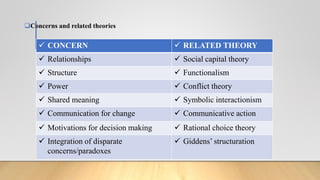
Concerns and related theories
 CONCERN  RELATED THEORY
 Relationships  Social capital theory
 Structure  Functionalism
 Power  Conflict theory
 Shared meaning  Symbolic interactionism
 Communication for change  Communicative action
 Motivations for decision making  Rational choice theory
 Integration of disparate
concerns/paradoxes
 Giddens’ structuration
SEVEN THEORIES FOR COMMUNITY
DEVELOPMENT
1. SOCIAL CAPITAL THEORY: CONCERNS ABOUT
RELATIONSHIPS
 Community developers know inherently that the quality of social
relationships is essential for solidarity building and successful
community initiatives.
 Friendships, trust, and the willingness to share some resources are
integral to collective action.
 Social scientists view these relationships as a form of capital.
 Social capital is that set of resources intrinsic to social relations and
includes trust, norms, and networks. It is often correlated with
confidence in public institutions, civic engagement, self-reliant
economic development, and overall community well-being and
happiness.
2. FUNCTIONALISM : CONCERNS ABOUT STRUCTURE
 It is important to look at structure, which underlies organizational and
group capacity to bring about or stop change.
• In essence, structure is related to Giddens's concept of agency or
capacity building. The theoretical concept concerned with
structure is known as structural functionalism. It is also called
systems theory, equilibrium theory, or simply functionalism.
 According to this theoretical framework, societies contain certain
interdependent structures, each of which performs certain functions
for societal maintenance. Structures refer to organizations and
institutions such as health care, educational entities, business and
nonprofits, or informal groups.
 Functions refer to their purposes, missions, and what they do in
society. These structures form the basis of a social system.
 These structures form the basis of a social system.
 Talcott Parsons and Robert K. Merton are the specialists most often
associated with this theory. According to Merton (1968), social systems
have manifest and latent functions. Manifest functions are intentional
and recognized.
 In contrast, latent functions may be unintentional and unrecognized. For
example, it could be argued that the manifest function of urban planning
is to assure well-organized and efficiently functioning cities, whereas
the latent function is to allocate advantages to certain interests such as
those involved with the growth machine or real estate developers.
 In contrast, latent functions may be unintentional and unrecognized. For
example, it could be argued that the manifest function of urban planning is
to assure well-organized and efficiently functioning cities, whereas the
latent function is to allocate advantages to certain interests such as those
involved with the growth machine or real estate developers.
 Functionalists such as Parsons argue that structures often contribute to their
own maintenance, not particularly to a greater societal good.
3. CONFLICT THEORY : CONCERNS ABOUT POWER
 Power is the third key issue for community development. Power is
control or access to resources (land, labor, capital, and knowledge).
 Community development builds capacity, concerns about power are
pivotal.
 Insights into power tend to be found in political science or political
sociology.
 More contemporary theorists have added to the richness of the literature. In his
later writings, Foucault (1985) argued that where there is power there is resistance.
 He examines the struggles against the power of men over women, administration
over the ways people live, and of psychiatry over the mentally ill.
 He sees power as a feature of all human relations (Foucault 1965, 1975, 1979,
1980, 1985; Nash 2000). Power has fluidity in the sense that it can be reversed and
exists in different degrees. Beyond conventional politics at the state level,
Foucault’s focus extends to the organizations and institutions of civil society and
to interpersonal relations.
4. SYMBOLIC INTERACTIONISM : CONCERNS ABOUT
SHARED MEANING
 Shared meaning is the fourth key concern in community development. If
the field is committed to building or strengthening solidarity, then
practitioners must be concerned about the meaning people give to places,
people and events.
 Herbert Blumer (1969) named the theory “symbolic interactionism”
because it emphasizes the symbolic nature of human interaction rather
than a mechanical pattern of stimulus and interaction.
For symbolic interactionists, the meaning of a situation is not
fixed but is constructed by participants as they anticipate the
responses of others. Mead (1992) explored the importance of
symbols, especially language, in shaping the meaning of the one
who makes the gesture as well as the one who receives it.
 Goffman (1959) argued that individuals “give” and “give off” signs
that provide information to others on how to respond.
 Symbolic interactionism is essential for community development
because it provides insight into the ways people develop a sense of
shared meaning, an essential ingredient for solidarity.
5. COMMUNICATIVE ACTION THEORY :
COMMUNICATION FOR CHANGE
 It is safe to assume that community development occurs within the
context of democracy that is deliberative and participatory.
 Public talk is not simply talk; it is essential for democratic
participation. It is about thinking through public policy choices.
 Deliberation occurs when the public examines the impacts of potential
choices and tries them on, just as one might try on clothing in a
department store before making a choice. In such settings, public talk
involves rich discussions among a variety of networks.
 From the community development perspective, participation occurs in
a setting where a diversity of voices are heard in order to explore
problems, test solutions, and make changes to policies when the
community finds flaws.
 Communities with robust democratic networks may be viewed as
communicatively integrated (Friedland 2001). This type of integration
involves the communicative activities that link individuals, networks,
and institutions into a community of place or interest.
6. RATIONAL CHOICE THEORY : MOTIVATION FOR
DECISION MAKING
 The rational economic man model was proposed by Alfred Marshall
(1895). He believed that humans were interested in maximizing their
utility, happiness, or profits.
 When applied to community development, rational choice theory is
concerned with finding appropriate rewards and minimizing risks to
individuals who become involved in community initiatives.
 Such rewards might be as simple as free babysitting services or an
awards and recognition banquet. Both examples would facilitate
people’s choices to invest their time or money in community
development efforts.
7. GIDDENS’S STRUCTURATION THEORY : INTEGRATION
OF DISPARATE CONCERNS AND PARADIGMS
 The classical theories of structural functionalism, conflict theory, and
rational choice theory are essential concepts for building community
capacity.
 The fluid contemporary theories of social capital, communicative
action, and the classical theory of symbolic interactionism are
important for creating or strengthening solidarity.
 There are obvious tensions inherent in these theories. The dualism of
macro versus micro characterizes much of the theoretical thinking in
sociology. Sharing the same goal of picturing social reality, these
schools choose to proceed from opposite directions.
 Anthony Giddens (1984, 1989) offers a perspective that is more fluid
and process-oriented. He introduces a third dimension, or an “in-
between” level of analysis, which is neither macro nor micro.
 It has to do with the cultural traditions, beliefs, societal norms, and
how actors draw upon those in their behavior (Collins 1988: 399). For
Giddens, those normative patterns of society exist “outside of time and
space” (Collins 1988: 398–399), meaning they are neither properties
of the empirical social system nor of the individual actors.
 Their actuality consists in the moments when individuals’ behaviors
rise to that level of society’s traditions and norms. People also draw
and act upon thought patterns or cultural “molds”; for example, the
classical notion of reciprocity – getting one thing in return for
something else. Cultural traditions and patterns become modalities by
virtue of placing them on Giddens's analytical scheme.
CONCLUSION
 Generally, theories are essential for community development practice
because it provides explanations of individual and group behavior. it
also aim to explain on how the frameworks used by community
developers that may comprehend and explain events.
 Also theories of community development have weakness in term of
application is just because of lack of drive force to adapt ways on
implementation of these theories.
REFERENCE
Hustedde, R.J. and Ganowicz, J. (2002). “The Basics: What’s Essential
about Theory for Community Development Practice?,” Journal of the
Community Development Society, 33(1): 1–19.

COMMUNITY DEVELOPMENT THEORY AND PRACTICE MODULE FOUR .pptx

  • 1.
    COMMUNITY DEVELOPMENT: THEORY ANDPRACTICE SY 311 MASERO EMMANUEL EDWARD
  • 2.
    MODULE: FOUR Community DevelopmentTheories Why Theories? Seven Theories for Community Development
  • 3.
    WHY THEORIES  Communitydevelopers need theories to help guide and frame the complexity of their work.  Theories are explanations that can provide help in understanding people’s behavior and a framework from which community developers can explain and comprehend events.  A good theory may be stated in abstract terms and help create strategies and tools for effective practice.
  • 4.
     Whether communitydevelopers want others to conduct relevant research or they want to participate in the research themselves, it is important that they have theoretical grounding. Because theory is the major guide to understanding the complexity of community life and social and economic change (Collins 1998; Ritzer 1996). GENERALLY WHAT IS THEORY  is a statement or a group of statement established by reasoned argument, based on known facts intended to explain particular facts.
  • 5.
    Seven key concernsin the community development field Following this definition of community development, there are seven major concerns involving solidarity and agency building: These seven concerns form the basis for essential community development theory; 1) Relationships, are linked to a sense of solidarity. 2) Structure, refers to social practices, organizations, or groups that play a role in solidarity and capacity building.
  • 6.
    Cont.. Seven keyconcerns in the community development field 3) Power , refers to relationships with those who control resources, such as land, labor, capital, and knowledge, or those who have greater access to those resources than others. 4) Shared meaning , refers to social meaning, especially symbols, that people give to a place, physical things, behavior, events, or action.
  • 7.
    Cont.. Seven keyconcerns in the community development field 5) Communication for change, is linked to the concept of full participation, a consistent value in the community development literature 6) Motivations for decision making, It helps us understand whether people will or will not become involved in a community initiative 7) Integration of these disparate concerns and paradoxes within the field, macro and micro concerns are part of community development practice.
  • 8.
    Concerns and relatedtheories  CONCERN  RELATED THEORY  Relationships  Social capital theory  Structure  Functionalism  Power  Conflict theory  Shared meaning  Symbolic interactionism  Communication for change  Communicative action  Motivations for decision making  Rational choice theory  Integration of disparate concerns/paradoxes  Giddens’ structuration
  • 9.
    SEVEN THEORIES FORCOMMUNITY DEVELOPMENT
  • 10.
    1. SOCIAL CAPITALTHEORY: CONCERNS ABOUT RELATIONSHIPS  Community developers know inherently that the quality of social relationships is essential for solidarity building and successful community initiatives.  Friendships, trust, and the willingness to share some resources are integral to collective action.  Social scientists view these relationships as a form of capital.
  • 11.
     Social capitalis that set of resources intrinsic to social relations and includes trust, norms, and networks. It is often correlated with confidence in public institutions, civic engagement, self-reliant economic development, and overall community well-being and happiness. 2. FUNCTIONALISM : CONCERNS ABOUT STRUCTURE  It is important to look at structure, which underlies organizational and group capacity to bring about or stop change.
  • 12.
    • In essence,structure is related to Giddens's concept of agency or capacity building. The theoretical concept concerned with structure is known as structural functionalism. It is also called systems theory, equilibrium theory, or simply functionalism.
  • 13.
     According tothis theoretical framework, societies contain certain interdependent structures, each of which performs certain functions for societal maintenance. Structures refer to organizations and institutions such as health care, educational entities, business and nonprofits, or informal groups.  Functions refer to their purposes, missions, and what they do in society. These structures form the basis of a social system.  These structures form the basis of a social system.
  • 14.
     Talcott Parsonsand Robert K. Merton are the specialists most often associated with this theory. According to Merton (1968), social systems have manifest and latent functions. Manifest functions are intentional and recognized.  In contrast, latent functions may be unintentional and unrecognized. For example, it could be argued that the manifest function of urban planning is to assure well-organized and efficiently functioning cities, whereas the latent function is to allocate advantages to certain interests such as those involved with the growth machine or real estate developers.
  • 15.
     In contrast,latent functions may be unintentional and unrecognized. For example, it could be argued that the manifest function of urban planning is to assure well-organized and efficiently functioning cities, whereas the latent function is to allocate advantages to certain interests such as those involved with the growth machine or real estate developers.  Functionalists such as Parsons argue that structures often contribute to their own maintenance, not particularly to a greater societal good.
  • 16.
    3. CONFLICT THEORY: CONCERNS ABOUT POWER  Power is the third key issue for community development. Power is control or access to resources (land, labor, capital, and knowledge).  Community development builds capacity, concerns about power are pivotal.  Insights into power tend to be found in political science or political sociology.
  • 17.
     More contemporarytheorists have added to the richness of the literature. In his later writings, Foucault (1985) argued that where there is power there is resistance.  He examines the struggles against the power of men over women, administration over the ways people live, and of psychiatry over the mentally ill.  He sees power as a feature of all human relations (Foucault 1965, 1975, 1979, 1980, 1985; Nash 2000). Power has fluidity in the sense that it can be reversed and exists in different degrees. Beyond conventional politics at the state level, Foucault’s focus extends to the organizations and institutions of civil society and to interpersonal relations.
  • 18.
    4. SYMBOLIC INTERACTIONISM: CONCERNS ABOUT SHARED MEANING  Shared meaning is the fourth key concern in community development. If the field is committed to building or strengthening solidarity, then practitioners must be concerned about the meaning people give to places, people and events.  Herbert Blumer (1969) named the theory “symbolic interactionism” because it emphasizes the symbolic nature of human interaction rather than a mechanical pattern of stimulus and interaction.
  • 19.
    For symbolic interactionists,the meaning of a situation is not fixed but is constructed by participants as they anticipate the responses of others. Mead (1992) explored the importance of symbols, especially language, in shaping the meaning of the one who makes the gesture as well as the one who receives it.
  • 20.
     Goffman (1959)argued that individuals “give” and “give off” signs that provide information to others on how to respond.  Symbolic interactionism is essential for community development because it provides insight into the ways people develop a sense of shared meaning, an essential ingredient for solidarity.
  • 21.
    5. COMMUNICATIVE ACTIONTHEORY : COMMUNICATION FOR CHANGE  It is safe to assume that community development occurs within the context of democracy that is deliberative and participatory.  Public talk is not simply talk; it is essential for democratic participation. It is about thinking through public policy choices.
  • 22.
     Deliberation occurswhen the public examines the impacts of potential choices and tries them on, just as one might try on clothing in a department store before making a choice. In such settings, public talk involves rich discussions among a variety of networks.  From the community development perspective, participation occurs in a setting where a diversity of voices are heard in order to explore problems, test solutions, and make changes to policies when the community finds flaws.
  • 23.
     Communities withrobust democratic networks may be viewed as communicatively integrated (Friedland 2001). This type of integration involves the communicative activities that link individuals, networks, and institutions into a community of place or interest.
  • 24.
    6. RATIONAL CHOICETHEORY : MOTIVATION FOR DECISION MAKING  The rational economic man model was proposed by Alfred Marshall (1895). He believed that humans were interested in maximizing their utility, happiness, or profits.  When applied to community development, rational choice theory is concerned with finding appropriate rewards and minimizing risks to individuals who become involved in community initiatives.
  • 25.
     Such rewardsmight be as simple as free babysitting services or an awards and recognition banquet. Both examples would facilitate people’s choices to invest their time or money in community development efforts.
  • 26.
    7. GIDDENS’S STRUCTURATIONTHEORY : INTEGRATION OF DISPARATE CONCERNS AND PARADIGMS  The classical theories of structural functionalism, conflict theory, and rational choice theory are essential concepts for building community capacity.  The fluid contemporary theories of social capital, communicative action, and the classical theory of symbolic interactionism are important for creating or strengthening solidarity.
  • 27.
     There areobvious tensions inherent in these theories. The dualism of macro versus micro characterizes much of the theoretical thinking in sociology. Sharing the same goal of picturing social reality, these schools choose to proceed from opposite directions.  Anthony Giddens (1984, 1989) offers a perspective that is more fluid and process-oriented. He introduces a third dimension, or an “in- between” level of analysis, which is neither macro nor micro.
  • 28.
     It hasto do with the cultural traditions, beliefs, societal norms, and how actors draw upon those in their behavior (Collins 1988: 399). For Giddens, those normative patterns of society exist “outside of time and space” (Collins 1988: 398–399), meaning they are neither properties of the empirical social system nor of the individual actors.
  • 29.
     Their actualityconsists in the moments when individuals’ behaviors rise to that level of society’s traditions and norms. People also draw and act upon thought patterns or cultural “molds”; for example, the classical notion of reciprocity – getting one thing in return for something else. Cultural traditions and patterns become modalities by virtue of placing them on Giddens's analytical scheme.
  • 30.
    CONCLUSION  Generally, theoriesare essential for community development practice because it provides explanations of individual and group behavior. it also aim to explain on how the frameworks used by community developers that may comprehend and explain events.  Also theories of community development have weakness in term of application is just because of lack of drive force to adapt ways on implementation of these theories.
  • 31.
    REFERENCE Hustedde, R.J. andGanowicz, J. (2002). “The Basics: What’s Essential about Theory for Community Development Practice?,” Journal of the Community Development Society, 33(1): 1–19.