Message Digest5
Prof. Neeraj Bhargava
Kapil Chauhan
Department of Computer Science
School of Engineering & Systems Sciences
MDS University, Ajmer
Introduction
Initial checking of integrity – checksums, then CRC
These are only good at detecting lost information due
to hardware or transmission errors
Potential Attack
A wants to obtain privileges from B
A generates two messages with the same hash
values
A presents an innocent message to B for his
digital signature
A applies the signature to the other malicious
message with the same hash
MD5
The solution lay in one-way hashing algorithms
These should keep two messages from colliding
They should also be sufficiently difficult to
reverse-engineer
MD5
MD5 represents the fifth iteration designed by
Ronald Rivest (RSA)
Others from other authors include Whirlpool and
SHA
MD5 is open-source and released under the GPL
MD5 is optimized for use on 32-bit computers
MD5 Hashing
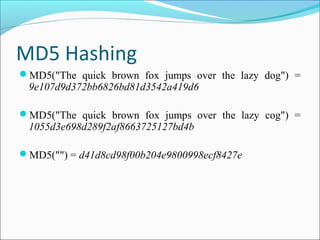
MD5("The quick brown fox jumps over the lazy dog") =
9e107d9d372bb6826bd81d3542a419d6
MD5("The quick brown fox jumps over the lazy cog") =
1055d3e698d289f2af8663725127bd4b
MD5("") = d41d8cd98f00b204e9800998ecf8427e
Modern Flaws
MD5 uses a short 128-bit hash
MD5 has become a popular hashing tool through
PHP
PASSWORD HASHING
Rivest says his algorithm was never designed for
this usage
Long messages that need an integrity check
before encryption
MD5 Flaws
Rainbow tables for passwords
COLLISIONS!
MD5 Collisions
2004 Wang et. al delivered an algorithm that could
produce collisions in a few hours on an IBM p690
cluster
Algorithm was improved by Lenstra et. al in 2005 to a
few hours on a single laptop
Conclusion
A digest algorithm does not provide integrity if
collisions are so simple to produce
SHA or Whirlpool should be considered until a
replacement for MD5 can be found

MD 5

  • 1.
    Message Digest5 Prof. NeerajBhargava Kapil Chauhan Department of Computer Science School of Engineering & Systems Sciences MDS University, Ajmer
  • 2.
    Introduction Initial checking ofintegrity – checksums, then CRC These are only good at detecting lost information due to hardware or transmission errors
  • 3.
    Potential Attack A wantsto obtain privileges from B A generates two messages with the same hash values A presents an innocent message to B for his digital signature A applies the signature to the other malicious message with the same hash
  • 4.
    MD5 The solution layin one-way hashing algorithms These should keep two messages from colliding They should also be sufficiently difficult to reverse-engineer
  • 5.
    MD5 MD5 represents thefifth iteration designed by Ronald Rivest (RSA) Others from other authors include Whirlpool and SHA MD5 is open-source and released under the GPL MD5 is optimized for use on 32-bit computers
  • 6.
    MD5 Hashing MD5("The quickbrown fox jumps over the lazy dog") = 9e107d9d372bb6826bd81d3542a419d6 MD5("The quick brown fox jumps over the lazy cog") = 1055d3e698d289f2af8663725127bd4b MD5("") = d41d8cd98f00b204e9800998ecf8427e
  • 7.
    Modern Flaws MD5 usesa short 128-bit hash MD5 has become a popular hashing tool through PHP PASSWORD HASHING Rivest says his algorithm was never designed for this usage Long messages that need an integrity check before encryption
  • 8.
    MD5 Flaws Rainbow tablesfor passwords COLLISIONS!
  • 9.
    MD5 Collisions 2004 Wanget. al delivered an algorithm that could produce collisions in a few hours on an IBM p690 cluster Algorithm was improved by Lenstra et. al in 2005 to a few hours on a single laptop
  • 10.
    Conclusion A digest algorithmdoes not provide integrity if collisions are so simple to produce SHA or Whirlpool should be considered until a replacement for MD5 can be found