Controlling Microbial Growth
          Chapter 12
Most microbes good, but…
•   where they are growing critical
•   yogurt = good
•   bloodstream = BAD
•   Nosocomial infections
•   Hygiene Hypothesis
Binary fission in bacteria


To control growth, we need to stop or slow down this process

                                                               Fig. 5.8
Cidal vs. Static
Control Methods
Physical Control
•   Heat: incineration vs. steam
•   Filtration
•   Temperature
•   Radiation
•   Desiccation (oven)
Physical Control - Heat

• Bacteria can’t tolerate extreme temp changes
  – Fever
• Protein denaturation - high fever
Heat
• Dry heat – incineration
Heat
• Dry heat - incineration
• Moist heat - boiling water/steam
  – Kills most in seconds
  – Pasteurization - temp & time
  – What about endospores?
How can you get temp above boiling
                            water?


Temperature and the Physical Control of Microbes
Operation of an Autoclave
What types of items go in?

• Medical instruments
  – Surgical
  – Dental
  – Piercing
• Microbial media
• Anything metal, some types of plastic
Physical Control

• Refrigeration/freezing - microbes still there
  – cold temp slows down
  – Microbes can freeze/thaw and still reproduce
Physical Control
• Radiation
  – UV
  – Ionizing
The Ionizing and Electromagnetic
      Spectrum of Energies         Fig. 5.7
Physical Control - radiation

• Radiation damages DNA
• UV radiation (ultraviolet light)
   – UV lamps for disinfection
  – Causes T-T dimers
  – Cell death
  – What happens in humans?
Mutations block
      DNA processes
•   TT dimer distorts DNA
•   No replication
•   No transcription
•   High dose = death
Physical Control - radiation
• Ionizing radiation (solar rays, radioactive)
  – 10K times more energy than UV
  – ionization of water (OH- & H3O+ )
  – DNA breaks apart
  – Sterilize plastics, food, destroy viruses (Ebola)
  – What happens to humans exposed to IR?
     • Acute exposure -
     • Chronic exposure -
     • How do we know this???
Physical Control - desiccation
• All living things need water
• Dry out grains, meat, fish to preserve
Disinfectants/Antiseptics
• Ancient Egypt - chemicals for embalming
• 1800’s - Iodine used in medicine
• Joseph Lister - 1860’s
  – Read Pasteur
  – soaked instruments in            phenol
  – Knighted in 1912
Halogens
      • Halogens - extremely
        reactive
      • Interacts with amino acids -
        destroys cell membrane
      • Iodine
           – w/detergent
      • Chlorine
           – disinfect H2O
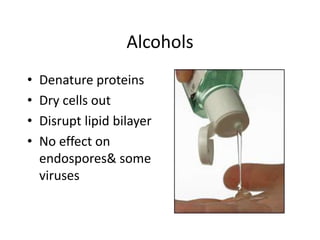
Alcohols
•   Denature proteins
•   Dry cells out
•   Disrupt lipid bilayer
•   No effect on
    endospores& some
    viruses
Phenolic Compounds

• highly reactive
  – acidic
• denature proteins
  – destroys cell membrane
• first used by Lister
  – Lysol
  – Trichlosan - milder
     • potential for resistance?
Heavy Metals
• Used as disinfectants - poison
• Specific enzymes inhibited
Heavy Metals
• Silver
   – Silver nitrate - eye
     infections (gonorrhea)
• Copper
   – Copper Sulfate -
     swimming pools;
     antifungal
• Mercury
   – antiseptics, pesticides
Antimicrobial Chemotherapy
• Antibiotic control
Pre-antibiotic era
• Medicine was a gruesome business
• Civil war - more than 2/3 of all deaths due to disease, not
  wounds
• Paul Erlich - early 1900s
   – Arsenic compounds as syphilis treatment
   – Fell out of favor b/c toxic
Sulfanilamide - sulfa drugs
• 1932 - “prontosil” developed by Gerhard Domagk
• Effective in treating Gram-positive bacterial infections
• Gave push to development of newer & better antibiotics


             Bacteria need                    This
             PABA to make                     looks like
             folic acid                       PABA
Development of penicillin
• Alexander Fleming
• 1929 - Penicillium mold prevented S. aureus
  growth
• Extract killed Gram-positive bacteria
• 1939 - Florey & Chain
• Mass produced in USA
Penicillin & derivatives

• One of the most widely used antibiotics
• Best against Gram-pos; some Gram-neg
  (gonorrhea)
• ~ 10% of population allergic
• Works on rapidly dividing cells
  – No effect on endospores!
Penicillin Derivatives
Penicillin Resistance
• Many bacterial species have developed resistance
• MRSA - methicillin resistant Staph. aureus
Streptomyces - natural antibiotic R&D
Soil bacterium - lots of genes for making
  antibiotic compounds
• Aminoglycoside (streptomycin, gentamycin)
  – Good if allergic to penicillin
  – Inhibits protein synthesis
  – Erythromycin: Zithromax, Biaxin
  – Vancomycin - last resort for MDR Gram-pos
Broad Spectrum antibiotics
• Selective Toxicity
• Chloramphenicol first one isolated
  – Effective against Gram-pos &neg, chlamydiae, some
    fungi
  – Nasty side effects - hemolytic (last resort)
• Tetracycline
  – Very few side effects (short term) - overprescribed
  – Yeast infections common
  – Discoloration of teeth/stunted bones in children
Antibiotic Resistance
• Emerging danger

• Natural selection of resistant strains thru
  overuse
  – Overprescibing meds
  – Used in livestock feed
• Take entire course of prescription
• Do not take higher dose of same
med if no improvement
• Do not take antibiotics for viral
infection
How bacteria become resistant:
Antifungal meds
• Fungal infections big problem for immune
  suppressed individuals
• Antifungals - not many choices
  – Nystatin, miconazole - interfere w/sterols (cell
    membrane)
  – Amphotericin B - used for serious internal organ
    infection
  – Griseofulvin - ringworm treatment
Antiviral meds - not antibiotics
• Antivirals target
  different stages of
  viral replication
  – amantadine -
    prevents
    attachment
  – acyclovir -
    interferes w/viral
    DNA replication

Mbi121 13 f12ctrlgrthnotes

  • 1.
  • 2.
    Most microbes good,but… • where they are growing critical • yogurt = good • bloodstream = BAD • Nosocomial infections • Hygiene Hypothesis
  • 3.
    Binary fission inbacteria To control growth, we need to stop or slow down this process Fig. 5.8
  • 4.
  • 5.
  • 6.
    Physical Control • Heat: incineration vs. steam • Filtration • Temperature • Radiation • Desiccation (oven)
  • 7.
    Physical Control -Heat • Bacteria can’t tolerate extreme temp changes – Fever • Protein denaturation - high fever
  • 8.
    Heat • Dry heat– incineration
  • 9.
    Heat • Dry heat- incineration • Moist heat - boiling water/steam – Kills most in seconds – Pasteurization - temp & time – What about endospores?
  • 10.
    How can youget temp above boiling water? Temperature and the Physical Control of Microbes
  • 11.
    Operation of anAutoclave
  • 12.
    What types ofitems go in? • Medical instruments – Surgical – Dental – Piercing • Microbial media • Anything metal, some types of plastic
  • 13.
    Physical Control • Refrigeration/freezing- microbes still there – cold temp slows down – Microbes can freeze/thaw and still reproduce
  • 14.
  • 15.
    The Ionizing andElectromagnetic Spectrum of Energies Fig. 5.7
  • 16.
    Physical Control -radiation • Radiation damages DNA • UV radiation (ultraviolet light) – UV lamps for disinfection – Causes T-T dimers – Cell death – What happens in humans?
  • 17.
    Mutations block DNA processes • TT dimer distorts DNA • No replication • No transcription • High dose = death
  • 18.
    Physical Control -radiation • Ionizing radiation (solar rays, radioactive) – 10K times more energy than UV – ionization of water (OH- & H3O+ ) – DNA breaks apart – Sterilize plastics, food, destroy viruses (Ebola) – What happens to humans exposed to IR? • Acute exposure - • Chronic exposure - • How do we know this???
  • 19.
    Physical Control -desiccation • All living things need water • Dry out grains, meat, fish to preserve
  • 20.
    Disinfectants/Antiseptics • Ancient Egypt- chemicals for embalming • 1800’s - Iodine used in medicine • Joseph Lister - 1860’s – Read Pasteur – soaked instruments in phenol – Knighted in 1912
  • 21.
    Halogens • Halogens - extremely reactive • Interacts with amino acids - destroys cell membrane • Iodine – w/detergent • Chlorine – disinfect H2O
  • 22.
    Alcohols • Denature proteins • Dry cells out • Disrupt lipid bilayer • No effect on endospores& some viruses
  • 23.
    Phenolic Compounds • highlyreactive – acidic • denature proteins – destroys cell membrane • first used by Lister – Lysol – Trichlosan - milder • potential for resistance?
  • 24.
    Heavy Metals • Usedas disinfectants - poison • Specific enzymes inhibited
  • 25.
    Heavy Metals • Silver – Silver nitrate - eye infections (gonorrhea) • Copper – Copper Sulfate - swimming pools; antifungal • Mercury – antiseptics, pesticides
  • 26.
  • 27.
    Pre-antibiotic era • Medicinewas a gruesome business • Civil war - more than 2/3 of all deaths due to disease, not wounds • Paul Erlich - early 1900s – Arsenic compounds as syphilis treatment – Fell out of favor b/c toxic
  • 30.
    Sulfanilamide - sulfadrugs • 1932 - “prontosil” developed by Gerhard Domagk • Effective in treating Gram-positive bacterial infections • Gave push to development of newer & better antibiotics Bacteria need This PABA to make looks like folic acid PABA
  • 31.
    Development of penicillin •Alexander Fleming • 1929 - Penicillium mold prevented S. aureus growth • Extract killed Gram-positive bacteria • 1939 - Florey & Chain • Mass produced in USA
  • 32.
    Penicillin & derivatives •One of the most widely used antibiotics • Best against Gram-pos; some Gram-neg (gonorrhea) • ~ 10% of population allergic • Works on rapidly dividing cells – No effect on endospores!
  • 33.
  • 34.
    Penicillin Resistance • Manybacterial species have developed resistance • MRSA - methicillin resistant Staph. aureus
  • 35.
    Streptomyces - naturalantibiotic R&D Soil bacterium - lots of genes for making antibiotic compounds • Aminoglycoside (streptomycin, gentamycin) – Good if allergic to penicillin – Inhibits protein synthesis – Erythromycin: Zithromax, Biaxin – Vancomycin - last resort for MDR Gram-pos
  • 36.
    Broad Spectrum antibiotics •Selective Toxicity • Chloramphenicol first one isolated – Effective against Gram-pos &neg, chlamydiae, some fungi – Nasty side effects - hemolytic (last resort) • Tetracycline – Very few side effects (short term) - overprescribed – Yeast infections common – Discoloration of teeth/stunted bones in children
  • 37.
    Antibiotic Resistance • Emergingdanger • Natural selection of resistant strains thru overuse – Overprescibing meds – Used in livestock feed
  • 38.
    • Take entirecourse of prescription • Do not take higher dose of same med if no improvement • Do not take antibiotics for viral infection
  • 40.
  • 41.
    Antifungal meds • Fungalinfections big problem for immune suppressed individuals • Antifungals - not many choices – Nystatin, miconazole - interfere w/sterols (cell membrane) – Amphotericin B - used for serious internal organ infection – Griseofulvin - ringworm treatment
  • 42.
    Antiviral meds -not antibiotics • Antivirals target different stages of viral replication – amantadine - prevents attachment – acyclovir - interferes w/viral DNA replication