ANTIBIOTICS :- The word “antibiotics” comes
from the Greek, anti (“against”) and bios (“life”). An
antibiotic is a drug that kills or slows the growth of
bacteria. The first antibiotic was discovered by
Alexander Fleming in 1928 .
Antibiotics are chemicals produced by or
derived from microorganisms (i.e. bugs or
germs such as bacteria and fungi).
Antibiotics are one class of antimicrobial,
a larger group which also includes anti-viral,
anti-fungal, and anti-parasitic drugs.
Antibiotics are among the most frequently
prescribed medications in modern medicine.
Antibiotics are used to treat many different
bacterial infections. Antibiotics cure disease by
killing or injuring bacteria. Bacteria are simple one-
celled organisms that can be found, by the billions,
all around us.
Bacteria cause disease and infection when they are
able to gain access to more vulnerable parts of our
bodies and multiply rapidly.
 Some antibiotics are ‘bactericidal’, meaning that they work by
killing bacteria. Other antibiotics are ‘bacteriostatic’, meaning that
they work by stopping bacteria multiplying.
Different type of antibiotic affects different bacteria in different
ways. Ex:-An antibiotic might inhibit a bacterium’s ability to turn
glucose into energy, or its ability to construct its cell wall. When
this happens, the bacterium dies instead of reproducing.
Some antibiotics can be used to treat a wide range of infections
and are known as ‘broad-spectrum’ antibiotics. Others are only
effective against a few types of bacteria and are called ‘narrow-
spectrum’ antibiotics.
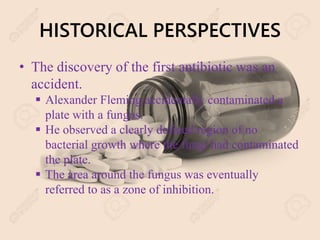
HISTORICAL PERSPECTIVES
• The discovery of the first antibiotic was an
accident.
 Alexander Fleming accidentally contaminated a
plate with a fungus.
 He observed a clearly defined region of no
bacterial growth where the fungi had contaminated
the plate.
 The area around the fungus was eventually
referred to as a zone of inhibition.
…HISTORICAL PERSPECTIVES
 It is estimated that over 80 million prescriptions are
written in America each year.
12,500 tons of antibiotics are produced annually.
25-50 % is fed to livestock to increase the rate of weight
gain.
From 1900 to 1980, mortality from infectious diseases
dropped from 797 per 100,000 persons to 36 per 100,000
persons.
…HISTORICAL
PERSPECTIVES
No major discoveries of natural antibiotic substances
have occurred for several years.
Efforts have now shifted to modifying existing
antibiotics.
Searching in new places for potential antibiotics has
also gained in prominence.
Many antibiotics are produced by microorganisms as
part of their survival mechanism.
They keep other organisms away.
They protect the supply of nutrients and oxygen.
ANTIBIOTICS ARE PART OF
BACTERIAL SELF PROTECTION
oMicroorganisms that produce these substances have
molecular mechanisms to control production and prevent
self-destruction.
oNaturally produced antibiotics are products of
secondary metabolic pathways.
oThese pathways are not turned on all the time.
oContinuous production could adversely affect the
organism.
oSome bacteria restrict antibiotic production to the
stationary phase.
oOthers keep the intracellular concentrations at low
levels.
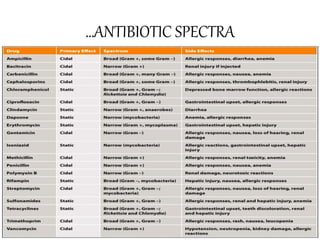
…ANTIBIOTIC SPECTRA
The first molecules that inhibited bacterial
growth were natural products.
Over time, these natural molecules have been
modified.
Several types of semi-synthetic antibiotics
have been derived from these molecules.
…ANTIBIOTIC SPECTRA
•The original natural molecules used by humans as
antibiotics have a very narrow spectrum.
•Penicillin activity is restricted to Gram-positive
bacteria.
•Natural molecules can be chemically modified making
it possible to broaden their spectrum.
•Antibiotics are classified as either broad-spectrum or
narrow-spectrum.
…ANTIBIOTIC SPECTRA
PENICILLINS
There are semi-synthetic forms of penicillin.
They are created through modifications that
can be made in a laboratory.
Chemically modifying penicillin broadens the
spectrum.
Semi-synthetic penicillins can be further
modified to increase the efficiency of inhibiting
bacterial growth.
CEPHALOSPORINS
The same kind of manipulation can be seen with
cephalosporin family.
Modification of the natural molecule has resulted in several
generations of semi-synthetics.
Modifications result from changing the side chains leaving
core intact.
Modifications also change reactivity patterns and spectrum..
RESISTANCE TO ANTIBIOTICS
Bacteria are constantly finding ways to counteract antibiotics.
One of the most important bacterial defense mechanisms is the production of enzyme β-
lactamase.
Organisms that produce β-lactamase are resistant to penicillin.
One way to overcome penicillin resistance is to combine penicillin drug with molecule
that protects the penicillin.
This diminishes or impedes β-lactamase activity.
An example of this is potassium clavulanate.
ANTIBIOTIC TARGETS
A fundamental criterion of antibiotics for medical use is
selective toxicity.
The antibiotic should be destructive to the disease-
causing organism but have no effect on the human host.
The first antibiotic discovered was most selectively
toxic.
…ANTIBIOTIC TARGETS
Many chemicals are useful in restricting bacterial growth.
They are also inherently toxic.
They cannot be used therapeutically.
Many antibiotic molecules are toxic if administered at high
concentrations.
Toxicity necessitates extensive testing.
It can take years and cost millions of dollars.
..ANTIBIOTIC TARGETS
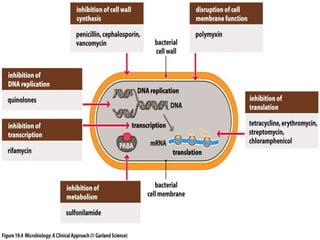
Antibiotic targets can be subdivided into
five major groups:
The bacterial cell wall
The bacterial plasma membrane
Synthesis of bacterial proteins
Bacterial nucleic acids
Bacterial metabolism
…ANTIBIOTIC TARGETS
The cell wall is the most appealing target for antibiotics.
It is found in both Gram-positive and Gram-negative bacteria.
The plasma membrane is involved with important physiological
functions.
It is a prime target for antibiotics.
Any disruption of the membrane destroys the bacteria.
Antibiotics act at different sites on bacterial ribosomes.
Ribosomes are sites for protein synthesis.
DNA and RNA are universal components which can be attacked
by antibiotics.
ANTIVIRAL DRUGS
Viruses pose a different set of problems for antibiotic
therapy.
They are obligate intracellular parasites.
Drugs that can eliminate the virus are dangerous to non-
infected cells.
This makes selective toxicity difficult.
Many viruses difficult to grow.
It is difficult to test potential antiviral drugs.
…ANTIVIRAL DRUGS
 Many acute viral infections have a short duration.
 They are essentially over before antibiotics could be of any therapeutic use.
 The lack of rapid tests means it is difficult to differentiate between various viral
infections.
 Successful antiviral drugs must eliminate all virions.
 The escape of even one virion could restart the infectious cycle.
 The first antibiotic to be used against viruses was the sulfa drug derivative
thiosemicarbazone.
 In 1960s amantadine developed for use against influenza.
…ANTIVIRAL DRUGS
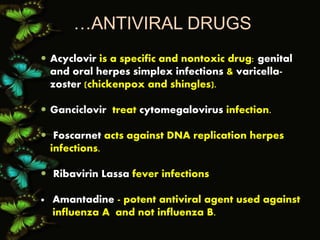
 Acyclovir is a specific and nontoxic drug: genital
and oral herpes simplex infections & varicella-
zoster (chickenpox and shingles).
 Ganciclovir treat cytomegalovirus infection.
 Foscarnet acts against DNA replication herpes
infections.
 Ribavirin Lassa fever infections
 Amantadine - potent antiviral agent used against
influenza A and not influenza B.
ANTIFUNGAL DRUGS
The emergence of diseases that render a host
immunocompromised has led to increased
secondary fungal infections.
Drugs used for fungal infection have selective
toxicity issues.
Attacking common targets can cause serious
side effects.
..ANTIFUNGAL DRUGS
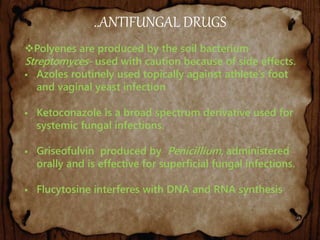
Polyenes are produced by the soil bacterium
Streptomyces- used with caution because of side effects.
 Azoles routinely used topically against athlete’s foot
and vaginal yeast infection
 Ketoconazole is a broad spectrum derivative used for
systemic fungal infections.
 Griseofulvin produced by Penicillium, administered
orally and is effective for superficial fungal infections.
 Flucytosine interferes with DNA and RNA synthesis
DRUGS FOR PROTOZOA
The development of drugs for parasitic
infections has lagged behind.
Parasitic infections do not occur often in
developed nations.
There is no money in it.
Two widely used anti-parasitic drugs are:
Quinine
Metronidazole.
DRUGS FOR HELMINTHS
Anti-helminthic drugs have also been largely
ignored until recently.
•Affected populations were not found in
developed countries.
•The popularity of sushi has led to an increase
in tapeworm infestations.
•Increased world travel has also increased
helminth infections.
NEW TARGETS FOR BACTERIA:
Peptide Fragments
Several antibiotic compounds are
composed of peptide fragments and
disrupt the bacterial plasma membrane.
Bacitracin, gramicidin S, and
polymyxin B
Maginins – produced by frogs
Defensins – produced by humans
So far, over 500 known peptides
produced by multicellular organisms
have antibiotic actions.
NEW TARGETS FOR VIRUSES
Molecular technologies are also used for
development of antiviral drugs.
Target-based screening permits a high
throughput of possible compounds.
Used with bioinformatics, combinatorial
chemistry, computer-based design
Can evaluate as many as 50,000 compounds in
single day
All compounds can be stored in libraries for
future use.
..NEW TARGETS FOR VIRUSES
 Combinatorial chemistry can produce thousands of compounds
in a day including:
 All possible combinations of a basic set of modular
components
 These can be combined into testing programs that search for
potential hits.
 Genetic and genome sequencing are also used.
 Many viral genomes completely sequenced
 High-density arrays of DNA fragments are used to asses
which genes are expressed
 Identification of gene sequences always switched on points to
possible targets.
THE COST OF RESEARCH AND DEVELOPMENT
The costs of drug development are not trivial even though
thousands of compounds can be rapidly identified.
•Thousands of promising compounds may yield only one
candidate.
•Rigorous and expensive testing is required before a new
drug can be brought to market.
..THE COST OF RESEARCH AND DEVELOPMENT
Candidate compounds have to pass tests for:
Toxicity
Allergic effects
Mutagenicity
Carcinogenicity
The estimated cost of a new drug is
between $100 million to $500 million.
Development can take as long as 5-10 years.
TESTING OF ANTIBIOTICS
Development of new antibiotics follows a very
stringent highly regulated pathway.
Selective toxicity required to keep the
public safe
The need for product safety two-edged sword.
It requires a great deal of time and money.
Several testing systems can be used to
evaluate new compounds.
Kirby-Bauer is the most widely used.
The E-test is more advanced.
..TESTING OF ANTIBIOTICS:
Kirby-Bauer Test
An agar plate is covered with known pathogen.
Filter-paper disks impregnated with known concentrations
of the compound.
They are placed on agar.
Zones of inhibition can be identified.
The method is also used to compare the relative
effectiveness of different compounds.
Large zone of inhibition does not necessarily mean a
more powerful compound.
Zones are evaluated using standardized tables.
..TESTING OF ANTIBIOTICS:
Kirby-Bauer Test
The resistance of specific organisms can be
classified as:
Sensitive
Intermediate
Resistant
The Kirby-Bauer test is inadequate for most
clinical purposes.
..TESTING OF ANTIBIOTICS:
E-test
The E test is a more advanced diffusion test.
Permits determination of the minimal inhibitory
concentration (MIC).
•The lowest antibiotic concentration that prevents
growth
Uses plastic-coated strips containing gradients of
antibiotic concentrations.
After incubation MIC can be read from the scale
TESTING OF ANTIBIOTICS:
Broth Dilution Test
Kirby-Bauer and E-test show which compounds inhibit
pathogen growth.
They cannot determine between microbicidal and
microbistatic.
The broth dilution test used for this purpose.
Permits determination of the minimal bactericidal
concentration (MBC).
..TESTING OF ANTIBIOTICS:
Broth Dilution Test
A specific organism is incubated in decreasing amounts
of antibiotic.
Wells that show no growth are recultured in nutrient
broth medium.
Growth in this medium indicates the test compound is
microbistatic.
No growth in this medium indicates the test compound
is microbicidal.
…TESTING OF ANTIBIOTICS:
Broth Dilution Test
Dilution tests are highly automated.
Additional testing uses colorimetric methods
Used to determine serum concentrations
Important because drugs are toxic at high concentration
Antibiotics

Antibiotics

  • 2.
    ANTIBIOTICS :- Theword “antibiotics” comes from the Greek, anti (“against”) and bios (“life”). An antibiotic is a drug that kills or slows the growth of bacteria. The first antibiotic was discovered by Alexander Fleming in 1928 .
  • 3.
    Antibiotics are chemicalsproduced by or derived from microorganisms (i.e. bugs or germs such as bacteria and fungi). Antibiotics are one class of antimicrobial, a larger group which also includes anti-viral, anti-fungal, and anti-parasitic drugs.
  • 4.
    Antibiotics are amongthe most frequently prescribed medications in modern medicine. Antibiotics are used to treat many different bacterial infections. Antibiotics cure disease by killing or injuring bacteria. Bacteria are simple one- celled organisms that can be found, by the billions, all around us. Bacteria cause disease and infection when they are able to gain access to more vulnerable parts of our bodies and multiply rapidly.
  • 5.
     Some antibioticsare ‘bactericidal’, meaning that they work by killing bacteria. Other antibiotics are ‘bacteriostatic’, meaning that they work by stopping bacteria multiplying. Different type of antibiotic affects different bacteria in different ways. Ex:-An antibiotic might inhibit a bacterium’s ability to turn glucose into energy, or its ability to construct its cell wall. When this happens, the bacterium dies instead of reproducing. Some antibiotics can be used to treat a wide range of infections and are known as ‘broad-spectrum’ antibiotics. Others are only effective against a few types of bacteria and are called ‘narrow- spectrum’ antibiotics.
  • 7.
    HISTORICAL PERSPECTIVES • Thediscovery of the first antibiotic was an accident.  Alexander Fleming accidentally contaminated a plate with a fungus.  He observed a clearly defined region of no bacterial growth where the fungi had contaminated the plate.  The area around the fungus was eventually referred to as a zone of inhibition.
  • 8.
    …HISTORICAL PERSPECTIVES  Itis estimated that over 80 million prescriptions are written in America each year. 12,500 tons of antibiotics are produced annually. 25-50 % is fed to livestock to increase the rate of weight gain. From 1900 to 1980, mortality from infectious diseases dropped from 797 per 100,000 persons to 36 per 100,000 persons.
  • 9.
    …HISTORICAL PERSPECTIVES No major discoveriesof natural antibiotic substances have occurred for several years. Efforts have now shifted to modifying existing antibiotics. Searching in new places for potential antibiotics has also gained in prominence. Many antibiotics are produced by microorganisms as part of their survival mechanism. They keep other organisms away. They protect the supply of nutrients and oxygen.
  • 10.
    ANTIBIOTICS ARE PARTOF BACTERIAL SELF PROTECTION oMicroorganisms that produce these substances have molecular mechanisms to control production and prevent self-destruction. oNaturally produced antibiotics are products of secondary metabolic pathways. oThese pathways are not turned on all the time. oContinuous production could adversely affect the organism. oSome bacteria restrict antibiotic production to the stationary phase. oOthers keep the intracellular concentrations at low levels.
  • 11.
    …ANTIBIOTIC SPECTRA The firstmolecules that inhibited bacterial growth were natural products. Over time, these natural molecules have been modified. Several types of semi-synthetic antibiotics have been derived from these molecules.
  • 12.
    …ANTIBIOTIC SPECTRA •The originalnatural molecules used by humans as antibiotics have a very narrow spectrum. •Penicillin activity is restricted to Gram-positive bacteria. •Natural molecules can be chemically modified making it possible to broaden their spectrum. •Antibiotics are classified as either broad-spectrum or narrow-spectrum.
  • 13.
  • 14.
    PENICILLINS There are semi-syntheticforms of penicillin. They are created through modifications that can be made in a laboratory. Chemically modifying penicillin broadens the spectrum. Semi-synthetic penicillins can be further modified to increase the efficiency of inhibiting bacterial growth.
  • 15.
    CEPHALOSPORINS The same kindof manipulation can be seen with cephalosporin family. Modification of the natural molecule has resulted in several generations of semi-synthetics. Modifications result from changing the side chains leaving core intact. Modifications also change reactivity patterns and spectrum..
  • 16.
    RESISTANCE TO ANTIBIOTICS Bacteriaare constantly finding ways to counteract antibiotics. One of the most important bacterial defense mechanisms is the production of enzyme β- lactamase. Organisms that produce β-lactamase are resistant to penicillin. One way to overcome penicillin resistance is to combine penicillin drug with molecule that protects the penicillin. This diminishes or impedes β-lactamase activity. An example of this is potassium clavulanate.
  • 17.
    ANTIBIOTIC TARGETS A fundamentalcriterion of antibiotics for medical use is selective toxicity. The antibiotic should be destructive to the disease- causing organism but have no effect on the human host. The first antibiotic discovered was most selectively toxic.
  • 18.
    …ANTIBIOTIC TARGETS Many chemicalsare useful in restricting bacterial growth. They are also inherently toxic. They cannot be used therapeutically. Many antibiotic molecules are toxic if administered at high concentrations. Toxicity necessitates extensive testing. It can take years and cost millions of dollars.
  • 19.
    ..ANTIBIOTIC TARGETS Antibiotic targetscan be subdivided into five major groups: The bacterial cell wall The bacterial plasma membrane Synthesis of bacterial proteins Bacterial nucleic acids Bacterial metabolism
  • 21.
    …ANTIBIOTIC TARGETS The cellwall is the most appealing target for antibiotics. It is found in both Gram-positive and Gram-negative bacteria. The plasma membrane is involved with important physiological functions. It is a prime target for antibiotics. Any disruption of the membrane destroys the bacteria. Antibiotics act at different sites on bacterial ribosomes. Ribosomes are sites for protein synthesis. DNA and RNA are universal components which can be attacked by antibiotics.
  • 22.
    ANTIVIRAL DRUGS Viruses posea different set of problems for antibiotic therapy. They are obligate intracellular parasites. Drugs that can eliminate the virus are dangerous to non- infected cells. This makes selective toxicity difficult. Many viruses difficult to grow. It is difficult to test potential antiviral drugs.
  • 23.
    …ANTIVIRAL DRUGS  Manyacute viral infections have a short duration.  They are essentially over before antibiotics could be of any therapeutic use.  The lack of rapid tests means it is difficult to differentiate between various viral infections.  Successful antiviral drugs must eliminate all virions.  The escape of even one virion could restart the infectious cycle.  The first antibiotic to be used against viruses was the sulfa drug derivative thiosemicarbazone.  In 1960s amantadine developed for use against influenza.
  • 24.
    …ANTIVIRAL DRUGS  Acycloviris a specific and nontoxic drug: genital and oral herpes simplex infections & varicella- zoster (chickenpox and shingles).  Ganciclovir treat cytomegalovirus infection.  Foscarnet acts against DNA replication herpes infections.  Ribavirin Lassa fever infections  Amantadine - potent antiviral agent used against influenza A and not influenza B.
  • 25.
    ANTIFUNGAL DRUGS The emergenceof diseases that render a host immunocompromised has led to increased secondary fungal infections. Drugs used for fungal infection have selective toxicity issues. Attacking common targets can cause serious side effects.
  • 26.
    ..ANTIFUNGAL DRUGS Polyenes areproduced by the soil bacterium Streptomyces- used with caution because of side effects.  Azoles routinely used topically against athlete’s foot and vaginal yeast infection  Ketoconazole is a broad spectrum derivative used for systemic fungal infections.  Griseofulvin produced by Penicillium, administered orally and is effective for superficial fungal infections.  Flucytosine interferes with DNA and RNA synthesis
  • 27.
    DRUGS FOR PROTOZOA Thedevelopment of drugs for parasitic infections has lagged behind. Parasitic infections do not occur often in developed nations. There is no money in it. Two widely used anti-parasitic drugs are: Quinine Metronidazole.
  • 28.
    DRUGS FOR HELMINTHS Anti-helminthicdrugs have also been largely ignored until recently. •Affected populations were not found in developed countries. •The popularity of sushi has led to an increase in tapeworm infestations. •Increased world travel has also increased helminth infections.
  • 29.
    NEW TARGETS FORBACTERIA: Peptide Fragments Several antibiotic compounds are composed of peptide fragments and disrupt the bacterial plasma membrane. Bacitracin, gramicidin S, and polymyxin B Maginins – produced by frogs Defensins – produced by humans So far, over 500 known peptides produced by multicellular organisms have antibiotic actions.
  • 30.
    NEW TARGETS FORVIRUSES Molecular technologies are also used for development of antiviral drugs. Target-based screening permits a high throughput of possible compounds. Used with bioinformatics, combinatorial chemistry, computer-based design Can evaluate as many as 50,000 compounds in single day All compounds can be stored in libraries for future use.
  • 31.
    ..NEW TARGETS FORVIRUSES  Combinatorial chemistry can produce thousands of compounds in a day including:  All possible combinations of a basic set of modular components  These can be combined into testing programs that search for potential hits.  Genetic and genome sequencing are also used.  Many viral genomes completely sequenced  High-density arrays of DNA fragments are used to asses which genes are expressed  Identification of gene sequences always switched on points to possible targets.
  • 32.
    THE COST OFRESEARCH AND DEVELOPMENT The costs of drug development are not trivial even though thousands of compounds can be rapidly identified. •Thousands of promising compounds may yield only one candidate. •Rigorous and expensive testing is required before a new drug can be brought to market.
  • 33.
    ..THE COST OFRESEARCH AND DEVELOPMENT Candidate compounds have to pass tests for: Toxicity Allergic effects Mutagenicity Carcinogenicity The estimated cost of a new drug is between $100 million to $500 million. Development can take as long as 5-10 years.
  • 34.
    TESTING OF ANTIBIOTICS Developmentof new antibiotics follows a very stringent highly regulated pathway. Selective toxicity required to keep the public safe The need for product safety two-edged sword. It requires a great deal of time and money. Several testing systems can be used to evaluate new compounds. Kirby-Bauer is the most widely used. The E-test is more advanced.
  • 35.
    ..TESTING OF ANTIBIOTICS: Kirby-BauerTest An agar plate is covered with known pathogen. Filter-paper disks impregnated with known concentrations of the compound. They are placed on agar. Zones of inhibition can be identified. The method is also used to compare the relative effectiveness of different compounds. Large zone of inhibition does not necessarily mean a more powerful compound. Zones are evaluated using standardized tables.
  • 36.
    ..TESTING OF ANTIBIOTICS: Kirby-BauerTest The resistance of specific organisms can be classified as: Sensitive Intermediate Resistant The Kirby-Bauer test is inadequate for most clinical purposes.
  • 37.
    ..TESTING OF ANTIBIOTICS: E-test TheE test is a more advanced diffusion test. Permits determination of the minimal inhibitory concentration (MIC). •The lowest antibiotic concentration that prevents growth Uses plastic-coated strips containing gradients of antibiotic concentrations. After incubation MIC can be read from the scale
  • 38.
    TESTING OF ANTIBIOTICS: BrothDilution Test Kirby-Bauer and E-test show which compounds inhibit pathogen growth. They cannot determine between microbicidal and microbistatic. The broth dilution test used for this purpose. Permits determination of the minimal bactericidal concentration (MBC).
  • 39.
    ..TESTING OF ANTIBIOTICS: BrothDilution Test A specific organism is incubated in decreasing amounts of antibiotic. Wells that show no growth are recultured in nutrient broth medium. Growth in this medium indicates the test compound is microbistatic. No growth in this medium indicates the test compound is microbicidal.
  • 40.
    …TESTING OF ANTIBIOTICS: BrothDilution Test Dilution tests are highly automated. Additional testing uses colorimetric methods Used to determine serum concentrations Important because drugs are toxic at high concentration