Go Global !Go Global !
Managerial Economics :Managerial Economics :
The Macroeconomic
Environment
By
Stephen OngStephen Ong
Visiting Fellow, Birmingham City UniversityVisiting Fellow, Birmingham City University
Visiting Professor, College of Management,Visiting Professor, College of Management,
Shenzhen UniversityShenzhen University
April 2013April 2013
Learning Objectives
• To identify the componentTo identify the component
parts of the economyparts of the economy
• To explain the Circular FlowTo explain the Circular Flow
ModelModel
• To define the fiveTo define the five
macroeconomic objectivesmacroeconomic objectives
• To explain howTo explain how
macroeconomic performancesmacroeconomic performances
are measuredare measured
AgendaAgenda
1. Components of the Economy
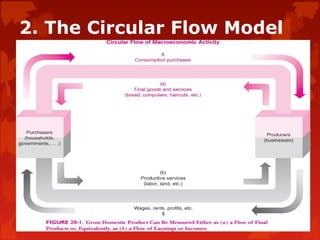
2. The Circular Flow Model
3. Macroeconomic objectives
4. Macroeconomic performance
measures
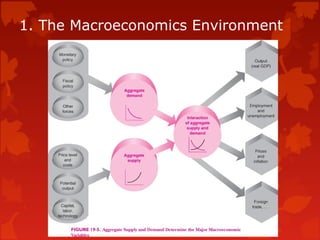
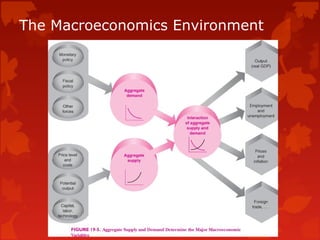
1. The Macroeconomics Environment
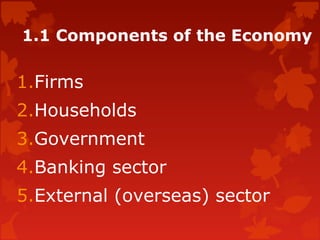
1. Components of the Economy
1.Firms
2.Households
3.Government
4.Banking sector
5.External (overseas) sector
6
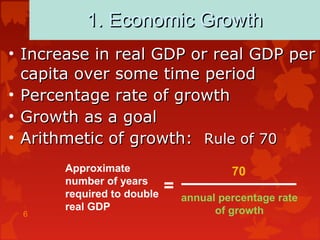
1. Economic Growth1. Economic Growth
• Increase in real GDP or real GDP perIncrease in real GDP or real GDP per
capita over some time periodcapita over some time period
• Percentage rate of growthPercentage rate of growth
• Growth as a goalGrowth as a goal
• Arithmetic of growth:Arithmetic of growth: Rule of 70Rule of 70
Approximate
number of years
required to double
real GDP
=
70
annual percentage rate
of growth
7
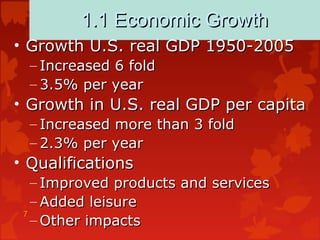
1.1 Economic Growth1.1 Economic Growth
• Growth U.S. real GDP 1950-2005Growth U.S. real GDP 1950-2005
– Increased 6 foldIncreased 6 fold
– 3.5% per year3.5% per year
• Growth in U.S. real GDP per capitaGrowth in U.S. real GDP per capita
– Increased more than 3 foldIncreased more than 3 fold
– 2.3% per year2.3% per year
• QualificationsQualifications
– Improved products and servicesImproved products and services
– Added leisureAdded leisure
– Other impactsOther impacts
8
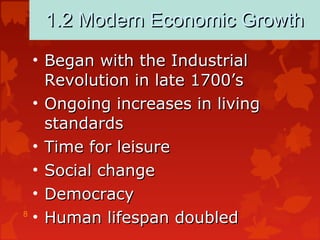
1.2 Modern Economic Growth1.2 Modern Economic Growth
• Began with the IndustrialBegan with the Industrial
Revolution in late 1700’sRevolution in late 1700’s
• Ongoing increases in livingOngoing increases in living
standardsstandards
• Time for leisureTime for leisure
• Social changeSocial change
• DemocracyDemocracy
• Human lifespan doubledHuman lifespan doubled
9
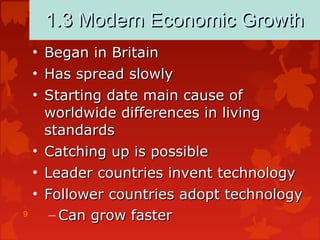
1.3 Modern Economic Growth1.3 Modern Economic Growth
• Began in BritainBegan in Britain
• Has spread slowlyHas spread slowly
• Starting date main cause ofStarting date main cause of
worldwide differences in livingworldwide differences in living
standardsstandards
• Catching up is possibleCatching up is possible
• Leader countries invent technologyLeader countries invent technology
• Follower countries adopt technologyFollower countries adopt technology
– Can grow fasterCan grow faster
10
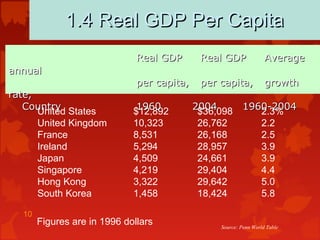
1.4 Real GDP Per Capita1.4 Real GDP Per Capita
Real GDPReal GDP Real GDPReal GDP AverageAverage
annualannual
per capita,per capita, per capita,per capita, growthgrowth
rate,rate,
CountryCountry 19601960 20042004 1960-20041960-2004United States $12,892 $36,098 2.3%
United Kingdom 10,323 26,762 2.2
France 8,531 26,168 2.5
Ireland 5,294 28,957 3.9
Japan 4,509 24,661 3.9
Singapore 4,219 29,404 4.4
Hong Kong 3,322 29,642 5.0
South Korea 1,458 18,424 5.8
Figures are in 1996 dollars Source: Penn World Table
11
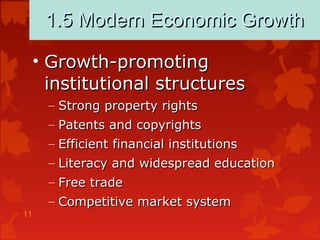
1.5 Modern Economic Growth1.5 Modern Economic Growth
• Growth-promotingGrowth-promoting
institutional structuresinstitutional structures
– Strong property rightsStrong property rights
– Patents and copyrightsPatents and copyrights
– Efficient financial institutionsEfficient financial institutions
– Literacy and widespread educationLiteracy and widespread education
– Free tradeFree trade
– Competitive market systemCompetitive market system
12
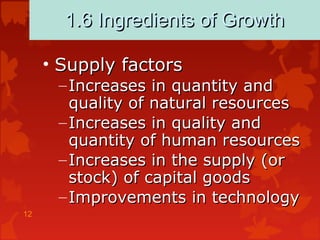
1.6 Ingredients of Growth1.6 Ingredients of Growth
• Supply factorsSupply factors
– Increases in quantity andIncreases in quantity and
quality of natural resourcesquality of natural resources
– Increases in quality andIncreases in quality and
quantity of human resourcesquantity of human resources
– Increases in the supply (orIncreases in the supply (or
stock) of capital goodsstock) of capital goods
– Improvements in technologyImprovements in technology
13
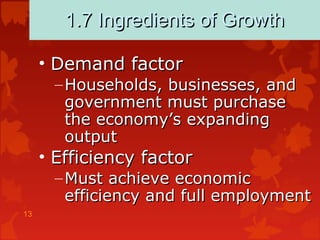
1.7 Ingredients of Growth1.7 Ingredients of Growth
• Demand factorDemand factor
– Households, businesses, andHouseholds, businesses, and
government must purchasegovernment must purchase
the economy’s expandingthe economy’s expanding
outputoutput
• Efficiency factorEfficiency factor
– Must achieve economicMust achieve economic
efficiency and full employmentefficiency and full employment
14
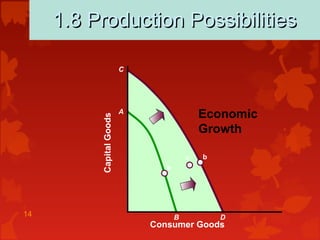
1.8 Production Possibilities1.8 Production Possibilities
Consumer Goods
CapitalGoods
a
Economic
Growth
b
A
C
B D
c
15
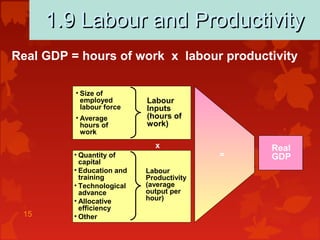
1.9 Labour and Productivity1.9 Labour and Productivity
• Size of
employed
labour force
• Average
hours of
work
Labour
Inputs
(hours of
work)
• Quantity of
capital
• Education and
training
• Technological
advance
• Allocative
efficiency
• Other
Labour
Productivity
(average
output per
hour)
Real
GDP
Real GDP = hours of work x labour productivity
x
=
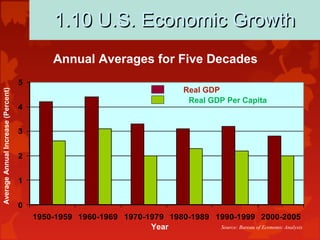
1.10 U.S. Economic Growth1.10 U.S. Economic Growth
Annual Averages for Five Decades
0
1
2
3
4
5
1950-1959 1960-1969 1970-1979 1980-1989 1990-1999 2000-2005
Year
AverageAnnualIncrease(Percent)
Real GDP
Real GDP Per Capita
Source: Bureau of Economic Analysis
17
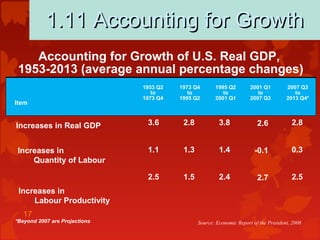
1.11 Accounting for Growth1.11 Accounting for Growth
Accounting for Growth of U.S. Real GDP,
1953-2013 (average annual percentage changes)
Item
1953 Q2
to
1973 Q4
1973 Q4
to
1995 Q2
1995 Q2
to
2001 Q1
2001 Q1
to
2007 Q3
2007 Q3
to
2013 Q4*
Increases in Real GDP
Increases in
Quantity of Labour
Increases in
Labour Productivity
3.6
1.1
2.5
2.8
1.3
1.5
3.8
1.4
2.4
2.6
-0.1
2.7
2.8
0.3
2.5
Source: Economic Report of the President, 2008*Beyond 2007 are Projections
18
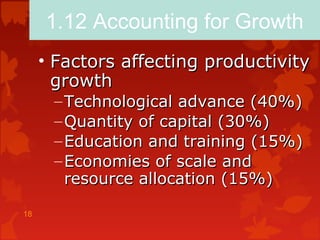
• Factors affecting productivityFactors affecting productivity
growthgrowth
– Technological advance (40%)Technological advance (40%)
– Quantity of capital (30%)Quantity of capital (30%)
– Education and training (15%)Education and training (15%)
– Economies of scale andEconomies of scale and
resource allocation (15%)resource allocation (15%)
1.12 Accounting for Growth
19
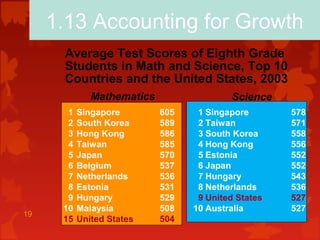
Average Test Scores of Eighth Grade
Students in Math and Science, Top 10
Countries and the United States, 2003
Singapore
South Korea
Hong Kong
Taiwan
Japan
Belgium
Netherlands
Estonia
Hungary
Malaysia
United States
1
2
3
4
5
6
7
8
9
10
15
605
589
586
585
570
537
536
531
529
508
504
Singapore
Taiwan
South Korea
Hong Kong
Estonia
Japan
Hungary
Netherlands
United States
Australia
1
2
3
4
5
6
7
8
9
10
578
571
558
556
552
552
543
536
527
527
Mathematics Science
1.13 Accounting for Growth
20
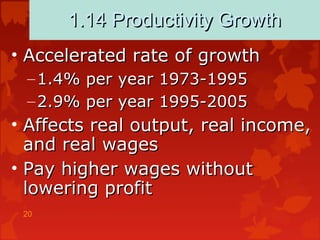
1.14 Productivity Growth1.14 Productivity Growth
• Accelerated rate of growthAccelerated rate of growth
– 1.4% per year 1973-19951.4% per year 1973-1995
– 2.9% per year 1995-20052.9% per year 1995-2005
• Affects real output, real income,Affects real output, real income,
and real wagesand real wages
• Pay higher wages withoutPay higher wages without
lowering profitlowering profit
21
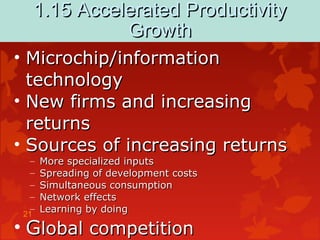
1.15 Accelerated Productivity1.15 Accelerated Productivity
GrowthGrowth
• Microchip/informationMicrochip/information
technologytechnology
• New firms and increasingNew firms and increasing
returnsreturns
• Sources of increasing returnsSources of increasing returns
– More specialized inputsMore specialized inputs
– Spreading of development costsSpreading of development costs
– Simultaneous consumptionSimultaneous consumption
– Network effectsNetwork effects
– Learning by doingLearning by doing
• GGlobal competitionlobal competition
22
1.16 Economic Growth1.16 Economic Growth
• Is accelerated productivity growthIs accelerated productivity growth
sustainable?sustainable?
• Is economic growth desirable andIs economic growth desirable and
sustainable?sustainable?
• The antigrowth viewThe antigrowth view
– Environmental and resource issuesEnvironmental and resource issues
• In defense of economic growthIn defense of economic growth
– Higher standard of livingHigher standard of living
– Human imagination can solveHuman imagination can solve
environmental and resource issuesenvironmental and resource issues
23
1.17 Economic Growth in China1.17 Economic Growth in China
• Growth averages past 25 years:Growth averages past 25 years:
– 9% annual growth output9% annual growth output
– 8% annual growth output per capita8% annual growth output per capita
• Labour more productiveLabour more productive
• More international tradeMore international trade
• Transition to market economyTransition to market economy
• Joined WTO 2001Joined WTO 2001
• Financial system remains weakFinancial system remains weak
• Income inequality acrossIncome inequality across
geographic areasgeographic areas
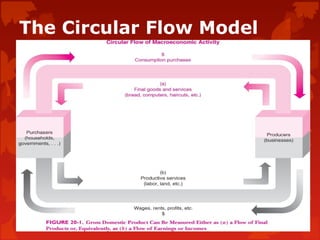
2. The Circular Flow Model
2. Performance and Policy2. Performance and Policy
• Real GDPReal GDP
– Corrects for price changesCorrects for price changes
• Nominal GDPNominal GDP
– Uses current pricesUses current prices
• UnemploymentUnemployment
• InflationInflation
– Increase in overall level ofIncrease in overall level of
pricesprices
26
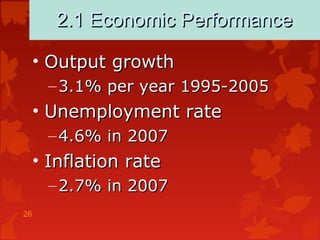
2.1 Economic Performance2.1 Economic Performance
• Output growthOutput growth
– 3.1% per year 1995-20053.1% per year 1995-2005
• Unemployment rateUnemployment rate
– 4.6% in 20074.6% in 2007
• Inflation rateInflation rate
– 2.7% in 20072.7% in 2007
27
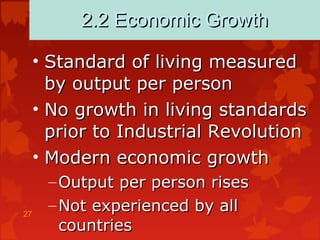
2.2 Economic Growth2.2 Economic Growth
• Standard of living measuredStandard of living measured
by output per personby output per person
• No growth in living standardsNo growth in living standards
prior to Industrial Revolutionprior to Industrial Revolution
• Modern economic growthModern economic growth
– Output per person risesOutput per person rises
– Not experienced by allNot experienced by all
countriescountries
28
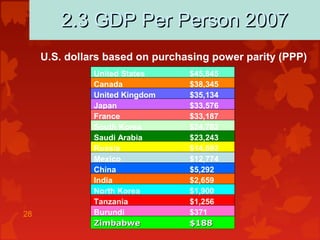
2.3 GDP Per Person 20072.3 GDP Per Person 2007
ZimbabweZimbabwe $188$188
United States $45,845
Canada $38,345
Japan $33,576
United Kingdom $35,134
South Korea $24,782
France $33,187
Russia $14,692
Saudi Arabia $23,243
Burundi $371
Tanzania $1,256
North Korea $1,900
India $2,659
China $5,292
Mexico $12,774
U.S. dollars based on purchasing power parity (PPP)
29
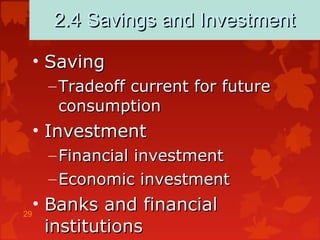
2.4 Savings and Investment2.4 Savings and Investment
• SavingSaving
– Tradeoff current for futureTradeoff current for future
consumptionconsumption
• InvestmentInvestment
– Financial investmentFinancial investment
– Economic investmentEconomic investment
• Banks and financialBanks and financial
institutionsinstitutions
30
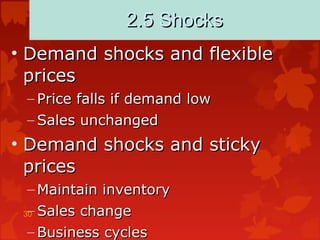
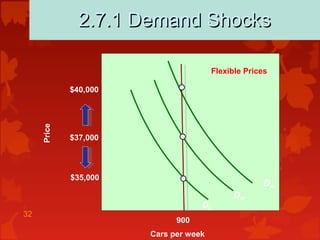
2.5 Shocks2.5 Shocks
• Demand shocks and flexibleDemand shocks and flexible
pricesprices
– Price falls if demand lowPrice falls if demand low
– Sales unchangedSales unchanged
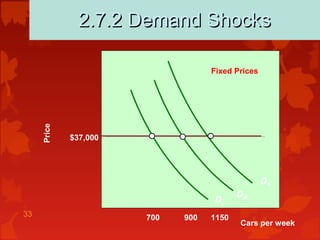
• Demand shocks and stickyDemand shocks and sticky
pricesprices
– Maintain inventoryMaintain inventory
– Sales changeSales change
– Business cyclesBusiness cycles
31
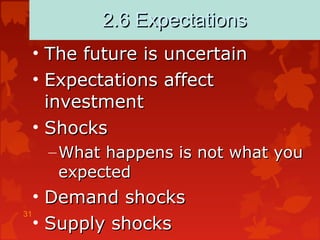
2.6 Expectations2.6 Expectations
• The future is uncertainThe future is uncertain
• Expectations affectExpectations affect
investmentinvestment
• ShocksShocks
– What happens is not what youWhat happens is not what you
expectedexpected
• Demand shocksDemand shocks
• Supply shocksSupply shocks
32
2.7.1 Demand Shocks2.7.1 Demand Shocks
Cars per week
Price
DM
DL
DH
900
$40,000
$37,000
$35,000
Flexible Prices
33
2.7.2 Demand Shocks2.7.2 Demand Shocks
Cars per week
DM
DL
DH
700 900 1150
$37,000
Fixed Prices
Price
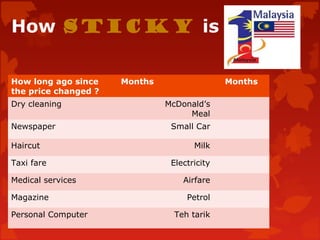
How sticky is
How long ago since
the price changed ?
Months Months
Dry cleaning McDonald’s
Meal
Newspaper Small Car
Haircut Milk
Taxi fare Electricity
Medical services Airfare
Magazine Petrol
Personal Computer Teh tarik
35
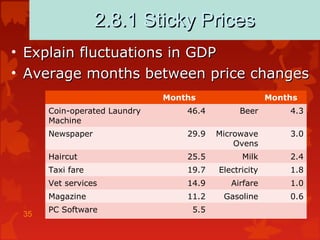
2.8.1 Sticky Prices2.8.1 Sticky Prices
• Explain fluctuations in GDPExplain fluctuations in GDP
• Average months between price changesAverage months between price changes
Months Months
Coin-operated Laundry
Machine
46.4 Beer 4.3
Newspaper 29.9 Microwave
Ovens
3.0
Haircut 25.5 Milk 2.4
Taxi fare 19.7 Electricity 1.8
Vet services 14.9 Airfare 1.0
Magazine 11.2 Gasoline 0.6
PC Software 5.5
36
2.8.1 Sticky Prices2.8.1 Sticky Prices
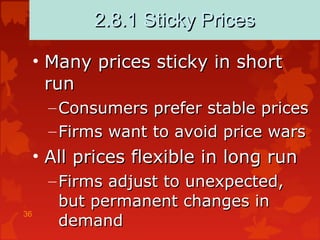
• Many prices sticky in shortMany prices sticky in short
runrun
– Consumers prefer stable pricesConsumers prefer stable prices
– Firms want to avoid price warsFirms want to avoid price wars
• All prices flexible in long runAll prices flexible in long run
– Firms adjust to unexpected,Firms adjust to unexpected,
but permanent changes inbut permanent changes in
demanddemand
37
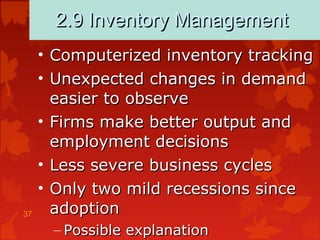
2.9 Inventory Management2.9 Inventory Management
• Computerized inventory trackingComputerized inventory tracking
• Unexpected changes in demandUnexpected changes in demand
easier to observeeasier to observe
• Firms make better output andFirms make better output and
employment decisionsemployment decisions
• Less severe business cyclesLess severe business cycles
• Only two mild recessions sinceOnly two mild recessions since
adoptionadoption
– Possible explanationPossible explanation
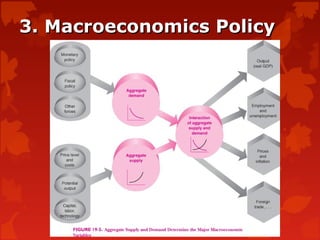
3. Macroeconomics Policy3. Macroeconomics Policy
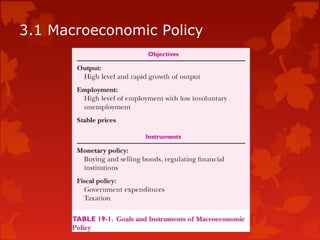
3.1 Macroeconomic Policy
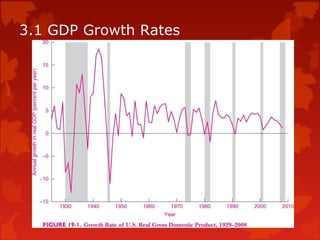
3.1 GDP Growth Rates
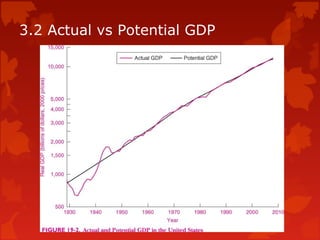
3.2 Actual vs Potential GDP
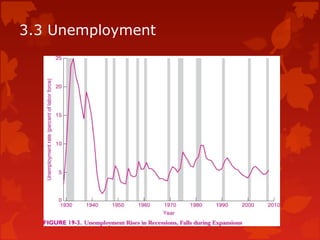
3.3 Unemployment
3.4 Inflation
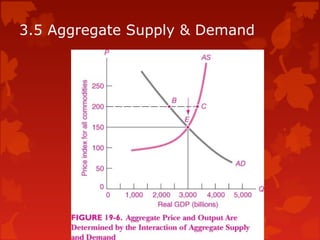
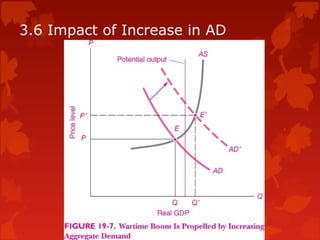
3.5 Aggregate Supply & Demand
3.6 Impact of Increase in AD
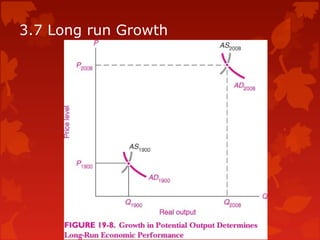
3.7 Long run Growth
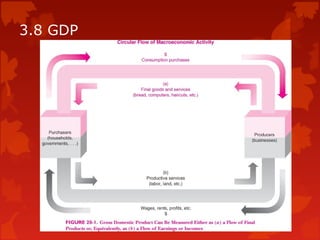
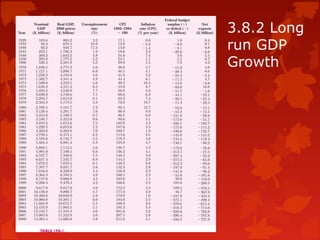
3.8 GDP
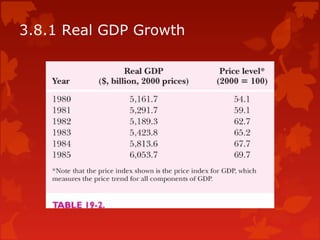
3.8.1 Real GDP Growth
3.8.2 Long
run GDP
Growth
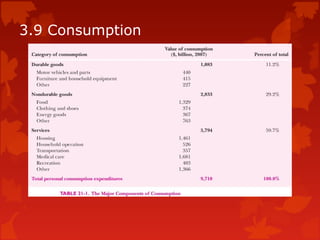
3.9 Consumption
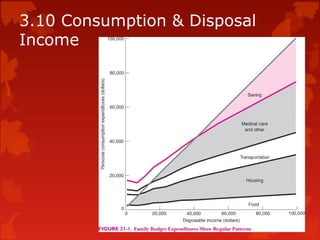
3.10 Consumption & Disposal
Income
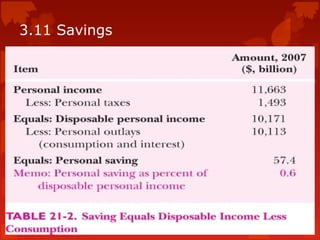
3.11 Savings
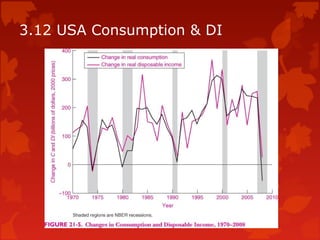
3.12 USA Consumption & DI
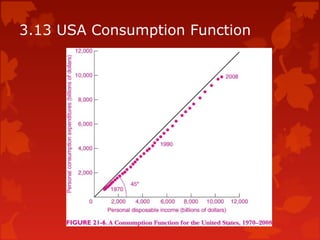
3.13 USA Consumption Function
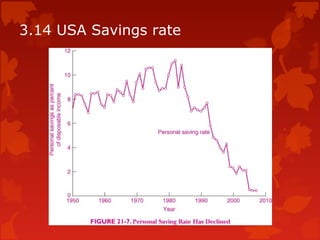
3.14 USA Savings rate
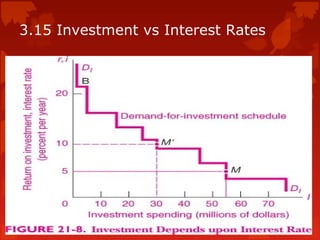
3.15 Investment vs Interest Rates
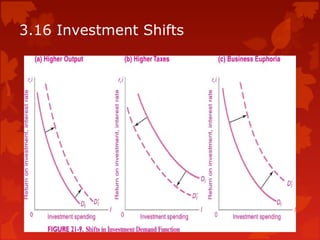
3.16 Investment Shifts
4. Macroeconomic Performance4. Macroeconomic Performance
MeasuresMeasures
Economic growth – GDP vs GNI
 Inflation
Unemployment
Balance of Payments
 Exchange rate
60
4.1 Gross Domestic Product4.1 Gross Domestic Product
• Measure of aggregate outputMeasure of aggregate output
• Monetary measureMonetary measure
• Avoid multiple countingAvoid multiple counting
– Market value final goodsMarket value final goods
– Ignore intermediate goodsIgnore intermediate goods
– Count value addedCount value added
61
4.1 Gross Domestic Product4.1 Gross Domestic Product
• Exclude financialExclude financial
transactionstransactions
– Public transfer paymentsPublic transfer payments
– Private transfer paymentsPrivate transfer payments
– Stock (and bond) marketStock (and bond) market
transactionstransactions
• Second hand salesSecond hand sales
– Sell used car to a friendSell used car to a friend
62
4.2 Two Approaches to GDP4.2 Two Approaches to GDP
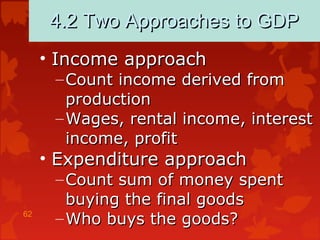
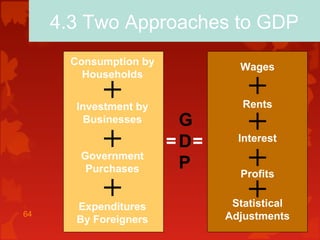
• Income approachIncome approach
– Count income derived fromCount income derived from
productionproduction
– Wages, rental income, interestWages, rental income, interest
income, profitincome, profit
• Expenditure approachExpenditure approach
– Count sum of money spentCount sum of money spent
buying the final goodsbuying the final goods
– Who buys the goods?Who buys the goods?
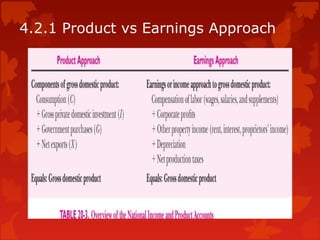
4.2.1 Product vs Earnings Approach
64
G
D
P
= =
+
Consumption by
Households
Investment by
Businesses
Government
Purchases
Expenditures
By Foreigners
+
+
+
+
+
Wages
Rents
Interest
Profits
Statistical
Adjustments
+
4.3 Two Approaches to GDP
65
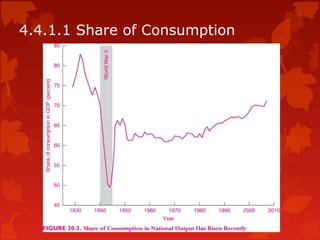
4.4.1 Expenditure Approach4.4.1 Expenditure Approach
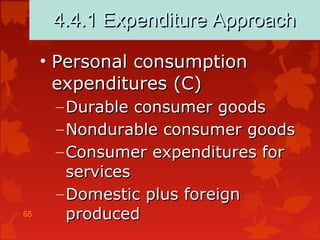
• Personal consumptionPersonal consumption
expenditures (C)expenditures (C)
– Durable consumer goodsDurable consumer goods
– Nondurable consumer goodsNondurable consumer goods
– Consumer expenditures forConsumer expenditures for
servicesservices
– Domestic plus foreignDomestic plus foreign
producedproduced
4.4.1.1 Share of Consumption
67
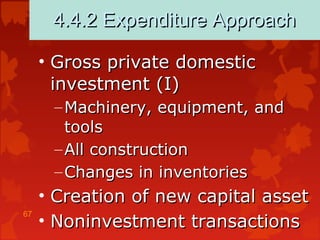
4.4.2 Expenditure Approach4.4.2 Expenditure Approach
• Gross private domesticGross private domestic
investment (I)investment (I)
– Machinery, equipment, andMachinery, equipment, and
toolstools
– All constructionAll construction
– Changes in inventoriesChanges in inventories
• Creation of new capital assetCreation of new capital asset
• Noninvestment transactionsNoninvestment transactions
68
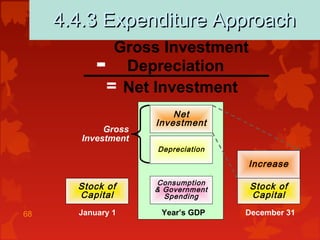
4.4.3 Expenditure Approach4.4.3 Expenditure Approach
January 1 Year’s GDP December 31
Consumption
& Government
Spending
Depreciation
Net
Investment
Gross
Investment
Stock of
Capital
Increase
Stock of
Capital
Gross Investment
Depreciation
Net Investment
-
=
69
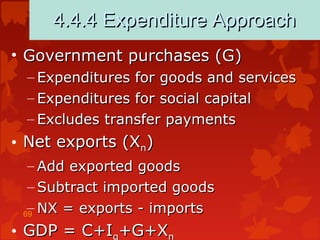
4.4.4 Expenditure Approach4.4.4 Expenditure Approach
• Government purchases (G)Government purchases (G)
– Expenditures for goods and servicesExpenditures for goods and services
– Expenditures for social capitalExpenditures for social capital
– Excludes transfer paymentsExcludes transfer payments
• Net exports (XNet exports (Xnn))
– Add exported goodsAdd exported goods
– Subtract imported goodsSubtract imported goods
– NX = exports - importsNX = exports - imports
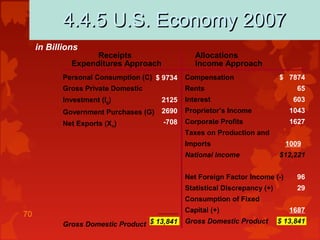
• GDP = C+IGDP = C+Ig+G+X+G+Xn
70
Compensation
Rents
Interest
Proprietor’s Income
Corporate Profits
Taxes on Production and
Imports
National Income
Net Foreign Factor Income (-)
Statistical Discrepancy (+)
Consumption of Fixed
Capital (+)
Gross Domestic Product
$ 7874
65
603
1043
1627
1009
$12,221
96
29
1687
$ 13,841
Personal Consumption (C)
Gross Private Domestic
Investment (Ig)
Government Purchases (G)
Net Exports (Xn)
Gross Domestic Product
in Billions
Receipts
Expenditures Approach
Allocations
Income Approach
$ 9734
2125
2690
-708
$ 13,841
4.4.5 U.S. Economy 20074.4.5 U.S. Economy 2007
71
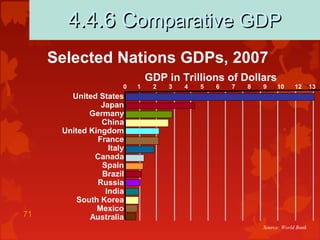
4.4.6 C4.4.6 Comparative GDPomparative GDP
Source: World Bank
Selected Nations GDPs, 2007
United States
Japan
Germany
China
United Kingdom
France
Italy
Canada
Spain
Brazil
Russia
India
South Korea
Mexico
Australia
0 1 2 3 4 5 6 7 8 9 10 12 13
GDP in Trillions of Dollars
72
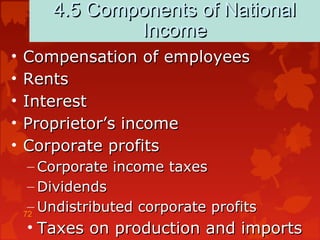
4.5 Components of National4.5 Components of National
IncomeIncome
• Compensation of employeesCompensation of employees
• RentsRents
• InterestInterest
• Proprietor’s incomeProprietor’s income
• Corporate profitsCorporate profits
– Corporate income taxesCorporate income taxes
– DividendsDividends
– Undistributed corporate profitsUndistributed corporate profits
• Taxes on production and importsTaxes on production and imports
73
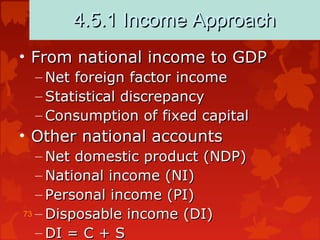
4.5.1 Income Approach4.5.1 Income Approach
• From national income to GDPFrom national income to GDP
– Net foreign factor incomeNet foreign factor income
– Statistical discrepancyStatistical discrepancy
– Consumption of fixed capitalConsumption of fixed capital
• Other national accountsOther national accounts
– Net domestic product (NDP)Net domestic product (NDP)
– National income (NI)National income (NI)
– Personal income (PI)Personal income (PI)
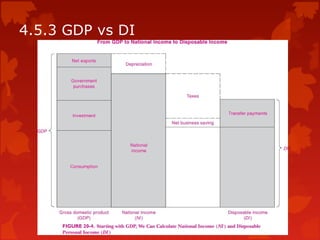
– Disposable income (DI)Disposable income (DI)
– DI = C + SDI = C + S
74
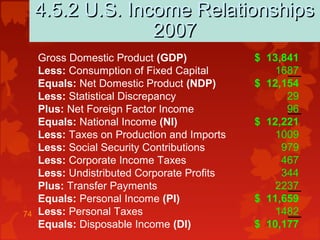
4.5.2 U.S. Income Relationships4.5.2 U.S. Income Relationships
20072007
Gross Domestic Product (GDP)
Less: Consumption of Fixed Capital
Equals: Net Domestic Product (NDP)
Less: Statistical Discrepancy
Plus: Net Foreign Factor Income
Equals: National Income (NI)
Less: Taxes on Production and Imports
Less: Social Security Contributions
Less: Corporate Income Taxes
Less: Undistributed Corporate Profits
Plus: Transfer Payments
Equals: Personal Income (PI)
Less: Personal Taxes
Equals: Disposable Income (DI)
$ 13,841
1687
$ 12,154
29
96
$ 12,221
1009
979
467
344
2237
$ 11,659
1482
$ 10,177
4.5.3 GDP vs DI
76
4.6 Nominal vs. Real GDP4.6 Nominal vs. Real GDP
• GDP is a dollar measure ofGDP is a dollar measure of
productionproduction
• Using dollar values createsUsing dollar values creates
problemsproblems
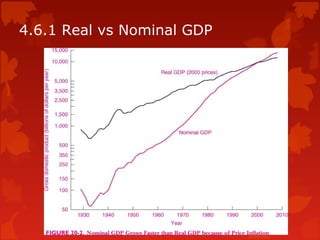
• Nominal GDPNominal GDP
– Use prevailing priceUse prevailing price
• Real GDPReal GDP
– Reflect changes in priceReflect changes in price
– Use base year priceUse base year price
4.6.1 Real vs Nominal GDP
78
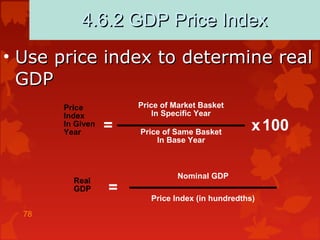
4.6.2 GDP Price Index4.6.2 GDP Price Index
• Use price index to determine realUse price index to determine real
GDPGDP
Price
Index
In Given
Year
= x100
Price of Market Basket
In Specific Year
Price of Same Basket
In Base Year
Real
GDP =
Nominal GDP
Price Index (in hundredths)
79
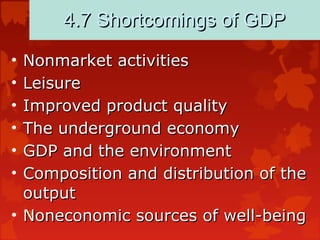
4.7 Shortcomings of GDP4.7 Shortcomings of GDP
• Nonmarket activitiesNonmarket activities
• LeisureLeisure
• Improved product qualityImproved product quality
• The underground economyThe underground economy
• GDP and the environmentGDP and the environment
• Composition and distribution of theComposition and distribution of the
outputoutput
• Noneconomic sources of well-beingNoneconomic sources of well-being
80
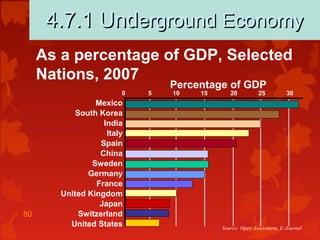
4.7.1 Und4.7.1 Underground Economyerground Economy
Source: Open Assessment, E-Journal
As a percentage of GDP, Selected
Nations, 2007
Mexico
South Korea
India
Italy
Spain
China
Sweden
Germany
France
United Kingdom
Japan
Switzerland
United States
0 5 10 15 20 25 30
Percentage of GDP
81
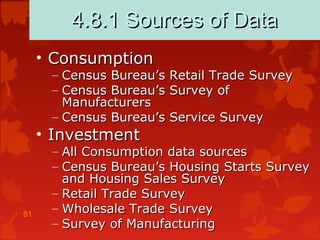
4.8.1 Sources of Data4.8.1 Sources of Data
• ConsumptionConsumption
– Census Bureau’s Retail Trade SurveyCensus Bureau’s Retail Trade Survey
– Census Bureau’s Survey ofCensus Bureau’s Survey of
ManufacturersManufacturers
– Census Bureau’s Service SurveyCensus Bureau’s Service Survey
• InvestmentInvestment
– All Consumption data sourcesAll Consumption data sources
– Census Bureau’s Housing Starts SurveyCensus Bureau’s Housing Starts Survey
and Housing Sales Surveyand Housing Sales Survey
– Retail Trade SurveyRetail Trade Survey
– Wholesale Trade SurveyWholesale Trade Survey
– Survey of ManufacturingSurvey of Manufacturing
82
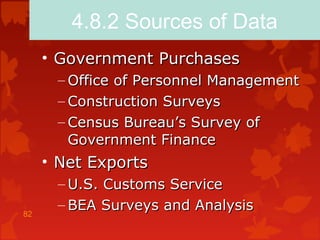
• Government PurchasesGovernment Purchases
– Office of Personnel ManagementOffice of Personnel Management
– Construction SurveysConstruction Surveys
– Census Bureau’s Survey ofCensus Bureau’s Survey of
Government FinanceGovernment Finance
• Net ExportsNet Exports
– U.S. Customs ServiceU.S. Customs Service
– BEA Surveys and AnalysisBEA Surveys and Analysis
4.8.2 Sources of Data
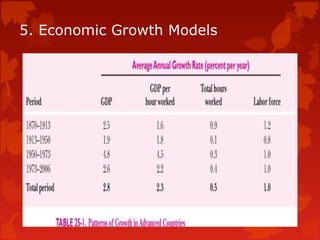
5. Economic Growth Models
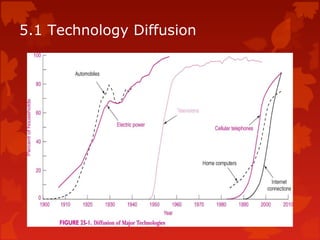
5.1 Technology Diffusion
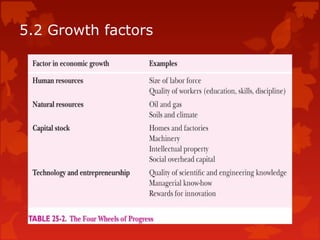
5.2 Growth factors
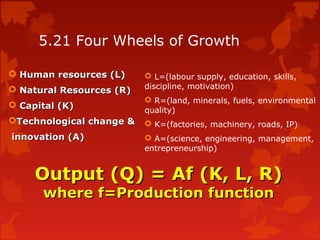
5.21 Four Wheels of Growth
 Human resources (L)Human resources (L)
 Natural Resources (R)Natural Resources (R)
 Capital (K)Capital (K)
Technological change &Technological change &
innovation (A)innovation (A)
Output (Q) = Af (K, L, R)Output (Q) = Af (K, L, R)
where f=Production functionwhere f=Production function
 L=(labour supply, education, skills,
discipline, motivation)
 R=(land, minerals, fuels, environmental
quality)
 K=(factories, machinery, roads, IP)
 A=(science, engineering, management,
entrepreneurship)
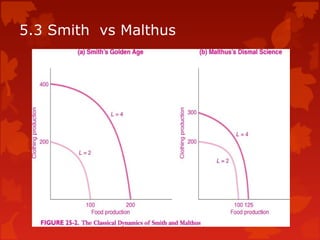
5.3 Smith vs Malthus
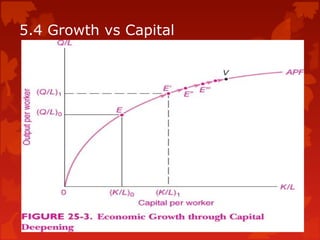
5.4 Growth vs Capital
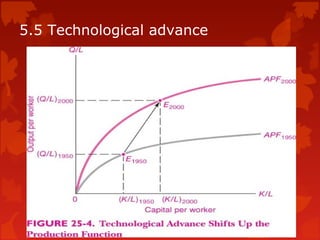
5.5 Technological advance
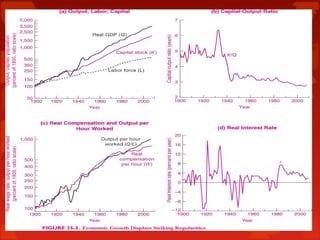
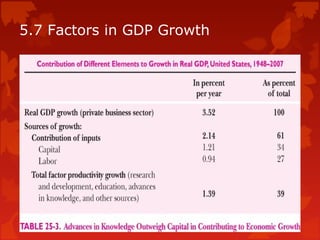
5.7 Factors in GDP Growth
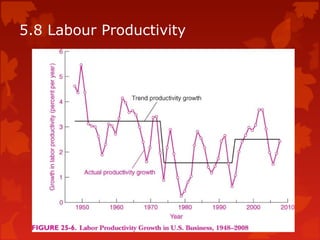
5.8 Labour Productivity
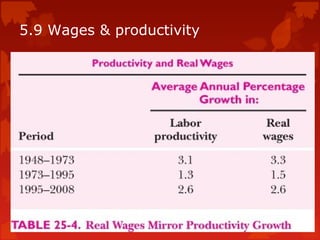
5.9 Wages & productivity
ConclusionConclusion
“Economic growth is the single mostEconomic growth is the single most
important factor in the success ofimportant factor in the success of
nations in the long run. Economicnations in the long run. Economic
growth involves the growth of potentialgrowth involves the growth of potential
output over the long run. The growth inoutput over the long run. The growth in
output per capita is an importantoutput per capita is an important
objective of government because it isobjective of government because it is
associated with rising average realassociated with rising average real
incomes and rising living standardsincomes and rising living standards”
Paul Samuelson
Questions?Questions?
Go Global !Go Global !
Managerial Economics :Managerial Economics :
The Macroeconomic
Environment 2:
The Business Cycle
Learning Objectives
 To analyse the key macroeconomic
indicators
 To explain how the business cycle works
 To critically assess the relationship
between the business cycle and company
performance
AgendaAgenda
1. Business
Cycles &
Business
Performance
2. Unemployment
3. Inflation
The Macroeconomics Environment
1.1 Components of the Economy
1.Firms
2.Households
3.Government
4.Banking sector
5.External (overseas) sector
The Circular Flow Model
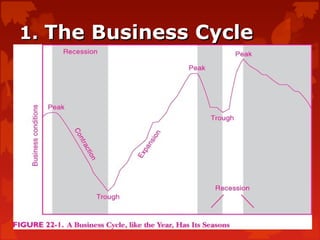
1.1. The Business CycleThe Business Cycle
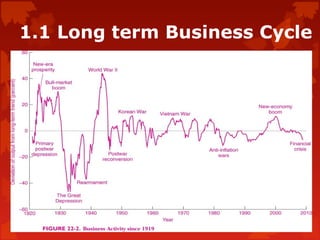
1.1 Long term Business Cycle
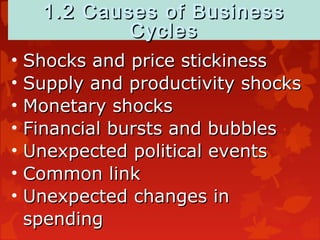
1.2 Causes of Business1.2 Causes of Business
CyclesCycles
• Shocks and price stickinessShocks and price stickiness
• Supply and productivity shocksSupply and productivity shocks
• Monetary shocksMonetary shocks
• Financial bursts and bubblesFinancial bursts and bubbles
• Unexpected political eventsUnexpected political events
• Common linkCommon link
• Unexpected changes inUnexpected changes in
spendingspending
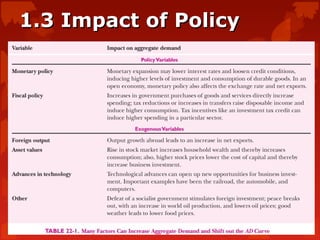
1.3 Impact of Policy1.3 Impact of Policy
1.4 Effects on Business1.4 Effects on Business
PerformancePerformance
1.Profitability
2.Share prices and Dividend Policies
3.Investment and Return on Capital
Employed
4.Cash Flow
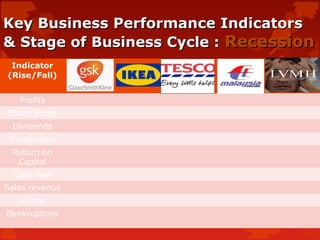
Key Business Performance IndicatorsKey Business Performance Indicators
& Stage of Business Cycle :& Stage of Business Cycle : RecessionRecession
Indicator
(Rise/Fall)
Profits
Share prices
Dividends
Investment
Return on
Capital
Cash flow
Sales revenue
Costs
Bankruptcies
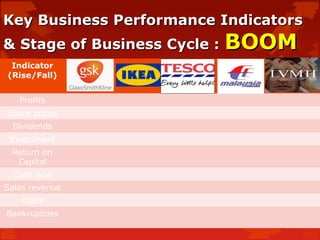
Key Business Performance IndicatorsKey Business Performance Indicators
& Stage of Business Cycle :& Stage of Business Cycle : BOOMBOOM
Indicator
(Rise/Fall)
Profits
Share prices
Dividends
Investment
Return on
Capital
Cash flow
Sales revenue
Costs
Bankruptcies
2. Unemployment2. Unemployment
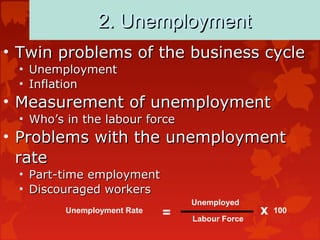
• Twin problems of the business cycleTwin problems of the business cycle
• UnemploymentUnemployment
• InflationInflation
• Measurement of unemploymentMeasurement of unemployment
• Who’s in the labour forceWho’s in the labour force
• Problems with the unemploymentProblems with the unemployment
raterate
• Part-time employmentPart-time employment
• Discouraged workersDiscouraged workers
Unemployment Rate
Unemployed
Labour Force
= x 100
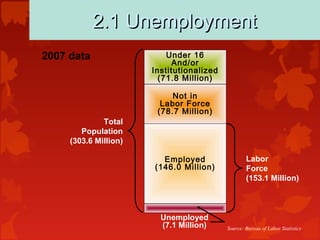
2.1 Unemployment2.1 Unemployment
Under 16
And/or
Institutionalized
(71.8 Million)
2007 data
Total
Population
(303.6 Million)
Not in
Labor Force
(78.7 Million)
Employed
(146.0 Million)
Labor
Force
(153.1 Million)
Unemployed
(7.1 Million) Source: Bureau of Labor Statistics
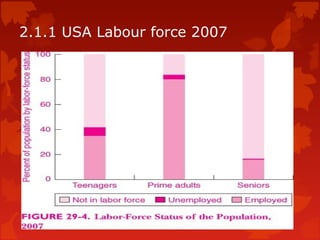
2.1.1 USA Labour force 2007
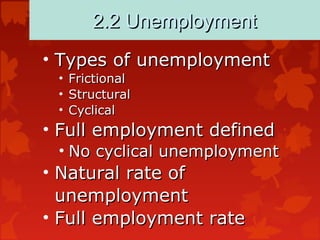
2.2 Unemployment2.2 Unemployment
• Types of unemploymentTypes of unemployment
• FrictionalFrictional
• StructuralStructural
• CyclicalCyclical
• Full employment definedFull employment defined
• No cyclical unemploymentNo cyclical unemployment
• Natural rate ofNatural rate of
unemploymentunemployment
• Full employment rateFull employment rate
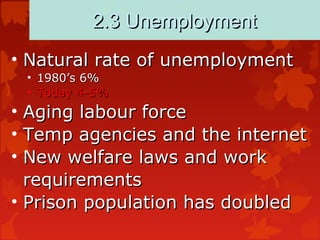
2.3 Unemployment2.3 Unemployment
• Natural rate of unemploymentNatural rate of unemployment
• 1980’s 6%1980’s 6%
• Today 4-5%Today 4-5%
• Aging labour forceAging labour force
• Temp agencies and the internetTemp agencies and the internet
• New welfare laws and workNew welfare laws and work
requirementsrequirements
• Prison population has doubledPrison population has doubled
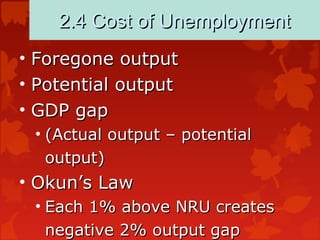
2.4 Cost of Unemployment2.4 Cost of Unemployment
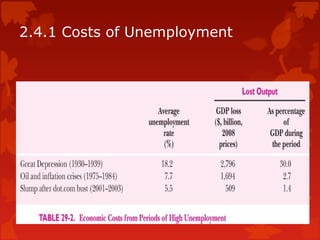
• Foregone outputForegone output
• Potential outputPotential output
• GDP gapGDP gap
• (Actual output – potential(Actual output – potential
output)output)
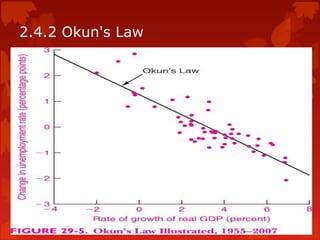
• Okun’s LawOkun’s Law
• Each 1% above NRU createsEach 1% above NRU creates
negative 2% output gapnegative 2% output gap
2.4.1 Costs of Unemployment
2.4.2 Okun's Law
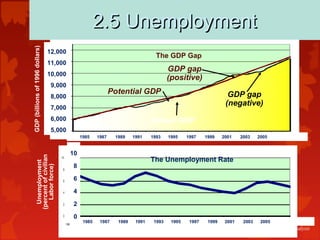
2.5 Unemployment2.5 Unemployment
5,000
6,000
7,000
8,000
9,000
10,000
11,000
12,000
1 985 1987 1989 1991 1993 1995 1997 1999 2001 2003 2005
1985 1987 1989 1991 1993 1995 1997 1999 2001 2003 2005
The GDP Gap
12,000
11,000
10,000
9,000
8,000
7,000
6,000
5,000
GDP(billionsof1996dollars)
0
2
4
6
8
10
1985 1987 1989 1991 1993 1995 1997 1999 2001 2003 2005
1985 1987 1989 1991 1993 1995 1997 1999 2001 2003 2005
The Unemployment Rate
10
8
6
4
2
0
Unemployment
(percentofcivilian
Laborforce)
Source: Congressional Budget Office & Bureau of Economic Analysis
GDP gap
(positive)
GDP gap
(negative)
Potential GDP
Actual GDP
2.6 Unemployment2.6 Unemployment
• Unequal burdensUnequal burdens
• OccupationOccupation
• AgeAge
• Race and ethnicityRace and ethnicity
• GenderGender
• EducationEducation
• DurationDuration
• Noneconomic costsNoneconomic costs
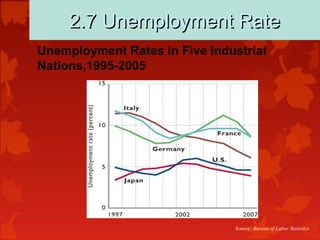
2.7 Unemployment Rate2.7 Unemployment Rate
Source: Bureau of Labor Statistics
Unemployment Rates in Five Industrial
Nations,1995-2005
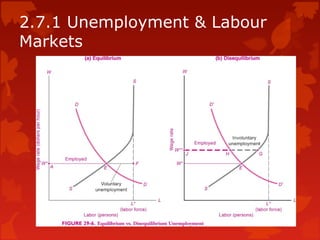
2.7.1 Unemployment & Labour
Markets
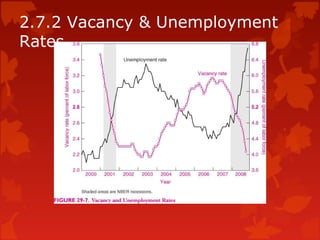
2.7.2 Vacancy & Unemployment
Rates
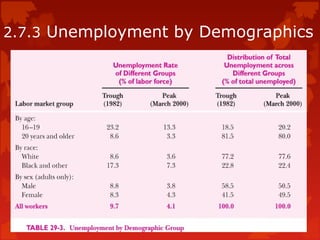
2.7.3 Unemployment by Demographics
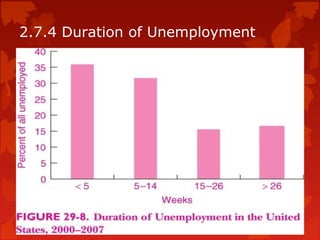
2.7.4 Duration of Unemployment
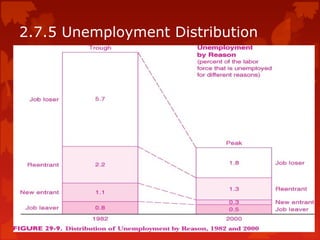
2.7.5 Unemployment Distribution
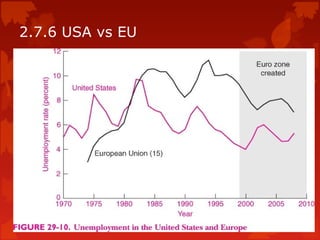
2.7.6 USA vs EU
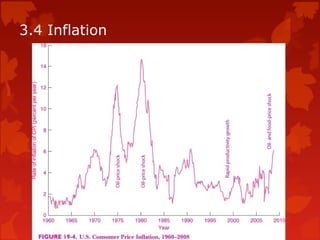
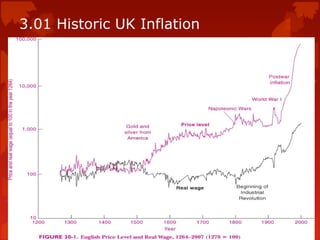
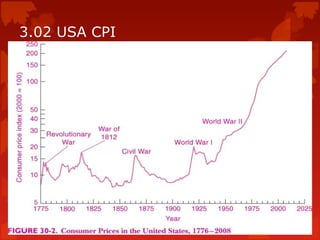
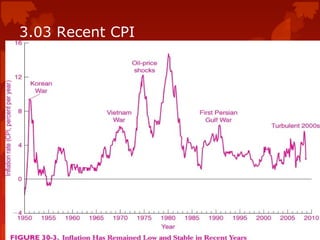
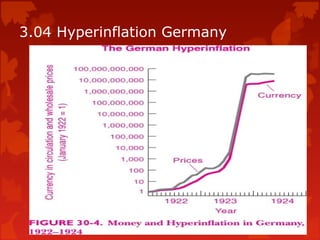
3. Inflation3. Inflation
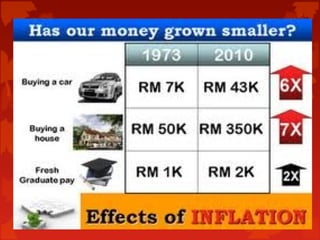
• Rise in general level ofRise in general level of
pricesprices
• Consumer price index (CPI)Consumer price index (CPI)
• Market basketMarket basket
• 300 goods and services300 goods and services
• Typical urban consumerTypical urban consumer
• 2 year updates2 year updates
CPI
Price of the Most Recent Market
Basket in the Particular Year
Price estimate of the Market
Basket in 1982-1984
= x 100
3.01 Historic UK Inflation
3.02 USA CPI
3.03 Recent CPI
3.04 Hyperinflation Germany
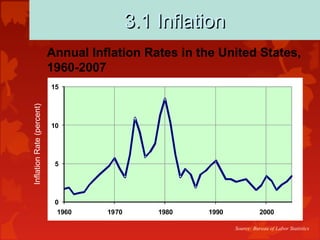
3.1 Inflation3.1 Inflation
Annual Inflation Rates in the United States,
1960-2007
0
5
10
15
1960 1970 1980 1990 2000
InflationRate(percent)
Source: Bureau of Labor Statistics
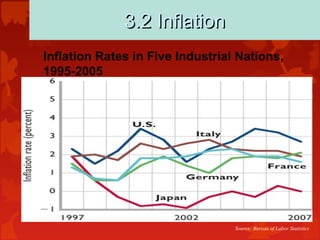
3.2 Inflation3.2 Inflation
Source: Bureau of Labor Statistics
Inflation Rates in Five Industrial Nations,
1995-2005
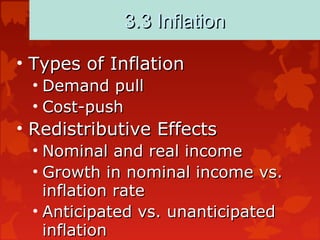
3.3 Inflation3.3 Inflation
• Types of InflationTypes of Inflation
• Demand pullDemand pull
• Cost-pushCost-push
• Redistributive EffectsRedistributive Effects
• Nominal and real incomeNominal and real income
• Growth in nominal income vs.Growth in nominal income vs.
inflation rateinflation rate
• Anticipated vs. unanticipatedAnticipated vs. unanticipated
inflationinflation
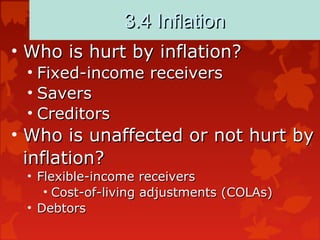
3.4 Inflation3.4 Inflation
• Who is hurt by inflation?Who is hurt by inflation?
• Fixed-income receiversFixed-income receivers
• SaversSavers
• CreditorsCreditors
• Who is unaffected or not hurt byWho is unaffected or not hurt by
inflation?inflation?
• Flexible-income receiversFlexible-income receivers
• Cost-of-living adjustments (COLAs)Cost-of-living adjustments (COLAs)
• DebtorsDebtors
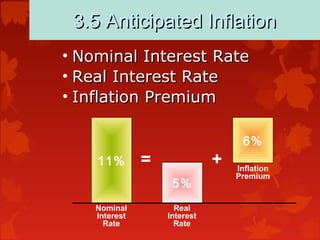
3.5 Anticipated Inflation3.5 Anticipated Inflation
• Nominal Interest RateNominal Interest Rate
• Real Interest RateReal Interest Rate
• Inflation PremiumInflation Premium
Nominal
Interest
Rate
Real
Interest
Rate
Inflation
Premium
11%
5%
6%
= +
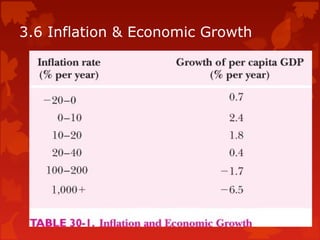
3.6 Inflation & Economic Growth
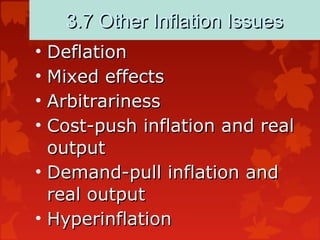
3.7 Other Inflation Issues3.7 Other Inflation Issues
• DeflationDeflation
• Mixed effectsMixed effects
• ArbitrarinessArbitrariness
• Cost-push inflation and realCost-push inflation and real
outputoutput
• Demand-pull inflation andDemand-pull inflation and
real outputreal output
• HyperinflationHyperinflation
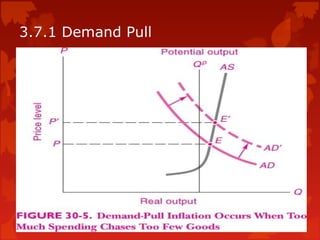
3.7.1 Demand Pull
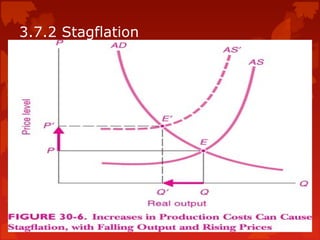
3.7.2 Stagflation
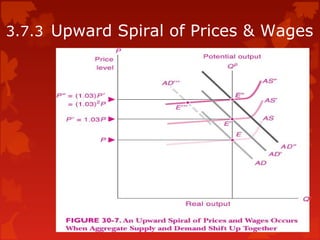
3.7.3 Upward Spiral of Prices & Wages
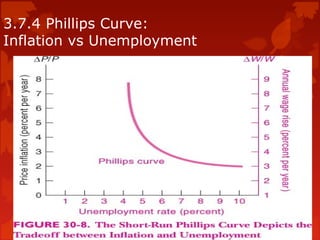
3.7.4 Phillips Curve:
Inflation vs Unemployment
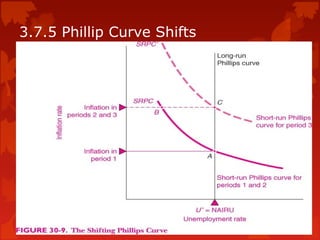
3.7.5 Phillip Curve Shifts
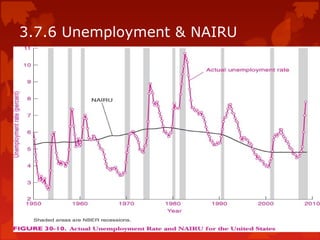
3.7.6 Unemployment & NAIRU
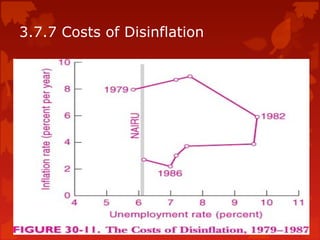
3.7.7 Costs of Disinflation
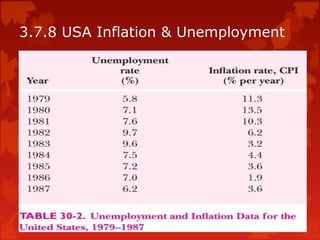
3.7.8 USA Inflation & Unemployment
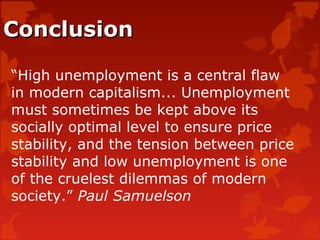
ConclusionConclusion
“High unemployment is a central flaw
in modern capitalism... Unemployment
must sometimes be kept above its
socially optimal level to ensure price
stability, and the tension between price
stability and low unemployment is one
of the cruelest dilemmas of modern
society.” Paul Samuelson
Core ReadingCore Reading
• Keat, Paul G. and Young, Philip KY (2009)
Managerial Economics, 6th
edition, Pearson
• Samuelson, William F. and Marks, Stephen G.
(2010) Managerial Economics, 6th
edition, John
Wiley
• Pindyck, Robert S. and Rubinfeld, Daniel L.(2013)
Microeconomics, 8th
edition, Pearson
• Samuelson, P.A. and Nordhaus, W. D.Samuelson, P.A. and Nordhaus, W. D.
(2010)(2010)“Economics”“Economics” Irwin/McGraw-Hill, 19Irwin/McGraw-Hill, 19thth
EditionEdition
• Porter, Michael E. (2004)Porter, Michael E. (2004)“Competitive Strategy –“Competitive Strategy –
Techniques for Analyzing Industries and Competitors”Techniques for Analyzing Industries and Competitors”
Free PressFree Press
Questions?Questions?

Mba1014 macro economic environment 200413

  • 1.
    Go Global !GoGlobal ! Managerial Economics :Managerial Economics : The Macroeconomic Environment By Stephen OngStephen Ong Visiting Fellow, Birmingham City UniversityVisiting Fellow, Birmingham City University Visiting Professor, College of Management,Visiting Professor, College of Management, Shenzhen UniversityShenzhen University April 2013April 2013
  • 2.
    Learning Objectives • Toidentify the componentTo identify the component parts of the economyparts of the economy • To explain the Circular FlowTo explain the Circular Flow ModelModel • To define the fiveTo define the five macroeconomic objectivesmacroeconomic objectives • To explain howTo explain how macroeconomic performancesmacroeconomic performances are measuredare measured
  • 3.
    AgendaAgenda 1. Components ofthe Economy 2. The Circular Flow Model 3. Macroeconomic objectives 4. Macroeconomic performance measures
  • 4.
  • 5.
    1. Components ofthe Economy 1.Firms 2.Households 3.Government 4.Banking sector 5.External (overseas) sector
  • 6.
    6 1. Economic Growth1.Economic Growth • Increase in real GDP or real GDP perIncrease in real GDP or real GDP per capita over some time periodcapita over some time period • Percentage rate of growthPercentage rate of growth • Growth as a goalGrowth as a goal • Arithmetic of growth:Arithmetic of growth: Rule of 70Rule of 70 Approximate number of years required to double real GDP = 70 annual percentage rate of growth
  • 7.
    7 1.1 Economic Growth1.1Economic Growth • Growth U.S. real GDP 1950-2005Growth U.S. real GDP 1950-2005 – Increased 6 foldIncreased 6 fold – 3.5% per year3.5% per year • Growth in U.S. real GDP per capitaGrowth in U.S. real GDP per capita – Increased more than 3 foldIncreased more than 3 fold – 2.3% per year2.3% per year • QualificationsQualifications – Improved products and servicesImproved products and services – Added leisureAdded leisure – Other impactsOther impacts
  • 8.
    8 1.2 Modern EconomicGrowth1.2 Modern Economic Growth • Began with the IndustrialBegan with the Industrial Revolution in late 1700’sRevolution in late 1700’s • Ongoing increases in livingOngoing increases in living standardsstandards • Time for leisureTime for leisure • Social changeSocial change • DemocracyDemocracy • Human lifespan doubledHuman lifespan doubled
  • 9.
    9 1.3 Modern EconomicGrowth1.3 Modern Economic Growth • Began in BritainBegan in Britain • Has spread slowlyHas spread slowly • Starting date main cause ofStarting date main cause of worldwide differences in livingworldwide differences in living standardsstandards • Catching up is possibleCatching up is possible • Leader countries invent technologyLeader countries invent technology • Follower countries adopt technologyFollower countries adopt technology – Can grow fasterCan grow faster
  • 10.
    10 1.4 Real GDPPer Capita1.4 Real GDP Per Capita Real GDPReal GDP Real GDPReal GDP AverageAverage annualannual per capita,per capita, per capita,per capita, growthgrowth rate,rate, CountryCountry 19601960 20042004 1960-20041960-2004United States $12,892 $36,098 2.3% United Kingdom 10,323 26,762 2.2 France 8,531 26,168 2.5 Ireland 5,294 28,957 3.9 Japan 4,509 24,661 3.9 Singapore 4,219 29,404 4.4 Hong Kong 3,322 29,642 5.0 South Korea 1,458 18,424 5.8 Figures are in 1996 dollars Source: Penn World Table
  • 11.
    11 1.5 Modern EconomicGrowth1.5 Modern Economic Growth • Growth-promotingGrowth-promoting institutional structuresinstitutional structures – Strong property rightsStrong property rights – Patents and copyrightsPatents and copyrights – Efficient financial institutionsEfficient financial institutions – Literacy and widespread educationLiteracy and widespread education – Free tradeFree trade – Competitive market systemCompetitive market system
  • 12.
    12 1.6 Ingredients ofGrowth1.6 Ingredients of Growth • Supply factorsSupply factors – Increases in quantity andIncreases in quantity and quality of natural resourcesquality of natural resources – Increases in quality andIncreases in quality and quantity of human resourcesquantity of human resources – Increases in the supply (orIncreases in the supply (or stock) of capital goodsstock) of capital goods – Improvements in technologyImprovements in technology
  • 13.
    13 1.7 Ingredients ofGrowth1.7 Ingredients of Growth • Demand factorDemand factor – Households, businesses, andHouseholds, businesses, and government must purchasegovernment must purchase the economy’s expandingthe economy’s expanding outputoutput • Efficiency factorEfficiency factor – Must achieve economicMust achieve economic efficiency and full employmentefficiency and full employment
  • 14.
    14 1.8 Production Possibilities1.8Production Possibilities Consumer Goods CapitalGoods a Economic Growth b A C B D c
  • 15.
    15 1.9 Labour andProductivity1.9 Labour and Productivity • Size of employed labour force • Average hours of work Labour Inputs (hours of work) • Quantity of capital • Education and training • Technological advance • Allocative efficiency • Other Labour Productivity (average output per hour) Real GDP Real GDP = hours of work x labour productivity x =
  • 16.
    1.10 U.S. EconomicGrowth1.10 U.S. Economic Growth Annual Averages for Five Decades 0 1 2 3 4 5 1950-1959 1960-1969 1970-1979 1980-1989 1990-1999 2000-2005 Year AverageAnnualIncrease(Percent) Real GDP Real GDP Per Capita Source: Bureau of Economic Analysis
  • 17.
    17 1.11 Accounting forGrowth1.11 Accounting for Growth Accounting for Growth of U.S. Real GDP, 1953-2013 (average annual percentage changes) Item 1953 Q2 to 1973 Q4 1973 Q4 to 1995 Q2 1995 Q2 to 2001 Q1 2001 Q1 to 2007 Q3 2007 Q3 to 2013 Q4* Increases in Real GDP Increases in Quantity of Labour Increases in Labour Productivity 3.6 1.1 2.5 2.8 1.3 1.5 3.8 1.4 2.4 2.6 -0.1 2.7 2.8 0.3 2.5 Source: Economic Report of the President, 2008*Beyond 2007 are Projections
  • 18.
    18 • Factors affectingproductivityFactors affecting productivity growthgrowth – Technological advance (40%)Technological advance (40%) – Quantity of capital (30%)Quantity of capital (30%) – Education and training (15%)Education and training (15%) – Economies of scale andEconomies of scale and resource allocation (15%)resource allocation (15%) 1.12 Accounting for Growth
  • 19.
    19 Average Test Scoresof Eighth Grade Students in Math and Science, Top 10 Countries and the United States, 2003 Singapore South Korea Hong Kong Taiwan Japan Belgium Netherlands Estonia Hungary Malaysia United States 1 2 3 4 5 6 7 8 9 10 15 605 589 586 585 570 537 536 531 529 508 504 Singapore Taiwan South Korea Hong Kong Estonia Japan Hungary Netherlands United States Australia 1 2 3 4 5 6 7 8 9 10 578 571 558 556 552 552 543 536 527 527 Mathematics Science 1.13 Accounting for Growth
  • 20.
    20 1.14 Productivity Growth1.14Productivity Growth • Accelerated rate of growthAccelerated rate of growth – 1.4% per year 1973-19951.4% per year 1973-1995 – 2.9% per year 1995-20052.9% per year 1995-2005 • Affects real output, real income,Affects real output, real income, and real wagesand real wages • Pay higher wages withoutPay higher wages without lowering profitlowering profit
  • 21.
    21 1.15 Accelerated Productivity1.15Accelerated Productivity GrowthGrowth • Microchip/informationMicrochip/information technologytechnology • New firms and increasingNew firms and increasing returnsreturns • Sources of increasing returnsSources of increasing returns – More specialized inputsMore specialized inputs – Spreading of development costsSpreading of development costs – Simultaneous consumptionSimultaneous consumption – Network effectsNetwork effects – Learning by doingLearning by doing • GGlobal competitionlobal competition
  • 22.
    22 1.16 Economic Growth1.16Economic Growth • Is accelerated productivity growthIs accelerated productivity growth sustainable?sustainable? • Is economic growth desirable andIs economic growth desirable and sustainable?sustainable? • The antigrowth viewThe antigrowth view – Environmental and resource issuesEnvironmental and resource issues • In defense of economic growthIn defense of economic growth – Higher standard of livingHigher standard of living – Human imagination can solveHuman imagination can solve environmental and resource issuesenvironmental and resource issues
  • 23.
    23 1.17 Economic Growthin China1.17 Economic Growth in China • Growth averages past 25 years:Growth averages past 25 years: – 9% annual growth output9% annual growth output – 8% annual growth output per capita8% annual growth output per capita • Labour more productiveLabour more productive • More international tradeMore international trade • Transition to market economyTransition to market economy • Joined WTO 2001Joined WTO 2001 • Financial system remains weakFinancial system remains weak • Income inequality acrossIncome inequality across geographic areasgeographic areas
  • 24.
    2. The CircularFlow Model
  • 25.
    2. Performance andPolicy2. Performance and Policy • Real GDPReal GDP – Corrects for price changesCorrects for price changes • Nominal GDPNominal GDP – Uses current pricesUses current prices • UnemploymentUnemployment • InflationInflation – Increase in overall level ofIncrease in overall level of pricesprices
  • 26.
    26 2.1 Economic Performance2.1Economic Performance • Output growthOutput growth – 3.1% per year 1995-20053.1% per year 1995-2005 • Unemployment rateUnemployment rate – 4.6% in 20074.6% in 2007 • Inflation rateInflation rate – 2.7% in 20072.7% in 2007
  • 27.
    27 2.2 Economic Growth2.2Economic Growth • Standard of living measuredStandard of living measured by output per personby output per person • No growth in living standardsNo growth in living standards prior to Industrial Revolutionprior to Industrial Revolution • Modern economic growthModern economic growth – Output per person risesOutput per person rises – Not experienced by allNot experienced by all countriescountries
  • 28.
    28 2.3 GDP PerPerson 20072.3 GDP Per Person 2007 ZimbabweZimbabwe $188$188 United States $45,845 Canada $38,345 Japan $33,576 United Kingdom $35,134 South Korea $24,782 France $33,187 Russia $14,692 Saudi Arabia $23,243 Burundi $371 Tanzania $1,256 North Korea $1,900 India $2,659 China $5,292 Mexico $12,774 U.S. dollars based on purchasing power parity (PPP)
  • 29.
    29 2.4 Savings andInvestment2.4 Savings and Investment • SavingSaving – Tradeoff current for futureTradeoff current for future consumptionconsumption • InvestmentInvestment – Financial investmentFinancial investment – Economic investmentEconomic investment • Banks and financialBanks and financial institutionsinstitutions
  • 30.
    30 2.5 Shocks2.5 Shocks •Demand shocks and flexibleDemand shocks and flexible pricesprices – Price falls if demand lowPrice falls if demand low – Sales unchangedSales unchanged • Demand shocks and stickyDemand shocks and sticky pricesprices – Maintain inventoryMaintain inventory – Sales changeSales change – Business cyclesBusiness cycles
  • 31.
    31 2.6 Expectations2.6 Expectations •The future is uncertainThe future is uncertain • Expectations affectExpectations affect investmentinvestment • ShocksShocks – What happens is not what youWhat happens is not what you expectedexpected • Demand shocksDemand shocks • Supply shocksSupply shocks
  • 32.
    32 2.7.1 Demand Shocks2.7.1Demand Shocks Cars per week Price DM DL DH 900 $40,000 $37,000 $35,000 Flexible Prices
  • 33.
    33 2.7.2 Demand Shocks2.7.2Demand Shocks Cars per week DM DL DH 700 900 1150 $37,000 Fixed Prices Price
  • 34.
    How sticky is Howlong ago since the price changed ? Months Months Dry cleaning McDonald’s Meal Newspaper Small Car Haircut Milk Taxi fare Electricity Medical services Airfare Magazine Petrol Personal Computer Teh tarik
  • 35.
    35 2.8.1 Sticky Prices2.8.1Sticky Prices • Explain fluctuations in GDPExplain fluctuations in GDP • Average months between price changesAverage months between price changes Months Months Coin-operated Laundry Machine 46.4 Beer 4.3 Newspaper 29.9 Microwave Ovens 3.0 Haircut 25.5 Milk 2.4 Taxi fare 19.7 Electricity 1.8 Vet services 14.9 Airfare 1.0 Magazine 11.2 Gasoline 0.6 PC Software 5.5
  • 36.
    36 2.8.1 Sticky Prices2.8.1Sticky Prices • Many prices sticky in shortMany prices sticky in short runrun – Consumers prefer stable pricesConsumers prefer stable prices – Firms want to avoid price warsFirms want to avoid price wars • All prices flexible in long runAll prices flexible in long run – Firms adjust to unexpected,Firms adjust to unexpected, but permanent changes inbut permanent changes in demanddemand
  • 37.
    37 2.9 Inventory Management2.9Inventory Management • Computerized inventory trackingComputerized inventory tracking • Unexpected changes in demandUnexpected changes in demand easier to observeeasier to observe • Firms make better output andFirms make better output and employment decisionsemployment decisions • Less severe business cyclesLess severe business cycles • Only two mild recessions sinceOnly two mild recessions since adoptionadoption – Possible explanationPossible explanation
  • 38.
    3. Macroeconomics Policy3.Macroeconomics Policy
  • 39.
  • 40.
  • 41.
    3.2 Actual vsPotential GDP
  • 42.
  • 43.
  • 45.
  • 46.
    3.6 Impact ofIncrease in AD
  • 47.
  • 48.
  • 49.
  • 50.
  • 51.
  • 52.
    3.10 Consumption &Disposal Income
  • 53.
  • 54.
  • 55.
  • 56.
  • 57.
    3.15 Investment vsInterest Rates
  • 58.
  • 59.
    4. Macroeconomic Performance4.Macroeconomic Performance MeasuresMeasures Economic growth – GDP vs GNI  Inflation Unemployment Balance of Payments  Exchange rate
  • 60.
    60 4.1 Gross DomesticProduct4.1 Gross Domestic Product • Measure of aggregate outputMeasure of aggregate output • Monetary measureMonetary measure • Avoid multiple countingAvoid multiple counting – Market value final goodsMarket value final goods – Ignore intermediate goodsIgnore intermediate goods – Count value addedCount value added
  • 61.
    61 4.1 Gross DomesticProduct4.1 Gross Domestic Product • Exclude financialExclude financial transactionstransactions – Public transfer paymentsPublic transfer payments – Private transfer paymentsPrivate transfer payments – Stock (and bond) marketStock (and bond) market transactionstransactions • Second hand salesSecond hand sales – Sell used car to a friendSell used car to a friend
  • 62.
    62 4.2 Two Approachesto GDP4.2 Two Approaches to GDP • Income approachIncome approach – Count income derived fromCount income derived from productionproduction – Wages, rental income, interestWages, rental income, interest income, profitincome, profit • Expenditure approachExpenditure approach – Count sum of money spentCount sum of money spent buying the final goodsbuying the final goods – Who buys the goods?Who buys the goods?
  • 63.
    4.2.1 Product vsEarnings Approach
  • 64.
    64 G D P = = + Consumption by Households Investmentby Businesses Government Purchases Expenditures By Foreigners + + + + + Wages Rents Interest Profits Statistical Adjustments + 4.3 Two Approaches to GDP
  • 65.
    65 4.4.1 Expenditure Approach4.4.1Expenditure Approach • Personal consumptionPersonal consumption expenditures (C)expenditures (C) – Durable consumer goodsDurable consumer goods – Nondurable consumer goodsNondurable consumer goods – Consumer expenditures forConsumer expenditures for servicesservices – Domestic plus foreignDomestic plus foreign producedproduced
  • 66.
    4.4.1.1 Share ofConsumption
  • 67.
    67 4.4.2 Expenditure Approach4.4.2Expenditure Approach • Gross private domesticGross private domestic investment (I)investment (I) – Machinery, equipment, andMachinery, equipment, and toolstools – All constructionAll construction – Changes in inventoriesChanges in inventories • Creation of new capital assetCreation of new capital asset • Noninvestment transactionsNoninvestment transactions
  • 68.
    68 4.4.3 Expenditure Approach4.4.3Expenditure Approach January 1 Year’s GDP December 31 Consumption & Government Spending Depreciation Net Investment Gross Investment Stock of Capital Increase Stock of Capital Gross Investment Depreciation Net Investment - =
  • 69.
    69 4.4.4 Expenditure Approach4.4.4Expenditure Approach • Government purchases (G)Government purchases (G) – Expenditures for goods and servicesExpenditures for goods and services – Expenditures for social capitalExpenditures for social capital – Excludes transfer paymentsExcludes transfer payments • Net exports (XNet exports (Xnn)) – Add exported goodsAdd exported goods – Subtract imported goodsSubtract imported goods – NX = exports - importsNX = exports - imports • GDP = C+IGDP = C+Ig+G+X+G+Xn
  • 70.
    70 Compensation Rents Interest Proprietor’s Income Corporate Profits Taxeson Production and Imports National Income Net Foreign Factor Income (-) Statistical Discrepancy (+) Consumption of Fixed Capital (+) Gross Domestic Product $ 7874 65 603 1043 1627 1009 $12,221 96 29 1687 $ 13,841 Personal Consumption (C) Gross Private Domestic Investment (Ig) Government Purchases (G) Net Exports (Xn) Gross Domestic Product in Billions Receipts Expenditures Approach Allocations Income Approach $ 9734 2125 2690 -708 $ 13,841 4.4.5 U.S. Economy 20074.4.5 U.S. Economy 2007
  • 71.
    71 4.4.6 C4.4.6 ComparativeGDPomparative GDP Source: World Bank Selected Nations GDPs, 2007 United States Japan Germany China United Kingdom France Italy Canada Spain Brazil Russia India South Korea Mexico Australia 0 1 2 3 4 5 6 7 8 9 10 12 13 GDP in Trillions of Dollars
  • 72.
    72 4.5 Components ofNational4.5 Components of National IncomeIncome • Compensation of employeesCompensation of employees • RentsRents • InterestInterest • Proprietor’s incomeProprietor’s income • Corporate profitsCorporate profits – Corporate income taxesCorporate income taxes – DividendsDividends – Undistributed corporate profitsUndistributed corporate profits • Taxes on production and importsTaxes on production and imports
  • 73.
    73 4.5.1 Income Approach4.5.1Income Approach • From national income to GDPFrom national income to GDP – Net foreign factor incomeNet foreign factor income – Statistical discrepancyStatistical discrepancy – Consumption of fixed capitalConsumption of fixed capital • Other national accountsOther national accounts – Net domestic product (NDP)Net domestic product (NDP) – National income (NI)National income (NI) – Personal income (PI)Personal income (PI) – Disposable income (DI)Disposable income (DI) – DI = C + SDI = C + S
  • 74.
    74 4.5.2 U.S. IncomeRelationships4.5.2 U.S. Income Relationships 20072007 Gross Domestic Product (GDP) Less: Consumption of Fixed Capital Equals: Net Domestic Product (NDP) Less: Statistical Discrepancy Plus: Net Foreign Factor Income Equals: National Income (NI) Less: Taxes on Production and Imports Less: Social Security Contributions Less: Corporate Income Taxes Less: Undistributed Corporate Profits Plus: Transfer Payments Equals: Personal Income (PI) Less: Personal Taxes Equals: Disposable Income (DI) $ 13,841 1687 $ 12,154 29 96 $ 12,221 1009 979 467 344 2237 $ 11,659 1482 $ 10,177
  • 75.
  • 76.
    76 4.6 Nominal vs.Real GDP4.6 Nominal vs. Real GDP • GDP is a dollar measure ofGDP is a dollar measure of productionproduction • Using dollar values createsUsing dollar values creates problemsproblems • Nominal GDPNominal GDP – Use prevailing priceUse prevailing price • Real GDPReal GDP – Reflect changes in priceReflect changes in price – Use base year priceUse base year price
  • 77.
    4.6.1 Real vsNominal GDP
  • 78.
    78 4.6.2 GDP PriceIndex4.6.2 GDP Price Index • Use price index to determine realUse price index to determine real GDPGDP Price Index In Given Year = x100 Price of Market Basket In Specific Year Price of Same Basket In Base Year Real GDP = Nominal GDP Price Index (in hundredths)
  • 79.
    79 4.7 Shortcomings ofGDP4.7 Shortcomings of GDP • Nonmarket activitiesNonmarket activities • LeisureLeisure • Improved product qualityImproved product quality • The underground economyThe underground economy • GDP and the environmentGDP and the environment • Composition and distribution of theComposition and distribution of the outputoutput • Noneconomic sources of well-beingNoneconomic sources of well-being
  • 80.
    80 4.7.1 Und4.7.1 UndergroundEconomyerground Economy Source: Open Assessment, E-Journal As a percentage of GDP, Selected Nations, 2007 Mexico South Korea India Italy Spain China Sweden Germany France United Kingdom Japan Switzerland United States 0 5 10 15 20 25 30 Percentage of GDP
  • 81.
    81 4.8.1 Sources ofData4.8.1 Sources of Data • ConsumptionConsumption – Census Bureau’s Retail Trade SurveyCensus Bureau’s Retail Trade Survey – Census Bureau’s Survey ofCensus Bureau’s Survey of ManufacturersManufacturers – Census Bureau’s Service SurveyCensus Bureau’s Service Survey • InvestmentInvestment – All Consumption data sourcesAll Consumption data sources – Census Bureau’s Housing Starts SurveyCensus Bureau’s Housing Starts Survey and Housing Sales Surveyand Housing Sales Survey – Retail Trade SurveyRetail Trade Survey – Wholesale Trade SurveyWholesale Trade Survey – Survey of ManufacturingSurvey of Manufacturing
  • 82.
    82 • Government PurchasesGovernmentPurchases – Office of Personnel ManagementOffice of Personnel Management – Construction SurveysConstruction Surveys – Census Bureau’s Survey ofCensus Bureau’s Survey of Government FinanceGovernment Finance • Net ExportsNet Exports – U.S. Customs ServiceU.S. Customs Service – BEA Surveys and AnalysisBEA Surveys and Analysis 4.8.2 Sources of Data
  • 83.
  • 84.
  • 85.
  • 86.
    5.21 Four Wheelsof Growth  Human resources (L)Human resources (L)  Natural Resources (R)Natural Resources (R)  Capital (K)Capital (K) Technological change &Technological change & innovation (A)innovation (A) Output (Q) = Af (K, L, R)Output (Q) = Af (K, L, R) where f=Production functionwhere f=Production function  L=(labour supply, education, skills, discipline, motivation)  R=(land, minerals, fuels, environmental quality)  K=(factories, machinery, roads, IP)  A=(science, engineering, management, entrepreneurship)
  • 87.
    5.3 Smith vsMalthus
  • 88.
  • 89.
  • 91.
    5.7 Factors inGDP Growth
  • 92.
  • 93.
    5.9 Wages &productivity
  • 94.
    ConclusionConclusion “Economic growth isthe single mostEconomic growth is the single most important factor in the success ofimportant factor in the success of nations in the long run. Economicnations in the long run. Economic growth involves the growth of potentialgrowth involves the growth of potential output over the long run. The growth inoutput over the long run. The growth in output per capita is an importantoutput per capita is an important objective of government because it isobjective of government because it is associated with rising average realassociated with rising average real incomes and rising living standardsincomes and rising living standards” Paul Samuelson
  • 95.
  • 96.
    Go Global !GoGlobal ! Managerial Economics :Managerial Economics : The Macroeconomic Environment 2: The Business Cycle
  • 97.
    Learning Objectives  Toanalyse the key macroeconomic indicators  To explain how the business cycle works  To critically assess the relationship between the business cycle and company performance
  • 98.
  • 99.
  • 100.
    1.1 Components ofthe Economy 1.Firms 2.Households 3.Government 4.Banking sector 5.External (overseas) sector
  • 101.
  • 102.
    1.1. The BusinessCycleThe Business Cycle
  • 103.
    1.1 Long termBusiness Cycle
  • 104.
    1.2 Causes ofBusiness1.2 Causes of Business CyclesCycles • Shocks and price stickinessShocks and price stickiness • Supply and productivity shocksSupply and productivity shocks • Monetary shocksMonetary shocks • Financial bursts and bubblesFinancial bursts and bubbles • Unexpected political eventsUnexpected political events • Common linkCommon link • Unexpected changes inUnexpected changes in spendingspending
  • 105.
    1.3 Impact ofPolicy1.3 Impact of Policy
  • 106.
    1.4 Effects onBusiness1.4 Effects on Business PerformancePerformance 1.Profitability 2.Share prices and Dividend Policies 3.Investment and Return on Capital Employed 4.Cash Flow
  • 107.
    Key Business PerformanceIndicatorsKey Business Performance Indicators & Stage of Business Cycle :& Stage of Business Cycle : RecessionRecession Indicator (Rise/Fall) Profits Share prices Dividends Investment Return on Capital Cash flow Sales revenue Costs Bankruptcies
  • 108.
    Key Business PerformanceIndicatorsKey Business Performance Indicators & Stage of Business Cycle :& Stage of Business Cycle : BOOMBOOM Indicator (Rise/Fall) Profits Share prices Dividends Investment Return on Capital Cash flow Sales revenue Costs Bankruptcies
  • 109.
    2. Unemployment2. Unemployment •Twin problems of the business cycleTwin problems of the business cycle • UnemploymentUnemployment • InflationInflation • Measurement of unemploymentMeasurement of unemployment • Who’s in the labour forceWho’s in the labour force • Problems with the unemploymentProblems with the unemployment raterate • Part-time employmentPart-time employment • Discouraged workersDiscouraged workers Unemployment Rate Unemployed Labour Force = x 100
  • 110.
    2.1 Unemployment2.1 Unemployment Under16 And/or Institutionalized (71.8 Million) 2007 data Total Population (303.6 Million) Not in Labor Force (78.7 Million) Employed (146.0 Million) Labor Force (153.1 Million) Unemployed (7.1 Million) Source: Bureau of Labor Statistics
  • 111.
    2.1.1 USA Labourforce 2007
  • 112.
    2.2 Unemployment2.2 Unemployment •Types of unemploymentTypes of unemployment • FrictionalFrictional • StructuralStructural • CyclicalCyclical • Full employment definedFull employment defined • No cyclical unemploymentNo cyclical unemployment • Natural rate ofNatural rate of unemploymentunemployment • Full employment rateFull employment rate
  • 113.
    2.3 Unemployment2.3 Unemployment •Natural rate of unemploymentNatural rate of unemployment • 1980’s 6%1980’s 6% • Today 4-5%Today 4-5% • Aging labour forceAging labour force • Temp agencies and the internetTemp agencies and the internet • New welfare laws and workNew welfare laws and work requirementsrequirements • Prison population has doubledPrison population has doubled
  • 114.
    2.4 Cost ofUnemployment2.4 Cost of Unemployment • Foregone outputForegone output • Potential outputPotential output • GDP gapGDP gap • (Actual output – potential(Actual output – potential output)output) • Okun’s LawOkun’s Law • Each 1% above NRU createsEach 1% above NRU creates negative 2% output gapnegative 2% output gap
  • 115.
    2.4.1 Costs ofUnemployment
  • 116.
  • 117.
    2.5 Unemployment2.5 Unemployment 5,000 6,000 7,000 8,000 9,000 10,000 11,000 12,000 1985 1987 1989 1991 1993 1995 1997 1999 2001 2003 2005 1985 1987 1989 1991 1993 1995 1997 1999 2001 2003 2005 The GDP Gap 12,000 11,000 10,000 9,000 8,000 7,000 6,000 5,000 GDP(billionsof1996dollars) 0 2 4 6 8 10 1985 1987 1989 1991 1993 1995 1997 1999 2001 2003 2005 1985 1987 1989 1991 1993 1995 1997 1999 2001 2003 2005 The Unemployment Rate 10 8 6 4 2 0 Unemployment (percentofcivilian Laborforce) Source: Congressional Budget Office & Bureau of Economic Analysis GDP gap (positive) GDP gap (negative) Potential GDP Actual GDP
  • 118.
    2.6 Unemployment2.6 Unemployment •Unequal burdensUnequal burdens • OccupationOccupation • AgeAge • Race and ethnicityRace and ethnicity • GenderGender • EducationEducation • DurationDuration • Noneconomic costsNoneconomic costs
  • 119.
    2.7 Unemployment Rate2.7Unemployment Rate Source: Bureau of Labor Statistics Unemployment Rates in Five Industrial Nations,1995-2005
  • 120.
    2.7.1 Unemployment &Labour Markets
  • 121.
    2.7.2 Vacancy &Unemployment Rates
  • 122.
  • 123.
    2.7.4 Duration ofUnemployment
  • 124.
  • 125.
  • 126.
    3. Inflation3. Inflation •Rise in general level ofRise in general level of pricesprices • Consumer price index (CPI)Consumer price index (CPI) • Market basketMarket basket • 300 goods and services300 goods and services • Typical urban consumerTypical urban consumer • 2 year updates2 year updates CPI Price of the Most Recent Market Basket in the Particular Year Price estimate of the Market Basket in 1982-1984 = x 100
  • 127.
  • 128.
  • 129.
  • 130.
  • 131.
    3.1 Inflation3.1 Inflation AnnualInflation Rates in the United States, 1960-2007 0 5 10 15 1960 1970 1980 1990 2000 InflationRate(percent) Source: Bureau of Labor Statistics
  • 132.
    3.2 Inflation3.2 Inflation Source:Bureau of Labor Statistics Inflation Rates in Five Industrial Nations, 1995-2005
  • 133.
    3.3 Inflation3.3 Inflation •Types of InflationTypes of Inflation • Demand pullDemand pull • Cost-pushCost-push • Redistributive EffectsRedistributive Effects • Nominal and real incomeNominal and real income • Growth in nominal income vs.Growth in nominal income vs. inflation rateinflation rate • Anticipated vs. unanticipatedAnticipated vs. unanticipated inflationinflation
  • 134.
    3.4 Inflation3.4 Inflation •Who is hurt by inflation?Who is hurt by inflation? • Fixed-income receiversFixed-income receivers • SaversSavers • CreditorsCreditors • Who is unaffected or not hurt byWho is unaffected or not hurt by inflation?inflation? • Flexible-income receiversFlexible-income receivers • Cost-of-living adjustments (COLAs)Cost-of-living adjustments (COLAs) • DebtorsDebtors
  • 135.
    3.5 Anticipated Inflation3.5Anticipated Inflation • Nominal Interest RateNominal Interest Rate • Real Interest RateReal Interest Rate • Inflation PremiumInflation Premium Nominal Interest Rate Real Interest Rate Inflation Premium 11% 5% 6% = +
  • 136.
    3.6 Inflation &Economic Growth
  • 137.
    3.7 Other InflationIssues3.7 Other Inflation Issues • DeflationDeflation • Mixed effectsMixed effects • ArbitrarinessArbitrariness • Cost-push inflation and realCost-push inflation and real outputoutput • Demand-pull inflation andDemand-pull inflation and real outputreal output • HyperinflationHyperinflation
  • 138.
  • 139.
  • 140.
    3.7.3 Upward Spiralof Prices & Wages
  • 141.
  • 142.
  • 143.
  • 144.
    3.7.7 Costs ofDisinflation
  • 145.
    3.7.8 USA Inflation& Unemployment
  • 146.
    ConclusionConclusion “High unemployment isa central flaw in modern capitalism... Unemployment must sometimes be kept above its socially optimal level to ensure price stability, and the tension between price stability and low unemployment is one of the cruelest dilemmas of modern society.” Paul Samuelson
  • 147.
    Core ReadingCore Reading •Keat, Paul G. and Young, Philip KY (2009) Managerial Economics, 6th edition, Pearson • Samuelson, William F. and Marks, Stephen G. (2010) Managerial Economics, 6th edition, John Wiley • Pindyck, Robert S. and Rubinfeld, Daniel L.(2013) Microeconomics, 8th edition, Pearson • Samuelson, P.A. and Nordhaus, W. D.Samuelson, P.A. and Nordhaus, W. D. (2010)(2010)“Economics”“Economics” Irwin/McGraw-Hill, 19Irwin/McGraw-Hill, 19thth EditionEdition • Porter, Michael E. (2004)Porter, Michael E. (2004)“Competitive Strategy –“Competitive Strategy – Techniques for Analyzing Industries and Competitors”Techniques for Analyzing Industries and Competitors” Free PressFree Press

  • 148.

Editor's Notes

  • #98 The Learning Objectives for Chapter 1 are To define globalization and international business and show how they affect each other To understand why companies engage in international business and why international business growth has accelerated To discuss globalization’s future and the major criticisms of globalization To become familiar with different ways in which a company can accomplish its global objectives To apply social science disciplines to understanding the differences between international and domestic business