Chapter 24
An Introduction to Macroeconomics
Copyright © 2015 McGraw-Hill Education. All rights reserved. No reproduction or distribution without the prior written consent of McGraw-Hill Education.
24-2
Two Major issues in Macroeconomics
• Macroeconomics deals with whole economy
which has limited resources to achieve high
standard of living.
• Economic Growth: Expansion of economy
• Business Cycle: fluctuation along the growth
trend
• Unemployment during recession
• Inflation
LO1
24-3
Macroeconomic Performance
Measures
• Macroeconomic Performance Measures
• GDP: Total production of goods and services
• GDP per capita as standard of living
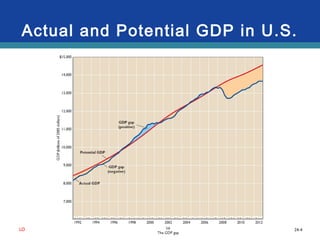
• Potential GDP for economic growth
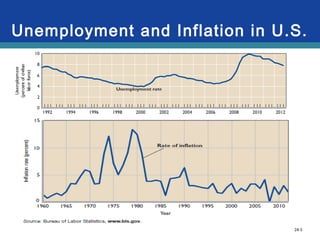
• Unemployment rate
• Labor participation rate
• Inflation rate
• Increase in overall level of prices
LO1
24-4
Actual and Potential GDP in U.S.
LO
24-5
Unemployment and Inflation in U.S.
LO
24-6
Macroeconomic Performance
in 2014
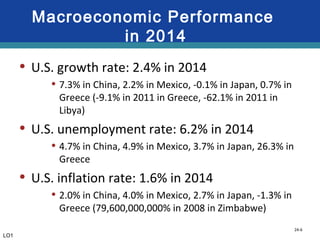
• U.S. growth rate: 2.4% in 2014
• 7.3% in China, 2.2% in Mexico, -0.1% in Japan, 0.7% in
Greece (-9.1% in 2011 in Greece, -62.1% in 2011 in
Libya)
• U.S. unemployment rate: 6.2% in 2014
• 4.7% in China, 4.9% in Mexico, 3.7% in Japan, 26.3% in
Greece
• U.S. inflation rate: 1.6% in 2014
• 2.0% in China, 4.0% in Mexico, 2.7% in Japan, -1.3% in
Greece (79,600,000,000% in 2008 in Zimbabwe)
LO1
24-7
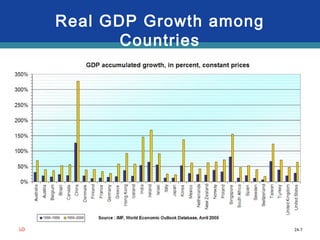
Real GDP Growth among
Countries
LO
24-8
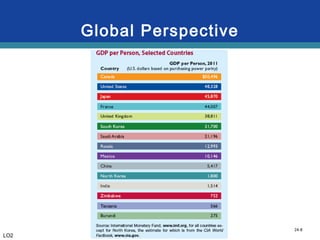
Global Perspective
LO2
24-9
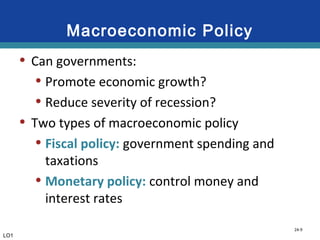
Macroeconomic Policy
• Can governments:
• Promote economic growth?
• Reduce severity of recession?
• Two types of macroeconomic policy
• Fiscal policy: government spending and
taxations
• Monetary policy: control money and
interest rates
LO1
24-10
Savings and Investment
• Main Source of Economic Growth is
• Investment on capital
• Technological advancement
• Saving as source of investment
• Trade-off current for future consumption
• Banks and financial institutions
LO3
24-11
Uncertainty, Expectations, and
Shocks
• The importance of expectations and shocks
• Expectations affect investment decisions
• Shocks (Unexpected events) alter actual
return on investment
LO4

Econ789 chapter024

  • 1.
    Chapter 24 An Introductionto Macroeconomics Copyright © 2015 McGraw-Hill Education. All rights reserved. No reproduction or distribution without the prior written consent of McGraw-Hill Education.
  • 2.
    24-2 Two Major issuesin Macroeconomics • Macroeconomics deals with whole economy which has limited resources to achieve high standard of living. • Economic Growth: Expansion of economy • Business Cycle: fluctuation along the growth trend • Unemployment during recession • Inflation LO1
  • 3.
    24-3 Macroeconomic Performance Measures • MacroeconomicPerformance Measures • GDP: Total production of goods and services • GDP per capita as standard of living • Potential GDP for economic growth • Unemployment rate • Labor participation rate • Inflation rate • Increase in overall level of prices LO1
  • 4.
  • 5.
  • 6.
    24-6 Macroeconomic Performance in 2014 •U.S. growth rate: 2.4% in 2014 • 7.3% in China, 2.2% in Mexico, -0.1% in Japan, 0.7% in Greece (-9.1% in 2011 in Greece, -62.1% in 2011 in Libya) • U.S. unemployment rate: 6.2% in 2014 • 4.7% in China, 4.9% in Mexico, 3.7% in Japan, 26.3% in Greece • U.S. inflation rate: 1.6% in 2014 • 2.0% in China, 4.0% in Mexico, 2.7% in Japan, -1.3% in Greece (79,600,000,000% in 2008 in Zimbabwe) LO1
  • 7.
    24-7 Real GDP Growthamong Countries LO
  • 8.
  • 9.
    24-9 Macroeconomic Policy • Cangovernments: • Promote economic growth? • Reduce severity of recession? • Two types of macroeconomic policy • Fiscal policy: government spending and taxations • Monetary policy: control money and interest rates LO1
  • 10.
    24-10 Savings and Investment •Main Source of Economic Growth is • Investment on capital • Technological advancement • Saving as source of investment • Trade-off current for future consumption • Banks and financial institutions LO3
  • 11.
    24-11 Uncertainty, Expectations, and Shocks •The importance of expectations and shocks • Expectations affect investment decisions • Shocks (Unexpected events) alter actual return on investment LO4

Editor's Notes

  • #2 In this chapter, we investigate the basic variables that are used to evaluate the progress of an economy, including facts of the economy. We will examine the role of savings and investment in the growth of an economy and how uncertainty and demand and supply shocks impact the economy. When looking at demand shocks, we will compare outcomes based on flexible and sticky prices.
  • #4 Fluctuations in output and employment are often referred to as the business cycle. A recession is a period where output and living standards decline; what precisely occurred in 2007 until 2009, what has come to be called the Great Recession. There are many different measures used by economists to evaluate how economies operate and how their performances might be improved. Chief among these are real GDP, unemployment, and inflation. Real GDP (gross domestic product) measures the value of final goods and services produced within the borders of a country during a specific period of time, usually a year. Real GDP is calculated by taking nominal GDP, which measures the dollar value of the goods and services at their current prices, and statistically eliminating the price changes that have occurred over time. Unemployment is another important measure. High rates of unemployment are undesirable because they indicate that a large portion of the workforce is not producing. Inflation, the third measure, looks at the increases in the overall level of prices. High levels of inflation mean that it will cost the average family more to purchase the same goods and services.
  • #7 These rates reflect the performance of the economy in the United States. When compared with other countries during the same period, we see vastly different results.
  • #9 This Global Perspective demonstrates the disparity of GDP that exists in the world today. The citizens of the richest nations have a standard of living more than 50 times higher than the citizens of the poorest countries. Prior to the Industrial Revolution, this gap was much narrower as countries were more equal.
  • #10 Macroeconomic models are used to clarify many important questions about the power and limits of government economic policy. The answers to these questions are critical because countries experience vastly different economic results at different times. The models help explain why large differences occur and how government policies can influence rates of growth, unemployment, and inflation.
  • #11 At the heart of economic growth is the principle that to raise standards of living over time, an economy must devote some of its current output to increasing future output. This requires both saving and investment. Saving occurs when current consumption is less than current output, and investment occurs when resources are devoted to increasing future output. While households are the principal source of savings, businesses are the principal economic investors. The savings of households are collected by banks and other financial institutions which lend the funds to businesses who can invest it in equipment, factories, and other capital goods.
  • #12 No one knows what the future holds. This uncertainty complicates decisions about savings and investments. Shocks occur when unexpected situations occur. Economies are exposed to both demand shocks and supply shocks. Demand shocks are unexpected changes in the demand for goods and services, while supply shocks involve unexpected changes in the supply of goods and services. These shocks can be caused by many factors.