Power and Political Behavior
By : edhole
http://www.edhole.com
Learning Goals
• Describe the nature of power in
organizations and ways to build power
• Discuss the relationship between power and
politics in organizations
• Describe the bases of power and ways of
building power in organizations
• Understand political strategies and political
tactics
• http://www.edhole.com
Learning Goals (Cont.)
• Do a political diagnosis
• Describe international differences in
political behavior in organizations
• Discuss the ethical issues surrounding
organizational politics
• http://www.edhole.com
Chapter Overview
• Introduction
• Power
• Political behavior
• International aspects of political behavior in
organizations
• Ethical issues about political behavior in
organizations
Introduction
Power
Dark and gloomy?
Bright and cheery?
How do you perceive power?
Introduction (Cont.)
Political
Behavior
How do you perceive political behavior?
Introduction (Cont.)
• Political behavior pervades organizational
life
• Focuses on developing and using power in
an organization
• Often gives power to people who do not
have it from their organizational position
Power
• Power: ability to get something done the
way a person wants it done
• Includes the ability to gather physical and
human resources and put them to work to
reach a goal
• Essential to leadership and management
functions
Power (Cont.)
• More than dominance: a capacity to get
something done in an organization
• Central feature of political behavior
• Unavoidable presence in organizations
Power (Cont.)
• Facets of power
– Potential power: one party perceives another
party as having power and the ability to use it
– Actual power: the presence and use of power
– Potential for power: person or group has
control of resources from which to build power
Power (Cont.)
• Power relationships: moments of social
interaction where power manifests itself
• Dimensions of power relationships
– Relational: social interaction between people
and groups
– Dependence
• Reliance of one party on another party
• High power when valued results not available
elsewhere
– Sanctioning: use of rewards or penalties
Power (Cont.)
• Power and authority
– Different concepts although a person can have
both
– Authority usually flows from a person’s
position in an organization
– Power can accrue to people at any level
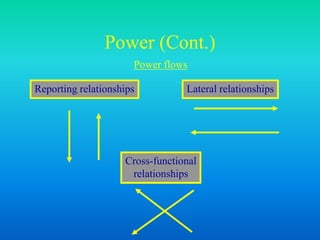
Power (Cont.)
Reporting relationships Lateral relationships
Cross-functional
relationships
Power flows
Power (Cont.)
• Power dynamics
– Dynamic not static; rises and falls for people
and groups
– Shifts in environment can change power of
person or group
• Marketing: successful product--power goes up; lose
market share--power goes down
• Technology: as it increases in importance, people
who know it become more powerful. The opposite
happens as importance of technology drops
Bases of Power
• Bases of power: aspects of formal manage-
ment position and personal characteristics
– Organizational bases of power: sources of
power in formal management position
– Personal bases of power: sources of power in
a manager’s personal characteristics
• Accumulate to a total power base
See text book Figure 15.1
Bases of Power (Cont.)
• Organizational bases of power
– Legitimate power
• Derives from position
• Decision authority
– Reward power
• Tie positive results to a person’s behavior
• Organization’s reward system and policies
Bases of Power (Cont.)
• Organizational bases of power (cont.)
– Coercive power
• Tie negative results to a person’s behavior
• Organization’s reward system and policies
– Information power
• Information control
• Information distribution
Bases of Power (Cont.)
• Organizational bases of power (cont.)
– All management positions have some
organizational basis of power
– Minimally have legitimate power
– Reward and coercive power depend on organi-
zational policies about rewards and sanctions
– Assume the power in the position but it stays
after person leaves the position
Bases of Power (Cont.)
• Personal bases of power
– Referent power: positive feelings about the
leader. Related to charisma
– Expert power: technical knowledge and
expertise
– Flow from the attributes and qualities of the
person
– Strongly affected by attribution processes
Power, Leadership,
and Management
• Essential to leadership and management
• Much more than dominance
• Capacity to get things done
Power, Leadership,
and Management (Cont.)
• Behavior of powerful leaders and managers
– Delegate decision authority
– See people’s talents as a resource
– Can change people’s working conditions
– Get resources and information for work group
– Take risks
Power, Leadership,
and Management (Cont.)
• Behavior of powerful leaders and managers
(cont.)
– Press for innovations
– Share power widely
– Help develop people
Results
Highly effective
Increases total power of the work group
Increases people’s promotion opportunities
Power, Leadership,
and Management (Cont.)
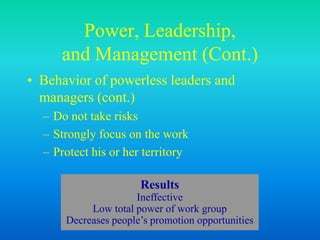
• Behavior of powerless leaders and
managers
– Supervise closely
– Do not delegate decision authority
– Often distrust subordinates
– See people’s talents as a threat
– Stick to the rules
Power, Leadership,
and Management (Cont.)
• Behavior of powerless leaders and
managers (cont.)
– Do not take risks
– Strongly focus on the work
– Protect his or her territory
Results
Ineffective
Low total power of work group
Decreases people’s promotion opportunities
Which do you prefer:
powerful
or
powerless
leader or manager?
Power, Leadership,
and Management (Cont.)
Building Power
• Six major sources of power
• Sources are related to bases of power
described earlier
• Political diagnosis, described later, is an
important step in building power
Building Power (Cont.)
• Knowledge, skill, reputation, professional
credibility (expert and information power)
• Political network
– Formal or informal
– Often based on position in a communication
channel
– Important in lateral relationships
• Create perception of dependence: control
of scarce resources
Building Power (Cont.)
• Work activities (legitimate power)
– Extraordinary
– Visible
– Successful at high-risk activities
• Charisma (referent power). Especially
important in lateral relationships
Building Power (Cont.)
• Power base of the work unit
– Coping with uncertainty
– Unique function
– Changes in external environment
– Centrality in work flow
Human resource management departments that become
expert in affirmative action, equal employment opportunity,
and workforce diversity can increase their power.
Attribution of Power
• Ascribing power to people at any level
• May not be same as actual power
• Attribution based on
– Personal characteristics
– Context of the person
Attribution of Power (Cont.)
• Personal characteristics
– Formal position: status and authority
– Technical knowledge
– Central position in a communication network
• Context of the person
– Physical context
– Group or project membership
– Member of a coalition
Political Behavior
• Getting, developing, and using power to
reach a desired result
• Often appears in situations of uncertainty or
conflict over choices
• Often happens outside accepted channels of
authority
Political Behavior (Cont.)
• Unofficial, unsanctioned behavior to reach a
goal
• Build bases of power
• Use political behavior
– Affect decisions
– Get scarce resources
– Earn cooperation of people outside direct
authority
Political Behavior (Cont.)
• Ebbs and flows with the dynamics of power
• Two characteristics: power and influence
• Directed at reaching organizational goals or
individual goals
• Plays an important role in lateral
relationships
• Rarely have formal authority in such
relationships
Political Behavior (Cont.)
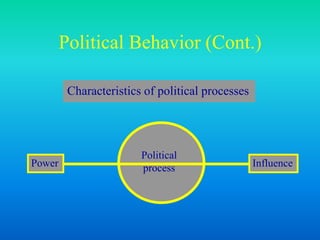
Power Influence
Political
process
Characteristics of political processes
Political Behavior (Cont.)
• Political behavior and lateral relationships
– Line-staff
• Many entry positions
– Marketing
– Human resource management
– Information systems
– Competition for resources: money, people,
equipment, office space
– Interdependence in work flow. Especially
modern manufacturing
Political Maneuvering
in Organizations
• Political maneuvering
– Political strategy
• Plan to reach a goal using specific political tactics
• Goal: organizational or personal
– Political tactics
• Builds power base
• Uses power
Political Maneuvering
in Organizations (Cont.)
• Political strategy
– Specifies combinations and sequences of
political tactics
– Includes plan for responding to changes in the
political context
– People at all levels can develop and use a
political strategy
– Not written; usually tacit
Political Maneuvering
in Organizations (Cont.)
• Political strategy (cont.)
– Used in
• Resource allocation
• Choice of senior managers
• Career decisions
• Performance appraisals
• Pay increase decisions
Political Maneuvering
in Organizations (Cont.)
• Political tactics
– Decision making processes
• Selectively emphasize decision alternatives
• Influence decision process in favor of self or work
unit
– Use outside expert or consultant. Power is
equal but wants to shift another level
– Control the decision making agenda: often
done when person does not want change
Political Maneuvering
in Organizations (Cont.)
• Political tactics (cont.)
– Build coalitions
• Form around people inside and outside the
organization
• Those believed important to person’s position
– Co-optation: get support by putting possible
opponents on a task force or advisory board
Political Diagnosis
• Help understand the loci of power
• Identify type of political behavior likely to
happen in an organization
• Usually done unobtrusively by observing
behavior and making subtle inquiries
Political Diagnosis (Cont.)
• Areas of diagnosis
– Individuals
• Identify powerful people and politically active
people
– Assess amounts of power
– Assess ways they likely will use their power
– Assess their political skills
Political Diagnosis (Cont.)
• Areas of diagnosis (cont.)
– Coalitions
• Alliance of people who share a common goal
• Widely dispersed in organization
• Try to affect decisions
Political Diagnosis (Cont.)
• Areas of diagnosis (cont.)
– Political networks
• Affiliations, alliances, coalitions
• Control information flow and resources
• Identify major influences in the network
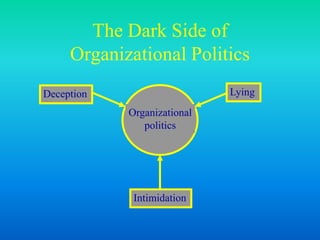
The Dark Side of
Organizational Politics
Organizational
politics
Deception Lying
Intimidation
The Dark Side of
Organizational Politics (Cont.)
• Deception
– See the Machiavelli quotation on page 293
– Trick another party into picking wrong decision
alternative
– Personal goals more important than
organizational goals
Manager does not want change and
asks for an endless series of studies
The Dark Side of
Organizational Politics (Cont.)
• Lying
– Intentional misstatement of the truth
– Trying to mislead other party
– Distorts information in favor of the liar
– Can have long-term negative effects if
discovered
“There will be no layoffs.”
The Dark Side of
Organizational Politics (Cont.)
• Intimidation
– Direct or indirect pressures on a person by
someone with power over the person
– Restrict communication of person with others
– Isolate from others
– Includes sexual harassment of anyone
Imply withholding a promotion unless . . .
International Aspects of Political
Behavior in Organizations
• People from different cultures hold different
beliefs about power and power relationships
• Some cultures see a directive and autocratic
use of power as correct
• Other cultures define a consultative or
democratic approach as correct
• Different individuals within those cultures
have different beliefs about power
relationships
International Aspects of Political
Behavior in Organizations
(Cont.)
• The Philippines, Mexico, India, Singapore,
Hong Kong: value a directive use of power
• Workers ascribe power to a directive
manager and weakness to a consultative one
• Consultative-oriented managers at a
disadvantage in power-directive cultures
International Aspects of Political
Behavior in Organizations
(Cont.)
• Scandinavian countries, Israel, Switzerland,
Austria, and New Zealand
– Expect managers to involve workers in
decision-making process
– Directive manager would not be well accepted
by workers in Scandinavian organizations
– Manager has high power in home culture; little
power in Scandinavian cultures
International Aspects of Political
Behavior in Organizations
(Cont.)
• Cultural orientation to uncertainty and
power
– Workers in Greece and France expect managers
to maintain low levels of uncertainty
– Manager who cannot keep uncertainty low has
little power and influence over his workers
– Workers in Denmark and the United States
have higher tolerance for uncertainty
International Aspects of Political
Behavior in Organizations
(Cont.)
• Cultural orientation to uncertainty and
power (cont.)
– Nonmanagers in those countries expect
managers to make risky decisions
– Ascribe high power to risk-taking managers;
low power to those who avoid risk
– Degree of power ascribed to managers affects
their ability to affect others with political tactics
International Aspects of Political
Behavior in Organizations
(Cont.)
• Individualistic orientation and power
– High individualistic: United States, Australia,
Great Britain, Canada, the Netherlands
– Low individualistic
• Many South American countries
• Value family ties and conformity to social norms
– South American workers expect managers to
look after them
– Managers who show interest in subordinates'
private lives enjoy high power
– http://www.edhole.com
Ethical Issues About Political
Behavior in Organizations
• Utilitarian view: using power and political
behavior to serve only one's self-interest is
unethical
• Political behavior that uses excessive
organizational resources to reach a personal
goal is also unethical
Ethical Issues About Political
Behavior in Organizations
(Cont.)
• Suggest any political strategy is unethical
– Does not serve goals of the organization or
– A larger group of people than the single
political actor
Ignoring equipment maintenance to push products through
a manufacturing process for personal gain is behaving unethically
Ethical Issues About Political
Behavior in Organizations
(Cont.)
• Using power and political behavior that
violates another person's rights is unethical
• A political tactic such as co-optation can
violate others' rights
• Co-opted individual, unless he or she
understands the goal of the political actor,
has not consented to such influence
Ethical Issues About Political
Behavior in Organizations
(Cont.)
• Sense of justice strongly argues for fair
treatment
• Giving preferential treatment to someone to
build a sense of obligation is unethical
• http://www.edhole.com
Ethical Issues About Political
Behavior in Organizations
(Cont.)
• Guidelines for ethical political behavior
– Distinguishes organizational statesmanship
from "dirty politics"
– Behavior should serve people outside the
organization, beyond the single political actor
– Individuals should clearly know intent of actor;
give free consent to be influenced
– http://www.edhole.com
Ethical Issues About Political
Behavior in Organizations
(Cont.)
• Guidelines (cont.)
– Right of due process should not be violated
while the political behavior unfolds
– Administration of policies should allow fair
treatment of all affected people
– http://www.edhole.com

Power and political behavior ! edhole.com

  • 1.
    Power and PoliticalBehavior By : edhole http://www.edhole.com
  • 2.
    Learning Goals • Describethe nature of power in organizations and ways to build power • Discuss the relationship between power and politics in organizations • Describe the bases of power and ways of building power in organizations • Understand political strategies and political tactics • http://www.edhole.com
  • 3.
    Learning Goals (Cont.) •Do a political diagnosis • Describe international differences in political behavior in organizations • Discuss the ethical issues surrounding organizational politics • http://www.edhole.com
  • 4.
    Chapter Overview • Introduction •Power • Political behavior • International aspects of political behavior in organizations • Ethical issues about political behavior in organizations
  • 5.
    Introduction Power Dark and gloomy? Brightand cheery? How do you perceive power?
  • 6.
    Introduction (Cont.) Political Behavior How doyou perceive political behavior?
  • 7.
    Introduction (Cont.) • Politicalbehavior pervades organizational life • Focuses on developing and using power in an organization • Often gives power to people who do not have it from their organizational position
  • 8.
    Power • Power: abilityto get something done the way a person wants it done • Includes the ability to gather physical and human resources and put them to work to reach a goal • Essential to leadership and management functions
  • 9.
    Power (Cont.) • Morethan dominance: a capacity to get something done in an organization • Central feature of political behavior • Unavoidable presence in organizations
  • 10.
    Power (Cont.) • Facetsof power – Potential power: one party perceives another party as having power and the ability to use it – Actual power: the presence and use of power – Potential for power: person or group has control of resources from which to build power
  • 11.
    Power (Cont.) • Powerrelationships: moments of social interaction where power manifests itself • Dimensions of power relationships – Relational: social interaction between people and groups – Dependence • Reliance of one party on another party • High power when valued results not available elsewhere – Sanctioning: use of rewards or penalties
  • 12.
    Power (Cont.) • Powerand authority – Different concepts although a person can have both – Authority usually flows from a person’s position in an organization – Power can accrue to people at any level
  • 13.
    Power (Cont.) Reporting relationshipsLateral relationships Cross-functional relationships Power flows
  • 14.
    Power (Cont.) • Powerdynamics – Dynamic not static; rises and falls for people and groups – Shifts in environment can change power of person or group • Marketing: successful product--power goes up; lose market share--power goes down • Technology: as it increases in importance, people who know it become more powerful. The opposite happens as importance of technology drops
  • 15.
    Bases of Power •Bases of power: aspects of formal manage- ment position and personal characteristics – Organizational bases of power: sources of power in formal management position – Personal bases of power: sources of power in a manager’s personal characteristics • Accumulate to a total power base See text book Figure 15.1
  • 16.
    Bases of Power(Cont.) • Organizational bases of power – Legitimate power • Derives from position • Decision authority – Reward power • Tie positive results to a person’s behavior • Organization’s reward system and policies
  • 17.
    Bases of Power(Cont.) • Organizational bases of power (cont.) – Coercive power • Tie negative results to a person’s behavior • Organization’s reward system and policies – Information power • Information control • Information distribution
  • 18.
    Bases of Power(Cont.) • Organizational bases of power (cont.) – All management positions have some organizational basis of power – Minimally have legitimate power – Reward and coercive power depend on organi- zational policies about rewards and sanctions – Assume the power in the position but it stays after person leaves the position
  • 19.
    Bases of Power(Cont.) • Personal bases of power – Referent power: positive feelings about the leader. Related to charisma – Expert power: technical knowledge and expertise – Flow from the attributes and qualities of the person – Strongly affected by attribution processes
  • 20.
    Power, Leadership, and Management •Essential to leadership and management • Much more than dominance • Capacity to get things done
  • 21.
    Power, Leadership, and Management(Cont.) • Behavior of powerful leaders and managers – Delegate decision authority – See people’s talents as a resource – Can change people’s working conditions – Get resources and information for work group – Take risks
  • 22.
    Power, Leadership, and Management(Cont.) • Behavior of powerful leaders and managers (cont.) – Press for innovations – Share power widely – Help develop people Results Highly effective Increases total power of the work group Increases people’s promotion opportunities
  • 23.
    Power, Leadership, and Management(Cont.) • Behavior of powerless leaders and managers – Supervise closely – Do not delegate decision authority – Often distrust subordinates – See people’s talents as a threat – Stick to the rules
  • 24.
    Power, Leadership, and Management(Cont.) • Behavior of powerless leaders and managers (cont.) – Do not take risks – Strongly focus on the work – Protect his or her territory Results Ineffective Low total power of work group Decreases people’s promotion opportunities
  • 25.
    Which do youprefer: powerful or powerless leader or manager? Power, Leadership, and Management (Cont.)
  • 26.
    Building Power • Sixmajor sources of power • Sources are related to bases of power described earlier • Political diagnosis, described later, is an important step in building power
  • 27.
    Building Power (Cont.) •Knowledge, skill, reputation, professional credibility (expert and information power) • Political network – Formal or informal – Often based on position in a communication channel – Important in lateral relationships • Create perception of dependence: control of scarce resources
  • 28.
    Building Power (Cont.) •Work activities (legitimate power) – Extraordinary – Visible – Successful at high-risk activities • Charisma (referent power). Especially important in lateral relationships
  • 29.
    Building Power (Cont.) •Power base of the work unit – Coping with uncertainty – Unique function – Changes in external environment – Centrality in work flow Human resource management departments that become expert in affirmative action, equal employment opportunity, and workforce diversity can increase their power.
  • 30.
    Attribution of Power •Ascribing power to people at any level • May not be same as actual power • Attribution based on – Personal characteristics – Context of the person
  • 31.
    Attribution of Power(Cont.) • Personal characteristics – Formal position: status and authority – Technical knowledge – Central position in a communication network • Context of the person – Physical context – Group or project membership – Member of a coalition
  • 32.
    Political Behavior • Getting,developing, and using power to reach a desired result • Often appears in situations of uncertainty or conflict over choices • Often happens outside accepted channels of authority
  • 33.
    Political Behavior (Cont.) •Unofficial, unsanctioned behavior to reach a goal • Build bases of power • Use political behavior – Affect decisions – Get scarce resources – Earn cooperation of people outside direct authority
  • 34.
    Political Behavior (Cont.) •Ebbs and flows with the dynamics of power • Two characteristics: power and influence • Directed at reaching organizational goals or individual goals • Plays an important role in lateral relationships • Rarely have formal authority in such relationships
  • 35.
    Political Behavior (Cont.) PowerInfluence Political process Characteristics of political processes
  • 36.
    Political Behavior (Cont.) •Political behavior and lateral relationships – Line-staff • Many entry positions – Marketing – Human resource management – Information systems – Competition for resources: money, people, equipment, office space – Interdependence in work flow. Especially modern manufacturing
  • 37.
    Political Maneuvering in Organizations •Political maneuvering – Political strategy • Plan to reach a goal using specific political tactics • Goal: organizational or personal – Political tactics • Builds power base • Uses power
  • 38.
    Political Maneuvering in Organizations(Cont.) • Political strategy – Specifies combinations and sequences of political tactics – Includes plan for responding to changes in the political context – People at all levels can develop and use a political strategy – Not written; usually tacit
  • 39.
    Political Maneuvering in Organizations(Cont.) • Political strategy (cont.) – Used in • Resource allocation • Choice of senior managers • Career decisions • Performance appraisals • Pay increase decisions
  • 40.
    Political Maneuvering in Organizations(Cont.) • Political tactics – Decision making processes • Selectively emphasize decision alternatives • Influence decision process in favor of self or work unit – Use outside expert or consultant. Power is equal but wants to shift another level – Control the decision making agenda: often done when person does not want change
  • 41.
    Political Maneuvering in Organizations(Cont.) • Political tactics (cont.) – Build coalitions • Form around people inside and outside the organization • Those believed important to person’s position – Co-optation: get support by putting possible opponents on a task force or advisory board
  • 42.
    Political Diagnosis • Helpunderstand the loci of power • Identify type of political behavior likely to happen in an organization • Usually done unobtrusively by observing behavior and making subtle inquiries
  • 43.
    Political Diagnosis (Cont.) •Areas of diagnosis – Individuals • Identify powerful people and politically active people – Assess amounts of power – Assess ways they likely will use their power – Assess their political skills
  • 44.
    Political Diagnosis (Cont.) •Areas of diagnosis (cont.) – Coalitions • Alliance of people who share a common goal • Widely dispersed in organization • Try to affect decisions
  • 45.
    Political Diagnosis (Cont.) •Areas of diagnosis (cont.) – Political networks • Affiliations, alliances, coalitions • Control information flow and resources • Identify major influences in the network
  • 46.
    The Dark Sideof Organizational Politics Organizational politics Deception Lying Intimidation
  • 47.
    The Dark Sideof Organizational Politics (Cont.) • Deception – See the Machiavelli quotation on page 293 – Trick another party into picking wrong decision alternative – Personal goals more important than organizational goals Manager does not want change and asks for an endless series of studies
  • 48.
    The Dark Sideof Organizational Politics (Cont.) • Lying – Intentional misstatement of the truth – Trying to mislead other party – Distorts information in favor of the liar – Can have long-term negative effects if discovered “There will be no layoffs.”
  • 49.
    The Dark Sideof Organizational Politics (Cont.) • Intimidation – Direct or indirect pressures on a person by someone with power over the person – Restrict communication of person with others – Isolate from others – Includes sexual harassment of anyone Imply withholding a promotion unless . . .
  • 50.
    International Aspects ofPolitical Behavior in Organizations • People from different cultures hold different beliefs about power and power relationships • Some cultures see a directive and autocratic use of power as correct • Other cultures define a consultative or democratic approach as correct • Different individuals within those cultures have different beliefs about power relationships
  • 51.
    International Aspects ofPolitical Behavior in Organizations (Cont.) • The Philippines, Mexico, India, Singapore, Hong Kong: value a directive use of power • Workers ascribe power to a directive manager and weakness to a consultative one • Consultative-oriented managers at a disadvantage in power-directive cultures
  • 52.
    International Aspects ofPolitical Behavior in Organizations (Cont.) • Scandinavian countries, Israel, Switzerland, Austria, and New Zealand – Expect managers to involve workers in decision-making process – Directive manager would not be well accepted by workers in Scandinavian organizations – Manager has high power in home culture; little power in Scandinavian cultures
  • 53.
    International Aspects ofPolitical Behavior in Organizations (Cont.) • Cultural orientation to uncertainty and power – Workers in Greece and France expect managers to maintain low levels of uncertainty – Manager who cannot keep uncertainty low has little power and influence over his workers – Workers in Denmark and the United States have higher tolerance for uncertainty
  • 54.
    International Aspects ofPolitical Behavior in Organizations (Cont.) • Cultural orientation to uncertainty and power (cont.) – Nonmanagers in those countries expect managers to make risky decisions – Ascribe high power to risk-taking managers; low power to those who avoid risk – Degree of power ascribed to managers affects their ability to affect others with political tactics
  • 55.
    International Aspects ofPolitical Behavior in Organizations (Cont.) • Individualistic orientation and power – High individualistic: United States, Australia, Great Britain, Canada, the Netherlands – Low individualistic • Many South American countries • Value family ties and conformity to social norms – South American workers expect managers to look after them – Managers who show interest in subordinates' private lives enjoy high power – http://www.edhole.com
  • 56.
    Ethical Issues AboutPolitical Behavior in Organizations • Utilitarian view: using power and political behavior to serve only one's self-interest is unethical • Political behavior that uses excessive organizational resources to reach a personal goal is also unethical
  • 57.
    Ethical Issues AboutPolitical Behavior in Organizations (Cont.) • Suggest any political strategy is unethical – Does not serve goals of the organization or – A larger group of people than the single political actor Ignoring equipment maintenance to push products through a manufacturing process for personal gain is behaving unethically
  • 58.
    Ethical Issues AboutPolitical Behavior in Organizations (Cont.) • Using power and political behavior that violates another person's rights is unethical • A political tactic such as co-optation can violate others' rights • Co-opted individual, unless he or she understands the goal of the political actor, has not consented to such influence
  • 59.
    Ethical Issues AboutPolitical Behavior in Organizations (Cont.) • Sense of justice strongly argues for fair treatment • Giving preferential treatment to someone to build a sense of obligation is unethical • http://www.edhole.com
  • 60.
    Ethical Issues AboutPolitical Behavior in Organizations (Cont.) • Guidelines for ethical political behavior – Distinguishes organizational statesmanship from "dirty politics" – Behavior should serve people outside the organization, beyond the single political actor – Individuals should clearly know intent of actor; give free consent to be influenced – http://www.edhole.com
  • 61.
    Ethical Issues AboutPolitical Behavior in Organizations (Cont.) • Guidelines (cont.) – Right of due process should not be violated while the political behavior unfolds – Administration of policies should allow fair treatment of all affected people – http://www.edhole.com