4e 
Nelson/Quick 
Chapter 11 
Power and 
Political 
Behavior 
©2015 Cengage Learning. All Rights Reserved. May not be scanned, copied or duplicated, or posted to a publicly accessible website, in whole or in part.
Power 
 Ability to influence another person 
 Exerted by means of: 
 Influence: Affecting the thoughts, behavior, and 
feelings of another person 
 Authority: Right to influence another person 
 Zone of indifference: Range in which attempts to 
influence a person will be: 
 Perceived as legitimate 
 Acted on without a great deal of thought 
©2015 Cengage Learning. All Rights Reserved. May not be scanned, copied or duplicated, or posted to a publicly accessible website, in whole or in part. 
2
Learning Outcome 
Identify forms and sources of power in 
organizations 
©2015 Cengage Learning. All Rights Reserved. May not be scanned, copied or duplicated, or posted to a publicly accessible website, in whole or in part. 3 
3
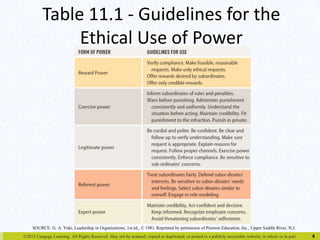
Table 11.1 - Guidelines for the 
Ethical Use of Power 
©2015 Cengage Learning. All Rights Reserved. May not be scanned, copied or duplicated, or posted to a publicly accessible website, in whole or in part. 
4 
SOURCE: G. A. Yuki, Leadership in Organizations, 1st ed., © 1981. Reprinted by permission of Pearson Education, Inc., Upper Saddle River, N.J.
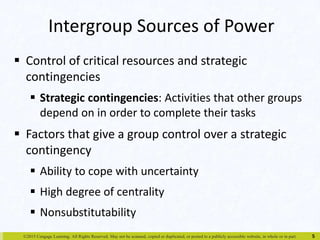
Intergroup Sources of Power 
 Control of critical resources and strategic 
contingencies 
 Strategic contingencies: Activities that other groups 
depend on in order to complete their tasks 
 Factors that give a group control over a strategic 
contingency 
 Ability to cope with uncertainty 
 High degree of centrality 
 Nonsubstitutability 
©2015 Cengage Learning. All Rights Reserved. May not be scanned, copied or duplicated, or posted to a publicly accessible website, in whole or in part. 
5
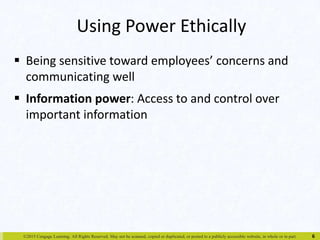
Using Power Ethically 
 Being sensitive toward employees’ concerns and 
communicating well 
 Information power: Access to and control over 
important information 
©2015 Cengage Learning. All Rights Reserved. May not be scanned, copied or duplicated, or posted to a publicly accessible website, in whole or in part. 
6
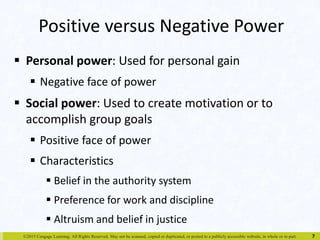
Positive versus Negative Power 
 Personal power: Used for personal gain 
 Negative face of power 
 Social power: Used to create motivation or to 
accomplish group goals 
 Positive face of power 
 Characteristics 
 Belief in the authority system 
 Preference for work and discipline 
 Altruism and belief in justice 
©2015 Cengage Learning. All Rights Reserved. May not be scanned, copied or duplicated, or posted to a publicly accessible website, in whole or in part. 
7
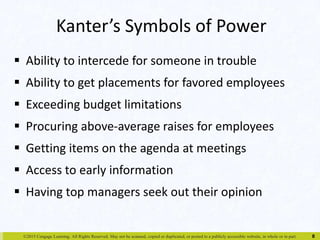
Kanter’s Symbols of Power 
 Ability to intercede for someone in trouble 
 Ability to get placements for favored employees 
 Exceeding budget limitations 
 Procuring above-average raises for employees 
 Getting items on the agenda at meetings 
 Access to early information 
 Having top managers seek out their opinion 
©2015 Cengage Learning. All Rights Reserved. May not be scanned, copied or duplicated, or posted to a publicly accessible website, in whole or in part. 
8
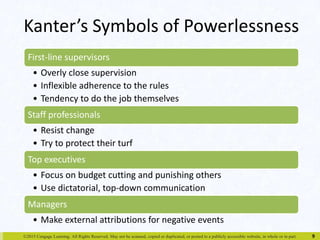
Kanter’s Symbols of Powerlessness 
©2015 Cengage Learning. All Rights Reserved. May not be scanned, copied or duplicated, or posted to a publicly accessible website, in whole or in part. 
9 
First-line supervisors 
• Overly close supervision 
• Inflexible adherence to the rules 
• Tendency to do the job themselves 
Staff professionals 
• Resist change 
• Try to protect their turf 
Top executives 
• Focus on budget cutting and punishing others 
• Use dictatorial, top-down communication 
Managers 
• Make external attributions for negative events
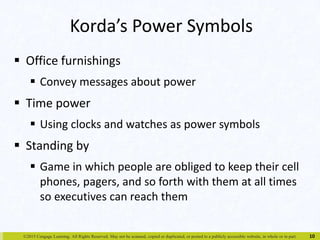
Korda’s Power Symbols 
 Office furnishings 
 Convey messages about power 
 Time power 
 Using clocks and watches as power symbols 
 Standing by 
 Game in which people are obliged to keep their cell 
phones, pagers, and so forth with them at all times 
so executives can reach them 
©2015 Cengage Learning. All Rights Reserved. May not be scanned, copied or duplicated, or posted to a publicly accessible website, in whole or in part. 
10
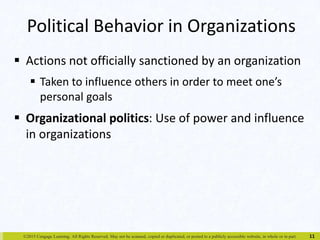
Political Behavior in Organizations 
 Actions not officially sanctioned by an organization 
 Taken to influence others in order to meet one’s 
personal goals 
 Organizational politics: Use of power and influence 
in organizations 
©2015 Cengage Learning. All Rights Reserved. May not be scanned, copied or duplicated, or posted to a publicly accessible website, in whole or in part. 
11
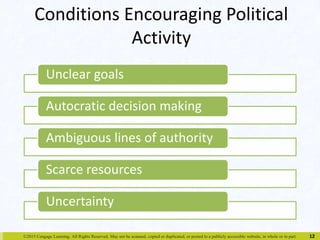
Conditions Encouraging Political 
Activity 
©2015 Cengage Learning. All Rights Reserved. May not be scanned, copied or duplicated, or posted to a publicly accessible website, in whole or in part. 
12 
Unclear goals 
Autocratic decision making 
Ambiguous lines of authority 
Scarce resources 
Uncertainty
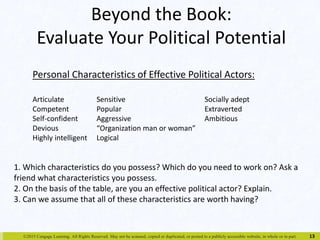
Beyond the Book: 
Evaluate Your Political Potential 
©2015 Cengage Learning. All Rights Reserved. May not be scanned, copied or duplicated, or posted to a publicly accessible website, in whole or in part. 
13 
Personal Characteristics of Effective Political Actors: 
Articulate Sensitive Socially adept 
Competent Popular Extraverted 
Self-confident Aggressive Ambitious 
Devious “Organization man or woman” 
Highly intelligent Logical 
1. Which characteristics do you possess? Which do you need to work on? Ask a 
friend what characteristics you possess. 
2. On the basis of the table, are you an effective political actor? Explain. 
3. Can we assume that all of these characteristics are worth having?
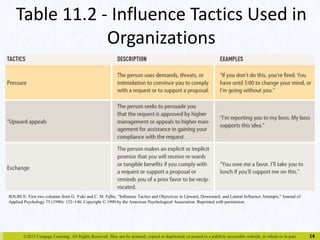
Table 11.2 - Influence Tactics Used in 
Organizations 
©2015 Cengage Learning. All Rights Reserved. May not be scanned, copied or duplicated, or posted to a publicly accessible website, in whole or in part. 
14 
SOURCE: First two columns from G. Yukl and C. M. Falbe, “Influence Tactics and Objectives in Upward, Downward, and Lateral Influence Attempts,” Journal of 
Applied Psychology 75 (1990): 132–140. Copyright © 1990 by the American Psychological Association. Reprinted with permission.
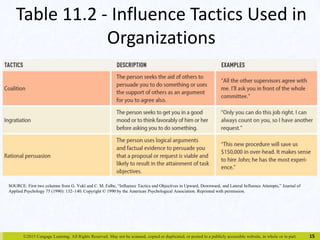
Table 11.2 - Influence Tactics Used in 
Organizations 
©2015 Cengage Learning. All Rights Reserved. May not be scanned, copied or duplicated, or posted to a publicly accessible website, in whole or in part. 
15 
SOURCE: First two columns from G. Yukl and C. M. Falbe, “Influence Tactics and Objectives in Upward, Downward, and Lateral Influence Attempts,” Journal of 
Applied Psychology 75 (1990): 132–140. Copyright © 1990 by the American Psychological Association. Reprinted with permission.
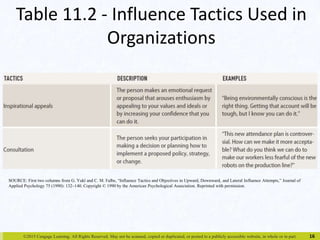
Table 11.2 - Influence Tactics Used in 
Organizations 
©2015 Cengage Learning. All Rights Reserved. May not be scanned, copied or duplicated, or posted to a publicly accessible website, in whole or in part. 
16 
SOURCE: First two columns from G. Yukl and C. M. Falbe, “Influence Tactics and Objectives in Upward, Downward, and Lateral Influence Attempts,” Journal of 
Applied Psychology 75 (1990): 132–140. Copyright © 1990 by the American Psychological Association. Reprinted with permission.
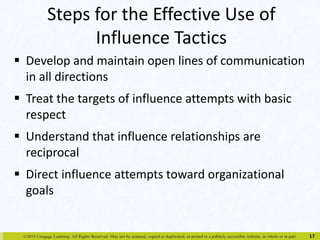
Steps for the Effective Use of 
Influence Tactics 
 Develop and maintain open lines of communication 
in all directions 
 Treat the targets of influence attempts with basic 
respect 
 Understand that influence relationships are 
reciprocal 
 Direct influence attempts toward organizational 
goals 
©2015 Cengage Learning. All Rights Reserved. May not be scanned, copied or duplicated, or posted to a publicly accessible website, in whole or in part. 
17
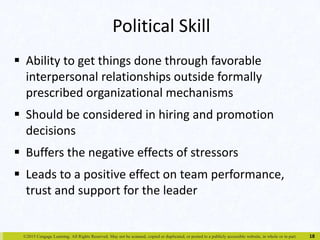
Political Skill 
 Ability to get things done through favorable 
interpersonal relationships outside formally 
prescribed organizational mechanisms 
 Should be considered in hiring and promotion 
decisions 
 Buffers the negative effects of stressors 
 Leads to a positive effect on team performance, 
trust and support for the leader 
©2015 Cengage Learning. All Rights Reserved. May not be scanned, copied or duplicated, or posted to a publicly accessible website, in whole or in part. 
18
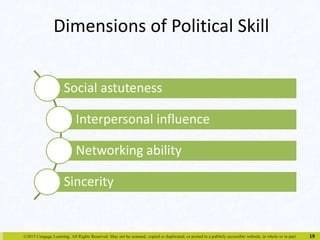
Dimensions of Political Skill 
©2015 Cengage Learning. All Rights Reserved. May not be scanned, copied or duplicated, or posted to a publicly accessible website, in whole or in part. 
19 
Social astuteness 
Interpersonal influence 
Networking ability 
Sincerity
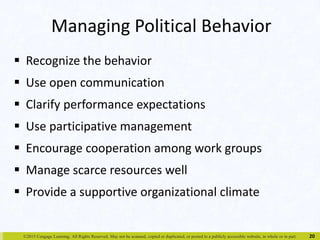
Managing Political Behavior 
 Recognize the behavior 
 Use open communication 
 Clarify performance expectations 
 Use participative management 
 Encourage cooperation among work groups 
 Manage scarce resources well 
 Provide a supportive organizational climate 
©2015 Cengage Learning. All Rights Reserved. May not be scanned, copied or duplicated, or posted to a publicly accessible website, in whole or in part. 
20
Empowerment 
 Sharing power such that individuals learn to believe 
in their ability, include following dimensions 
 Meaning, competence, self-determination, and 
impact 
 Guidelines 
 Express confidence and set high performance 
expectations and meaningful goals 
 Create opportunities to participate in decision making 
 Remove bureaucratic constraints 
©2015 Cengage Learning. All Rights Reserved. May not be scanned, copied or duplicated, or posted to a publicly accessible website, in whole or in part. 
21
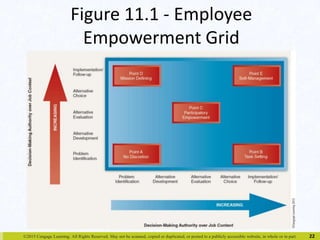
Figure 11.1 - Employee 
Empowerment Grid 
©2015 Cengage Learning. All Rights Reserved. May not be scanned, copied or duplicated, or posted to a publicly accessible website, in whole or in part. 
22

Power

  • 1.
    4e Nelson/Quick Chapter11 Power and Political Behavior ©2015 Cengage Learning. All Rights Reserved. May not be scanned, copied or duplicated, or posted to a publicly accessible website, in whole or in part.
  • 2.
    Power  Abilityto influence another person  Exerted by means of:  Influence: Affecting the thoughts, behavior, and feelings of another person  Authority: Right to influence another person  Zone of indifference: Range in which attempts to influence a person will be:  Perceived as legitimate  Acted on without a great deal of thought ©2015 Cengage Learning. All Rights Reserved. May not be scanned, copied or duplicated, or posted to a publicly accessible website, in whole or in part. 2
  • 3.
    Learning Outcome Identifyforms and sources of power in organizations ©2015 Cengage Learning. All Rights Reserved. May not be scanned, copied or duplicated, or posted to a publicly accessible website, in whole or in part. 3 3
  • 4.
    Table 11.1 -Guidelines for the Ethical Use of Power ©2015 Cengage Learning. All Rights Reserved. May not be scanned, copied or duplicated, or posted to a publicly accessible website, in whole or in part. 4 SOURCE: G. A. Yuki, Leadership in Organizations, 1st ed., © 1981. Reprinted by permission of Pearson Education, Inc., Upper Saddle River, N.J.
  • 5.
    Intergroup Sources ofPower  Control of critical resources and strategic contingencies  Strategic contingencies: Activities that other groups depend on in order to complete their tasks  Factors that give a group control over a strategic contingency  Ability to cope with uncertainty  High degree of centrality  Nonsubstitutability ©2015 Cengage Learning. All Rights Reserved. May not be scanned, copied or duplicated, or posted to a publicly accessible website, in whole or in part. 5
  • 6.
    Using Power Ethically  Being sensitive toward employees’ concerns and communicating well  Information power: Access to and control over important information ©2015 Cengage Learning. All Rights Reserved. May not be scanned, copied or duplicated, or posted to a publicly accessible website, in whole or in part. 6
  • 7.
    Positive versus NegativePower  Personal power: Used for personal gain  Negative face of power  Social power: Used to create motivation or to accomplish group goals  Positive face of power  Characteristics  Belief in the authority system  Preference for work and discipline  Altruism and belief in justice ©2015 Cengage Learning. All Rights Reserved. May not be scanned, copied or duplicated, or posted to a publicly accessible website, in whole or in part. 7
  • 8.
    Kanter’s Symbols ofPower  Ability to intercede for someone in trouble  Ability to get placements for favored employees  Exceeding budget limitations  Procuring above-average raises for employees  Getting items on the agenda at meetings  Access to early information  Having top managers seek out their opinion ©2015 Cengage Learning. All Rights Reserved. May not be scanned, copied or duplicated, or posted to a publicly accessible website, in whole or in part. 8
  • 9.
    Kanter’s Symbols ofPowerlessness ©2015 Cengage Learning. All Rights Reserved. May not be scanned, copied or duplicated, or posted to a publicly accessible website, in whole or in part. 9 First-line supervisors • Overly close supervision • Inflexible adherence to the rules • Tendency to do the job themselves Staff professionals • Resist change • Try to protect their turf Top executives • Focus on budget cutting and punishing others • Use dictatorial, top-down communication Managers • Make external attributions for negative events
  • 10.
    Korda’s Power Symbols  Office furnishings  Convey messages about power  Time power  Using clocks and watches as power symbols  Standing by  Game in which people are obliged to keep their cell phones, pagers, and so forth with them at all times so executives can reach them ©2015 Cengage Learning. All Rights Reserved. May not be scanned, copied or duplicated, or posted to a publicly accessible website, in whole or in part. 10
  • 11.
    Political Behavior inOrganizations  Actions not officially sanctioned by an organization  Taken to influence others in order to meet one’s personal goals  Organizational politics: Use of power and influence in organizations ©2015 Cengage Learning. All Rights Reserved. May not be scanned, copied or duplicated, or posted to a publicly accessible website, in whole or in part. 11
  • 12.
    Conditions Encouraging Political Activity ©2015 Cengage Learning. All Rights Reserved. May not be scanned, copied or duplicated, or posted to a publicly accessible website, in whole or in part. 12 Unclear goals Autocratic decision making Ambiguous lines of authority Scarce resources Uncertainty
  • 13.
    Beyond the Book: Evaluate Your Political Potential ©2015 Cengage Learning. All Rights Reserved. May not be scanned, copied or duplicated, or posted to a publicly accessible website, in whole or in part. 13 Personal Characteristics of Effective Political Actors: Articulate Sensitive Socially adept Competent Popular Extraverted Self-confident Aggressive Ambitious Devious “Organization man or woman” Highly intelligent Logical 1. Which characteristics do you possess? Which do you need to work on? Ask a friend what characteristics you possess. 2. On the basis of the table, are you an effective political actor? Explain. 3. Can we assume that all of these characteristics are worth having?
  • 14.
    Table 11.2 -Influence Tactics Used in Organizations ©2015 Cengage Learning. All Rights Reserved. May not be scanned, copied or duplicated, or posted to a publicly accessible website, in whole or in part. 14 SOURCE: First two columns from G. Yukl and C. M. Falbe, “Influence Tactics and Objectives in Upward, Downward, and Lateral Influence Attempts,” Journal of Applied Psychology 75 (1990): 132–140. Copyright © 1990 by the American Psychological Association. Reprinted with permission.
  • 15.
    Table 11.2 -Influence Tactics Used in Organizations ©2015 Cengage Learning. All Rights Reserved. May not be scanned, copied or duplicated, or posted to a publicly accessible website, in whole or in part. 15 SOURCE: First two columns from G. Yukl and C. M. Falbe, “Influence Tactics and Objectives in Upward, Downward, and Lateral Influence Attempts,” Journal of Applied Psychology 75 (1990): 132–140. Copyright © 1990 by the American Psychological Association. Reprinted with permission.
  • 16.
    Table 11.2 -Influence Tactics Used in Organizations ©2015 Cengage Learning. All Rights Reserved. May not be scanned, copied or duplicated, or posted to a publicly accessible website, in whole or in part. 16 SOURCE: First two columns from G. Yukl and C. M. Falbe, “Influence Tactics and Objectives in Upward, Downward, and Lateral Influence Attempts,” Journal of Applied Psychology 75 (1990): 132–140. Copyright © 1990 by the American Psychological Association. Reprinted with permission.
  • 17.
    Steps for theEffective Use of Influence Tactics  Develop and maintain open lines of communication in all directions  Treat the targets of influence attempts with basic respect  Understand that influence relationships are reciprocal  Direct influence attempts toward organizational goals ©2015 Cengage Learning. All Rights Reserved. May not be scanned, copied or duplicated, or posted to a publicly accessible website, in whole or in part. 17
  • 18.
    Political Skill Ability to get things done through favorable interpersonal relationships outside formally prescribed organizational mechanisms  Should be considered in hiring and promotion decisions  Buffers the negative effects of stressors  Leads to a positive effect on team performance, trust and support for the leader ©2015 Cengage Learning. All Rights Reserved. May not be scanned, copied or duplicated, or posted to a publicly accessible website, in whole or in part. 18
  • 19.
    Dimensions of PoliticalSkill ©2015 Cengage Learning. All Rights Reserved. May not be scanned, copied or duplicated, or posted to a publicly accessible website, in whole or in part. 19 Social astuteness Interpersonal influence Networking ability Sincerity
  • 20.
    Managing Political Behavior  Recognize the behavior  Use open communication  Clarify performance expectations  Use participative management  Encourage cooperation among work groups  Manage scarce resources well  Provide a supportive organizational climate ©2015 Cengage Learning. All Rights Reserved. May not be scanned, copied or duplicated, or posted to a publicly accessible website, in whole or in part. 20
  • 21.
    Empowerment  Sharingpower such that individuals learn to believe in their ability, include following dimensions  Meaning, competence, self-determination, and impact  Guidelines  Express confidence and set high performance expectations and meaningful goals  Create opportunities to participate in decision making  Remove bureaucratic constraints ©2015 Cengage Learning. All Rights Reserved. May not be scanned, copied or duplicated, or posted to a publicly accessible website, in whole or in part. 21
  • 22.
    Figure 11.1 -Employee Empowerment Grid ©2015 Cengage Learning. All Rights Reserved. May not be scanned, copied or duplicated, or posted to a publicly accessible website, in whole or in part. 22

Editor's Notes

  • #14 Evaluate Your Political Potential Examine the following list and answer the questions that follow it. Personal Characteristics of Effective Political Actors Personal Characteristic Behavioral Example Articulate • Must be able to clearly communicate ideas. Sensitive • Must be sensitive to other individuals, situations, and opportunities. Socially adept • Must understand the social norms of the organization and behave so as to be perceived by influential others as “fitting in well.” Competent • Must have the necessary skills and qualifications. Popular • Must be liked or admired by others in the organization. Extraverted • Must be interested in what happens outside of him or her. Self-confident • Must have confidence in his or her abilities. Aggressive • Must be self-assertive and forceful. Ambitious • Must be eager to attain success. Devious • Must be willing to use any tactic to get his or her way. “Organization man or woman” • Must emphasize the well-being of the organization. Highly intelligent • Must be able to use his or her knowledge to solve problems. Logical • Must be capable of reasoning. 1. Which characteristics do you possess? Which do you need to work on? Ask a friend what characteristics you possess. 2. On the basis of the table, are you an effective political actor? Explain. 3. Can we assume that all of these characteristics are worth having? SOURCE: Table from “Organizational Politics: Tactics and Characteristics of Its Actors” by R. N. Allen, D. L. Madison, L. W. Porter, P. A. Renwick, and B. T. Mayes. Copyright © 1979 by The Regents of the University of California. Reprinted from the California Management Review, Vol. 22, No. 1, Fall 1979, 77–83. By permission of The Regents.