Maziwa Zaidi
(Tanzania dairy value chain development program)
Amos Omore
ILRI-Tanzania
Inception Workshop of the USAID ITM Scaling Project in Tanzania
Bagamoyo, 29 Sept 2015
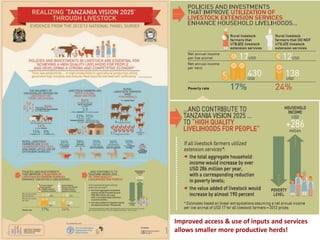
Improved access & use of inputs and services
allows smaller more productive herds!
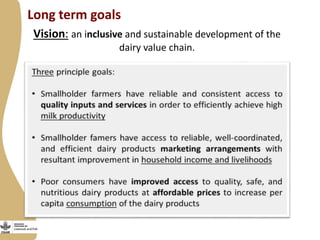
Vision: an inclusive and sustainable development of the
dairy value chain.
Long term goals
Big Picture: Place of individual projects in
‘Maziwa Zaidi’
Key partnerships and engagements
1. Strategic Research Partnerships
• SUA
• TALIRI
 Reinforced by CGIAR & ARIs
2. Development Partnerships
• Servicing the system: Heifer and
SNV
• From the system: TDB, FAIDA
MaLi
3. Multi-stakeholder processes for
strengthening relationships
• DDF
• Local area platforms
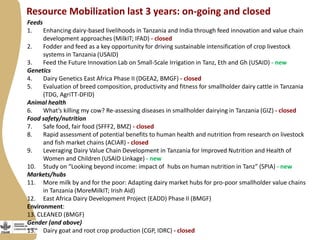
Resource Mobilization last 3 years: on-going and closed
Feeds
1. Enhancing dairy-based livelihoods in Tanzania and India through feed innovation and value chain
development approaches (MilkIT; IFAD) - closed
2. Fodder and feed as a key opportunity for driving sustainable intensification of crop livestock
systems in Tanzania (USAID)
3. Feed the Future Innovation Lab on Small-Scale Irrigation in Tanz, Eth and Gh (USAID) - new
Genetics
4. Dairy Genetics East Africa Phase II (DGEA2, BMGF) - closed
5. Evaluation of breed composition, productivity and fitness for smallholder dairy cattle in Tanzania
(TDG, AgriTT-DFID)
Animal health
6. What’s killing my cow? Re-assessing diseases in smallholder dairying in Tanzania (GIZ) - closed
Food safety/nutrition
7. Safe food, fair food (SFFF2, BMZ) - closed
8. Rapid assessment of potential benefits to human health and nutrition from research on livestock
and fish market chains (ACIAR) - closed
9. Leveraging Dairy Value Chain Development in Tanzania for Improved Nutrition and Health of
Women and Children (USAID Linkage) - new
10. Study on “Looking beyond income: impact of hubs on human nutrition in Tanz” (SPIA) - new
Markets/hubs
11. More milk by and for the poor: Adapting dairy market hubs for pro-poor smallholder value chains
in Tanzania (MoreMilkIT; Irish Aid)
12. East Africa Dairy Development Project (EADD) Phase II (BMGF)
Environment:
13. CLEANED (BMGF)
Gender (and above)
13. Dairy goat and root crop production (CGP, IDRC) - closed
Pipeline
Status Short title Topic Partners
(lead 1st)
Duration Budget Donor Comments
Pipeline
submitted/r
ecently
received
CGP Gender SUA, UA,
Heifer, ILRI
CAD5,000,000
(ILRI: 593,000)
IDRC, CIDA Failed
FTF Innov Lab Feeds Texas, ILRI 2015-20 ILRI: 1,248,000 USAID Funds cover Tanz,
Eth & Ghana
Women &
Gender
Nutrition ILRI, SUA 2014-15 US$ 50,000 USAID
Linkage
Hubs impact on
nutrition
Nutrition ILRI, SUA 2014-15 US$ 100,000 SPIA
Ecf itm IA An hlth /M&E ILRI 2016-16 US$100,000 SPIA ?
Sustainable
intensification
Environment CIAT 2015-17 € 80,000 BMZ
LIQUID Production /
quality
WUR 2015- None to ILRI WOTRO To support
students
ECF ITM
Delivery
Health ILRI 2015-16 $ 100,000 USAID
BMGF Gender ILRI
IMMANA Nutrition
metrics
RUFORUM students
MoreMilk in Tanzania (MoreMilkiT) Project
Adapting dairy market hubs for pro-poor smallholder value chains in Tanzania
Potential synergies to enhance ITM delivery
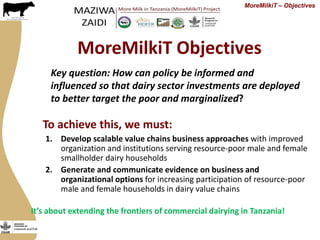
MoreMilkiT Objectives
1. Develop scalable value chains business approaches with improved
organization and institutions serving resource-poor male and female
smallholder dairy households
2. Generate and communicate evidence on business and
organizational options for increasing participation of resource-poor
male and female households in dairy value chains
MoreMilkiT – Objectives
Key question: How can policy be informed and
influenced so that dairy sector investments are deployed
to better target the poor and marginalized?
To achieve this, we must:
It’s about extending the frontiers of commercial dairying in Tanzania!
Leah Mwilaki’s business represents what we want to multiply
• Leah’s business interlocks input & output transactions between where
farmers come together in small groups to access the desired inputs or
services with their milk delivery as collateral (check-off). Earns about
$700/mo
• She represents a critical linkage in the dairy market hub (DMH) approach
that the MoreMilkiT Project partnership is piloting to grow dairying in
marginalized areas. The hubs could act as platforms to improve quality
assurance
MoreMilkiT
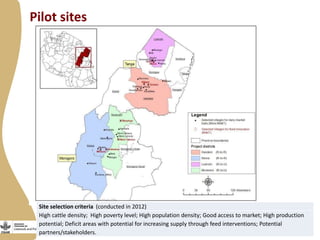
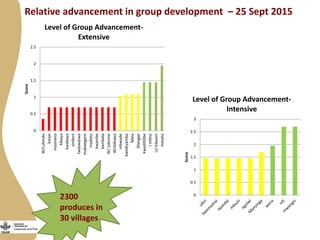
Pilot sites
Site selection criteria (conducted in 2012)
High cattle density; High poverty level; High population density; Good access to market; High production
potential; Deficit areas with potential for increasing supply through feed interventions; Potential
partners/stakeholders.
W/Luhindo
konje
msomera
kibaya
kwabaya
sindeni
twatwatwa
mabwegere
madoto
kwambe
kambala
W/sokoine
W/dakawa
mbwade
kwediyamba
Mela
Mangae
kweditilibe
Imfilisi
U/kibaoni
masatu
0
0.5
1
1.5
2
2.5
Score Level of Group Advancement-
Extensive
0
0.5
1
1.5
2
2.5
3
Score
Level of Group Advancement-
Intensive
Relative advancement in group development – 25 Sept 2015
2300
produces in
30 villages
Research & Learning: MLE, ToC
reflections and targeted studies
Project
interventio
n
Project
activities
&
outputs
Farmer &
communit
y change
in
behaviour
Outcome
s at
househol
d &
group
levels
Analyses
&
reflectio
ns
MoreMilkiT: Objective 2
Monitoring changes at household, community
and national levels
CGIAR is a global partnership that unites organizations engaged in research for a food secure future. The CGIAR
Research Program on Livestock and Fish aims to increase the productivity of small-scale livestock and fish systems
in sustainable ways, making meat, milk and fish more available and affordable across the developing world.
CGIAR Research Program on Livestock and Fish
livestockfish.cgiar.org

Maziwa Zaidi—Tanzania dairy value chain development program

  • 1.
    Maziwa Zaidi (Tanzania dairyvalue chain development program) Amos Omore ILRI-Tanzania Inception Workshop of the USAID ITM Scaling Project in Tanzania Bagamoyo, 29 Sept 2015
  • 2.
    Improved access &use of inputs and services allows smaller more productive herds!
  • 3.
    Vision: an inclusiveand sustainable development of the dairy value chain. Long term goals
  • 4.
    Big Picture: Placeof individual projects in ‘Maziwa Zaidi’
  • 5.
    Key partnerships andengagements 1. Strategic Research Partnerships • SUA • TALIRI  Reinforced by CGIAR & ARIs 2. Development Partnerships • Servicing the system: Heifer and SNV • From the system: TDB, FAIDA MaLi 3. Multi-stakeholder processes for strengthening relationships • DDF • Local area platforms
  • 6.
    Resource Mobilization last3 years: on-going and closed Feeds 1. Enhancing dairy-based livelihoods in Tanzania and India through feed innovation and value chain development approaches (MilkIT; IFAD) - closed 2. Fodder and feed as a key opportunity for driving sustainable intensification of crop livestock systems in Tanzania (USAID) 3. Feed the Future Innovation Lab on Small-Scale Irrigation in Tanz, Eth and Gh (USAID) - new Genetics 4. Dairy Genetics East Africa Phase II (DGEA2, BMGF) - closed 5. Evaluation of breed composition, productivity and fitness for smallholder dairy cattle in Tanzania (TDG, AgriTT-DFID) Animal health 6. What’s killing my cow? Re-assessing diseases in smallholder dairying in Tanzania (GIZ) - closed Food safety/nutrition 7. Safe food, fair food (SFFF2, BMZ) - closed 8. Rapid assessment of potential benefits to human health and nutrition from research on livestock and fish market chains (ACIAR) - closed 9. Leveraging Dairy Value Chain Development in Tanzania for Improved Nutrition and Health of Women and Children (USAID Linkage) - new 10. Study on “Looking beyond income: impact of hubs on human nutrition in Tanz” (SPIA) - new Markets/hubs 11. More milk by and for the poor: Adapting dairy market hubs for pro-poor smallholder value chains in Tanzania (MoreMilkIT; Irish Aid) 12. East Africa Dairy Development Project (EADD) Phase II (BMGF) Environment: 13. CLEANED (BMGF) Gender (and above) 13. Dairy goat and root crop production (CGP, IDRC) - closed
  • 7.
    Pipeline Status Short titleTopic Partners (lead 1st) Duration Budget Donor Comments Pipeline submitted/r ecently received CGP Gender SUA, UA, Heifer, ILRI CAD5,000,000 (ILRI: 593,000) IDRC, CIDA Failed FTF Innov Lab Feeds Texas, ILRI 2015-20 ILRI: 1,248,000 USAID Funds cover Tanz, Eth & Ghana Women & Gender Nutrition ILRI, SUA 2014-15 US$ 50,000 USAID Linkage Hubs impact on nutrition Nutrition ILRI, SUA 2014-15 US$ 100,000 SPIA Ecf itm IA An hlth /M&E ILRI 2016-16 US$100,000 SPIA ? Sustainable intensification Environment CIAT 2015-17 € 80,000 BMZ LIQUID Production / quality WUR 2015- None to ILRI WOTRO To support students ECF ITM Delivery Health ILRI 2015-16 $ 100,000 USAID BMGF Gender ILRI IMMANA Nutrition metrics RUFORUM students
  • 8.
    MoreMilk in Tanzania(MoreMilkiT) Project Adapting dairy market hubs for pro-poor smallholder value chains in Tanzania Potential synergies to enhance ITM delivery
  • 9.
    MoreMilkiT Objectives 1. Developscalable value chains business approaches with improved organization and institutions serving resource-poor male and female smallholder dairy households 2. Generate and communicate evidence on business and organizational options for increasing participation of resource-poor male and female households in dairy value chains MoreMilkiT – Objectives Key question: How can policy be informed and influenced so that dairy sector investments are deployed to better target the poor and marginalized? To achieve this, we must: It’s about extending the frontiers of commercial dairying in Tanzania!
  • 10.
    Leah Mwilaki’s businessrepresents what we want to multiply • Leah’s business interlocks input & output transactions between where farmers come together in small groups to access the desired inputs or services with their milk delivery as collateral (check-off). Earns about $700/mo • She represents a critical linkage in the dairy market hub (DMH) approach that the MoreMilkiT Project partnership is piloting to grow dairying in marginalized areas. The hubs could act as platforms to improve quality assurance MoreMilkiT
  • 11.
    Pilot sites Site selectioncriteria (conducted in 2012) High cattle density; High poverty level; High population density; Good access to market; High production potential; Deficit areas with potential for increasing supply through feed interventions; Potential partners/stakeholders.
  • 12.
    W/Luhindo konje msomera kibaya kwabaya sindeni twatwatwa mabwegere madoto kwambe kambala W/sokoine W/dakawa mbwade kwediyamba Mela Mangae kweditilibe Imfilisi U/kibaoni masatu 0 0.5 1 1.5 2 2.5 Score Level ofGroup Advancement- Extensive 0 0.5 1 1.5 2 2.5 3 Score Level of Group Advancement- Intensive Relative advancement in group development – 25 Sept 2015 2300 produces in 30 villages
  • 13.
    Research & Learning:MLE, ToC reflections and targeted studies Project interventio n Project activities & outputs Farmer & communit y change in behaviour Outcome s at househol d & group levels Analyses & reflectio ns MoreMilkiT: Objective 2 Monitoring changes at household, community and national levels
  • 14.
    CGIAR is aglobal partnership that unites organizations engaged in research for a food secure future. The CGIAR Research Program on Livestock and Fish aims to increase the productivity of small-scale livestock and fish systems in sustainable ways, making meat, milk and fish more available and affordable across the developing world. CGIAR Research Program on Livestock and Fish livestockfish.cgiar.org

Editor's Notes

  • #7 Page title minimum of 30 points and maximum of two lines Main point 6 point smaller than slide title Bullet points 4 point less than main point Font type is Calibri It is advised in one slide maximum 6 bullets We recommend you use images on slides You can change partner logos on front page You have to duplicate this slide for more inside pages
  • #8 Page title minimum of 30 points and maximum of two lines Main point 6 point smaller than slide title Bullet points 4 point less than main point Font type is Calibri It is advised in one slide maximum 6 bullets We recommend you use images on slides You can change partner logos on front page You have to duplicate this slide for more inside pages