Tanzania Smallholder Dairy Value Chain Research for Development:
Proposal for Maziwa Zaidi Phase 2
Amos Omore
Maziwa Zaidi Agribusiness Forum
Moshi, Tanzania
17 October 2019
Background
• Lots of research; little impact on the ground
• We have been testing various interventions since 2012
• We want to share with you a selection of what we have to
offer
• We want to see what may interest you and how you might
use the technologies and innovations individually or as a
bundle
• This is your opportunity to influence us to make research
more impactful in your current or future agribusiness
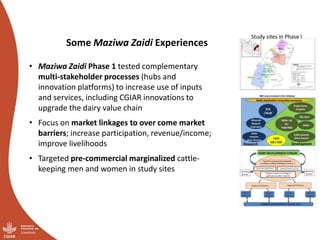
Some Maziwa Zaidi Experiences
• Maziwa Zaidi Phase 1 tested complementary
multi-stakeholder processes (hubs and
innovation platforms) to increase use of inputs
and services, including CGIAR innovations to
upgrade the dairy value chain
• Focus on market linkages to over come market
barriers; increase participation, revenue/income;
improve livelihoods
• Targeted pre-commercial marginalized cattle-
keeping men and women in study sites
Study sites in Phase I
Lessons learned
• The hubs were found useful for intended
purposes and progress towards sustainability
demonstrated
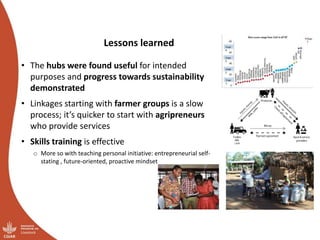
• Linkages starting with farmer groups is a slow
process; it’s quicker to start with agripreneurs
who provide services
• Skills training is effective
o More so with teaching personal initiative: entrepreneurial self-
stating , future-oriented, proactive mindset
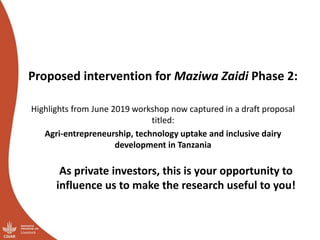
Proposed intervention for Maziwa Zaidi Phase 2:
Highlights from June 2019 workshop now captured in a draft proposal
titled:
Agri-entrepreneurship, technology uptake and inclusive dairy
development in Tanzania
As private investors, this is your opportunity to
influence us to make the research useful to you!
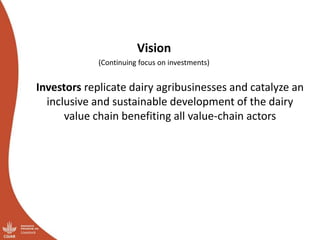
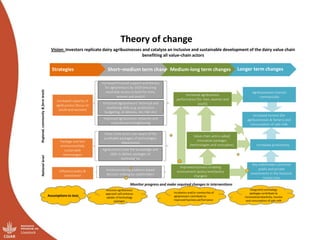
Vision
(Continuing focus on investments)
Investors replicate dairy agribusinesses and catalyze an
inclusive and sustainable development of the dairy
value chain benefiting all value-chain actors
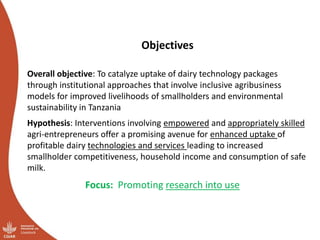
Objectives
Overall objective: To catalyze uptake of dairy technology packages
through institutional approaches that involve inclusive agribusiness
models for improved livelihoods of smallholders and environmental
sustainability in Tanzania
Hypothesis: Interventions involving empowered and appropriately skilled
agri-entrepreneurs offer a promising avenue for enhanced uptake of
profitable dairy technologies and services leading to increased
smallholder competitiveness, household income and consumption of safe
milk.
Focus: Promoting research into use
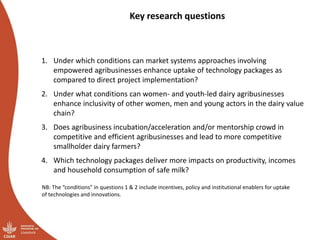
Key research questions
1. Under which conditions can market systems approaches involving
empowered agribusinesses enhance uptake of technology packages as
compared to direct project implementation?
2. Under what conditions can women- and youth-led dairy agribusinesses
enhance inclusivity of other women, men and young actors in the dairy value
chain?
3. Does agribusiness incubation/acceleration and/or mentorship crowd in
competitive and efficient agribusinesses and lead to more competitive
smallholder dairy farmers?
4. Which technology packages deliver more impacts on productivity, incomes
and household consumption of safe milk?
NB: The “conditions” in questions 1 & 2 include incentives, policy and institutional enablers for uptake
of technologies and innovations.
Theory of changeNationallevel
Agribusinesses interact
commercially
Strategies Short–medium term changesMedium-long term changes Longer term changes
Increased productivity
Increased financial support and literacy
for agripreneurs by 2020 (ensuring
equitable access to both for men,
women and youth)
Enhanced agripreneurs' technical and
marketing skills (e.g. production,
budgeting, AI delivery, AH, F&F etc)
Value chain actors are aware of the
profitable packages of technologies
(Awareness)
Increased agribusiness
performance (for men, women and
youth)
Value chain actors adopt
innovative packages
(technologies and innovation)
Institutionalizing evidence-based
decision making by stakeholders
Agribusiness have the knowledge and
skills to deliver packages of
technologies
Improved business enabling
environment (policy level/policy
changes)
Increased capacity of
agribusiness (focus on
youth and women)
Package and test
environmentally
sustainable
technologies
Influence policy &
investment
Key stakeholders promote
public and private
investments in the livestock
master plan
Improved agribusiness networks and
institutional strengthening
Increased income (for
agribusinesses & famers) and
consumption of safe milk
Regional,community&farmlevels
Monitor progress and make required changes in interventions
Assumptions to test:
Vision: Investors replicate dairy agribusinesses and catalyze an inclusive and sustainable development of the dairy value chain
benefiting all value-chain actors
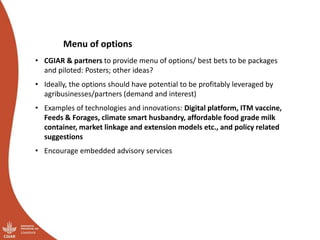
Menu of options
• CGIAR & partners to provide menu of options/ best bets to be packages
and piloted: Posters; other ideas?
• Ideally, the options should have potential to be profitably leveraged by
agribusinesses/partners (demand and interest)
• Examples of technologies and innovations: Digital platform, ITM vaccine,
Feeds & Forages, climate smart husbandry, affordable food grade milk
container, market linkage and extension models etc., and policy related
suggestions
• Encourage embedded advisory services
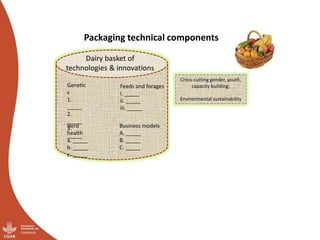
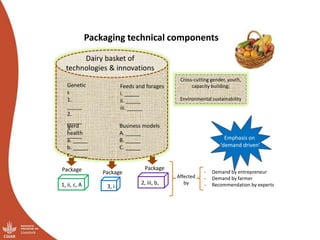
Packaging technical components
Genetic
s
1.
_____
2.
_____
3.
_____
Feeds and forages
i. _____
ii. _____
iii. _____
Herd
health
a. _____
b. _____
c. _____
Business models
A. _____
B. _____
C. _____
Dairy basket of
technologies & innovations
Cross-cutting gender, youth,
capacity building;
Environmental sustainability
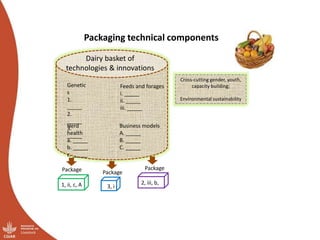
Packaging technical components
Genetic
s
1.
_____
2.
_____
3.
_____
Feeds and forages
i. _____
ii. _____
iii. _____
Herd
health
a. _____
b. _____
c. _____
Business models
A. _____
B. _____
C. _____
Dairy basket of
technologies & innovations
1, ii, c, A 3, i
2, iii, b,
Package Package
Package
Cross-cutting gender, youth,
capacity building;
Environmental sustainability
Packaging technical components
Genetic
s
1.
_____
2.
_____
3.
_____
Feeds and forages
i. _____
ii. _____
iii. _____
Herd
health
a. _____
b. _____
c. _____
Business models
A. _____
B. _____
C. _____
Dairy basket of
technologies & innovations
1, ii, c, A 3, i
2, iii, b,
Package Package
Package
Affected
by
- Demand by entrepreneur
- Demand by farmer
- Recommendation by experts
Emphasis on
‘demand driven’
Cross-cutting gender, youth,
capacity building;
Environmental sustainability
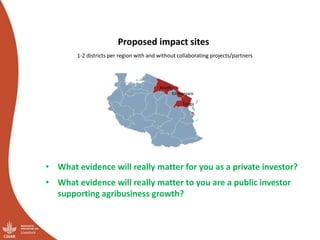
Proposed impact sites
1-2 districts per region with and without collaborating projects/partners
Arusha
Kilimanjaro
Tanga
• What evidence will really matter for you as a private investor?
• What evidence will really matter to you are a public investor
supporting agribusiness growth?
CGIAR Research Program on Livestock
livestock.cgiar.org
The CGIAR Research Program on Livestock aims to increase the productivity and profitability of livestock agri-food systems in sustainable ways, making meat,
milk and eggs more available and affordable across the developing world.
This presentation is licensed for use under the Creative Commons Attribution 4.0 International Licence.
The program thanks all donors and organizations which globally support its work through their contributions to the CGIAR system

Tanzania Smallholder Dairy Value Chain Research for Development: Proposal for Maziwa Zaidi Phase 2

  • 1.
    Tanzania Smallholder DairyValue Chain Research for Development: Proposal for Maziwa Zaidi Phase 2 Amos Omore Maziwa Zaidi Agribusiness Forum Moshi, Tanzania 17 October 2019
  • 2.
    Background • Lots ofresearch; little impact on the ground • We have been testing various interventions since 2012 • We want to share with you a selection of what we have to offer • We want to see what may interest you and how you might use the technologies and innovations individually or as a bundle • This is your opportunity to influence us to make research more impactful in your current or future agribusiness
  • 3.
    Some Maziwa ZaidiExperiences • Maziwa Zaidi Phase 1 tested complementary multi-stakeholder processes (hubs and innovation platforms) to increase use of inputs and services, including CGIAR innovations to upgrade the dairy value chain • Focus on market linkages to over come market barriers; increase participation, revenue/income; improve livelihoods • Targeted pre-commercial marginalized cattle- keeping men and women in study sites Study sites in Phase I
  • 4.
    Lessons learned • Thehubs were found useful for intended purposes and progress towards sustainability demonstrated • Linkages starting with farmer groups is a slow process; it’s quicker to start with agripreneurs who provide services • Skills training is effective o More so with teaching personal initiative: entrepreneurial self- stating , future-oriented, proactive mindset
  • 5.
    Proposed intervention forMaziwa Zaidi Phase 2: Highlights from June 2019 workshop now captured in a draft proposal titled: Agri-entrepreneurship, technology uptake and inclusive dairy development in Tanzania As private investors, this is your opportunity to influence us to make the research useful to you!
  • 6.
    Vision (Continuing focus oninvestments) Investors replicate dairy agribusinesses and catalyze an inclusive and sustainable development of the dairy value chain benefiting all value-chain actors
  • 7.
    Objectives Overall objective: Tocatalyze uptake of dairy technology packages through institutional approaches that involve inclusive agribusiness models for improved livelihoods of smallholders and environmental sustainability in Tanzania Hypothesis: Interventions involving empowered and appropriately skilled agri-entrepreneurs offer a promising avenue for enhanced uptake of profitable dairy technologies and services leading to increased smallholder competitiveness, household income and consumption of safe milk. Focus: Promoting research into use
  • 8.
    Key research questions 1.Under which conditions can market systems approaches involving empowered agribusinesses enhance uptake of technology packages as compared to direct project implementation? 2. Under what conditions can women- and youth-led dairy agribusinesses enhance inclusivity of other women, men and young actors in the dairy value chain? 3. Does agribusiness incubation/acceleration and/or mentorship crowd in competitive and efficient agribusinesses and lead to more competitive smallholder dairy farmers? 4. Which technology packages deliver more impacts on productivity, incomes and household consumption of safe milk? NB: The “conditions” in questions 1 & 2 include incentives, policy and institutional enablers for uptake of technologies and innovations.
  • 9.
    Theory of changeNationallevel Agribusinessesinteract commercially Strategies Short–medium term changesMedium-long term changes Longer term changes Increased productivity Increased financial support and literacy for agripreneurs by 2020 (ensuring equitable access to both for men, women and youth) Enhanced agripreneurs' technical and marketing skills (e.g. production, budgeting, AI delivery, AH, F&F etc) Value chain actors are aware of the profitable packages of technologies (Awareness) Increased agribusiness performance (for men, women and youth) Value chain actors adopt innovative packages (technologies and innovation) Institutionalizing evidence-based decision making by stakeholders Agribusiness have the knowledge and skills to deliver packages of technologies Improved business enabling environment (policy level/policy changes) Increased capacity of agribusiness (focus on youth and women) Package and test environmentally sustainable technologies Influence policy & investment Key stakeholders promote public and private investments in the livestock master plan Improved agribusiness networks and institutional strengthening Increased income (for agribusinesses & famers) and consumption of safe milk Regional,community&farmlevels Monitor progress and make required changes in interventions Assumptions to test: Vision: Investors replicate dairy agribusinesses and catalyze an inclusive and sustainable development of the dairy value chain benefiting all value-chain actors
  • 10.
    Menu of options •CGIAR & partners to provide menu of options/ best bets to be packages and piloted: Posters; other ideas? • Ideally, the options should have potential to be profitably leveraged by agribusinesses/partners (demand and interest) • Examples of technologies and innovations: Digital platform, ITM vaccine, Feeds & Forages, climate smart husbandry, affordable food grade milk container, market linkage and extension models etc., and policy related suggestions • Encourage embedded advisory services
  • 11.
    Packaging technical components Genetic s 1. _____ 2. _____ 3. _____ Feedsand forages i. _____ ii. _____ iii. _____ Herd health a. _____ b. _____ c. _____ Business models A. _____ B. _____ C. _____ Dairy basket of technologies & innovations Cross-cutting gender, youth, capacity building; Environmental sustainability
  • 12.
    Packaging technical components Genetic s 1. _____ 2. _____ 3. _____ Feedsand forages i. _____ ii. _____ iii. _____ Herd health a. _____ b. _____ c. _____ Business models A. _____ B. _____ C. _____ Dairy basket of technologies & innovations 1, ii, c, A 3, i 2, iii, b, Package Package Package Cross-cutting gender, youth, capacity building; Environmental sustainability
  • 13.
    Packaging technical components Genetic s 1. _____ 2. _____ 3. _____ Feedsand forages i. _____ ii. _____ iii. _____ Herd health a. _____ b. _____ c. _____ Business models A. _____ B. _____ C. _____ Dairy basket of technologies & innovations 1, ii, c, A 3, i 2, iii, b, Package Package Package Affected by - Demand by entrepreneur - Demand by farmer - Recommendation by experts Emphasis on ‘demand driven’ Cross-cutting gender, youth, capacity building; Environmental sustainability
  • 14.
    Proposed impact sites 1-2districts per region with and without collaborating projects/partners Arusha Kilimanjaro Tanga • What evidence will really matter for you as a private investor? • What evidence will really matter to you are a public investor supporting agribusiness growth?
  • 15.
    CGIAR Research Programon Livestock livestock.cgiar.org The CGIAR Research Program on Livestock aims to increase the productivity and profitability of livestock agri-food systems in sustainable ways, making meat, milk and eggs more available and affordable across the developing world. This presentation is licensed for use under the Creative Commons Attribution 4.0 International Licence. The program thanks all donors and organizations which globally support its work through their contributions to the CGIAR system

Editor's Notes

  • #3 Page title minimum of 30 points and maximum of two lines Main point 6 point smaller than slide title Bullet points 4 point less than main point Font type is Calibri It is advised in one slide maximum 6 bullets We recommend you use images on slides You can change partner logos on front page You have to duplicate this slide for more inside pages
  • #4 Page title minimum of 30 points and maximum of two lines Main point 6 point smaller than slide title Bullet points 4 point less than main point Font type is Calibri It is advised in one slide maximum 6 bullets We recommend you use images on slides You can change partner logos on front page You have to duplicate this slide for more inside pages
  • #5 Page title minimum of 30 points and maximum of two lines Main point 6 point smaller than slide title Bullet points 4 point less than main point Font type is Calibri It is advised in one slide maximum 6 bullets We recommend you use images on slides You can change partner logos on front page You have to duplicate this slide for more inside pages
  • #7 Page title minimum of 30 points and maximum of two lines Main point 6 point smaller than slide title Bullet points 4 point less than main point Font type is Calibri It is advised in one slide maximum 6 bullets We recommend you use images on slides You can change partner logos on front page You have to duplicate this slide for more inside pages
  • #8 Page title minimum of 30 points and maximum of two lines Main point 6 point smaller than slide title Bullet points 4 point less than main point Font type is Calibri It is advised in one slide maximum 6 bullets We recommend you use images on slides You can change partner logos on front page You have to duplicate this slide for more inside pages
  • #11 Page title minimum of 30 points and maximum of two lines Main point 6 point smaller than slide title Bullet points 4 point less than main point Font type is Calibri It is advised in one slide maximum 6 bullets We recommend you use images on slides You can change partner logos on front page You have to duplicate this slide for more inside pages
  • #12 Page title minimum of 30 points and maximum of two lines Main point 6 point smaller than slide title Bullet points 4 point less than main point Font type is Calibri It is advised in one slide maximum 6 bullets We recommend you use images on slides You can change partner logos on front page You have to duplicate this slide for more inside pages
  • #13 Page title minimum of 30 points and maximum of two lines Main point 6 point smaller than slide title Bullet points 4 point less than main point Font type is Calibri It is advised in one slide maximum 6 bullets We recommend you use images on slides You can change partner logos on front page You have to duplicate this slide for more inside pages
  • #14 Page title minimum of 30 points and maximum of two lines Main point 6 point smaller than slide title Bullet points 4 point less than main point Font type is Calibri It is advised in one slide maximum 6 bullets We recommend you use images on slides You can change partner logos on front page You have to duplicate this slide for more inside pages