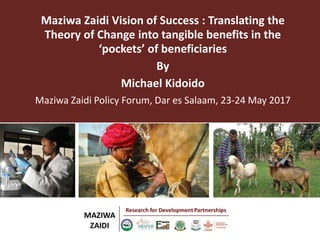
Maziwa Zaidi Vision of Success : Translating the
Theory of Change into tangible benefits in the
‘pockets’ of beneficiaries
By
Michael Kidoido
Maziwa Zaidi Policy Forum, Dar es Salaam, 23-24 May 2017
Maziwa Zaidi vision…..
“An inclusive and sustainable
development of the Tanzania dairy
value chain”
Maziwa Zaidi long term goals…
 Smallholder farmers have reliable and consistent
access to quality inputs and services (leading to high
productivity)
 Smallholder famers have access to an inclusive,
reliable, well-coordinated, and efficient dairy
products marketing arrangement (leading to high
income and better livelihoods)
 Poor consumers can access quality, safe, and
nutritious dairy products at affordable prices (leading
to increase in their per capita consumption of the
dairy products)
The focus for the first 4 years….
“To accelerate change among private and public
investors and to scale the pre-commercial hub
approach in inclusive ways”
What are those opportunities for private
and public investments required….
 This has required a concerted AR4D, co-creation of
innovations and coherent partnerships at all levels:
 Farmers
 Farmer-groups
 Villages/communities
 LGAs,
 NGOs,
 Value chain actors,
 Policy actors etc.
 Maziwa Zaidi has been that AR4D approach…..
Maziwa Zaidi has been working with…
1. NGOs (HIT, Faida MaLi, SNV , LoL), Extension
Systems, Business Service Providers, Traders
and Milk Processors to facilitate collaboration
among value chain actors:
Short term: To contextualize approaches and relay feedback to
beneficiaries to catalyse adoption of technologies
Medium term: Value chain actors actively participate in the hub
Medium term: Value chain actors collaborate to respond to
business benefits
Medium term: Business service providers to buy, sell and invest in
the value chain
6
TALIRI with LGAs are now using IPs and FEAST
tools to engage value chain actors e.g. EADD IPs in
Babati region
Participatory research/technology development in
seen in pilot sites in Tanga and Morogoro
Experimentation of innovations with other farmer
groups around those created by MZ (e.g., in
Twatwatwa) to experiment with what was
happening in neighbouring villages
Emerging evidence ………..
7
Worked with ….…..
2. BDS providers, Traders and Milk Processors
(TAMPA, TAMPRODA), Inputs and service
providers, Farmers, Farmers’ associations
(TAMPRODA) to build capacity and facilitate
collaboration among value chain actors
Short term:
 Value Chain actors to pilot innovations e.g. Mazzican
 Processors and private service providers to respond to
emerging business opportunities
 Value chain actors becoming more organized leading to
more investment in the dairy sector
8
Emerging evidence…………
A large scale processor e.g. ASAS Dairies Ltd.
independently exploring the feasibility of engaging
groups formed by MZ in agro-pastoralist communities
in Morogoro to collect milk from them
Financial institutions e.g. Covenant Bank responding
by offering credit to producer groups to purchase
inputs such as heifers
Shambani Milk Graduates Processors Ltd., contracted
agro-pastoralists/traders in Morogoro to supply milk
to their factory in the town
9
Worked with……………
3. Smallholder Farmers, NARES, Research
partners (SUA and TALIRI, ILRI, CIAT, other CG
centres) and Extension agents to develop
best practices such that
 Short term: Partners pilot innovations and is
increase technology adoption
 Medium term: That more evidence is available
and it starts driving accelerated investment in
the value chain
Emerging evidence……
 Increased uptake of new feed /improved
forage varieties by producers
 Spill over of feeds/improved forage varieties
to villages/non project areas in Lushoto
district and in/around Manyinga village in
Mvomero district (public and private)
Worked with………..
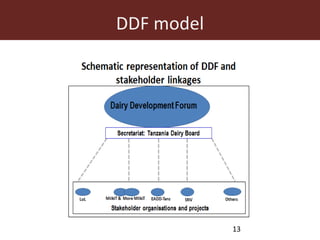
4. Tanzania Dairy Board (TDB), the DDF
secretariat and DDF members at national and
regional level to develop capacity and engage
with policy makers such that:
Short term: The DDF secretariat engages and mobilizes
stakeholders efficiently
Short term: Members become more aware of evolving
opportunities for investment
Medium term: Stakeholders prioritize innovations to tackle
constraints that affect hub growth
All these changes would the further attract private sector
investment in the sector
12
DDF model
13
Emerging evidence…………….
A farmer group in Mangae village grabbing non-dairy
opportunities e.g collective marketing of goats
The coordination role of TDB has become more
visible:
 Concept of innovation platform is now understood by the leadership in
MALF;
 more stakeholders (besides mostly policy makers initially) are
participating in DDF meetings and sharing information (e.g., through a
DDF Whatsapp Group);
 more recognition of smallholder dairy production (inclusivity) and the
increasing interest to increase business interactions through the DDF
by formalizing it
Use of the Forum by government to link with some
actors for financing through the Tanzania Agricultural
Development Bank (TADB)
14
Worked with….
5. Regional/ Local Governments to engage with policy
makers such that
 Short term: Local government becoming more active
partners in terms on planning and financing.
 Medium term: To eventually influence the central
government in prioritizing dairy sector in the master
plans.
 Medium term: This will would catalyse private service
provider investment in the value chain.
 Emerging evidence
 LGAs were reported to be more open to collaboration
with researchers and are beginning to allocate more
resources to livestock related activities
15
Short and medium changes will result
in…….
 Donors working in Tanzania accepting
evidence that the hub approach is pro-
poor thus increasing their investment
 Big private sector actors respond to
business opportunities for growing the
dairy sector
16
Eventually…..
Private and Public Investors will
replicate the commercial hubs
approach in inclusive ways
..leading to tangible benefits in the
“Pockets” of beneficiaries
High incomes
High consumption of dairy production
17
This presentation is licensed for use under the Creative Commons Attribution 4.0 International Licence.
better lives through livestock
ilri.org
ILRI thanks all donors and organizations which globally support its work through their contributions to
the CGIAR system

Maziwa Zaidi Vision of Success: Translating the Theory of Change into tangible benefits in the ‘pockets’ of beneficiaries

  • 1.
    Maziwa Zaidi Visionof Success : Translating the Theory of Change into tangible benefits in the ‘pockets’ of beneficiaries By Michael Kidoido Maziwa Zaidi Policy Forum, Dar es Salaam, 23-24 May 2017
  • 2.
    Maziwa Zaidi vision….. “Aninclusive and sustainable development of the Tanzania dairy value chain”
  • 3.
    Maziwa Zaidi longterm goals…  Smallholder farmers have reliable and consistent access to quality inputs and services (leading to high productivity)  Smallholder famers have access to an inclusive, reliable, well-coordinated, and efficient dairy products marketing arrangement (leading to high income and better livelihoods)  Poor consumers can access quality, safe, and nutritious dairy products at affordable prices (leading to increase in their per capita consumption of the dairy products)
  • 4.
    The focus forthe first 4 years…. “To accelerate change among private and public investors and to scale the pre-commercial hub approach in inclusive ways”
  • 5.
    What are thoseopportunities for private and public investments required….  This has required a concerted AR4D, co-creation of innovations and coherent partnerships at all levels:  Farmers  Farmer-groups  Villages/communities  LGAs,  NGOs,  Value chain actors,  Policy actors etc.  Maziwa Zaidi has been that AR4D approach…..
  • 6.
    Maziwa Zaidi hasbeen working with… 1. NGOs (HIT, Faida MaLi, SNV , LoL), Extension Systems, Business Service Providers, Traders and Milk Processors to facilitate collaboration among value chain actors: Short term: To contextualize approaches and relay feedback to beneficiaries to catalyse adoption of technologies Medium term: Value chain actors actively participate in the hub Medium term: Value chain actors collaborate to respond to business benefits Medium term: Business service providers to buy, sell and invest in the value chain 6
  • 7.
    TALIRI with LGAsare now using IPs and FEAST tools to engage value chain actors e.g. EADD IPs in Babati region Participatory research/technology development in seen in pilot sites in Tanga and Morogoro Experimentation of innovations with other farmer groups around those created by MZ (e.g., in Twatwatwa) to experiment with what was happening in neighbouring villages Emerging evidence ……….. 7
  • 8.
    Worked with ….….. 2.BDS providers, Traders and Milk Processors (TAMPA, TAMPRODA), Inputs and service providers, Farmers, Farmers’ associations (TAMPRODA) to build capacity and facilitate collaboration among value chain actors Short term:  Value Chain actors to pilot innovations e.g. Mazzican  Processors and private service providers to respond to emerging business opportunities  Value chain actors becoming more organized leading to more investment in the dairy sector 8
  • 9.
    Emerging evidence………… A largescale processor e.g. ASAS Dairies Ltd. independently exploring the feasibility of engaging groups formed by MZ in agro-pastoralist communities in Morogoro to collect milk from them Financial institutions e.g. Covenant Bank responding by offering credit to producer groups to purchase inputs such as heifers Shambani Milk Graduates Processors Ltd., contracted agro-pastoralists/traders in Morogoro to supply milk to their factory in the town 9
  • 10.
    Worked with…………… 3. SmallholderFarmers, NARES, Research partners (SUA and TALIRI, ILRI, CIAT, other CG centres) and Extension agents to develop best practices such that  Short term: Partners pilot innovations and is increase technology adoption  Medium term: That more evidence is available and it starts driving accelerated investment in the value chain
  • 11.
    Emerging evidence……  Increaseduptake of new feed /improved forage varieties by producers  Spill over of feeds/improved forage varieties to villages/non project areas in Lushoto district and in/around Manyinga village in Mvomero district (public and private)
  • 12.
    Worked with……….. 4. TanzaniaDairy Board (TDB), the DDF secretariat and DDF members at national and regional level to develop capacity and engage with policy makers such that: Short term: The DDF secretariat engages and mobilizes stakeholders efficiently Short term: Members become more aware of evolving opportunities for investment Medium term: Stakeholders prioritize innovations to tackle constraints that affect hub growth All these changes would the further attract private sector investment in the sector 12
  • 13.
  • 14.
    Emerging evidence……………. A farmergroup in Mangae village grabbing non-dairy opportunities e.g collective marketing of goats The coordination role of TDB has become more visible:  Concept of innovation platform is now understood by the leadership in MALF;  more stakeholders (besides mostly policy makers initially) are participating in DDF meetings and sharing information (e.g., through a DDF Whatsapp Group);  more recognition of smallholder dairy production (inclusivity) and the increasing interest to increase business interactions through the DDF by formalizing it Use of the Forum by government to link with some actors for financing through the Tanzania Agricultural Development Bank (TADB) 14
  • 15.
    Worked with…. 5. Regional/Local Governments to engage with policy makers such that  Short term: Local government becoming more active partners in terms on planning and financing.  Medium term: To eventually influence the central government in prioritizing dairy sector in the master plans.  Medium term: This will would catalyse private service provider investment in the value chain.  Emerging evidence  LGAs were reported to be more open to collaboration with researchers and are beginning to allocate more resources to livestock related activities 15
  • 16.
    Short and mediumchanges will result in…….  Donors working in Tanzania accepting evidence that the hub approach is pro- poor thus increasing their investment  Big private sector actors respond to business opportunities for growing the dairy sector 16
  • 17.
    Eventually….. Private and PublicInvestors will replicate the commercial hubs approach in inclusive ways ..leading to tangible benefits in the “Pockets” of beneficiaries High incomes High consumption of dairy production 17
  • 18.
    This presentation islicensed for use under the Creative Commons Attribution 4.0 International Licence. better lives through livestock ilri.org ILRI thanks all donors and organizations which globally support its work through their contributions to the CGIAR system

Editor's Notes

  • #2 There MUST be a CGIAR logo or a CRP logo. You can copy and paste the logo you need from the final slide of this presentation. Then you can delete that final slide   To replace a photo above, copy and paste this link in your browser: http://www.flickr.com/photos/ilri/sets/72157632057087650/detail/   Find a photo you like and the right size, copy and paste it in the block above.