UNIT 5 WEEK 3 8TH GRADE
TEACHER ANITA CASTELLANOS
 1. Review of last week class
 2. Mayan Civilization
 Time, map of the world in Maya time and Timeline of civilization
 Location Map
 Social Structure Social Pyramid
 Government, Important People
 Economy Principal products
 Mayan Science: Math, Astronomy and The Calendar
 Mayan Culture: Art, Architecture, Beauty Standards, Religion, Games, Writing
and Language.
ACTIVITIES: My birthday in the mayan calendar, order a timeline, reading.
 It is believed first Americans came around 25.000
years ago.
 There are 8 theories of the Population beginnings
in America.
 There are evidences of the existence of a land bridge
in the Bering Strait were people crossed from Asia
to America.
 We share DNA with people from Polinesia, Melanesia,
Australia and Asia
 Thor Heyerdahl proved that people could come by
the Atlantic Ocean from Africa and Europe and also by
the Pacific Ocean from Oceania.
Time, Location, Society, Government and Economy
Timeline activity in the platform --> Order the events of the Mayan civilization
PERIOD DURATION CHARACTERIZED BY
OLMEC 1200 – 1000 BC Lived in the same time as the
Mayans, some believe were the
Mayan predecessors
Pre-classic 1800 BC – 250 AC Development of writing, large
scale constructions
Classic 250 – 900 AC Development of great kingdoms,
intellectual advances, stone and
chocolate is traded
Post-classic 900 – 1500 AC Collapse of kingdoms, emphasis
on commerce
Beginning
of Maya
civilization
750 BC –
500 BC
https://maya.nmai.si.edu/the-maya/maya-world
Let´s
check the
names of
Mayan
Cities
 Theocracy: Leaders were rulers
and priests.
 Kings were considered gods.
 Kings were hereditary
positions. And they could be
man or woman.
 Each independent Maya city
had its own rulers
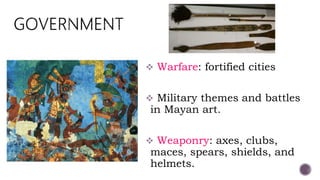
 Warfare: fortified cities
 Military themes and battles
in Mayan art.
 Weaponry: axes, clubs,
maces, spears, shields, and
helmets.
The most famous Palenque
Ruler was Pakal,
He became a king when he
was 12 years old.
He ruled for 68 years
Farming and agriculture was the
main activity and basis of their
economy
Maize (Corn) was the most
important crop
They had markets and traded
products with other villages
 They had products like: salt, cloth, honey, fruit, and domestic animals.
 They grew pineapples, chili peppers, cacao, squash, papayas, avocados,
maize, and beans.
 They used to eat turkey, and there´s evidence of iguana, armadillo,
tapir, monkey, and the manatee being eated.
 DID THE MAYAN EAT DOGS?
 Yes!. Mayans raised dogs as we raise chicken or pigs to eat their meat.
 Dogs were not pets, as pets Mayans had parrots. Ha! Ha!
Math, Astrology,
The Calendar
 Was applied to architecture, the
creation of the calendar and to
measure time and study
astronomy.
 Thy had a system of 20 numbers
 They were about the first people
in the world to know about the
existence of 0 which helped
make accurate calculations
 Very accurate charts of the Moon.
 They have great observatories to watch
the sky
 Their pyramids were built based on the
stars
 There are two calendars at work
simultaneously in the Maya system:
the Haab, of 365 days, and the
Tzolkin, or sacred calendar, of 260
days.
 They also have a Long Count
Calendar which helped them predict
events in the future and calculate
dates as far as 2012.
 Their calendar was more accurate
than other calendars in the whole
world.
Art, Architecture, Beauty Standards, Religion, Games, Language
and Writing,
Sculpture
Masks
Painting
Pottery
Jewelry
 Stepped temples in the form of
pyramids
 The ruler's court included
palaces, temples and ball
courts, and great plazas, open
areas for festivals and public
events.
 Temples were built one on top
of the other
 Every time a ruler died, he was
buried in the pyramid.
 Pircings
 Tatoos
 Teeth incrustations
 Crossed eyes
 Head elongation
 The sacred book of the Mayans is called Popol Vuh
 They believed man was made by corn
 Their religion was polytheistic, which means that
they believed in many gods and goddesses.
 Mayans did human sacrifes as part of religious
rituals. They also sacrificed jaguars and made
personal blood sacrifices to maintain the balance of
the universe
 Kings were buried along with food and riches to
help then go to the afterlife.
 The Mayan ball game
 Was played by
professionals and elite
players
 There is evidence of
ceremonial sacrifices of
the players after the
games.
 Only 5 cultures in the history of
humanity have developed their own
and unique system to write
everything they could say.
 These 5 cultures are the Sumerians
who created cuneiform writing, the
Chinesse, the Harappan (indus
civilization) the Egyptians and the
Mayans
 They invented a complex glypgh
system with more tan 800
characters
 We have some of the writings of
mayans recovered in 3 books or
codex.
Everything else was destroyed, either
from the high mayan priests or the
Spanish conquistadors.
In the mayan civilization there were a
lot of different dialects because of the
división of city states.
 The Mayan language still exist
today and is spoken by indigenous
groups in mesoamerica.
 Go to the school platform and check for the activities of Unit 3, week 5
 Order events of the Mayan civilization in a timeline
 You can check the vocabulary for the unit there
 Download a reading about Mayan cities and answer the questions of the
reading.
 Explore the resources there to learn more about the Mayans.
 https://www.tes.com/lessons/as5kt4Nq9GTBsg/guatemala-unit-3
 http://www.mayavase.com/grol/grolier.html
 http://www.famsi.org/reports/03075/CKguidebook_spanish.pdf
 https://www.teachervision.com/mexican-history-hispanic-heritage/mayan-empire
 https://www.youtube.com/watch?v=_KyPkS1NjFg
 https://prezi.com/xfp_hqdf2rxy/timeline-of-the-mayan-civilization/
 https://www.tes.com/teaching-resource/mayan-timeline-6436442
 https://mayas.mrdonn.org/geography.html
 https://mayas.mrdonn.org/games.html
 https://edu.glogster.com/glog/los-mayans/2c994qhxo3q?=glogpedia-source
 https://www.history.com/topics/ancient-americas/mayan-scientific-achievements
 http://www.mesoweb.org/
 http://economiademallorca.com/art/1565/el-busto-del-rey-pakal-se-expone-en-la-fundacion-sophia-de-palma-de-mallorca
 https://historylink101.com/1/mayan/ancient_mayan.htm
 http://www.mayankids.com/mmkpeople/mksailing.htm
 https://www.history.com/topics/ancient-americas/maya
 https://ancientamerindia.wordpress.com/2012/12/14/classical-maya-warfare-300-900-ad/
 https://sites.google.com/site/ancientmayancivilization/ancient-mayan-economics
 https://www.youtube.com/watch?v=OuV47zv0DT4
 https://www.elcaminomascorto.es/antiguas-ciudades-mayas/
 https://www.livescience.com/41781-the-maya.html
 https://www.history.com/topics/ancient-americas/maya
 https://www.youtube.com/watch?v=tZQWYafLrFM
 https://www.keystagehistory.co.uk/keystage-2/primary-history-teaching-the-maya-from-september-2014-key-stage-2/
 https://www.pastfactory.com/culture/mayans-history-people/40/
 https://www.organicauthority.com/health/life-lessons-from-the-mayans-calendar
 https://pueblosoriginarios.com/meso/maya/sitios/tumba_pacal.html
 https://www.thoughtco.com/beginners-guide-to-the-maya-civilization-171598
 https://study.com/academy/lesson/mayan-culture-lesson-for-kids.html
 https://www.pinterest.com/pin/768919336349386465/
 https://www.flickr.com/photos/victortamargo/7850453206
 https://es.wikipedia.org/wiki/K%27inich_Janaab%27_Pakal
 https://aquinoticias.mx/conoce-la-majestuosidad-de-la-tumba-de-pakal/
 https://www.cultura10.org/maya/economia/
 https://wikisivar.com/la-cultura-maya/
 http://instructionswaterheater.blogspot.com/2017/09/mayan-rulers.html
 https://www.theyucatantimes.com/2020/02/explaining-the-mayan-calendar/
 https://www.trendsmap.com/twitter/tweet/1200864119550664704
 https://www.researchgate.net/figure/Figura-19-Escultura-Grupo-IV-Archivo-fotografico-del-Proyecto-Arqueologico-
Palenque_fig17_309153387
 https://www.youtube.com/watch?v=mrTzjGYHJxI
 https://www.ancient.eu/Maya_Civilization/

Mayas week 3 unit 5

  • 1.
    UNIT 5 WEEK3 8TH GRADE TEACHER ANITA CASTELLANOS
  • 2.
     1. Reviewof last week class  2. Mayan Civilization  Time, map of the world in Maya time and Timeline of civilization  Location Map  Social Structure Social Pyramid  Government, Important People  Economy Principal products  Mayan Science: Math, Astronomy and The Calendar  Mayan Culture: Art, Architecture, Beauty Standards, Religion, Games, Writing and Language. ACTIVITIES: My birthday in the mayan calendar, order a timeline, reading.
  • 3.
     It isbelieved first Americans came around 25.000 years ago.  There are 8 theories of the Population beginnings in America.  There are evidences of the existence of a land bridge in the Bering Strait were people crossed from Asia to America.  We share DNA with people from Polinesia, Melanesia, Australia and Asia  Thor Heyerdahl proved that people could come by the Atlantic Ocean from Africa and Europe and also by the Pacific Ocean from Oceania.
  • 4.
    Time, Location, Society,Government and Economy
  • 5.
    Timeline activity inthe platform --> Order the events of the Mayan civilization PERIOD DURATION CHARACTERIZED BY OLMEC 1200 – 1000 BC Lived in the same time as the Mayans, some believe were the Mayan predecessors Pre-classic 1800 BC – 250 AC Development of writing, large scale constructions Classic 250 – 900 AC Development of great kingdoms, intellectual advances, stone and chocolate is traded Post-classic 900 – 1500 AC Collapse of kingdoms, emphasis on commerce
  • 6.
  • 7.
  • 9.
     Theocracy: Leaderswere rulers and priests.  Kings were considered gods.  Kings were hereditary positions. And they could be man or woman.  Each independent Maya city had its own rulers
  • 10.
     Warfare: fortifiedcities  Military themes and battles in Mayan art.  Weaponry: axes, clubs, maces, spears, shields, and helmets.
  • 11.
    The most famousPalenque Ruler was Pakal, He became a king when he was 12 years old. He ruled for 68 years
  • 12.
    Farming and agriculturewas the main activity and basis of their economy Maize (Corn) was the most important crop They had markets and traded products with other villages
  • 13.
     They hadproducts like: salt, cloth, honey, fruit, and domestic animals.  They grew pineapples, chili peppers, cacao, squash, papayas, avocados, maize, and beans.  They used to eat turkey, and there´s evidence of iguana, armadillo, tapir, monkey, and the manatee being eated.  DID THE MAYAN EAT DOGS?  Yes!. Mayans raised dogs as we raise chicken or pigs to eat their meat.  Dogs were not pets, as pets Mayans had parrots. Ha! Ha!
  • 14.
  • 15.
     Was appliedto architecture, the creation of the calendar and to measure time and study astronomy.  Thy had a system of 20 numbers  They were about the first people in the world to know about the existence of 0 which helped make accurate calculations
  • 16.
     Very accuratecharts of the Moon.  They have great observatories to watch the sky  Their pyramids were built based on the stars
  • 17.
     There aretwo calendars at work simultaneously in the Maya system: the Haab, of 365 days, and the Tzolkin, or sacred calendar, of 260 days.  They also have a Long Count Calendar which helped them predict events in the future and calculate dates as far as 2012.  Their calendar was more accurate than other calendars in the whole world.
  • 18.
    Art, Architecture, BeautyStandards, Religion, Games, Language and Writing,
  • 19.
  • 20.
     Stepped templesin the form of pyramids  The ruler's court included palaces, temples and ball courts, and great plazas, open areas for festivals and public events.  Temples were built one on top of the other  Every time a ruler died, he was buried in the pyramid.
  • 22.
     Pircings  Tatoos Teeth incrustations  Crossed eyes  Head elongation
  • 23.
     The sacredbook of the Mayans is called Popol Vuh  They believed man was made by corn  Their religion was polytheistic, which means that they believed in many gods and goddesses.  Mayans did human sacrifes as part of religious rituals. They also sacrificed jaguars and made personal blood sacrifices to maintain the balance of the universe  Kings were buried along with food and riches to help then go to the afterlife.
  • 24.
     The Mayanball game  Was played by professionals and elite players  There is evidence of ceremonial sacrifices of the players after the games.
  • 25.
     Only 5cultures in the history of humanity have developed their own and unique system to write everything they could say.  These 5 cultures are the Sumerians who created cuneiform writing, the Chinesse, the Harappan (indus civilization) the Egyptians and the Mayans  They invented a complex glypgh system with more tan 800 characters
  • 26.
     We havesome of the writings of mayans recovered in 3 books or codex. Everything else was destroyed, either from the high mayan priests or the Spanish conquistadors. In the mayan civilization there were a lot of different dialects because of the división of city states.  The Mayan language still exist today and is spoken by indigenous groups in mesoamerica.
  • 27.
     Go tothe school platform and check for the activities of Unit 3, week 5  Order events of the Mayan civilization in a timeline  You can check the vocabulary for the unit there  Download a reading about Mayan cities and answer the questions of the reading.  Explore the resources there to learn more about the Mayans.
  • 28.
     https://www.tes.com/lessons/as5kt4Nq9GTBsg/guatemala-unit-3  http://www.mayavase.com/grol/grolier.html http://www.famsi.org/reports/03075/CKguidebook_spanish.pdf  https://www.teachervision.com/mexican-history-hispanic-heritage/mayan-empire  https://www.youtube.com/watch?v=_KyPkS1NjFg  https://prezi.com/xfp_hqdf2rxy/timeline-of-the-mayan-civilization/  https://www.tes.com/teaching-resource/mayan-timeline-6436442  https://mayas.mrdonn.org/geography.html  https://mayas.mrdonn.org/games.html  https://edu.glogster.com/glog/los-mayans/2c994qhxo3q?=glogpedia-source  https://www.history.com/topics/ancient-americas/mayan-scientific-achievements  http://www.mesoweb.org/  http://economiademallorca.com/art/1565/el-busto-del-rey-pakal-se-expone-en-la-fundacion-sophia-de-palma-de-mallorca  https://historylink101.com/1/mayan/ancient_mayan.htm  http://www.mayankids.com/mmkpeople/mksailing.htm  https://www.history.com/topics/ancient-americas/maya  https://ancientamerindia.wordpress.com/2012/12/14/classical-maya-warfare-300-900-ad/  https://sites.google.com/site/ancientmayancivilization/ancient-mayan-economics  https://www.youtube.com/watch?v=OuV47zv0DT4  https://www.elcaminomascorto.es/antiguas-ciudades-mayas/
  • 29.
     https://www.livescience.com/41781-the-maya.html  https://www.history.com/topics/ancient-americas/maya https://www.youtube.com/watch?v=tZQWYafLrFM  https://www.keystagehistory.co.uk/keystage-2/primary-history-teaching-the-maya-from-september-2014-key-stage-2/  https://www.pastfactory.com/culture/mayans-history-people/40/  https://www.organicauthority.com/health/life-lessons-from-the-mayans-calendar  https://pueblosoriginarios.com/meso/maya/sitios/tumba_pacal.html  https://www.thoughtco.com/beginners-guide-to-the-maya-civilization-171598  https://study.com/academy/lesson/mayan-culture-lesson-for-kids.html  https://www.pinterest.com/pin/768919336349386465/  https://www.flickr.com/photos/victortamargo/7850453206  https://es.wikipedia.org/wiki/K%27inich_Janaab%27_Pakal  https://aquinoticias.mx/conoce-la-majestuosidad-de-la-tumba-de-pakal/  https://www.cultura10.org/maya/economia/  https://wikisivar.com/la-cultura-maya/  http://instructionswaterheater.blogspot.com/2017/09/mayan-rulers.html  https://www.theyucatantimes.com/2020/02/explaining-the-mayan-calendar/  https://www.trendsmap.com/twitter/tweet/1200864119550664704  https://www.researchgate.net/figure/Figura-19-Escultura-Grupo-IV-Archivo-fotografico-del-Proyecto-Arqueologico- Palenque_fig17_309153387  https://www.youtube.com/watch?v=mrTzjGYHJxI  https://www.ancient.eu/Maya_Civilization/