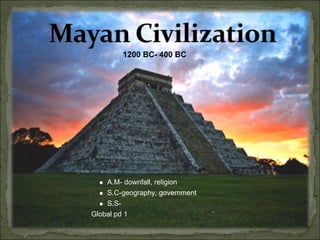
1200 BC- 400 BC


    A.M- downfall, religion
    S.C-geography, government
    S.S-
Global pd 1
Located in the Guatemala.
Tikal is bounded by rivers to the east and west
that go into the Caribbean and Gulf of Mexico.
Wetlands provided fertile areas for agriculture.
Maya’s homeland was from southern Mexico to
northern Central America.
Had a highland and lowland region; located on the
Yucatan Peninsula.
In peninsula is hot and humid because it is in the
tropics and near the coast.
The climate of the Highlands greatly contrasted
with that of the Lowlands as it was much cooler
and drier.
The highlands were rich in obsidian, jade, and
other valuable metals that Mayans used to
develop a lively trade.
They also grew squash, beans, chili peppers,
amaranth, manioc, cacao, cotton for light cloth.
The lowlands are a limestone shelf bordered on
the north and west by the Gulf of Mexico and on
the east by the Caribbean Sea.
The northern lowland climate is hot and has little
to no rain. They only had cenotes which were
large sinkholes filled with rainwater.
The southern lowlands consist of rainforest and
savannas and their rivers were linked to the
Usumacinta River.
Mayan society was divided into seperate city-states.
Each city-state was ruled by a noble family. The kingdoms were controlled by dynasties which
claimed they descended from The Hero Twins
One of the most famous Maya rulers was Lord Pacal.
       Pacal was a king for about 50 years before he died. When his tomb was discovered he was
       wearing a jade death mask
Each king was regarded as a holy figure, and the throne was passed down to the eldest son
The government was ruled by priests and kings - the priests had fantastic power; they ruled
cities, led ceremonies, and performed other jobs.
Others were elected to help the nobles run the city-states; judges, warriors and a council or
elders were necessary
They also believed that Jaguar was their underworld in
Religion was a key factor in Mayan life                    which people would have their afterlife, after going a
The king was a holy figure and on the top of the social    dangerous soul expedition.
classes although that did not ensure him a place in        The Mayans had religious rituals that included human
heaven.                                                    sacrifice, where they nourished the gods with their
The Mayans were polytheistic, believing in many god        blood.
such as the gods of corn, death, rain and war.             Their religious beliefs gradually connected with
Games were played in ball courts to maintain the           astronomy, mathematics and the production of their
cycles of the sun and moon and to bring rain.              calendar.

Believed that each day represented a different god, so     Believed that each day represented a different god, so
they made a calendar to be prepared for the behavior       they made a calendar to be prepared for the behavior of
of the different god each day.                             the different god each day.

Worshipped in temple-pyramids, palaces and                 The religious calendar was created based on the
observatories, all hand made w/out metals tools and all    position of the planets, sun and moon and was a 260
contain beautiful stone carvings, representing religious   day calendar.
beliefs.                                                   Solar calendar: 18, 20 day months
                                                           In addition, both calendars were linked and helped to
                                                           determine the best time to plant crops, the best time to
                                                           interact in war, and the beginning of new rulers reign.
Trade and Agriculture
                   Maya cities were linked together by
                   trade alliances - trade played an
                   important role in connecting the
                   empire
                   Salt, flint, feathers, shells, honey,
                   cotton, textile, and jade ornaments
                   were popular products
                   Cacao beans sometimes severed as
                   currency
                   The Maya farmed maize, beans,
                   and squash - these crops were the
                   foundation of Mayan life.
                   Used different farming techniques,
                   some unique to their society (see
                   Advancements and Innovations),
                   such as slash-and-burn agriculture
                   and a method of planting crops of
                   raised beds above swamps and
                   hillside terraces.
                   Having several productive farming
                   techniques allowed Mayan farmers
                   to produce copious amounts of food
Sophisticated farming technique of planting crops on raised beds above swamps and on
hillside terraces that allowed farmers to grow large amounts of food
Used obsidian to make tools and weapons
Used glyphs, which stood for whole words or syllables, as a writing system
Used codex (bark paper book) to record historical events
Developed a calendar and math system, and also ideas in astronomy
    260 day religious calendar, consisting of twelve 13 day months
    a second 365 day solar calendar, consisting of eighteen 20 day months
    based calendars off study of the moon, planets and sun; made possible by using a
    math system that included the concept of zero
Culture
The Maya were influenced strongly by the Olmec.
The Maya were also incredibly in touch with nature -
in their religion, government, agriculture, and
innovations
During the Classic Period (AD 250 - 900) the Maya
flourished
       built Tikal (major city)
       cities were full of giant pyramids, temples,
       palaces and elaborate stone carvings of the
       gods, and even ball courts
       urban centers were often found in the
       rainforest
The Maya were knowledgeable of mathematics and
astronomy
Their population was relatively small, and very few
actually lived in the urban centers
Noble class (priests, leading warriors) followed by
Merchants, and then peasants made up class
system
The Mayan had specific ideas about beauty
       prized a long, backward sloping forehead
       crossed-eyes
       babies would be altered to achieve these
       characteristics
In the late 800's the Mayans
deserted a few of their cites,
although other cities ( Yucatan. etc.)
continued to flourish. No one knows
for sure why.
Soon the northern Toltec's moved
in on the Maya. As a result, culture
was changed and the existence of
certain cities completely wiped out.
The civilization slowly began to
weaken. Violence became a
problem and people were forced to
live in jungles in poverty and
famine.
When the Spanish arrived in 1500,
The Maya were merely a fraction of
what they used to be. They were
easily overcome.
"Introduction, Mayan Kids.com." Welcome to Mayan Kids. N.p., n.d. Web. 6 Apr. 2011. <http://www.mayankids.
com/mkintro.htm>.
"Mayan Religion - ReligionFacts." Religion, World Religions, Comparative Religion - Just the facts on the world's
religions.. N.p., n.d. Web. 6 Apr. 2011. <http://www.religionfacts.com/mayan_religion/index.htm>.
"The Mayan Calendar | Calendars." Webexhibits. N.p., n.d. Web. 6 Apr. 2011. <http://www.webexhibits.
org/calendars/calendar-mayan.html>.
"Tikal Information." CyArk. N.p., n.d. Web. 6 Apr. 2011. <http://archive.cyark.org/tikal-info?gclid=CJb-
lqnsh6gCFYje4Aod6Vv-rA>.
"heritage key." HK. N.p., n.d. Web. 7 Apr. 2011. <heritage-key.com/HKimages/002/maya_forestry_blog2.jpg>.
"Mayan Empire." Mayancountdown. N.p., n.d. Web. 7 Apr. 2011. <mayancountdown.net/images/mayan_map>.
"Mayan Geography and Landscape." MAYAN INDIANS. N.p., n.d. Web. 8 Apr. 2011. <http://www.mayanindians.
com/mayan-landscape.html>.
"Geographical orientation." Michielb.nl. N.p., n.d. Web. 8 Apr. 2011. <http://www.michielb.nl/maya/geographical.
html>.

Maya global pd 1

  • 1.
    1200 BC- 400BC A.M- downfall, religion S.C-geography, government S.S- Global pd 1
  • 2.
    Located in theGuatemala. Tikal is bounded by rivers to the east and west that go into the Caribbean and Gulf of Mexico. Wetlands provided fertile areas for agriculture. Maya’s homeland was from southern Mexico to northern Central America. Had a highland and lowland region; located on the Yucatan Peninsula. In peninsula is hot and humid because it is in the tropics and near the coast. The climate of the Highlands greatly contrasted with that of the Lowlands as it was much cooler and drier. The highlands were rich in obsidian, jade, and other valuable metals that Mayans used to develop a lively trade. They also grew squash, beans, chili peppers, amaranth, manioc, cacao, cotton for light cloth. The lowlands are a limestone shelf bordered on the north and west by the Gulf of Mexico and on the east by the Caribbean Sea. The northern lowland climate is hot and has little to no rain. They only had cenotes which were large sinkholes filled with rainwater. The southern lowlands consist of rainforest and savannas and their rivers were linked to the Usumacinta River.
  • 3.
    Mayan society wasdivided into seperate city-states. Each city-state was ruled by a noble family. The kingdoms were controlled by dynasties which claimed they descended from The Hero Twins One of the most famous Maya rulers was Lord Pacal. Pacal was a king for about 50 years before he died. When his tomb was discovered he was wearing a jade death mask Each king was regarded as a holy figure, and the throne was passed down to the eldest son The government was ruled by priests and kings - the priests had fantastic power; they ruled cities, led ceremonies, and performed other jobs. Others were elected to help the nobles run the city-states; judges, warriors and a council or elders were necessary
  • 4.
    They also believedthat Jaguar was their underworld in Religion was a key factor in Mayan life which people would have their afterlife, after going a The king was a holy figure and on the top of the social dangerous soul expedition. classes although that did not ensure him a place in The Mayans had religious rituals that included human heaven. sacrifice, where they nourished the gods with their The Mayans were polytheistic, believing in many god blood. such as the gods of corn, death, rain and war. Their religious beliefs gradually connected with Games were played in ball courts to maintain the astronomy, mathematics and the production of their cycles of the sun and moon and to bring rain. calendar. Believed that each day represented a different god, so Believed that each day represented a different god, so they made a calendar to be prepared for the behavior they made a calendar to be prepared for the behavior of of the different god each day. the different god each day. Worshipped in temple-pyramids, palaces and The religious calendar was created based on the observatories, all hand made w/out metals tools and all position of the planets, sun and moon and was a 260 contain beautiful stone carvings, representing religious day calendar. beliefs. Solar calendar: 18, 20 day months In addition, both calendars were linked and helped to determine the best time to plant crops, the best time to interact in war, and the beginning of new rulers reign.
  • 5.
    Trade and Agriculture Maya cities were linked together by trade alliances - trade played an important role in connecting the empire Salt, flint, feathers, shells, honey, cotton, textile, and jade ornaments were popular products Cacao beans sometimes severed as currency The Maya farmed maize, beans, and squash - these crops were the foundation of Mayan life. Used different farming techniques, some unique to their society (see Advancements and Innovations), such as slash-and-burn agriculture and a method of planting crops of raised beds above swamps and hillside terraces. Having several productive farming techniques allowed Mayan farmers to produce copious amounts of food
  • 6.
    Sophisticated farming techniqueof planting crops on raised beds above swamps and on hillside terraces that allowed farmers to grow large amounts of food Used obsidian to make tools and weapons Used glyphs, which stood for whole words or syllables, as a writing system Used codex (bark paper book) to record historical events Developed a calendar and math system, and also ideas in astronomy 260 day religious calendar, consisting of twelve 13 day months a second 365 day solar calendar, consisting of eighteen 20 day months based calendars off study of the moon, planets and sun; made possible by using a math system that included the concept of zero
  • 7.
    Culture The Maya wereinfluenced strongly by the Olmec. The Maya were also incredibly in touch with nature - in their religion, government, agriculture, and innovations During the Classic Period (AD 250 - 900) the Maya flourished built Tikal (major city) cities were full of giant pyramids, temples, palaces and elaborate stone carvings of the gods, and even ball courts urban centers were often found in the rainforest The Maya were knowledgeable of mathematics and astronomy Their population was relatively small, and very few actually lived in the urban centers Noble class (priests, leading warriors) followed by Merchants, and then peasants made up class system The Mayan had specific ideas about beauty prized a long, backward sloping forehead crossed-eyes babies would be altered to achieve these characteristics
  • 8.
    In the late800's the Mayans deserted a few of their cites, although other cities ( Yucatan. etc.) continued to flourish. No one knows for sure why. Soon the northern Toltec's moved in on the Maya. As a result, culture was changed and the existence of certain cities completely wiped out. The civilization slowly began to weaken. Violence became a problem and people were forced to live in jungles in poverty and famine. When the Spanish arrived in 1500, The Maya were merely a fraction of what they used to be. They were easily overcome.
  • 9.
    "Introduction, Mayan Kids.com."Welcome to Mayan Kids. N.p., n.d. Web. 6 Apr. 2011. <http://www.mayankids. com/mkintro.htm>. "Mayan Religion - ReligionFacts." Religion, World Religions, Comparative Religion - Just the facts on the world's religions.. N.p., n.d. Web. 6 Apr. 2011. <http://www.religionfacts.com/mayan_religion/index.htm>. "The Mayan Calendar | Calendars." Webexhibits. N.p., n.d. Web. 6 Apr. 2011. <http://www.webexhibits. org/calendars/calendar-mayan.html>. "Tikal Information." CyArk. N.p., n.d. Web. 6 Apr. 2011. <http://archive.cyark.org/tikal-info?gclid=CJb- lqnsh6gCFYje4Aod6Vv-rA>. "heritage key." HK. N.p., n.d. Web. 7 Apr. 2011. <heritage-key.com/HKimages/002/maya_forestry_blog2.jpg>. "Mayan Empire." Mayancountdown. N.p., n.d. Web. 7 Apr. 2011. <mayancountdown.net/images/mayan_map>. "Mayan Geography and Landscape." MAYAN INDIANS. N.p., n.d. Web. 8 Apr. 2011. <http://www.mayanindians. com/mayan-landscape.html>. "Geographical orientation." Michielb.nl. N.p., n.d. Web. 8 Apr. 2011. <http://www.michielb.nl/maya/geographical. html>.