Effective citing and referencing
Published August 2014
Published on behalf of the International Baccalaureate Organization, a not-for-profit
educational foundation of 15 Route des Morillons, 1218 Le Grand-Saconnex, Geneva,
Switzerland by the
International Baccalaureate Organization (UK) Ltd
Peterson House, Malthouse Avenue, Cardiff Gate
Cardiff, Wales CF23 8GL
United Kingdom
Website: www.ibo.org
© International Baccalaureate Organization 2014
The International Baccalaureate Organization (known as the IB) offers four high-quality
and challenging educational programmes for a worldwide community of schools, aiming
to create a better, more peaceful world. This publication is one of a range of materials
produced to support these programmes.
The IB may use a variety of sources in its work and checks information to verify accuracy
and authenticity, particularly when using community-based knowledge sources such as
Wikipedia. The IB respects the principles of intellectual property and makes strenuous
efforts to identify and obtain permission before publication from rights holders of all
copyright material used. The IB is grateful for permissions received for material used
in this publication and will be pleased to correct any errors or omissions at the earliest
opportunity.
All rights reserved. No part of this publication may be reproduced, stored in a retrieval
system, or transmitted, in any form or by any means, without the prior written permission
of the IB, or as expressly permitted by law or by the IB’s own rules and policy. See
http://www.ibo.org/copyright.
IB merchandise and publications can be purchased through the IB store at
http://store.ibo.org.
Email: sales@ibo.org
The IB programme continuum of international education
Effective citing and referencing
International Baccalaureate, Baccalauréat International and Bachillerato Internacional
are registered trademarks of the International Baccalaureate Organization.
IB mission statement
The International Baccalaureate aims to develop inquiring, knowledgeable and caring young people who help to
create a better and more peaceful world through intercultural understanding and respect.
To this end the organization works with schools, governments and international organizations to develop
challenging programmes of international education and rigorous assessment.
These programmes encourage students across the world to become active, compassionate and lifelong learners
who understand that other people, with their differences, can also be right.
IB learner profile
The aim of all IB programmes is to develop internationally minded people who, recognizing their common
humanity and shared guardianship of the planet, help to create a better and more peaceful world.
IB learners strive to be:
Inquirers They develop their natural curiosity. They acquire the skills necessary to conduct inquiry
and research and show independence in learning. They actively enjoy learning and this
love of learning will be sustained throughout their lives.
Knowledgeable They explore concepts, ideas and issues that have local and global significance. In so
doing, they acquire in-depth knowledge and develop understanding across a broad and
balanced range of disciplines.
Thinkers They exercise initiative in applying thinking skills critically and creatively to recognize and
approach complex problems, and make reasoned, ethical decisions.
Communicators They understand and express ideas and information confidently and creatively in more
than one language and in a variety of modes of communication. They work effectively
and willingly in collaboration with others.
Principled They act with integrity and honesty, with a strong sense of fairness, justice and respect
for the dignity of the individual, groups and communities. They take responsibility for
their own actions and the consequences that accompany them.
Open-minded They understand and appreciate their own cultures and personal histories, and are open
to the perspectives, values and traditions of other individuals and communities. They are
accustomed to seeking and evaluating a range of points of view, and are willing to grow
from the experience.
Caring They show empathy, compassion and respect towards the needs and feelings of others.
They have a personal commitment to service, and act to make a positive difference to the
lives of others and to the environment.
Risk-takers They approach unfamiliar situations and uncertainty with courage and forethought, and
have the independence of spirit to explore new roles, ideas and strategies. They are brave
and articulate in defending their beliefs.
Balanced They understand the importance of intellectual, physical and emotional balance to
achieve personal well-being for themselves and others.
Reflective They give thoughtful consideration to their own learning and experience. They are able
to assess and understand their strengths and limitations in order to support their learning
and personal development.
Effective citing and referencing
Contents
Introduction			 1
Why cite			 2
What to cite			 3
When to cite			 4
How to cite			 5
Definitions			 11
Documentation checklist	 14
Elements to be included in the reference	 16
Effective citing and referencing 1
Introduction
In the International Baccalaureate (IB) community we produce different types of documents and other
forms of work, some of which rely on resources by other people. Following good academic practice, it is
expected that we appropriately acknowledge any ideas, words, or work of other people.
This means that, when creating an authentic piece of work, we are expected to:
•	 undertake research on what is already known
•	 analyse the research in the context of the work to be produced
•	 compare and/or contrast existing knowledge against our own findings/thoughts/opinions
•	 synthesize and present the document in an appropriate way for the expected audience
•	 acknowledge all contributing sources appropriately.
The ways in which we can acknowledge contributing sources appropriately may vary according to the type
of work we produce. Sources are acknowledged differently in a press release or magazine article, in a piece of
fiction, in artwork or a musical performance, a slide presentation, film clip or radio broadcast. The important,
honest thing for us to do in these and other types of work is to acknowledge our sources and influences
in some way. In academic writing, and in any work presented for assessment, not only is it necessary to
acknowledge our sources appropriately, but it is regarded as important that the acknowledgments be made
using a consistent style. The use of a style guide helps us to ensure this consistency.
When we use other people’s words, work and ideas to support our own ideas, or to demonstrate divergent
opinion, it is essential that we indicate whose words and work we are using. Any reader would benefit from
seeing just how the other person’s work contributes to ours.
If we fail to show that we are using someone else’s words, work or ideas by not indicating that they originated
with someone else, then we mislead the reader. If we give the impression that these words or ideas are our
own when they are not, this is not good scholarship and, deliberate or unintentional, may be deemed as
academic misconduct.
Purpose of this document
The purpose of this publication is to guide members of the International Baccalaureate (IB) community in
understanding the IB’s expectations with regards to referencing the ideas, words, or work of other people
when producing an original document or piece of work.
This document provides guidance on referencing and demonstrates some of the differences between the
most widely used styles. Due to the wide range of subjects, multiple response languages and the diversity
of referencing styles, the IB does not prescribe or insist on a particular style. All examples provided in this
document are for illustration purposes only. The IB’s requirements are for honesty in indicating when and
which ideas and words are not the writer’s own, and consistency in referencing the source of those ideas
and words.
Effective citing and referencing2
Why cite
Proper citation is a key element in academic scholarship and intellectual exchange. When we cite we:
•	 show respect for the work of others
•	 help a reader to distinguish our work from the work of others who have contributed to our work
•	 give the reader the opportunity to check the validity of our use of other people’s work
•	 give the reader the opportunity to follow up our references, out of interest
•	 show and receive proper credit for our research process
•	 demonstrate that we are able to use reliable sources and critically assess them to support our work
•	 establish the credibility and authority of our knowledge and ideas
•	 demonstrate that we are able to draw our own conclusions
•	 share the blame (if we get it wrong).
Effective citing and referencing 3
What to cite
As creators/authors, we are expected to acknowledge any materials or ideas that are not ours and that have
been used in any way, such as quotation, paraphrase or summary. The term “materials” means written, oral
or electronic products, and may include the following.
•	 Text
•	 Visual
•	 Audio
•	 Graphic
•	 Artistic
•	 Lectures
•	 Interviews
•	 Conversations
•	 Letters
•	 Broadcasts
•	 Maps
Basic and common knowledge within a field or subject does not need to be acknowledged. However, if we
are in doubt whether the source material is common knowledge or not, we should cite!
Effective citing and referencing4
When to cite
When we acknowledge the use of materials or ideas that are not ours, the reader must be able to clearly
distinguish between our own words, illustrations, findings and ideas and the words and work of other
creators.
Style guides give us advice for documenting our sources in written work, but they are less helpful with
other formats and mediums. Nevertheless, we can be honest and we can be helpful to our audience(s)—for
assessment purposes, this is an expectation.
In written work, we should cite in the text where we have used an external source. The inclusion of a
reference in a bibliography (works cited/list of references) at the end of the paper is not enough. However,
for pieces of “creative” written work such as writing in the style of an author or genre, for which in-text
citation is not usually expected, creative ways of acknowledging the use of other people’s work may be
permissible. A bibliography or list of references is also expected.
In other forms of work (music, video, artistic pieces), we are expected to acknowledge use of external
sources appropriately.
In presentations we can provide our audience with a handout of our references, or list our sources on the
final slide(s).
During an oral presentation, we can acknowledge the sources we are using by the use of phrases, for
example, “As Gandhi put it …” or “According to …”. We can show a direct quotation by saying “Quote …
Unquote” or by signalling with “rabbit’s ears” or “air quotes”. In a presentation supported by posters or
slides, we can include short or full references on the slides; if short references are made on the slides, then
we should again provide a full list of references on a handout or on the final slide(s).
We can include references or acknowledgments of other people’s work in the final credits of a film. A piece
of music can be accompanied by programme notes indicating influences and direct sources. Art on display
can be labelled or captioned.
Effective citing and referencing 5
How to cite
When we cite, we should make clear what it is that we are citing. It must be clear to the reader just what
it is that we owe to someone else, and whether we have quoted exactly or have used our own words and
understanding of the original material.
•	 The reader must be able to distinguish clearly between our words/work and the words/work of others.
–– Quotations—the exact words as used by others—are indicated either by quotation marks or by
displaying (indenting) the quotation.
–– Paraphrase and summary of others’ work should similarly be distinguishable from our own
words and ideas.
•	 Use of a style guide ensures that our citations and references are recorded consistently.
•	 Choice of introductory or parenthetical citation is often a matter of readability, emphasis and authority.
As noted in the definitions below, the citation in the text links to a full reference that will enable the reader
to trace the exact material used.
The three main types of in-text citation are as follows.
1.	 Author
In-text citation is done by an introductory and/or parenthetical citation providing:
–– the last name of the author, and
–– page number(s) from which the quotation or paraphrase is taken, if applicable.
2.	 Author–date
In-text citation is done by an introductory and/or parenthetical citation providing:
–– the last name of the author, and
–– the year of publication from which the quotation or paraphrase is taken, and the page number,
if applicable.
3.	 Numbered footnote
In-text citation is done by:
–– superscript note numbers that come after the referenced passage, and after the final punctuation
mark, if used, and
–– corresponding footnotes placed at the bottom of their page of reference containing all reference
details from which the quotation or paraphrase is taken; when using a source for a second or
subsequent time, a shorter footnote reference is sufficient.
The following section provides examples on how to cite:
•	 printed sources
•	 non-printed electronic sources
•	 online video clips
•	 social media.
How to cite
Effective citing and referencing6
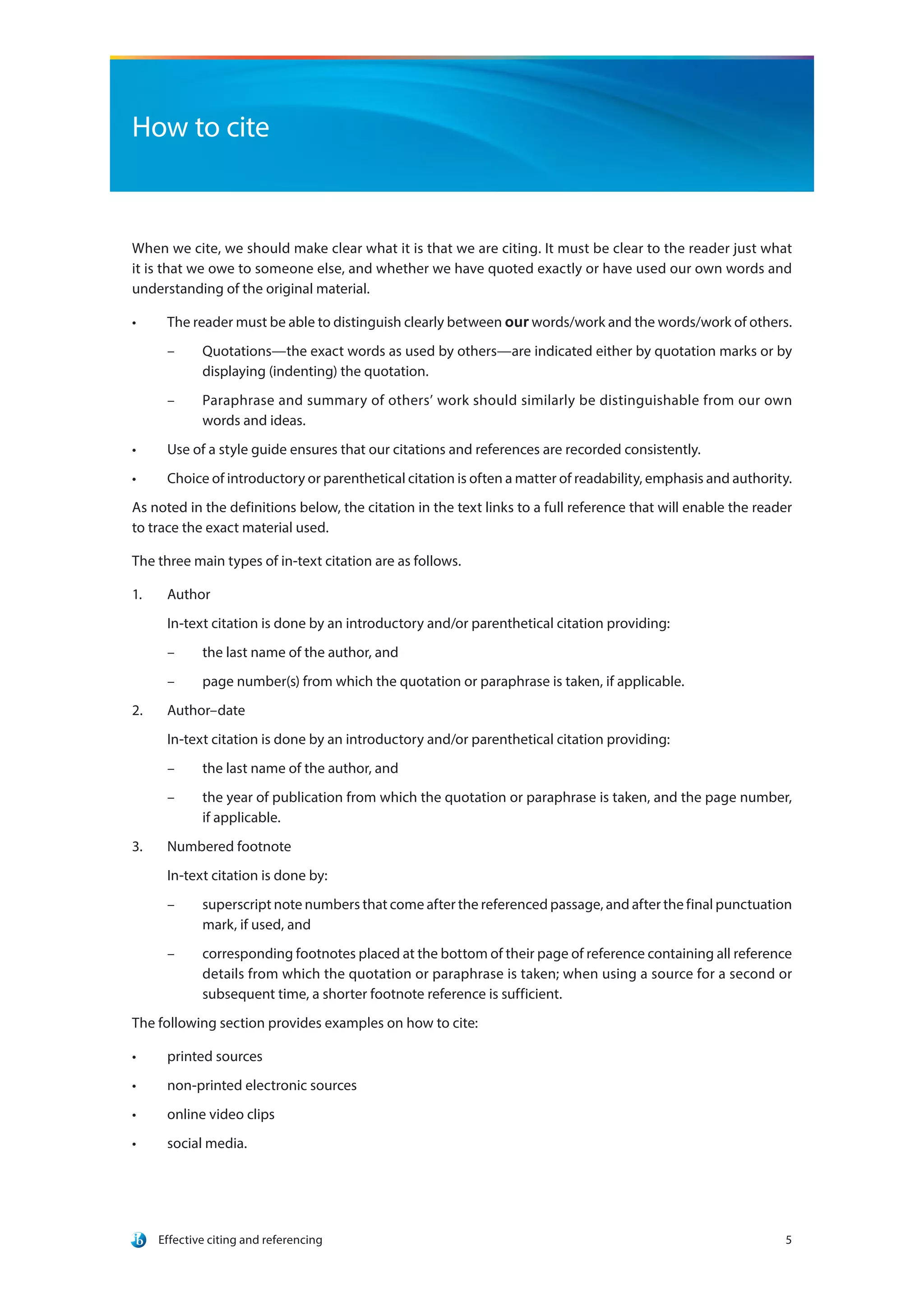
CitingprintedsourcesSourcematerial
Quotation
Author
Carrollpointsoutthat“deliberatebreachesformarelativelysmall
proportionofdishonestycaseswhereasupto80%inmostyears
involvemisuseofothers’workthroughplagiarismorcollusion”(2).
Someattemptstogainunfairadvantagesinvolvedeliberatebreachesof
therules.Learnerswhotakedevicesintoexaminations,gainunauthorized
accesstoassessmentquestions,orwhohireanimpersonatorareclearly
beingdishonest.Becauseofdevelopmentsincommunicationtechnology,
smallerdevicescanbesmuggledintoexaminationrooms,impersonators
areeasiertorecruit,andhackedquestionsaremoreeasilyavailable.
However,deliberatebreachesformarelativelysmallproportionof
dishonestycaseswhereasupto80%inmostyearsinvolvemisuseofothers’
workthroughplagiarismorcollusion.Inthesecases,determiningwhether
alearnerhasacteddishonestlyismuchmoreproblematicandtheroleof
technologyandnetworkedcommunicationsinencouragingmisuseisalso
morecomplex.
Reference:
Carroll,J.July2012.AcademichonestyintheIB.IBPositionPaper.
http://blogs.ibo.org/positionpapers/files/2013/02/Academic-honesty-
in-the-IB.pdf.
Author–
date
Carrollremindsusthat“deliberatebreachesformarelativelysmall
proportionofdishonestycaseswhereasupto80%inmostyears
involvemisuseofothers’workthroughplagiarismorcollusion”
(2012: 2).
Numbered
footnote
AsCarrollhasnoted,“deliberatebreachesformarelativelysmall
proportionofdishonestycaseswhereasupto80%inmostyears
involvemisuseofothers’workthroughplagiarismorcollusion”.1
1
Carroll,J.2012.AcademichonestyintheIB.IBPositionPaper.
http://blogs.ibo.org/positionpapers/files/2013/02/Academic-honesty-in-the-IB.pdf.p2.
Paraphrase
Author
Whilesomestudentsstilltrytobringunauthorizedmaterialsinto
examinationroomswithaclearintentiontocheat,thevastmajority
ofbreaches(80%)relatetoplagiarismandcollusion;establishing
responsibilityandintentinsuchcasesisnotalwayseasy(Carroll2).
Author–
date
Carroll(2012:2)notesthatwhilesomestudentsstilltrytobring
unauthorizedmaterialsintoexaminationroomswithaclearintention
tocheat,thevastmajorityofbreaches(80%)relatetoplagiarismand
collusion;establishingresponsibilityandintentinsuchcasesisnot
alwayseasy.
Numbered
footnote
Whilesomestudentsstilltrytobringunauthorizedmaterialsinto
examinationroomswithaclearintentiontocheat,thevastmajority
ofbreaches(80%)relatetoplagiarismandcollusion;establishing
responsibilityandintentinsuchcasesisnotalwayseasy.1
1
Carroll,J.2012.AcademichonestyintheIB.IBPositionPaper.
http://blogs.ibo.org/positionpapers/files/2013/02/Academic-honesty-in-the-IB.pdf.p2.
How to cite
Effective citing and referencing 7
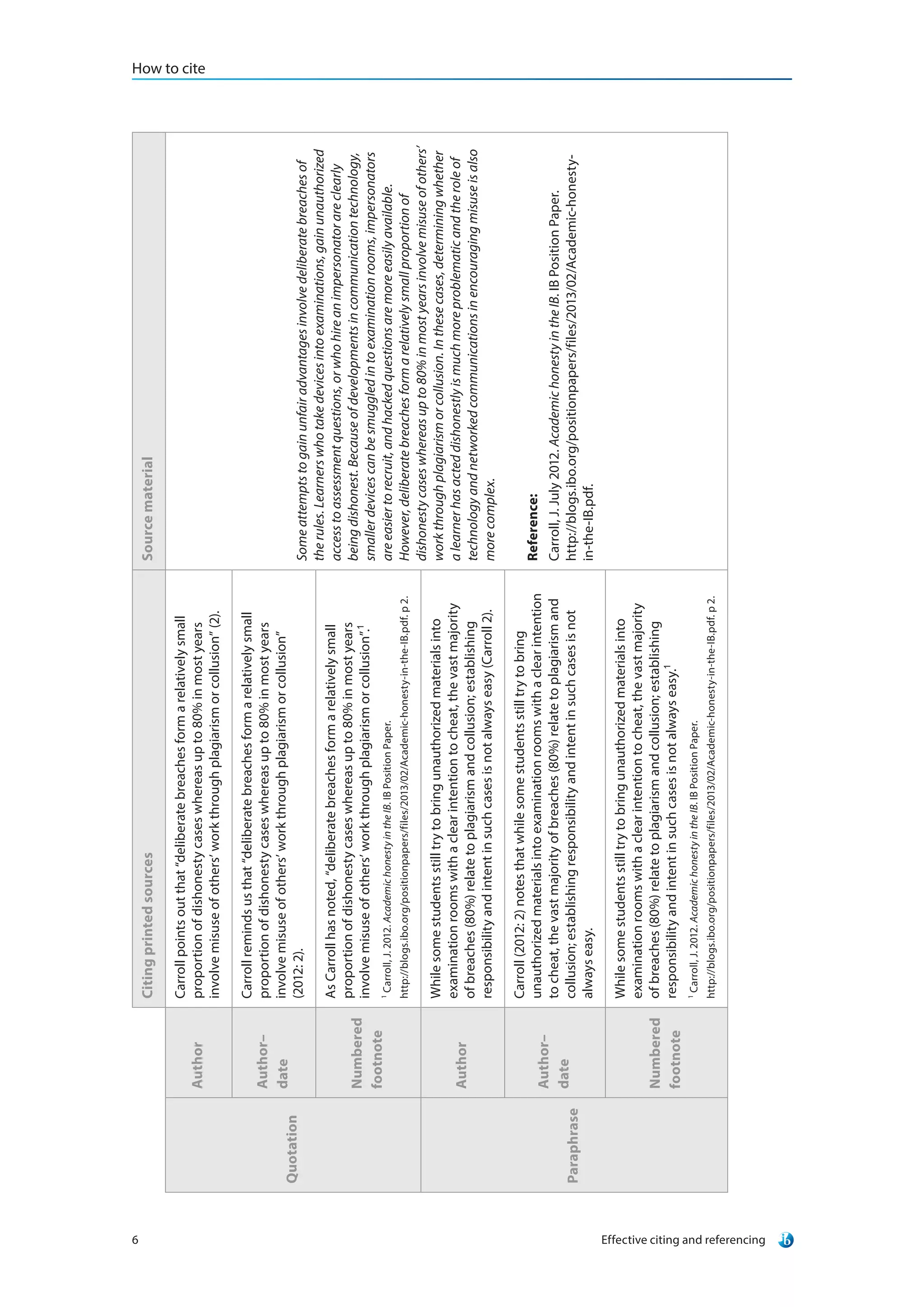
Citingnon-printedelectronicsourcesSourcematerial
Quotation
Author
Indeclaringthatabilitytoreadis“avitalsurvivalskill”,Roycepointsout
that,“whenyouthinkaboutthevastamountofinformation,written
information,thatcomputertechnologymakespossible,theabilityto
readbecomesevermoreimportant”.
Readingisimportant.Itisavitalsurvivalskill.Reading,andofcourse
writing,isthebasisoflearning.Untilrecently,itwasthemainmethod
bywhichpeoplefarapartcouldtalktoeachother,acrossthemilesor
acrosstheyears.Eventoday,readinghasadvantagesnotsharedby
telecommunicationsorcomputertechnology.Andwhenyouthinkabout
thevastamountofinformation,writteninformation,thatcomputer
technologymakespossible,theabilitytoreadbecomesevermore
important.
Reference:
Royce,J.1995.Readingmatters:Words,words,words...http://read2live.
info/read2.htm.Accessed30 November2013.
Author–
date
Royce,suggestingthatabilitytoreadis“avitalsurvivalskill”,added,
“whenyouthinkaboutthevastamountofinformation,written
information,thatcomputertechnologymakespossible,theabilityto
readbecomesevermoreimportant”(1995).
Numbered
footnote
Indeclaringthatabilitytoreadis“avitalsurvivalskill”,Roycepointsout
that,“whenyouthinkaboutthevastamountofinformation,written
information,thatcomputertechnologymakespossible,theabilityto
readbecomesevermoreimportant”.2
2
Royce,J.1995.Readingmatters:Words,words,words...http://read2live.info/read2.htm.
Accessed30 November2013.
Paraphrase
Author
AsRoycehassuggested,technologyhasnotmadeobsoletetheneed
forgoodreadingskills;farfromit—somuchdigitaltextisproduced
todaythatabilitytoreadisasimportant,perhapsevenmoreimportant,
thanever.
Author–
date
AsRoyce(1995)hassuggested,technologyhasnotmadeobsolete
theneedforgoodreadingskills;farfromit—somuchdigitaltextis
producedtodaythatabilitytoreadisasimportant,perhapsevenmore
important,thanever.Almost20yearslater,thisremainsastrueasever.
Numbered
footnote
AsRoyce2
noted,technologyhasnotmadeobsoletetheneedforgood
readingskills;farfromit—somuchdigitaltextisproducedtodaythat
abilitytoreadisasimportant,perhapsevenmoreimportant,thanever.
2
Royce,J.1995.Readingmatters:Words,words,words...http://read2live.info/read2.htm.
Accessed30 November2013.
How to cite
Effective citing and referencing8
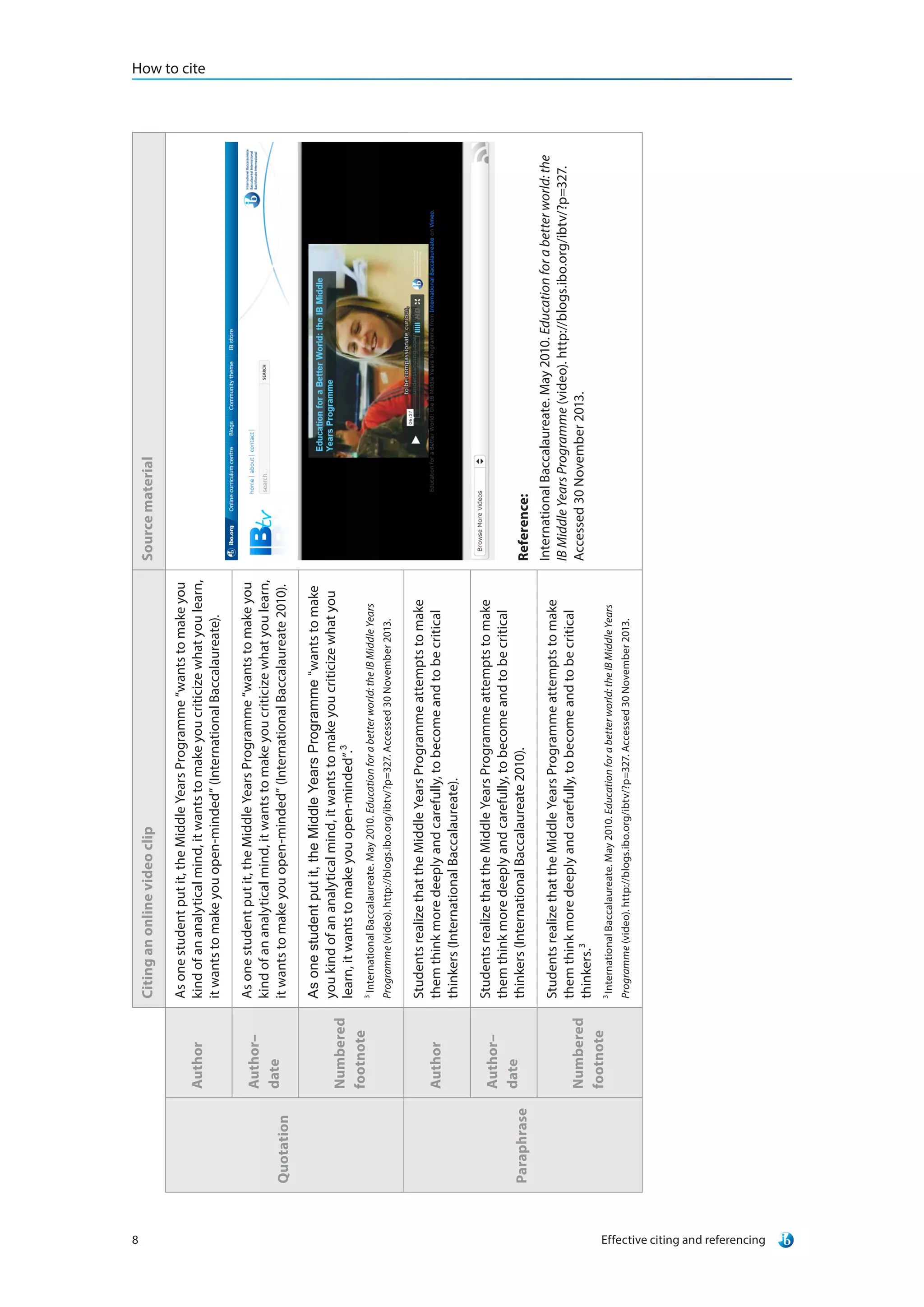
CitinganonlinevideoclipSourcematerial
Quotation
Author
Asonestudentputit,theMiddleYearsProgramme“wantstomakeyou
kindofananalyticalmind,itwantstomakeyoucriticizewhatyoulearn,
itwantstomakeyouopen-minded”(InternationalBaccalaureate).
Reference:
InternationalBaccalaureate.May2010.Educationforabetterworld:the
IBMiddleYearsProgramme(video).http://blogs.ibo.org/ibtv/?p=327.
Accessed30 November2013.
Author–
date
Asonestudentputit,theMiddleYearsProgramme“wantstomakeyou
kindofananalyticalmind,itwantstomakeyoucriticizewhatyoulearn,
itwantstomakeyouopen-minded”(InternationalBaccalaureate2010).
Numbered
footnote
Asonestudentputit,theMiddleYearsProgramme“wantstomake
youkindofananalyticalmind,itwantstomakeyoucriticizewhatyou
learn,itwantstomakeyouopen-minded”.3
3
InternationalBaccalaureate.May2010.Educationforabetterworld:theIBMiddleYears
Programme(video).http://blogs.ibo.org/ibtv/?p=327.Accessed30 November2013.
Paraphrase
Author
StudentsrealizethattheMiddleYearsProgrammeattemptstomake
themthinkmoredeeplyandcarefully,tobecomeandtobecritical
thinkers(InternationalBaccalaureate).
Author–
date
StudentsrealizethattheMiddleYearsProgrammeattemptstomake
themthinkmoredeeplyandcarefully,tobecomeandtobecritical
thinkers(InternationalBaccalaureate2010).
Numbered
footnote
StudentsrealizethattheMiddleYearsProgrammeattemptstomake
themthinkmoredeeplyandcarefully,tobecomeandtobecritical
thinkers.3
3
InternationalBaccalaureate.May2010.Educationforabetterworld:theIBMiddleYears
Programme(video).http://blogs.ibo.org/ibtv/?p=327.Accessed30 November2013.
How to cite
Effective citing and referencing 9
CitingsocialmediaSourcematerial
Quotation
Author
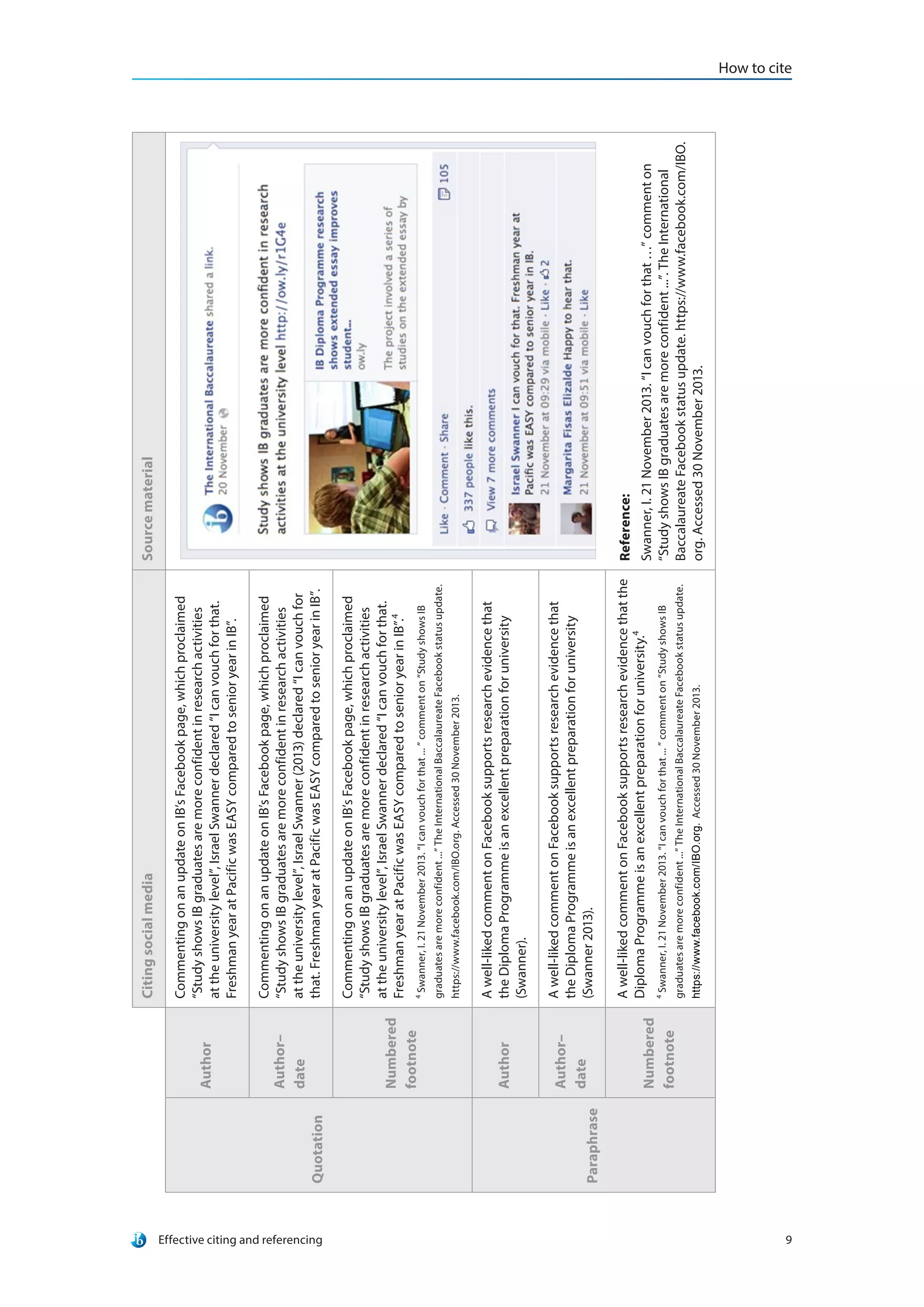
CommentingonanupdateonIB’sFacebookpage,whichproclaimed
“StudyshowsIBgraduatesaremoreconfidentinresearchactivities
attheuniversitylevel”,IsraelSwannerdeclared“Icanvouchforthat.
FreshmanyearatPacificwasEASYcomparedtosenioryearinIB”.
Reference:
Swanner,I.21 November2013.“Icanvouchforthat…”commenton
“StudyshowsIBgraduatesaremoreconfident...”.TheInternational
BaccalaureateFacebookstatusupdate.https://www.facebook.com/IBO.
org.Accessed30 November2013.
Author–
date
CommentingonanupdateonIB’sFacebookpage,whichproclaimed
“StudyshowsIBgraduatesaremoreconfidentinresearchactivities
attheuniversitylevel”,IsraelSwanner(2013)declared“Icanvouchfor
that.FreshmanyearatPacificwasEASYcomparedtosenioryearinIB”.
Numbered
footnote
CommentingonanupdateonIB’sFacebookpage,whichproclaimed
“StudyshowsIBgraduatesaremoreconfidentinresearchactivities
attheuniversitylevel”,IsraelSwannerdeclared“Icanvouchforthat.
FreshmanyearatPacificwasEASYcomparedtosenioryearinIB”.4
4
Swanner,I.21November2013.“Icanvouchforthat...”commenton”StudyshowsIB
graduatesaremoreconfident...”TheInternationalBaccalaureateFacebookstatusupdate.
https://www.facebook.com/IBO.org.Accessed30 November2013.
Paraphrase
Author
Awell-likedcommentonFacebooksupportsresearchevidencethat
theDiplomaProgrammeisanexcellentpreparationforuniversity
(Swanner).
Author–
date
Awell-likedcommentonFacebooksupportsresearchevidencethat
theDiplomaProgrammeisanexcellentpreparationforuniversity
(Swanner 2013).
Numbered
footnote
Awell-likedcommentonFacebooksupportsresearchevidencethatthe
DiplomaProgrammeisanexcellentpreparationforuniversity.4
4
Swanner,I.21November2013.“Icanvouchforthat...”commenton”StudyshowsIB
graduatesaremoreconfident...”TheInternationalBaccalaureateFacebookstatusupdate.
https://www.facebook.com/IBO.org.Accessed30 November2013.
How to cite
Effective citing and referencing10
Citing an image Source material
Author
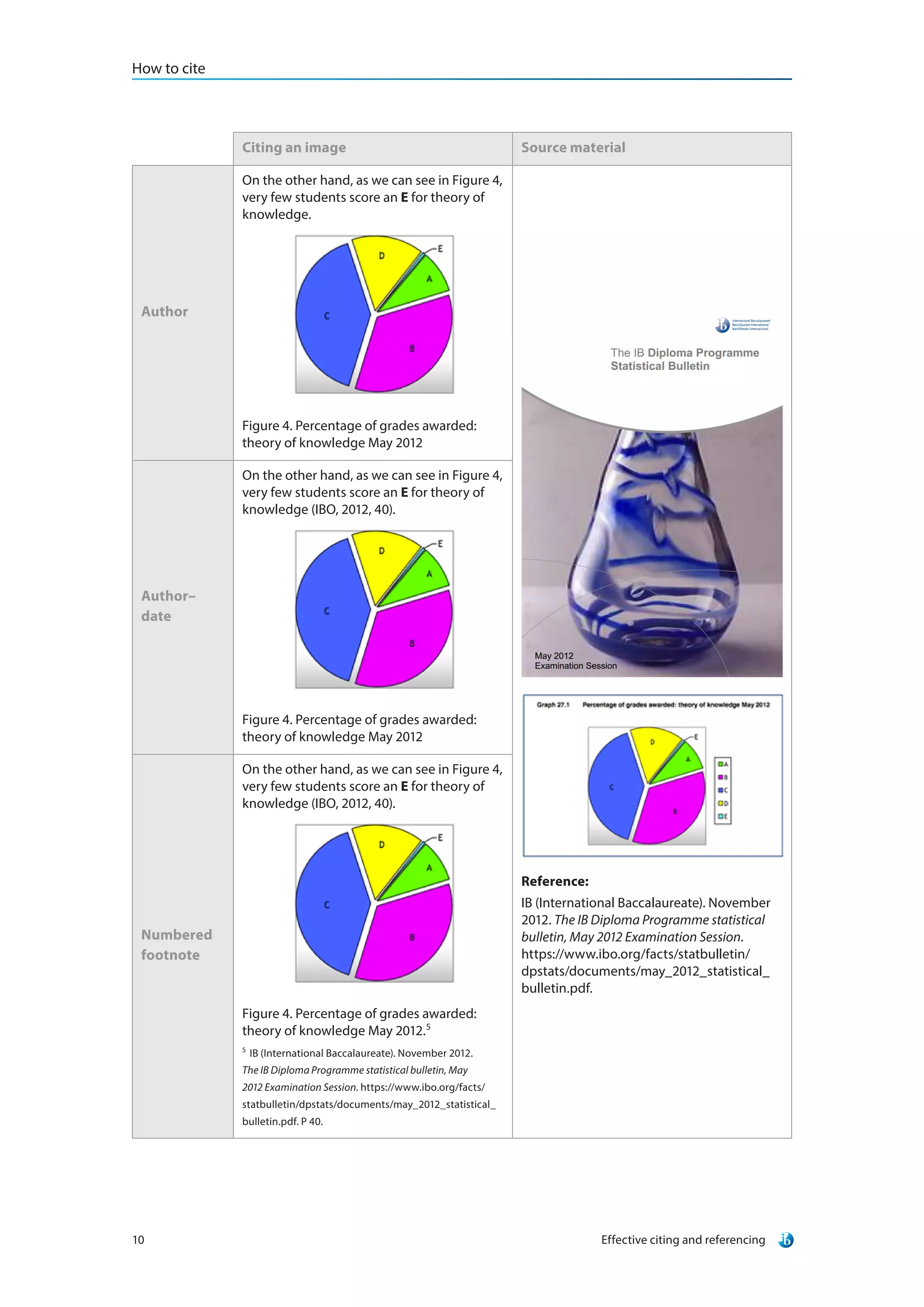
On the other hand, as we can see in Figure 4,
very few students score an E for theory of
knowledge.
Figure 4. Percentage of grades awarded:
theory of knowledge May 2012
Reference:
IB (International Baccalaureate). November
2012. The IB Diploma Programme statistical
bulletin, May 2012 Examination Session.
https://www.ibo.org/facts/statbulletin/
dpstats/documents/may_2012_statistical_
bulletin.pdf.
Author–
date
On the other hand, as we can see in Figure 4,
very few students score an E for theory of
knowledge (IBO, 2012, 40).
Figure 4. Percentage of grades awarded:
theory of knowledge May 2012
Numbered
footnote
On the other hand, as we can see in Figure 4,
very few students score an E for theory of
knowledge (IBO, 2012, 40).
Figure 4. Percentage of grades awarded:
theory of knowledge May 2012.5
5
IB (International Baccalaureate). November 2012.
The IB Diploma Programme statistical bulletin, May
2012 Examination Session. https://www.ibo.org/facts/
statbulletin/dpstats/documents/may_2012_statistical_
bulletin.pdf. P 40.
Effective citing and referencing 11
Definitions
The words listed here are often used, sometimes interchangeably, in textbooks and in style guides. To
support understanding, the terminology in this guide uses the following definitions.
Documentation
Documentation is the stylized process of indicating sources in the text (citation) and giving full details
(references) to enable another reader to locate the sources.
Style guide
A style guide is a published manual that gives guidance on citation and references to help ensure that our
documentation is expressed consistently, and that we include all the elements needed for our sources to be
identified.
Some style guides offer more than one set of choices or sub-styles; if we use a particular sub-style, we must
be sure to use the same sub-style throughout our work.
As well as advice on citations and referencing, many published style guides give advice on spelling,
abbreviations, punctuation, and so on. Many also give guidance on research and on the general writing
process.
Style guides in common use in the academic world include the following.
•	 MLA (Modern Language Association)
•	 APA (American Pyschological Association)
•	 Harvard
•	 Chicago/Turabian
•	 CSE (Council of Science Editors)
•	 ISO 690 (International Organization for Standardization)
Note local variations between style guides; writers should be sure to follow a single style guide consistently.
When consulted sources are accessed online, the IB prefers the use of URLs (uniform resource locators) or
DOIs (digital object identifiers), even if the published style guide makes them optional.
Owing to different editions of style guides, the variety of languages in which members of the IB community
complete their work, and diverse subject areas, the IB does not endorse any particular style guide. This
choice is left to the discretion of the authors/creators, or their advisers.
For assessment purposes, IB students are not expected to show faultless expertise in referencing but are
expected to acknowledge all uses of other people’s work.
Definitions
Effective citing and referencing12
Citation
A citation is an indication (signal) in the text that this (material) is not ours; we have “borrowed” it (as a direct
quote, paraphrase or summary) from someone or somewhere else. The citation in the text can be:
•	 in the form of an introductory phrase, or
•	 at the end of the statement, or
•	 indicated by a superscript or bracketed number that leads to a similarly numbered footnote or
endnote.
Every citation should be given a full reference that enables the reader to locate the exact source used.
Reference
A reference gives full details of the source cited in the work; the parts or elements of the reference should be
noted in a consistent order. Use of a recognized style guide will help ensure consistency, and will also ensure
that all required elements are included.
Every reference should be given a citation in the text. If we have looked at a source but not mentioned or
cited it in the text, then we do not include it as a reference.
Bibliography/references/works cited
Most style guides require a list of references at the end of the work. This is usually a list, in alphabetical order,
of the authors (last name first), whose words and works have been cited in the work. The title of this section
varies from one style guide to another.
Each entry in the list of references includes the full information (or as much of it as can be found), expressed
in a consistent fashion, which will allow an interested reader to track down exactly where you found the
material you have used and cited.
Paraphrase
In writing an essay, we often use our own words to put over someone else’s thoughts and ideas. While there
are some words that we cannot change (especially the names of people, places, chemicals, and so on), we
should use our own words for as much as we can of the rest of the passage. We should also aim to change
the structure of the passage, perhaps by reordering the thoughts and ideas.
When we paraphrase, we need to make it very clear where the original author’s ideas start and where they
finish. If we include our own examples, we should make it clear that these are our thoughts and not those of
the original author.
Definitions
Effective citing and referencing 13
Summary
A summary is a much-shortened summing up of someone else’s work. We might summarize a chapter or
academic paper, or perhaps even a book, in two or three sentences. Again, although we are using our own
words, we must still cite the original source used.
Summaries are often used in a review of the literature—when we sum up what other writers have said or
done in investigating a topic or theme.
Quotation
When we use someone else’s exact words, we quote that original author, and we show this is a quotation by
using quotation marks. Longer quotations may be indicated by the use of an indented paragraph (without
quotation marks). As well as indicating the words quoted, we must also acknowledge the author by using an
in-text citation, the citation in turn linking to a full reference.
Quotations should normally be used sparingly and carefully; essays on literary subjects or from historical
documents might include more quotations than other essays.
Effective citing and referencing14
Documentation checklist
When you have used an author’s exact words, have you put “quotation marks” around the
quotation and named (cited) the original writer?
(If you indent your quotation(s), quotation marks are not needed, but the author must still be
cited; have you cited your indented quotations?)
When you put someone else’s thoughts and ideas in your own words, have you still named
(cited) the original author(s)?
When you use someone else’s words or work, is it clear where such use starts—and where it
finishes?
Have you included full references for all borrowed images, tables, graphs, maps, and so on?
Print material: Have you included the page number(s) of print material you have used
(especially important with exact quotations)?
Internet material: Have you included both the date on which the material was posted and the
date of your last visit to the web page or site?
Internet material: Have you included the URL or the DOI?
For each citation in the text, is there a full reference in your list of references (works cited/
bibliography) at the end?
Is the citation a direct link to the first word(s) of the reference?
For each reference in the list of references (works cited/bibliography) at the end, is there a
citation in the text?
Do(es) the first word(s) of the reference link directly to the citation as used?
Is your list of references (works cited/bibliography) in alphabetical order, with the last name of
the author first?
Documentation checklist
Effective citing and referencing 15
Effective citing and referencingEffective citing and referencing 1716
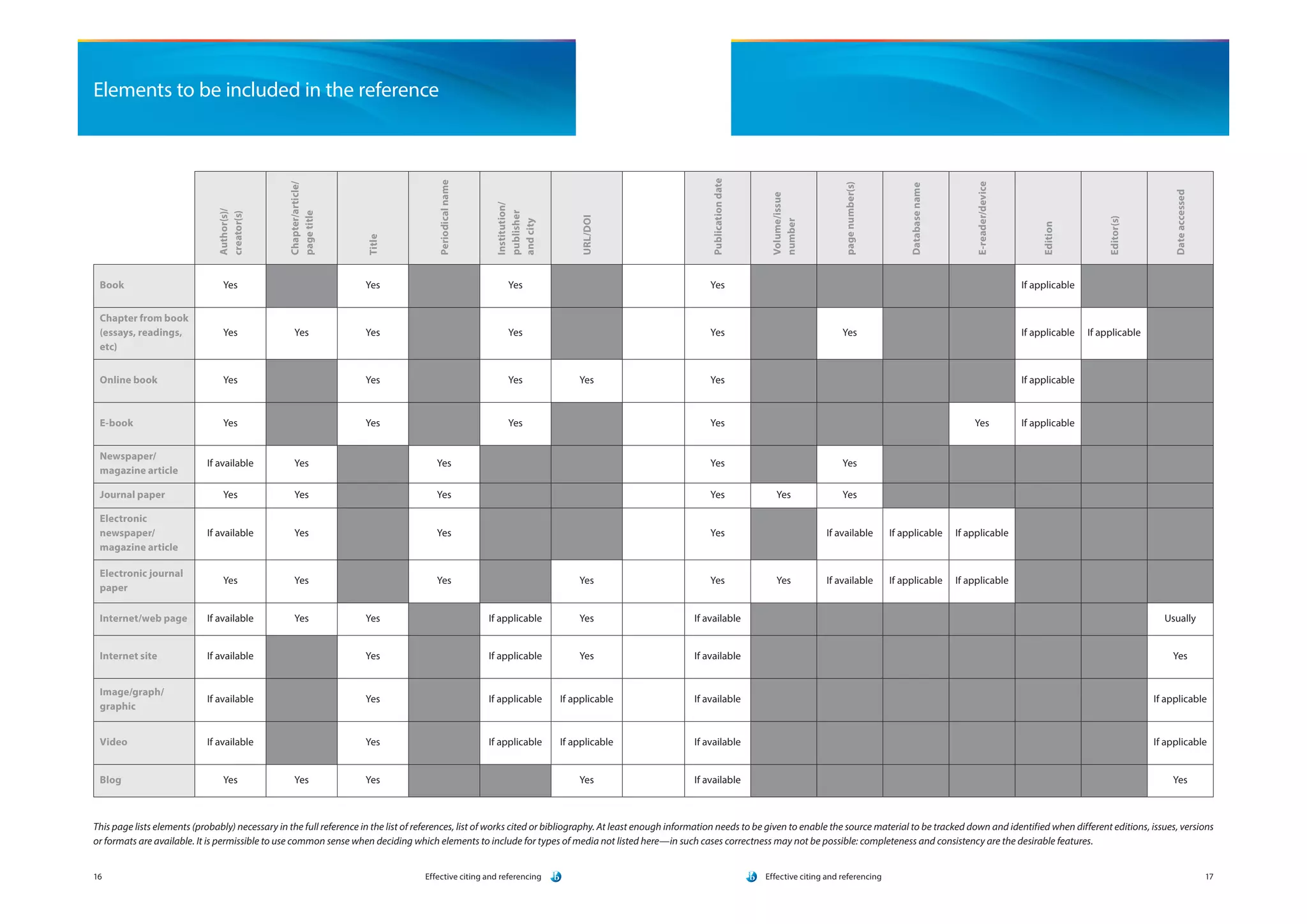
Elements to be included in the reference
Author(s)/
creator(s)
Chapter/article/
pagetitle
Title
Periodicalname
Institution/
publisher
andcity
URL/DOI
Publicationdate
Volume/issue
number
pagenumber(s)
Databasename
E-reader/device
Edition
Editor(s)
Dateaccessed
Book Yes Yes Yes Yes If applicable
Chapter from book
(essays, readings,
etc)
Yes Yes Yes Yes Yes Yes If applicable If applicable
Online book Yes Yes Yes Yes Yes If applicable
E-book Yes Yes Yes Yes Yes If applicable
Newspaper/
magazine article
If available Yes Yes Yes Yes
Journal paper Yes Yes Yes Yes Yes Yes
Electronic
newspaper/
magazine article
If available Yes Yes Yes If available If applicable If applicable
Electronic journal
paper
Yes Yes Yes Yes Yes Yes If available If applicable If applicable
Internet/web page If available Yes Yes If applicable Yes If available Usually
Internet site If available Yes If applicable Yes If available Yes
Image/graph/
graphic
If available Yes If applicable If applicable If available If applicable
Video If available Yes If applicable If applicable If available If applicable
Blog Yes Yes Yes Yes If available Yes
This page lists elements (probably) necessary in the full reference in the list of references, list of works cited or bibliography. At least enough information needs to be given to enable the source material to be tracked down and identified when different editions, issues, versions
or formats are available. It is permissible to use common sense when deciding which elements to include for types of media not listed here—in such cases correctness may not be possible: completeness and consistency are the desirable features.

Effective citing and referencing

  • 1.
  • 3.
  • 4.
    Published August 2014 Publishedon behalf of the International Baccalaureate Organization, a not-for-profit educational foundation of 15 Route des Morillons, 1218 Le Grand-Saconnex, Geneva, Switzerland by the International Baccalaureate Organization (UK) Ltd Peterson House, Malthouse Avenue, Cardiff Gate Cardiff, Wales CF23 8GL United Kingdom Website: www.ibo.org © International Baccalaureate Organization 2014 The International Baccalaureate Organization (known as the IB) offers four high-quality and challenging educational programmes for a worldwide community of schools, aiming to create a better, more peaceful world. This publication is one of a range of materials produced to support these programmes. The IB may use a variety of sources in its work and checks information to verify accuracy and authenticity, particularly when using community-based knowledge sources such as Wikipedia. The IB respects the principles of intellectual property and makes strenuous efforts to identify and obtain permission before publication from rights holders of all copyright material used. The IB is grateful for permissions received for material used in this publication and will be pleased to correct any errors or omissions at the earliest opportunity. All rights reserved. No part of this publication may be reproduced, stored in a retrieval system, or transmitted, in any form or by any means, without the prior written permission of the IB, or as expressly permitted by law or by the IB’s own rules and policy. See http://www.ibo.org/copyright. IB merchandise and publications can be purchased through the IB store at http://store.ibo.org. Email: sales@ibo.org The IB programme continuum of international education Effective citing and referencing International Baccalaureate, Baccalauréat International and Bachillerato Internacional are registered trademarks of the International Baccalaureate Organization.
  • 5.
    IB mission statement TheInternational Baccalaureate aims to develop inquiring, knowledgeable and caring young people who help to create a better and more peaceful world through intercultural understanding and respect. To this end the organization works with schools, governments and international organizations to develop challenging programmes of international education and rigorous assessment. These programmes encourage students across the world to become active, compassionate and lifelong learners who understand that other people, with their differences, can also be right. IB learner profile The aim of all IB programmes is to develop internationally minded people who, recognizing their common humanity and shared guardianship of the planet, help to create a better and more peaceful world. IB learners strive to be: Inquirers They develop their natural curiosity. They acquire the skills necessary to conduct inquiry and research and show independence in learning. They actively enjoy learning and this love of learning will be sustained throughout their lives. Knowledgeable They explore concepts, ideas and issues that have local and global significance. In so doing, they acquire in-depth knowledge and develop understanding across a broad and balanced range of disciplines. Thinkers They exercise initiative in applying thinking skills critically and creatively to recognize and approach complex problems, and make reasoned, ethical decisions. Communicators They understand and express ideas and information confidently and creatively in more than one language and in a variety of modes of communication. They work effectively and willingly in collaboration with others. Principled They act with integrity and honesty, with a strong sense of fairness, justice and respect for the dignity of the individual, groups and communities. They take responsibility for their own actions and the consequences that accompany them. Open-minded They understand and appreciate their own cultures and personal histories, and are open to the perspectives, values and traditions of other individuals and communities. They are accustomed to seeking and evaluating a range of points of view, and are willing to grow from the experience. Caring They show empathy, compassion and respect towards the needs and feelings of others. They have a personal commitment to service, and act to make a positive difference to the lives of others and to the environment. Risk-takers They approach unfamiliar situations and uncertainty with courage and forethought, and have the independence of spirit to explore new roles, ideas and strategies. They are brave and articulate in defending their beliefs. Balanced They understand the importance of intellectual, physical and emotional balance to achieve personal well-being for themselves and others. Reflective They give thoughtful consideration to their own learning and experience. They are able to assess and understand their strengths and limitations in order to support their learning and personal development.
  • 7.
    Effective citing andreferencing Contents Introduction 1 Why cite 2 What to cite 3 When to cite 4 How to cite 5 Definitions 11 Documentation checklist 14 Elements to be included in the reference 16
  • 9.
    Effective citing andreferencing 1 Introduction In the International Baccalaureate (IB) community we produce different types of documents and other forms of work, some of which rely on resources by other people. Following good academic practice, it is expected that we appropriately acknowledge any ideas, words, or work of other people. This means that, when creating an authentic piece of work, we are expected to: • undertake research on what is already known • analyse the research in the context of the work to be produced • compare and/or contrast existing knowledge against our own findings/thoughts/opinions • synthesize and present the document in an appropriate way for the expected audience • acknowledge all contributing sources appropriately. The ways in which we can acknowledge contributing sources appropriately may vary according to the type of work we produce. Sources are acknowledged differently in a press release or magazine article, in a piece of fiction, in artwork or a musical performance, a slide presentation, film clip or radio broadcast. The important, honest thing for us to do in these and other types of work is to acknowledge our sources and influences in some way. In academic writing, and in any work presented for assessment, not only is it necessary to acknowledge our sources appropriately, but it is regarded as important that the acknowledgments be made using a consistent style. The use of a style guide helps us to ensure this consistency. When we use other people’s words, work and ideas to support our own ideas, or to demonstrate divergent opinion, it is essential that we indicate whose words and work we are using. Any reader would benefit from seeing just how the other person’s work contributes to ours. If we fail to show that we are using someone else’s words, work or ideas by not indicating that they originated with someone else, then we mislead the reader. If we give the impression that these words or ideas are our own when they are not, this is not good scholarship and, deliberate or unintentional, may be deemed as academic misconduct. Purpose of this document The purpose of this publication is to guide members of the International Baccalaureate (IB) community in understanding the IB’s expectations with regards to referencing the ideas, words, or work of other people when producing an original document or piece of work. This document provides guidance on referencing and demonstrates some of the differences between the most widely used styles. Due to the wide range of subjects, multiple response languages and the diversity of referencing styles, the IB does not prescribe or insist on a particular style. All examples provided in this document are for illustration purposes only. The IB’s requirements are for honesty in indicating when and which ideas and words are not the writer’s own, and consistency in referencing the source of those ideas and words.
  • 10.
    Effective citing andreferencing2 Why cite Proper citation is a key element in academic scholarship and intellectual exchange. When we cite we: • show respect for the work of others • help a reader to distinguish our work from the work of others who have contributed to our work • give the reader the opportunity to check the validity of our use of other people’s work • give the reader the opportunity to follow up our references, out of interest • show and receive proper credit for our research process • demonstrate that we are able to use reliable sources and critically assess them to support our work • establish the credibility and authority of our knowledge and ideas • demonstrate that we are able to draw our own conclusions • share the blame (if we get it wrong).
  • 11.
    Effective citing andreferencing 3 What to cite As creators/authors, we are expected to acknowledge any materials or ideas that are not ours and that have been used in any way, such as quotation, paraphrase or summary. The term “materials” means written, oral or electronic products, and may include the following. • Text • Visual • Audio • Graphic • Artistic • Lectures • Interviews • Conversations • Letters • Broadcasts • Maps Basic and common knowledge within a field or subject does not need to be acknowledged. However, if we are in doubt whether the source material is common knowledge or not, we should cite!
  • 12.
    Effective citing andreferencing4 When to cite When we acknowledge the use of materials or ideas that are not ours, the reader must be able to clearly distinguish between our own words, illustrations, findings and ideas and the words and work of other creators. Style guides give us advice for documenting our sources in written work, but they are less helpful with other formats and mediums. Nevertheless, we can be honest and we can be helpful to our audience(s)—for assessment purposes, this is an expectation. In written work, we should cite in the text where we have used an external source. The inclusion of a reference in a bibliography (works cited/list of references) at the end of the paper is not enough. However, for pieces of “creative” written work such as writing in the style of an author or genre, for which in-text citation is not usually expected, creative ways of acknowledging the use of other people’s work may be permissible. A bibliography or list of references is also expected. In other forms of work (music, video, artistic pieces), we are expected to acknowledge use of external sources appropriately. In presentations we can provide our audience with a handout of our references, or list our sources on the final slide(s). During an oral presentation, we can acknowledge the sources we are using by the use of phrases, for example, “As Gandhi put it …” or “According to …”. We can show a direct quotation by saying “Quote … Unquote” or by signalling with “rabbit’s ears” or “air quotes”. In a presentation supported by posters or slides, we can include short or full references on the slides; if short references are made on the slides, then we should again provide a full list of references on a handout or on the final slide(s). We can include references or acknowledgments of other people’s work in the final credits of a film. A piece of music can be accompanied by programme notes indicating influences and direct sources. Art on display can be labelled or captioned.
  • 13.
    Effective citing andreferencing 5 How to cite When we cite, we should make clear what it is that we are citing. It must be clear to the reader just what it is that we owe to someone else, and whether we have quoted exactly or have used our own words and understanding of the original material. • The reader must be able to distinguish clearly between our words/work and the words/work of others. –– Quotations—the exact words as used by others—are indicated either by quotation marks or by displaying (indenting) the quotation. –– Paraphrase and summary of others’ work should similarly be distinguishable from our own words and ideas. • Use of a style guide ensures that our citations and references are recorded consistently. • Choice of introductory or parenthetical citation is often a matter of readability, emphasis and authority. As noted in the definitions below, the citation in the text links to a full reference that will enable the reader to trace the exact material used. The three main types of in-text citation are as follows. 1. Author In-text citation is done by an introductory and/or parenthetical citation providing: –– the last name of the author, and –– page number(s) from which the quotation or paraphrase is taken, if applicable. 2. Author–date In-text citation is done by an introductory and/or parenthetical citation providing: –– the last name of the author, and –– the year of publication from which the quotation or paraphrase is taken, and the page number, if applicable. 3. Numbered footnote In-text citation is done by: –– superscript note numbers that come after the referenced passage, and after the final punctuation mark, if used, and –– corresponding footnotes placed at the bottom of their page of reference containing all reference details from which the quotation or paraphrase is taken; when using a source for a second or subsequent time, a shorter footnote reference is sufficient. The following section provides examples on how to cite: • printed sources • non-printed electronic sources • online video clips • social media.
  • 14.
    How to cite Effectiveciting and referencing6 CitingprintedsourcesSourcematerial Quotation Author Carrollpointsoutthat“deliberatebreachesformarelativelysmall proportionofdishonestycaseswhereasupto80%inmostyears involvemisuseofothers’workthroughplagiarismorcollusion”(2). Someattemptstogainunfairadvantagesinvolvedeliberatebreachesof therules.Learnerswhotakedevicesintoexaminations,gainunauthorized accesstoassessmentquestions,orwhohireanimpersonatorareclearly beingdishonest.Becauseofdevelopmentsincommunicationtechnology, smallerdevicescanbesmuggledintoexaminationrooms,impersonators areeasiertorecruit,andhackedquestionsaremoreeasilyavailable. However,deliberatebreachesformarelativelysmallproportionof dishonestycaseswhereasupto80%inmostyearsinvolvemisuseofothers’ workthroughplagiarismorcollusion.Inthesecases,determiningwhether alearnerhasacteddishonestlyismuchmoreproblematicandtheroleof technologyandnetworkedcommunicationsinencouragingmisuseisalso morecomplex. Reference: Carroll,J.July2012.AcademichonestyintheIB.IBPositionPaper. http://blogs.ibo.org/positionpapers/files/2013/02/Academic-honesty- in-the-IB.pdf. Author– date Carrollremindsusthat“deliberatebreachesformarelativelysmall proportionofdishonestycaseswhereasupto80%inmostyears involvemisuseofothers’workthroughplagiarismorcollusion” (2012: 2). Numbered footnote AsCarrollhasnoted,“deliberatebreachesformarelativelysmall proportionofdishonestycaseswhereasupto80%inmostyears involvemisuseofothers’workthroughplagiarismorcollusion”.1 1 Carroll,J.2012.AcademichonestyintheIB.IBPositionPaper. http://blogs.ibo.org/positionpapers/files/2013/02/Academic-honesty-in-the-IB.pdf.p2. Paraphrase Author Whilesomestudentsstilltrytobringunauthorizedmaterialsinto examinationroomswithaclearintentiontocheat,thevastmajority ofbreaches(80%)relatetoplagiarismandcollusion;establishing responsibilityandintentinsuchcasesisnotalwayseasy(Carroll2). Author– date Carroll(2012:2)notesthatwhilesomestudentsstilltrytobring unauthorizedmaterialsintoexaminationroomswithaclearintention tocheat,thevastmajorityofbreaches(80%)relatetoplagiarismand collusion;establishingresponsibilityandintentinsuchcasesisnot alwayseasy. Numbered footnote Whilesomestudentsstilltrytobringunauthorizedmaterialsinto examinationroomswithaclearintentiontocheat,thevastmajority ofbreaches(80%)relatetoplagiarismandcollusion;establishing responsibilityandintentinsuchcasesisnotalwayseasy.1 1 Carroll,J.2012.AcademichonestyintheIB.IBPositionPaper. http://blogs.ibo.org/positionpapers/files/2013/02/Academic-honesty-in-the-IB.pdf.p2.
  • 15.
    How to cite Effectiveciting and referencing 7 Citingnon-printedelectronicsourcesSourcematerial Quotation Author Indeclaringthatabilitytoreadis“avitalsurvivalskill”,Roycepointsout that,“whenyouthinkaboutthevastamountofinformation,written information,thatcomputertechnologymakespossible,theabilityto readbecomesevermoreimportant”. Readingisimportant.Itisavitalsurvivalskill.Reading,andofcourse writing,isthebasisoflearning.Untilrecently,itwasthemainmethod bywhichpeoplefarapartcouldtalktoeachother,acrossthemilesor acrosstheyears.Eventoday,readinghasadvantagesnotsharedby telecommunicationsorcomputertechnology.Andwhenyouthinkabout thevastamountofinformation,writteninformation,thatcomputer technologymakespossible,theabilitytoreadbecomesevermore important. Reference: Royce,J.1995.Readingmatters:Words,words,words...http://read2live. info/read2.htm.Accessed30 November2013. Author– date Royce,suggestingthatabilitytoreadis“avitalsurvivalskill”,added, “whenyouthinkaboutthevastamountofinformation,written information,thatcomputertechnologymakespossible,theabilityto readbecomesevermoreimportant”(1995). Numbered footnote Indeclaringthatabilitytoreadis“avitalsurvivalskill”,Roycepointsout that,“whenyouthinkaboutthevastamountofinformation,written information,thatcomputertechnologymakespossible,theabilityto readbecomesevermoreimportant”.2 2 Royce,J.1995.Readingmatters:Words,words,words...http://read2live.info/read2.htm. Accessed30 November2013. Paraphrase Author AsRoycehassuggested,technologyhasnotmadeobsoletetheneed forgoodreadingskills;farfromit—somuchdigitaltextisproduced todaythatabilitytoreadisasimportant,perhapsevenmoreimportant, thanever. Author– date AsRoyce(1995)hassuggested,technologyhasnotmadeobsolete theneedforgoodreadingskills;farfromit—somuchdigitaltextis producedtodaythatabilitytoreadisasimportant,perhapsevenmore important,thanever.Almost20yearslater,thisremainsastrueasever. Numbered footnote AsRoyce2 noted,technologyhasnotmadeobsoletetheneedforgood readingskills;farfromit—somuchdigitaltextisproducedtodaythat abilitytoreadisasimportant,perhapsevenmoreimportant,thanever. 2 Royce,J.1995.Readingmatters:Words,words,words...http://read2live.info/read2.htm. Accessed30 November2013.
  • 16.
    How to cite Effectiveciting and referencing8 CitinganonlinevideoclipSourcematerial Quotation Author Asonestudentputit,theMiddleYearsProgramme“wantstomakeyou kindofananalyticalmind,itwantstomakeyoucriticizewhatyoulearn, itwantstomakeyouopen-minded”(InternationalBaccalaureate). Reference: InternationalBaccalaureate.May2010.Educationforabetterworld:the IBMiddleYearsProgramme(video).http://blogs.ibo.org/ibtv/?p=327. Accessed30 November2013. Author– date Asonestudentputit,theMiddleYearsProgramme“wantstomakeyou kindofananalyticalmind,itwantstomakeyoucriticizewhatyoulearn, itwantstomakeyouopen-minded”(InternationalBaccalaureate2010). Numbered footnote Asonestudentputit,theMiddleYearsProgramme“wantstomake youkindofananalyticalmind,itwantstomakeyoucriticizewhatyou learn,itwantstomakeyouopen-minded”.3 3 InternationalBaccalaureate.May2010.Educationforabetterworld:theIBMiddleYears Programme(video).http://blogs.ibo.org/ibtv/?p=327.Accessed30 November2013. Paraphrase Author StudentsrealizethattheMiddleYearsProgrammeattemptstomake themthinkmoredeeplyandcarefully,tobecomeandtobecritical thinkers(InternationalBaccalaureate). Author– date StudentsrealizethattheMiddleYearsProgrammeattemptstomake themthinkmoredeeplyandcarefully,tobecomeandtobecritical thinkers(InternationalBaccalaureate2010). Numbered footnote StudentsrealizethattheMiddleYearsProgrammeattemptstomake themthinkmoredeeplyandcarefully,tobecomeandtobecritical thinkers.3 3 InternationalBaccalaureate.May2010.Educationforabetterworld:theIBMiddleYears Programme(video).http://blogs.ibo.org/ibtv/?p=327.Accessed30 November2013.
  • 17.
    How to cite Effectiveciting and referencing 9 CitingsocialmediaSourcematerial Quotation Author CommentingonanupdateonIB’sFacebookpage,whichproclaimed “StudyshowsIBgraduatesaremoreconfidentinresearchactivities attheuniversitylevel”,IsraelSwannerdeclared“Icanvouchforthat. FreshmanyearatPacificwasEASYcomparedtosenioryearinIB”. Reference: Swanner,I.21 November2013.“Icanvouchforthat…”commenton “StudyshowsIBgraduatesaremoreconfident...”.TheInternational BaccalaureateFacebookstatusupdate.https://www.facebook.com/IBO. org.Accessed30 November2013. Author– date CommentingonanupdateonIB’sFacebookpage,whichproclaimed “StudyshowsIBgraduatesaremoreconfidentinresearchactivities attheuniversitylevel”,IsraelSwanner(2013)declared“Icanvouchfor that.FreshmanyearatPacificwasEASYcomparedtosenioryearinIB”. Numbered footnote CommentingonanupdateonIB’sFacebookpage,whichproclaimed “StudyshowsIBgraduatesaremoreconfidentinresearchactivities attheuniversitylevel”,IsraelSwannerdeclared“Icanvouchforthat. FreshmanyearatPacificwasEASYcomparedtosenioryearinIB”.4 4 Swanner,I.21November2013.“Icanvouchforthat...”commenton”StudyshowsIB graduatesaremoreconfident...”TheInternationalBaccalaureateFacebookstatusupdate. https://www.facebook.com/IBO.org.Accessed30 November2013. Paraphrase Author Awell-likedcommentonFacebooksupportsresearchevidencethat theDiplomaProgrammeisanexcellentpreparationforuniversity (Swanner). Author– date Awell-likedcommentonFacebooksupportsresearchevidencethat theDiplomaProgrammeisanexcellentpreparationforuniversity (Swanner 2013). Numbered footnote Awell-likedcommentonFacebooksupportsresearchevidencethatthe DiplomaProgrammeisanexcellentpreparationforuniversity.4 4 Swanner,I.21November2013.“Icanvouchforthat...”commenton”StudyshowsIB graduatesaremoreconfident...”TheInternationalBaccalaureateFacebookstatusupdate. https://www.facebook.com/IBO.org.Accessed30 November2013.
  • 18.
    How to cite Effectiveciting and referencing10 Citing an image Source material Author On the other hand, as we can see in Figure 4, very few students score an E for theory of knowledge. Figure 4. Percentage of grades awarded: theory of knowledge May 2012 Reference: IB (International Baccalaureate). November 2012. The IB Diploma Programme statistical bulletin, May 2012 Examination Session. https://www.ibo.org/facts/statbulletin/ dpstats/documents/may_2012_statistical_ bulletin.pdf. Author– date On the other hand, as we can see in Figure 4, very few students score an E for theory of knowledge (IBO, 2012, 40). Figure 4. Percentage of grades awarded: theory of knowledge May 2012 Numbered footnote On the other hand, as we can see in Figure 4, very few students score an E for theory of knowledge (IBO, 2012, 40). Figure 4. Percentage of grades awarded: theory of knowledge May 2012.5 5 IB (International Baccalaureate). November 2012. The IB Diploma Programme statistical bulletin, May 2012 Examination Session. https://www.ibo.org/facts/ statbulletin/dpstats/documents/may_2012_statistical_ bulletin.pdf. P 40.
  • 19.
    Effective citing andreferencing 11 Definitions The words listed here are often used, sometimes interchangeably, in textbooks and in style guides. To support understanding, the terminology in this guide uses the following definitions. Documentation Documentation is the stylized process of indicating sources in the text (citation) and giving full details (references) to enable another reader to locate the sources. Style guide A style guide is a published manual that gives guidance on citation and references to help ensure that our documentation is expressed consistently, and that we include all the elements needed for our sources to be identified. Some style guides offer more than one set of choices or sub-styles; if we use a particular sub-style, we must be sure to use the same sub-style throughout our work. As well as advice on citations and referencing, many published style guides give advice on spelling, abbreviations, punctuation, and so on. Many also give guidance on research and on the general writing process. Style guides in common use in the academic world include the following. • MLA (Modern Language Association) • APA (American Pyschological Association) • Harvard • Chicago/Turabian • CSE (Council of Science Editors) • ISO 690 (International Organization for Standardization) Note local variations between style guides; writers should be sure to follow a single style guide consistently. When consulted sources are accessed online, the IB prefers the use of URLs (uniform resource locators) or DOIs (digital object identifiers), even if the published style guide makes them optional. Owing to different editions of style guides, the variety of languages in which members of the IB community complete their work, and diverse subject areas, the IB does not endorse any particular style guide. This choice is left to the discretion of the authors/creators, or their advisers. For assessment purposes, IB students are not expected to show faultless expertise in referencing but are expected to acknowledge all uses of other people’s work.
  • 20.
    Definitions Effective citing andreferencing12 Citation A citation is an indication (signal) in the text that this (material) is not ours; we have “borrowed” it (as a direct quote, paraphrase or summary) from someone or somewhere else. The citation in the text can be: • in the form of an introductory phrase, or • at the end of the statement, or • indicated by a superscript or bracketed number that leads to a similarly numbered footnote or endnote. Every citation should be given a full reference that enables the reader to locate the exact source used. Reference A reference gives full details of the source cited in the work; the parts or elements of the reference should be noted in a consistent order. Use of a recognized style guide will help ensure consistency, and will also ensure that all required elements are included. Every reference should be given a citation in the text. If we have looked at a source but not mentioned or cited it in the text, then we do not include it as a reference. Bibliography/references/works cited Most style guides require a list of references at the end of the work. This is usually a list, in alphabetical order, of the authors (last name first), whose words and works have been cited in the work. The title of this section varies from one style guide to another. Each entry in the list of references includes the full information (or as much of it as can be found), expressed in a consistent fashion, which will allow an interested reader to track down exactly where you found the material you have used and cited. Paraphrase In writing an essay, we often use our own words to put over someone else’s thoughts and ideas. While there are some words that we cannot change (especially the names of people, places, chemicals, and so on), we should use our own words for as much as we can of the rest of the passage. We should also aim to change the structure of the passage, perhaps by reordering the thoughts and ideas. When we paraphrase, we need to make it very clear where the original author’s ideas start and where they finish. If we include our own examples, we should make it clear that these are our thoughts and not those of the original author.
  • 21.
    Definitions Effective citing andreferencing 13 Summary A summary is a much-shortened summing up of someone else’s work. We might summarize a chapter or academic paper, or perhaps even a book, in two or three sentences. Again, although we are using our own words, we must still cite the original source used. Summaries are often used in a review of the literature—when we sum up what other writers have said or done in investigating a topic or theme. Quotation When we use someone else’s exact words, we quote that original author, and we show this is a quotation by using quotation marks. Longer quotations may be indicated by the use of an indented paragraph (without quotation marks). As well as indicating the words quoted, we must also acknowledge the author by using an in-text citation, the citation in turn linking to a full reference. Quotations should normally be used sparingly and carefully; essays on literary subjects or from historical documents might include more quotations than other essays.
  • 22.
    Effective citing andreferencing14 Documentation checklist Documentation checklist When you have used an author’s exact words, have you put “quotation marks” around the quotation and named (cited) the original writer? (If you indent your quotation(s), quotation marks are not needed, but the author must still be cited; have you cited your indented quotations?) When you put someone else’s thoughts and ideas in your own words, have you still named (cited) the original author(s)? When you use someone else’s words or work, is it clear where such use starts—and where it finishes? Have you included full references for all borrowed images, tables, graphs, maps, and so on? Print material: Have you included the page number(s) of print material you have used (especially important with exact quotations)? Internet material: Have you included both the date on which the material was posted and the date of your last visit to the web page or site? Internet material: Have you included the URL or the DOI? For each citation in the text, is there a full reference in your list of references (works cited/ bibliography) at the end? Is the citation a direct link to the first word(s) of the reference? For each reference in the list of references (works cited/bibliography) at the end, is there a citation in the text? Do(es) the first word(s) of the reference link directly to the citation as used? Is your list of references (works cited/bibliography) in alphabetical order, with the last name of the author first?
  • 23.
  • 24.
    Effective citing andreferencingEffective citing and referencing 1716 Elements to be included in the reference Author(s)/ creator(s) Chapter/article/ pagetitle Title Periodicalname Institution/ publisher andcity URL/DOI Publicationdate Volume/issue number pagenumber(s) Databasename E-reader/device Edition Editor(s) Dateaccessed Book Yes Yes Yes Yes If applicable Chapter from book (essays, readings, etc) Yes Yes Yes Yes Yes Yes If applicable If applicable Online book Yes Yes Yes Yes Yes If applicable E-book Yes Yes Yes Yes Yes If applicable Newspaper/ magazine article If available Yes Yes Yes Yes Journal paper Yes Yes Yes Yes Yes Yes Electronic newspaper/ magazine article If available Yes Yes Yes If available If applicable If applicable Electronic journal paper Yes Yes Yes Yes Yes Yes If available If applicable If applicable Internet/web page If available Yes Yes If applicable Yes If available Usually Internet site If available Yes If applicable Yes If available Yes Image/graph/ graphic If available Yes If applicable If applicable If available If applicable Video If available Yes If applicable If applicable If available If applicable Blog Yes Yes Yes Yes If available Yes This page lists elements (probably) necessary in the full reference in the list of references, list of works cited or bibliography. At least enough information needs to be given to enable the source material to be tracked down and identified when different editions, issues, versions or formats are available. It is permissible to use common sense when deciding which elements to include for types of media not listed here—in such cases correctness may not be possible: completeness and consistency are the desirable features.