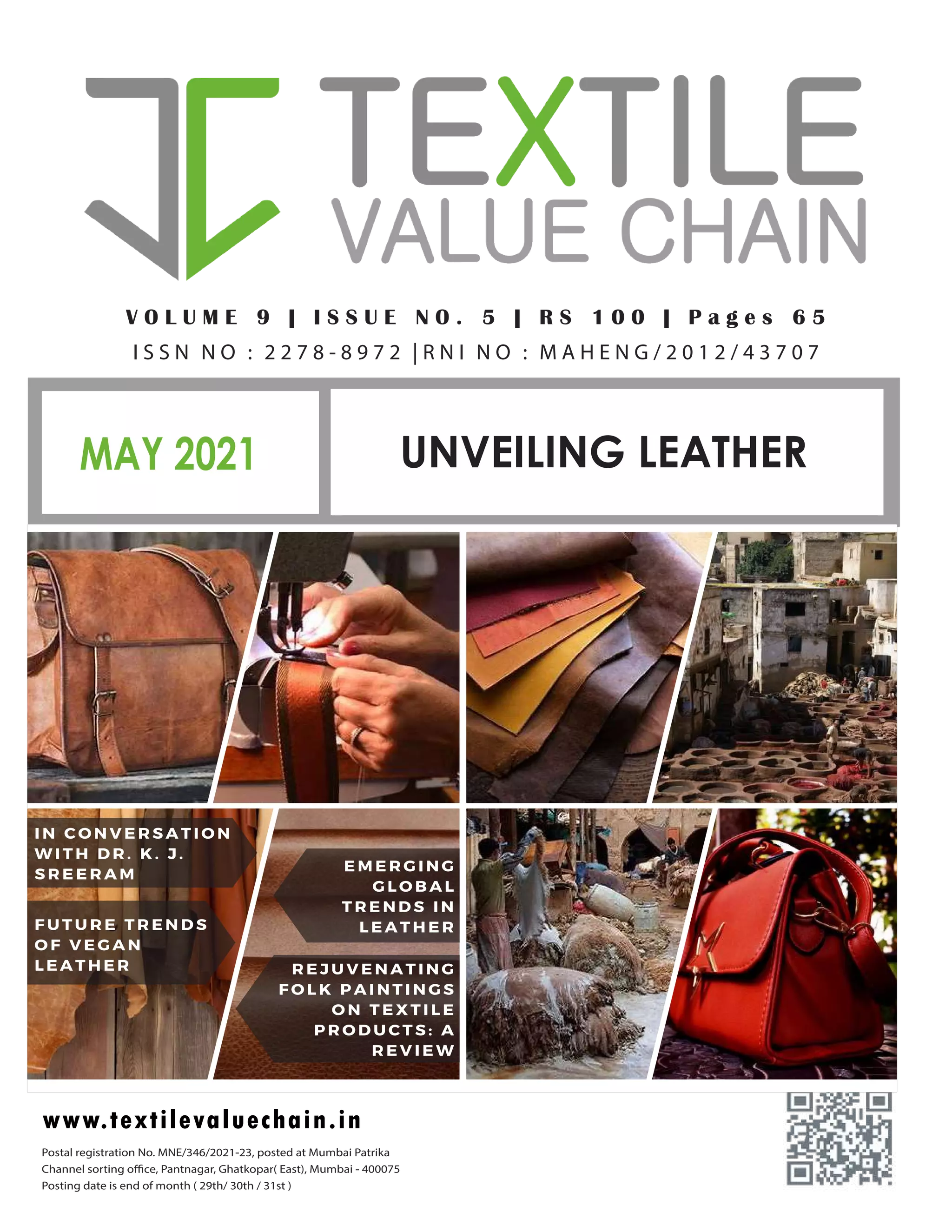
UNVEILING LEATHER
MAY 2021
V O L U M E 9 | I S S U E N O . 5 | R S 1 0 0 | P a g e s 6 5
I S S N N O : 2 2 7 8 - 8 9 7 2 | R N I N O : M A H E N G / 2 0 1 2 / 4 3 7 0 7
www.textilevaluechain.in
Postal registration No. MNE/346/2021-23, posted at Mumbai Patrika
Channel sorting office, Pantnagar, Ghatkopar( East), Mumbai - 400075
Posting date is end of month ( 29th/ 30th / 31st )
R E J U V E N A T I N G
F O L K P A I N T I N G S
O N T E X T I L E
P R O D U C T S : A
R E V I E W
F U T U R E T R E N D S
O F V E G A N
L E A T H E R
E M E R G I N G
G L O B A L
T R E N D S I N
L E A T H E R
I N C O N V E R S A T I O N
W I T H D R . K . J .
S R E E R A M
M A R C H 2 0 2 1
2 C O V E R S T O R Y
3
C O V E R S T O R Y
M A R C H 2 0 2 1
4
C O V E R S T O R Y
M A R C H 2 0 2 1
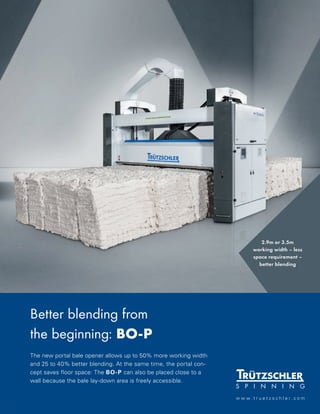
Better blending from
the beginning: BO-P
The new portal bale opener allows up to 50% more working width
and 25 to 40% better blending. At the same time, the portal con-
cept saves floor space: The BO-P can also be placed close to a
wall because the bale lay-down area is freely accessible.
w w w . t r u e t z s c h l e r . c o m
2.9m or 3.5m
working width – less
space requirement –
better blending
5
C O V E R S T O R Y
M A R C H 2 0 2 1
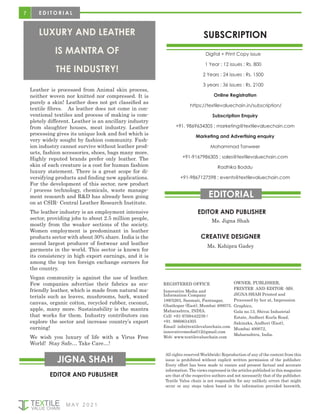
CONTENTS
ADVERTISER INDEX
08 IN CONVERSATION WITH Dr. K. J. SREERAM
Director of CSIR-CLRI
INTERVIEW
M AY 2 0 2 1
FUTURE TRENDS OF VEGAN LEATHER by
Shivani Gaikwad
15
13 EMERGING GLOBAL TRENDS IN LEATHER by
Rupali Kshatriya
EXPLORING SEA LEATHERWEAR by
Kshipra Gadey
10
COVER STORY
STUDY OF LEATHER FABRIC by
Pradnya Avhad
19
17 LEATHER MADE OUT OF CACTUS by
Dr. N. N. Mahapatra
LEATHER ANTIQUITY by Saayali Gaikwad
23
21 BEING WHOLESOME by Pearl Bhansal
GLOBAL LEATHER MACHINERY EXPORT HIT HARD
BY COVID-19 PANDEMIC
25
24 LEATHER PROCESSING by Vaibhavi Kokane
26 ELEVATING YOUR CAREER IN
LEATHER DESIGN AND TECHNOLOGY by Nalanda
Gadey
CAREER GUIDANCE
28 FUTURE OF DESIGN EDUCATION
CHALLENGING BUT WORTHWHILE... by Sonali Brid
EDUCATION
31 REJUVENATING FOLK PAINTINGS ON TEXTILE
PRODUCTS: A REVIEW by Nikita Sachwani
PEER REVIEW PAPER
AN ENVIRONMENT FRIENDLY
MUSHROOM LEATHER by V. Loga Subramani
37
REVIEW PAPER
EMPATHY – A LESS VALUED
LEADERSHIP COMPETENCY by Rajiv Misra
29
HR FOCUS
Page 1: Raymond
Page 2: Rimtex
Page 3: Trutzschelar
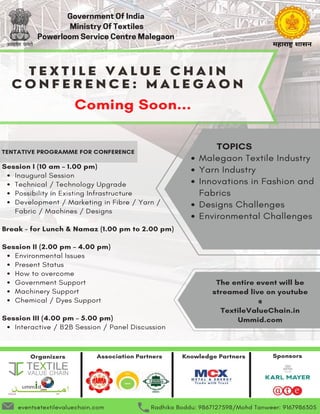
Page 4: Malegaon Conference, Textile Value Chain
MONPA HANDMADE PAPER OF
ARUNACHAL PRADESH by Shipra Yadav
44
40 RECYCLING LEATHER by Ashwini Tarte and Dr.
Suman D. Mundkur
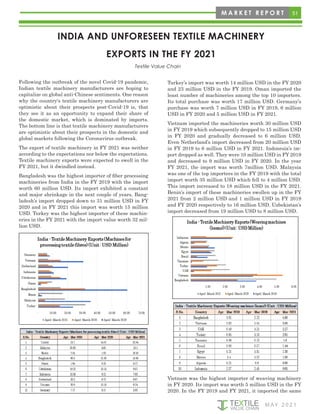
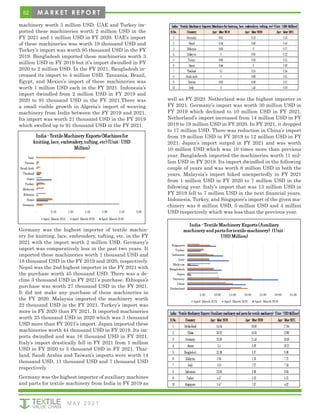
INDIA AND UNFORESEEN TEXTILE MACHINERY
EXPORTS IN THE FY 2021
51
46 COIR PRODUCTS EXPORT OPPORTUNITIES by
Dr. J. Anandha Kumar
MARKET REPORT
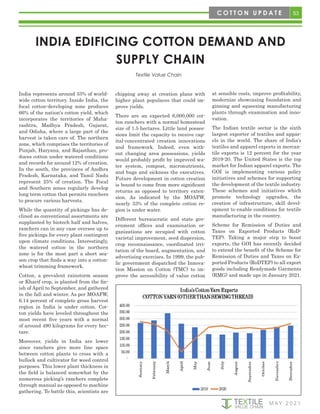
INDIA EDIFICING COTTON DEMAND AND
SUPPLY CHAIN
55
SUSTAINABLE AGRICULTURE FOR
BENEFITTING ENVIRONMENT,
ECONOMY & INDUSTRY by Manish Daga
53
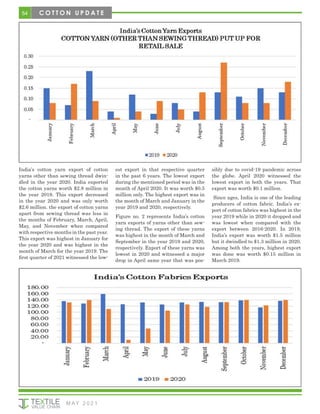
COTTON UPDATE
59
57 HEMP by Aishwarya Patil
SUSTAINABLE FIBRE
62
60
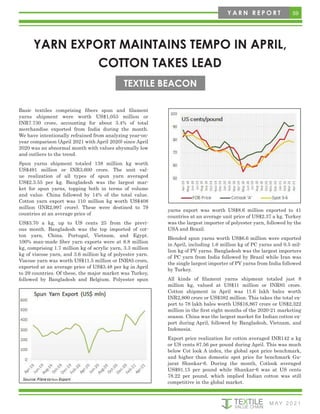
YARN EXPORT MAINTAINS TEMPO IN APRIL,
COTTON TAKES LEAD by Textile Beacon
YARN UPDATE
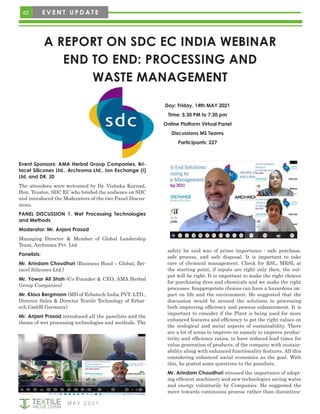
A REPORT ON SDC EC INDIA WEBINAR
END TO END: PROCESSING AND
WASTE MANAGEMENT
EVENT UPDATE
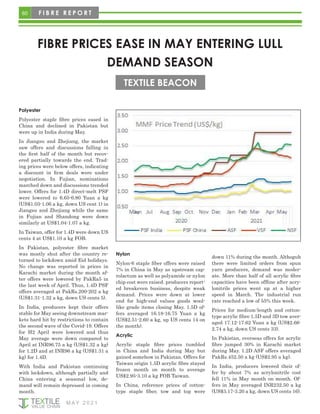
FIBRE PRICES EASE IN MAY ENTERING LULL
DEMAND SEASON by Textile Beacon
DILO GROUP ENGINEERING FOR NONWOVENS
22 NEWS
CULP PRESENTS CHILLSENSE BEDDING
TICKING TEXTURES
36
LENZING CLAIM TO FAME FILAMENTS TO BE
PRODUCED USING MATERIAL WASTE
45
M AY 2 0 2 1
E D I T O R I A L
JIGNA SHAH
EDITOR AND PUBLISHER
All rights reserved Worldwide; Reproduction of any of the content from this
issue is prohibited without explicit written permission of the publisher.
Every effort has been made to ensure and present factual and accurate
information. The views expressed in the articles published in this magazine
are that of the respective authors and not necessarily that of the publisher.
Textile Value chain is not responsible for any unlikely errors that might
occur or any steps taken based in the information provided herewith.
REGISTERED OFFICE
Innovative Media and
Information Company
189/5263, Sanmati, Pantnagar,
Ghatkopar (East), Mumbai 400075.
Maharashtra, INDIA.
Cell: +91-9769442239 /
+91. 9860634305
Email: info@textilevaluechain.com
innovativemedia012@gmail.com
Web: www.textilevaluechain.com
OWNER, PUBLISHER,
PRINTER AND EDITOR -MS.
JIGNA SHAH Printed and
Processed by her at, Impression
Graphics,
Gala no.13, Shivai Industrial
Estate, Andheri Kurla Road,
Sakinaka, Andheri (East),
Mumbai 400072,
Maharashtra, India.
SUBSCRIPTION
Digital + Print Copy issue
1 Year : 12 issues : Rs. 800
2 Years : 24 issues : Rs. 1500
3 years : 36 issues : Rs. 2100
Online Registration
https://textilevaluechain.in/subscription/
Subscription Enquiry
+91. 9869634305 ; marketing@textilevaluechain.com
Marketing and Advertising enquiry
Mohammad Tanweer
+91-9167986305 ; sales@textilevaluechain.com
Radhika Boddu
+91-9867127598 ; events@textilevaluechain.com
LUXURY AND LEATHER
IS MANTRA OF
THE INDUSTRY!
EDITOR AND PUBLISHER
Ms. Jigna Shah
CREATIVE DESIGNER
Ms. Kshipra Gadey
EDITORIAL
7
Leather is processed from Animal skin process,
neither woven nor knitted nor compressed. It is
purely a skin! Leather does not get classified as
textile fibres. As leather does not come in con-
ventional textiles and process of making is com-
pletely different. Leather is an ancillary industry
from slaughter houses, meat industry. Leather
processing gives its unique look and feel which is
very widely sought by fashion community. Fash-
ion industry cannot survive without leather prod-
ucts, fashion accessories, shoes, bags many more.
Highly reputed brands prefer only leather. The
skin of each creature is a cost for human fashion
luxury statement. There is a great scope for di-
versifying products and finding new applications.
For the development of this sector, new product
/ process technology, chemicals, waste manage-
ment research and R&D has already been going
on at CSIR- Central Leather Research Institute.
The leather industry is an employment intensive
sector, providing jobs to about 2.5 million people,
mostly from the weaker sections of the society.
Women employment is predominant in leather
products sector with about 30% share. India is the
second largest producer of footwear and leather
garments in the world. This sector is known for
its consistency in high export earnings, and it is
among the top ten foreign exchange earners for
the country.
Vegan community is against the use of leather.
Few companies advertise their fabrics as eco-
friendly leather, which is made from natural ma-
terials such as leaves, mushrooms, bark, waxed
canvas, organic cotton, recycled rubber, coconut,
apple, many more. Sustainability is the mantra
that works for them. Industry contributors can
explore the sector and increase country’s export
earning!
We wish you luxury of life with a Virus Free
World! Stay Safe… Take Care…!
8
M AY 2 0 2 1
I N T E R V I E W
IN CONVERSATION WITH
DR. K. J. SREERAM
DIRECTOR OF CSIR-CLRI
Indian Leather industry share in glob-
al market
Leather garments form a significant
segment of the Leather Industry in
India. Leather garments production
capacity is estimated to be 16 million
pieces annually. India produces differ-
ent types of leather garments i.e., jack-
ets, long coats, waist coats/shirts, pant/
shorts, motorbike jackets, industrial
leather garments, leather aprons etc.
India is the second largest producer of
leather garments, next only to China,
which produces 70 million pieces of the
total global trade volume of about 120
million pieces.
It is a matter of great pride that Indian
leather garments have been making
giant strides in the world of fashion.
National Institute of Fashion Technol-
ogy and National Institute of Design
lends design support to make continu-
ous fashion statements. These Insti-
tutes provides well trained personnel
and imaginative designers. India’s
acknowledged strength is leather tan-
ning and its ability to produce a wide
variety of fashion leathers.
India’s position as the third largest
global supplier of leather garments
is only going to strengthen given the
availability of quality raw material
coupled with skilled craftsmanship.
Major brands like ARMANI, ZEGNA,
ABERCROMBIE & FITCH, MARCO
POLO, MANGO, COLEHAAN, AN-
DREW MAARC, GUESS source Leath-
er Garments from India.
“LEATHER WILL NEVER DIE UNTIL ANI-
MAL EXIST”
It is reiterated that leather is a by-
product of the meat Industry. If the
meat Industry survives and cattle is
reared for the purpose, there will be no
shortage of skins/ hides available for
the leather industry.
Leather is three dimensional in struc-
ture. Leather breathes. LEATHER
is made from hides and skins of ani-
mals like goat, sheep, cow, and buffalo
that are slaughtered primarily for the
MEAT Industry. Leather is a by-prod-
uct of the meat industry. Putrefiable
raw hides and skins are processed to
make them non-putrefiable. This pro-
cess is called Tanning.
Leather contribution in fashion indus-
try.
The Leather Industry holds a promi-
nent place in the Indian economy. This
sector is known for its consistency in
high export earnings, and it is among
the top ten foreign exchange earners
for the country.
With an annual turnover of over US$
12 billion, the export of leather and
leather products increased manifold
over the past decades and touched US$
6.5 billion during 2014-15, recording
a cumulative annual growth rate of
about 13.10% (5 years).
The Leather industry is bestowed with
9
M AY 2 0 2 1
I N T E R V I E W
an affluence of raw materials as In-
dia is endowed with 21% of world cat-
tle & buffalo and 11% of world goat &
sheep population. Added to this are the
strengths of skilled manpower, inno-
vative technology, increasing industry
compliance to international environ-
mental standards, and the dedicated
support of the allied industries.
The leather industry is an employment
intensive sector, providing job to about
2.5 million people, mostly from the
weaker sections of the society. Women
employment is predominant in leather
products sector with about 30% share.
India is the second largest producer of
footwear and leather garments in the
world.
Brief about CSIR -CLRI activities
The CSIR-Central Leather Research
Institute: It is World's largest Leather
Research Institute was founded on 24
April 1948. The CLRI had made an ini-
tiative with foresight to link technol-
ogy system with both academy and in-
dustry. CSIR-CLRI, today, is a central
hub in Indian leather sector with direct
roles in education, research, training,
testing, designing, forecasting, plan-
ning, social empowerment and leading
in science and technology relating to
leather and allied products. Moreover,
it has secured a top place on the map of
scientific development as far as leath-
er-research-industry is concerned.
State-of-art facilities in CSIR-CLRI
support, innovation in leather pro-
cessing, creative designing of leather
products viz. leather garment, leather
goods, footwear, and development of
novel environmental technologies for
leather sector.
It is one matter to design and develop
technologies but entirely another to
promote such viable technologies in a
traditional sector like leather. CSIR-
CLRI in 1948, made an initiative with
foresight to link technology system
with both academy and industry. It as-
sumed the role of being a part of the
University of Madras in imparting ed-
ucation in leather technology. The seed
sown in 1948 has now grown into a tree
with nearly 60% of the leather industry
in India being manned and managed
by the Alumni of CSIR-CLRI.
CSIR-CLRI is a global leader in leather
research. The technological services of
the institute are as durable as leather.
Leather and allied research form core
areas of its activities. There is criti-
cal strength for research and develop-
ment in some focus areas of science and
technology. Research in CSIR-CLRI in-
cludes non-leather as well.
Share Leather research activity in
terms of process technologies, chem-
icals, product technology, waste
management, healthcare product
technologies
We are one of the leading leather re-
search organization with leather pro-
cessing technologies like Waterless
Chrome Tanning Technology (WCTT),
Preservation-Cum-Unhairing (PCU)
Process, Odor Abatement System for
Tanneries, Eco Based Zero Wastewater
Discharge Process, Dry Tanning (Dis-
persing Agent), Rapid Fiber Opening
by Cocktail of Enzymes and Chicken
Feet Leather and Leather Products.
We also work with leather chemicals
like Retanning Cum Lubricant Agent-
Relub-17r, Retanning Agent Protan
Khr, Protein Based Retanning Agent
Crostan Ea, etc.
Our waste management consists of
Immobilized Oxidation Reactors (Ior)
For Wastewater treatment, Sole from
Fleshing's Waste, Sequential Toxic-
Anoxic Bio Reactor (Soabr) Technology
For Reduction Of Primary Chemical
Sludge In Wastewater treatment, Se-
cure Landfill (Slf), Preparation of Com-
post from Animal Hair Waste (Process
Based Technology) and Co-Digestion of
Tannery Solid Waste For Biogas Gen-
eration.
Our healthcare products include High
Value Products from Trimming Waste
(Hvp-T), Collagen Sheet (Wound Care)
and Amiprojil-Paste/Powder for burns
and wounds.
10
M AY 2 0 2 1
EXPLORING SEA LEATHERWEAR
Textile Value Chain
KSHIPRA GADEY
Introduction
Efficiency of the human brain has al-
ways successfully found a way out to
fulfill the needs through every possi-
ble aspect. When humans thought that
they needed to cover their bodies, they
invented clothing. This clothing was
initially the skin of dead animals. Mod-
ern day man has evolved and developed
immense technological advances. The
similarity between the modern-day
man and ancient is that both passion-
ately wore the dead animals; then for
need and now for a fashion statement.
Humans have tried all the animal
hides including mammals, reptiles,
birds and even the human skin. How
would aquatic animals stay safe in this
race of beautiful hides for fashion? Hu-
mans have successfully created leather
from every possible animal including
aquatic animals like fish.
Fish skin is an uncommon sort of
leather. Lately, objects produced using
stingray leather have been in fame, be-
cause of the glass globule like surface
construction of the skin. Likewise, the
expansion of fish ranches, for different
species, has expanded the accessibility
of fish skin, as skins would in some way
or another be squandered.
Fish leather is more grounded than
other skin types, if similar thickness-
es are looked at. The elasticity of fish
leather comes up to 90 Newtons (for
example salmon or roost). The assem-
bling guideline for fish skin creation
was created by the Nanai individuals
from Eastern Siberia, who generally
make fish leather articles of clothing.
The tanning requires about a month.
The skins considered for making fish
skin leather are Shark, salmon, carp,
stingray, cod, ocean wolf and sturgeon.
Fish skin for the most part has a flaky
construction, is slenderer than leather
and is viewed as versatile and tear
safe.
Procedure for making fish leather
First step in making fish leather is
gathering fish skins. For making this
leather on small scale, skin can also
be obtained from fish stalls. With the
help of fleshing blade, overabundance
tissue is scratched. Skin is then kept
for absorption in saline arrangements.
Scales are eliminated and with the
help of synthetic specialists, producers
discharge the scales. Skin is then de-
toxed. This fundamentally implies that
the skins get an intensive washing to
eliminate any oils or natural matter. It
is then delicately cleaned. It can then
be preserved or converted into hide.
The skin can be refrigerated for preser-
vation. Tanning procedure can be uti-
lized for this. Fish leather can likewise
be dried by pressing. It can further
be coated for strength and waterproof
property.
Fishes that can be utilized for leather
1. Stingray Leather: The first one and
the most widely used exotic leather
is a stingray. Stingray skin is a solid,
strong cowhide with a "rough" surface
of smooth pearls across its surface and
is both moderate and arrives in a wide
exhibit of tones and sizes. Stingray
skin, In view of the shifting levels of
size among grown-up stingrays utilized
for cowhide, stingray skin will be found
in additional huge extravagance appli-
cations like upholstery, vehicle insides,
and trims, while likewise being found
in more modest applications like wal-
lets, satchels, adornments and deco-
rates. Stingray skin is otherwise called
shagreen.
Today, the skins we purchase to make
wallets, watch ties, wrapped boxes and
little sacks, are for the most part from
cultivated stingrays in Asia, specifi-
cally, Thailand. The skin has a sinewy
tissue side comprised of collagen fila-
ments, similar as standard cowhide,
yet that is the place where the simili-
tudes end.
The surface is comprised of little cir-
cles, now and again called pearls. They
are bigger in the focal point of the skin
and more modest on the external edg-
es. Each little circle is comprised of a
hard substance called dentin, with a
considerably harder external covering
of veneer. The stingray utilizes this
tooth like external protective layer as
a guard framework against assault,
which is the reason the circles just
cover the space of the beam around the
essential organs. During handling, the
delicate substantial outside wings are
taken out (for food utilization), and the
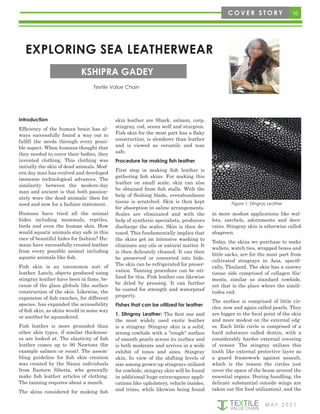
Figure 1: Stingray Leather
C O V E R S T O R Y
11
M AY 2 0 2 1
Figure 3: Carp Leather
upper layer of shagreen is shipped off
for tanning. This is the reason stingray
skin is not reliable with the state of a
live stingray.
Most stingray skins are chrome tanned
which permits the skin to stay solid
and adaptable for item make.
2. Atlantic Stingray Leather: The At-
lantic stingray is a type of stingray in
the family Dasyatidae, normal along
the Atlantic shoreline of North Ameri-
ca from Chesapeake Bay to Mexico, in-
cluding bitter and freshwater environ-
ments. It very well might be recognized
from different stingrays nearby by its
generally stretched nose. This species
is of minimal business significance.
The skin of the Atlantic stingray has a
totally unique surface contrasted with
the typical stingray leather. The skin
does not have a pearl structure. Leath-
er objects from Atlantic stingray cow-
hide are uncommon.
3. Carp Leather: Carp fishes are wide-
ly used across the world for obtaining
leather. These fishes are of various va-
rieties and come in different sizes. The
most widely used carp type is regular
carp for leather. This kind has a soft
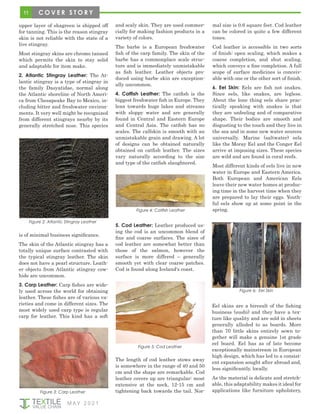
Figure 2: Atlantic Stingray Leather
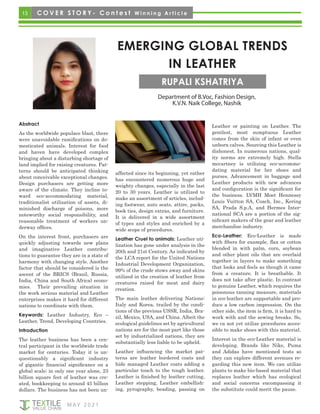
Figure 4: Catfish Leather
and scaly skin. They are used commer-
cially for making fashion products in a
variety of colors.
The barbe is a European freshwater
fish of the carp family. The skin of the
barbe has a commonplace scale struc-
ture and is immediately unmistakable
as fish leather. Leather objects pro-
duced using barbe skin are exception-
ally uncommon.
4. Catfish Leather: The catfish is the
biggest freshwater fish in Europe. They
lean towards huge lakes and streams
with sloppy water and are generally
found in Central and Eastern Europe
and Central Asia. The catfish has no
scales. The calfskin is smooth with an
unmistakable grain and drawing. A lot
of designs can be obtained naturally
obtained on catfish leather. The sizes
vary naturally according to the size
and type of the catfish slaughtered.
5. Cod Leather: Leather produced us-
ing the cod is an uncommon blend of
fine and coarse surfaces. The sizes of
cod leather are somewhat better than
those of the salmon, however the
surface is more differed – generally
smooth yet with clear coarse patches.
Cod is found along Iceland's coast.
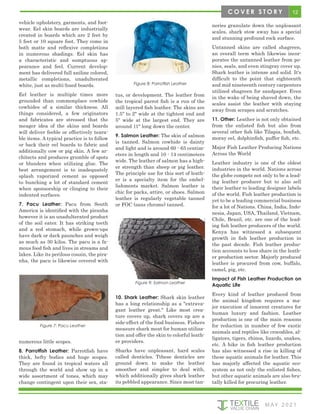
Figure 5: Cod Leather
The length of cod leather stows away
is somewhere in the range of 40 and 50
cm and the shape are remarkable. Cod
leather covers up are triangular: most
extensive at the neck, 12-15 cm and
tightening back towards the tail. Nor-
mal size is 0.6 square feet. Cod leather
can be colored in quite a few different
tones.
Cod leather is accessible in two sorts
of finish: open scaling, which makes a
coarse completion, and shut scaling,
which conveys a fine completion. A full
scope of surface medicines is conceiv-
able with one or the other sort of finish.
6. Eel Skin: Eels are fish not snakes.
Since eels, like snakes, are legless.
About the lone thing eels share prac-
tically speaking with snakes is that
they are unfeeling and of comparative
shape. Their bodies are smooth and
disgusting to the touch and they live in
the sea and in some new water sources
universally. Marine (saltwater) eels
like the Moray Eel and the Conger Eel
arrive at imposing sizes. These species
are wild and are found in coral reefs.
Most different kinds of eels live in new
water in Europe and Eastern America.
Both European and American Eels
leave their new water homes at produc-
ing time in the harvest time when they
are prepared to lay their eggs. Youth-
ful eels show up at some point in the
spring.
Figure 6: Eel Skin
Eel skins are a biresult of the fishing
business (sushi) and they have a tex-
ture like quality and are sold in sheets
generally alluded to as boards. More
than 70 little skins entirely sewn to-
gether will make a genuine 1st grade
eel board. Eel has as of late become
exceptionally mainstream in European
high design, which has led to a consist-
ent expansion sought after abroad and,
less significantly, locally.
As the material is delicate and stretch-
able, this adaptability makes it ideal for
applications like furniture upholstery,
C O V E R S T O R Y
M AY 2 0 2 1
12
C O V E R S T O R Y
vehicle upholstery, garments, and foot-
wear. Eel skin boards are industrially
created in boards which are 2 feet by
5 feet or 10 square foot. They come in
both matte and reflexive completions
in numerous shadings. Eel skin has
a characteristic and sumptuous ap-
pearance and feel. Current develop-
ment has delivered full aniline colored,
metallic completions, unadulterated
white, just as multi-hued boards.
Eel leather is multiple times more
grounded than commonplace cowhide
cowhides of a similar thickness. All
things considered, a few originators
and fabricates are stressed that the
meager idea of the skins and boards
will deliver feeble or effectively teara-
ble items. A typical practice is to follow
or back their eel boards to fabric and
additionally cow or pig skin. A few ar-
chitects and produces grumble of spots
or blunders when utilizing glue. The
best arrangement is to inadequately
splash vaporized cement as opposed
to bunching a lot of standard cement
when sponsorship or clinging to their
indented surfaces.
7. Pacu Leather: Pacu from South
America is identified with the piranha
however it is an unadulterated product
of the soil eater. It has striking teeth
and a red stomach, while grown-ups
have dark or dark paunches and weigh
as much as 30 kilos. The pacu is a fa-
mous food fish and lives in streams and
lakes. Like its perilous cousin, the pira-
nha, the pacu is likewise covered with
numerous little scopes.
8. Parrotfish Leather: Parrotfish have
thick, hefty bodies and huge scopes.
They are found in tropical waters all
through the world and show up in a
wide assortment of tones, which may
change contingent upon their sex, sta-
Figure 7: Pacu Leather
tus, or development. The leather from
the tropical parrot fish is a run of the
mill layered fish leather. The skins are
1.5" to 2" wide at the tightest end and
5" wide at the largest end. They are
around 11" long down the center.
9. Salmon Leather: The skin of salmon
is tanned. Salmon cowhide is dainty
and light and is around 60 - 65 centim-
eters in length and 10 - 14 centimeters
wide. The leather of salmon has a high-
er strength than sheep or pig leather.
The principle use for this sort of leath-
er is a specialty item for the embel-
lishments market. Salmon leather is
chic for packs, attire, or shoes. Salmon
leather is regularly vegetable tanned
or FOC (sans chrome) tanned.
Figure 8: Parrotfish Leather
Figure 9: Salmon Leather
10. Shark Leather: Shark skin leather
has a long relationship as a "extrava-
gant leather great." Like most crea-
ture covers up, shark covers up are a
side-effect of the food business. Fishers
measure shark meat for human utiliza-
tion and offer the skin to colorful leath-
er providers.
Sharks have unpleasant, hard scales
called denticles. Tthese denticles are
ground down to make the leather
smoother and simpler to deal with,
which additionally gives shark leather
its pebbled appearance. Since most tan-
neries granulate down the unpleasant
scales, shark stow away has a special
and stunning profound rock surface.
Untanned skins are called shagreen,
an overall term which likewise incor-
porates the untanned leather from po-
nies, seals, and even stingray cover up.
Shark leather is intense and solid. It's
difficult to the point that eighteenth
and mid nineteenth century carpenters
utilized shagreen for sandpaper. Even
in the wake of being shaved down, the
scales assist the leather with staying
away from scrapes and scratches.
11. Other: Leather is not only obtained
from the enlisted fish but also from
several other fish like Tilapia, boxfish,
moray eel, dolphinfish, puffer fish, etc.
Major Fish Leather Producing Nations
Across the World
Leather industry is one of the oldest
industries in the world. Nations across
the globe compete not only to be a lead-
ing leather producer but to also sell
their leather to leading designer labels
of the world. Fish leather production is
yet to be a leading commercial business
for a lot of Nations. China, India, Indo-
nesia, Japan, USA, Thailand, Vietnam,
Chile, Brazil, etc. are one of the lead-
ing fish leather producers of the world.
Kenya has witnessed a subsequent
growth in fish leather production in
the past decade. Fish leather produc-
tion accounts to less share in the leath-
er production sector. Majorly produced
leather is procured from cow, buffalo,
camel, pig, etc.
Impact of Fish Leather Production on
Aquatic Life
Every kind of leather produced from
the animal kingdom requires a ma-
jor execution of innocent creatures for
human luxury and fashion. Leather
production is one of the main reasons
for reduction in number of few exotic
animals and reptiles like crocodiles, al-
ligators, tigers, rhinos, lizards, snakes,
etc. A hike in fish leather production
has also witnessed a rise in killing of
these aquatic animals for leather. This
has majorly affected the aquatic eco-
system as not only the enlisted fishes,
but other aquatic animals are also bru-
tally killed for procuring leather.
13
M AY 2 0 2 1
C O V E R S T O R Y - C o n t e s t W i n n i n g A r t i c l e
EMERGING GLOBAL TRENDS
IN LEATHER
Department of B.Voc, Fashion Design,
K.V.N. Naik College, Nashik
RUPALI KSHATRIYA
Abstract
As the worldwide populace blast, there
were unavoidable ramifications on do-
mesticated animals. Interest for food
and haven have developed complex
bringing about a disturbing shortage of
land implied for raising creatures. Pat-
terns should be anticipated thinking
about conceivable exceptional changes.
Design purchasers are getting more
aware of the climate. They incline to-
ward eco-accommodating material,
traditionalist utilization of assets, di-
minished discharge of poisons, more
noteworthy social responsibility, and
reasonable treatment of workers un-
derway offices.
On the interest front, purchasers are
quickly adjusting towards new plans
and imaginative Leather contribu-
tions to guarantee they are in a state of
harmony with changing style. Another
factor that should be considered is the
ascent of the BRICS (Brazil, Russia,
India, China and South Africa) econo-
mies. Their prevailing situation in
the work serious material and Leather
enterprises makes it hard for different
nations to coordinate with them.
Keywords: Leather Industry, Eco –
Leather, Trend, Developing Countries.
Introduction
The leather business has been a cen-
tral participant in the worldwide trade
market for centuries. Today it is un-
questionably a significant industry
of gigantic financial significance on a
global scale; in only one year alone, 23
billion square feet of leather was cre-
ated, bookkeeping to around 45 billion
dollars. The business has not been un-
affected since its beginning, yet rather
has encountered numerous huge and
weighty changes, especially in the last
20 to 30 years. Leather is utilized to
make an assortment of articles, includ-
ing footwear, auto seats, attire, packs,
book ties, design extras, and furniture.
It is delivered in a wide assortment
of types and styles and enriched by a
wide scope of procedures.
Leather Cruel to animals: Leather uti-
lization has gone under analysis in the
20th and 21st Century. As indicated by
the LCA report for the United Nations
Industrial Development Organization,
99% of the crude stows away and skins
utilized in the creation of leather from
creatures raised for meat and dairy
creation.
The main leather delivering Nations:
Italy and Korea, trailed by the condi-
tions of the previous USSR, India, Bra-
zil, Mexico, USA, and China. Albeit the
ecological guidelines set by agricultural
nations are for the most part like those
set by industrialized nations, they are
substantially less liable to be upheld.
Leather influencing the market pat-
terns are leather bordered coats and
hide managed Leather coats adding a
particular touch to the tough leather.
Leather is finished by leather cutting,
Leather stepping, Leather embellish-
ing, pyrography, beading, passing on
Leather or painting on Leather. The
gentlest, most sumptuous Leather
comes from the skin of infant or even
unborn calves. Sourcing this Leather is
dishonest. In numerous nations, qual-
ity norms are extremely high. Stella
mccartney is utilizing eco-accommo-
dating material for her shoes and
purses. Advancement in baggage and
Leather products with new advances
and configuration is the significant for
the business. LVMH Moet Hennessy
Louis Vuitton SA, Coach, Inc., Kering
SA, Prada S.p.A, and Hermes Inter-
national SCA are a portion of the sig-
nificant makers of the gear and leather
merchandise industry.
Eco-Leather: Eco-Leather is made
with fibers for example, flax or cotton
blended in with palm, corn, soybean
and other plant oils that are overlaid
together in layers to make something
that looks and feels as though it came
from a creature. It is breathable. It
does not take after plastic. In contrast
to genuine Leather, which requires the
poisonous tanning measure, materials
in eco-leather are supportable and pro-
duce a low carbon impression. On the
other side, the item is firm, it is hard to
work with and the sewing breaks. So,
we ca not yet utilize procedures acces-
sible to make shoes with this material.
Interest in the eco-Leather material is
developing. Brands like Nike, Puma
and Adidas have mentioned tests so
they can explore different avenues re-
garding this new item. We can utilize
plants to make bio-based material that
replaces leather which has ecological
and social concerns encompassing it
the substitute could merit the pause.
14
C O V E R S T O R Y - C o n t e s t W i n n i n g A r t i c l e
M AY 2 0 2 1
Beige Leather 2021: Beige Leather
2021 is not anything convoluted by any
stretch of the imagination. It is just a
blend of the two greatest patterns at
this moment, beige, and leather! Beige
leather skirts are likewise having their
second. The beige leather frequently
goes close with earthy colored; creature
prints and everything hearty tones. So,
this is a choice accept knee-high boots,
turtlenecks, curiously large glasses,
and layered outfits.
Leather Trends Fall Winter 2021 2022:
Climate change has been influencing
society, making apprehension and un-
easiness. The customers will be looking
for expectation and rebuilding through
perfect, feasible items. Interests in in-
ventive innovations like a veggie lover
(desert flora, mushroom, apple, grape,
and pineapple Leather) or reused
leather will lead this development.
Eco-more amicable and more practi-
cal materials will have more promi-
nent appeal to more up to date ages.
Most customers will attempt to roll out
an improvement in their utilization.
In this manner, it will be essential to
remember that there is a developing
spotlight on quality over amount.
1. Intriguing Leather prints
For ladies and men prepared to-wear
and adornments, the reptile skin
Leather will be one of the impres-
sive patterns for Autumn-Winter
2021/2020. This print will be utilized
for sacks, belts, shoes, coats and even
furnishings. For this pattern, we will
be searching for regular shades of a
crocodile or snake. In this period of in-
novation, computerized, neon extraor-
dinary examples are pursued. With
this sort of print, you will need to make
a piece that the customer will think
about remarkable.
2. Shiny leather
In response to expanded political and
social pressures all throughout the
planet, customers will search for "hard
and fast" articulation for Autumn-Win-
ter 21/22. Clients will be searching for
lavish plans. The trend will be to uti-
lize a smooth waxy completion on the
leather to give a more advanced look,
lavishness in footwear, prepared to-
wear and adornments. Thus, when you
consider this specific amazingly radi-
ant completion pattern, have as a top
priority gleaming pants, metallic coats
and fluid Leather coats.
3. Beautiful leather
The shoppers will look for solace and
a tad of euphoria in their sentimental-
ity. The pastel shadings that will be on
the spotlight for Autumn/Winter 21/22
will be
•	 Pastel blue (Pantone 12-4607
TPX),
•	 Cabbage (Pantone 13-5714 TPX),
•	 Lavender Fog (13-3820 TCX),
•	 Puristic Lilac (Pantone 14-3905
TCX),
•	 Putty Pink (Pantone 13-1208 TCX)
•	 Buff Orange (14-1128 TCX) and
•	 Lemon Verbena (12-0742 TCX).
Zero in on colors that have a gray-
ish suggestion that will bring a more
adaptable touch.
1. Upcoming wearable leather trends
in fashion industry
Fashion trends are influenced by glob-
al shifts, considering foreign demand
and driving marketplaces around the
world. Snake, croc, and abstract de-
signs can help to break up the monot-
ony of leather. Dark, paranoid clothing
has become the new hot. By emphasiz-
ing contrast, some interplay between
darker and lighter colors might be ap-
pealing.
A leather jacket with a fur collar is the
greatest method to keep yourself toasty
and stylish when it is too chilly to func-
tion. These jackets are the best way to
combine warmth, elegance, and style.
Coordinate the shade of the fur with
the rest of your look or create a con-
trast by choosing a collar that stands
out from your outfit.
2. Changing leather trend and vegan
leather
With the increasing emphasis on sus-
tainability in fashion, vegan leather
is becoming more common. The rising
popularity of fake vegan leather is one
of them. Vegans are those who oppose
the use of animals as food. Meat and
fish, as well as dairy products, eggs,
and honey, are among them. Vegan
product lines have been introduced by
some of the world’s largest fashion la-
bels in recent years, and the trend is
rapidly spreading.
3. Leather innovations in fashion in-
dustry
Without using chemically intensive
methods, the leather can be dyed nat-
urally and tanned. Pinatex, derived
from pineapple plant leaves, and Be-
yond Leather, which uses leftovers
from apple juice and cider processing.
Plants, recycled cotton, hemp, natural
rubber, cork, and vegetable oil can all
be used to make leather. This promises
a 40% reduction in carbon emissions as
compared to conventional leather and
a 17-fold reduction in carbon emissions
as compared to synthetic leather made
from plastic.
Conclusion
Many people value leather as a natural
material and are interested in it, but
they are sometimes unaware of what
they have on hand. Leather has a clear
and bold appearance that many people
want in a statement piece. Leather is
trending and thriving because of its
versatility; it can easily be toned up or
down for any style mix. Leather will
continue to be used for a very long time
in the future.
References
•	 https://www.fibre2fashion.com/
industry-article/7739/emerging-
g l o b a l - t r e n d s - i n - l e a t h e r - a n d -
fashion?amp=true
•	 https://www.thegoodtrade.com/fea-
tures/sustainable-vegan-leather-alter-
natives
•	 https://en.m.wikipedia.org/wiki/Leather
•	 https://www.fibre2fashion.com/indus-
try-article/2233/leather-trend-and-fash-
ion
15
M AY 2 0 2 1
FUTURE TRENDS OF VEGAN
LEATHER
PG Department of Textile Science and Apparel Design,
SNDT Women’s University, Mumbai
SHIVANI GAIKWAD
Introduction
Vegan leather also called “Faux” leath-
er, is an alternative leather to animal
leather. Vegan leather is not made
from animal skin. Plants, fruits and
plastic are the main materials, which
is used to make vegan leather. Vegan
leather has a similar look like leather
which is produced from animal skin.
Vegan leather is also known as Syn-
thetic leather, Pleather and Alterna-
tive leather.
Following are the latest substitutes
and alternative of animal leather:
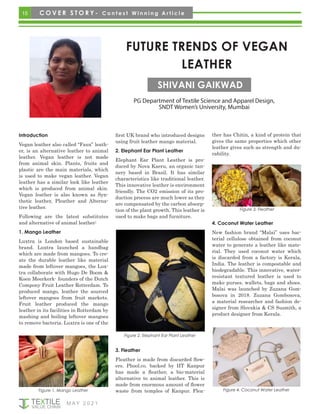
1. Mango Leather
Luxtra is London based sustainable
brand. Luxtra launched a handbag
which are made from mangoes. To cre-
ate the durable leather like material
made from leftover mangoes, the Lux-
tra collaborate with Hugo De Boom &
Koen Meerkerk- founders of the Dutch
Compony Fruit Leather Rotterdam. To
produced mango, leather the sourced
leftover mangoes from fruit markets.
Fruit leather produced the mango
leather in its facilities in Rotterdam by
mashing and boiling leftover mangoes
to remove bacteria. Luxtra is one of the
first UK brand who introduced designs
using fruit leather mango material.
2. Elephant Ear Plant Leather
Elephant Ear Plant Leather is pro-
duced by Nova Kaeru, an organic tan-
nery based in Brazil. It has similar
characteristics like traditional leather.
This innovative leather is environment
friendly. The CO2 emission of its pro-
duction process are much lower as they
are compensated by the carbon absorp-
tion of the plant growth. This leather is
used to make bags and furniture.
ther has Chitin, a kind of protein that
gives the same properties which other
leather gives such as strength and du-
rability.
Figure 1. Mango Leather
Figure 2. Elephant Ear Plant Leather
3. Fleather
Fleather is made from discarded flow-
ers. Phool.co. backed by IIT Kanpur
has made a fleather, a bio-material
alternative to animal leather. This is
made from enormous amount of flower
waste from temples of Kanpur. Flea-
Figure 3. Fleather
4. Coconut Water Leather
New fashion brand “Malai” uses bac-
terial cellulose obtained from coconut
water to generate a leather like mate-
rial. They used coconut water which
is discarded from a factory is Kerala,
India. The leather is compostable and
biodegradable. This innovative, water-
resistant textured leather is used to
make purses, wallets, bags and shoes.
Malai was launched by Zuzana Gom-
bosova in 2018. Zuzana Gombosova,
a material researcher and fashion de-
signer from Slovakia & CS Susmith, a
product designer from Kerala.
Figure 4. Coconut Water Leather
C O V E R S T O R Y - C o n t e s t W i n n i n g A r t i c l e
16
M AY 2 0 2 1
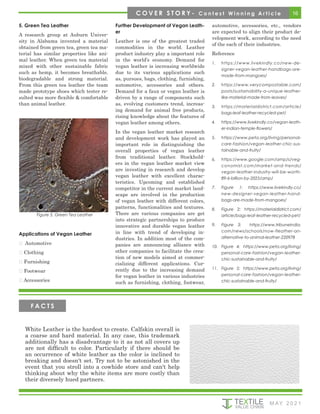
5. Green Tea Leather
A research group at Auburn Univer-
sity in Alabama invented a material
obtained from green tea, green tea ma-
terial has similar properties like ani-
mal leather. When green tea material
mixed with other sustainable fabric
such as hemp, it becomes breathable,
biodegradable and strong material.
From this green tea leather the team
made prototype shoes which tester re-
sulted was more flexible & comfortable
than animal leather.
Further Development of Vegan Leath-
er
Leather is one of the greatest traded
commodities in the world. Leather
product industry play a important role
in the world’s economy. Demand for
vegan leather is increasing worldwide
due to its various applications such
as, pursues, bags, clothing, furnishing,
automotive, accessories and others.
Demand for a faux or vegan leather is
driven by a range of components such
as, evolving customers trend, increas-
ing demand for animal free products,
rising knowledge about the features of
vegan leather among others.
In the vegan leather market research
and development work has played an
important role in distinguishing the
overall properties of vegan leather
from traditional leather. Stockhold-
ers in the vegan leather market view
are investing in research and develop
vegan leather with excellent charac-
teristics. Upcoming and established
competitor in the current market land-
scape are involved in the production
of vegan leather with different colors,
patterns, functionalities and textures.
There are various companies are get
into strategic partnerships to produce
innovative and durable vegan leather
in line with trend of developing in-
dustries. In addition most of the com-
panies are announcing alliance with
other companies to facilitate the crea-
tion of new models aimed at commer-
cializing different applications. Cur-
rently due to the increasing demand
for vegan leather in various industries
such as furnishing, clothing, footwear,
automotive, accessories, etc., vendors
are expected to align their product de-
velopment work, according to the need
of the each of their industries.
Reference
1.	 https://www.livekindly.co/new-de-
signer-vegan-leather-handbags-are-
made-from-mangoes/
2.	 https://www.verycompostable.com/
posts/sustainability-a-unique-leather-
like-material-made-from-leaves/
3.	 https://materialdistrict.com/article/
bags-leaf-leather-recycled-pet/
4.	 https://www.livekindly.co/vegan-leath-
er-indian-temple-flowers/
5.	 https://www.peta.org/living/personal-
care-fashion/vegan-leather-chic-sus-
tainable-and-fruity/
6.	 https://www.google.com/amp/s/veg-
conomist.com/market-and-trends/
vegan-leather-industry-will-be-worth-
89-6-billion-by-2025/amp/
7.	 Figure 1: https://www.livekindly.co/
new-designer-vegan-leather-hand-
bags-are-made-from-mangoes/
8.	 Figure 2: https://materialdistrict.com/
article/bags-leaf-leather-recycled-pet/
9.	 Figure 3: https://www.tribuneindia.
com/news/schools/now-fleather-an-
alternative-to-animal-leather-220978
10.	 Figure 4: https://www.peta.org/living/
personal-care-fashion/vegan-leather-
chic-sustainable-and-fruity/
11.	 Figure 5: https://www.peta.org/living/
personal-care-fashion/vegan-leather-
chic-sustainable-and-fruity/
Figure 5. Green Tea Leather
Applications of Vegan Leather
 Automotive
 Clothing
 Furnishing
 Footwear
 Accessories
C O V E R S T O R Y - C o n t e s t W i n n i n g A r t i c l e
White Leather is the hardest to create. Calfskin overall is
a coarse and hard material. In any case, this trademark
additionally has a disadvantage to it as not all covers up
are not difficult to color. Particularly if there should be
an occurrence of white leather as the color is inclined to
breaking and doesn't set. Try not to be astonished in the
event that you stroll into a cowhide store and can't help
thinking about why the white items are more costly than
their diversely hued partners.
F A C T S
17
M AY 2 0 2 1
C O V E R S T O R Y
LEATHER MADE OUT OF CACTUS
Dr.N.N. MAHAPATRA
Business Head (Dyes)
Shree Pushkar Chemicals & Fertilisers Ltd., Mumbai
Plant-based leather alternatives are a
growing market, with innovators turn-
ing to pineapple, olives, and coconuts to
produce eco-friendly materials. Earlier
this year one of the leading brands un-
veiled a vegan jacket made from pine-
apple leather, while another launched
a product of leather shoes made from
olive leaves. Very interesting an-
other local south India manufacturer
came out with leather and accessories
made from coconuts.
With growing awareness of the effects
of the leather industry on the environ-
ment and animals, the market for cru-
elty-free alternatives will keep grow-
ing. So many brands are out there,
trying to make vegan leather as low-
impact as possible by using plants to
create leather-like fabrics. Two facto-
ries in Mexico have developed durable
vegan leather from cactus, and it could
very well replace animal leather.
Initially, all vegan leather was made of
plastic-based materials. Later on due to
further research in the last few years,
textile scientists have discovered many
ways to make vegan leather out of eve-
rything easily available from pineap-
ples to cactus leaves to flowers. The ve-
gan leather industry has come up now
leaving aside the good old leather
and coming out with some exciting
plant-based leathers on the market.
Very interesting every vegan leather is
made from a plant, but unfortunately,
none of them are fully biodegradable
yet. That is because each material is
either made with a mixture of plants
and polyurethane or is plant-based and
coated with a plastic-based resin. While
there are a few brands already selling
fully compostable sneakers, no one has
been able to come out with compostable
vegan leather shoes yet. But the good
news is, most of the brands are fine-
tuning towards perfecting their respec-
tive vegan leathers to make their shoes
biodegradable.
It is well known Vegan leather has
always a lower impact than animal-
based leather, whether it is plant-based
or completely synthetic. Not only does
vegan leather leave animals out of the
picture, but the process of manufactur-
ing like breeding, raising, and killing
animals and tanning leather has a
high environmental impact. To raise
animals (typically cows) for leather
requires large amounts of land, water,
and cattle feed, the animals emit meth-
ane into the atmosphere; and the ex-
crement from cattle bodies and factory
farms pollutes the nearby waterways,
soil, and air, which becomes a public
health risk for people who live nearby.
The manufacturers had previously
made vegan leather from a mix of
polyurethane and bio-oil. The bio-oil
is sourced from cereal crops that were
organically grown in northern Europe
in a carbon-neutral process. The manu-
facturer is trying to stop using polyu-
rethane to make its vegan leather and
recently planning to come out with a
new product using viscose made from
eucalyptus bark.
It has been found that all the major
vegan leather manufacturers make ve-
gan leathers made from plants but also
contain polyurethane in their compo-
sition, usually in their finishing or as
the backing material. It was a required
component in the production.
Later on, people are thinking of a
100 percent biodegradable vegan
leather technology that does not ex-
ist to exclude polyurethane totally
but time is not far the researchers
have developed a vegan leather
made from nopal cactus leaves which
are organic, partially biodegradable,
soft, and durable which can be used
to make furniture and car interiors in
addition to fashion items like wallets,
purses, and shoes.
The scientists named Adrian Lopez
Velarde and Marte Cazarez came to-
gether to create a cruelty-free alter-
native to animal leather, and just last
month, they developed the first time an
organic leather made entirely from no-
pal or prickly pear cactus which they
name as “ Dessert “. They want to sell
Desserto fabric to other designers and
fashion brands, rather than design and
sell their products. These nopal cactus
grow in abundance across Mexico with-
out requiring any water called a low-
impact crop.
Cactus leather is a sustainable leather
alternative made from Opuntia Cactus
(also known as Nopal) that has been
developed in Mexico. It is called Des-
serto and is a highly sustainable plant-
based vegan leather made from cactus
having superior softness to touch and
great performance for a wide variety
of applications and complying with
the most rigorous quality and environ-
mental standards. Developed by two
entrepreneurs from Mexico who used
to work in the automotive and fashion
industries where they found strong en-
vironmental impact in both sectors it
is concluded this vegan leather aims to
18
M AY 2 0 2 1
C O V E R S T O R Y
offer a cruel-free and sustainable alter-
native, without toxic chemicals, phtha-
lates, and PVC.
Production of Vegan Leather
It is one of the world’s most popular
and heavy demand products where
leather is part of an overwhelming $80
billion industry. Thanks to these two
innovative entrepreneurs for develop-
ing a method of converting cactus into
vegan leather which is so realistic to
look and feel you would never imag-
ine it was made from this desert plant.
They have named their cactus vegan
leather Desserto, and it is made from
cactus grown on their plantation in the
city of Zacatecas situated in Mexico.
The cactus as a plant is having rugged,
thick skin, which makes it the perfect
texture to have a similar appearance to
animal leather.
Interestingly, the idea of using this
raw material was mooted because this
plant does not need any water to grow,
and there is plenty of it throughout
Mexico country. Before starting bulk
production in various industries, it is
essential to see the supply of cactus
plant, the main raw material which
should be stable and abundant. Pres-
ently they have 2 hectares where they
cultivate cactus, as well as there is an
expansion capacity of 40 hectares. Re-
garding production capacity, they can
500,000 linear meters of vegan leather
a month.
The harvesting process includes the
cactus cycle where they select and
cut only the mature leaves of the
plant around every 6 - 8 months. No
irrigation systems are used as the
cactus grow healthy with rainwater
and earth minerals found in the soil.
The vegan leather is made with leaves
from the Prickly Pear Cactus. The ma-
ture leaves are cut from organically
grown cactus plants, cleaned, mashed,
and then left out in the sun to dry for
three days until the desired humidity
levels are achieved, before processing.
The process for cactus leather involves
using either the new young leaves or
the mature leaves of the plant. It can
then be dyed naturally using meth-
ods developed by the three innovators
Adriano Di Marti, López Velarde’s, and
Cázarez’s. This makes for vegan leath-
er that is certified organic and can hold
up to regular usage for nearly a decade.
The organic raw material is then pro-
cessed and mixed with non-toxic chem-
icals and then shaped into any texture
and color. The ranch is fully organic, so
no herbicides or pesticides are used in
the process. All the remaining organic
cactus material which are not used is
exported and sold nationally to the food
industry.
Properties of Vegan Leather
It is also flexible, breathable, durable,
and does not stain making it an ideal
replacement for animal and synthetic
leather. The touch and feel of the ma-
terial are also soft and very similar to
real leather. The product is also highly
sustainable with a lower carbon foot-
print than other leather alternatives.
The finest point is
1. It is less water-intensive
2. It is Free from phthalates
3. It is Free from toxic chemicals
4. It is PVC free.
The “ Desserto “ cactus vegan leather
has been manufactured as per the
technical specifications required by the
fashion, leather goods, furniture, and
even automotive industries. It is hav-
ing a durability of around ten years,
the cactus leather’s basic features,
elasticity, customizable and breath-
able, are like those of animal or syn-
thetic leather.
Uses of Plant Leather
Apart from being natural and cruelty-
free, the material also meets the
specifications of several industries and
can be used in:
1. Fashion
2. Leather goods
3. Automobiles
4. Furniture
Vegan leather is on par, in terms of
pricing, with genuine leather. So far,
the company has created car seats,
shoes, handbags, and even apparel. In
another plus for the environment, cac-
tus leather is partially biodegradable
and does not contain any plastic—an-
other issue with synthetic leather. This
makes for a true alternative to animal
leather that does not harm the planet.
Ages of Siberians and Scandinavians have been utilizing Salm-
on leather for quite a long time. Having started in Siberia, the
antiquated craft of assembling Salmon leather has consistently
been near and is more eco-accommodating in light of the utiliza-
tion of the vegetable tanning strategy. Anyway, Salmon leather
never acquired notoriety because of the lessening quantities of
wild Salmon in specific spaces of the world and the wide acces-
sibility of creature skin.
F A C T S
19
M AY 2 0 2 1
STUDY OF LEATHER FABRIC
DKTE Society’s Textile and Engineering Institute, Icchalkaranji
PRADNYA AVHAD
Abstract
Leather is a durable and flexible mate-
rial created by tanning the animal raw
hide. The mainly used raw material
is cattle hide and skin. Leather usage
has come under criticism in the 20th
and 21st centuries by Animal Rights
groups. These groups claim that buy-
ing or wearing leather is unethical be-
cause producing leather requires ani-
mals to be killed. However, according
to the LCA report for the United Na-
tions Industrial Development Organi-
zation, most of the raw hides and skins
used in the production of leather were
derived from animals that are raised
for meat and/or dairy production. The
skin and hide from the meat industry
may create a major pollution. It can
be either burnt or buried in landfill.
Leather production utilizes the non-
usable part of dead animals, so that,
there will no waste of animals’ skin. It
helps to decrease dead animal waste
and improves economic growth of India
by maximizing export of leather goods.
Introduction
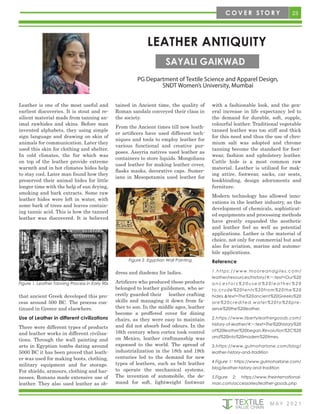
Leather is processed by tanning ani-
mal raw hide and skins to make it du-
rable and flexible. It can be produced
at manufacturing scales ranging from
artisan to modern industrial scale.
Leather making has been practiced for
more than 7,000 years; the earliest re-
cord of leather artifacts dates to 2200
BCE. Leather is used to make a variety
of articles. It is produced in a wide va-
riety of types and styles and decorated
by a wide range of techniques as in Fig.
No.1.
Leather usage has come under criti-
cism in the 20th and 21st centuries
by animal rights groups. These groups
claim that buying or wearing leather
is unethical because producing leather
requires animals to be killed. How-
ever, according to the LCA report for
the United Nations Industrial Devel-
opment Organization, 99% of the raw
hides and skins used in the production
of leather derive from animals raised
for meat and/or dairy production.
Manufacturing Process
The leather manufacturing process is
divided into three fundamental sub-
processes: 1. Preparatory stages, 2.
Tanning, and 3. Crusting. A further
sub-process of finishing can be added
into the leather processing sequence,
but not all leathers receive finishing.
1. The preparatory stages are when
the hide is prepared for tanning. Pre-
paratory stages may include soaking,
hair removal, liming, deliming, bating,
bleaching, and pickling.
2. Tanning is a process that stabilizes
the proteins, particularly collagen, of
the raw hide to increase the thermal,
chemical, and microbiological stability
of the hides and skins. Thus, making
it suitable for a wide variety of end
applications. The principal difference
between raw and tanned hides is that
raw hides dry out to form a hard, in-
flexible material that, when rewetted,
will putrefy, while tanned material
dries to a flexible form that does not
become putrid when rewetted.
Many tanning methods and materi-
als exist. The typical process sees tan-
ners load the hides into a drum and
immerse them in a tank that contains
the tanning "liquor." The hides soak
while the drum slowly rotates about
its axis, and the tanning liquor slowly
penetrates through the full thickness
of the hide. Once the process achieves
even penetration, workers slowly raise
the liquor’s pH in a process called basi-
fication, which fixes the tanning mate-
rial to the leather. The more tanning
material fixed, the higher the leather’s
hydrothermal stability and shrinkage
temperature resistance.
3. Crusting is a process that thins and
lubricates leather. It often includes a
coloring operation. Chemicals added
during crusting must be fixed in place.
Crusting culminates with a drying and
softening operation, and may include
splitting, shaving, dyeing, whitening
or other methods.
Finishing Process for some leathers,
tanners apply a surface coating, called
finishing. Finishing operations can in-
clude oiling, brushing, buffing, coating,
polishing, embossing, glazing, or tum-
bling, among others.
Leather can be oiled to improve its wa-
ter resistance. This currying process
after tanning supplements the natu-
ral oils remaining in the leather itself,
which can be washed out through re-
peated exposure to water. Frequent oil-
ing of leather, with mink oil, neat’s-foot
oil, or a similar material keeps it sup-
ple and improves its lifespan dramati-
C O V E R S T O R Y
20
M AY 2 0 2 1
cally [1].
Tanning methods
Tanning processes largely differ in
which chemicals are used in the tan-
ning liquor. Some common types in-
clude:
Vegetable-tanned leather is tanned us-
ing tannins extracted from vegetable
matter, such as tree bark prepared in
bark mills. It is the oldest known meth-
od.
Chrome-tanned leather is tanned us-
ing chromium sulfate and other chro-
mium salts. It is also known as "wet
blue" for the pale blue color of the un-
dyed leather
Aldehyde-tanned leather is tanned us-
ing glutaraldehyde or oxazolidine com-
pounds. It is referred to as "wet white"
due to its pale cream color.
Chamois leather is a form of aldehyde
tanning that produces a porous and
highly water-absorbent leather. Cham-
ois leather is made using marine oils.
Brain tanned leathers are made by a
labor-intensive process that uses emul-
sified oils, often those of animal brains
such as deer, cattle, and buffalo.
Alum leather is transformed using alu-
minum salts mixed with a variety of
binders and protein sources, such as
flour and egg yolk. Alum leather is not
actually tanned; rather the process is
called tawing.
Grades of Leather
 Top grain leather
 Full grain leather
 Corrected grain leather
 Split leather
 Bicast leather
 Patent leather
 Suede leather
 Bonded leather
Properties of Leather
 Leather has High tensile strength
i.e., cow leather is between 8 – 25 N /
mm². Leather with higher fat content
has a higher tear strength. But there
are many other parameters that in-
fluence the tear strength, the tanning
method, the finish, the stiffness, or
the age of the leather. Since leather is
a natural product, every skin behaves
differently. Resistance to tear is an im-
portant property. Good leather is sta-
ble and resistant to tearing, whereas
suede, nubuck or extremely soft lamb-
skin will not have the same stability
as, for example, a belted leather.
 High resistance to flexing i.e., the
ability to withstand numerous flex-
ing cycles without damage or deterio-
ration. Better mouldability, it can be
molded into a certain shape and then
remolded into another shape later.
 Permeability to water vapor i.e., ena-
bles leather to absorb water and per-
spiration.
 Good thermostatic properties i.e. The
leather is warm in winter and cool in
summer. It is resistant to heat and fire.
Leather provides good heat insulation.
 The leather is resistant to abrasion
in both wet and dry environments.
This makes leather an excellent pro-
tector of skin.
 Resistant to Fire, fungi, and chemi-
cal attack.
Advantages of Leather
Leather is truly sustainable and natu-
ral fiber. Good leather ages well and
can keep for long period. Leather is
easy to repair and easy to maintenance.
Leather products can be recycled and
have natural comfort. Leather is more
luxurious and have beautiful surface
area. It has many ends uses as follows-
Leather can be used as binder for fin-
ished books. It is often used to make
clothing including pants, skirt, rain-
coats, and jackets. Leather has been
used for all types of equestrian related
products, including horse hoof boots.
also, From fashionable winter gloves
to durable work gloves. Fashionable
footwear is one of the most common
uses for leather, including boots, shoes,
slippers, and more. Couches, chairs,
recliners, and even automotive interi-
ors are made from leather. Leather can
be used for accessories like wristwatch
straps, jewellery, belts, wallets, bags,
and purses etc.
Disadvantages
Leather is more sensitive to fluctua-
tions in temperature, where it can feel
warmer in summer and cold in winter.
When it comes to color and patterns,
combinations of color and patterns are
limited. It has main drawback i.e., pro-
ducing leather requires animals to be
killed.
Conclusion
This study gives us basic information
of leather i.e., history, manufacturing
process, applications, etc. Which shows
leather is a natural, biodegradable fab-
ric. It is made from tanning of animal
skin. The rawhide and skin used for
leather manufacturing is comes from,
99% of the raw hides and skins used
in the production of leather derive from
animals raised for meat and/or dairy
production. Leather productions uti-
lize non usable part of dead animals,
so that there will no waste of animals.
References
1. "Interesting Facts about Leather"
https://www.decorium.com/tag/disadvan-
tages-of-leather/ CalTrend. Retrieved 7 Feb-
ruary 2018.
2. Applications
h t t p s : / / e n . w i k i p e d i a . o r g / w i k i /
Leather#Production_processes
3. Properties
https://saddlesindia.com/properties-of-
leather/
https://www.colourlock.com/blog/Advan-
tageLeather/
4. Basic Information- Manufacturing process.
https://en.wikipedia.org/wiki/Leather
C O V E R S T O R Y
21
M AY 2 0 2 1
C O V E R S T O R Y
BEING WHOLESOME
Textile Department, NIFT, Chennai
PEARL BANSAL
Abstract
India being a developing nation, in
terms of technology most specifically,
textiles have taken a turn towards
sustainability. The textile industries of
India are more conscious about being
environmentally friendly and conser-
vation of their resources to fulfill their
social commitment to a sustainable
world. But are the textile industries be-
ing able to live up to terms of the word
“sustainability?” The roadblock here
is the term “leather.” As commonly
known, leather is durable and luxuri-
ous. What makes it luxurious in the
world is that it has extracted from the
animal hides of alligators, crocodiles,
reptiles, snakes, deers, pigs, lambs,
cows, thus proving its authenticity.
Leather is expensive and regarded as
a biodegradable material, but what is
the real cost we are soon gonna pay off
for making luxurious leather products
in the future? That question will be
valid if there are going to be any ani-
mal left to derive leather from.
Introduction
With the inclination of the world’s tex-
tiles towards the factor “sustainability,”
will the luxurious worth of the “leath-
er” remain? There is a growth in the
demand for leather as a material for
the goods in the industry. Simultane-
ously, there are countries that, keeping
the quality standards in mind, are also
avoiding the use of harmful chemicals
to produce more sustainable products
of leather. In India, the leather indus-
try is blooming, thus creating bright
career options in the field of technology
and designing areas. But again, the
question arises, at what cost? At the
cost of giving up on our ecosystem and
wildlife? Is it even sustainable? No, it's
not. After the leather is derived, it does
not remain eco-friendly due to the ad-
dition of chemicals; create pollutants
and toxic waste. The natural breeding
of animals gives out carbon emissions
and pollutes the air soil and water.
Thus, proving to be toxic for the whole
ecosystem. It takes approximately 20-
25 years to decompose completely be-
cause of the tanning process done. The
whole world is talking about turning
into a vegan in terms of food, we are
nearly neglecting the fact that we are
using the non-vegan material “leath-
er’” without looking for a suitable al-
ternative for the same to maintain its
value.
Coming up with creative solutions for
a problem is what sets a base for a per-
son with a creative mind. Innovations
are what defines new technologies.
With these two factors going hand in
hand, we are in the process to come
with an answer to the question of how
can “leather “as a material contribu-
tion in the terms of sustainability. The
leather industry is enforcing laws for
improved and sustainable solutions by
investing in top tanneries.
According to research by the Vogue
Business, the top most global indus-
try of the world, the Leather Working
Group is working towards the usage of
authentic ways to assure that the tan-
neries have a minimal effect on the eco-
system. But how can Leather become a
wholesome material, wherein no wild-
life is affected.
Adrián López Velarde and Marte Cáza-
rez used the “cactus plant” to grow in
the Mexican state, to replace the hides
of animals, known as Desserto. Cacti
leather proves to be a vegan material
which also will give a unique and rav-
ishing look to the leather products. It
was applauded for its durability, elas-
ticity, brilliant texture, feel, color and
softness. Thus acting as the best-suited
replacement for a sustainable ecosys-
tem.
Mushrooms are nothing but an ed-
ible fungus called Phellinus ellipsoids,
which surely grow in abundance.
Leather is made from mushrooms is
termed “Muskin,” made from the caps
of mushrooms. The originator of the
leather, Grado Zero, assures the usage
of eco wax for the eco-friendly produc-
tion of the products. This mushroom
leather has a mutual benefit. How?
It’s because these fungus feed in the
tree trunks thus rotting them. Because
these mushroom caps will be used, they
will not only replace the animal leather
but also ensure a healthy environment.
Muskin is water-resistant, non-toxic,
and durable for the products.
Yet another popular vegan form of
leather is pineapple, known as the
Piñatex’s leather, made from the leaves
of the fruit. It was discovered by the
London-based company, Ananas Anam
Ltd. The raw material of this leather
is food waste. Pinatex leather creates a
good opportunity for the farming com-
22
M AY 2 0 2 1
C O V E R S T O R Y
munities, therefore a creative and sus-
tainable byproduct.
Conclusion
Replacement of animal leather with
more environmentally friendly leather
material is the need today. Without
wildlife being affected, it will lead us
strictly on the path of sustainability
and create something different and in-
novative which would boost up the
industry of textiles in ay ways. It will
also reduce pollution and toxicity as
these environmental and vegan prod-
ucts will be the new base setters.
It will also create farming opportuni-
ties for many people. Keeping up with
the latest trend sustainability, will not
only be beneficial to those terms but
will also prove to be of great success if
the textiles designers take it forward.
It’s not that there aren’t any alterna-
tives or solutions to it. There are some
which have been already discovered,
but it’s on us, the And come up with
these “go green” kinda, if we take u the
idea of growing plants like cactus. By
mending our ways of living a luxurious
life, it will bring a healthy lifestyle for
those poor animals from whom we take
away their skin. The textile designers
and those working on the technologies
related to textiles, come together and
find more ways to go fully eco-friendly
in every possible way we can for the
benefit of our future generation.
References
1.	 https://www.myklassroom.com/Engineer-
ing-branches/13/Leather-Technology
2.	 https://www.fibre2fashion.com/industry-
article/7739/emerging-global-trends-in-
leather-and-fashion
3.	 https://healabel.com/l-fabrics-materials-
textiles/leather
4.	 https://www.voguebusiness.com/compa-
nies/green-sustainable-conscious-leather
5.	 https://mymodernmet.com/vegan-cac-
tus-leather-desserto/
6.	 https://www.thegoodtrade.com/fea-
tures/sustainable-vegan-leather-alterna-
tives
Due to recovery progress in the automo-
tive sector, investments in nonwoven
production lines for the manufacture
of glass fibre-reinforced thermobonded
structural parts for automotive inte-
riors are being considered. DiloGroup
has received a repeat order from Zhe-
jiang Huajiang Science and Tech-
nology Co., Ltd. for a complete web-
forming and needling line to process
blends of glass and polypropylene fibre
through a state-of-the-art fibre prepa-
ration system, web-forming, carding
and crosslapping and needling units.
The fibre preparation system from
DiloTemafa is adapted to the special re-
quirements for processing glass fibre in
the most efficient way and to provide
homogeneous blends with PP.
The component-dependent “Baltro-
mix” blending system using highly
precise weighing pans provides accu-
rately dosed fibre material on the col-
lecting apron, which is further opened
and blended in a carding willow. This
carding willow is used in most of Dilo-
Group complete line installations as a
successful tool for further opening and
blending tasks, in many cases together
with a smaller chamber for final blend-
ing.
In many installations DiloTemafa also
provides the recycling of quality fibre
derived from the whole process which
is sucked off at many stations in the
fibre preparation and web-forming
system in order to save fibre material.
Installations for fibre transport and for
fibre recycling within a line together
with re-opened edge trim material
from a needling station and for de-
dusting the machines by a drum filter
or bag filter station can be specifically
engineered and designed by DiloGroup
air system engineering department.
The efficiency of a whole line process-
ing mineral fibre largely depends on
the efficiency in dedusting all machine
components from bale opening through
needling. Solutions for this demand-
ing task are part of the expertise of
DiloSystems as general contractor. At
the card, the so-called “fancy roller” is
part of the system to provide the means
to build the web on this double-doffer
system without leaving too much fi-
bre within the card clothing wire. Dilo
works closely together with a range
of customers and card wire suppliers
to provide an optimum wire system
for processing the demanding range of
mineral fibres successfully.
In the needleloom this expertise to pro-
long the intervals for cleaning stops is
vital to efficiency. Therefore, blowing
nozzles to clean the perforated plates,
stripper and bed plates, are installed
within the needleloom. The dust ex-
haust is separated at a filter station.
The majority of Dilo lines today in-
clude an elaborate air system and the
necessary components for fibre trans-
port, dust transport and the transport
of recycled fibres which are introduced
at the beginning of the line.
23
C O V E R S T O R Y
M AY 2 0 2 1
Leather is one of the most useful and
earliest discoveries. It is stout and re-
silient material made from tanning an-
imal rawhides and skins. Before man
invented alphabets, they using simple
sign language and drawing on skin of
animals for communication. Later they
used this skin for clothing and shelter.
In cold climates, the fur which was
on top of the leather provide extreme
warmth and in hot climates hides help
to stay cool. Later man found how they
preserved their animal hides for little
longer time with the help of sun drying,
smoking and bark extracts. Some raw
leather hides were left in water, with
some bark of trees and leaves contain-
ing tannic acid. This is how the tanned
leather was discovered. It is believed
tained in Ancient time, the quality of
Roman sandals conveyed their class in
the society.
From the Ancient times till now leath-
er artificers have used different tech-
niques and tools to employ leather for
various functional and creative pur-
poses. Assyria natives used leather as
containers to store liquids. Mongolians
used leather for making leather cover,
flasks masks, decorative caps. Sumer-
ians in Mesopotamia used leather for
with a fashionable look, and the gen-
eral increase in life expectancy led to
the demand for durable, soft, supple,
colourful leather. Traditional vegetable
tanned leather was too stiff and thick
for this need and thus the use of chro-
mium salt was adopted and chrome
tanning become the standard for foot-
wear, fashion and upholstery leather.
Cattle hide is a most common raw
material. Leather is utilized for mak-
ing attire, footwear, sacks, car seats,
bookbinding, design adornments and
furniture.
Modern technology has allowed inno-
vations in the leather industry, as the
development of chemicals, sophisticat-
ed equipments and processing methods
have greatly expanded the aesthetic
and leather feel as well as potential
applications. Lather is the material of
choice, not only for commercial but and
also for aviation, marine and automo-
bile applications.
Reference
1.https://www.mooreandgiles.com/
leather/resources/history/#:~:text=Our%20
a n c e s t o r s % 2 0 u s e d % 2 0 l e a t h e r % 2 0
to,crude%20tents%20from%20the%20
hides.&text=The%20ancient%20Greeks%20
are%20credited,water%20to%20pre-
serve%20the%20leather.
2.https://www.libertyleathergoods.com/
history-of-leather/#:~:text=The%20history%20
of%20leather%20began,Revolution%2C%20
and%20into%20modern%20times.
3.https://www.gulmoharlane.com/blog/
leather-history-and-tradition
4.Figure 1: https://www.gulmoharlane.com/
blog/leather-history-and-tradition
5.Figure 2: https://www.theinternational-
man.com/accessories/leather-goods.php
Figure 1. Leather Tanning Process in Early 90s
that ancient Greek developed this pro-
cess around 500 BC. The process con-
tinued in Greece and elsewhere.
Use of Leather in different civilizations
There were different types of products
and leather works in different civiliza-
tions. Through the wall painting and
arts in Egyptian tombs dating around
5000 BC it has been proved that leath-
er was used for making boots, clothing,
military equipment and for storage.
For shields, armours, clothing and har-
nesses, Romans made extensive use of
leather. They also used leather as ob-
Figure 2. Egyptian Wall Painting
dress and diadems for ladies.
Artificers who produced these products
belonged to leather guildsmen, who se-
cretly guarded their leather crafting
skills and managing it down from fa-
ther to son. In the middle ages, leather
become a proffered cover for dining
chairs, as they were easy to maintain
and did not absorb food odours. In the
16th century when cortex took control
on Mexico, leather craftmanship was
expoesed to the world. The spread of
industrialization in the 18th and 19th
centuries led to the demand for new
types of leathers, such as belt leather
to operate the mechanical systems.
The invention of automobile, the de-
mand for soft, lightweight footwear
LEATHER ANTIQUITY
PG Department of Textile Science and Apparel Design,
SNDT Women’s University, Mumbai
SAYALI GAIKWAD
24 C O V E R S T O R Y
M AY 2 0 2 1
LEATHER PROCESSING
VAIBHAVI KOKANE
Textile Value Chain
Introduction
In the strictest sense of the term, the
‘Leather Industry’ covers the preserv-
ing of the rawhide after the slaughter-
house and the tanneries which process
the raw skins into durable leathers.
India is the second-largest producer of
footwear in the world. In India, there is
a high earning foreign exchange and in
leather is in the top 10 sectors.
Why the leather industry is in the top
10 sectors?
World’s 20% cattle production happens
in only India, which means India is
producing maximum raw material and
in India there is maximum skill man-
power, and using upgrade technology,
international standard, etc. And that is
the reason for India's share increases
in competition.
Process of Tanning: The flowchart be-
low shows the complex process of Tan-
ning Leather
Procuring animal skin
By Salting: Animal Skin is composed
of 60-65 % water, 30-32 % protein, ap-
proximately 10 % fat, and 0.5 – 1 %
minerals. It prevents putrefaction of
the protein (collagen) from bacterial
growth. Salt removes water from the
hides and skins using a difference in
osmotic pressure. In wet salting, the
hides are heavily salted, then pressed
into packs for about 30 days. In brine-
curing, the hides are agitated in a salt-
water bath for about 16 hours. Curing
can also be accomplished by preserving
the hides and skins at very low tem-
peratures.
Pre-tanning or bean house opera-
tions
Soaking: The skins are de-haired, de-
greased desalted, and soaked in water
for six hours to two days. To prevent
damage of the skin by bacterial growth
during the soaking period, biocides
such as dithiocarbonates, 2 –thiocy-
anates, Ethylbenzothiazoline, etc. To
protect wet leathers from microbial
growth.
Liming: After soaking the hides are
treated with milk of lime supplemented
by sodium sulphide, cyanides, amines,
etc.
Unhairing and Scudding: Unhairing
agents are used such as sodium hy-
droxide, sodium hydrosulphide, cal-
cium hydrosulphide Dimethylamine,
and sodium sulfhydrate. Most of the
hair is then removed mechanically, ini-
tially with a machine and then by hand
using a dull knife a process known as
scudding.
Deliming and Bating: Depending on
the end-use of the leather, hides are
treated with enzymes to soften them,
a process called bating. Enzymes act
properly so the pH of the collagen is
brought down to a lower level so the
enzymes may act on it, in a process
known as de- liming.
Pickling: Once bating is complete, the
hides and skins are treated first with
common salt (sodium chloride) and
then with sulphuric acid in case a min-
eral tanning is to be done. This process
is known as Pickling. The salt pene-
trates the hide twice as fast as the acid
and checks the ill effect of the sudden
drop of PH.
Chrome Tanning: Chromium(ll) sul-
phate and sodium bicarbonate (base)
are added to this process. Chromium(ll)
sulphate is used as a tanning agent.
Chromium(ll) sulphate dissolves to
give the hexaaquahromium (ll) cation,
which at higher pH undergoes process-
es called olation to give polychromies(ll)
compounds that are active in tanning,
being the cross-linking of the collagen
subunits. The cross-linkage of chro-
mium ions with free carboxyl groups in
the collagen. It makes the hide resist-
ant to bacteria and high temperature.
The chromium-tanned hide contains
about 2-3% by dry weight of Cr
Vegetable Tanning: Hides are kept
immersed in Tannin liquor for several
weeks in series of vats with increasing
concentration of tannins. Tannins bind
to the collagen proteins in the hide and
coat them, causing them to become
less water-soluble and more resistant
to bacterial attack. The process also
causes the hide to become more flex-
ible. The vegetable-tanned hide is not
very flexible. It is used for luggage, fur-
niture, footwear, belts, and other cloth-
ing accessories.
Procuring animal skin: The animal is
killed and skinned before the body heat
leaves the tissues.
Curing is the preservation of hides.
Curing can be performed in different
ways.
25
M AY 2 0 2 1
C O V E R S T O R Y
GLOBAL LEATHER MACHINERY EXPORT HIT HARD
BY COVID-19 PANDEMIC
Textile Value Chain
Leather manufacturing had always
been a procedure which was performed
manually with the help of tools. In the
recent years, machinery has taken over
the leather manufacturing industry.
Leather machinery is taking over the
leather production industry due to its
recent advances that reduce time, cost
and manpower required for leather
production.
The coronavirus pandemic had a lot of
adverse effect on the global textile in-
dustry. Leather machinery exports wit-
ness this impact globally. A subsequent
decrease was witnessed in the export of
leather machinery in the year 2020 due
to the pandemic.
China was the leading exporter of the
leather machinery in the year 2019 as
well as 2020. Its export was worth 527
million dollars in the year 2019. The
export dropped drastically in the year
2020 due to the covid-19 pandemic.
Though a reduction in the export was
witnessed, China’s global share in
leather machinery export climbed up
from 39% in 2019 to 41% in 2020.
Italy was the second largest exporter
of leather machinery in 2019 and 2020
with the export worth 394 million dol-
lars and 272 million dollars. Records
suggest that it was the top exporter for
the past 3 years from 2016-2018 but
China’s export drastically increased in
2019, while Italy’s export dropped dra-
matically. Its share in the global export
of leather machinery in the year 2020
was 32%.
Due to the covid-19 pandemic, almost
all the nation’s exports dwindled in
2020. Taiwan’s export of leather ma-
chinery was one $28 million in the year
2019 due to the pandemic its export de-
creased to $76 million in 2020. Not only
the exports but even its global share
fell from 10% to 9% in the year 2020.
Turkey's contribution was worth 1% in
the global share of leather machinery
export. Turkey's global share remains
same in both the years. Its export
was worth 11 million Dollars in the
year 2019. These exports drastically
shrinked to $5 million in the year 2020.
USA was surprisingly not among the
top exporters of leather machinery. Its
export was worth $15 million and $10
million in the year 2019 and 2020, re-
spectively. Its contribution was 1% in
both years to global share.
France was the only nation that wit-
nessed a hike in export in the year
2020. Its export was worth $19 million
in 2019, in 2020 its export increased to
$19.6 million. Its contribution to the
global share was one person in the year
2019. There was a subsequent increase
in its global share in 2020 which was
2%.
Korea's export was worth $87 million
in the year 2019. There was a dramatic
decrease in its export in the year 2020
due to the pandemic. Korea's export
fell to $46 million in the year 2020. Its
global share was 7% in the year 2019.
There was a decrease in its global
share in the year 2020. Its global share
was 6% in the year 2020.
Germany's export was worth $54 mil-
lion in the year 2019. Like other na-
tions Germany also witnessed decrease
in its export in the year 2020 due to the
pandemic. Its export was worth $46
million in 2020. despite the decrease in
the export in the year 2020 Germany
witnessed a hike in its global share
from 4% in 2019 to 6% in 2020.
Hong Kong exported the leather ma-
chinery's worth $19 million in the year
2019. Its export dwindled to $8 million
in the year 2020 due to the pandemic.
Its global share remained 1% in both
the years for the same.
Though Spain was among the top ten
exporters of leather machinery, its ex-
port was word $13 million only in the
year 2019. Its export filled two $9 mil-
lion from$13 million in the earlier year
in the year 2020 due to the pandemic.
Its global share remained 1% in both
the years for leather machinery export.
The export done by other countries was
worth $83 million which was even less
than Korea in the year 2019. This ex-
port fell drastically two $55 million in
the year 2020 due to the pandemic.
M AY 2 0 2 1
26 C A R E E R G U I D A N C E
ELEVATING YOUR CAREER IN
LEATHER DESIGN AND TECHNOLOGY
Founder, Flyy Hiigh Consultancy
NALANDA GADEY
Today Laether jackets, belts, shoes,
bags, and other accessories are a part of
everyday life. Leather is a natural long-
lasting product. Various products such
as leather shoes, leather car interiors,
leather furniture, leather handbags,
leather bags, leather wallets, leather
clothes (leather pants, jackets, gloves,
and belts), leather balls, leather, etc.
are available. Consistent with adapt-
ability to some items such as strips and
toys, interiors, luggage, musical instru-
ments, clothing tags, gift items, etc. In
addition to being used in practical use,
leather has been widely used in the
arts field. Leather has transformed into
decoration, painting and art. The abil-
ity of leather workers to turn leather
into beautiful usable ones is, in itself,
an art form. However, there are many
other hand artists who make art using
leather in different ways.
Indian Leather Market
India ranks fourth among the top ten
leather producing countries in 2020.
The second largest producer of leather
products in the world. The second larg-
est exporter of leather goods in the
world. The third largest exporter of
harnesses and harnesses. Ranks fifth
among the world’s largest exporters of
leather products and accessories. Raw
materials are readily available: India
has 20% of the world’s cattle and buf-
falo and 11% of the world’s goats. In re-
cent years, car, furniture, and aircraft
upholstery companies are demanding
fine, gravel-free flat grain leather for
maximum cutting value. Chemically
treated leather, leather, and leather
are suitable for storing them and for
use as clothing, shoes, handbags, fur-
niture, tools, and sporting goods. The
main markets for Indian leather is the
United States, the United Kingdom,
Germany, Italy, and France.
Career and Scope
The use of leather in our daily life has
exposed us to great career opportuni-
ties in design and monetization in the
field of technology. Artificial leather
approaches the look and durability of
leather at a low cost and its produc-
tion is not much more labour intensive.
Leather Technology makes good use of
leather in the engineering field dealing
with leather production, refining and
synthesis. It also describes the synthet-
ic and effective application of synthetic
leather in commercial production.
Leather Designing is one of the fast-
est growing areas in India and is part
of Fashion Designing. Leather bags,
shoes and belts in India are in high
demand in India and the international
market. As a result, they are widely ex-
ported. Designing leather products is a
daunting task, and anyone trying to do
so need to know these facts. One of the
most dynamic and demanding tasks is
today’s leather technology and leather
design. It has an immediate lucrative
career path.
Looking for Career in Leather – Re-
quired Skills
Depending on your interests and ap-
titudes, you can pursue design or en-
ter the field of production as a career.
Creativity and a sense of colour, tex-
ture, and patterns are required for de-
signing skills, while on the other hand
strong numerical skills and knowledge
of computer-aided design software.
Problem Solving Skills, Communica-
tion Ideas, Creative Approach Dedica-
tion and Enthusiasm, Entrepreneur
skills are also required.
Availability of Courses in this sector
Some Colleges and Universities offer a
variety of courses, including
Certificate programs (3 months to 1
year), Diploma programs (3 years),
Bachelor of Technology/Bachelor of De-
sign (4 years), and
Master of Engineering (2 years); both
in India and abroad countries.
Few courses are enlisted below.
Courses in Leather Technology avail-
able in India
Leather technology is one of the grow-
27
M AY 2 0 2 1
C A R E E R G U I D A N C E
ing fields of textile technology. India
has number of courses that are willing
to offer some interesting options to the
students choosing leather technology
as a career path, including:
1. Certificate Course Footwear making
Skill Training
2. Certificate Course Leather Goods &
Garments Making skill training
3. Certificate Course Shoe CAD Design
training
4. Certificate Course Goods & Gar-
ments CAD Design Training
5. Diploma in Leather Technology
6. Diploma in Leather & Fashion Tech-
nology (specialisation in Computer
Aided Shoe Design / Tanning)
7. Diploma in Leather Goods and Foot-
wear Technology
8. B. Tech Leather Technology
9. B. Tech Footwear Technology
10. M. Tech Footwear Engineering and
Management
11. M. Tech Footwear Science and En-
gineering
12. M. Tech Leather Technology
13. Ph.D. (Footwear Science & Engi-
neering)
Courses in Leather Design available
in India
Leather design is one of the fastest
growing areas of textile design. There
are a great variety of processes that
can be offered to students exploring
leather design in their careers in India:
1. Certificate Course in Leather De-
signing
2. Certificate Course in Accessories De-
sign
3. Certificate course in Footwear De-
sign
4. Diploma in Footwear Manufacture
and Design
5. B. Des. (Leather Goods & Accesso-
ries Design)
6. Bachelor of Design (B. Des) in Leath-
er Design
7. Bachelor of Design (B. Des) in Crafts
& Design- Soft Material Design
8. PG Diploma in Leather Design
Indian Colleges offering Leather
Technology Courses
The Indian leather industry has seen
a steady increase in exports. Want to
pursue a career as a passion for leather
design / leather technology? See a list
of several Universities where you can
start your career advancement.
1. HBTU Kanpur - Harcourt Butler
Technical University
2. Dayalbagh Educational Institute,
Agra
3. Aligarh Muslim University, Aligarh
4. Government Polytechnic, Mumbai
5. Muzaffarpur Institute of Technology,
Muzaffarpur
6. Alagappa College of Technology,
Chennai
7. CSIR Central Leather Research In-
stitute, Chennai
8. CMJ University, Shillong
9. Government College of Engineering
and Leather Technology (GCELT), Kol-
kata
10. Kashmir Government Polytechnic
College, Srinagar
Indian Colleges Offering Leather De-
sign
In the field of leather designing, there
are many Universities that introduce
students to world of leather design, in-
cluding:
1. National Institute of Fashion Tech-
nology, Chennai, Delhi, Mumbai
2. Footwear Design and Development
Institute, Noida, Mumbai, Chennai,
Kolkata
3. Government College of Engineering
and Leather Technology, Kolkata
4. Karnataka Institute of Leather
Technology, Karnataka
5. Central Footwear Training Institute,
Chennai, Agra
6. Parul Institute, Vadodara
7. Hamstech Institute of Fashion & In-
terior Design, Hyderabad
8. B D Somani Institute of Art and
Fashion Technology, Mumbai
Footwear Design are offered by 7 In-
stitutions Abroad
Footwear are the most in demand, so
there are many students trying to learn
Footwear design. There are many uni-
versities around the world that offer
courses in this area. These are:
1. Royal Melbourne Institute of Tech-
nology University, Australia
2. University of the Arts London, UK
3. De Montfort University, UK
4. Lasalle College, Canada
5. Leicester College, UK
6. Textile and Fashion Industry Train-
ing Centre, Singapore
Career Opportunities Leather Tech-
nology and Design
India, a major exporter of leather
goods, has many exporters that employ
technical and non-technical person-
nel. Leather engineers with innovative
ideas and the ability to transform these
ideas into shapes can find rewarding
jobs in the leather industry. Designers
can work with existing designers, man-
ufacturers, boutiques and more in the
industry. Through two years of work
experience, students can set up their
own production and / or marketing unit
for leather-related products.
Education in Leather Technology may
pave the way to becoming a Production
Manager Research Associate, Project
Support, CAD Designer, Quality In-
spector, Line Manager, Marketing &
Sales or even a Technical Designer
The leather design course can be
moved to the top node of career as a
designer, trend/fashion forecast, trade
analyst, trader, marketing and sales,
export trader style designer or stitch-
ery (leather and apparel).
This field is still growing, and since sal-
aries vary depending upon job demand
and many other factors, determining
the exact salary can be a bit difficult
for this exercise.
28
M AY 2 0 2 1
E D U C A T I O N
FUTURE OF DESIGN EDUCATION
CHALLENGING BUT WORTHWHILE...
SONALI BRID
Assistant Professor, ITM/ IDM
Design education relates to the broad
range of disciplines providing the plat-
form for building skills sets, profes-
sionalism and molding them to set the
stage for future development. Design
institutes have set a platform working
collaboratively to develop design minds
and practicing soft skills. Academi-
cians understand the role of a designer
which necessitates design thinking,
leading them to innovative practice
and successful delivery.
In today’s world design learning has
not limited to traditional curriculum.
It is beyond the mastering of tools
and technology. More about a deeper
understanding of new concepts which
are visually stimulating, technologi-
cally challenging, and sustainable. The
unexpected transition to the digital
platform needed a no-break continu-
ation in a limited period, but it was a
realization stage for self-development
and upgradation. Many short-duration
online learning programs appeared fo-
cusing on specialized topics and skill-
building. This has given global access
to specialized courses which even edu-
cators were dreaming to opt. Design in-
stitutes now have to revise their strate-
gy assuring that they are delivering an
uncompromised syllabus with globally
recognized challenges.
Truly it is a challenging phase for de-
sign educators to tackle emerging prob-
lems during the pandemic. Students
are missing their big classrooms, huge
resources, happening campus life, and
exciting design culture. The sudden
transition phase of virtual classrooms
with limited or no resources have
questioned the effectiveness of the
program to some extent. On the other
hand, these digital classrooms have
also boosted experimentation and ex-
ploration which is an integral part of
some design courses like fashion and
communication. These design fields
have no set path and can follow mul-
tiple pathways. Challenges were set
following current industrial needs and
complications to achieve despite sev-
eral conditions. Moving forward with
uncertainty design education can be
more effective and experiential with
cross-disciplinary challenges. Program
delivery can be broader than the rou-
tine curriculum as well as effectively
contributing to design learning.
The next thing in design education is
a modern learning approach with a va-
riety of pedagogies, a lot of formal and
informal discussions debates, and quiz
with mentors. The more challenging
task needs to be set with self-initiat-
ed explorative learning. The research
phase can be broader by opting for al-
ternative techniques. An elaborate con-
ceptual stage can be explored consider-
ing the efficiency of design.
Technical learning can have a lot of
planned and pre-recorded demos but
challenging activities which can be
more flexible and experiential. Stu-
dents can be given access to other
digital resources like Journals, publi-
cations, or digital libraries. There can
be more worldwide guest interactions
which can expand student’s thinking
and design perspective. Channelized
company tie-ups can be initiated to
pull in employment opportunities not
bothering about the duration of em-
ployment because these industry briefs
will have a positive impact and can
give more hands-on experience which
is beyond studio classes. Many can fo-
cus on studio learning practices and
the process of making will need men-
toring and assistance with some offline
interactions. Specialized facilities can
slowly be resume back with socially
distance learning.
Students can take advantage of the
digitally available resources which can
be accessed anytime from anywhere in
the world. There can be a lot of interac-
tions exchanging social thoughts and
views regarding ethical practices. One
has seen the benefit of Digital class-
room interactions which has enabled
students to get well versed with vir-
tual space. Different presentation plat-
forms can be opted by both students
and tutors. Optimistic feedback and
critique sessions can be practiced often
for project building and development.
Assignments can be evaluated based
on the risk taken and creative thoughts
behind them.
Imagining the long-term effect of this
pandemic the future learning is going
to be remote learning to some extent
but will be more organized enjoyable
with your pace courses. Overall, there
is a new opportunity to create an edu-
cational experience with hybrid learn-
ing.
29
M AY 2 0 2 1
H R F O C U S
EMPATHY – A LESS VALUED
LEADERSHIP COMPETENCY
RAJIV MISRA
R Square Consulting
Recently while reading an article, I un-
derwent multiple emotions from disbe-
lief to shock and finally to disgust. The
article narrated the story of a company
that sent a communication to a few
hundred employees to attend an online
talk on Covid 19. When the employees
logged in, they could see a slide that
simply read “Covid 19”. After 15 mins
a junior member of the HR team logged
in and said one sentence- “Due to Covid
19 you are fired” and logged off the call.
I tried to put myself in the employees’
shoes and gauge the emotions which
could be going through their minds dur-
ing the wait and post the one-sentence
firing. From despondency to depres-
sion, all of us have been in the grip of
a range of emotions over the last year
that has led us to be emotionally and
psychologically drained. Whether it is
anxiety about the present and future
income or about how our loved ones are
going to be impacted by the pandemic
there is an undercurrent of uneasiness
in the environment which is palpable.
As human beings, we crave certainty
and order in our lives, which mostly
leads to our need for more and more
information. To be asked to leave their
jobs without any information about
notice period details, severance pay,
outplacement support, or benefits con-
tinuation must have been like being
set adrift in a stormy sea with no life-
jacket.
The way the company chose to commu-
nicate this news through a junior HR
team member said much more about the
leadership of the company than its web-
site, the vision document, or the values
described in the employee handbook.
Leadership is what is experienced by
others and not what is talked about in
various company documents.
The incident made it clear that the
company leadership lacked empathy,
a critical, but oft undervalued compe-
tency.
My discomfort was less with the de-
cision of asking people to leave and
more with the way it was done, with
no respect shown to employees. We of-
ten come across a notion that a Leader
can rally people around with charisma
and drive. Empathy is not something
that comes to our mind when we think
of leaders. However, I feel that it is the
most critical competency to be a great
leader as leadership is about leading
people and you cannot lead people if
you do not understand what they are
feeling and going through.
It is a tough time for business and
tough decisions need to be taken. So,
if a tough decision means that a leader
must ask people to leave, then it needs
to be done. The question is, how do you
communicate this decision to the af-
fected team member?
As business owners, many of my SME
clients have sought my suggestion on
how to handle a situation of having to
cut the workforce. So here are few sug-
gestions on what the leader should do:
•	 The first thing is to communicate
transparently. Let the employees
know the real situation and as far
as cash flows are concerned and try
to find a solution jointly. In case,
you feel that the junior members of
the team lack the maturity to con-
tribute to the decision-making, call
the mid and senior-level employees
for this session.
•	 Look at layoffs as the last option. Is
it possible to cut pay by 30% rather
than asking 30% of the team to
leave?
•	 If lay-offs must be done, the sen-
ior-most leader in the company
should make the communication.
Give reasons, provide information
about notice period, severance pay,
possible time by when re-hire may
be possible, outplacement support,
etc. Please take their questions
and answer them to the best of
your ability. If people get abusive
or vent, have the humility to ac-
cept that without showing any an-
ger or discomfort.
I was told a long time back by my sen-
ior in the army “People don’t remember
what you told them, but they never for-
get how you made them feel”. If you as
a leader make the people feel humili-
ated, small, and not valued, they will
remember it for the rest of their lives.
And they will talk about it to friends,
acquaintances, and anyone who would
care to listen. And in today’s hypercon-
nected world, they would also post it
on social media, making an irreparable
dent in your reputation as a Leader
30 H R F O C U S
and along with it long-term damage to
the ability of your organization to at-
tract talent in the future. As business
leaders, as we go through these tough
times, in addition to all the other lead-
ership competencies which you will
have to exhibit to get your company
and your people through, it may be
prudent to focus much more on Empa-
thy, to ensure that the people in your
organization experience you as a hu-
mane and caring leader.
M AY 2 0 2 1
Leather is a long-lasting and flexible ma-
terial made by tanning animal hides and
skins. Cattle hide is the most used raw
material. It can be manufactured on a
variety of scales, from artisan to modern
industrial. Leather production has been
going on for over 7,000 years;[1] the ear-
liest record of leather artefacts dates to
2200 BCE.
Top Grain Leather
The top layer of a hide is known as top
grain leather. The leather hide is me-
chanically split into layers after it has
been tanned but before it is finished. Top
Grain is tough and long-lasting, with the
"hallmarks of the road" like wrinkles,
scars, bug bites, and other natural char-
acteristics. The best portion of the hide is
the top grain.
The Split Hide is separated from the Top
Grain and is used to manufacture suede
and other leather products. Splits aren't
as strong as Top Grain leather and aren't
as excellent in quality. They're more
prone to fading, stretching, and tearing.
Split hides are used by some furniture
producers on the sides and backs of fur-
niture, where the customer is unlikely to
touch or sit.
Full Grain and Corrected Grain Leathe
Full Grain leather is top grain leather
that hasn't been buffed or polished, pre-
serving the natural texture and grain.
The trail's signatures, or markings, will
stay on the hide. Stretch marks, scars,
branding, bug bites, and other imperfec-
tions may be evident. The leather's origi-
nal appearance and feel are kept.
Most natural markings are lightly rubbed
or sanded out with Corrected Grain leath-
ers, and an artificial yet realistic-looking
grain is embossed on the hide. Top grain
leathers that have been corrected are
still top grain leathers. They've been re-
designed to have a more uniform feel and
hue.
Leather for furniture
Only about a third of the world's hides
are appropriate for furniture upholstery.
Just around 5% of the supply matches
the aesthetic characteristics necessary,
thus whole hides with only minor flaws
are necessary. While hides that will be
chopped into smaller pieces and used for
belts, shoes, and small leather products
can have some natural markings and
scars, hides that will be used for furni-
ture must be more flawless. Because
automotive leather hides must undergo
considerable processing in order to meet
durability and severe wear require-
ments, they are not as rare or valuable
as hides used to produce sofas, loveseats,
and chairs. Pure aniline, full grain semi
aniline, or corrected/embossed leather is
required for furniture.
Types of Leather
Aniline
This is the most "organic" and "natural"
sort of leather. This leather, also known
as Pure Aniline or Full Aniline, has no
protective covering. It hasn't been han-
dled or processed in any way to change
the natural grain, appearance, or feel of
the hide. The most luxuriously soft feel
of all the leather varieties is aniline, but
it is more prone to fading, staining, and
soiling. This is a good type of leather for
someone who enjoys the smooth, natural
feel of leather but also appreciates and
values the distinctive natural markings.
It's reasonable to assume that the furni-
ture will only see light to moderate use.
Semi-Aniline
Although not as pure and natural as
aniline leather, this type of leather has
some of the same properties. Following
aniline dyeing, the hides are sprayed
or rubbed with a protective topcoat. To
produce a two-tone or other effect, an
additional color may be used as well.
As with aniline leather, certain natural
markings may show through the topcoat,
making wrinkles, scars, and bites obvi-
ous. While semi-aniline leather is more
protected than pure aniline leather and
the color will likely be more uniform, it is
still susceptible to fading, staining, and
other problems. This is a fantastic sort of
leather for a consumer who wants natu-
ral leather's suppleness and texture but
will use the furniture frequently.
Pigmented
This is the toughest leather, but it isn't
the most natural. Because the natural
markings have usually been sanded or
buffed away, this is the case. The hide is
then embossed with an artificial grain.
As a result, the grain and colouring are
consistent, which some buyers prefer. In
addition, a protective topcoat with col-
our is usually sprayed or rubbed into the
surface. Adding this layer usually takes
away part of the leather's natural soft-
ness and breathability. The colour of Pig-
mented leather may not be as deep and
rich as Aniline leather, and it may not
have the same sumptuous hand, but it is
the most durable and cleanable. This is
a good sort of leather for someone who is
ready to forego some softness and natural
texture in exchange for more functional-
ity.
Nubuck
Nubuck is a soft, rich top grain leather
with a small nap that has been softly
buffed or sanded to give it a suede-like
look. It's worth noting, though, that
Nubuck is a top grain leather, which
means it's more durable and high-quality
than suede. Nubuck leather is a quality,
natural substance that typically lacks a
protective finish. It's prone to fading and
smudging.
This is a good sort of leather for someone
looking for a one-of-a-kind, trendy, and
really comfy leather that demands a little
additional care and maintenance.
LEATHER FUNDAMENTALS
F A C T S
31
M AY 2 0 2 1
P E E R R E V I E W P A P E R
REJUVENATING FOLK PAINTINGS ON TEXTILE
PRODUCTS: A REVIEW
Guest Faculty, Department of Garment Production and Export Management,
Government Arts Girls College, Kota
NIKITA SACHWANI
Abstract
India is a diverse country with a vast
range of art forms and cultures which
serve as a unique identification for the
area of their origin. These together con-
tribute to the rich heritage of this coun-
try. This study titled “Rejuvenating
Folk Paintings on Textile Products: A
Review” is an attempt to bring together
various efforts made by entrepreneurs,
researchers, academic institutes, de-
signers, organizations and craftsmen
of this country to bring back Indian
folk painting to life through their ap-
plication on textiles/ textile products.
Work done during the last five years
(2016-2020) has been reviewed and dis-
cussed. The aim of this study is to help
and provide necessary inputs related to
past work done in this field. This is ex-
pected to be beneficial for textile reviv-
alists, designers, students and all those
who are working or are willing to work
for the revival of folk paintings of India
by applying them on different media
and product diversification.
Keywords: Heritage, rejuvenating,
craftsmen, product diversification, de-
signers, entrepreneurs.
Introduction
India is a land of diversity, a fact that
is blatantly visible in people, culture,
and climate of this nation. “This coun-
try has hundreds of ethnic groups scat-
tered from north to south and east to
west, each with its own art form rep-
resenting its taste, needs, aspirations,
aims, joys, sorrows and struggles”.
“With regional peculiarities, nature
around and a different pattern of day-
today life apart, their art reveals each
group’s ethnic distinction and creative
talent” [1]. Along with adding richness
to heritage of India, these art forms
have fascinated people all over the
world.
Warli Paintings of Maharashtra are
creative expression of the women of
a tribe known as Warli. The name of
this painting is dedicated to this tribe.
These paintings are a picturization of
daily life. Scenes in these paintings in-
clude animals, birds, humans in their
daily activities, celebrations, hunting
etc. These paintings are expressed by
these words- “Painted white on mud
walls, they are pretty close to pre-his-
toric cave paintings in execution and
usually depict scenes of human fig-
ures” [2].
Another bold and colourful expression
of the feminine creativity is the Mad-
hubani Painting of Bihar which is also
named as of Mithila Art due to its roots
in the Mithila region of Bihar. Origi-
nally painted on mud walls, motifs of
hindu deities like Devi Durga, Devi
Saraswati and Lakshmi, Lord Shiva,
Krishna, Tulsi plant, Moon and Sun,
wedding processions and rituals etc.
are depicted using mineral pigment
colours. Geometric shapes eg: fine lines
are used for the purpose of filling.
Aipan paintings of Kumaon region is
a ritualistic folk art, is believed to pro-
vide protection from the evil. Events
like festivals, auspicious occasions and
even death rituals are prominently
expressed in white colour (cooked rice
paste) in this painting. Floor and walls
of the houses serve as the canvas for
this art. Red ochre mud called ‘Geru’
in local language is coated to provide a
background.
Phad painting of Rajasthan is done on
cloth depicting local deities and sto-
ries, and the legends of local rulers. It
is a type of scroll painting made using
bright and subtle colours. The outline of
paintings are first drawn using blocks
and later on filled with colours. These
paintings are often carried from place
to place by the traditional singers, who
narrate the various themes depicted
on scrolls. Along with Phad, Rajasthan
is also known for its elaborate, highly
intricate and refined, Pichwai paint-
ings. They are used as backdrops in
the famous Shrinathji Temple at Nath-
dwara. Their main theme is Shrinathji
and his miraculous stories [3].
Gond community is famous for their
unique style of painting which is fa-
mous by the name of Gond paintings.
These paintings feature the relation of
nature and its connection to humans
on the walls and floors of the buildings
of this tribe. “It is done with the con-
struction and re- construction of each
and every house, with local colors and
materials like charcoal, coloured soil,
plant sap, leaves, cow dung, limestone
powder, etc. The images are tattoos or
minimalist human and animal forms”
[4] [5]. According to the beliefs of the
tribal people, these paintings attract
good luck, so they used to paint these
on their walls and floors. This artwork
was also very skilfully used by the
Gond tribe to record their history.
Rogan Paintings, an art form used for
painting textiles in the Kutch district
(Gujarat), declined in the latter half
of the 20th century. This is now mas-
tered and practiced by only 2 families
of Kutch. “In this craft, paint made
from boiled oil and vegetable dyes is
laid down on fabric using either a met-
al block (printing) or a stylus (paint-
ing)”[6].
32
M AY 2 0 2 1
The Mandana paintings are connected
to the Hadoti area of Rajasthan and
that too with the Meena community
residing in this area. This painting
work is executed by the women of this
community on floor and walls. Accord-
ing to the beliefs of this community,
Mandana paintings provide protection
to their homes. For this kind of paint-
ings, limestone powder or chalk pow-
der is used as a painting medium. The
ground is prepared by applying a mix-
ture of cow dung, geru and a clay called
rati. For painting, a date stick, a small
cluster of hair or a piece of cotton fabric
is used as a tool. Figures of women at
work, lord Ganesha, birds and animals
like peacock and tiger respectively, flo-
ral motifs etc. can be noticed in Man-
dana paintings. [7]
The Saura tribe belonging to Orissa
state are known for their wall paint-
ings based on spiritual and ceremonial
themes. “A study of their art and paint-
ing tradition reveals the rich ancient
tribal art idiom, which is still in vogue
with popular appeal” [8]. These paint-
ings appear somewhat like warli paint-
ings and are given the name- ‘Ikons’. In
these paintings, motifs like moon and
sun, tree of life, animals like horses,
elephants and also humans are found
painted using natural colours prepared
using white stone, earth, flower and
leaf extracts.
With advancement in time, growing
industrialization and modernization
there has been a rise in preference for
mass produced, machine made articles
which has posed a threat to our tradi-
tional crafts and has raised concern in
the country to preserve, sustain and
cultivate our traditional assets so that
they sustain the wave of modernization
and remain available to the future gen-
erations. For this purpose, folk paint-
ings can be applied on textile products
which are an integral part of our life.
These products range from small ar-
ticles like handkerchiefs, purse and
pouches, bags, clothing, up to large ar-
ticles like bed covers and draperies. In
this way these paintings can become a
part of our daily lives resulting in their
revival and growth.
The objective of this paper is to present
a review of 5 works published during
each of the past five years (2016-2020)
respectively which aim at reviving In-
dian folk paintings through their ap-
plication on textiles / apparel / lifestyle
accessories.
Material and Methods
This review paper is based on sec-
ondary sources. Extensive litera-
ture review was carried out to obtain
elaborate information about various
attempts made to apply folk paint-
ings of India on textiles for the pur-
pose of their revival; within the span
of past five years (2016-2020). Online
research databases namely Academia,
Researchgate, Krishikosh e-granth,
Shodhganga, Google Scholar have been
used to access research papers, review
papers, conference proceedings, Ph. D/
Dissertation thesis and other related
text. In addition to this books, newspa-
per articles, reports from government
and national institutes, websites have
also been accessed online. Keywords
such as ‘Folk paintings of India’, ‘In-
tervention in folk art for application on
textiles’, ‘Apparel for craft revival’ etc.
have been used. The total works stud-
ied were categorized with reference to
their publication year and five works
from each year starting from 2016 to
2020 were selected for review.
Discussion
This section has been discussed in 5
parts on the basis of the year of publi-
cation of the respective studies.
Table-1: YEAR- 2016
P E E R R E V I E W P A P E R
33
M AY 2 0 2 1
Table-2: YEAR 2017
Table-3: YEAR- 2018
P E E R R E V I E W P A P E R
34
M AY 2 0 2 1
Table-4: YEAR 2019
Table-5: YEAR- 2020
Conclusion
The rich cultural heritage of India
must be protected and made to flour-
ish. Various folk paintings of India
and their revival has been presented
through this paper. Both traditional
and modern methods have been used
for revival of paintings as discussed in
this paper. Some experts do not consid-
er using modern processes like screen
printing, digital printing as suitable
majorly because of two reasons. First
reason is that traditionally folk arts
were ecofriendly and using modern
methods violates this spirit and the
second reason is that mass production
of these folk arts will cause distortions
in these art forms which will lead to
loss of originality with time. After go-
ing through the works done for revival
of folk paintings on textiles/ textile
products, the researcher feels that a
blended approach is the need of this
hour. Neither manual nor modern in-
dustrial methods can alone complete
the task. Along with this a combined
effort of government and the citizens is
required. We as citizens must be aware
of our responsibility towards the rich
heritage. This study will provide help-
ful inputs about the past works for the
upcoming efforts in this field so that so
that, these arts they see the light of the
future.
Reference
1. Folk and Tribal Paintings: The Warli School
- Academy of Fine Arts and Literature -
Google Arts & Culture. (n.d.). Retrieved
from: https://artsandculture.google.com/
exhibit/folk-and-tribal-paintings-the-warli-
school-academy-of-fine-arts-and-literature/
P E E R R E V I E W P A P E R
35
M AY 2 0 2 1
yQJirm46EdNXKA?hl=en.
2. Culture and heritage - folk and tribal art -
warli folk painting. (n.d.). Retrieved April 21,
2021, from https://knowindia.gov.in/culture-
and-heritage/folk-and-tribal-art/warli-folk-
painting.php
3. Nayanathara, S. (2006). A Glimpse of Tra-
ditional Indian Paintings. In The World of Indi-
an Murals and Paintings (p. 15). ChilliBreeze.
Retrieved April 16, 2021, from https://www.
google.co.in/books/edition/Indian_Murals_
and_Paintings/FbVe7pZ6GEIC?hl=en&gbpv
=1&dq=about+Kalamkari+painting&pg=PT1
4&printsec=frontcover.
4. Gond paintings. (n.d.). Retrieved April
14, 2021, from https://indianculture.gov.in/
paintings/gond-paintings
5. M. (2021, February 15). Gond paint-
ing. Retrieved April 02, 2021, from https://
amounee.com/product/gond-painting-
3/?v=4cd05540c260
6. Rogan painting. (n.d.). Retrieved April 06,
2021, from https://en.wikipedia.org/wiki/Ro-
gan_painting
7. Mandana paintings. (n.d.). Retrieved April
06, 2021, from https://en.wikipedia.org/wiki/
Mandana_Paintings
8. Baral, B., Divyadarshan, C., & Sharma,
A. (2018, October 21). Saura Painting -
Raghurajpur, Orissa. Retrieved April 07, 2021,
from www.dsource.in/resource/saura-paint-
ing-raghurajpur-orissa/introduction.
9. Sharma, E. (2016). Digitalization of Motifs
Based on Indian folk Paintings through CAD
and their Adaptation on Apparels using Digi-
tal Printing Technique. Research Journal of
Family, Community and Consumer Scienc-
es, 4(1).
10. Gupta, M., & Gangwar, S. (2016). Adap-
taion of Designs for Textile Products Inspired
from Madhubani Painting. International
Journal of Research- Granthalaayah, 4(5).
11. Negi, M., Rani, A., Bala, R., & Singh, A.
(2017). New perspective in textile designing
with aipan design through tie and dye tech-
nique. In A treatise on Recent Trends and
Sustainability in Crafts & Design (pp. 113-
117). New Delhi: Excel Publications.
12. Webdesk, Free Press Journal. (2016, Au-
gust 26). Lakmé fashion Week Winter/festive
2016- day 3. Retrieved April 01, 2021, from
https://www.freepressjournal.in/cmcm/
lakme-fashion-week-winterfestive-2016-day-
3#:~:text=Divya%20Sheth's%20%E2%80%9C
Nijmandir%E2%80%9D,printed%20motifs%20
on%20the%20garments.
13. Online, Indain Express. (2016, August
30). The best oF Lakme Fashion Week Win-
ter/festive 2016, see pics. Retrieved April
09, 2021, from https://indianexpress.com/
photos/lifestyle-gallery/shilpa-shetty-karee-
na-kapoor-prachi-desai-jacqueline-fernan-
dez-best-of-lakme-fashion-week-2016-see-
pics-3004141/13/
14. Saxena, A. (2017). An Account Of Dots
And Lines - The Gond Tribal Art Of Madhya
Pradesh, Their Tradition, Relevance And Sus-
tainability In Contemporary Design Domain.
Indian Journal of Current Research, 9(1),
61128-61135.
15. Bora, S., & S. (2017). Designing of ap-
parel using traditional gond painting motif.
International Journal of Home Science, 3(1),
304-309.
16. Shwetha, R. G. (2017). Revival and Ap-
plication of Rogan Painting on Waterproof
Reversible Denim Jackets. International
Journal of Creative Research Thoughts, 5(4),
1890-1905.
17. Negi, M., Rani, A., Bala, R., & Singh, A.
(2017). New perspective in textile designing
with aipan design through tie and dye tech-
nique. In T. Gupta, P. B. Mistry, & B. S. Gupta
(Eds.), A treatise on Recent Trends and Sus-
tainability in Crafts & Design (pp. 167-175).
New Delhi: Excel. Retrieved April 12, 2017,
fromhttps://www.academia.edu/36085497/
International_Conference_on_Recent_
Trends_and_Sustainability_in_Crafts_and_
Design_A_treatise_on_Recent_Trends_and_
Sustainability_in_Crafts_and_Design.
18. Jaiswal, E., Goswami, M., & Mishra, A.
(2017). The revival of dying legacy: Tikuli art.
In T. Gupta, P. B. Mistry, & B. S. Gupta (Eds.),
A treatise on Recent Trends and Sustain-
ability in Crafts & Design (pp. 167-175). New
Delhi: Excel. Retrieved April 12, 2017, from
https://www.academia.edu/36085497/
International_Conference_on_Recent_
Trends_and_Sustainability_in_Crafts_and_
Design_A_treatise_on_Recent_Trends_and_
Sustainability_in_Crafts_and_Design.
19. Purwar, S. (2018). Folk arts: A strong
source of designing. International Journal of
Applied Home Science, 5(2), 514-517.
20. Singh, S. (2018). Study of Hand Painted
Kalamkari to Design New Motifs. Internation-
al Journal of Computer Application, 8(2),
25-40. doi:https://dx.doi.org/10.26808/rs.ca.
i8v2.03
21. Ghosh, S. (2018). Retracing Kalamkari’s
journey: From classic to a contemporary
textile art. The Chitrolekha Journal on Art
and Design, 2(2), 4-28. doi:https://dx.doi.
org/10.21659/cjad.22.v2n201
22. Saikrishnan, A. N., & Chandrashekaran,
V. (2018, April). Fashion Products Develop-
ment by Inspirtion of Indian Folk Art and
Craft Designs. Retrieved April 01, 2021, from
https://textilevaluechain.in/2018/06/22/
fashion-products-development-by-inspira-
tion-of-indian-folk-art-and-craft-designs/.
23. TNN. (2018, March 18). Reinventing the
classics on day 3 of The FDCI-presented
fashion week in Delhi - Times of India. Re-
trieved April 13, 2021, from https://timesofin-
dia.indiatimes.com/entertainment/events/
delhi/reinventing-the-classics-on-day-3-of-
the-fdci-presented-fashion-week-in-delhi/
articleshow/63347509.cms
24. Shrivastava, N., Goel, A., & Rani, S. (2019).
Adaptation of mandala art for development
of design suitable for textile articles. Interna-
tional Journal of Home Science, 5(3), 1-4.
25. Bhandari, V., Rani, A., Gahlot, M., & S.
(2019). Aipan: An Inspiring Folkart for Textile
Designing. International Journal of Current
Microbiology and Applied Sciences, 8(6),
527-537. doi:https://doi.org/10.20546/ijc-
mas.2019.806.061
26. Sen, P. (2019, July 05). Inspired by Madhu-
bani art, mithila by Designer Daya Bansal is
a fusion of Indian art and MODERN SILHOU-
ETTES. Retrieved April 18, 2021, from http://
www.indulgexpress.com/fashion/new-
launches/2019/jul/05/inspired-by-madhuba-
ni-art-mithila-by-designer-daya-bansal-is-a-
fusion-of-indian-art-and-modern-silho-16132.
html
27. Sengupta, M. (2019, July 10). Breathing
life into a lost art. Retrieved April 19, 2021,
from https://telanganatoday.com/breath-
ing-life-into-a-lost-art
28. Crossley, I. (2019, August 22). Vineetrahul
shows Pichwai collection At Lakme Fashion
Week. Retrieved April 18, 2021, from https://
in.fashionnetwork.com/news/Vineetrahul-
shows-pichwai-collection-at-lakme-fashion-
week,1129882.html
29. Tiwari, Dr. S., & Dhakad, D. (2020). De-
sign Intervention & Craft Revival with Refer-
ence to Pichwai Paintings: A Contemporise
Approach. Journal of Textile Science and
Fashion Technology, 6(1), 1-7. doi:10.33552/
P E E R R E V I E W P A P E R
36
M AY 2 0 2 1
JTSFT.2020.06.000628
30. Dhir, Y. (2020). CAD intervention for Re-
vival, Stylization & Adaptation of Madhubani
Traditional Textiles. International Journal for
Modern Trends in Science and Technology,
6(8S), 145-148. doi:https://doi.org/10.46501/
IJMTSTCIET28
31. Babel, S., & Sachihar, L. (2020). Designing
Cushions Picking Inspiration from Traditional
Folk Painting: Sanjhi. International Journal
of Science and Research, 9(1), 1106-1108.
doi:10.21275/ART20204230
32. TEXTILE VALUE CHAIN (2020, September
22). Tata Power's 'SaheliWorld.org' Launches
'Warli Art Collection' to Revive the Ancient
Art Form by Artisans of Jawahar. Retrieved
April 20, 2021, from https://textilevaluechain.
in/2020/09/22/tata-powers-saheliworld-org-
launches-warli-art-collection-to-revive-the-
ancient-art-form-by-artisans-of-jawahar/
33. Jha, A. (2020, July 08). Dying crafts of IN-
DIA: Into the world of Colourful Rogan tex-
tile art. The Indian Express. Retrieved April
19, 2021, from https://indianexpress.com/
article/lifestyle/fashion/the-dying-craft-of-
india-rogan-art-abdul-gafur-6495790/
34. The Traditional Rogan Art. (n.d.). Re-
trieved April 20, 2021, from http://roganart-
nirona.com/
P E E R R E V I E W P A P E R
CULP PRESENTS CHILLSENSE BEDDING
TICKING TEXTURE
High Point - Culp Inc has dispatched
another line of roundabout sewed tex-
tures which, just as flaunting harm-
less to the ecosystem accreditations,
likewise offer cooling innovation for
the sleeping cushion ticking area.
The ChillSense texture is sewn uti-
lizing Repreve strands from Unifi,
Culp's longstanding provider of man-
ageable crude materials. Repreve is
produced using reused plastic con-
tainers with U TRUST confirmation
to ensure reused content cases.
As indicated by Unifi, textures made
with Unifi's ChillSense filaments
move heat from the body to the tex-
ture all the more rapidly, making a
cool mix. The new Culp textures are
a mix of 70% ChillSense and 30 per-
cent Repreve.
Understanding the buyer interest for
cooling innovation in textures, Unifi,
Inc. made the ChillSense fiber, which
has a momentary vibe of coolness to
the touch. Brian Moore, VP of world-
wide brand deals for Unifi, Inc. clari-
fied: "Textures made with ChillSense
filaments have a high warm effusiv-
ity - the rate at which a material can
assimilate heat. Textures with high
effusivity address the capacity of a
material to trade nuclear power with
the skin."
Jeff Veach, VP of deals and advertis-
ing for Culp Home Fashions added:
"The cooling innovation is inborn in-
side the yarn, not needing the option
of synthetic substances. ChillSense
fueled by Repreve consolidates ex-
ecution and supportability compo-
nents in a single texture and ad-
dresses a moderate contribution for
our clients and purchasers to settle
on a maintainability based purchas-
ing choice. Since 2019, Culp has re-
directed more than 63 million plastic
containers from going into squander
streams by consolidating Repreve re-
used fiber into its sleeping pad tex-
tures and upholstery textures items,
including the ChillSense controlled
by Repreve line. We are eager to of-
fer two extraordinary innovations in
one."
A further element of the association
among Culp and Unifi is their consol-
idated worldwide ability to explore
the current store network issues. Re-
marking on this, Veach noted: "Culp
has the excess to create and scale this
new texture line. The crude mate-
rial can be made locally in Reidsville
and it can likewise be made abroad,
working together with Culp's broad
texture arrangement capacities."
N E W S
37
M AY 2 0 2 1
R E V I E W P A P E R
cies used for the medicinal purpose [7]
(Mitchell P, Tien, Chaitali, F, & John,
2017). In this case, mushrooms are
primal matter in the processing of sus-
tainable leather as they own the com-
petency to grow mycelium underneath
them.
3. Under grown network of hyphae
Mycelium is the largest living struc-
ture on the globe occupies nearly 10
Figure 1: Network of white threads (Myce-
lium)
(Source: Pixabay - https://pixabay.com/
photos/mushroom-mycelium-small-mush-
room-3835397/)
Abstract
A versatile material that has created
outstanding attention among buyers
of apparel, footwear, and furniture
because of its flexibilit and durability
properties. Excluding the features of
leather, the steps are involved in its
manufacturing having a huge impact
on the surroundings. In contrast to the
newest leather made from mushroom
technology, the usual leather accounts
for higher ecological footprints. The
emergency of innovative fabrics formed
from the mycelium of mushrooms is
expected to have huge demand in the
market in the upcoming generation.
This context emphasizes the process-
ing methods involved in designing
mushroom leather, its advantages over
animal leather, and its influence on the
environment.
Key Words: animal leather, envi-
ronment friendly, leather, mush-
room leather, sustainable, etc.
Introduction
Leather is a well-known material in the
field of clothing, furniture, accessories,
and footwear. On account of its long-
lasting, versatility, and good comfort
it has a huge estimation in the mar-
ket with a business value of US$ 100
billion per year. Traditionally the raw
materials that take part in the process-
ing are animal skins which make the
leather industry depend on by-prod-
ucts of the dairy and meat industries.
Subsequently, the leathers are tanned
and processed under several conditions
which release toxic chemicals that ac-
count for carbon emissions and playing
a significant role in the greenhouse ef-
fect. The latest competitor has emerged
in the market showcasing modern
technologies by replacing the leather
derived from animals with sustainable
and environment-friendly leather. The
innovative product that completely re-
moves usage of chemicals, reduction in
carbon emissions, on the other hand
having the supremacy such as recycla-
ble, flexible and can able to mimic the
standard leather is simply awesome. In
this article, the discussion is made on
the process included in the production
of alternate leather with its impact on
surroundings and benefits over animal
leather.
2. Implementation of an exceptional
ingredient
Labels such as sustainable, environ-
ment-friendly, renewable, and organic
are well suited for the innovative class
of textile “Mushroom Leather”. Apart
from the application of fungi in medi-
cal science, edibles, and biofertilizers
the compound multicellular organisms
are utilized in making an eco-friendly
product. Varieties of mushrooms exist
in the environment having divergent
properties in which some accounts for
nourishment and another set of spe-
AN ENVIRONMENT FRIENDLY
MUSHROOM LEATHER
DKTE’S Textile & Engineering Institute, Ichalkaranji
V. LOGA SUBRAMANI A. A. RAYBAGI
B. Tech T.T. Assistant Professor in Textiles
38
M AY 2 0 2 1
Figure 2: Tightly interlaced pack of mycelium
(Source: Network of Deutsche Welle)
Kilometer square in Oregon’s Blue
Mountains. Mycelium, the vegetative
constituent of fungus incorporated with
a matrix of filaments. In another way,
the term mycelium is defined as a root-
like structure covering mushrooms.
The process of developing the network
of such delicate white strands requires
minimum dissipation of energy and
resulted in the trash can be recycled
[2] (J, T, Rames, & Kavitha, 2015).
4. Construction of an eco-friendly
substitute
4.1 Preparation of substrate
During the processing of mushroom
leather, the surface on which the
mushroom grows should be dampened.
Mushrooms are included with organic
wastes such as sawdust, straw, and
corn. The company named MycoWorks
mixes agar along with mushrooms
whereas Mycotech uses sawdust.
Wet substrate makes it easier for the
mushroom to append with the organic
inclusions and develop. The growing
conditions can be tuned to produce
composites of varied sizes, shapes, and
performance of the outcome [3] (Ma-
daria, 2018).
4.2 Development of mycelium
The process of developing mycelium
also eliminates the involvement of
overpriced and cosmopolitan methods.
Following the cleaning process, the
wastes are mixed with a minute, repro-
ductive unit of mushroom and covered.
Mycelium grows at an exponential
rate ranges from four to nine days [4]
(Mitchell P, Antoni, Sabu, & Alexan-
der, 2020). Other factors also modify
the growth of mycelium is a variety of
mushroom, humidity, and temperature
[3] (Qua, 2019). The cells ultimately
having tightly interlaced mycelium
that grows into a bundle of thread-like
structures with interconnections that
are highly responsible for material
strength. Before drying and utiliza-
tion, the final material is compressed
to obtain the needed size and shape [4]
(Mitchell P, Antoni, Sabu, & Alexander,
2020).
5. Contrasting characteristics of
mushroom leather
5.1 During processing
In the premature stage of the process,
modification of substrates and altera-
tion of growing conditions is possible
[1] (Haneef, Luca, Cloudia, Jose, &
Athanassia, 2017). The material can
be grown in vertically stacked layers
results in better use of space. Polyvi-
nyl chloride or PVC leather [3] (Qua,
2019) is produced by chemical altera-
tion of vinyl polymer whereas myceli-
um-based leather eliminates the usage
of chemicals during processing. The
process implements minimum usage
of water less than one-tenth of water
used in typical leather production. My-
celium fabrics can form the resultant
fabric with different textures, sizes,
finishes, and complex shapes to acquire
desired characteristics.
5.2 Advantages of mushroom leather
over typical leather
The time required in the latest manu-
facturing technology is very less com-
pared to the typical process. Growing
cattle for skin (raw material) may
take three years to produce fragments
of leather while the growth of mush-
rooms is rapid. Hence raising livestock
is not involved in fungi-derived leather
[3] (Qua, 2019). Fewer carbon emis-
sions and processing with a minimum
amount of chemicals are the added
advantage. It helps in controlling
properties such as texture, strength,
elongation, orientation, and un-
matched finishes [6] (Madaria, 2018).
Figure 3: Ebony finish of Black Emboss
Figure 4: Brown Natural leather
(Source: Myco Works Inc. - https://www.
madewithreishi.com/products)
Mycelium has the potential to construct
large-scale structured (macro struc-
tured) fabrics which are robust and
pleasant to breathe. The contribution
of animal agriculture in greenhouse
gas emissions is more considering my-
celium has a soft connection to the en-
vironment from the initial to the final
stage. The watch straps of mushroom
leather can prevent skin annoyance
due to eczema. Light mycelium-based
leather also has more absorbency com-
pared to its competitor [4] (Mitchell
P, Antoni, Sabu, & Alexander, 2020).
Table 1: Properties of mushroom-based
leather compared to cowhide leather
Environmental impact of mushroom
technology
The whole process of fabricating the
mushroom leather happens in a closed-
R E V I E W P A P E R
39
M AY 2 0 2 1
loop manner. The term closed-loop
means that the raw materials employed
in the process acquired from post-con-
sumer waste and made into recycling
and adapted to use into a variety of
products [3] (Madaria, 2018). Growth
substrates incorporated such as saw-
dust, corn, and straw are usually by-
products of agriculture that facilitate
creative re-use. The effective growth
of mycelium is achieved by an organ-
ic process that makes up the leath-
er-like composite with a low impact
on the environment [6] (Qua, 2019).
Figure 5: Percentage more people ready to pay for sustainable fashion
(Source: Survey on global perspective by KPMG)
Conclusion
The process of making leather from
mushrooms that too inclusive of re-
newable ingredients and customization
technology is unprecedented. With the
constantly evolving technologies, the
leather alternative is expected to have
an extraordinary market in the future.
In addition to enormous benefits, my-
celium-based materials have the least
impact on the environment than mak-
ing them superior to typical leather.
The mushroom leather has been pro-
duced on a small scale now; when it
starts to be manufactured in extensive
volumes then customers will highly get
attracted to such sustainable fashion.
Also, we can state that money is the
big concern in switching to sustain-
able fashion, if there is cost reduc-
tion, hope the leather can draw much
attention from buyers [13]. Every
individual should aware of the term
“Eco-conscious”. Once they started to
show concern for the environment then
green could be an incredible trend in
the world.
References
1) Haneef, M., Luca, C., Cloudia, C.,
Jose, H.-G., & Athanassia, A. (2017, 01 24).
Advanced Materials From Fungal Myce-
lium: Fabrication and Tuning of Physical
Properties. Scientific Reports, 7. doi:10.1038/
srep41292
2) J, K., T, S., Rames, P., & Kavitha, S.
(2015, 02 15). Eco-friendly waste manage-
ment strategies for greener environment
towards sustainable development in leather
industry: A comprehensive review. Jour-
nal of cleaner production. doi:10.1016/j.
jclepro.2014.11.013
3) Madaria, D. (2018). I search paper:
Mushroom Leather.
4) Mitchell P, J., Antoni, G., Sabu, J., &
Alexander, B. (2020, 09 07). Leather-like ma-
terial fabrication using fungi. Natural sustain-
ability. doi:10.1038/s41893-020-00606-1
5) Mitchell P, J., Tien, H., Chaitali, D., F, D.,
& John , S. (2017). Mycelium Composites: A
Review of Engineering Characteristics and
Growth Kinetics. Journal of Bionanoscience.
6) Qua, F. (2019). A qualitative study on
sustainable materials for design through a
comparative review of leather and its mod-
ern alternatives.
7) Stamets, P. (2005). Mycelium Running:
How mushrooms can save the world. New
York: Ten-speed press.
8) “Bolt Threads – Mylo.” Bolt Threads, Bolt
Threads Inc., http://www.boltthreads.com
9) Reishi™: https://www.madewithreishi.
com/products
10) Myco Works
https://www.mycoworks.com/our-
products#an-advanced-materials-platform
11) Mushroom Leather is more than a
sustainable alternative to animal skin by
Katherine Saxon https://wtvox.com/fashion/
mushroom-leather
12) Eco vative design: https://ecovativede-
sign.com/
Sustainable fashion, a survey on global per-
spectives by KPMG, FASHION SUMMIT.
R E V I E W P A P E R
Leather has been around for quite a long time and is produced
using the skins of expired creatures without the requirement
for the utilization of costly engineered materials. It has con-
sistently been eco-accommodating and that is something that
won't ever change particularly with the appearance of biode-
gradable leather in the 21st century.
F A C T S
Figure 5: Illustration of eco-friendly nature
of mushroom leather
40 R E V I E W P A P E R
M AY 2 0 2 1
RECYCLING LEATHER
ASHWINI TARTE DR. SUMAN D MUNDKUR
Abstract
The leather industry is one of the
leading industries in textiles. It pro-
duces large amounts of waste during
the manufacturing process and after
the use of leather fabric by consum-
ers. This industry is one of the larg-
est waste-producing industries. Al-
most 20% of worldwide waste from
leather is generated in Asia. This can
be very harmful to aquatic life. It oc-
cupies a large landfill space. The waste
should be recycled to minimize the
environmental impact. It produces
solid waste and liquid waste during
processing. There are a lot of studies
done on leather recycling and reus-
ing leather products. Some methods to
recover energy from the heat and en-
ergy which is generated during leather
processing. The restyling technique
also helps reuse and reduce waste.
Keywords: leather manufacturing,
leather waste, leather recycling.
Introduction
Leather has been treated with chemi-
cals to preserve and make it suitable
for use as clothing, footwear, handbags,
furniture, tools, and sports equipment.
The consumption of leather products
by humans is very commonly used. The
primary raw material for any leather
processing industry is derived from
slaughterhouses and waste from the
meat industry. This raw material is
processed and converted into usable
leather in tanneries. Hence, the tan-
ning industry is considered as one of
the primary leather processing units in
the entire leather industry. The chemi-
cal treatment called tanning converts
the otherwise perishable skin to a sta-
ble and non-decaying material. Tan-
ning agents include vegetable tannins
(from sources such as tree bark), min-
eral salts (such as chromium sulfate),
Fig 1. Processing of leather [3]
and fish or animal oils. In this tanning
process, maximum leather waste is
generated; this waste is further used
for generating heat and energy [1].
Process of modern leather Manufacting
Leather production is a very lengthy
process that involves several steps be-
fore tanning. The most important stag-
es in converting the raw animal hide
to leather are listed below [2][3]. The
modern commercial leather-making
process involves three basic phases:
M.Tech Student
Department of Fibres and Textile Processing Technology, ICT Mumbai
Visiting Faculty
41
M AY 2 0 2 1
Fig. No. 3 Steps to improve waste manage-
ment [8]
R E V I E W P A P E R
Name of Chemical Use Target organs
Chromium sulphate
Principal raw material used in the production
of chrome tanning materials for the leather
industry like Chrome-tanning salts
Blood, kidneys, heart,
lungs, eyes and carcinogen
Chromium used for dyeing Kidney, CNS,
Short chain chlorinated
paraffin's (PBT)
Additive for the leather treatment (renders
smoothness to leather), leather clothing and
belts and as a leather oiling agent.
Liver, kidney, thyroid and
carcinogen
Cobalt dichloride
Used in leather dyeing and
finishing as well found in tanned leather
Lungs, liver, kidney, heart,
skin
Methyl isothiazolinone Biocide, microbiological protection Skin, eyes and carcinogen
Formaldehyde HCHO
Heavy metals Arsenic
Leather finishing Eyes, lungs and carcinogen
1. Preparation for tanning,
2. Tanning
3. Processing tanned leather [4].
No.1 lists down the different steps in
the processing of leather.
Eco-friendly alternatives for the haz-
ardous chemicals used in leather
processing
The consumer consciousness and strict
regulations by worldwide authorities
require leather products with the low-
est possible risk for the environment.
Instead of using chromium sulfate,
we can use vegetable tannin like que-
bracho, chestnut, behra nuts in the
tanning process, which gives a more
stable leather and it is an eco-friend-
ly method [6]. Nitrocellulose lacquer
emulsions can be successfully replaced
with castor oil, which maintains the
typical lacquer emulsion properties
like glossy touch, softness, and elastic-
ity. Enzymes, amino acids, or oxazoli-
dine can be used as an alternative in
tanning processes. As an alternative
for the solvent N-Methyl pyrrolidone
high wear topcoat acrylics being free of
solvents has been used. Formaldehyde
in leather finishing is not only used as
a crosslinker for cases in topcoats but
also as a biocide. Finishing chemicals
may contain formaldehyde even when
no formaldehyde was used for the pro-
duction, as many raw materials are
preserved in a formaldehyde base. To
overcome this problem use of formalde-
hyde scavengers can be adopted as in
the case of some Wet End Chemicals
Inorganic heavy metal pigments like
lead chromate, cadmium sulfide and
others can be replaced by organic pig-
ments or pigments. We can use silver
nanoparticles in the tanning process
which improves the mechanical and
physical properties. It can also be used
as an antimicrobial and UV resistant
application [5][7].
Waste management in the leather in-
dustry
Fig. No.2 below gives the volume of
waste generated from the leather In-
dustry. The largest amount of waste
comes from the Asian Continent. The
waste generated from the leather In-
dustry from China alone contributes
to 13% while, one-fourth of the global
waste comes from the other Asian
countries together.
Table No. 1 Harmful chemicals use in leather industry [4] up in a municipal landfill.
2. Pre-consumer waste: is waste gen-
erated during the manufacturing pro-
cess. Waste originates from all stages
of leather making process, such as fine
leather particles, residues from vari-
ous chemical discharges, and reagents
from different waste liquors (Effluent),
comprising of large pieces of leather
cuttings, trimmings, and gross shav-
ings, fleshing residues, solid hair de-
bris and remnants of paper bags. Out
of 1000 kg of rawhide, nearly 850 kg
is generated as solid wastes in leath-
er processing. Only 150 Kg of the raw
material is converted to leather [9].
Over 80 % of the organic pollution
load in BOD terms comes from the
pre-tanning process this mainly comes
from degraded skin and hair matter.
During the tanning process at least
300 kg of chemicals are added per
ton of hides. Excess of non-used salts
will appear in the wastewater [8].
A large amount of waste generated
by tanneries is discharged in natu-
ral water bodies directly or indirectly
through two open drains without any
treatment. The water in developing
countries, like India and Bangladesh,
is polluted to such a degree, that it has
become unsuitable for public use. In
summer, when the rate of decomposi-
tion of the waste is higher, serious air
pollution is caused in residential areas
by producing intolerable obnoxious
odors [10].
Tannery wastewater and solid wastes
often find their way into surface water,
where toxins are carried downstream
water. Chromium waste can also leak
into the soil and contaminate ground-
water systems [9].
Steps to improve the waste manage-
ment in the leather industry
Two types of waste generated in the
leather industry
1. Post-consumer waste: It is also
called household waste and dirty
waste. Any worn out, damaged, and out
of fashion apparel and textile products,
which are discarded and no longer in
use by the wearer. They are sometimes
given to charities but more typically
are disposed of into the trash and end
42
M AY 2 0 2 1
Fig. No. 4 UASB Reactor [11]
1. Reduce: We should buy only what
we need because a better way to reduce
waste is by not creating it. Reducing
the amount of buying is the most sig-
nificant of all the options to manage
waste. The key is to only purchase
goods that we need and in the right
amount. If we generate an excess of
products in the first place, we do not
have to extract raw resources, manu-
facture goods from scratch, come up
with shipping materials, utilize addi-
tional resources for shipping, and then
devise ways to dispose of them [12].
2. Reuse: If we have to acquire goods,
try getting used ones or obtaining sub-
stitutes. Waste, after all, is in the eye
of the beholder. One person’s trash is
another person’s trea­
sure. If we look at
things we are throwing away, we can
learn to see them as materials that can
be reused to solve everyday problems
and satisfy everyday needs. Most of us,
however, have not even begun to ex-
ploit the resourc­
es in our trash. Once
you have made up your mind to use
trash for positive uses, you can begin to
brainstorm and generate ideas. Reus-
ing saves money, conserves re­
sources,
and satisfies the human urge to be cre-
ative [12].
3. Recycle: When we discard waste,
find ways to recycle it instead of letting
it go to landfills [12][13].
Old leather recycling
1. Take gently worn leather goods to be
fixed professionally. General shoe and
bag repair shops often have the equip-
ment to make repairs including patch-
ing, stitching, and stretching, and can
restore your leather goods to extend
their life. Do not buy new, fix your fa-
vorites instead as a sustainable option.
2. Take leather scraps to a recycling
outlet for resale. It is a good option
of taking leather scraps to be resold
to others for many purposes includ-
ing craft projects. Some industrial
level companies also recycle leather
to be used again in their products.
3. Donate worn leather shoes to a lo-
cal charity. Many non-profit organiza-
tions will collect used footwear and
pass it on to those in need in the com-
munity. Before giving away, we should
carefully inspect and clean our shoes
to appraise their quality for reuse.
4. Donate clothes and bags. Use the in-
ternet to find a collector in your neigh-
borhood and give back to your commu-
nity [14].
Upcycling Leather Items Creatively
1. We can use old belts to make a ‘shelf’.
Once we have finished wearing a belt,
we can still use it in a variety of handy
ways around the home, including cre-
ating a unique hanging shelf. It’s easy,
cheap, and saves space in your room.
2. We can create funky new handles
for a handbag from leather waste.
3. We can make a set of new nap-
kin rings for your dining room table.
4. Also of kind rug for the living room
can be made from leather waste. If we
have enough scraps, we can make a
large rug for the living room [14].
4. Energy Recovery
UASB technology
The heat and energy generation can
be achieved by treating the wastewa-
ter effluent using Upflow Anaerobic
Sludge Blanket Technology (UASB)
with Sulfur Recovery Plant. The UASB
technology has been well-known for
treating wastewater primarily because
of its low sludge production. The ma-
jor advantage of this technology is
that it provides a potential possibility
to generate energy, rather than con-
suming the same while treating the
wastewater using this technology for
treating tannery wastewater. Because
of the high sulfate content, it results
in the generation of methane gas, con-
taminated with hydrogen sulfide. An
improved system has, therefore, been
developed whereby the sulfate is com-
pletely removed as elemental sulfur.
This also reduces the COD by 60% and
TDS by 90%
UASB uses an anaerobic process
while forming a blanket of granular
sludge which is suspended in the tank.
Wastewater flows upward through
the blanket and is processed by the
anaerobic microorganism, eventually
aggregates form into dense compact
biofilms referred to as granules and
Biogas with a high concentration of
methane is produced as a by-product,
and this may be used as an energy
source, to generate electricity [11].
Biomethanation for Solid Waste Dis-
posal of leather
Solid wastes generated by the leather
processing industry are posing a major
challenge. Tannery, fleshings, which
are the major solid wastes emanat-
ing from the beam house of a tannery,
are subjected to biomethanation. It is
a process whereby the fleshing is liq-
uified completely biologically. The re-
sulting liquefied fleshing is treated in
anaerobic reactors to produce biogas.
Any anaerobic reactor like the UASB
reactor can be used for this purpose.
Biomethanation is a process by which
organic material is microbiologically
converted under anaerobic conditions
to biogas. Three main physiological
groups of microorganisms are involved
in fermenting bacteria, organic acid
oxidizing bacteria, and methanogenic
archaea. Microorganisms degrade or-
ganic matter to methane and carbon
dioxide. Biomethanation has strong
potential for the production of energy
from organic residues and wastes. It
will help to reduce the use of fossil fuels
and thus reduce CO2 emissions [11].
Fig. No. 5 Process Flow of Bio methanation
process [11]
5. Special treatment Regenerated
leather (RGL)
Preparation of leather-like material,
regenerated leather from finished
leather wastes is economical and helps
in reducing the environmental pollu-
R E V I E W P A P E R
43
M AY 2 0 2 1
tion. Incorporating plant fibers into
RGL enhances its mechanical proper-
ties. Plant fibers are exploited as rein-
forcement materials owing to their low
cost, fairly good mechanical proper-
ties, high specific strength, non-abra-
sive, eco-friendly, and bio-degradabil-
ity characteristics. Fiberized leather
wastes and PFs were mixed in various
proportions to prepare regenerated
leather composites. Plant fibers like
coconut, sugarcane, banana, and corn
silk were used for a study, regenerat-
ed leather composites prepared using
leather waste and coconut fiber (50:40
ratio) proved to be a better composite
with potent properties. Regenerated
leather composites are promising for
the preparation of leather goods and
footwear materials in addition to their
cost-effectiveness and environmental
pollution abatement [16].
some brands are making use of offcuts
or combining leather offcuts with other
materials to create a combination ma-
terial, this is not currently widespread
and often this material is used for
certain products only. There is an ex-
tra cost to recycling goods. If the mar-
ket is not willing to pay the increased
cost for a recycled product, it is un-
likely that companies will invest [18].
Conclusion
As the amount of use of leather in-
creases, the waste generated from the
leather is inevitable. Research Insti-
tutes and Industries are keen to search
for various textile waste recycling op-
portunities at the industrial level for
both economic and environmental
reasons. The waste generated during
the tanning process of leather manu-
facturing contains harmful chemicals
which pollute the groundwater and
is a hazard to living organisms. To
overcome this problem, there are al-
ternative chemicals that can be used
in the tanning process. These alter-
natives give better results, are safe
for living beings, and sustainable.
Some Research Institutes have devel-
oped new technologies related to heat
and energy generation from toxic solid
and liquid waste that is generated in
the leather industry. With the help
modern technology, leather goods can
be recycled more efficiently with mini-
mum waste products.
References
1. Dr. Shilpa Goel ‘An in-depth study of India’s leather in-
dustry with special reference to export prospects of leather
products’ International Journal of Advanced Research in
Management and Social Sciences, January 2014.
2. Karanam Sai Bhavya Raji P, Jenifer Selvarani A ‘Leather
Processing, Its Effects on Environment and Alternatives of
Chrome Tanning’ International Journal of Advanced Re-
search in Engineering and Technology (IJARET) Volume 10,
Issue 6, November-December 2019, pp. 69-79.
3. Moses A Ollengo and Esther W Nthiga Peter Maina,
(2019), ‘Trends in leather processing’: A Review, Internation-
al Journal of Scientific and Research Publications, 9 (12).
4. Sumita Dixit, Ashish Yadav, Premendra D. Dwivedi, Mukul
Das ‘Journal Toxic hazards of leather industry and technolo-
gies to combat threat: a review’ Journal of Cleaner Pro-
duction (2015) 39-49.
5. M. Seggiani, M. Puccini, S. Vitolo, C. Chiappe, C. S.
Pomelli & D Castiello ‘Eco-friendly titanium tanning for the
manufacture of bovine upper leathers: Pilot scale studies’
Clean Technologies and Environmental Policy volume 16,
pages1795–1803 (2014).
6. ‘Leather processing, its effects on environment and alter-
natives of chrome tanning’ laeme publication international
journal of advanced research in engineering and technol-
ogy (ijaret) volume 10, issue 6, november-december 2019,
pp. 69-79, article
7. F.R. Souza, and M. Gutterres, ‘Application of enzyme in
leather processing,A comparison between chemical and
coenzyme processes’. Brazilian Journal of Chemical Engi-
neering, 29(3), 2012, 473-481.
8. J. Hidalgo Ruiz, ‘Wastes generated in the leather prod-
ucts industry’ fourteenth session of the leather and leather
products industry Panel Zlin, Czech Republic 13-15 Decem-
ber 2000.
9. Agarwal, R., Sharan, M. (2015). ‘Municipal textile waste
and its management’, Research journal of Family, Commu-
nity and Consumer Sciences. Vol. 3 (1).
10. Ozgunay H, Colak S, Mutlu MM, Akyuz F, ‘Characteriza-
tion of leather industry waste’. Pol J Environ Stud 6:867–873,
(2015).
11. N.M. Sivaram and Debabrata Barik, ‘Toxic Waste From
Leather Industries’ Department of Mechanical Engineering,
National Institute of Technology Pondicherry, Karaikal, U.T. n
book: Energy from Toxic Organic Waste for Heat and Power
Generation (pp.55-67).
12. Fahzy Abdul-Rahman, ‘Reduce, Reuse, Recycle: Alter-
natives for Waste Management’ Guide G-314, N.M State
Uuniversity, Florida Cooperative Extension Service publica-
tion HE 3157. January 2014.
13. Rick leblanc ‘The Basics of Textile Recycling’ Growth
of Textile Recycling Promises to Divert More Material from
Landfills’. Updated December 30, 2020 https://www.the-
balancesmb.com/the-basics-of-recycling-clothing-and-
other-textiles-2877780.
14. ‘How to Recycle Leather’ Co-authored by wikiHow Staff
Last Updated: March 29, 2019 https://www.wikihow.com/
Recycle-Leather#References
15. Bairagi, N. ‘Recycling of textiles in India’. Department of
Knit wear Design, National Institute of Fashion Technology,
Bengaluru, India, Textile Science and Engineering, (2014).
16. Rethinam, Senthil, Tiruchirapalli, Sivagnanam, Uma,
Bhabendra Nath Das & Thotapalli Parvathaleswara Sastry
’Recycling of finished leather wastes: a novel approach’
17. Islam, M.M., Khan, M.M.R. (2014). ‘Environmental sustain-
ability evaluation of apparel product: A Case study of knit-
ted T-shirts. Journal of Textiles, Hindawi Publishing Corpora-
tion, Article id 643080, 6 pages
18. Clean Technologies and Environmental Policy, (2015),
Volume 17, pages187–197.
Fig. No. 6 Regenerated leather
processing [16]
Benefits of recycling
Reduce, Reuse, and Recycling decreas-
es the landfill space requirements.
This will result in pollution avoidance,
reduced consumption of energy, chemi-
cals, and water. There will be a reduced
demand for dyes. Overall, reducing the
need for processing virgin materials
[15][17].
Challenges with Recycling
Although the recycling of materials
creates a circular economy and there-
fore increases sustainability, there
are potential challenges to recycling
leather. Theoretically, offcuts of leather
created within the leather manufac-
turing process are more easily recycled
than final products at the end of their
life. However, with a potential lack of
market for offcuts, this product is often
disposed of in the tannery. Although
R E V I E W P A P E R
44
M AY 2 0 2 1
MONPA HANDMADE PAPER OF
ARUNACHAL PRADESH
Department of Fashion Technology,
National Institute of Fashion Technology, Patna
SHIPRA YADAV
Revival of 1000 Years old Paper
Traditional art and craft, practiced by
various skill-societies in the country
are the evidence of Indian cultural
heritage. For this, a positive develop-
ment has been made in the state of
Arunachal Pradesh where an extinct
1000-years-old ancient paper mill has
been revived by the Khadi and Village
Industrial Commission (KVIC). This
optimistic approach has welcomed op-
portunities in bringing the employment
for the people of the state of Arunachal
Pradesh and also play a vital role to
boost the Indian economy.
The paper has great historic and re-
ligious significance as it is the paper
used for writing Buddhist scriptures
and hymns in monasteries.
The Monpa handmade paper, made
from the bark of a local tree called
Shugu Sheng, has medicinal values
too. Monpa paper craft is made by ta-
wang scheduled tribe people, known as
monpa. They were the early people to
practice this handmade paper. Slowly
and gradually this art become an inte-
gral part of the local custom and their
source of earning livelihoods. Monpa
paper become famous and started being
produced in large amount, which was
exported in nearby places like Bhutan,
Tibet, Thailand and Japan. Because at
that time there was no proper paper
making industry existed in those coun-
tries. Thus, the people of Tawang got
the benefit.
The Monpa
The monpas are the major tribes of
Arunachal Pradesh in northern In-
dia and the believed to be only no-
madic tribe in north east India. They
completely depend upon animals’ live
sheep, cow, yak, goats and horses.
Monpas share a close affinity with the
sharchops of Bhutan.
About Tawang
This Tawang not only known for hand-
made paper but also handmade pottery
and handmade furniture as with the
passage of time it was also get extinct.
It also famous amoung tourists for the
mountain motorbikes. Tawang shares
it bordering region with Tibet and Bhu-
tan.
Over time, the local industry of
Arunachal Pradesh began declining
and the indigenous handmade paper
was taken over by the inferior Chi-
nese paper. After this declination, in
1994, there was an attempt made for
the revival of Monpa paper industry
but failed due to various geographical
challenges in Tawang due to its tough
geographical region, with high moun-
tains, daunting terrains which makes
industrial developed a complicated to
established.
Fig. 1- Monpa Handmade Paper
Process of Making Monpa Hand-
made Paper
Monpa paper is made from the bark
of tree Shugu Sheng, grown locally in
Tawang. To make Mon Shugu, the in-
ner fibrous bark of the Shugu Sheng
shrub is dried, boiled with a solution of
ash, made into pulp and then cut into
sheets of paper. The process of mak-
ing this paper is entirely organic with
no chemical additives. This naturally
processed paper possesses strong ten-
sile strength and is durable. Initially
the paper industry engaged 9 artisans,
who can produced 500-600 sheets of
monpa handmade paper per day. For
which each artisan was earning Rs.
400/-.
The Arunachal Pradesh government
lent support to the project and offered a
building on a nominal rent to set up the
unit. A team of scientist and officials of
The Kumarappa National Handmade
Paper Institute (KNHPI) Jaipur were
deployed at tawang by the instruction
of KVIC.
Challenged faced: The most challeng-
ing task for KVIC officials was to trans-
port the machines to Twang owing to
its difficult mountainous terrain and
inclement weather conditions.
Findings
Monpa handmade paper making unit
in Tawang which not only aimed at re-
viving the art but also engaging the lo-
cal youths with this art professionally
and earn.
 Monpa handmade paper has high
commercial value that can be har-
nessed to create local employment. By
R E V I E W P A P E R
45
M AY 2 0 2 1
increasing production of Monpa hand-
made paper, it can be exported to other
countries. This is a local product with
great global potential, which is aligned
with the Mantra of "Local to Global"
given by the Prime Minister.
 The Government has tried to im-
plement schemes for the people of
Arunachal Pradesh like intra-state
transmission and distribution infra-
structure in the state by providing the
states grid connectivity to remote ar-
eas.
 Producing paper from Non-Timber
Forest Products (NTFPs) and non-
wood fibres help in reducing the need to
procure pulpwood from natural forests
and to minimize deforestation. These
products are vital sources of income,
nutrition and sustenance for many
forest-based communities around the
world.
 With increasing population, paper
consumption has also been increas-
ing which demand large number of
raw materials from different sources,
such as wood, non-wood fibre and non-
timber forest products to increase the
production.
Conclusion
With the strong resolve of the higher
management of KVIC, the unit was
successfully established despite many
challenges. The 1000-year-old herit-
age art the monpa handmade paper
of Arunachal Pradesh which was driv-
en to extinction has come to life once
again with the committed efforts of
KVIC.The revival of this paper indus-
try brings an encouragement to the art
and heritage to the people of Tawang.
This initiative not only brings the re-
vival but the employment to the people
of Arunachal Pradesh making it a part
of their livelihood by the prime minis-
ter mantra “local to global”. The mak-
ing process of monpa handmade paper
is eco-friendly and the product is biode-
gradable which made from non-timber
forest product. It also encourages the
value of monpa (scheduled tribe) to the
world recognition. Not only this revives
the Indian heritage but also play a vi-
tal role to boost the Indian economy.
References
[1] PIB Delhi (2021, February 04). Press Infor-
mation Bureau, Government of India, Minis-
try of Micro, Small & Medium Enterprises; Ar-
ticle. People Patronize Monpa Handmade
Paper of Tawang after PM’s push in Mann Ki
Baat.Retrieved from https://pib.gov.in/Press-
releaseshare.aspx?PRID=1695156
Figure [1] [3]- PIB (2020) Monpa Hand-
made Paper [Photograph] Arunachal re-
vives 1,000-year-old handmade paper
industry https://acumenias.in/uploads/
affair/Monpa%20Handmade%20Pa-
per20201230070138.jpg
Figure [2] PIB (2020 December 28). monpa
handmade paper[photograph]. https://va-
jiramandravi.s3.us-east-1.amazonaws.com/
media/2020/12/28/10/12/4/jjjjj.jpg
Figure [4][5] Holiday Scout (2017, 04 June)
Tawang Focus – The Art of Making Paper.
[Photograph] https://theholidayscout.com/
indigenous-knowledge/arts-and-crafts/ta-
wang-focus-the-art-of-making-paper/
Figure [6] Sentinel Digital Desk (2020 28
Dec). KVIC revives Monpa handmade pa-
per industry, historic event for the locals of
Tawang. [photograph]. https://www.sen-
tinelassam.com/north-east-india-news/
arunachal-news/kvic-revives-monpa-hand-
made-paper-industry-historic-event-for-the-
locals-of-tawang-518374
R E V I E W P A P E R
Lenzing and Södra are expecting to
transform a yearly 25,000 tons of ma-
terial waste into the new item by 2025.
Lenzing is collaborating with mash
maker Södra, settled in Växjö, Swe-
den, on the further improvement of
OnceMore Pulp created from material
waste.
The arrangement includes the ex-
change of information between the two
organizations which have been proac-
tively driving the roundabout economy
numerous years and following joint
turn of events and a limit extension,
OnceMore Pulp will be utilized as a
crude material for the creation of Len-
zing's Tencel x Refibra marked forte
strands. The two organizations are in-
tending to turn a yearly 25,000 tons of
LENZING CLAIM TO FAME FILAMENTS TO BE
PRODUCED USING MATERIAL WASTE
material waste each year into the new
item by 2025.
The OnceMore cycle joins wood cel-
lulose with up to half material waste
substance to make an unadulterated,
excellent dissolving mash which can be
utilized to create new attire and other
material items.
"The participation with Södra is a sig-
nificant achievement towards accom-
plishing our yearning environment
and manageability objectives. We are
pleased to have the option to go this
route with a capable accomplice.
"One organization alone can't address
the major problem of material waste,"
said Christian Skilich, individual from
the overseeing leading group of Lenz-
ing. "It is proactive organizations like
this one that will empower us to push
ahead and achieve genuine fundamen-
tal change."
"With OnceMore mash, Södra has
made an internationally one of a kind
answer for putting together materi-
als with respect to a reused source,"
added Lotta Lyrå, President and CEO
of Södra. By uniting with Lenzing, we
will carry a-list reusing to the material
worth chain. Through another specula-
tion, we will likewise build our crea-
tion limit with regards to OnceMore
mash ten times during 2022 and have
a more significant level of reused ma-
terial substance. These are significant
strides towards our drawn out focus of
making a round material industry."
N E W S
46
M AY 2 0 2 1
R E V I E W P A P E R
COIR PRODUCTS EXPORT OPPORTUNITIES
DR.J.ANANDHA KUMAR
Lecturer, Department of Textile Processing, GRG Polytechnic College
Abstract
Coir is a versatile lingo-cellulosic fiber
obtained from coconut trees (Cocos nu-
cifera). Coir is available in large quan-
tities, in the order of 5 million tons a
year globally. The export of coir and coir
products from India was Rs. 2757.90
crore for the year 2019-20. Register-
ing an all-time high record, which was
around Rs. 30 crores higher than that
of the last year i.e., 2018-19 at Rs.
2728.04 crore. While the exports of coir
pith, tufted mats, coir Geo-textiles,
coir rugs and carpets, coir ropes and
power-loom mats grew both in terms of
quantity and value. The products like
hand-loom mats, coir yarn, rubberized
coir and power-loom matting showed a
decline in terms of the quantity and in-
crease in terms of value. Coir pith with
export earnings of Rs. 1349.63 crore
constituted 49% of the total export of
coir products from the country. The
value-added items put together con-
stituted 33% of the total exports. The
best way to bring the existing coir in-
dustry to a higher level is the develop-
ment of new value-added coir products.
This review article throws light on the
opportunities in coir spinning and the
various value-added coir products for
Export.
Introduction
Coir is the fibre obtained from the fruit
of coconut tree (Cocos nucifera). It be-
longs to the palm tree family (Arecace-
ae) grown in tropical and sub-tropical
countries [1]. Coconut fruit consists
of exocarp (the outer husk), mesocarp
(the fibrous husk), endocarp (the hard
shell) and the endosperm (the meat)
[2]. Coir fibre is extracted from the co-
conut fruit after the removal of husk af-
ter the removal of the endocarp and the
endosperm. The husk consists of 75%
of fibre material and 25% fine material
called pith [3]. Though coconut tree
grows in several countries, majority of
fibre extraction takes place in countries
like India, Sri Lanka and Philippines.
Less than 50% of coconut husk are uti-
lised for fibre extraction and remaining
husks are used as domestic fuel and
left over as waste which decomposes in
due course of time. Coir fibre consists
of 43.44% of cellulose, 45.84% of lignin,
0.25% of hemi cellulose, 3.00% of pec-
tin, 2.20% of ash and 5.25% of water-
soluble compounds [4]. Due to the high
quantity of lignin, coir fibre is brown,
stiff and has high flexural rigidity [5].
Two types of of course fibres are avail-
able in the coir industry like white fi-
bre and brown fibre [6]. Fibre obtained
from the immature green husk after a
long retting process of 10 to 12 month
is known as white fibres. Brown fibres
are extracted from matured husk with
a getting process of 10 days.
Spinning of coir fibres has been carried
out in India, Sri Lanka and Thailand.
Coir fibre yarn is produced by the tra-
ditional hand spinning process and the
mechanised spinning process. Hand
spinning is being carried out by women
workers in the rural regions of Kerala
and provides livelihood to a sizable
women population. Mechanised spin-
ning process has got its importance
as the demand for coir yarns is not
fulfilled by the low production of hand
spinning process [7]. Most of the white
fibres are processed in hand spinning
and the brown fibres are processed in
the mechanised spinning system.
Coir Fibre Industry in India
Coir Industry in India, manufac-
tures yarns, mats, mattings and other
products using age-old processes due
to which the quality of the products
leaves much to be desired. The fibre
properties and chemical composition
are given below in Table 1. and Table
2. respectively:
Table 1. Physical Properties of Coir Fibers
Table 2. Chemical Composition Coir
Fibers (% by mass on dry basis)
Spinning
Spinning is mostly done manually. The
output is low, and the nature of work is
tiresome. Mechanised ratts are avail-
able, but in most of the cases, the qual-
ity of yarns from these ratts does not
conform to the exporter’s quality re-
quirements. Majority of the coir yarns
47
M AY 2 0 2 1
R E V I E W P A P E R
spun using mechanized ratts are man-
ufactured with cotton or polyester fila-
ment as core. Whenever cotton is used
as core, the cost of the resultant coir
yarn increases and when polyester fila-
ments are used as core, the eco-friendly
nature of the coir product is affected.
Hand Spinning
The usual practice in hand spinning
is to roll the fibre into short length of
6 to 9 inches, giving a clockwise twist
by hand. When enough has been made,
two of these short lengths are taken
in hand together and made into yarn
of two plies by giving a counter twist,
using both palms? When the counter
twist reaches near the end of the strik-
ing, further pieces of short lengths that
are kept ready, are added one after
other, while the Counter twist by hand
is continued, till the required length
of yarn for a knot is reached. This is
reeled in the form of a hank and a knot
is made at the end. Handspun yarn al-
ways has a soft twist.
Traditional Ratt Spinning
Since the middle of the 19th century,
coir spinning wheels or ‘Charka’ have
been introduced with a view to increas-
ing production and obtaining the hard
twist required for the manufacture of
matting, etc. Wheel spinning is gradu-
ally displacing hand spinning. To pre-
pare two-ply coir yarn on the spinning
wheel, one set of two wheels, one sta-
tionary and the other movable is re-
quired. The stationary wheel usually
contains two spindles set in motion
through the centre of the wheel. The
movable wheel contains one spindle
only. Two persons take the silvers of
‘coir’ prepared and kept ready after
willowing. Usually, women keep them
in their arm pits, make a loop with a
small quantity of fibre and then puts
the loop thus formed into the notch of
one of the spindles on the stationary
wheel and gives the fibre a uniform
thickness while walking backward.
Another operator then gives the twist
to the fibre; thus, led by turning the
handle of the spinning wheel. This op-
eration is continued till the required
length of strand is reached.
The strands are then passed through a
grooved rod and tied together into the
notch of the spindle; the grooved rod be-
ing allowed to move forward. The mov-
able wheel is turned in the opposite di-
rection. The object of the grooved rod is
to regulate the twist of the yarn and to
prevent entanglement of the strands at
the time of doubling. When the grooved
rod reaches the stationary wheel, the
turning of the spindles of the spinning
wheel is stopped and all the ends from
that of the stationary wheel are cut off
and the yarn is tested to see whether
there is sufficient twist. If more twist is
required, the movable wheel is turned
toward its original direction till the re-
quired twist is obtained, if it contains
more twist than desired, the movable
wheel is turned in a direction contrary
to the original twist. Traditional Wheel
spinning using a spinning wheel re-
quires three people, who may produce
12-15 kg of yarn per day.
Motorised Traditional Ratt
Motorised Traditional Ratt is a devel-
oped form of a coir spinning ‘charka’.
Here, the stationary ratt is rotated us-
ing a suitable contrivance attached to
an electric motor. By attaching the ro-
tating system to the stationary ratt one
worker is avoided and the productivity
is increased. The wages thus earned
are divided among the two workers
resulting in enhancement of wages of
spinners. This system has been intro-
duced recently and found successful in
the industry for spinning all varieties
of yarn.
Motorised Ratt
The research and development in coir
industry was mainly aimed for reduc-
ing the drudgery of the workers in-
volved in the spinning of coir yarn on
traditional and motorised traditional
ratts. Two or three spinners are en-
gaged for exercising the production
activity in yarn spinning, where they
are exposed to changing weather condi-
tions, which ultimately affects the pro-
duction. They are also forced to walk up
and down in the spinning yard for tak-
ing the individual strands and for dou-
bling operation. As a result of research
and development, a spinning device for
reducing the drudgery, improving the
productivity and to improve the work-
ing environment, the motorised ratt
was introduced in the industry. In the
case of a motorised ratt the spinner is
made to sit on a chair /stool and roll the
well cleaned fibre stacked in the spin-
ning trays attached to the spinning de-
vice where the yarn is spun and wound
over the bobbins attached to the ratt.
Automatic Spinning
The production turnover in the case of
hand spinning was less. The efforts to
maximise the productivity of the yarn
resulted in the introduction of auto-
matic spinning machine units.The au-
tomatic spinning machine units are ca-
pable of production of yarns of runnage
varying from 50 to 300 meters/kg and
twists from 10 to 30 twists/feet.
Coir fibre in the form of bales is the
raw material for the unit. These fibres
are soaked in water for one hour and
are cleaned in the willowing machine.
Pith content and the hard bits are re-
moved in the process. Manual atten-
tion is also required for this removal,
to the fullest extent. The cleaned fibers
are passed into the feeder of silvering
machine, where the fibers are paral-
leled and drawn by draw rollers. These
paralleled fibers are twisted and taken
on to drum. The twisted paralleled fib-
ers are called silvers. The silvers are
fed on to the feeder of the spinning ma-
chine, combed and to made to fall on
to “W” tray. Core threads of nylon/cot-
ton/HDPE/LDP Eassing in the tray are
used as carrier for the coir fibres. These
fibres are entwined on to the thread
and are twisted by the grip nozzles/
rollers. Two such strands are doubled
and wound on to a bobbin to form the
yarn of required twist and runnage.
The automatic spinning machine fa-
cilitates spinning of varieties of yarns
according to the requirement of the
industry. By varying the parameters
of the machine to vary the twist and/
or runnage. The yarns thus formed are
wound in the form of balls for the easy
transportation.
Weaving
Majority of coir mats and mattings
are manufactured in handlooms. Auto-
matic looms are sparingly used in the
coir industry. It is mainly due to the
exorbitantly high cost of the automatic
looms. At present, automatic looms for
M AY 2 0 2 1
48 R E V I E W P A P E R
coir weaving are not manufactured in-
digenously but imported. Development
of heavy-duty cost-effective looms will
provide a solution for manufacturing
better quality mats and mattings at a
relatively lower cost.
Dyeing and Bleaching
Even though some of the exporters
have modern dyeing and bleaching fa-
cilities with effluent treatment plants;
majority of the dyeing and bleaching
activities are carried out with lower
level of technology. There is scope for
setting up better dyeing and bleaching
houses, at least in the case of medium
scale exporters/manufacturers.
Finishing
The finishing operations like shearing,
stitching, stenciling, clipping etc. are
done manually or by operating with
lower level of technology. Clipping of
the mats is performed by using a pair
of scissors, which is cumbersome. Some
of these processes could be mechanized
for removing human drudgery and for
improving product aesthetics.
Value Added Coir Products
Coir Fibre is extracted from the fibrous
outer cover of the fruit of the Coconut
palm, with or without retting. Coir
Fibre is graded based on its nature of
extraction, colour, presence of long and
short fibres, impurities etc.
Coir Yarn is generally of 2 ply, spun
from coir fibre by hand as well as with
the help of traditional ratts, fully auto-
matic spinning machines etc. The Coir
yarn is of different qualities/grades
based on the quality of fibre used, the
nature of twist, presence of impuri-
ties etc. Available in different forms
Retted Fiber Coir Yarn
Bristle Fiber
like hydraulically pressed bales, spools
bobbins, dholls, balls etc. cut length
for various industrial and agricultural
purposes.
Creel mats are manufactured both
on handlooms and powerlooms. They
are specially noted for their low pile
height. The yarn for the pile structure
is released from the beam during the
weaving process. The pile structure is
obtained by suitable positioning of the
coir yarn in the fabric structure with
the use of grooved rods and cutting
the yarn passing over the rods with a
sharp knife. These are available in sol-
id shades, stripes, mottled, stenciled,
and tile patterns. 2-chain creel mats
and 3- chain creel mats are available
in this category. 3-chain creel mats
have a firmer structure than 2-chain
creel mats. Special type of mats with
jute twine sold under the name ‘car-
natic mats. Coir Mats are made on
handlooms, power looms or frames and
with or without brush. Creel Mats are
known for its thin brush. Rod Mats for
thick brush and Fibre Mats for compact
brush. Latex/rubber backing makes
the mats non-slip. Available with wo-
ven or stenciled designs and bevelled
patterns for use in interior or exterior
door fronts.
Matting mats
Coir mattings are cut into the sizes of
mats and the edges are finished with
all around rubber edging or tucked-in
edges. Latex backing or rubber sheet
backing are also reported in the man-
ufacture of these mats to give a firm
look for the product. These are mostly
available in all fancy shades, woven
patterns etc.
Made on traditional handlooms or pow-
erlooms. Available in natural beach,
solid colours and a multitude of de-
signs/patterns made by weave and col-
our combinations and with or without
Coir Mats
M AY 2 0 2 1
Coir Non-Woven Mats
49
R E V I E W P A P E R
latex backing. Quality of the matting
is determined by the type of yarn and
weave used. Mainly used as floor cov-
erings and floor runners for furnishing
stairs/corridors. Also used for wall pan-
elling, ceiling, lining and echo-control.
Coir Mattings are cut to rug size, ends
bound, tucked-in, fringed or rubber
sealed for use as area rugs. Also avail-
able with cotton/tapestry bound and
with or without latex backing.
Coir Non-Woven Mats
Coir Geotextiles protect the land sur-
face and promote quick vegetation.
Geotextiles are natural eco-friendly,
used in erosion control blankets in
woven and non-wovens. Totally biode-
gradable, geotextiles help soil stabili-
sation and renew vegetation in varying
slopes. A spongy material that binds
the coconut fibre in the husk, coir pith
is finding new applications. It is an
excellent soil conditioner and is being
extensively used as a soil-less medium
for agri-horticultural purposes. With
its moisture retention qualities, coir
Matting Mats
pith is ideal for growing anthuriums
and orchids. Available in raw form or
converted into organic manure.
Coir Geo-Textiles
Products made out of Coir fibre. From
poles to plant pots to hanging baskets,
coir makes just about every accessory
that is essential for modern day gar-
dening. Coconut husk chips also are
widely used in horticultural applica-
tions.
Conclusions
The Indian coir industry is an impor-
tant cottage industry contributing sig-
nificantly to the economy of the major
coconut-growing States and Union Ter-
ritories such as Kerala, Tamil Nadu,
Andhra Pradesh, Karnataka, Maha-
rashtra, Goa, Orissa, Assam, Andaman
& Nicobar, Lakshadweep and Puduch-
erry. About 5.5 lakh get employment,
from this industry. Coconut husk is the
basic raw material for coir products.
At least 50 per cent of the available
Coir Geo-Textiles
coir husk is used to produce coir prod-
ucts. The rest is used as fuel in rural
areas. Hence, there is scope for growth
of coir industry. Efforts have also been
made to widen export markets for coir
and coir products. The rising demand
for coir, an expanding market for coir-
based erosion control products, and the
spread of coir pith as a peat moss sub-
stitute in horticulture resulted in high-
er production and prices. To India's ad-
vantage, it exports largely value-added
products yarn, mats, and rugs. The
challenge now for industry is to sus-
tain/expand markets for this versatile
renewable resource, while maintain-
ing its role as employer for the rural
50 R E V I E W P A P E R
Horticulture Coir Products
people. This may require producers to
innovate production, improve product
consistency, and develop novel appli-
cations jointly with their customers in
importing countries.
Acknowledgements
The Author wish to thank the Manage-
ment of GRG Institutions, Coimbatore
for their constant encouragement and
motivation to carry out this work.
References
1. S.Sengupta, G.Basu, R.Chakraborty
and C.J.Thampi, Stochastic analysis of
major physical properties of coconut fi-
bre Indian Journal of Fibre and Textile
Research,39(1),(2014),pp 14-23.
2.http://agritech.tnau.ac.in/horticulture/
horti_pcrops_coconut_botany.html (2014)
3. J. Raviv and Heinrich Lieth, Soilless Cul-
ture: Theory and Practice, Elsevier Science,
(2007).
4.D.S.Varma, M.Varma and
I.K.Varma,Thermal Behaviour Coir Fibres
Thermochin Acta, 108, (1986), pp199-210.
5. H.D.Rozman, K.W.Tan, R.N.Kumar,
A.Abubakar, Z.A.Mohd. Ishak and
H.Ismail,The effect of lignin as a compatibi-
lizer on the physical properties of coconut
fiber –polypropylene composites Europen
Polymer Journal, 36(7), (2000), pp.1483-1494.
6. Meenatchisundaram R I, Retting of Coir
–A review, Ceylon Cocon. Plrs.Rev.7, (1980),
pp.20-28.
7. Leena Mishra, Gautam Basu and Asish Ku-
mar Samanta, Effect of Chemical Softening
of coconut Fibres on Structure and proper-
ties of its blended yarn with Jute, Fibres and
Polymers, 18(2), (2016), pp 357-368.
8. www.coirboard.gov.in
M AY 2 0 2 1
51
M AY 2 0 2 1
INDIA AND UNFORESEEN TEXTILE MACHINERY
EXPORTS IN THE FY 2021
Textile Value Chain
Following the outbreak of the novel Covid-19 pandemic,
Indian textile machinery manufacturers are hoping to
capitalize on global anti-Chinese sentiments. One reason
why the country's textile machinery manufacturers are
optimistic about their prospects post-Covid-19 is, that
they see it as an opportunity to expand their share of
the domestic market, which is dominated by imports.
The bottom line is that textile machinery manufacturers
are optimistic about their prospects in the domestic and
global markets following the Coronavirus outbreak.
The export of textile machinery in FY 2021 was neither
according to the expectations nor below the expectations.
Textile machinery exports were expected to swell in the
FY 2021, but it dwindled instead.
Bangladesh was the highest importer of fiber processing
machineries from India in the FY 2019 with the import
worth 60 million USD. Its import exhibited a constant
and major shrinkage in the next couple of years. Bang-
ladesh’s import dropped down to 31 million USD in FY
2020 and in FY 2021 this import was worth 15 million
USD. Turkey was the highest importer of these machin-
eries in the FY 2021 with the import value worth 32 mil-
lion USD.
Turkey’s import was worth 14 million USD in the FY 2020
and 23 million USD in the FY 2019. Oman imported the
least number of machineries among the top 10 importers.
Its total purchase was worth 17 million USD. Germany’s
purchase was worth 7 million USD in FY 2019, 6 million
USD in FY 2020 and 5 million USD in FY 2021.
Vietnam imported the machineries worth 30 million USD
in FY 2019 which subsequently dropped to 15 million USD
in FY 2020 and gradually decreased to 6 million USD.
Even Netherland’s import decreased from 20 million USD
in FY 2019 to 6 million USD in FY 2021. Indonesia’s im-
port dropped as well. They were 10 million USD in FY 2019
and decreased to 9 million USD in FY 2020. In the year
FY 2021, the import was worth 7million USD. Malaysia
was one of the top importers in the FY 2019 with the total
import worth 35 million USD which fell to 4 million USD.
This import increased to 18 million USD in the FY 2021.
Benin’s import of these machineries swollen up in the FY
2021 from 2 million USD and 1 million USD in FY 2019
and FY 2020 respectively to 16 million USD. Uzbekistan’s
import decreased from 19 million USD to 8 million USD.
M A R K E T R E P O R T
Vietnam was the highest importer of weaving machinery
in FY 2020. Its import was worth 5 million USD in the FY
2020. In the FY 2019 and FY 2021, it imported the same
M AY 2 0 2 1
52
machinery worth 3 million USD. UAE and Turkey im-
ported these machineries worth 2 million USD in the
FY 2021 and 1 million USD in FY 2020. UAE’s import
of these machineries was worth 19 thousand USD and
Turkey’s import was worth 95 thousand USD in the FY
2019. Bangladesh imported these machineries worth 3
million USD in FY 2019 but it’s import dwindled in FY
2020 to 2 million USD. In the FY 2021, Bangladesh in-
creased its import to 4 million USD. Tanzania, Brazil,
Egypt, and Mexico’s import of these machineries was
worth 1 million USD each in the FY 2021. Indonesia’s
import dwindled from 2 million USD in FY 2019 and
2020 to 91 thousand USD in the FY 2021.There was
a small visible growth in Algeria’s import of weaving
machinery from India between the FY 2019 and 2021.
Its import was worth 21 thousand USD in the FY 2019
which swelled up to 91 thousand USD in the FY 2021.
well as FY 2020. Netherland was the highest importer in
FY 2021. Germany’s import was worth 30 million USD in
FY 2019 which declined to 10 million USD in FY 2021.
Netherland’s import increased from 14 million USD in FY
2019 to 19 million USD in FY 2020. In FY 2021, it dropped
to 17 million USD. There was reduction in China’s import
from 19 million USD in FY 2019 to 12 million USD in FY
2021. Japan’s import surged in FY 2021 and was worth
10 million USD which was 10 times more than previous
year. Bangladesh imported the machineries worth 11 mil-
lion USD in FY 2019. Its import dwindled in the following
couple of years and was worth 8 million USD in both the
years. Malaysia’s import hiked unexpectedly in FY 2021
from 1 million USD in FY 2020 to 7 million USD in the
following year. Italy’s import that was 13 million USD in
FY 2019 fell to 7 million USD in the next financial years.
Indonesia, Turkey, and Singapore’s import of the given ma-
chinery was 6 million USD, 5 million USD and 4 million
USD respectively which was less than the previous year.
M A R K E T R E P O R T
Germany was the highest importer of textile machin-
ery for knitting, lace, embroidery, tufting, etc. in the FY
2021 with the import worth 2 million USD. Germany’s
import was comparatively less in the past two years. It
imported these machineries worth 1 thousand USD and
18 thousand USD in the FY 2019 and 2020, respectively.
Nepal was the 2nd highest importer in the FY 2021 with
the purchase worth 45 thousand USD. There was a de-
cline 3 thousand USD in FY 2021’s purchase. Ethiopia’s
purchase was worth 27 thousand USD in the FY 2021.
It did not make any purchase of these machineries in
the FY 2020. Malaysia imported the machinery worth
22 thousand USD in the FY 2021. Turkey’s import was
more in FY 2020 than FY 2021. It imported machineries
worth 25 thousand USD in 2020 which was 3 thousand
USD more than FY 2021’s import. Japan imported these
machineries worth 44 thousand USD in FY 2019. Its im-
ports dwindled and was 16 thousand USD in FY 2021.
Italy’s import drastically fell in FY 2021 from 1 million
USD in FY 2020 to 3 thousand USD in FY 2021. Thai-
land, Saudi Arabia and Taiwan’s imports were worth 14
thousand USD, 11 thousand USD and 7 thousand USD
respectively.
Germany was the highest importer of auxiliary machines
and parts for textile machinery from India in FY 2019 as
53
M AY 2 0 2 1
C O T T O N U P D A T E
INDIA EDIFICING COTTON DEMAND AND
SUPPLY CHAIN
Textile Value Chain
India represents around 33% of world-
wide cotton territory. Inside India, the
focal cotton-developing zone produces
66% of the nation's cotton yield, which
incorporates the territories of Maha-
rashtra, Madhya Pradesh, Gujarat,
and Odisha, where a large part of the
harvest is taken care of. The northern
zone, which comprises the territories of
Punjab, Haryana, and Rajasthan, pro-
duces cotton under watered conditions
and records for around 12% of creation.
In the south, the provinces of Andhra
Pradesh, Karnataka, and Tamil Nadu
represent 25% of creation. The Focal
and Southern zones regularly develop
long term cotton that permits ranchers
to procure various harvests.
While the quantity of pickings has de-
clined as conventional assortments are
supplanted by biotech half and halves,
ranchers can in any case oversee up to
five pickings for every plant contingent
upon climate conditions. Interestingly,
the watered cotton in the northern
zone is for the most part a short sea-
son crop that finds a way into a cotton-
wheat trimming framework.
Cotton, a prevalent rainstorm season
or Kharif crop, is planted from the fin-
ish of April to September, and gathered
in the fall and winter. As per MOAFW,
6.14 percent of complete gross harvest
region in India is under cotton. Cot-
ton yields have leveled throughout the
most recent five years with a normal
of around 490 kilograms for every hec-
tare.
Moreover, yields in India are lower
since ranchers give more line space
between cotton plants to cross with a
bullock and cultivator for weed control
purposes. This lower plant thickness in
the field is balanced somewhat by the
numerous picking’s ranchers complete
through manual as opposed to machine
gathering. To battle this, scientists are
chipping away at creation plans with
higher plant populaces that could im-
prove yields.
There are an expected 6,000,000 cot-
ton ranchers with a normal homestead
size of 1.5 hectares. Little land posses-
sions limit the capacity to receive cap-
ital-concentrated creation innovations
and framework. Indeed, even with-
out changing area possessions, yields
would probably profit by improved wa-
ter system, compost, micronutrients,
and bugs and sickness the executives.
Future development in cotton creation
is bound to come from more significant
returns as opposed to territory exten-
sion. As indicated by the MOAFW,
nearly 33% of the complete cotton re-
gion is under water.
Different bureaucratic and state gov-
ernment offices and examination or-
ganizations are occupied with cotton
varietal improvement, seed dispersion,
crop reconnaissance, coordinated irri-
tation of the board, augmentation, and
advertising exercises. In 1999, the pub-
lic government dispatched the Innova-
tion Mission on Cotton (TMC) to im-
prove the accessibility of value cotton
at sensible costs, improve profitability,
modernize showcasing foundation and
ginning and squeezing manufacturing
plants through examination and inno-
vation.
The Indian textile sector is the sixth
largest exporter of textiles and appar-
els in the world. The share of India’s
textiles and apparel exports in mercan-
tile exports is 12 percent for the year
2019-20. The United States is the top
market for Indian apparel exports. The
GOI is implementing various policy
initiatives and schemes for supporting
the development of the textile industry.
These schemes and initiatives which
promote technology upgrades, the
creation of infrastructure, skill devel-
opment to enable conditions for textile
manufacturing in the country.
Scheme for Remission of Duties and
Taxes on Exported Products (RoD-
TEP). Taking a major step to boost
exports, the GOI has recently decided
to extend the benefit of the Scheme for
Remission of Duties and Taxes on Ex-
ported Products (RoDTEP) to all export
goods including Readymade Garments
(RMG) and made ups in January 2021.
54
M AY 2 0 2 1
India’s cotton yarn export of cotton
yarns other than sewing thread dwin-
dled in the year 2020. India exported
the cotton yarns worth $2.8 million in
the year 2019. This export decreased
in the year 2020 and was only worth
$2.6 million. the export of cotton yarns
apart from sewing thread was less in
the months of February, March, April,
May, and November when compared
with respective months in the past year.
This export was highest in January for
the year 2020 and was highest in the
month of March for the year 2019. The
first quarter of 2021 witnessed the low-
est export in that respective quarter
in the past 6 years. The lowest export
during the mentioned period was in the
month of April 2020. It was worth $0.5
million only. The highest export was in
the month of March and January in the
year 2019 and 2020, respectively.
Figure no. 2 represents India’s cotton
yarn exports of yarns other than sew-
ing thread. The export of these yarns
was highest in the month of March and
September in the year 2019 and 2020,
respectively. Export of these yarns was
lowest in 2020 and witnessed a major
drop in April same year that was pos-
sibly due to covid-19 pandemic across
the globe. April 2020 witnessed the
lowest export in both the years. That
export was worth $0.1 million.
Since ages, India is one of the leading
producers of cotton fabric. India’s ex-
port of cotton fabrics was highest in the
year 2019 while in 2020 it dropped and
was lowest when compared with the
export between 2016-2020. In 2019,
India’s export was worth $1.5 million
but it dwindled to $1.3 million in 2020.
Among both the years, highest export
was done was worth $0.15 million in
March 2019.
C O T T O N U P D A T E
55
M AY 2 0 2 1
Sustainable Agriculture for benefitting
Environment, Economy & Industry -
Part 2
ELSCotton:GoldenopportunityforIndia
Would you believe it if I said, “There
is a shortage of cotton in India?” You
would immediately retort back with a
curt reply, “You must be kidding”. You
will most certainly corroborate your re-
sponse with logical facts like
India is the largest producer of cotton
India is amongst Top 3 exporter of cot-
ton
For the last many years, India has re-
mained a ‘Cotton surplus’ Top consum-
er of cotton
India is most likely to have its highest
carry overstock this year
While all of these are true, we fail to re-
alize “What does India’s Textile Indus-
try need?” The fact remains that India
is facing an acute shortage of 2 types
of cotton.
Organic cotton
ELS cotton
Facts and figures justifying the need to
grow more Organic cotton were men-
tioned in Part 1. The current article
highlights the need to incentivize and
enhance the production of the required
quality of ELS cotton to meet the burn-
ing need of the Textile industry and
increase the income of cotton farmers.
ELS COTTON
In India, cotton consumption has in-
creased from 15.4 million bales dur-
ing 2002-03 to around 32 million bales
(weighing 170 kg. each) during 2020-
21. The growth rate is increasing lately
at a much faster rate as compared to
that of 10 years ago. The production of
cotton has stagnated to a great extent
in recent years and is expected to be
around 35 to 36 million bales during
2020-21. Despite having a surplus do-
mestic cotton production, Indian mills
need to import cotton from different
countries. The main reason behind this
fact is the non-availability of enough
extra-long-staple cotton commonly
known as ELS cotton in India.
Technically, the cotton fiber whose
2.5% span length is more than 32.5
mm is considered ELS cotton. As per
the general trade definition, the cot-
ton fibers whose staple length is
equal to or longer than 1 3/8 inches
i.e. 34.9 mm are called ELS cotton.
In India, varieties such as Suvin, DCH
32, and a minor amount of MCU 5
(superfine) can be categorized as ELS
cotton. Although ELS cotton repre-
sents only one percent of India’s cotton
production, it is the fastest-growing
segment of the cotton market during
2020-21.
Huge mismatch in production and
consumption of ELS cotton
ELS production has come down from
24.5 lakh bales in 1983-84 to a mere
4 lakh bales in 2020-21. The estimat-
ed production of 4 lakh bales consists
of mainly DCH32 which comes from
Madhya Pradesh and Karnataka. Pro-
duction of Suvin, grown only in Tamil
Nadu, is very negligible (less than 1500
bales).
The requirement of ELS cotton is over
1 million bales with the potential to
grow to 2 million bales. India regularly
imports 0.5-0.6 million bales of ELS to
meet its requirement of higher qual-
ity yarn for fabrics and ready-mades.
Buyers and importers of ELS cotton la-
ment that India is lagging in ELS cot-
ton while countries such as the US and
Egypt have done considerable research
to improve ELS cotton varieties like
Pima and Giza. Better fiber properties
like 2.5 percent span length, higher
tensile strength and micronaire, and
above all, absence of contamination,
makes imported ELS more attractive.
The Government and Textile industry
needs to take special efforts to increase
both the acreage and productivity of
ELS cotton to reduce the dependence
on imported cotton. Agriculture Scien-
tists must develop new cotton varieties,
which are extra-long and have good
maturity values, strength, and elonga-
tion. BT varieties of ELS cotton may
be useful in increasing productivity.
In short, there is an urgent need to
boost ELS production as Indian mills
are exposed to the risk of huge premi-
ums and a considerable amount of for-
eign exchange is spent on importing it.
Challenges in ELS cotton production
Low availability of quality seeds that
can assure better germination and crop
purity
ELS is a very long duration crop (182-
210 days)
Yields are very low (less than 6 quin-
tals cotton per acre).
Ginning out-turn is 26-30 % as against
SUSTAINABLE AGRICULTURE FOR
BENEFITTING ENVIRONMENT,
ECONOMY & INDUSTRY
MANISH DAGA
C O T T O N U P D A T E
Cottonguru
56
M AY 2 0 2 1
34-40 % for another cotton.
If we fail to provide the right impetus
to farmers growing ELS cotton, we may
well have to import our entire require-
ment of ELS cotton shortly.
Cottonguru® Suggestions:
•	 Government must draft the new
National Fibre Policy to encourage
farmers to produce more quantity
of ELS cotton with special empha-
sis on DCH-32 and Suvin.
•	 Research Institutions and seed
companies must be incentivized to
ensure the best quality of seeds for
increasing strength, yield, and gin-
ning out-turn of ELS cotton.
•	 Farmers who grow the extra-long-
staple cotton must be incentivized
in terms of price by increasing the
MSP.
Solution:
We need to build a robust and trace-
able supply chain for conventional
and Organic ELS cotton. COVID19
pandemic is an opportunity in dis-
guise for stakeholders to build their
“very own ELS cotton supply chain”
as there is huge economic potential
for the Textile industry and farm-
ers are more open to adaptation.
Cottonguru® is assisting many such
Textile Corporates and Brands to
build robust, sustainable, traceable,
and profitable supply chains. Cotton-
guru® assists in projects for Organic
& conventional ELS cotton and con-
tamination-controlled cotton based on
a professional turnkey basis backed
by its expertise and experience of over
100 years and a strong network of over
100,000 cotton farmers across India.
Conclusion:
While India tops the world in cotton
production and exports, there is little
to celebrate in terms of ELS cotton.
ELS Production presently is just over
1% of the total Indian cotton crop.
Huge dependence of Textile industry on
importedcottontomeetitsrequirements
The market for long-staple and extra-
long-staple cotton is likely to grow sub-
stantially in India due to the growing
demands of finer high-value textiles
for both domestic and export markets.
C o r e P u r p o s e a n d M i s s i o n
V i s i o n
The company runs on clear mission to assist farmers in improving yield and quality. It strives to help cotton users in locating regu-
lar sources of sustainable and contamination-free cotton at nominal prices. It aim to prevent the arbitrary use of plastic and paper
objects and replace it with cotton-based products which are ‘natural, eco-friendly renewable resource’ (E. g. cotton handkerchief v/s
tissue paper, cotton bags v/s plastic or paper bags) thereby, helping save the environment.
Unlocking the socio-economic potential of agriculture for global prosperity.
C o r e P u r p o s e a n d M i s s i o n
Cottonguru® is the leader in agriculture and textile advisory services across the country. It is in cotton industry since 1903 and
have strived hard to reach this leading position. It has vast experience of working with the smallest of farmers and topmost con-
sumers, DNA of technical and Marketing expertise and impeccable Brand image has given it a clear edge over our competitors.
Cottonguru® wishes to and will continue to contribute to the value addition of cotton and agriculture in every possible manner.
Change is the only thing that is constant in the world. Cottonguru® Group has survived for over 100 years uninterrupted overcom-
ing all calamities mainly because of deep rooted ethical values and ability to adapt to the changes. With a unique blend of tradition
and technology, we have reached the coveted stage of "Think Cotton – Think Cottonguru®"
C O T T O N U P D A T E
M AY 2 0 2 1
57
S U S T A I N A B L E F I B E R
HEMP
AISHWARYA PATIL
Hemp is obtained from the Cannabis
sativa plant, the hemp filaments are
notable for their solidness and tough-
ness. In their crude state hemp strands
are profound earthy colored to yellow-
ish dark. Hemp was one of the first and
most regular plants to be made into
texture around 10,000 years prior.
Harvesting of Hemp fiber
Hemp fiber is grown in a calm environ-
ment. It needs three and a half months
with 10-12 crawls of precipitation to de-
velop sufficiently. Hemp plants are ad-
ditionally thermophilic and heliotropic,
implying that they need a decent meas-
ure of warmth and sun, without which
seed creation and biomass are settled.
Beginning in Central Asia, it is pres-
ently cultivated in various nations
from the USA, Italy, Canada, Germany,
France, Philippines, and India.
The plant-developed fibers are thickly
planted and grow up to 2-3 meters tall.
They are collected after their develop-
ment. These seeds can be utilized for
additional harvests and sold as food.
The hemp plant helps in recovering
and detoxifying the soil. Apart from the
normal advantages, falling leaves re-
new the soil with nutrients, oxygen, ni-
trogen. The underlying foundations of
the hemp plant disperse and retain the
energy of downpour, which keeps the
seeds in place, and likewise ensures
and treats the soil.
The base advantage of a hemp crop is
as a turn crop. Hemp improves and
balances out the soil where ranchers
develop the harvests and provide them
with weed-free farms.
Hemp fiber handling
Hemp handling does not require nu-
merous synthetics, however, may re-
quire other engineered filaments and
gums relying upon the item that will
be made. The fiber is produced using a
stalk and goes through numerous cy-
cles to foster good results.
Retting
Retting is a cycle that utilizes the
activity of miniature life forms and
dampness on plants to break up or de-
cay away a large part of the cell tissues
and gelatins encompassing bast-fiber
groups, thus working with the parti-
tion of the fiber from the stem.
Field/dew retting is a kind of retting
that should be possible on-ranch, while
different varieties require a special
service.
Water retting includes drenching the
dry hemp stems in microorganisms-
filled water tanks, lakes, or waterways.
Compound retting utilizes acids and
unique chemicals to separate the seg-
ments of the bast filaments. They are
bubbled in medicines comprising of
synthetic substances like Sodium Hy-
droxide, Sodium Chloride, Sodium Sul-
phite, Hydrochloric corrosive, and Ox-
alic corrosive.
Decortication
Hemp decortication is the cycle that
eliminates the intense, woody inside of
the hemp plant and isolates it from its
delicate outside.
Hackling
Hackling is when short and medium-
sized filaments are brushed out of the
tail.
Figure 2: Harvesting of Hemp
Figure 1: Hemp Plant
Figure 3: Hemp Fiber
Department of Textile Design,
Sophia Polytechnic, Mumbai
58
M AY 2 0 2 1
S U S T A I N A B L E F I B E R
Spinning
To additionally treat the filaments for
a better yarn, they are gone through
a box of boiling water before being
turned. This is known as wet turning.
It mollifies the gelatin and considers
further detachment of strands. Dry
turning is additionally conceivable, yet
the result is coarser. It is additionally
less expensive.
Baling
Hemp filaments are at last baled for
long-haul stockpiling or transporta-
tion. Enormous, round bunches work
best as they take into consideration
better drying. and the hemp isn't just
about as firmly stuffed as in squares.
They ought to be put away in a dry,
less damp climate restricting any kind
of water entrance to keep away from
form. Utilizing plastic net wrap and
twine would additionally guarantee its
uprightness.
Hemp Fiber Properties
It is exceptionally impervious to hurt-
ful UV beams and willnot blur in the
daylight. It is speedy drying and fore-
stalls the development of microscopic
organisms and buildup, making it
hostile to microbial. Hemp withstands
washing – each time it is washed, the
strands become gentler and better. It
additionally sheds an infinitesimal
layer that abstains from ruining and
uncovered a new surface. The actual
texture is completely biodegradable
and recyclable, adding to manageabil-
ity. Even though it is difficult to blanch
the normally dim shade of hemp fiber,
it tends to be colored in splendid or
more obscure shadings and does not
blur without any problem.
The elasticity of hemp fiber is more
prominent than other vegetal strands
and twice that of cotton. This demon-
strates that it is undeniably more sol-
id and can be utilized for mechanical
items requiring a sturdier texture. The
hemp strands have minute recesses,
making them incredibly breathable
and retentive. The texture assists one
with remaining cool in blistering cli-
mate and warm in cool climate due to
the catacombic development, which
permits air caught in the strands to be
warmed by the body. The fiber has low
versatility, so items made with hemp
textures hold their shape.
Uses of Hemp fiber
Attire and Textiles - Hemp fiber has
been utilized for millennia to make
cloth for garments and materials. The
material has various profitable proper-
ties like UV security and its microbial/
hypo-allergenic advantages make it
ideal for delicate skin.
Shoes - Hemp has additionally been
utilized to make shoes that are agree-
able and durable rather than cowhide.
Calfskin can be costly; however, hemp
fiber is much less expensive, not as te-
dious, and does not hurt creatures.
Paper - The most widely recognized
and old utilization of hemp fiber is for
paper. It can be a fill-in for wood fiber
in mash and paper creation. It offers
4-5 times longer fiber and higher elas-
ticity, adding to higher tear opposition.
Ropes and Cords - Hemp is perhaps
the best fiber to make ropes and ropes
because of its toughness and is more
grounded than jute, material, and cot-
ton. It was likewise utilized for sail ap-
paratus and anchor strings.
The flexibility of Hemp adds to its year-
ly development pace of over 30%. It will
just keep on expanding as individuals
roll out the improvement to feasible,
eco-accommodating items with little
mischief to the climate. From the dif-
ferent properties of hemp, we can con-
clude that hemp is a material with a
fantastic extent of supportability. It is
not just natural but is also climate well
disposed and modest in every aspect.
Hemp is eco-accommodating and like-
wise benefits the soil and air where it
is developed.
References
•	 https://www.the-sustainable-fashion-
collective.com/2014/12/02/hemp-fi-
bre-fabric-eco-benefit/
•	 https://www.nugistics.io/hemp-fiber-
extraction-processing-properties/
Image source
•	 https://arc-anglerfish-arc2-prod-pmn.
s3.amazonaws.com/public/KB2HJM-
SUEFGHLO2EDE7P6WRJEY.jpg
•	 https://www.ksre.k-state.edu/news/
images/news-stories/2019/ag-natural-
resources/ukhempharvest%20web.jpg
•	 https://njaes.rutgers.edu/fs1312/fs1312-
main-1.jpg
•	 https://www.unnatisilks.com/blog/wp-
content/uploads/2019/06/Group-2-2.
jpg
•	 https://static.wixstatic.com/me-
dia/e4039a_531d48f0b94340799e
5bdb0a4641127d~mv2.jpg/v1/fit/
w_320%2Ch_600%2Cal_c%2Cq_80/file.
jpg
•	 https://previews.123rf.com/im -
a g e s / m a h r o c h / m a h r o c h 1 0 0 7 /
mahroch100700050/7468070-detail-
of-the-rope-made-of-natural-fibres-of-
hemp.jpg
Figure 4: Hemp Ropes and Cords
59
M AY 2 0 2 1
Y A R N R E P O R T
YARN EXPORT MAINTAINS TEMPO IN APRIL,
COTTON TAKES LEAD
TEXTILE BEACON
Basic textiles comprising fibers spun and filament
yarns shipment were worth US$1,053 million or
INR7.730 crore, accounting for about 3.4% of total
merchandise exported from India during the month.
We have intentionally refrained from analyzing year-on-
year comparison (April 2021 with April 2020) since April
2020 was an abnormal month with values abysmally low
and outliers to the trend.
Spun yarns shipment totaled 138 million kg worth
US$491 million or INR3,600 crore. The unit val-
ue realization of all types of spun yarn averaged
US$2.3.55 per kg. Bangladesh was the largest mar-
ket for spun yarns, topping both in terms of volume
and value. China followed by 14% of the total value.
Cotton yarn export was 110 million kg worth US$408
million (INR2,997 crore). These were destined to 79
countries at an average price of
US$3.70 a kg, up to US cents 25 from the previ-
ous month. Bangladesh was the top imported of cot-
ton yarn, China, Portugal, Vietnam, and Egypt.
100% man-made fiber yarn exports were at 8.8 million
kg, comprising 1.7 million kg of acrylic yarn, 3.3 million
kg of viscose yarn, and 3.6 million kg of polyester yarn.
Viscose yarn was worth US$11.5 million or INR85 crore,
exported at an average price of US$3.48 per kg in April
to 29 countries. Of these, the major market was Turkey,
followed by Bangladesh and Belgium. Polyester spun
yarns export was worth US$8.6 million exported to 41
countries at an average unit price of US$2.37 a kg. Turkey
was the largest importer of polyester yarn, followed by the
USA and Brazil.
Blended spun yarns worth US$6.6 million were exported
in April, including 1.6 million kg of PC yarns and 0.5 mil-
lion kg of PV yarns. Bangladesh was the largest importers
of PC yarn from India followed by Brazil while Iran was
the single largest importer of PV yarns from India followed
by Turkey.
All kinds of filament yarns shipment totaled just 8
million kg, valued at US$11 million or INR85 crore.
Cotton shipment in April was 11.6 lakh bales worth
INR2,800 crore or US$382 million. This takes the total ex-
port to 78 lakh bales worth US$16,867 crore or US$2,322
million in the first eight months of the 2020-21 marketing
season. China was the largest market for Indian cotton ex-
port during April, followed by Bangladesh, Vietnam, and
Indonesia.
Export price realization for cotton averaged INR142 a kg
or US cents 87.56 per pound during April. This was much
below Cot look A index, the global spot price benchmark,
and higher than domestic spot price for benchmark Gu-
jarat Shankar-6. During the month, Cotlook averaged
US$91.15 per pound while Shankar-6 was at US cents
78.22 per pound, which implied Indian cotton was still
competitive in the global market.
60
M AY 2 0 2 1
F I B R E R E P O R T
FIBRE PRICES EASE IN MAY ENTERING LULL
DEMAND SEASON
TEXTILE BEACON
Polyester
Polyester staple fibre prices eased in
China and declined in Pakistan but
were up in India during May.
In Jiangsu and Zhejiang, the market
saw offers and discussions falling in
the first half of the month but recov-
ered partially towards the end. Trad-
ing prices were below offers, indicating
a discount in firm deals were under
negotiation. In Fujian, nominations
marched down and discussions trended
lower. Offers for 1.4D direct-melt PSF
were lowered to 6.65-6.80 Yuan a kg
(US$1.03-1.06 a kg, down US cent 1) in
Jiangsu and Zhejiang while the same
in Fujian and Shandong were down
similarly at US$1.04-1.07 a kg.
In Taiwan, offer for 1.4D were down US
cents 4 at US$1.10 a kg FOB.
In Pakistan, polyester fibre market
was mostly shut after the country re-
turned to lockdown amid Eid holidays.
No change was reported in prices in
Karachi market during the month af-
ter offers were lowered by PakRa5 in
the last week of April. Thus, 1.4D PSF
offers averaged at PakRs.200-202 a kg
(US$1.31-1.32 a kg, down US cents 5).
In India, producers kept their offers
stable for May seeing downstream mar-
kets hard hit by restrictions to contain
the second wave of the Covid-19. Offers
for H2 April were lowered and thus
May average were down compared to
April at INR96.75 a kg (US$1.32 a kg)
for 1.2D and at INR96 a kg (US$1.31 a
kg) for 1.4D.
With India and Pakistan continuing
with lockdown, although partially and
China entering a seasonal low, de-
mand will remain depressed in coming
month.
Nylon
Nylon-6 staple fiber offers were raised
7% in China in May as upstream cap-
rolactum as well as polyamide or nylon
chip cost were raised. producers report-
ed breakeven business, despite weak
demand. Prices were down at lower
end for high-end values goods wool-
like grade items closing May. 1.5D of-
fers averaged 16.18-16.75 Yuan a kg
(US$2.51-2.60 a kg, up US cents 14 on
the month).
Acrylic
Acrylic staple fibre prices tumbled
in China and India during May but
gained somehow in Pakistan. Offers for
Taiwan origin 1.5D acrylic fibre stayed
frozen month on month to average
US$2.95-3.10 a kg FOB Taiwan.
In China, reference prices of cotton-
type staple fiber, tow and top were
down 11% during the month. Althoguh
there were limited orders from spun
yarn producers, demand was moder-
ate. More than half of all acrylic fibre
capacities have been offline after acry-
lonitrile prices went up at a higher
speed in March. The industrial run
rate reached a low of 55% this week.
Prices for medium-length and cotton-
type acrylic fibre 1.5D and 3D tow aver-
aged 17.12-17.62 Yuan a kg (US$2.66-
2.74 a kg, down US cents 33).
In Pakistan, overseas offers for acrylic
fibre jumped 30% in Karachi market
during May. 1.2D ASF offers averaged
PakRs.452.50 a kg (US$2.95 a kg).
In India, producers lowered their of-
fer by about 7% as acrylonitrile cost
fell 11% in May month on month. Of-
fers in May averaged INR232.50 a kg
(US$3.17-3.20 a kg, down US cents 16).
61
M AY 2 0 2 1
F I B R E R E P O R T
Viscose
Viscose staple fibre prices were lowered
in China and Pakistan during May, in
line with weak demand from spinners
and lower spun yarn prices, while they
were rolled over in India. In China,
producers offered large discounts, so
transaction volumes increased some-
what. Downstream mills made mas-
sive procurement at low price levels,
so inventory pressure on fibre produc-
ers eased somewhat. Prices for both
medium-end and high-end goods were
pegged lower while spot prices were
pegged lower than offers. In spot, av-
erage prices fell US cents 8 with 1.5D
at 13.90 Yuan a kg (US$2.16 a kg) and
1.2D to 14.48 Yuan a kg (US$2.25 a kg).
In Taiwan, offers for 1.5D were raised,
in contrast by US cents 4 to US$2.10
a kg FOB, citing costlier raw material
pulp cost.
In Pakistan, producers’ offers were
lowered in the last week of April as
lockdown and Eid holidays did not
see any trading activity. Offers were
maintained stable in May in expecta-
tion that recovery in demand will pick
up after the Eid holidays, whereas the
Covid crisis appear to have weakened.
Offers for 1.5D VSF in Karachi aver-
aged PakRs340-345 a kg (US$2.22-
2.25 a kg, down US cents 13-15).
In India, producers’ offers for 1.2-1.5D
remained unchanged at INR195-197 a
kg (US$2.67-2.70 a kg).
Overall, viscose fibre prices are expect-
ed to remain soft amid with bearish ex-
pectation in June.
“ENHANCE YOUR DIGITAL FOOTPRINTS WITH
TEXTILE VALUE CHAIN”
GO DIGITAL
All You Need Is...
A Digital Push!
Digital Promotion In Textile Value Chain Media
Promote Your Business Online
Banner On Home Page
Social Media Promotion
TVC E-Newsletter Banner
Customised Email Marketing
Social Media Agency
Handling Of Upto Four Social Media
Three Post Per Week
Designing Of Posts
Competitor Analysis
Follower Increase Activity
Monthly Performance Report
For Enquiry:
Mr. Mohammad Tanweer
Mail: sales@textilevaluechain.com
Phone: +91 9167986305
Visit Our Platforms To Know More : Our Clients :
Chur Textiles
Mechtex Engineers
Textile Courses Online
62 E V E N T U P D A T E
A REPORT ON SDC EC INDIA WEBINAR
END TO END: PROCESSING AND
WASTE MANAGEMENT
M AY 2 0 2 1
Event Sponsors: AMA Herbal Group Companies, Bri-
tacel Silicones Ltd., Archroma Ltd., Ion Exchange (I)
Ltd, and DR. JD
The attendees were welcomed by Dr. Vishaka Karnad,
Hon. Trustee, SDC EC who briefed the audience on SDC
and introduced the Moderators of the two Panel Discus-
sions.
PANEL DISCUSSION 1. Wet Processing Technologies
and Methods
Moderator: Mr. Anjani Prasad
Managing Director & Member of Global Leadership
Team, Archroma Pvt. Ltd.
Panelists:
Mr. Arindam Choudhuri (Business Head – Global, Bri-
tacel Silicones Ltd.)
Mr. Yawar Ali Shah (Co-Founder & CEO, AMA Herbal
Group Companies)
Mr. Klaus Bergmann (MD of Erbatech India PVT. LTD.,
Director Sales & Director Textile Technology of Erbat-
ech GmbH Germany)
Mr. Anjani Prasad introduced all the panelists and the
theme of wet processing technologies and methods. The
safety he said was of prime importance - safe purchase,
safe process, and safe disposal. It is important to take
care of chemical management. Check for RSL, MRSL at
the starting point, if inputs are right only then, the out-
put will be right. It is important to make the right choices
for purchasing dyes and chemicals and we make the right
processes. Inappropriate choices can have a hazardous im-
pact on life and the environment. He suggested that the
discussion would be around the solutions to processing
both improving efficiency and process enhancement. It is
important to consider if the Plant is being used for more
enhanced features and efficiency to get the right values on
the ecological and social aspects of sustainability. There
are a lot of areas to improve on namely to improve produc-
tivity and efficiency ratios, to have reduced lead times for
value generation of products, of the company with sustain-
ability along with enhanced functionality features. All this
considering enhanced social economics as the goal. With
this, he posted some questions to the panelists.
Mr. Arindam Choudhuri stressed the importance of adopt-
ing efficient machinery and new technologies saving water
and energy voluntarily by Companies. He suggested the
move towards continuous process rather than discontinu-
Day: Friday, 14th MAY 2021
Time: 5:30 PM to 7:30 pm
Online Platform Virtual Panel
Discussions MS Teams
Participants: 227
M AY 2 0 2 1
63
E V E N T U P D A T E
ous process, ZLD or water harvesting or recycling, in-
stallation of the solar system across the free space in-
side dye house to save natural energy, design dye house
premises efficiently to save daylight, process optimiza-
tion to reduce the machine run time, reduce the inor-
ganic chemical use in the process, reduce the sludge
after ETP, or concentrated chemical use to reduce petro-
chemical base packing material and air pollution while
transporting the chemicals.
Non-PVA/Non-Synthetic (Acrylic /Resin/Binder) base
Sizing agent, use of hot water to de-size natural starch
which can easily be removed from fabric in PTR wash-
ing range (without enzymatic de-sizing) saving on one
process/hold time 8 – 12 hours, electrical rotation cost &
labor man-hour, etc. He suggested Pad–Steam de-size
over Pad–batch de-size for regular/conventional sizing
process. In the Pad batch, you need rotation that leads
to an increase in lead time, electrical energy consump-
tion, and wastage of water. Caledon Vat pigment dye-
ing system for light and pastel shades over CPB/PDPS
System with no washing required, in Caledon dyeing,
Hydrose and Soda Ash replacement by chemicals, Low
temperature, Soaping, Bleaching, RT de-size/bio-polish,
Resin. Avoid Sanforize/Calendar whichever possible so
that extra mechanical process can be avoided and ener-
gy cost reduced. Purchase and concentrated chemicals
to avoid unnecessary packing material wastage, limit
the transport of chemicals, saving on utility/energy/raw
material.
Knits Continuous bleaching and CPB dyeing to avoid
salt/time/energy consumption. He touched on the Green
chemistry concept for textile finishes and the usage of Sus-
tainable Certified chemicals. He mentioned the advantag-
es of Chemical Fission that were found to yield uniform
particle size, better finish batch to batch, equal surface
preparation, reduction in silicone consumption, and ease of
crosslinking with organic molecules. Textile finishes need
to be sourced from renewable, natural raw materials, that
achieve high levels of textile performance while radically
lowering carbon emissions. The activation of silicone open-
chain polymer emulsion yields component that is readily
reactive with easy penetration, giving durable finish, low
consumption, and uniform softness.
Mr. Yawar Ali Shah said that there are millions of dol-
lars spent on sustainability. We are responsible enough to
make textile processing sustainable. We need to plan the
Exhaust method in garment dyeing, planning that is nec-
essary, as prevention is better than cure. To illustrate, he
compared the process of Natural Dyeing as compared to re-
active dyeing. He proved from R&D studies that the saving
of auxiliaries, dyeing time, and dyeing at room tempera-
ture, clearly directed to zero consumption of energy, sav-
ing the time of dyeing and remarkable reduction of BOD,
COD, TDS, and pH values with no serious modifications.
Mr. Klaus Bergmann emphasized the need for salt-free
dyeing or strongly reduced salt dyeing. As the textile in-
dustry faces the problem of water. He spoke on the key
advantages of the continuous dyeing process with low pro-
duction costs, easy reproducibility, no enzymatic treatment
for hairiness, and no salt in the effluent. It is important to
go ahead in adopting safe technologies. He compared the
consumption values of continuous dyeing and discontinu-
ous dyeing with a 60% reduction in water 52% steam and
45% electricity consumption. There is a potential demand
for new technologies, strongly reduced or salt-free dye-
ing of knitted as compared to the Jet/Soft Flow dyeing of
Standard Reactive dyeing which requires (was 100g/lt salt
was too much) five times the amount of salt.
Mr. Arindam recommended bio-elimination. He suggested
that people from the fashion and processing houses must
shorten the material to liquor ratio and improve chemi-
64
M AY 2 0 2 1
E V E N T U P D A T E
cal efficiency for old machines by using modern tech-
nologies. Mr. Anjani Prasad added that safe selection
of products and check on MSDS. OECD can be checked
for biodegradability. OECD can be checked whether
it will biodegrade on its own. In reality jet technology
leads to 2-5%/kg fiber loss which is not sustainable.
Solvent-based or acid-based processes are not benefi-
cial. Bio polishing process can be avoided. Mr. Yawar
Ali Shah added that brands are recycling 20-30% recy-
cled with fresh. This sustainable concept not only saves
energy costs and reduces landfill space. Upcycling of
garments has a lot of scopes. Mr. Anjani Prasad gave
an example of stripping or shredding waste for regen-
eration for Viscose, paper, nonwovens, nitrocellulose
for construction, etc. Yawar Ali Shah said that what is
a waste for one is considered as a resource by another
e.g., pomegranate rind considered as waste is a source
of dye. He gave an example of the extraction of Ethyl
alcohol from Sugarcane for sanitizer. Waste from any
source has utility and has to be renewed as a resource.
PANEL DISCUSSION 2: End of pipeline solutions and
waste management solutions
Moderator: Mr. Ajay Popat, President, Ion Exchange
(I) Ltd.
Panelists:
Dr. K. Ramesh, Tamilnadu Water Investment Company
Limited, Tirupur, Tamil Nadu.
Mr. Soren Robenhagen, Sales Director, Industrial Wa-
ter, Aquaporin, Denmark.
Dr. Jaideep Dudhbhate, Textile Consultant, Pune, In-
dia.
•	 Mr. Ajay Popat introduced each of the topics and
speakers and the topic of waste management. Textile
Waste Water- Current Limitations of conventional
effluent treatment processes. The discussion, there-
fore, focused on the New technologies / Drivers listed
here: Recovery of salts, dyes, energy and water, Au-
tomation & Digitalization, Remote Sensing, Moni-
toring Control, Optimize OPEX, Sustainable Treat-
ment Technologies, Biological processes with lower,
Energy Footprint, Sludge generation, Advanced
Oxidation, Electrocoagulation, Non-vortex cavita-
tion, PCO, Affordable ZLD- AMBC and OARO / FO.
Pollution and increased demand have made good
quality water-scarce and expensive due to stringent
discharge norms.
•	 ZLD is mandated in textile units having effluent dis-
chargemorethan25m3/day&alsoforalltextileunits
inclustersirrespectiveoftheirwastewaterdischarge
Textile units face the folloing limitations for ZLD
implementation :
•	 Capital expenditure of INR 8-9 crore /MLD exclud-
ing land cost Operating cost of approximately INR
225/m3
•	 Cost of Electricity from 3000-15000 kW/day
ZLD Increases the cost of production by 25-30 %
•	 Generation of quantum of hazardous solid waste & in-
crease in disposal costs
•	 High Carbon footprint with power consumption from
8-10 kW/m3, Thermal evaporators require 20-40 kW/
m3
•	 Inefficient functioning of Primary & Secondary involv-
ing Biological treatment units leading to choking &
scaling of membrane & evaporators which increases
expenditure due to repair/replacement.
Mr. Ajay shared the TERI Analysis Report and indicated
the technologies and drivers to resolve the limitations and
problems of the industry.
Dr. K. Ramesh presented a Case study on Waste Mixed
Salt minimization Technique in ZLD Process. The Waste
salt generation from RO brine Management system com-
prised of Mechanical Vapor Recompression (MVR) type
Evaporator, Multiple Effect Evaporator (MEE), and Agi-
tated Thin Film Dryer (ATFD). He spoke on the high waste
mixed salt generation due to crystallization of salt from
RO brine, generation and disposal issues of considerable
amounts of fly ash from boiler due to salt crystallization.
80% salt recovered from the wastewater can be reused
in the dyeing process. No fresh salt is required. The re-
maining salt (20%) is waste mixed salt with contaminants
and is being stored. He suggested the Treated brine Re-
use Technology to reduce waste mixed salt generation.
In another Case study, on Salt Separation and Purification
in ZLD Process using Membrane Technology. The improved
brine reuse technology with NF, Membrane Distillation
(MD) is based on Solar thermal energy for Zero Liquid
Discharge (ZLD) with Zero Waste Salt (ZWS) generation.
Solid waste reduction techniques and disposal methods.
Sludge reduction techniques in ZLD Process/Water recy-
cling Plants. Elimination of primary chemical treatment
and treating of combined wastewater (TDS < 10g/L) di-
rectly through Aerobic biological treatment (Extended
Aeration). For Hardness reduction, WAC resin can be
implemented instead of Lime-Soda Softening(LSS) treat-
ment. The quantity of Chemicals required to treat the
WAC’s sidestream waste is very minimal than the LSS.
Disposal and utilization methods were discussed where,
the Bio-sludge was stored, mixed with biomass bri-
quettes for burning in boilers. The Chemical sludge
for new plants, manufacturing of fly ash brick (from
the Captive Power Plant/Boiler) with the lime sludge
was proposed. Currently, Chemical sludge lime is be-
ing sent to nearby cement industries for Co-processing.
Integration of Solar Energy for brine management to
eliminate ash generation and disposal issues. Brine
Management using solar energy to eliminate ash gen-
eration from the boiler. Application of Membrane Dis-
tillation (MD) system instead of MEE and use of a solar
thermal system to generate hot water (at 90o
C) which
can be used as a heating medium instead of steam.
Advanced Oxidation Process (AOP) is a Sludge-less
65
M AY 2 0 2 1
E V E N T U P D A T E
Technology, to reduce COD and Colour removal. In
current treatment methods, Biological treatment is
capable of removing COD and BOD but not color.
Generally, chemical treatment and Polymeric resin
(WBA) are extensively used to remove the color from
the secondary treated effluent. High sludge genera-
tion from chemical treatment and liquid waste stream
from WBA resin is difficult to handle and high Opex.
Electrooxidation (EO) to replace WBA and Chemical
treatment methods. Electrooxidation offers a good re-
duction in COD and Colour if implemented as a down-
stream treatment unit to the secondary treatment
system. EO process can also be used as a standalone
treatment unit to recycle the brine solution (Post hard-
ness removal). Zero-Sludge from EO Process and hence
no sludge handling and disposal issues.
Mr. Soren Robenhagen spoke on Aquaporin’s sustain-
able re-use of water in industrial applications. He in-
troduced Forward Osmosis and explained how it works.
Forward osmosis uses natural energy in the form of os-
motic pressure to transport water through a membrane.
This process enables efficient extraction of water, leav-
ing challenging contaminants behind and reducing ef-
fluent volume. The benefits of applying forward osmosis
ered (20x concentration). Stable water flux at 8-10 LMH,
>5 LMH from 90-95 %. Good membrane chemical and
physical tolerance. Another Case Study on FO post RO in
ZLD scheme with FO brine concentration. LD scheme with
FO, which pre-concentrates the brine concentration up to
150,000 ppm and reduces the volume by up to 90 % before
it is sent for evaporation.
Dr. Jaideep Dudhbhate contributed to the topic on the
end of the pipeline solutions for the reduction of wastes/
sludges generated in the wastewater treatment plants.
He presented several case studies and pilot treatments
for the reduction in color and chemical sludge quan-
tity to 0.5-1 ton/d. Although lime-ferrous treatment is
eliminated, tertiary treatment was needed. However
biological sludge generation still takes place (excess
bio sludge generation 0.25-0.35 Kg / Kg COD reduced).
He explained the sludge-less biological process with a re-
duction of 90-95%. Some solutions in textile wastewater
effluents were suggested tertiary decolorization after bio-
logical treatment. Low energy requirements–almost 50%
power saving in COD reduction. When there is excess bio
sludge along with less chemical sludge, less requirement
for downstream sludge handling.
The Panel Discussions ended with a Vote of Thanks by
Mr. Sandeep Singh, Hon. Trustee, SDC EC. The chat-
box had several questions that were answered in the
Chat and few queries would be answered through the
mail. A feedback form was administered and certifi-
cates were issued to participants and all the sponsors
for their generous support extended through their spon-
sorship. Heartfelt thanks to the Sponsors of this Event
and the SDC EC Team for making the program success-
ful. Looking forward to furthering interactions and col-
laborations in our endeavors for learning and enrichment.
-DR. VISHAKA ASHISH KARNAD (CTEXT.FTI)
Associate Professor, College of Home Science, Nirmala
Niketan
Honorary Secretary, SDC EC & Hon. Secretary “Textiles”
SIG TI
in textile wet-processing. Reduce water consumption
for washing and rinsing operations. Recycle rinsing wa-
ters within the wet-processing or reuse the water for
utilities. Reduce the effluent volume sent to the effluent
treatment plant and evaporator to save costs. Recover
chemicals (dyes/salts/metals) for reuse. The concentrat-
ed “draw solution” drives the FO process. Regeneration
of the draw solution is often needed to maintain the
driving force and to extract clean water as a product.
Water is recovered from both upstream wet processing
and downstream in ETP/ZLD. Cut energy consump-
tion - reduce carbon footprint and operating costs.
Presenting a Case Study on Wool & cotton dyehouse
wastewater, Mr. Soren Robenhagen explained that
water-saving and reuse allow for 6.7 EUR/m3 saving in
bleaching and dying operations. 95 % clean water recov-

MAY 2021

  • 1.
    UNVEILING LEATHER MAY 2021 VO L U M E 9 | I S S U E N O . 5 | R S 1 0 0 | P a g e s 6 5 I S S N N O : 2 2 7 8 - 8 9 7 2 | R N I N O : M A H E N G / 2 0 1 2 / 4 3 7 0 7 www.textilevaluechain.in Postal registration No. MNE/346/2021-23, posted at Mumbai Patrika Channel sorting office, Pantnagar, Ghatkopar( East), Mumbai - 400075 Posting date is end of month ( 29th/ 30th / 31st ) R E J U V E N A T I N G F O L K P A I N T I N G S O N T E X T I L E P R O D U C T S : A R E V I E W F U T U R E T R E N D S O F V E G A N L E A T H E R E M E R G I N G G L O B A L T R E N D S I N L E A T H E R I N C O N V E R S A T I O N W I T H D R . K . J . S R E E R A M
  • 2.
    M A RC H 2 0 2 1 2 C O V E R S T O R Y
  • 3.
    3 C O VE R S T O R Y M A R C H 2 0 2 1
  • 4.
    4 C O VE R S T O R Y M A R C H 2 0 2 1 Better blending from the beginning: BO-P The new portal bale opener allows up to 50% more working width and 25 to 40% better blending. At the same time, the portal con- cept saves floor space: The BO-P can also be placed close to a wall because the bale lay-down area is freely accessible. w w w . t r u e t z s c h l e r . c o m 2.9m or 3.5m working width – less space requirement – better blending
  • 5.
    5 C O VE R S T O R Y M A R C H 2 0 2 1
  • 6.
    CONTENTS ADVERTISER INDEX 08 INCONVERSATION WITH Dr. K. J. SREERAM Director of CSIR-CLRI INTERVIEW M AY 2 0 2 1 FUTURE TRENDS OF VEGAN LEATHER by Shivani Gaikwad 15 13 EMERGING GLOBAL TRENDS IN LEATHER by Rupali Kshatriya EXPLORING SEA LEATHERWEAR by Kshipra Gadey 10 COVER STORY STUDY OF LEATHER FABRIC by Pradnya Avhad 19 17 LEATHER MADE OUT OF CACTUS by Dr. N. N. Mahapatra LEATHER ANTIQUITY by Saayali Gaikwad 23 21 BEING WHOLESOME by Pearl Bhansal GLOBAL LEATHER MACHINERY EXPORT HIT HARD BY COVID-19 PANDEMIC 25 24 LEATHER PROCESSING by Vaibhavi Kokane 26 ELEVATING YOUR CAREER IN LEATHER DESIGN AND TECHNOLOGY by Nalanda Gadey CAREER GUIDANCE 28 FUTURE OF DESIGN EDUCATION CHALLENGING BUT WORTHWHILE... by Sonali Brid EDUCATION 31 REJUVENATING FOLK PAINTINGS ON TEXTILE PRODUCTS: A REVIEW by Nikita Sachwani PEER REVIEW PAPER AN ENVIRONMENT FRIENDLY MUSHROOM LEATHER by V. Loga Subramani 37 REVIEW PAPER EMPATHY – A LESS VALUED LEADERSHIP COMPETENCY by Rajiv Misra 29 HR FOCUS Page 1: Raymond Page 2: Rimtex Page 3: Trutzschelar Page 4: Malegaon Conference, Textile Value Chain MONPA HANDMADE PAPER OF ARUNACHAL PRADESH by Shipra Yadav 44 40 RECYCLING LEATHER by Ashwini Tarte and Dr. Suman D. Mundkur INDIA AND UNFORESEEN TEXTILE MACHINERY EXPORTS IN THE FY 2021 51 46 COIR PRODUCTS EXPORT OPPORTUNITIES by Dr. J. Anandha Kumar MARKET REPORT INDIA EDIFICING COTTON DEMAND AND SUPPLY CHAIN 55 SUSTAINABLE AGRICULTURE FOR BENEFITTING ENVIRONMENT, ECONOMY & INDUSTRY by Manish Daga 53 COTTON UPDATE 59 57 HEMP by Aishwarya Patil SUSTAINABLE FIBRE 62 60 YARN EXPORT MAINTAINS TEMPO IN APRIL, COTTON TAKES LEAD by Textile Beacon YARN UPDATE A REPORT ON SDC EC INDIA WEBINAR END TO END: PROCESSING AND WASTE MANAGEMENT EVENT UPDATE FIBRE PRICES EASE IN MAY ENTERING LULL DEMAND SEASON by Textile Beacon DILO GROUP ENGINEERING FOR NONWOVENS 22 NEWS CULP PRESENTS CHILLSENSE BEDDING TICKING TEXTURES 36 LENZING CLAIM TO FAME FILAMENTS TO BE PRODUCED USING MATERIAL WASTE 45
  • 7.
    M AY 20 2 1 E D I T O R I A L JIGNA SHAH EDITOR AND PUBLISHER All rights reserved Worldwide; Reproduction of any of the content from this issue is prohibited without explicit written permission of the publisher. Every effort has been made to ensure and present factual and accurate information. The views expressed in the articles published in this magazine are that of the respective authors and not necessarily that of the publisher. Textile Value chain is not responsible for any unlikely errors that might occur or any steps taken based in the information provided herewith. REGISTERED OFFICE Innovative Media and Information Company 189/5263, Sanmati, Pantnagar, Ghatkopar (East), Mumbai 400075. Maharashtra, INDIA. Cell: +91-9769442239 / +91. 9860634305 Email: info@textilevaluechain.com innovativemedia012@gmail.com Web: www.textilevaluechain.com OWNER, PUBLISHER, PRINTER AND EDITOR -MS. JIGNA SHAH Printed and Processed by her at, Impression Graphics, Gala no.13, Shivai Industrial Estate, Andheri Kurla Road, Sakinaka, Andheri (East), Mumbai 400072, Maharashtra, India. SUBSCRIPTION Digital + Print Copy issue 1 Year : 12 issues : Rs. 800 2 Years : 24 issues : Rs. 1500 3 years : 36 issues : Rs. 2100 Online Registration https://textilevaluechain.in/subscription/ Subscription Enquiry +91. 9869634305 ; marketing@textilevaluechain.com Marketing and Advertising enquiry Mohammad Tanweer +91-9167986305 ; sales@textilevaluechain.com Radhika Boddu +91-9867127598 ; events@textilevaluechain.com LUXURY AND LEATHER IS MANTRA OF THE INDUSTRY! EDITOR AND PUBLISHER Ms. Jigna Shah CREATIVE DESIGNER Ms. Kshipra Gadey EDITORIAL 7 Leather is processed from Animal skin process, neither woven nor knitted nor compressed. It is purely a skin! Leather does not get classified as textile fibres. As leather does not come in con- ventional textiles and process of making is com- pletely different. Leather is an ancillary industry from slaughter houses, meat industry. Leather processing gives its unique look and feel which is very widely sought by fashion community. Fash- ion industry cannot survive without leather prod- ucts, fashion accessories, shoes, bags many more. Highly reputed brands prefer only leather. The skin of each creature is a cost for human fashion luxury statement. There is a great scope for di- versifying products and finding new applications. For the development of this sector, new product / process technology, chemicals, waste manage- ment research and R&D has already been going on at CSIR- Central Leather Research Institute. The leather industry is an employment intensive sector, providing jobs to about 2.5 million people, mostly from the weaker sections of the society. Women employment is predominant in leather products sector with about 30% share. India is the second largest producer of footwear and leather garments in the world. This sector is known for its consistency in high export earnings, and it is among the top ten foreign exchange earners for the country. Vegan community is against the use of leather. Few companies advertise their fabrics as eco- friendly leather, which is made from natural ma- terials such as leaves, mushrooms, bark, waxed canvas, organic cotton, recycled rubber, coconut, apple, many more. Sustainability is the mantra that works for them. Industry contributors can explore the sector and increase country’s export earning! We wish you luxury of life with a Virus Free World! Stay Safe… Take Care…!
  • 8.
    8 M AY 20 2 1 I N T E R V I E W IN CONVERSATION WITH DR. K. J. SREERAM DIRECTOR OF CSIR-CLRI Indian Leather industry share in glob- al market Leather garments form a significant segment of the Leather Industry in India. Leather garments production capacity is estimated to be 16 million pieces annually. India produces differ- ent types of leather garments i.e., jack- ets, long coats, waist coats/shirts, pant/ shorts, motorbike jackets, industrial leather garments, leather aprons etc. India is the second largest producer of leather garments, next only to China, which produces 70 million pieces of the total global trade volume of about 120 million pieces. It is a matter of great pride that Indian leather garments have been making giant strides in the world of fashion. National Institute of Fashion Technol- ogy and National Institute of Design lends design support to make continu- ous fashion statements. These Insti- tutes provides well trained personnel and imaginative designers. India’s acknowledged strength is leather tan- ning and its ability to produce a wide variety of fashion leathers. India’s position as the third largest global supplier of leather garments is only going to strengthen given the availability of quality raw material coupled with skilled craftsmanship. Major brands like ARMANI, ZEGNA, ABERCROMBIE & FITCH, MARCO POLO, MANGO, COLEHAAN, AN- DREW MAARC, GUESS source Leath- er Garments from India. “LEATHER WILL NEVER DIE UNTIL ANI- MAL EXIST” It is reiterated that leather is a by- product of the meat Industry. If the meat Industry survives and cattle is reared for the purpose, there will be no shortage of skins/ hides available for the leather industry. Leather is three dimensional in struc- ture. Leather breathes. LEATHER is made from hides and skins of ani- mals like goat, sheep, cow, and buffalo that are slaughtered primarily for the MEAT Industry. Leather is a by-prod- uct of the meat industry. Putrefiable raw hides and skins are processed to make them non-putrefiable. This pro- cess is called Tanning. Leather contribution in fashion indus- try. The Leather Industry holds a promi- nent place in the Indian economy. This sector is known for its consistency in high export earnings, and it is among the top ten foreign exchange earners for the country. With an annual turnover of over US$ 12 billion, the export of leather and leather products increased manifold over the past decades and touched US$ 6.5 billion during 2014-15, recording a cumulative annual growth rate of about 13.10% (5 years). The Leather industry is bestowed with
  • 9.
    9 M AY 20 2 1 I N T E R V I E W an affluence of raw materials as In- dia is endowed with 21% of world cat- tle & buffalo and 11% of world goat & sheep population. Added to this are the strengths of skilled manpower, inno- vative technology, increasing industry compliance to international environ- mental standards, and the dedicated support of the allied industries. The leather industry is an employment intensive sector, providing job to about 2.5 million people, mostly from the weaker sections of the society. Women employment is predominant in leather products sector with about 30% share. India is the second largest producer of footwear and leather garments in the world. Brief about CSIR -CLRI activities The CSIR-Central Leather Research Institute: It is World's largest Leather Research Institute was founded on 24 April 1948. The CLRI had made an ini- tiative with foresight to link technol- ogy system with both academy and in- dustry. CSIR-CLRI, today, is a central hub in Indian leather sector with direct roles in education, research, training, testing, designing, forecasting, plan- ning, social empowerment and leading in science and technology relating to leather and allied products. Moreover, it has secured a top place on the map of scientific development as far as leath- er-research-industry is concerned. State-of-art facilities in CSIR-CLRI support, innovation in leather pro- cessing, creative designing of leather products viz. leather garment, leather goods, footwear, and development of novel environmental technologies for leather sector. It is one matter to design and develop technologies but entirely another to promote such viable technologies in a traditional sector like leather. CSIR- CLRI in 1948, made an initiative with foresight to link technology system with both academy and industry. It as- sumed the role of being a part of the University of Madras in imparting ed- ucation in leather technology. The seed sown in 1948 has now grown into a tree with nearly 60% of the leather industry in India being manned and managed by the Alumni of CSIR-CLRI. CSIR-CLRI is a global leader in leather research. The technological services of the institute are as durable as leather. Leather and allied research form core areas of its activities. There is criti- cal strength for research and develop- ment in some focus areas of science and technology. Research in CSIR-CLRI in- cludes non-leather as well. Share Leather research activity in terms of process technologies, chem- icals, product technology, waste management, healthcare product technologies We are one of the leading leather re- search organization with leather pro- cessing technologies like Waterless Chrome Tanning Technology (WCTT), Preservation-Cum-Unhairing (PCU) Process, Odor Abatement System for Tanneries, Eco Based Zero Wastewater Discharge Process, Dry Tanning (Dis- persing Agent), Rapid Fiber Opening by Cocktail of Enzymes and Chicken Feet Leather and Leather Products. We also work with leather chemicals like Retanning Cum Lubricant Agent- Relub-17r, Retanning Agent Protan Khr, Protein Based Retanning Agent Crostan Ea, etc. Our waste management consists of Immobilized Oxidation Reactors (Ior) For Wastewater treatment, Sole from Fleshing's Waste, Sequential Toxic- Anoxic Bio Reactor (Soabr) Technology For Reduction Of Primary Chemical Sludge In Wastewater treatment, Se- cure Landfill (Slf), Preparation of Com- post from Animal Hair Waste (Process Based Technology) and Co-Digestion of Tannery Solid Waste For Biogas Gen- eration. Our healthcare products include High Value Products from Trimming Waste (Hvp-T), Collagen Sheet (Wound Care) and Amiprojil-Paste/Powder for burns and wounds.
  • 10.
    10 M AY 20 2 1 EXPLORING SEA LEATHERWEAR Textile Value Chain KSHIPRA GADEY Introduction Efficiency of the human brain has al- ways successfully found a way out to fulfill the needs through every possi- ble aspect. When humans thought that they needed to cover their bodies, they invented clothing. This clothing was initially the skin of dead animals. Mod- ern day man has evolved and developed immense technological advances. The similarity between the modern-day man and ancient is that both passion- ately wore the dead animals; then for need and now for a fashion statement. Humans have tried all the animal hides including mammals, reptiles, birds and even the human skin. How would aquatic animals stay safe in this race of beautiful hides for fashion? Hu- mans have successfully created leather from every possible animal including aquatic animals like fish. Fish skin is an uncommon sort of leather. Lately, objects produced using stingray leather have been in fame, be- cause of the glass globule like surface construction of the skin. Likewise, the expansion of fish ranches, for different species, has expanded the accessibility of fish skin, as skins would in some way or another be squandered. Fish leather is more grounded than other skin types, if similar thickness- es are looked at. The elasticity of fish leather comes up to 90 Newtons (for example salmon or roost). The assem- bling guideline for fish skin creation was created by the Nanai individuals from Eastern Siberia, who generally make fish leather articles of clothing. The tanning requires about a month. The skins considered for making fish skin leather are Shark, salmon, carp, stingray, cod, ocean wolf and sturgeon. Fish skin for the most part has a flaky construction, is slenderer than leather and is viewed as versatile and tear safe. Procedure for making fish leather First step in making fish leather is gathering fish skins. For making this leather on small scale, skin can also be obtained from fish stalls. With the help of fleshing blade, overabundance tissue is scratched. Skin is then kept for absorption in saline arrangements. Scales are eliminated and with the help of synthetic specialists, producers discharge the scales. Skin is then de- toxed. This fundamentally implies that the skins get an intensive washing to eliminate any oils or natural matter. It is then delicately cleaned. It can then be preserved or converted into hide. The skin can be refrigerated for preser- vation. Tanning procedure can be uti- lized for this. Fish leather can likewise be dried by pressing. It can further be coated for strength and waterproof property. Fishes that can be utilized for leather 1. Stingray Leather: The first one and the most widely used exotic leather is a stingray. Stingray skin is a solid, strong cowhide with a "rough" surface of smooth pearls across its surface and is both moderate and arrives in a wide exhibit of tones and sizes. Stingray skin, In view of the shifting levels of size among grown-up stingrays utilized for cowhide, stingray skin will be found in additional huge extravagance appli- cations like upholstery, vehicle insides, and trims, while likewise being found in more modest applications like wal- lets, satchels, adornments and deco- rates. Stingray skin is otherwise called shagreen. Today, the skins we purchase to make wallets, watch ties, wrapped boxes and little sacks, are for the most part from cultivated stingrays in Asia, specifi- cally, Thailand. The skin has a sinewy tissue side comprised of collagen fila- ments, similar as standard cowhide, yet that is the place where the simili- tudes end. The surface is comprised of little cir- cles, now and again called pearls. They are bigger in the focal point of the skin and more modest on the external edg- es. Each little circle is comprised of a hard substance called dentin, with a considerably harder external covering of veneer. The stingray utilizes this tooth like external protective layer as a guard framework against assault, which is the reason the circles just cover the space of the beam around the essential organs. During handling, the delicate substantial outside wings are taken out (for food utilization), and the Figure 1: Stingray Leather C O V E R S T O R Y
  • 11.
    11 M AY 20 2 1 Figure 3: Carp Leather upper layer of shagreen is shipped off for tanning. This is the reason stingray skin is not reliable with the state of a live stingray. Most stingray skins are chrome tanned which permits the skin to stay solid and adaptable for item make. 2. Atlantic Stingray Leather: The At- lantic stingray is a type of stingray in the family Dasyatidae, normal along the Atlantic shoreline of North Ameri- ca from Chesapeake Bay to Mexico, in- cluding bitter and freshwater environ- ments. It very well might be recognized from different stingrays nearby by its generally stretched nose. This species is of minimal business significance. The skin of the Atlantic stingray has a totally unique surface contrasted with the typical stingray leather. The skin does not have a pearl structure. Leath- er objects from Atlantic stingray cow- hide are uncommon. 3. Carp Leather: Carp fishes are wide- ly used across the world for obtaining leather. These fishes are of various va- rieties and come in different sizes. The most widely used carp type is regular carp for leather. This kind has a soft Figure 2: Atlantic Stingray Leather Figure 4: Catfish Leather and scaly skin. They are used commer- cially for making fashion products in a variety of colors. The barbe is a European freshwater fish of the carp family. The skin of the barbe has a commonplace scale struc- ture and is immediately unmistakable as fish leather. Leather objects pro- duced using barbe skin are exception- ally uncommon. 4. Catfish Leather: The catfish is the biggest freshwater fish in Europe. They lean towards huge lakes and streams with sloppy water and are generally found in Central and Eastern Europe and Central Asia. The catfish has no scales. The calfskin is smooth with an unmistakable grain and drawing. A lot of designs can be obtained naturally obtained on catfish leather. The sizes vary naturally according to the size and type of the catfish slaughtered. 5. Cod Leather: Leather produced us- ing the cod is an uncommon blend of fine and coarse surfaces. The sizes of cod leather are somewhat better than those of the salmon, however the surface is more differed – generally smooth yet with clear coarse patches. Cod is found along Iceland's coast. Figure 5: Cod Leather The length of cod leather stows away is somewhere in the range of 40 and 50 cm and the shape are remarkable. Cod leather covers up are triangular: most extensive at the neck, 12-15 cm and tightening back towards the tail. Nor- mal size is 0.6 square feet. Cod leather can be colored in quite a few different tones. Cod leather is accessible in two sorts of finish: open scaling, which makes a coarse completion, and shut scaling, which conveys a fine completion. A full scope of surface medicines is conceiv- able with one or the other sort of finish. 6. Eel Skin: Eels are fish not snakes. Since eels, like snakes, are legless. About the lone thing eels share prac- tically speaking with snakes is that they are unfeeling and of comparative shape. Their bodies are smooth and disgusting to the touch and they live in the sea and in some new water sources universally. Marine (saltwater) eels like the Moray Eel and the Conger Eel arrive at imposing sizes. These species are wild and are found in coral reefs. Most different kinds of eels live in new water in Europe and Eastern America. Both European and American Eels leave their new water homes at produc- ing time in the harvest time when they are prepared to lay their eggs. Youth- ful eels show up at some point in the spring. Figure 6: Eel Skin Eel skins are a biresult of the fishing business (sushi) and they have a tex- ture like quality and are sold in sheets generally alluded to as boards. More than 70 little skins entirely sewn to- gether will make a genuine 1st grade eel board. Eel has as of late become exceptionally mainstream in European high design, which has led to a consist- ent expansion sought after abroad and, less significantly, locally. As the material is delicate and stretch- able, this adaptability makes it ideal for applications like furniture upholstery, C O V E R S T O R Y
  • 12.
    M AY 20 2 1 12 C O V E R S T O R Y vehicle upholstery, garments, and foot- wear. Eel skin boards are industrially created in boards which are 2 feet by 5 feet or 10 square foot. They come in both matte and reflexive completions in numerous shadings. Eel skin has a characteristic and sumptuous ap- pearance and feel. Current develop- ment has delivered full aniline colored, metallic completions, unadulterated white, just as multi-hued boards. Eel leather is multiple times more grounded than commonplace cowhide cowhides of a similar thickness. All things considered, a few originators and fabricates are stressed that the meager idea of the skins and boards will deliver feeble or effectively teara- ble items. A typical practice is to follow or back their eel boards to fabric and additionally cow or pig skin. A few ar- chitects and produces grumble of spots or blunders when utilizing glue. The best arrangement is to inadequately splash vaporized cement as opposed to bunching a lot of standard cement when sponsorship or clinging to their indented surfaces. 7. Pacu Leather: Pacu from South America is identified with the piranha however it is an unadulterated product of the soil eater. It has striking teeth and a red stomach, while grown-ups have dark or dark paunches and weigh as much as 30 kilos. The pacu is a fa- mous food fish and lives in streams and lakes. Like its perilous cousin, the pira- nha, the pacu is likewise covered with numerous little scopes. 8. Parrotfish Leather: Parrotfish have thick, hefty bodies and huge scopes. They are found in tropical waters all through the world and show up in a wide assortment of tones, which may change contingent upon their sex, sta- Figure 7: Pacu Leather tus, or development. The leather from the tropical parrot fish is a run of the mill layered fish leather. The skins are 1.5" to 2" wide at the tightest end and 5" wide at the largest end. They are around 11" long down the center. 9. Salmon Leather: The skin of salmon is tanned. Salmon cowhide is dainty and light and is around 60 - 65 centim- eters in length and 10 - 14 centimeters wide. The leather of salmon has a high- er strength than sheep or pig leather. The principle use for this sort of leath- er is a specialty item for the embel- lishments market. Salmon leather is chic for packs, attire, or shoes. Salmon leather is regularly vegetable tanned or FOC (sans chrome) tanned. Figure 8: Parrotfish Leather Figure 9: Salmon Leather 10. Shark Leather: Shark skin leather has a long relationship as a "extrava- gant leather great." Like most crea- ture covers up, shark covers up are a side-effect of the food business. Fishers measure shark meat for human utiliza- tion and offer the skin to colorful leath- er providers. Sharks have unpleasant, hard scales called denticles. Tthese denticles are ground down to make the leather smoother and simpler to deal with, which additionally gives shark leather its pebbled appearance. Since most tan- neries granulate down the unpleasant scales, shark stow away has a special and stunning profound rock surface. Untanned skins are called shagreen, an overall term which likewise incor- porates the untanned leather from po- nies, seals, and even stingray cover up. Shark leather is intense and solid. It's difficult to the point that eighteenth and mid nineteenth century carpenters utilized shagreen for sandpaper. Even in the wake of being shaved down, the scales assist the leather with staying away from scrapes and scratches. 11. Other: Leather is not only obtained from the enlisted fish but also from several other fish like Tilapia, boxfish, moray eel, dolphinfish, puffer fish, etc. Major Fish Leather Producing Nations Across the World Leather industry is one of the oldest industries in the world. Nations across the globe compete not only to be a lead- ing leather producer but to also sell their leather to leading designer labels of the world. Fish leather production is yet to be a leading commercial business for a lot of Nations. China, India, Indo- nesia, Japan, USA, Thailand, Vietnam, Chile, Brazil, etc. are one of the lead- ing fish leather producers of the world. Kenya has witnessed a subsequent growth in fish leather production in the past decade. Fish leather produc- tion accounts to less share in the leath- er production sector. Majorly produced leather is procured from cow, buffalo, camel, pig, etc. Impact of Fish Leather Production on Aquatic Life Every kind of leather produced from the animal kingdom requires a ma- jor execution of innocent creatures for human luxury and fashion. Leather production is one of the main reasons for reduction in number of few exotic animals and reptiles like crocodiles, al- ligators, tigers, rhinos, lizards, snakes, etc. A hike in fish leather production has also witnessed a rise in killing of these aquatic animals for leather. This has majorly affected the aquatic eco- system as not only the enlisted fishes, but other aquatic animals are also bru- tally killed for procuring leather.
  • 13.
    13 M AY 20 2 1 C O V E R S T O R Y - C o n t e s t W i n n i n g A r t i c l e EMERGING GLOBAL TRENDS IN LEATHER Department of B.Voc, Fashion Design, K.V.N. Naik College, Nashik RUPALI KSHATRIYA Abstract As the worldwide populace blast, there were unavoidable ramifications on do- mesticated animals. Interest for food and haven have developed complex bringing about a disturbing shortage of land implied for raising creatures. Pat- terns should be anticipated thinking about conceivable exceptional changes. Design purchasers are getting more aware of the climate. They incline to- ward eco-accommodating material, traditionalist utilization of assets, di- minished discharge of poisons, more noteworthy social responsibility, and reasonable treatment of workers un- derway offices. On the interest front, purchasers are quickly adjusting towards new plans and imaginative Leather contribu- tions to guarantee they are in a state of harmony with changing style. Another factor that should be considered is the ascent of the BRICS (Brazil, Russia, India, China and South Africa) econo- mies. Their prevailing situation in the work serious material and Leather enterprises makes it hard for different nations to coordinate with them. Keywords: Leather Industry, Eco – Leather, Trend, Developing Countries. Introduction The leather business has been a cen- tral participant in the worldwide trade market for centuries. Today it is un- questionably a significant industry of gigantic financial significance on a global scale; in only one year alone, 23 billion square feet of leather was cre- ated, bookkeeping to around 45 billion dollars. The business has not been un- affected since its beginning, yet rather has encountered numerous huge and weighty changes, especially in the last 20 to 30 years. Leather is utilized to make an assortment of articles, includ- ing footwear, auto seats, attire, packs, book ties, design extras, and furniture. It is delivered in a wide assortment of types and styles and enriched by a wide scope of procedures. Leather Cruel to animals: Leather uti- lization has gone under analysis in the 20th and 21st Century. As indicated by the LCA report for the United Nations Industrial Development Organization, 99% of the crude stows away and skins utilized in the creation of leather from creatures raised for meat and dairy creation. The main leather delivering Nations: Italy and Korea, trailed by the condi- tions of the previous USSR, India, Bra- zil, Mexico, USA, and China. Albeit the ecological guidelines set by agricultural nations are for the most part like those set by industrialized nations, they are substantially less liable to be upheld. Leather influencing the market pat- terns are leather bordered coats and hide managed Leather coats adding a particular touch to the tough leather. Leather is finished by leather cutting, Leather stepping, Leather embellish- ing, pyrography, beading, passing on Leather or painting on Leather. The gentlest, most sumptuous Leather comes from the skin of infant or even unborn calves. Sourcing this Leather is dishonest. In numerous nations, qual- ity norms are extremely high. Stella mccartney is utilizing eco-accommo- dating material for her shoes and purses. Advancement in baggage and Leather products with new advances and configuration is the significant for the business. LVMH Moet Hennessy Louis Vuitton SA, Coach, Inc., Kering SA, Prada S.p.A, and Hermes Inter- national SCA are a portion of the sig- nificant makers of the gear and leather merchandise industry. Eco-Leather: Eco-Leather is made with fibers for example, flax or cotton blended in with palm, corn, soybean and other plant oils that are overlaid together in layers to make something that looks and feels as though it came from a creature. It is breathable. It does not take after plastic. In contrast to genuine Leather, which requires the poisonous tanning measure, materials in eco-leather are supportable and pro- duce a low carbon impression. On the other side, the item is firm, it is hard to work with and the sewing breaks. So, we ca not yet utilize procedures acces- sible to make shoes with this material. Interest in the eco-Leather material is developing. Brands like Nike, Puma and Adidas have mentioned tests so they can explore different avenues re- garding this new item. We can utilize plants to make bio-based material that replaces leather which has ecological and social concerns encompassing it the substitute could merit the pause.
  • 14.
    14 C O VE R S T O R Y - C o n t e s t W i n n i n g A r t i c l e M AY 2 0 2 1 Beige Leather 2021: Beige Leather 2021 is not anything convoluted by any stretch of the imagination. It is just a blend of the two greatest patterns at this moment, beige, and leather! Beige leather skirts are likewise having their second. The beige leather frequently goes close with earthy colored; creature prints and everything hearty tones. So, this is a choice accept knee-high boots, turtlenecks, curiously large glasses, and layered outfits. Leather Trends Fall Winter 2021 2022: Climate change has been influencing society, making apprehension and un- easiness. The customers will be looking for expectation and rebuilding through perfect, feasible items. Interests in in- ventive innovations like a veggie lover (desert flora, mushroom, apple, grape, and pineapple Leather) or reused leather will lead this development. Eco-more amicable and more practi- cal materials will have more promi- nent appeal to more up to date ages. Most customers will attempt to roll out an improvement in their utilization. In this manner, it will be essential to remember that there is a developing spotlight on quality over amount. 1. Intriguing Leather prints For ladies and men prepared to-wear and adornments, the reptile skin Leather will be one of the impres- sive patterns for Autumn-Winter 2021/2020. This print will be utilized for sacks, belts, shoes, coats and even furnishings. For this pattern, we will be searching for regular shades of a crocodile or snake. In this period of in- novation, computerized, neon extraor- dinary examples are pursued. With this sort of print, you will need to make a piece that the customer will think about remarkable. 2. Shiny leather In response to expanded political and social pressures all throughout the planet, customers will search for "hard and fast" articulation for Autumn-Win- ter 21/22. Clients will be searching for lavish plans. The trend will be to uti- lize a smooth waxy completion on the leather to give a more advanced look, lavishness in footwear, prepared to- wear and adornments. Thus, when you consider this specific amazingly radi- ant completion pattern, have as a top priority gleaming pants, metallic coats and fluid Leather coats. 3. Beautiful leather The shoppers will look for solace and a tad of euphoria in their sentimental- ity. The pastel shadings that will be on the spotlight for Autumn/Winter 21/22 will be • Pastel blue (Pantone 12-4607 TPX), • Cabbage (Pantone 13-5714 TPX), • Lavender Fog (13-3820 TCX), • Puristic Lilac (Pantone 14-3905 TCX), • Putty Pink (Pantone 13-1208 TCX) • Buff Orange (14-1128 TCX) and • Lemon Verbena (12-0742 TCX). Zero in on colors that have a gray- ish suggestion that will bring a more adaptable touch. 1. Upcoming wearable leather trends in fashion industry Fashion trends are influenced by glob- al shifts, considering foreign demand and driving marketplaces around the world. Snake, croc, and abstract de- signs can help to break up the monot- ony of leather. Dark, paranoid clothing has become the new hot. By emphasiz- ing contrast, some interplay between darker and lighter colors might be ap- pealing. A leather jacket with a fur collar is the greatest method to keep yourself toasty and stylish when it is too chilly to func- tion. These jackets are the best way to combine warmth, elegance, and style. Coordinate the shade of the fur with the rest of your look or create a con- trast by choosing a collar that stands out from your outfit. 2. Changing leather trend and vegan leather With the increasing emphasis on sus- tainability in fashion, vegan leather is becoming more common. The rising popularity of fake vegan leather is one of them. Vegans are those who oppose the use of animals as food. Meat and fish, as well as dairy products, eggs, and honey, are among them. Vegan product lines have been introduced by some of the world’s largest fashion la- bels in recent years, and the trend is rapidly spreading. 3. Leather innovations in fashion in- dustry Without using chemically intensive methods, the leather can be dyed nat- urally and tanned. Pinatex, derived from pineapple plant leaves, and Be- yond Leather, which uses leftovers from apple juice and cider processing. Plants, recycled cotton, hemp, natural rubber, cork, and vegetable oil can all be used to make leather. This promises a 40% reduction in carbon emissions as compared to conventional leather and a 17-fold reduction in carbon emissions as compared to synthetic leather made from plastic. Conclusion Many people value leather as a natural material and are interested in it, but they are sometimes unaware of what they have on hand. Leather has a clear and bold appearance that many people want in a statement piece. Leather is trending and thriving because of its versatility; it can easily be toned up or down for any style mix. Leather will continue to be used for a very long time in the future. References • https://www.fibre2fashion.com/ industry-article/7739/emerging- g l o b a l - t r e n d s - i n - l e a t h e r - a n d - fashion?amp=true • https://www.thegoodtrade.com/fea- tures/sustainable-vegan-leather-alter- natives • https://en.m.wikipedia.org/wiki/Leather • https://www.fibre2fashion.com/indus- try-article/2233/leather-trend-and-fash- ion
  • 15.
    15 M AY 20 2 1 FUTURE TRENDS OF VEGAN LEATHER PG Department of Textile Science and Apparel Design, SNDT Women’s University, Mumbai SHIVANI GAIKWAD Introduction Vegan leather also called “Faux” leath- er, is an alternative leather to animal leather. Vegan leather is not made from animal skin. Plants, fruits and plastic are the main materials, which is used to make vegan leather. Vegan leather has a similar look like leather which is produced from animal skin. Vegan leather is also known as Syn- thetic leather, Pleather and Alterna- tive leather. Following are the latest substitutes and alternative of animal leather: 1. Mango Leather Luxtra is London based sustainable brand. Luxtra launched a handbag which are made from mangoes. To cre- ate the durable leather like material made from leftover mangoes, the Lux- tra collaborate with Hugo De Boom & Koen Meerkerk- founders of the Dutch Compony Fruit Leather Rotterdam. To produced mango, leather the sourced leftover mangoes from fruit markets. Fruit leather produced the mango leather in its facilities in Rotterdam by mashing and boiling leftover mangoes to remove bacteria. Luxtra is one of the first UK brand who introduced designs using fruit leather mango material. 2. Elephant Ear Plant Leather Elephant Ear Plant Leather is pro- duced by Nova Kaeru, an organic tan- nery based in Brazil. It has similar characteristics like traditional leather. This innovative leather is environment friendly. The CO2 emission of its pro- duction process are much lower as they are compensated by the carbon absorp- tion of the plant growth. This leather is used to make bags and furniture. ther has Chitin, a kind of protein that gives the same properties which other leather gives such as strength and du- rability. Figure 1. Mango Leather Figure 2. Elephant Ear Plant Leather 3. Fleather Fleather is made from discarded flow- ers. Phool.co. backed by IIT Kanpur has made a fleather, a bio-material alternative to animal leather. This is made from enormous amount of flower waste from temples of Kanpur. Flea- Figure 3. Fleather 4. Coconut Water Leather New fashion brand “Malai” uses bac- terial cellulose obtained from coconut water to generate a leather like mate- rial. They used coconut water which is discarded from a factory is Kerala, India. The leather is compostable and biodegradable. This innovative, water- resistant textured leather is used to make purses, wallets, bags and shoes. Malai was launched by Zuzana Gom- bosova in 2018. Zuzana Gombosova, a material researcher and fashion de- signer from Slovakia & CS Susmith, a product designer from Kerala. Figure 4. Coconut Water Leather C O V E R S T O R Y - C o n t e s t W i n n i n g A r t i c l e
  • 16.
    16 M AY 20 2 1 5. Green Tea Leather A research group at Auburn Univer- sity in Alabama invented a material obtained from green tea, green tea ma- terial has similar properties like ani- mal leather. When green tea material mixed with other sustainable fabric such as hemp, it becomes breathable, biodegradable and strong material. From this green tea leather the team made prototype shoes which tester re- sulted was more flexible & comfortable than animal leather. Further Development of Vegan Leath- er Leather is one of the greatest traded commodities in the world. Leather product industry play a important role in the world’s economy. Demand for vegan leather is increasing worldwide due to its various applications such as, pursues, bags, clothing, furnishing, automotive, accessories and others. Demand for a faux or vegan leather is driven by a range of components such as, evolving customers trend, increas- ing demand for animal free products, rising knowledge about the features of vegan leather among others. In the vegan leather market research and development work has played an important role in distinguishing the overall properties of vegan leather from traditional leather. Stockhold- ers in the vegan leather market view are investing in research and develop vegan leather with excellent charac- teristics. Upcoming and established competitor in the current market land- scape are involved in the production of vegan leather with different colors, patterns, functionalities and textures. There are various companies are get into strategic partnerships to produce innovative and durable vegan leather in line with trend of developing in- dustries. In addition most of the com- panies are announcing alliance with other companies to facilitate the crea- tion of new models aimed at commer- cializing different applications. Cur- rently due to the increasing demand for vegan leather in various industries such as furnishing, clothing, footwear, automotive, accessories, etc., vendors are expected to align their product de- velopment work, according to the need of the each of their industries. Reference 1. https://www.livekindly.co/new-de- signer-vegan-leather-handbags-are- made-from-mangoes/ 2. https://www.verycompostable.com/ posts/sustainability-a-unique-leather- like-material-made-from-leaves/ 3. https://materialdistrict.com/article/ bags-leaf-leather-recycled-pet/ 4. https://www.livekindly.co/vegan-leath- er-indian-temple-flowers/ 5. https://www.peta.org/living/personal- care-fashion/vegan-leather-chic-sus- tainable-and-fruity/ 6. https://www.google.com/amp/s/veg- conomist.com/market-and-trends/ vegan-leather-industry-will-be-worth- 89-6-billion-by-2025/amp/ 7. Figure 1: https://www.livekindly.co/ new-designer-vegan-leather-hand- bags-are-made-from-mangoes/ 8. Figure 2: https://materialdistrict.com/ article/bags-leaf-leather-recycled-pet/ 9. Figure 3: https://www.tribuneindia. com/news/schools/now-fleather-an- alternative-to-animal-leather-220978 10. Figure 4: https://www.peta.org/living/ personal-care-fashion/vegan-leather- chic-sustainable-and-fruity/ 11. Figure 5: https://www.peta.org/living/ personal-care-fashion/vegan-leather- chic-sustainable-and-fruity/ Figure 5. Green Tea Leather Applications of Vegan Leather  Automotive  Clothing  Furnishing  Footwear  Accessories C O V E R S T O R Y - C o n t e s t W i n n i n g A r t i c l e White Leather is the hardest to create. Calfskin overall is a coarse and hard material. In any case, this trademark additionally has a disadvantage to it as not all covers up are not difficult to color. Particularly if there should be an occurrence of white leather as the color is inclined to breaking and doesn't set. Try not to be astonished in the event that you stroll into a cowhide store and can't help thinking about why the white items are more costly than their diversely hued partners. F A C T S
  • 17.
    17 M AY 20 2 1 C O V E R S T O R Y LEATHER MADE OUT OF CACTUS Dr.N.N. MAHAPATRA Business Head (Dyes) Shree Pushkar Chemicals & Fertilisers Ltd., Mumbai Plant-based leather alternatives are a growing market, with innovators turn- ing to pineapple, olives, and coconuts to produce eco-friendly materials. Earlier this year one of the leading brands un- veiled a vegan jacket made from pine- apple leather, while another launched a product of leather shoes made from olive leaves. Very interesting an- other local south India manufacturer came out with leather and accessories made from coconuts. With growing awareness of the effects of the leather industry on the environ- ment and animals, the market for cru- elty-free alternatives will keep grow- ing. So many brands are out there, trying to make vegan leather as low- impact as possible by using plants to create leather-like fabrics. Two facto- ries in Mexico have developed durable vegan leather from cactus, and it could very well replace animal leather. Initially, all vegan leather was made of plastic-based materials. Later on due to further research in the last few years, textile scientists have discovered many ways to make vegan leather out of eve- rything easily available from pineap- ples to cactus leaves to flowers. The ve- gan leather industry has come up now leaving aside the good old leather and coming out with some exciting plant-based leathers on the market. Very interesting every vegan leather is made from a plant, but unfortunately, none of them are fully biodegradable yet. That is because each material is either made with a mixture of plants and polyurethane or is plant-based and coated with a plastic-based resin. While there are a few brands already selling fully compostable sneakers, no one has been able to come out with compostable vegan leather shoes yet. But the good news is, most of the brands are fine- tuning towards perfecting their respec- tive vegan leathers to make their shoes biodegradable. It is well known Vegan leather has always a lower impact than animal- based leather, whether it is plant-based or completely synthetic. Not only does vegan leather leave animals out of the picture, but the process of manufactur- ing like breeding, raising, and killing animals and tanning leather has a high environmental impact. To raise animals (typically cows) for leather requires large amounts of land, water, and cattle feed, the animals emit meth- ane into the atmosphere; and the ex- crement from cattle bodies and factory farms pollutes the nearby waterways, soil, and air, which becomes a public health risk for people who live nearby. The manufacturers had previously made vegan leather from a mix of polyurethane and bio-oil. The bio-oil is sourced from cereal crops that were organically grown in northern Europe in a carbon-neutral process. The manu- facturer is trying to stop using polyu- rethane to make its vegan leather and recently planning to come out with a new product using viscose made from eucalyptus bark. It has been found that all the major vegan leather manufacturers make ve- gan leathers made from plants but also contain polyurethane in their compo- sition, usually in their finishing or as the backing material. It was a required component in the production. Later on, people are thinking of a 100 percent biodegradable vegan leather technology that does not ex- ist to exclude polyurethane totally but time is not far the researchers have developed a vegan leather made from nopal cactus leaves which are organic, partially biodegradable, soft, and durable which can be used to make furniture and car interiors in addition to fashion items like wallets, purses, and shoes. The scientists named Adrian Lopez Velarde and Marte Cazarez came to- gether to create a cruelty-free alter- native to animal leather, and just last month, they developed the first time an organic leather made entirely from no- pal or prickly pear cactus which they name as “ Dessert “. They want to sell Desserto fabric to other designers and fashion brands, rather than design and sell their products. These nopal cactus grow in abundance across Mexico with- out requiring any water called a low- impact crop. Cactus leather is a sustainable leather alternative made from Opuntia Cactus (also known as Nopal) that has been developed in Mexico. It is called Des- serto and is a highly sustainable plant- based vegan leather made from cactus having superior softness to touch and great performance for a wide variety of applications and complying with the most rigorous quality and environ- mental standards. Developed by two entrepreneurs from Mexico who used to work in the automotive and fashion industries where they found strong en- vironmental impact in both sectors it is concluded this vegan leather aims to
  • 18.
    18 M AY 20 2 1 C O V E R S T O R Y offer a cruel-free and sustainable alter- native, without toxic chemicals, phtha- lates, and PVC. Production of Vegan Leather It is one of the world’s most popular and heavy demand products where leather is part of an overwhelming $80 billion industry. Thanks to these two innovative entrepreneurs for develop- ing a method of converting cactus into vegan leather which is so realistic to look and feel you would never imag- ine it was made from this desert plant. They have named their cactus vegan leather Desserto, and it is made from cactus grown on their plantation in the city of Zacatecas situated in Mexico. The cactus as a plant is having rugged, thick skin, which makes it the perfect texture to have a similar appearance to animal leather. Interestingly, the idea of using this raw material was mooted because this plant does not need any water to grow, and there is plenty of it throughout Mexico country. Before starting bulk production in various industries, it is essential to see the supply of cactus plant, the main raw material which should be stable and abundant. Pres- ently they have 2 hectares where they cultivate cactus, as well as there is an expansion capacity of 40 hectares. Re- garding production capacity, they can 500,000 linear meters of vegan leather a month. The harvesting process includes the cactus cycle where they select and cut only the mature leaves of the plant around every 6 - 8 months. No irrigation systems are used as the cactus grow healthy with rainwater and earth minerals found in the soil. The vegan leather is made with leaves from the Prickly Pear Cactus. The ma- ture leaves are cut from organically grown cactus plants, cleaned, mashed, and then left out in the sun to dry for three days until the desired humidity levels are achieved, before processing. The process for cactus leather involves using either the new young leaves or the mature leaves of the plant. It can then be dyed naturally using meth- ods developed by the three innovators Adriano Di Marti, López Velarde’s, and Cázarez’s. This makes for vegan leath- er that is certified organic and can hold up to regular usage for nearly a decade. The organic raw material is then pro- cessed and mixed with non-toxic chem- icals and then shaped into any texture and color. The ranch is fully organic, so no herbicides or pesticides are used in the process. All the remaining organic cactus material which are not used is exported and sold nationally to the food industry. Properties of Vegan Leather It is also flexible, breathable, durable, and does not stain making it an ideal replacement for animal and synthetic leather. The touch and feel of the ma- terial are also soft and very similar to real leather. The product is also highly sustainable with a lower carbon foot- print than other leather alternatives. The finest point is 1. It is less water-intensive 2. It is Free from phthalates 3. It is Free from toxic chemicals 4. It is PVC free. The “ Desserto “ cactus vegan leather has been manufactured as per the technical specifications required by the fashion, leather goods, furniture, and even automotive industries. It is hav- ing a durability of around ten years, the cactus leather’s basic features, elasticity, customizable and breath- able, are like those of animal or syn- thetic leather. Uses of Plant Leather Apart from being natural and cruelty- free, the material also meets the specifications of several industries and can be used in: 1. Fashion 2. Leather goods 3. Automobiles 4. Furniture Vegan leather is on par, in terms of pricing, with genuine leather. So far, the company has created car seats, shoes, handbags, and even apparel. In another plus for the environment, cac- tus leather is partially biodegradable and does not contain any plastic—an- other issue with synthetic leather. This makes for a true alternative to animal leather that does not harm the planet. Ages of Siberians and Scandinavians have been utilizing Salm- on leather for quite a long time. Having started in Siberia, the antiquated craft of assembling Salmon leather has consistently been near and is more eco-accommodating in light of the utiliza- tion of the vegetable tanning strategy. Anyway, Salmon leather never acquired notoriety because of the lessening quantities of wild Salmon in specific spaces of the world and the wide acces- sibility of creature skin. F A C T S
  • 19.
    19 M AY 20 2 1 STUDY OF LEATHER FABRIC DKTE Society’s Textile and Engineering Institute, Icchalkaranji PRADNYA AVHAD Abstract Leather is a durable and flexible mate- rial created by tanning the animal raw hide. The mainly used raw material is cattle hide and skin. Leather usage has come under criticism in the 20th and 21st centuries by Animal Rights groups. These groups claim that buy- ing or wearing leather is unethical be- cause producing leather requires ani- mals to be killed. However, according to the LCA report for the United Na- tions Industrial Development Organi- zation, most of the raw hides and skins used in the production of leather were derived from animals that are raised for meat and/or dairy production. The skin and hide from the meat industry may create a major pollution. It can be either burnt or buried in landfill. Leather production utilizes the non- usable part of dead animals, so that, there will no waste of animals’ skin. It helps to decrease dead animal waste and improves economic growth of India by maximizing export of leather goods. Introduction Leather is processed by tanning ani- mal raw hide and skins to make it du- rable and flexible. It can be produced at manufacturing scales ranging from artisan to modern industrial scale. Leather making has been practiced for more than 7,000 years; the earliest re- cord of leather artifacts dates to 2200 BCE. Leather is used to make a variety of articles. It is produced in a wide va- riety of types and styles and decorated by a wide range of techniques as in Fig. No.1. Leather usage has come under criti- cism in the 20th and 21st centuries by animal rights groups. These groups claim that buying or wearing leather is unethical because producing leather requires animals to be killed. How- ever, according to the LCA report for the United Nations Industrial Devel- opment Organization, 99% of the raw hides and skins used in the production of leather derive from animals raised for meat and/or dairy production. Manufacturing Process The leather manufacturing process is divided into three fundamental sub- processes: 1. Preparatory stages, 2. Tanning, and 3. Crusting. A further sub-process of finishing can be added into the leather processing sequence, but not all leathers receive finishing. 1. The preparatory stages are when the hide is prepared for tanning. Pre- paratory stages may include soaking, hair removal, liming, deliming, bating, bleaching, and pickling. 2. Tanning is a process that stabilizes the proteins, particularly collagen, of the raw hide to increase the thermal, chemical, and microbiological stability of the hides and skins. Thus, making it suitable for a wide variety of end applications. The principal difference between raw and tanned hides is that raw hides dry out to form a hard, in- flexible material that, when rewetted, will putrefy, while tanned material dries to a flexible form that does not become putrid when rewetted. Many tanning methods and materi- als exist. The typical process sees tan- ners load the hides into a drum and immerse them in a tank that contains the tanning "liquor." The hides soak while the drum slowly rotates about its axis, and the tanning liquor slowly penetrates through the full thickness of the hide. Once the process achieves even penetration, workers slowly raise the liquor’s pH in a process called basi- fication, which fixes the tanning mate- rial to the leather. The more tanning material fixed, the higher the leather’s hydrothermal stability and shrinkage temperature resistance. 3. Crusting is a process that thins and lubricates leather. It often includes a coloring operation. Chemicals added during crusting must be fixed in place. Crusting culminates with a drying and softening operation, and may include splitting, shaving, dyeing, whitening or other methods. Finishing Process for some leathers, tanners apply a surface coating, called finishing. Finishing operations can in- clude oiling, brushing, buffing, coating, polishing, embossing, glazing, or tum- bling, among others. Leather can be oiled to improve its wa- ter resistance. This currying process after tanning supplements the natu- ral oils remaining in the leather itself, which can be washed out through re- peated exposure to water. Frequent oil- ing of leather, with mink oil, neat’s-foot oil, or a similar material keeps it sup- ple and improves its lifespan dramati- C O V E R S T O R Y
  • 20.
    20 M AY 20 2 1 cally [1]. Tanning methods Tanning processes largely differ in which chemicals are used in the tan- ning liquor. Some common types in- clude: Vegetable-tanned leather is tanned us- ing tannins extracted from vegetable matter, such as tree bark prepared in bark mills. It is the oldest known meth- od. Chrome-tanned leather is tanned us- ing chromium sulfate and other chro- mium salts. It is also known as "wet blue" for the pale blue color of the un- dyed leather Aldehyde-tanned leather is tanned us- ing glutaraldehyde or oxazolidine com- pounds. It is referred to as "wet white" due to its pale cream color. Chamois leather is a form of aldehyde tanning that produces a porous and highly water-absorbent leather. Cham- ois leather is made using marine oils. Brain tanned leathers are made by a labor-intensive process that uses emul- sified oils, often those of animal brains such as deer, cattle, and buffalo. Alum leather is transformed using alu- minum salts mixed with a variety of binders and protein sources, such as flour and egg yolk. Alum leather is not actually tanned; rather the process is called tawing. Grades of Leather  Top grain leather  Full grain leather  Corrected grain leather  Split leather  Bicast leather  Patent leather  Suede leather  Bonded leather Properties of Leather  Leather has High tensile strength i.e., cow leather is between 8 – 25 N / mm². Leather with higher fat content has a higher tear strength. But there are many other parameters that in- fluence the tear strength, the tanning method, the finish, the stiffness, or the age of the leather. Since leather is a natural product, every skin behaves differently. Resistance to tear is an im- portant property. Good leather is sta- ble and resistant to tearing, whereas suede, nubuck or extremely soft lamb- skin will not have the same stability as, for example, a belted leather.  High resistance to flexing i.e., the ability to withstand numerous flex- ing cycles without damage or deterio- ration. Better mouldability, it can be molded into a certain shape and then remolded into another shape later.  Permeability to water vapor i.e., ena- bles leather to absorb water and per- spiration.  Good thermostatic properties i.e. The leather is warm in winter and cool in summer. It is resistant to heat and fire. Leather provides good heat insulation.  The leather is resistant to abrasion in both wet and dry environments. This makes leather an excellent pro- tector of skin.  Resistant to Fire, fungi, and chemi- cal attack. Advantages of Leather Leather is truly sustainable and natu- ral fiber. Good leather ages well and can keep for long period. Leather is easy to repair and easy to maintenance. Leather products can be recycled and have natural comfort. Leather is more luxurious and have beautiful surface area. It has many ends uses as follows- Leather can be used as binder for fin- ished books. It is often used to make clothing including pants, skirt, rain- coats, and jackets. Leather has been used for all types of equestrian related products, including horse hoof boots. also, From fashionable winter gloves to durable work gloves. Fashionable footwear is one of the most common uses for leather, including boots, shoes, slippers, and more. Couches, chairs, recliners, and even automotive interi- ors are made from leather. Leather can be used for accessories like wristwatch straps, jewellery, belts, wallets, bags, and purses etc. Disadvantages Leather is more sensitive to fluctua- tions in temperature, where it can feel warmer in summer and cold in winter. When it comes to color and patterns, combinations of color and patterns are limited. It has main drawback i.e., pro- ducing leather requires animals to be killed. Conclusion This study gives us basic information of leather i.e., history, manufacturing process, applications, etc. Which shows leather is a natural, biodegradable fab- ric. It is made from tanning of animal skin. The rawhide and skin used for leather manufacturing is comes from, 99% of the raw hides and skins used in the production of leather derive from animals raised for meat and/or dairy production. Leather productions uti- lize non usable part of dead animals, so that there will no waste of animals. References 1. "Interesting Facts about Leather" https://www.decorium.com/tag/disadvan- tages-of-leather/ CalTrend. Retrieved 7 Feb- ruary 2018. 2. Applications h t t p s : / / e n . w i k i p e d i a . o r g / w i k i / Leather#Production_processes 3. Properties https://saddlesindia.com/properties-of- leather/ https://www.colourlock.com/blog/Advan- tageLeather/ 4. Basic Information- Manufacturing process. https://en.wikipedia.org/wiki/Leather C O V E R S T O R Y
  • 21.
    21 M AY 20 2 1 C O V E R S T O R Y BEING WHOLESOME Textile Department, NIFT, Chennai PEARL BANSAL Abstract India being a developing nation, in terms of technology most specifically, textiles have taken a turn towards sustainability. The textile industries of India are more conscious about being environmentally friendly and conser- vation of their resources to fulfill their social commitment to a sustainable world. But are the textile industries be- ing able to live up to terms of the word “sustainability?” The roadblock here is the term “leather.” As commonly known, leather is durable and luxuri- ous. What makes it luxurious in the world is that it has extracted from the animal hides of alligators, crocodiles, reptiles, snakes, deers, pigs, lambs, cows, thus proving its authenticity. Leather is expensive and regarded as a biodegradable material, but what is the real cost we are soon gonna pay off for making luxurious leather products in the future? That question will be valid if there are going to be any ani- mal left to derive leather from. Introduction With the inclination of the world’s tex- tiles towards the factor “sustainability,” will the luxurious worth of the “leath- er” remain? There is a growth in the demand for leather as a material for the goods in the industry. Simultane- ously, there are countries that, keeping the quality standards in mind, are also avoiding the use of harmful chemicals to produce more sustainable products of leather. In India, the leather indus- try is blooming, thus creating bright career options in the field of technology and designing areas. But again, the question arises, at what cost? At the cost of giving up on our ecosystem and wildlife? Is it even sustainable? No, it's not. After the leather is derived, it does not remain eco-friendly due to the ad- dition of chemicals; create pollutants and toxic waste. The natural breeding of animals gives out carbon emissions and pollutes the air soil and water. Thus, proving to be toxic for the whole ecosystem. It takes approximately 20- 25 years to decompose completely be- cause of the tanning process done. The whole world is talking about turning into a vegan in terms of food, we are nearly neglecting the fact that we are using the non-vegan material “leath- er’” without looking for a suitable al- ternative for the same to maintain its value. Coming up with creative solutions for a problem is what sets a base for a per- son with a creative mind. Innovations are what defines new technologies. With these two factors going hand in hand, we are in the process to come with an answer to the question of how can “leather “as a material contribu- tion in the terms of sustainability. The leather industry is enforcing laws for improved and sustainable solutions by investing in top tanneries. According to research by the Vogue Business, the top most global indus- try of the world, the Leather Working Group is working towards the usage of authentic ways to assure that the tan- neries have a minimal effect on the eco- system. But how can Leather become a wholesome material, wherein no wild- life is affected. Adrián López Velarde and Marte Cáza- rez used the “cactus plant” to grow in the Mexican state, to replace the hides of animals, known as Desserto. Cacti leather proves to be a vegan material which also will give a unique and rav- ishing look to the leather products. It was applauded for its durability, elas- ticity, brilliant texture, feel, color and softness. Thus acting as the best-suited replacement for a sustainable ecosys- tem. Mushrooms are nothing but an ed- ible fungus called Phellinus ellipsoids, which surely grow in abundance. Leather is made from mushrooms is termed “Muskin,” made from the caps of mushrooms. The originator of the leather, Grado Zero, assures the usage of eco wax for the eco-friendly produc- tion of the products. This mushroom leather has a mutual benefit. How? It’s because these fungus feed in the tree trunks thus rotting them. Because these mushroom caps will be used, they will not only replace the animal leather but also ensure a healthy environment. Muskin is water-resistant, non-toxic, and durable for the products. Yet another popular vegan form of leather is pineapple, known as the Piñatex’s leather, made from the leaves of the fruit. It was discovered by the London-based company, Ananas Anam Ltd. The raw material of this leather is food waste. Pinatex leather creates a good opportunity for the farming com-
  • 22.
    22 M AY 20 2 1 C O V E R S T O R Y munities, therefore a creative and sus- tainable byproduct. Conclusion Replacement of animal leather with more environmentally friendly leather material is the need today. Without wildlife being affected, it will lead us strictly on the path of sustainability and create something different and in- novative which would boost up the industry of textiles in ay ways. It will also reduce pollution and toxicity as these environmental and vegan prod- ucts will be the new base setters. It will also create farming opportuni- ties for many people. Keeping up with the latest trend sustainability, will not only be beneficial to those terms but will also prove to be of great success if the textiles designers take it forward. It’s not that there aren’t any alterna- tives or solutions to it. There are some which have been already discovered, but it’s on us, the And come up with these “go green” kinda, if we take u the idea of growing plants like cactus. By mending our ways of living a luxurious life, it will bring a healthy lifestyle for those poor animals from whom we take away their skin. The textile designers and those working on the technologies related to textiles, come together and find more ways to go fully eco-friendly in every possible way we can for the benefit of our future generation. References 1. https://www.myklassroom.com/Engineer- ing-branches/13/Leather-Technology 2. https://www.fibre2fashion.com/industry- article/7739/emerging-global-trends-in- leather-and-fashion 3. https://healabel.com/l-fabrics-materials- textiles/leather 4. https://www.voguebusiness.com/compa- nies/green-sustainable-conscious-leather 5. https://mymodernmet.com/vegan-cac- tus-leather-desserto/ 6. https://www.thegoodtrade.com/fea- tures/sustainable-vegan-leather-alterna- tives Due to recovery progress in the automo- tive sector, investments in nonwoven production lines for the manufacture of glass fibre-reinforced thermobonded structural parts for automotive inte- riors are being considered. DiloGroup has received a repeat order from Zhe- jiang Huajiang Science and Tech- nology Co., Ltd. for a complete web- forming and needling line to process blends of glass and polypropylene fibre through a state-of-the-art fibre prepa- ration system, web-forming, carding and crosslapping and needling units. The fibre preparation system from DiloTemafa is adapted to the special re- quirements for processing glass fibre in the most efficient way and to provide homogeneous blends with PP. The component-dependent “Baltro- mix” blending system using highly precise weighing pans provides accu- rately dosed fibre material on the col- lecting apron, which is further opened and blended in a carding willow. This carding willow is used in most of Dilo- Group complete line installations as a successful tool for further opening and blending tasks, in many cases together with a smaller chamber for final blend- ing. In many installations DiloTemafa also provides the recycling of quality fibre derived from the whole process which is sucked off at many stations in the fibre preparation and web-forming system in order to save fibre material. Installations for fibre transport and for fibre recycling within a line together with re-opened edge trim material from a needling station and for de- dusting the machines by a drum filter or bag filter station can be specifically engineered and designed by DiloGroup air system engineering department. The efficiency of a whole line process- ing mineral fibre largely depends on the efficiency in dedusting all machine components from bale opening through needling. Solutions for this demand- ing task are part of the expertise of DiloSystems as general contractor. At the card, the so-called “fancy roller” is part of the system to provide the means to build the web on this double-doffer system without leaving too much fi- bre within the card clothing wire. Dilo works closely together with a range of customers and card wire suppliers to provide an optimum wire system for processing the demanding range of mineral fibres successfully. In the needleloom this expertise to pro- long the intervals for cleaning stops is vital to efficiency. Therefore, blowing nozzles to clean the perforated plates, stripper and bed plates, are installed within the needleloom. The dust ex- haust is separated at a filter station. The majority of Dilo lines today in- clude an elaborate air system and the necessary components for fibre trans- port, dust transport and the transport of recycled fibres which are introduced at the beginning of the line.
  • 23.
    23 C O VE R S T O R Y M AY 2 0 2 1 Leather is one of the most useful and earliest discoveries. It is stout and re- silient material made from tanning an- imal rawhides and skins. Before man invented alphabets, they using simple sign language and drawing on skin of animals for communication. Later they used this skin for clothing and shelter. In cold climates, the fur which was on top of the leather provide extreme warmth and in hot climates hides help to stay cool. Later man found how they preserved their animal hides for little longer time with the help of sun drying, smoking and bark extracts. Some raw leather hides were left in water, with some bark of trees and leaves contain- ing tannic acid. This is how the tanned leather was discovered. It is believed tained in Ancient time, the quality of Roman sandals conveyed their class in the society. From the Ancient times till now leath- er artificers have used different tech- niques and tools to employ leather for various functional and creative pur- poses. Assyria natives used leather as containers to store liquids. Mongolians used leather for making leather cover, flasks masks, decorative caps. Sumer- ians in Mesopotamia used leather for with a fashionable look, and the gen- eral increase in life expectancy led to the demand for durable, soft, supple, colourful leather. Traditional vegetable tanned leather was too stiff and thick for this need and thus the use of chro- mium salt was adopted and chrome tanning become the standard for foot- wear, fashion and upholstery leather. Cattle hide is a most common raw material. Leather is utilized for mak- ing attire, footwear, sacks, car seats, bookbinding, design adornments and furniture. Modern technology has allowed inno- vations in the leather industry, as the development of chemicals, sophisticat- ed equipments and processing methods have greatly expanded the aesthetic and leather feel as well as potential applications. Lather is the material of choice, not only for commercial but and also for aviation, marine and automo- bile applications. Reference 1.https://www.mooreandgiles.com/ leather/resources/history/#:~:text=Our%20 a n c e s t o r s % 2 0 u s e d % 2 0 l e a t h e r % 2 0 to,crude%20tents%20from%20the%20 hides.&text=The%20ancient%20Greeks%20 are%20credited,water%20to%20pre- serve%20the%20leather. 2.https://www.libertyleathergoods.com/ history-of-leather/#:~:text=The%20history%20 of%20leather%20began,Revolution%2C%20 and%20into%20modern%20times. 3.https://www.gulmoharlane.com/blog/ leather-history-and-tradition 4.Figure 1: https://www.gulmoharlane.com/ blog/leather-history-and-tradition 5.Figure 2: https://www.theinternational- man.com/accessories/leather-goods.php Figure 1. Leather Tanning Process in Early 90s that ancient Greek developed this pro- cess around 500 BC. The process con- tinued in Greece and elsewhere. Use of Leather in different civilizations There were different types of products and leather works in different civiliza- tions. Through the wall painting and arts in Egyptian tombs dating around 5000 BC it has been proved that leath- er was used for making boots, clothing, military equipment and for storage. For shields, armours, clothing and har- nesses, Romans made extensive use of leather. They also used leather as ob- Figure 2. Egyptian Wall Painting dress and diadems for ladies. Artificers who produced these products belonged to leather guildsmen, who se- cretly guarded their leather crafting skills and managing it down from fa- ther to son. In the middle ages, leather become a proffered cover for dining chairs, as they were easy to maintain and did not absorb food odours. In the 16th century when cortex took control on Mexico, leather craftmanship was expoesed to the world. The spread of industrialization in the 18th and 19th centuries led to the demand for new types of leathers, such as belt leather to operate the mechanical systems. The invention of automobile, the de- mand for soft, lightweight footwear LEATHER ANTIQUITY PG Department of Textile Science and Apparel Design, SNDT Women’s University, Mumbai SAYALI GAIKWAD
  • 24.
    24 C OV E R S T O R Y M AY 2 0 2 1 LEATHER PROCESSING VAIBHAVI KOKANE Textile Value Chain Introduction In the strictest sense of the term, the ‘Leather Industry’ covers the preserv- ing of the rawhide after the slaughter- house and the tanneries which process the raw skins into durable leathers. India is the second-largest producer of footwear in the world. In India, there is a high earning foreign exchange and in leather is in the top 10 sectors. Why the leather industry is in the top 10 sectors? World’s 20% cattle production happens in only India, which means India is producing maximum raw material and in India there is maximum skill man- power, and using upgrade technology, international standard, etc. And that is the reason for India's share increases in competition. Process of Tanning: The flowchart be- low shows the complex process of Tan- ning Leather Procuring animal skin By Salting: Animal Skin is composed of 60-65 % water, 30-32 % protein, ap- proximately 10 % fat, and 0.5 – 1 % minerals. It prevents putrefaction of the protein (collagen) from bacterial growth. Salt removes water from the hides and skins using a difference in osmotic pressure. In wet salting, the hides are heavily salted, then pressed into packs for about 30 days. In brine- curing, the hides are agitated in a salt- water bath for about 16 hours. Curing can also be accomplished by preserving the hides and skins at very low tem- peratures. Pre-tanning or bean house opera- tions Soaking: The skins are de-haired, de- greased desalted, and soaked in water for six hours to two days. To prevent damage of the skin by bacterial growth during the soaking period, biocides such as dithiocarbonates, 2 –thiocy- anates, Ethylbenzothiazoline, etc. To protect wet leathers from microbial growth. Liming: After soaking the hides are treated with milk of lime supplemented by sodium sulphide, cyanides, amines, etc. Unhairing and Scudding: Unhairing agents are used such as sodium hy- droxide, sodium hydrosulphide, cal- cium hydrosulphide Dimethylamine, and sodium sulfhydrate. Most of the hair is then removed mechanically, ini- tially with a machine and then by hand using a dull knife a process known as scudding. Deliming and Bating: Depending on the end-use of the leather, hides are treated with enzymes to soften them, a process called bating. Enzymes act properly so the pH of the collagen is brought down to a lower level so the enzymes may act on it, in a process known as de- liming. Pickling: Once bating is complete, the hides and skins are treated first with common salt (sodium chloride) and then with sulphuric acid in case a min- eral tanning is to be done. This process is known as Pickling. The salt pene- trates the hide twice as fast as the acid and checks the ill effect of the sudden drop of PH. Chrome Tanning: Chromium(ll) sul- phate and sodium bicarbonate (base) are added to this process. Chromium(ll) sulphate is used as a tanning agent. Chromium(ll) sulphate dissolves to give the hexaaquahromium (ll) cation, which at higher pH undergoes process- es called olation to give polychromies(ll) compounds that are active in tanning, being the cross-linking of the collagen subunits. The cross-linkage of chro- mium ions with free carboxyl groups in the collagen. It makes the hide resist- ant to bacteria and high temperature. The chromium-tanned hide contains about 2-3% by dry weight of Cr Vegetable Tanning: Hides are kept immersed in Tannin liquor for several weeks in series of vats with increasing concentration of tannins. Tannins bind to the collagen proteins in the hide and coat them, causing them to become less water-soluble and more resistant to bacterial attack. The process also causes the hide to become more flex- ible. The vegetable-tanned hide is not very flexible. It is used for luggage, fur- niture, footwear, belts, and other cloth- ing accessories. Procuring animal skin: The animal is killed and skinned before the body heat leaves the tissues. Curing is the preservation of hides. Curing can be performed in different ways.
  • 25.
    25 M AY 20 2 1 C O V E R S T O R Y GLOBAL LEATHER MACHINERY EXPORT HIT HARD BY COVID-19 PANDEMIC Textile Value Chain Leather manufacturing had always been a procedure which was performed manually with the help of tools. In the recent years, machinery has taken over the leather manufacturing industry. Leather machinery is taking over the leather production industry due to its recent advances that reduce time, cost and manpower required for leather production. The coronavirus pandemic had a lot of adverse effect on the global textile in- dustry. Leather machinery exports wit- ness this impact globally. A subsequent decrease was witnessed in the export of leather machinery in the year 2020 due to the pandemic. China was the leading exporter of the leather machinery in the year 2019 as well as 2020. Its export was worth 527 million dollars in the year 2019. The export dropped drastically in the year 2020 due to the covid-19 pandemic. Though a reduction in the export was witnessed, China’s global share in leather machinery export climbed up from 39% in 2019 to 41% in 2020. Italy was the second largest exporter of leather machinery in 2019 and 2020 with the export worth 394 million dol- lars and 272 million dollars. Records suggest that it was the top exporter for the past 3 years from 2016-2018 but China’s export drastically increased in 2019, while Italy’s export dropped dra- matically. Its share in the global export of leather machinery in the year 2020 was 32%. Due to the covid-19 pandemic, almost all the nation’s exports dwindled in 2020. Taiwan’s export of leather ma- chinery was one $28 million in the year 2019 due to the pandemic its export de- creased to $76 million in 2020. Not only the exports but even its global share fell from 10% to 9% in the year 2020. Turkey's contribution was worth 1% in the global share of leather machinery export. Turkey's global share remains same in both the years. Its export was worth 11 million Dollars in the year 2019. These exports drastically shrinked to $5 million in the year 2020. USA was surprisingly not among the top exporters of leather machinery. Its export was worth $15 million and $10 million in the year 2019 and 2020, re- spectively. Its contribution was 1% in both years to global share. France was the only nation that wit- nessed a hike in export in the year 2020. Its export was worth $19 million in 2019, in 2020 its export increased to $19.6 million. Its contribution to the global share was one person in the year 2019. There was a subsequent increase in its global share in 2020 which was 2%. Korea's export was worth $87 million in the year 2019. There was a dramatic decrease in its export in the year 2020 due to the pandemic. Korea's export fell to $46 million in the year 2020. Its global share was 7% in the year 2019. There was a decrease in its global share in the year 2020. Its global share was 6% in the year 2020. Germany's export was worth $54 mil- lion in the year 2019. Like other na- tions Germany also witnessed decrease in its export in the year 2020 due to the pandemic. Its export was worth $46 million in 2020. despite the decrease in the export in the year 2020 Germany witnessed a hike in its global share from 4% in 2019 to 6% in 2020. Hong Kong exported the leather ma- chinery's worth $19 million in the year 2019. Its export dwindled to $8 million in the year 2020 due to the pandemic. Its global share remained 1% in both the years for the same. Though Spain was among the top ten exporters of leather machinery, its ex- port was word $13 million only in the year 2019. Its export filled two $9 mil- lion from$13 million in the earlier year in the year 2020 due to the pandemic. Its global share remained 1% in both the years for leather machinery export. The export done by other countries was worth $83 million which was even less than Korea in the year 2019. This ex- port fell drastically two $55 million in the year 2020 due to the pandemic.
  • 26.
    M AY 20 2 1 26 C A R E E R G U I D A N C E ELEVATING YOUR CAREER IN LEATHER DESIGN AND TECHNOLOGY Founder, Flyy Hiigh Consultancy NALANDA GADEY Today Laether jackets, belts, shoes, bags, and other accessories are a part of everyday life. Leather is a natural long- lasting product. Various products such as leather shoes, leather car interiors, leather furniture, leather handbags, leather bags, leather wallets, leather clothes (leather pants, jackets, gloves, and belts), leather balls, leather, etc. are available. Consistent with adapt- ability to some items such as strips and toys, interiors, luggage, musical instru- ments, clothing tags, gift items, etc. In addition to being used in practical use, leather has been widely used in the arts field. Leather has transformed into decoration, painting and art. The abil- ity of leather workers to turn leather into beautiful usable ones is, in itself, an art form. However, there are many other hand artists who make art using leather in different ways. Indian Leather Market India ranks fourth among the top ten leather producing countries in 2020. The second largest producer of leather products in the world. The second larg- est exporter of leather goods in the world. The third largest exporter of harnesses and harnesses. Ranks fifth among the world’s largest exporters of leather products and accessories. Raw materials are readily available: India has 20% of the world’s cattle and buf- falo and 11% of the world’s goats. In re- cent years, car, furniture, and aircraft upholstery companies are demanding fine, gravel-free flat grain leather for maximum cutting value. Chemically treated leather, leather, and leather are suitable for storing them and for use as clothing, shoes, handbags, fur- niture, tools, and sporting goods. The main markets for Indian leather is the United States, the United Kingdom, Germany, Italy, and France. Career and Scope The use of leather in our daily life has exposed us to great career opportuni- ties in design and monetization in the field of technology. Artificial leather approaches the look and durability of leather at a low cost and its produc- tion is not much more labour intensive. Leather Technology makes good use of leather in the engineering field dealing with leather production, refining and synthesis. It also describes the synthet- ic and effective application of synthetic leather in commercial production. Leather Designing is one of the fast- est growing areas in India and is part of Fashion Designing. Leather bags, shoes and belts in India are in high demand in India and the international market. As a result, they are widely ex- ported. Designing leather products is a daunting task, and anyone trying to do so need to know these facts. One of the most dynamic and demanding tasks is today’s leather technology and leather design. It has an immediate lucrative career path. Looking for Career in Leather – Re- quired Skills Depending on your interests and ap- titudes, you can pursue design or en- ter the field of production as a career. Creativity and a sense of colour, tex- ture, and patterns are required for de- signing skills, while on the other hand strong numerical skills and knowledge of computer-aided design software. Problem Solving Skills, Communica- tion Ideas, Creative Approach Dedica- tion and Enthusiasm, Entrepreneur skills are also required. Availability of Courses in this sector Some Colleges and Universities offer a variety of courses, including Certificate programs (3 months to 1 year), Diploma programs (3 years), Bachelor of Technology/Bachelor of De- sign (4 years), and Master of Engineering (2 years); both in India and abroad countries. Few courses are enlisted below. Courses in Leather Technology avail- able in India Leather technology is one of the grow-
  • 27.
    27 M AY 20 2 1 C A R E E R G U I D A N C E ing fields of textile technology. India has number of courses that are willing to offer some interesting options to the students choosing leather technology as a career path, including: 1. Certificate Course Footwear making Skill Training 2. Certificate Course Leather Goods & Garments Making skill training 3. Certificate Course Shoe CAD Design training 4. Certificate Course Goods & Gar- ments CAD Design Training 5. Diploma in Leather Technology 6. Diploma in Leather & Fashion Tech- nology (specialisation in Computer Aided Shoe Design / Tanning) 7. Diploma in Leather Goods and Foot- wear Technology 8. B. Tech Leather Technology 9. B. Tech Footwear Technology 10. M. Tech Footwear Engineering and Management 11. M. Tech Footwear Science and En- gineering 12. M. Tech Leather Technology 13. Ph.D. (Footwear Science & Engi- neering) Courses in Leather Design available in India Leather design is one of the fastest growing areas of textile design. There are a great variety of processes that can be offered to students exploring leather design in their careers in India: 1. Certificate Course in Leather De- signing 2. Certificate Course in Accessories De- sign 3. Certificate course in Footwear De- sign 4. Diploma in Footwear Manufacture and Design 5. B. Des. (Leather Goods & Accesso- ries Design) 6. Bachelor of Design (B. Des) in Leath- er Design 7. Bachelor of Design (B. Des) in Crafts & Design- Soft Material Design 8. PG Diploma in Leather Design Indian Colleges offering Leather Technology Courses The Indian leather industry has seen a steady increase in exports. Want to pursue a career as a passion for leather design / leather technology? See a list of several Universities where you can start your career advancement. 1. HBTU Kanpur - Harcourt Butler Technical University 2. Dayalbagh Educational Institute, Agra 3. Aligarh Muslim University, Aligarh 4. Government Polytechnic, Mumbai 5. Muzaffarpur Institute of Technology, Muzaffarpur 6. Alagappa College of Technology, Chennai 7. CSIR Central Leather Research In- stitute, Chennai 8. CMJ University, Shillong 9. Government College of Engineering and Leather Technology (GCELT), Kol- kata 10. Kashmir Government Polytechnic College, Srinagar Indian Colleges Offering Leather De- sign In the field of leather designing, there are many Universities that introduce students to world of leather design, in- cluding: 1. National Institute of Fashion Tech- nology, Chennai, Delhi, Mumbai 2. Footwear Design and Development Institute, Noida, Mumbai, Chennai, Kolkata 3. Government College of Engineering and Leather Technology, Kolkata 4. Karnataka Institute of Leather Technology, Karnataka 5. Central Footwear Training Institute, Chennai, Agra 6. Parul Institute, Vadodara 7. Hamstech Institute of Fashion & In- terior Design, Hyderabad 8. B D Somani Institute of Art and Fashion Technology, Mumbai Footwear Design are offered by 7 In- stitutions Abroad Footwear are the most in demand, so there are many students trying to learn Footwear design. There are many uni- versities around the world that offer courses in this area. These are: 1. Royal Melbourne Institute of Tech- nology University, Australia 2. University of the Arts London, UK 3. De Montfort University, UK 4. Lasalle College, Canada 5. Leicester College, UK 6. Textile and Fashion Industry Train- ing Centre, Singapore Career Opportunities Leather Tech- nology and Design India, a major exporter of leather goods, has many exporters that employ technical and non-technical person- nel. Leather engineers with innovative ideas and the ability to transform these ideas into shapes can find rewarding jobs in the leather industry. Designers can work with existing designers, man- ufacturers, boutiques and more in the industry. Through two years of work experience, students can set up their own production and / or marketing unit for leather-related products. Education in Leather Technology may pave the way to becoming a Production Manager Research Associate, Project Support, CAD Designer, Quality In- spector, Line Manager, Marketing & Sales or even a Technical Designer The leather design course can be moved to the top node of career as a designer, trend/fashion forecast, trade analyst, trader, marketing and sales, export trader style designer or stitch- ery (leather and apparel). This field is still growing, and since sal- aries vary depending upon job demand and many other factors, determining the exact salary can be a bit difficult for this exercise.
  • 28.
    28 M AY 20 2 1 E D U C A T I O N FUTURE OF DESIGN EDUCATION CHALLENGING BUT WORTHWHILE... SONALI BRID Assistant Professor, ITM/ IDM Design education relates to the broad range of disciplines providing the plat- form for building skills sets, profes- sionalism and molding them to set the stage for future development. Design institutes have set a platform working collaboratively to develop design minds and practicing soft skills. Academi- cians understand the role of a designer which necessitates design thinking, leading them to innovative practice and successful delivery. In today’s world design learning has not limited to traditional curriculum. It is beyond the mastering of tools and technology. More about a deeper understanding of new concepts which are visually stimulating, technologi- cally challenging, and sustainable. The unexpected transition to the digital platform needed a no-break continu- ation in a limited period, but it was a realization stage for self-development and upgradation. Many short-duration online learning programs appeared fo- cusing on specialized topics and skill- building. This has given global access to specialized courses which even edu- cators were dreaming to opt. Design in- stitutes now have to revise their strate- gy assuring that they are delivering an uncompromised syllabus with globally recognized challenges. Truly it is a challenging phase for de- sign educators to tackle emerging prob- lems during the pandemic. Students are missing their big classrooms, huge resources, happening campus life, and exciting design culture. The sudden transition phase of virtual classrooms with limited or no resources have questioned the effectiveness of the program to some extent. On the other hand, these digital classrooms have also boosted experimentation and ex- ploration which is an integral part of some design courses like fashion and communication. These design fields have no set path and can follow mul- tiple pathways. Challenges were set following current industrial needs and complications to achieve despite sev- eral conditions. Moving forward with uncertainty design education can be more effective and experiential with cross-disciplinary challenges. Program delivery can be broader than the rou- tine curriculum as well as effectively contributing to design learning. The next thing in design education is a modern learning approach with a va- riety of pedagogies, a lot of formal and informal discussions debates, and quiz with mentors. The more challenging task needs to be set with self-initiat- ed explorative learning. The research phase can be broader by opting for al- ternative techniques. An elaborate con- ceptual stage can be explored consider- ing the efficiency of design. Technical learning can have a lot of planned and pre-recorded demos but challenging activities which can be more flexible and experiential. Stu- dents can be given access to other digital resources like Journals, publi- cations, or digital libraries. There can be more worldwide guest interactions which can expand student’s thinking and design perspective. Channelized company tie-ups can be initiated to pull in employment opportunities not bothering about the duration of em- ployment because these industry briefs will have a positive impact and can give more hands-on experience which is beyond studio classes. Many can fo- cus on studio learning practices and the process of making will need men- toring and assistance with some offline interactions. Specialized facilities can slowly be resume back with socially distance learning. Students can take advantage of the digitally available resources which can be accessed anytime from anywhere in the world. There can be a lot of interac- tions exchanging social thoughts and views regarding ethical practices. One has seen the benefit of Digital class- room interactions which has enabled students to get well versed with vir- tual space. Different presentation plat- forms can be opted by both students and tutors. Optimistic feedback and critique sessions can be practiced often for project building and development. Assignments can be evaluated based on the risk taken and creative thoughts behind them. Imagining the long-term effect of this pandemic the future learning is going to be remote learning to some extent but will be more organized enjoyable with your pace courses. Overall, there is a new opportunity to create an edu- cational experience with hybrid learn- ing.
  • 29.
    29 M AY 20 2 1 H R F O C U S EMPATHY – A LESS VALUED LEADERSHIP COMPETENCY RAJIV MISRA R Square Consulting Recently while reading an article, I un- derwent multiple emotions from disbe- lief to shock and finally to disgust. The article narrated the story of a company that sent a communication to a few hundred employees to attend an online talk on Covid 19. When the employees logged in, they could see a slide that simply read “Covid 19”. After 15 mins a junior member of the HR team logged in and said one sentence- “Due to Covid 19 you are fired” and logged off the call. I tried to put myself in the employees’ shoes and gauge the emotions which could be going through their minds dur- ing the wait and post the one-sentence firing. From despondency to depres- sion, all of us have been in the grip of a range of emotions over the last year that has led us to be emotionally and psychologically drained. Whether it is anxiety about the present and future income or about how our loved ones are going to be impacted by the pandemic there is an undercurrent of uneasiness in the environment which is palpable. As human beings, we crave certainty and order in our lives, which mostly leads to our need for more and more information. To be asked to leave their jobs without any information about notice period details, severance pay, outplacement support, or benefits con- tinuation must have been like being set adrift in a stormy sea with no life- jacket. The way the company chose to commu- nicate this news through a junior HR team member said much more about the leadership of the company than its web- site, the vision document, or the values described in the employee handbook. Leadership is what is experienced by others and not what is talked about in various company documents. The incident made it clear that the company leadership lacked empathy, a critical, but oft undervalued compe- tency. My discomfort was less with the de- cision of asking people to leave and more with the way it was done, with no respect shown to employees. We of- ten come across a notion that a Leader can rally people around with charisma and drive. Empathy is not something that comes to our mind when we think of leaders. However, I feel that it is the most critical competency to be a great leader as leadership is about leading people and you cannot lead people if you do not understand what they are feeling and going through. It is a tough time for business and tough decisions need to be taken. So, if a tough decision means that a leader must ask people to leave, then it needs to be done. The question is, how do you communicate this decision to the af- fected team member? As business owners, many of my SME clients have sought my suggestion on how to handle a situation of having to cut the workforce. So here are few sug- gestions on what the leader should do: • The first thing is to communicate transparently. Let the employees know the real situation and as far as cash flows are concerned and try to find a solution jointly. In case, you feel that the junior members of the team lack the maturity to con- tribute to the decision-making, call the mid and senior-level employees for this session. • Look at layoffs as the last option. Is it possible to cut pay by 30% rather than asking 30% of the team to leave? • If lay-offs must be done, the sen- ior-most leader in the company should make the communication. Give reasons, provide information about notice period, severance pay, possible time by when re-hire may be possible, outplacement support, etc. Please take their questions and answer them to the best of your ability. If people get abusive or vent, have the humility to ac- cept that without showing any an- ger or discomfort. I was told a long time back by my sen- ior in the army “People don’t remember what you told them, but they never for- get how you made them feel”. If you as a leader make the people feel humili- ated, small, and not valued, they will remember it for the rest of their lives. And they will talk about it to friends, acquaintances, and anyone who would care to listen. And in today’s hypercon- nected world, they would also post it on social media, making an irreparable dent in your reputation as a Leader
  • 30.
    30 H RF O C U S and along with it long-term damage to the ability of your organization to at- tract talent in the future. As business leaders, as we go through these tough times, in addition to all the other lead- ership competencies which you will have to exhibit to get your company and your people through, it may be prudent to focus much more on Empa- thy, to ensure that the people in your organization experience you as a hu- mane and caring leader. M AY 2 0 2 1 Leather is a long-lasting and flexible ma- terial made by tanning animal hides and skins. Cattle hide is the most used raw material. It can be manufactured on a variety of scales, from artisan to modern industrial. Leather production has been going on for over 7,000 years;[1] the ear- liest record of leather artefacts dates to 2200 BCE. Top Grain Leather The top layer of a hide is known as top grain leather. The leather hide is me- chanically split into layers after it has been tanned but before it is finished. Top Grain is tough and long-lasting, with the "hallmarks of the road" like wrinkles, scars, bug bites, and other natural char- acteristics. The best portion of the hide is the top grain. The Split Hide is separated from the Top Grain and is used to manufacture suede and other leather products. Splits aren't as strong as Top Grain leather and aren't as excellent in quality. They're more prone to fading, stretching, and tearing. Split hides are used by some furniture producers on the sides and backs of fur- niture, where the customer is unlikely to touch or sit. Full Grain and Corrected Grain Leathe Full Grain leather is top grain leather that hasn't been buffed or polished, pre- serving the natural texture and grain. The trail's signatures, or markings, will stay on the hide. Stretch marks, scars, branding, bug bites, and other imperfec- tions may be evident. The leather's origi- nal appearance and feel are kept. Most natural markings are lightly rubbed or sanded out with Corrected Grain leath- ers, and an artificial yet realistic-looking grain is embossed on the hide. Top grain leathers that have been corrected are still top grain leathers. They've been re- designed to have a more uniform feel and hue. Leather for furniture Only about a third of the world's hides are appropriate for furniture upholstery. Just around 5% of the supply matches the aesthetic characteristics necessary, thus whole hides with only minor flaws are necessary. While hides that will be chopped into smaller pieces and used for belts, shoes, and small leather products can have some natural markings and scars, hides that will be used for furni- ture must be more flawless. Because automotive leather hides must undergo considerable processing in order to meet durability and severe wear require- ments, they are not as rare or valuable as hides used to produce sofas, loveseats, and chairs. Pure aniline, full grain semi aniline, or corrected/embossed leather is required for furniture. Types of Leather Aniline This is the most "organic" and "natural" sort of leather. This leather, also known as Pure Aniline or Full Aniline, has no protective covering. It hasn't been han- dled or processed in any way to change the natural grain, appearance, or feel of the hide. The most luxuriously soft feel of all the leather varieties is aniline, but it is more prone to fading, staining, and soiling. This is a good type of leather for someone who enjoys the smooth, natural feel of leather but also appreciates and values the distinctive natural markings. It's reasonable to assume that the furni- ture will only see light to moderate use. Semi-Aniline Although not as pure and natural as aniline leather, this type of leather has some of the same properties. Following aniline dyeing, the hides are sprayed or rubbed with a protective topcoat. To produce a two-tone or other effect, an additional color may be used as well. As with aniline leather, certain natural markings may show through the topcoat, making wrinkles, scars, and bites obvi- ous. While semi-aniline leather is more protected than pure aniline leather and the color will likely be more uniform, it is still susceptible to fading, staining, and other problems. This is a fantastic sort of leather for a consumer who wants natu- ral leather's suppleness and texture but will use the furniture frequently. Pigmented This is the toughest leather, but it isn't the most natural. Because the natural markings have usually been sanded or buffed away, this is the case. The hide is then embossed with an artificial grain. As a result, the grain and colouring are consistent, which some buyers prefer. In addition, a protective topcoat with col- our is usually sprayed or rubbed into the surface. Adding this layer usually takes away part of the leather's natural soft- ness and breathability. The colour of Pig- mented leather may not be as deep and rich as Aniline leather, and it may not have the same sumptuous hand, but it is the most durable and cleanable. This is a good sort of leather for someone who is ready to forego some softness and natural texture in exchange for more functional- ity. Nubuck Nubuck is a soft, rich top grain leather with a small nap that has been softly buffed or sanded to give it a suede-like look. It's worth noting, though, that Nubuck is a top grain leather, which means it's more durable and high-quality than suede. Nubuck leather is a quality, natural substance that typically lacks a protective finish. It's prone to fading and smudging. This is a good sort of leather for someone looking for a one-of-a-kind, trendy, and really comfy leather that demands a little additional care and maintenance. LEATHER FUNDAMENTALS F A C T S
  • 31.
    31 M AY 20 2 1 P E E R R E V I E W P A P E R REJUVENATING FOLK PAINTINGS ON TEXTILE PRODUCTS: A REVIEW Guest Faculty, Department of Garment Production and Export Management, Government Arts Girls College, Kota NIKITA SACHWANI Abstract India is a diverse country with a vast range of art forms and cultures which serve as a unique identification for the area of their origin. These together con- tribute to the rich heritage of this coun- try. This study titled “Rejuvenating Folk Paintings on Textile Products: A Review” is an attempt to bring together various efforts made by entrepreneurs, researchers, academic institutes, de- signers, organizations and craftsmen of this country to bring back Indian folk painting to life through their ap- plication on textiles/ textile products. Work done during the last five years (2016-2020) has been reviewed and dis- cussed. The aim of this study is to help and provide necessary inputs related to past work done in this field. This is ex- pected to be beneficial for textile reviv- alists, designers, students and all those who are working or are willing to work for the revival of folk paintings of India by applying them on different media and product diversification. Keywords: Heritage, rejuvenating, craftsmen, product diversification, de- signers, entrepreneurs. Introduction India is a land of diversity, a fact that is blatantly visible in people, culture, and climate of this nation. “This coun- try has hundreds of ethnic groups scat- tered from north to south and east to west, each with its own art form rep- resenting its taste, needs, aspirations, aims, joys, sorrows and struggles”. “With regional peculiarities, nature around and a different pattern of day- today life apart, their art reveals each group’s ethnic distinction and creative talent” [1]. Along with adding richness to heritage of India, these art forms have fascinated people all over the world. Warli Paintings of Maharashtra are creative expression of the women of a tribe known as Warli. The name of this painting is dedicated to this tribe. These paintings are a picturization of daily life. Scenes in these paintings in- clude animals, birds, humans in their daily activities, celebrations, hunting etc. These paintings are expressed by these words- “Painted white on mud walls, they are pretty close to pre-his- toric cave paintings in execution and usually depict scenes of human fig- ures” [2]. Another bold and colourful expression of the feminine creativity is the Mad- hubani Painting of Bihar which is also named as of Mithila Art due to its roots in the Mithila region of Bihar. Origi- nally painted on mud walls, motifs of hindu deities like Devi Durga, Devi Saraswati and Lakshmi, Lord Shiva, Krishna, Tulsi plant, Moon and Sun, wedding processions and rituals etc. are depicted using mineral pigment colours. Geometric shapes eg: fine lines are used for the purpose of filling. Aipan paintings of Kumaon region is a ritualistic folk art, is believed to pro- vide protection from the evil. Events like festivals, auspicious occasions and even death rituals are prominently expressed in white colour (cooked rice paste) in this painting. Floor and walls of the houses serve as the canvas for this art. Red ochre mud called ‘Geru’ in local language is coated to provide a background. Phad painting of Rajasthan is done on cloth depicting local deities and sto- ries, and the legends of local rulers. It is a type of scroll painting made using bright and subtle colours. The outline of paintings are first drawn using blocks and later on filled with colours. These paintings are often carried from place to place by the traditional singers, who narrate the various themes depicted on scrolls. Along with Phad, Rajasthan is also known for its elaborate, highly intricate and refined, Pichwai paint- ings. They are used as backdrops in the famous Shrinathji Temple at Nath- dwara. Their main theme is Shrinathji and his miraculous stories [3]. Gond community is famous for their unique style of painting which is fa- mous by the name of Gond paintings. These paintings feature the relation of nature and its connection to humans on the walls and floors of the buildings of this tribe. “It is done with the con- struction and re- construction of each and every house, with local colors and materials like charcoal, coloured soil, plant sap, leaves, cow dung, limestone powder, etc. The images are tattoos or minimalist human and animal forms” [4] [5]. According to the beliefs of the tribal people, these paintings attract good luck, so they used to paint these on their walls and floors. This artwork was also very skilfully used by the Gond tribe to record their history. Rogan Paintings, an art form used for painting textiles in the Kutch district (Gujarat), declined in the latter half of the 20th century. This is now mas- tered and practiced by only 2 families of Kutch. “In this craft, paint made from boiled oil and vegetable dyes is laid down on fabric using either a met- al block (printing) or a stylus (paint- ing)”[6].
  • 32.
    32 M AY 20 2 1 The Mandana paintings are connected to the Hadoti area of Rajasthan and that too with the Meena community residing in this area. This painting work is executed by the women of this community on floor and walls. Accord- ing to the beliefs of this community, Mandana paintings provide protection to their homes. For this kind of paint- ings, limestone powder or chalk pow- der is used as a painting medium. The ground is prepared by applying a mix- ture of cow dung, geru and a clay called rati. For painting, a date stick, a small cluster of hair or a piece of cotton fabric is used as a tool. Figures of women at work, lord Ganesha, birds and animals like peacock and tiger respectively, flo- ral motifs etc. can be noticed in Man- dana paintings. [7] The Saura tribe belonging to Orissa state are known for their wall paint- ings based on spiritual and ceremonial themes. “A study of their art and paint- ing tradition reveals the rich ancient tribal art idiom, which is still in vogue with popular appeal” [8]. These paint- ings appear somewhat like warli paint- ings and are given the name- ‘Ikons’. In these paintings, motifs like moon and sun, tree of life, animals like horses, elephants and also humans are found painted using natural colours prepared using white stone, earth, flower and leaf extracts. With advancement in time, growing industrialization and modernization there has been a rise in preference for mass produced, machine made articles which has posed a threat to our tradi- tional crafts and has raised concern in the country to preserve, sustain and cultivate our traditional assets so that they sustain the wave of modernization and remain available to the future gen- erations. For this purpose, folk paint- ings can be applied on textile products which are an integral part of our life. These products range from small ar- ticles like handkerchiefs, purse and pouches, bags, clothing, up to large ar- ticles like bed covers and draperies. In this way these paintings can become a part of our daily lives resulting in their revival and growth. The objective of this paper is to present a review of 5 works published during each of the past five years (2016-2020) respectively which aim at reviving In- dian folk paintings through their ap- plication on textiles / apparel / lifestyle accessories. Material and Methods This review paper is based on sec- ondary sources. Extensive litera- ture review was carried out to obtain elaborate information about various attempts made to apply folk paint- ings of India on textiles for the pur- pose of their revival; within the span of past five years (2016-2020). Online research databases namely Academia, Researchgate, Krishikosh e-granth, Shodhganga, Google Scholar have been used to access research papers, review papers, conference proceedings, Ph. D/ Dissertation thesis and other related text. In addition to this books, newspa- per articles, reports from government and national institutes, websites have also been accessed online. Keywords such as ‘Folk paintings of India’, ‘In- tervention in folk art for application on textiles’, ‘Apparel for craft revival’ etc. have been used. The total works stud- ied were categorized with reference to their publication year and five works from each year starting from 2016 to 2020 were selected for review. Discussion This section has been discussed in 5 parts on the basis of the year of publi- cation of the respective studies. Table-1: YEAR- 2016 P E E R R E V I E W P A P E R
  • 33.
    33 M AY 20 2 1 Table-2: YEAR 2017 Table-3: YEAR- 2018 P E E R R E V I E W P A P E R
  • 34.
    34 M AY 20 2 1 Table-4: YEAR 2019 Table-5: YEAR- 2020 Conclusion The rich cultural heritage of India must be protected and made to flour- ish. Various folk paintings of India and their revival has been presented through this paper. Both traditional and modern methods have been used for revival of paintings as discussed in this paper. Some experts do not consid- er using modern processes like screen printing, digital printing as suitable majorly because of two reasons. First reason is that traditionally folk arts were ecofriendly and using modern methods violates this spirit and the second reason is that mass production of these folk arts will cause distortions in these art forms which will lead to loss of originality with time. After go- ing through the works done for revival of folk paintings on textiles/ textile products, the researcher feels that a blended approach is the need of this hour. Neither manual nor modern in- dustrial methods can alone complete the task. Along with this a combined effort of government and the citizens is required. We as citizens must be aware of our responsibility towards the rich heritage. This study will provide help- ful inputs about the past works for the upcoming efforts in this field so that so that, these arts they see the light of the future. Reference 1. Folk and Tribal Paintings: The Warli School - Academy of Fine Arts and Literature - Google Arts & Culture. (n.d.). Retrieved from: https://artsandculture.google.com/ exhibit/folk-and-tribal-paintings-the-warli- school-academy-of-fine-arts-and-literature/ P E E R R E V I E W P A P E R
  • 35.
    35 M AY 20 2 1 yQJirm46EdNXKA?hl=en. 2. Culture and heritage - folk and tribal art - warli folk painting. (n.d.). Retrieved April 21, 2021, from https://knowindia.gov.in/culture- and-heritage/folk-and-tribal-art/warli-folk- painting.php 3. Nayanathara, S. (2006). A Glimpse of Tra- ditional Indian Paintings. In The World of Indi- an Murals and Paintings (p. 15). ChilliBreeze. Retrieved April 16, 2021, from https://www. google.co.in/books/edition/Indian_Murals_ and_Paintings/FbVe7pZ6GEIC?hl=en&gbpv =1&dq=about+Kalamkari+painting&pg=PT1 4&printsec=frontcover. 4. Gond paintings. (n.d.). Retrieved April 14, 2021, from https://indianculture.gov.in/ paintings/gond-paintings 5. M. (2021, February 15). Gond paint- ing. Retrieved April 02, 2021, from https:// amounee.com/product/gond-painting- 3/?v=4cd05540c260 6. Rogan painting. (n.d.). Retrieved April 06, 2021, from https://en.wikipedia.org/wiki/Ro- gan_painting 7. Mandana paintings. (n.d.). Retrieved April 06, 2021, from https://en.wikipedia.org/wiki/ Mandana_Paintings 8. Baral, B., Divyadarshan, C., & Sharma, A. (2018, October 21). Saura Painting - Raghurajpur, Orissa. Retrieved April 07, 2021, from www.dsource.in/resource/saura-paint- ing-raghurajpur-orissa/introduction. 9. Sharma, E. (2016). Digitalization of Motifs Based on Indian folk Paintings through CAD and their Adaptation on Apparels using Digi- tal Printing Technique. Research Journal of Family, Community and Consumer Scienc- es, 4(1). 10. Gupta, M., & Gangwar, S. (2016). Adap- taion of Designs for Textile Products Inspired from Madhubani Painting. International Journal of Research- Granthalaayah, 4(5). 11. Negi, M., Rani, A., Bala, R., & Singh, A. (2017). New perspective in textile designing with aipan design through tie and dye tech- nique. In A treatise on Recent Trends and Sustainability in Crafts & Design (pp. 113- 117). New Delhi: Excel Publications. 12. Webdesk, Free Press Journal. (2016, Au- gust 26). Lakmé fashion Week Winter/festive 2016- day 3. Retrieved April 01, 2021, from https://www.freepressjournal.in/cmcm/ lakme-fashion-week-winterfestive-2016-day- 3#:~:text=Divya%20Sheth's%20%E2%80%9C Nijmandir%E2%80%9D,printed%20motifs%20 on%20the%20garments. 13. Online, Indain Express. (2016, August 30). The best oF Lakme Fashion Week Win- ter/festive 2016, see pics. Retrieved April 09, 2021, from https://indianexpress.com/ photos/lifestyle-gallery/shilpa-shetty-karee- na-kapoor-prachi-desai-jacqueline-fernan- dez-best-of-lakme-fashion-week-2016-see- pics-3004141/13/ 14. Saxena, A. (2017). An Account Of Dots And Lines - The Gond Tribal Art Of Madhya Pradesh, Their Tradition, Relevance And Sus- tainability In Contemporary Design Domain. Indian Journal of Current Research, 9(1), 61128-61135. 15. Bora, S., & S. (2017). Designing of ap- parel using traditional gond painting motif. International Journal of Home Science, 3(1), 304-309. 16. Shwetha, R. G. (2017). Revival and Ap- plication of Rogan Painting on Waterproof Reversible Denim Jackets. International Journal of Creative Research Thoughts, 5(4), 1890-1905. 17. Negi, M., Rani, A., Bala, R., & Singh, A. (2017). New perspective in textile designing with aipan design through tie and dye tech- nique. In T. Gupta, P. B. Mistry, & B. S. Gupta (Eds.), A treatise on Recent Trends and Sus- tainability in Crafts & Design (pp. 167-175). New Delhi: Excel. Retrieved April 12, 2017, fromhttps://www.academia.edu/36085497/ International_Conference_on_Recent_ Trends_and_Sustainability_in_Crafts_and_ Design_A_treatise_on_Recent_Trends_and_ Sustainability_in_Crafts_and_Design. 18. Jaiswal, E., Goswami, M., & Mishra, A. (2017). The revival of dying legacy: Tikuli art. In T. Gupta, P. B. Mistry, & B. S. Gupta (Eds.), A treatise on Recent Trends and Sustain- ability in Crafts & Design (pp. 167-175). New Delhi: Excel. Retrieved April 12, 2017, from https://www.academia.edu/36085497/ International_Conference_on_Recent_ Trends_and_Sustainability_in_Crafts_and_ Design_A_treatise_on_Recent_Trends_and_ Sustainability_in_Crafts_and_Design. 19. Purwar, S. (2018). Folk arts: A strong source of designing. International Journal of Applied Home Science, 5(2), 514-517. 20. Singh, S. (2018). Study of Hand Painted Kalamkari to Design New Motifs. Internation- al Journal of Computer Application, 8(2), 25-40. doi:https://dx.doi.org/10.26808/rs.ca. i8v2.03 21. Ghosh, S. (2018). Retracing Kalamkari’s journey: From classic to a contemporary textile art. The Chitrolekha Journal on Art and Design, 2(2), 4-28. doi:https://dx.doi. org/10.21659/cjad.22.v2n201 22. Saikrishnan, A. N., & Chandrashekaran, V. (2018, April). Fashion Products Develop- ment by Inspirtion of Indian Folk Art and Craft Designs. Retrieved April 01, 2021, from https://textilevaluechain.in/2018/06/22/ fashion-products-development-by-inspira- tion-of-indian-folk-art-and-craft-designs/. 23. TNN. (2018, March 18). Reinventing the classics on day 3 of The FDCI-presented fashion week in Delhi - Times of India. Re- trieved April 13, 2021, from https://timesofin- dia.indiatimes.com/entertainment/events/ delhi/reinventing-the-classics-on-day-3-of- the-fdci-presented-fashion-week-in-delhi/ articleshow/63347509.cms 24. Shrivastava, N., Goel, A., & Rani, S. (2019). Adaptation of mandala art for development of design suitable for textile articles. Interna- tional Journal of Home Science, 5(3), 1-4. 25. Bhandari, V., Rani, A., Gahlot, M., & S. (2019). Aipan: An Inspiring Folkart for Textile Designing. International Journal of Current Microbiology and Applied Sciences, 8(6), 527-537. doi:https://doi.org/10.20546/ijc- mas.2019.806.061 26. Sen, P. (2019, July 05). Inspired by Madhu- bani art, mithila by Designer Daya Bansal is a fusion of Indian art and MODERN SILHOU- ETTES. Retrieved April 18, 2021, from http:// www.indulgexpress.com/fashion/new- launches/2019/jul/05/inspired-by-madhuba- ni-art-mithila-by-designer-daya-bansal-is-a- fusion-of-indian-art-and-modern-silho-16132. html 27. Sengupta, M. (2019, July 10). Breathing life into a lost art. Retrieved April 19, 2021, from https://telanganatoday.com/breath- ing-life-into-a-lost-art 28. Crossley, I. (2019, August 22). Vineetrahul shows Pichwai collection At Lakme Fashion Week. Retrieved April 18, 2021, from https:// in.fashionnetwork.com/news/Vineetrahul- shows-pichwai-collection-at-lakme-fashion- week,1129882.html 29. Tiwari, Dr. S., & Dhakad, D. (2020). De- sign Intervention & Craft Revival with Refer- ence to Pichwai Paintings: A Contemporise Approach. Journal of Textile Science and Fashion Technology, 6(1), 1-7. doi:10.33552/ P E E R R E V I E W P A P E R
  • 36.
    36 M AY 20 2 1 JTSFT.2020.06.000628 30. Dhir, Y. (2020). CAD intervention for Re- vival, Stylization & Adaptation of Madhubani Traditional Textiles. International Journal for Modern Trends in Science and Technology, 6(8S), 145-148. doi:https://doi.org/10.46501/ IJMTSTCIET28 31. Babel, S., & Sachihar, L. (2020). Designing Cushions Picking Inspiration from Traditional Folk Painting: Sanjhi. International Journal of Science and Research, 9(1), 1106-1108. doi:10.21275/ART20204230 32. TEXTILE VALUE CHAIN (2020, September 22). Tata Power's 'SaheliWorld.org' Launches 'Warli Art Collection' to Revive the Ancient Art Form by Artisans of Jawahar. Retrieved April 20, 2021, from https://textilevaluechain. in/2020/09/22/tata-powers-saheliworld-org- launches-warli-art-collection-to-revive-the- ancient-art-form-by-artisans-of-jawahar/ 33. Jha, A. (2020, July 08). Dying crafts of IN- DIA: Into the world of Colourful Rogan tex- tile art. The Indian Express. Retrieved April 19, 2021, from https://indianexpress.com/ article/lifestyle/fashion/the-dying-craft-of- india-rogan-art-abdul-gafur-6495790/ 34. The Traditional Rogan Art. (n.d.). Re- trieved April 20, 2021, from http://roganart- nirona.com/ P E E R R E V I E W P A P E R CULP PRESENTS CHILLSENSE BEDDING TICKING TEXTURE High Point - Culp Inc has dispatched another line of roundabout sewed tex- tures which, just as flaunting harm- less to the ecosystem accreditations, likewise offer cooling innovation for the sleeping cushion ticking area. The ChillSense texture is sewn uti- lizing Repreve strands from Unifi, Culp's longstanding provider of man- ageable crude materials. Repreve is produced using reused plastic con- tainers with U TRUST confirmation to ensure reused content cases. As indicated by Unifi, textures made with Unifi's ChillSense filaments move heat from the body to the tex- ture all the more rapidly, making a cool mix. The new Culp textures are a mix of 70% ChillSense and 30 per- cent Repreve. Understanding the buyer interest for cooling innovation in textures, Unifi, Inc. made the ChillSense fiber, which has a momentary vibe of coolness to the touch. Brian Moore, VP of world- wide brand deals for Unifi, Inc. clari- fied: "Textures made with ChillSense filaments have a high warm effusiv- ity - the rate at which a material can assimilate heat. Textures with high effusivity address the capacity of a material to trade nuclear power with the skin." Jeff Veach, VP of deals and advertis- ing for Culp Home Fashions added: "The cooling innovation is inborn in- side the yarn, not needing the option of synthetic substances. ChillSense fueled by Repreve consolidates ex- ecution and supportability compo- nents in a single texture and ad- dresses a moderate contribution for our clients and purchasers to settle on a maintainability based purchas- ing choice. Since 2019, Culp has re- directed more than 63 million plastic containers from going into squander streams by consolidating Repreve re- used fiber into its sleeping pad tex- tures and upholstery textures items, including the ChillSense controlled by Repreve line. We are eager to of- fer two extraordinary innovations in one." A further element of the association among Culp and Unifi is their consol- idated worldwide ability to explore the current store network issues. Re- marking on this, Veach noted: "Culp has the excess to create and scale this new texture line. The crude mate- rial can be made locally in Reidsville and it can likewise be made abroad, working together with Culp's broad texture arrangement capacities." N E W S
  • 37.
    37 M AY 20 2 1 R E V I E W P A P E R cies used for the medicinal purpose [7] (Mitchell P, Tien, Chaitali, F, & John, 2017). In this case, mushrooms are primal matter in the processing of sus- tainable leather as they own the com- petency to grow mycelium underneath them. 3. Under grown network of hyphae Mycelium is the largest living struc- ture on the globe occupies nearly 10 Figure 1: Network of white threads (Myce- lium) (Source: Pixabay - https://pixabay.com/ photos/mushroom-mycelium-small-mush- room-3835397/) Abstract A versatile material that has created outstanding attention among buyers of apparel, footwear, and furniture because of its flexibilit and durability properties. Excluding the features of leather, the steps are involved in its manufacturing having a huge impact on the surroundings. In contrast to the newest leather made from mushroom technology, the usual leather accounts for higher ecological footprints. The emergency of innovative fabrics formed from the mycelium of mushrooms is expected to have huge demand in the market in the upcoming generation. This context emphasizes the process- ing methods involved in designing mushroom leather, its advantages over animal leather, and its influence on the environment. Key Words: animal leather, envi- ronment friendly, leather, mush- room leather, sustainable, etc. Introduction Leather is a well-known material in the field of clothing, furniture, accessories, and footwear. On account of its long- lasting, versatility, and good comfort it has a huge estimation in the mar- ket with a business value of US$ 100 billion per year. Traditionally the raw materials that take part in the process- ing are animal skins which make the leather industry depend on by-prod- ucts of the dairy and meat industries. Subsequently, the leathers are tanned and processed under several conditions which release toxic chemicals that ac- count for carbon emissions and playing a significant role in the greenhouse ef- fect. The latest competitor has emerged in the market showcasing modern technologies by replacing the leather derived from animals with sustainable and environment-friendly leather. The innovative product that completely re- moves usage of chemicals, reduction in carbon emissions, on the other hand having the supremacy such as recycla- ble, flexible and can able to mimic the standard leather is simply awesome. In this article, the discussion is made on the process included in the production of alternate leather with its impact on surroundings and benefits over animal leather. 2. Implementation of an exceptional ingredient Labels such as sustainable, environ- ment-friendly, renewable, and organic are well suited for the innovative class of textile “Mushroom Leather”. Apart from the application of fungi in medi- cal science, edibles, and biofertilizers the compound multicellular organisms are utilized in making an eco-friendly product. Varieties of mushrooms exist in the environment having divergent properties in which some accounts for nourishment and another set of spe- AN ENVIRONMENT FRIENDLY MUSHROOM LEATHER DKTE’S Textile & Engineering Institute, Ichalkaranji V. LOGA SUBRAMANI A. A. RAYBAGI B. Tech T.T. Assistant Professor in Textiles
  • 38.
    38 M AY 20 2 1 Figure 2: Tightly interlaced pack of mycelium (Source: Network of Deutsche Welle) Kilometer square in Oregon’s Blue Mountains. Mycelium, the vegetative constituent of fungus incorporated with a matrix of filaments. In another way, the term mycelium is defined as a root- like structure covering mushrooms. The process of developing the network of such delicate white strands requires minimum dissipation of energy and resulted in the trash can be recycled [2] (J, T, Rames, & Kavitha, 2015). 4. Construction of an eco-friendly substitute 4.1 Preparation of substrate During the processing of mushroom leather, the surface on which the mushroom grows should be dampened. Mushrooms are included with organic wastes such as sawdust, straw, and corn. The company named MycoWorks mixes agar along with mushrooms whereas Mycotech uses sawdust. Wet substrate makes it easier for the mushroom to append with the organic inclusions and develop. The growing conditions can be tuned to produce composites of varied sizes, shapes, and performance of the outcome [3] (Ma- daria, 2018). 4.2 Development of mycelium The process of developing mycelium also eliminates the involvement of overpriced and cosmopolitan methods. Following the cleaning process, the wastes are mixed with a minute, repro- ductive unit of mushroom and covered. Mycelium grows at an exponential rate ranges from four to nine days [4] (Mitchell P, Antoni, Sabu, & Alexan- der, 2020). Other factors also modify the growth of mycelium is a variety of mushroom, humidity, and temperature [3] (Qua, 2019). The cells ultimately having tightly interlaced mycelium that grows into a bundle of thread-like structures with interconnections that are highly responsible for material strength. Before drying and utiliza- tion, the final material is compressed to obtain the needed size and shape [4] (Mitchell P, Antoni, Sabu, & Alexander, 2020). 5. Contrasting characteristics of mushroom leather 5.1 During processing In the premature stage of the process, modification of substrates and altera- tion of growing conditions is possible [1] (Haneef, Luca, Cloudia, Jose, & Athanassia, 2017). The material can be grown in vertically stacked layers results in better use of space. Polyvi- nyl chloride or PVC leather [3] (Qua, 2019) is produced by chemical altera- tion of vinyl polymer whereas myceli- um-based leather eliminates the usage of chemicals during processing. The process implements minimum usage of water less than one-tenth of water used in typical leather production. My- celium fabrics can form the resultant fabric with different textures, sizes, finishes, and complex shapes to acquire desired characteristics. 5.2 Advantages of mushroom leather over typical leather The time required in the latest manu- facturing technology is very less com- pared to the typical process. Growing cattle for skin (raw material) may take three years to produce fragments of leather while the growth of mush- rooms is rapid. Hence raising livestock is not involved in fungi-derived leather [3] (Qua, 2019). Fewer carbon emis- sions and processing with a minimum amount of chemicals are the added advantage. It helps in controlling properties such as texture, strength, elongation, orientation, and un- matched finishes [6] (Madaria, 2018). Figure 3: Ebony finish of Black Emboss Figure 4: Brown Natural leather (Source: Myco Works Inc. - https://www. madewithreishi.com/products) Mycelium has the potential to construct large-scale structured (macro struc- tured) fabrics which are robust and pleasant to breathe. The contribution of animal agriculture in greenhouse gas emissions is more considering my- celium has a soft connection to the en- vironment from the initial to the final stage. The watch straps of mushroom leather can prevent skin annoyance due to eczema. Light mycelium-based leather also has more absorbency com- pared to its competitor [4] (Mitchell P, Antoni, Sabu, & Alexander, 2020). Table 1: Properties of mushroom-based leather compared to cowhide leather Environmental impact of mushroom technology The whole process of fabricating the mushroom leather happens in a closed- R E V I E W P A P E R
  • 39.
    39 M AY 20 2 1 loop manner. The term closed-loop means that the raw materials employed in the process acquired from post-con- sumer waste and made into recycling and adapted to use into a variety of products [3] (Madaria, 2018). Growth substrates incorporated such as saw- dust, corn, and straw are usually by- products of agriculture that facilitate creative re-use. The effective growth of mycelium is achieved by an organ- ic process that makes up the leath- er-like composite with a low impact on the environment [6] (Qua, 2019). Figure 5: Percentage more people ready to pay for sustainable fashion (Source: Survey on global perspective by KPMG) Conclusion The process of making leather from mushrooms that too inclusive of re- newable ingredients and customization technology is unprecedented. With the constantly evolving technologies, the leather alternative is expected to have an extraordinary market in the future. In addition to enormous benefits, my- celium-based materials have the least impact on the environment than mak- ing them superior to typical leather. The mushroom leather has been pro- duced on a small scale now; when it starts to be manufactured in extensive volumes then customers will highly get attracted to such sustainable fashion. Also, we can state that money is the big concern in switching to sustain- able fashion, if there is cost reduc- tion, hope the leather can draw much attention from buyers [13]. Every individual should aware of the term “Eco-conscious”. Once they started to show concern for the environment then green could be an incredible trend in the world. References 1) Haneef, M., Luca, C., Cloudia, C., Jose, H.-G., & Athanassia, A. (2017, 01 24). Advanced Materials From Fungal Myce- lium: Fabrication and Tuning of Physical Properties. Scientific Reports, 7. doi:10.1038/ srep41292 2) J, K., T, S., Rames, P., & Kavitha, S. (2015, 02 15). Eco-friendly waste manage- ment strategies for greener environment towards sustainable development in leather industry: A comprehensive review. Jour- nal of cleaner production. doi:10.1016/j. jclepro.2014.11.013 3) Madaria, D. (2018). I search paper: Mushroom Leather. 4) Mitchell P, J., Antoni, G., Sabu, J., & Alexander, B. (2020, 09 07). Leather-like ma- terial fabrication using fungi. Natural sustain- ability. doi:10.1038/s41893-020-00606-1 5) Mitchell P, J., Tien, H., Chaitali, D., F, D., & John , S. (2017). Mycelium Composites: A Review of Engineering Characteristics and Growth Kinetics. Journal of Bionanoscience. 6) Qua, F. (2019). A qualitative study on sustainable materials for design through a comparative review of leather and its mod- ern alternatives. 7) Stamets, P. (2005). Mycelium Running: How mushrooms can save the world. New York: Ten-speed press. 8) “Bolt Threads – Mylo.” Bolt Threads, Bolt Threads Inc., http://www.boltthreads.com 9) Reishi™: https://www.madewithreishi. com/products 10) Myco Works https://www.mycoworks.com/our- products#an-advanced-materials-platform 11) Mushroom Leather is more than a sustainable alternative to animal skin by Katherine Saxon https://wtvox.com/fashion/ mushroom-leather 12) Eco vative design: https://ecovativede- sign.com/ Sustainable fashion, a survey on global per- spectives by KPMG, FASHION SUMMIT. R E V I E W P A P E R Leather has been around for quite a long time and is produced using the skins of expired creatures without the requirement for the utilization of costly engineered materials. It has con- sistently been eco-accommodating and that is something that won't ever change particularly with the appearance of biode- gradable leather in the 21st century. F A C T S Figure 5: Illustration of eco-friendly nature of mushroom leather
  • 40.
    40 R EV I E W P A P E R M AY 2 0 2 1 RECYCLING LEATHER ASHWINI TARTE DR. SUMAN D MUNDKUR Abstract The leather industry is one of the leading industries in textiles. It pro- duces large amounts of waste during the manufacturing process and after the use of leather fabric by consum- ers. This industry is one of the larg- est waste-producing industries. Al- most 20% of worldwide waste from leather is generated in Asia. This can be very harmful to aquatic life. It oc- cupies a large landfill space. The waste should be recycled to minimize the environmental impact. It produces solid waste and liquid waste during processing. There are a lot of studies done on leather recycling and reus- ing leather products. Some methods to recover energy from the heat and en- ergy which is generated during leather processing. The restyling technique also helps reuse and reduce waste. Keywords: leather manufacturing, leather waste, leather recycling. Introduction Leather has been treated with chemi- cals to preserve and make it suitable for use as clothing, footwear, handbags, furniture, tools, and sports equipment. The consumption of leather products by humans is very commonly used. The primary raw material for any leather processing industry is derived from slaughterhouses and waste from the meat industry. This raw material is processed and converted into usable leather in tanneries. Hence, the tan- ning industry is considered as one of the primary leather processing units in the entire leather industry. The chemi- cal treatment called tanning converts the otherwise perishable skin to a sta- ble and non-decaying material. Tan- ning agents include vegetable tannins (from sources such as tree bark), min- eral salts (such as chromium sulfate), Fig 1. Processing of leather [3] and fish or animal oils. In this tanning process, maximum leather waste is generated; this waste is further used for generating heat and energy [1]. Process of modern leather Manufacting Leather production is a very lengthy process that involves several steps be- fore tanning. The most important stag- es in converting the raw animal hide to leather are listed below [2][3]. The modern commercial leather-making process involves three basic phases: M.Tech Student Department of Fibres and Textile Processing Technology, ICT Mumbai Visiting Faculty
  • 41.
    41 M AY 20 2 1 Fig. No. 3 Steps to improve waste manage- ment [8] R E V I E W P A P E R Name of Chemical Use Target organs Chromium sulphate Principal raw material used in the production of chrome tanning materials for the leather industry like Chrome-tanning salts Blood, kidneys, heart, lungs, eyes and carcinogen Chromium used for dyeing Kidney, CNS, Short chain chlorinated paraffin's (PBT) Additive for the leather treatment (renders smoothness to leather), leather clothing and belts and as a leather oiling agent. Liver, kidney, thyroid and carcinogen Cobalt dichloride Used in leather dyeing and finishing as well found in tanned leather Lungs, liver, kidney, heart, skin Methyl isothiazolinone Biocide, microbiological protection Skin, eyes and carcinogen Formaldehyde HCHO Heavy metals Arsenic Leather finishing Eyes, lungs and carcinogen 1. Preparation for tanning, 2. Tanning 3. Processing tanned leather [4]. No.1 lists down the different steps in the processing of leather. Eco-friendly alternatives for the haz- ardous chemicals used in leather processing The consumer consciousness and strict regulations by worldwide authorities require leather products with the low- est possible risk for the environment. Instead of using chromium sulfate, we can use vegetable tannin like que- bracho, chestnut, behra nuts in the tanning process, which gives a more stable leather and it is an eco-friend- ly method [6]. Nitrocellulose lacquer emulsions can be successfully replaced with castor oil, which maintains the typical lacquer emulsion properties like glossy touch, softness, and elastic- ity. Enzymes, amino acids, or oxazoli- dine can be used as an alternative in tanning processes. As an alternative for the solvent N-Methyl pyrrolidone high wear topcoat acrylics being free of solvents has been used. Formaldehyde in leather finishing is not only used as a crosslinker for cases in topcoats but also as a biocide. Finishing chemicals may contain formaldehyde even when no formaldehyde was used for the pro- duction, as many raw materials are preserved in a formaldehyde base. To overcome this problem use of formalde- hyde scavengers can be adopted as in the case of some Wet End Chemicals Inorganic heavy metal pigments like lead chromate, cadmium sulfide and others can be replaced by organic pig- ments or pigments. We can use silver nanoparticles in the tanning process which improves the mechanical and physical properties. It can also be used as an antimicrobial and UV resistant application [5][7]. Waste management in the leather in- dustry Fig. No.2 below gives the volume of waste generated from the leather In- dustry. The largest amount of waste comes from the Asian Continent. The waste generated from the leather In- dustry from China alone contributes to 13% while, one-fourth of the global waste comes from the other Asian countries together. Table No. 1 Harmful chemicals use in leather industry [4] up in a municipal landfill. 2. Pre-consumer waste: is waste gen- erated during the manufacturing pro- cess. Waste originates from all stages of leather making process, such as fine leather particles, residues from vari- ous chemical discharges, and reagents from different waste liquors (Effluent), comprising of large pieces of leather cuttings, trimmings, and gross shav- ings, fleshing residues, solid hair de- bris and remnants of paper bags. Out of 1000 kg of rawhide, nearly 850 kg is generated as solid wastes in leath- er processing. Only 150 Kg of the raw material is converted to leather [9]. Over 80 % of the organic pollution load in BOD terms comes from the pre-tanning process this mainly comes from degraded skin and hair matter. During the tanning process at least 300 kg of chemicals are added per ton of hides. Excess of non-used salts will appear in the wastewater [8]. A large amount of waste generated by tanneries is discharged in natu- ral water bodies directly or indirectly through two open drains without any treatment. The water in developing countries, like India and Bangladesh, is polluted to such a degree, that it has become unsuitable for public use. In summer, when the rate of decomposi- tion of the waste is higher, serious air pollution is caused in residential areas by producing intolerable obnoxious odors [10]. Tannery wastewater and solid wastes often find their way into surface water, where toxins are carried downstream water. Chromium waste can also leak into the soil and contaminate ground- water systems [9]. Steps to improve the waste manage- ment in the leather industry Two types of waste generated in the leather industry 1. Post-consumer waste: It is also called household waste and dirty waste. Any worn out, damaged, and out of fashion apparel and textile products, which are discarded and no longer in use by the wearer. They are sometimes given to charities but more typically are disposed of into the trash and end
  • 42.
    42 M AY 20 2 1 Fig. No. 4 UASB Reactor [11] 1. Reduce: We should buy only what we need because a better way to reduce waste is by not creating it. Reducing the amount of buying is the most sig- nificant of all the options to manage waste. The key is to only purchase goods that we need and in the right amount. If we generate an excess of products in the first place, we do not have to extract raw resources, manu- facture goods from scratch, come up with shipping materials, utilize addi- tional resources for shipping, and then devise ways to dispose of them [12]. 2. Reuse: If we have to acquire goods, try getting used ones or obtaining sub- stitutes. Waste, after all, is in the eye of the beholder. One person’s trash is another person’s trea­ sure. If we look at things we are throwing away, we can learn to see them as materials that can be reused to solve everyday problems and satisfy everyday needs. Most of us, however, have not even begun to ex- ploit the resourc­ es in our trash. Once you have made up your mind to use trash for positive uses, you can begin to brainstorm and generate ideas. Reus- ing saves money, conserves re­ sources, and satisfies the human urge to be cre- ative [12]. 3. Recycle: When we discard waste, find ways to recycle it instead of letting it go to landfills [12][13]. Old leather recycling 1. Take gently worn leather goods to be fixed professionally. General shoe and bag repair shops often have the equip- ment to make repairs including patch- ing, stitching, and stretching, and can restore your leather goods to extend their life. Do not buy new, fix your fa- vorites instead as a sustainable option. 2. Take leather scraps to a recycling outlet for resale. It is a good option of taking leather scraps to be resold to others for many purposes includ- ing craft projects. Some industrial level companies also recycle leather to be used again in their products. 3. Donate worn leather shoes to a lo- cal charity. Many non-profit organiza- tions will collect used footwear and pass it on to those in need in the com- munity. Before giving away, we should carefully inspect and clean our shoes to appraise their quality for reuse. 4. Donate clothes and bags. Use the in- ternet to find a collector in your neigh- borhood and give back to your commu- nity [14]. Upcycling Leather Items Creatively 1. We can use old belts to make a ‘shelf’. Once we have finished wearing a belt, we can still use it in a variety of handy ways around the home, including cre- ating a unique hanging shelf. It’s easy, cheap, and saves space in your room. 2. We can create funky new handles for a handbag from leather waste. 3. We can make a set of new nap- kin rings for your dining room table. 4. Also of kind rug for the living room can be made from leather waste. If we have enough scraps, we can make a large rug for the living room [14]. 4. Energy Recovery UASB technology The heat and energy generation can be achieved by treating the wastewa- ter effluent using Upflow Anaerobic Sludge Blanket Technology (UASB) with Sulfur Recovery Plant. The UASB technology has been well-known for treating wastewater primarily because of its low sludge production. The ma- jor advantage of this technology is that it provides a potential possibility to generate energy, rather than con- suming the same while treating the wastewater using this technology for treating tannery wastewater. Because of the high sulfate content, it results in the generation of methane gas, con- taminated with hydrogen sulfide. An improved system has, therefore, been developed whereby the sulfate is com- pletely removed as elemental sulfur. This also reduces the COD by 60% and TDS by 90% UASB uses an anaerobic process while forming a blanket of granular sludge which is suspended in the tank. Wastewater flows upward through the blanket and is processed by the anaerobic microorganism, eventually aggregates form into dense compact biofilms referred to as granules and Biogas with a high concentration of methane is produced as a by-product, and this may be used as an energy source, to generate electricity [11]. Biomethanation for Solid Waste Dis- posal of leather Solid wastes generated by the leather processing industry are posing a major challenge. Tannery, fleshings, which are the major solid wastes emanat- ing from the beam house of a tannery, are subjected to biomethanation. It is a process whereby the fleshing is liq- uified completely biologically. The re- sulting liquefied fleshing is treated in anaerobic reactors to produce biogas. Any anaerobic reactor like the UASB reactor can be used for this purpose. Biomethanation is a process by which organic material is microbiologically converted under anaerobic conditions to biogas. Three main physiological groups of microorganisms are involved in fermenting bacteria, organic acid oxidizing bacteria, and methanogenic archaea. Microorganisms degrade or- ganic matter to methane and carbon dioxide. Biomethanation has strong potential for the production of energy from organic residues and wastes. It will help to reduce the use of fossil fuels and thus reduce CO2 emissions [11]. Fig. No. 5 Process Flow of Bio methanation process [11] 5. Special treatment Regenerated leather (RGL) Preparation of leather-like material, regenerated leather from finished leather wastes is economical and helps in reducing the environmental pollu- R E V I E W P A P E R
  • 43.
    43 M AY 20 2 1 tion. Incorporating plant fibers into RGL enhances its mechanical proper- ties. Plant fibers are exploited as rein- forcement materials owing to their low cost, fairly good mechanical proper- ties, high specific strength, non-abra- sive, eco-friendly, and bio-degradabil- ity characteristics. Fiberized leather wastes and PFs were mixed in various proportions to prepare regenerated leather composites. Plant fibers like coconut, sugarcane, banana, and corn silk were used for a study, regenerat- ed leather composites prepared using leather waste and coconut fiber (50:40 ratio) proved to be a better composite with potent properties. Regenerated leather composites are promising for the preparation of leather goods and footwear materials in addition to their cost-effectiveness and environmental pollution abatement [16]. some brands are making use of offcuts or combining leather offcuts with other materials to create a combination ma- terial, this is not currently widespread and often this material is used for certain products only. There is an ex- tra cost to recycling goods. If the mar- ket is not willing to pay the increased cost for a recycled product, it is un- likely that companies will invest [18]. Conclusion As the amount of use of leather in- creases, the waste generated from the leather is inevitable. Research Insti- tutes and Industries are keen to search for various textile waste recycling op- portunities at the industrial level for both economic and environmental reasons. The waste generated during the tanning process of leather manu- facturing contains harmful chemicals which pollute the groundwater and is a hazard to living organisms. To overcome this problem, there are al- ternative chemicals that can be used in the tanning process. These alter- natives give better results, are safe for living beings, and sustainable. Some Research Institutes have devel- oped new technologies related to heat and energy generation from toxic solid and liquid waste that is generated in the leather industry. With the help modern technology, leather goods can be recycled more efficiently with mini- mum waste products. References 1. Dr. Shilpa Goel ‘An in-depth study of India’s leather in- dustry with special reference to export prospects of leather products’ International Journal of Advanced Research in Management and Social Sciences, January 2014. 2. Karanam Sai Bhavya Raji P, Jenifer Selvarani A ‘Leather Processing, Its Effects on Environment and Alternatives of Chrome Tanning’ International Journal of Advanced Re- search in Engineering and Technology (IJARET) Volume 10, Issue 6, November-December 2019, pp. 69-79. 3. Moses A Ollengo and Esther W Nthiga Peter Maina, (2019), ‘Trends in leather processing’: A Review, Internation- al Journal of Scientific and Research Publications, 9 (12). 4. Sumita Dixit, Ashish Yadav, Premendra D. Dwivedi, Mukul Das ‘Journal Toxic hazards of leather industry and technolo- gies to combat threat: a review’ Journal of Cleaner Pro- duction (2015) 39-49. 5. M. Seggiani, M. Puccini, S. Vitolo, C. Chiappe, C. S. Pomelli & D Castiello ‘Eco-friendly titanium tanning for the manufacture of bovine upper leathers: Pilot scale studies’ Clean Technologies and Environmental Policy volume 16, pages1795–1803 (2014). 6. ‘Leather processing, its effects on environment and alter- natives of chrome tanning’ laeme publication international journal of advanced research in engineering and technol- ogy (ijaret) volume 10, issue 6, november-december 2019, pp. 69-79, article 7. F.R. Souza, and M. Gutterres, ‘Application of enzyme in leather processing,A comparison between chemical and coenzyme processes’. Brazilian Journal of Chemical Engi- neering, 29(3), 2012, 473-481. 8. J. Hidalgo Ruiz, ‘Wastes generated in the leather prod- ucts industry’ fourteenth session of the leather and leather products industry Panel Zlin, Czech Republic 13-15 Decem- ber 2000. 9. Agarwal, R., Sharan, M. (2015). ‘Municipal textile waste and its management’, Research journal of Family, Commu- nity and Consumer Sciences. Vol. 3 (1). 10. Ozgunay H, Colak S, Mutlu MM, Akyuz F, ‘Characteriza- tion of leather industry waste’. Pol J Environ Stud 6:867–873, (2015). 11. N.M. Sivaram and Debabrata Barik, ‘Toxic Waste From Leather Industries’ Department of Mechanical Engineering, National Institute of Technology Pondicherry, Karaikal, U.T. n book: Energy from Toxic Organic Waste for Heat and Power Generation (pp.55-67). 12. Fahzy Abdul-Rahman, ‘Reduce, Reuse, Recycle: Alter- natives for Waste Management’ Guide G-314, N.M State Uuniversity, Florida Cooperative Extension Service publica- tion HE 3157. January 2014. 13. Rick leblanc ‘The Basics of Textile Recycling’ Growth of Textile Recycling Promises to Divert More Material from Landfills’. Updated December 30, 2020 https://www.the- balancesmb.com/the-basics-of-recycling-clothing-and- other-textiles-2877780. 14. ‘How to Recycle Leather’ Co-authored by wikiHow Staff Last Updated: March 29, 2019 https://www.wikihow.com/ Recycle-Leather#References 15. Bairagi, N. ‘Recycling of textiles in India’. Department of Knit wear Design, National Institute of Fashion Technology, Bengaluru, India, Textile Science and Engineering, (2014). 16. Rethinam, Senthil, Tiruchirapalli, Sivagnanam, Uma, Bhabendra Nath Das & Thotapalli Parvathaleswara Sastry ’Recycling of finished leather wastes: a novel approach’ 17. Islam, M.M., Khan, M.M.R. (2014). ‘Environmental sustain- ability evaluation of apparel product: A Case study of knit- ted T-shirts. Journal of Textiles, Hindawi Publishing Corpora- tion, Article id 643080, 6 pages 18. Clean Technologies and Environmental Policy, (2015), Volume 17, pages187–197. Fig. No. 6 Regenerated leather processing [16] Benefits of recycling Reduce, Reuse, and Recycling decreas- es the landfill space requirements. This will result in pollution avoidance, reduced consumption of energy, chemi- cals, and water. There will be a reduced demand for dyes. Overall, reducing the need for processing virgin materials [15][17]. Challenges with Recycling Although the recycling of materials creates a circular economy and there- fore increases sustainability, there are potential challenges to recycling leather. Theoretically, offcuts of leather created within the leather manufac- turing process are more easily recycled than final products at the end of their life. However, with a potential lack of market for offcuts, this product is often disposed of in the tannery. Although R E V I E W P A P E R
  • 44.
    44 M AY 20 2 1 MONPA HANDMADE PAPER OF ARUNACHAL PRADESH Department of Fashion Technology, National Institute of Fashion Technology, Patna SHIPRA YADAV Revival of 1000 Years old Paper Traditional art and craft, practiced by various skill-societies in the country are the evidence of Indian cultural heritage. For this, a positive develop- ment has been made in the state of Arunachal Pradesh where an extinct 1000-years-old ancient paper mill has been revived by the Khadi and Village Industrial Commission (KVIC). This optimistic approach has welcomed op- portunities in bringing the employment for the people of the state of Arunachal Pradesh and also play a vital role to boost the Indian economy. The paper has great historic and re- ligious significance as it is the paper used for writing Buddhist scriptures and hymns in monasteries. The Monpa handmade paper, made from the bark of a local tree called Shugu Sheng, has medicinal values too. Monpa paper craft is made by ta- wang scheduled tribe people, known as monpa. They were the early people to practice this handmade paper. Slowly and gradually this art become an inte- gral part of the local custom and their source of earning livelihoods. Monpa paper become famous and started being produced in large amount, which was exported in nearby places like Bhutan, Tibet, Thailand and Japan. Because at that time there was no proper paper making industry existed in those coun- tries. Thus, the people of Tawang got the benefit. The Monpa The monpas are the major tribes of Arunachal Pradesh in northern In- dia and the believed to be only no- madic tribe in north east India. They completely depend upon animals’ live sheep, cow, yak, goats and horses. Monpas share a close affinity with the sharchops of Bhutan. About Tawang This Tawang not only known for hand- made paper but also handmade pottery and handmade furniture as with the passage of time it was also get extinct. It also famous amoung tourists for the mountain motorbikes. Tawang shares it bordering region with Tibet and Bhu- tan. Over time, the local industry of Arunachal Pradesh began declining and the indigenous handmade paper was taken over by the inferior Chi- nese paper. After this declination, in 1994, there was an attempt made for the revival of Monpa paper industry but failed due to various geographical challenges in Tawang due to its tough geographical region, with high moun- tains, daunting terrains which makes industrial developed a complicated to established. Fig. 1- Monpa Handmade Paper Process of Making Monpa Hand- made Paper Monpa paper is made from the bark of tree Shugu Sheng, grown locally in Tawang. To make Mon Shugu, the in- ner fibrous bark of the Shugu Sheng shrub is dried, boiled with a solution of ash, made into pulp and then cut into sheets of paper. The process of mak- ing this paper is entirely organic with no chemical additives. This naturally processed paper possesses strong ten- sile strength and is durable. Initially the paper industry engaged 9 artisans, who can produced 500-600 sheets of monpa handmade paper per day. For which each artisan was earning Rs. 400/-. The Arunachal Pradesh government lent support to the project and offered a building on a nominal rent to set up the unit. A team of scientist and officials of The Kumarappa National Handmade Paper Institute (KNHPI) Jaipur were deployed at tawang by the instruction of KVIC. Challenged faced: The most challeng- ing task for KVIC officials was to trans- port the machines to Twang owing to its difficult mountainous terrain and inclement weather conditions. Findings Monpa handmade paper making unit in Tawang which not only aimed at re- viving the art but also engaging the lo- cal youths with this art professionally and earn.  Monpa handmade paper has high commercial value that can be har- nessed to create local employment. By R E V I E W P A P E R
  • 45.
    45 M AY 20 2 1 increasing production of Monpa hand- made paper, it can be exported to other countries. This is a local product with great global potential, which is aligned with the Mantra of "Local to Global" given by the Prime Minister.  The Government has tried to im- plement schemes for the people of Arunachal Pradesh like intra-state transmission and distribution infra- structure in the state by providing the states grid connectivity to remote ar- eas.  Producing paper from Non-Timber Forest Products (NTFPs) and non- wood fibres help in reducing the need to procure pulpwood from natural forests and to minimize deforestation. These products are vital sources of income, nutrition and sustenance for many forest-based communities around the world.  With increasing population, paper consumption has also been increas- ing which demand large number of raw materials from different sources, such as wood, non-wood fibre and non- timber forest products to increase the production. Conclusion With the strong resolve of the higher management of KVIC, the unit was successfully established despite many challenges. The 1000-year-old herit- age art the monpa handmade paper of Arunachal Pradesh which was driv- en to extinction has come to life once again with the committed efforts of KVIC.The revival of this paper indus- try brings an encouragement to the art and heritage to the people of Tawang. This initiative not only brings the re- vival but the employment to the people of Arunachal Pradesh making it a part of their livelihood by the prime minis- ter mantra “local to global”. The mak- ing process of monpa handmade paper is eco-friendly and the product is biode- gradable which made from non-timber forest product. It also encourages the value of monpa (scheduled tribe) to the world recognition. Not only this revives the Indian heritage but also play a vi- tal role to boost the Indian economy. References [1] PIB Delhi (2021, February 04). Press Infor- mation Bureau, Government of India, Minis- try of Micro, Small & Medium Enterprises; Ar- ticle. People Patronize Monpa Handmade Paper of Tawang after PM’s push in Mann Ki Baat.Retrieved from https://pib.gov.in/Press- releaseshare.aspx?PRID=1695156 Figure [1] [3]- PIB (2020) Monpa Hand- made Paper [Photograph] Arunachal re- vives 1,000-year-old handmade paper industry https://acumenias.in/uploads/ affair/Monpa%20Handmade%20Pa- per20201230070138.jpg Figure [2] PIB (2020 December 28). monpa handmade paper[photograph]. https://va- jiramandravi.s3.us-east-1.amazonaws.com/ media/2020/12/28/10/12/4/jjjjj.jpg Figure [4][5] Holiday Scout (2017, 04 June) Tawang Focus – The Art of Making Paper. [Photograph] https://theholidayscout.com/ indigenous-knowledge/arts-and-crafts/ta- wang-focus-the-art-of-making-paper/ Figure [6] Sentinel Digital Desk (2020 28 Dec). KVIC revives Monpa handmade pa- per industry, historic event for the locals of Tawang. [photograph]. https://www.sen- tinelassam.com/north-east-india-news/ arunachal-news/kvic-revives-monpa-hand- made-paper-industry-historic-event-for-the- locals-of-tawang-518374 R E V I E W P A P E R Lenzing and Södra are expecting to transform a yearly 25,000 tons of ma- terial waste into the new item by 2025. Lenzing is collaborating with mash maker Södra, settled in Växjö, Swe- den, on the further improvement of OnceMore Pulp created from material waste. The arrangement includes the ex- change of information between the two organizations which have been proac- tively driving the roundabout economy numerous years and following joint turn of events and a limit extension, OnceMore Pulp will be utilized as a crude material for the creation of Len- zing's Tencel x Refibra marked forte strands. The two organizations are in- tending to turn a yearly 25,000 tons of LENZING CLAIM TO FAME FILAMENTS TO BE PRODUCED USING MATERIAL WASTE material waste each year into the new item by 2025. The OnceMore cycle joins wood cel- lulose with up to half material waste substance to make an unadulterated, excellent dissolving mash which can be utilized to create new attire and other material items. "The participation with Södra is a sig- nificant achievement towards accom- plishing our yearning environment and manageability objectives. We are pleased to have the option to go this route with a capable accomplice. "One organization alone can't address the major problem of material waste," said Christian Skilich, individual from the overseeing leading group of Lenz- ing. "It is proactive organizations like this one that will empower us to push ahead and achieve genuine fundamen- tal change." "With OnceMore mash, Södra has made an internationally one of a kind answer for putting together materi- als with respect to a reused source," added Lotta Lyrå, President and CEO of Södra. By uniting with Lenzing, we will carry a-list reusing to the material worth chain. Through another specula- tion, we will likewise build our crea- tion limit with regards to OnceMore mash ten times during 2022 and have a more significant level of reused ma- terial substance. These are significant strides towards our drawn out focus of making a round material industry." N E W S
  • 46.
    46 M AY 20 2 1 R E V I E W P A P E R COIR PRODUCTS EXPORT OPPORTUNITIES DR.J.ANANDHA KUMAR Lecturer, Department of Textile Processing, GRG Polytechnic College Abstract Coir is a versatile lingo-cellulosic fiber obtained from coconut trees (Cocos nu- cifera). Coir is available in large quan- tities, in the order of 5 million tons a year globally. The export of coir and coir products from India was Rs. 2757.90 crore for the year 2019-20. Register- ing an all-time high record, which was around Rs. 30 crores higher than that of the last year i.e., 2018-19 at Rs. 2728.04 crore. While the exports of coir pith, tufted mats, coir Geo-textiles, coir rugs and carpets, coir ropes and power-loom mats grew both in terms of quantity and value. The products like hand-loom mats, coir yarn, rubberized coir and power-loom matting showed a decline in terms of the quantity and in- crease in terms of value. Coir pith with export earnings of Rs. 1349.63 crore constituted 49% of the total export of coir products from the country. The value-added items put together con- stituted 33% of the total exports. The best way to bring the existing coir in- dustry to a higher level is the develop- ment of new value-added coir products. This review article throws light on the opportunities in coir spinning and the various value-added coir products for Export. Introduction Coir is the fibre obtained from the fruit of coconut tree (Cocos nucifera). It be- longs to the palm tree family (Arecace- ae) grown in tropical and sub-tropical countries [1]. Coconut fruit consists of exocarp (the outer husk), mesocarp (the fibrous husk), endocarp (the hard shell) and the endosperm (the meat) [2]. Coir fibre is extracted from the co- conut fruit after the removal of husk af- ter the removal of the endocarp and the endosperm. The husk consists of 75% of fibre material and 25% fine material called pith [3]. Though coconut tree grows in several countries, majority of fibre extraction takes place in countries like India, Sri Lanka and Philippines. Less than 50% of coconut husk are uti- lised for fibre extraction and remaining husks are used as domestic fuel and left over as waste which decomposes in due course of time. Coir fibre consists of 43.44% of cellulose, 45.84% of lignin, 0.25% of hemi cellulose, 3.00% of pec- tin, 2.20% of ash and 5.25% of water- soluble compounds [4]. Due to the high quantity of lignin, coir fibre is brown, stiff and has high flexural rigidity [5]. Two types of of course fibres are avail- able in the coir industry like white fi- bre and brown fibre [6]. Fibre obtained from the immature green husk after a long retting process of 10 to 12 month is known as white fibres. Brown fibres are extracted from matured husk with a getting process of 10 days. Spinning of coir fibres has been carried out in India, Sri Lanka and Thailand. Coir fibre yarn is produced by the tra- ditional hand spinning process and the mechanised spinning process. Hand spinning is being carried out by women workers in the rural regions of Kerala and provides livelihood to a sizable women population. Mechanised spin- ning process has got its importance as the demand for coir yarns is not fulfilled by the low production of hand spinning process [7]. Most of the white fibres are processed in hand spinning and the brown fibres are processed in the mechanised spinning system. Coir Fibre Industry in India Coir Industry in India, manufac- tures yarns, mats, mattings and other products using age-old processes due to which the quality of the products leaves much to be desired. The fibre properties and chemical composition are given below in Table 1. and Table 2. respectively: Table 1. Physical Properties of Coir Fibers Table 2. Chemical Composition Coir Fibers (% by mass on dry basis) Spinning Spinning is mostly done manually. The output is low, and the nature of work is tiresome. Mechanised ratts are avail- able, but in most of the cases, the qual- ity of yarns from these ratts does not conform to the exporter’s quality re- quirements. Majority of the coir yarns
  • 47.
    47 M AY 20 2 1 R E V I E W P A P E R spun using mechanized ratts are man- ufactured with cotton or polyester fila- ment as core. Whenever cotton is used as core, the cost of the resultant coir yarn increases and when polyester fila- ments are used as core, the eco-friendly nature of the coir product is affected. Hand Spinning The usual practice in hand spinning is to roll the fibre into short length of 6 to 9 inches, giving a clockwise twist by hand. When enough has been made, two of these short lengths are taken in hand together and made into yarn of two plies by giving a counter twist, using both palms? When the counter twist reaches near the end of the strik- ing, further pieces of short lengths that are kept ready, are added one after other, while the Counter twist by hand is continued, till the required length of yarn for a knot is reached. This is reeled in the form of a hank and a knot is made at the end. Handspun yarn al- ways has a soft twist. Traditional Ratt Spinning Since the middle of the 19th century, coir spinning wheels or ‘Charka’ have been introduced with a view to increas- ing production and obtaining the hard twist required for the manufacture of matting, etc. Wheel spinning is gradu- ally displacing hand spinning. To pre- pare two-ply coir yarn on the spinning wheel, one set of two wheels, one sta- tionary and the other movable is re- quired. The stationary wheel usually contains two spindles set in motion through the centre of the wheel. The movable wheel contains one spindle only. Two persons take the silvers of ‘coir’ prepared and kept ready after willowing. Usually, women keep them in their arm pits, make a loop with a small quantity of fibre and then puts the loop thus formed into the notch of one of the spindles on the stationary wheel and gives the fibre a uniform thickness while walking backward. Another operator then gives the twist to the fibre; thus, led by turning the handle of the spinning wheel. This op- eration is continued till the required length of strand is reached. The strands are then passed through a grooved rod and tied together into the notch of the spindle; the grooved rod be- ing allowed to move forward. The mov- able wheel is turned in the opposite di- rection. The object of the grooved rod is to regulate the twist of the yarn and to prevent entanglement of the strands at the time of doubling. When the grooved rod reaches the stationary wheel, the turning of the spindles of the spinning wheel is stopped and all the ends from that of the stationary wheel are cut off and the yarn is tested to see whether there is sufficient twist. If more twist is required, the movable wheel is turned toward its original direction till the re- quired twist is obtained, if it contains more twist than desired, the movable wheel is turned in a direction contrary to the original twist. Traditional Wheel spinning using a spinning wheel re- quires three people, who may produce 12-15 kg of yarn per day. Motorised Traditional Ratt Motorised Traditional Ratt is a devel- oped form of a coir spinning ‘charka’. Here, the stationary ratt is rotated us- ing a suitable contrivance attached to an electric motor. By attaching the ro- tating system to the stationary ratt one worker is avoided and the productivity is increased. The wages thus earned are divided among the two workers resulting in enhancement of wages of spinners. This system has been intro- duced recently and found successful in the industry for spinning all varieties of yarn. Motorised Ratt The research and development in coir industry was mainly aimed for reduc- ing the drudgery of the workers in- volved in the spinning of coir yarn on traditional and motorised traditional ratts. Two or three spinners are en- gaged for exercising the production activity in yarn spinning, where they are exposed to changing weather condi- tions, which ultimately affects the pro- duction. They are also forced to walk up and down in the spinning yard for tak- ing the individual strands and for dou- bling operation. As a result of research and development, a spinning device for reducing the drudgery, improving the productivity and to improve the work- ing environment, the motorised ratt was introduced in the industry. In the case of a motorised ratt the spinner is made to sit on a chair /stool and roll the well cleaned fibre stacked in the spin- ning trays attached to the spinning de- vice where the yarn is spun and wound over the bobbins attached to the ratt. Automatic Spinning The production turnover in the case of hand spinning was less. The efforts to maximise the productivity of the yarn resulted in the introduction of auto- matic spinning machine units.The au- tomatic spinning machine units are ca- pable of production of yarns of runnage varying from 50 to 300 meters/kg and twists from 10 to 30 twists/feet. Coir fibre in the form of bales is the raw material for the unit. These fibres are soaked in water for one hour and are cleaned in the willowing machine. Pith content and the hard bits are re- moved in the process. Manual atten- tion is also required for this removal, to the fullest extent. The cleaned fibers are passed into the feeder of silvering machine, where the fibers are paral- leled and drawn by draw rollers. These paralleled fibers are twisted and taken on to drum. The twisted paralleled fib- ers are called silvers. The silvers are fed on to the feeder of the spinning ma- chine, combed and to made to fall on to “W” tray. Core threads of nylon/cot- ton/HDPE/LDP Eassing in the tray are used as carrier for the coir fibres. These fibres are entwined on to the thread and are twisted by the grip nozzles/ rollers. Two such strands are doubled and wound on to a bobbin to form the yarn of required twist and runnage. The automatic spinning machine fa- cilitates spinning of varieties of yarns according to the requirement of the industry. By varying the parameters of the machine to vary the twist and/ or runnage. The yarns thus formed are wound in the form of balls for the easy transportation. Weaving Majority of coir mats and mattings are manufactured in handlooms. Auto- matic looms are sparingly used in the coir industry. It is mainly due to the exorbitantly high cost of the automatic looms. At present, automatic looms for
  • 48.
    M AY 20 2 1 48 R E V I E W P A P E R coir weaving are not manufactured in- digenously but imported. Development of heavy-duty cost-effective looms will provide a solution for manufacturing better quality mats and mattings at a relatively lower cost. Dyeing and Bleaching Even though some of the exporters have modern dyeing and bleaching fa- cilities with effluent treatment plants; majority of the dyeing and bleaching activities are carried out with lower level of technology. There is scope for setting up better dyeing and bleaching houses, at least in the case of medium scale exporters/manufacturers. Finishing The finishing operations like shearing, stitching, stenciling, clipping etc. are done manually or by operating with lower level of technology. Clipping of the mats is performed by using a pair of scissors, which is cumbersome. Some of these processes could be mechanized for removing human drudgery and for improving product aesthetics. Value Added Coir Products Coir Fibre is extracted from the fibrous outer cover of the fruit of the Coconut palm, with or without retting. Coir Fibre is graded based on its nature of extraction, colour, presence of long and short fibres, impurities etc. Coir Yarn is generally of 2 ply, spun from coir fibre by hand as well as with the help of traditional ratts, fully auto- matic spinning machines etc. The Coir yarn is of different qualities/grades based on the quality of fibre used, the nature of twist, presence of impuri- ties etc. Available in different forms Retted Fiber Coir Yarn Bristle Fiber like hydraulically pressed bales, spools bobbins, dholls, balls etc. cut length for various industrial and agricultural purposes. Creel mats are manufactured both on handlooms and powerlooms. They are specially noted for their low pile height. The yarn for the pile structure is released from the beam during the weaving process. The pile structure is obtained by suitable positioning of the coir yarn in the fabric structure with the use of grooved rods and cutting the yarn passing over the rods with a sharp knife. These are available in sol- id shades, stripes, mottled, stenciled, and tile patterns. 2-chain creel mats and 3- chain creel mats are available in this category. 3-chain creel mats have a firmer structure than 2-chain creel mats. Special type of mats with jute twine sold under the name ‘car- natic mats. Coir Mats are made on handlooms, power looms or frames and with or without brush. Creel Mats are known for its thin brush. Rod Mats for thick brush and Fibre Mats for compact brush. Latex/rubber backing makes the mats non-slip. Available with wo- ven or stenciled designs and bevelled patterns for use in interior or exterior door fronts. Matting mats Coir mattings are cut into the sizes of mats and the edges are finished with all around rubber edging or tucked-in edges. Latex backing or rubber sheet backing are also reported in the man- ufacture of these mats to give a firm look for the product. These are mostly available in all fancy shades, woven patterns etc. Made on traditional handlooms or pow- erlooms. Available in natural beach, solid colours and a multitude of de- signs/patterns made by weave and col- our combinations and with or without Coir Mats
  • 49.
    M AY 20 2 1 Coir Non-Woven Mats 49 R E V I E W P A P E R latex backing. Quality of the matting is determined by the type of yarn and weave used. Mainly used as floor cov- erings and floor runners for furnishing stairs/corridors. Also used for wall pan- elling, ceiling, lining and echo-control. Coir Mattings are cut to rug size, ends bound, tucked-in, fringed or rubber sealed for use as area rugs. Also avail- able with cotton/tapestry bound and with or without latex backing. Coir Non-Woven Mats Coir Geotextiles protect the land sur- face and promote quick vegetation. Geotextiles are natural eco-friendly, used in erosion control blankets in woven and non-wovens. Totally biode- gradable, geotextiles help soil stabili- sation and renew vegetation in varying slopes. A spongy material that binds the coconut fibre in the husk, coir pith is finding new applications. It is an excellent soil conditioner and is being extensively used as a soil-less medium for agri-horticultural purposes. With its moisture retention qualities, coir Matting Mats pith is ideal for growing anthuriums and orchids. Available in raw form or converted into organic manure. Coir Geo-Textiles Products made out of Coir fibre. From poles to plant pots to hanging baskets, coir makes just about every accessory that is essential for modern day gar- dening. Coconut husk chips also are widely used in horticultural applica- tions. Conclusions The Indian coir industry is an impor- tant cottage industry contributing sig- nificantly to the economy of the major coconut-growing States and Union Ter- ritories such as Kerala, Tamil Nadu, Andhra Pradesh, Karnataka, Maha- rashtra, Goa, Orissa, Assam, Andaman & Nicobar, Lakshadweep and Puduch- erry. About 5.5 lakh get employment, from this industry. Coconut husk is the basic raw material for coir products. At least 50 per cent of the available Coir Geo-Textiles coir husk is used to produce coir prod- ucts. The rest is used as fuel in rural areas. Hence, there is scope for growth of coir industry. Efforts have also been made to widen export markets for coir and coir products. The rising demand for coir, an expanding market for coir- based erosion control products, and the spread of coir pith as a peat moss sub- stitute in horticulture resulted in high- er production and prices. To India's ad- vantage, it exports largely value-added products yarn, mats, and rugs. The challenge now for industry is to sus- tain/expand markets for this versatile renewable resource, while maintain- ing its role as employer for the rural
  • 50.
    50 R EV I E W P A P E R Horticulture Coir Products people. This may require producers to innovate production, improve product consistency, and develop novel appli- cations jointly with their customers in importing countries. Acknowledgements The Author wish to thank the Manage- ment of GRG Institutions, Coimbatore for their constant encouragement and motivation to carry out this work. References 1. S.Sengupta, G.Basu, R.Chakraborty and C.J.Thampi, Stochastic analysis of major physical properties of coconut fi- bre Indian Journal of Fibre and Textile Research,39(1),(2014),pp 14-23. 2.http://agritech.tnau.ac.in/horticulture/ horti_pcrops_coconut_botany.html (2014) 3. J. Raviv and Heinrich Lieth, Soilless Cul- ture: Theory and Practice, Elsevier Science, (2007). 4.D.S.Varma, M.Varma and I.K.Varma,Thermal Behaviour Coir Fibres Thermochin Acta, 108, (1986), pp199-210. 5. H.D.Rozman, K.W.Tan, R.N.Kumar, A.Abubakar, Z.A.Mohd. Ishak and H.Ismail,The effect of lignin as a compatibi- lizer on the physical properties of coconut fiber –polypropylene composites Europen Polymer Journal, 36(7), (2000), pp.1483-1494. 6. Meenatchisundaram R I, Retting of Coir –A review, Ceylon Cocon. Plrs.Rev.7, (1980), pp.20-28. 7. Leena Mishra, Gautam Basu and Asish Ku- mar Samanta, Effect of Chemical Softening of coconut Fibres on Structure and proper- ties of its blended yarn with Jute, Fibres and Polymers, 18(2), (2016), pp 357-368. 8. www.coirboard.gov.in M AY 2 0 2 1
  • 51.
    51 M AY 20 2 1 INDIA AND UNFORESEEN TEXTILE MACHINERY EXPORTS IN THE FY 2021 Textile Value Chain Following the outbreak of the novel Covid-19 pandemic, Indian textile machinery manufacturers are hoping to capitalize on global anti-Chinese sentiments. One reason why the country's textile machinery manufacturers are optimistic about their prospects post-Covid-19 is, that they see it as an opportunity to expand their share of the domestic market, which is dominated by imports. The bottom line is that textile machinery manufacturers are optimistic about their prospects in the domestic and global markets following the Coronavirus outbreak. The export of textile machinery in FY 2021 was neither according to the expectations nor below the expectations. Textile machinery exports were expected to swell in the FY 2021, but it dwindled instead. Bangladesh was the highest importer of fiber processing machineries from India in the FY 2019 with the import worth 60 million USD. Its import exhibited a constant and major shrinkage in the next couple of years. Bang- ladesh’s import dropped down to 31 million USD in FY 2020 and in FY 2021 this import was worth 15 million USD. Turkey was the highest importer of these machin- eries in the FY 2021 with the import value worth 32 mil- lion USD. Turkey’s import was worth 14 million USD in the FY 2020 and 23 million USD in the FY 2019. Oman imported the least number of machineries among the top 10 importers. Its total purchase was worth 17 million USD. Germany’s purchase was worth 7 million USD in FY 2019, 6 million USD in FY 2020 and 5 million USD in FY 2021. Vietnam imported the machineries worth 30 million USD in FY 2019 which subsequently dropped to 15 million USD in FY 2020 and gradually decreased to 6 million USD. Even Netherland’s import decreased from 20 million USD in FY 2019 to 6 million USD in FY 2021. Indonesia’s im- port dropped as well. They were 10 million USD in FY 2019 and decreased to 9 million USD in FY 2020. In the year FY 2021, the import was worth 7million USD. Malaysia was one of the top importers in the FY 2019 with the total import worth 35 million USD which fell to 4 million USD. This import increased to 18 million USD in the FY 2021. Benin’s import of these machineries swollen up in the FY 2021 from 2 million USD and 1 million USD in FY 2019 and FY 2020 respectively to 16 million USD. Uzbekistan’s import decreased from 19 million USD to 8 million USD. M A R K E T R E P O R T Vietnam was the highest importer of weaving machinery in FY 2020. Its import was worth 5 million USD in the FY 2020. In the FY 2019 and FY 2021, it imported the same
  • 52.
    M AY 20 2 1 52 machinery worth 3 million USD. UAE and Turkey im- ported these machineries worth 2 million USD in the FY 2021 and 1 million USD in FY 2020. UAE’s import of these machineries was worth 19 thousand USD and Turkey’s import was worth 95 thousand USD in the FY 2019. Bangladesh imported these machineries worth 3 million USD in FY 2019 but it’s import dwindled in FY 2020 to 2 million USD. In the FY 2021, Bangladesh in- creased its import to 4 million USD. Tanzania, Brazil, Egypt, and Mexico’s import of these machineries was worth 1 million USD each in the FY 2021. Indonesia’s import dwindled from 2 million USD in FY 2019 and 2020 to 91 thousand USD in the FY 2021.There was a small visible growth in Algeria’s import of weaving machinery from India between the FY 2019 and 2021. Its import was worth 21 thousand USD in the FY 2019 which swelled up to 91 thousand USD in the FY 2021. well as FY 2020. Netherland was the highest importer in FY 2021. Germany’s import was worth 30 million USD in FY 2019 which declined to 10 million USD in FY 2021. Netherland’s import increased from 14 million USD in FY 2019 to 19 million USD in FY 2020. In FY 2021, it dropped to 17 million USD. There was reduction in China’s import from 19 million USD in FY 2019 to 12 million USD in FY 2021. Japan’s import surged in FY 2021 and was worth 10 million USD which was 10 times more than previous year. Bangladesh imported the machineries worth 11 mil- lion USD in FY 2019. Its import dwindled in the following couple of years and was worth 8 million USD in both the years. Malaysia’s import hiked unexpectedly in FY 2021 from 1 million USD in FY 2020 to 7 million USD in the following year. Italy’s import that was 13 million USD in FY 2019 fell to 7 million USD in the next financial years. Indonesia, Turkey, and Singapore’s import of the given ma- chinery was 6 million USD, 5 million USD and 4 million USD respectively which was less than the previous year. M A R K E T R E P O R T Germany was the highest importer of textile machin- ery for knitting, lace, embroidery, tufting, etc. in the FY 2021 with the import worth 2 million USD. Germany’s import was comparatively less in the past two years. It imported these machineries worth 1 thousand USD and 18 thousand USD in the FY 2019 and 2020, respectively. Nepal was the 2nd highest importer in the FY 2021 with the purchase worth 45 thousand USD. There was a de- cline 3 thousand USD in FY 2021’s purchase. Ethiopia’s purchase was worth 27 thousand USD in the FY 2021. It did not make any purchase of these machineries in the FY 2020. Malaysia imported the machinery worth 22 thousand USD in the FY 2021. Turkey’s import was more in FY 2020 than FY 2021. It imported machineries worth 25 thousand USD in 2020 which was 3 thousand USD more than FY 2021’s import. Japan imported these machineries worth 44 thousand USD in FY 2019. Its im- ports dwindled and was 16 thousand USD in FY 2021. Italy’s import drastically fell in FY 2021 from 1 million USD in FY 2020 to 3 thousand USD in FY 2021. Thai- land, Saudi Arabia and Taiwan’s imports were worth 14 thousand USD, 11 thousand USD and 7 thousand USD respectively. Germany was the highest importer of auxiliary machines and parts for textile machinery from India in FY 2019 as
  • 53.
    53 M AY 20 2 1 C O T T O N U P D A T E INDIA EDIFICING COTTON DEMAND AND SUPPLY CHAIN Textile Value Chain India represents around 33% of world- wide cotton territory. Inside India, the focal cotton-developing zone produces 66% of the nation's cotton yield, which incorporates the territories of Maha- rashtra, Madhya Pradesh, Gujarat, and Odisha, where a large part of the harvest is taken care of. The northern zone, which comprises the territories of Punjab, Haryana, and Rajasthan, pro- duces cotton under watered conditions and records for around 12% of creation. In the south, the provinces of Andhra Pradesh, Karnataka, and Tamil Nadu represent 25% of creation. The Focal and Southern zones regularly develop long term cotton that permits ranchers to procure various harvests. While the quantity of pickings has de- clined as conventional assortments are supplanted by biotech half and halves, ranchers can in any case oversee up to five pickings for every plant contingent upon climate conditions. Interestingly, the watered cotton in the northern zone is for the most part a short sea- son crop that finds a way into a cotton- wheat trimming framework. Cotton, a prevalent rainstorm season or Kharif crop, is planted from the fin- ish of April to September, and gathered in the fall and winter. As per MOAFW, 6.14 percent of complete gross harvest region in India is under cotton. Cot- ton yields have leveled throughout the most recent five years with a normal of around 490 kilograms for every hec- tare. Moreover, yields in India are lower since ranchers give more line space between cotton plants to cross with a bullock and cultivator for weed control purposes. This lower plant thickness in the field is balanced somewhat by the numerous picking’s ranchers complete through manual as opposed to machine gathering. To battle this, scientists are chipping away at creation plans with higher plant populaces that could im- prove yields. There are an expected 6,000,000 cot- ton ranchers with a normal homestead size of 1.5 hectares. Little land posses- sions limit the capacity to receive cap- ital-concentrated creation innovations and framework. Indeed, even with- out changing area possessions, yields would probably profit by improved wa- ter system, compost, micronutrients, and bugs and sickness the executives. Future development in cotton creation is bound to come from more significant returns as opposed to territory exten- sion. As indicated by the MOAFW, nearly 33% of the complete cotton re- gion is under water. Different bureaucratic and state gov- ernment offices and examination or- ganizations are occupied with cotton varietal improvement, seed dispersion, crop reconnaissance, coordinated irri- tation of the board, augmentation, and advertising exercises. In 1999, the pub- lic government dispatched the Innova- tion Mission on Cotton (TMC) to im- prove the accessibility of value cotton at sensible costs, improve profitability, modernize showcasing foundation and ginning and squeezing manufacturing plants through examination and inno- vation. The Indian textile sector is the sixth largest exporter of textiles and appar- els in the world. The share of India’s textiles and apparel exports in mercan- tile exports is 12 percent for the year 2019-20. The United States is the top market for Indian apparel exports. The GOI is implementing various policy initiatives and schemes for supporting the development of the textile industry. These schemes and initiatives which promote technology upgrades, the creation of infrastructure, skill devel- opment to enable conditions for textile manufacturing in the country. Scheme for Remission of Duties and Taxes on Exported Products (RoD- TEP). Taking a major step to boost exports, the GOI has recently decided to extend the benefit of the Scheme for Remission of Duties and Taxes on Ex- ported Products (RoDTEP) to all export goods including Readymade Garments (RMG) and made ups in January 2021.
  • 54.
    54 M AY 20 2 1 India’s cotton yarn export of cotton yarns other than sewing thread dwin- dled in the year 2020. India exported the cotton yarns worth $2.8 million in the year 2019. This export decreased in the year 2020 and was only worth $2.6 million. the export of cotton yarns apart from sewing thread was less in the months of February, March, April, May, and November when compared with respective months in the past year. This export was highest in January for the year 2020 and was highest in the month of March for the year 2019. The first quarter of 2021 witnessed the low- est export in that respective quarter in the past 6 years. The lowest export during the mentioned period was in the month of April 2020. It was worth $0.5 million only. The highest export was in the month of March and January in the year 2019 and 2020, respectively. Figure no. 2 represents India’s cotton yarn exports of yarns other than sew- ing thread. The export of these yarns was highest in the month of March and September in the year 2019 and 2020, respectively. Export of these yarns was lowest in 2020 and witnessed a major drop in April same year that was pos- sibly due to covid-19 pandemic across the globe. April 2020 witnessed the lowest export in both the years. That export was worth $0.1 million. Since ages, India is one of the leading producers of cotton fabric. India’s ex- port of cotton fabrics was highest in the year 2019 while in 2020 it dropped and was lowest when compared with the export between 2016-2020. In 2019, India’s export was worth $1.5 million but it dwindled to $1.3 million in 2020. Among both the years, highest export was done was worth $0.15 million in March 2019. C O T T O N U P D A T E
  • 55.
    55 M AY 20 2 1 Sustainable Agriculture for benefitting Environment, Economy & Industry - Part 2 ELSCotton:GoldenopportunityforIndia Would you believe it if I said, “There is a shortage of cotton in India?” You would immediately retort back with a curt reply, “You must be kidding”. You will most certainly corroborate your re- sponse with logical facts like India is the largest producer of cotton India is amongst Top 3 exporter of cot- ton For the last many years, India has re- mained a ‘Cotton surplus’ Top consum- er of cotton India is most likely to have its highest carry overstock this year While all of these are true, we fail to re- alize “What does India’s Textile Indus- try need?” The fact remains that India is facing an acute shortage of 2 types of cotton. Organic cotton ELS cotton Facts and figures justifying the need to grow more Organic cotton were men- tioned in Part 1. The current article highlights the need to incentivize and enhance the production of the required quality of ELS cotton to meet the burn- ing need of the Textile industry and increase the income of cotton farmers. ELS COTTON In India, cotton consumption has in- creased from 15.4 million bales dur- ing 2002-03 to around 32 million bales (weighing 170 kg. each) during 2020- 21. The growth rate is increasing lately at a much faster rate as compared to that of 10 years ago. The production of cotton has stagnated to a great extent in recent years and is expected to be around 35 to 36 million bales during 2020-21. Despite having a surplus do- mestic cotton production, Indian mills need to import cotton from different countries. The main reason behind this fact is the non-availability of enough extra-long-staple cotton commonly known as ELS cotton in India. Technically, the cotton fiber whose 2.5% span length is more than 32.5 mm is considered ELS cotton. As per the general trade definition, the cot- ton fibers whose staple length is equal to or longer than 1 3/8 inches i.e. 34.9 mm are called ELS cotton. In India, varieties such as Suvin, DCH 32, and a minor amount of MCU 5 (superfine) can be categorized as ELS cotton. Although ELS cotton repre- sents only one percent of India’s cotton production, it is the fastest-growing segment of the cotton market during 2020-21. Huge mismatch in production and consumption of ELS cotton ELS production has come down from 24.5 lakh bales in 1983-84 to a mere 4 lakh bales in 2020-21. The estimat- ed production of 4 lakh bales consists of mainly DCH32 which comes from Madhya Pradesh and Karnataka. Pro- duction of Suvin, grown only in Tamil Nadu, is very negligible (less than 1500 bales). The requirement of ELS cotton is over 1 million bales with the potential to grow to 2 million bales. India regularly imports 0.5-0.6 million bales of ELS to meet its requirement of higher qual- ity yarn for fabrics and ready-mades. Buyers and importers of ELS cotton la- ment that India is lagging in ELS cot- ton while countries such as the US and Egypt have done considerable research to improve ELS cotton varieties like Pima and Giza. Better fiber properties like 2.5 percent span length, higher tensile strength and micronaire, and above all, absence of contamination, makes imported ELS more attractive. The Government and Textile industry needs to take special efforts to increase both the acreage and productivity of ELS cotton to reduce the dependence on imported cotton. Agriculture Scien- tists must develop new cotton varieties, which are extra-long and have good maturity values, strength, and elonga- tion. BT varieties of ELS cotton may be useful in increasing productivity. In short, there is an urgent need to boost ELS production as Indian mills are exposed to the risk of huge premi- ums and a considerable amount of for- eign exchange is spent on importing it. Challenges in ELS cotton production Low availability of quality seeds that can assure better germination and crop purity ELS is a very long duration crop (182- 210 days) Yields are very low (less than 6 quin- tals cotton per acre). Ginning out-turn is 26-30 % as against SUSTAINABLE AGRICULTURE FOR BENEFITTING ENVIRONMENT, ECONOMY & INDUSTRY MANISH DAGA C O T T O N U P D A T E Cottonguru
  • 56.
    56 M AY 20 2 1 34-40 % for another cotton. If we fail to provide the right impetus to farmers growing ELS cotton, we may well have to import our entire require- ment of ELS cotton shortly. Cottonguru® Suggestions: • Government must draft the new National Fibre Policy to encourage farmers to produce more quantity of ELS cotton with special empha- sis on DCH-32 and Suvin. • Research Institutions and seed companies must be incentivized to ensure the best quality of seeds for increasing strength, yield, and gin- ning out-turn of ELS cotton. • Farmers who grow the extra-long- staple cotton must be incentivized in terms of price by increasing the MSP. Solution: We need to build a robust and trace- able supply chain for conventional and Organic ELS cotton. COVID19 pandemic is an opportunity in dis- guise for stakeholders to build their “very own ELS cotton supply chain” as there is huge economic potential for the Textile industry and farm- ers are more open to adaptation. Cottonguru® is assisting many such Textile Corporates and Brands to build robust, sustainable, traceable, and profitable supply chains. Cotton- guru® assists in projects for Organic & conventional ELS cotton and con- tamination-controlled cotton based on a professional turnkey basis backed by its expertise and experience of over 100 years and a strong network of over 100,000 cotton farmers across India. Conclusion: While India tops the world in cotton production and exports, there is little to celebrate in terms of ELS cotton. ELS Production presently is just over 1% of the total Indian cotton crop. Huge dependence of Textile industry on importedcottontomeetitsrequirements The market for long-staple and extra- long-staple cotton is likely to grow sub- stantially in India due to the growing demands of finer high-value textiles for both domestic and export markets. C o r e P u r p o s e a n d M i s s i o n V i s i o n The company runs on clear mission to assist farmers in improving yield and quality. It strives to help cotton users in locating regu- lar sources of sustainable and contamination-free cotton at nominal prices. It aim to prevent the arbitrary use of plastic and paper objects and replace it with cotton-based products which are ‘natural, eco-friendly renewable resource’ (E. g. cotton handkerchief v/s tissue paper, cotton bags v/s plastic or paper bags) thereby, helping save the environment. Unlocking the socio-economic potential of agriculture for global prosperity. C o r e P u r p o s e a n d M i s s i o n Cottonguru® is the leader in agriculture and textile advisory services across the country. It is in cotton industry since 1903 and have strived hard to reach this leading position. It has vast experience of working with the smallest of farmers and topmost con- sumers, DNA of technical and Marketing expertise and impeccable Brand image has given it a clear edge over our competitors. Cottonguru® wishes to and will continue to contribute to the value addition of cotton and agriculture in every possible manner. Change is the only thing that is constant in the world. Cottonguru® Group has survived for over 100 years uninterrupted overcom- ing all calamities mainly because of deep rooted ethical values and ability to adapt to the changes. With a unique blend of tradition and technology, we have reached the coveted stage of "Think Cotton – Think Cottonguru®" C O T T O N U P D A T E
  • 57.
    M AY 20 2 1 57 S U S T A I N A B L E F I B E R HEMP AISHWARYA PATIL Hemp is obtained from the Cannabis sativa plant, the hemp filaments are notable for their solidness and tough- ness. In their crude state hemp strands are profound earthy colored to yellow- ish dark. Hemp was one of the first and most regular plants to be made into texture around 10,000 years prior. Harvesting of Hemp fiber Hemp fiber is grown in a calm environ- ment. It needs three and a half months with 10-12 crawls of precipitation to de- velop sufficiently. Hemp plants are ad- ditionally thermophilic and heliotropic, implying that they need a decent meas- ure of warmth and sun, without which seed creation and biomass are settled. Beginning in Central Asia, it is pres- ently cultivated in various nations from the USA, Italy, Canada, Germany, France, Philippines, and India. The plant-developed fibers are thickly planted and grow up to 2-3 meters tall. They are collected after their develop- ment. These seeds can be utilized for additional harvests and sold as food. The hemp plant helps in recovering and detoxifying the soil. Apart from the normal advantages, falling leaves re- new the soil with nutrients, oxygen, ni- trogen. The underlying foundations of the hemp plant disperse and retain the energy of downpour, which keeps the seeds in place, and likewise ensures and treats the soil. The base advantage of a hemp crop is as a turn crop. Hemp improves and balances out the soil where ranchers develop the harvests and provide them with weed-free farms. Hemp fiber handling Hemp handling does not require nu- merous synthetics, however, may re- quire other engineered filaments and gums relying upon the item that will be made. The fiber is produced using a stalk and goes through numerous cy- cles to foster good results. Retting Retting is a cycle that utilizes the activity of miniature life forms and dampness on plants to break up or de- cay away a large part of the cell tissues and gelatins encompassing bast-fiber groups, thus working with the parti- tion of the fiber from the stem. Field/dew retting is a kind of retting that should be possible on-ranch, while different varieties require a special service. Water retting includes drenching the dry hemp stems in microorganisms- filled water tanks, lakes, or waterways. Compound retting utilizes acids and unique chemicals to separate the seg- ments of the bast filaments. They are bubbled in medicines comprising of synthetic substances like Sodium Hy- droxide, Sodium Chloride, Sodium Sul- phite, Hydrochloric corrosive, and Ox- alic corrosive. Decortication Hemp decortication is the cycle that eliminates the intense, woody inside of the hemp plant and isolates it from its delicate outside. Hackling Hackling is when short and medium- sized filaments are brushed out of the tail. Figure 2: Harvesting of Hemp Figure 1: Hemp Plant Figure 3: Hemp Fiber Department of Textile Design, Sophia Polytechnic, Mumbai
  • 58.
    58 M AY 20 2 1 S U S T A I N A B L E F I B E R Spinning To additionally treat the filaments for a better yarn, they are gone through a box of boiling water before being turned. This is known as wet turning. It mollifies the gelatin and considers further detachment of strands. Dry turning is additionally conceivable, yet the result is coarser. It is additionally less expensive. Baling Hemp filaments are at last baled for long-haul stockpiling or transporta- tion. Enormous, round bunches work best as they take into consideration better drying. and the hemp isn't just about as firmly stuffed as in squares. They ought to be put away in a dry, less damp climate restricting any kind of water entrance to keep away from form. Utilizing plastic net wrap and twine would additionally guarantee its uprightness. Hemp Fiber Properties It is exceptionally impervious to hurt- ful UV beams and willnot blur in the daylight. It is speedy drying and fore- stalls the development of microscopic organisms and buildup, making it hostile to microbial. Hemp withstands washing – each time it is washed, the strands become gentler and better. It additionally sheds an infinitesimal layer that abstains from ruining and uncovered a new surface. The actual texture is completely biodegradable and recyclable, adding to manageabil- ity. Even though it is difficult to blanch the normally dim shade of hemp fiber, it tends to be colored in splendid or more obscure shadings and does not blur without any problem. The elasticity of hemp fiber is more prominent than other vegetal strands and twice that of cotton. This demon- strates that it is undeniably more sol- id and can be utilized for mechanical items requiring a sturdier texture. The hemp strands have minute recesses, making them incredibly breathable and retentive. The texture assists one with remaining cool in blistering cli- mate and warm in cool climate due to the catacombic development, which permits air caught in the strands to be warmed by the body. The fiber has low versatility, so items made with hemp textures hold their shape. Uses of Hemp fiber Attire and Textiles - Hemp fiber has been utilized for millennia to make cloth for garments and materials. The material has various profitable proper- ties like UV security and its microbial/ hypo-allergenic advantages make it ideal for delicate skin. Shoes - Hemp has additionally been utilized to make shoes that are agree- able and durable rather than cowhide. Calfskin can be costly; however, hemp fiber is much less expensive, not as te- dious, and does not hurt creatures. Paper - The most widely recognized and old utilization of hemp fiber is for paper. It can be a fill-in for wood fiber in mash and paper creation. It offers 4-5 times longer fiber and higher elas- ticity, adding to higher tear opposition. Ropes and Cords - Hemp is perhaps the best fiber to make ropes and ropes because of its toughness and is more grounded than jute, material, and cot- ton. It was likewise utilized for sail ap- paratus and anchor strings. The flexibility of Hemp adds to its year- ly development pace of over 30%. It will just keep on expanding as individuals roll out the improvement to feasible, eco-accommodating items with little mischief to the climate. From the dif- ferent properties of hemp, we can con- clude that hemp is a material with a fantastic extent of supportability. It is not just natural but is also climate well disposed and modest in every aspect. Hemp is eco-accommodating and like- wise benefits the soil and air where it is developed. References • https://www.the-sustainable-fashion- collective.com/2014/12/02/hemp-fi- bre-fabric-eco-benefit/ • https://www.nugistics.io/hemp-fiber- extraction-processing-properties/ Image source • https://arc-anglerfish-arc2-prod-pmn. s3.amazonaws.com/public/KB2HJM- SUEFGHLO2EDE7P6WRJEY.jpg • https://www.ksre.k-state.edu/news/ images/news-stories/2019/ag-natural- resources/ukhempharvest%20web.jpg • https://njaes.rutgers.edu/fs1312/fs1312- main-1.jpg • https://www.unnatisilks.com/blog/wp- content/uploads/2019/06/Group-2-2. jpg • https://static.wixstatic.com/me- dia/e4039a_531d48f0b94340799e 5bdb0a4641127d~mv2.jpg/v1/fit/ w_320%2Ch_600%2Cal_c%2Cq_80/file. jpg • https://previews.123rf.com/im - a g e s / m a h r o c h / m a h r o c h 1 0 0 7 / mahroch100700050/7468070-detail- of-the-rope-made-of-natural-fibres-of- hemp.jpg Figure 4: Hemp Ropes and Cords
  • 59.
    59 M AY 20 2 1 Y A R N R E P O R T YARN EXPORT MAINTAINS TEMPO IN APRIL, COTTON TAKES LEAD TEXTILE BEACON Basic textiles comprising fibers spun and filament yarns shipment were worth US$1,053 million or INR7.730 crore, accounting for about 3.4% of total merchandise exported from India during the month. We have intentionally refrained from analyzing year-on- year comparison (April 2021 with April 2020) since April 2020 was an abnormal month with values abysmally low and outliers to the trend. Spun yarns shipment totaled 138 million kg worth US$491 million or INR3,600 crore. The unit val- ue realization of all types of spun yarn averaged US$2.3.55 per kg. Bangladesh was the largest mar- ket for spun yarns, topping both in terms of volume and value. China followed by 14% of the total value. Cotton yarn export was 110 million kg worth US$408 million (INR2,997 crore). These were destined to 79 countries at an average price of US$3.70 a kg, up to US cents 25 from the previ- ous month. Bangladesh was the top imported of cot- ton yarn, China, Portugal, Vietnam, and Egypt. 100% man-made fiber yarn exports were at 8.8 million kg, comprising 1.7 million kg of acrylic yarn, 3.3 million kg of viscose yarn, and 3.6 million kg of polyester yarn. Viscose yarn was worth US$11.5 million or INR85 crore, exported at an average price of US$3.48 per kg in April to 29 countries. Of these, the major market was Turkey, followed by Bangladesh and Belgium. Polyester spun yarns export was worth US$8.6 million exported to 41 countries at an average unit price of US$2.37 a kg. Turkey was the largest importer of polyester yarn, followed by the USA and Brazil. Blended spun yarns worth US$6.6 million were exported in April, including 1.6 million kg of PC yarns and 0.5 mil- lion kg of PV yarns. Bangladesh was the largest importers of PC yarn from India followed by Brazil while Iran was the single largest importer of PV yarns from India followed by Turkey. All kinds of filament yarns shipment totaled just 8 million kg, valued at US$11 million or INR85 crore. Cotton shipment in April was 11.6 lakh bales worth INR2,800 crore or US$382 million. This takes the total ex- port to 78 lakh bales worth US$16,867 crore or US$2,322 million in the first eight months of the 2020-21 marketing season. China was the largest market for Indian cotton ex- port during April, followed by Bangladesh, Vietnam, and Indonesia. Export price realization for cotton averaged INR142 a kg or US cents 87.56 per pound during April. This was much below Cot look A index, the global spot price benchmark, and higher than domestic spot price for benchmark Gu- jarat Shankar-6. During the month, Cotlook averaged US$91.15 per pound while Shankar-6 was at US cents 78.22 per pound, which implied Indian cotton was still competitive in the global market.
  • 60.
    60 M AY 20 2 1 F I B R E R E P O R T FIBRE PRICES EASE IN MAY ENTERING LULL DEMAND SEASON TEXTILE BEACON Polyester Polyester staple fibre prices eased in China and declined in Pakistan but were up in India during May. In Jiangsu and Zhejiang, the market saw offers and discussions falling in the first half of the month but recov- ered partially towards the end. Trad- ing prices were below offers, indicating a discount in firm deals were under negotiation. In Fujian, nominations marched down and discussions trended lower. Offers for 1.4D direct-melt PSF were lowered to 6.65-6.80 Yuan a kg (US$1.03-1.06 a kg, down US cent 1) in Jiangsu and Zhejiang while the same in Fujian and Shandong were down similarly at US$1.04-1.07 a kg. In Taiwan, offer for 1.4D were down US cents 4 at US$1.10 a kg FOB. In Pakistan, polyester fibre market was mostly shut after the country re- turned to lockdown amid Eid holidays. No change was reported in prices in Karachi market during the month af- ter offers were lowered by PakRa5 in the last week of April. Thus, 1.4D PSF offers averaged at PakRs.200-202 a kg (US$1.31-1.32 a kg, down US cents 5). In India, producers kept their offers stable for May seeing downstream mar- kets hard hit by restrictions to contain the second wave of the Covid-19. Offers for H2 April were lowered and thus May average were down compared to April at INR96.75 a kg (US$1.32 a kg) for 1.2D and at INR96 a kg (US$1.31 a kg) for 1.4D. With India and Pakistan continuing with lockdown, although partially and China entering a seasonal low, de- mand will remain depressed in coming month. Nylon Nylon-6 staple fiber offers were raised 7% in China in May as upstream cap- rolactum as well as polyamide or nylon chip cost were raised. producers report- ed breakeven business, despite weak demand. Prices were down at lower end for high-end values goods wool- like grade items closing May. 1.5D of- fers averaged 16.18-16.75 Yuan a kg (US$2.51-2.60 a kg, up US cents 14 on the month). Acrylic Acrylic staple fibre prices tumbled in China and India during May but gained somehow in Pakistan. Offers for Taiwan origin 1.5D acrylic fibre stayed frozen month on month to average US$2.95-3.10 a kg FOB Taiwan. In China, reference prices of cotton- type staple fiber, tow and top were down 11% during the month. Althoguh there were limited orders from spun yarn producers, demand was moder- ate. More than half of all acrylic fibre capacities have been offline after acry- lonitrile prices went up at a higher speed in March. The industrial run rate reached a low of 55% this week. Prices for medium-length and cotton- type acrylic fibre 1.5D and 3D tow aver- aged 17.12-17.62 Yuan a kg (US$2.66- 2.74 a kg, down US cents 33). In Pakistan, overseas offers for acrylic fibre jumped 30% in Karachi market during May. 1.2D ASF offers averaged PakRs.452.50 a kg (US$2.95 a kg). In India, producers lowered their of- fer by about 7% as acrylonitrile cost fell 11% in May month on month. Of- fers in May averaged INR232.50 a kg (US$3.17-3.20 a kg, down US cents 16).
  • 61.
    61 M AY 20 2 1 F I B R E R E P O R T Viscose Viscose staple fibre prices were lowered in China and Pakistan during May, in line with weak demand from spinners and lower spun yarn prices, while they were rolled over in India. In China, producers offered large discounts, so transaction volumes increased some- what. Downstream mills made mas- sive procurement at low price levels, so inventory pressure on fibre produc- ers eased somewhat. Prices for both medium-end and high-end goods were pegged lower while spot prices were pegged lower than offers. In spot, av- erage prices fell US cents 8 with 1.5D at 13.90 Yuan a kg (US$2.16 a kg) and 1.2D to 14.48 Yuan a kg (US$2.25 a kg). In Taiwan, offers for 1.5D were raised, in contrast by US cents 4 to US$2.10 a kg FOB, citing costlier raw material pulp cost. In Pakistan, producers’ offers were lowered in the last week of April as lockdown and Eid holidays did not see any trading activity. Offers were maintained stable in May in expecta- tion that recovery in demand will pick up after the Eid holidays, whereas the Covid crisis appear to have weakened. Offers for 1.5D VSF in Karachi aver- aged PakRs340-345 a kg (US$2.22- 2.25 a kg, down US cents 13-15). In India, producers’ offers for 1.2-1.5D remained unchanged at INR195-197 a kg (US$2.67-2.70 a kg). Overall, viscose fibre prices are expect- ed to remain soft amid with bearish ex- pectation in June. “ENHANCE YOUR DIGITAL FOOTPRINTS WITH TEXTILE VALUE CHAIN” GO DIGITAL All You Need Is... A Digital Push! Digital Promotion In Textile Value Chain Media Promote Your Business Online Banner On Home Page Social Media Promotion TVC E-Newsletter Banner Customised Email Marketing Social Media Agency Handling Of Upto Four Social Media Three Post Per Week Designing Of Posts Competitor Analysis Follower Increase Activity Monthly Performance Report For Enquiry: Mr. Mohammad Tanweer Mail: sales@textilevaluechain.com Phone: +91 9167986305 Visit Our Platforms To Know More : Our Clients : Chur Textiles Mechtex Engineers Textile Courses Online
  • 62.
    62 E VE N T U P D A T E A REPORT ON SDC EC INDIA WEBINAR END TO END: PROCESSING AND WASTE MANAGEMENT M AY 2 0 2 1 Event Sponsors: AMA Herbal Group Companies, Bri- tacel Silicones Ltd., Archroma Ltd., Ion Exchange (I) Ltd, and DR. JD The attendees were welcomed by Dr. Vishaka Karnad, Hon. Trustee, SDC EC who briefed the audience on SDC and introduced the Moderators of the two Panel Discus- sions. PANEL DISCUSSION 1. Wet Processing Technologies and Methods Moderator: Mr. Anjani Prasad Managing Director & Member of Global Leadership Team, Archroma Pvt. Ltd. Panelists: Mr. Arindam Choudhuri (Business Head – Global, Bri- tacel Silicones Ltd.) Mr. Yawar Ali Shah (Co-Founder & CEO, AMA Herbal Group Companies) Mr. Klaus Bergmann (MD of Erbatech India PVT. LTD., Director Sales & Director Textile Technology of Erbat- ech GmbH Germany) Mr. Anjani Prasad introduced all the panelists and the theme of wet processing technologies and methods. The safety he said was of prime importance - safe purchase, safe process, and safe disposal. It is important to take care of chemical management. Check for RSL, MRSL at the starting point, if inputs are right only then, the out- put will be right. It is important to make the right choices for purchasing dyes and chemicals and we make the right processes. Inappropriate choices can have a hazardous im- pact on life and the environment. He suggested that the discussion would be around the solutions to processing both improving efficiency and process enhancement. It is important to consider if the Plant is being used for more enhanced features and efficiency to get the right values on the ecological and social aspects of sustainability. There are a lot of areas to improve on namely to improve produc- tivity and efficiency ratios, to have reduced lead times for value generation of products, of the company with sustain- ability along with enhanced functionality features. All this considering enhanced social economics as the goal. With this, he posted some questions to the panelists. Mr. Arindam Choudhuri stressed the importance of adopt- ing efficient machinery and new technologies saving water and energy voluntarily by Companies. He suggested the move towards continuous process rather than discontinu- Day: Friday, 14th MAY 2021 Time: 5:30 PM to 7:30 pm Online Platform Virtual Panel Discussions MS Teams Participants: 227
  • 63.
    M AY 20 2 1 63 E V E N T U P D A T E ous process, ZLD or water harvesting or recycling, in- stallation of the solar system across the free space in- side dye house to save natural energy, design dye house premises efficiently to save daylight, process optimiza- tion to reduce the machine run time, reduce the inor- ganic chemical use in the process, reduce the sludge after ETP, or concentrated chemical use to reduce petro- chemical base packing material and air pollution while transporting the chemicals. Non-PVA/Non-Synthetic (Acrylic /Resin/Binder) base Sizing agent, use of hot water to de-size natural starch which can easily be removed from fabric in PTR wash- ing range (without enzymatic de-sizing) saving on one process/hold time 8 – 12 hours, electrical rotation cost & labor man-hour, etc. He suggested Pad–Steam de-size over Pad–batch de-size for regular/conventional sizing process. In the Pad batch, you need rotation that leads to an increase in lead time, electrical energy consump- tion, and wastage of water. Caledon Vat pigment dye- ing system for light and pastel shades over CPB/PDPS System with no washing required, in Caledon dyeing, Hydrose and Soda Ash replacement by chemicals, Low temperature, Soaping, Bleaching, RT de-size/bio-polish, Resin. Avoid Sanforize/Calendar whichever possible so that extra mechanical process can be avoided and ener- gy cost reduced. Purchase and concentrated chemicals to avoid unnecessary packing material wastage, limit the transport of chemicals, saving on utility/energy/raw material. Knits Continuous bleaching and CPB dyeing to avoid salt/time/energy consumption. He touched on the Green chemistry concept for textile finishes and the usage of Sus- tainable Certified chemicals. He mentioned the advantag- es of Chemical Fission that were found to yield uniform particle size, better finish batch to batch, equal surface preparation, reduction in silicone consumption, and ease of crosslinking with organic molecules. Textile finishes need to be sourced from renewable, natural raw materials, that achieve high levels of textile performance while radically lowering carbon emissions. The activation of silicone open- chain polymer emulsion yields component that is readily reactive with easy penetration, giving durable finish, low consumption, and uniform softness. Mr. Yawar Ali Shah said that there are millions of dol- lars spent on sustainability. We are responsible enough to make textile processing sustainable. We need to plan the Exhaust method in garment dyeing, planning that is nec- essary, as prevention is better than cure. To illustrate, he compared the process of Natural Dyeing as compared to re- active dyeing. He proved from R&D studies that the saving of auxiliaries, dyeing time, and dyeing at room tempera- ture, clearly directed to zero consumption of energy, sav- ing the time of dyeing and remarkable reduction of BOD, COD, TDS, and pH values with no serious modifications. Mr. Klaus Bergmann emphasized the need for salt-free dyeing or strongly reduced salt dyeing. As the textile in- dustry faces the problem of water. He spoke on the key advantages of the continuous dyeing process with low pro- duction costs, easy reproducibility, no enzymatic treatment for hairiness, and no salt in the effluent. It is important to go ahead in adopting safe technologies. He compared the consumption values of continuous dyeing and discontinu- ous dyeing with a 60% reduction in water 52% steam and 45% electricity consumption. There is a potential demand for new technologies, strongly reduced or salt-free dye- ing of knitted as compared to the Jet/Soft Flow dyeing of Standard Reactive dyeing which requires (was 100g/lt salt was too much) five times the amount of salt. Mr. Arindam recommended bio-elimination. He suggested that people from the fashion and processing houses must shorten the material to liquor ratio and improve chemi-
  • 64.
    64 M AY 20 2 1 E V E N T U P D A T E cal efficiency for old machines by using modern tech- nologies. Mr. Anjani Prasad added that safe selection of products and check on MSDS. OECD can be checked for biodegradability. OECD can be checked whether it will biodegrade on its own. In reality jet technology leads to 2-5%/kg fiber loss which is not sustainable. Solvent-based or acid-based processes are not benefi- cial. Bio polishing process can be avoided. Mr. Yawar Ali Shah added that brands are recycling 20-30% recy- cled with fresh. This sustainable concept not only saves energy costs and reduces landfill space. Upcycling of garments has a lot of scopes. Mr. Anjani Prasad gave an example of stripping or shredding waste for regen- eration for Viscose, paper, nonwovens, nitrocellulose for construction, etc. Yawar Ali Shah said that what is a waste for one is considered as a resource by another e.g., pomegranate rind considered as waste is a source of dye. He gave an example of the extraction of Ethyl alcohol from Sugarcane for sanitizer. Waste from any source has utility and has to be renewed as a resource. PANEL DISCUSSION 2: End of pipeline solutions and waste management solutions Moderator: Mr. Ajay Popat, President, Ion Exchange (I) Ltd. Panelists: Dr. K. Ramesh, Tamilnadu Water Investment Company Limited, Tirupur, Tamil Nadu. Mr. Soren Robenhagen, Sales Director, Industrial Wa- ter, Aquaporin, Denmark. Dr. Jaideep Dudhbhate, Textile Consultant, Pune, In- dia. • Mr. Ajay Popat introduced each of the topics and speakers and the topic of waste management. Textile Waste Water- Current Limitations of conventional effluent treatment processes. The discussion, there- fore, focused on the New technologies / Drivers listed here: Recovery of salts, dyes, energy and water, Au- tomation & Digitalization, Remote Sensing, Moni- toring Control, Optimize OPEX, Sustainable Treat- ment Technologies, Biological processes with lower, Energy Footprint, Sludge generation, Advanced Oxidation, Electrocoagulation, Non-vortex cavita- tion, PCO, Affordable ZLD- AMBC and OARO / FO. Pollution and increased demand have made good quality water-scarce and expensive due to stringent discharge norms. • ZLD is mandated in textile units having effluent dis- chargemorethan25m3/day&alsoforalltextileunits inclustersirrespectiveoftheirwastewaterdischarge Textile units face the folloing limitations for ZLD implementation : • Capital expenditure of INR 8-9 crore /MLD exclud- ing land cost Operating cost of approximately INR 225/m3 • Cost of Electricity from 3000-15000 kW/day ZLD Increases the cost of production by 25-30 % • Generation of quantum of hazardous solid waste & in- crease in disposal costs • High Carbon footprint with power consumption from 8-10 kW/m3, Thermal evaporators require 20-40 kW/ m3 • Inefficient functioning of Primary & Secondary involv- ing Biological treatment units leading to choking & scaling of membrane & evaporators which increases expenditure due to repair/replacement. Mr. Ajay shared the TERI Analysis Report and indicated the technologies and drivers to resolve the limitations and problems of the industry. Dr. K. Ramesh presented a Case study on Waste Mixed Salt minimization Technique in ZLD Process. The Waste salt generation from RO brine Management system com- prised of Mechanical Vapor Recompression (MVR) type Evaporator, Multiple Effect Evaporator (MEE), and Agi- tated Thin Film Dryer (ATFD). He spoke on the high waste mixed salt generation due to crystallization of salt from RO brine, generation and disposal issues of considerable amounts of fly ash from boiler due to salt crystallization. 80% salt recovered from the wastewater can be reused in the dyeing process. No fresh salt is required. The re- maining salt (20%) is waste mixed salt with contaminants and is being stored. He suggested the Treated brine Re- use Technology to reduce waste mixed salt generation. In another Case study, on Salt Separation and Purification in ZLD Process using Membrane Technology. The improved brine reuse technology with NF, Membrane Distillation (MD) is based on Solar thermal energy for Zero Liquid Discharge (ZLD) with Zero Waste Salt (ZWS) generation. Solid waste reduction techniques and disposal methods. Sludge reduction techniques in ZLD Process/Water recy- cling Plants. Elimination of primary chemical treatment and treating of combined wastewater (TDS < 10g/L) di- rectly through Aerobic biological treatment (Extended Aeration). For Hardness reduction, WAC resin can be implemented instead of Lime-Soda Softening(LSS) treat- ment. The quantity of Chemicals required to treat the WAC’s sidestream waste is very minimal than the LSS. Disposal and utilization methods were discussed where, the Bio-sludge was stored, mixed with biomass bri- quettes for burning in boilers. The Chemical sludge for new plants, manufacturing of fly ash brick (from the Captive Power Plant/Boiler) with the lime sludge was proposed. Currently, Chemical sludge lime is be- ing sent to nearby cement industries for Co-processing. Integration of Solar Energy for brine management to eliminate ash generation and disposal issues. Brine Management using solar energy to eliminate ash gen- eration from the boiler. Application of Membrane Dis- tillation (MD) system instead of MEE and use of a solar thermal system to generate hot water (at 90o C) which can be used as a heating medium instead of steam. Advanced Oxidation Process (AOP) is a Sludge-less
  • 65.
    65 M AY 20 2 1 E V E N T U P D A T E Technology, to reduce COD and Colour removal. In current treatment methods, Biological treatment is capable of removing COD and BOD but not color. Generally, chemical treatment and Polymeric resin (WBA) are extensively used to remove the color from the secondary treated effluent. High sludge genera- tion from chemical treatment and liquid waste stream from WBA resin is difficult to handle and high Opex. Electrooxidation (EO) to replace WBA and Chemical treatment methods. Electrooxidation offers a good re- duction in COD and Colour if implemented as a down- stream treatment unit to the secondary treatment system. EO process can also be used as a standalone treatment unit to recycle the brine solution (Post hard- ness removal). Zero-Sludge from EO Process and hence no sludge handling and disposal issues. Mr. Soren Robenhagen spoke on Aquaporin’s sustain- able re-use of water in industrial applications. He in- troduced Forward Osmosis and explained how it works. Forward osmosis uses natural energy in the form of os- motic pressure to transport water through a membrane. This process enables efficient extraction of water, leav- ing challenging contaminants behind and reducing ef- fluent volume. The benefits of applying forward osmosis ered (20x concentration). Stable water flux at 8-10 LMH, >5 LMH from 90-95 %. Good membrane chemical and physical tolerance. Another Case Study on FO post RO in ZLD scheme with FO brine concentration. LD scheme with FO, which pre-concentrates the brine concentration up to 150,000 ppm and reduces the volume by up to 90 % before it is sent for evaporation. Dr. Jaideep Dudhbhate contributed to the topic on the end of the pipeline solutions for the reduction of wastes/ sludges generated in the wastewater treatment plants. He presented several case studies and pilot treatments for the reduction in color and chemical sludge quan- tity to 0.5-1 ton/d. Although lime-ferrous treatment is eliminated, tertiary treatment was needed. However biological sludge generation still takes place (excess bio sludge generation 0.25-0.35 Kg / Kg COD reduced). He explained the sludge-less biological process with a re- duction of 90-95%. Some solutions in textile wastewater effluents were suggested tertiary decolorization after bio- logical treatment. Low energy requirements–almost 50% power saving in COD reduction. When there is excess bio sludge along with less chemical sludge, less requirement for downstream sludge handling. The Panel Discussions ended with a Vote of Thanks by Mr. Sandeep Singh, Hon. Trustee, SDC EC. The chat- box had several questions that were answered in the Chat and few queries would be answered through the mail. A feedback form was administered and certifi- cates were issued to participants and all the sponsors for their generous support extended through their spon- sorship. Heartfelt thanks to the Sponsors of this Event and the SDC EC Team for making the program success- ful. Looking forward to furthering interactions and col- laborations in our endeavors for learning and enrichment. -DR. VISHAKA ASHISH KARNAD (CTEXT.FTI) Associate Professor, College of Home Science, Nirmala Niketan Honorary Secretary, SDC EC & Hon. Secretary “Textiles” SIG TI in textile wet-processing. Reduce water consumption for washing and rinsing operations. Recycle rinsing wa- ters within the wet-processing or reuse the water for utilities. Reduce the effluent volume sent to the effluent treatment plant and evaporator to save costs. Recover chemicals (dyes/salts/metals) for reuse. The concentrat- ed “draw solution” drives the FO process. Regeneration of the draw solution is often needed to maintain the driving force and to extract clean water as a product. Water is recovered from both upstream wet processing and downstream in ETP/ZLD. Cut energy consump- tion - reduce carbon footprint and operating costs. Presenting a Case Study on Wool & cotton dyehouse wastewater, Mr. Soren Robenhagen explained that water-saving and reuse allow for 6.7 EUR/m3 saving in bleaching and dying operations. 95 % clean water recov-