V O L U M E 9 | I S S U E N O . 1 2 | R S 1 0 0 | P a g e s 6 8
I S S N N O : 2 2 7 8 - 8 9 7 2 | R N I N O : M A H E N G / 2 0 1 2 / 4 3 7 0 7
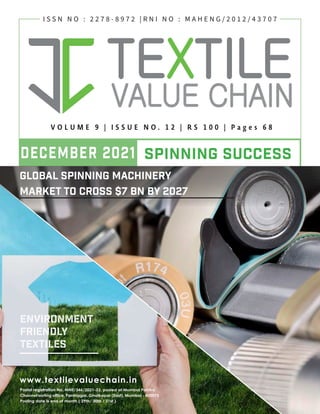
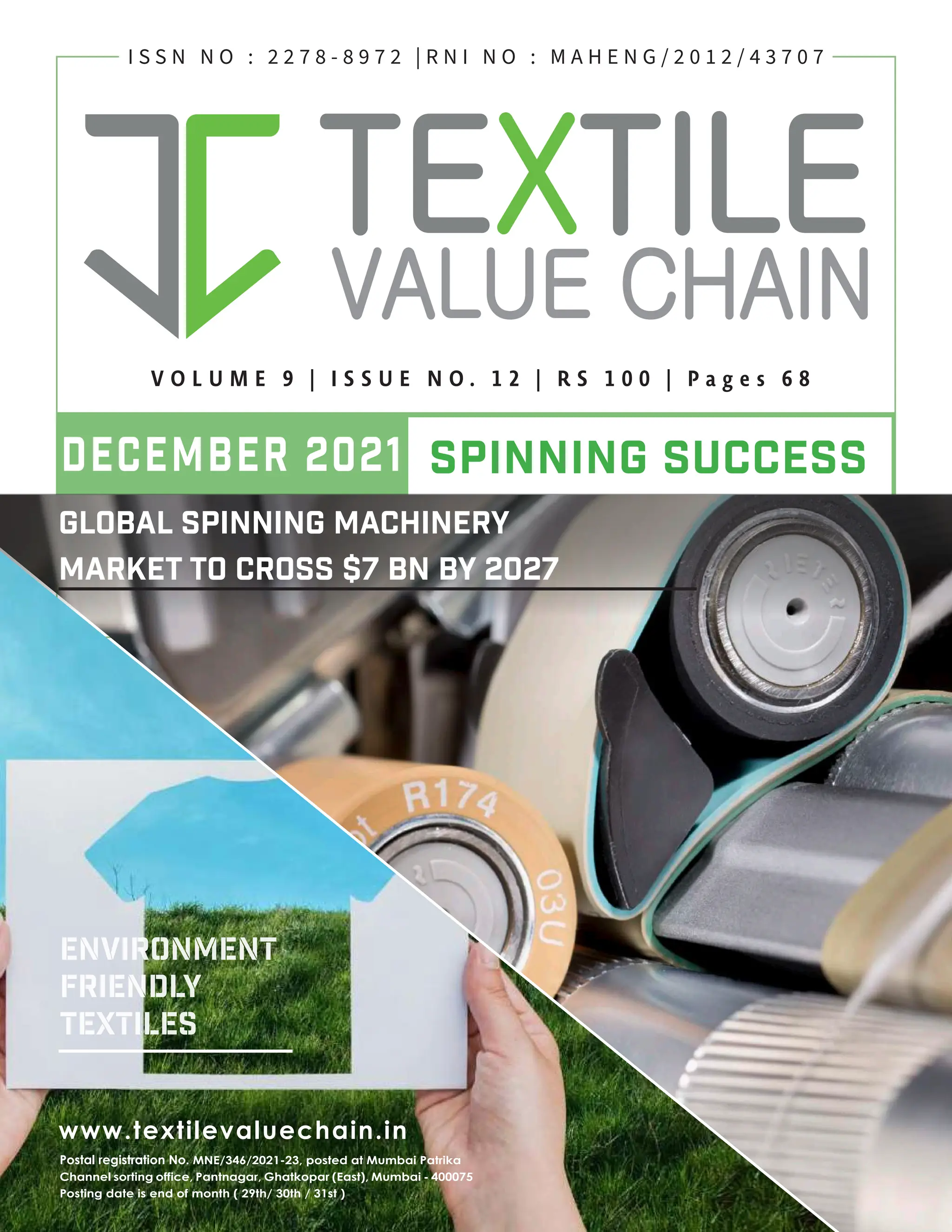
DECEMBER 2021 SPINNING SUCCESS
ENVirONMENT
FRIENDLY
TEXTILES
www.textilevaluechain.in
Postal registration No. MNE/346/2021-23, posted at Mumbai Patrika
Channel sorting office, Pantnagar, Ghatkopar (East), Mumbai - 400075
Posting date is end of month ( 29th/ 30th / 31st )
Global Spinning Machinery
Market to cross $7 Bn by 2027
2 TVC | Dec 2021
3
TVC | Dec 2021
4 TVC | Dec 2021
5
TVC | Dec 2021
6 TVC | Dec 2021
For QUALITY Products from Europe and EFFICIENT Services in India
------------------------------------------------------------------------------------------------------------------------------------------------------
We represent in India the following TexEle Machinery & Accessories manufacturers for
Technical TexEles :
LACOM GmbH, Germany : Hotmelt Lamina-ng and Coa-ng Systems – Mul-
Purpose, Mul- Roller, Gravure Roller and Slot Die for complete range of Technical
Tex-les (Website: www.lacom-online.de)
MORCHEM S.A.U., Spain : PUR Hotmelt Adhesives for Technical Tex-les, Solvent
Based, Water Based adhesives, cleaners and primers. (Website: hSps://
www.morchem.com/markets-and-soluEons/texEle-laminaEon/ )
Fibres, Waste Recycling & Nonwovens :
Margasa, Spain: Tex-le Hard Waste Recycling Lines -complete with prepara-on,
cuKng, Storage, feeding, tearing, filtra-on and fiber packing. Peripheral
equipment, for nonwovens waste. Complete lines for “Airlay Nonwovens” with
thermo or resin bonding. CoSon Waste Cleaning Lines.
(Website: hSp://www.margasa.com)
FARE' S.p.A., Italy : Complete Lines for Spunbond / Meltblown nonwoven
products /complete line to produce all type of fibers including mono and
bicomponent including PET and PET fibers. Machines for producing Tapes and
Rafia (website : www.farespa.com)
ConvenEonal :
Mariplast Spa, Italy : All type of Yarn Carriers for spun and filament yarns
-Cylindrical Tubes, Roving Bobbins, Ring Frame Bobbins, Cones and one -me use
and Reusable Dye Tubes (Website: www.mariplast.com)
C + L TexElmaschinen GmbH, Germany : Reeling (Yarn Hank Forming) Machines,
steaming, Bulking and Banding Machines for yarns (for Western and Southern
India) (Website: www.croon-lucke.com)
7
TVC | Dec 2021
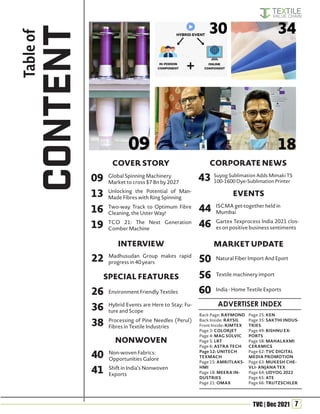
Table
of
CONTENT
09 43
44
46
41
13
16
19
26
22 50
56
60
36
38
40
COVER STORY CORPORATE NEWS
EVENTS
NONWOVEN
SPECIAL FEATURES
INTERVIEW MARKET UPDATE
Global Spinning Machinery
Market to cross $7 Bn by 2027
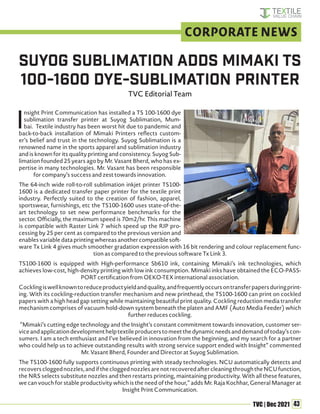
Suyog Sublimation Adds Mimaki TS
100-1600 Dye-Sublimation Printer
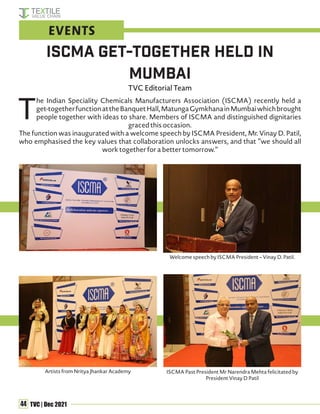
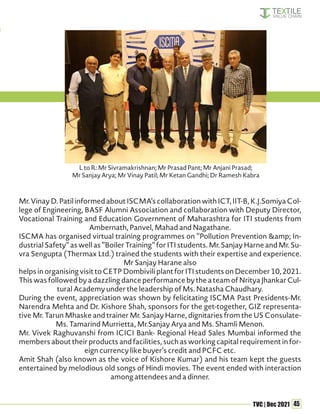
ISCMA get-together held in
Mumbai
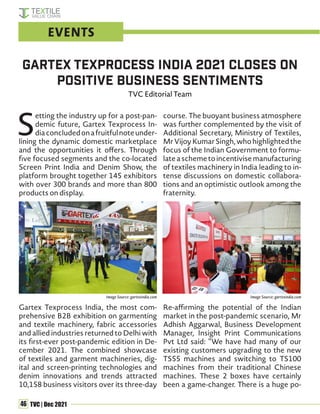
Gartex Texprocess India 2021 clos-
es on positive business sentiments
Unlocking the Potential of Man-
Made Fibres with Ring Spinning
Two-way Track to Optimum Fibre
Cleaning, the Uster Way!
TCO 21: The Next Generation
Comber Machine
Shift in India’s Nonwoven
Exports
Environment Friendly Textiles
Madhusudan Group makes rapid
progress in 40 years
Natural Fiber Import And Eport
Textile machinery import
India - Home Textile Exports
Hybrid Events are Here to Stay: Fu-
ture and Scope
Processing of Pine Needles (Perul)
Fibres in Textile Industries
Non-woven Fabrics:
Opportunities Galore
09 18
30
ADVERTISER INDEX
Back Page: RAYMOND
Back Inside: RAYSIL
Front Inside: RIMTEX
Page 3: COLORJET
Page 4: MAG SOLVIC
Page 5: LRT
Page 6: ASTRA TECH
Page 12: UNITECH
TEXMACH
Page 15: AMRITLAKS-
HMI
Page 18: MEERA IN-
DUSTRIES
Page 21: OMAX
Page 25: KEN
Page 35: SAKTHI INDUS-
TRIES
Page 49: BISHNU EX-
PORTS
Page 58: MAHALAXMI
CERAMICS
Page 62: TVC DIGITAL
MEDIA PROMOTION
Page 63: MUKESH CHE-
VLI- ANJANA TEX
Page 64: UDYOG 2022
Page 65: ATE
Page 66: TRUTZSCHLER
34
8 TVC | Dec 2021
All rights reserved Worldwide; Reproduction of any of the content from
this issue is prohibited without explicit written permission of the publisher.
Every effort has been made to ensure and present factual and accurate
information. The views expressed in the articles published in this magazine
are that of the respective authors and not necessarily that of the publisher.
Textile Value chain is not responsible for any unlikely errors that might
occur or any steps taken based in the information provided herewith.
REGISTERED OFFICE:
Innovative Media and Information
Company
189/5263, Sanmati, Pantnagar,
Ghatkopar (East), Mumbai 400075.
Maharashtra, INDIA.
Cell: +91-9769442239
Email: info@textilevaluechain.com
Web: www.textilevaluechain.com
Owner, Publisher, Printer and
Editor - Ms. Jigna Shah
Printed and Processed by her at,
Impression Graphics,
Gala no.13, Shivai Industrial Estate,
Andheri Kurla Road, Sakinaka,
Andheri (East), Mumbai 400072,
Maharashtra, India.
SUBSCRIPTION
Digital + Print Copy issue
1 Year : 12 issues : Rs. 800
2 Years : 24 issues : Rs. 1500
3 Years : 36 issues : Rs. 2100
Online Registration
https://textilevaluechain.in/subscription/
Subscription Enquiry
Ms. Vaibhavi Kokane
+91-9869634305 ; textilevaluechain123@gmail.com
Marketing and Advertising enquiry
Mohammad Tanweer
+91-9167986305 ; sales@textilevaluechain.com
EDITOR AND PUBLISHER
Ms. Jigna Shah
EDITORIAL TEAM
Spinning machinery has always been the mainstay of
India’s textile machinery industry. Year after year, it has
demonstrated its strength in its end-products or the ma-
chinery & parts segments. In yarns, India is No. 1 and the
potential has been growing tremendously. The machin-
erysegmentisnotfarbehind.DespitetheCOVID-19cri-
sis,theglobalmarketforspinningmachinesestimatedat
US$5 billion in the year 2020, is projected to reach a re-
vised size of US$7.3 billion by 2027, growing at a CAGR
of 5.5 per cent.
Fibre consumption is on the rise, and man-made fibres
today along with natural fibres play an important role in
this. The global demand for the textile yarn market was
valued at US$11.9 billion in 2019 is expected to reach
US$16.0 billion in 2026 and is anticipated to grow at a
CAGR of 4 per cent between 2020 and 2026. Major pro-
duction centres of cotton yarn manufacturing are con-
centrated in China, India, the U.S., Pakistan, Indonesia,
Brazil, Turkey, South Korea, Italy, Egypt, and Japan. With
the concepts of sustainability and environ-friendly prod-
ucts gaining grounds, research is focused on new mixes
of yarns between natural fibres and man-made fibres.
Fashion no longer starts towards the end of the value
chain, but commences right from the selection of raw
materials. Ultimately, this will rekindle the spinning seg-
ment, and also the technologies. Besides, during 2020
and 2021, despite a difficult business climate created by
the pandemic, spinning technology companies continue
to innovate, say industry experts. The initiative to use re-
cycled fibre in yarns is increasing and technologies need
to be refined or created to tackle such fibres in a cost-ef-
fective way, while producing a high-quality product for
downstream processing.
All these stresses the importance of technologies mak-
ing an impact on spinning. Automation initiatives are on
the rise. The industry in India should be aware that with-
out industry 4.0 all will come to nought. The technolo-
gy providers have a major role in this transformation.
Technical textiles have also given new opportunities for
the technology companies. Spinning machinery forms a
major chunk in the production of machinery in India and
the total provisional production of textile machinery,
parts & accessories during 2020-21 recorded a margin-
al decrease of 5% viz, Rs.5,093 crore as against Rs.5,355
crore achieved during the previous year. This is despite
the fact that there was negligible business during first
twoquartersof2020-21.Lookatthemachineryexports,
which during 2020-21 rose to Rs. 3,307 crore as against
Rs. 2,556 crore achieved during 2019-20. Predictably,
the machinery import was reduced to Rs. 8096 crore as
against Rs. 9,273 crore during the year. The textile engi-
neering industry must be happy at this juncture, which
has opened up opportunities galore for sharpening its
competitive edge.
Spinning Success is a
Matter of Time
CREATIVE DESIGNER
Ms. Poiyamozhi P S
CONTENT WRITER
Ms. Somasree Roy
ADVISOR - EDITORIAL & MARKETING
Mr. Samuel Joseph
9
TVC | Dec 2021
F
or two years, Covid-19 raged and ravaged
and the malady still at large, but fortunately
thetextilemachineryindustryinIndia,suffer-
ingfromlow-capacityutilisationat49percentlost
only 3 per cent of its capacity use at 46 per cent.
Thetotalprovisionalproductionoftextilemachin-
ery, parts & accessories during 2020-21 recorded
a marginal decline of 5 per cent at Rs.5,093 crore
as against Rs.5,355 crore in the previous year. Ex-
ports during 2020-21 rose to Rs. 3,307 crore as
against Rs. 2,556 crore achieved during 2019-20.
As a good tiding for the domestic industry, the im-
port was reduced to Rs. 8096 crore as against Rs.
9,273 crore. All these indicators demonstrate that
all is well with the textile machinery industry, and
the spinning machinery and parts have particular-
ly done well domestically as well as globally.
Amid the COVID-19 crisis, the global market for
Spinning Machines estimated at US$ 5 Billion in
the year 2020, is projected to reach a revised size
of US$ 7.3 Billion by 2027, growing at a CAGR of
5.5 per cent over the analysis period 2020-2027.
Ring Spinning is projected to record a 5.6 per cent
CAGR and reach US$ 3.1 Billion by the end of the
analysis period of 2020-2027. According to the
“Spinning Machines - Global Market Trajectory
& Analytics” report of the ResearchAndMarkets.
com. After an early analysis of the business impli-
cations of the pandemic and its induced econom-
ic crisis, growth in the Rotor Spinning segment is
readjusted to a revised 5.8 per cent CAGR for the
next 7-year period.
The Spinning Machines market in the U.S. is esti-
mated at US$ 1.4 Billion in the year 2020. China,
the world’s second largest economy, is forecast
to reach a projected market size of US$ 1.5 Billion
by the year 2027 trailing a CAGR of 8.4 per cent
over the analysis period 2020 to 2027. Among the
other noteworthy geographic markets are Japan
and Canada, each forecast to grow at 3 per cent
and 5 per cent respectively over the 2020-2027
period. Within Europe, Germany is forecast to
grow at approximately 3.5 per cent CAGR. In the
global Other Types segment, USA, Canada, Ja-
pan, China and Europe will drive the 4.4 per cent
CAGRestimatedforthissegment.Theseregional
markets accounting for a combined market size
of US$ 745.2 Million in the year 2020 will reach
a projected size of US$ 1 Billion by the close of
the analysis period. China will remain among the
fastest growing in this cluster of regional mar-
kets.LedbycountriessuchasAustralia,India,and
South Korea, the market in Asia-Pacific is forecast
to reach US$ 976 Million by the year 2027, while
Latin America will expand at a 5.9 per cent CAGR
through the analysis period.
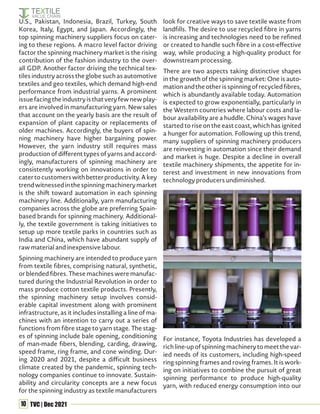
Major production centres of cotton yarn man-
ufacturing are concentrated in China, India, the
Global Spinning Machinery
Market to cross $7 Bn by 2027
TVC Editorial Team
COVER STORY
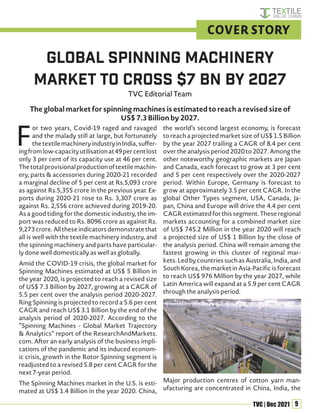
The global market for spinning machines is estimated to reach a revised size of
US$ 7.3 Billion by 2027.
10 TVC | Dec 2021
U.S., Pakistan, Indonesia, Brazil, Turkey, South
Korea, Italy, Egypt, and Japan. Accordingly, the
top spinning machinery suppliers focus on cater-
ing to these regions. A macro level factor driving
factor the spinning machinery market is the rising
contribution of the fashion industry to the over-
all GDP. Another factor driving the technical tex-
tiles industry across the globe such as automotive
textiles and geo textiles, which demand high-end
performance from industrial yarns. A prominent
issuefacingtheindustryisthatveryfewnewplay-
ers are involved in manufacturing yarn. New sales
that account on the yearly basis are the result of
expansion of plant capacity or replacements of
older machines. Accordingly, the buyers of spin-
ning machinery have higher bargaining power.
However, the yarn industry still requires mass
production of different types of yarns and accord-
ingly, manufacturers of spinning machinery are
consistently working on innovations in order to
catertocustomerswithbetterproductivity.Akey
trendwitnessedinthespinningmachinerymarket
is the shift toward automation in each spinning
machinery line. Additionally, yarn manufacturing
companies across the globe are preferring Spain-
based brands for spinning machinery. Additional-
ly, the textile government is taking initiatives to
setup up more textile parks in countries such as
India and China, which have abundant supply of
raw material and inexpensive labour.
Spinning machinery are intended to produce yarn
from textile fibres, comprising natural, synthetic,
or blended fibres. These machines were manufac-
tured during the Industrial Revolution in order to
mass produce cotton textile products. Presently,
the spinning machinery setup involves consid-
erable capital investment along with prominent
infrastructure, as it includes installing a line of ma-
chines with an intention to carry out a series of
functions from fibre stage to yarn stage. The stag-
es of spinning include bale opening, conditioning
of man-made fibers, blending, carding, drawing,
speed frame, ring frame, and cone winding. Dur-
ing 2020 and 2021, despite a difficult business
climate created by the pandemic, spinning tech-
nology companies continue to innovate. Sustain-
ability and circularity concepts are a new focus
for the spinning industry as textile manufacturers
look for creative ways to save textile waste from
landfills. The desire to use recycled fibre in yarns
is increasing and technologies need to be refined
or created to handle such fibre in a cost-effective
way, while producing a high-quality product for
downstream processing.
There are two aspects taking distinctive shapes
in the growth of the spinning market: One is auto-
mationandtheotherisspinningofrecycledfibres,
which is abundantly available today. Automation
is expected to grow exponentially, particularly in
the Western countries where labour costs and la-
bour availability are a huddle. China’s wages have
started to rise on the east coast, which has ignited
a hunger for automation. Following up this trend,
many suppliers of spinning machinery producers
are reinvesting in automation since their demand
and market is huge. Despite a decline in overall
textile machinery shipments, the appetite for in-
terest and investment in new innovations from
technology producers undiminished.
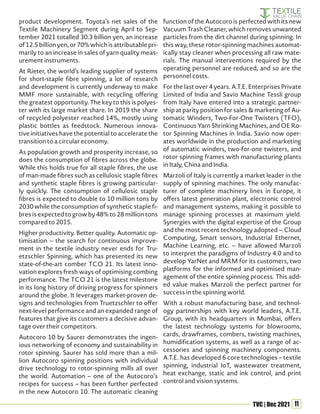
For instance, Toyota Industries has developed a
richline-upofspinningmachinerytomeetthevar-
ied needs of its customers, including high-speed
ring spinning frames and roving frames. It is work-
ing on initiatives to combine the pursuit of great
spinning performance to produce high-quality
yarn, with reduced energy consumption into our
11
TVC | Dec 2021
product development. Toyota’s net sales of the
Textile Machinery Segment during April to Sep-
tember 2021 totalled 30.3 billion yen, an increase
of12.5billionyen,or70%whichisattributablepri-
marily to an increase in sales of yarn quality meas-
urement instruments.
At Rieter, the world’s leading supplier of systems
for short-staple fibre spinning, a lot of research
and development is currently underway to make
MMF more sustainable, with recycling offering
the greatest opportunity. The key to this is polyes-
ter with its large market share. In 2019 the share
of recycled polyester reached 14%, mostly using
plastic bottles as feedstock. Numerous innova-
tive initiatives have the potential to accelerate the
transition to a circular economy.
As population growth and prosperity increase, so
does the consumption of fibres across the globe.
While this holds true for all staple fibres, the use
of man-made fibres such as cellulosic staple fibres
and synthetic staple fibres is growing particular-
ly quickly. The consumption of cellulosic staple
fibres is expected to double to 10 million tons by
2030 while the consumption of synthetic staple fi-
bres is expected to grow by 48% to 28 million tons
compared to 2015.
Higher productivity. Better quality. Automatic op-
timisation -- the search for continuous improve-
ment in the textile industry never ends for Tru-
etzschler Spinning, which has presented its new
state-of-the-art comber TCO 21. Its latest inno-
vation explores fresh ways of optimising combing
performance. The TCO 21 is the latest milestone
in its long history of driving progress for spinners
around the globe. It leverages market-proven de-
signs and technologies from Truetzschler to offer
next-level performance and an expanded range of
features that give its customers a decisive advan-
tage over their competitors.
Autocoro 10 by Saurer demonstrates the ingen-
ious networking of economy and sustainability in
rotor spinning. Saurer has sold more than a mil-
lion Autocoro spinning positions with individual
drive technology to rotor-spinning mills all over
the world. Automation – one of the Autocoro’s
recipes for success – has been further perfected
in the new Autocoro 10. The automatic cleaning
function of the Autocoro is perfected with its new
Vacuum Trash Cleaner, which removes unwanted
particles from the dirt channel during spinning. In
this way, these rotor-spinning machines automat-
ically stay cleaner when processing all raw mate-
rials. The manual interventions required by the
operating personnel are reduced, and so are the
personnel costs.
For the last over 4 years. A.T.E. Enterprises Private
Limited of India and Savio Machine Tessli group
from Italy have entered into a strategic partner-
ship at parity position for sales & marketing of Au-
tomatic Winders, Two-For-One Twisters (TFO),
Continuous Yarn Shrinking Machines, and OE Ro-
tor Spinning Machines in India. Savio now oper-
ates worldwide in the production and marketing
of automatic winders, two-for-one twisters, and
rotor spinning frames with manufacturing plants
in Italy, China and India.
Marzoli of Italy is currently a market leader in the
supply of spinning machines. The only manufac-
turer of complete machinery lines in Europe, it
offers latest generation plant, electronic control
and management systems, making it possible to
manage spinning processes at maximum yield.
Synergies with the digital expertise of the Group
and the most recent technology adopted -- Cloud
Computing, Smart sensors, Industrial Ethernet,
Machine Learning, etc. -- have allowed Marzoli
to interpret the paradigms of Industry 4.0 and to
develop YarNet and MRM for its customers, two
platforms for the informed and optimised man-
agement of the entire spinning process. This add-
ed value makes Marzoli the perfect partner for
success in the spinning world.
With a robust manufacturing base, and technol-
ogy partnerships with key world leaders, A.T.E.
Group, with its headquarters in Mumbai, offers
the latest technology systems for blowrooms,
cards, drawframes, combers, twisting machines,
humidification systems, as well as a range of ac-
cessories and spinning machinery components.
A.T.E. has developed 6 core technologies – textile
spinning, industrial IoT, wastewater treatment,
heat exchange, static and ink control, and print
control and vision systems.
12 TVC | Dec 2021
13
TVC | Dec 2021
F
ibre consumption is on the rise,
and man-made fibres (MMF)
play an important role in this.
Blends containing various fibre ma-
terials are particularly popular and
are found in an increasing number of
applications. Rieter ring spinning ma-
chine G 38 offers unique solutions for
processing MMF and blends.
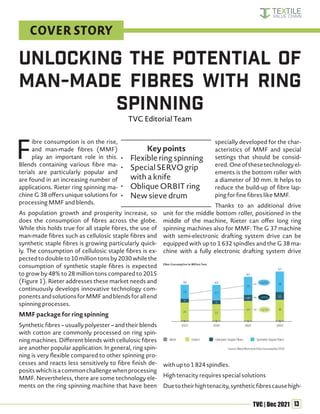
As population growth and prosperity increase, so
does the consumption of fibres across the globe.
While this holds true for all staple fibres, the use of
man-made fibres such as cellulosic staple fibres and
synthetic staple fibres is growing particularly quick-
ly. The consumption of cellulosic staple fibres is ex-
pected to double to 10 million tons by 2030 while the
consumption of synthetic staple fibres is expected
to grow by 48% to 28 million tons compared to 2015
(Figure 1). Rieter addresses these market needs and
continuously develops innovative technology com-
ponentsandsolutionsforMMFandblendsforallend
spinning processes.
MMF package for ring spinning
Synthetic fibres – usually polyester – and their blends
with cotton are commonly processed on ring spin-
ning machines. Different blends with cellulosic fibres
are another popular application. In general, ring spin-
ning is very flexible compared to other spinning pro-
cesses and reacts less sensitively to fibre finish de-
positswhichisacommonchallengewhenprocessing
MMF. Nevertheless, there are some technology ele-
ments on the ring spinning machine that have been
specially developed for the char-
acteristics of MMF and special
settings that should be consid-
ered.Oneofthesetechnologyel-
ements is the bottom roller with
a diameter of 30 mm. It helps to
reduce the build-up of fibre lap-
ping for fine fibres like MMF.
Thanks to an additional drive
unit for the middle bottom roller, positioned in the
middle of the machine, Rieter can offer long ring
spinning machines also for MMF: The G 37 machine
with semi-electronic drafting system drive can be
equipped with up to 1 632 spindles and the G 38 ma-
chine with a fully electronic drafting system drive
with up to 1 824 spindles.
High tenacity requires special solutions
Duetotheirhightenacity,syntheticfibrescausehigh-
Unlocking the Potential of
Man-Made Fibres with Ring
Spinning
TVC Editorial Team
Key points
• Flexible ring spinning
• Special SERVO grip
with a knife
• Oblique ORBIT ring
• New sieve drum
COVER STORY
14 TVC | Dec 2021
er part wear during processing. This can be mitigated
by installing separators with reinforced front edges.
These edges help to protect the separators from the
fibre ends in the event of an ends down and increase
the life cycle of the parts significantly. The high tenac-
ity of synthetic fibres also poses challenges in terms
of reliable detachment during the cop change proce-
dure. If the detachment is unsuccessful, this can re-
sult in dragged yarn and a series of ends down, which
affects yarn quality and efficiency. For this reason, a
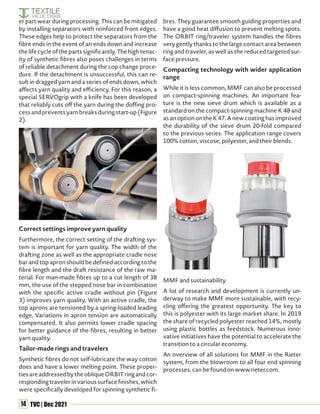
special SERVOgrip with a knife has been developed
that reliably cuts off the yarn during the doffing pro-
cessandpreventsyarnbreaksduringstart-up(Figure
2).
Correct settings improve yarn quality
Furthermore, the correct setting of the drafting sys-
tem is important for yarn quality. The width of the
drafting zone as well as the appropriate cradle nose
bar and top apron should be defined according to the
fibre length and the draft resistance of the raw ma-
terial. For man-made fibres up to a cut length of 38
mm, the use of the stepped nose bar in combination
with the specific active cradle without pin (Figure
3) improves yarn quality. With an active cradle, the
top aprons are tensioned by a spring-loaded leading
edge. Variations in apron tension are automatically
compensated. It also permits lower cradle spacing
for better guidance of the fibres, resulting in better
yarn quality.
Tailor-made rings and travelers
Synthetic fibres do not self-lubricate the way cotton
does and have a lower melting point. These proper-
tiesareaddressedbytheobliqueORBITringandcor-
responding traveler in various surface finishes, which
were specifically developed for spinning synthetic fi-
bres. They guarantee smooth guiding properties and
have a good heat diffusion to prevent melting spots.
The ORBIT ring/traveler system handles the fibres
very gently thanks to the large contact area between
ring and traveler, as well as the reduced targeted sur-
face pressure.
Compacting technology with wider application
range
While it is less common, MMF can also be processed
on compact-spinning machines. An important fea-
ture is the new sieve drum which is available as a
standard on the compact-spinning machine K 48 and
asanoptionontheK47.Anewcoatinghasimproved
the durability of the sieve drum 20-fold compared
to the previous series. The application range covers
100% cotton, viscose, polyester, and their blends.
MMF and sustainability
A lot of research and development is currently un-
derway to make MMF more sustainable, with recy-
cling offering the greatest opportunity. The key to
this is polyester with its large market share. In 2019
the share of recycled polyester reached 14%, mostly
using plastic bottles as feedstock. Numerous inno-
vative initiatives have the potential to accelerate the
transition to a circular economy.
An overview of all solutions for MMF in the Rieter
system, from the blowroom to all four end spinning
processes, can be found on www.rieter.com.
15
TVC | Dec 2021
DIRECT WARPING-
COTTON
DIRECT WARPER
WITH
EVENISER
HIGH SPEED
FILAMENT SIZING
MACHINE
+91 80800 62392
amritlakshmi@amritlakshmi.com
amritlakshmi.com
"PioneersInWeavingPreparatorySince1978”
HIGH SPEED SIZING
MACHINE
JUTE SIZING
FILAMENT
BEAMING MACHINE
Contact Us
V
a
r
i
e
t
i
e
s
o
f
P
r
o
d
u
c
t
s
O
ffered
16 TVC | Dec 2021
U
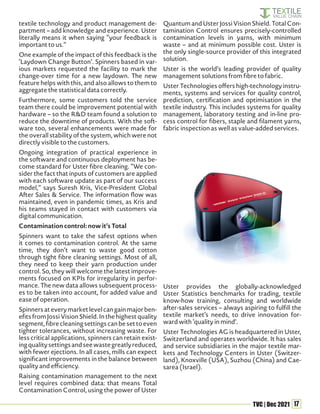
ster fosters a highly effective dialogue with
its customers – so that spinning mills play a
continuing role in the development of sys-
tem improvements. Customer needs are fed back
directly to Uster R&D experts, leading to con-
stant progress in fibre cleaning, with reductions in
costs, less waste and a stress-free experience for
the spinners. It’s a two-way track to progress.
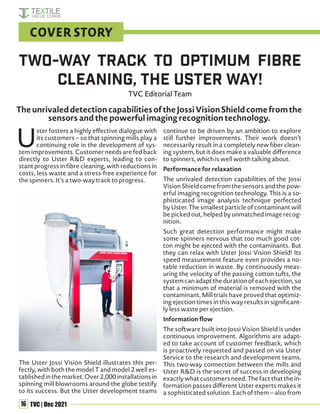
The Uster Jossi Vision Shield illustrates this per-
fectly, with both the model T and model 2 well es-
tablishedinthemarket.Over2,000installationsin
spinning mill blowrooms around the globe testify
to its success. But the Uster development teams
continue to be driven by an ambition to explore
still further improvements. Their work doesn’t
necessarily result in a completely new fiber clean-
ing system, but it does make a valuable difference
to spinners, which is well worth talking about.
Performance for relaxation
The unrivaled detection capabilities of the Jossi
Vision Shield come from the sensors and the pow-
erful imaging recognition technology. This is a so-
phisticated image analysis technique perfected
by Uster. The smallest particle of contaminant will
be picked out, helped by unmatched image recog-
nition.
Such great detection performance might make
some spinners nervous that too much good cot-
ton might be ejected with the contaminants. But
they can relax with Uster Jossi Vision Shield! Its
speed measurement feature even provides a no-
table reduction in waste. By continuously meas-
uring the velocity of the passing cotton tufts, the
system can adapt the duration of each ejection, so
that a minimum of material is removed with the
contaminant. Mill trials have proved that optimiz-
ing ejection times in this way results in significant-
ly less waste per ejection.
Information flow
The software built into Jossi Vision Shield is under
continuous improvement. Algorithms are adapt-
ed to take account of customer feedback, which
is proactively requested and passed on via Uster
Service to the research and development teams.
This two-way connection between the mills and
Uster R&D is the secret of success in developing
exactly what customers need. The fact that the in-
formation passes different Uster experts makes it
a sophisticated solution. Each of them – also from
Two-way Track to Optimum Fibre
Cleaning, the Uster Way!
TVC Editorial Team
COVER STORY
TheunrivaleddetectioncapabilitiesoftheJossiVisionShieldcomefromthe
sensors and the powerful imaging recognition technology.
17
TVC | Dec 2021
textile technology and product management de-
partment – add knowledge and experience. Uster
literally means it when saying “your feedback is
important to us.”
One example of the impact of this feedback is the
‘Laydown Change Button’. Spinners based in var-
ious markets requested the facility to mark the
change-over time for a new laydown. The new
feature helps with this, and also allows to them to
aggregate the statistical data correctly.
Furthermore, some customers told the service
team there could be improvement potential with
hardware – so the R&D team found a solution to
reduce the downtime of products. With the soft-
ware too, several enhancements were made for
the overall stability of the system, which were not
directly visible to the customers.
Ongoing integration of practical experience in
the software and continuous deployment has be-
come standard for Uster fibre cleaning. “We con-
sider the fact that inputs of customers are applied
with each software update as part of our success
model,” says Suresh Kris, Vice-President Global
After Sales & Service. The information flow was
maintained, even in pandemic times, as Kris and
his teams stayed in contact with customers via
digital communication.
Contamination control: now it’s Total
Spinners want to take the safest options when
it comes to contamination control. At the same
time, they don’t want to waste good cotton
through tight fibre cleaning settings. Most of all,
they need to keep their yarn production under
control. So, they will welcome the latest improve-
ments focused on KPIs for irregularity in perfor-
mance. The new data allows subsequent process-
es to be taken into account, for added value and
ease of operation.
Spinnersateverymarketlevelcangainmajorben-
efits from Jossi Vision Shield. In the highest quality
segment,fibrecleaningsettingscanbesettoeven
tighter tolerances, without increasing waste. For
less critical applications, spinners can retain exist-
ingqualitysettingsandseewastegreatlyreduced,
with fewer ejections. In all cases, mills can expect
significant improvements in the balance between
quality and efficiency.
Raising contamination management to the next
level requires combined data: that means Total
Contamination Control, using the power of Uster
Quantum and Uster Jossi Vision Shield. Total Con-
tamination Control ensures precisely-controlled
contamination levels in yarns, with minimum
waste – and at minimum possible cost. Uster is
the only single-source provider of this integrated
solution.
Uster is the world’s leading provider of quality
management solutions from fibre to fabric.
Uster Technologies offers high-technology instru-
ments, systems and services for quality control,
prediction, certification and optimisation in the
textile industry. This includes systems for quality
management, laboratory testing and in-line pro-
cess control for fibers, staple and filament yarns,
fabric inspection as well as value-added services.
Uster provides the globally-acknowledged
Uster Statistics benchmarks for trading, textile
know-how training, consulting and worldwide
after-sales services – always aspiring to fulfill the
textile market’s needs, to drive innovation for-
ward with ‘quality in mind’.
Uster Technologies AG is headquartered in Uster,
Switzerland and operates worldwide. It has sales
and service subsidiaries in the major textile mar-
kets and Technology Centers in Uster (Switzer-
land), Knoxville (USA), Suzhou (China) and Cae-
sarea (Israel).
18 TVC | Dec 2021
Futuristic Twisting
Futuristic Twisting
Twisting Solutions
Twisting Solutions
Textiles
Textiles
FIBC Threads
Belting Fabrics
Dipped Cords
Geo Textiles
Bullet Proof Jackets
direct twisting +
precision winding
Tapes / Twines / Multifilament
Meera Industries USA, LLC
209, Swathmore Ave, High Point
NC, USA 27263
Meera Industries Limited
2126, Road No.2, GIDC, Sachin, Surat
394230 Gujarat, INDIA
+91 98795 97041 | sales@meeraind.com | www.meeraind.com
19
TVC | Dec 2021
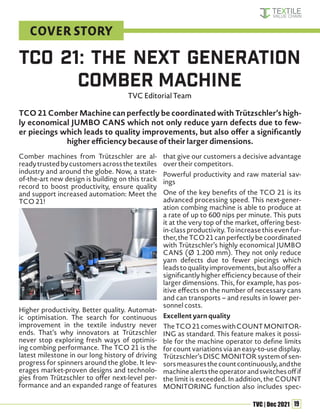
TCO 21 Comber Machine can perfectly be coordinated with Trützschler’s high-
ly economical JUMBO CANS which not only reduce yarn defects due to few-
er piecings which leads to quality improvements, but also offer a significantly
higher efficiency because of their larger dimensions.
Comber machines from Trützschler are al-
readytrustedbycustomersacrossthetextiles
industry and around the globe. Now, a state-
of-the-art new design is building on this track
record to boost productivity, ensure quality
and support increased automation: Meet the
TCO 21!
Higher productivity. Better quality. Automat-
ic optimisation. The search for continuous
improvement in the textile industry never
ends. That’s why innovators at Trützschler
never stop exploring fresh ways of optimis-
ing combing performance. The TCO 21 is the
latest milestone in our long history of driving
progress for spinners around the globe. It lev-
erages market-proven designs and technolo-
gies from Trützschler to offer next-level per-
formance and an expanded range of features
that give our customers a decisive advantage
over their competitors.
Powerful productivity and raw material sav-
ings
One of the key benefits of the TCO 21 is its
advanced processing speed. This next-gener-
ation combing machine is able to produce at
a rate of up to 600 nips per minute. This puts
it at the very top of the market, offering best-
in-class productivity. To increase this even fur-
ther,theTCO21canperfectlybecoordinated
with Trützschler’s highly economical JUMBO
CANS (Ø 1.200 mm). They not only reduce
yarn defects due to fewer piecings which
leadstoqualityimprovements,butalsooffera
significantly higher efficiency because of their
larger dimensions. This, for example, has pos-
itive effects on the number of necessary cans
and can transports – and results in lower per-
sonnel costs.
Excellent yarn quality
TheTCO21comeswithCOUNTMONITOR-
ING as standard. This feature makes it possi-
ble for the machine operator to define limits
for count variations via an easy-to-use display.
Trützschler’s DISC MONITOR system of sen-
sorsmeasuresthecountcontinuously,andthe
machinealertstheoperatorandswitchesoffif
the limit is exceeded. In addition, the COUNT
MONITORING function also includes spec-
TCO 21: The Next Generation
Comber Machine
TVC Editorial Team
COVER STORY
20 TVC | Dec 2021
trogram analysis.
Customers can further strengthen their focus
on quality by choosing to add the COUNT
CONTROL function to the TCO 21. It is man-
aged via the same easy-to-use display, and of-
fers automatic sliver count measurement, as
well as spectrogram analysis. On top of this, it
automatically regulates the main draft during
production to balance count variations and
ensure the desired sliver count. This feature is
particularlyattractiveforcustomerswhowho
manufacture blends of cotton and synthetic,
as it can also be used to avoid variations in the
overall yarn composition.
Automatic optimisation
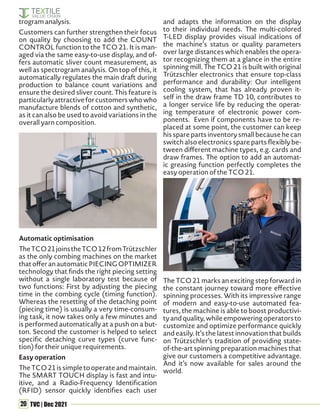
TheTCO21joinstheTCO12fromTrützschler
as the only combing machines on the market
thatofferanautomaticPIECINGOPTIMIZER
technology that finds the right piecing setting
without a single laboratory test because of
two functions: First by adjusting the piecing
time in the combing cycle (timing function).
Whereas the resetting of the detaching point
(piecing time) is usually a very time-consum-
ing task, it now takes only a few minutes and
is performed automatically at a push on a but-
ton. Second the customer is helped to select
specific detaching curve types (curve func-
tion) for their unique requirements.
Easy operation
TheTCO21issimpletooperateandmaintain.
The SMART TOUCH display is fast and intu-
itive, and a Radio-Frequency Identification
(RFID) sensor quickly identifies each user
and adapts the information on the display
to their individual needs. The multi-colored
T-LED display provides visual indications of
the machine’s status or quality parameters
over large distances which enables the opera-
tor recognizing them at a glance in the entire
spinning mill. The TCO 21 is built with original
Trützschler electronics that ensure top-class
performance and durability: Our intelligent
cooling system, that has already proven it-
self in the draw frame TD 10, contributes to
a longer service life by reducing the operat-
ing temperature of electronic power com-
ponents. Even if components have to be re-
placed at some point, the customer can keep
his spare parts inventory small because he can
switch also electronics spare parts flexibly be-
tween different machine types, e.g. cards and
draw frames. The option to add an automat-
ic greasing function perfectly completes the
easy operation of the TCO 21.
The TCO 21 marks an exciting step forward in
the constant journey toward more effective
spinning processes. With its impressive range
of modern and easy-to-use automated fea-
tures, the machine is able to boost productivi-
tyandquality,whileempoweringoperatorsto
customize and optimize performance quickly
and easily. It’s the latest innovation that builds
on Trützschler’s tradition of providing state-
of-the-art spinning preparation machines that
give our customers a competitive advantage.
And it’s now available for sales around the
world.
21
TVC | Dec 2021
F A R M T O F A S H I O N
F
A
R
M
I
N
G
G
I
N
N
I
N
G
K
N
I
T
T
I
N
G
D
Y
E
I
N
G
A
N
D
P
R
I
N
T
I
N
G
G
A
R
M
E
N
T
I
N
G
S
P
I
N
N
I
N
G
1800 - 889 - 6020
info@omaxcotspin.com
www.omaxcotspin.com
Sr. No. 842,843,845/1, Near. Petrol Pump, Village Rajsitapur , Ta. Dhrangadhra Dist. Surendranagar. Gujarat. (INDIA).
22 TVC | Dec 2021
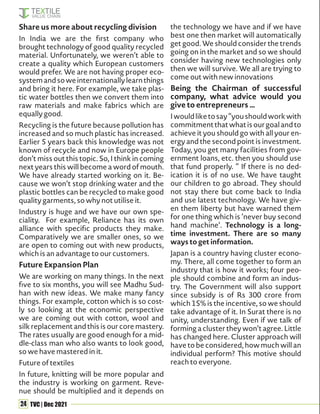
GirdharGopal Mundra , Vice Chairman and Yatiraj Mundra, Director of Mad-
husudan Group speak about their company, plans for the future and also the
values important for entrepreneurs.
Brief of company since inception
In 1982, we shifted to Surat from Pipari-
ya Madhya Pradesh, which falls under
Jabalpur railway division. The main reason
for shifting is that in Pipariya there is no
wholesale shop for buying clothes. There
was no scope in Pipariya. We also travelled
and studied Bombay, Ahmedabad, and Su-
rat and found that Surat is a more progres-
sive place and in future there is plenty of
scope. Having travelled for 10 years, first
in Surat we made sarees for 2-3 years, and
then we made shirts. In Surat we launched
a shirt, called Texcon Tex shirting in latest
fashion. In 1992 we had developed a pro-
cess house in Madhusudan. Students stud-
ying engineering or non-engineering study,
chemicalindustry,etchavethepotentialto
set up textile industry. A student who has
studied mechanical engineering and 2 stu-
dents having done MBAs in the US came
over here. Here, innovative pop culture
thriving, t-shirts became popular, and we
made cloth from plastic bottles. China be-
ing a tough competitor in these products.
Howwasthecompanygoinginthelast
40 years under your leadership?
In 1975 I set up a business and from 1976
onwards I had managed the complete
work. This is a family business of textiles
and we have offices in Mumbai, Bhiwandi,
Surat, Panipat, Amritsar, Kolkata and many
more places. Apart from the domestic
business, we are in the export business too
MadhuSudan Group makes
rapid progress in 40 years
INTERVIEW
Mr. GirdharGopal Mundra
Vice Chairman
Mr. Yatiraj Mundra
Director
23
TVC | Dec 2021
in yarns and garments. Our company has
moved from Rs 3 lakh turnover to Rs 500
crore.
How much are your domestic and in-
ternational turnovers currently?
The share of domestic business is 60% and
40% is export. We are exporting to coun-
tries including Thailand, Turkey, Bangla-
desh, Sri-Lanka, and many more. We are
having textile centres in some areas and
we have our agents’ offices as well our of-
fices. In some areas our teams are availa-
ble and are running the business.
What are the Value and Ethics of Mad-
hu Sudan?
We are known for 6 types of values, i.e.,
team work, diversity, innovation, adapt-
able, discipline, accountable. Madhusu-
dan company is an ethical textile company
in the world. Any of the company can be
associate with Madhusudan and they will
definitely get best services, best innova-
tion best development in the ethical way.
How much research is going on and
what developments?
Wehaveresearchcentresineverydivision.
Ingarments,everydayisanewinnovation.
Today we have 11,000 different qualities
we have R&D department in every sector
they study and come with new ideas on
howthetrendisgoingonandthenproduce
goodsgivingitbacktocustomers.Whyitis
successful? Because here the top manage-
ment, R&D and we ourselves personally
do all machine development. The team is
working towards new development.
What are your patent policies?
Unfortunately, textile industry is very un-
organised. There is one solution which
says if we perform new innovation that
will be copied so patent doesn’t work in
this industry. There is only one thing which
says we come with innovation that gets
copied and then we proceed with more
new things. Always be one step ahead to
always come with new ideas because era
ofpatenthasvanished.ThepeopleofSurat
are very sharp since they grasp new things
and also maintain reasonability for cus-
tomers. If something costs somewhere Rs
10 lakh here it will cost only in thousands.
We brought our machine idea from Korea
in 1998-99 for Rs 1.5 crore and made our
firstmachineforRs12lakhandafterwards
it was copied and made for Rs 3 to 4 lakh.
Views on pricing…
There are two things: First, those who will
invent; their prices will always be high and
the second thing is we are in this market
and we will sell to customers who are go-
ing to buy things from others also. We are
a competitive company with competitive
price and additional service and value is
innovation where customer gets the re-
alisation of price today. Customer gets
that benefit if someone takes value added
product from us.
What are your new plans and textile
expansion?
It is already a vertically integrated yarn
plant. It also has processing and garment-
ing and we own our brand and the plan af-
ter 1 to 2 years is to expand in every field.
The more the production the more is our
sales. We have expanded right from toy to
garments. Madhusudhan will vertically in-
tegrated textile company. Apart from this
we also have one vertical in medical into
health care division, which manufactures
equipment and products for health care.
WeexporttotheUS,Canada,Switzerland,
Belgium, etc. In India, we supply directly
and also distribute.
24 TVC | Dec 2021
Share us more about recycling division
In India we are the first company who
brought technology of good quality recycled
material. Unfortunately, we weren’t able to
create a quality which European customers
would prefer. We are not having proper eco-
systemandsoweinternationallylearnthings
and bring it here. For example, we take plas-
tic water bottles then we convert them into
raw materials and make fabrics which are
equally good.
Recycling is the future because pollution has
increased and so much plastic has increased.
Earlier 5 years back this knowledge was not
known of recycle and now in Europe people
don’t miss out this topic. So, I think in coming
next years this will become a word of mouth.
We have already started working on it. Be-
cause we won’t stop drinking water and the
plastic bottles can be recycled to make good
quality garments, so why not utilise it.
Industry is huge and we have our own spe-
ciality. For example, Reliance has its own
alliance with specific products they make.
Comparatively we are smaller ones, so we
are open to coming out with new products,
which is an advantage to our customers.
Future Expansion Plan
We are working on many things. In the next
five to six months, you will see Madhu Sud-
han with new ideas. We make many fancy
things. For example, cotton which is so cost-
ly so looking at the economic perspective
we are coming out with cotton, wool and
silk replacement and this is our core mastery.
The rates usually are good enough for a mid-
dle-class man who also wants to look good,
so we have mastered in it.
Future of textiles
In future, knitting will be more popular and
the industry is working on garment. Reve-
nue should be multiplied and it depends on
the technology we have and if we have
best one then market will automatically
get good. We should consider the trends
going on in the market and so we should
consider having new technologies only
then we will survive. We all are trying to
come out with new innovations
Being the Chairman of successful
company, what advice would you
give to entrepreneurs …
Iwouldliketosay“youshouldworkwith
commitmentthatwhatisourgoalandto
achieve it you should go with all your en-
ergy and the second point is investment.
Today, you get many facilities from gov-
ernment loans, etc. then you should use
that fund properly. “ If there is no ded-
ication it is of no use. We have taught
our children to go abroad. They should
not stay there but come back to India
and use latest technology. We have giv-
en them liberty but have warned them
for one thing which is ‘never buy second
hand machine’. Technology is a long-
time investment. There are so many
ways to get information.
Japan is a country having cluster econo-
my. There, all come together to form an
industry that is how it works; four peo-
ple should combine and form an indus-
try. The Government will also support
since subsidy is of Rs 300 crore from
which 15% is the incentive, so we should
take advantage of it. In Surat there is no
unity, understanding. Even if we talk of
forming a cluster they won’t agree. Little
has changed here. Cluster approach will
have to be considered, how much will an
individual perform? This motive should
reach to everyone.
25
TVC | Dec 2021
V I S I O N
D i v e r s e p r o d u c t k n o w l e d g e
T e c h n i c a l l y q u a l i f i e d &
c o m p e t e n t t e a m t o s e r v i c e t h e
c u s t o m e r n e e d s
O r g a n i z a t i o n a l s t r e n g t h & b a c k -
u p t o e x e c u t e l a r g e i n s t i t u t i o n a l
o r d e r s
P r o d u c t d e v e l o p m e n t & S a m p l i n g
a r e u n d e r t a k e n c o m m e r c i a l l y
+91 230 243 8538 office@kenindia.in
Q U A L I T Y P O L I C Y
U n d e r s t a n d i n g o f C u s t o m e r n e e d s
& a b i l i t y t o s e r v i c e i n s t i t u t i o n a l
c u s t o m e r s t o a p p a r e l s
F a b r i c D e s i g n & D e v e l o p m e n t
c a p a b i l i t y
D i v e r s e m a n u f a c t u r i n g c a p a b i l i t y
A b i l i t y t o d e l i v e r & c o m m i t m e n t
t o e x c e l l e n c e
To be the supplier of first choice for our customers working in close
association with them offering complete Fabric & Apparels related
solutions from design to delivery.
KEN endeavors to create value for its customers by setting
benchmarks in cost competitiveness, quality parameters and
turnaround time. This is to be achieved by a continuous process of
product innovation, enhancement of personnel skills and optimum
utilization of technology.
W H Y K E N . . .
O r g a n i z a t i o n w i t h 8 0 0 M e m b e r s
T e a m
9/621, Industrial Estate,
Ichalkaranji- 416115,
Maharashtra, INDIA.
CORPORATE OFFICE
26 TVC | Dec 2021
T
he textile industry in India is a gigantic industry – and it is gigantically polluting. The textile industry uses copious amounts of
two things: water and chemicals third largest pollution generating industry after Leather & paper. This industry is a unique
industry where designer wants to touch the emotions of human - ultimate user. When this industry moves towards fashion,
it is ultra-dynamic in nature & it changes at every moment. In this era of global warming, it is very clear that, we stand at a turn-
ing point. For the first time, humans are no longer just affected by
weather cycles & affecting natural seasons & climatic cycles - and
also suffering the consequences of doing so.
Climate change is one of the most pressing problems of the 21st
century. It affects everything, right from the air we breathe, the
water we drink, the food we grow & eat & cloths we wear. Also,
the textiles we consume on daily basis are produced in a harm-
ful manner right from cultivation to disposal. This is because the
chemicals used during the lifecycle of garment releases harmful
pollutants which affect nature including human being.
Water is used at every stage in fabric manufacturing process to
dissolve chemicals to be used & then to wash and rinse out those
same chemicals to be ready for the next step. It takes between
large amounts of the chemicals to produce fabric. The production
of the one T shirt (right from cultivation to disposal) consumes
approximate 4000 Litres of water & huge amount of chemicals.
The chemically infused effluent-saturated with dyes, de-foamers,
detergents, bleaches, optical brighteners, softeners, stiffeners,
and many other chemicals -- is often released into the local river,
where it enters the groundwater, drinking water, & gives adverse
impacts on flora, fauna, and our food chain.
One should note a seriousness of this & try to understand that,
many of these chemicals remain in the fabric that gets absorbed
through human skin during usages. Over a period of time, we abrade tiny particles of the fabric that we then ingest or inhale. One
Kgofcottonfabricconventionallyprocessedintofabriccontains75%cottonfibresand25%chemicals,manyofwhichareproven
toxic to humans and animals. These chemicals get mixed with local water reservoirs / rivers & pollute it. Just imagine living with-
out fresh food & water. In India alone textile industry consumes water quantity equal to around 2 million Olympic size swimming
poolseveryyearthattooreleaselargelyuntreated.Theuseofchemicalsanddyesduringthemanufactureoftextilesgeneratesan
enormous quantity of waste as sludge, fibres and chemically polluted waters. As a consequence of such high quantities of solid &
liquid waste, textile industries are now facing major problems in environment pollution.
WhileunderstandingbasicsofTextiles,itleadstovarietyofchemicaloperationsandmaterials.Letusacceptthetruththat,Textile
istheonlymaterialwhichisincontactwithhumanskinfor24hours&anypollutantpresentonfabricsurfaceistendtoaccumulate
onsurfaceofskinoraccumulateinfattissues&harmthebody.Itisalsoharmfultomotherearthwhenitisreleasedtoatmosphere
by the way of production activity, frequent washes at user end, & also at the time of disposal after use. Textile contributes a range
of potential hazards to its workers and the surrounding communities and environment. Chemicals are frequently used in work-
places & some of them are by nature hazardous. It is essential to understand the chemical nature & its impact on environment
beforeapplication&shouldtrytoeliminatesuchchemicals.Manyscientistshaveworkeddeeplyonthissubject&derivedalistof
Environment Friendly Textiles
Basics of pollution & pollutants
(This article by Sanjay Harane, is specially focused on producing textile end
products used for fashion & luxurious life in non-toxic, ethical and sustaina-
ble manner. It also highlights the methodology - How to produce sensuous
fabrics which is eco-friendly & not harmful to human being & surrounding
environment. The author, Sanjay Harane, has 38 years of experience. He
workedwithleadingtextilecompaniesandrepresentedvarioustextilerelat-
edassociations.Hehasalsopublishedmanyarticlesonpollutionandhazard-
ous chenicals.)
SPECIAL FEATURES
27
TVC | Dec 2021
chemicals in textiles – popularly known as RSL (Restricted Substances List) In addition to this, as a further activity, they released
a list MRSL (Manufacturers Restricted Substances List) This leads to restriction of chemicals usage during production activity.
This is because, large numbers of man power being used in textile production activity & they can have adverse effect of pollutants
& lead to develop harmful effect. European countries have worked in this connection & developed REACH document (REACH
stands for - Registration, Evaluation, Authorisation and Restriction of Chemicals) REACH is a regulation of the European Union,
adopted to improve the protection of human health and the environment from the risks that can be posed by chemicals, while
enhancing the competitiveness of the EU chemicals industry. It also promotes alternative methods for the hazard assessment of
substances in order to reduce the number of tests on animals.
In principle, REACH applies to all chemical substances; not only those used in industrial processes but also in our day-to-day lives,
for example in cleaning products, paints as well as in articles such as clothes, furniture and electrical appliances. Therefore, the
regulation has an impact on most companies across the EU.
REACH places the burden of proof on companies. To comply with the regulation, companies must identify and manage the risks
linkedtothesubstancestheymanufactureandmarketintheEU.Italsohelpstounderstandhowthesubstancecanbesafelyused,
and they must communicate the risk management measures to the users.
Iftheriskscannotbemanaged,authoritiescanrestricttheuseofsubstancesindifferentways.Inthelongrun,themosthazardous
substances should be substituted with less dangerous ones.
It’s necessary for Employers to make necessary arrangements to ensure the safety and health of employees who handle, store
and transport chemicals. In order to make such arrangements the employer has to evaluate work related hazards or potential
hazards and develop safety procedures and risk control measures.
What is Pollution: -
The contamination of soil, water, or the atmosphere by the discharge of harmful substances is known as the act or process of pol-
luting or the state of being polluted,
Generally, pollution is an outcome of human activity & impact of other living ani-
mals on natural atmosphere.
Thetextileindustryisoneofthemostpollutantsreleasingindustriesoftheworld.
... Besides, 20 percent of all fresh water pollution is made by textile treatment and
dyeing. Pollutants released by the global textile industry are continuously doing
unimaginable harm to the environment. It is essential to have sharp focus on pol-
lution & pollutants created by Textile industry.
Impact of pollution is observed on Air, Water & Soil.
It Disturbs the Natural cycles (seasonal changes) in atmosphere.
Global warming
Ozone layer depletion
Process Pollutants
Sizing & Desizing Enzymes, Starch, Waxes, CMC, PVA etc..
Scouring & Bleaching Hydrogen Peroxide, caustic, Soda ash, Sodium Hypo chloride, Pero stabilizer, Surfactant,
Acetic acid, cotton wax etc..
Mercerizing, Caustic Soda, Cotton wax etc..
Dyeing Dyes, Salts, Surfactant, Urea, Soda Ash etc..
Printing Urea, Dyes, Pigments, Binder, Soda Ash, Thickener etc..
Finishing Resins, Formaldehyde, PVA, Waxes, silicones, Polyethylene etc.
28 TVC | Dec 2021
Sizing:Thisprocessinvolvessizingofyarnwithstarchorpolyvinylalcohol(PVA)orcarboxylmethylcellulose(CMC)togivenecessary
tensile strength and smoothness required for weaving.
Desizing:The sizing components which are rendered water soluble during sizing are removed from the cloth to make it suitable for dye-
ing and further processing. This can be done either through conventional process of acid steeping or through enzymes.
Scouring / Bleaching: This process involves removal of natural impurities such as greases, waxes, fats and other impurities. The desize
cloth is taken for scouring. This can be done either through conventional method (kier boiling) or through modern techniques (contin-
uous scour). Kiering liquor is an alkaline solution containing caustic soda, soda ash, Hydrogen peroxide, Peroxide stabilizer, with small
amount of detergent. This process removes the natural colouring materials and renders the cloths white.
Mercerizing: The process of Mercerization provides lustre, strength, increases dye affinity and abrasion resistance to fabrics. It is gen-
erally carried out for cotton fabrics only for easy dyeing. Mercerization can be carried out with the help of highly concentrated caustic
soda (250 to 300 GPL) with alkaline stable wetting agent.
Dyeing & Printing: This is the most complex step in wet processing which provides attractive colour on the product. Dyeing is carried
outeitheratthefibrestage,yarnstage,oratfabricstage.Fordyeingprocess,hundredsofdyesandauxiliariesareused.Intextileindustry,
various types of fibres are used which leads to different process & various dyes & chemicals printing paste add to the load of pollution
drastically.
Finishing: Finishing process is a specialised process which leads to use of various specialised chemicals & ultimate pollution load is in-
creased. The finishing chemicals are more harmful to human health & also are environmental hazards.
The combination of all above processes used in textile manufacturing, large volume of water with various pollutants is generated & it
Type of
Chemical Haz-
ard
Impact of Hazard Precautions to be taken
Physical hazard
Cause fire
Proper storage of chemicals
Explosive
Corrodes equipment, plant & machinery
Causes violent reactions when used with other chemi-
cals in process
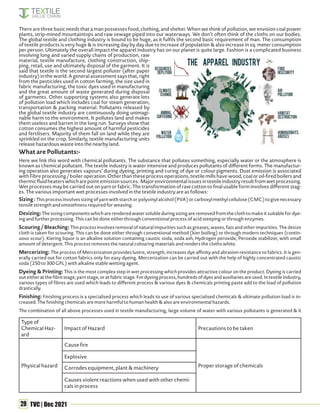
There are three basic needs that a man possesses food, clothing, and shelter. When we think of pollution, we envision coal power
plants, strip-mined mountaintops and raw sewage piped into our waterways. We don’t often think of the cloths on our bodies.
The global textile and clothing industry is bound to be huge, as it fulfils the second basic requirement of man. The consumption
of textile products is very huge & is increasing day by day due to increase of population & also increase in sq. meter consumption
per person. Ultimately the overall impact the apparel industry has on our planet is quite large. Fashion is a complicated business
involving long and varied supply chains of production, raw
material, textile manufacture, clothing construction, ship-
ping, retail, use and ultimately disposal of the garment. It is
said that textile is the second largest polluter (after paper
industry) in the world. A general assessment says that, right
from the pesticides used in cotton farming, the size used in
fabric manufacturing, the toxic dyes used in manufacturing
and the great amount of waste generated during disposal
of garments. Other supporting systems also generate lots
of pollution load which includes coal for steam generation,
transportation & packing material. Pollutants released by
the global textile industry are continuously doing unimagi-
nable harm to the environment. It pollutes land and makes
them useless and barren in the long run. Surveys show that
cotton consumes the highest amount of harmful pesticides
and fertilisers. Majority of them fall on land while they are
sprinkled on the crop. Similarly, textile manufacturing units
release hazardous waste into the nearby land.
What are Pollutants:-
Here we link this word with chemical pollutants. The substance that pollutes something, especially water or the atmosphere is
known as chemical pollutant. The textile industry is water intensive and produces pollutants of different forms. The manufactur-
ing operation also generates vapours’ during dyeing, printing and curing of dye or colour pigments. Dust emission is associated
with Fibre processing / boiler operation. Other than these process operations, textile mills have wood, coal or oil-fired boilers and
thermicfluidheaterswhicharepointemissionsources. Majorenvironmentalissuesintextileindustryresultfromwetprocessing.
Wet processes may be carried out on yarn or fabric. The transformation of raw cotton to final usable form involves different stag-
es. The various important wet processes involved in the textile industry are as follows:
29
TVC | Dec 2021
needs to be treated in Effluent treatment plant. There are two wars to reduce pollution load
1) By treating effluent in correct manner with correct discharge norms.
2) By avoiding / reducing use of chemical hazards in process.
In second option, one can select green chemicals which are no or less harmful & gets bio-degraded without adverse impact on atmos-
phere. Green chemistry is a whole new way of thinking or entire new production approach that helps in using the existing knowledge
and fundamentals of chemistry and other sciences to decrease the negative impact environment is facing. Green chemistry is different
processes and methods that can help in minimizing the effect of pollution or environmental deterioration.
It is a combination of chemistry and chemical engineering for the betterment of the environment. There are several processes in textile
production line, that not only add to the environmental pollution but the processes are not cost-effective and harmful to the environ-
ment. These processes are the cause of hazardous waste generation. Moreover, disposal of by-product (Sludge) & also garments after
usagearedumped&arethecauseofenvironmentalpollution.Theprocessshouldbesuchthateventhoughthegarmentsorby-products
cannot add anything gainful but it should not add to the environmental pollution.
Importance of Green Chemistry
Therefore, it is important to utilise the presently available knowledge to reduce the chemical hazards and also help in developmental ac-
tivities.Thisshouldformthebasisofgreenchemistry.So,whatarethemeasuresthatneedtobetaken?Forinstance,weshouldbecareful
while using certain highly toxic organic solvents like toluene, benzene, carbon tetrachloride, etc.
Itisafactthat,textileindustryishighlywaterconsumingindustry.Inadditiontothis,theeffluentcharacteristicandeffluentquantityvary
according to the processes involved, chemicals used and the scale of operation. Therefore, quality of effluent from one industry varies
from another industry. As the textile manufacturing units use different types of raw materials, chemicals and processes. As per market
demand, textile units change their product mix & lead to variation in effluent characteristics which leads to difficulties in treatment at
ETP. To avoid use of hazardous chemicals is the only solution for pollution prevention.
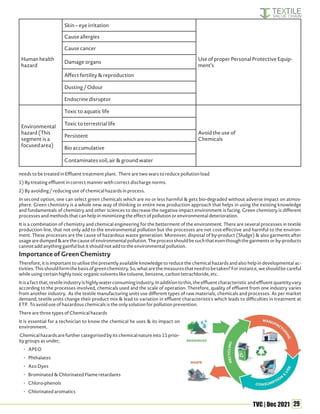
There are three types of Chemical hazards
It is essential for a technician to know the chemical he uses & its impact on
environment.
Chemical hazards are further categorised by its chemical nature into 11 prior-
ity groups as under;
• APEO
• Phthalates
• Azo Dyes
• Brominated & Chlorinated Flame retardants
• Chloro-phenols
• Chlorinated aromatics
Human health
hazard
Skin – eye irritation
Use of proper Personal Protective Equip-
ment’s
Cause allergies
Cause cancer
Damage organs
Affect fertility & reproduction
Dusting / Odour
Endocrine disruptor
Environmental
hazard (This
segment is a
focused area)
Toxic to aquatic life
Avoid the use of
Chemicals
Toxic to terrestrial life
Persistent
Bio accumulative
Contaminates soil, air & ground water
30 TVC | Dec 2021
• Chlorinated solvents
• Organotin Compounds
• Short Chain Chlorinated Paraffin’s (SCCPs)
• Heavy metals
• Per-fluorinated Chemicals (PFCs).
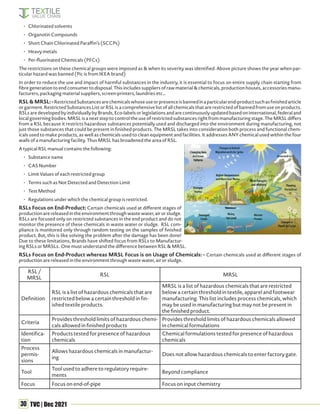
The restrictions on these chemical groups were imposed as & when its severity was identified. Above picture shows the year when par-
ticular hazard was banned (Pic is from IKEA brand)
In order to reduce the use and impact of harmful substances in the industry, it is essential to focus on entire supply chain starting from
fibre generation to end consumer to disposal. This includes suppliers of raw material & chemicals, production houses, accessories manu-
facturers, packaging material suppliers, screen-printers, laundries etc…
RSL&MRSL:-RestrictedSubstancesarechemicalswhoseuseorpresenceisbannedinaparticularend-productsuchasfinishedarticle
or garment. Restricted Substances List or RSL is a comprehensive list of all chemicals that are restricted of banned from use on products.
RSLs are developed by individually by Brands, Eco-labels or legislations and are continuously updated based on international, federal and
local governing bodies. MRSL is a next step to control the use of restricted substances right from manufacturing stage. The MRSL differs
from a RSL because it restricts hazardous substances potentially used and discharged into the environment during manufacturing, not
just those substances that could be present in finished products. The MRSL takes into consideration both process and functional chem-
icals used to make products, as well as chemicals used to clean equipment and facilities. It addresses ANY chemical used within the four
walls of a manufacturing facility. Thus MRSL has broadened the area of RSL.
A typical RSL manual contains the following:
• Substance name
• CAS Number
• Limit Values of each restricted group
• Terms such as Not Detected and Detection Limit
• Test Method
• Regulations under which the chemical group is restricted.
RSLs Focus on End-Product: Certain chemicals used at different stages of
production are released in the environment through waste water, air or sludge.
RSLs are focused only on restricted substances in the end product and do not
monitor the presence of these chemicals in waste water or sludge. RSL com-
pliance is monitored only through random testing on the samples of finished
product. But, this is like solving the problem after the damage has been done!
Due to these limitations, Brands have shifted focus from RSLs to Manufactur-
ing RSLs or MRSLs. One must understand the difference between RSL & MRSL.
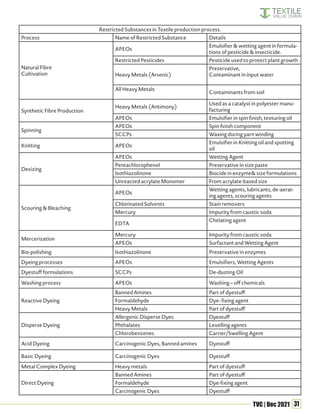
RSLs Focus on End-Product whereas MRSL Focus is on Usage of Chemicals: - Certain chemicals used at different stages of
production are released in the environment through waste water, air or sludge.
RSL /
MRSL
RSL MRSL
Definition
RSL is a list of hazardous chemicals that are
restricted below a certain threshold in fin-
ished textile products.
MRSL is a list of hazardous chemicals that are restricted
below a certain threshold in textile, apparel and footwear
manufacturing. This list includes process chemicals, which
may be used in manufacturing but may not be present in
the finished product.
Criteria
Provides threshold limits of hazardous chemi-
cals allowed in finished products
Provides threshold limits of hazardous chemicals allowed
in chemical formulations
Identifica-
tion
Products tested for presence of hazardous
chemicals
Chemical formulations tested for presence of hazardous
chemicals
Process
permis-
sions
Allows hazardous chemicals in manufactur-
ing
Does not allow hazardous chemicals to enter factory gate.
Tool
Tool used to adhere to regulatory require-
ments
Beyond compliance
Focus Focus on end-of-pipe Focus on input chemistry
31
TVC | Dec 2021
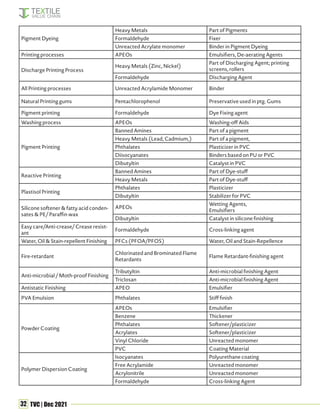
Restricted Substances in Textile production process.
Process Name of Restricted Substance Details
Natural Fibre
Cultivation
APEOs
Emulsifier & wetting agent in formula-
tions of pesticide & insecticide.
Restricted Pesticides Pesticide used to protect plant growth
Heavy Metals (Arsenic)
Preservative,
Contaminant in input water
All Heavy Metals
Contaminants from soil
Synthetic Fibre Production
Heavy Metals (Antimony)
Used as a catalyst in polyester manu-
facturing
APEOs Emulsifier in spin finish, texturing oil
Spinning
APEOs Spin finish component
SCCPs Waxing during yarn winding
Knitting APEOs
Emulsifier in Knitting oil and spotting
oil
Desizing
APEOs Wetting Agent
Pentachlorophenol Preservative in size paste
Isothiazolinone Biocide in enzyme& size formulations
Unreacted acrylate Monomer From acrylate-based size
Scouring & Bleaching
APEOs
Wetting agents, lubricants, de-aerat-
ing agents, scouring agents
Chlorinated Solvents Stain removers
Mercury Impurity from caustic soda
EDTA
Chelating agent
Mercerization
Mercury Impurity from caustic soda
APEOs Surfactant and Wetting Agent
Bio-polishing Isothiazolinone Preservative in enzymes
Dyeing processes APEOs Emulsifiers, Wetting Agents
Dyestuff formulations SCCPs De-dusting Oil
Washing process APEOs Washing – off chemicals
Reactive Dyeing
Banned Amines Part of dyestuff
Formaldehyde Dye- fixing agent
Heavy Metals Part of dyestuff
Disperse Dyeing
Allergenic Disperse Dyes Dyestuff
Phthalates Levelling agents
Chlorobenzenes Carrier/Swelling Agent
Acid Dyeing Carcinogenic Dyes, Banned amines Dyestuff
Basic Dyeing Carcinogenic Dyes Dyestuff
Metal Complex Dyeing Heavy metals Part of dyestuff
Direct Dyeing
Banned Amines Part of dyestuff
Formaldehyde Dye-fixing agent
Carcinogenic Dyes Dyestuff
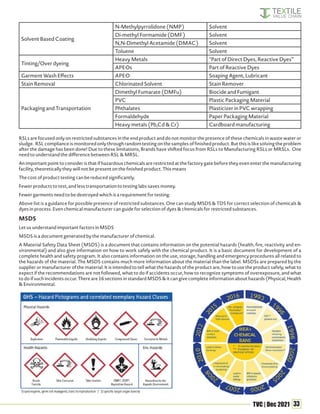
32 TVC | Dec 2021
Pigment Dyeing
Heavy Metals Part of Pigments
Formaldehyde Fixer
Unreacted Acrylate monomer Binder in Pigment Dyeing
Printing processes APEOs Emulsifiers, De-aerating Agents
Discharge Printing Process
Heavy Metals (Zinc, Nickel)
Part of Discharging Agent; printing
screens, rollers
Formaldehyde Discharging Agent
All Printing processes Unreacted Acrylamide Monomer Binder
Natural Printing gums Pentachlorophenol Preservative used in ptg. Gums
Pigment printing Formaldehyde Dye Fixing agent
Washing process APEOs Washing-off Aids
Pigment Printing
Banned Amines Part of a pigment
Heavy Metals (Lead, Cadmium,) Part of a pigment,
Phthalates Plasticizer in PVC
Diisocyanates Binders based on PU or PVC
Dibutyltin Catalyst in PVC
Reactive Printing
Banned Amines Part of Dye-stuff
Heavy Metals Part of Dye-stuff
Plastisol Printing
Phthalates Plasticizer
Dibutyltin Stabilizer for PVC
Silicone softener & fatty acid conden-
sates & PE/ Paraffin wax
APEOs
Wetting Agents,
Emulsifiers
Dibutyltin Catalyst in silicone finishing
Easy care/Anti-crease/ Crease resist-
ant
Formaldehyde Cross-linking agent
Water, Oil & Stain-repellent Finishing PFCs (PFOA/PFOS) Water, Oil and Stain-Repellence
Fire-retardant
Chlorinated and Brominated Flame
Retardants
Flame Retardant-finishing agent
Anti-microbial / Moth-proof Finishing
Tributyltin Anti-microbial finishing Agent
Triclosan Anti-microbial finishing Agent
Antistatic Finishing APEO Emulsifier
PVA Emulsion Phthalates Stiff finish
Powder Coating
APEOs Emulsifier
Benzene Thickener
Phthalates Softener/plasticizer
Acrylates Softener/plasticizer
Vinyl Chloride Unreacted monomer
PVC Coating Material
Polymer Dispersion Coating
Isocyanates Polyurethane coating
Free Acrylamide Unreacted monomer
Acrylonitrile Unreacted monomer
Formaldehyde Cross-linking Agent
33
TVC | Dec 2021
Solvent Based Coating
N-Methylpyrrolidone (NMP) Solvent
Di-methyl Formamide (DMF) Solvent
N,N-Dimethyl Acetamide (DMAC) Solvent
Toluene Solvent
Tinting/Over dyeing
Heavy Metals "Part of Direct Dyes, Reactive Dyes”
APEOs Part of Reactive Dyes
Garment Wash Effects APEO Soaping Agent, Lubricant
Stain Removal Chlorinated Solvent Stain Remover
Packaging and Transportation
Dimethyl Fumarate (DMFu) Biocide and Fumigant
PVC Plastic Packaging Material
Phthalates Plasticizer in PVC wrapping
Formaldehyde Paper Packaging Material
Heavy metals (Pb,Cd & Cr) Cardboard manufacturing
RSLs are focused only on restricted substances in the end product and do not monitor the presence of these chemicals in waste water or
sludge. RSL compliance is monitored only through random testing on the samples of finished product. But this is like solving the problem
after the damage has been done! Due to these limitations, Brands have shifted focus from RSLs to Manufacturing RSLs or MRSLs. One
need to understand the difference between RSL & MRSL.
An important point to consider is that if hazardous chemicals are restricted at the factory gate before they even enter the manufacturing
facility, theoretically they will not be present on the finished product. This means
The cost of product testing can be reduced significantly.
Fewer products to test, and less transportation to testing labs saves money.
Fewer garments need to be destroyed which is a requirement for testing.
Above list is a guidance for possible presence of restricted substances. One can study MSDS & TDS for correct selection of chemicals &
dyes in process. Even chemical manufacturer can guide for selection of dyes & chemicals for restricted substances.
MSDS
Let us understand important factors in MSDS
MSDS is a document generated by the manufacturer of chemical.
A Material Safety Data Sheet (MSDS) is a document that contains information on the potential hazards (health, fire, reactivity and en-
vironmental) and also give information on how to work safely with the chemical product. It is a basic document for development of a
complete health and safety program. It also contains information on the use, storage, handling and emergency procedures all related to
the hazards of the material. The MSDS contains much more information about the material than the label. MSDSs are prepared by the
supplier or manufacturer of the material. It is intended to tell what the hazards of the product are, how to use the product safely, what to
expect if the recommendations are not followed, what to do if accidents occur, how to recognize symptoms of overexposure, and what
to do if such incidents occur. There are 16 sections in standard MSDS & it can give complete information about hazards (Physical, Health
& Environmental.
34 TVC | Dec 2021
Standard format of Safety Data Sheets
MSDS should be provided in the official language of the country, where the substance is supplied.
There is a total 16 sections in MSDS & should be as under:
• Identification of the substance/mixture and the company/undertaking
• Hazards identification (assessment)
• Composition/information on ingredients
• First aid measures
• Firefighting measures
• Accidental release measures
• Handling and storage
• Exposure controls / personal protection
• Physical and chemical properties
• Stability and reactivity
• Toxicological information
• Ecological information
• Disposal considerations
• Transport information
• Regulatory information
• Other information
This format is based on GHS recommendations and it is acceptable throughout the world.
For sustainability, one must focus on hazard identification. Same is seen in section No. – 2, 10, 11, 12 & 13. No doubt section No 15 is also
important for hazard handling.
The impact of pollution is so high that, Government has laid down stricter norms for discharge of effluent & sludge (CPCB, SPCB) In
addition to this, various NGO’s, Brands, buying houses are not allowing any industry to do business if they are polluting the atmosphere.
The solution to above issue is very simple & is known as CMS that is Chemical management System.
Let us take an OATH
“We will take care of mother earth with social responsibility and environmental protection.
This is our contribution to a better future for us and for coming generations
It simply means: Give back what you take!
35
TVC | Dec 2021
36 TVC | Dec 2021
E
ver since Covid-19 outbreak, everything has trans-
formed. Though the world has started to recover,
nothing will remain the same in the post-pandemic
world from workplace activities and our content con-
sumptiontohowweengageinevents.Apartfromallthe
difficulties, it gave us some important business lessons.
For starters, it showed us that not everything has to be
done in person.
During this challenging period, we have modified our
contact with others by doing online meetings and con-
ferences. Event planners have made significant strides
to move live events to the virtual sphere. Once the pan-
demic is over, the dilemma of if we will return to normal
face-to-face contacts or whether virtual events will be-
come permanent. We already have a clear idea of what
will happen as a result of the current relaxation of the
Covid regulations.
Several virtual conferencing providers have opted to
push into what is going to be the future – Hybrid Events.
This approach, which combines live as well as digital
participation, offers substantial benefits that make it
ideal of both environments.
The advantages of virtual and hybrid events extend be-
yondlogistics.Severalbusinesses,eventorganisers,and
marketers are discovering that there are major advan-
tages to holding digital events that traditional events
do not offer. According to a latest Grand View Research
analysis, the worldwide virtual events industry is pre-
dicted to increase by 23% from 2020 to 2027.
What are Hybrid Events?
Hybrid events are the ones that mixes a live event with a
virtual system, such as an exhibition, conference, work-
shop, seminar, or other gathering.
A Hybrid Event is –
• A smooth incorporation of technology to allow en-
gagement from both live and digital viewers.
• An experience which serves all spectators in a view-
er-friendly manner.
• Bringingbothvirtualandliveviewersonasamefield.
The following are the reasons why Hybrid Events are
here to stay:
Broader outreach and greater participation
An event may reach a vast number of participants by in-
corporating both a live audience and a digital audience
through hybrid events. An in-person event may impose
constraintsonthecapacityofthevenueandthenumber
of individuals who can participate. With hybrid events,
you can get the same or even more participation virtual-
ly as you have physically. This manner, you may broaden
youraudienceandfullyutilisethecapacityofyourevent.
Furthermore, this approach allows participants who are
unable to physically visit the events at various places to
participate remotely through a digital platform. Guests
from all around the globe can digitally attend the event
from the comfort of their homes, which would not have
been possible otherwise.
Greater audience engagement
Including a virtual component in a live event allows far
more interaction chances than a simply live event, both
during and after the event.
It’s due to the fact that the digital audience is constantly
interacting from their mobile phones or desktops or lap-
tops,whichmeanstheymaydiscuss,share,like,remark,
and do a variety of other things.
You can, for instance, hold polls in events that comprise
both a live and an online audience.
Alternatively, you may hold a live Q&A session with a
speaker,thenaskthemforaQ&Asessionwiththevirtu-
alaudience,whichisoftenheldatastudiothattransmits
the live event.
Coordinators and participants benefit from cost effec-
tiveness
Online events democratise thought leadership by elim-
inating the transportation and in-person barriers that
prevent people from accessing content. Exhibitor stalls
have a prolonged shelf in digital and hybrid events since
Hybrid Events are Here to Stay:
Future and Scope
TVC Editorial Team
SPECIAL FEATURES
37
TVC | Dec 2021
theycanremainactiveevenaftertheeventhasconclud-
ed, increasing revenue potential. It will assist organisers
in replicating events or scheduling new events as need-
ed; with the foundation already in place, less expendi-
turewillberequiredandmoreincomewillbegenerated.
Additional Possibilities for Sponsorships
Hybrid events will increase sponsorship possibilities for
a number of reasons. Because of the enhanced reach of
joining remotely, there will be even more attendance,
allowing sponsors to access a broader audience. Spon-
sors will be able to participate in the event as well by
establishing digital event stalls and finally presenting
through video conference. Furthermore, because of the
virtual element of the event, a hybrid event enables you
to get more sponsors than those for the event venue.
Reduction of Carbon Emissions
This is an undeniable reason. Embracing online or hybrid
is a great alternative if your company wants to mini-
mise its carbon emissions and become more environ-
ment-friendly. You can keep your event’s authenticity
including all the advantages of interacting with others
while being mindful of the influence you’re making on
the earth.
According to a recent study, adopting virtual will lower
yourCo2emissionsbymorethan99percent.Ifyoucon-
vert some or most of your guests to a digital platform,
you will save Co2 emissions by reducing transportation,
food and beverage waste.
Improved Content Quality
When event organisers are not preoccupied with the
complexities of arranging an event for huge numbers of
people, they have far more time and effort to devote to
selecting the best quality content and output level for
presentations and guest speakers. By reducing the num-
ber of in-person guests, organisers will be able to con-
centrate on quality rather than quantity.
Enhanced ROI (ROI)
With all of the moving parts, calculating ROI at events
is difficult. Hybrid events, on the other hand, provide a
higher return on investment, owing mostly to their en-
hanced outreach and adaptability.
Since your hybrid events are attracting larger individ-
uals, this can lead to even more visits for sponsors and
more sign-ups following the event. You also gain a huge
amount of data, which allows you to deliver more pre-
cise performance reports.
Event’s adaptability
Finally, hybrid events have the ability to solve problems.
If you’re planning a live event and are unable to attend
due to unforeseen situations, hybrid events can help! It
is natural to experience unexpected setbacks, and there
are a variety of scenarios in which hybrid events may
come to the aid. For example, the Covid restrictions
have recently changed rather unexpectedly, making
it incredibly impossible for a person to ensure their at-
tendance. You always have a backup plan when you’re
attending or organising a hybrid event! You’ll be able to
convert part of the live participants to virtual ones. As a
result, cancelling the event and incurring additional fi-
nancial expenses will not be necessary.
Theopportunitiesforhybrideventsareinfinite,andthey
may provide an exciting and one-of-a-kind event experi-
ence. Technical advancements in recent years, such as
worldwide internet services that enable live-streaming
everywhere, have blurred the distinction between the
physical and technical world. Take advantage of this!
Hybrid events provide the opportunity for a more en-
hanced meeting experience than ever before.
References:
https://www.brella.io/blog/hybrid-event-benefits
https://www.beaconlive.com/blog/why-hybrid-
events-are-here-to-stay
https://morethandigital.info/en/7-reasons-why-hy-
brid-events-will-be-the-future/
Image Source: IEEE MCE
Image Source: AVT Productions
38 TVC | Dec 2021
The yarns with 70:30 Cotton: PNF (actual in yarn stage) was successfully spun and yarns
were sized and woven into fabrics using loom and the fabrics have unique look and are useful
to produce Jackets, home textiles and apparels.
T
here are various types of fibres available as textile
fibres. These are either natural or manmade (syn-
thetic). Recent trends show that use of natural
fibres is increasing all across the world as compared to
synthetic fibres because natural fibres are eco-friendly,
skin friendly and most importantly they are biodegrad-
able. The Indian Himalayan region has enormous na-
tures fibre wealth, including pine needles. These fibres
are being used by the local people in a very casual way
to fulfil their bare minimum needs.
Due to insufficient possibilities of employment in hills,
poverty prevails in the hills. Further, the most negative
and damaging impact is that pine needles (called perul
in local language), fall down every year in abundance
which catch fire and become highly combustible after
getting dried. This leads to a forest fire causing huge
losses to the people living in the region.
Thus, it can be concluded that there is strong need to
open the path for generation of employment at hills.
Textile is the second largest employment giving indus-
try in India and so it is better to exploit the use of natural
fibres of the region to bring happiness to the hill people
by upbringing their livelihood & earnings and reducing
chances of forest fires. It has been observed that the
products developed from these fibres have very high
domestic and export demand.
Production of Pine Neddles Fibres
The process for fibre extraction from Pine Needles (Pe-
rul)whichinvolveslowtemperatureandlowalkalifibre
extractionfollowedbysilicaremovaltogetherwithpro-
visions for softening of fibres. A plant fibre forms a fibre
extracted from stem, leaf of plant and can be also pro-
duced by plant as protecting seed hairs. In existing ex-
traction process pine fibre is extracted from leaf of pine
tree that is also called as pine needle or Perul. Fibre ex-
traction is carried out by cooking the needles. Cooking
constitutes a process in which pine leaves are treated
with certain chemicals at boiling temperature. Design
Academy Eindhoven graduate Tamara Orjola’s Forest
Wool stools and carpets are made from processed pine
needles left over from the timber industry.
By crushing, soaking, steaming, binding and pressing
the needles, Orjola extracts the pine needles’ fibre and
transforms it into textiles, composites and paper. The
process also allows essential oils and dye to be extract-
ed and used.
Further, the extraction processes are accompanied by
manual/machine decortications of boiled pine needles.
The chemicals that are used in extraction are generally
alkali or salt, which are used at boiling or elevated tem-
perature. In order to impart clean look, the process is
generally accompanied by bleaching. The bleaching can
be done by any of the available method like hypochlo-
rite bleaching or peroxide bleaching etc. However, the
fibres produced are short and coarse. The extraction of
pine fibre by treatment with alkali followed by soaking
in water, wherein material must be treated at 212 Fahr-
enheit. Variable size fibres can be obtained.
According to this process, the needles or pine-straw
not only has the effect of dissecting the fibre vascular
bundles, but the contour of the fibrils is also altered.
By the constant circulation of the alkaline solution and
subsequent washings with water, the pores or cells are
thoroughly permeated, a great deal of foreign matter is
driven out, and the place of the old natural constituents
is taken by the new chemical compounds. By the decor-
ticating process a great deal of organic matter is rubbed
Processing of Pine Needles (Perul)
Fibres in Textile Industries
Dr N.N.Mahapatra
Business Head (Dyes)
Shree Pushkar Chemicals & Fertilisers Ltd., Mumbai
SPECIAL FEATURES
39
TVC | Dec 2021
out and the teeth of the cards are enabled to readily
take hold of the mass to finally remove all foreign and
objectionable matter and to affect the shredding of the
leaves, which may be done to a greater or less degree to
produce a fibre of fine or coarser grade, as desired. The
pine needles are treated with warm or hot alkali. After
alkali treatment needles are passed between pressure
rolls. Pressure applications are followed by washing,
wherein pressures are applied to loosen the silica. Silica
removal is necessary as it is the constituent in the fibre
that is mainly responsible for brittleness.
Alsointhecurrentlyavailabletechnologies,thereareno
provisions to achieve softness and for textile processes
flexibilityisrequiredbecausestiffnessleadstobreakag-
es during fibre processing in different textile process.
The pine fibres are conditioned at 27 + 2 C and 65% + 5
Relative Humidity.
The treatment of conditioned pine fibres carried out
with alkali for 30 minutes to 10 hours, concentration of
which varies from 0.5 to 5%.
The treatment with metallic salt is conducted for 30
minutes to 10 hours having concentration of 0.5 to 5
The treated pine fibres undergoes decortication fol-
lowed by washing.
The washing is done by means of soft water.
The bleaching is conducted by Hydrogen Peroxide
(H2O2) having concentration of 1-2 grams per litre
together with 0.5-2 grams per litre NaoH and 0.25-1
grams per litre peroxide stabilizer.
The drying is carried out for example at 1200C for
about 20 minutes to extract fibre.
The process for fibre extraction from pine needles
comprising steps of sorting of pine needles, pine fibres
conditioning, dual chemical treatment, decortication,
washing, bleaching, drying of fibres followed by sof-
tening and fibre extraction the metallic salt has silica
removal action, which decreases harshness. This leads
to softening of fibres. Thus, loosening of lignin and sil-
ica removal is carried out by the aforesaid chemical
processes. The finally treated pine fibres undergoes de-
cortication manually or by a machine. The decorticated
fibres are then washed by means of distilled water.
The washing is followed by bleaching and drying. The
bleaching is conducted by Hydrogen Peroxide (H2O2)
having concentration of 1-2 grams per litre togeth-
er with 0.5-2 grams per litre NaoH and 0.25-1 grams
per litre peroxide stabilizer for nearly 15 minutes. The
bleached pine fibres thus obtained are dried in a drying
chamber for example at 1200C for about 20 minutes to
extract fibre.
The devised process of invention results in produc-
tion of soft fibres facilitating the process. Softening is
achieved by means of oil in water emulsion method.
The temperature is near to room temperature and said
alkali is in the range of 0-8%.
Parameters Pine needles
Tenacity (g/den) 1.1
Min. 0.32
Max. 3.63
Average 1.1
CV% 66.8
Elongation% 5.94
Min. 0.8
Max. 10.1
Average 5.94
CV% 41.25
Count (Denier/Ne) 87.69/60.61
Bundle strength (g/tex) 5.64
Elongation% 6.9
Moisture Regain 11 %
Fiber Length Range:- 3-8 cm
Anti-Microbial Property Yes
Average fiber Fineness 88.56 micron
Crystallinity 61.76 %
The silica removal is accomplished at low concentra-
tion of chemical for complete removal thereof.
USES OF PINE NEDDLES FIBRES ;
The pine needle fibres (PNF) have been blended
with cotton in different ratios and it was found difficult
to spin yarn as the percentage of PNF fibres increases.
Also it is observed that there is preferential loss of PNF
in carding, resulting in less PNF percentage in resultant
yarn. The yarns with 70:30 Cotton: PNF (actual in yarn
stage) was successfully spun and yarns were sized and
woven into fabrics using loom. The fabrics have unique
look and are useful to produce Jackets, home textiles
and apparels.
Properties Of Pine Neddle Fibres
40 TVC | Dec 2021
N
onwoven fabrics closely resemble con-
ventional fabrics but are not knitted or
woven. They are bonded together by
mechanical, heat solvent, and chemical treat-
ment. The nonwoven fabrics/textiles industry
is growing as an alternative to polyurethane
foams. Increasing awareness about the toxic
substances in polyurethane foam is expected
to drive the growth of non-woven fabrics/tex-
tiles industry.
The global non-woven fabrics/textile industry is expected to register
a robust growth due to the cost-effectiveness of the raw materials
used in their manufacturing. Additionally, the raw materials are readi-
ly available. Hence, it serves a wide range of industries. Furthermore,
the growing demand in the medical sector is expected to drive the in-
dustry. The medical sector requires various products such as surgical
gowns, masks, caps, and bath wipes in large quantities. The industry
is also expected to replace all its polyurethane foam-based products
due to tightening regulations and their toxicity, further fuelling de-
mand for nonwoven fabrics/textiles.
Moreover, the non-woven fabrics/textiles industry is expected to
grow due to increasing demand from its application in manufacturing
filters. These are used for filtering gasoline, oil, and air. In addition,
they are used as filter for beverages including coffee, tea, and filters
for the pharmaceutical industry and in mineral processing. The grow-
ing numbers of oil and gas exploration expeditions are expected to
drive growth for the fabrics/textiles industry in near future.
An intelligence report by TMR is the outcome of intense study and
rigorous assessment of various dynamics shaping the growth of the
industry. TMR nurtures a close-knit team of analysts, strategists, and
industry experts who offer clients tools, methodologies, and frame-
works to make smarter decisions. Its objective insights, and action-
able analytics provide CXOs and executives to advance their mis-
sion-critical priorities with confidence.
The scrutiny of the various forces impacting the dynamics of the
industry, and key and associated industries, guide’s enterprises in
understanding various consumer propositions. Our clients leverage
these insights and perspectives to enhance customer experience in
the fast-paced business environment.
All their insights and perspectives are broadly based on 4 Pillars or
Stages: ASBC-S, which offer an elaborate and customisable frame-
work for the success of an organisation. The
essenceandtherolesofthese inorganisational
successes are highlighted below:
Agenda for CXOs:TMR, through the study
sets the tone for agendas that are pertinent to
CEOs, CFOs, CIOs, and other CXO executives
of businesses operating in the industry. The
perspectives help the clients bridge the gap
between agenda and action plan. TMR strives
to offer guidance to CXOs to undertake mis-
sion-critical activities empowered by various business analysis tools,
and boost the performance of the organisations. The perspectives
guide you to decide on your own industry mix that align well with the
policies, visions, and mission.
Strategic Frameworks: The study offers how organisations are
settingbothshort-termandlong-termstrategicplans.Ourteamofex-
perts collaborate and communicate with you to understand these to
make your organisations sustainable and resilient during tough times.
The insights help them decide sustainable competitive advantage for
each business units.
Benchmarking for Deciding Target Industries and Brand
Positioning: The assessments in the study provides a scrutiny of
industry channels and industry mix. Our various teams work synergis-
tically with you to help identify your actual and potential direct, indi-
rect, and budget competition areas. Additionally, the study helps you
decide most effective budgets for various processes and promotional
activities. Furthermore, the study guides you to set benchmarks for
integrating people and processes with the 4Ps of industry. Eventually,
thiswillempoweryoutofindoutuniquepropositioningstrategiesand
niches.
Business Composability for Sustainability (C-S): Constant
strategy planning for sustainability characterising our C-S framework
in the report has become more relevant than before in the face of dis-
ruptions caused by pandemics, recessions, boom and bust cycles, and
changing geopolitical scenario. The TMR study offers a high level of
customisation to help you achieve business composability. Compos-
able enterprises are increasingly gaining the attention of CXOs in or-
der to help them combat industry volatility. Our analysts and industry
experts help you wade through such uncertainties and guide you to
become a smart sustainable business in entirety.
Get More Information about Nonwoven fabrics by TMR
Non-woven Fabrics:
Opportunities Galore
TVC Editorial Team
Summary:
Non-woven Fabrics/Textiles
Market is mainly driven
by increasing awareness
about and rising adoption of
non-woven fabrics/textiles
NONWOVENS
41
TVC | Dec 2021
Shift in India’s Nonwoven
Exports
TVC Editorial Team
O
ver the past decade, the global nonwoven
industry has increased at a steady rate of 7.5
per cent each year in tonnage. Though devel-
opmentinthenonwovenindustryintheUSA,Europe,
and Japan has reduced with age, these countries con-
tinuetodevelopatarateof5percentperyear.Thein-
creased demand for such fibres as emerging markets
like Asia expand accounts for a large share of global
nonwoven growth. The major contributors to this ex-
pansion are India and China.
Nonwovensandtechnicaltextilesarethemostpoten-
tial and active areas of the textile industry; therefore,
production and usage will rise in the coming years.
In India, the nonwovens sector is booming. Nonwo-
vens have been manufactured in India for ages, al-
though they were primarily confined to nonwovens
made with staple fibres using traditional and outdat-
ed technologies. In addition, as the trend for lower
basis weight continues, spunmelt and spunlace mate-
rials have become increasingly important.
Nowadays, most of the nonwoven’s volume is used
in low-end, cheap items including shopping bags,
backings, and rugs among other things. However, if
high-end applications like filtration, automotive, geo-
textiles, and the sanitation and healthcare industries
demonstrate constant development, the value of the
development will climb as well.
NONWOVENS
42 TVC | Dec 2021
Nonwoven Exports of India
India exported wadding of man-made fibres worth
US$0.34 million in September 2020 which declined
to US$0.27 million. Between January to September
2021 the total exports were worth US$2 million. In
September 2020, adding; other articles of wadding
of cotton exports were worth US$3.92 million, rising
to US$4.28 million in September 2021. By Septem-
ber 2020, the exports were totalled US$34.84 million
which decreased to US$31.49 million. Wadding and
articles of wadding nes exports in September 2021
witnessed a fall, from US$0.16 million to US$0.1 mil-
lion. At the end of September 2021, the exports rose
by US$0.06 million to US$0.83 million. Exports of tex-
tileflockanddustandmillnepsbytheendofSeptem-
ber2021increasedtoUS$1.61million,upbyUS$1.48
million from the previous year.
India exported felt, impregnated, coated, covered or
laminated worth US$0.23 million in September 2020
which had a fall in September 2021. From January to
September 2020 the exports were US$0.73 million
decreasing to US$0.71 million in the corresponding
period of next year. Needle loom felt and stitch-bond-
ed fibre fabrics exports soared to US$0.49 million in
September 2021 from US$0.19 million in September
2020. Between January and September 2020, the ex-
ports were worth US$2.4 million which doubled in
the next year. Felt of other textile materials exports
declined from US$0.27 million in September 2020 to
US$0.15 million in September 2021.
Exports of man-made filament weighting>25g /sqm
which were about US$54.53 million by the end of
September 2020, climbed up to US$101.11 million in
thesametimespanof2021.Indiasuppliedman-made
filament weighting between 70g/sqm and 150g/sqm
worthUS$21.81millionbySeptember2020,whichin-
creased to US$36.3 million. Exports of rubber thread
and cord, textile covered remained the same in Sep-
tember of both years.
Between January and September 2021, India’s ex-
ports of other cordage etc of polyethylene/poly-
propylene were around US$82 million, up by US$28
million from last year. Other twine, cordage, rope and
cables exports decreased from US$2.2 million in Sep-
tember 2020 to US$1.23 million in September 2021.
India’s exports of made-up fishing nets of man-made
textile materials by the end of September 2021 de-
clined to US$47.67 million. India exported articles
of yarn strap/the like of heading o. 5404/5405 twine
cordage-rope/cables n.e.s. were worth US$1.21 mil-
lion in September 2020 which increased to US$1.5
million in the next year.
43
TVC | Dec 2021
I
nsight Print Communication has installed a TS 100-1600 dye
sublimation transfer printer at Suyog Sublimation, Mum-
bai. Textile industry has been worst hit due to pandemic and
back-to-back installation of Mimaki Printers reflects custom-
er’s belief and trust in the technology. Suyog Sublimation is a
renowned name in the sports apparel and sublimation industry
and is known for its quality printing and consistency. Suyog Sub-
limation founded 25 years ago by Mr. Vasant Bherd, who has ex-
pertise in many technologies. Mr. Vasant has been responsible
for company’s success and zest towards innovation.
The 64-inch wide roll-to-roll sublimation inkjet printer TS100-
1600 is a dedicated transfer paper printer for the textile print
industry. Perfectly suited to the creation of fashion, apparel,
sportswear, furnishings, etc the TS100-1600 uses state-of-the-
art technology to set new performance benchmarks for the
sector. Officially, the maximum speed is 70m2/hr. This machine
is compatible with Raster Link 7 which speed up the RIP pro-
cessing by 25 per cent as compared to the previous version and
enablesvariabledataprintingwhereasanothercompatiblesoft-
ware Tx Link 4 gives much smoother gradation expression with 16 bit rendering and colour replacement func-
tion as compared to the previous software Tx Link 3.
TS100-1600 is equipped with High-performance Sb610 ink, containing Mimaki’s ink technologies, which
achieves low-cost, high-density printing with low ink consumption. Mimaki inks have obtained the ECO-PASS-
PORT certification from OEKO-TEX international association.
Cocklingiswellknowntoreduceproductyieldandquality,andfrequentlyoccursontransferpapersduringprint-
ing. With its cockling-reduction transfer mechanism and new printhead, the TS100-1600 can print on cockled
papers with a high head gap setting while maintaining beautiful print quality. Cockling reduction media transfer
mechanism comprises of vacuum hold-down system beneath the platen and AMF (Auto Media Feeder) which
further reduces cockling.
“Mimaki’s cutting edge technology and the Insight’s constant commitment towards innovation, customer ser-
viceandapplicationdevelopmenthelptextileproducerstomeetthedynamicneedsanddemandoftoday’scon-
sumers. I am a tech enthusiast and I’ve believed in innovation from the beginning, and my search for a partner
who could help us to achieve outstanding results with strong service support ended with Insight” commented
Mr. Vasant Bherd, Founder and Director at Suyog Sublimation.
The TS100-1600 fully supports continuous printing with steady technologies. NCU automatically detects and
recoverscloggednozzles,andifthecloggednozzlesarenotrecoveredaftercleaningthroughtheNCUfunction,
the NRS selects substitute nozzles and then restarts printing, maintaining productivity. With all these features,
we can vouch for stable productivity which is the need of the hour,” adds Mr. Raja Kochhar, General Manager at
Insight Print Communication.
Suyog Sublimation Adds Mimaki TS
100-1600 Dye-Sublimation Printer
TVC Editorial Team
CORPORATE NEWS
44 TVC | Dec 2021
ISCMA Past President Mr Narendra Mehta felicitated by
President Vinay D Patil
T
he Indian Speciality Chemicals Manufacturers Association (ISCMA) recently held a
get-togetherfunctionattheBanquetHall,MatungaGymkhanainMumbaiwhichbrought
people together with ideas to share. Members of ISCMA and distinguished dignitaries
graced this occasion.
The function was inaugurated with a welcome speech by ISCMA President, Mr. Vinay D. Patil,
who emphasised the key values that collaboration unlocks answers, and that “we should all
work together for a better tomorrow.”
ISCMA get-together held in
Mumbai
TVC Editorial Team
Welcome speech by ISCMA President – Vinay D. Patil.
EVENTS
Artists from Nritya Jhankar Academy
45
TVC | Dec 2021
Mr.VinayD.PatilinformedaboutISCMA’scollaborationwithICT,IIT-B,K.J.SomiyaCol-
lege of Engineering, BASF Alumni Association and collaboration with Deputy Director,
Vocational Training and Education Government of Maharashtra for ITI students from
Ambernath, Panvel, Mahad and Nagathane.
ISCMA has organised virtual training programmes on “Pollution Prevention & In-
dustrial Safety” as well as “Boiler Training” for ITI students. Mr. Sanjay Harne and Mr. Su-
vra Sengupta (Thermax Ltd.) trained the students with their expertise and experience.
Mr Sanjay Harane also
helps in organising visit to CETP Dombivili plant for ITI students on December 10, 2021.
This was followed by a dazzling dance performance by the a team of Nritya Jhankar Cul-
tural Academy under the leadership of Ms. Natasha Chaudhary.
During the event, appreciation was shown by felicitating ISCMA Past Presidents-Mr.
Narendra Mehta and Dr. Kishore Shah, sponsors for the get-together, GIZ representa-
tive Mr. Tarun Mhaske and trainer Mr. Sanjay Harne, dignitaries from the US Consulate-
Ms. Tamarind Murrietta, Mr.Sanjay Arya and Ms. Shamli Menon.
Mr. Vivek Raghuvanshi from ICICI Bank- Regional Head Sales Mumbai informed the
members about their products and facilities, such as working capital requirement in for-
eign currency like buyer’s credit and PCFC etc.
Amit Shah (also known as the voice of Kishore Kumar) and his team kept the guests
entertained by melodious old songs of Hindi movies. The event ended with interaction
among attendees and a dinner.
L to R: Mr Sivramakrishnan; Mr Prasad Pant; Mr Anjani Prasad;
Mr Sanjay Arya; Mr Vinay Patil; Mr Ketan Gandhi; Dr Ramesh Kabra
46 TVC | Dec 2021
S
etting the industry up for a post-pan-
demic future, Gartex Texprocess In-
diaconcludedonafruitfulnoteunder-
lining the dynamic domestic marketplace
and the opportunities it offers. Through
five focused segments and the co-located
Screen Print India and Denim Show, the
platform brought together 145 exhibitors
with over 300 brands and more than 800
products on display.
Gartex Texprocess India, the most com-
prehensive B2B exhibition on garmenting
and textile machinery, fabric accessories
and allied industries returned to Delhi with
its first-ever post-pandemic edition in De-
cember 2021. The combined showcase
of textiles and garment machineries, dig-
ital and screen-printing technologies and
denim innovations and trends attracted
10,158 business visitors over its three-day
course. The buoyant business atmosphere
was further complemented by the visit of
Additional Secretary, Ministry of Textiles,
MrVijoyKumarSingh,whohighlightedthe
focus of the Indian Government to formu-
lateaschemetoincentivisemanufacturing
of textiles machinery in India leading to in-
tense discussions on domestic collabora-
tions and an optimistic outlook among the
fraternity.
Re-affirming the potential of the Indian
market in the post-pandemic scenario, Mr
Adhish Aggarwal, Business Development
Manager, Insight Print Communications
Pvt Ltd said: “We have had many of our
existing customers upgrading to the new
TS55 machines and switching to TS100
machines from their traditional Chinese
machines. These 2 boxes have certainly
been a game-changer. There is a huge po-
Gartex Texprocess India 2021 closes on
positive business sentiments
TVC Editorial Team
EVENTS
Image Source: gartexindia.com Image Source: gartexindia.com
47
TVC | Dec 2021
tential in the Indian market, with the Gov-
ernment also setting up textile hubs and
sanctioning grants for the same.” The com-
pany showcased the new high-speed sub-
limation printer Mimaki TS55-1800 and
an entry-level sublimation printer TS100-
1600 by Mimaki, a renowned Japanese
brand in textile printing industry.
First time exhibitor Felix Schoeller India
also reported to have a good business
response. Mr Pranav Vaswani, Director,
shared: “We participated in the Gartex
Texprocess India 2021 to promote our
sublimation paper which is sold out as an
S-RACE brand. This is our first time par-
ticipating in Gartex and we had a pretty
good response in these three days. It was
greattofindalotofgoodqualityconscious
customers at this exhibition and has been
a very interesting experience for us as we
came across a lot of new customers, who
we could introduce our products to. I think
it is going to give us good business traction
over the next one and a half years because
a lot of people have become aware of our
products, and we are very happy overall.”
Mr Bharath Subramaniam, Managing Di-
rector, Mehala Machines India Limited,
also shared his experience as an exhibitor
at Gartex Texprocess India 2021: “We had
displayed our latest products in technical
textile fabrics for protective wear, per-
formance wear, workwear and bags. The
platform proved to be really beneficial for
us, we got really good prospects and we
are happy to see customers from different
parts of India converging at the exhibition.
Overall, the response has been excellent.”
Hefurthersharedthatthereisahugescope
for automation and that advanced tech-
nology in garment manufacturing will be-
come the centrepiece leading to increased
productivity.
Targeting the future of fashion through
advancements in garment machinery, in-
novative fabrics, embroideries and trims,
denim collections, as well as screen-print-
ing technologies and its rising applications,
the platform brought the textile value
chain together through its dedicated prod-
uct zones of Embroidery zone, Digitex
show, Fabrics & Trims show. The specialty
areas made product sourcing easy for its
business visitors.
Screen Printing segment remains
strong for textile printing industry
Screenprintingplaysamajorroleintoday’s
fashion industry and holds a prominent po-
sition among brands for high volume pro-
duction.Withtechnologicaldevelopments
Image Source: gartexindia.com
48 TVC | Dec 2021
in this space, screen printing has also made
the fashion business more economical
than ever. Showcasing advancements in
this space with their entirely new line of
ultrasoft binders, Mr Moulik Ranka, Di-
rector, Zydex Industries said: “It has been
veryrefreshingtoseeandconnectwithold
faces again after the last two troublesome
years. We were very excited to launch an
entirely new line of ultrasoft binders that
allow expanding the pigment printing
space to replace 30-40% of reactive type
designs resulting in significant savings in
energyaswellaswater.Theshowhasbeen
really good with excellent footfall and we
areextremelypleasedtohaveparticipated
here.”
DistributorsofUSA-basedcompanyStahls
also reported a remarkable response from
Indianbuyers.MrHarishDharamsinh,Mar-
keting Executive, Skyscreen International
Pvt Ltd explained: We are the distributors
of Stahls heat transfer films, vinyl, and heat
press machines of Stahls for the Asia re-
gion. We also are the distributor of GCC
cutting plotters and selling DTF printing
machines along with ink, matte films, etc.
Screen Print India has been remarkable in
the post-pandemic scenario and provided
us with a great response from the buyers.”
Denim Show: a major attraction at
Gartex Texprocess India
One of the central attractions at the show,
the Denim Zone with its unique art instal-
lation, a dedicated trend area and blended
product showcases made waves among
thebuyers.TheDenimshowwitnessedre-
markable participation from 25 of India’s
prominent Denim mills paving way for po-
tential partnerships.
Asia’s largest denim producer, Jindal
Worldwide Ltd reported to have received
a great footfall of international buyers
from the show. Mr Amit Jindal, Managing
Director shared: “We have been getting
great responses from the show year after
year. This time we are surprised to see a lot
of customers coming from outside of India
like Peru, South America, Columbia, Bang-
ladesh, Egypt and Turkey. So we really see
that this show is going international and it
is giving us a great business response.”
Mr Aamir Akhtar, CEO, Arvind Ltd said:
“Unfortunately, the last two years we had
tosortoftakeabriefbreak.Returningafter
two years, the show has been really amaz-
ing this time. The people here, the mood
here, the sentiment here, the quality of
buyers here; it is really very encouraging. It
is amazing to see the general sentiment to
be so positive and it is almost like setting a
new direction for the industry.”
Withbusinessactivitysoaringandbooking
confirmations for the next edition starting
during the show itself, Gartex Texprocess
India’s Mumbai edition will be a must-
watch event for the textile, garment ma-
chinery and fashion industries to source
newproductsandideas.Datesofthe2022
Mumbai edition will be announced in the
coming months.
Image Source: gartexindia.com
49
TVC | Dec 2021
Corporate Office : SF-34, Vasant Square, Vasant Kunj, New Delhi – 110070, India
Mobile : +91 98100 09264, 96506 54343 Email : mani@bishnutexport.com
Air Covered Yarns in Nylon-6, Nylon-66 and Polyester
Single Covered Yarns
20 Denier to 250 Denier
for High end Seamless
Knitting and
Medical Bandages
20 Denier to 300 Denier
in S & Z twists
Double Covered Yarns
350 Denier to 1400 Denier
Single And Double Covered Yarns in Nylon-6, Nylon-66
and Polyester
50 TVC | Dec 2021
NATURAL FIBER IMPORT AND EXPORT
Silk
Commodity Oct
2020 (R)
Oct
2021 (F)
Jan-Oct
2020 (R)
Jan-Oct
2021 (F)
%Growth
SILK-WORM COCOONS SUITABLE FOR REELING 0 0 0.94 25408.11
WOVEN FABRICS OF SILK OR OF SILK WASTE 8.66 8.29 49.06 64.34 31.14
YRN SPN FRM SLK WST NT PUT UP FR RETAL SLE 0.33 0.26 1.92 1.74 -9.67
RAW SILK (NOT THROWN) 0.02 0.03 0.12 1.48 1106.28
SLK YRN AND YRN SPUN FROM SLK WAST PUT UP FOR
RETAIL SALE,SLK-WORM GUT
0.05 0.07 0.55 0.61 11.22
SLK YARNS(OTHR THN YRN SPUN FROM SLK WSTE)NT
PUT UP FOR RETAIL SALE
0.02 0.09 0.17 1.48 782.41
SLK WSTE (INCLD COCOONS NT SUTBLE FR RELNG-
YARN WSTE AND GARNTE STOCK)
2.78 2.07 15.48 25.16 62.54
Name: Wool, animal hair, horsehair yarn and fabric
Commodity Oct
2020 (R)
Oct
2021 (F)
Jan-Oct
2020 (R)
Jan-Oct
2021 (F)
%Growth
WOVEN FABRICS OF CARDED WOOL OR OF CARDED
FINE ANIMAL HAIR
0.31 0.69 2.56 4.58 79.09
FINE/COARSE ANML HAIR NT CRDED/COMBED 0.13 0.25 91.65
WOOL NOT CARDED OR COMBED 0.1 0.09 -3.31
YRN OF CRDED WOOL NT PUT UP FR RETAIL SALE 0.28 0.4 3.11 4.03 29.62
WOVN FBRCS OF CMBD WOOL/FINE ANML HAIR 0.98 2.52 11.11 15.17 36.61
GRNTD STOCK OF WOOL/FINE/COARSE ANML HAIR 0.07 0.1 39.3
YRN OF CMBD WOOL NT PUT UP FR RETAIL SALE 4.62 5.95 52.23 57.61 10.29
WOVN FBRCS OF CORSE ANML HAIR/OF HORS HAIR 0.01 0.01 0.03 0.03 3.79
YRN OF COARSE ANML HAIR/OF HORS HAIR(INCL
GMPD HORSHAIR YARN)W/N PUT UP FR RETL SALE
0.01 0.01 0 -71.43
WOOL AND FINE OR COARSE ANIMAL HAIR, CARDED
OR COMBED (INCLUDING COMBED
0.9 0.76 7.51 6.82 -9.26
WASTE OF WOOL OR OF FINE OR COARSE ANIMAL
HAIR, INCLUDING YARN WASTE BUT EXCLUDING GAR-
NETTED STOCK
0.39 0.36 3.34 3.79 13.45
YARN OF FINE ANIMAL HAIR (CARDED OR COMBED),
NOT PUT UP FOR RETAIL SALE
0 0.02 7466.67
YARN OF WOOL OR FINE ANIMAL HAIR, PUT UP FOR
RETAIL SALE
0.29 0.49 3.2 4.63 44.89
EXPORT
MARKET UPDATE
51
TVC | Dec 2021
Cotton
Commodity Oct
2020 (R)
Oct
2021 (F)
Jan-Oct
2020 (R)
Jan-Oct
2021 (F)
%Growth
COTN YRN(OTHR THN SWNG THRD)
CNTNG 85% OR MORE BY WT OF CO-
TON NT PUT UP FR RETL SALE
222.52 441.51 2114.74 3718.43 75.83
COTON YRN(OTHR THN SEWNG
THRD)CONTNG COTON <85% BY WT
NT PUT FOR RETAIL SALE
4.99 20.3 55.79 171.57 207.55
COTON SEWNG THRED W/N PUT UP
FOR RETL SALE
1.49 1.5 11.99 16.97 41.54
WOVN FBRCS CONTNG<85% CO-
TON,MXD MAINLY OR SOLELY WTH
MANMADE FBRS WEGHNG<=200G/
M2
3.58 9.19 28.61 57.52 101.07
WOVN FBRCS OF COTON CONT-
NG>=85% BY WT OF COTON WEGHNG
NT MORE THN 200 G/M2
100.31 127.25 755.08 1021.57 35.29
WOVN FBRCS OF COTTON, CONTNG
>=85% COTN BY WT WEIGHING>200
GM PER SQM
38.9 50.07 303.14 464.93 53.37
WOVN FBRCS OF COTON,CONT-
NG<85% COTTON,MXD MAINLY WTH
MNMD FBRS WEIGHING>200 G/M2
16.83 24.96 129.79 229.02 76.46
COTTON YARN (OTHER THAN SEW-
ING THREAD) PUT UP FOR RETAIL
SALE
0.08 0.22 1 1.64 63.63
COTTON, NOT CARDED OR COMBED 130.02 92.34 1052.77 1990.43 89.07
OTHER WOVEN FABRICS OF COTTON 4.03 4.16 45.96 49.1 6.83
COTTON, CARDED OR COMBED 2.25 6.69 9.56 40.81 326.85
COTON WAST(INCL YARN WAST AND
GRNTED STOCK)
7.05 9.51 70.56 81.73 15.84
52 TVC | Dec 2021
Vegetable textile fibres nes, paper yarn, woven fabric
Commodity Oct
2020 (R)
Oct
2021 (F)
Jan-Oct
2020 (R)
Jan-Oct
2021 (F)
%Growth
YARN OF JUTE OR OF OTHER TEX-
TILE BAST FIBRES OF HEADING 5303
1.56 0.75 10.59 19.35 82.78
TRUE HEMP(CANABIS SATIVAL)
RAW/PROCESSED BUT NOT SPUN
TOW AND WASTE OF TRUE HEMP
(INCL YARN WASTE AND GARNET-
TED STO
0.01 0.01 -36.11
YRN OF COARSE ANML HAIR/OF
HORS HAIR(INCL GMPD HORSHAIR
YARN)W/N PUT UP FR RETL SALE
0.01 0.01 0 -71.43
JUTE AND OTHR TXTL BAST FBRS(-
EXCL FLAX,TRUE HEMP AND RAM-
IE)RAW/PRCSSD BUTNT SPUN;TOW
AND WASTE(INCL YARN WASTE
AND GARNT
2.89 3.64 14.13 25.08 77.47
WOVEN FABRICS OF OTHER VEG-
ETABLE TEXTILE FIBRES; WOVEN
FABRICS OF PAPER YARN
0.79 0.99 8.28 8.34 0.78
FLAX YARN 0.66 0.92 3.48 4.97 43.01
WASTE OF WOOL OR OF FINE OR
COARSE ANIMAL HAIR, INCLUDING
YARN WASTE BUT EXCLUDING GAR-
NETTED STOCK
0.39 0.36 3.34 3.79 13.45
WOVEN FABRICS OF FLAX 3.48 4.95 27.45 36.05 31.33
COCONUT,ABACA,RAMIE AND
OTHR VGTBL TXTL FBRS N.E.S.OR IN-
CLUDED,RAW OR PRCSSD, TOW,N-
OILS AND WASTE OF THESE FIBRS
29.68 29.75 275.47 403.12 46.34
YARN OF OTHER VEGETABLE TEX-
TILE FIBRES; PAPER YARN
0.52 0.52 4.16 5.77 38.74
FLUX,RAW OR PRCSSD BUT NT
SPUN;FLAX TOW AND WAST(IN-
CL YARN WAST AND GARNTTD
STOCK)
0.06 0.83 2.42 5.75 137.85
53
TVC | Dec 2021
SILK
Commodity Oct
2020 (R)
Oct
2021 (F)
Jan-Oct
2020 (R)
Jan-Oct
2021 (F)
%Growth
WOVEN FABRICS OF SILK OR OF SILK WASTE 1.66 2.34 13.44 14.25 6.1
YRN SPN FRM SLK WST NT PUT UP FR RETAL SLE 0.14 0.35 1.81 2.79 53.88
RAW SILK (NOT THROWN) 5.74 10.32 71.31 79.53 11.53
SLK YRN AND YRN SPUN FROM SLK WAST PUT UP
FOR RETAIL SALE,SLK-WORM GUT
0.02 0.06 0.23 0.35 50.26
SLK YARNS(OTHR THN YRN SPUN FROM SLK
WSTE)NT PUT UP FOR RETAIL SALE
0.31 0.59 4.18 5.45 30.43
SLK WSTE (INCLD COCOONS NT SUTBLE FR REL-
NGYARN WSTE AND GARNTE STOCK)
0.1 1.09 0.58 -46.61
Name: Wool, animal hair, horsehair yarn and fabric
Commodity Oct
2020 (R)
Oct
2021 (F)
Jan-Oct
2020 (R)
Jan-Oct
2021 (F)
%Growth
WOVEN FABRICS OF CARDED WOOL OR OF CARDED
FINE ANIMAL HAIR
1.35 1.81 10.21 9.22 -9.71
FINE/COARSE ANML HAIR NT CRDED/COMBED 0.01 0.73 2.17 3.12 43.6
WOOL NOT CARDED OR COMBED 9.31 17.33 119.18 163.75 37.4
YRN OF CRDED WOOL NT PUT UP FR RETAIL SALE 0.06 0.08 0.42 0.84 101.44
WOVN FBRCS OF CMBD WOOL/FINE ANML HAIR 0.89 1.77 4.83 6.02 24.53
GRNTD STOCK OF WOOL/FINE/COARSE ANML HAIR 0.03
YRN OF CMBD WOOL NT PUT UP FR RETAIL SALE 0.3 0.17 2.74 3.28 19.91
WOVN FBRCS OF CORSE ANML HAIR/OF HORS HAIR 0.01 0.09 1321.31
YRN OF COARSE ANML HAIR/OF HORS HAIR(INCL
GMPD HORSHAIR YARN)W/N PUT UP FR RETL SALE
0
WOOL AND FINE OR COARSE ANIMAL HAIR, CARDED
OR COMBED (INCLUDING COMBED
0.88 1.15 7.04 11.3 60.54
WASTE OF WOOL OR OF FINE OR COARSE ANIMAL HAIR,
INCLUDING YARN WASTE BUT EXCLUDING GARNETTED
STOCK
0.01 0.08 442.14
YARN OF FINE ANIMAL HAIR (CARDED OR COMBED),
NOT PUT UP FOR RETAIL SALE
0.01 0.11 0.16 43.41
YARN OF WOOL OR FINE ANIMAL HAIR, PUT UP FOR
RETAIL SALE
0 0.02 0.91 0.52 -42.83
IMPORT
54 TVC | Dec 2021
Cotton
Commodity Oct
2020 (R)
Oct
2021 (F)
Jan-Oct
2020 (R)
Jan-Oct
2021 (F)
%Growth
COTN YRN(OTHR THN SWNG THRD)
CNTNG 85% OR MORE BY WT OF CO-
TON NT PUT UP FR RETL SALE
0.79 0.35 6.81 14.08 106.7
COTON YRN(OTHR THN SEWNG
THRD)CONTNG COTON <85% BY WT
NT PUT FOR RETAIL SALE
0.07 0.26 2.96 3.91 32.13
COTON SEWNG THRED W/N PUT UP
FOR RETL SALE
0.06 0.1 0.52 0.63 21.92
WOVN FBRCS CONTNG<85% CO-
TON,MXD MAINLY OR SOLELY WTH
MANMADE FBRS WEGHNG<=200G/
M2
0.98 2.4 7.64 12.09 58.15
WOVN FBRCS OF COTON CONT-
NG>=85% BY WT OF COTON WEGHNG
NT MORE THN 200 G/M2
3.6 9.49 39.11 61.65 57.62
WOVN FBRCS OF COTTON, CONTNG
>=85% COTN BY WT WEIGHING>200
GM PER SQM
1.79 5.11 23.43 31.04 32.48
WOVN FBRCS OF COTON,CONT-
NG<85% COTTON,MXD MAINLY WTH
MNMD FBRS WEIGHING>200 G/M2
1.12 1.66 12.45 11.69 -6.17
COTTON YARN (OTHER THAN SEW-
ING THREAD) PUT UP FOR RETAIL
SALE
0.01 0.01 0.17 0.16 -7.49
COTTON, NOT CARDED OR COMBED 23.2 36.2 299.22 444.05 48.4
OTHER WOVEN FABRICS OF COTTON 0.18 0.59 2.58 3.55 37.81
COTTON, CARDED OR COMBED 0.05 0.03 0.51 0.53 3.49
COTON WAST(INCL YARN WAST AND
GRNTED STOCK)
2.72 1.79 18.84 17.84 -5.34
55
TVC | Dec 2021
Vegetable textile fibres nes, paper yarn, woven fabric
Commodity Oct
2020 (R)
Oct
2021 (F)
Jan-Oct
2020 (R)
Jan-Oct
2021 (F)
%Growth
YARN OF JUTE OR OF OTHER TEXTILE
BAST FIBRES OF HEADING 5303
5.08 5.8 39.78 39.33 -1.14
TRUE HEMP(CANABIS SATIVAL)RAW/
PROCESSED BUT NOT SPUN TOW AND
WASTE OF TRUE HEMP (INCL YARN
WASTE AND GARNETTED STO
0.01 0.08 0.04 0.22 410.47
YRN OF COARSE ANML HAIR/OF
HORS HAIR(INCL GMPD HORSHAIR
YARN)W/N PUT UP FR RETL SALE
0
JUTE AND OTHR TXTL BAST FBRS(-
EXCL FLAX,TRUE HEMP AND RAMIE)
RAW/PRCSSD BUTNT SPUN;TOW
AND WASTE(INCL YARN WASTE AND
GARNT
5.27 3.71 29.01 20.26 -30.15
WOVEN FABRICS OF OTHER VEGETA-
BLE TEXTILE FIBRES; WOVEN FABRICS
OF PAPER YARN
0.15 0.88 1.61 3.04 89.02
FLAX YARN 2.64 6.79 15.89 40.37 154.03
WASTE OF WOOL OR OF FINE OR
COARSE ANIMAL HAIR, INCLUDING
YARN WASTE BUT EXCLUDING GAR-
NETTED STOCK
0.01 0.08 442.14
WOVEN FABRICS OF FLAX 2.32 3.19 17.56 15.27 -13.02
COCONUT,ABACA,RAMIE AND OTHR
VGTBL TXTL FBRS N.E.S.OR INCLUD-
ED,RAW OR PRCSSD, TOW,NOILS AND
WASTE OF THESE FIBRS
0.34 0.6 5.19 6.01 15.63
YARN OF OTHER VEGETABLE TEXTILE
FIBRES; PAPER YARN
0.37 0.56 2.57 6.67 159.32
FLUX,RAW OR PRCSSD BUT NT SPUN;-
FLAX TOW AND WAST(INCL YARN
WAST AND GARNTTD STOCK)
2.8 4.69 45.19 76.31 68.87
56 TVC | Dec 2021
India - Textile Machinery Import
S.No. Commodity Name Jan - Oct 2020 Jan - Oct 2021 % Change
1 Machines for processing textile fibres 88.06 261.08 196.48
2 Auxiliary machinery and parts for textile machinery 173.86 326.44 87.76
3 Weaving machines (looms) 214.42 322.12 50.23
4 Machines for knitting, lace, embroidery, tufting, etc 126.07 272.58 116.21
5 Machinery for making felt, nonwovens, including hats 46.48 70.69 52.09
Total 648.89 1252.91 93.09
Unit: US $ Million
Source: Ministry of Commerce and Industry
Machines for processing textile fibres
S.No. Country Jan - Oct 2020 Jan - Oct 2021 % Change
1 Japan 25.49 104.82 311.22
2 China 18.26 42.81 134.45
3 Germany 14.28 22.84 59.94
4 Italy 7.07 20.16 185.15
5 Netherland 1.65 19.83 1101.82
6 Switzerland 7.51 16.45 119.04
7 Belgium 2.03 9.38 362.07
8 Malaysia 1.25 7.49 499.20
9 France 3.18
10 U S A 0.66 2.22 236.36
11 Others 9.85 11.9 20.81
Total 88.05 261.08 196.51
Unit: US $ Million
Source: Ministry of Commerce and Industry
textile machinery import
MARKET UPDATE
57
TVC | Dec 2021
Weaving Machines (Looms)
S.No. Country Jan - Oct 2020 Jan - Oct 2021 %Growth
1 China 81.83 185.55 126.75
2 Japan 48.58 46.29 -4.71
3 Belgium 42.22 29.16 -30.93
4 Italy 12.99 24.47 88.38
5 USA 2.25 7.13 216.89
6 Hong Kong 4.08 5.88 44.12
7 Turkey 2.15 3.88 80.47
8 UAE 5.07 3.41 -32.74
9 Germany 1.81 2.98 64.64
10 Netherland 0.43 2.03 372.0930233
11 Others 12.97 11.34 -12.57
Total 214.38 322.12 50.26
Machines For Knitting, Lace, Embroidery, Tufting, Etc
S.No. Country Jan - Oct 2020 Jan - Oct 2021 % Growth
1 China 78.31 186.9 138.67
2 Germany 12.13 21.96 81.04
3 Taiwan 11.36 16.71 47.10
4 Japan 7.66 13.79 80.03
5 Turkey 0.26 5.79 2126.92
6 Korea 4.08 5.75 40.93
7 Switzerland 1.53 5.49 258.82
8 Italy 1.01 4.41 336.63
9 USA 3.19 2.58 -19.12
10 Singapore 0.75 2.39 218.67
11 Others 5.8 6.81 17.41
Total 126.08 272.58 116.20
Unit: US $ Million
Source: Ministry of Commerce and Industry
Unit: US $ Million
Source: Ministry of Commerce and Industry
58 TVC | Dec 2021
59
TVC | Dec 2021
Auxiliary Machinery and Parts for Textile Machinery
S.No. Country Jan - Oct 2020 Jan - Oct 2021 % Growth
1 China 53.85 114.11 111.90
2 Germany 45.01 90.14 100.27
3 Switzerland 14.13 24.88 76.08
4 Japan 18.92 23.74 25.48
5 Italy 6.76 11.26 66.57
6 Belgium 4.34 10.02 130.88
7 Netherland 8.36 9.19 9.93
8 Czechrepub 0.62 8.16 1216.13
9 Korea 3.23 6.35 96.59
10 France 3.72 5.76 54.84
11 Others 14.88 22.83 53.43
Total 173.82 326.44 87.80
Unit: US $ Million
Source: Ministry of Commerce and Industry
60 TVC | Dec 2021
Blankets and Travelling Rugs
Commodity Name May 2020 May 2021 "Jan - Oct
2020”
“Jan - Oct
2021”
% Change
Blankets (Other Than Electric Blankets) And Traveling Rugs,
Of Cotton
2.94 6.44 48.17 69.62 44.53
Blankets (Other Than Electric Blankets) And Traveling Rugs,
Of Textile Materials
3.79 5.83 50.18 57.64 14.87
Blankets (Other Than Electric Blankets) And Traveling Rugs,
Of Synthetic Fibers
2.37 1.63 21.59 32.21 49.19
Blankets (Other Than Electric Blankets) And Traveling Rugs,
Of Wool Or Fine Animal Hair
0.16 0.35 3.18 6.03 89.62
Blankets, Electric 0.02 0 0.05 0.13 160.00
Total 9.28 14.25 123.17 165.63 34.47
Bed linen, Table linen, Toilet linen and Kitchen linen
Commodity May 2020 May 2021 "Jan - Oct
2020”
“Jan - Oct
2021”
% Change
Toilet And Kitchen Linen Of Cotton Terry Toweling Or Simi-
lar Cotton Terry Fabrics
54.81 72.13 804.75 849.4 5.55
Bed Linen (Other Than Printed) Of Cotton, Not Knitted Or
Crocheted
6.46 69.33 143.73 708.1 392.66
Bed Linen, Printed, Of Cotton, Not Knitted Or Crocheted 1.35 10.67 18.24 98.51 440.08
Table Linen, Knitted Or Crocheted 1.61 3.5 42.7 52.26 22.39
Bed Linen, Knitted Or Crocheted 1.25 3.56 28.21 41.32 46.47
Bed Linen (Other Than Printed) Of Textile Materials , Not
Knitted Or Crocheted
0.23 3.54 14.45 46.6 222.49
Toilet And Kitchen Linen Of Cotton, Other Than Of Terry
Fabrics
1.28 1.94 26.03 33.31 27.97
Table Linen Of Cotton, Not Knitted Or Crocheted 0.54 1.34 10.02 21.61 115.67
Bed Linen, Printed, Of Manmade Fibers, Not Knitted Or
Crocheted
0.46 0.94 8.86 10.73 21.11
Bed Linen (Other Than Printed) Of Manmade Fibers, Not
Knitted Or Crocheted
0.46 0.9 6.21 12.42 100.00
Table Linen Of Textile Materials , Not Knitted Or Crocheted 0.12 0.93 9.05 9.78 8.07
Toilet And Kitchen Linen Of Textile Materials 0.14 0.28 4.74 6.37 34.39
Toilet And Kitchen Linen Of Manmade Fibers 0 0.07 0.48 1.06 120.83
Bed Linen, Printed, Of Textile Materials , Not Knitted Or
Crocheted
0.04 0.7 1.45 107.14
Table Linen Of Manmade Fibers, Not Knitted Or Crocheted 0.14 0.06 1.89 1.1 -41.80
Total 68.85 169.23 1120.06 1894.02 69.10
Unit: US $ Million
Source: Ministry of Commerce and Industry
Unit: US $ Million
Source: Ministry of Commerce and Industry
India - Home Textile Exports
MARKET UPDATE
61
TVC | Dec 2021
Curtains, drapes, interior blinds, valances
Commodity May 2020 May 2021 "Jan - Oct
2020”
“Jan - Oct
2021”
% Change
Curtains (Including Drapes), Interior Blinds And Curtain Or
Bed Valances Of Cotton, Not Knitted Or Crocheted
2.2 6.08 54.71 72.87 33.19
Curtains (Including Drapes), Interior Blinds And Curtain Or
Bed Valances Of Textile Materials , Not Knitted Or Cro-
cheted
12.38 7.38 65.31 48.54 -25.68
Curtains (Including Drapes), Interior Blinds And Curtain Or
Bed Valances Of Synthetic Fibers, Not Knitted Or Cro-
cheted
0.17 1.01 6.54 9.57 46.33
Curtains (Including Drapes), Interior Blinds And Curtain Or
Bed Valances Of Synthetic Fibers, Knitted Or Crocheted
0.25 1.59 3.73 134.59
Curtains (Including Drapes), Interior Blinds And Curtain Or
Bed Valances Of Textile Materials , Knitted Or Crocheted
0.02 0.08 0.42 1.29 207.14
Total 14.77 14.8 128.57 136 5.78
Furnishing articles nes, except mattresses, etc
Commodity May 2020 May 2021 "Jan - Oct
2020”
“Jan - Oct
2021”
% Change
Furnishing Articles , Of Cotton, Not Knitted Or Crocheted 25.61 102.63 542.05 1051.23 93.94
Bedspreads Of Textile Materials, Not Knitted Or Crocheted 38.36 46.35 741.64 611.32 -17.57
Furnishing Articles , Of Textile Materials , Not Knitted Or
Crocheted
1.42 6.71 38.21 82.84 116.80
Furnishing articles; excluding those of heading no. 9404, bed
nets, specified in Subheading Note 1 to this Chapter
9.23 7.66 39.22 65.34 66.60
Furnishing Articles , Of Textile Materials, Knitted Or Cro-
cheted
0.84 2.25 19.41 24.82 27.87
Furnishing Articles , Of Synthetic Fibers, Not Knitted Or
Crocheted
0.36 1.84 14.73 26.26 78.28
Bedspreads Of Textile Materials, Knitted Or Crocheted 0.01 0.27 0.65 1.69 160.00
Total 75.83 167.71 1395.91 1863.5 33.50
Unit: US $ Million
Source: Ministry of Commerce and Industry
Unit: US $ Million
Source: Ministry of Commerce and Industry
62 TVC | Dec 2021
Full Page Advertisement in E-Magazine
Banner on www.textilevaluechain.in Home Page
Social Media Promotion in TEXTILE VALUE CHAIN
Customised Email Marketing
Banner in Weekly Newsletter
Online Directory Listing in www.textilevaluechain.in
Recruitment Solution through Job Portal
www.textileappareljobs.com (365 days)
G O D I G I T A L W I T H U S
MD. TANWEER
+91 9167986305, SALES@TEXTILEVALUECHAIN.COM
LET YOUR BUSINESS WORKS DIGITALLY
INVEST TIME PRODUCTIVELY
63
TVC | Dec 2021
GOOD NEWS
COLD PROCESS YARN
SIZING
CHEMICAL
TEXO 999
M
MU
UK
KE
ES
SH
H C
CH
HE
EV
VL
LI
I
E
E-
-m
ma
ai
il
l :
: a
an
nj
ja
an
na
at
te
ex
x9
99
99
9@
@g
gm
ma
ai
il
l.
.c
co
om
m
ANJANA TEX
ANJANA TEX
M
Mo
o.
.:
: 9
98
82
25
54
4 6
68
80
01
14
4
9
98
82
24
42
2 6
68
80
01
14
4
64 TVC | Dec 2021
65
TVC | Dec 2021
66 TVC | Dec 2021
Better blending from
the beginning: BO-P
The new portal bale opener allows up to 50% more working width
and 25 to 40% better blending. At the same time, the portal con-
cept saves floor space: The BO-P can also be placed close to a
wall because the bale lay-down area is freely accessible.
w w w . t r u e t z s c h l e r . c o m
2.9m or 3.5m
working width – less
space requirement –
better blending
67
TVC | Dec 2021
68 TVC | Dec 2021

Textile Value Chain- Dec 2021

  • 1.
    V O LU M E 9 | I S S U E N O . 1 2 | R S 1 0 0 | P a g e s 6 8 I S S N N O : 2 2 7 8 - 8 9 7 2 | R N I N O : M A H E N G / 2 0 1 2 / 4 3 7 0 7 DECEMBER 2021 SPINNING SUCCESS ENVirONMENT FRIENDLY TEXTILES www.textilevaluechain.in Postal registration No. MNE/346/2021-23, posted at Mumbai Patrika Channel sorting office, Pantnagar, Ghatkopar (East), Mumbai - 400075 Posting date is end of month ( 29th/ 30th / 31st ) Global Spinning Machinery Market to cross $7 Bn by 2027
  • 2.
    2 TVC |Dec 2021
  • 3.
  • 4.
    4 TVC |Dec 2021
  • 5.
  • 6.
    6 TVC |Dec 2021 For QUALITY Products from Europe and EFFICIENT Services in India ------------------------------------------------------------------------------------------------------------------------------------------------------ We represent in India the following TexEle Machinery & Accessories manufacturers for Technical TexEles : LACOM GmbH, Germany : Hotmelt Lamina-ng and Coa-ng Systems – Mul- Purpose, Mul- Roller, Gravure Roller and Slot Die for complete range of Technical Tex-les (Website: www.lacom-online.de) MORCHEM S.A.U., Spain : PUR Hotmelt Adhesives for Technical Tex-les, Solvent Based, Water Based adhesives, cleaners and primers. (Website: hSps:// www.morchem.com/markets-and-soluEons/texEle-laminaEon/ ) Fibres, Waste Recycling & Nonwovens : Margasa, Spain: Tex-le Hard Waste Recycling Lines -complete with prepara-on, cuKng, Storage, feeding, tearing, filtra-on and fiber packing. Peripheral equipment, for nonwovens waste. Complete lines for “Airlay Nonwovens” with thermo or resin bonding. CoSon Waste Cleaning Lines. (Website: hSp://www.margasa.com) FARE' S.p.A., Italy : Complete Lines for Spunbond / Meltblown nonwoven products /complete line to produce all type of fibers including mono and bicomponent including PET and PET fibers. Machines for producing Tapes and Rafia (website : www.farespa.com) ConvenEonal : Mariplast Spa, Italy : All type of Yarn Carriers for spun and filament yarns -Cylindrical Tubes, Roving Bobbins, Ring Frame Bobbins, Cones and one -me use and Reusable Dye Tubes (Website: www.mariplast.com) C + L TexElmaschinen GmbH, Germany : Reeling (Yarn Hank Forming) Machines, steaming, Bulking and Banding Machines for yarns (for Western and Southern India) (Website: www.croon-lucke.com)
  • 7.
    7 TVC | Dec2021 Table of CONTENT 09 43 44 46 41 13 16 19 26 22 50 56 60 36 38 40 COVER STORY CORPORATE NEWS EVENTS NONWOVEN SPECIAL FEATURES INTERVIEW MARKET UPDATE Global Spinning Machinery Market to cross $7 Bn by 2027 Suyog Sublimation Adds Mimaki TS 100-1600 Dye-Sublimation Printer ISCMA get-together held in Mumbai Gartex Texprocess India 2021 clos- es on positive business sentiments Unlocking the Potential of Man- Made Fibres with Ring Spinning Two-way Track to Optimum Fibre Cleaning, the Uster Way! TCO 21: The Next Generation Comber Machine Shift in India’s Nonwoven Exports Environment Friendly Textiles Madhusudan Group makes rapid progress in 40 years Natural Fiber Import And Eport Textile machinery import India - Home Textile Exports Hybrid Events are Here to Stay: Fu- ture and Scope Processing of Pine Needles (Perul) Fibres in Textile Industries Non-woven Fabrics: Opportunities Galore 09 18 30 ADVERTISER INDEX Back Page: RAYMOND Back Inside: RAYSIL Front Inside: RIMTEX Page 3: COLORJET Page 4: MAG SOLVIC Page 5: LRT Page 6: ASTRA TECH Page 12: UNITECH TEXMACH Page 15: AMRITLAKS- HMI Page 18: MEERA IN- DUSTRIES Page 21: OMAX Page 25: KEN Page 35: SAKTHI INDUS- TRIES Page 49: BISHNU EX- PORTS Page 58: MAHALAXMI CERAMICS Page 62: TVC DIGITAL MEDIA PROMOTION Page 63: MUKESH CHE- VLI- ANJANA TEX Page 64: UDYOG 2022 Page 65: ATE Page 66: TRUTZSCHLER 34
  • 8.
    8 TVC |Dec 2021 All rights reserved Worldwide; Reproduction of any of the content from this issue is prohibited without explicit written permission of the publisher. Every effort has been made to ensure and present factual and accurate information. The views expressed in the articles published in this magazine are that of the respective authors and not necessarily that of the publisher. Textile Value chain is not responsible for any unlikely errors that might occur or any steps taken based in the information provided herewith. REGISTERED OFFICE: Innovative Media and Information Company 189/5263, Sanmati, Pantnagar, Ghatkopar (East), Mumbai 400075. Maharashtra, INDIA. Cell: +91-9769442239 Email: info@textilevaluechain.com Web: www.textilevaluechain.com Owner, Publisher, Printer and Editor - Ms. Jigna Shah Printed and Processed by her at, Impression Graphics, Gala no.13, Shivai Industrial Estate, Andheri Kurla Road, Sakinaka, Andheri (East), Mumbai 400072, Maharashtra, India. SUBSCRIPTION Digital + Print Copy issue 1 Year : 12 issues : Rs. 800 2 Years : 24 issues : Rs. 1500 3 Years : 36 issues : Rs. 2100 Online Registration https://textilevaluechain.in/subscription/ Subscription Enquiry Ms. Vaibhavi Kokane +91-9869634305 ; textilevaluechain123@gmail.com Marketing and Advertising enquiry Mohammad Tanweer +91-9167986305 ; sales@textilevaluechain.com EDITOR AND PUBLISHER Ms. Jigna Shah EDITORIAL TEAM Spinning machinery has always been the mainstay of India’s textile machinery industry. Year after year, it has demonstrated its strength in its end-products or the ma- chinery & parts segments. In yarns, India is No. 1 and the potential has been growing tremendously. The machin- erysegmentisnotfarbehind.DespitetheCOVID-19cri- sis,theglobalmarketforspinningmachinesestimatedat US$5 billion in the year 2020, is projected to reach a re- vised size of US$7.3 billion by 2027, growing at a CAGR of 5.5 per cent. Fibre consumption is on the rise, and man-made fibres today along with natural fibres play an important role in this. The global demand for the textile yarn market was valued at US$11.9 billion in 2019 is expected to reach US$16.0 billion in 2026 and is anticipated to grow at a CAGR of 4 per cent between 2020 and 2026. Major pro- duction centres of cotton yarn manufacturing are con- centrated in China, India, the U.S., Pakistan, Indonesia, Brazil, Turkey, South Korea, Italy, Egypt, and Japan. With the concepts of sustainability and environ-friendly prod- ucts gaining grounds, research is focused on new mixes of yarns between natural fibres and man-made fibres. Fashion no longer starts towards the end of the value chain, but commences right from the selection of raw materials. Ultimately, this will rekindle the spinning seg- ment, and also the technologies. Besides, during 2020 and 2021, despite a difficult business climate created by the pandemic, spinning technology companies continue to innovate, say industry experts. The initiative to use re- cycled fibre in yarns is increasing and technologies need to be refined or created to tackle such fibres in a cost-ef- fective way, while producing a high-quality product for downstream processing. All these stresses the importance of technologies mak- ing an impact on spinning. Automation initiatives are on the rise. The industry in India should be aware that with- out industry 4.0 all will come to nought. The technolo- gy providers have a major role in this transformation. Technical textiles have also given new opportunities for the technology companies. Spinning machinery forms a major chunk in the production of machinery in India and the total provisional production of textile machinery, parts & accessories during 2020-21 recorded a margin- al decrease of 5% viz, Rs.5,093 crore as against Rs.5,355 crore achieved during the previous year. This is despite the fact that there was negligible business during first twoquartersof2020-21.Lookatthemachineryexports, which during 2020-21 rose to Rs. 3,307 crore as against Rs. 2,556 crore achieved during 2019-20. Predictably, the machinery import was reduced to Rs. 8096 crore as against Rs. 9,273 crore during the year. The textile engi- neering industry must be happy at this juncture, which has opened up opportunities galore for sharpening its competitive edge. Spinning Success is a Matter of Time CREATIVE DESIGNER Ms. Poiyamozhi P S CONTENT WRITER Ms. Somasree Roy ADVISOR - EDITORIAL & MARKETING Mr. Samuel Joseph
  • 9.
    9 TVC | Dec2021 F or two years, Covid-19 raged and ravaged and the malady still at large, but fortunately thetextilemachineryindustryinIndia,suffer- ingfromlow-capacityutilisationat49percentlost only 3 per cent of its capacity use at 46 per cent. Thetotalprovisionalproductionoftextilemachin- ery, parts & accessories during 2020-21 recorded a marginal decline of 5 per cent at Rs.5,093 crore as against Rs.5,355 crore in the previous year. Ex- ports during 2020-21 rose to Rs. 3,307 crore as against Rs. 2,556 crore achieved during 2019-20. As a good tiding for the domestic industry, the im- port was reduced to Rs. 8096 crore as against Rs. 9,273 crore. All these indicators demonstrate that all is well with the textile machinery industry, and the spinning machinery and parts have particular- ly done well domestically as well as globally. Amid the COVID-19 crisis, the global market for Spinning Machines estimated at US$ 5 Billion in the year 2020, is projected to reach a revised size of US$ 7.3 Billion by 2027, growing at a CAGR of 5.5 per cent over the analysis period 2020-2027. Ring Spinning is projected to record a 5.6 per cent CAGR and reach US$ 3.1 Billion by the end of the analysis period of 2020-2027. According to the “Spinning Machines - Global Market Trajectory & Analytics” report of the ResearchAndMarkets. com. After an early analysis of the business impli- cations of the pandemic and its induced econom- ic crisis, growth in the Rotor Spinning segment is readjusted to a revised 5.8 per cent CAGR for the next 7-year period. The Spinning Machines market in the U.S. is esti- mated at US$ 1.4 Billion in the year 2020. China, the world’s second largest economy, is forecast to reach a projected market size of US$ 1.5 Billion by the year 2027 trailing a CAGR of 8.4 per cent over the analysis period 2020 to 2027. Among the other noteworthy geographic markets are Japan and Canada, each forecast to grow at 3 per cent and 5 per cent respectively over the 2020-2027 period. Within Europe, Germany is forecast to grow at approximately 3.5 per cent CAGR. In the global Other Types segment, USA, Canada, Ja- pan, China and Europe will drive the 4.4 per cent CAGRestimatedforthissegment.Theseregional markets accounting for a combined market size of US$ 745.2 Million in the year 2020 will reach a projected size of US$ 1 Billion by the close of the analysis period. China will remain among the fastest growing in this cluster of regional mar- kets.LedbycountriessuchasAustralia,India,and South Korea, the market in Asia-Pacific is forecast to reach US$ 976 Million by the year 2027, while Latin America will expand at a 5.9 per cent CAGR through the analysis period. Major production centres of cotton yarn man- ufacturing are concentrated in China, India, the Global Spinning Machinery Market to cross $7 Bn by 2027 TVC Editorial Team COVER STORY The global market for spinning machines is estimated to reach a revised size of US$ 7.3 Billion by 2027.
  • 10.
    10 TVC |Dec 2021 U.S., Pakistan, Indonesia, Brazil, Turkey, South Korea, Italy, Egypt, and Japan. Accordingly, the top spinning machinery suppliers focus on cater- ing to these regions. A macro level factor driving factor the spinning machinery market is the rising contribution of the fashion industry to the over- all GDP. Another factor driving the technical tex- tiles industry across the globe such as automotive textiles and geo textiles, which demand high-end performance from industrial yarns. A prominent issuefacingtheindustryisthatveryfewnewplay- ers are involved in manufacturing yarn. New sales that account on the yearly basis are the result of expansion of plant capacity or replacements of older machines. Accordingly, the buyers of spin- ning machinery have higher bargaining power. However, the yarn industry still requires mass production of different types of yarns and accord- ingly, manufacturers of spinning machinery are consistently working on innovations in order to catertocustomerswithbetterproductivity.Akey trendwitnessedinthespinningmachinerymarket is the shift toward automation in each spinning machinery line. Additionally, yarn manufacturing companies across the globe are preferring Spain- based brands for spinning machinery. Additional- ly, the textile government is taking initiatives to setup up more textile parks in countries such as India and China, which have abundant supply of raw material and inexpensive labour. Spinning machinery are intended to produce yarn from textile fibres, comprising natural, synthetic, or blended fibres. These machines were manufac- tured during the Industrial Revolution in order to mass produce cotton textile products. Presently, the spinning machinery setup involves consid- erable capital investment along with prominent infrastructure, as it includes installing a line of ma- chines with an intention to carry out a series of functions from fibre stage to yarn stage. The stag- es of spinning include bale opening, conditioning of man-made fibers, blending, carding, drawing, speed frame, ring frame, and cone winding. Dur- ing 2020 and 2021, despite a difficult business climate created by the pandemic, spinning tech- nology companies continue to innovate. Sustain- ability and circularity concepts are a new focus for the spinning industry as textile manufacturers look for creative ways to save textile waste from landfills. The desire to use recycled fibre in yarns is increasing and technologies need to be refined or created to handle such fibre in a cost-effective way, while producing a high-quality product for downstream processing. There are two aspects taking distinctive shapes in the growth of the spinning market: One is auto- mationandtheotherisspinningofrecycledfibres, which is abundantly available today. Automation is expected to grow exponentially, particularly in the Western countries where labour costs and la- bour availability are a huddle. China’s wages have started to rise on the east coast, which has ignited a hunger for automation. Following up this trend, many suppliers of spinning machinery producers are reinvesting in automation since their demand and market is huge. Despite a decline in overall textile machinery shipments, the appetite for in- terest and investment in new innovations from technology producers undiminished. For instance, Toyota Industries has developed a richline-upofspinningmachinerytomeetthevar- ied needs of its customers, including high-speed ring spinning frames and roving frames. It is work- ing on initiatives to combine the pursuit of great spinning performance to produce high-quality yarn, with reduced energy consumption into our
  • 11.
    11 TVC | Dec2021 product development. Toyota’s net sales of the Textile Machinery Segment during April to Sep- tember 2021 totalled 30.3 billion yen, an increase of12.5billionyen,or70%whichisattributablepri- marily to an increase in sales of yarn quality meas- urement instruments. At Rieter, the world’s leading supplier of systems for short-staple fibre spinning, a lot of research and development is currently underway to make MMF more sustainable, with recycling offering the greatest opportunity. The key to this is polyes- ter with its large market share. In 2019 the share of recycled polyester reached 14%, mostly using plastic bottles as feedstock. Numerous innova- tive initiatives have the potential to accelerate the transition to a circular economy. As population growth and prosperity increase, so does the consumption of fibres across the globe. While this holds true for all staple fibres, the use of man-made fibres such as cellulosic staple fibres and synthetic staple fibres is growing particular- ly quickly. The consumption of cellulosic staple fibres is expected to double to 10 million tons by 2030 while the consumption of synthetic staple fi- bres is expected to grow by 48% to 28 million tons compared to 2015. Higher productivity. Better quality. Automatic op- timisation -- the search for continuous improve- ment in the textile industry never ends for Tru- etzschler Spinning, which has presented its new state-of-the-art comber TCO 21. Its latest inno- vation explores fresh ways of optimising combing performance. The TCO 21 is the latest milestone in its long history of driving progress for spinners around the globe. It leverages market-proven de- signs and technologies from Truetzschler to offer next-level performance and an expanded range of features that give its customers a decisive advan- tage over their competitors. Autocoro 10 by Saurer demonstrates the ingen- ious networking of economy and sustainability in rotor spinning. Saurer has sold more than a mil- lion Autocoro spinning positions with individual drive technology to rotor-spinning mills all over the world. Automation – one of the Autocoro’s recipes for success – has been further perfected in the new Autocoro 10. The automatic cleaning function of the Autocoro is perfected with its new Vacuum Trash Cleaner, which removes unwanted particles from the dirt channel during spinning. In this way, these rotor-spinning machines automat- ically stay cleaner when processing all raw mate- rials. The manual interventions required by the operating personnel are reduced, and so are the personnel costs. For the last over 4 years. A.T.E. Enterprises Private Limited of India and Savio Machine Tessli group from Italy have entered into a strategic partner- ship at parity position for sales & marketing of Au- tomatic Winders, Two-For-One Twisters (TFO), Continuous Yarn Shrinking Machines, and OE Ro- tor Spinning Machines in India. Savio now oper- ates worldwide in the production and marketing of automatic winders, two-for-one twisters, and rotor spinning frames with manufacturing plants in Italy, China and India. Marzoli of Italy is currently a market leader in the supply of spinning machines. The only manufac- turer of complete machinery lines in Europe, it offers latest generation plant, electronic control and management systems, making it possible to manage spinning processes at maximum yield. Synergies with the digital expertise of the Group and the most recent technology adopted -- Cloud Computing, Smart sensors, Industrial Ethernet, Machine Learning, etc. -- have allowed Marzoli to interpret the paradigms of Industry 4.0 and to develop YarNet and MRM for its customers, two platforms for the informed and optimised man- agement of the entire spinning process. This add- ed value makes Marzoli the perfect partner for success in the spinning world. With a robust manufacturing base, and technol- ogy partnerships with key world leaders, A.T.E. Group, with its headquarters in Mumbai, offers the latest technology systems for blowrooms, cards, drawframes, combers, twisting machines, humidification systems, as well as a range of ac- cessories and spinning machinery components. A.T.E. has developed 6 core technologies – textile spinning, industrial IoT, wastewater treatment, heat exchange, static and ink control, and print control and vision systems.
  • 12.
    12 TVC |Dec 2021
  • 13.
    13 TVC | Dec2021 F ibre consumption is on the rise, and man-made fibres (MMF) play an important role in this. Blends containing various fibre ma- terials are particularly popular and are found in an increasing number of applications. Rieter ring spinning ma- chine G 38 offers unique solutions for processing MMF and blends. As population growth and prosperity increase, so does the consumption of fibres across the globe. While this holds true for all staple fibres, the use of man-made fibres such as cellulosic staple fibres and synthetic staple fibres is growing particularly quick- ly. The consumption of cellulosic staple fibres is ex- pected to double to 10 million tons by 2030 while the consumption of synthetic staple fibres is expected to grow by 48% to 28 million tons compared to 2015 (Figure 1). Rieter addresses these market needs and continuously develops innovative technology com- ponentsandsolutionsforMMFandblendsforallend spinning processes. MMF package for ring spinning Synthetic fibres – usually polyester – and their blends with cotton are commonly processed on ring spin- ning machines. Different blends with cellulosic fibres are another popular application. In general, ring spin- ning is very flexible compared to other spinning pro- cesses and reacts less sensitively to fibre finish de- positswhichisacommonchallengewhenprocessing MMF. Nevertheless, there are some technology ele- ments on the ring spinning machine that have been specially developed for the char- acteristics of MMF and special settings that should be consid- ered.Oneofthesetechnologyel- ements is the bottom roller with a diameter of 30 mm. It helps to reduce the build-up of fibre lap- ping for fine fibres like MMF. Thanks to an additional drive unit for the middle bottom roller, positioned in the middle of the machine, Rieter can offer long ring spinning machines also for MMF: The G 37 machine with semi-electronic drafting system drive can be equipped with up to 1 632 spindles and the G 38 ma- chine with a fully electronic drafting system drive with up to 1 824 spindles. High tenacity requires special solutions Duetotheirhightenacity,syntheticfibrescausehigh- Unlocking the Potential of Man-Made Fibres with Ring Spinning TVC Editorial Team Key points • Flexible ring spinning • Special SERVO grip with a knife • Oblique ORBIT ring • New sieve drum COVER STORY
  • 14.
    14 TVC |Dec 2021 er part wear during processing. This can be mitigated by installing separators with reinforced front edges. These edges help to protect the separators from the fibre ends in the event of an ends down and increase the life cycle of the parts significantly. The high tenac- ity of synthetic fibres also poses challenges in terms of reliable detachment during the cop change proce- dure. If the detachment is unsuccessful, this can re- sult in dragged yarn and a series of ends down, which affects yarn quality and efficiency. For this reason, a special SERVOgrip with a knife has been developed that reliably cuts off the yarn during the doffing pro- cessandpreventsyarnbreaksduringstart-up(Figure 2). Correct settings improve yarn quality Furthermore, the correct setting of the drafting sys- tem is important for yarn quality. The width of the drafting zone as well as the appropriate cradle nose bar and top apron should be defined according to the fibre length and the draft resistance of the raw ma- terial. For man-made fibres up to a cut length of 38 mm, the use of the stepped nose bar in combination with the specific active cradle without pin (Figure 3) improves yarn quality. With an active cradle, the top aprons are tensioned by a spring-loaded leading edge. Variations in apron tension are automatically compensated. It also permits lower cradle spacing for better guidance of the fibres, resulting in better yarn quality. Tailor-made rings and travelers Synthetic fibres do not self-lubricate the way cotton does and have a lower melting point. These proper- tiesareaddressedbytheobliqueORBITringandcor- responding traveler in various surface finishes, which were specifically developed for spinning synthetic fi- bres. They guarantee smooth guiding properties and have a good heat diffusion to prevent melting spots. The ORBIT ring/traveler system handles the fibres very gently thanks to the large contact area between ring and traveler, as well as the reduced targeted sur- face pressure. Compacting technology with wider application range While it is less common, MMF can also be processed on compact-spinning machines. An important fea- ture is the new sieve drum which is available as a standard on the compact-spinning machine K 48 and asanoptionontheK47.Anewcoatinghasimproved the durability of the sieve drum 20-fold compared to the previous series. The application range covers 100% cotton, viscose, polyester, and their blends. MMF and sustainability A lot of research and development is currently un- derway to make MMF more sustainable, with recy- cling offering the greatest opportunity. The key to this is polyester with its large market share. In 2019 the share of recycled polyester reached 14%, mostly using plastic bottles as feedstock. Numerous inno- vative initiatives have the potential to accelerate the transition to a circular economy. An overview of all solutions for MMF in the Rieter system, from the blowroom to all four end spinning processes, can be found on www.rieter.com.
  • 15.
    15 TVC | Dec2021 DIRECT WARPING- COTTON DIRECT WARPER WITH EVENISER HIGH SPEED FILAMENT SIZING MACHINE +91 80800 62392 amritlakshmi@amritlakshmi.com amritlakshmi.com "PioneersInWeavingPreparatorySince1978” HIGH SPEED SIZING MACHINE JUTE SIZING FILAMENT BEAMING MACHINE Contact Us V a r i e t i e s o f P r o d u c t s O ffered
  • 16.
    16 TVC |Dec 2021 U ster fosters a highly effective dialogue with its customers – so that spinning mills play a continuing role in the development of sys- tem improvements. Customer needs are fed back directly to Uster R&D experts, leading to con- stant progress in fibre cleaning, with reductions in costs, less waste and a stress-free experience for the spinners. It’s a two-way track to progress. The Uster Jossi Vision Shield illustrates this per- fectly, with both the model T and model 2 well es- tablishedinthemarket.Over2,000installationsin spinning mill blowrooms around the globe testify to its success. But the Uster development teams continue to be driven by an ambition to explore still further improvements. Their work doesn’t necessarily result in a completely new fiber clean- ing system, but it does make a valuable difference to spinners, which is well worth talking about. Performance for relaxation The unrivaled detection capabilities of the Jossi Vision Shield come from the sensors and the pow- erful imaging recognition technology. This is a so- phisticated image analysis technique perfected by Uster. The smallest particle of contaminant will be picked out, helped by unmatched image recog- nition. Such great detection performance might make some spinners nervous that too much good cot- ton might be ejected with the contaminants. But they can relax with Uster Jossi Vision Shield! Its speed measurement feature even provides a no- table reduction in waste. By continuously meas- uring the velocity of the passing cotton tufts, the system can adapt the duration of each ejection, so that a minimum of material is removed with the contaminant. Mill trials have proved that optimiz- ing ejection times in this way results in significant- ly less waste per ejection. Information flow The software built into Jossi Vision Shield is under continuous improvement. Algorithms are adapt- ed to take account of customer feedback, which is proactively requested and passed on via Uster Service to the research and development teams. This two-way connection between the mills and Uster R&D is the secret of success in developing exactly what customers need. The fact that the in- formation passes different Uster experts makes it a sophisticated solution. Each of them – also from Two-way Track to Optimum Fibre Cleaning, the Uster Way! TVC Editorial Team COVER STORY TheunrivaleddetectioncapabilitiesoftheJossiVisionShieldcomefromthe sensors and the powerful imaging recognition technology.
  • 17.
    17 TVC | Dec2021 textile technology and product management de- partment – add knowledge and experience. Uster literally means it when saying “your feedback is important to us.” One example of the impact of this feedback is the ‘Laydown Change Button’. Spinners based in var- ious markets requested the facility to mark the change-over time for a new laydown. The new feature helps with this, and also allows to them to aggregate the statistical data correctly. Furthermore, some customers told the service team there could be improvement potential with hardware – so the R&D team found a solution to reduce the downtime of products. With the soft- ware too, several enhancements were made for the overall stability of the system, which were not directly visible to the customers. Ongoing integration of practical experience in the software and continuous deployment has be- come standard for Uster fibre cleaning. “We con- sider the fact that inputs of customers are applied with each software update as part of our success model,” says Suresh Kris, Vice-President Global After Sales & Service. The information flow was maintained, even in pandemic times, as Kris and his teams stayed in contact with customers via digital communication. Contamination control: now it’s Total Spinners want to take the safest options when it comes to contamination control. At the same time, they don’t want to waste good cotton through tight fibre cleaning settings. Most of all, they need to keep their yarn production under control. So, they will welcome the latest improve- ments focused on KPIs for irregularity in perfor- mance. The new data allows subsequent process- es to be taken into account, for added value and ease of operation. Spinnersateverymarketlevelcangainmajorben- efits from Jossi Vision Shield. In the highest quality segment,fibrecleaningsettingscanbesettoeven tighter tolerances, without increasing waste. For less critical applications, spinners can retain exist- ingqualitysettingsandseewastegreatlyreduced, with fewer ejections. In all cases, mills can expect significant improvements in the balance between quality and efficiency. Raising contamination management to the next level requires combined data: that means Total Contamination Control, using the power of Uster Quantum and Uster Jossi Vision Shield. Total Con- tamination Control ensures precisely-controlled contamination levels in yarns, with minimum waste – and at minimum possible cost. Uster is the only single-source provider of this integrated solution. Uster is the world’s leading provider of quality management solutions from fibre to fabric. Uster Technologies offers high-technology instru- ments, systems and services for quality control, prediction, certification and optimisation in the textile industry. This includes systems for quality management, laboratory testing and in-line pro- cess control for fibers, staple and filament yarns, fabric inspection as well as value-added services. Uster provides the globally-acknowledged Uster Statistics benchmarks for trading, textile know-how training, consulting and worldwide after-sales services – always aspiring to fulfill the textile market’s needs, to drive innovation for- ward with ‘quality in mind’. Uster Technologies AG is headquartered in Uster, Switzerland and operates worldwide. It has sales and service subsidiaries in the major textile mar- kets and Technology Centers in Uster (Switzer- land), Knoxville (USA), Suzhou (China) and Cae- sarea (Israel).
  • 18.
    18 TVC |Dec 2021 Futuristic Twisting Futuristic Twisting Twisting Solutions Twisting Solutions Textiles Textiles FIBC Threads Belting Fabrics Dipped Cords Geo Textiles Bullet Proof Jackets direct twisting + precision winding Tapes / Twines / Multifilament Meera Industries USA, LLC 209, Swathmore Ave, High Point NC, USA 27263 Meera Industries Limited 2126, Road No.2, GIDC, Sachin, Surat 394230 Gujarat, INDIA +91 98795 97041 | sales@meeraind.com | www.meeraind.com
  • 19.
    19 TVC | Dec2021 TCO 21 Comber Machine can perfectly be coordinated with Trützschler’s high- ly economical JUMBO CANS which not only reduce yarn defects due to few- er piecings which leads to quality improvements, but also offer a significantly higher efficiency because of their larger dimensions. Comber machines from Trützschler are al- readytrustedbycustomersacrossthetextiles industry and around the globe. Now, a state- of-the-art new design is building on this track record to boost productivity, ensure quality and support increased automation: Meet the TCO 21! Higher productivity. Better quality. Automat- ic optimisation. The search for continuous improvement in the textile industry never ends. That’s why innovators at Trützschler never stop exploring fresh ways of optimis- ing combing performance. The TCO 21 is the latest milestone in our long history of driving progress for spinners around the globe. It lev- erages market-proven designs and technolo- gies from Trützschler to offer next-level per- formance and an expanded range of features that give our customers a decisive advantage over their competitors. Powerful productivity and raw material sav- ings One of the key benefits of the TCO 21 is its advanced processing speed. This next-gener- ation combing machine is able to produce at a rate of up to 600 nips per minute. This puts it at the very top of the market, offering best- in-class productivity. To increase this even fur- ther,theTCO21canperfectlybecoordinated with Trützschler’s highly economical JUMBO CANS (Ø 1.200 mm). They not only reduce yarn defects due to fewer piecings which leadstoqualityimprovements,butalsooffera significantly higher efficiency because of their larger dimensions. This, for example, has pos- itive effects on the number of necessary cans and can transports – and results in lower per- sonnel costs. Excellent yarn quality TheTCO21comeswithCOUNTMONITOR- ING as standard. This feature makes it possi- ble for the machine operator to define limits for count variations via an easy-to-use display. Trützschler’s DISC MONITOR system of sen- sorsmeasuresthecountcontinuously,andthe machinealertstheoperatorandswitchesoffif the limit is exceeded. In addition, the COUNT MONITORING function also includes spec- TCO 21: The Next Generation Comber Machine TVC Editorial Team COVER STORY
  • 20.
    20 TVC |Dec 2021 trogram analysis. Customers can further strengthen their focus on quality by choosing to add the COUNT CONTROL function to the TCO 21. It is man- aged via the same easy-to-use display, and of- fers automatic sliver count measurement, as well as spectrogram analysis. On top of this, it automatically regulates the main draft during production to balance count variations and ensure the desired sliver count. This feature is particularlyattractiveforcustomerswhowho manufacture blends of cotton and synthetic, as it can also be used to avoid variations in the overall yarn composition. Automatic optimisation TheTCO21joinstheTCO12fromTrützschler as the only combing machines on the market thatofferanautomaticPIECINGOPTIMIZER technology that finds the right piecing setting without a single laboratory test because of two functions: First by adjusting the piecing time in the combing cycle (timing function). Whereas the resetting of the detaching point (piecing time) is usually a very time-consum- ing task, it now takes only a few minutes and is performed automatically at a push on a but- ton. Second the customer is helped to select specific detaching curve types (curve func- tion) for their unique requirements. Easy operation TheTCO21issimpletooperateandmaintain. The SMART TOUCH display is fast and intu- itive, and a Radio-Frequency Identification (RFID) sensor quickly identifies each user and adapts the information on the display to their individual needs. The multi-colored T-LED display provides visual indications of the machine’s status or quality parameters over large distances which enables the opera- tor recognizing them at a glance in the entire spinning mill. The TCO 21 is built with original Trützschler electronics that ensure top-class performance and durability: Our intelligent cooling system, that has already proven it- self in the draw frame TD 10, contributes to a longer service life by reducing the operat- ing temperature of electronic power com- ponents. Even if components have to be re- placed at some point, the customer can keep his spare parts inventory small because he can switch also electronics spare parts flexibly be- tween different machine types, e.g. cards and draw frames. The option to add an automat- ic greasing function perfectly completes the easy operation of the TCO 21. The TCO 21 marks an exciting step forward in the constant journey toward more effective spinning processes. With its impressive range of modern and easy-to-use automated fea- tures, the machine is able to boost productivi- tyandquality,whileempoweringoperatorsto customize and optimize performance quickly and easily. It’s the latest innovation that builds on Trützschler’s tradition of providing state- of-the-art spinning preparation machines that give our customers a competitive advantage. And it’s now available for sales around the world.
  • 21.
    21 TVC | Dec2021 F A R M T O F A S H I O N F A R M I N G G I N N I N G K N I T T I N G D Y E I N G A N D P R I N T I N G G A R M E N T I N G S P I N N I N G 1800 - 889 - 6020 info@omaxcotspin.com www.omaxcotspin.com Sr. No. 842,843,845/1, Near. Petrol Pump, Village Rajsitapur , Ta. Dhrangadhra Dist. Surendranagar. Gujarat. (INDIA).
  • 22.
    22 TVC |Dec 2021 GirdharGopal Mundra , Vice Chairman and Yatiraj Mundra, Director of Mad- husudan Group speak about their company, plans for the future and also the values important for entrepreneurs. Brief of company since inception In 1982, we shifted to Surat from Pipari- ya Madhya Pradesh, which falls under Jabalpur railway division. The main reason for shifting is that in Pipariya there is no wholesale shop for buying clothes. There was no scope in Pipariya. We also travelled and studied Bombay, Ahmedabad, and Su- rat and found that Surat is a more progres- sive place and in future there is plenty of scope. Having travelled for 10 years, first in Surat we made sarees for 2-3 years, and then we made shirts. In Surat we launched a shirt, called Texcon Tex shirting in latest fashion. In 1992 we had developed a pro- cess house in Madhusudan. Students stud- ying engineering or non-engineering study, chemicalindustry,etchavethepotentialto set up textile industry. A student who has studied mechanical engineering and 2 stu- dents having done MBAs in the US came over here. Here, innovative pop culture thriving, t-shirts became popular, and we made cloth from plastic bottles. China be- ing a tough competitor in these products. Howwasthecompanygoinginthelast 40 years under your leadership? In 1975 I set up a business and from 1976 onwards I had managed the complete work. This is a family business of textiles and we have offices in Mumbai, Bhiwandi, Surat, Panipat, Amritsar, Kolkata and many more places. Apart from the domestic business, we are in the export business too MadhuSudan Group makes rapid progress in 40 years INTERVIEW Mr. GirdharGopal Mundra Vice Chairman Mr. Yatiraj Mundra Director
  • 23.
    23 TVC | Dec2021 in yarns and garments. Our company has moved from Rs 3 lakh turnover to Rs 500 crore. How much are your domestic and in- ternational turnovers currently? The share of domestic business is 60% and 40% is export. We are exporting to coun- tries including Thailand, Turkey, Bangla- desh, Sri-Lanka, and many more. We are having textile centres in some areas and we have our agents’ offices as well our of- fices. In some areas our teams are availa- ble and are running the business. What are the Value and Ethics of Mad- hu Sudan? We are known for 6 types of values, i.e., team work, diversity, innovation, adapt- able, discipline, accountable. Madhusu- dan company is an ethical textile company in the world. Any of the company can be associate with Madhusudan and they will definitely get best services, best innova- tion best development in the ethical way. How much research is going on and what developments? Wehaveresearchcentresineverydivision. Ingarments,everydayisanewinnovation. Today we have 11,000 different qualities we have R&D department in every sector they study and come with new ideas on howthetrendisgoingonandthenproduce goodsgivingitbacktocustomers.Whyitis successful? Because here the top manage- ment, R&D and we ourselves personally do all machine development. The team is working towards new development. What are your patent policies? Unfortunately, textile industry is very un- organised. There is one solution which says if we perform new innovation that will be copied so patent doesn’t work in this industry. There is only one thing which says we come with innovation that gets copied and then we proceed with more new things. Always be one step ahead to always come with new ideas because era ofpatenthasvanished.ThepeopleofSurat are very sharp since they grasp new things and also maintain reasonability for cus- tomers. If something costs somewhere Rs 10 lakh here it will cost only in thousands. We brought our machine idea from Korea in 1998-99 for Rs 1.5 crore and made our firstmachineforRs12lakhandafterwards it was copied and made for Rs 3 to 4 lakh. Views on pricing… There are two things: First, those who will invent; their prices will always be high and the second thing is we are in this market and we will sell to customers who are go- ing to buy things from others also. We are a competitive company with competitive price and additional service and value is innovation where customer gets the re- alisation of price today. Customer gets that benefit if someone takes value added product from us. What are your new plans and textile expansion? It is already a vertically integrated yarn plant. It also has processing and garment- ing and we own our brand and the plan af- ter 1 to 2 years is to expand in every field. The more the production the more is our sales. We have expanded right from toy to garments. Madhusudhan will vertically in- tegrated textile company. Apart from this we also have one vertical in medical into health care division, which manufactures equipment and products for health care. WeexporttotheUS,Canada,Switzerland, Belgium, etc. In India, we supply directly and also distribute.
  • 24.
    24 TVC |Dec 2021 Share us more about recycling division In India we are the first company who brought technology of good quality recycled material. Unfortunately, we weren’t able to create a quality which European customers would prefer. We are not having proper eco- systemandsoweinternationallylearnthings and bring it here. For example, we take plas- tic water bottles then we convert them into raw materials and make fabrics which are equally good. Recycling is the future because pollution has increased and so much plastic has increased. Earlier 5 years back this knowledge was not known of recycle and now in Europe people don’t miss out this topic. So, I think in coming next years this will become a word of mouth. We have already started working on it. Be- cause we won’t stop drinking water and the plastic bottles can be recycled to make good quality garments, so why not utilise it. Industry is huge and we have our own spe- ciality. For example, Reliance has its own alliance with specific products they make. Comparatively we are smaller ones, so we are open to coming out with new products, which is an advantage to our customers. Future Expansion Plan We are working on many things. In the next five to six months, you will see Madhu Sud- han with new ideas. We make many fancy things. For example, cotton which is so cost- ly so looking at the economic perspective we are coming out with cotton, wool and silk replacement and this is our core mastery. The rates usually are good enough for a mid- dle-class man who also wants to look good, so we have mastered in it. Future of textiles In future, knitting will be more popular and the industry is working on garment. Reve- nue should be multiplied and it depends on the technology we have and if we have best one then market will automatically get good. We should consider the trends going on in the market and so we should consider having new technologies only then we will survive. We all are trying to come out with new innovations Being the Chairman of successful company, what advice would you give to entrepreneurs … Iwouldliketosay“youshouldworkwith commitmentthatwhatisourgoalandto achieve it you should go with all your en- ergy and the second point is investment. Today, you get many facilities from gov- ernment loans, etc. then you should use that fund properly. “ If there is no ded- ication it is of no use. We have taught our children to go abroad. They should not stay there but come back to India and use latest technology. We have giv- en them liberty but have warned them for one thing which is ‘never buy second hand machine’. Technology is a long- time investment. There are so many ways to get information. Japan is a country having cluster econo- my. There, all come together to form an industry that is how it works; four peo- ple should combine and form an indus- try. The Government will also support since subsidy is of Rs 300 crore from which 15% is the incentive, so we should take advantage of it. In Surat there is no unity, understanding. Even if we talk of forming a cluster they won’t agree. Little has changed here. Cluster approach will have to be considered, how much will an individual perform? This motive should reach to everyone.
  • 25.
    25 TVC | Dec2021 V I S I O N D i v e r s e p r o d u c t k n o w l e d g e T e c h n i c a l l y q u a l i f i e d & c o m p e t e n t t e a m t o s e r v i c e t h e c u s t o m e r n e e d s O r g a n i z a t i o n a l s t r e n g t h & b a c k - u p t o e x e c u t e l a r g e i n s t i t u t i o n a l o r d e r s P r o d u c t d e v e l o p m e n t & S a m p l i n g a r e u n d e r t a k e n c o m m e r c i a l l y +91 230 243 8538 office@kenindia.in Q U A L I T Y P O L I C Y U n d e r s t a n d i n g o f C u s t o m e r n e e d s & a b i l i t y t o s e r v i c e i n s t i t u t i o n a l c u s t o m e r s t o a p p a r e l s F a b r i c D e s i g n & D e v e l o p m e n t c a p a b i l i t y D i v e r s e m a n u f a c t u r i n g c a p a b i l i t y A b i l i t y t o d e l i v e r & c o m m i t m e n t t o e x c e l l e n c e To be the supplier of first choice for our customers working in close association with them offering complete Fabric & Apparels related solutions from design to delivery. KEN endeavors to create value for its customers by setting benchmarks in cost competitiveness, quality parameters and turnaround time. This is to be achieved by a continuous process of product innovation, enhancement of personnel skills and optimum utilization of technology. W H Y K E N . . . O r g a n i z a t i o n w i t h 8 0 0 M e m b e r s T e a m 9/621, Industrial Estate, Ichalkaranji- 416115, Maharashtra, INDIA. CORPORATE OFFICE
  • 26.
    26 TVC |Dec 2021 T he textile industry in India is a gigantic industry – and it is gigantically polluting. The textile industry uses copious amounts of two things: water and chemicals third largest pollution generating industry after Leather & paper. This industry is a unique industry where designer wants to touch the emotions of human - ultimate user. When this industry moves towards fashion, it is ultra-dynamic in nature & it changes at every moment. In this era of global warming, it is very clear that, we stand at a turn- ing point. For the first time, humans are no longer just affected by weather cycles & affecting natural seasons & climatic cycles - and also suffering the consequences of doing so. Climate change is one of the most pressing problems of the 21st century. It affects everything, right from the air we breathe, the water we drink, the food we grow & eat & cloths we wear. Also, the textiles we consume on daily basis are produced in a harm- ful manner right from cultivation to disposal. This is because the chemicals used during the lifecycle of garment releases harmful pollutants which affect nature including human being. Water is used at every stage in fabric manufacturing process to dissolve chemicals to be used & then to wash and rinse out those same chemicals to be ready for the next step. It takes between large amounts of the chemicals to produce fabric. The production of the one T shirt (right from cultivation to disposal) consumes approximate 4000 Litres of water & huge amount of chemicals. The chemically infused effluent-saturated with dyes, de-foamers, detergents, bleaches, optical brighteners, softeners, stiffeners, and many other chemicals -- is often released into the local river, where it enters the groundwater, drinking water, & gives adverse impacts on flora, fauna, and our food chain. One should note a seriousness of this & try to understand that, many of these chemicals remain in the fabric that gets absorbed through human skin during usages. Over a period of time, we abrade tiny particles of the fabric that we then ingest or inhale. One Kgofcottonfabricconventionallyprocessedintofabriccontains75%cottonfibresand25%chemicals,manyofwhichareproven toxic to humans and animals. These chemicals get mixed with local water reservoirs / rivers & pollute it. Just imagine living with- out fresh food & water. In India alone textile industry consumes water quantity equal to around 2 million Olympic size swimming poolseveryyearthattooreleaselargelyuntreated.Theuseofchemicalsanddyesduringthemanufactureoftextilesgeneratesan enormous quantity of waste as sludge, fibres and chemically polluted waters. As a consequence of such high quantities of solid & liquid waste, textile industries are now facing major problems in environment pollution. WhileunderstandingbasicsofTextiles,itleadstovarietyofchemicaloperationsandmaterials.Letusacceptthetruththat,Textile istheonlymaterialwhichisincontactwithhumanskinfor24hours&anypollutantpresentonfabricsurfaceistendtoaccumulate onsurfaceofskinoraccumulateinfattissues&harmthebody.Itisalsoharmfultomotherearthwhenitisreleasedtoatmosphere by the way of production activity, frequent washes at user end, & also at the time of disposal after use. Textile contributes a range of potential hazards to its workers and the surrounding communities and environment. Chemicals are frequently used in work- places & some of them are by nature hazardous. It is essential to understand the chemical nature & its impact on environment beforeapplication&shouldtrytoeliminatesuchchemicals.Manyscientistshaveworkeddeeplyonthissubject&derivedalistof Environment Friendly Textiles Basics of pollution & pollutants (This article by Sanjay Harane, is specially focused on producing textile end products used for fashion & luxurious life in non-toxic, ethical and sustaina- ble manner. It also highlights the methodology - How to produce sensuous fabrics which is eco-friendly & not harmful to human being & surrounding environment. The author, Sanjay Harane, has 38 years of experience. He workedwithleadingtextilecompaniesandrepresentedvarioustextilerelat- edassociations.Hehasalsopublishedmanyarticlesonpollutionandhazard- ous chenicals.) SPECIAL FEATURES
  • 27.
    27 TVC | Dec2021 chemicals in textiles – popularly known as RSL (Restricted Substances List) In addition to this, as a further activity, they released a list MRSL (Manufacturers Restricted Substances List) This leads to restriction of chemicals usage during production activity. This is because, large numbers of man power being used in textile production activity & they can have adverse effect of pollutants & lead to develop harmful effect. European countries have worked in this connection & developed REACH document (REACH stands for - Registration, Evaluation, Authorisation and Restriction of Chemicals) REACH is a regulation of the European Union, adopted to improve the protection of human health and the environment from the risks that can be posed by chemicals, while enhancing the competitiveness of the EU chemicals industry. It also promotes alternative methods for the hazard assessment of substances in order to reduce the number of tests on animals. In principle, REACH applies to all chemical substances; not only those used in industrial processes but also in our day-to-day lives, for example in cleaning products, paints as well as in articles such as clothes, furniture and electrical appliances. Therefore, the regulation has an impact on most companies across the EU. REACH places the burden of proof on companies. To comply with the regulation, companies must identify and manage the risks linkedtothesubstancestheymanufactureandmarketintheEU.Italsohelpstounderstandhowthesubstancecanbesafelyused, and they must communicate the risk management measures to the users. Iftheriskscannotbemanaged,authoritiescanrestricttheuseofsubstancesindifferentways.Inthelongrun,themosthazardous substances should be substituted with less dangerous ones. It’s necessary for Employers to make necessary arrangements to ensure the safety and health of employees who handle, store and transport chemicals. In order to make such arrangements the employer has to evaluate work related hazards or potential hazards and develop safety procedures and risk control measures. What is Pollution: - The contamination of soil, water, or the atmosphere by the discharge of harmful substances is known as the act or process of pol- luting or the state of being polluted, Generally, pollution is an outcome of human activity & impact of other living ani- mals on natural atmosphere. Thetextileindustryisoneofthemostpollutantsreleasingindustriesoftheworld. ... Besides, 20 percent of all fresh water pollution is made by textile treatment and dyeing. Pollutants released by the global textile industry are continuously doing unimaginable harm to the environment. It is essential to have sharp focus on pol- lution & pollutants created by Textile industry. Impact of pollution is observed on Air, Water & Soil. It Disturbs the Natural cycles (seasonal changes) in atmosphere. Global warming Ozone layer depletion Process Pollutants Sizing & Desizing Enzymes, Starch, Waxes, CMC, PVA etc.. Scouring & Bleaching Hydrogen Peroxide, caustic, Soda ash, Sodium Hypo chloride, Pero stabilizer, Surfactant, Acetic acid, cotton wax etc.. Mercerizing, Caustic Soda, Cotton wax etc.. Dyeing Dyes, Salts, Surfactant, Urea, Soda Ash etc.. Printing Urea, Dyes, Pigments, Binder, Soda Ash, Thickener etc.. Finishing Resins, Formaldehyde, PVA, Waxes, silicones, Polyethylene etc.
  • 28.
    28 TVC |Dec 2021 Sizing:Thisprocessinvolvessizingofyarnwithstarchorpolyvinylalcohol(PVA)orcarboxylmethylcellulose(CMC)togivenecessary tensile strength and smoothness required for weaving. Desizing:The sizing components which are rendered water soluble during sizing are removed from the cloth to make it suitable for dye- ing and further processing. This can be done either through conventional process of acid steeping or through enzymes. Scouring / Bleaching: This process involves removal of natural impurities such as greases, waxes, fats and other impurities. The desize cloth is taken for scouring. This can be done either through conventional method (kier boiling) or through modern techniques (contin- uous scour). Kiering liquor is an alkaline solution containing caustic soda, soda ash, Hydrogen peroxide, Peroxide stabilizer, with small amount of detergent. This process removes the natural colouring materials and renders the cloths white. Mercerizing: The process of Mercerization provides lustre, strength, increases dye affinity and abrasion resistance to fabrics. It is gen- erally carried out for cotton fabrics only for easy dyeing. Mercerization can be carried out with the help of highly concentrated caustic soda (250 to 300 GPL) with alkaline stable wetting agent. Dyeing & Printing: This is the most complex step in wet processing which provides attractive colour on the product. Dyeing is carried outeitheratthefibrestage,yarnstage,oratfabricstage.Fordyeingprocess,hundredsofdyesandauxiliariesareused.Intextileindustry, various types of fibres are used which leads to different process & various dyes & chemicals printing paste add to the load of pollution drastically. Finishing: Finishing process is a specialised process which leads to use of various specialised chemicals & ultimate pollution load is in- creased. The finishing chemicals are more harmful to human health & also are environmental hazards. The combination of all above processes used in textile manufacturing, large volume of water with various pollutants is generated & it Type of Chemical Haz- ard Impact of Hazard Precautions to be taken Physical hazard Cause fire Proper storage of chemicals Explosive Corrodes equipment, plant & machinery Causes violent reactions when used with other chemi- cals in process There are three basic needs that a man possesses food, clothing, and shelter. When we think of pollution, we envision coal power plants, strip-mined mountaintops and raw sewage piped into our waterways. We don’t often think of the cloths on our bodies. The global textile and clothing industry is bound to be huge, as it fulfils the second basic requirement of man. The consumption of textile products is very huge & is increasing day by day due to increase of population & also increase in sq. meter consumption per person. Ultimately the overall impact the apparel industry has on our planet is quite large. Fashion is a complicated business involving long and varied supply chains of production, raw material, textile manufacture, clothing construction, ship- ping, retail, use and ultimately disposal of the garment. It is said that textile is the second largest polluter (after paper industry) in the world. A general assessment says that, right from the pesticides used in cotton farming, the size used in fabric manufacturing, the toxic dyes used in manufacturing and the great amount of waste generated during disposal of garments. Other supporting systems also generate lots of pollution load which includes coal for steam generation, transportation & packing material. Pollutants released by the global textile industry are continuously doing unimagi- nable harm to the environment. It pollutes land and makes them useless and barren in the long run. Surveys show that cotton consumes the highest amount of harmful pesticides and fertilisers. Majority of them fall on land while they are sprinkled on the crop. Similarly, textile manufacturing units release hazardous waste into the nearby land. What are Pollutants:- Here we link this word with chemical pollutants. The substance that pollutes something, especially water or the atmosphere is known as chemical pollutant. The textile industry is water intensive and produces pollutants of different forms. The manufactur- ing operation also generates vapours’ during dyeing, printing and curing of dye or colour pigments. Dust emission is associated with Fibre processing / boiler operation. Other than these process operations, textile mills have wood, coal or oil-fired boilers and thermicfluidheaterswhicharepointemissionsources. Majorenvironmentalissuesintextileindustryresultfromwetprocessing. Wet processes may be carried out on yarn or fabric. The transformation of raw cotton to final usable form involves different stag- es. The various important wet processes involved in the textile industry are as follows:
  • 29.
    29 TVC | Dec2021 needs to be treated in Effluent treatment plant. There are two wars to reduce pollution load 1) By treating effluent in correct manner with correct discharge norms. 2) By avoiding / reducing use of chemical hazards in process. In second option, one can select green chemicals which are no or less harmful & gets bio-degraded without adverse impact on atmos- phere. Green chemistry is a whole new way of thinking or entire new production approach that helps in using the existing knowledge and fundamentals of chemistry and other sciences to decrease the negative impact environment is facing. Green chemistry is different processes and methods that can help in minimizing the effect of pollution or environmental deterioration. It is a combination of chemistry and chemical engineering for the betterment of the environment. There are several processes in textile production line, that not only add to the environmental pollution but the processes are not cost-effective and harmful to the environ- ment. These processes are the cause of hazardous waste generation. Moreover, disposal of by-product (Sludge) & also garments after usagearedumped&arethecauseofenvironmentalpollution.Theprocessshouldbesuchthateventhoughthegarmentsorby-products cannot add anything gainful but it should not add to the environmental pollution. Importance of Green Chemistry Therefore, it is important to utilise the presently available knowledge to reduce the chemical hazards and also help in developmental ac- tivities.Thisshouldformthebasisofgreenchemistry.So,whatarethemeasuresthatneedtobetaken?Forinstance,weshouldbecareful while using certain highly toxic organic solvents like toluene, benzene, carbon tetrachloride, etc. Itisafactthat,textileindustryishighlywaterconsumingindustry.Inadditiontothis,theeffluentcharacteristicandeffluentquantityvary according to the processes involved, chemicals used and the scale of operation. Therefore, quality of effluent from one industry varies from another industry. As the textile manufacturing units use different types of raw materials, chemicals and processes. As per market demand, textile units change their product mix & lead to variation in effluent characteristics which leads to difficulties in treatment at ETP. To avoid use of hazardous chemicals is the only solution for pollution prevention. There are three types of Chemical hazards It is essential for a technician to know the chemical he uses & its impact on environment. Chemical hazards are further categorised by its chemical nature into 11 prior- ity groups as under; • APEO • Phthalates • Azo Dyes • Brominated & Chlorinated Flame retardants • Chloro-phenols • Chlorinated aromatics Human health hazard Skin – eye irritation Use of proper Personal Protective Equip- ment’s Cause allergies Cause cancer Damage organs Affect fertility & reproduction Dusting / Odour Endocrine disruptor Environmental hazard (This segment is a focused area) Toxic to aquatic life Avoid the use of Chemicals Toxic to terrestrial life Persistent Bio accumulative Contaminates soil, air & ground water
  • 30.
    30 TVC |Dec 2021 • Chlorinated solvents • Organotin Compounds • Short Chain Chlorinated Paraffin’s (SCCPs) • Heavy metals • Per-fluorinated Chemicals (PFCs). The restrictions on these chemical groups were imposed as & when its severity was identified. Above picture shows the year when par- ticular hazard was banned (Pic is from IKEA brand) In order to reduce the use and impact of harmful substances in the industry, it is essential to focus on entire supply chain starting from fibre generation to end consumer to disposal. This includes suppliers of raw material & chemicals, production houses, accessories manu- facturers, packaging material suppliers, screen-printers, laundries etc… RSL&MRSL:-RestrictedSubstancesarechemicalswhoseuseorpresenceisbannedinaparticularend-productsuchasfinishedarticle or garment. Restricted Substances List or RSL is a comprehensive list of all chemicals that are restricted of banned from use on products. RSLs are developed by individually by Brands, Eco-labels or legislations and are continuously updated based on international, federal and local governing bodies. MRSL is a next step to control the use of restricted substances right from manufacturing stage. The MRSL differs from a RSL because it restricts hazardous substances potentially used and discharged into the environment during manufacturing, not just those substances that could be present in finished products. The MRSL takes into consideration both process and functional chem- icals used to make products, as well as chemicals used to clean equipment and facilities. It addresses ANY chemical used within the four walls of a manufacturing facility. Thus MRSL has broadened the area of RSL. A typical RSL manual contains the following: • Substance name • CAS Number • Limit Values of each restricted group • Terms such as Not Detected and Detection Limit • Test Method • Regulations under which the chemical group is restricted. RSLs Focus on End-Product: Certain chemicals used at different stages of production are released in the environment through waste water, air or sludge. RSLs are focused only on restricted substances in the end product and do not monitor the presence of these chemicals in waste water or sludge. RSL com- pliance is monitored only through random testing on the samples of finished product. But, this is like solving the problem after the damage has been done! Due to these limitations, Brands have shifted focus from RSLs to Manufactur- ing RSLs or MRSLs. One must understand the difference between RSL & MRSL. RSLs Focus on End-Product whereas MRSL Focus is on Usage of Chemicals: - Certain chemicals used at different stages of production are released in the environment through waste water, air or sludge. RSL / MRSL RSL MRSL Definition RSL is a list of hazardous chemicals that are restricted below a certain threshold in fin- ished textile products. MRSL is a list of hazardous chemicals that are restricted below a certain threshold in textile, apparel and footwear manufacturing. This list includes process chemicals, which may be used in manufacturing but may not be present in the finished product. Criteria Provides threshold limits of hazardous chemi- cals allowed in finished products Provides threshold limits of hazardous chemicals allowed in chemical formulations Identifica- tion Products tested for presence of hazardous chemicals Chemical formulations tested for presence of hazardous chemicals Process permis- sions Allows hazardous chemicals in manufactur- ing Does not allow hazardous chemicals to enter factory gate. Tool Tool used to adhere to regulatory require- ments Beyond compliance Focus Focus on end-of-pipe Focus on input chemistry
  • 31.
    31 TVC | Dec2021 Restricted Substances in Textile production process. Process Name of Restricted Substance Details Natural Fibre Cultivation APEOs Emulsifier & wetting agent in formula- tions of pesticide & insecticide. Restricted Pesticides Pesticide used to protect plant growth Heavy Metals (Arsenic) Preservative, Contaminant in input water All Heavy Metals Contaminants from soil Synthetic Fibre Production Heavy Metals (Antimony) Used as a catalyst in polyester manu- facturing APEOs Emulsifier in spin finish, texturing oil Spinning APEOs Spin finish component SCCPs Waxing during yarn winding Knitting APEOs Emulsifier in Knitting oil and spotting oil Desizing APEOs Wetting Agent Pentachlorophenol Preservative in size paste Isothiazolinone Biocide in enzyme& size formulations Unreacted acrylate Monomer From acrylate-based size Scouring & Bleaching APEOs Wetting agents, lubricants, de-aerat- ing agents, scouring agents Chlorinated Solvents Stain removers Mercury Impurity from caustic soda EDTA Chelating agent Mercerization Mercury Impurity from caustic soda APEOs Surfactant and Wetting Agent Bio-polishing Isothiazolinone Preservative in enzymes Dyeing processes APEOs Emulsifiers, Wetting Agents Dyestuff formulations SCCPs De-dusting Oil Washing process APEOs Washing – off chemicals Reactive Dyeing Banned Amines Part of dyestuff Formaldehyde Dye- fixing agent Heavy Metals Part of dyestuff Disperse Dyeing Allergenic Disperse Dyes Dyestuff Phthalates Levelling agents Chlorobenzenes Carrier/Swelling Agent Acid Dyeing Carcinogenic Dyes, Banned amines Dyestuff Basic Dyeing Carcinogenic Dyes Dyestuff Metal Complex Dyeing Heavy metals Part of dyestuff Direct Dyeing Banned Amines Part of dyestuff Formaldehyde Dye-fixing agent Carcinogenic Dyes Dyestuff
  • 32.
    32 TVC |Dec 2021 Pigment Dyeing Heavy Metals Part of Pigments Formaldehyde Fixer Unreacted Acrylate monomer Binder in Pigment Dyeing Printing processes APEOs Emulsifiers, De-aerating Agents Discharge Printing Process Heavy Metals (Zinc, Nickel) Part of Discharging Agent; printing screens, rollers Formaldehyde Discharging Agent All Printing processes Unreacted Acrylamide Monomer Binder Natural Printing gums Pentachlorophenol Preservative used in ptg. Gums Pigment printing Formaldehyde Dye Fixing agent Washing process APEOs Washing-off Aids Pigment Printing Banned Amines Part of a pigment Heavy Metals (Lead, Cadmium,) Part of a pigment, Phthalates Plasticizer in PVC Diisocyanates Binders based on PU or PVC Dibutyltin Catalyst in PVC Reactive Printing Banned Amines Part of Dye-stuff Heavy Metals Part of Dye-stuff Plastisol Printing Phthalates Plasticizer Dibutyltin Stabilizer for PVC Silicone softener & fatty acid conden- sates & PE/ Paraffin wax APEOs Wetting Agents, Emulsifiers Dibutyltin Catalyst in silicone finishing Easy care/Anti-crease/ Crease resist- ant Formaldehyde Cross-linking agent Water, Oil & Stain-repellent Finishing PFCs (PFOA/PFOS) Water, Oil and Stain-Repellence Fire-retardant Chlorinated and Brominated Flame Retardants Flame Retardant-finishing agent Anti-microbial / Moth-proof Finishing Tributyltin Anti-microbial finishing Agent Triclosan Anti-microbial finishing Agent Antistatic Finishing APEO Emulsifier PVA Emulsion Phthalates Stiff finish Powder Coating APEOs Emulsifier Benzene Thickener Phthalates Softener/plasticizer Acrylates Softener/plasticizer Vinyl Chloride Unreacted monomer PVC Coating Material Polymer Dispersion Coating Isocyanates Polyurethane coating Free Acrylamide Unreacted monomer Acrylonitrile Unreacted monomer Formaldehyde Cross-linking Agent
  • 33.
    33 TVC | Dec2021 Solvent Based Coating N-Methylpyrrolidone (NMP) Solvent Di-methyl Formamide (DMF) Solvent N,N-Dimethyl Acetamide (DMAC) Solvent Toluene Solvent Tinting/Over dyeing Heavy Metals "Part of Direct Dyes, Reactive Dyes” APEOs Part of Reactive Dyes Garment Wash Effects APEO Soaping Agent, Lubricant Stain Removal Chlorinated Solvent Stain Remover Packaging and Transportation Dimethyl Fumarate (DMFu) Biocide and Fumigant PVC Plastic Packaging Material Phthalates Plasticizer in PVC wrapping Formaldehyde Paper Packaging Material Heavy metals (Pb,Cd & Cr) Cardboard manufacturing RSLs are focused only on restricted substances in the end product and do not monitor the presence of these chemicals in waste water or sludge. RSL compliance is monitored only through random testing on the samples of finished product. But this is like solving the problem after the damage has been done! Due to these limitations, Brands have shifted focus from RSLs to Manufacturing RSLs or MRSLs. One need to understand the difference between RSL & MRSL. An important point to consider is that if hazardous chemicals are restricted at the factory gate before they even enter the manufacturing facility, theoretically they will not be present on the finished product. This means The cost of product testing can be reduced significantly. Fewer products to test, and less transportation to testing labs saves money. Fewer garments need to be destroyed which is a requirement for testing. Above list is a guidance for possible presence of restricted substances. One can study MSDS & TDS for correct selection of chemicals & dyes in process. Even chemical manufacturer can guide for selection of dyes & chemicals for restricted substances. MSDS Let us understand important factors in MSDS MSDS is a document generated by the manufacturer of chemical. A Material Safety Data Sheet (MSDS) is a document that contains information on the potential hazards (health, fire, reactivity and en- vironmental) and also give information on how to work safely with the chemical product. It is a basic document for development of a complete health and safety program. It also contains information on the use, storage, handling and emergency procedures all related to the hazards of the material. The MSDS contains much more information about the material than the label. MSDSs are prepared by the supplier or manufacturer of the material. It is intended to tell what the hazards of the product are, how to use the product safely, what to expect if the recommendations are not followed, what to do if accidents occur, how to recognize symptoms of overexposure, and what to do if such incidents occur. There are 16 sections in standard MSDS & it can give complete information about hazards (Physical, Health & Environmental.
  • 34.
    34 TVC |Dec 2021 Standard format of Safety Data Sheets MSDS should be provided in the official language of the country, where the substance is supplied. There is a total 16 sections in MSDS & should be as under: • Identification of the substance/mixture and the company/undertaking • Hazards identification (assessment) • Composition/information on ingredients • First aid measures • Firefighting measures • Accidental release measures • Handling and storage • Exposure controls / personal protection • Physical and chemical properties • Stability and reactivity • Toxicological information • Ecological information • Disposal considerations • Transport information • Regulatory information • Other information This format is based on GHS recommendations and it is acceptable throughout the world. For sustainability, one must focus on hazard identification. Same is seen in section No. – 2, 10, 11, 12 & 13. No doubt section No 15 is also important for hazard handling. The impact of pollution is so high that, Government has laid down stricter norms for discharge of effluent & sludge (CPCB, SPCB) In addition to this, various NGO’s, Brands, buying houses are not allowing any industry to do business if they are polluting the atmosphere. The solution to above issue is very simple & is known as CMS that is Chemical management System. Let us take an OATH “We will take care of mother earth with social responsibility and environmental protection. This is our contribution to a better future for us and for coming generations It simply means: Give back what you take!
  • 35.
  • 36.
    36 TVC |Dec 2021 E ver since Covid-19 outbreak, everything has trans- formed. Though the world has started to recover, nothing will remain the same in the post-pandemic world from workplace activities and our content con- sumptiontohowweengageinevents.Apartfromallthe difficulties, it gave us some important business lessons. For starters, it showed us that not everything has to be done in person. During this challenging period, we have modified our contact with others by doing online meetings and con- ferences. Event planners have made significant strides to move live events to the virtual sphere. Once the pan- demic is over, the dilemma of if we will return to normal face-to-face contacts or whether virtual events will be- come permanent. We already have a clear idea of what will happen as a result of the current relaxation of the Covid regulations. Several virtual conferencing providers have opted to push into what is going to be the future – Hybrid Events. This approach, which combines live as well as digital participation, offers substantial benefits that make it ideal of both environments. The advantages of virtual and hybrid events extend be- yondlogistics.Severalbusinesses,eventorganisers,and marketers are discovering that there are major advan- tages to holding digital events that traditional events do not offer. According to a latest Grand View Research analysis, the worldwide virtual events industry is pre- dicted to increase by 23% from 2020 to 2027. What are Hybrid Events? Hybrid events are the ones that mixes a live event with a virtual system, such as an exhibition, conference, work- shop, seminar, or other gathering. A Hybrid Event is – • A smooth incorporation of technology to allow en- gagement from both live and digital viewers. • An experience which serves all spectators in a view- er-friendly manner. • Bringingbothvirtualandliveviewersonasamefield. The following are the reasons why Hybrid Events are here to stay: Broader outreach and greater participation An event may reach a vast number of participants by in- corporating both a live audience and a digital audience through hybrid events. An in-person event may impose constraintsonthecapacityofthevenueandthenumber of individuals who can participate. With hybrid events, you can get the same or even more participation virtual- ly as you have physically. This manner, you may broaden youraudienceandfullyutilisethecapacityofyourevent. Furthermore, this approach allows participants who are unable to physically visit the events at various places to participate remotely through a digital platform. Guests from all around the globe can digitally attend the event from the comfort of their homes, which would not have been possible otherwise. Greater audience engagement Including a virtual component in a live event allows far more interaction chances than a simply live event, both during and after the event. It’s due to the fact that the digital audience is constantly interacting from their mobile phones or desktops or lap- tops,whichmeanstheymaydiscuss,share,like,remark, and do a variety of other things. You can, for instance, hold polls in events that comprise both a live and an online audience. Alternatively, you may hold a live Q&A session with a speaker,thenaskthemforaQ&Asessionwiththevirtu- alaudience,whichisoftenheldatastudiothattransmits the live event. Coordinators and participants benefit from cost effec- tiveness Online events democratise thought leadership by elim- inating the transportation and in-person barriers that prevent people from accessing content. Exhibitor stalls have a prolonged shelf in digital and hybrid events since Hybrid Events are Here to Stay: Future and Scope TVC Editorial Team SPECIAL FEATURES
  • 37.
    37 TVC | Dec2021 theycanremainactiveevenaftertheeventhasconclud- ed, increasing revenue potential. It will assist organisers in replicating events or scheduling new events as need- ed; with the foundation already in place, less expendi- turewillberequiredandmoreincomewillbegenerated. Additional Possibilities for Sponsorships Hybrid events will increase sponsorship possibilities for a number of reasons. Because of the enhanced reach of joining remotely, there will be even more attendance, allowing sponsors to access a broader audience. Spon- sors will be able to participate in the event as well by establishing digital event stalls and finally presenting through video conference. Furthermore, because of the virtual element of the event, a hybrid event enables you to get more sponsors than those for the event venue. Reduction of Carbon Emissions This is an undeniable reason. Embracing online or hybrid is a great alternative if your company wants to mini- mise its carbon emissions and become more environ- ment-friendly. You can keep your event’s authenticity including all the advantages of interacting with others while being mindful of the influence you’re making on the earth. According to a recent study, adopting virtual will lower yourCo2emissionsbymorethan99percent.Ifyoucon- vert some or most of your guests to a digital platform, you will save Co2 emissions by reducing transportation, food and beverage waste. Improved Content Quality When event organisers are not preoccupied with the complexities of arranging an event for huge numbers of people, they have far more time and effort to devote to selecting the best quality content and output level for presentations and guest speakers. By reducing the num- ber of in-person guests, organisers will be able to con- centrate on quality rather than quantity. Enhanced ROI (ROI) With all of the moving parts, calculating ROI at events is difficult. Hybrid events, on the other hand, provide a higher return on investment, owing mostly to their en- hanced outreach and adaptability. Since your hybrid events are attracting larger individ- uals, this can lead to even more visits for sponsors and more sign-ups following the event. You also gain a huge amount of data, which allows you to deliver more pre- cise performance reports. Event’s adaptability Finally, hybrid events have the ability to solve problems. If you’re planning a live event and are unable to attend due to unforeseen situations, hybrid events can help! It is natural to experience unexpected setbacks, and there are a variety of scenarios in which hybrid events may come to the aid. For example, the Covid restrictions have recently changed rather unexpectedly, making it incredibly impossible for a person to ensure their at- tendance. You always have a backup plan when you’re attending or organising a hybrid event! You’ll be able to convert part of the live participants to virtual ones. As a result, cancelling the event and incurring additional fi- nancial expenses will not be necessary. Theopportunitiesforhybrideventsareinfinite,andthey may provide an exciting and one-of-a-kind event experi- ence. Technical advancements in recent years, such as worldwide internet services that enable live-streaming everywhere, have blurred the distinction between the physical and technical world. Take advantage of this! Hybrid events provide the opportunity for a more en- hanced meeting experience than ever before. References: https://www.brella.io/blog/hybrid-event-benefits https://www.beaconlive.com/blog/why-hybrid- events-are-here-to-stay https://morethandigital.info/en/7-reasons-why-hy- brid-events-will-be-the-future/ Image Source: IEEE MCE Image Source: AVT Productions
  • 38.
    38 TVC |Dec 2021 The yarns with 70:30 Cotton: PNF (actual in yarn stage) was successfully spun and yarns were sized and woven into fabrics using loom and the fabrics have unique look and are useful to produce Jackets, home textiles and apparels. T here are various types of fibres available as textile fibres. These are either natural or manmade (syn- thetic). Recent trends show that use of natural fibres is increasing all across the world as compared to synthetic fibres because natural fibres are eco-friendly, skin friendly and most importantly they are biodegrad- able. The Indian Himalayan region has enormous na- tures fibre wealth, including pine needles. These fibres are being used by the local people in a very casual way to fulfil their bare minimum needs. Due to insufficient possibilities of employment in hills, poverty prevails in the hills. Further, the most negative and damaging impact is that pine needles (called perul in local language), fall down every year in abundance which catch fire and become highly combustible after getting dried. This leads to a forest fire causing huge losses to the people living in the region. Thus, it can be concluded that there is strong need to open the path for generation of employment at hills. Textile is the second largest employment giving indus- try in India and so it is better to exploit the use of natural fibres of the region to bring happiness to the hill people by upbringing their livelihood & earnings and reducing chances of forest fires. It has been observed that the products developed from these fibres have very high domestic and export demand. Production of Pine Neddles Fibres The process for fibre extraction from Pine Needles (Pe- rul)whichinvolveslowtemperatureandlowalkalifibre extractionfollowedbysilicaremovaltogetherwithpro- visions for softening of fibres. A plant fibre forms a fibre extracted from stem, leaf of plant and can be also pro- duced by plant as protecting seed hairs. In existing ex- traction process pine fibre is extracted from leaf of pine tree that is also called as pine needle or Perul. Fibre ex- traction is carried out by cooking the needles. Cooking constitutes a process in which pine leaves are treated with certain chemicals at boiling temperature. Design Academy Eindhoven graduate Tamara Orjola’s Forest Wool stools and carpets are made from processed pine needles left over from the timber industry. By crushing, soaking, steaming, binding and pressing the needles, Orjola extracts the pine needles’ fibre and transforms it into textiles, composites and paper. The process also allows essential oils and dye to be extract- ed and used. Further, the extraction processes are accompanied by manual/machine decortications of boiled pine needles. The chemicals that are used in extraction are generally alkali or salt, which are used at boiling or elevated tem- perature. In order to impart clean look, the process is generally accompanied by bleaching. The bleaching can be done by any of the available method like hypochlo- rite bleaching or peroxide bleaching etc. However, the fibres produced are short and coarse. The extraction of pine fibre by treatment with alkali followed by soaking in water, wherein material must be treated at 212 Fahr- enheit. Variable size fibres can be obtained. According to this process, the needles or pine-straw not only has the effect of dissecting the fibre vascular bundles, but the contour of the fibrils is also altered. By the constant circulation of the alkaline solution and subsequent washings with water, the pores or cells are thoroughly permeated, a great deal of foreign matter is driven out, and the place of the old natural constituents is taken by the new chemical compounds. By the decor- ticating process a great deal of organic matter is rubbed Processing of Pine Needles (Perul) Fibres in Textile Industries Dr N.N.Mahapatra Business Head (Dyes) Shree Pushkar Chemicals & Fertilisers Ltd., Mumbai SPECIAL FEATURES
  • 39.
    39 TVC | Dec2021 out and the teeth of the cards are enabled to readily take hold of the mass to finally remove all foreign and objectionable matter and to affect the shredding of the leaves, which may be done to a greater or less degree to produce a fibre of fine or coarser grade, as desired. The pine needles are treated with warm or hot alkali. After alkali treatment needles are passed between pressure rolls. Pressure applications are followed by washing, wherein pressures are applied to loosen the silica. Silica removal is necessary as it is the constituent in the fibre that is mainly responsible for brittleness. Alsointhecurrentlyavailabletechnologies,thereareno provisions to achieve softness and for textile processes flexibilityisrequiredbecausestiffnessleadstobreakag- es during fibre processing in different textile process. The pine fibres are conditioned at 27 + 2 C and 65% + 5 Relative Humidity. The treatment of conditioned pine fibres carried out with alkali for 30 minutes to 10 hours, concentration of which varies from 0.5 to 5%. The treatment with metallic salt is conducted for 30 minutes to 10 hours having concentration of 0.5 to 5 The treated pine fibres undergoes decortication fol- lowed by washing. The washing is done by means of soft water. The bleaching is conducted by Hydrogen Peroxide (H2O2) having concentration of 1-2 grams per litre together with 0.5-2 grams per litre NaoH and 0.25-1 grams per litre peroxide stabilizer. The drying is carried out for example at 1200C for about 20 minutes to extract fibre. The process for fibre extraction from pine needles comprising steps of sorting of pine needles, pine fibres conditioning, dual chemical treatment, decortication, washing, bleaching, drying of fibres followed by sof- tening and fibre extraction the metallic salt has silica removal action, which decreases harshness. This leads to softening of fibres. Thus, loosening of lignin and sil- ica removal is carried out by the aforesaid chemical processes. The finally treated pine fibres undergoes de- cortication manually or by a machine. The decorticated fibres are then washed by means of distilled water. The washing is followed by bleaching and drying. The bleaching is conducted by Hydrogen Peroxide (H2O2) having concentration of 1-2 grams per litre togeth- er with 0.5-2 grams per litre NaoH and 0.25-1 grams per litre peroxide stabilizer for nearly 15 minutes. The bleached pine fibres thus obtained are dried in a drying chamber for example at 1200C for about 20 minutes to extract fibre. The devised process of invention results in produc- tion of soft fibres facilitating the process. Softening is achieved by means of oil in water emulsion method. The temperature is near to room temperature and said alkali is in the range of 0-8%. Parameters Pine needles Tenacity (g/den) 1.1 Min. 0.32 Max. 3.63 Average 1.1 CV% 66.8 Elongation% 5.94 Min. 0.8 Max. 10.1 Average 5.94 CV% 41.25 Count (Denier/Ne) 87.69/60.61 Bundle strength (g/tex) 5.64 Elongation% 6.9 Moisture Regain 11 % Fiber Length Range:- 3-8 cm Anti-Microbial Property Yes Average fiber Fineness 88.56 micron Crystallinity 61.76 % The silica removal is accomplished at low concentra- tion of chemical for complete removal thereof. USES OF PINE NEDDLES FIBRES ; The pine needle fibres (PNF) have been blended with cotton in different ratios and it was found difficult to spin yarn as the percentage of PNF fibres increases. Also it is observed that there is preferential loss of PNF in carding, resulting in less PNF percentage in resultant yarn. The yarns with 70:30 Cotton: PNF (actual in yarn stage) was successfully spun and yarns were sized and woven into fabrics using loom. The fabrics have unique look and are useful to produce Jackets, home textiles and apparels. Properties Of Pine Neddle Fibres
  • 40.
    40 TVC |Dec 2021 N onwoven fabrics closely resemble con- ventional fabrics but are not knitted or woven. They are bonded together by mechanical, heat solvent, and chemical treat- ment. The nonwoven fabrics/textiles industry is growing as an alternative to polyurethane foams. Increasing awareness about the toxic substances in polyurethane foam is expected to drive the growth of non-woven fabrics/tex- tiles industry. The global non-woven fabrics/textile industry is expected to register a robust growth due to the cost-effectiveness of the raw materials used in their manufacturing. Additionally, the raw materials are readi- ly available. Hence, it serves a wide range of industries. Furthermore, the growing demand in the medical sector is expected to drive the in- dustry. The medical sector requires various products such as surgical gowns, masks, caps, and bath wipes in large quantities. The industry is also expected to replace all its polyurethane foam-based products due to tightening regulations and their toxicity, further fuelling de- mand for nonwoven fabrics/textiles. Moreover, the non-woven fabrics/textiles industry is expected to grow due to increasing demand from its application in manufacturing filters. These are used for filtering gasoline, oil, and air. In addition, they are used as filter for beverages including coffee, tea, and filters for the pharmaceutical industry and in mineral processing. The grow- ing numbers of oil and gas exploration expeditions are expected to drive growth for the fabrics/textiles industry in near future. An intelligence report by TMR is the outcome of intense study and rigorous assessment of various dynamics shaping the growth of the industry. TMR nurtures a close-knit team of analysts, strategists, and industry experts who offer clients tools, methodologies, and frame- works to make smarter decisions. Its objective insights, and action- able analytics provide CXOs and executives to advance their mis- sion-critical priorities with confidence. The scrutiny of the various forces impacting the dynamics of the industry, and key and associated industries, guide’s enterprises in understanding various consumer propositions. Our clients leverage these insights and perspectives to enhance customer experience in the fast-paced business environment. All their insights and perspectives are broadly based on 4 Pillars or Stages: ASBC-S, which offer an elaborate and customisable frame- work for the success of an organisation. The essenceandtherolesofthese inorganisational successes are highlighted below: Agenda for CXOs:TMR, through the study sets the tone for agendas that are pertinent to CEOs, CFOs, CIOs, and other CXO executives of businesses operating in the industry. The perspectives help the clients bridge the gap between agenda and action plan. TMR strives to offer guidance to CXOs to undertake mis- sion-critical activities empowered by various business analysis tools, and boost the performance of the organisations. The perspectives guide you to decide on your own industry mix that align well with the policies, visions, and mission. Strategic Frameworks: The study offers how organisations are settingbothshort-termandlong-termstrategicplans.Ourteamofex- perts collaborate and communicate with you to understand these to make your organisations sustainable and resilient during tough times. The insights help them decide sustainable competitive advantage for each business units. Benchmarking for Deciding Target Industries and Brand Positioning: The assessments in the study provides a scrutiny of industry channels and industry mix. Our various teams work synergis- tically with you to help identify your actual and potential direct, indi- rect, and budget competition areas. Additionally, the study helps you decide most effective budgets for various processes and promotional activities. Furthermore, the study guides you to set benchmarks for integrating people and processes with the 4Ps of industry. Eventually, thiswillempoweryoutofindoutuniquepropositioningstrategiesand niches. Business Composability for Sustainability (C-S): Constant strategy planning for sustainability characterising our C-S framework in the report has become more relevant than before in the face of dis- ruptions caused by pandemics, recessions, boom and bust cycles, and changing geopolitical scenario. The TMR study offers a high level of customisation to help you achieve business composability. Compos- able enterprises are increasingly gaining the attention of CXOs in or- der to help them combat industry volatility. Our analysts and industry experts help you wade through such uncertainties and guide you to become a smart sustainable business in entirety. Get More Information about Nonwoven fabrics by TMR Non-woven Fabrics: Opportunities Galore TVC Editorial Team Summary: Non-woven Fabrics/Textiles Market is mainly driven by increasing awareness about and rising adoption of non-woven fabrics/textiles NONWOVENS
  • 41.
    41 TVC | Dec2021 Shift in India’s Nonwoven Exports TVC Editorial Team O ver the past decade, the global nonwoven industry has increased at a steady rate of 7.5 per cent each year in tonnage. Though devel- opmentinthenonwovenindustryintheUSA,Europe, and Japan has reduced with age, these countries con- tinuetodevelopatarateof5percentperyear.Thein- creased demand for such fibres as emerging markets like Asia expand accounts for a large share of global nonwoven growth. The major contributors to this ex- pansion are India and China. Nonwovensandtechnicaltextilesarethemostpoten- tial and active areas of the textile industry; therefore, production and usage will rise in the coming years. In India, the nonwovens sector is booming. Nonwo- vens have been manufactured in India for ages, al- though they were primarily confined to nonwovens made with staple fibres using traditional and outdat- ed technologies. In addition, as the trend for lower basis weight continues, spunmelt and spunlace mate- rials have become increasingly important. Nowadays, most of the nonwoven’s volume is used in low-end, cheap items including shopping bags, backings, and rugs among other things. However, if high-end applications like filtration, automotive, geo- textiles, and the sanitation and healthcare industries demonstrate constant development, the value of the development will climb as well. NONWOVENS
  • 42.
    42 TVC |Dec 2021 Nonwoven Exports of India India exported wadding of man-made fibres worth US$0.34 million in September 2020 which declined to US$0.27 million. Between January to September 2021 the total exports were worth US$2 million. In September 2020, adding; other articles of wadding of cotton exports were worth US$3.92 million, rising to US$4.28 million in September 2021. By Septem- ber 2020, the exports were totalled US$34.84 million which decreased to US$31.49 million. Wadding and articles of wadding nes exports in September 2021 witnessed a fall, from US$0.16 million to US$0.1 mil- lion. At the end of September 2021, the exports rose by US$0.06 million to US$0.83 million. Exports of tex- tileflockanddustandmillnepsbytheendofSeptem- ber2021increasedtoUS$1.61million,upbyUS$1.48 million from the previous year. India exported felt, impregnated, coated, covered or laminated worth US$0.23 million in September 2020 which had a fall in September 2021. From January to September 2020 the exports were US$0.73 million decreasing to US$0.71 million in the corresponding period of next year. Needle loom felt and stitch-bond- ed fibre fabrics exports soared to US$0.49 million in September 2021 from US$0.19 million in September 2020. Between January and September 2020, the ex- ports were worth US$2.4 million which doubled in the next year. Felt of other textile materials exports declined from US$0.27 million in September 2020 to US$0.15 million in September 2021. Exports of man-made filament weighting>25g /sqm which were about US$54.53 million by the end of September 2020, climbed up to US$101.11 million in thesametimespanof2021.Indiasuppliedman-made filament weighting between 70g/sqm and 150g/sqm worthUS$21.81millionbySeptember2020,whichin- creased to US$36.3 million. Exports of rubber thread and cord, textile covered remained the same in Sep- tember of both years. Between January and September 2021, India’s ex- ports of other cordage etc of polyethylene/poly- propylene were around US$82 million, up by US$28 million from last year. Other twine, cordage, rope and cables exports decreased from US$2.2 million in Sep- tember 2020 to US$1.23 million in September 2021. India’s exports of made-up fishing nets of man-made textile materials by the end of September 2021 de- clined to US$47.67 million. India exported articles of yarn strap/the like of heading o. 5404/5405 twine cordage-rope/cables n.e.s. were worth US$1.21 mil- lion in September 2020 which increased to US$1.5 million in the next year.
  • 43.
    43 TVC | Dec2021 I nsight Print Communication has installed a TS 100-1600 dye sublimation transfer printer at Suyog Sublimation, Mum- bai. Textile industry has been worst hit due to pandemic and back-to-back installation of Mimaki Printers reflects custom- er’s belief and trust in the technology. Suyog Sublimation is a renowned name in the sports apparel and sublimation industry and is known for its quality printing and consistency. Suyog Sub- limation founded 25 years ago by Mr. Vasant Bherd, who has ex- pertise in many technologies. Mr. Vasant has been responsible for company’s success and zest towards innovation. The 64-inch wide roll-to-roll sublimation inkjet printer TS100- 1600 is a dedicated transfer paper printer for the textile print industry. Perfectly suited to the creation of fashion, apparel, sportswear, furnishings, etc the TS100-1600 uses state-of-the- art technology to set new performance benchmarks for the sector. Officially, the maximum speed is 70m2/hr. This machine is compatible with Raster Link 7 which speed up the RIP pro- cessing by 25 per cent as compared to the previous version and enablesvariabledataprintingwhereasanothercompatiblesoft- ware Tx Link 4 gives much smoother gradation expression with 16 bit rendering and colour replacement func- tion as compared to the previous software Tx Link 3. TS100-1600 is equipped with High-performance Sb610 ink, containing Mimaki’s ink technologies, which achieves low-cost, high-density printing with low ink consumption. Mimaki inks have obtained the ECO-PASS- PORT certification from OEKO-TEX international association. Cocklingiswellknowntoreduceproductyieldandquality,andfrequentlyoccursontransferpapersduringprint- ing. With its cockling-reduction transfer mechanism and new printhead, the TS100-1600 can print on cockled papers with a high head gap setting while maintaining beautiful print quality. Cockling reduction media transfer mechanism comprises of vacuum hold-down system beneath the platen and AMF (Auto Media Feeder) which further reduces cockling. “Mimaki’s cutting edge technology and the Insight’s constant commitment towards innovation, customer ser- viceandapplicationdevelopmenthelptextileproducerstomeetthedynamicneedsanddemandoftoday’scon- sumers. I am a tech enthusiast and I’ve believed in innovation from the beginning, and my search for a partner who could help us to achieve outstanding results with strong service support ended with Insight” commented Mr. Vasant Bherd, Founder and Director at Suyog Sublimation. The TS100-1600 fully supports continuous printing with steady technologies. NCU automatically detects and recoverscloggednozzles,andifthecloggednozzlesarenotrecoveredaftercleaningthroughtheNCUfunction, the NRS selects substitute nozzles and then restarts printing, maintaining productivity. With all these features, we can vouch for stable productivity which is the need of the hour,” adds Mr. Raja Kochhar, General Manager at Insight Print Communication. Suyog Sublimation Adds Mimaki TS 100-1600 Dye-Sublimation Printer TVC Editorial Team CORPORATE NEWS
  • 44.
    44 TVC |Dec 2021 ISCMA Past President Mr Narendra Mehta felicitated by President Vinay D Patil T he Indian Speciality Chemicals Manufacturers Association (ISCMA) recently held a get-togetherfunctionattheBanquetHall,MatungaGymkhanainMumbaiwhichbrought people together with ideas to share. Members of ISCMA and distinguished dignitaries graced this occasion. The function was inaugurated with a welcome speech by ISCMA President, Mr. Vinay D. Patil, who emphasised the key values that collaboration unlocks answers, and that “we should all work together for a better tomorrow.” ISCMA get-together held in Mumbai TVC Editorial Team Welcome speech by ISCMA President – Vinay D. Patil. EVENTS Artists from Nritya Jhankar Academy
  • 45.
    45 TVC | Dec2021 Mr.VinayD.PatilinformedaboutISCMA’scollaborationwithICT,IIT-B,K.J.SomiyaCol- lege of Engineering, BASF Alumni Association and collaboration with Deputy Director, Vocational Training and Education Government of Maharashtra for ITI students from Ambernath, Panvel, Mahad and Nagathane. ISCMA has organised virtual training programmes on “Pollution Prevention &amp; In- dustrial Safety” as well as “Boiler Training” for ITI students. Mr. Sanjay Harne and Mr. Su- vra Sengupta (Thermax Ltd.) trained the students with their expertise and experience. Mr Sanjay Harane also helps in organising visit to CETP Dombivili plant for ITI students on December 10, 2021. This was followed by a dazzling dance performance by the a team of Nritya Jhankar Cul- tural Academy under the leadership of Ms. Natasha Chaudhary. During the event, appreciation was shown by felicitating ISCMA Past Presidents-Mr. Narendra Mehta and Dr. Kishore Shah, sponsors for the get-together, GIZ representa- tive Mr. Tarun Mhaske and trainer Mr. Sanjay Harne, dignitaries from the US Consulate- Ms. Tamarind Murrietta, Mr.Sanjay Arya and Ms. Shamli Menon. Mr. Vivek Raghuvanshi from ICICI Bank- Regional Head Sales Mumbai informed the members about their products and facilities, such as working capital requirement in for- eign currency like buyer’s credit and PCFC etc. Amit Shah (also known as the voice of Kishore Kumar) and his team kept the guests entertained by melodious old songs of Hindi movies. The event ended with interaction among attendees and a dinner. L to R: Mr Sivramakrishnan; Mr Prasad Pant; Mr Anjani Prasad; Mr Sanjay Arya; Mr Vinay Patil; Mr Ketan Gandhi; Dr Ramesh Kabra
  • 46.
    46 TVC |Dec 2021 S etting the industry up for a post-pan- demic future, Gartex Texprocess In- diaconcludedonafruitfulnoteunder- lining the dynamic domestic marketplace and the opportunities it offers. Through five focused segments and the co-located Screen Print India and Denim Show, the platform brought together 145 exhibitors with over 300 brands and more than 800 products on display. Gartex Texprocess India, the most com- prehensive B2B exhibition on garmenting and textile machinery, fabric accessories and allied industries returned to Delhi with its first-ever post-pandemic edition in De- cember 2021. The combined showcase of textiles and garment machineries, dig- ital and screen-printing technologies and denim innovations and trends attracted 10,158 business visitors over its three-day course. The buoyant business atmosphere was further complemented by the visit of Additional Secretary, Ministry of Textiles, MrVijoyKumarSingh,whohighlightedthe focus of the Indian Government to formu- lateaschemetoincentivisemanufacturing of textiles machinery in India leading to in- tense discussions on domestic collabora- tions and an optimistic outlook among the fraternity. Re-affirming the potential of the Indian market in the post-pandemic scenario, Mr Adhish Aggarwal, Business Development Manager, Insight Print Communications Pvt Ltd said: “We have had many of our existing customers upgrading to the new TS55 machines and switching to TS100 machines from their traditional Chinese machines. These 2 boxes have certainly been a game-changer. There is a huge po- Gartex Texprocess India 2021 closes on positive business sentiments TVC Editorial Team EVENTS Image Source: gartexindia.com Image Source: gartexindia.com
  • 47.
    47 TVC | Dec2021 tential in the Indian market, with the Gov- ernment also setting up textile hubs and sanctioning grants for the same.” The com- pany showcased the new high-speed sub- limation printer Mimaki TS55-1800 and an entry-level sublimation printer TS100- 1600 by Mimaki, a renowned Japanese brand in textile printing industry. First time exhibitor Felix Schoeller India also reported to have a good business response. Mr Pranav Vaswani, Director, shared: “We participated in the Gartex Texprocess India 2021 to promote our sublimation paper which is sold out as an S-RACE brand. This is our first time par- ticipating in Gartex and we had a pretty good response in these three days. It was greattofindalotofgoodqualityconscious customers at this exhibition and has been a very interesting experience for us as we came across a lot of new customers, who we could introduce our products to. I think it is going to give us good business traction over the next one and a half years because a lot of people have become aware of our products, and we are very happy overall.” Mr Bharath Subramaniam, Managing Di- rector, Mehala Machines India Limited, also shared his experience as an exhibitor at Gartex Texprocess India 2021: “We had displayed our latest products in technical textile fabrics for protective wear, per- formance wear, workwear and bags. The platform proved to be really beneficial for us, we got really good prospects and we are happy to see customers from different parts of India converging at the exhibition. Overall, the response has been excellent.” Hefurthersharedthatthereisahugescope for automation and that advanced tech- nology in garment manufacturing will be- come the centrepiece leading to increased productivity. Targeting the future of fashion through advancements in garment machinery, in- novative fabrics, embroideries and trims, denim collections, as well as screen-print- ing technologies and its rising applications, the platform brought the textile value chain together through its dedicated prod- uct zones of Embroidery zone, Digitex show, Fabrics & Trims show. The specialty areas made product sourcing easy for its business visitors. Screen Printing segment remains strong for textile printing industry Screenprintingplaysamajorroleintoday’s fashion industry and holds a prominent po- sition among brands for high volume pro- duction.Withtechnologicaldevelopments Image Source: gartexindia.com Image Source: gartexindia.com
  • 48.
    48 TVC |Dec 2021 in this space, screen printing has also made the fashion business more economical than ever. Showcasing advancements in this space with their entirely new line of ultrasoft binders, Mr Moulik Ranka, Di- rector, Zydex Industries said: “It has been veryrefreshingtoseeandconnectwithold faces again after the last two troublesome years. We were very excited to launch an entirely new line of ultrasoft binders that allow expanding the pigment printing space to replace 30-40% of reactive type designs resulting in significant savings in energyaswellaswater.Theshowhasbeen really good with excellent footfall and we areextremelypleasedtohaveparticipated here.” DistributorsofUSA-basedcompanyStahls also reported a remarkable response from Indianbuyers.MrHarishDharamsinh,Mar- keting Executive, Skyscreen International Pvt Ltd explained: We are the distributors of Stahls heat transfer films, vinyl, and heat press machines of Stahls for the Asia re- gion. We also are the distributor of GCC cutting plotters and selling DTF printing machines along with ink, matte films, etc. Screen Print India has been remarkable in the post-pandemic scenario and provided us with a great response from the buyers.” Denim Show: a major attraction at Gartex Texprocess India One of the central attractions at the show, the Denim Zone with its unique art instal- lation, a dedicated trend area and blended product showcases made waves among thebuyers.TheDenimshowwitnessedre- markable participation from 25 of India’s prominent Denim mills paving way for po- tential partnerships. Asia’s largest denim producer, Jindal Worldwide Ltd reported to have received a great footfall of international buyers from the show. Mr Amit Jindal, Managing Director shared: “We have been getting great responses from the show year after year. This time we are surprised to see a lot of customers coming from outside of India like Peru, South America, Columbia, Bang- ladesh, Egypt and Turkey. So we really see that this show is going international and it is giving us a great business response.” Mr Aamir Akhtar, CEO, Arvind Ltd said: “Unfortunately, the last two years we had tosortoftakeabriefbreak.Returningafter two years, the show has been really amaz- ing this time. The people here, the mood here, the sentiment here, the quality of buyers here; it is really very encouraging. It is amazing to see the general sentiment to be so positive and it is almost like setting a new direction for the industry.” Withbusinessactivitysoaringandbooking confirmations for the next edition starting during the show itself, Gartex Texprocess India’s Mumbai edition will be a must- watch event for the textile, garment ma- chinery and fashion industries to source newproductsandideas.Datesofthe2022 Mumbai edition will be announced in the coming months. Image Source: gartexindia.com
  • 49.
    49 TVC | Dec2021 Corporate Office : SF-34, Vasant Square, Vasant Kunj, New Delhi – 110070, India Mobile : +91 98100 09264, 96506 54343 Email : mani@bishnutexport.com Air Covered Yarns in Nylon-6, Nylon-66 and Polyester Single Covered Yarns 20 Denier to 250 Denier for High end Seamless Knitting and Medical Bandages 20 Denier to 300 Denier in S & Z twists Double Covered Yarns 350 Denier to 1400 Denier Single And Double Covered Yarns in Nylon-6, Nylon-66 and Polyester
  • 50.
    50 TVC |Dec 2021 NATURAL FIBER IMPORT AND EXPORT Silk Commodity Oct 2020 (R) Oct 2021 (F) Jan-Oct 2020 (R) Jan-Oct 2021 (F) %Growth SILK-WORM COCOONS SUITABLE FOR REELING 0 0 0.94 25408.11 WOVEN FABRICS OF SILK OR OF SILK WASTE 8.66 8.29 49.06 64.34 31.14 YRN SPN FRM SLK WST NT PUT UP FR RETAL SLE 0.33 0.26 1.92 1.74 -9.67 RAW SILK (NOT THROWN) 0.02 0.03 0.12 1.48 1106.28 SLK YRN AND YRN SPUN FROM SLK WAST PUT UP FOR RETAIL SALE,SLK-WORM GUT 0.05 0.07 0.55 0.61 11.22 SLK YARNS(OTHR THN YRN SPUN FROM SLK WSTE)NT PUT UP FOR RETAIL SALE 0.02 0.09 0.17 1.48 782.41 SLK WSTE (INCLD COCOONS NT SUTBLE FR RELNG- YARN WSTE AND GARNTE STOCK) 2.78 2.07 15.48 25.16 62.54 Name: Wool, animal hair, horsehair yarn and fabric Commodity Oct 2020 (R) Oct 2021 (F) Jan-Oct 2020 (R) Jan-Oct 2021 (F) %Growth WOVEN FABRICS OF CARDED WOOL OR OF CARDED FINE ANIMAL HAIR 0.31 0.69 2.56 4.58 79.09 FINE/COARSE ANML HAIR NT CRDED/COMBED 0.13 0.25 91.65 WOOL NOT CARDED OR COMBED 0.1 0.09 -3.31 YRN OF CRDED WOOL NT PUT UP FR RETAIL SALE 0.28 0.4 3.11 4.03 29.62 WOVN FBRCS OF CMBD WOOL/FINE ANML HAIR 0.98 2.52 11.11 15.17 36.61 GRNTD STOCK OF WOOL/FINE/COARSE ANML HAIR 0.07 0.1 39.3 YRN OF CMBD WOOL NT PUT UP FR RETAIL SALE 4.62 5.95 52.23 57.61 10.29 WOVN FBRCS OF CORSE ANML HAIR/OF HORS HAIR 0.01 0.01 0.03 0.03 3.79 YRN OF COARSE ANML HAIR/OF HORS HAIR(INCL GMPD HORSHAIR YARN)W/N PUT UP FR RETL SALE 0.01 0.01 0 -71.43 WOOL AND FINE OR COARSE ANIMAL HAIR, CARDED OR COMBED (INCLUDING COMBED 0.9 0.76 7.51 6.82 -9.26 WASTE OF WOOL OR OF FINE OR COARSE ANIMAL HAIR, INCLUDING YARN WASTE BUT EXCLUDING GAR- NETTED STOCK 0.39 0.36 3.34 3.79 13.45 YARN OF FINE ANIMAL HAIR (CARDED OR COMBED), NOT PUT UP FOR RETAIL SALE 0 0.02 7466.67 YARN OF WOOL OR FINE ANIMAL HAIR, PUT UP FOR RETAIL SALE 0.29 0.49 3.2 4.63 44.89 EXPORT MARKET UPDATE
  • 51.
    51 TVC | Dec2021 Cotton Commodity Oct 2020 (R) Oct 2021 (F) Jan-Oct 2020 (R) Jan-Oct 2021 (F) %Growth COTN YRN(OTHR THN SWNG THRD) CNTNG 85% OR MORE BY WT OF CO- TON NT PUT UP FR RETL SALE 222.52 441.51 2114.74 3718.43 75.83 COTON YRN(OTHR THN SEWNG THRD)CONTNG COTON <85% BY WT NT PUT FOR RETAIL SALE 4.99 20.3 55.79 171.57 207.55 COTON SEWNG THRED W/N PUT UP FOR RETL SALE 1.49 1.5 11.99 16.97 41.54 WOVN FBRCS CONTNG<85% CO- TON,MXD MAINLY OR SOLELY WTH MANMADE FBRS WEGHNG<=200G/ M2 3.58 9.19 28.61 57.52 101.07 WOVN FBRCS OF COTON CONT- NG>=85% BY WT OF COTON WEGHNG NT MORE THN 200 G/M2 100.31 127.25 755.08 1021.57 35.29 WOVN FBRCS OF COTTON, CONTNG >=85% COTN BY WT WEIGHING>200 GM PER SQM 38.9 50.07 303.14 464.93 53.37 WOVN FBRCS OF COTON,CONT- NG<85% COTTON,MXD MAINLY WTH MNMD FBRS WEIGHING>200 G/M2 16.83 24.96 129.79 229.02 76.46 COTTON YARN (OTHER THAN SEW- ING THREAD) PUT UP FOR RETAIL SALE 0.08 0.22 1 1.64 63.63 COTTON, NOT CARDED OR COMBED 130.02 92.34 1052.77 1990.43 89.07 OTHER WOVEN FABRICS OF COTTON 4.03 4.16 45.96 49.1 6.83 COTTON, CARDED OR COMBED 2.25 6.69 9.56 40.81 326.85 COTON WAST(INCL YARN WAST AND GRNTED STOCK) 7.05 9.51 70.56 81.73 15.84
  • 52.
    52 TVC |Dec 2021 Vegetable textile fibres nes, paper yarn, woven fabric Commodity Oct 2020 (R) Oct 2021 (F) Jan-Oct 2020 (R) Jan-Oct 2021 (F) %Growth YARN OF JUTE OR OF OTHER TEX- TILE BAST FIBRES OF HEADING 5303 1.56 0.75 10.59 19.35 82.78 TRUE HEMP(CANABIS SATIVAL) RAW/PROCESSED BUT NOT SPUN TOW AND WASTE OF TRUE HEMP (INCL YARN WASTE AND GARNET- TED STO 0.01 0.01 -36.11 YRN OF COARSE ANML HAIR/OF HORS HAIR(INCL GMPD HORSHAIR YARN)W/N PUT UP FR RETL SALE 0.01 0.01 0 -71.43 JUTE AND OTHR TXTL BAST FBRS(- EXCL FLAX,TRUE HEMP AND RAM- IE)RAW/PRCSSD BUTNT SPUN;TOW AND WASTE(INCL YARN WASTE AND GARNT 2.89 3.64 14.13 25.08 77.47 WOVEN FABRICS OF OTHER VEG- ETABLE TEXTILE FIBRES; WOVEN FABRICS OF PAPER YARN 0.79 0.99 8.28 8.34 0.78 FLAX YARN 0.66 0.92 3.48 4.97 43.01 WASTE OF WOOL OR OF FINE OR COARSE ANIMAL HAIR, INCLUDING YARN WASTE BUT EXCLUDING GAR- NETTED STOCK 0.39 0.36 3.34 3.79 13.45 WOVEN FABRICS OF FLAX 3.48 4.95 27.45 36.05 31.33 COCONUT,ABACA,RAMIE AND OTHR VGTBL TXTL FBRS N.E.S.OR IN- CLUDED,RAW OR PRCSSD, TOW,N- OILS AND WASTE OF THESE FIBRS 29.68 29.75 275.47 403.12 46.34 YARN OF OTHER VEGETABLE TEX- TILE FIBRES; PAPER YARN 0.52 0.52 4.16 5.77 38.74 FLUX,RAW OR PRCSSD BUT NT SPUN;FLAX TOW AND WAST(IN- CL YARN WAST AND GARNTTD STOCK) 0.06 0.83 2.42 5.75 137.85
  • 53.
    53 TVC | Dec2021 SILK Commodity Oct 2020 (R) Oct 2021 (F) Jan-Oct 2020 (R) Jan-Oct 2021 (F) %Growth WOVEN FABRICS OF SILK OR OF SILK WASTE 1.66 2.34 13.44 14.25 6.1 YRN SPN FRM SLK WST NT PUT UP FR RETAL SLE 0.14 0.35 1.81 2.79 53.88 RAW SILK (NOT THROWN) 5.74 10.32 71.31 79.53 11.53 SLK YRN AND YRN SPUN FROM SLK WAST PUT UP FOR RETAIL SALE,SLK-WORM GUT 0.02 0.06 0.23 0.35 50.26 SLK YARNS(OTHR THN YRN SPUN FROM SLK WSTE)NT PUT UP FOR RETAIL SALE 0.31 0.59 4.18 5.45 30.43 SLK WSTE (INCLD COCOONS NT SUTBLE FR REL- NGYARN WSTE AND GARNTE STOCK) 0.1 1.09 0.58 -46.61 Name: Wool, animal hair, horsehair yarn and fabric Commodity Oct 2020 (R) Oct 2021 (F) Jan-Oct 2020 (R) Jan-Oct 2021 (F) %Growth WOVEN FABRICS OF CARDED WOOL OR OF CARDED FINE ANIMAL HAIR 1.35 1.81 10.21 9.22 -9.71 FINE/COARSE ANML HAIR NT CRDED/COMBED 0.01 0.73 2.17 3.12 43.6 WOOL NOT CARDED OR COMBED 9.31 17.33 119.18 163.75 37.4 YRN OF CRDED WOOL NT PUT UP FR RETAIL SALE 0.06 0.08 0.42 0.84 101.44 WOVN FBRCS OF CMBD WOOL/FINE ANML HAIR 0.89 1.77 4.83 6.02 24.53 GRNTD STOCK OF WOOL/FINE/COARSE ANML HAIR 0.03 YRN OF CMBD WOOL NT PUT UP FR RETAIL SALE 0.3 0.17 2.74 3.28 19.91 WOVN FBRCS OF CORSE ANML HAIR/OF HORS HAIR 0.01 0.09 1321.31 YRN OF COARSE ANML HAIR/OF HORS HAIR(INCL GMPD HORSHAIR YARN)W/N PUT UP FR RETL SALE 0 WOOL AND FINE OR COARSE ANIMAL HAIR, CARDED OR COMBED (INCLUDING COMBED 0.88 1.15 7.04 11.3 60.54 WASTE OF WOOL OR OF FINE OR COARSE ANIMAL HAIR, INCLUDING YARN WASTE BUT EXCLUDING GARNETTED STOCK 0.01 0.08 442.14 YARN OF FINE ANIMAL HAIR (CARDED OR COMBED), NOT PUT UP FOR RETAIL SALE 0.01 0.11 0.16 43.41 YARN OF WOOL OR FINE ANIMAL HAIR, PUT UP FOR RETAIL SALE 0 0.02 0.91 0.52 -42.83 IMPORT
  • 54.
    54 TVC |Dec 2021 Cotton Commodity Oct 2020 (R) Oct 2021 (F) Jan-Oct 2020 (R) Jan-Oct 2021 (F) %Growth COTN YRN(OTHR THN SWNG THRD) CNTNG 85% OR MORE BY WT OF CO- TON NT PUT UP FR RETL SALE 0.79 0.35 6.81 14.08 106.7 COTON YRN(OTHR THN SEWNG THRD)CONTNG COTON <85% BY WT NT PUT FOR RETAIL SALE 0.07 0.26 2.96 3.91 32.13 COTON SEWNG THRED W/N PUT UP FOR RETL SALE 0.06 0.1 0.52 0.63 21.92 WOVN FBRCS CONTNG<85% CO- TON,MXD MAINLY OR SOLELY WTH MANMADE FBRS WEGHNG<=200G/ M2 0.98 2.4 7.64 12.09 58.15 WOVN FBRCS OF COTON CONT- NG>=85% BY WT OF COTON WEGHNG NT MORE THN 200 G/M2 3.6 9.49 39.11 61.65 57.62 WOVN FBRCS OF COTTON, CONTNG >=85% COTN BY WT WEIGHING>200 GM PER SQM 1.79 5.11 23.43 31.04 32.48 WOVN FBRCS OF COTON,CONT- NG<85% COTTON,MXD MAINLY WTH MNMD FBRS WEIGHING>200 G/M2 1.12 1.66 12.45 11.69 -6.17 COTTON YARN (OTHER THAN SEW- ING THREAD) PUT UP FOR RETAIL SALE 0.01 0.01 0.17 0.16 -7.49 COTTON, NOT CARDED OR COMBED 23.2 36.2 299.22 444.05 48.4 OTHER WOVEN FABRICS OF COTTON 0.18 0.59 2.58 3.55 37.81 COTTON, CARDED OR COMBED 0.05 0.03 0.51 0.53 3.49 COTON WAST(INCL YARN WAST AND GRNTED STOCK) 2.72 1.79 18.84 17.84 -5.34
  • 55.
    55 TVC | Dec2021 Vegetable textile fibres nes, paper yarn, woven fabric Commodity Oct 2020 (R) Oct 2021 (F) Jan-Oct 2020 (R) Jan-Oct 2021 (F) %Growth YARN OF JUTE OR OF OTHER TEXTILE BAST FIBRES OF HEADING 5303 5.08 5.8 39.78 39.33 -1.14 TRUE HEMP(CANABIS SATIVAL)RAW/ PROCESSED BUT NOT SPUN TOW AND WASTE OF TRUE HEMP (INCL YARN WASTE AND GARNETTED STO 0.01 0.08 0.04 0.22 410.47 YRN OF COARSE ANML HAIR/OF HORS HAIR(INCL GMPD HORSHAIR YARN)W/N PUT UP FR RETL SALE 0 JUTE AND OTHR TXTL BAST FBRS(- EXCL FLAX,TRUE HEMP AND RAMIE) RAW/PRCSSD BUTNT SPUN;TOW AND WASTE(INCL YARN WASTE AND GARNT 5.27 3.71 29.01 20.26 -30.15 WOVEN FABRICS OF OTHER VEGETA- BLE TEXTILE FIBRES; WOVEN FABRICS OF PAPER YARN 0.15 0.88 1.61 3.04 89.02 FLAX YARN 2.64 6.79 15.89 40.37 154.03 WASTE OF WOOL OR OF FINE OR COARSE ANIMAL HAIR, INCLUDING YARN WASTE BUT EXCLUDING GAR- NETTED STOCK 0.01 0.08 442.14 WOVEN FABRICS OF FLAX 2.32 3.19 17.56 15.27 -13.02 COCONUT,ABACA,RAMIE AND OTHR VGTBL TXTL FBRS N.E.S.OR INCLUD- ED,RAW OR PRCSSD, TOW,NOILS AND WASTE OF THESE FIBRS 0.34 0.6 5.19 6.01 15.63 YARN OF OTHER VEGETABLE TEXTILE FIBRES; PAPER YARN 0.37 0.56 2.57 6.67 159.32 FLUX,RAW OR PRCSSD BUT NT SPUN;- FLAX TOW AND WAST(INCL YARN WAST AND GARNTTD STOCK) 2.8 4.69 45.19 76.31 68.87
  • 56.
    56 TVC |Dec 2021 India - Textile Machinery Import S.No. Commodity Name Jan - Oct 2020 Jan - Oct 2021 % Change 1 Machines for processing textile fibres 88.06 261.08 196.48 2 Auxiliary machinery and parts for textile machinery 173.86 326.44 87.76 3 Weaving machines (looms) 214.42 322.12 50.23 4 Machines for knitting, lace, embroidery, tufting, etc 126.07 272.58 116.21 5 Machinery for making felt, nonwovens, including hats 46.48 70.69 52.09 Total 648.89 1252.91 93.09 Unit: US $ Million Source: Ministry of Commerce and Industry Machines for processing textile fibres S.No. Country Jan - Oct 2020 Jan - Oct 2021 % Change 1 Japan 25.49 104.82 311.22 2 China 18.26 42.81 134.45 3 Germany 14.28 22.84 59.94 4 Italy 7.07 20.16 185.15 5 Netherland 1.65 19.83 1101.82 6 Switzerland 7.51 16.45 119.04 7 Belgium 2.03 9.38 362.07 8 Malaysia 1.25 7.49 499.20 9 France 3.18 10 U S A 0.66 2.22 236.36 11 Others 9.85 11.9 20.81 Total 88.05 261.08 196.51 Unit: US $ Million Source: Ministry of Commerce and Industry textile machinery import MARKET UPDATE
  • 57.
    57 TVC | Dec2021 Weaving Machines (Looms) S.No. Country Jan - Oct 2020 Jan - Oct 2021 %Growth 1 China 81.83 185.55 126.75 2 Japan 48.58 46.29 -4.71 3 Belgium 42.22 29.16 -30.93 4 Italy 12.99 24.47 88.38 5 USA 2.25 7.13 216.89 6 Hong Kong 4.08 5.88 44.12 7 Turkey 2.15 3.88 80.47 8 UAE 5.07 3.41 -32.74 9 Germany 1.81 2.98 64.64 10 Netherland 0.43 2.03 372.0930233 11 Others 12.97 11.34 -12.57 Total 214.38 322.12 50.26 Machines For Knitting, Lace, Embroidery, Tufting, Etc S.No. Country Jan - Oct 2020 Jan - Oct 2021 % Growth 1 China 78.31 186.9 138.67 2 Germany 12.13 21.96 81.04 3 Taiwan 11.36 16.71 47.10 4 Japan 7.66 13.79 80.03 5 Turkey 0.26 5.79 2126.92 6 Korea 4.08 5.75 40.93 7 Switzerland 1.53 5.49 258.82 8 Italy 1.01 4.41 336.63 9 USA 3.19 2.58 -19.12 10 Singapore 0.75 2.39 218.67 11 Others 5.8 6.81 17.41 Total 126.08 272.58 116.20 Unit: US $ Million Source: Ministry of Commerce and Industry Unit: US $ Million Source: Ministry of Commerce and Industry
  • 58.
    58 TVC |Dec 2021
  • 59.
    59 TVC | Dec2021 Auxiliary Machinery and Parts for Textile Machinery S.No. Country Jan - Oct 2020 Jan - Oct 2021 % Growth 1 China 53.85 114.11 111.90 2 Germany 45.01 90.14 100.27 3 Switzerland 14.13 24.88 76.08 4 Japan 18.92 23.74 25.48 5 Italy 6.76 11.26 66.57 6 Belgium 4.34 10.02 130.88 7 Netherland 8.36 9.19 9.93 8 Czechrepub 0.62 8.16 1216.13 9 Korea 3.23 6.35 96.59 10 France 3.72 5.76 54.84 11 Others 14.88 22.83 53.43 Total 173.82 326.44 87.80 Unit: US $ Million Source: Ministry of Commerce and Industry
  • 60.
    60 TVC |Dec 2021 Blankets and Travelling Rugs Commodity Name May 2020 May 2021 "Jan - Oct 2020” “Jan - Oct 2021” % Change Blankets (Other Than Electric Blankets) And Traveling Rugs, Of Cotton 2.94 6.44 48.17 69.62 44.53 Blankets (Other Than Electric Blankets) And Traveling Rugs, Of Textile Materials 3.79 5.83 50.18 57.64 14.87 Blankets (Other Than Electric Blankets) And Traveling Rugs, Of Synthetic Fibers 2.37 1.63 21.59 32.21 49.19 Blankets (Other Than Electric Blankets) And Traveling Rugs, Of Wool Or Fine Animal Hair 0.16 0.35 3.18 6.03 89.62 Blankets, Electric 0.02 0 0.05 0.13 160.00 Total 9.28 14.25 123.17 165.63 34.47 Bed linen, Table linen, Toilet linen and Kitchen linen Commodity May 2020 May 2021 "Jan - Oct 2020” “Jan - Oct 2021” % Change Toilet And Kitchen Linen Of Cotton Terry Toweling Or Simi- lar Cotton Terry Fabrics 54.81 72.13 804.75 849.4 5.55 Bed Linen (Other Than Printed) Of Cotton, Not Knitted Or Crocheted 6.46 69.33 143.73 708.1 392.66 Bed Linen, Printed, Of Cotton, Not Knitted Or Crocheted 1.35 10.67 18.24 98.51 440.08 Table Linen, Knitted Or Crocheted 1.61 3.5 42.7 52.26 22.39 Bed Linen, Knitted Or Crocheted 1.25 3.56 28.21 41.32 46.47 Bed Linen (Other Than Printed) Of Textile Materials , Not Knitted Or Crocheted 0.23 3.54 14.45 46.6 222.49 Toilet And Kitchen Linen Of Cotton, Other Than Of Terry Fabrics 1.28 1.94 26.03 33.31 27.97 Table Linen Of Cotton, Not Knitted Or Crocheted 0.54 1.34 10.02 21.61 115.67 Bed Linen, Printed, Of Manmade Fibers, Not Knitted Or Crocheted 0.46 0.94 8.86 10.73 21.11 Bed Linen (Other Than Printed) Of Manmade Fibers, Not Knitted Or Crocheted 0.46 0.9 6.21 12.42 100.00 Table Linen Of Textile Materials , Not Knitted Or Crocheted 0.12 0.93 9.05 9.78 8.07 Toilet And Kitchen Linen Of Textile Materials 0.14 0.28 4.74 6.37 34.39 Toilet And Kitchen Linen Of Manmade Fibers 0 0.07 0.48 1.06 120.83 Bed Linen, Printed, Of Textile Materials , Not Knitted Or Crocheted 0.04 0.7 1.45 107.14 Table Linen Of Manmade Fibers, Not Knitted Or Crocheted 0.14 0.06 1.89 1.1 -41.80 Total 68.85 169.23 1120.06 1894.02 69.10 Unit: US $ Million Source: Ministry of Commerce and Industry Unit: US $ Million Source: Ministry of Commerce and Industry India - Home Textile Exports MARKET UPDATE
  • 61.
    61 TVC | Dec2021 Curtains, drapes, interior blinds, valances Commodity May 2020 May 2021 "Jan - Oct 2020” “Jan - Oct 2021” % Change Curtains (Including Drapes), Interior Blinds And Curtain Or Bed Valances Of Cotton, Not Knitted Or Crocheted 2.2 6.08 54.71 72.87 33.19 Curtains (Including Drapes), Interior Blinds And Curtain Or Bed Valances Of Textile Materials , Not Knitted Or Cro- cheted 12.38 7.38 65.31 48.54 -25.68 Curtains (Including Drapes), Interior Blinds And Curtain Or Bed Valances Of Synthetic Fibers, Not Knitted Or Cro- cheted 0.17 1.01 6.54 9.57 46.33 Curtains (Including Drapes), Interior Blinds And Curtain Or Bed Valances Of Synthetic Fibers, Knitted Or Crocheted 0.25 1.59 3.73 134.59 Curtains (Including Drapes), Interior Blinds And Curtain Or Bed Valances Of Textile Materials , Knitted Or Crocheted 0.02 0.08 0.42 1.29 207.14 Total 14.77 14.8 128.57 136 5.78 Furnishing articles nes, except mattresses, etc Commodity May 2020 May 2021 "Jan - Oct 2020” “Jan - Oct 2021” % Change Furnishing Articles , Of Cotton, Not Knitted Or Crocheted 25.61 102.63 542.05 1051.23 93.94 Bedspreads Of Textile Materials, Not Knitted Or Crocheted 38.36 46.35 741.64 611.32 -17.57 Furnishing Articles , Of Textile Materials , Not Knitted Or Crocheted 1.42 6.71 38.21 82.84 116.80 Furnishing articles; excluding those of heading no. 9404, bed nets, specified in Subheading Note 1 to this Chapter 9.23 7.66 39.22 65.34 66.60 Furnishing Articles , Of Textile Materials, Knitted Or Cro- cheted 0.84 2.25 19.41 24.82 27.87 Furnishing Articles , Of Synthetic Fibers, Not Knitted Or Crocheted 0.36 1.84 14.73 26.26 78.28 Bedspreads Of Textile Materials, Knitted Or Crocheted 0.01 0.27 0.65 1.69 160.00 Total 75.83 167.71 1395.91 1863.5 33.50 Unit: US $ Million Source: Ministry of Commerce and Industry Unit: US $ Million Source: Ministry of Commerce and Industry
  • 62.
    62 TVC |Dec 2021 Full Page Advertisement in E-Magazine Banner on www.textilevaluechain.in Home Page Social Media Promotion in TEXTILE VALUE CHAIN Customised Email Marketing Banner in Weekly Newsletter Online Directory Listing in www.textilevaluechain.in Recruitment Solution through Job Portal www.textileappareljobs.com (365 days) G O D I G I T A L W I T H U S MD. TANWEER +91 9167986305, SALES@TEXTILEVALUECHAIN.COM LET YOUR BUSINESS WORKS DIGITALLY INVEST TIME PRODUCTIVELY
  • 63.
    63 TVC | Dec2021 GOOD NEWS COLD PROCESS YARN SIZING CHEMICAL TEXO 999 M MU UK KE ES SH H C CH HE EV VL LI I E E- -m ma ai il l : : a an nj ja an na at te ex x9 99 99 9@ @g gm ma ai il l. .c co om m ANJANA TEX ANJANA TEX M Mo o. .: : 9 98 82 25 54 4 6 68 80 01 14 4 9 98 82 24 42 2 6 68 80 01 14 4
  • 64.
    64 TVC |Dec 2021
  • 65.
  • 66.
    66 TVC |Dec 2021 Better blending from the beginning: BO-P The new portal bale opener allows up to 50% more working width and 25 to 40% better blending. At the same time, the portal con- cept saves floor space: The BO-P can also be placed close to a wall because the bale lay-down area is freely accessible. w w w . t r u e t z s c h l e r . c o m 2.9m or 3.5m working width – less space requirement – better blending
  • 67.
  • 68.
    68 TVC |Dec 2021