 Leather is one of the most widely-traded
commodities globally. The growth in
demand is driven by the fashion industry,
especially footwear, furniture and interior
design, and the automotive industry,
among others.
 Indian Leather Industry is the 5th
largest in the
world.
 The exports from the Indian leather sector
earn Rs. 1,06,910 million and provide direct
employment to more than 2.5 million
people.
 The leather and the leather products sector
has been identified as one of the unique
sectors which has the advantage of both
value addition and export potential
 The major markets for Indian leather
products are Germany, Italy, the UK, the US,
Hong Kong, Spain, France, the Netherlands,
the UAE, Portugal and Belgium.
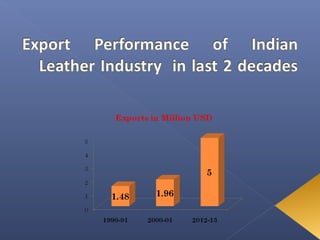
 For the period 2007-08 to 2011-12, India's
leather exports grew at a rate of 8.2 per
cent, reaching US$ 4.86 billion in 2011-12.
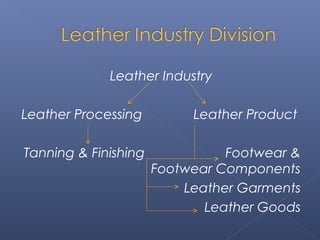
Leather Industry
Leather Processing Leather Product
Tanning & Finishing Footwear &
Footwear Components
Leather Garments
Leather Goods
 The Council for Leather Exports (CLE) is
an autonomous, non-profit organization,
which is entrusted with export promotion
activities and development of the Indian
leather industry. About 2,400 that
manufacture/ export leather and leather
products are members of the Council.
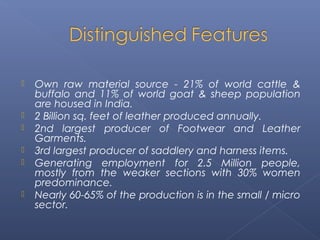
 Own raw material source - 21% of world cattle &
buffalo and 11% of world goat & sheep population
are housed in India.
 2 Billion sq. feet of leather produced annually.
 2nd largest producer of Footwear and Leather
Garments.
 3rd largest producer of saddlery and harness items.
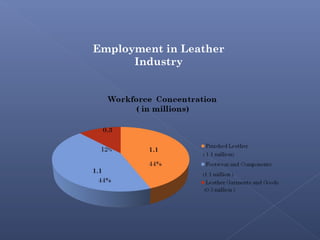
 Generating employment for 2.5 Million people,
mostly from the weaker sections with 30% women
predominance.
 Nearly 60-65% of the production is in the small / micro
sector.
Employment in Leather
Industry
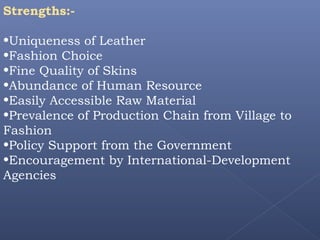
Strengths:-
•Uniqueness of Leather
•Fashion Choice
•Fine Quality of Skins
•Abundance of Human Resource
•Easily Accessible Raw Material
•Prevalence of Production Chain from Village to
Fashion
•Policy Support from the Government
•Encouragement by International-Development
Agencies
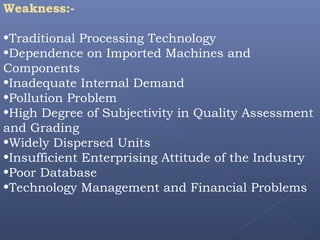
Weakness:-
•Traditional Processing Technology
•Dependence on Imported Machines and
Components
•Inadequate Internal Demand
•Pollution Problem
•High Degree of Subjectivity in Quality Assessment
and Grading
•Widely Dispersed Units
•Insufficient Enterprising Attitude of the Industry
•Poor Database
•Technology Management and Financial Problems
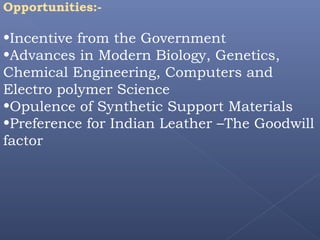
Opportunities:-
•Incentive from the Government
•Advances in Modern Biology, Genetics,
Chemical Engineering, Computers and
Electro polymer Science
•Opulence of Synthetic Support Materials
•Preference for Indian Leather –The Goodwill
factor
Threats:-
•Environmental Pollution may force closure of
Tanneries unless relocated to a specified cluster
•Liability Aspects of Pollution
•High Price of Leather & Leather products
•Inelastic Supply of Raw Material
•Perpetual Dependence on Western Market
•Rising Aggressive Competition from International
Players
•Challenges from Synthetics
CONCLUSION:
Back in 1970s, the Indian leather industry was one of the
major contributors of the Indian economy. It not only had
reasonable share in the GDP but was generating many
employment opportunities for its citizens. To be more
precise and accurate on quantitative data we have divided
the leather industry into two major categories i.e. the
leather processing sector and the leather goods
manufacturing sector
Investment in leather goods manufacturing sector of
leather industry is producing many types of leather goods
i.e. shoes, sandals, bags of all kinds, leather jackets,
leather hats, covers for many articles etc. Historically,
leather jackets, traditional shoes and traditional hats called
Karakul were produced in the country .Overall analysis
shows that huge investment opportunities exist to be
availed by existing and new firms. History shows that the
industry was highly profitable while access to domestic and
international markets. All needed is the implementation of
a well studied and formulated action plan by the investors
to yield generous profits and sustain long-term growth.
REFERENCES:-
•Council for Leather Exports (CLE)
•website: www.leatherindia.org
•ll India Skin and Hide Tanners & Merchants Association
(AISHTMA)
•website: http://www.aishtma.com
•indian Finished Leather Manufacturers & Exporters
Association (IFLMEA)
•website: http://www.iflmea.net/svs.aspx
•indian Footwear Components Manufacturers Association
(IFCOMA)
•website: www.ifcoma.org
•indian Leather Products Association (ILPA)
•website: http://www.ilpaindia.org
•indian Leather Technologists’ Association (ILTA)
•website: http://www.iltaonleather.com/
•central Leather Research Institute (CLRI)
•website: www.clri.org
saurabh3

saurabh3

  • 3.
     Leather isone of the most widely-traded commodities globally. The growth in demand is driven by the fashion industry, especially footwear, furniture and interior design, and the automotive industry, among others.  Indian Leather Industry is the 5th largest in the world.  The exports from the Indian leather sector earn Rs. 1,06,910 million and provide direct employment to more than 2.5 million people.
  • 4.
     The leatherand the leather products sector has been identified as one of the unique sectors which has the advantage of both value addition and export potential  The major markets for Indian leather products are Germany, Italy, the UK, the US, Hong Kong, Spain, France, the Netherlands, the UAE, Portugal and Belgium.  For the period 2007-08 to 2011-12, India's leather exports grew at a rate of 8.2 per cent, reaching US$ 4.86 billion in 2011-12.
  • 5.
    Leather Industry Leather ProcessingLeather Product Tanning & Finishing Footwear & Footwear Components Leather Garments Leather Goods
  • 6.
     The Councilfor Leather Exports (CLE) is an autonomous, non-profit organization, which is entrusted with export promotion activities and development of the Indian leather industry. About 2,400 that manufacture/ export leather and leather products are members of the Council.
  • 7.
     Own rawmaterial source - 21% of world cattle & buffalo and 11% of world goat & sheep population are housed in India.  2 Billion sq. feet of leather produced annually.  2nd largest producer of Footwear and Leather Garments.  3rd largest producer of saddlery and harness items.  Generating employment for 2.5 Million people, mostly from the weaker sections with 30% women predominance.  Nearly 60-65% of the production is in the small / micro sector.
  • 12.
  • 14.
    Strengths:- •Uniqueness of Leather •FashionChoice •Fine Quality of Skins •Abundance of Human Resource •Easily Accessible Raw Material •Prevalence of Production Chain from Village to Fashion •Policy Support from the Government •Encouragement by International-Development Agencies
  • 15.
    Weakness:- •Traditional Processing Technology •Dependenceon Imported Machines and Components •Inadequate Internal Demand •Pollution Problem •High Degree of Subjectivity in Quality Assessment and Grading •Widely Dispersed Units •Insufficient Enterprising Attitude of the Industry •Poor Database •Technology Management and Financial Problems
  • 16.
    Opportunities:- •Incentive from theGovernment •Advances in Modern Biology, Genetics, Chemical Engineering, Computers and Electro polymer Science •Opulence of Synthetic Support Materials •Preference for Indian Leather –The Goodwill factor
  • 17.
    Threats:- •Environmental Pollution mayforce closure of Tanneries unless relocated to a specified cluster •Liability Aspects of Pollution •High Price of Leather & Leather products •Inelastic Supply of Raw Material •Perpetual Dependence on Western Market •Rising Aggressive Competition from International Players •Challenges from Synthetics
  • 18.
    CONCLUSION: Back in 1970s,the Indian leather industry was one of the major contributors of the Indian economy. It not only had reasonable share in the GDP but was generating many employment opportunities for its citizens. To be more precise and accurate on quantitative data we have divided the leather industry into two major categories i.e. the leather processing sector and the leather goods manufacturing sector
  • 19.
    Investment in leathergoods manufacturing sector of leather industry is producing many types of leather goods i.e. shoes, sandals, bags of all kinds, leather jackets, leather hats, covers for many articles etc. Historically, leather jackets, traditional shoes and traditional hats called Karakul were produced in the country .Overall analysis shows that huge investment opportunities exist to be availed by existing and new firms. History shows that the industry was highly profitable while access to domestic and international markets. All needed is the implementation of a well studied and formulated action plan by the investors to yield generous profits and sustain long-term growth.
  • 20.
    REFERENCES:- •Council for LeatherExports (CLE) •website: www.leatherindia.org •ll India Skin and Hide Tanners & Merchants Association (AISHTMA) •website: http://www.aishtma.com •indian Finished Leather Manufacturers & Exporters Association (IFLMEA) •website: http://www.iflmea.net/svs.aspx •indian Footwear Components Manufacturers Association (IFCOMA) •website: www.ifcoma.org •indian Leather Products Association (ILPA) •website: http://www.ilpaindia.org •indian Leather Technologists’ Association (ILTA) •website: http://www.iltaonleather.com/ •central Leather Research Institute (CLRI) •website: www.clri.org