The document introduces the maximum likelihood method (MLM) for determining the most likely cause of an observed result from several possible causes. It provides examples of using MLM to determine the most likely father of a child from potential candidates and the most likely distribution of balls in a box based on the observed colors of balls drawn from the box. MLM involves calculating the likelihood of each potential cause producing the observed result and selecting the cause with the highest likelihood as the most probable explanation.
The Maximum LikelihoodMethod (MLM) Objective To introduce the idea of working out the most likely cause of an observed result by considering the likelihood of each of several possible causes and picking the cause with the highest likelihood
2.
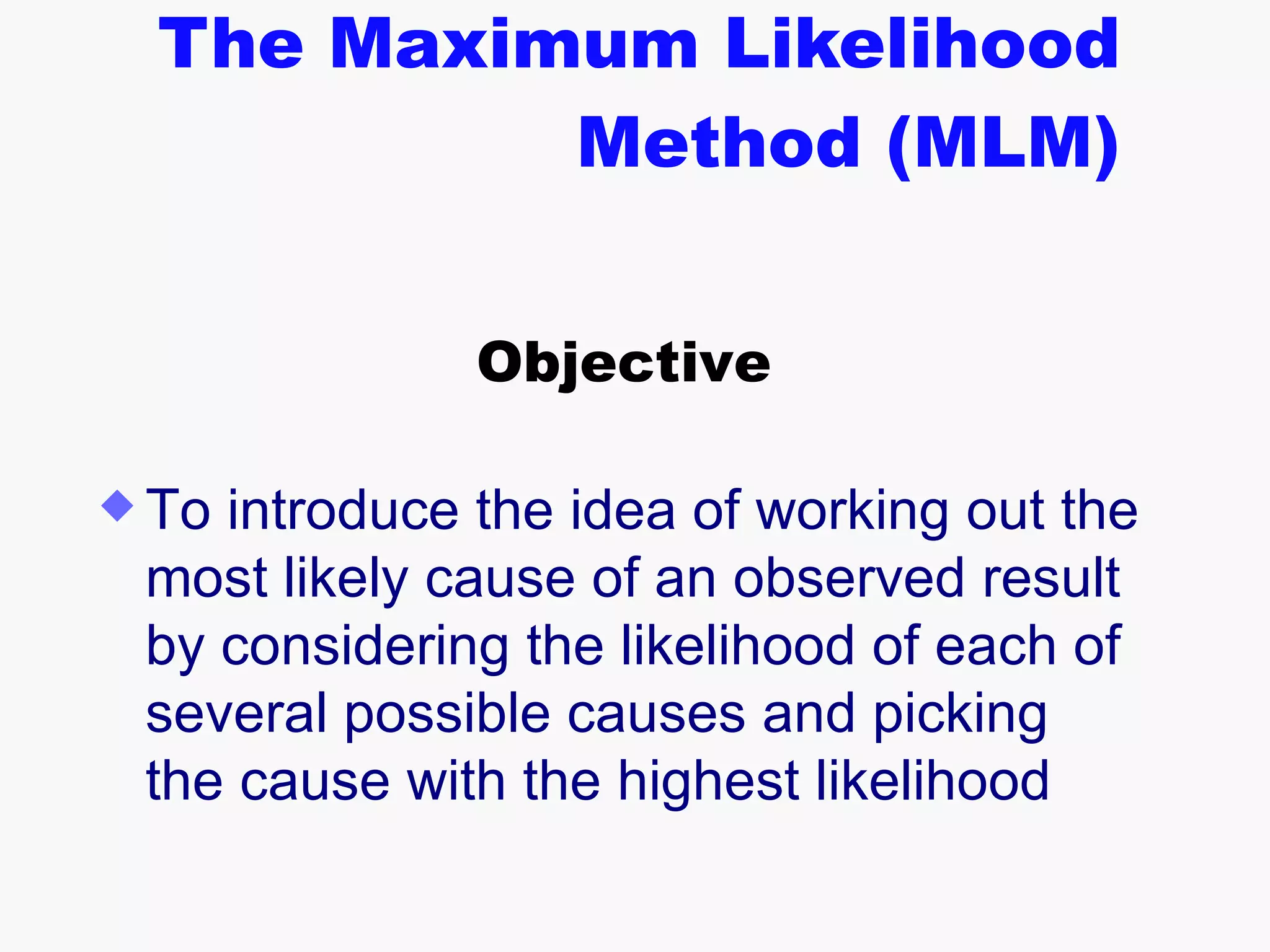
Who is thedaddy? Here is a picture of a boy and his mother…
3.
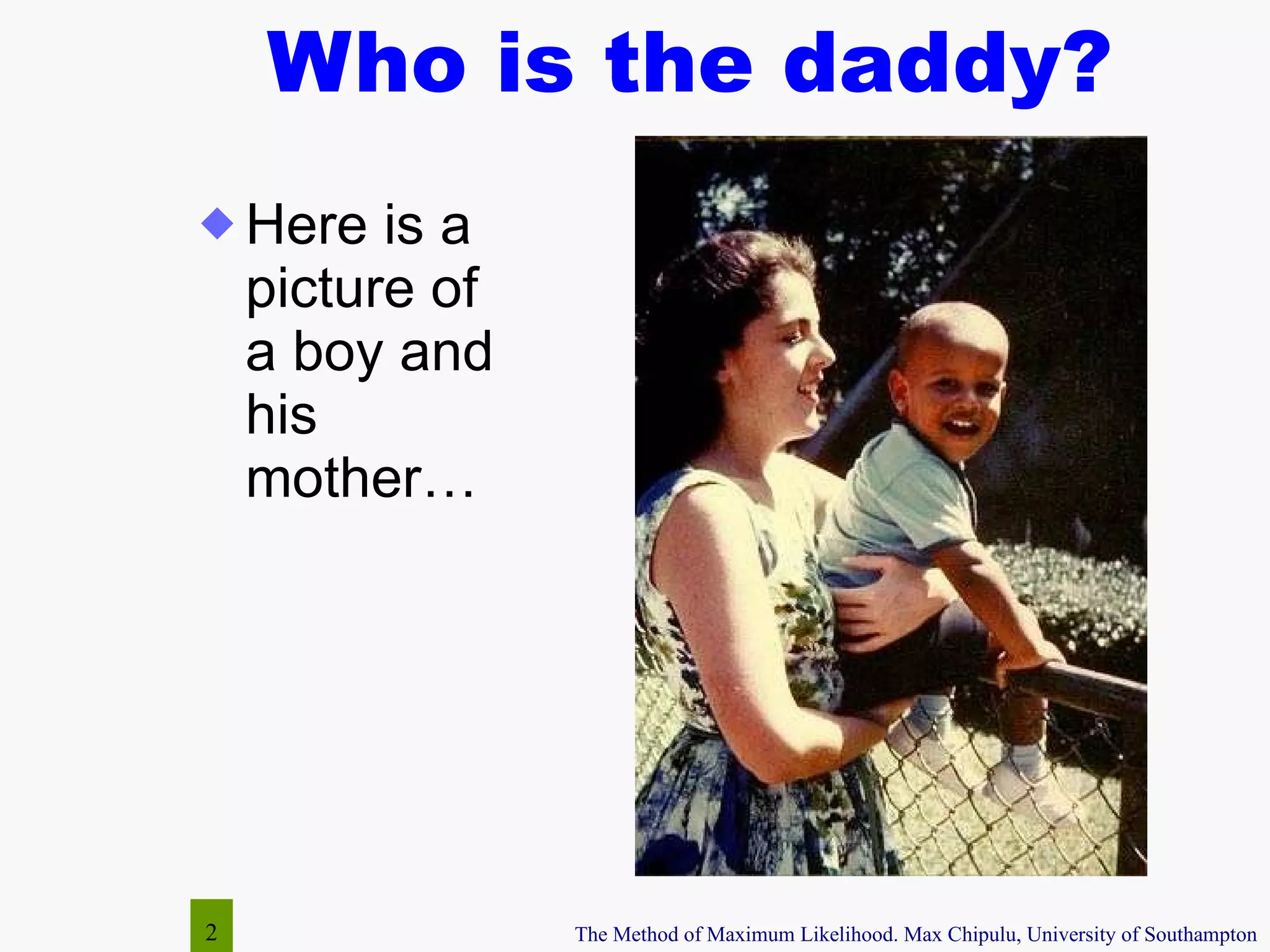
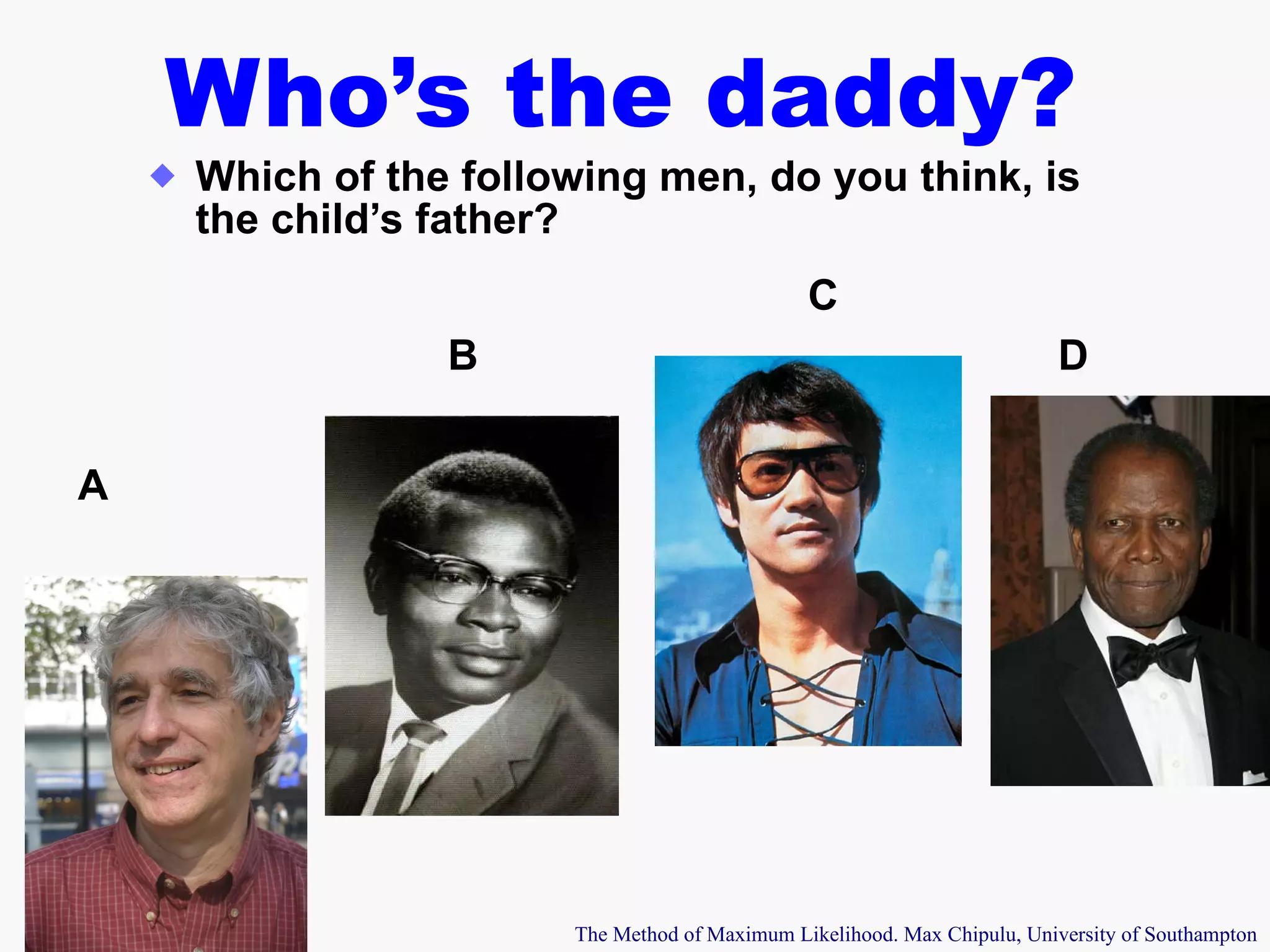
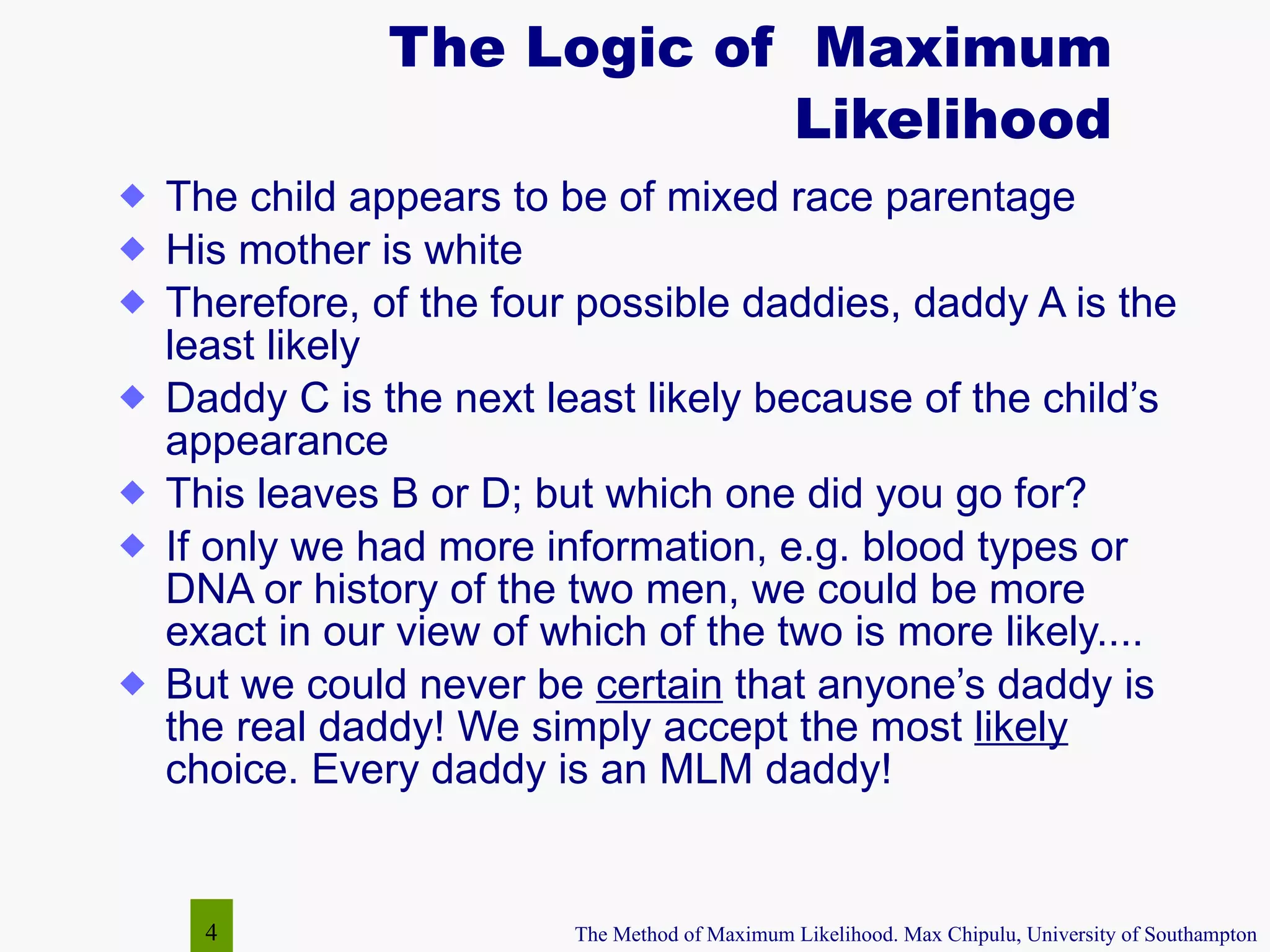
Who’s the daddy?Which of the following men, do you think, is the child’s father? A B C D
4.
The Logic of Maximum Likelihood The child appears to be of mixed race parentage His mother is white Therefore, of the four possible daddies, daddy A is the least likely Daddy C is the next least likely because of the child’s appearance This leaves B or D; but which one did you go for? If only we had more information, e.g. blood types or DNA or history of the two men, we could be more exact in our view of which of the two is more likely.... But we could never be certain that anyone’s daddy is the real daddy! We simply accept the most likely choice. Every daddy is an MLM daddy!
5.
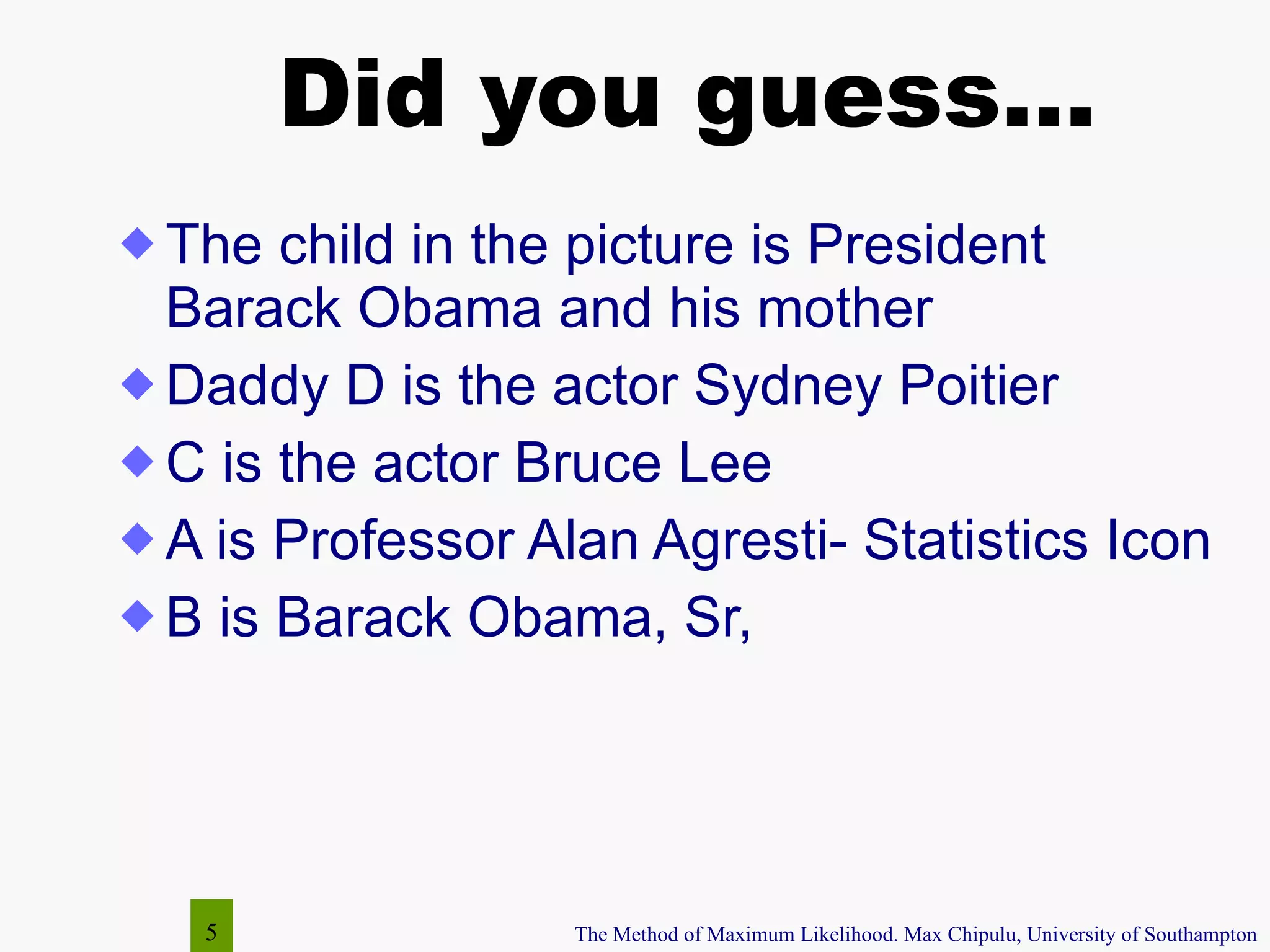
Did you guess…The child in the picture is President Barack Obama and his mother Daddy D is the actor Sydney Poitier C is the actor Bruce Lee A is Professor Alan Agresti- Statistics Icon B is Barack Obama, Sr,
6.
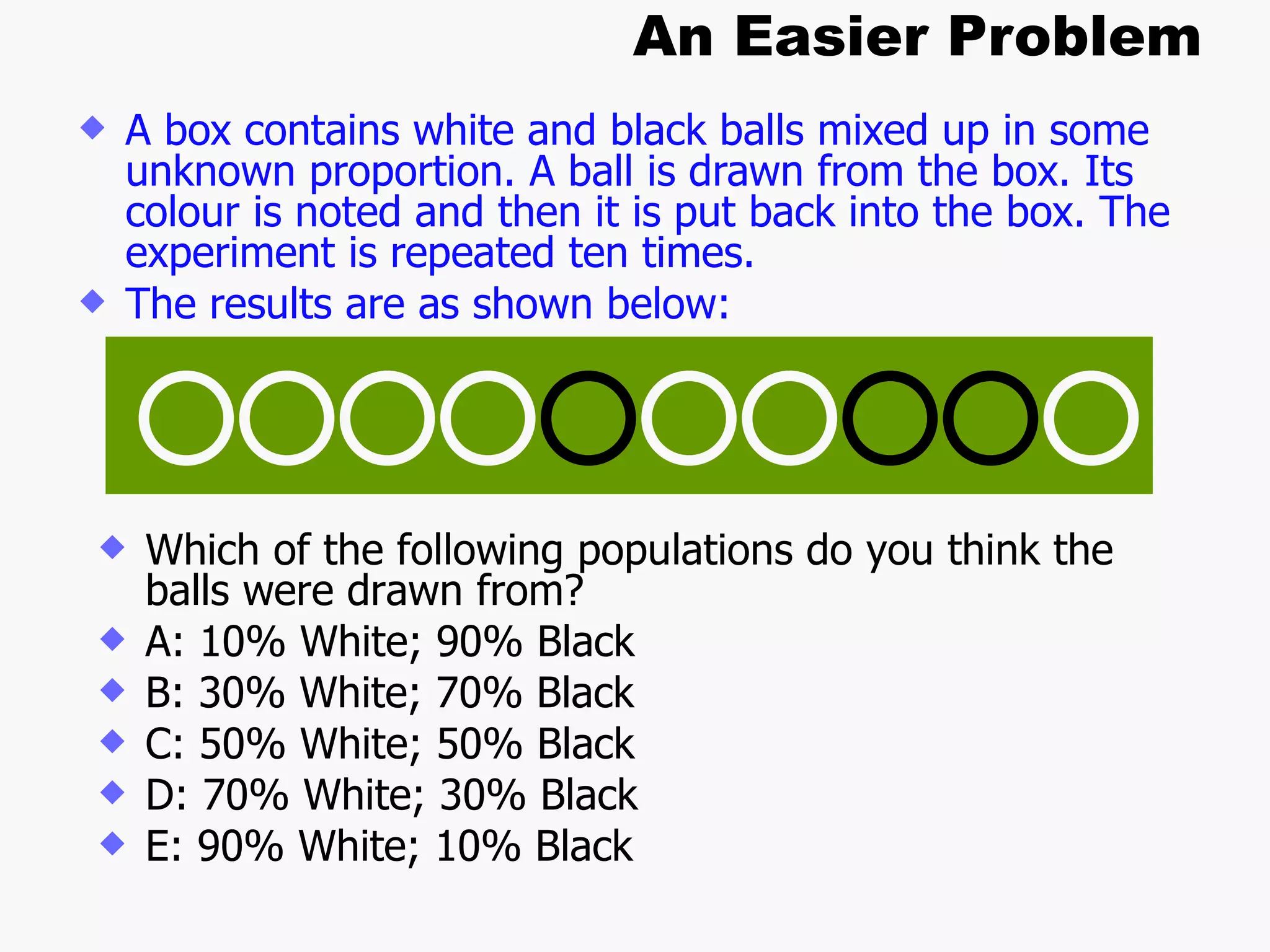
An Easier ProblemA box contains white and black balls mixed up in some unknown proportion. A ball is drawn from the box. Its colour is noted and then it is put back into the box. The experiment is repeated ten times. The results are as shown below: Which of the following populations do you think the balls were drawn from? A: 10% White; 90% Black B: 30% White; 70% Black C: 50% White; 50% Black D: 70% White; 30% Black E: 90% White; 10% Black
7.
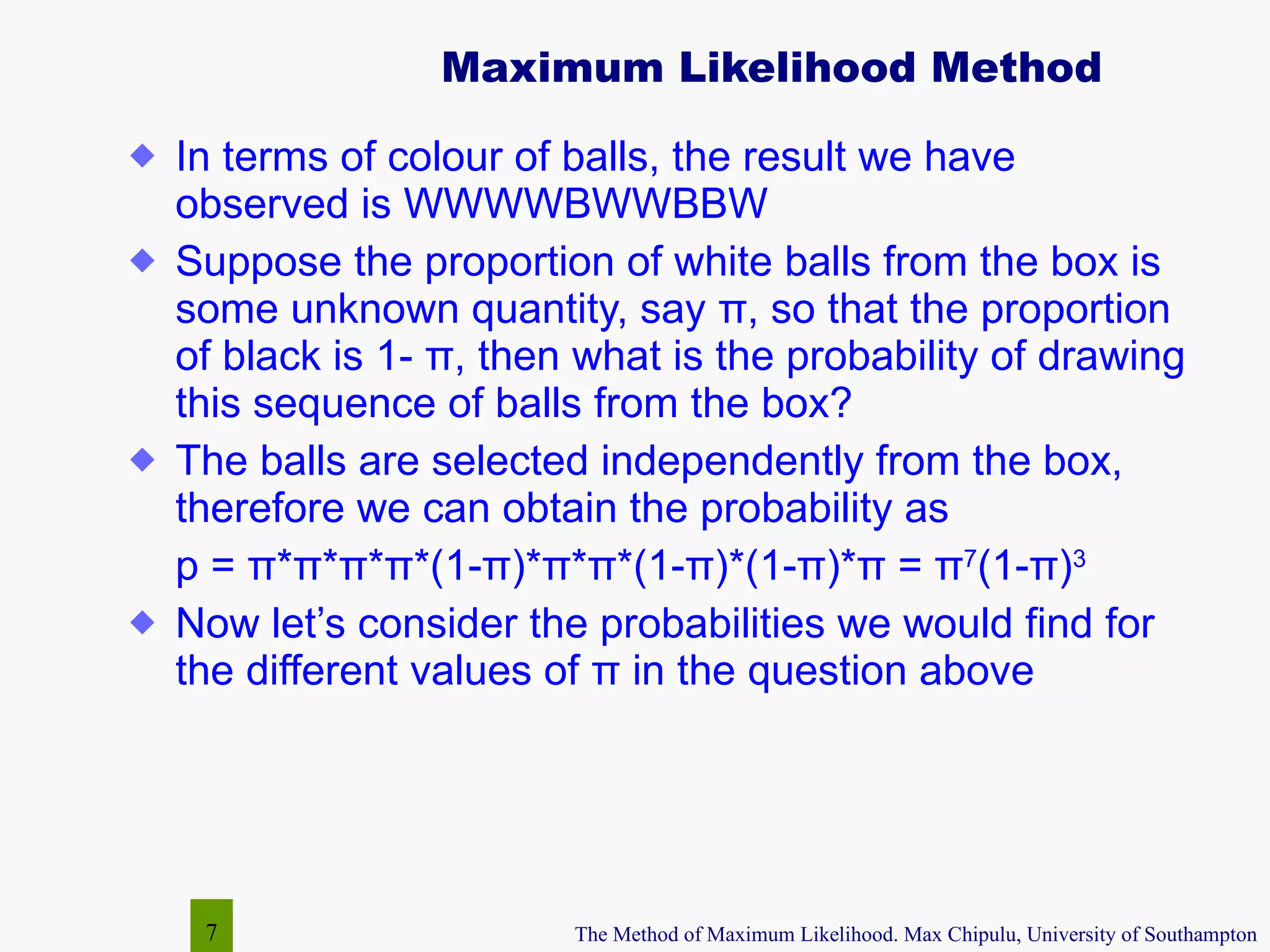
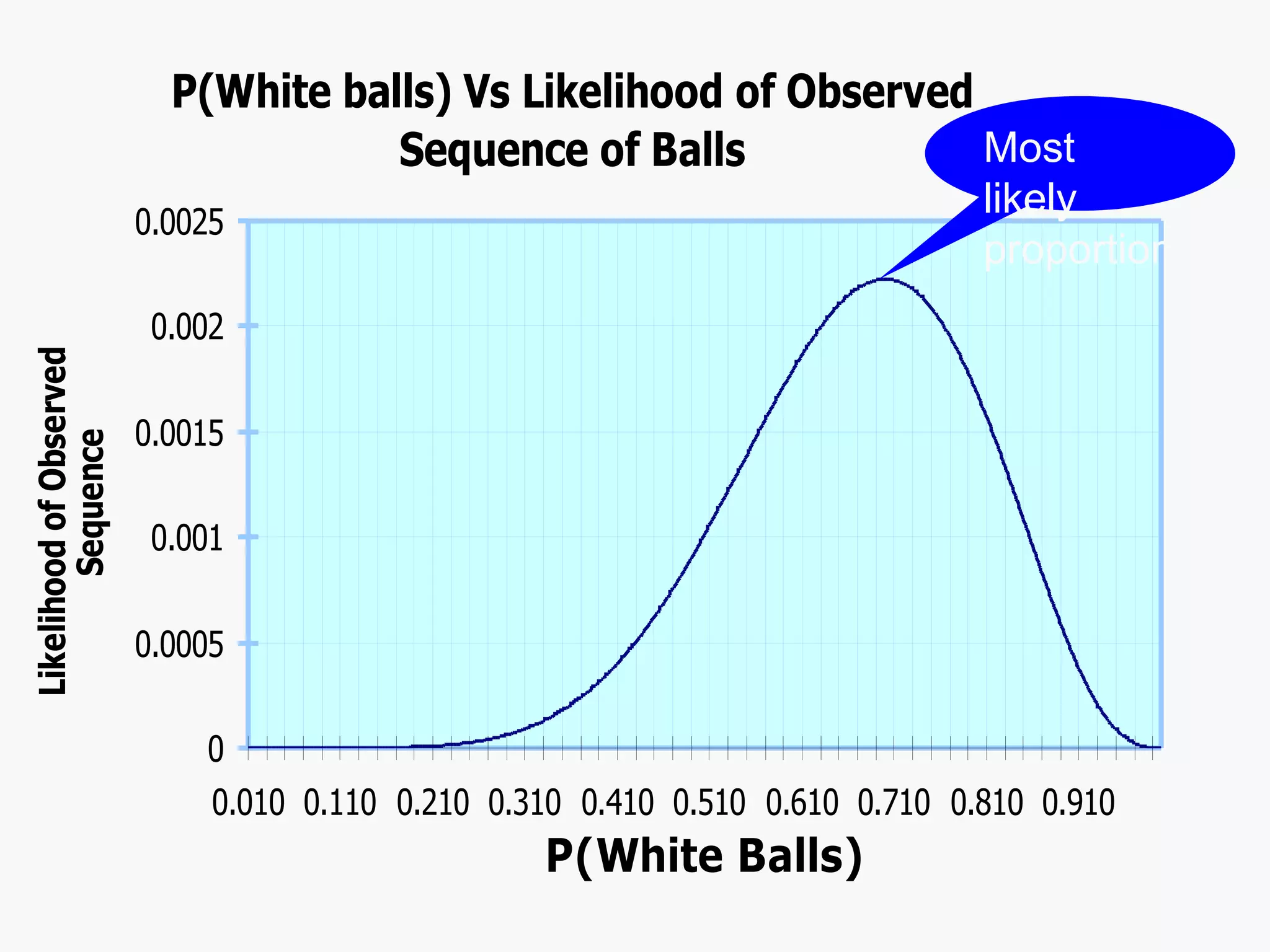
Maximum Likelihood MethodIn terms of colour of balls, the result we have observed is WWWWBWWBBW Suppose the proportion of white balls from the box is some unknown quantity, say π , so that the proportion of black is 1- π , then what is the probability of drawing this sequence of balls from the box? The balls are selected independently from the box, therefore we can obtain the probability as p = π * π * π * π *(1- π )* π * π *(1- π )*(1- π )* π = π 7 (1- π ) 3 Now let’s consider the probabilities we would find for the different values of π in the question above
8.
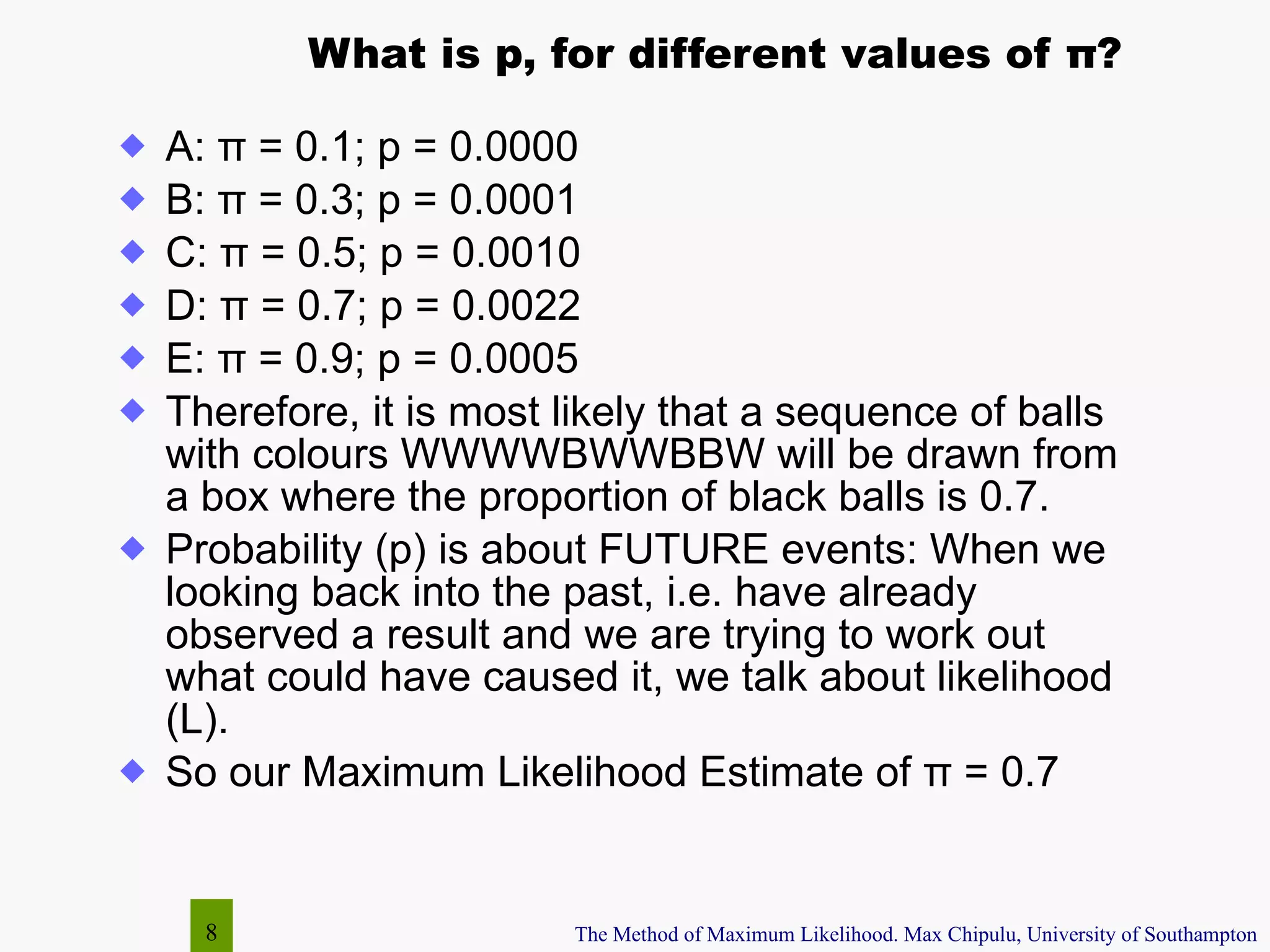
What is p,for different values of π ? A: π = 0.1; p = 0.0000 B: π = 0.3; p = 0.0001 C: π = 0.5; p = 0.0010 D: π = 0.7; p = 0.0022 E: π = 0.9; p = 0.0005 Therefore, it is most likely that a sequence of balls with colours WWWWBWWBBW will be drawn from a box where the proportion of black balls is 0.7. Probability (p) is about FUTURE events: When we looking back into the past, i.e. have already observed a result and we are trying to work out what could have caused it, we talk about likelihood (L). So our Maximum Likelihood Estimate of π = 0.7
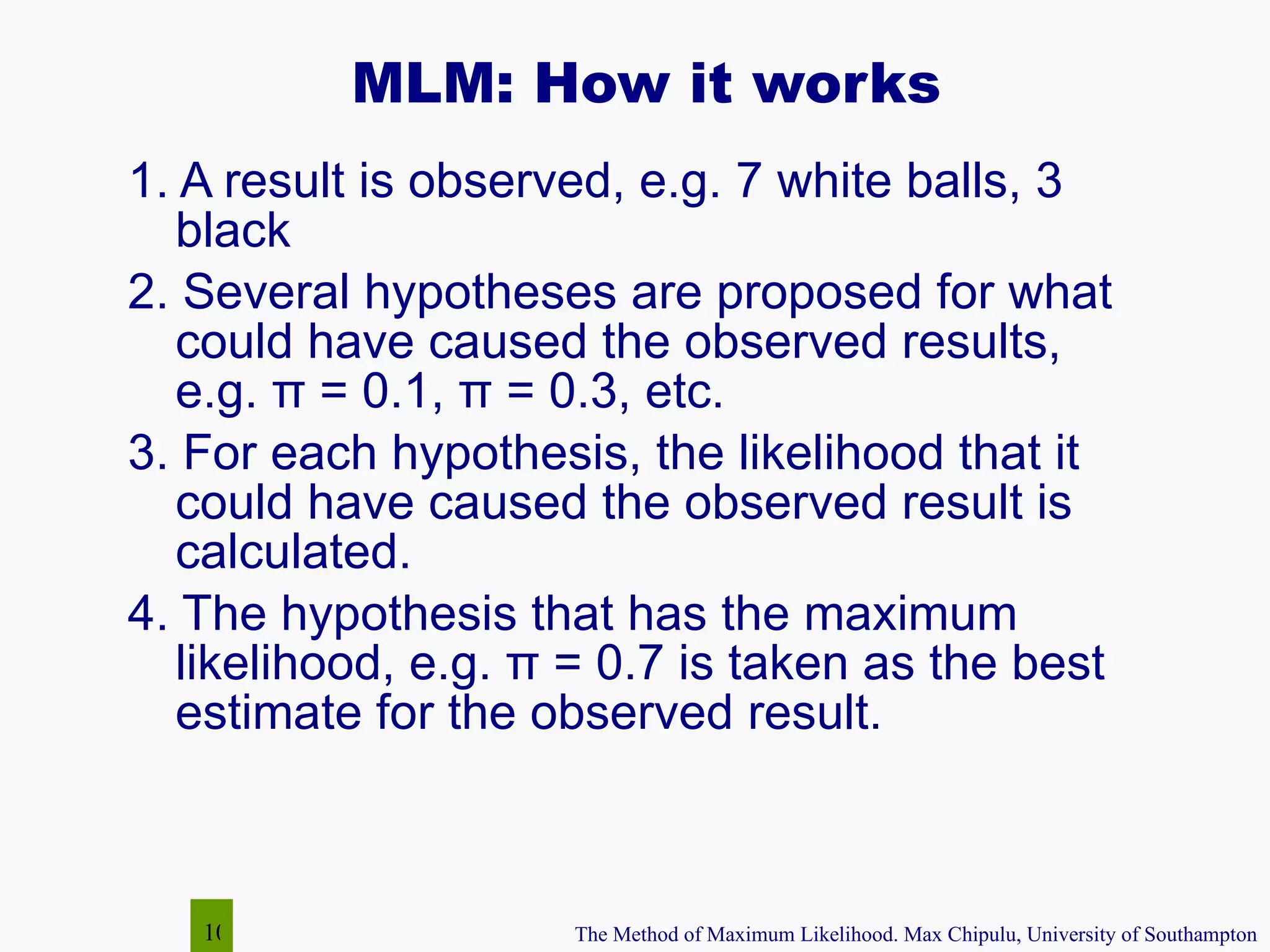
MLM: How itworks 1. A result is observed, e.g. 7 white balls, 3 black 2. Several hypotheses are proposed for what could have caused the observed results, e.g. π = 0.1, π = 0.3, etc. 3. For each hypothesis, the likelihood that it could have caused the observed result is calculated. 4. The hypothesis that has the maximum likelihood, e.g. π = 0.7 is taken as the best estimate for the observed result.
11.
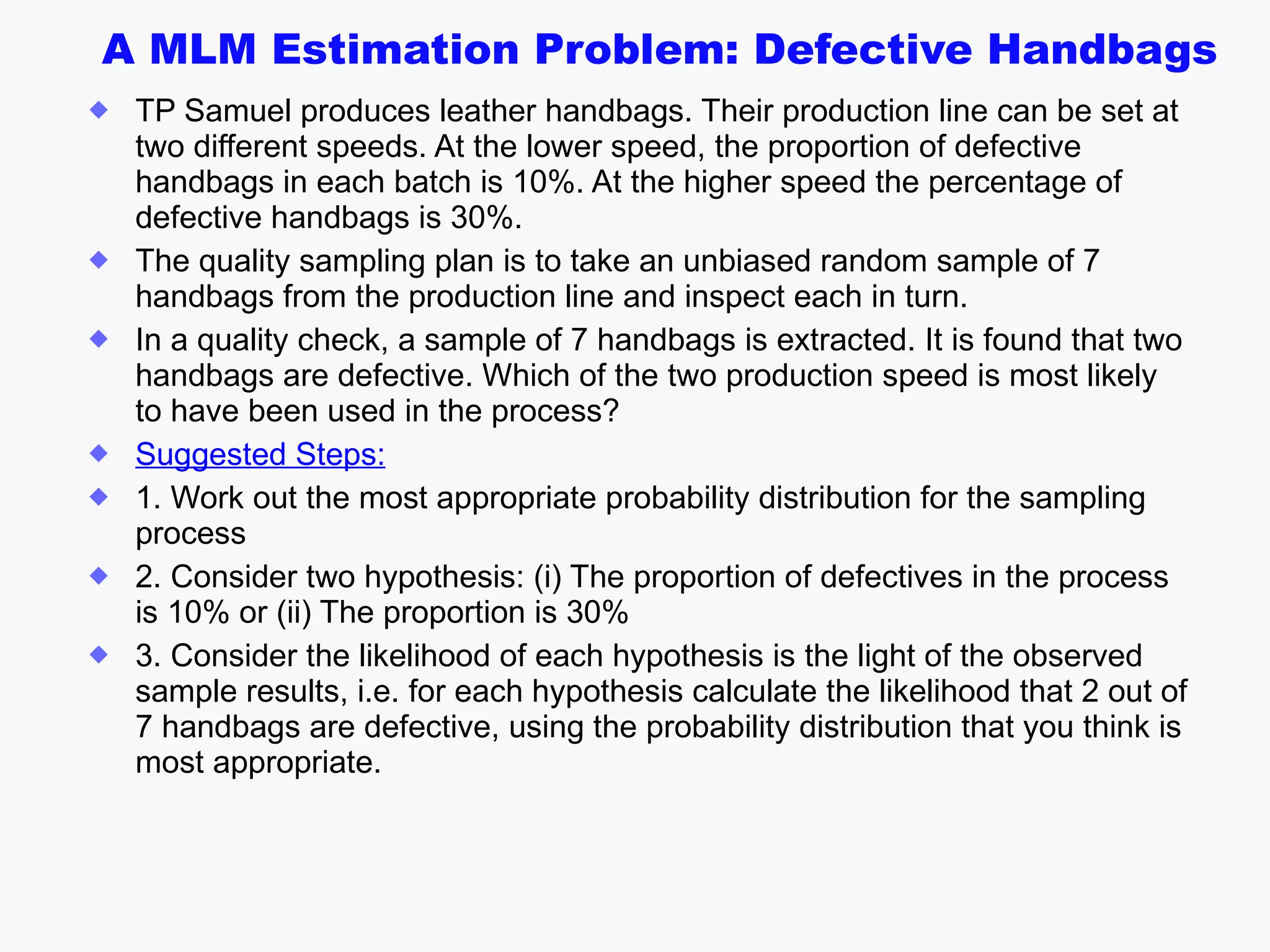
A MLM EstimationProblem: Defective Handbags TP Samuel produces leather handbags. Their production line can be set at two different speeds. At the lower speed, the proportion of defective handbags in each batch is 10%. At the higher speed the percentage of defective handbags is 30%. The quality sampling plan is to take an unbiased random sample of 7 handbags from the production line and inspect each in turn. In a quality check, a sample of 7 handbags is extracted. It is found that two handbags are defective. Which of the two production speed is most likely to have been used in the process? Suggested Steps: 1. Work out the most appropriate probability distribution for the sampling process 2. Consider two hypothesis: (i) The proportion of defectives in the process is 10% or (ii) The proportion is 30% 3. Consider the likelihood of each hypothesis is the light of the observed sample results, i.e. for each hypothesis calculate the likelihood that 2 out of 7 handbags are defective, using the probability distribution that you think is most appropriate.