MAXILLARY
NERVE
PTERYGO-PALATINE
GANGLION
INTRODUCTION
• Largest peripheral ganglion
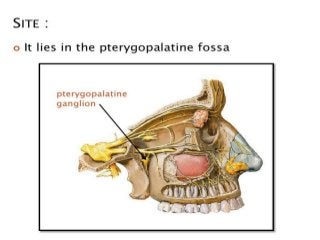
• Lies in deepest part of Pterygo-palatine fossa.
• Topographically : Maxillary nerve
• Functionally : Greater petrosal branch of facial
nerve
SITUATION
• Lateral to the Spheno-palatine Foramen
• Below Maxillary nerve
• In front of Pterygoid canal.
• Medially : Pharyngeal artery
• Laterally : Pterygoid canal
CONNECTIONS
PARA-SYMPATHETIC / MOTOR ROOT
• Derived from the nerve of Pterygoid canal
• Pre-ganglionic fibres – Lacrimatory nucleus
• Nervous Intermedius
• Trunk and geniculate ganglion of Facial nerve
• Greater Petrosal nerve
• Nerve of Pterygoid canal
• Relay
PARA-SYMPATHETIC / MOTOR ROOT
• Pre-ganglionic fibres – supply
– Lacrimal gland
– Nasal glands
– Palatine glands
– Pharyngeal glands
SYMPATHETIC ROOT
• Sympathetic plexus of nerves around ICA
• Deep Petrosal nerve
• Carry post ganglionic fibres from Superior
cervical ganglion of ST
• Deep Petrosal nerve joins Greater Petrosal
nerve
• Nerve of Pterygoid canal
SYMPATHETIC ROOT
• Fibres of Deep Petrosal nerve pass uninterrupted
through the ganglion
• Supply Vasomotor fibres to mucous membrane
of :
– Nose
– Naso-pharynx
– Palate
SENSORY ROOT
• Derived from Maxillary nerve arising from
Trigeminal ganglion
• Fibres pass uninterrupted through the ganglion
BRANCHES
• The distributing branches of ganglion are the
ganglionic branches of Maxillary nerve
• These fibres have passed through the ganglion
without relay.
BRANCHES
• Ganglion gives four sets of branches :
– Orbital
– Palatine
– Nasal
– Pharyngeal
• Each branch carries a mixture of sensory,
sympathetic and para-sympathetic fibres.
ORBITAL BRANCHES
• Enters through Inferior orbital fissure
• Supply :
1. Periosteum of orbit
2. Orbitalis
3. Mucous membrane of Sphenoidal and
Posterior Ethmoidal air sinuses.
GREATER PALATINE BRANCH
• Greater / Anterior palatine branch : passes
through Greater Palatine foramen.
• Supplies :
– Mucous membrane of hard palate and adjoining
gum
• Gives Posterior Inferior Nasal branch :
– Mucous membrane of postero-inferior quadrant
of lateral wall of nasal cavity
LESSER PALATINE BRANCH
• Greater / Anterior palatine branch : passes
through Greater Palatine foramen.
• Supplies :
– Mucous membrane of hard palate and adjoining
gum
• Gives Posterior Inferior Nasal branch :
– Mucous membrane of postero-inferior quadrant
of lateral wall of nasal cavity
NASAL BRANCH
• Greater / Anterior palatine branch : passes
through Greater Palatine foramen.
• Supplies :
– Mucous membrane of hard palate and adjoining
gum
• Gives Posterior Inferior Nasal branch :
– Mucous membrane of postero-inferior quadrant
of lateral wall of nasal cavity
PHARYNGEAL BRANCH
• Passes backwards through Palatino-vaginal
canal
• Supplies :
– Mucous membrane of naso-pharynx behind
auditory tube
APPLIED ANATOMY
1. Ganglion of Hay fever – R.J Last
2. Injection of alcohol – intractable cases of
allergic rhinitis
3. Brain freeze / Ice cream headache – cranial
pain / headache

Maxillary nerve.pptx

  • 1.
  • 2.
  • 6.
    INTRODUCTION • Largest peripheralganglion • Lies in deepest part of Pterygo-palatine fossa. • Topographically : Maxillary nerve • Functionally : Greater petrosal branch of facial nerve
  • 7.
    SITUATION • Lateral tothe Spheno-palatine Foramen • Below Maxillary nerve • In front of Pterygoid canal. • Medially : Pharyngeal artery • Laterally : Pterygoid canal
  • 8.
  • 9.
    PARA-SYMPATHETIC / MOTORROOT • Derived from the nerve of Pterygoid canal • Pre-ganglionic fibres – Lacrimatory nucleus • Nervous Intermedius • Trunk and geniculate ganglion of Facial nerve • Greater Petrosal nerve • Nerve of Pterygoid canal • Relay
  • 10.
    PARA-SYMPATHETIC / MOTORROOT • Pre-ganglionic fibres – supply – Lacrimal gland – Nasal glands – Palatine glands – Pharyngeal glands
  • 11.
    SYMPATHETIC ROOT • Sympatheticplexus of nerves around ICA • Deep Petrosal nerve • Carry post ganglionic fibres from Superior cervical ganglion of ST • Deep Petrosal nerve joins Greater Petrosal nerve • Nerve of Pterygoid canal
  • 12.
    SYMPATHETIC ROOT • Fibresof Deep Petrosal nerve pass uninterrupted through the ganglion • Supply Vasomotor fibres to mucous membrane of : – Nose – Naso-pharynx – Palate
  • 13.
    SENSORY ROOT • Derivedfrom Maxillary nerve arising from Trigeminal ganglion • Fibres pass uninterrupted through the ganglion
  • 15.
    BRANCHES • The distributingbranches of ganglion are the ganglionic branches of Maxillary nerve • These fibres have passed through the ganglion without relay.
  • 16.
    BRANCHES • Ganglion givesfour sets of branches : – Orbital – Palatine – Nasal – Pharyngeal • Each branch carries a mixture of sensory, sympathetic and para-sympathetic fibres.
  • 18.
    ORBITAL BRANCHES • Entersthrough Inferior orbital fissure • Supply : 1. Periosteum of orbit 2. Orbitalis 3. Mucous membrane of Sphenoidal and Posterior Ethmoidal air sinuses.
  • 20.
    GREATER PALATINE BRANCH •Greater / Anterior palatine branch : passes through Greater Palatine foramen. • Supplies : – Mucous membrane of hard palate and adjoining gum • Gives Posterior Inferior Nasal branch : – Mucous membrane of postero-inferior quadrant of lateral wall of nasal cavity
  • 22.
    LESSER PALATINE BRANCH •Greater / Anterior palatine branch : passes through Greater Palatine foramen. • Supplies : – Mucous membrane of hard palate and adjoining gum • Gives Posterior Inferior Nasal branch : – Mucous membrane of postero-inferior quadrant of lateral wall of nasal cavity
  • 24.
    NASAL BRANCH • Greater/ Anterior palatine branch : passes through Greater Palatine foramen. • Supplies : – Mucous membrane of hard palate and adjoining gum • Gives Posterior Inferior Nasal branch : – Mucous membrane of postero-inferior quadrant of lateral wall of nasal cavity
  • 27.
    PHARYNGEAL BRANCH • Passesbackwards through Palatino-vaginal canal • Supplies : – Mucous membrane of naso-pharynx behind auditory tube
  • 28.
    APPLIED ANATOMY 1. Ganglionof Hay fever – R.J Last 2. Injection of alcohol – intractable cases of allergic rhinitis 3. Brain freeze / Ice cream headache – cranial pain / headache