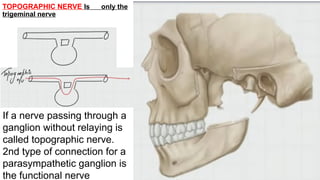
TOPOGRAPHIC NERVE Is only the
trigeminal nerve
If a nerve passing through a
ganglion without relaying is
called topographic nerve.
2nd type of connection for a
parasympathetic ganglion is
the functional nerve
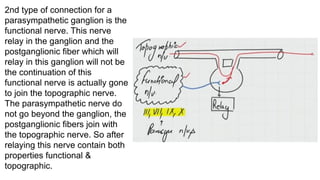
2nd type of connection for a
parasympathetic ganglion is the
functional nerve. This nerve
relay in the ganglion and the
postganglionic fiber which will
relay in this ganglion will not be
the continuation of this
functional nerve is actually gone
to join the topographic nerve.
The parasympathetic nerve do
not go beyond the ganglion, the
postganglionic fibers join with
the topographic nerve. So after
relaying this nerve contain both
properties functional &
topographic.
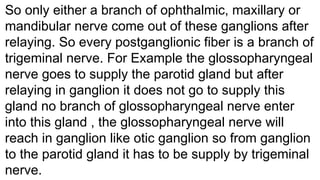
So only either a branch of ophthalmic, maxillary or
mandibular nerve come out of these ganglions after
relaying. So every postganglionic fiber is a branch of
trigeminal nerve. For Example the glossopharyngeal
nerve goes to supply the parotid gland but after
relaying in ganglion it does not go to supply this
gland no branch of glossopharyngeal nerve enter
into this gland , the glossopharyngeal nerve will
reach in ganglion like otic ganglion so from ganglion
to the parotid gland it has to be supply by trigeminal
nerve.
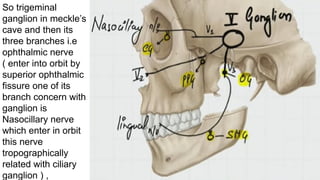
So trigeminal
ganglion in meckle’s
cave and then its
three branches i.e
ophthalmic nerve
( enter into orbit by
superior ophthalmic
fissure one of its
branch concern with
ganglion is
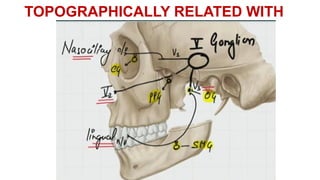
Nasocillary nerve
which enter in orbit
this nerve
tropographically
related with ciliary
ganglion ) ,
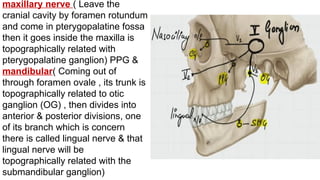
maxillary nerve ( Leave the
cranial cavity by foramen rotundum
and come in pterygopalatine fossa
then it goes inside the maxilla is
topographically related with
pterygopalatine ganglion) PPG &
mandibular( Coming out of
through foramen ovale , its trunk is
topographically related to otic
ganglion (OG) , then divides into
anterior & posterior divisions, one
of its branch which is concern
there is called lingual nerve & that
lingual nerve will be
topographically related with the
submandibular ganglion)
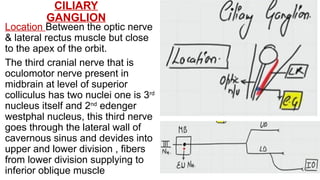
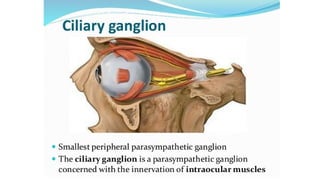
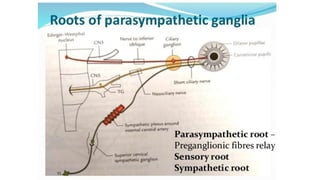
CILIARY
GANGLION
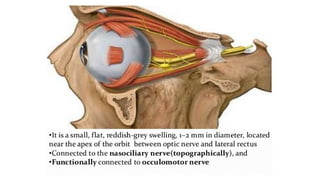
Location Between the optic nerve
& lateral rectus muscle but close
to the apex of the orbit.
The third cranial nerve that is
oculomotor nerve present in
midbrain at level of superior
colliculus has two nuclei one is 3rd
nucleus itself and 2nd
edenger
westphal nucleus, this third nerve
goes through the lateral wall of
cavernous sinus and devides into
upper and lower division , fibers
from lower division supplying to
inferior oblique muscle
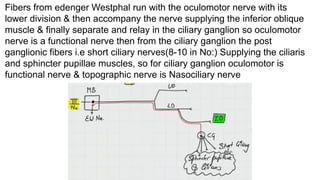
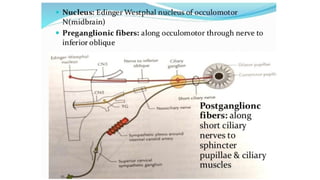
Fibers from edenger Westphal run with the oculomotor nerve with its
lower division & then accompany the nerve supplying the inferior oblique
muscle & finally separate and relay in the ciliary ganglion so oculomotor
nerve is a functional nerve then from the ciliary ganglion the post
ganglionic fibers i.e short ciliary nerves(8-10 in No:) Supplying the ciliaris
and sphincter pupillae muscles, so for ciliary ganglion oculomotor is
functional nerve & topographic nerve is Nasociliary nerve
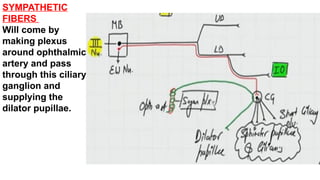
SYMPATHETIC
FIBERS
Will come by
making plexus
around ophthalmic
artery and pass
through this ciliary
ganglion and
supplying the
dilator pupillae.
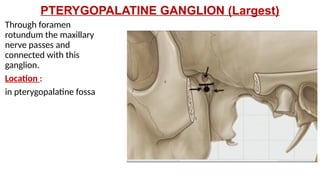
PTERYGOPALATINE GANGLION (Largest)
Through foramen
rotundum the maxillary
nerve passes and
connected with this
ganglion.
Location :
in pterygopalatine fossa
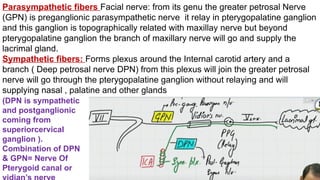
Parasympathetic fibers Facial nerve: from its genu the greater petrosal Nerve
(GPN) is preganglionic parasympathetic nerve it relay in pterygopalatine ganglion
and this ganglion is topographically related with maxillay nerve but beyond
pterygopalatine ganglion the branch of maxillary nerve will go and supply the
lacrimal gland.
Sympathetic fibers: Forms plexus around the Internal carotid artery and a
branch ( Deep petrosal nerve DPN) from this plexus will join the greater petrosal
nerve will go through the pterygopalatine ganglion without relaying and will
supplying nasal , palatine and other glands
(DPN is sympathetic
and postganglionic
coming from
superiorcervical
ganglion ).
Combination of DPN
& GPN= Nerve Of
Pterygoid canal or
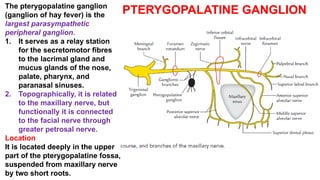
PTERYGOPALATINE GANGLION
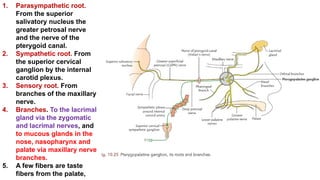
The pterygopalatine ganglion
(ganglion of hay fever) is the
largest parasympathetic
peripheral ganglion.
1. It serves as a relay station
for the secretomotor fibres
to the lacrimal gland and
mucus glands of the nose,
palate, pharynx, and
paranasal sinuses.
2. Topographically, it is related
to the maxillary nerve, but
functionally it is connected
to the facial nerve through
greater petrosal nerve.
Location
It is located deeply in the upper
part of the pterygopalatine fossa,
suspended from maxillary nerve
by two short roots.
1. Parasympathetic root.
From the superior
salivatory nucleus the
greater petrosal nerve
and the nerve of the
pterygoid canal.
2. Sympathetic root. From
the superior cervical
ganglion by the internal
carotid plexus.
3. Sensory root. From
branches of the maxillary
nerve.
4. Branches. To the lacrimal
gland via the zygomatic
and lacrimal nerves, and
to mucous glands in the
nose, nasopharynx and
palate via maxillary nerve
branches.
5. A few fibers are taste
fibers from the palate,
OTIC GANGLION
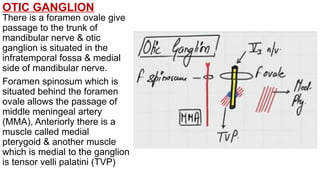
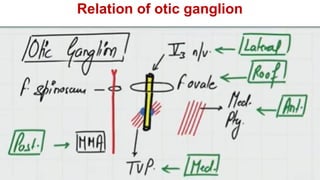
There is a foramen ovale give
passage to the trunk of
mandibular nerve & otic
ganglion is situated in the
infratemporal fossa & medial
side of mandibular nerve.
Foramen spinosum which is
situated behind the foramen
ovale allows the passage of
middle meningeal artery
(MMA), Anteriorly there is a
muscle called medial
pterygoid & another muscle
which is medial to the ganglion
is tensor velli palatini (TVP)
Relation of otic ganglion
TOPOGRAPHICALLY RELATED WITH
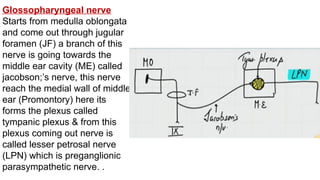
Glossopharyngeal nerve
Starts from medulla oblongata
and come out through jugular
foramen (JF) a branch of this
nerve is going towards the
middle ear cavity (ME) called
jacobson;’s nerve, this nerve
reach the medial wall of middle
ear (Promontory) here its
forms the plexus called
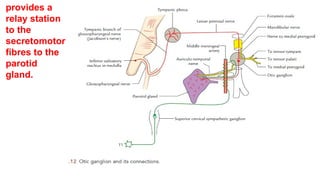
tympanic plexus & from this
plexus coming out nerve is
called lesser petrosal nerve
(LPN) which is preganglionic
parasympathetic nerve. .
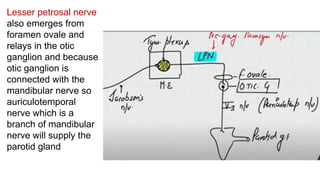
Lesser petrosal nerve
also emerges from
foramen ovale and
relays in the otic
ganglion and because
otic ganglion is
connected with the
mandibular nerve so
auriculotemporal
nerve which is a
branch of mandibular
nerve will supply the
parotid gland
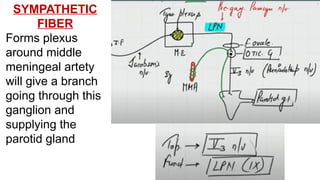
SYMPATHETIC
FIBER
Forms plexus
around middle
meningeal artety
will give a branch
going through this
ganglion and
supplying the
parotid gland
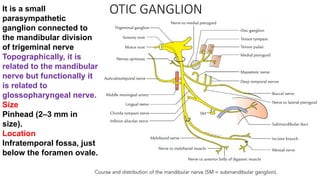
OTIC GANGLION
It is a small
parasympathetic
ganglion connected to
the mandibular division
of trigeminal nerve
Topographically, it is
related to the mandibular
nerve but functionally it
is related to
glossopharyngeal nerve.
Size
Pinhead (2–3 mm in
size).
Location
Infratemporal fossa, just
below the foramen ovale.
provides a
relay station
to the
secretomotor
fibres to the
parotid
gland.
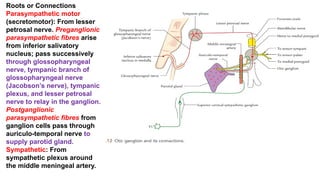
Roots or Connections
Parasympathetic motor
(secretomotor): From lesser
petrosal nerve. Preganglionic
parasympathetic fibres arise
from inferior salivatory
nucleus; pass successively
through glossopharyngeal
nerve, tympanic branch of
glossopharyngeal nerve
(Jacobson’s nerve), tympanic
plexus, and lesser petrosal
nerve to relay in the ganglion.
Postganglionic
parasympathetic fibres from
ganglion cells pass through
auriculo-temporal nerve to
supply parotid gland.
Sympathetic: From
sympathetic plexus around
the middle meningeal artery.
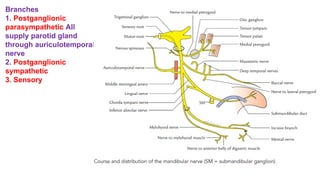
Branches
1. Postganglionic
parasympathetic All
supply parotid gland
through auriculotemporal
nerve
2. Postganglionic
sympathetic
3. Sensory
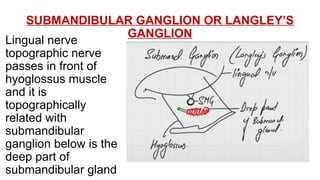
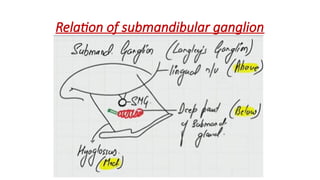
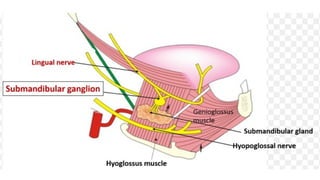
SUBMANDIBULAR GANGLION OR LANGLEY’S
GANGLION
Lingual nerve
topographic nerve
passes in front of
hyoglossus muscle
and it is
topographically
related with
submandibular
ganglion below is the
deep part of
submandibular gland
Relation of submandibular ganglion
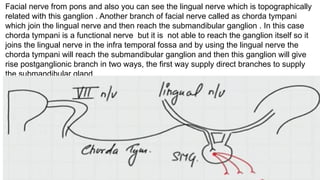
Facial nerve from pons and also you can see the lingual nerve which is topographically
related with this ganglion . Another branch of facial nerve called as chorda tympani
which join the lingual nerve and then reach the submandibular ganglion . In this case
chorda tympani is a functional nerve but it is not able to reach the ganglion itself so it
joins the lingual nerve in the infra temporal fossa and by using the lingual nerve the
chorda tympani will reach the submandibular ganglion and then this ganglion will give
rise postganglionic branch in two ways, the first way supply direct branches to supply
the submandibular gland
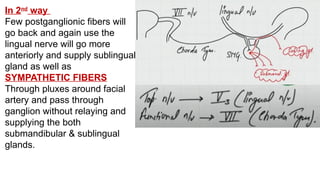
In 2nd
way
Few postganglionic fibers will
go back and again use the
lingual nerve will go more
anteriorly and supply sublingual
gland as well as
SYMPATHETIC FIBERS
Through pluxes around facial
artery and pass through
ganglion without relaying and
supplying the both
submandibular & sublingual
glands.
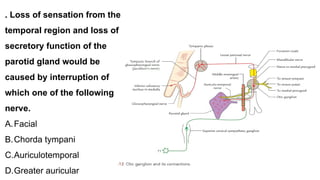
. Loss of sensation from the
temporal region and loss of
secretory function of the
parotid gland would be
caused by interruption of
which one of the following
nerve.
A.Facial
B.Chorda tympani
C.Auriculotemporal
D.Greater auricular
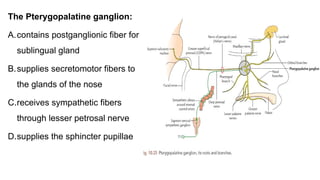
The Pterygopalatine ganglion:
A.contains postganglionic fiber for
sublingual gland
B.supplies secretomotor fibers to
the glands of the nose
C.receives sympathetic fibers
through lesser petrosal nerve
D.supplies the sphincter pupillae
Which one of the following ganglion is present in
infratemporal fossa:
A.Ciliary
B.Otic
C.Pterygopalatine
D.Submandibular
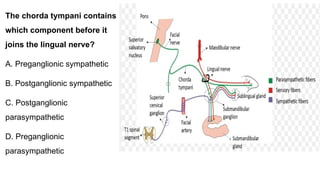
The chorda tympani contains
which component before it
joins the lingual nerve?
A. Preganglionic sympathetic
B. Postganglionic sympathetic
C. Postganglionic
parasympathetic
D. Preganglionic
parasympathetic
The absence of tears is due to
lesion in which of the following
ganglion?
A.Ciliary
B.Sphenopalatine
C.Superior cervical sympathetic
D.Trigeminal
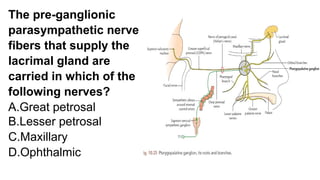
The pre-ganglionic
parasympathetic nerve
fibers that supply the
lacrimal gland are
carried in which of the
following nerves?
A.Great petrosal
B.Lesser petrosal
C.Maxillary
D.Ophthalmic
parasympathetic........... ganglion.pptx.

parasympathetic........... ganglion.pptx.

  • 3.
    TOPOGRAPHIC NERVE Isonly the trigeminal nerve If a nerve passing through a ganglion without relaying is called topographic nerve. 2nd type of connection for a parasympathetic ganglion is the functional nerve
  • 4.
    2nd type ofconnection for a parasympathetic ganglion is the functional nerve. This nerve relay in the ganglion and the postganglionic fiber which will relay in this ganglion will not be the continuation of this functional nerve is actually gone to join the topographic nerve. The parasympathetic nerve do not go beyond the ganglion, the postganglionic fibers join with the topographic nerve. So after relaying this nerve contain both properties functional & topographic.
  • 5.
    So only eithera branch of ophthalmic, maxillary or mandibular nerve come out of these ganglions after relaying. So every postganglionic fiber is a branch of trigeminal nerve. For Example the glossopharyngeal nerve goes to supply the parotid gland but after relaying in ganglion it does not go to supply this gland no branch of glossopharyngeal nerve enter into this gland , the glossopharyngeal nerve will reach in ganglion like otic ganglion so from ganglion to the parotid gland it has to be supply by trigeminal nerve.
  • 6.
    So trigeminal ganglion inmeckle’s cave and then its three branches i.e ophthalmic nerve ( enter into orbit by superior ophthalmic fissure one of its branch concern with ganglion is Nasocillary nerve which enter in orbit this nerve tropographically related with ciliary ganglion ) ,
  • 7.
    maxillary nerve (Leave the cranial cavity by foramen rotundum and come in pterygopalatine fossa then it goes inside the maxilla is topographically related with pterygopalatine ganglion) PPG & mandibular( Coming out of through foramen ovale , its trunk is topographically related to otic ganglion (OG) , then divides into anterior & posterior divisions, one of its branch which is concern there is called lingual nerve & that lingual nerve will be topographically related with the submandibular ganglion)
  • 8.
    CILIARY GANGLION Location Between theoptic nerve & lateral rectus muscle but close to the apex of the orbit. The third cranial nerve that is oculomotor nerve present in midbrain at level of superior colliculus has two nuclei one is 3rd nucleus itself and 2nd edenger westphal nucleus, this third nerve goes through the lateral wall of cavernous sinus and devides into upper and lower division , fibers from lower division supplying to inferior oblique muscle
  • 9.
    Fibers from edengerWestphal run with the oculomotor nerve with its lower division & then accompany the nerve supplying the inferior oblique muscle & finally separate and relay in the ciliary ganglion so oculomotor nerve is a functional nerve then from the ciliary ganglion the post ganglionic fibers i.e short ciliary nerves(8-10 in No:) Supplying the ciliaris and sphincter pupillae muscles, so for ciliary ganglion oculomotor is functional nerve & topographic nerve is Nasociliary nerve
  • 10.
    SYMPATHETIC FIBERS Will come by makingplexus around ophthalmic artery and pass through this ciliary ganglion and supplying the dilator pupillae.
  • 15.
    PTERYGOPALATINE GANGLION (Largest) Throughforamen rotundum the maxillary nerve passes and connected with this ganglion. Location : in pterygopalatine fossa
  • 16.
    Parasympathetic fibers Facialnerve: from its genu the greater petrosal Nerve (GPN) is preganglionic parasympathetic nerve it relay in pterygopalatine ganglion and this ganglion is topographically related with maxillay nerve but beyond pterygopalatine ganglion the branch of maxillary nerve will go and supply the lacrimal gland. Sympathetic fibers: Forms plexus around the Internal carotid artery and a branch ( Deep petrosal nerve DPN) from this plexus will join the greater petrosal nerve will go through the pterygopalatine ganglion without relaying and will supplying nasal , palatine and other glands (DPN is sympathetic and postganglionic coming from superiorcervical ganglion ). Combination of DPN & GPN= Nerve Of Pterygoid canal or
  • 17.
    PTERYGOPALATINE GANGLION The pterygopalatineganglion (ganglion of hay fever) is the largest parasympathetic peripheral ganglion. 1. It serves as a relay station for the secretomotor fibres to the lacrimal gland and mucus glands of the nose, palate, pharynx, and paranasal sinuses. 2. Topographically, it is related to the maxillary nerve, but functionally it is connected to the facial nerve through greater petrosal nerve. Location It is located deeply in the upper part of the pterygopalatine fossa, suspended from maxillary nerve by two short roots.
  • 18.
    1. Parasympathetic root. Fromthe superior salivatory nucleus the greater petrosal nerve and the nerve of the pterygoid canal. 2. Sympathetic root. From the superior cervical ganglion by the internal carotid plexus. 3. Sensory root. From branches of the maxillary nerve. 4. Branches. To the lacrimal gland via the zygomatic and lacrimal nerves, and to mucous glands in the nose, nasopharynx and palate via maxillary nerve branches. 5. A few fibers are taste fibers from the palate,
  • 19.
    OTIC GANGLION There isa foramen ovale give passage to the trunk of mandibular nerve & otic ganglion is situated in the infratemporal fossa & medial side of mandibular nerve. Foramen spinosum which is situated behind the foramen ovale allows the passage of middle meningeal artery (MMA), Anteriorly there is a muscle called medial pterygoid & another muscle which is medial to the ganglion is tensor velli palatini (TVP)
  • 20.
  • 21.
  • 22.
    Glossopharyngeal nerve Starts frommedulla oblongata and come out through jugular foramen (JF) a branch of this nerve is going towards the middle ear cavity (ME) called jacobson;’s nerve, this nerve reach the medial wall of middle ear (Promontory) here its forms the plexus called tympanic plexus & from this plexus coming out nerve is called lesser petrosal nerve (LPN) which is preganglionic parasympathetic nerve. .
  • 23.
    Lesser petrosal nerve alsoemerges from foramen ovale and relays in the otic ganglion and because otic ganglion is connected with the mandibular nerve so auriculotemporal nerve which is a branch of mandibular nerve will supply the parotid gland
  • 24.
    SYMPATHETIC FIBER Forms plexus around middle meningealartety will give a branch going through this ganglion and supplying the parotid gland
  • 25.
    OTIC GANGLION It isa small parasympathetic ganglion connected to the mandibular division of trigeminal nerve Topographically, it is related to the mandibular nerve but functionally it is related to glossopharyngeal nerve. Size Pinhead (2–3 mm in size). Location Infratemporal fossa, just below the foramen ovale.
  • 26.
    provides a relay station tothe secretomotor fibres to the parotid gland.
  • 27.
    Roots or Connections Parasympatheticmotor (secretomotor): From lesser petrosal nerve. Preganglionic parasympathetic fibres arise from inferior salivatory nucleus; pass successively through glossopharyngeal nerve, tympanic branch of glossopharyngeal nerve (Jacobson’s nerve), tympanic plexus, and lesser petrosal nerve to relay in the ganglion. Postganglionic parasympathetic fibres from ganglion cells pass through auriculo-temporal nerve to supply parotid gland. Sympathetic: From sympathetic plexus around the middle meningeal artery.
  • 28.
    Branches 1. Postganglionic parasympathetic All supplyparotid gland through auriculotemporal nerve 2. Postganglionic sympathetic 3. Sensory
  • 29.
    SUBMANDIBULAR GANGLION ORLANGLEY’S GANGLION Lingual nerve topographic nerve passes in front of hyoglossus muscle and it is topographically related with submandibular ganglion below is the deep part of submandibular gland
  • 30.
  • 31.
    Facial nerve frompons and also you can see the lingual nerve which is topographically related with this ganglion . Another branch of facial nerve called as chorda tympani which join the lingual nerve and then reach the submandibular ganglion . In this case chorda tympani is a functional nerve but it is not able to reach the ganglion itself so it joins the lingual nerve in the infra temporal fossa and by using the lingual nerve the chorda tympani will reach the submandibular ganglion and then this ganglion will give rise postganglionic branch in two ways, the first way supply direct branches to supply the submandibular gland
  • 32.
    In 2nd way Few postganglionicfibers will go back and again use the lingual nerve will go more anteriorly and supply sublingual gland as well as SYMPATHETIC FIBERS Through pluxes around facial artery and pass through ganglion without relaying and supplying the both submandibular & sublingual glands.
  • 35.
    . Loss ofsensation from the temporal region and loss of secretory function of the parotid gland would be caused by interruption of which one of the following nerve. A.Facial B.Chorda tympani C.Auriculotemporal D.Greater auricular
  • 36.
    The Pterygopalatine ganglion: A.containspostganglionic fiber for sublingual gland B.supplies secretomotor fibers to the glands of the nose C.receives sympathetic fibers through lesser petrosal nerve D.supplies the sphincter pupillae
  • 37.
    Which one ofthe following ganglion is present in infratemporal fossa: A.Ciliary B.Otic C.Pterygopalatine D.Submandibular
  • 38.
    The chorda tympanicontains which component before it joins the lingual nerve? A. Preganglionic sympathetic B. Postganglionic sympathetic C. Postganglionic parasympathetic D. Preganglionic parasympathetic
  • 39.
    The absence oftears is due to lesion in which of the following ganglion? A.Ciliary B.Sphenopalatine C.Superior cervical sympathetic D.Trigeminal
  • 40.
    The pre-ganglionic parasympathetic nerve fibersthat supply the lacrimal gland are carried in which of the following nerves? A.Great petrosal B.Lesser petrosal C.Maxillary D.Ophthalmic