
Major
ConneCtor
Tanta UNIversity
Fatema al zhraa
alhaj omar
Definition
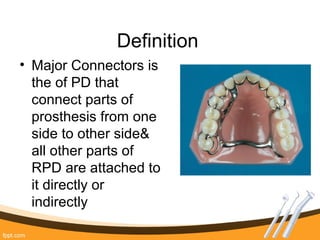
• Major Connectors is
the of PD that
connect parts of
prosthesis from one
side to other side&
all other parts of
RPD are attached to
it directly or
indirectly
Functions
• Make RPD as a one unit
• Equal stress distribution at the parts of
RPPD
• Cross arch stabilization
• If it rested on hard tissue give support
(unless if it rested on soft tissue , relief
must be done
Requirements
• Rigid to give equal distribution of forces
• should be comfort to patient
• shouldn't interference with movable tissue
• shouldn't impingement of gingival margins (maxilla at
least 6mm from margins mandible at least 3-4 mm from
gingiva)
• shouldn't have sharp edges or margins
• Should be perpendicular at minor connector but with
gentle curve
• Avoid food impaction
• designed to be self cleansable area
Types of mandibular major
connectors
• Lingual bar
• lingual plate
• Double lingual bar ( lingual bar with a
continuous bar indirect retainer)
• labial bar (plate)
• cingulum bar
• sublingual bar
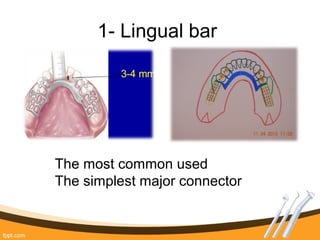
1- Lingual bar
The most common used
The simplest major connector
Design of lingual bar
1. it is half pear shape (flat to floor )
2. superior portion is thin& inferior portion is
thick
3. superior portion should be away from
gingival at least 3-4mm
4. portion should be present as low as floor
of the mouth
5. if lingual undercut present, relief should
be done
Advantages # Disadvantages
* Advantages
1. simple
2.accebted tongue
3. No interference to gingiva
* Disadvantages
it is rigid if poorty constructed
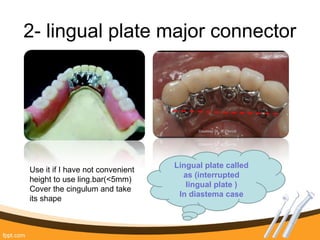
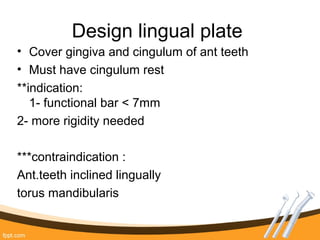
2- lingual plate major connector
Use it if I have not convenient
height to use ling.bar(<5mm)
Cover the cingulum and take
its shape
Lingual plate called
as (interrupted
lingual plate )
In diastema case
Design lingual plate
• Cover gingiva and cingulum of ant teeth
• Must have cingulum rest
**indication:
1- functional bar < 7mm
2- more rigidity needed
***contraindication :
Ant.teeth inclined lingually
torus mandibularis
Advantages # Disadvantages
• Advantages:
• Most rigid M.C
• Act as indirect retainer
• Reflection food
• Resist horizontal forces
• Cross arch stabilization
• Splinting RPD as one unit
i
• Disadvantages:
• Gingival irritation
• Periodontal disease
• No gingival stimulation
• Disadvantages:
• Gingival irritation
• Periodontal disease
• No gingival stimulation
Double lingual bar
(LINGUAL BAR WITH CONTINUOUS
BAR INDIRECT RETAINER)
Indications:
1. Situations where the major
connector must contact the
natural teeth to provide
bracing and indirect retention
and there are open cervical
embrasures which
contraindicate the use of a
lingual plate. There must be
adequate space for the lingual
bar portion of the major connector.
Contraindications:
1. Where a lingual bar or
lingual plate will suffice.
2. Any contraindication for a
lingual bar.
3. Any contraindication for a
lingual plate except open
cervical embrasures.
4. Diastemas.
Double lingual bar design
• rest seat preparation
needed
• As lingual plate but
have a space at the
middle
• Half oval shaped
Advantages # Disadvantages
• Advantages:
1. More rigid than lingual
bar.
2. Indirect retainer
3. Horizontal stabilization
4. Covers less tooth and
tissue
surface than lingual
plate.
Disadvantages:
1. Very complex design.
2. May be objectionable to
patient because there are four
edges exposed to the tip of
the tongue.
3-food impaction
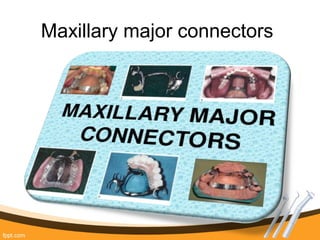
Maxillary major connectors
• Anterior palatal bar
• Posterior palatal bar
• Middle palatal bar
• Anterio posterior palatal bar (ring design )
• Anterior palatal strap
• Middle palatal strap
• Anterio posterior palatal strap (closed horse
shoe )
• Complete plate
Maxillary major connectors
1. Antero posterior palatal bar(ring
design)
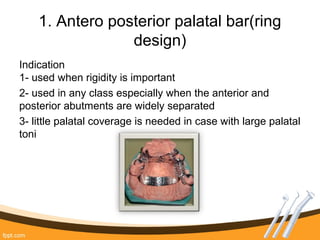
Indication
1- used when rigidity is important
2- used in any class especially when the anterior and
posterior abutments are widely separated
3- little palatal coverage is needed in case with large palatal
toni
1. Antero posterior palatal bar(ring
design)
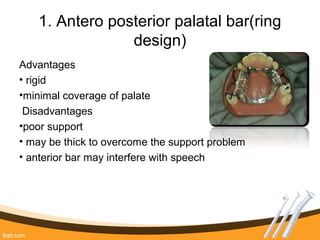
Advantages
• rigid
•minimal coverage of palate
Disadvantages
•poor support
• may be thick to overcome the support problem
• anterior bar may interfere with speech
1. (ring design)
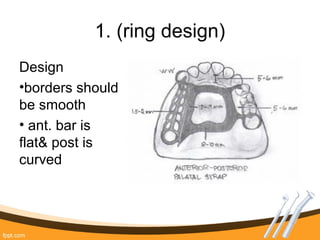
Design
•borders should
be smooth
• ant. bar is
flat& post is
curved
2. Closed horses shoes (aniero
posterior palatal strap
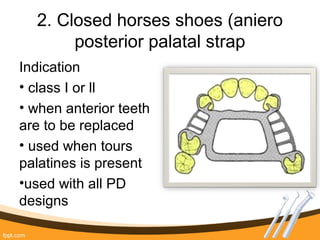
Indication
• class I or ll
• when anterior teeth
are to be replaced
• used when tours
palatines is present
•used with all PD
designs
2. Closed horses shoes (aniero
posterior palatal strap
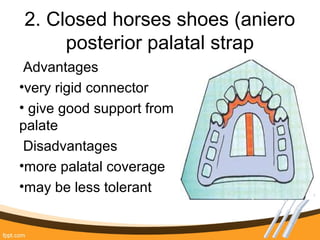
Advantages
•very rigid connector
• give good support from
palate
Disadvantages
•more palatal coverage
•may be less tolerant
2. Closed horses shoes (aniero
posterior palatal strap
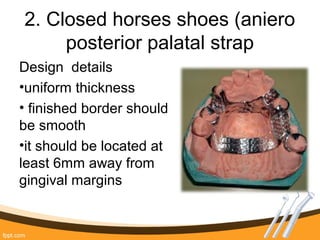
Design details
•uniform thickness
• finished border should
be smooth
•it should be located at
least 6mm away from
gingival margins
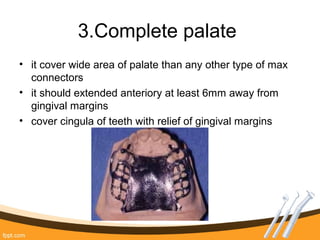
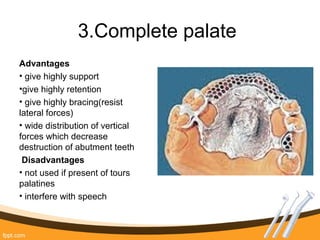
3.Complete palate
• it cover wide area of palate than any other type of max
connectors
• it should extended anteriory at least 6mm away from
gingival margins
• cover cingula of teeth with relief of gingival margins
3.Complete palate
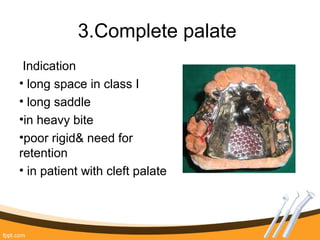
Indication
• long space in class I
• long saddle
•in heavy bite
•poor rigid& need for
retention
• in patient with cleft palate
3.Complete palate
Advantages
• give highly support
•give highly retention
• give highly bracing(resist
lateral forces)
• wide distribution of vertical
forces which decrease
destruction of abutment teeth
Disadvantages
• not used if present of tours
palatines
• interfere with speech
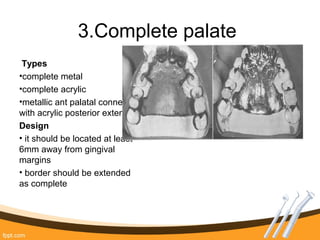
3.Complete palate
Types
•complete metal
•complete acrylic
•metallic ant palatal connector
with acrylic posterior extension
Design
• it should be located at least
6mm away from gingival
margins
• border should be extended
as complete
Major connectors

Major connectors

  • 1.
  • 2.
    Definition • Major Connectorsis the of PD that connect parts of prosthesis from one side to other side& all other parts of RPD are attached to it directly or indirectly
  • 3.
    Functions • Make RPDas a one unit • Equal stress distribution at the parts of RPPD • Cross arch stabilization • If it rested on hard tissue give support (unless if it rested on soft tissue , relief must be done
  • 4.
    Requirements • Rigid togive equal distribution of forces • should be comfort to patient • shouldn't interference with movable tissue • shouldn't impingement of gingival margins (maxilla at least 6mm from margins mandible at least 3-4 mm from gingiva) • shouldn't have sharp edges or margins • Should be perpendicular at minor connector but with gentle curve • Avoid food impaction • designed to be self cleansable area
  • 5.
    Types of mandibularmajor connectors • Lingual bar • lingual plate • Double lingual bar ( lingual bar with a continuous bar indirect retainer) • labial bar (plate) • cingulum bar • sublingual bar
  • 6.
    1- Lingual bar Themost common used The simplest major connector
  • 7.
    Design of lingualbar 1. it is half pear shape (flat to floor ) 2. superior portion is thin& inferior portion is thick 3. superior portion should be away from gingival at least 3-4mm 4. portion should be present as low as floor of the mouth 5. if lingual undercut present, relief should be done
  • 8.
    Advantages # Disadvantages *Advantages 1. simple 2.accebted tongue 3. No interference to gingiva * Disadvantages it is rigid if poorty constructed
  • 9.
    2- lingual platemajor connector Use it if I have not convenient height to use ling.bar(<5mm) Cover the cingulum and take its shape Lingual plate called as (interrupted lingual plate ) In diastema case
  • 10.
    Design lingual plate •Cover gingiva and cingulum of ant teeth • Must have cingulum rest **indication: 1- functional bar < 7mm 2- more rigidity needed ***contraindication : Ant.teeth inclined lingually torus mandibularis
  • 11.
    Advantages # Disadvantages •Advantages: • Most rigid M.C • Act as indirect retainer • Reflection food • Resist horizontal forces • Cross arch stabilization • Splinting RPD as one unit i • Disadvantages: • Gingival irritation • Periodontal disease • No gingival stimulation • Disadvantages: • Gingival irritation • Periodontal disease • No gingival stimulation
  • 12.
    Double lingual bar (LINGUALBAR WITH CONTINUOUS BAR INDIRECT RETAINER) Indications: 1. Situations where the major connector must contact the natural teeth to provide bracing and indirect retention and there are open cervical embrasures which contraindicate the use of a lingual plate. There must be adequate space for the lingual bar portion of the major connector. Contraindications: 1. Where a lingual bar or lingual plate will suffice. 2. Any contraindication for a lingual bar. 3. Any contraindication for a lingual plate except open cervical embrasures. 4. Diastemas.
  • 13.
    Double lingual bardesign • rest seat preparation needed • As lingual plate but have a space at the middle • Half oval shaped
  • 14.
    Advantages # Disadvantages •Advantages: 1. More rigid than lingual bar. 2. Indirect retainer 3. Horizontal stabilization 4. Covers less tooth and tissue surface than lingual plate. Disadvantages: 1. Very complex design. 2. May be objectionable to patient because there are four edges exposed to the tip of the tongue. 3-food impaction
  • 15.
    Maxillary major connectors •Anterior palatal bar • Posterior palatal bar • Middle palatal bar • Anterio posterior palatal bar (ring design ) • Anterior palatal strap • Middle palatal strap • Anterio posterior palatal strap (closed horse shoe ) • Complete plate
  • 16.
  • 17.
    1. Antero posteriorpalatal bar(ring design) Indication 1- used when rigidity is important 2- used in any class especially when the anterior and posterior abutments are widely separated 3- little palatal coverage is needed in case with large palatal toni
  • 18.
    1. Antero posteriorpalatal bar(ring design) Advantages • rigid •minimal coverage of palate Disadvantages •poor support • may be thick to overcome the support problem • anterior bar may interfere with speech
  • 19.
    1. (ring design) Design •bordersshould be smooth • ant. bar is flat& post is curved
  • 20.
    2. Closed horsesshoes (aniero posterior palatal strap Indication • class I or ll • when anterior teeth are to be replaced • used when tours palatines is present •used with all PD designs
  • 21.
    2. Closed horsesshoes (aniero posterior palatal strap Advantages •very rigid connector • give good support from palate Disadvantages •more palatal coverage •may be less tolerant
  • 22.
    2. Closed horsesshoes (aniero posterior palatal strap Design details •uniform thickness • finished border should be smooth •it should be located at least 6mm away from gingival margins
  • 23.
    3.Complete palate • itcover wide area of palate than any other type of max connectors • it should extended anteriory at least 6mm away from gingival margins • cover cingula of teeth with relief of gingival margins
  • 24.
    3.Complete palate Indication • longspace in class I • long saddle •in heavy bite •poor rigid& need for retention • in patient with cleft palate
  • 25.
    3.Complete palate Advantages • givehighly support •give highly retention • give highly bracing(resist lateral forces) • wide distribution of vertical forces which decrease destruction of abutment teeth Disadvantages • not used if present of tours palatines • interfere with speech
  • 26.
    3.Complete palate Types •complete metal •completeacrylic •metallic ant palatal connector with acrylic posterior extension Design • it should be located at least 6mm away from gingival margins • border should be extended as complete