The Business Case for sustainability
MATTHIAS LEISINGER
CORPORATE RESPONSIBILITY
14 APRIL 2015, CAPE TOWN
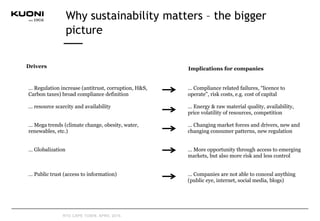
• … Regulation increase (antitrust, corruption, H&S,
Carbon taxes) broad compliance definition
• … resource scarcity and availability
• … Mega trends (climate change, obesity, water,
renewables, etc.)
• … Globalization
• … Public trust (access to information)
• … Compliance related failures, “licence to
operate”, risk costs, e.g. cost of capital
• … Energy & raw material quality, availability,
price volatility of resources, competition
• … Changing market forces and drivers, new and
changing consumer patterns, new regulation
• … More opportunity through access to emerging
markets, but also more risk and less control
• … Companies are not able to conceal anything
(public eye, internet, social media, blogs)
Implications for companiesDrivers
Why sustainability matters – the bigger
picture
RTD CAPE TOWN, APRIL 2015
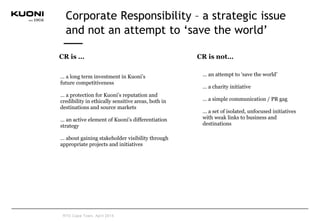
• … an attempt to ‘save the world’
• … a charity initiative
• … a simple communication / PR gag
• … a set of isolated, unfocused initiatives
with weak links to business and
destinations
CR is not…CR is …
• … a long term investment in Kuoni’s
• future competitiveness
• … a protection for Kuoni’s reputation and
credibility in ethically sensitive areas, both in
destinations and source markets
• … an active element of Kuoni’s differentiation
strategy
• … about gaining stakeholder visibility through
appropriate projects and initiatives
Corporate Responsibility – a strategic issue
and not an attempt to ‘save the world’
RTD Cape Town, April 2015
CREATING SHARED VALUE FOR KEY STAKEHOLDERS
AND MANAGE THEIR EXPECTATIONS
• Build trust and loyalty by developing
new products that respond to the
growing demand for sustainable tourism
• Differentiate the company in a
competitive environment
A growing number of investors
are making investment decisions
based not only on traditional
financial analysis but on an
evaluation of CR performance
as well
• Reputation within society has a
significant impact on a company’s
performance
• Studies show that up to one-third of a
company’s reputation is based on its
CR perception
• Leverage innovation through partnerships
• Empowering suppliers
leads to higher product quality
and customer satisfaction
• Candidates/people care about
sustainability – top-talent recruitment
• Create an environment that motivates,
develops and rewards individuals
• Mandatory legislation and reporting
requirements from governments and
EU/OECD
• A growing number of governments
source products and services based on
CR criteria
Reducing the environmental footprint
leads to internal costs savings and helps
to protect the product at a destination
level
Employees
Customers
Investors
Society
EnvironmentSuppliers & Partners
Governments
RTD CAPE TOWN, APRIL 2015
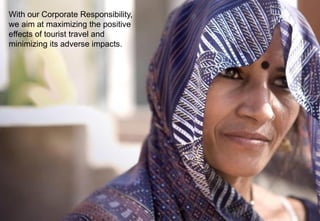
With our Corporate Responsibility,
we aim at maximizing the positive
effects of tourist travel and
minimizing its adverse impacts.
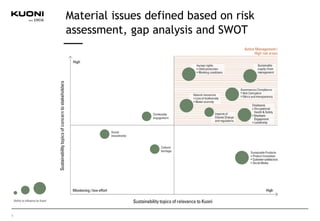
Material issues defined based on risk
assessment, gap analysis and SWOT
6
RTD Cape Town, April 2015
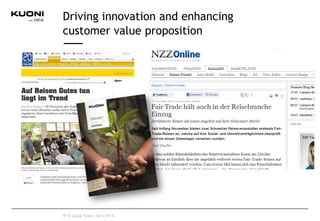
Driving innovation and enhancing
customer value proposition
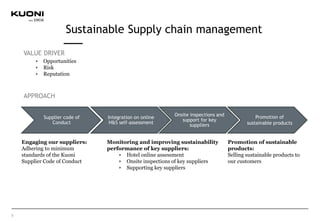
VALUE DRIVER
Opportunities
Risk
Reputation
APPROACH
Promotion of
sustainable
products
Supplier code of
Conduct
Integration on online
H&S self-assessment
Onsite inspections and
support for key
suppliers
Promotion of
sustainable products
Sustainable Supply chain management
8
Engaging our suppliers:
Adhering to minimum
standards of the Kuoni
Supplier Code of Conduct
Promotion of sustainable
products:
Selling sustainable products to
our customers
Monitoring and improving sustainability
performance of key suppliers:
Hotel online assessment
Onsite inspections of key suppliers
Supporting key suppliers
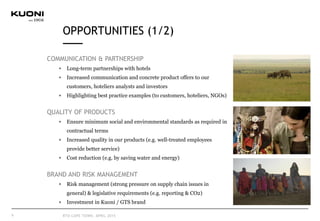
OPPORTUNITIES (1/2)
COMMUNICATION & PARTNERSHIP
Long-term partnerships with hotels
Increased communication and concrete product offers to our
customers, hoteliers analysts and investors
Highlighting best practice examples (to customers, hoteliers, NGOs)
QUALITY OF PRODUCTS
Ensure minimum social and environmental standards as required in
contractual terms
Increased quality in our products (e.g. well-treated employees
provide better service)
Cost reduction (e.g. by saving water and energy)
BRAND AND RISK MANAGEMENT
Risk management (strong pressure on supply chain issues in
general) & legislative requirements (e.g. reporting & CO2)
Investment in Kuoni / GTS brand
9 RTD CAPE TOWN, APRIL 2015
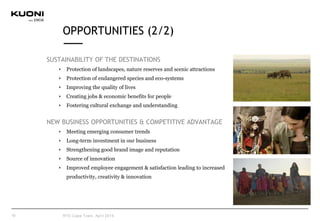
SUSTAINABILITY OF THE DESTINATIONS
Protection of landscapes, nature reserves and scenic attractions
Protection of endangered species and eco-systems
Improving the quality of lives
Creating jobs & economic benefits for people
Fostering cultural exchange and understanding
NEW BUSINESS OPPORTUNITIES & COMPETITIVE ADVANTAGE
Meeting emerging consumer trends
Long-term investment in our business
Strengthening good brand image and reputation
Source of innovation
Improved employee engagement & satisfaction leading to increased
productivity, creativity & innovation
10
OPPORTUNITIES (2/2)
RTD Cape Town, April 2015
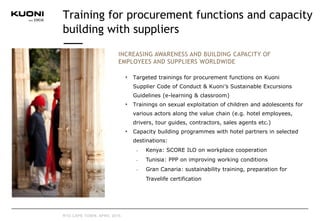
INCREASING AWARENESS AND BUILDING CAPACITY OF
EMPLOYEES AND SUPPLIERS WORLDWIDE
Targeted trainings for procurement functions on Kuoni
Supplier Code of Conduct & Kuoni’s Sustainable Excursions
Guidelines (e-learning & classroom)
Trainings on sexual exploitation of children and adolescents for
various actors along the value chain (e.g. hotel employees,
drivers, tour guides, contractors, sales agents etc.)
Capacity building programmes with hotel partners in selected
destinations:
• Kenya: SCORE ILO on workplace cooperation
• Tunisia: PPP on improving working conditions
• Gran Canaria: sustainability training, preparation for
Travelife certification
Training for procurement functions and capacity
building with suppliers
RTD CAPE TOWN, APRIL 2015
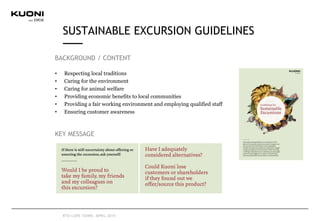
BACKGROUND / CONTENT
• Respecting local traditions
• Caring for the environment
• Caring for animal welfare
• Providing economic benefits to local communities
• Providing a fair working environment and employing qualified staff
• Ensuring customer awareness
KEY MESSAGE
SUSTAINABLE EXCURSION GUIDELINES
RTD CAPE TOWN, APRIL 2015
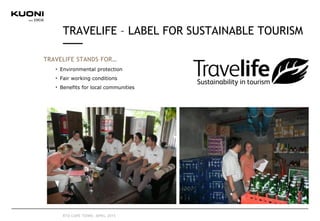
TRAVELIFE – LABEL FOR SUSTAINABLE TOURISM
TRAVELIFE STANDS FOR…
Environmental protection
Fair working conditions
Benefits for local communities
RTD CAPE TOWN, APRIL 2015
Human Rights due diligence
RTD Cape Town, April 2015
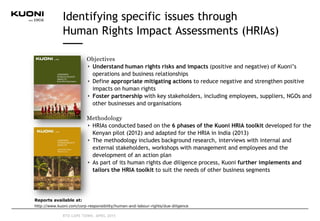
Objectives
Understand human rights risks and impacts (positive and negative) of Kuoni’s
operations and business relationships
Define appropriate mitigating actions to reduce negative and strengthen positive
impacts on human rights
Foster partnership with key stakeholders, including employees, suppliers, NGOs and
other businesses and organisations
Methodology
HRIAs conducted based on the 6 phases of the Kuoni HRIA toolkit developed for the
Kenyan pilot (2012) and adapted for the HRIA in India (2013)
The methodology includes background research, interviews with internal and
external stakeholders, workshops with management and employees and the
development of an action plan
As part of its human rights due diligence process, Kuoni further implements and
tailors the HRIA toolkit to suit the needs of other business segments
Identifying specific issues through
Human Rights Impact Assessments (HRIAs)
Reports available at:
http://www.kuoni.com/corp-responsibility/human-and-labour-rights/due-diligence
RTD CAPE TOWN, APRIL 2015
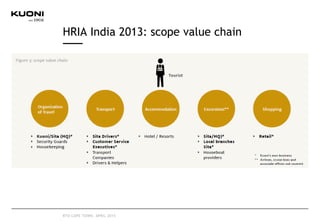
HRIA India 2013: scope value chain
RTD CAPE TOWN, APRIL 2015
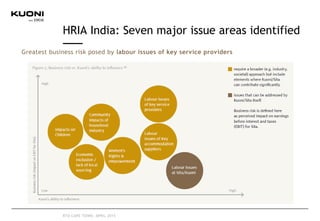
Greatest business risk posed by labour issues of key service providers
HRIA India: Seven major issue areas identified
RTD CAPE TOWN, APRIL 2015
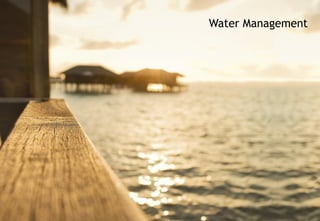
Water Management
19
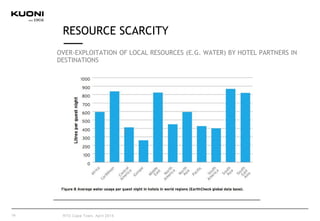
RESOURCE SCARCITY
OVER-EXPLOITATION OF LOCAL RESOURCES (E.G. WATER) BY HOTEL PARTNERS IN
DESTINATIONS
RTD Cape Town, April 2015
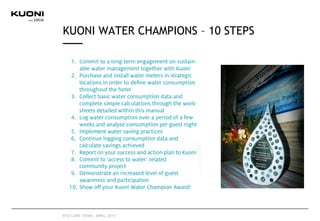
KUONI WATER CHAMPIONS – 10 STEPS
RTD CAPE TOWN, APRIL 2015
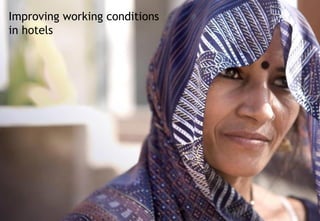
Improving working conditions
in hotels
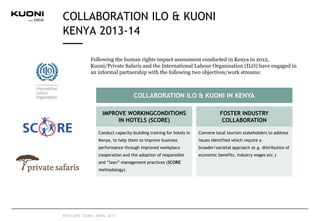
Following the human rights impact assessment conducted in Kenya in 2012,
Kuoni/Private Safaris and the International Labour Organisation (ILO) have engaged in
an informal partnership with the following two objectives/work streams:
COLLABORATION ILO & KUONI
KENYA 2013-14
RTD CAPE TOWN, APRIL 2015
FOSTER INDUSTRY
COLLABORATION
IMPROVE WORKINGCONDITIONS
IN HOTELS (SCORE)
Convene local tourism stakeholders to address
issues identified which require a
broader/societal approach (e.g. distribution of
economic benefits, industry wages etc.)
Conduct capacity-building training for hotels in
Kenya, to help them to improve business
performance through improved workplace
cooperation and the adoption of responsible
and “lean” management practices (SCORE
methodology).
COLLABORATION ILO & KUONI IN KENYA
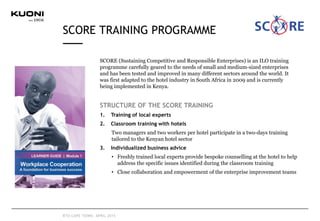
SCORE TRAINING PROGRAMME
RTD CAPE TOWN, APRIL 2015
SCORE (Sustaining Competitive and Responsible Enterprises) is an ILO training
programme carefully geared to the needs of small and medium-sized enterprises
and has been tested and improved in many different sectors around the world. It
was first adapted to the hotel industry in South Africa in 2009 and is currently
being implemented in Kenya.
STRUCTURE OF THE SCORE TRAINING
1. Training of local experts
2. Classroom training with hotels
Two managers and two workers per hotel participate in a two-days training
tailored to the Kenyan hotel sector
3. Individualized business advice
• Freshly trained local experts provide bespoke counselling at the hotel to help
address the specific issues identified during the classroom training
• Close collaboration and empowerment of the enterprise improvement teams
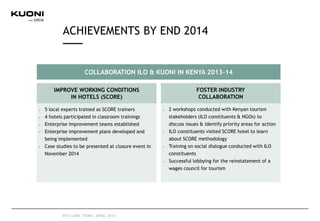
ACHIEVEMENTS BY END 2014
RTD CAPE TOWN, APRIL 2015
FOSTER INDUSTRY
COLLABORATION
IMPROVE WORKING CONDITIONS
IN HOTELS (SCORE)
• 2 workshops conducted with Kenyan tourism
stakeholders (ILO constituents & NGOs) to
discuss issues & identify priority areas for action
• ILO constituents visited SCORE hotel to learn
about SCORE methodology
• Training on social dialogue conducted with ILO
constituents
• Successful lobbying for the reinstatement of a
wages council for tourism
• 5 local experts trained as SCORE trainers
• 4 hotels participated in classroom trainings
• Enterprise improvement teams established
• Enterprise improvement plans developed and
being implemented
• Case studies to be presented at closure event in
November 2014
COLLABORATION ILO & KUONI IN KENYA 2013-14
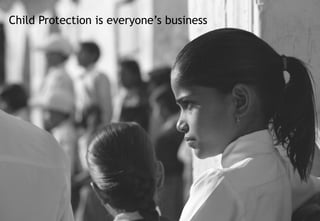
Child Protection is everyone’s business
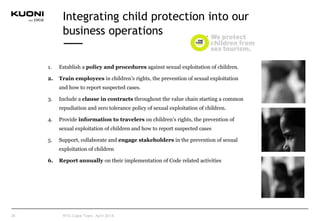
Integrating child protection into our
business operations
1. Establish a policy and procedures against sexual exploitation of children.
2. Train employees in children’s rights, the prevention of sexual exploitation
and how to report suspected cases.
3. Include a clause in contracts throughout the value chain starting a common
repudiation and zero tolerance policy of sexual exploitation of children.
4. Provide information to travelers on children’s rights, the prevention of
sexual exploitation of children and how to report suspected cases
5. Support, collaborate and engage stakeholders in the prevention of sexual
exploitation of children
6. Report annually on their implementation of Code related activities
26 RTD Cape Town, April 2015
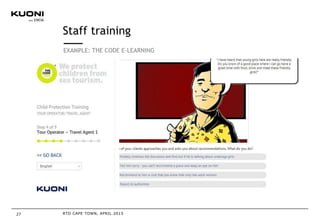
Staff training
RTD CAPE TOWN, APRIL 201527
EXAMPLE: THE CODE E-LEARNING
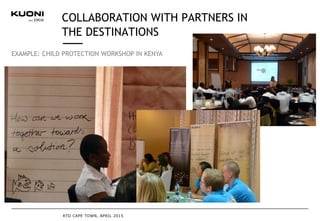
COLLABORATION WITH PARTNERS IN
THE DESTINATIONS
RTD CAPE TOWN, APRIL 2015
EXAMPLE: CHILD PROTECTION WORKSHOP IN KENYA
RTD CAPE TOWN, APRIL 2015
INDUSTRY & STAKEHOLDER
COLLABORATION
FOR INCREASED IMPACT
FOSTERING POSITIVE IMPACT THORUGH STAKEHOLDER
ENGAGEMENT, PARTNERSHIP & DIALOGUE
RTD CAPE TOWN, APRIL 2015
MULTI-STAKEHOLDER INITIATIVE:
OPEN PLATFORM FOR THE SUPPORT OF HUMAN RIGHTS IN TOURISM
Roundtable on Human Rights in Tourism
http://www.menschenrechte-im-tourismus.net/en/startseite.html
Objectives:
- Kick off a process to implement the UN Guiding Principles on
Business and Human Rights in the tourism sector and ensure
tourism service providers commit to implement due diligence
- Develop, recommend and promulgate a standard and
management approach for human rights due diligence in the
tourism sector
- Provide information and (training) materials and best practices
which allow the exchange of know-how
- Sensitize broader public, media, travellers, enterprises,
investors, teachers and students as well as politicians on the
compliance with human rights in tourism.
RTD CAPE TOWN, APRIL 2015
THANK YOU!
MATTHIAS.LEISINGER@KUONI.COM
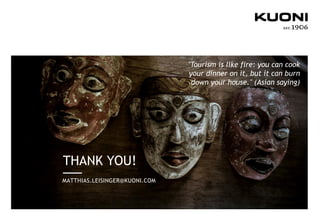
"Tourism is like fire: you can cook
your dinner on it, but it can burn
down your house." (Asian saying)

Matthias Leisinger - RTD11 2015

  • 1.
    The Business Casefor sustainability MATTHIAS LEISINGER CORPORATE RESPONSIBILITY 14 APRIL 2015, CAPE TOWN
  • 2.
    • … Regulationincrease (antitrust, corruption, H&S, Carbon taxes) broad compliance definition • … resource scarcity and availability • … Mega trends (climate change, obesity, water, renewables, etc.) • … Globalization • … Public trust (access to information) • … Compliance related failures, “licence to operate”, risk costs, e.g. cost of capital • … Energy & raw material quality, availability, price volatility of resources, competition • … Changing market forces and drivers, new and changing consumer patterns, new regulation • … More opportunity through access to emerging markets, but also more risk and less control • … Companies are not able to conceal anything (public eye, internet, social media, blogs) Implications for companiesDrivers Why sustainability matters – the bigger picture RTD CAPE TOWN, APRIL 2015
  • 3.
    • … anattempt to ‘save the world’ • … a charity initiative • … a simple communication / PR gag • … a set of isolated, unfocused initiatives with weak links to business and destinations CR is not…CR is … • … a long term investment in Kuoni’s • future competitiveness • … a protection for Kuoni’s reputation and credibility in ethically sensitive areas, both in destinations and source markets • … an active element of Kuoni’s differentiation strategy • … about gaining stakeholder visibility through appropriate projects and initiatives Corporate Responsibility – a strategic issue and not an attempt to ‘save the world’ RTD Cape Town, April 2015
  • 4.
    CREATING SHARED VALUEFOR KEY STAKEHOLDERS AND MANAGE THEIR EXPECTATIONS • Build trust and loyalty by developing new products that respond to the growing demand for sustainable tourism • Differentiate the company in a competitive environment A growing number of investors are making investment decisions based not only on traditional financial analysis but on an evaluation of CR performance as well • Reputation within society has a significant impact on a company’s performance • Studies show that up to one-third of a company’s reputation is based on its CR perception • Leverage innovation through partnerships • Empowering suppliers leads to higher product quality and customer satisfaction • Candidates/people care about sustainability – top-talent recruitment • Create an environment that motivates, develops and rewards individuals • Mandatory legislation and reporting requirements from governments and EU/OECD • A growing number of governments source products and services based on CR criteria Reducing the environmental footprint leads to internal costs savings and helps to protect the product at a destination level Employees Customers Investors Society EnvironmentSuppliers & Partners Governments RTD CAPE TOWN, APRIL 2015
  • 5.
    With our CorporateResponsibility, we aim at maximizing the positive effects of tourist travel and minimizing its adverse impacts.
  • 6.
    Material issues definedbased on risk assessment, gap analysis and SWOT 6
  • 7.
    RTD Cape Town,April 2015 Driving innovation and enhancing customer value proposition
  • 8.
    VALUE DRIVER Opportunities Risk Reputation APPROACH Promotion of sustainable products Suppliercode of Conduct Integration on online H&S self-assessment Onsite inspections and support for key suppliers Promotion of sustainable products Sustainable Supply chain management 8 Engaging our suppliers: Adhering to minimum standards of the Kuoni Supplier Code of Conduct Promotion of sustainable products: Selling sustainable products to our customers Monitoring and improving sustainability performance of key suppliers: Hotel online assessment Onsite inspections of key suppliers Supporting key suppliers
  • 9.
    OPPORTUNITIES (1/2) COMMUNICATION &PARTNERSHIP Long-term partnerships with hotels Increased communication and concrete product offers to our customers, hoteliers analysts and investors Highlighting best practice examples (to customers, hoteliers, NGOs) QUALITY OF PRODUCTS Ensure minimum social and environmental standards as required in contractual terms Increased quality in our products (e.g. well-treated employees provide better service) Cost reduction (e.g. by saving water and energy) BRAND AND RISK MANAGEMENT Risk management (strong pressure on supply chain issues in general) & legislative requirements (e.g. reporting & CO2) Investment in Kuoni / GTS brand 9 RTD CAPE TOWN, APRIL 2015
  • 10.
    SUSTAINABILITY OF THEDESTINATIONS Protection of landscapes, nature reserves and scenic attractions Protection of endangered species and eco-systems Improving the quality of lives Creating jobs & economic benefits for people Fostering cultural exchange and understanding NEW BUSINESS OPPORTUNITIES & COMPETITIVE ADVANTAGE Meeting emerging consumer trends Long-term investment in our business Strengthening good brand image and reputation Source of innovation Improved employee engagement & satisfaction leading to increased productivity, creativity & innovation 10 OPPORTUNITIES (2/2) RTD Cape Town, April 2015
  • 11.
    INCREASING AWARENESS ANDBUILDING CAPACITY OF EMPLOYEES AND SUPPLIERS WORLDWIDE Targeted trainings for procurement functions on Kuoni Supplier Code of Conduct & Kuoni’s Sustainable Excursions Guidelines (e-learning & classroom) Trainings on sexual exploitation of children and adolescents for various actors along the value chain (e.g. hotel employees, drivers, tour guides, contractors, sales agents etc.) Capacity building programmes with hotel partners in selected destinations: • Kenya: SCORE ILO on workplace cooperation • Tunisia: PPP on improving working conditions • Gran Canaria: sustainability training, preparation for Travelife certification Training for procurement functions and capacity building with suppliers RTD CAPE TOWN, APRIL 2015
  • 12.
    BACKGROUND / CONTENT •Respecting local traditions • Caring for the environment • Caring for animal welfare • Providing economic benefits to local communities • Providing a fair working environment and employing qualified staff • Ensuring customer awareness KEY MESSAGE SUSTAINABLE EXCURSION GUIDELINES RTD CAPE TOWN, APRIL 2015
  • 13.
    TRAVELIFE – LABELFOR SUSTAINABLE TOURISM TRAVELIFE STANDS FOR… Environmental protection Fair working conditions Benefits for local communities RTD CAPE TOWN, APRIL 2015
  • 14.
    Human Rights duediligence RTD Cape Town, April 2015
  • 15.
    Objectives Understand human rightsrisks and impacts (positive and negative) of Kuoni’s operations and business relationships Define appropriate mitigating actions to reduce negative and strengthen positive impacts on human rights Foster partnership with key stakeholders, including employees, suppliers, NGOs and other businesses and organisations Methodology HRIAs conducted based on the 6 phases of the Kuoni HRIA toolkit developed for the Kenyan pilot (2012) and adapted for the HRIA in India (2013) The methodology includes background research, interviews with internal and external stakeholders, workshops with management and employees and the development of an action plan As part of its human rights due diligence process, Kuoni further implements and tailors the HRIA toolkit to suit the needs of other business segments Identifying specific issues through Human Rights Impact Assessments (HRIAs) Reports available at: http://www.kuoni.com/corp-responsibility/human-and-labour-rights/due-diligence RTD CAPE TOWN, APRIL 2015
  • 16.
    HRIA India 2013:scope value chain RTD CAPE TOWN, APRIL 2015
  • 17.
    Greatest business riskposed by labour issues of key service providers HRIA India: Seven major issue areas identified RTD CAPE TOWN, APRIL 2015
  • 18.
  • 19.
    19 RESOURCE SCARCITY OVER-EXPLOITATION OFLOCAL RESOURCES (E.G. WATER) BY HOTEL PARTNERS IN DESTINATIONS RTD Cape Town, April 2015
  • 20.
    KUONI WATER CHAMPIONS– 10 STEPS RTD CAPE TOWN, APRIL 2015
  • 21.
  • 22.
    Following the humanrights impact assessment conducted in Kenya in 2012, Kuoni/Private Safaris and the International Labour Organisation (ILO) have engaged in an informal partnership with the following two objectives/work streams: COLLABORATION ILO & KUONI KENYA 2013-14 RTD CAPE TOWN, APRIL 2015 FOSTER INDUSTRY COLLABORATION IMPROVE WORKINGCONDITIONS IN HOTELS (SCORE) Convene local tourism stakeholders to address issues identified which require a broader/societal approach (e.g. distribution of economic benefits, industry wages etc.) Conduct capacity-building training for hotels in Kenya, to help them to improve business performance through improved workplace cooperation and the adoption of responsible and “lean” management practices (SCORE methodology). COLLABORATION ILO & KUONI IN KENYA
  • 23.
    SCORE TRAINING PROGRAMME RTDCAPE TOWN, APRIL 2015 SCORE (Sustaining Competitive and Responsible Enterprises) is an ILO training programme carefully geared to the needs of small and medium-sized enterprises and has been tested and improved in many different sectors around the world. It was first adapted to the hotel industry in South Africa in 2009 and is currently being implemented in Kenya. STRUCTURE OF THE SCORE TRAINING 1. Training of local experts 2. Classroom training with hotels Two managers and two workers per hotel participate in a two-days training tailored to the Kenyan hotel sector 3. Individualized business advice • Freshly trained local experts provide bespoke counselling at the hotel to help address the specific issues identified during the classroom training • Close collaboration and empowerment of the enterprise improvement teams
  • 24.
    ACHIEVEMENTS BY END2014 RTD CAPE TOWN, APRIL 2015 FOSTER INDUSTRY COLLABORATION IMPROVE WORKING CONDITIONS IN HOTELS (SCORE) • 2 workshops conducted with Kenyan tourism stakeholders (ILO constituents & NGOs) to discuss issues & identify priority areas for action • ILO constituents visited SCORE hotel to learn about SCORE methodology • Training on social dialogue conducted with ILO constituents • Successful lobbying for the reinstatement of a wages council for tourism • 5 local experts trained as SCORE trainers • 4 hotels participated in classroom trainings • Enterprise improvement teams established • Enterprise improvement plans developed and being implemented • Case studies to be presented at closure event in November 2014 COLLABORATION ILO & KUONI IN KENYA 2013-14
  • 25.
    Child Protection iseveryone’s business
  • 26.
    Integrating child protectioninto our business operations 1. Establish a policy and procedures against sexual exploitation of children. 2. Train employees in children’s rights, the prevention of sexual exploitation and how to report suspected cases. 3. Include a clause in contracts throughout the value chain starting a common repudiation and zero tolerance policy of sexual exploitation of children. 4. Provide information to travelers on children’s rights, the prevention of sexual exploitation of children and how to report suspected cases 5. Support, collaborate and engage stakeholders in the prevention of sexual exploitation of children 6. Report annually on their implementation of Code related activities 26 RTD Cape Town, April 2015
  • 27.
    Staff training RTD CAPETOWN, APRIL 201527 EXAMPLE: THE CODE E-LEARNING
  • 28.
    COLLABORATION WITH PARTNERSIN THE DESTINATIONS RTD CAPE TOWN, APRIL 2015 EXAMPLE: CHILD PROTECTION WORKSHOP IN KENYA
  • 29.
    RTD CAPE TOWN,APRIL 2015 INDUSTRY & STAKEHOLDER COLLABORATION FOR INCREASED IMPACT
  • 30.
    FOSTERING POSITIVE IMPACTTHORUGH STAKEHOLDER ENGAGEMENT, PARTNERSHIP & DIALOGUE RTD CAPE TOWN, APRIL 2015
  • 31.
    MULTI-STAKEHOLDER INITIATIVE: OPEN PLATFORMFOR THE SUPPORT OF HUMAN RIGHTS IN TOURISM Roundtable on Human Rights in Tourism http://www.menschenrechte-im-tourismus.net/en/startseite.html Objectives: - Kick off a process to implement the UN Guiding Principles on Business and Human Rights in the tourism sector and ensure tourism service providers commit to implement due diligence - Develop, recommend and promulgate a standard and management approach for human rights due diligence in the tourism sector - Provide information and (training) materials and best practices which allow the exchange of know-how - Sensitize broader public, media, travellers, enterprises, investors, teachers and students as well as politicians on the compliance with human rights in tourism. RTD CAPE TOWN, APRIL 2015
  • 32.
    THANK YOU! MATTHIAS.LEISINGER@KUONI.COM "Tourism islike fire: you can cook your dinner on it, but it can burn down your house." (Asian saying)