A Global View of
Sustainable Tourism
Mr. Randy Durband
CEO, GSTC
Conference on ST in SIDS
23 November 2017
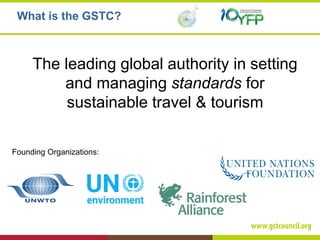
What is the GSTC?
Founding Organizations:
The leading global authority in setting
and managing standards for
sustainable travel & tourism
12
th
Asia Pacific Roundtable f
Call for Action – “Acting
14 July 2
Apsara Angko
http://www.aprs
CONCE
1. 12
th
APRSCP: Call for Action – “Acting Together f
The 12
th
Asia Pacific Roundtable for Sustainable Co
Angkor Hotel in Siem Reap, Cambodia on 12 and 1
is organized by the Asia Pacific Roundtable on Susta
Ministry of Environment, Kingdom of Cambodia, in
(IISR). The 12
th
APRSCP is supported by the United
Regional Policy Support Component (RPSC) of the
Asia Network Facility, the Network on Resource Ef
Industrial Development Organization (UNIDO) and t
2. Theme
Sustainable Tourism – UNWTO/UNEP Definition
“Tourism that takes full account of its
current and future economic, social and
environmental impacts, addressing the
needs of visitors, the industry, the
environment and host communities”
Making Tourism More Sustainable - A Guide for Policy Makers,
UNEP and UNWTO, 2005
Also in 2005, UNWTO and UNEP published “The
12 Aims of Sustainable Tourism”
Next came the GSTC in 2007…
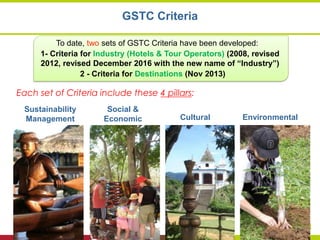
Each set of Criteria include these 4 pillars:
Social &
Economic Cultural Environmental
Sustainability
Management
GSTC Criteria
2 - Criteria for Destinations (Nov 2013)
1- Criteria for Industry (Hotels & Tour Operators) (2008, revised
2012, revised December 2016 with the new name of “Industry”)
To date, two sets of GSTC Criteria have been developed:
Maximize the Benefits – Minimize the Negatives
A: Demonstrate sustainable destination
management
B: Maximize economic benefits to the host
community and minimize negative impacts
C: Maximize benefits to communities, visitors, and
culture; minimize negative impacts
D. Maximize benefits to the environment and
minimize negative impacts
The Role of Standards
➢ Basis for certification
➢ For training, education, awareness
➢ Guidelines for legal and regulatory
codes
➢ Measurement & Evaluation
➢ Market Access clarity
➢Uneven development and awareness
➢Private Sector moving too slowly
➢Public Sector resources are mostly for
promotion and little for development
and management
➢Measurement is on the rise
A Global View of Sustainable Tourism
Measurement Priorities
Moving beyond merely counting the number
of arrivals requires resources, which requires
priorities
GHG emissions from travel and tourism
activities
For destinations, key measures include
➢ average length of stay
➢ average spend per visitor
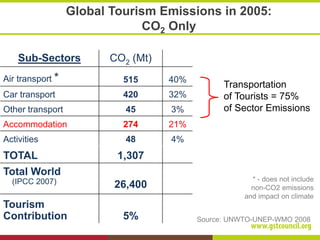
Global Tourism Emissions in 2005:
CO2 Only
Sub-Sectors CO2 (Mt)
Air transport * 515 40%
Car transport 420 32%
Other transport 45 3%
Accommodation 274 21%
Activities 48 4%
TOTAL 1,307
Total World
(IPCC 2007) 26,400
Tourism
Contribution 5%
Transportation
of Tourists = 75%
of Sector Emissions
* - does not include
non-CO2 emissions
and impact on climate
Source: UNWTO-UNEP-WMO 2008
Voices of Protest
Excerpt from a statement the by UK group
“Plane Stupid” in 2015 in opposition to adding
a new runway to London’s Heathrow Airport:
The demand for airport expansion is being
driven by rich frequent flyers. Last year, less
than half of people in Britain flew. Of those who
did, a mere 15% of flyers took 70% of our flights.
As well as noise and air pollution, poor people
are paying the price in droughts, flooding and
storms so that the rich can cook the planet
with frequent leisure flights.
➢Uneven development and awareness
➢Private Sector moving too slowly
➢Public Sector resources are mostly for
promotion and little for development
and management
➢Measurement is on the rise
➢Marketing for sustainability
A Global View of Sustainable Tourism
Market Research on selling green
A 2011 study of Chinese and American consumers’
attitudes and behavior toward green products (all
product types, not focused on travel/tourism):
The study divided populations into 3 categories:
Super Greens – motivated to purchase green
Middle Greens – concerned about green issues
but not super motivated in their purchasing
Green Rejecters
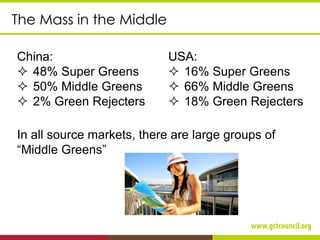
The Mass in the Middle
China:
 48% Super Greens
 50% Middle Greens
 2% Green Rejecters
In all source markets, there are large groups of
“Middle Greens”
USA:
 16% Super Greens
 66% Middle Greens
 18% Green Rejecters
How to reach the Middle Greens
What NOT to do: Sell green for the sake of green
Instead:
➢ Sell experience first, and talk about green/sustainable
in secondary messaging
➢ Avoid green stereotypes; focus on personal benefits
of your product and service
➢ Sell enjoyment over altruism!
➢ Overcome the perception that green means lack of
comfort
Sell “what’s in it for me” (the traveler)
➢Authenticity: unspoiled, not commercialized
Destination messaging (including SIDS)
➢ Exceptional and unique
➢ Experience and participation
Product messaging
Selling with the words sustainable, green, etc.
have not succeeded.
Mixed success with ecotourism and eco-lodges.
Make the message appealing, not a list of facts:
“…a menu advertising ‘sustainable food’ isn’t as
likely to be as appealing as one offering ‘locally
sourced, fresh, authentic food’”
-- Dr. Xavier Font, Surrey University, UK
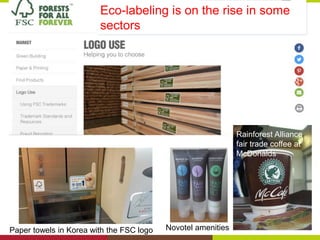
Paper towels in Korea with the FSC logo
Eco-labeling is on the rise in some
sectors
Novotel amenities
Rainforest Alliance
fair trade coffee at
McDonalds
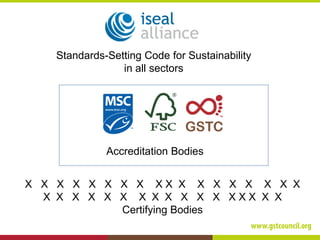
X X X X X X X X X X X X X X X X X X
X X X X X X X X X X X X X X X X X
Certifying Bodies
Standards-Setting Code for Sustainability
in all sectors
Accreditation Bodies
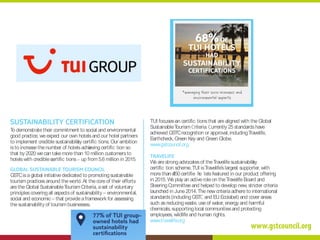
To demonstratetheir commitment to social and environmental
good practice, weexpect our own hotelsand our hotel partners
to implement crediblesustainability certifica tions. Our ambition
isto increasethenumber of hotelsachievingcertifica tion so
that by 2020 we can takemorethan 10 million customersto
hotelswith crediblecertifica tions up from 5.6 million in 2015.
GSTCisaglobal initiativededicated to promotingsustainable
tourism practicesaround theworld. At thecore of their efforts
aretheGlobal SustainableTourism Criteria, aset of voluntary
principlescoveringall aspectsof sustainability – environmental,
social and economic– that provideaframeworkfor assessing
thesustainability of tourismbusinesses.
TUI focuseson certifica tionsthat arealigned with theGlobal
SustainableTourism riteria. urrently 25 standardshave
achieved GSTCrecognition or approval, includingTravelife,
Earthcheck, Green Key and Green Globe.
www.gstcouncil.org
We arestrongadvocatesof theTravelifesustainability
certific
a
tion scheme.TUI isTravelife’slargest supporter, with
morethan 450 certified ho telsfeatured in our product offering
in 2015. Weplay an activeroleon theTravelife Board and
SteeringCommitteeand helped to develop new, stricter criteria
launched in June2014.Thenewcriteriaadhereto international
standards(includingGST and EU Ecolabel) and cover areas
such asreducingwaste, useof water, energy and harmful
chemicals, supportinglocal communitiesand protecting
employees,wildlife and human rights.
www.travelife.org
sustainability certifica tions
50 of our hotels(representingnearly
5. million customers) weresubscribed
or certifie
d
t oTravelifeor awarded aGST
certific
a
tion in 2015.
Royal Caribbean & WWF Set Sustainability Goals
Sustainable Seafood Target
Responsibly source 90 percent of its wild-
caught seafood by volume from MSC
certified sustainable fisheries by 2020
Global Tour Operations Target
By the end of 2019, all “sustainable tours”
offered by RCL will be provided by GSTC
certified operators
The Role of Certification
➢ Verify the validity of claims and
fighting false claims (“greenwashing”)
➢ Risk management mitigation
➢ Provides discipline for improvement
➢ Market access function
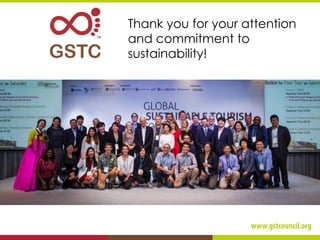
Thank you for your attention
and commitment to
sustainability!

Session1 01 Randy Durband keynote

  • 1.
    A Global Viewof Sustainable Tourism Mr. Randy Durband CEO, GSTC Conference on ST in SIDS 23 November 2017
  • 2.
    What is theGSTC? Founding Organizations: The leading global authority in setting and managing standards for sustainable travel & tourism 12 th Asia Pacific Roundtable f Call for Action – “Acting 14 July 2 Apsara Angko http://www.aprs CONCE 1. 12 th APRSCP: Call for Action – “Acting Together f The 12 th Asia Pacific Roundtable for Sustainable Co Angkor Hotel in Siem Reap, Cambodia on 12 and 1 is organized by the Asia Pacific Roundtable on Susta Ministry of Environment, Kingdom of Cambodia, in (IISR). The 12 th APRSCP is supported by the United Regional Policy Support Component (RPSC) of the Asia Network Facility, the Network on Resource Ef Industrial Development Organization (UNIDO) and t 2. Theme
  • 3.
    Sustainable Tourism –UNWTO/UNEP Definition “Tourism that takes full account of its current and future economic, social and environmental impacts, addressing the needs of visitors, the industry, the environment and host communities” Making Tourism More Sustainable - A Guide for Policy Makers, UNEP and UNWTO, 2005 Also in 2005, UNWTO and UNEP published “The 12 Aims of Sustainable Tourism” Next came the GSTC in 2007…
  • 4.
    Each set ofCriteria include these 4 pillars: Social & Economic Cultural Environmental Sustainability Management GSTC Criteria 2 - Criteria for Destinations (Nov 2013) 1- Criteria for Industry (Hotels & Tour Operators) (2008, revised 2012, revised December 2016 with the new name of “Industry”) To date, two sets of GSTC Criteria have been developed:
  • 5.
    Maximize the Benefits– Minimize the Negatives A: Demonstrate sustainable destination management B: Maximize economic benefits to the host community and minimize negative impacts C: Maximize benefits to communities, visitors, and culture; minimize negative impacts D. Maximize benefits to the environment and minimize negative impacts
  • 6.
    The Role ofStandards ➢ Basis for certification ➢ For training, education, awareness ➢ Guidelines for legal and regulatory codes ➢ Measurement & Evaluation ➢ Market Access clarity
  • 7.
    ➢Uneven development andawareness ➢Private Sector moving too slowly ➢Public Sector resources are mostly for promotion and little for development and management ➢Measurement is on the rise A Global View of Sustainable Tourism
  • 8.
    Measurement Priorities Moving beyondmerely counting the number of arrivals requires resources, which requires priorities GHG emissions from travel and tourism activities For destinations, key measures include ➢ average length of stay ➢ average spend per visitor
  • 9.
    Global Tourism Emissionsin 2005: CO2 Only Sub-Sectors CO2 (Mt) Air transport * 515 40% Car transport 420 32% Other transport 45 3% Accommodation 274 21% Activities 48 4% TOTAL 1,307 Total World (IPCC 2007) 26,400 Tourism Contribution 5% Transportation of Tourists = 75% of Sector Emissions * - does not include non-CO2 emissions and impact on climate Source: UNWTO-UNEP-WMO 2008
  • 10.
    Voices of Protest Excerptfrom a statement the by UK group “Plane Stupid” in 2015 in opposition to adding a new runway to London’s Heathrow Airport: The demand for airport expansion is being driven by rich frequent flyers. Last year, less than half of people in Britain flew. Of those who did, a mere 15% of flyers took 70% of our flights. As well as noise and air pollution, poor people are paying the price in droughts, flooding and storms so that the rich can cook the planet with frequent leisure flights.
  • 11.
    ➢Uneven development andawareness ➢Private Sector moving too slowly ➢Public Sector resources are mostly for promotion and little for development and management ➢Measurement is on the rise ➢Marketing for sustainability A Global View of Sustainable Tourism
  • 12.
    Market Research onselling green A 2011 study of Chinese and American consumers’ attitudes and behavior toward green products (all product types, not focused on travel/tourism): The study divided populations into 3 categories: Super Greens – motivated to purchase green Middle Greens – concerned about green issues but not super motivated in their purchasing Green Rejecters
  • 13.
    The Mass inthe Middle China:  48% Super Greens  50% Middle Greens  2% Green Rejecters In all source markets, there are large groups of “Middle Greens” USA:  16% Super Greens  66% Middle Greens  18% Green Rejecters
  • 14.
    How to reachthe Middle Greens What NOT to do: Sell green for the sake of green Instead: ➢ Sell experience first, and talk about green/sustainable in secondary messaging ➢ Avoid green stereotypes; focus on personal benefits of your product and service ➢ Sell enjoyment over altruism! ➢ Overcome the perception that green means lack of comfort
  • 15.
    Sell “what’s init for me” (the traveler) ➢Authenticity: unspoiled, not commercialized Destination messaging (including SIDS) ➢ Exceptional and unique ➢ Experience and participation
  • 16.
    Product messaging Selling withthe words sustainable, green, etc. have not succeeded. Mixed success with ecotourism and eco-lodges. Make the message appealing, not a list of facts: “…a menu advertising ‘sustainable food’ isn’t as likely to be as appealing as one offering ‘locally sourced, fresh, authentic food’” -- Dr. Xavier Font, Surrey University, UK
  • 17.
    Paper towels inKorea with the FSC logo Eco-labeling is on the rise in some sectors Novotel amenities Rainforest Alliance fair trade coffee at McDonalds
  • 18.
    X X XX X X X X X X X X X X X X X X X X X X X X X X X X X X X X X X X Certifying Bodies Standards-Setting Code for Sustainability in all sectors Accreditation Bodies
  • 19.
    To demonstratetheir commitmentto social and environmental good practice, weexpect our own hotelsand our hotel partners to implement crediblesustainability certifica tions. Our ambition isto increasethenumber of hotelsachievingcertifica tion so that by 2020 we can takemorethan 10 million customersto hotelswith crediblecertifica tions up from 5.6 million in 2015. GSTCisaglobal initiativededicated to promotingsustainable tourism practicesaround theworld. At thecore of their efforts aretheGlobal SustainableTourism Criteria, aset of voluntary principlescoveringall aspectsof sustainability – environmental, social and economic– that provideaframeworkfor assessing thesustainability of tourismbusinesses. TUI focuseson certifica tionsthat arealigned with theGlobal SustainableTourism riteria. urrently 25 standardshave achieved GSTCrecognition or approval, includingTravelife, Earthcheck, Green Key and Green Globe. www.gstcouncil.org We arestrongadvocatesof theTravelifesustainability certific a tion scheme.TUI isTravelife’slargest supporter, with morethan 450 certified ho telsfeatured in our product offering in 2015. Weplay an activeroleon theTravelife Board and SteeringCommitteeand helped to develop new, stricter criteria launched in June2014.Thenewcriteriaadhereto international standards(includingGST and EU Ecolabel) and cover areas such asreducingwaste, useof water, energy and harmful chemicals, supportinglocal communitiesand protecting employees,wildlife and human rights. www.travelife.org sustainability certifica tions 50 of our hotels(representingnearly 5. million customers) weresubscribed or certifie d t oTravelifeor awarded aGST certific a tion in 2015.
  • 20.
    Royal Caribbean &WWF Set Sustainability Goals Sustainable Seafood Target Responsibly source 90 percent of its wild- caught seafood by volume from MSC certified sustainable fisheries by 2020 Global Tour Operations Target By the end of 2019, all “sustainable tours” offered by RCL will be provided by GSTC certified operators
  • 21.
    The Role ofCertification ➢ Verify the validity of claims and fighting false claims (“greenwashing”) ➢ Risk management mitigation ➢ Provides discipline for improvement ➢ Market access function
  • 22.
    Thank you foryour attention and commitment to sustainability!