What is 
Matter? 
Third Grade
What is matter? 
• Everything is matter! 
• Anything that has mass and takes 
up space is matter. 
• It includes all the things that you 
can see, touch or smell. 
• Your desk, paper, pencil, and even 
the air you breath are matter.
Matter everywhere 
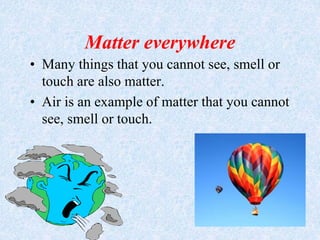
• Many things that you cannot see, smell or 
touch are also matter. 
• Air is an example of matter that you cannot 
see, smell or touch.
Matter has mass 
• You can feel the mass of things as weight 
when you pick them up. 
• When you blow up a balloon, you see that 
even air takes up space.
• Look at the hockey puck and volleyball. 
• The puck is small and hard. 
• The volleyball is large and soft. 
• The puck and volleyball look different, but 
both are matter.
Hockey puck volleyball 
Both are 
matteran 
d used for 
sports. 
Black, 
flat 
and 
hard 
Yellow, 
white, 
big 
and 
soft
States of matter 
• All matter is made of small 
particles. These particles are 
so small that you can not see 
them, even under a magnifying 
lens. 
• The particles are always 
moving.
• In some kinds of matter the 
particles are held tightly together 
• In other kinds of matter they are 
held less tightly. 
• States of matter are the form that 
matter can take 
• Three states of matter are solids, 
liquids, and gases.
• In solids particles are packed 
tightly together. 
• In liquids particles are packed 
together less tightly. 
• In gases particles move about 
freely. 
• Your science book is a solid. Like 
other solids, the book does not 
change shape.
• The particles of solids are held 
tightly together.
Solids: 
• solids are made of tightly 
packed particles. 
•Solids have their own shape. 
•You can easily measure both 
the mass and the volume of 
solids. Like your science book, 
the fabric of the balloons and 
balloon baskets are also solids.
particles are tightly 
packed in solids
Liquids: 
• particles in liquids are held 
together less tightly. 
•The particles in a liquid flow 
past one another. 
•Liquids take the shape of their 
containers. 
•If you pour a liquid from one 
container to another, the liquid 
will take the shape of the new 
container.
particles are 
held less 
tightly in 
liquids 
•You can easily measure the mass 
and the volume of liquids.
Gases: 
•The tiny particles that make up 
gases are far apart compared to 
solids and liquids. 
•The particles of a gas move freely 
and take up the space of their 
container. 
•The particles of a gas bounce off 
one another as they move freely.
•All matter has mass, so gas has 
mass too. You can measure the 
mass and volume of a gas. 
•The air in the balloon is gas. The 
air takes the shape of this balloon. 
•The particles of air move freely in 
the balloon.
Changes in water 
• Matter can change states 
through heating or cooling. 
•When water heats up, the space 
between the water particles 
becomes greater. 
•When water cools down the space 
between the particles becomes 
less.
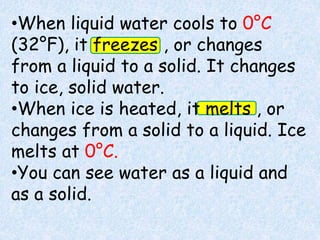
•When liquid water cools to 0°C 
(32°F), it freezes , or changes 
from a liquid to a solid. It changes 
to ice, solid water. 
•When ice is heated, it melts , or 
changes from a solid to a liquid. Ice 
melts at 0°C. 
•You can see water as a liquid and 
as a solid.
water as liquid 
water as solid
•You cannot see water as a gas. 
•Water as a gas is called water 
vapor. 
•When water is heated to 100°C, 
it boils, or changes from liquid 
water into bubbles of water 
vapor. 
•Water vapor and steam are not 
same; steam is droplets of liquid 
water in the air.
Water 
vapor
Steam is 
not 
water 
vapor.
•When water boils, it evaporates. 
•Evaporation is the change from 
liquid water to water vapor. 
•Evaporation can also happen 
slowly at the water surface.
•Notice the water droplets on 
the outside of the pot of water. 
•Where does that water come 
from? 
•When water vapor in the air 
cools, it can change back into 
liquid. 
•The water vapor condenses. 
•Condensation is the change 
from a gas into a liquid.
Water 
evaporation 
and condensation

Matter

  • 1.
    What is Matter? Third Grade
  • 2.
    What is matter? • Everything is matter! • Anything that has mass and takes up space is matter. • It includes all the things that you can see, touch or smell. • Your desk, paper, pencil, and even the air you breath are matter.
  • 3.
    Matter everywhere •Many things that you cannot see, smell or touch are also matter. • Air is an example of matter that you cannot see, smell or touch.
  • 4.
    Matter has mass • You can feel the mass of things as weight when you pick them up. • When you blow up a balloon, you see that even air takes up space.
  • 5.
    • Look atthe hockey puck and volleyball. • The puck is small and hard. • The volleyball is large and soft. • The puck and volleyball look different, but both are matter.
  • 6.
    Hockey puck volleyball Both are matteran d used for sports. Black, flat and hard Yellow, white, big and soft
  • 7.
    States of matter • All matter is made of small particles. These particles are so small that you can not see them, even under a magnifying lens. • The particles are always moving.
  • 8.
    • In somekinds of matter the particles are held tightly together • In other kinds of matter they are held less tightly. • States of matter are the form that matter can take • Three states of matter are solids, liquids, and gases.
  • 9.
    • In solidsparticles are packed tightly together. • In liquids particles are packed together less tightly. • In gases particles move about freely. • Your science book is a solid. Like other solids, the book does not change shape.
  • 10.
    • The particlesof solids are held tightly together.
  • 11.
    Solids: • solidsare made of tightly packed particles. •Solids have their own shape. •You can easily measure both the mass and the volume of solids. Like your science book, the fabric of the balloons and balloon baskets are also solids.
  • 12.
    particles are tightly packed in solids
  • 13.
    Liquids: • particlesin liquids are held together less tightly. •The particles in a liquid flow past one another. •Liquids take the shape of their containers. •If you pour a liquid from one container to another, the liquid will take the shape of the new container.
  • 14.
    particles are heldless tightly in liquids •You can easily measure the mass and the volume of liquids.
  • 15.
    Gases: •The tinyparticles that make up gases are far apart compared to solids and liquids. •The particles of a gas move freely and take up the space of their container. •The particles of a gas bounce off one another as they move freely.
  • 16.
    •All matter hasmass, so gas has mass too. You can measure the mass and volume of a gas. •The air in the balloon is gas. The air takes the shape of this balloon. •The particles of air move freely in the balloon.
  • 18.
    Changes in water • Matter can change states through heating or cooling. •When water heats up, the space between the water particles becomes greater. •When water cools down the space between the particles becomes less.
  • 19.
    •When liquid watercools to 0°C (32°F), it freezes , or changes from a liquid to a solid. It changes to ice, solid water. •When ice is heated, it melts , or changes from a solid to a liquid. Ice melts at 0°C. •You can see water as a liquid and as a solid.
  • 20.
    water as liquid water as solid
  • 21.
    •You cannot seewater as a gas. •Water as a gas is called water vapor. •When water is heated to 100°C, it boils, or changes from liquid water into bubbles of water vapor. •Water vapor and steam are not same; steam is droplets of liquid water in the air.
  • 22.
  • 23.
    Steam is not water vapor.
  • 24.
    •When water boils,it evaporates. •Evaporation is the change from liquid water to water vapor. •Evaporation can also happen slowly at the water surface.
  • 25.
    •Notice the waterdroplets on the outside of the pot of water. •Where does that water come from? •When water vapor in the air cools, it can change back into liquid. •The water vapor condenses. •Condensation is the change from a gas into a liquid.
  • 26.