Mathematics, Machine Learning
and ML Engineering
Gopi Krishna Nuti
Lead Data Scientist, Autodesk
Vice President, MUST Research
Ngopikrishna.public@gmail.com
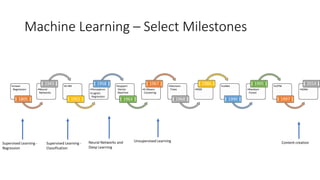
Machine Learning – Select Milestones
•Linear
Regression
1805
•Neural
Networks
1943 •K-NN
1951
•Perceptron
•Logistic
Regression
1958 •Support
Vector
Machine
1963
•K-Means
Clustering
1967 •Decision
Trees
1968
•RNN
1986 •LeNet
1990
•Random
Forest
1995 •LSTM
1997
•GANs
2014
Supervised Learning -
Regression
Supervised Learning -
Classification
Neural Networks and
Deep Learning
Unsupervised Learning Content creation
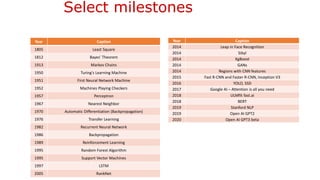
Select milestones
Year Caption
1805 Least Square
1812 Bayes' Theorem
1913 Markov Chains
1950 Turing's Learning Machine
1951 First Neural Network Machine
1952 Machines Playing Checkers
1957 Perceptron
1967 Nearest Neighbor
1970 Automatic Differentiation (Backpropagation)
1976 Transfer Learning
1982 Recurrent Neural Network
1986 Backpropagation
1989 Reinforcement Learning
1995 Random Forest Algorithm
1995 Support Vector Machines
1997 LSTM
2005 RankNet
Year Caption
2014 Leap in Face Recognition
2014 Sibyl
2014 XgBoost
2014 GANs
2014 Regions with CNN features
2015 Fast R-CNN and Faster R-CNN, Inception V3
2016 YOLO, SSD
2017 Google AI – Attention is all you need
2018 ULMfit fast.ai
2018 BERT
2019 Stanford NLP
2019 Open AI GPT2
2020 Open AI GPT3 beta
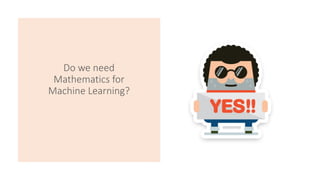
Do we need
Mathematics for
Machine Learning?
Impact of
Mathematics
on AI/ML
• Classical Machine Learning algorithms
• Concepts like p-Values, power of a hypothesis,
• Data distributions (Normal, F, T etc),
• Test statistics like Chi-Squaer
Statistics
• Some classical Machine Learning algorithms
• Distance between points, orthogonal coordinates etc.
Coordinate Geometry
• Neural Networks
• Perceptron
• Differentiations, Integrations and more…
Linear Algebra
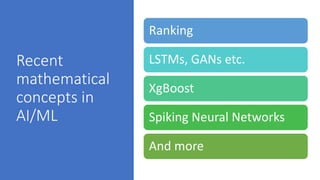
Recent
mathematical
concepts in
AI/ML
Ranking
LSTMs, GANs etc.
XgBoost
Spiking Neural Networks
And more
ML/AI
Engineering
A truly multi-disciplinary field
Combines Computer Science
and Cognitive Science
Potentially transformative
applications in many areas of
science, industry and society.
Do we need
Mathematics for
ML Engineering
That’s the question, isn’t it?
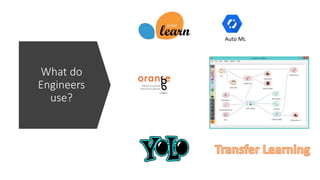
What do
Engineers
use?
Auto ML
AutoML
• An amalgamation of Data Science algorithms made
possible by best practices of Programming
• Machine Learning models are available at the click of a
button.
• Sometimes, even drag-n-drop is not necessary.
• Good - Democratizes AI. Citizen data scientists
• Bad – Black boxes.
• Ugly - Invisible Bias
Is this desirable?
Yes
Is this desirable
Picture courtesy: https://www.thoughtco.com/thomas-edison-1779841
Has this happened before?
Trends in ML Engineering
Multi
dimensional
New
algorithms
New
domains
Commoditiz
ation
Evolution as
a discipline
Gartner’s AI Hype Cycle for 2020
Image courtesy Gartner.com
AI Services Commoditization
Image courtesy : Gartner.com
Where does everyone fit?
ML Researcher
Classical Approaches
• How can statistics be used?
Deep Learning
• 3rd and 4th gen Neural Networks
Interpretability of models
ML Engineer
Commoditize
Standardize
Expand to new domains
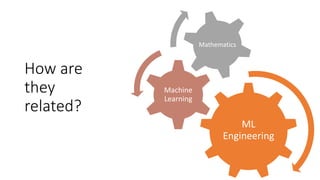
How are
they
related?
ML
Engineering
Machine
Learning
Mathematics
Applying AI
for Math
• Applying AI for long standing problems for “near
optimal” solutions.
• Examples
• Travelling Salesman Problem
• Navier Stokes Equations
• Proving Kazhdan-Lusztig polynomials
• Supervised learning for identifying a
previously unknown relationship between
two knots in Knot theorem
• Discovering new patterns in Pure
Mathematics
https://www.sciencealert.com/ai-is-discovering-patterns-in-pure-mathematics-that-have-never-been-
seen-before
Applying
Math for AI
• Interpretability of black box models
• Spiking Neural Networks
• Identifying the functions that govern
vision, hearing etc.
Thank you!

Mathematics, Machine Learning and ML Engineering

  • 1.
    Mathematics, Machine Learning andML Engineering Gopi Krishna Nuti Lead Data Scientist, Autodesk Vice President, MUST Research Ngopikrishna.public@gmail.com
  • 2.
    Machine Learning –Select Milestones •Linear Regression 1805 •Neural Networks 1943 •K-NN 1951 •Perceptron •Logistic Regression 1958 •Support Vector Machine 1963 •K-Means Clustering 1967 •Decision Trees 1968 •RNN 1986 •LeNet 1990 •Random Forest 1995 •LSTM 1997 •GANs 2014 Supervised Learning - Regression Supervised Learning - Classification Neural Networks and Deep Learning Unsupervised Learning Content creation
  • 3.
    Select milestones Year Caption 1805Least Square 1812 Bayes' Theorem 1913 Markov Chains 1950 Turing's Learning Machine 1951 First Neural Network Machine 1952 Machines Playing Checkers 1957 Perceptron 1967 Nearest Neighbor 1970 Automatic Differentiation (Backpropagation) 1976 Transfer Learning 1982 Recurrent Neural Network 1986 Backpropagation 1989 Reinforcement Learning 1995 Random Forest Algorithm 1995 Support Vector Machines 1997 LSTM 2005 RankNet Year Caption 2014 Leap in Face Recognition 2014 Sibyl 2014 XgBoost 2014 GANs 2014 Regions with CNN features 2015 Fast R-CNN and Faster R-CNN, Inception V3 2016 YOLO, SSD 2017 Google AI – Attention is all you need 2018 ULMfit fast.ai 2018 BERT 2019 Stanford NLP 2019 Open AI GPT2 2020 Open AI GPT3 beta
  • 4.
    Do we need Mathematicsfor Machine Learning?
  • 5.
    Impact of Mathematics on AI/ML •Classical Machine Learning algorithms • Concepts like p-Values, power of a hypothesis, • Data distributions (Normal, F, T etc), • Test statistics like Chi-Squaer Statistics • Some classical Machine Learning algorithms • Distance between points, orthogonal coordinates etc. Coordinate Geometry • Neural Networks • Perceptron • Differentiations, Integrations and more… Linear Algebra
  • 6.
    Recent mathematical concepts in AI/ML Ranking LSTMs, GANsetc. XgBoost Spiking Neural Networks And more
  • 7.
    ML/AI Engineering A truly multi-disciplinaryfield Combines Computer Science and Cognitive Science Potentially transformative applications in many areas of science, industry and society.
  • 8.
    Do we need Mathematicsfor ML Engineering That’s the question, isn’t it?
  • 9.
  • 10.
    AutoML • An amalgamationof Data Science algorithms made possible by best practices of Programming • Machine Learning models are available at the click of a button. • Sometimes, even drag-n-drop is not necessary. • Good - Democratizes AI. Citizen data scientists • Bad – Black boxes. • Ugly - Invisible Bias
  • 11.
  • 12.
    Is this desirable Picturecourtesy: https://www.thoughtco.com/thomas-edison-1779841
  • 13.
  • 14.
    Trends in MLEngineering Multi dimensional New algorithms New domains Commoditiz ation Evolution as a discipline
  • 15.
    Gartner’s AI HypeCycle for 2020 Image courtesy Gartner.com
  • 16.
    AI Services Commoditization Imagecourtesy : Gartner.com
  • 17.
    Where does everyonefit? ML Researcher Classical Approaches • How can statistics be used? Deep Learning • 3rd and 4th gen Neural Networks Interpretability of models ML Engineer Commoditize Standardize Expand to new domains
  • 18.
  • 19.
    Applying AI for Math •Applying AI for long standing problems for “near optimal” solutions. • Examples • Travelling Salesman Problem • Navier Stokes Equations • Proving Kazhdan-Lusztig polynomials • Supervised learning for identifying a previously unknown relationship between two knots in Knot theorem • Discovering new patterns in Pure Mathematics https://www.sciencealert.com/ai-is-discovering-patterns-in-pure-mathematics-that-have-never-been- seen-before
  • 20.
    Applying Math for AI •Interpretability of black box models • Spiking Neural Networks • Identifying the functions that govern vision, hearing etc.
  • 21.