AI - ML - Data Science – Booming Technology:
Taking Engineering to the next level
First Year – Orientation based Presentation
DR.G. ARUN SAMPAUL THOMAS
Associate Professor & HOD - AI&ML
JB INSTITUTE OF ENGINEERING AND TECHNOLOGY
Hyderabad, Telangana, India
Academician, Researcher in Data Science & Big Data Analytics, Student Mentor
Expert in NBA Criteria 2, NAAC Criteria 2 (Teaching-Learning Process)
Contact @ +91 95855 11808
hod.ai_ml@jbiet.edu.in
1
Agenda
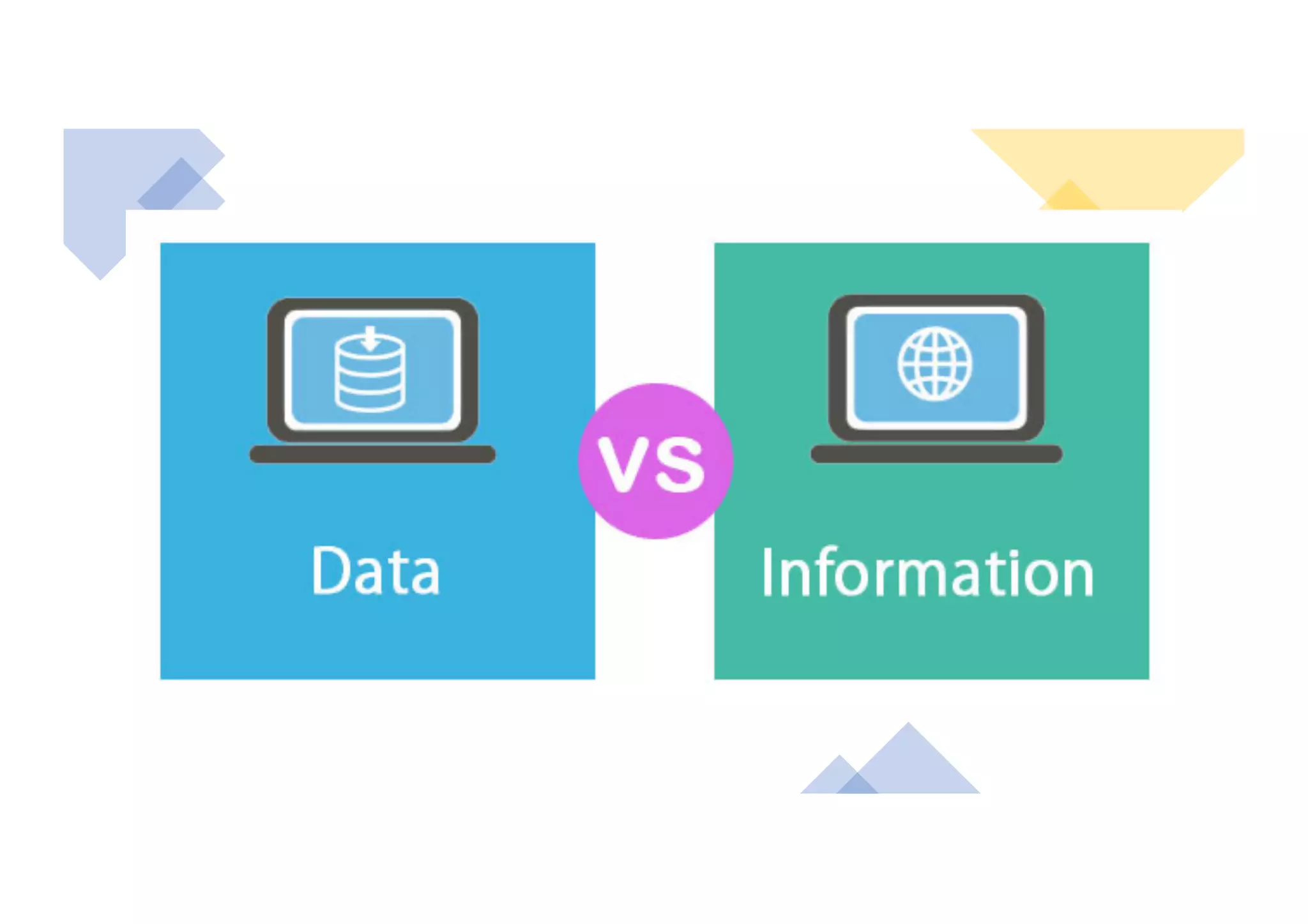
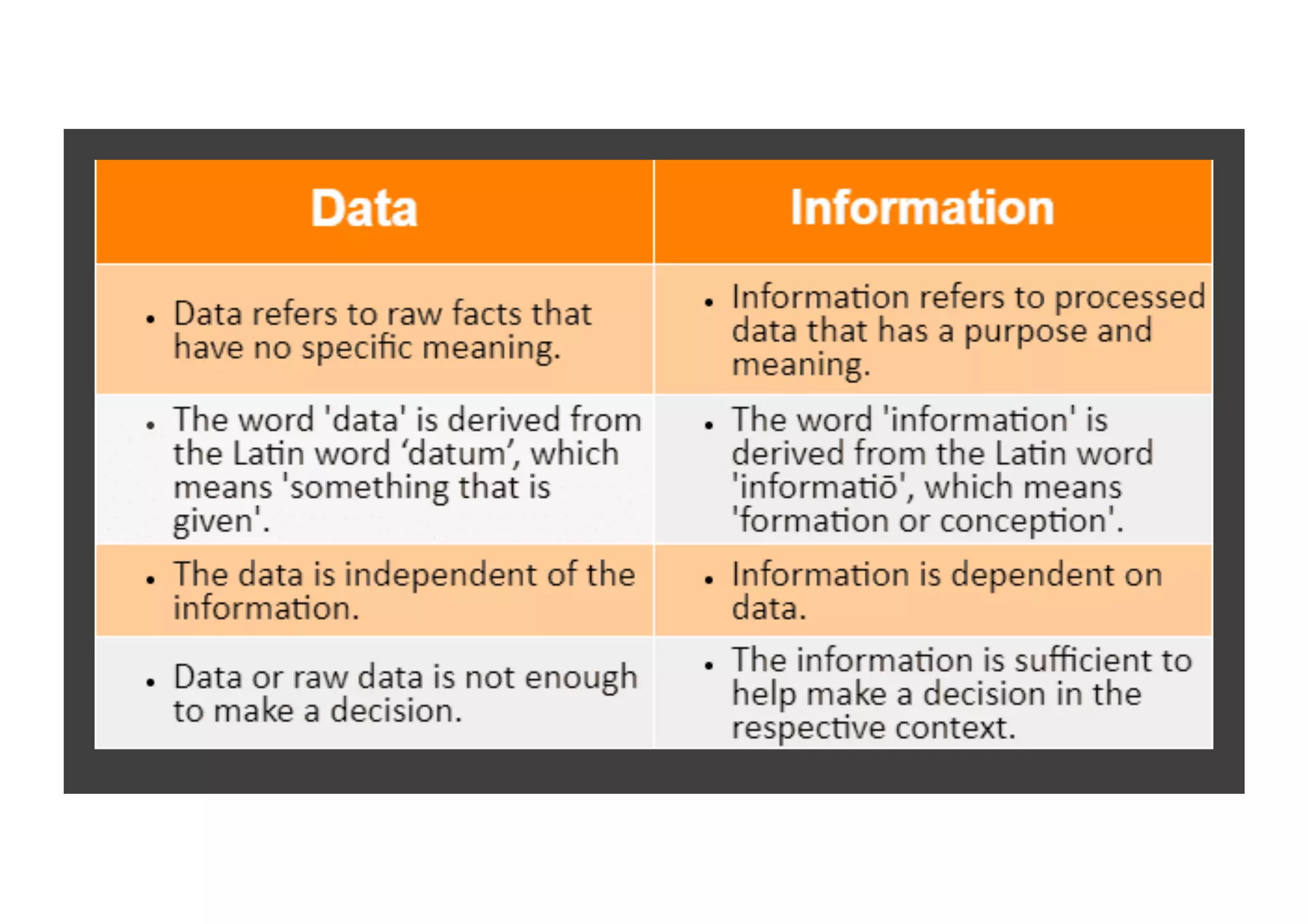
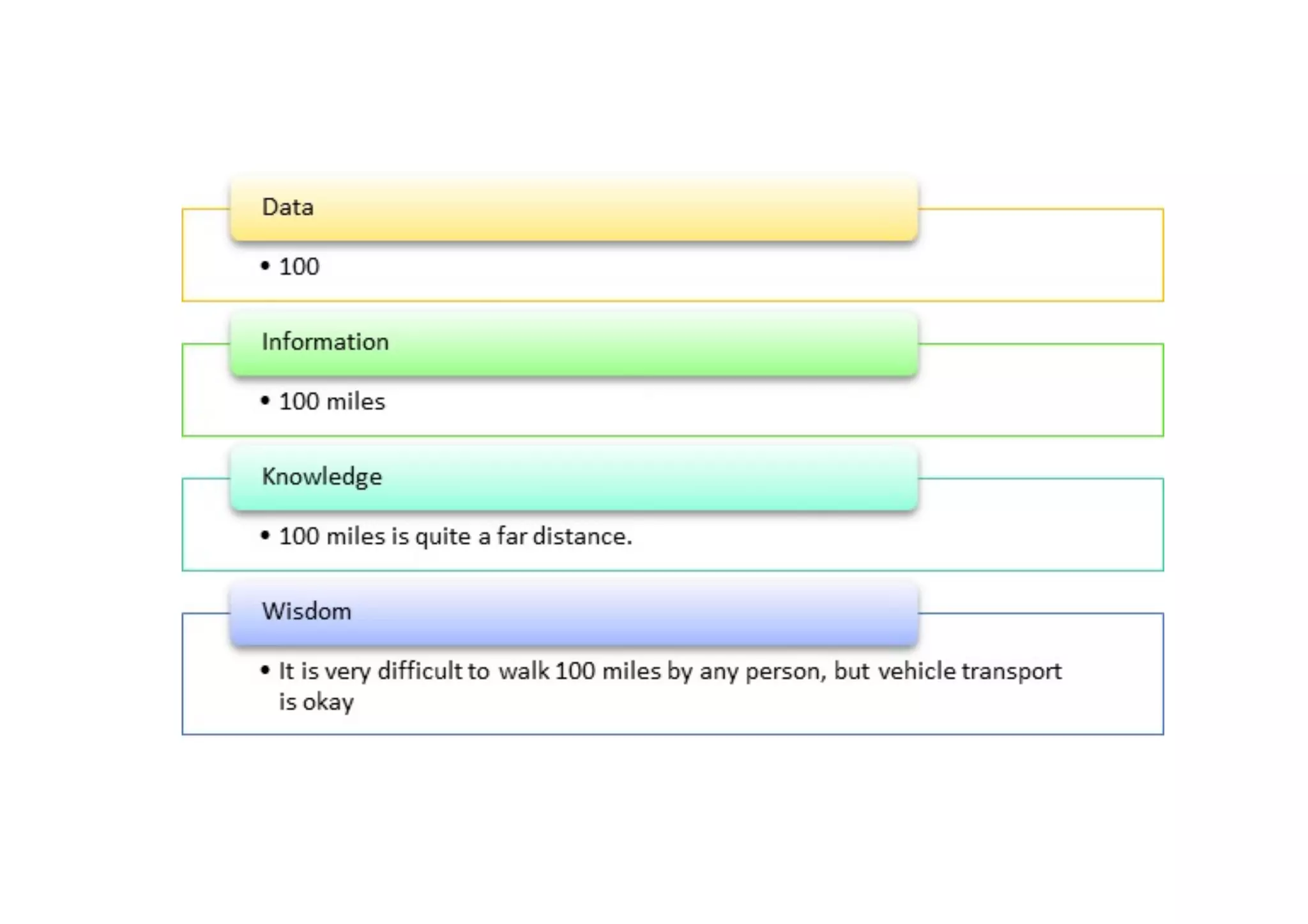
• Data Vs Info
• AI
• Data science
• Real world applications
• 2022 - Skillsets
• Q&A
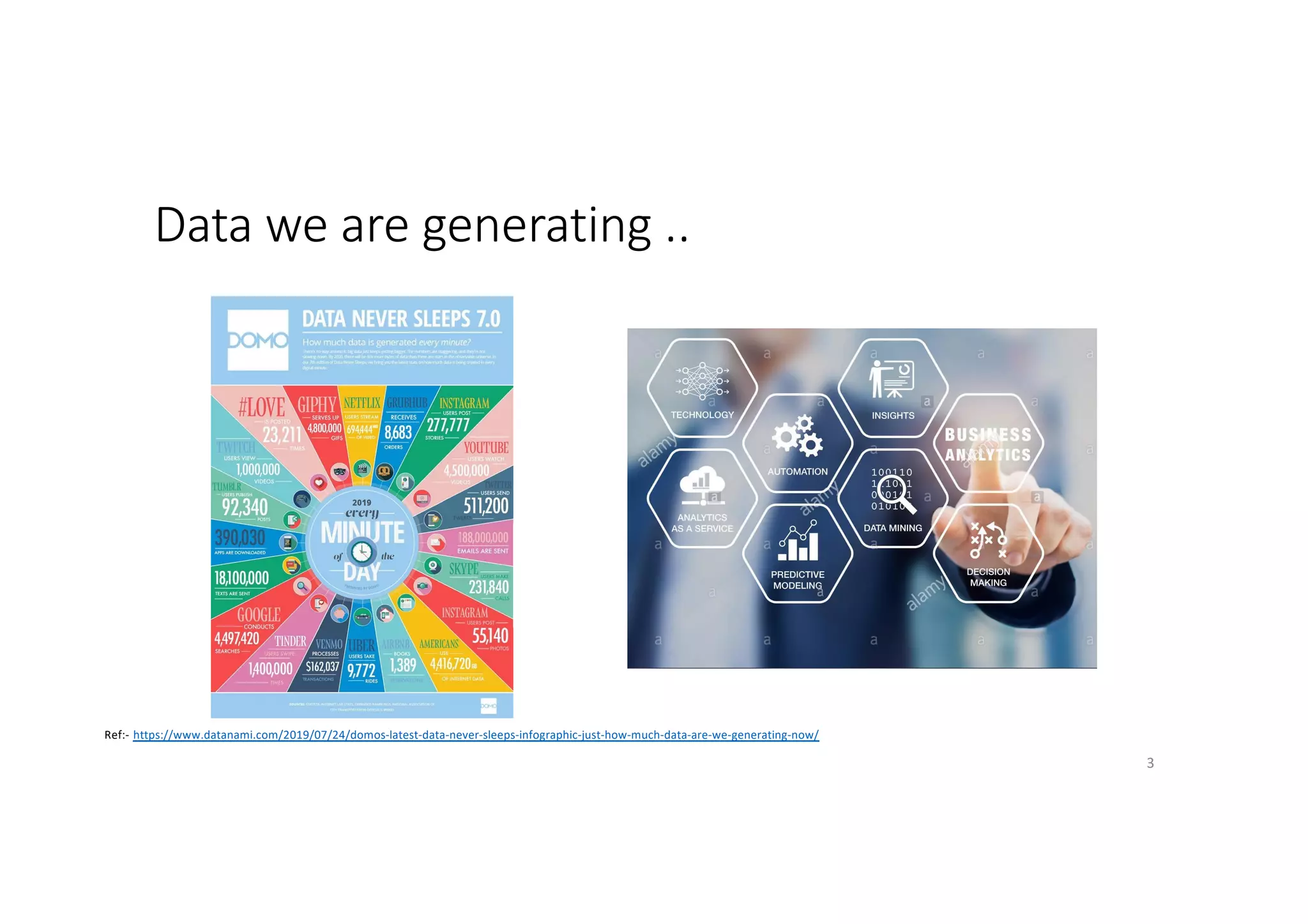
Data we are generating ..
3
Ref:- https://www.datanami.com/2019/07/24/domos-latest-data-never-sleeps-infographic-just-how-much-data-are-we-generating-now/
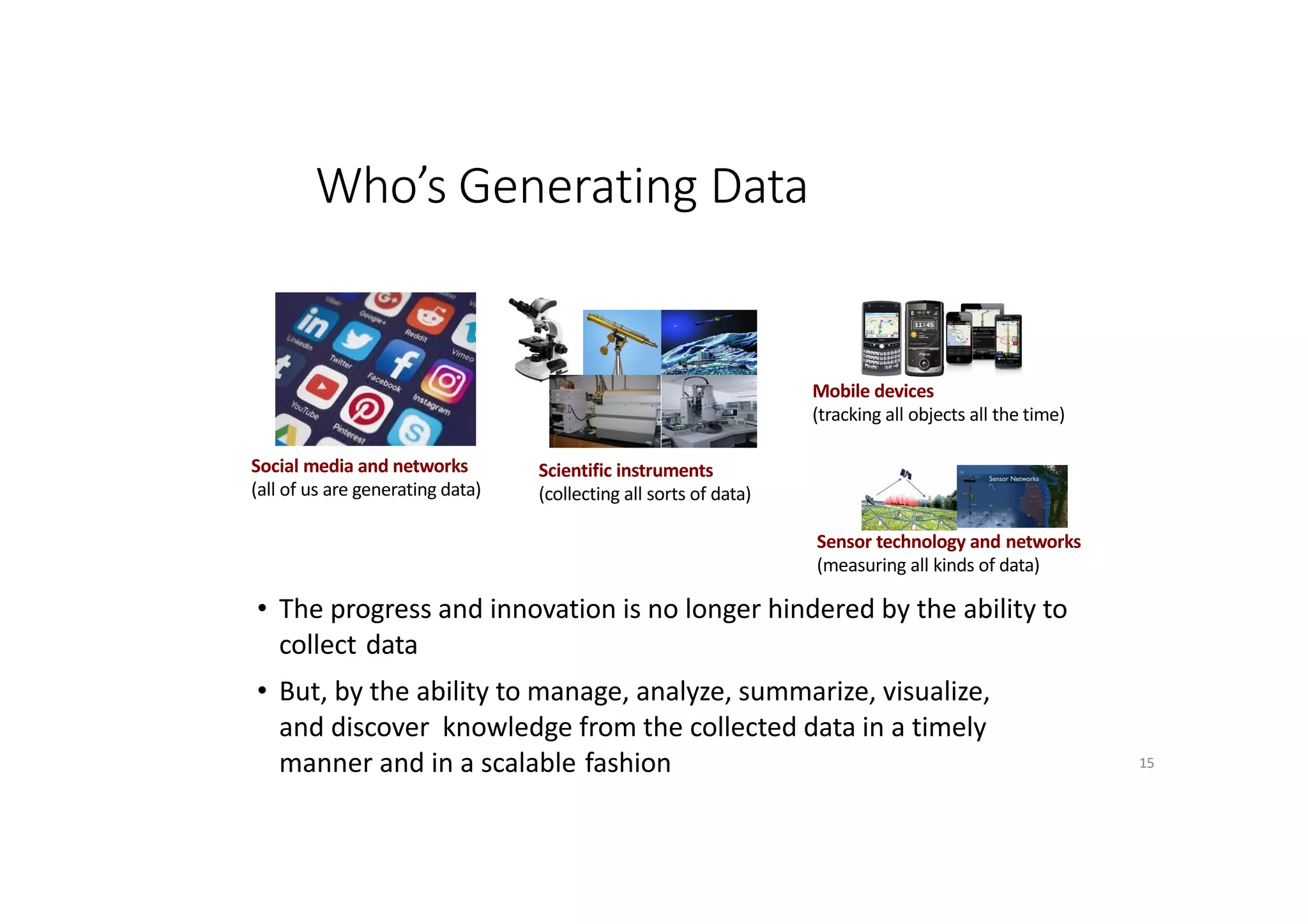
Who’s Generating Data
Social media and networks
(all of us are generating data)
Scientific instruments
(collecting all sorts of data)
Mobile devices
(tracking all objects all the time)
Sensor technology and networks
(measuring all kinds of data)
• The progress and innovation is no longer hindered by the ability to
collect data
• But, by the ability to manage, analyze, summarize, visualize,
and discover knowledge from the collected data in a timely
manner and in a scalable fashion 15
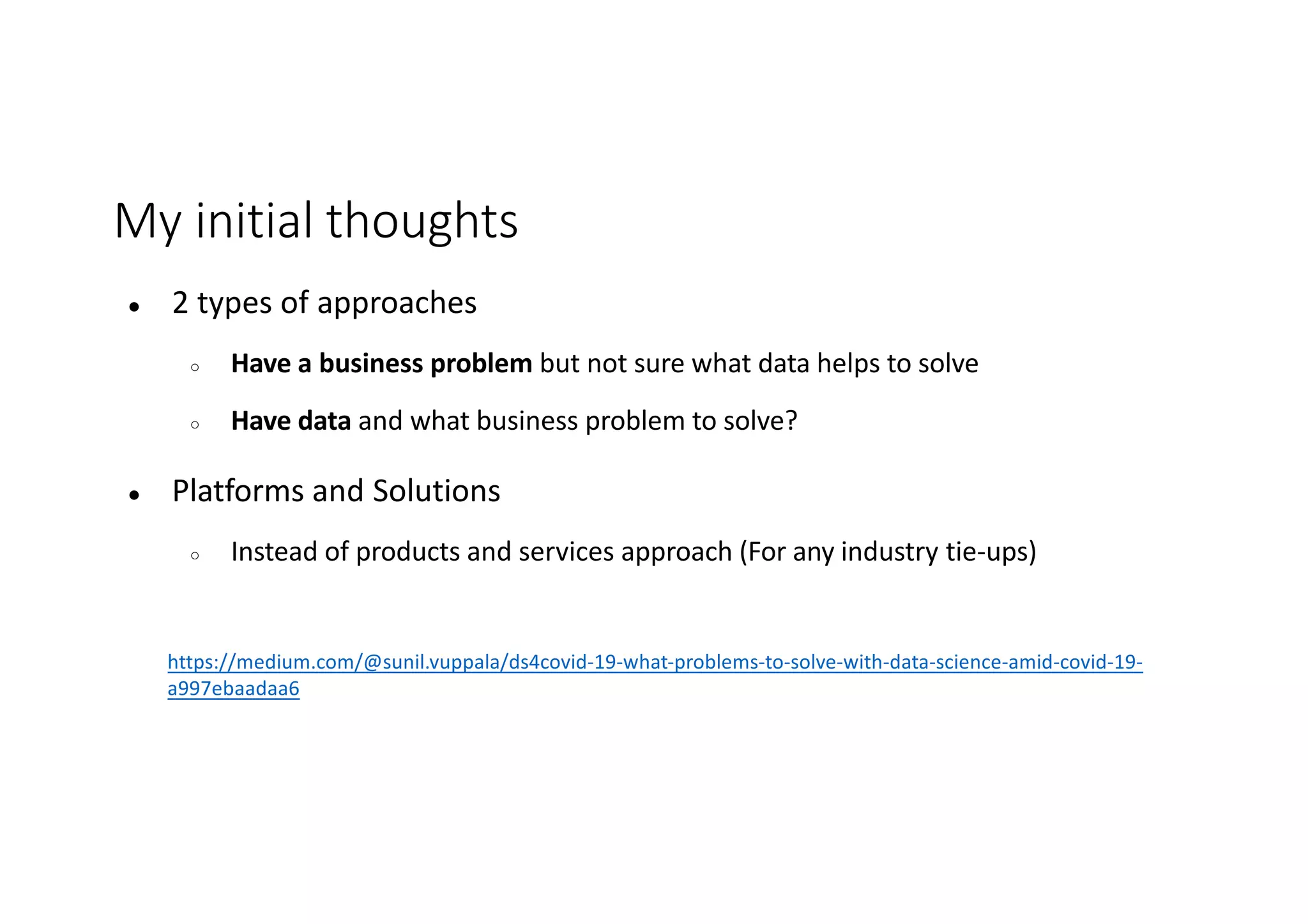
My initial thoughts
● 2 types of approaches
○ Have a business problem but not sure what data helps to solve
○ Have data and what business problem to solve?
● Platforms and Solutions
○ Instead of products and services approach (For any industry tie-ups)
https://medium.com/@sunil.vuppala/ds4covid-19-what-problems-to-solve-with-data-science-amid-covid-19-
a997ebaadaa6
Computers versus humans
•A computer can do some things better than a human
can
• Adding a thousand four-digit numbers
• Drawing complex, 3D images
• Store and retrieve massive amounts of data
•However, there are things humans can do much
better.
11
Thinking Machines
Artificial intelligence (AI)
The study of computer systems that attempt to model and apply the
intelligence of the human mind
For example, writing a program to pick out objects in a picture
Ø An intelligent entity created by humans.
Ø Capable of performing tasks intelligently without being
explicitly instructed.
Ø Capable of thinking and acting rationally and humanely.
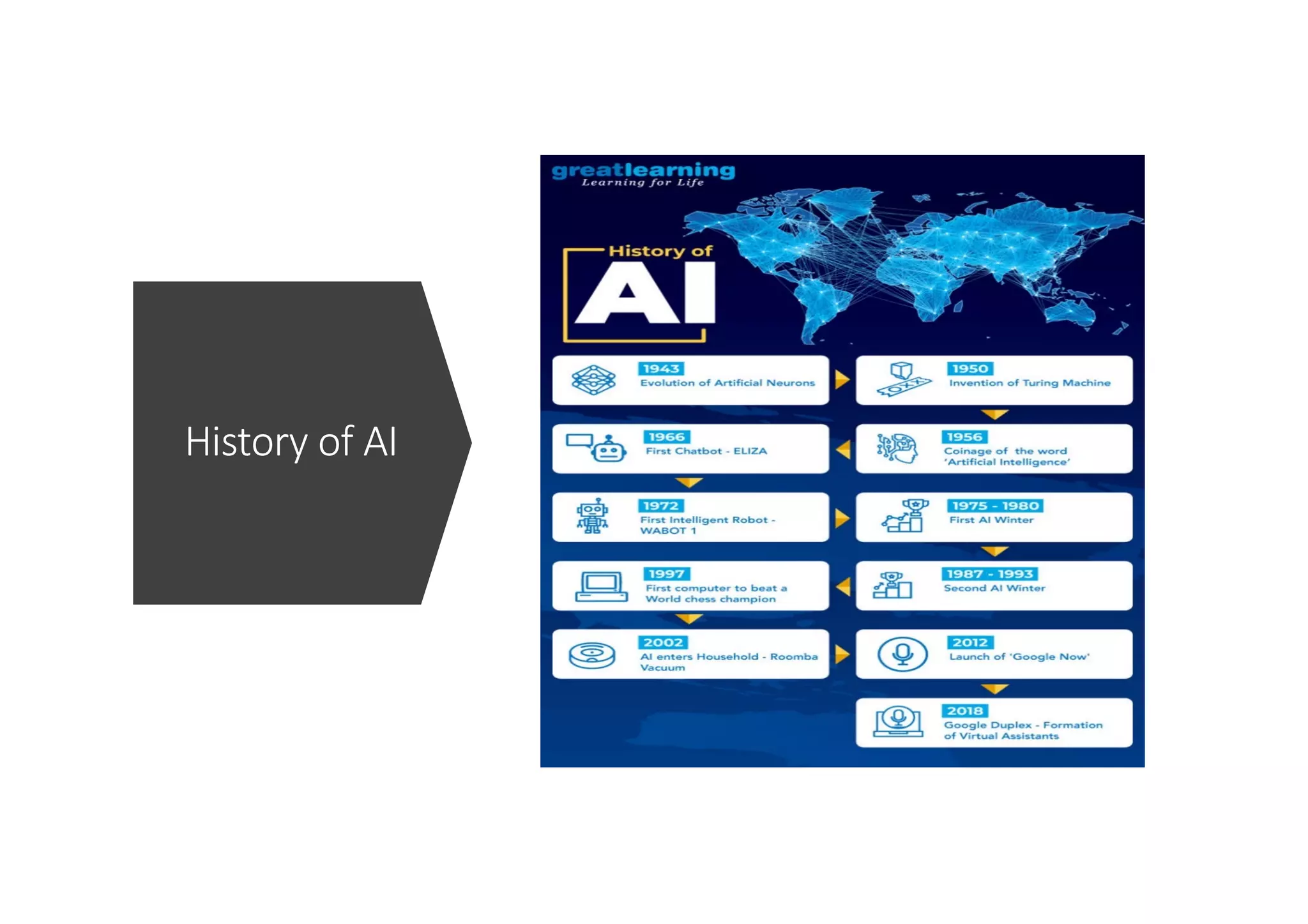
History of AI
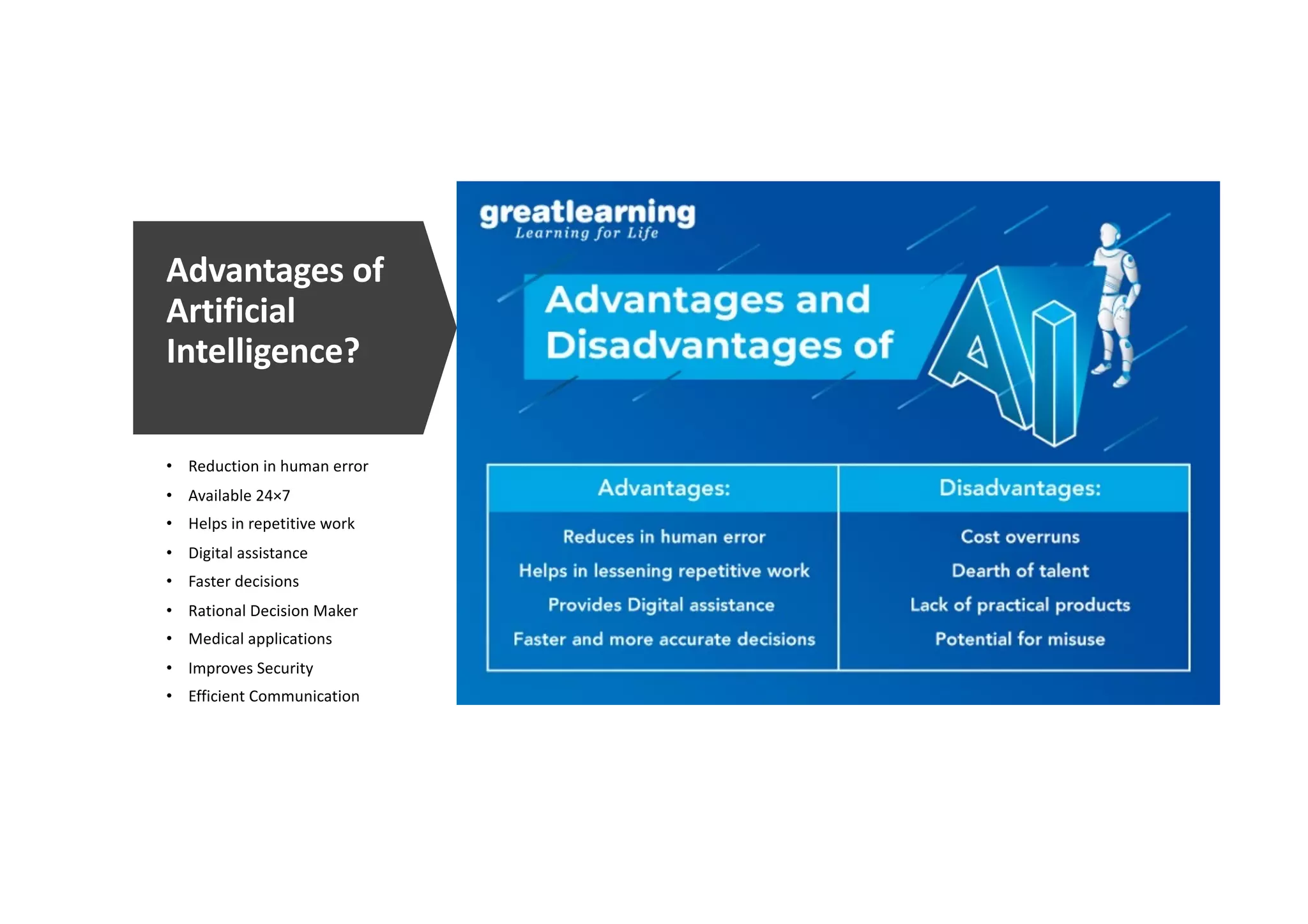
Advantages of
Artificial
Intelligence?
• Reduction in human error
• Available 24×7
• Helps in repetitive work
• Digital assistance
• Faster decisions
• Rational Decision Maker
• Medical applications
• Improves Security
• Efficient Communication
Prerequisites for Artificial Intelligence?
As a beginner, here are some of the basic prerequisites that will help get started with the subject.
1.A strong hold on Mathematics — namely Calculus, Statistics and probability.
2.A good amount of experience in programming languages like Java, or Python.
3.A strong hold in understanding and writing algorithms.
4.A strong background in data analytics skills.
5.A good amount of knowledge in discrete mathematics.
6.The will to learn machine learning languages.
Everyday Applications of Artificial
Intelligence
1.Google’s AI-powered predictions (E.g.: Google Maps)
2.Ride-sharing applications (E.g.: Uber, Lyft)
3.AI Autopilot in Commercial Flights
4.Spam filters on E-mails
5.Plagiarism checkers and tools
6.Facial Recognition
7.Search recommendations
8.Voice-to-text features
9.Smart personal assistants (E.g.: Siri, Alexa)
10.Fraud protection and prevention.
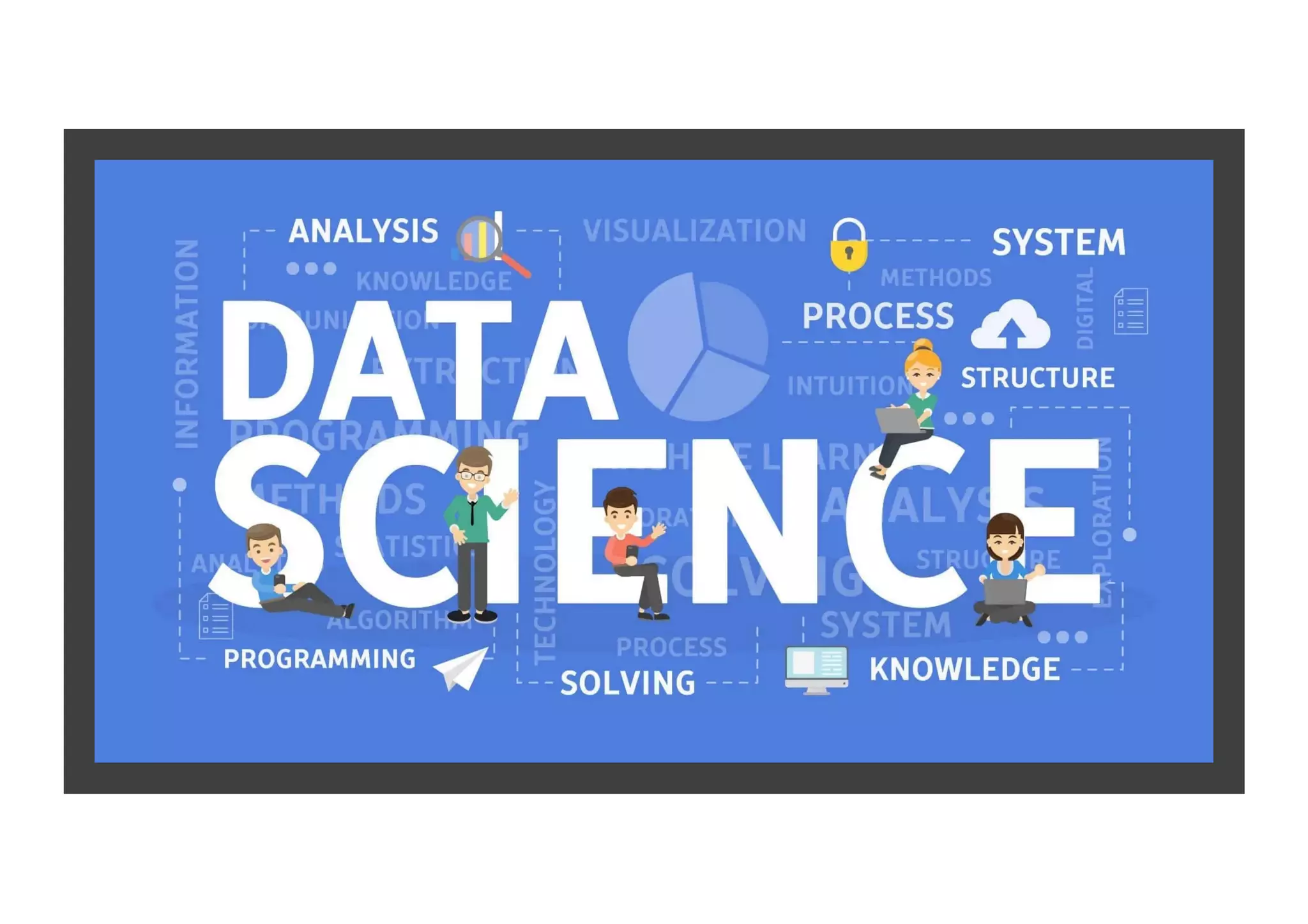
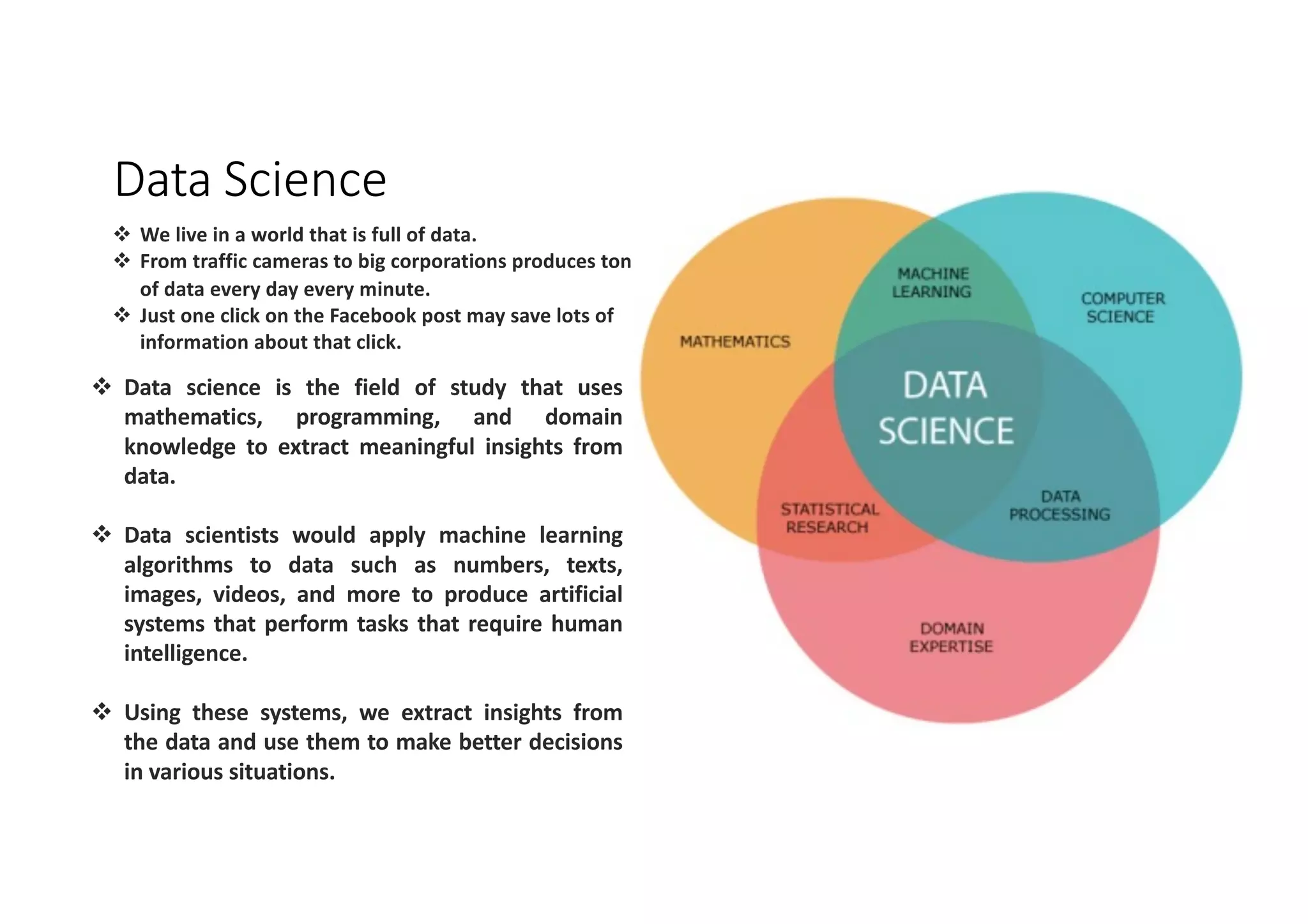
Data Science
v We live in a world that is full of data.
v From traffic cameras to big corporations produces tons
of data every day every minute.
v Just one click on the Facebook post may save lots of
information about that click.
v Data science is the field of study that uses
mathematics, programming, and domain
knowledge to extract meaningful insights from
data.
v Data scientists would apply machine learning
algorithms to data such as numbers, texts,
images, videos, and more to produce artificial
systems that perform tasks that require human
intelligence.
v Using these systems, we extract insights from
the data and use them to make better decisions
in various situations.
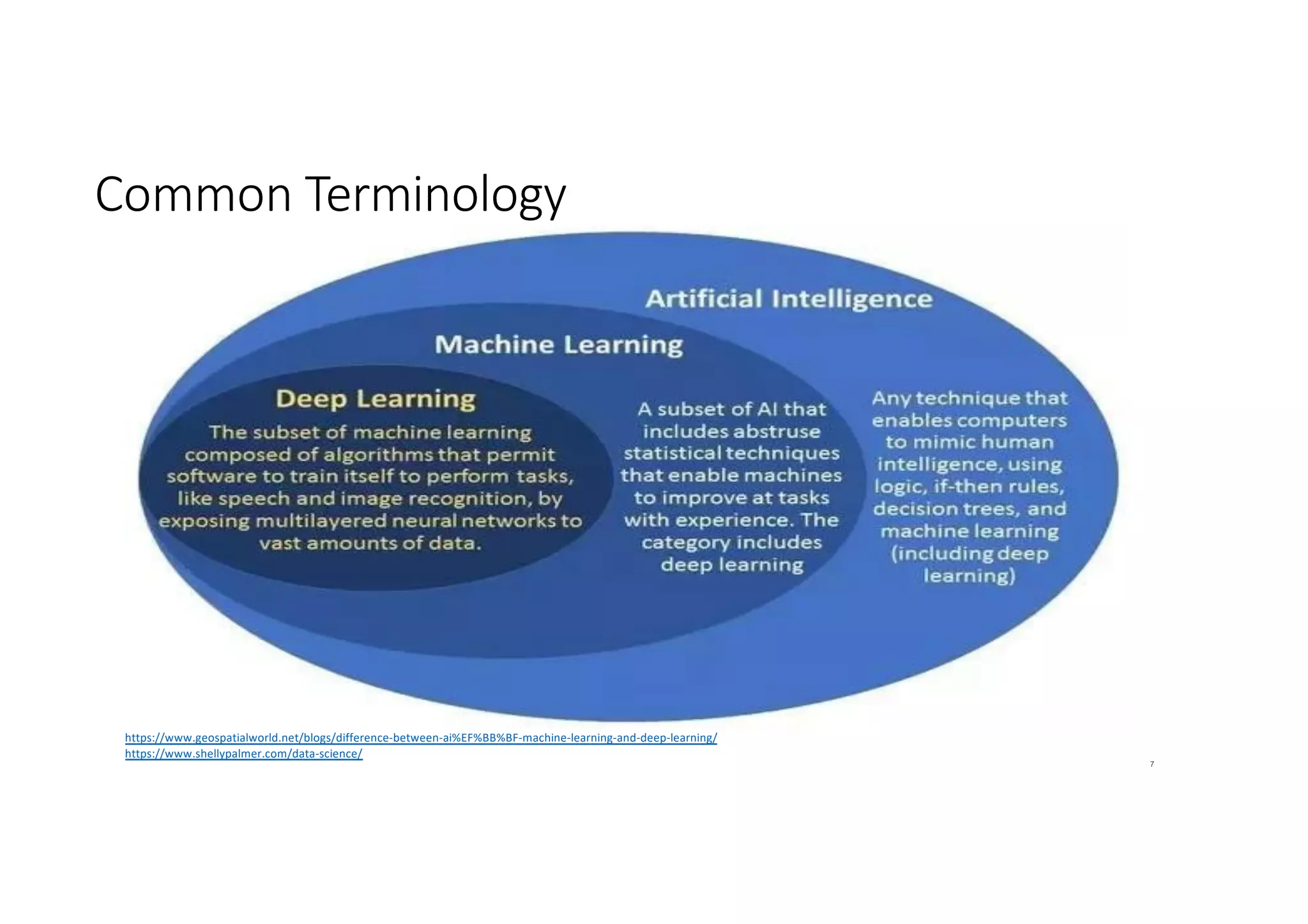
Common Terminology
7
https://www.geospatialworld.net/blogs/difference-between-ai%EF%BB%BF-machine-learning-and-deep-learning/
https://www.shellypalmer.com/data-science/
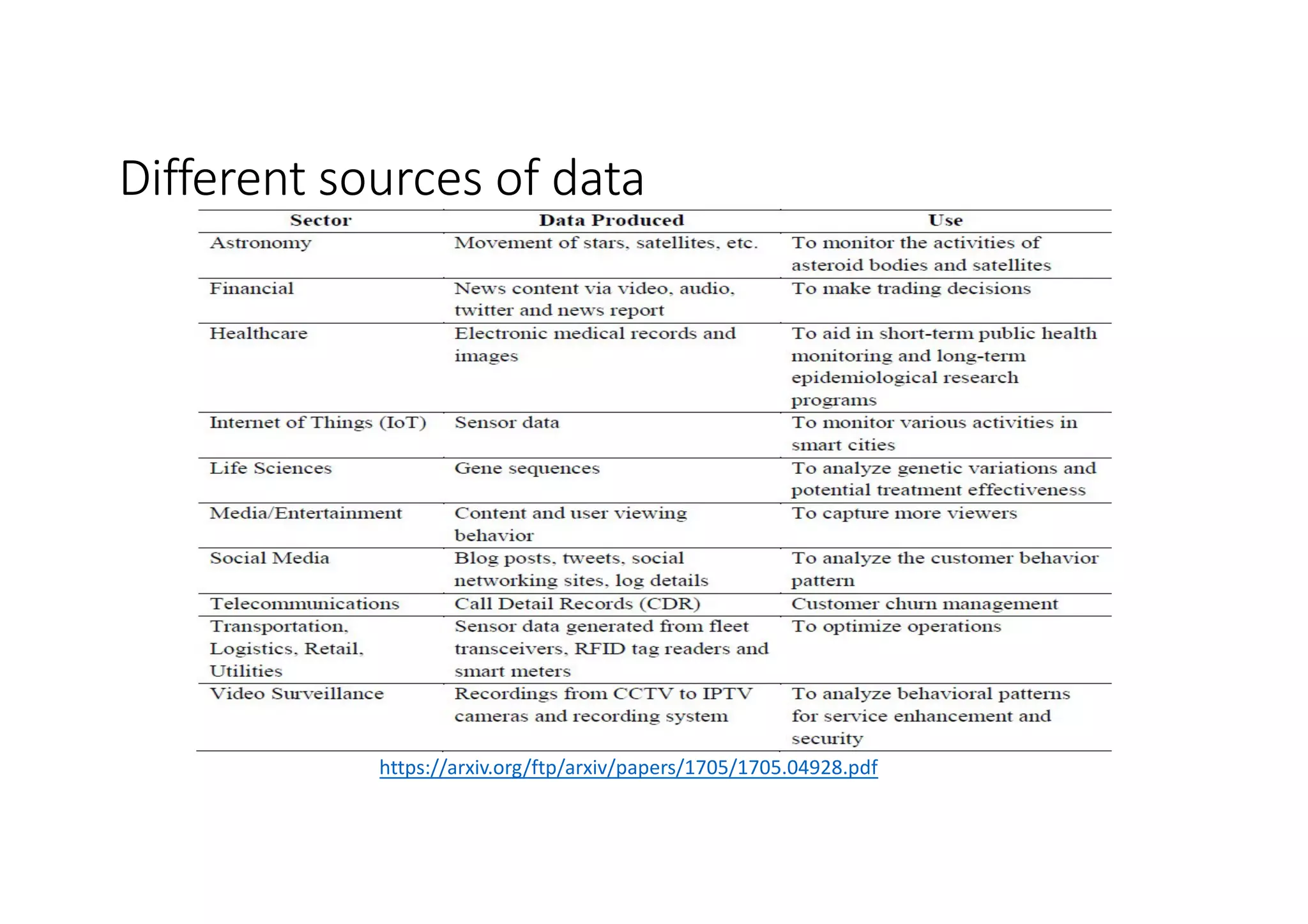
Different sources of data
https://arxiv.org/ftp/arxiv/papers/1705/1705.04928.pdf
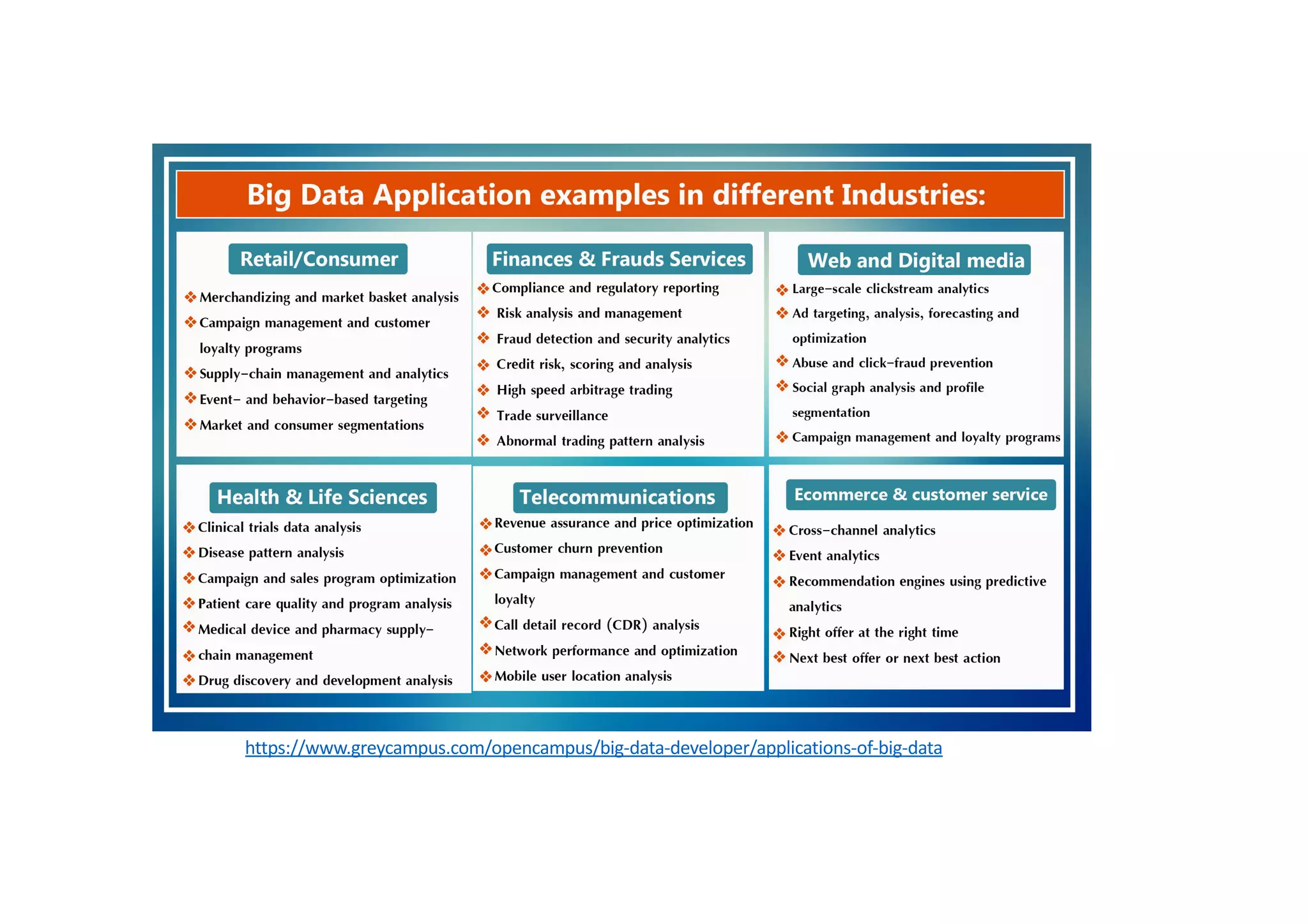
https://www.greycampus.com/opencampus/big-data-developer/applications-of-big-data
22
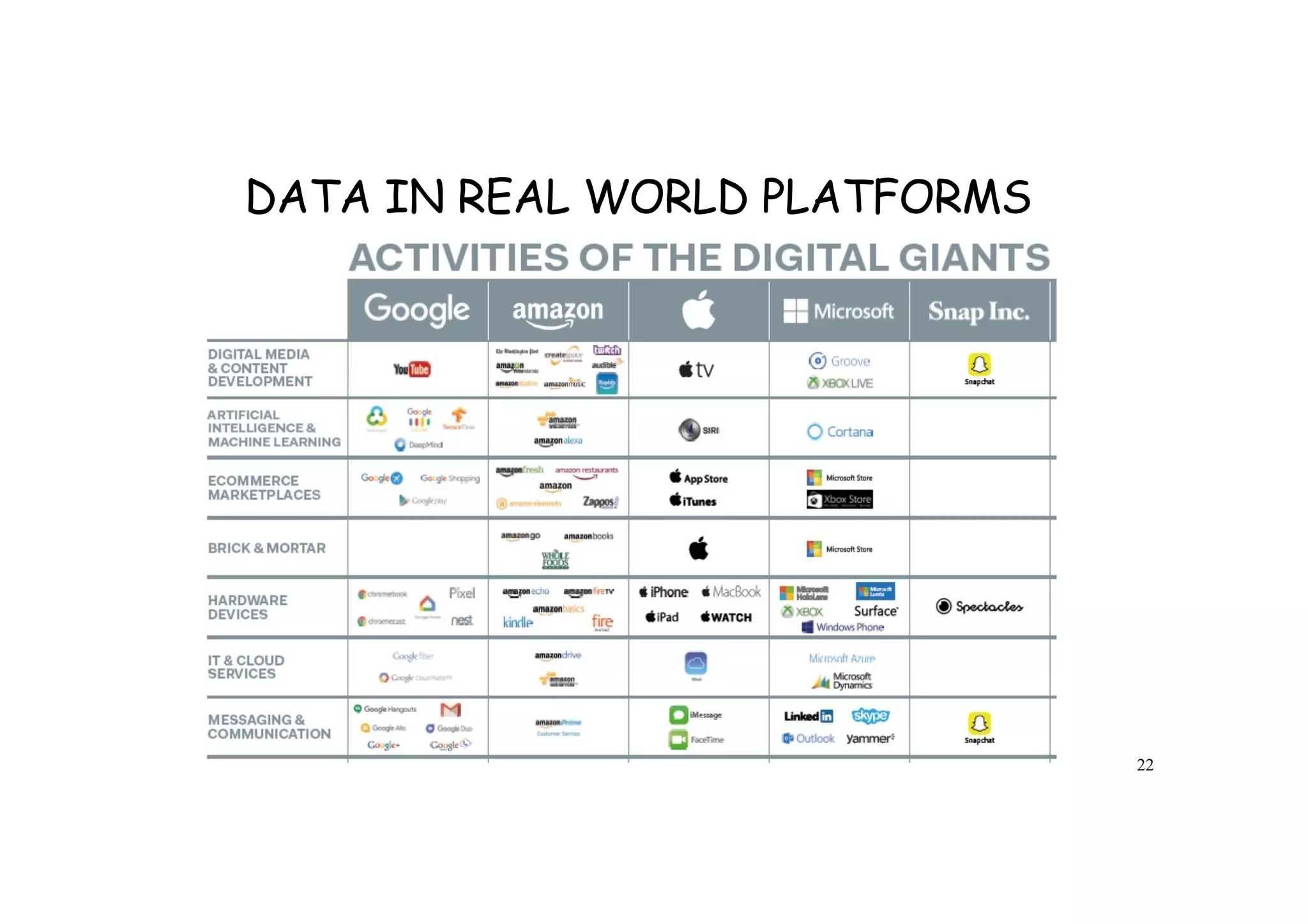
DATA IN REAL WORLD PLATFORMS
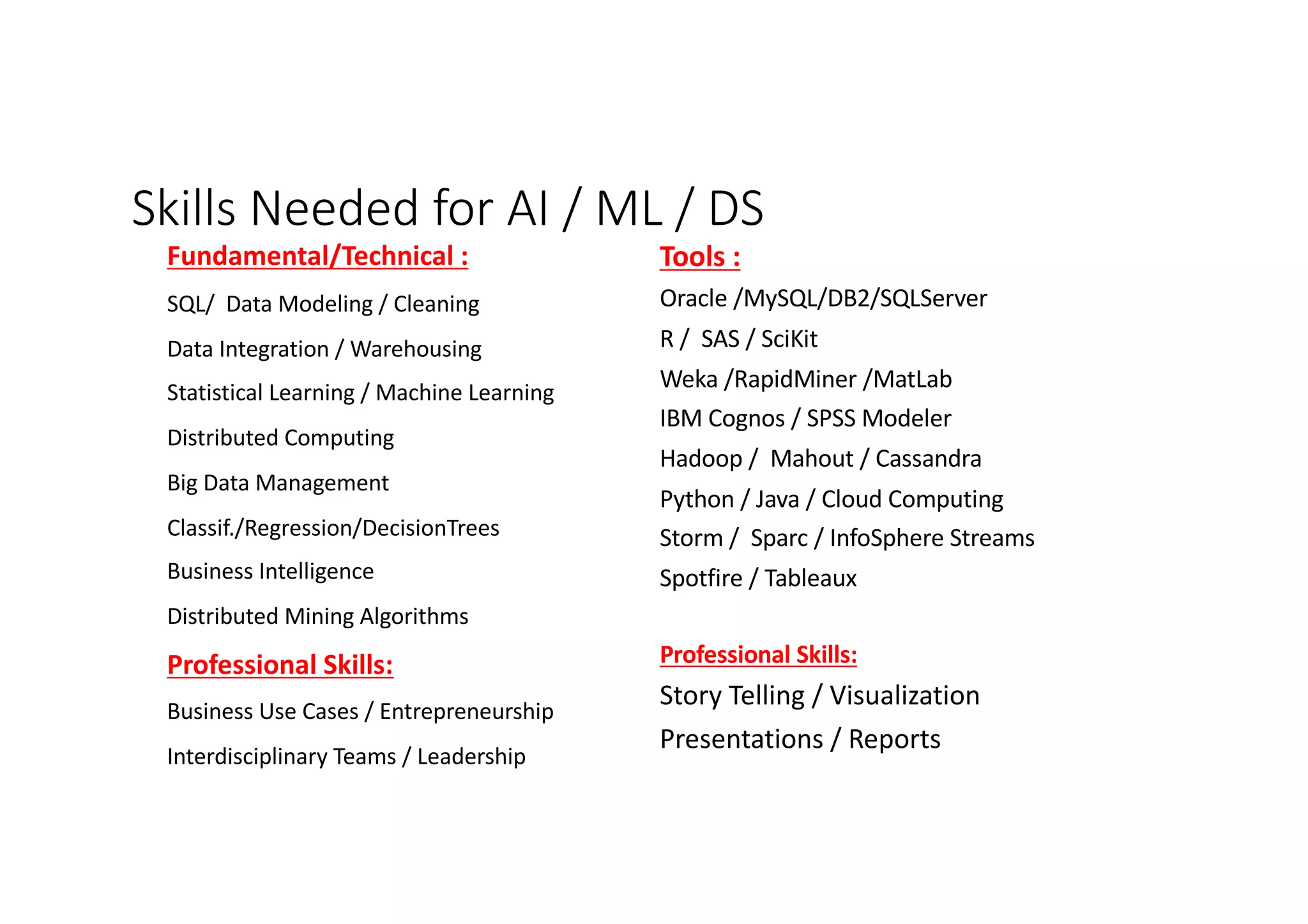
Skills Needed for AI / ML / DS
Fundamental/Technical :
SQL/ Data Modeling / Cleaning
Data Integration / Warehousing
Statistical Learning / Machine Learning
Distributed Computing
Big Data Management
Classif./Regression/DecisionTrees
Business Intelligence
Distributed Mining Algorithms
Professional Skills:
Business Use Cases / Entrepreneurship
Interdisciplinary Teams / Leadership
Tools :
Oracle /MySQL/DB2/SQLServer
R / SAS / SciKit
Weka /RapidMiner /MatLab
IBM Cognos / SPSS Modeler
Hadoop / Mahout / Cassandra
Python / Java / Cloud Computing
Storm / Sparc / InfoSphere Streams
Spotfire / Tableaux
Professional Skills:
Story Telling / Visualization
Presentations / Reports
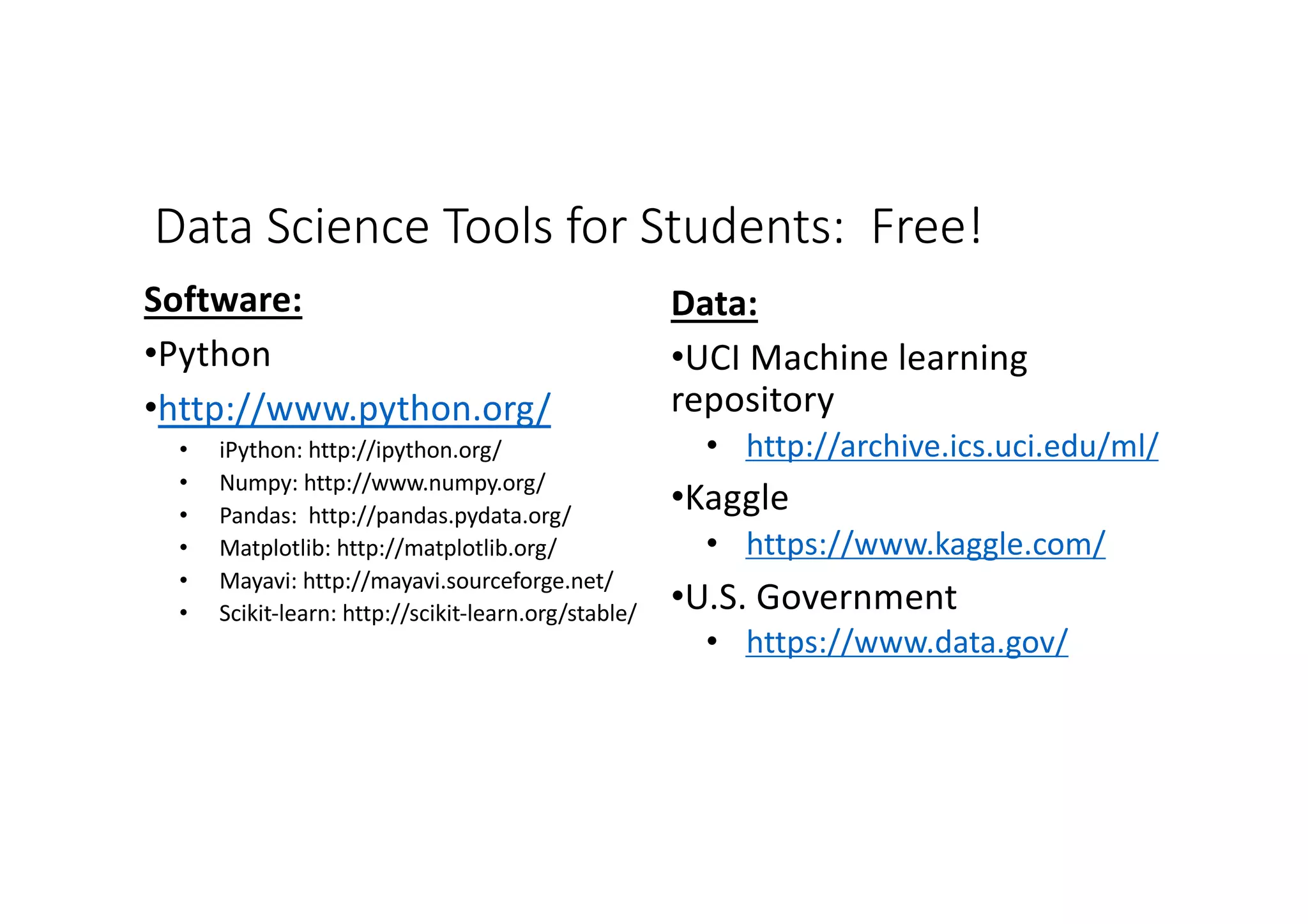
Data Science Tools for Students: Free!
Software:
•Python
•http://www.python.org/
• iPython: http://ipython.org/
• Numpy: http://www.numpy.org/
• Pandas: http://pandas.pydata.org/
• Matplotlib: http://matplotlib.org/
• Mayavi: http://mayavi.sourceforge.net/
• Scikit-learn: http://scikit-learn.org/stable/
Data:
•UCI Machine learning
repository
• http://archive.ics.uci.edu/ml/
•Kaggle
• https://www.kaggle.com/
•U.S. Government
• https://www.data.gov/
Data Science - NXT Level_Dr.Arun.pdf

Data Science - NXT Level_Dr.Arun.pdf

  • 1.
    AI - ML- Data Science – Booming Technology: Taking Engineering to the next level First Year – Orientation based Presentation DR.G. ARUN SAMPAUL THOMAS Associate Professor & HOD - AI&ML JB INSTITUTE OF ENGINEERING AND TECHNOLOGY Hyderabad, Telangana, India Academician, Researcher in Data Science & Big Data Analytics, Student Mentor Expert in NBA Criteria 2, NAAC Criteria 2 (Teaching-Learning Process) Contact @ +91 95855 11808 hod.ai_ml@jbiet.edu.in 1
  • 2.
    Agenda • Data VsInfo • AI • Data science • Real world applications • 2022 - Skillsets • Q&A
  • 6.
    Data we aregenerating .. 3 Ref:- https://www.datanami.com/2019/07/24/domos-latest-data-never-sleeps-infographic-just-how-much-data-are-we-generating-now/
  • 7.
    Who’s Generating Data Socialmedia and networks (all of us are generating data) Scientific instruments (collecting all sorts of data) Mobile devices (tracking all objects all the time) Sensor technology and networks (measuring all kinds of data) • The progress and innovation is no longer hindered by the ability to collect data • But, by the ability to manage, analyze, summarize, visualize, and discover knowledge from the collected data in a timely manner and in a scalable fashion 15
  • 8.
    My initial thoughts ●2 types of approaches ○ Have a business problem but not sure what data helps to solve ○ Have data and what business problem to solve? ● Platforms and Solutions ○ Instead of products and services approach (For any industry tie-ups) https://medium.com/@sunil.vuppala/ds4covid-19-what-problems-to-solve-with-data-science-amid-covid-19- a997ebaadaa6
  • 10.
    Computers versus humans •Acomputer can do some things better than a human can • Adding a thousand four-digit numbers • Drawing complex, 3D images • Store and retrieve massive amounts of data •However, there are things humans can do much better.
  • 11.
    11 Thinking Machines Artificial intelligence(AI) The study of computer systems that attempt to model and apply the intelligence of the human mind For example, writing a program to pick out objects in a picture Ø An intelligent entity created by humans. Ø Capable of performing tasks intelligently without being explicitly instructed. Ø Capable of thinking and acting rationally and humanely.
  • 12.
  • 13.
    Advantages of Artificial Intelligence? • Reductionin human error • Available 24×7 • Helps in repetitive work • Digital assistance • Faster decisions • Rational Decision Maker • Medical applications • Improves Security • Efficient Communication
  • 14.
    Prerequisites for ArtificialIntelligence? As a beginner, here are some of the basic prerequisites that will help get started with the subject. 1.A strong hold on Mathematics — namely Calculus, Statistics and probability. 2.A good amount of experience in programming languages like Java, or Python. 3.A strong hold in understanding and writing algorithms. 4.A strong background in data analytics skills. 5.A good amount of knowledge in discrete mathematics. 6.The will to learn machine learning languages.
  • 15.
    Everyday Applications ofArtificial Intelligence 1.Google’s AI-powered predictions (E.g.: Google Maps) 2.Ride-sharing applications (E.g.: Uber, Lyft) 3.AI Autopilot in Commercial Flights 4.Spam filters on E-mails 5.Plagiarism checkers and tools 6.Facial Recognition 7.Search recommendations 8.Voice-to-text features 9.Smart personal assistants (E.g.: Siri, Alexa) 10.Fraud protection and prevention.
  • 17.
    Data Science v Welive in a world that is full of data. v From traffic cameras to big corporations produces tons of data every day every minute. v Just one click on the Facebook post may save lots of information about that click. v Data science is the field of study that uses mathematics, programming, and domain knowledge to extract meaningful insights from data. v Data scientists would apply machine learning algorithms to data such as numbers, texts, images, videos, and more to produce artificial systems that perform tasks that require human intelligence. v Using these systems, we extract insights from the data and use them to make better decisions in various situations.
  • 18.
  • 20.
    Different sources ofdata https://arxiv.org/ftp/arxiv/papers/1705/1705.04928.pdf
  • 21.
  • 22.
    22 DATA IN REALWORLD PLATFORMS
  • 25.
    Skills Needed forAI / ML / DS Fundamental/Technical : SQL/ Data Modeling / Cleaning Data Integration / Warehousing Statistical Learning / Machine Learning Distributed Computing Big Data Management Classif./Regression/DecisionTrees Business Intelligence Distributed Mining Algorithms Professional Skills: Business Use Cases / Entrepreneurship Interdisciplinary Teams / Leadership Tools : Oracle /MySQL/DB2/SQLServer R / SAS / SciKit Weka /RapidMiner /MatLab IBM Cognos / SPSS Modeler Hadoop / Mahout / Cassandra Python / Java / Cloud Computing Storm / Sparc / InfoSphere Streams Spotfire / Tableaux Professional Skills: Story Telling / Visualization Presentations / Reports
  • 26.
    Data Science Toolsfor Students: Free! Software: •Python •http://www.python.org/ • iPython: http://ipython.org/ • Numpy: http://www.numpy.org/ • Pandas: http://pandas.pydata.org/ • Matplotlib: http://matplotlib.org/ • Mayavi: http://mayavi.sourceforge.net/ • Scikit-learn: http://scikit-learn.org/stable/ Data: •UCI Machine learning repository • http://archive.ics.uci.edu/ml/ •Kaggle • https://www.kaggle.com/ •U.S. Government • https://www.data.gov/