Applying Machine Learning and AI for Business
• www.GoDataScience.io
• Peter Morgan – Chief Data Scientist
• Russell Miles – CEO
• @godatascience
• @pmzepto
• @russmiles
©GoDataScience 1
I. ML - Overview
• Definition – “Field of study that gives computers the
ability to learn without being explicitly programmed” -
Arthur Samuel, 1959
• Used for fitting lines/hyperplanes (regression), finding
models, classifying objects, hypothesis testing, etc.
• Three main categories of learning
• Supervised (labelled data, classifying)
• Unsupervised (unlabelled data, clustering)
• Reinforcement learning (reward/penalty)
©GoDataScience 2
ML Algorithm Classes
• Regression, e.g., linear, logistic
• Decision Trees, e.g., CART
• Ensemble, e.g., Random Forests
• Bayesian, e.g., Naïve Bayes
• Artificial Neural Networks, e.g., RNN
• Instance, e.g., k-Nearest Neighbour (kNN)
• Support Vector Machines (SVM)
• Evolutionary, e.g., genetic (mimics natural selection)
• Dimensionality Reduction, e.g., PCA
• Clustering, e.g., K-means
• Reinforcement, e.g., Q-learning
• List of ML algos
https://en.wikipedia.org/wiki/List_of_machine_learning_concepts
©GoDataScience 3
ML Applications
• Speech recognition
• Object recognition and tracking
• Spam filtering
• Self-driving cars
• Recommendation engines
• Fraud detection
• Search engines, e.g., PageRank
• Ad placement
• Financial forecasting
©GoDataScience 4
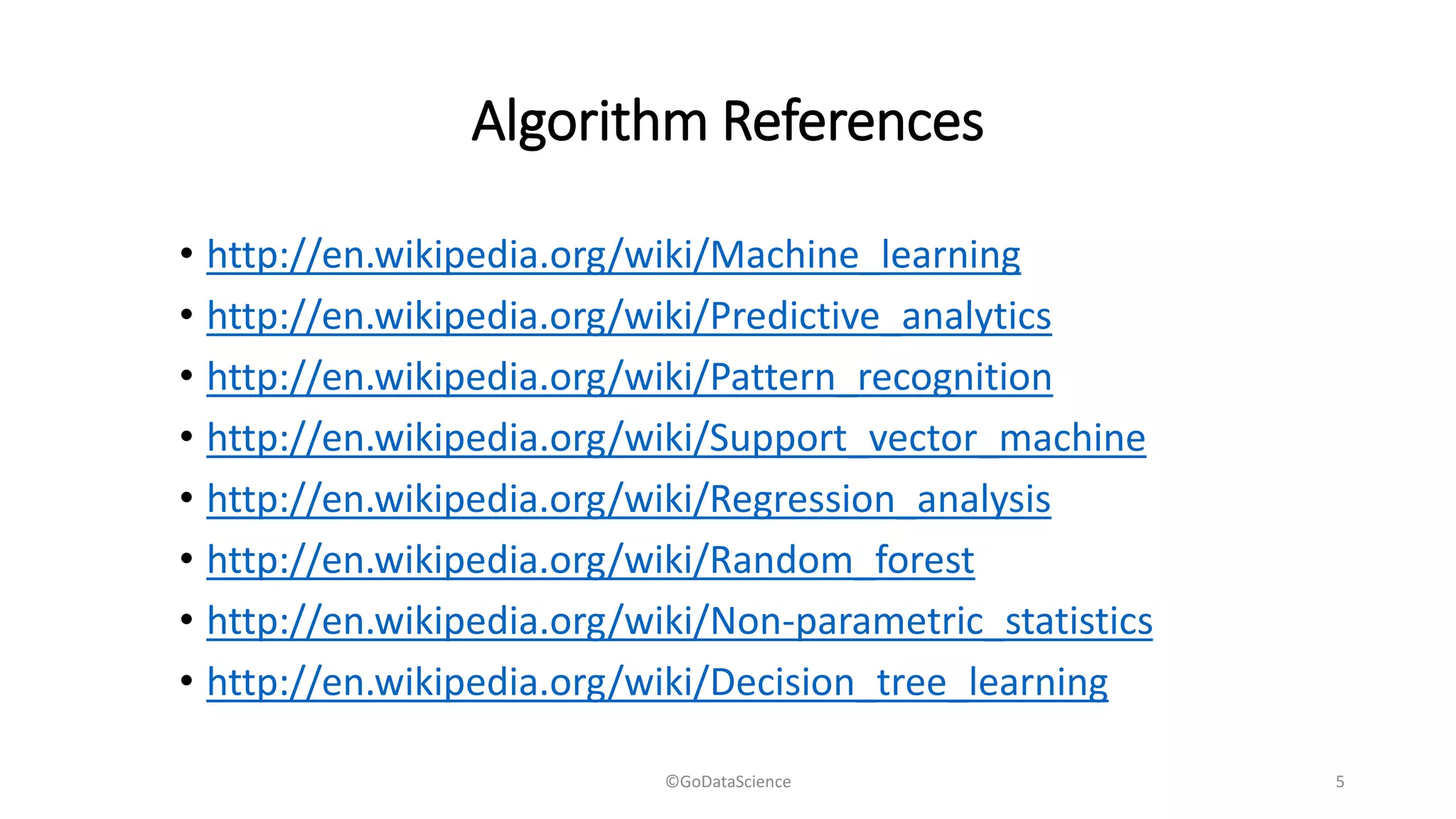
Algorithm References
• http://en.wikipedia.org/wiki/Machine_learning
• http://en.wikipedia.org/wiki/Predictive_analytics
• http://en.wikipedia.org/wiki/Pattern_recognition
• http://en.wikipedia.org/wiki/Support_vector_machine
• http://en.wikipedia.org/wiki/Regression_analysis
• http://en.wikipedia.org/wiki/Random_forest
• http://en.wikipedia.org/wiki/Non-parametric_statistics
• http://en.wikipedia.org/wiki/Decision_tree_learning
©GoDataScience 5
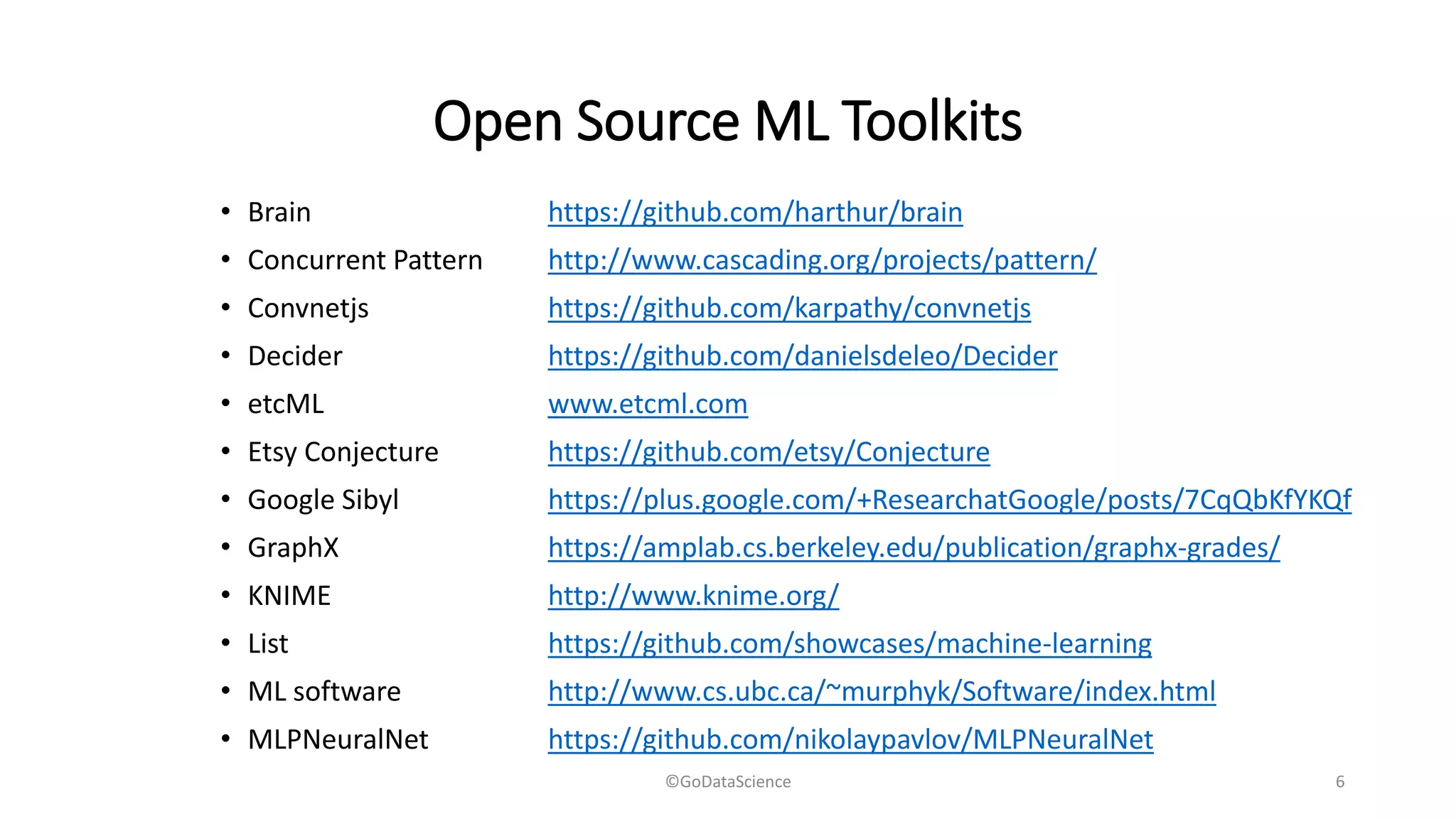
Open Source ML Toolkits
• Brain https://github.com/harthur/brain
• Concurrent Pattern http://www.cascading.org/projects/pattern/
• Convnetjs https://github.com/karpathy/convnetjs
• Decider https://github.com/danielsdeleo/Decider
• etcML www.etcml.com
• Etsy Conjecture https://github.com/etsy/Conjecture
• Google Sibyl https://plus.google.com/+ResearchatGoogle/posts/7CqQbKfYKQf
• GraphX https://amplab.cs.berkeley.edu/publication/graphx-grades/
• KNIME http://www.knime.org/
• List https://github.com/showcases/machine-learning
• ML software http://www.cs.ubc.ca/~murphyk/Software/index.html
• MLPNeuralNet https://github.com/nikolaypavlov/MLPNeuralNet
©GoDataScience 6
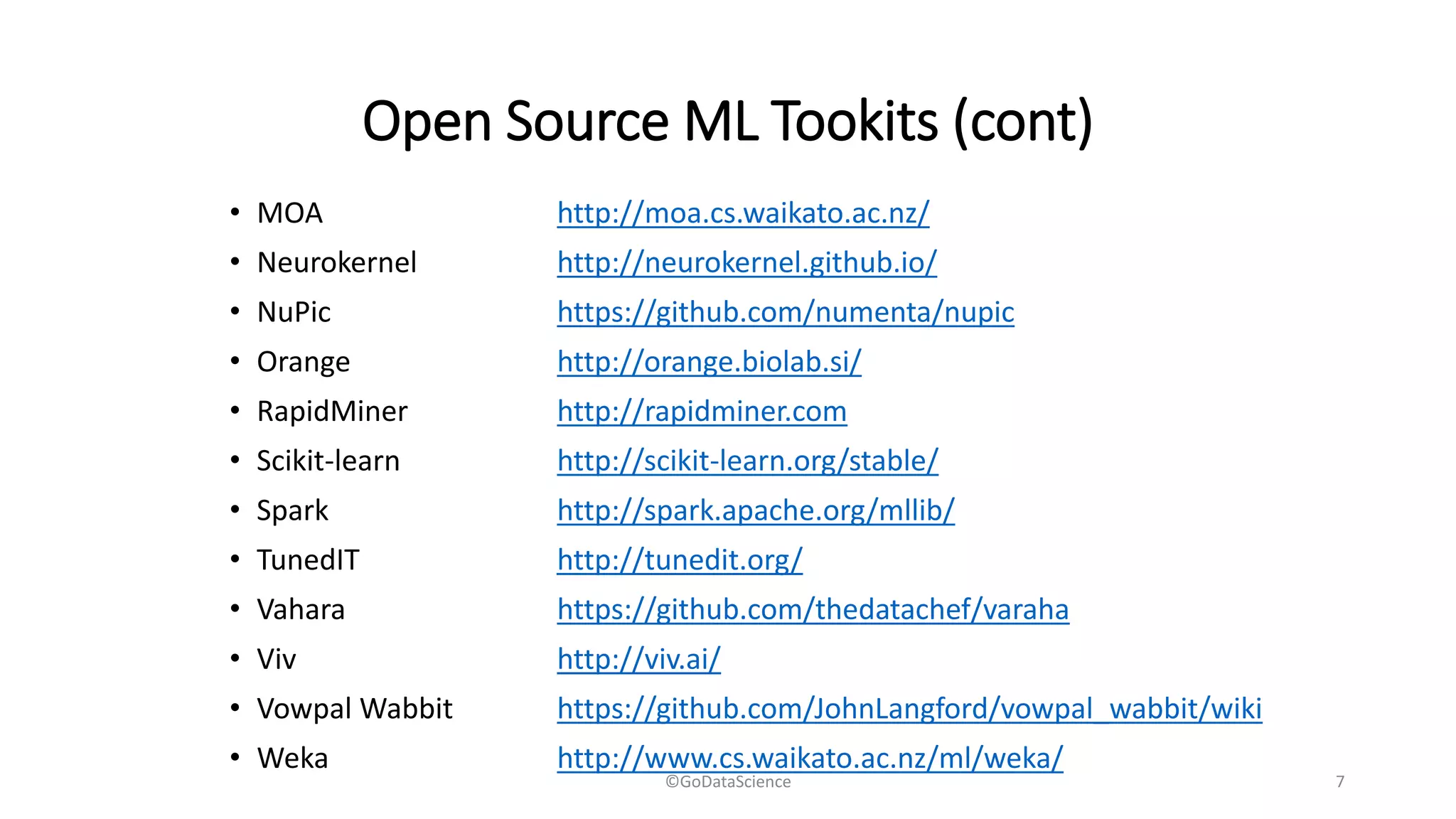
Open Source ML Tookits (cont)
• MOA http://moa.cs.waikato.ac.nz/
• Neurokernel http://neurokernel.github.io/
• NuPic https://github.com/numenta/nupic
• Orange http://orange.biolab.si/
• RapidMiner http://rapidminer.com
• Scikit-learn http://scikit-learn.org/stable/
• Spark http://spark.apache.org/mllib/
• TunedIT http://tunedit.org/
• Vahara https://github.com/thedatachef/varaha
• Viv http://viv.ai/
• Vowpal Wabbit https://github.com/JohnLangford/vowpal_wabbit/wiki
• Weka http://www.cs.waikato.ac.nz/ml/weka/
©GoDataScience 7
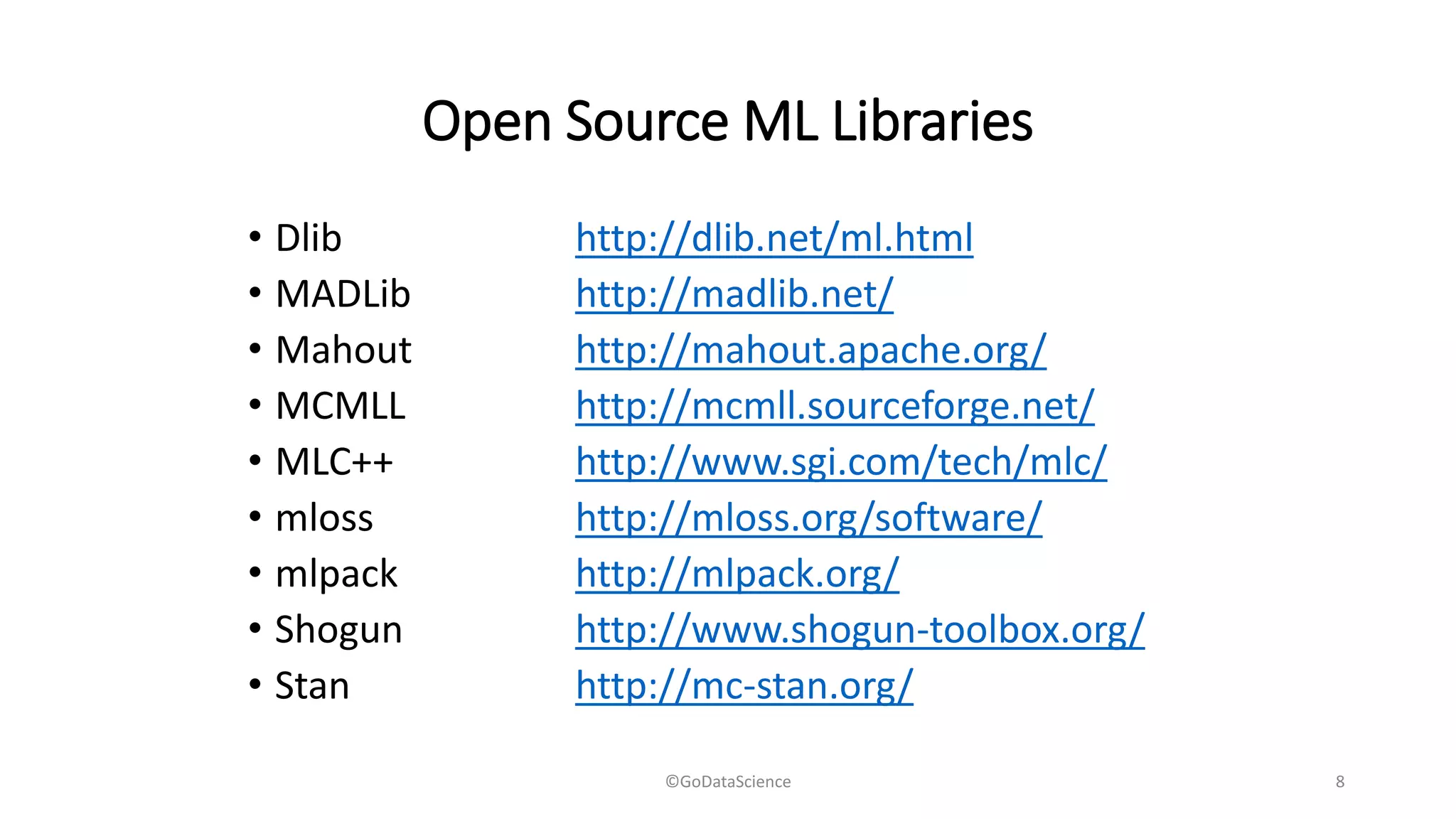
Open Source ML Libraries
• Dlib http://dlib.net/ml.html
• MADLib http://madlib.net/
• Mahout http://mahout.apache.org/
• MCMLL http://mcmll.sourceforge.net/
• MLC++ http://www.sgi.com/tech/mlc/
• mloss http://mloss.org/software/
• mlpack http://mlpack.org/
• Shogun http://www.shogun-toolbox.org/
• Stan http://mc-stan.org/
©GoDataScience 8
Proprietary ML Toolkits
• Ayasdi http://www.ayasdi.com/
• BigML https://bigml.com/
• H2O http://h2o.ai
• IBM Watson http://www.ibm.com/smarterplanet/us/en/ibmwatson/
• Matlab http://uk.mathworks.com/solutions/machine-learning/
• Nutonian http://www.nutonian.com/
• Prediction.io http://prediction.io/
• Rocketfuel http://rocketfuel.com/
• Skytree http://www.skytree.net/
• Trifacta http://www.trifacta.com/
• Wolfram Alpha http://www.wolframalpha.com/
• Wise.io http://www.wise.io/
• Yhat https://yhathq.com/
©GoDataScience 9
Other ML Resources
• MLaaS (Cloud based)
• Microsoft http://azure.microsoft.com/en-us/documentation/services/machine-learning/
• Google https://cloud.google.com/products/prediction-api/
• AWS https://aws.amazon.com/marketplace/search?page=1&searchTerms=machine+learning
• Conferences
• ICML
• NIPS
• ML Journals
• ML Journal http://www.springer.com/computer/ai/journal/10994
• JMLR http://jmlr.org/papers/
• Pattern Recognition http://www.jprr.org/index.php/jprr
• arXiv http://arxiv.org/list/stat.ML/recent
• gitXiv http://gitxiv.com
©GoDataScience 10
References – Machine Learning
• Abu-Mostafa, Yaser et al – Learning from Data, AML, 2012
• Alpaydın, Ethem - Introduction to Machine Learning, 2nd ed, MIT Press,
2009
• Bishop, Christopher - Pattern Recognition and Machine Learning,
Springer, 2007
• Domingos, Pedro - The Master Algorithm, Allen Lane, 2015
• Flach, Peter - Machine Learning: The Art and Science of Algorithms that
Make Sense of Data, Cambridge University Press, 2012
• Mitchell, Tom – Machine Learning, McGraw-Hill, 1997
• Murphy, Kevin - Machine Learning: A Probabilistic Perspective, MIT
Press, 2012
• Rickhert, Willi and Luis Coelho, Building Machine Learning Systems
with Python, Packt, 2013
• Witten, Ian et al - Data Mining, Practical Machine Learning Tools and
Techniques, 3rd ed, Morgan Kaufman, 2011
©GoDataScience 11
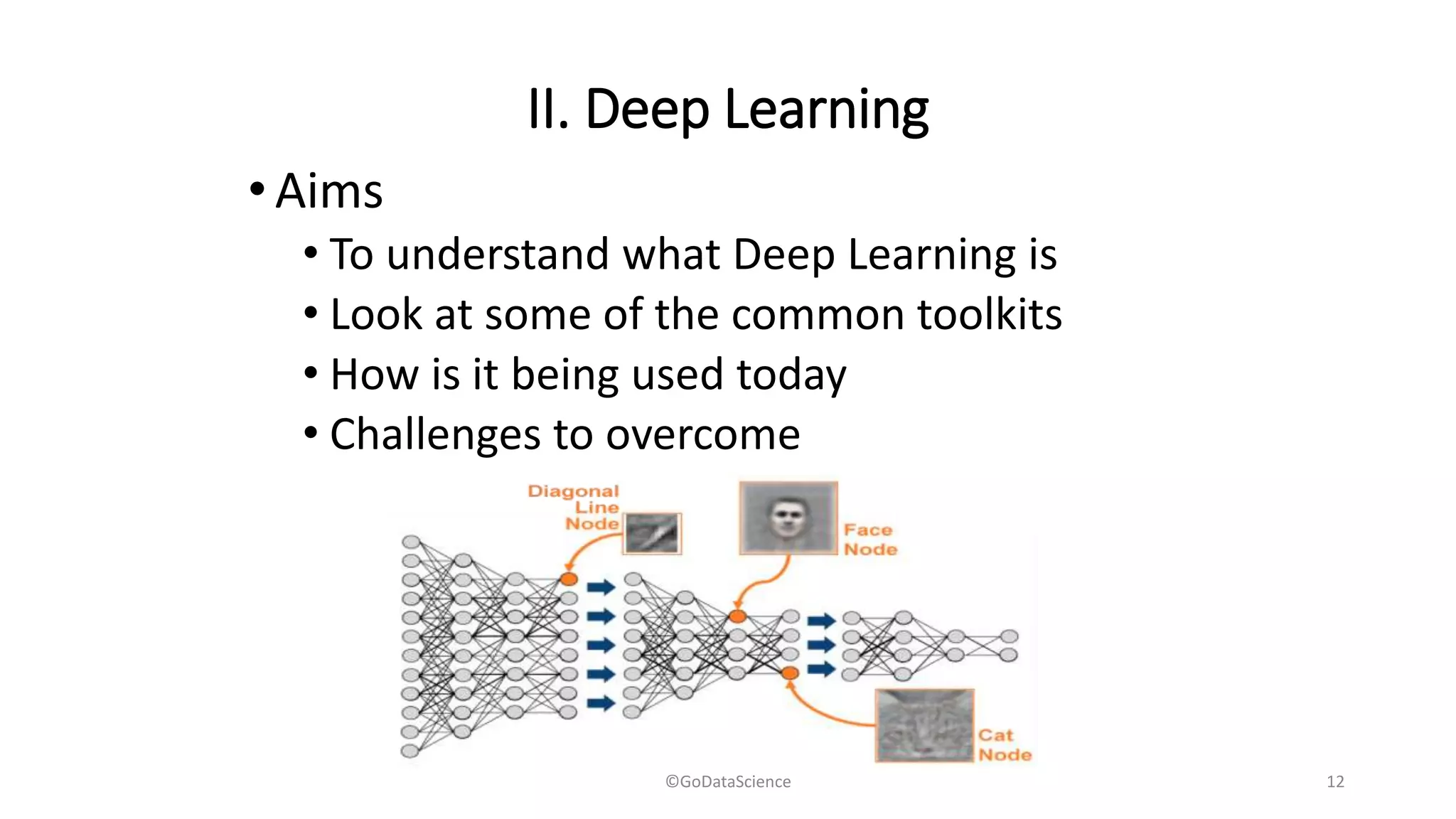
II. Deep Learning
•Aims
• To understand what Deep Learning is
• Look at some of the common toolkits
• How is it being used today
• Challenges to overcome
©GoDataScience 12
Deep Learning Overview
• Extract patterns and meaning from data
• Modeled after how the human brain processes data
• DL methods have gained notable successes in the field of speech and
image recognition as well as in cognitive computing
• Outperforming other algorithms
• They are essentially ANNs
• CNN = Convolutional Neural Networks (images)
• RNN = Recurrent Neural Networks (speech & text)
• LSTM = Long Short Term Memory
©GoDataScience 13
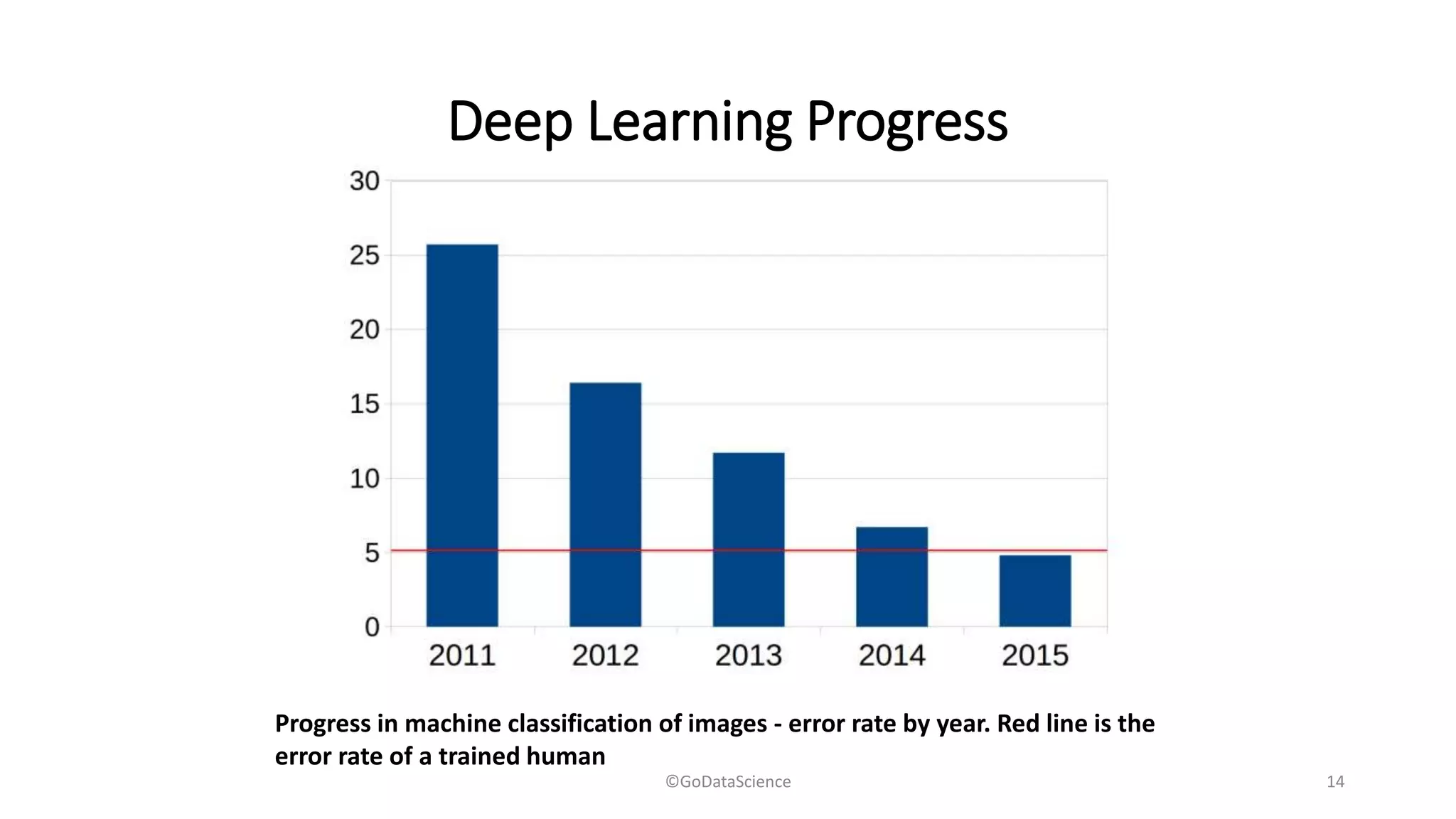
Deep Learning Progress
Progress in machine classification of images - error rate by year. Red line is the
error rate of a trained human
©GoDataScience 14
DL Resources
• People
• Yann LeCun http://yann.lecun.com/
• Geff Hinton http://www.cs.toronto.edu/~hinton/
• Yoshua Bengio
http://www.iro.umontreal.ca/~bengioy/yoshua_en/index.html
• Andrew Ng http://cs.stanford.edu/people/ang/
• Quoc Le http://cs.stanford.edu/~quocle/
• Jurgen Schmidhuber http://people.idsia.ch/~juergen/
• Blogs & Communities
• FastML http://fastml.com/
• Chris Olah http://colah.github.io/
• Andrej Karparthy http://karpathy.github.io
• DeepLearning.net http://deeplearning.net/
©GoDataScience 15
DL Open Source Packages
• Caffe http://caffe.berkeleyvision.org
• CUDA Convnet https://code.google.com/p/cuda-convnet/
• cuDNN https://developer.nvidia.com/cuDNN
• Deeplearning4j http://deeplearning4j.org/
• PyBrain http://pybrain.org/
• PyLearn2 http://deeplearning.net/software/pylearn2/
• SINGA http://singa.incubator.apache.org
• TensorFlow http://tensorflow.org
• Theano http://deeplearning.net/software/theano/
• Torch http://torch.ch/
• In fact, Google, IBM, Samsung, Microsoft and Baidu have open
sourced their machine learning frameworks all within the space of
the last two weeks
©GoDataScience 16
Deep Learning Companies
• AlchemyAPI http://www.alchemyapi.com/
• Clarifai http://www.clarifai.com/
• Deepmind www.google.com
• Ersatz Labs http://www.ersatzlabs.com/
• Memkite http://memkite.com/
• Nervana http://www.nervanasys.com/
• Numenta http://numenta.org/
• Nvidia https://developer.nvidia.com/deep-learning
• Skymind http://www.skymind.io/
• Vicarious http://vicarious.com/
©GoDataScience 17
References – Deep Learning
• Bengio, Yoshua et al – Deep Learning, An MIT Press book in
preparation http://goodfeli.github.io/dlbook/
• Buduma, Nikhil – Fundamentals of Deep Learning, O’Reilly, 2015
• Gibson, A and J. Patterson - Deep Learning: A Practitioner's Approach,
O’Reilly, 2015
• Maters, Timothy, Deep Belief Nets in C++ and CUDA C, Vol. 1,
CreateSpace, 2015
• Maters, Timothy, Deep Belief Nets in C++ and CUDA C, Vol. 2,
CreateSpace, 2015
©GoDataScience 18
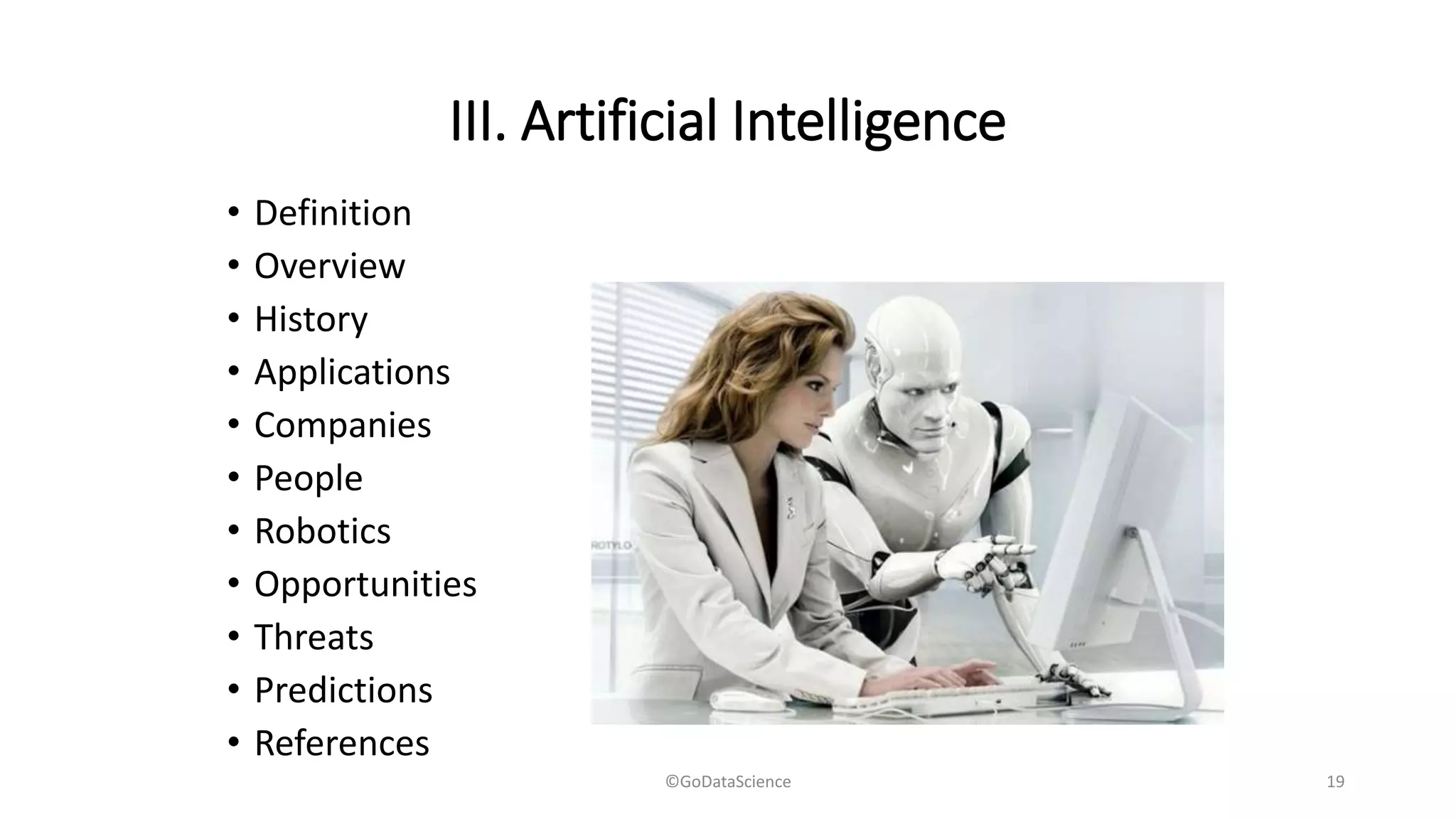
III. Artificial Intelligence
• Definition
• Overview
• History
• Applications
• Companies
• People
• Robotics
• Opportunities
• Threats
• Predictions
• References
©GoDataScience 19
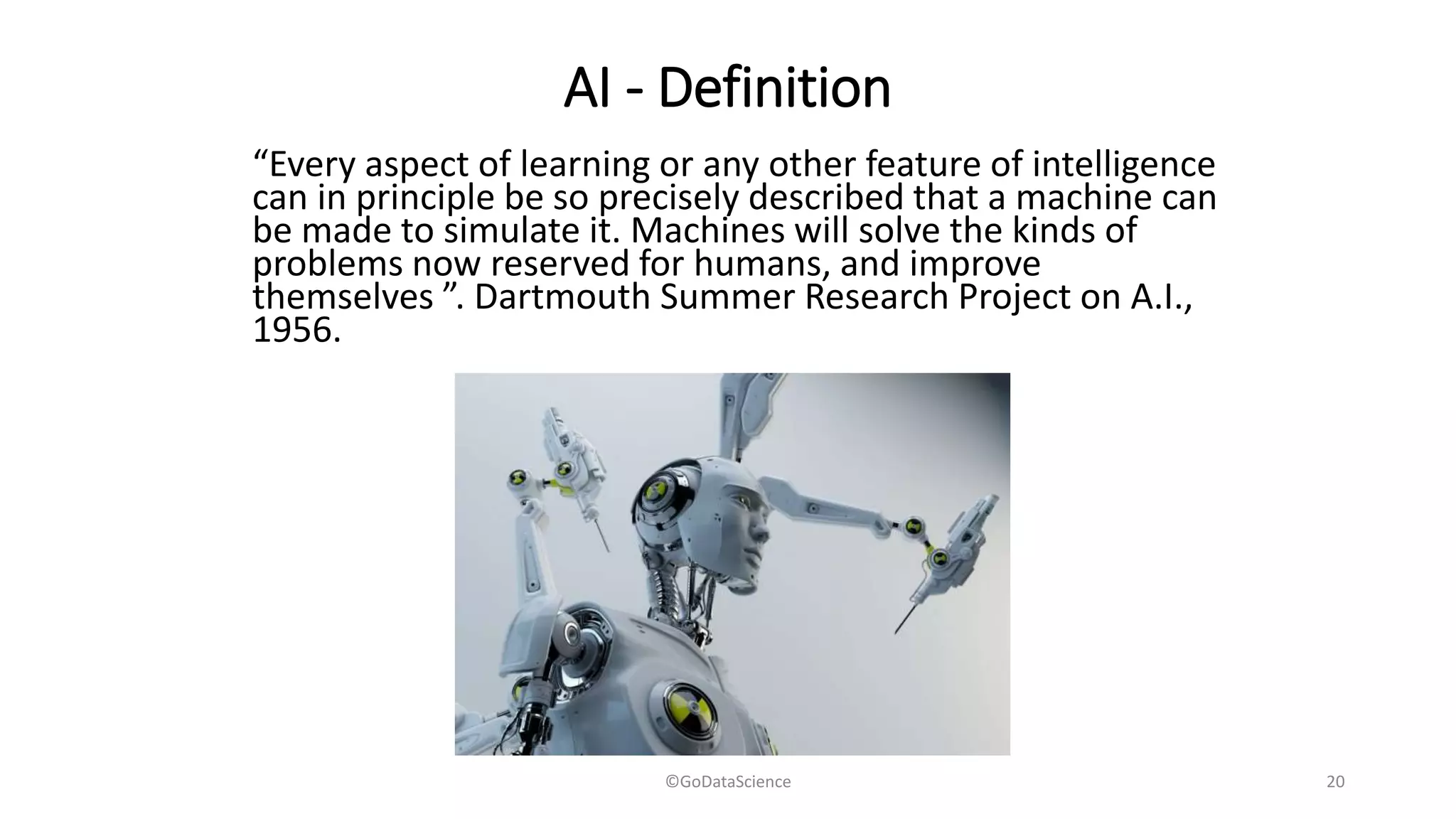
AI - Definition
“Every aspect of learning or any other feature of intelligence
can in principle be so precisely described that a machine can
be made to simulate it. Machines will solve the kinds of
problems now reserved for humans, and improve
themselves ”. Dartmouth Summer Research Project on A.I.,
1956.
©GoDataScience 20
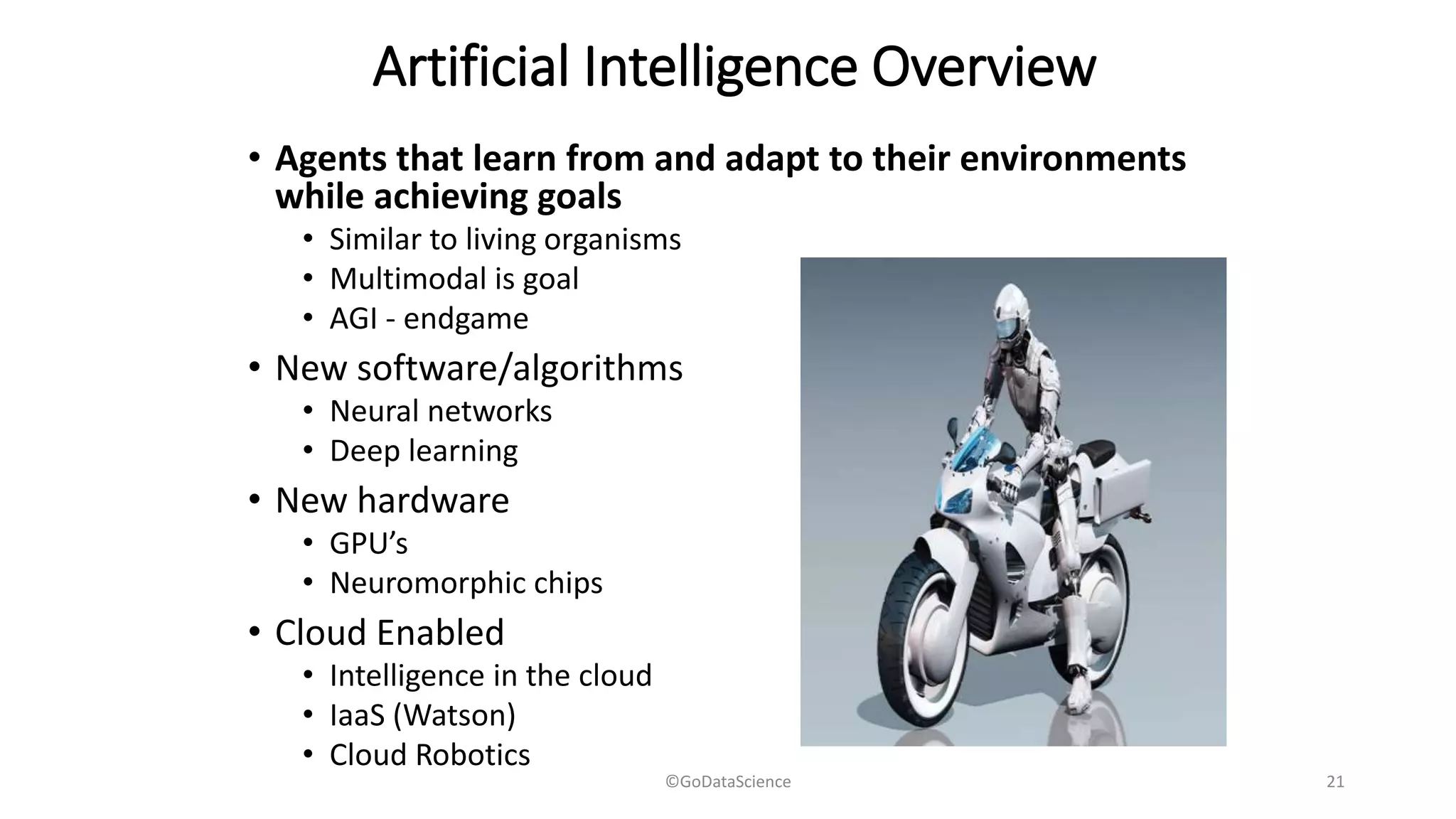
Artificial Intelligence Overview
• Agents that learn from and adapt to their environments
while achieving goals
• Similar to living organisms
• Multimodal is goal
• AGI - endgame
• New software/algorithms
• Neural networks
• Deep learning
• New hardware
• GPU’s
• Neuromorphic chips
• Cloud Enabled
• Intelligence in the cloud
• IaaS (Watson)
• Cloud Robotics
©GoDataScience 21
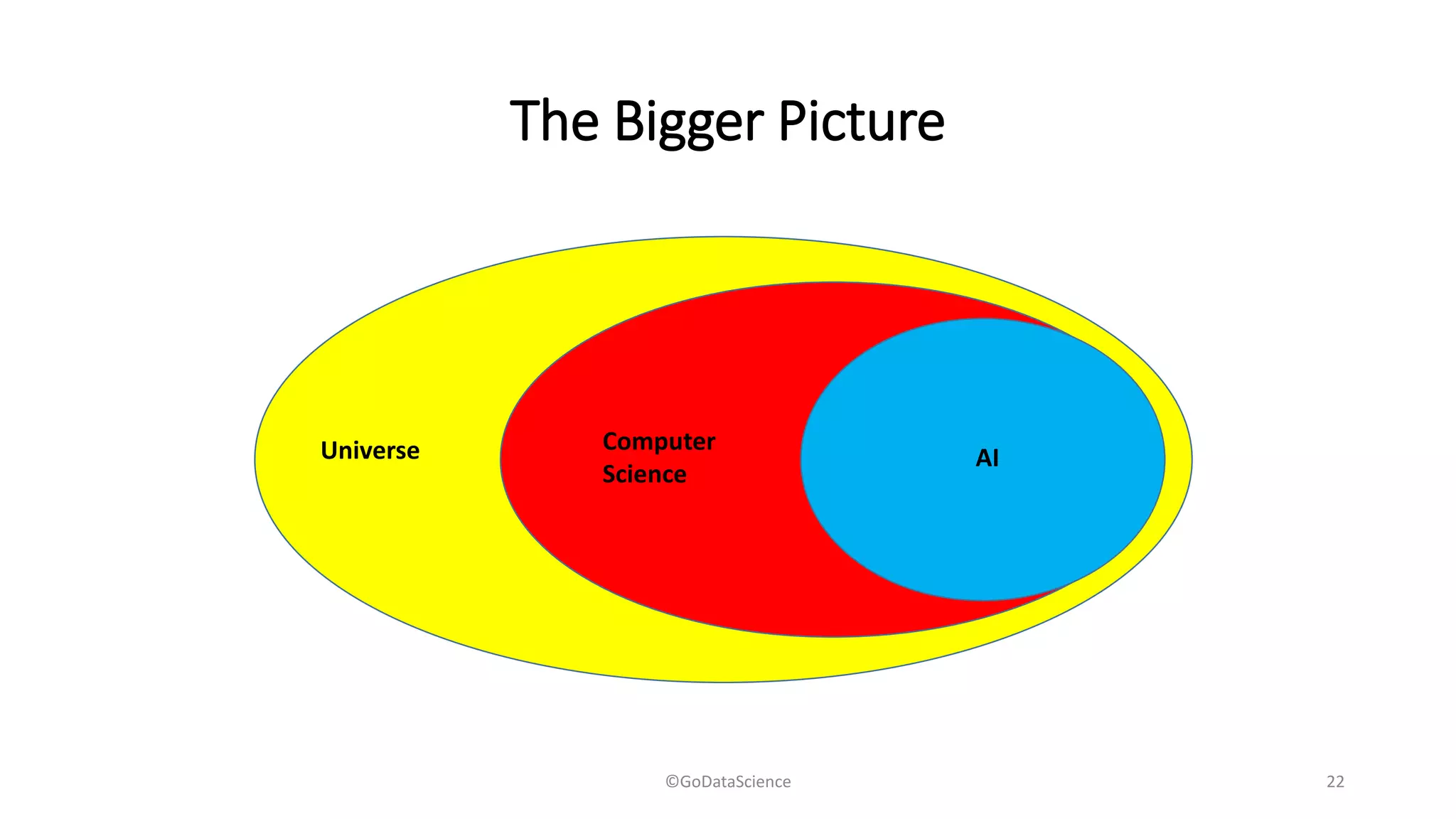
The Bigger Picture
Universe Computer
Science
AI
©GoDataScience 22
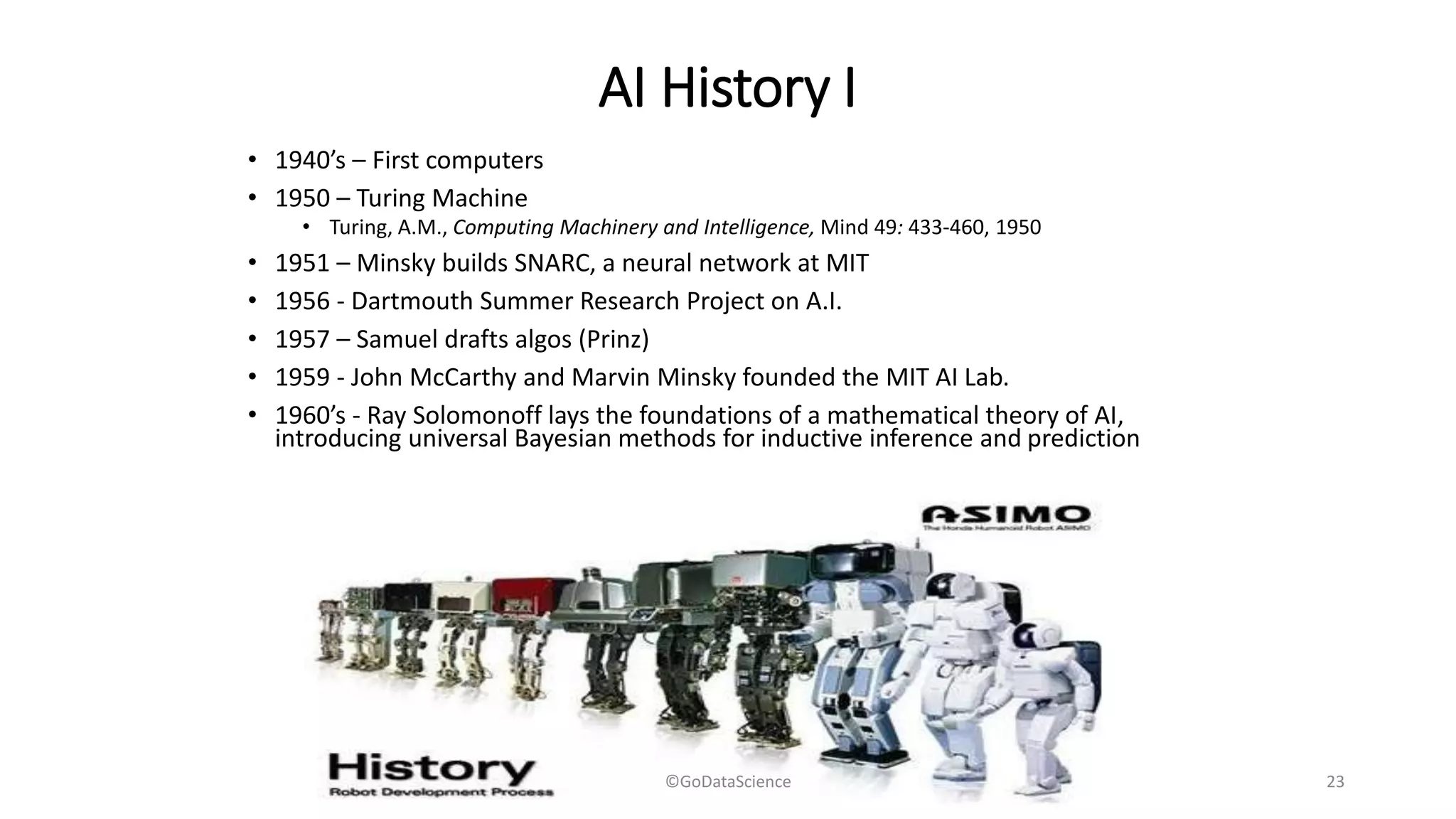
AI History I
• 1940’s – First computers
• 1950 – Turing Machine
• Turing, A.M., Computing Machinery and Intelligence, Mind 49: 433-460, 1950
• 1951 – Minsky builds SNARC, a neural network at MIT
• 1956 - Dartmouth Summer Research Project on A.I.
• 1957 – Samuel drafts algos (Prinz)
• 1959 - John McCarthy and Marvin Minsky founded the MIT AI Lab.
• 1960’s - Ray Solomonoff lays the foundations of a mathematical theory of AI,
introducing universal Bayesian methods for inductive inference and prediction
©GoDataScience 23
AI History II
• 1969 - Shakey the robot at Stanford
• 1970s – AI Winter I
• 1970s - Natural Language Processing (Symbolic)
• 1979 – Music programmes by Kurzweil and Lucas
• 1980 – First AAAI conference
• 1981 – Connection Machine (parallel AI)
• 1980s - Rule Based Expert Systems (Symbolic)
• 1985 – Back propagation
• 1987 – “The Society of Mind” by Marvin Minsky published
• 1990s - AI Winter II (Narrow AI)
• 1994 – First self-driving car road test – in Paris
• 1997 - Deep Blue beats Gary Kasparov
©GoDataScience 24
AI History III
• 2004 - DARPA introduces the DARPA Grand Challenge requiring
competitors to produce autonomous vehicles for prize money
• 2007 - Checkers is solved by a team of researchers at the
University of Alberta
• 2009 - Google builds self driving car
• 2010s - Statistical Machine Learning, algorithms that learn from
raw data
• 2011 - Watson beats Ken Jennings and Brad Rutter on Jeopardy
• 2012+ Deep Learning (DL); Sub-Symbolic
• 2013 - E.U. Human Brain Project (model brain by 2023)
• 2014 – Human vision surpassed by DL systems at Google, Baidu,
Facebook
• 2015 – Machine dreaming (Google and Facebook NN’s)
©GoDataScience 25
AI Applications
• Finance
• Asset allocation
• Algo trading
• Fraud detection
• Cybersecurity
• eCommerce
• Search
• Manufacturing
• Medicine
• Law
• Business Analytics
• Ad serving
• Recommendation engines
• Smart homes
• Robotics
• Industry
• Consumer
• Space
• Military
• UAV (cars, drones etc.)
• Scientific discovery
• Mathematical theorems
• Route Planning
• Virtual Assistants
• Personalisation
• Compose music
• Write stories
©GoDataScience 26
AI Applications (cont)
• Computer vision
• Speech recognition
• NLP
• Translation
• Call centres
• Rescue operations
• Policing
• Military
• Political
• National security
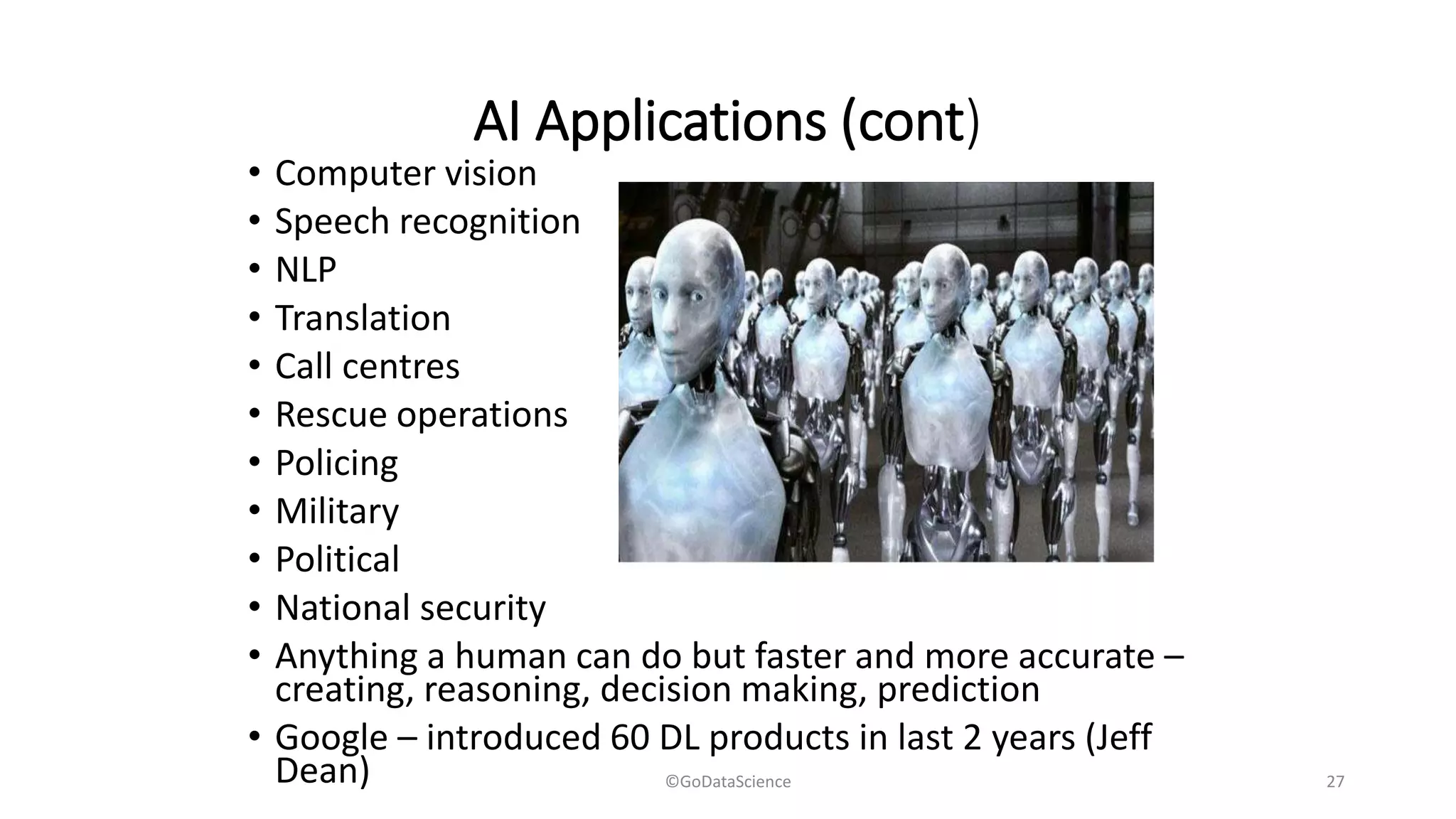
• Anything a human can do but faster and more accurate –
creating, reasoning, decision making, prediction
• Google – introduced 60 DL products in last 2 years (Jeff
Dean) ©GoDataScience 27
AI Applications - Examples
• AI can do all these things already today:
• Translating an article from Chinese to English
• Translating speech from Chinese to English, in real time
• Identifying all the chairs/faces in an image
• Transcribing a conversation at a party (with background noise)
• Folding your laundry (robotics)
• Proving new theorems (ATP)
• Automatically replying to your email, and scheduling
©GoDataScience 28
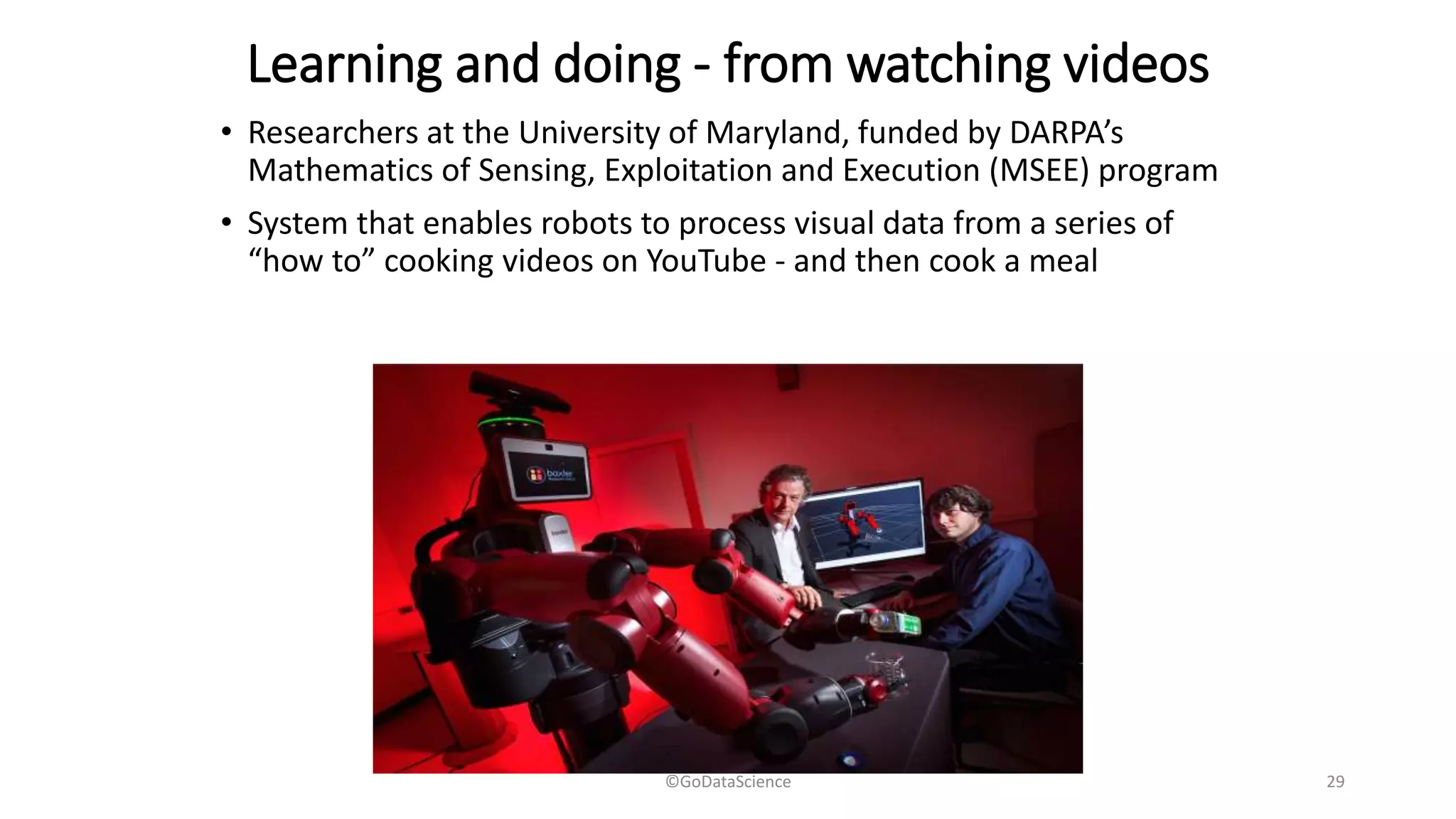
Learning and doing - from watching videos
• Researchers at the University of Maryland, funded by DARPA’s
Mathematics of Sensing, Exploitation and Execution (MSEE) program
• System that enables robots to process visual data from a series of
“how to” cooking videos on YouTube - and then cook a meal
©GoDataScience 29
AI Performance evaluation
• Optimal: it is not possible to perform better
• Checkers, Rubik’s cube, some poker
• Strong super-human: performs better than all
humans
• Chess, scrabble, question-answer
• Super-human: performs better than most humans
• Backgammon, cars, crosswords
• Par-human: performs similarly to most humans
• Go, Image recognition, OCR
• Sub-human: performs worse than most humans
• Translation, speech recognition, handwriting
©GoDataScience 30
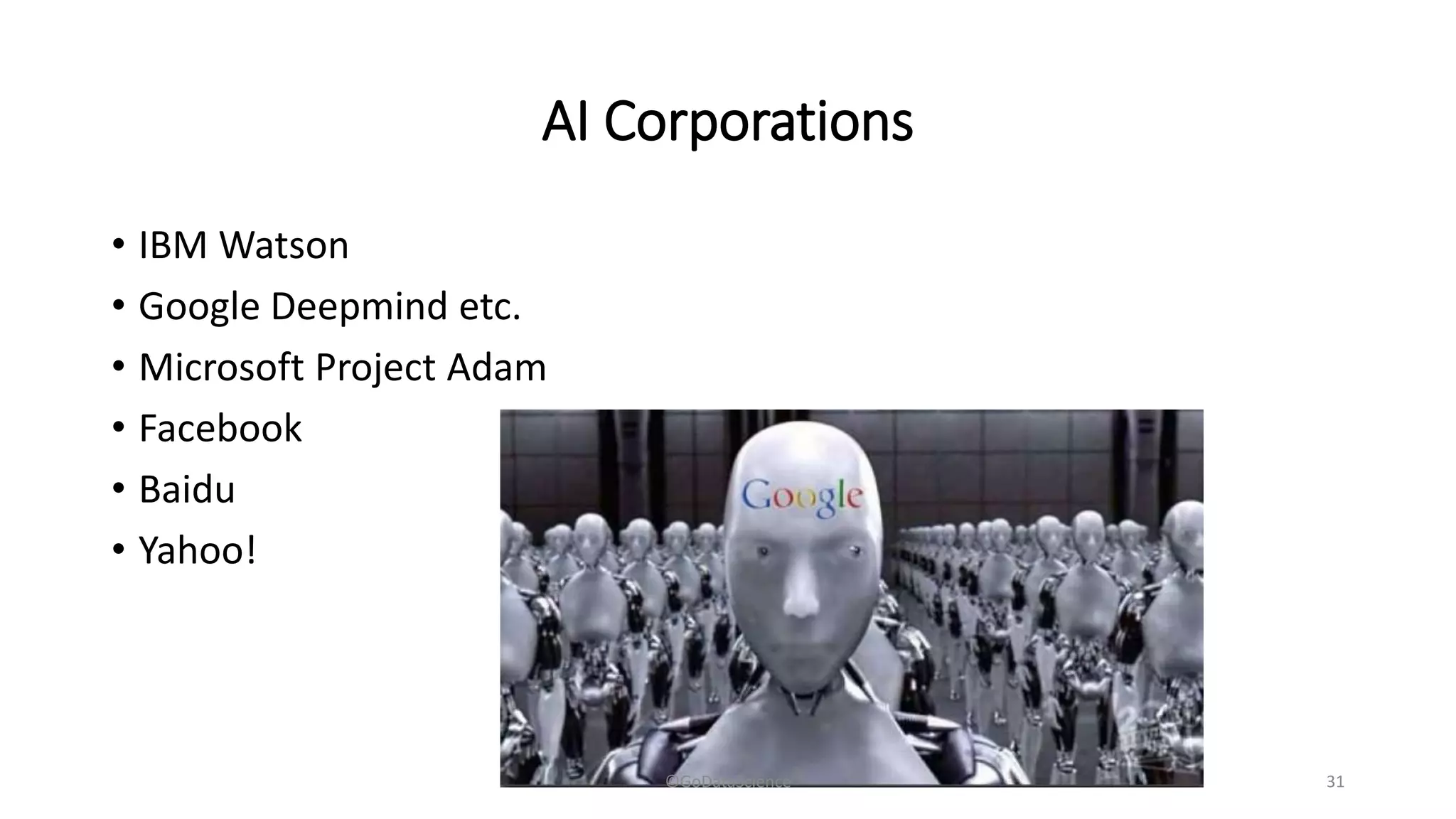
AI Corporations
• IBM Watson
• Google Deepmind etc.
• Microsoft Project Adam
• Facebook
• Baidu
• Yahoo!
©GoDataScience 31
AI Startups
• Numenta
• OpenCog
• Vicarious
• Clarafai
• Sentient
• Nurture
• Wit.ai
• Cortical.io
• Viv.ai
Number is growing rapidly (daily?)
©GoDataScience 32
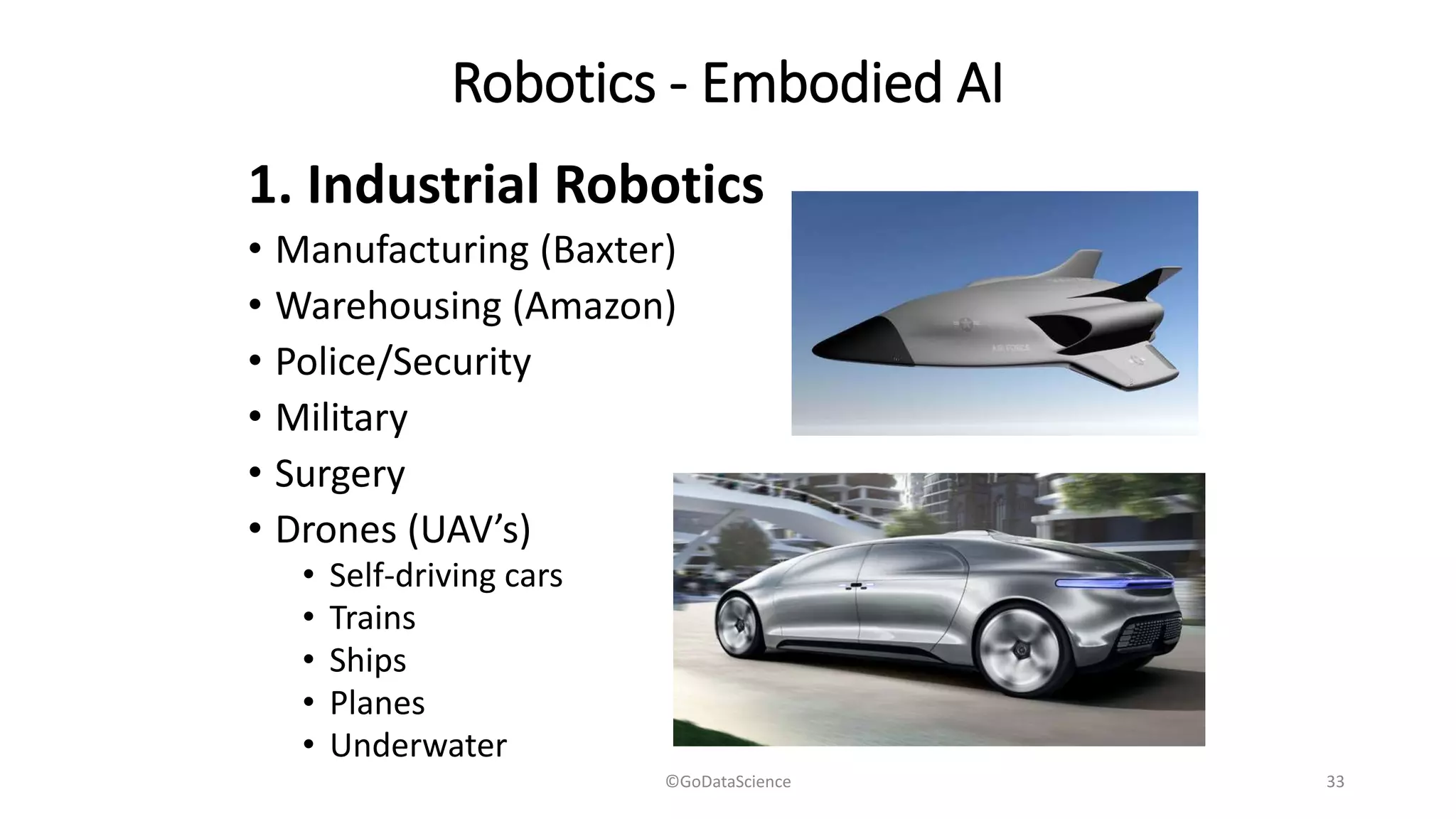
Robotics - Embodied AI
1. Industrial Robotics
• Manufacturing (Baxter)
• Warehousing (Amazon)
• Police/Security
• Military
• Surgery
• Drones (UAV’s)
• Self-driving cars
• Trains
• Ships
• Planes
• Underwater
©GoDataScience 33
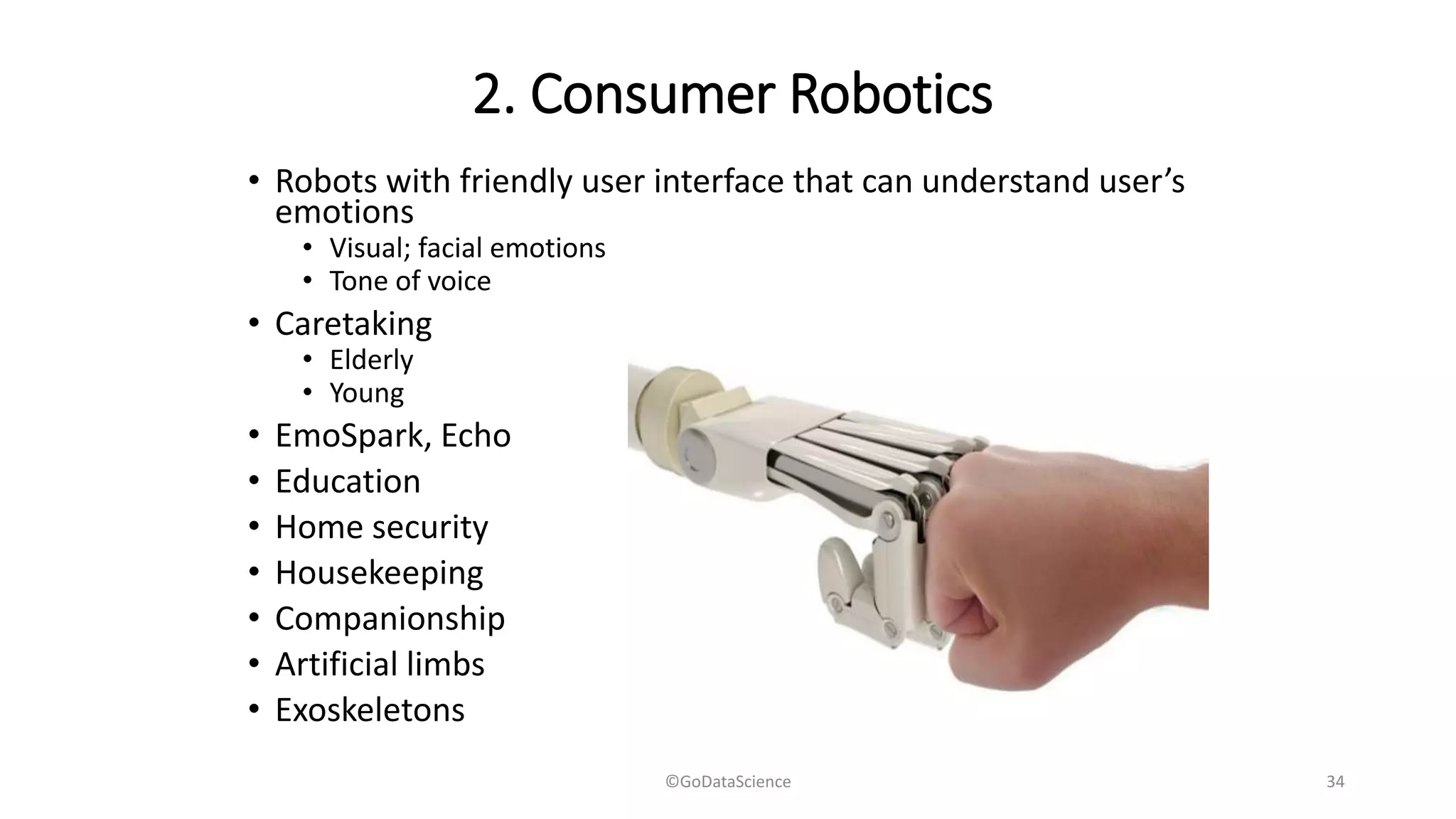
2. Consumer Robotics
• Robots with friendly user interface that can understand user’s
emotions
• Visual; facial emotions
• Tone of voice
• Caretaking
• Elderly
• Young
• EmoSpark, Echo
• Education
• Home security
• Housekeeping
• Companionship
• Artificial limbs
• Exoskeletons
©GoDataScience 34
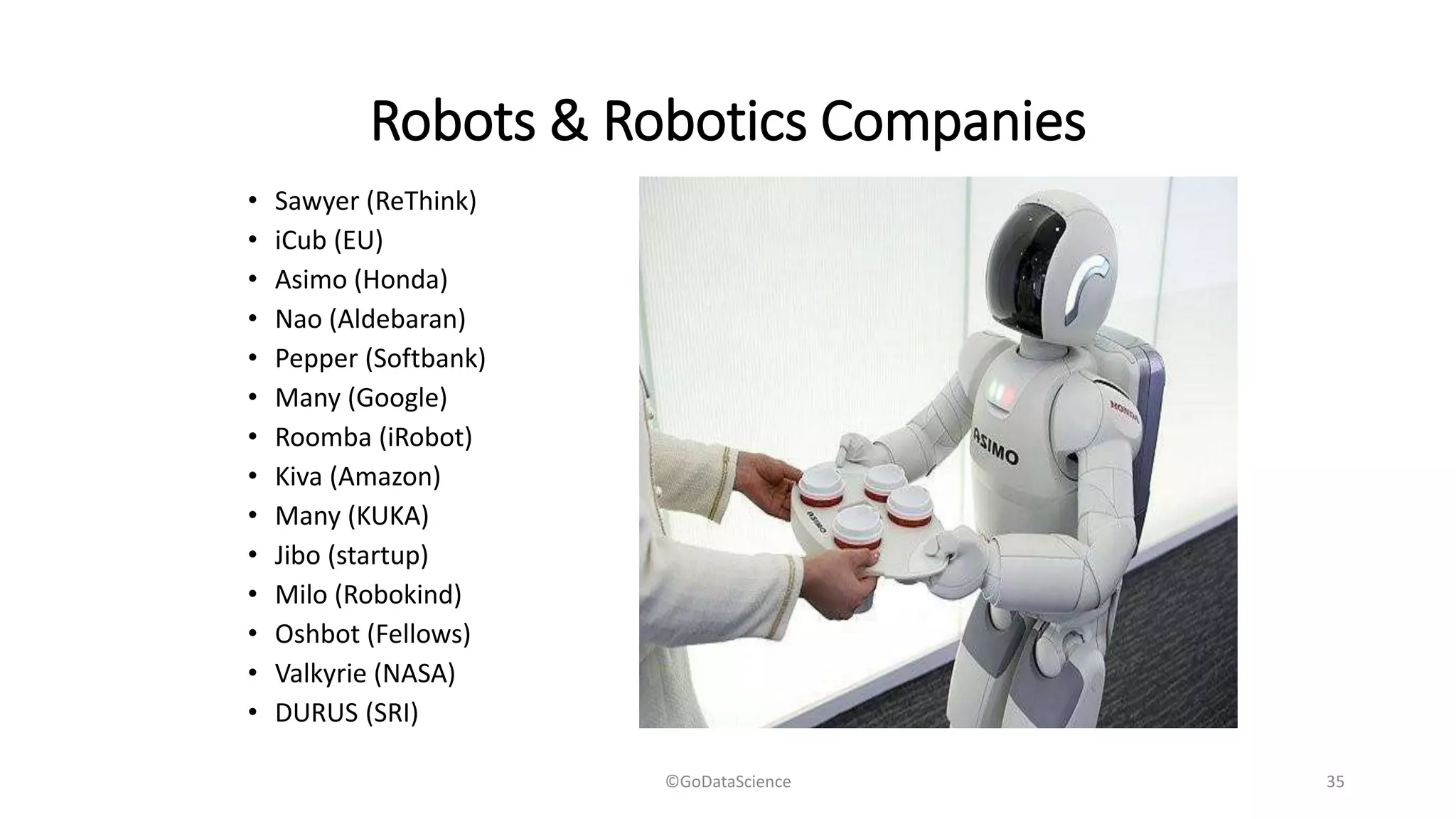
Robots & Robotics Companies
• Sawyer (ReThink)
• iCub (EU)
• Asimo (Honda)
• Nao (Aldebaran)
• Pepper (Softbank)
• Many (Google)
• Roomba (iRobot)
• Kiva (Amazon)
• Many (KUKA)
• Jibo (startup)
• Milo (Robokind)
• Oshbot (Fellows)
• Valkyrie (NASA)
• DURUS (SRI)
©GoDataScience 35
AI & Robotics Websites
• Jobs, News, Trade
• Robotics Business review
• AI Hub
• AZoRobotics
• Robohub
• Robotics News
• I-Programmer
©GoDataScience 36
Opportunities
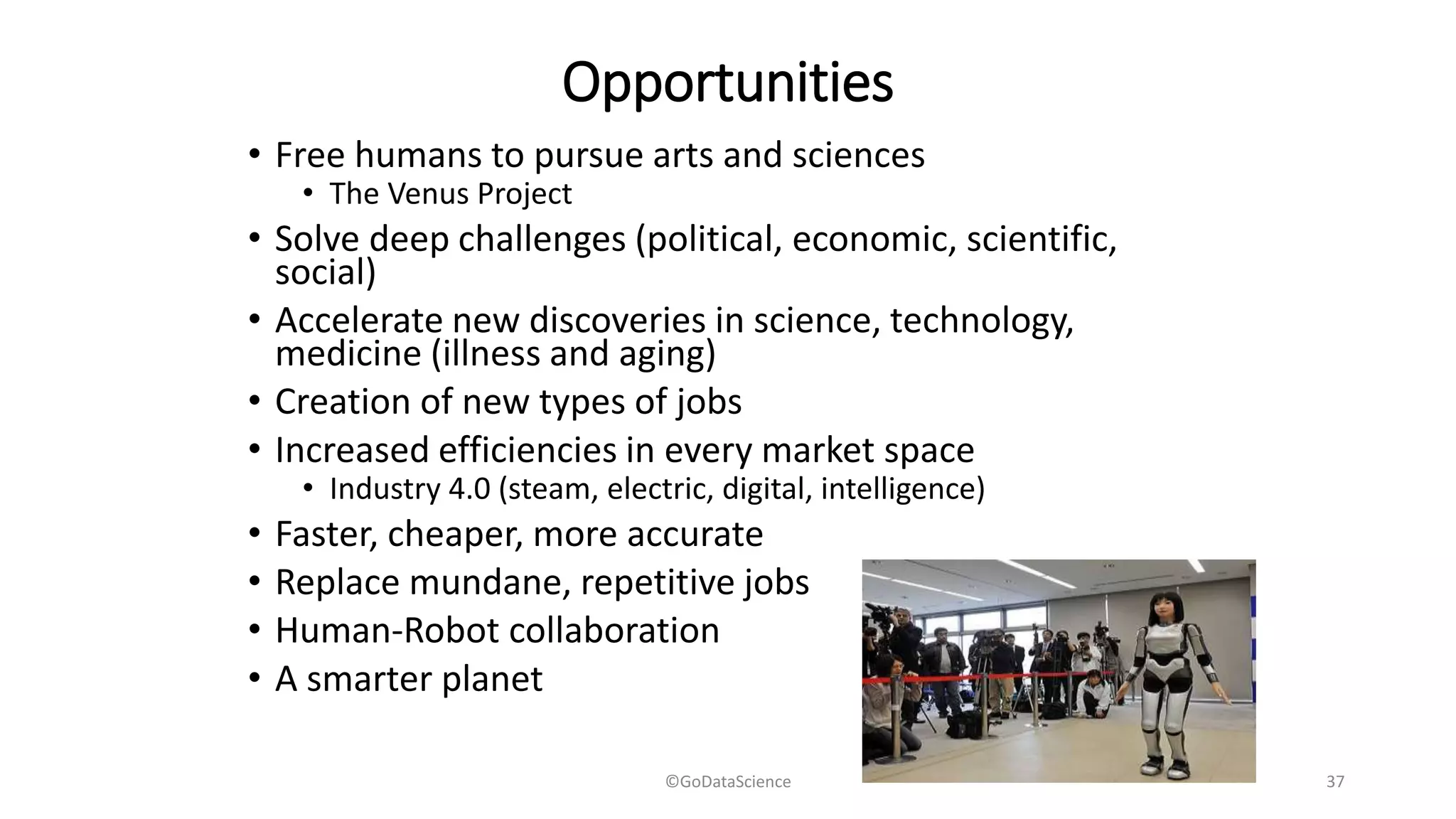
• Free humans to pursue arts and sciences
• The Venus Project
• Solve deep challenges (political, economic, scientific,
social)
• Accelerate new discoveries in science, technology,
medicine (illness and aging)
• Creation of new types of jobs
• Increased efficiencies in every market space
• Industry 4.0 (steam, electric, digital, intelligence)
• Faster, cheaper, more accurate
• Replace mundane, repetitive jobs
• Human-Robot collaboration
• A smarter planet
©GoDataScience 37
Threats
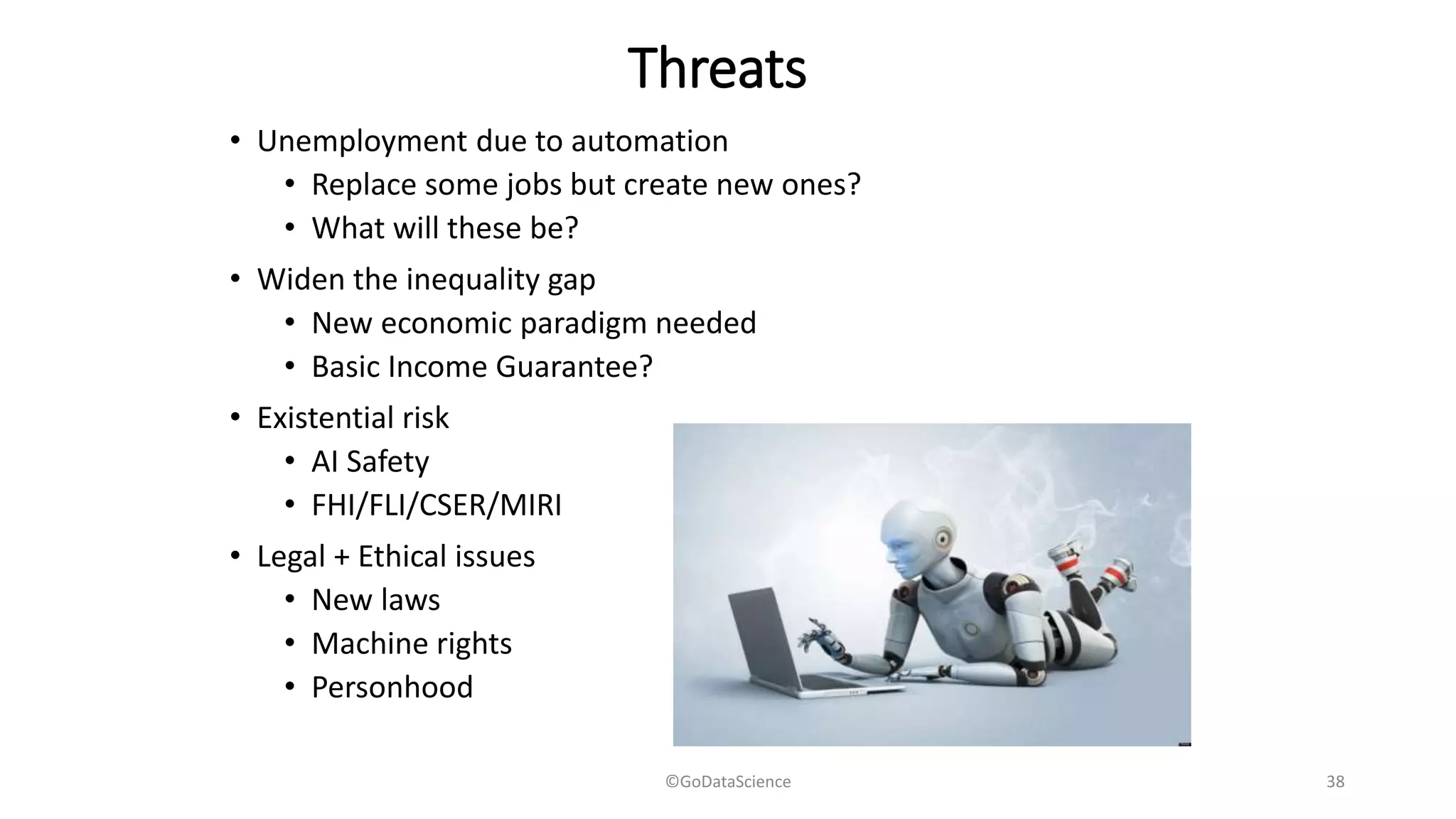
• Unemployment due to automation
• Replace some jobs but create new ones?
• What will these be?
• Widen the inequality gap
• New economic paradigm needed
• Basic Income Guarantee?
• Existential risk
• AI Safety
• FHI/FLI/CSER/MIRI
• Legal + Ethical issues
• New laws
• Machine rights
• Personhood
©GoDataScience 38
AI Safety - Oversight
• BARA = British Automation and Robot Association
• EU Robotics
• RIA = Robotic Industries Association
• IFR = International Federation of Robotics
• ISO – Robotics
©GoDataScience 39
Organisations - xRisk
• FHI = Future of Humanity Institute
• Oxford
• FLI = Future of Life Institute
• MIT
• $7million grants awarded in June
• MIRI = Machine Intelligence Research Institute
• San Francisco
• CSER = Center for Science and Existential Risk
• Cambridge
• AI Safety Facebook Group
©GoDataScience 40
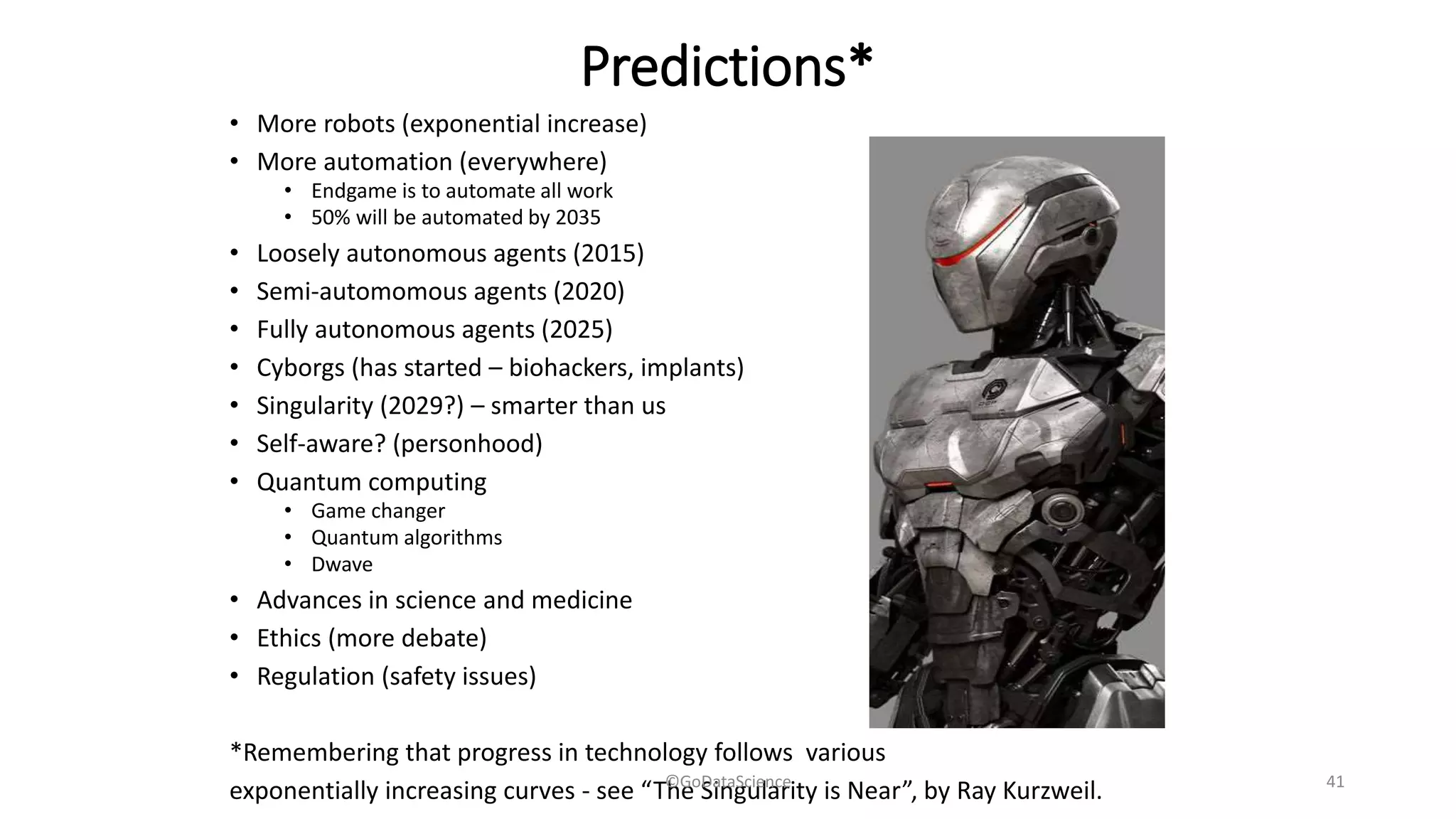
Predictions*
• More robots (exponential increase)
• More automation (everywhere)
• Endgame is to automate all work
• 50% will be automated by 2035
• Loosely autonomous agents (2015)
• Semi-automomous agents (2020)
• Fully autonomous agents (2025)
• Cyborgs (has started – biohackers, implants)
• Singularity (2029?) – smarter than us
• Self-aware? (personhood)
• Quantum computing
• Game changer
• Quantum algorithms
• Dwave
• Advances in science and medicine
• Ethics (more debate)
• Regulation (safety issues)
*Remembering that progress in technology follows various
exponentially increasing curves - see “The Singularity is Near”, by Ray Kurzweil.©GoDataScience 41
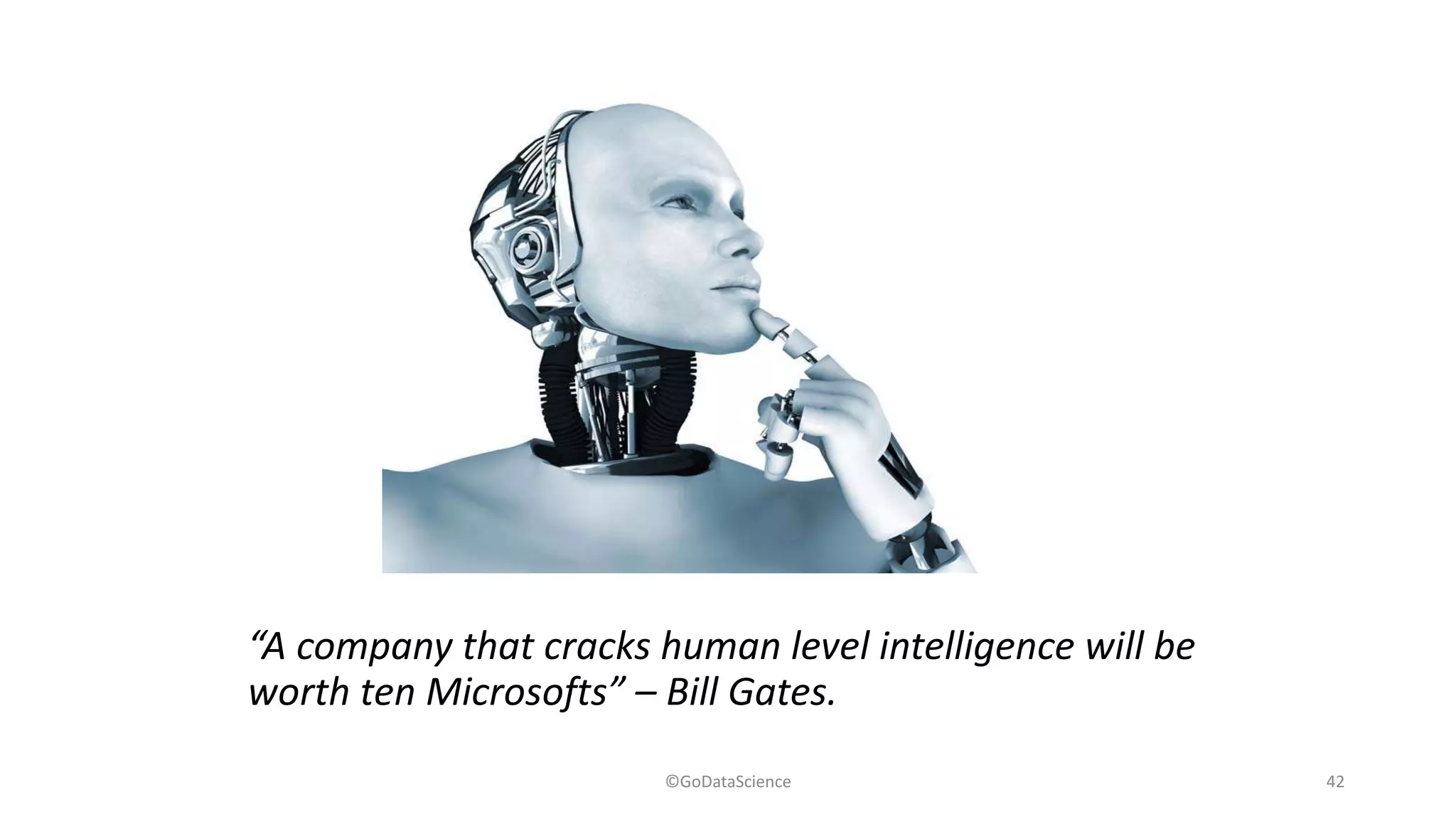
“A company that cracks human level intelligence will be
worth ten Microsofts” – Bill Gates.
©GoDataScience 42
References
• Barrat, James, Our Final Invention, St. Martin's Griffin, 2014
• Brynjolfsson, Erik and Andrew McAfee, The Second Machine
Age, W.W. Norton & Co., 2014
• Ford, Martin, Rise of the Robots: Technology and the Threat
of a Jobless Future, Basic Books, 2015
• Goertzel, Ben et al - Engineering General Intelligence, Part 1,
Atlantis Press, 2014
• Hawkins, Jeff – On Intelligence, Owl, 2005
• Kaku, Michio, The Future of the Mind, Doubleday, 2014
• Kaplan, Jerry – Humans Need Not Apply, Yale University Press,
2015
©GoDataScience 43
References (cont)
• Kurzweil, Ray, The Singularity is Near, Penguin Books, 2006
• Kurzweil, Ray, How to Create a Mind, Penguin Books, 2013
• Marcus, G. and J. Freeman (eds) - The Future of the Brain: Essays by the
World's Leading Neuroscientists, Princeton, 2014
• Markoff, John – Machines of Loving Grace, Ecco Press, 2015
• Nowak, Peter, Humans 3.0: The Upgrading of the Species, Lyons Press,
2015
• Russell and Norvig, Artificial Intelligence, A Modern Approach, Pearson,
2009
• Shanahan, Murray – The Technological Singularity, MIT Press, 2015
©GoDataScience 44
Thanks for listening!!
www.godatascience.io
@godatascience
@pmzepto
@russmiles

Applying Machine Learning and Artificial Intelligence to Business

  • 1.
    Applying Machine Learningand AI for Business • www.GoDataScience.io • Peter Morgan – Chief Data Scientist • Russell Miles – CEO • @godatascience • @pmzepto • @russmiles ©GoDataScience 1
  • 2.
    I. ML -Overview • Definition – “Field of study that gives computers the ability to learn without being explicitly programmed” - Arthur Samuel, 1959 • Used for fitting lines/hyperplanes (regression), finding models, classifying objects, hypothesis testing, etc. • Three main categories of learning • Supervised (labelled data, classifying) • Unsupervised (unlabelled data, clustering) • Reinforcement learning (reward/penalty) ©GoDataScience 2
  • 3.
    ML Algorithm Classes •Regression, e.g., linear, logistic • Decision Trees, e.g., CART • Ensemble, e.g., Random Forests • Bayesian, e.g., Naïve Bayes • Artificial Neural Networks, e.g., RNN • Instance, e.g., k-Nearest Neighbour (kNN) • Support Vector Machines (SVM) • Evolutionary, e.g., genetic (mimics natural selection) • Dimensionality Reduction, e.g., PCA • Clustering, e.g., K-means • Reinforcement, e.g., Q-learning • List of ML algos https://en.wikipedia.org/wiki/List_of_machine_learning_concepts ©GoDataScience 3
  • 4.
    ML Applications • Speechrecognition • Object recognition and tracking • Spam filtering • Self-driving cars • Recommendation engines • Fraud detection • Search engines, e.g., PageRank • Ad placement • Financial forecasting ©GoDataScience 4
  • 5.
    Algorithm References • http://en.wikipedia.org/wiki/Machine_learning •http://en.wikipedia.org/wiki/Predictive_analytics • http://en.wikipedia.org/wiki/Pattern_recognition • http://en.wikipedia.org/wiki/Support_vector_machine • http://en.wikipedia.org/wiki/Regression_analysis • http://en.wikipedia.org/wiki/Random_forest • http://en.wikipedia.org/wiki/Non-parametric_statistics • http://en.wikipedia.org/wiki/Decision_tree_learning ©GoDataScience 5
  • 6.
    Open Source MLToolkits • Brain https://github.com/harthur/brain • Concurrent Pattern http://www.cascading.org/projects/pattern/ • Convnetjs https://github.com/karpathy/convnetjs • Decider https://github.com/danielsdeleo/Decider • etcML www.etcml.com • Etsy Conjecture https://github.com/etsy/Conjecture • Google Sibyl https://plus.google.com/+ResearchatGoogle/posts/7CqQbKfYKQf • GraphX https://amplab.cs.berkeley.edu/publication/graphx-grades/ • KNIME http://www.knime.org/ • List https://github.com/showcases/machine-learning • ML software http://www.cs.ubc.ca/~murphyk/Software/index.html • MLPNeuralNet https://github.com/nikolaypavlov/MLPNeuralNet ©GoDataScience 6
  • 7.
    Open Source MLTookits (cont) • MOA http://moa.cs.waikato.ac.nz/ • Neurokernel http://neurokernel.github.io/ • NuPic https://github.com/numenta/nupic • Orange http://orange.biolab.si/ • RapidMiner http://rapidminer.com • Scikit-learn http://scikit-learn.org/stable/ • Spark http://spark.apache.org/mllib/ • TunedIT http://tunedit.org/ • Vahara https://github.com/thedatachef/varaha • Viv http://viv.ai/ • Vowpal Wabbit https://github.com/JohnLangford/vowpal_wabbit/wiki • Weka http://www.cs.waikato.ac.nz/ml/weka/ ©GoDataScience 7
  • 8.
    Open Source MLLibraries • Dlib http://dlib.net/ml.html • MADLib http://madlib.net/ • Mahout http://mahout.apache.org/ • MCMLL http://mcmll.sourceforge.net/ • MLC++ http://www.sgi.com/tech/mlc/ • mloss http://mloss.org/software/ • mlpack http://mlpack.org/ • Shogun http://www.shogun-toolbox.org/ • Stan http://mc-stan.org/ ©GoDataScience 8
  • 9.
    Proprietary ML Toolkits •Ayasdi http://www.ayasdi.com/ • BigML https://bigml.com/ • H2O http://h2o.ai • IBM Watson http://www.ibm.com/smarterplanet/us/en/ibmwatson/ • Matlab http://uk.mathworks.com/solutions/machine-learning/ • Nutonian http://www.nutonian.com/ • Prediction.io http://prediction.io/ • Rocketfuel http://rocketfuel.com/ • Skytree http://www.skytree.net/ • Trifacta http://www.trifacta.com/ • Wolfram Alpha http://www.wolframalpha.com/ • Wise.io http://www.wise.io/ • Yhat https://yhathq.com/ ©GoDataScience 9
  • 10.
    Other ML Resources •MLaaS (Cloud based) • Microsoft http://azure.microsoft.com/en-us/documentation/services/machine-learning/ • Google https://cloud.google.com/products/prediction-api/ • AWS https://aws.amazon.com/marketplace/search?page=1&searchTerms=machine+learning • Conferences • ICML • NIPS • ML Journals • ML Journal http://www.springer.com/computer/ai/journal/10994 • JMLR http://jmlr.org/papers/ • Pattern Recognition http://www.jprr.org/index.php/jprr • arXiv http://arxiv.org/list/stat.ML/recent • gitXiv http://gitxiv.com ©GoDataScience 10
  • 11.
    References – MachineLearning • Abu-Mostafa, Yaser et al – Learning from Data, AML, 2012 • Alpaydın, Ethem - Introduction to Machine Learning, 2nd ed, MIT Press, 2009 • Bishop, Christopher - Pattern Recognition and Machine Learning, Springer, 2007 • Domingos, Pedro - The Master Algorithm, Allen Lane, 2015 • Flach, Peter - Machine Learning: The Art and Science of Algorithms that Make Sense of Data, Cambridge University Press, 2012 • Mitchell, Tom – Machine Learning, McGraw-Hill, 1997 • Murphy, Kevin - Machine Learning: A Probabilistic Perspective, MIT Press, 2012 • Rickhert, Willi and Luis Coelho, Building Machine Learning Systems with Python, Packt, 2013 • Witten, Ian et al - Data Mining, Practical Machine Learning Tools and Techniques, 3rd ed, Morgan Kaufman, 2011 ©GoDataScience 11
  • 12.
    II. Deep Learning •Aims •To understand what Deep Learning is • Look at some of the common toolkits • How is it being used today • Challenges to overcome ©GoDataScience 12
  • 13.
    Deep Learning Overview •Extract patterns and meaning from data • Modeled after how the human brain processes data • DL methods have gained notable successes in the field of speech and image recognition as well as in cognitive computing • Outperforming other algorithms • They are essentially ANNs • CNN = Convolutional Neural Networks (images) • RNN = Recurrent Neural Networks (speech & text) • LSTM = Long Short Term Memory ©GoDataScience 13
  • 14.
    Deep Learning Progress Progressin machine classification of images - error rate by year. Red line is the error rate of a trained human ©GoDataScience 14
  • 15.
    DL Resources • People •Yann LeCun http://yann.lecun.com/ • Geff Hinton http://www.cs.toronto.edu/~hinton/ • Yoshua Bengio http://www.iro.umontreal.ca/~bengioy/yoshua_en/index.html • Andrew Ng http://cs.stanford.edu/people/ang/ • Quoc Le http://cs.stanford.edu/~quocle/ • Jurgen Schmidhuber http://people.idsia.ch/~juergen/ • Blogs & Communities • FastML http://fastml.com/ • Chris Olah http://colah.github.io/ • Andrej Karparthy http://karpathy.github.io • DeepLearning.net http://deeplearning.net/ ©GoDataScience 15
  • 16.
    DL Open SourcePackages • Caffe http://caffe.berkeleyvision.org • CUDA Convnet https://code.google.com/p/cuda-convnet/ • cuDNN https://developer.nvidia.com/cuDNN • Deeplearning4j http://deeplearning4j.org/ • PyBrain http://pybrain.org/ • PyLearn2 http://deeplearning.net/software/pylearn2/ • SINGA http://singa.incubator.apache.org • TensorFlow http://tensorflow.org • Theano http://deeplearning.net/software/theano/ • Torch http://torch.ch/ • In fact, Google, IBM, Samsung, Microsoft and Baidu have open sourced their machine learning frameworks all within the space of the last two weeks ©GoDataScience 16
  • 17.
    Deep Learning Companies •AlchemyAPI http://www.alchemyapi.com/ • Clarifai http://www.clarifai.com/ • Deepmind www.google.com • Ersatz Labs http://www.ersatzlabs.com/ • Memkite http://memkite.com/ • Nervana http://www.nervanasys.com/ • Numenta http://numenta.org/ • Nvidia https://developer.nvidia.com/deep-learning • Skymind http://www.skymind.io/ • Vicarious http://vicarious.com/ ©GoDataScience 17
  • 18.
    References – DeepLearning • Bengio, Yoshua et al – Deep Learning, An MIT Press book in preparation http://goodfeli.github.io/dlbook/ • Buduma, Nikhil – Fundamentals of Deep Learning, O’Reilly, 2015 • Gibson, A and J. Patterson - Deep Learning: A Practitioner's Approach, O’Reilly, 2015 • Maters, Timothy, Deep Belief Nets in C++ and CUDA C, Vol. 1, CreateSpace, 2015 • Maters, Timothy, Deep Belief Nets in C++ and CUDA C, Vol. 2, CreateSpace, 2015 ©GoDataScience 18
  • 19.
    III. Artificial Intelligence •Definition • Overview • History • Applications • Companies • People • Robotics • Opportunities • Threats • Predictions • References ©GoDataScience 19
  • 20.
    AI - Definition “Everyaspect of learning or any other feature of intelligence can in principle be so precisely described that a machine can be made to simulate it. Machines will solve the kinds of problems now reserved for humans, and improve themselves ”. Dartmouth Summer Research Project on A.I., 1956. ©GoDataScience 20
  • 21.
    Artificial Intelligence Overview •Agents that learn from and adapt to their environments while achieving goals • Similar to living organisms • Multimodal is goal • AGI - endgame • New software/algorithms • Neural networks • Deep learning • New hardware • GPU’s • Neuromorphic chips • Cloud Enabled • Intelligence in the cloud • IaaS (Watson) • Cloud Robotics ©GoDataScience 21
  • 22.
    The Bigger Picture UniverseComputer Science AI ©GoDataScience 22
  • 23.
    AI History I •1940’s – First computers • 1950 – Turing Machine • Turing, A.M., Computing Machinery and Intelligence, Mind 49: 433-460, 1950 • 1951 – Minsky builds SNARC, a neural network at MIT • 1956 - Dartmouth Summer Research Project on A.I. • 1957 – Samuel drafts algos (Prinz) • 1959 - John McCarthy and Marvin Minsky founded the MIT AI Lab. • 1960’s - Ray Solomonoff lays the foundations of a mathematical theory of AI, introducing universal Bayesian methods for inductive inference and prediction ©GoDataScience 23
  • 24.
    AI History II •1969 - Shakey the robot at Stanford • 1970s – AI Winter I • 1970s - Natural Language Processing (Symbolic) • 1979 – Music programmes by Kurzweil and Lucas • 1980 – First AAAI conference • 1981 – Connection Machine (parallel AI) • 1980s - Rule Based Expert Systems (Symbolic) • 1985 – Back propagation • 1987 – “The Society of Mind” by Marvin Minsky published • 1990s - AI Winter II (Narrow AI) • 1994 – First self-driving car road test – in Paris • 1997 - Deep Blue beats Gary Kasparov ©GoDataScience 24
  • 25.
    AI History III •2004 - DARPA introduces the DARPA Grand Challenge requiring competitors to produce autonomous vehicles for prize money • 2007 - Checkers is solved by a team of researchers at the University of Alberta • 2009 - Google builds self driving car • 2010s - Statistical Machine Learning, algorithms that learn from raw data • 2011 - Watson beats Ken Jennings and Brad Rutter on Jeopardy • 2012+ Deep Learning (DL); Sub-Symbolic • 2013 - E.U. Human Brain Project (model brain by 2023) • 2014 – Human vision surpassed by DL systems at Google, Baidu, Facebook • 2015 – Machine dreaming (Google and Facebook NN’s) ©GoDataScience 25
  • 26.
    AI Applications • Finance •Asset allocation • Algo trading • Fraud detection • Cybersecurity • eCommerce • Search • Manufacturing • Medicine • Law • Business Analytics • Ad serving • Recommendation engines • Smart homes • Robotics • Industry • Consumer • Space • Military • UAV (cars, drones etc.) • Scientific discovery • Mathematical theorems • Route Planning • Virtual Assistants • Personalisation • Compose music • Write stories ©GoDataScience 26
  • 27.
    AI Applications (cont) •Computer vision • Speech recognition • NLP • Translation • Call centres • Rescue operations • Policing • Military • Political • National security • Anything a human can do but faster and more accurate – creating, reasoning, decision making, prediction • Google – introduced 60 DL products in last 2 years (Jeff Dean) ©GoDataScience 27
  • 28.
    AI Applications -Examples • AI can do all these things already today: • Translating an article from Chinese to English • Translating speech from Chinese to English, in real time • Identifying all the chairs/faces in an image • Transcribing a conversation at a party (with background noise) • Folding your laundry (robotics) • Proving new theorems (ATP) • Automatically replying to your email, and scheduling ©GoDataScience 28
  • 29.
    Learning and doing- from watching videos • Researchers at the University of Maryland, funded by DARPA’s Mathematics of Sensing, Exploitation and Execution (MSEE) program • System that enables robots to process visual data from a series of “how to” cooking videos on YouTube - and then cook a meal ©GoDataScience 29
  • 30.
    AI Performance evaluation •Optimal: it is not possible to perform better • Checkers, Rubik’s cube, some poker • Strong super-human: performs better than all humans • Chess, scrabble, question-answer • Super-human: performs better than most humans • Backgammon, cars, crosswords • Par-human: performs similarly to most humans • Go, Image recognition, OCR • Sub-human: performs worse than most humans • Translation, speech recognition, handwriting ©GoDataScience 30
  • 31.
    AI Corporations • IBMWatson • Google Deepmind etc. • Microsoft Project Adam • Facebook • Baidu • Yahoo! ©GoDataScience 31
  • 32.
    AI Startups • Numenta •OpenCog • Vicarious • Clarafai • Sentient • Nurture • Wit.ai • Cortical.io • Viv.ai Number is growing rapidly (daily?) ©GoDataScience 32
  • 33.
    Robotics - EmbodiedAI 1. Industrial Robotics • Manufacturing (Baxter) • Warehousing (Amazon) • Police/Security • Military • Surgery • Drones (UAV’s) • Self-driving cars • Trains • Ships • Planes • Underwater ©GoDataScience 33
  • 34.
    2. Consumer Robotics •Robots with friendly user interface that can understand user’s emotions • Visual; facial emotions • Tone of voice • Caretaking • Elderly • Young • EmoSpark, Echo • Education • Home security • Housekeeping • Companionship • Artificial limbs • Exoskeletons ©GoDataScience 34
  • 35.
    Robots & RoboticsCompanies • Sawyer (ReThink) • iCub (EU) • Asimo (Honda) • Nao (Aldebaran) • Pepper (Softbank) • Many (Google) • Roomba (iRobot) • Kiva (Amazon) • Many (KUKA) • Jibo (startup) • Milo (Robokind) • Oshbot (Fellows) • Valkyrie (NASA) • DURUS (SRI) ©GoDataScience 35
  • 36.
    AI & RoboticsWebsites • Jobs, News, Trade • Robotics Business review • AI Hub • AZoRobotics • Robohub • Robotics News • I-Programmer ©GoDataScience 36
  • 37.
    Opportunities • Free humansto pursue arts and sciences • The Venus Project • Solve deep challenges (political, economic, scientific, social) • Accelerate new discoveries in science, technology, medicine (illness and aging) • Creation of new types of jobs • Increased efficiencies in every market space • Industry 4.0 (steam, electric, digital, intelligence) • Faster, cheaper, more accurate • Replace mundane, repetitive jobs • Human-Robot collaboration • A smarter planet ©GoDataScience 37
  • 38.
    Threats • Unemployment dueto automation • Replace some jobs but create new ones? • What will these be? • Widen the inequality gap • New economic paradigm needed • Basic Income Guarantee? • Existential risk • AI Safety • FHI/FLI/CSER/MIRI • Legal + Ethical issues • New laws • Machine rights • Personhood ©GoDataScience 38
  • 39.
    AI Safety -Oversight • BARA = British Automation and Robot Association • EU Robotics • RIA = Robotic Industries Association • IFR = International Federation of Robotics • ISO – Robotics ©GoDataScience 39
  • 40.
    Organisations - xRisk •FHI = Future of Humanity Institute • Oxford • FLI = Future of Life Institute • MIT • $7million grants awarded in June • MIRI = Machine Intelligence Research Institute • San Francisco • CSER = Center for Science and Existential Risk • Cambridge • AI Safety Facebook Group ©GoDataScience 40
  • 41.
    Predictions* • More robots(exponential increase) • More automation (everywhere) • Endgame is to automate all work • 50% will be automated by 2035 • Loosely autonomous agents (2015) • Semi-automomous agents (2020) • Fully autonomous agents (2025) • Cyborgs (has started – biohackers, implants) • Singularity (2029?) – smarter than us • Self-aware? (personhood) • Quantum computing • Game changer • Quantum algorithms • Dwave • Advances in science and medicine • Ethics (more debate) • Regulation (safety issues) *Remembering that progress in technology follows various exponentially increasing curves - see “The Singularity is Near”, by Ray Kurzweil.©GoDataScience 41
  • 42.
    “A company thatcracks human level intelligence will be worth ten Microsofts” – Bill Gates. ©GoDataScience 42
  • 43.
    References • Barrat, James,Our Final Invention, St. Martin's Griffin, 2014 • Brynjolfsson, Erik and Andrew McAfee, The Second Machine Age, W.W. Norton & Co., 2014 • Ford, Martin, Rise of the Robots: Technology and the Threat of a Jobless Future, Basic Books, 2015 • Goertzel, Ben et al - Engineering General Intelligence, Part 1, Atlantis Press, 2014 • Hawkins, Jeff – On Intelligence, Owl, 2005 • Kaku, Michio, The Future of the Mind, Doubleday, 2014 • Kaplan, Jerry – Humans Need Not Apply, Yale University Press, 2015 ©GoDataScience 43
  • 44.
    References (cont) • Kurzweil,Ray, The Singularity is Near, Penguin Books, 2006 • Kurzweil, Ray, How to Create a Mind, Penguin Books, 2013 • Marcus, G. and J. Freeman (eds) - The Future of the Brain: Essays by the World's Leading Neuroscientists, Princeton, 2014 • Markoff, John – Machines of Loving Grace, Ecco Press, 2015 • Nowak, Peter, Humans 3.0: The Upgrading of the Species, Lyons Press, 2015 • Russell and Norvig, Artificial Intelligence, A Modern Approach, Pearson, 2009 • Shanahan, Murray – The Technological Singularity, MIT Press, 2015 ©GoDataScience 44
  • 45.