My eTwinning experience Enrica Maragliano LCS C.Colombo Genova
My eTwinning experience I heard about eTwinning in 2008 and I found exactly what I needed. I was looking for a database where I could find possible partners for a Comenius project to be activated in my school.  In the previous years I found another db and I got in touch with some teachers but it was not very popular and “crowded”. The interaction between people was limited to register email addresses and getting in touch by private mail.
Finally eTwinning! Finally at school we received an invitation to a seminar in Turin, where we were shown the main features of the eTwinning: I immediately understood that this was exactly the tool I was looking for to find partners for the project ideas I had in mind.
The first attempts My first attempts were done trying to find partners interested in my school main subjects, Humanities. I'm a Maths and Physics teacher but I thought a Comenius project about Maths couldn't be accepted in a school with such an old tradition in ancient languages. Then I got in touch with a Turkish teacher who proposed me a Comenius project about Maths History: it was a great idea for a  Classical Lyceum!
From Comenius to eTwinning It was 15 days before deadline and we were 4 partners. The Turkish lady was not very reliable and the most part of the writing and projecting was done by Giorgos, the Greek partner, and me. The project was rejected by two out of four NA, even if our National Agency approved it. I understood I was on the right track and I used eTwinning to find partners for the Comenius project. I succeeded and now we are working on “Bridges through History with Maths”!
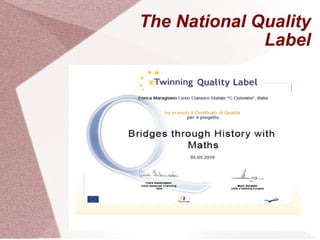
The first awards  As we were aware we worked well, some partners applied for the National QL and all of us who asked for it, got it: this also means that we won the European QL! Furthermore the Bulgarian partner and myself achieved the national excellence and I have been awarded during the Comenius/eTwinning conference (Florence, December 2010). A big satisfaction for me and for my students! Now the plastic plaque hangs in the headmaster office between the others school prizes!
The project goals Students studied some of the great mathematicians of all ages: their contribution to mankind was deepened and emphasised.  The historical and scientific framework usually enhanced the performance in Maths and strengthened the idea that culture is not divided into separate branches.  Maths is a global language and one of the main goals was understanding that often behind the big discoveries there is hard work and many attempts.
The project goals Students had to share their knowledge with other students. They improved their English to communicate and cooperate with other European pupils and practised and often increased their ICT knowledge.
The National Quality Label
Link to the TwinSpace You can have a look to the project results to the public part of the TwinSpace: http://new-twinspace.etwinning.net/web/p17897/welcome
No more without eTwinning! After my first experience I understood I liked that way of working and I decided to use it directly during my lessons, as a part of the teaching program. Students loved this new way of working and I could see a major focus during the regular lessons, a better approach to the use of computers, a special interest regarding the subject  we have worked about with foreign students.
Geometry, Art and everyday reality I got the inspiration for the new project when I was in Florence to get the award. With a colleague, looking at the dome by Brunelleschi, we wondered if he could be approximated by a parabola: mental Maths deformation! In any case, it seemed very important to let students understand that the same object or the same aspect of reality can be seen from very different perspectives, all equally acceptable: for example, a door is a "hole in a wall," but it can be also a rectangle.
The project steps  Students took pictures of the town and then they identified the main shapes using Geogebra.  Our partners did the same and, afterwards, everybody found informations about the monument or building they chose  Finally they prepared some videos with their works and those of the partners. This last activity was very useful because it allowed to see the different shapes of buildings in different countries (Italy, Belgium, Poland, Greece, France, Turkey).
Some pictures
Another award For this project together with the Belgian and the Polish colleagues we asked for the Quality Label and all of us got it! This means that also for this year we got the European Quality Label! I must say that I love this project very much... :-)
The European Quality Label
Link to the TwinSpace You can have a look to the project results to the public part of the TwinSpace: http://new-twinspace.etwinning.net/web/p46860/welcome
Future planning With the Belgian colleague I decided to activate a new project this year about Statistics. We are just at the beginning of our work but I can observe some things I'd like to point out: while at the beginning only few colleagues helped in the project, now even colleagues I never imagine were interested asked me to collaborate students no more involved in the projects say that they want to do some other project
An eTwinning project: Improves the knowledge about the topics or subjects directly involved in the project Improves English and ICT skills Improves students autonomy and motivates them to study Improves tolerance and friendship between pupils from different countries and allows students and teachers to learn from each other It is free
How to deal with the normal teaching program? It is not necessary beginning with a big project: don't do the step longer than the leg Find the “right” (reliable) partners - sometimes you have just to try and error If you choose a multidisciplinary topic, you can divide tasks between different subjects (“saving” time for your “normal lessons”) You need to plan carefully the activities
Conclusion Maths is generally considered an “arid” subject but if you try to show to your students that with Maths they can do something practical or closer to their interests they will love it  (or at least they won't hate it  so much...)

Presentazione e twinning

  • 1.
    My eTwinning experienceEnrica Maragliano LCS C.Colombo Genova
  • 2.
    My eTwinning experienceI heard about eTwinning in 2008 and I found exactly what I needed. I was looking for a database where I could find possible partners for a Comenius project to be activated in my school. In the previous years I found another db and I got in touch with some teachers but it was not very popular and “crowded”. The interaction between people was limited to register email addresses and getting in touch by private mail.
  • 3.
    Finally eTwinning! Finallyat school we received an invitation to a seminar in Turin, where we were shown the main features of the eTwinning: I immediately understood that this was exactly the tool I was looking for to find partners for the project ideas I had in mind.
  • 4.
    The first attemptsMy first attempts were done trying to find partners interested in my school main subjects, Humanities. I'm a Maths and Physics teacher but I thought a Comenius project about Maths couldn't be accepted in a school with such an old tradition in ancient languages. Then I got in touch with a Turkish teacher who proposed me a Comenius project about Maths History: it was a great idea for a Classical Lyceum!
  • 5.
    From Comenius toeTwinning It was 15 days before deadline and we were 4 partners. The Turkish lady was not very reliable and the most part of the writing and projecting was done by Giorgos, the Greek partner, and me. The project was rejected by two out of four NA, even if our National Agency approved it. I understood I was on the right track and I used eTwinning to find partners for the Comenius project. I succeeded and now we are working on “Bridges through History with Maths”!
  • 6.
    The first awards As we were aware we worked well, some partners applied for the National QL and all of us who asked for it, got it: this also means that we won the European QL! Furthermore the Bulgarian partner and myself achieved the national excellence and I have been awarded during the Comenius/eTwinning conference (Florence, December 2010). A big satisfaction for me and for my students! Now the plastic plaque hangs in the headmaster office between the others school prizes!
  • 7.
    The project goalsStudents studied some of the great mathematicians of all ages: their contribution to mankind was deepened and emphasised. The historical and scientific framework usually enhanced the performance in Maths and strengthened the idea that culture is not divided into separate branches. Maths is a global language and one of the main goals was understanding that often behind the big discoveries there is hard work and many attempts.
  • 8.
    The project goalsStudents had to share their knowledge with other students. They improved their English to communicate and cooperate with other European pupils and practised and often increased their ICT knowledge.
  • 9.
  • 10.
    Link to theTwinSpace You can have a look to the project results to the public part of the TwinSpace: http://new-twinspace.etwinning.net/web/p17897/welcome
  • 11.
    No more withouteTwinning! After my first experience I understood I liked that way of working and I decided to use it directly during my lessons, as a part of the teaching program. Students loved this new way of working and I could see a major focus during the regular lessons, a better approach to the use of computers, a special interest regarding the subject we have worked about with foreign students.
  • 12.
    Geometry, Art andeveryday reality I got the inspiration for the new project when I was in Florence to get the award. With a colleague, looking at the dome by Brunelleschi, we wondered if he could be approximated by a parabola: mental Maths deformation! In any case, it seemed very important to let students understand that the same object or the same aspect of reality can be seen from very different perspectives, all equally acceptable: for example, a door is a "hole in a wall," but it can be also a rectangle.
  • 13.
    The project steps Students took pictures of the town and then they identified the main shapes using Geogebra. Our partners did the same and, afterwards, everybody found informations about the monument or building they chose Finally they prepared some videos with their works and those of the partners. This last activity was very useful because it allowed to see the different shapes of buildings in different countries (Italy, Belgium, Poland, Greece, France, Turkey).
  • 14.
  • 15.
    Another award Forthis project together with the Belgian and the Polish colleagues we asked for the Quality Label and all of us got it! This means that also for this year we got the European Quality Label! I must say that I love this project very much... :-)
  • 16.
  • 17.
    Link to theTwinSpace You can have a look to the project results to the public part of the TwinSpace: http://new-twinspace.etwinning.net/web/p46860/welcome
  • 18.
    Future planning Withthe Belgian colleague I decided to activate a new project this year about Statistics. We are just at the beginning of our work but I can observe some things I'd like to point out: while at the beginning only few colleagues helped in the project, now even colleagues I never imagine were interested asked me to collaborate students no more involved in the projects say that they want to do some other project
  • 19.
    An eTwinning project:Improves the knowledge about the topics or subjects directly involved in the project Improves English and ICT skills Improves students autonomy and motivates them to study Improves tolerance and friendship between pupils from different countries and allows students and teachers to learn from each other It is free
  • 20.
    How to dealwith the normal teaching program? It is not necessary beginning with a big project: don't do the step longer than the leg Find the “right” (reliable) partners - sometimes you have just to try and error If you choose a multidisciplinary topic, you can divide tasks between different subjects (“saving” time for your “normal lessons”) You need to plan carefully the activities
  • 21.
    Conclusion Maths isgenerally considered an “arid” subject but if you try to show to your students that with Maths they can do something practical or closer to their interests they will love it (or at least they won't hate it so much...)