Algebra 1
Susan Stevens
drgoodreader@gmail.com
904-679-9287
https://edu.symbaloo.com/home/mix/13ePLTYKYS
Real-Life Math
Goals for Today
• Help me discover where you are in the
classroom/teaching
• Think about needs and research in mathematics
education
• Think about change and mindset
• Design at least one (if not two) real-life lessons
Questions
• If I were a fly on the wall, what would I see in your
classroom?
• How satisfied are you with the way it’s going?
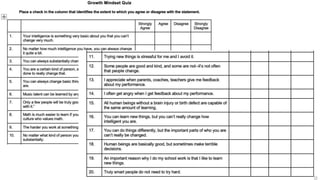
• Fixed mindset/growth mindset?
• Favorite math writers/gurus?
• Experience with real-life problems/Problem-based
math/STEM
• How good are you with change on a scale of 1 to 6 (6
being I LOVE CHANGE)
• How good are you with ambiguity on a scale of 1 to 6
Ambiguity
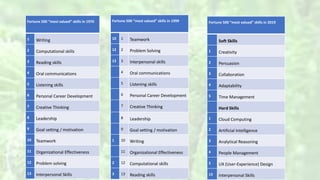
Fortune 500 “most valued” skills in 1970
1 Writing
2 Computational skills
3 Reading skills
4 Oral communications
5 Listening skills
6 Personal Career Development
7 Creative Thinking
8 Leadership
9 Goal setting / motivation
10 Teamwork
11 Organizational Effectiveness
12 Problem solving
13 Interpersonal Skills
Fortune 500 “most valued” skills in 1999
10 1 Teamwork
12 2 Problem Solving
13 3 Interpersonal skills
4 Oral communications
5 Listening skills
6 Personal Career Development
7 Creative Thinking
8 Leadership
9 Goal setting / motivation
1 10 Writing
11 Organizational Effectiveness
2 12 Computational skills
3 13 Reading skills
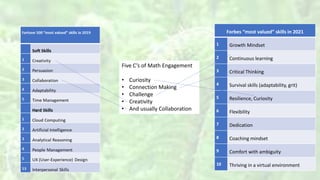
Fortune 500 “most valued” skills in 2019
Soft Skills
1 Creativity
2 Persuasion
3 Collaboration
4 Adaptability
5 Time Management
Hard Skills
1 Cloud Computing
2 Artificial Intelligence
3 Analytical Reasoning
4 People Management
5 UX (User-Experience) Design
13 Interpersonal Skills
Forbes “most valued” skills in 2021
1 Growth Mindset
2 Continuous learning
3 Critical Thinking
4 Survival skills (adaptability, grit)
5 Resilience, Curiosity
6 Flexibility
7 Dedication
8 Coaching mindset
9 Comfort with ambiguity
10 Thriving in a virtual environment
Five C’s of Math Engagement
• Curiosity
• Connection Making
• Challenge
• Creativity
• And usually Collaboration
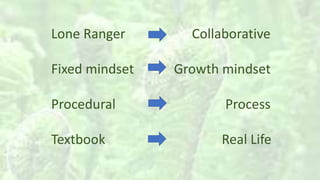
Lone Ranger Collaborative
Fixed mindset Growth mindset
Procedural Process
Textbook Real Life
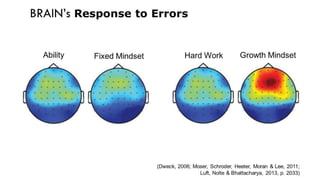
Brain Plasticity
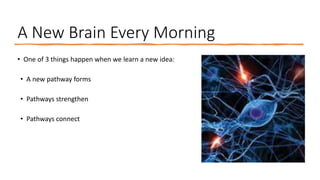
A New Brain Every Morning
• One of 3 things happen when we learn a new idea:
• A new pathway forms
• Pathways strengthen
• Pathways connect
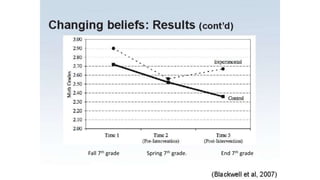
Fall 7th grade Spring 7th grade. End 7th grade
What is math?
Math is the study of patterns; …it is an
aesthetic, creative and beautiful subject.
– Jo Boaler
Math Does Not Equal Calculating – Conrad Wolfram
1. Posing a question
2. Going from real world to a
mathematical model
3. Performing a calculation
4. Going from the model back to
the real world to see if the
original question was answered
Misconceptions About Math
Fast is best.
Math is a gift.
(I’m/you’re a math person/not a math person.)
Math is all about calculating.
A dangerous misconception exists
about mindset, which is the idea
that you can instill a growth
mindset in students by sharing
positive messages while still
teaching in a fixed way—with
math questions that have one
answer and one valued method.
– Jo Boaler p.xiv Mathematical Mindsets
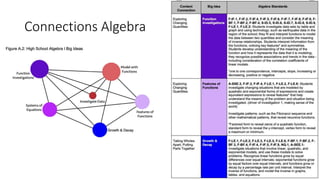
Connections Algebra
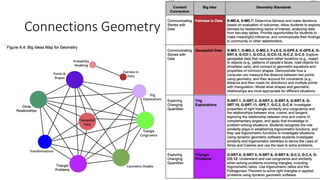
Connections Geometry
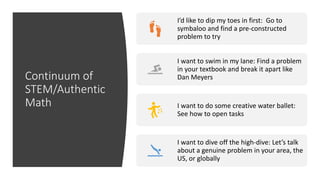
Continuum of
STEM/Authentic
Math
I’d like to dip my toes in first: Go to
symbaloo and find a pre-constructed
problem to try
I want to swim in my lane: Find a problem
in your textbook and break it apart like
Dan Meyers
I want to do some creative water ballet:
See how to open tasks
I want to dive off the high-dive: Let’s talk
about a genuine problem in your area, the
US, or globally
1. Symbaloo
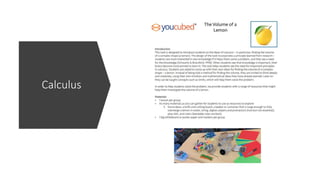
Calculus
Algebra
2. Dan Meyer’s
How to Open a
Textbook Task
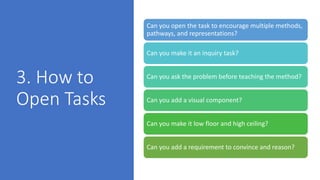
3. How to
Open Tasks
Can you open the task to encourage multiple methods,
pathways, and representations?
Can you make it an inquiry task?
Can you ask the problem before teaching the method?
Can you add a visual component?
Can you make it low floor and high ceiling?
Can you add a requirement to convince and reason?
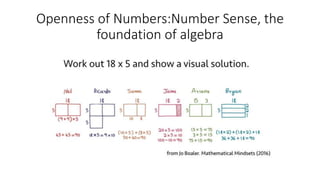
Openness of Numbers:Number Sense, the
foundation of algebra
Think about the answer to 18 x 5 and then share with me your method for reaching it.
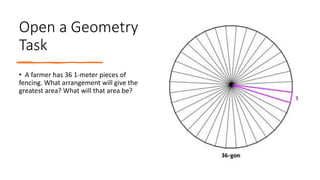
Open a Geometry
Task
• A farmer has 36 1-meter pieces of
fencing. What arrangement will give the
greatest area? What will that area be?
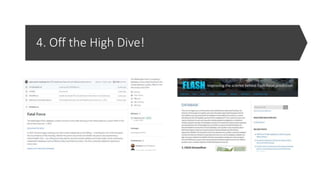
4. Off the High Dive!
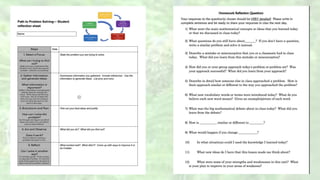
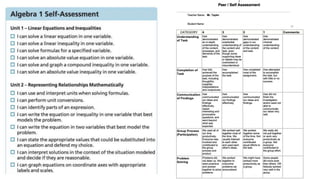
Assessment Possibilities
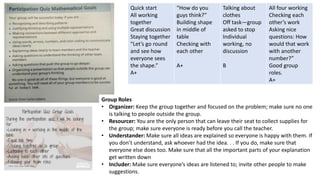
Quick start
All working
together
Great discussion
Staying together
“Let’s go round
and see how
everyone sees
the shape.”
A+
“How do you
guys think?”
Building shape
in middle of
table
Checking with
each other
A+
Talking about
clothes
Off task—group
asked to stop
Individual
working, no
discussion
B
All four working
Checking each
other’s work
Asking nice
questions: How
would that work
with another
number?”
Good group
roles.
A+
Group Roles
• Organizer: Keep the group together and focused on the problem; make sure no one
is talking to people outside the group.
• Resourcer: You are the only person that can leave their seat to collect supplies for
the group; make sure everyone is ready before you call the teacher.
• Understander: Make sure all ideas are explained so everyone is happy with them. If
you don’t understand, ask whoever had the idea. . . If you do, make sure that
everyone else does too. Make sure that all the important parts of your explanation
get written down
• Includer: Make sure everyone’s ideas are listened to; invite other people to make
suggestions.
Make It
Messy!
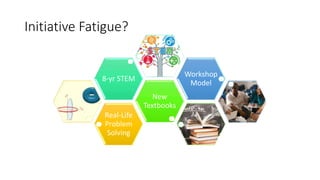
Initiative Fatigue?
Real-Life
Problem
Solving
New
Textbooks
8-yr STEM
Workshop
Model
Real-Life
Math
Algebra 1
Susan Stevens
drgoodreader@gmail.com
904-679-9287
https://edu.symbaloo.com/home/mix/13ePLTYKYS

Math workshops.pptx

  • 1.
  • 2.
    Goals for Today •Help me discover where you are in the classroom/teaching • Think about needs and research in mathematics education • Think about change and mindset • Design at least one (if not two) real-life lessons
  • 3.
    Questions • If Iwere a fly on the wall, what would I see in your classroom? • How satisfied are you with the way it’s going? • Fixed mindset/growth mindset? • Favorite math writers/gurus? • Experience with real-life problems/Problem-based math/STEM • How good are you with change on a scale of 1 to 6 (6 being I LOVE CHANGE) • How good are you with ambiguity on a scale of 1 to 6
  • 4.
  • 5.
    Fortune 500 “mostvalued” skills in 1970 1 Writing 2 Computational skills 3 Reading skills 4 Oral communications 5 Listening skills 6 Personal Career Development 7 Creative Thinking 8 Leadership 9 Goal setting / motivation 10 Teamwork 11 Organizational Effectiveness 12 Problem solving 13 Interpersonal Skills Fortune 500 “most valued” skills in 1999 10 1 Teamwork 12 2 Problem Solving 13 3 Interpersonal skills 4 Oral communications 5 Listening skills 6 Personal Career Development 7 Creative Thinking 8 Leadership 9 Goal setting / motivation 1 10 Writing 11 Organizational Effectiveness 2 12 Computational skills 3 13 Reading skills Fortune 500 “most valued” skills in 2019 Soft Skills 1 Creativity 2 Persuasion 3 Collaboration 4 Adaptability 5 Time Management Hard Skills 1 Cloud Computing 2 Artificial Intelligence 3 Analytical Reasoning 4 People Management 5 UX (User-Experience) Design 13 Interpersonal Skills
  • 6.
    Forbes “most valued”skills in 2021 1 Growth Mindset 2 Continuous learning 3 Critical Thinking 4 Survival skills (adaptability, grit) 5 Resilience, Curiosity 6 Flexibility 7 Dedication 8 Coaching mindset 9 Comfort with ambiguity 10 Thriving in a virtual environment Five C’s of Math Engagement • Curiosity • Connection Making • Challenge • Creativity • And usually Collaboration
  • 7.
    Lone Ranger Collaborative Fixedmindset Growth mindset Procedural Process Textbook Real Life
  • 11.
  • 12.
    A New BrainEvery Morning • One of 3 things happen when we learn a new idea: • A new pathway forms • Pathways strengthen • Pathways connect
  • 13.
    Fall 7th gradeSpring 7th grade. End 7th grade
  • 15.
  • 16.
    Math is thestudy of patterns; …it is an aesthetic, creative and beautiful subject. – Jo Boaler
  • 17.
    Math Does NotEqual Calculating – Conrad Wolfram 1. Posing a question 2. Going from real world to a mathematical model 3. Performing a calculation 4. Going from the model back to the real world to see if the original question was answered
  • 18.
    Misconceptions About Math Fastis best. Math is a gift. (I’m/you’re a math person/not a math person.) Math is all about calculating.
  • 19.
    A dangerous misconceptionexists about mindset, which is the idea that you can instill a growth mindset in students by sharing positive messages while still teaching in a fixed way—with math questions that have one answer and one valued method. – Jo Boaler p.xiv Mathematical Mindsets
  • 20.
  • 21.
  • 22.
    Continuum of STEM/Authentic Math I’d liketo dip my toes in first: Go to symbaloo and find a pre-constructed problem to try I want to swim in my lane: Find a problem in your textbook and break it apart like Dan Meyers I want to do some creative water ballet: See how to open tasks I want to dive off the high-dive: Let’s talk about a genuine problem in your area, the US, or globally
  • 23.
  • 24.
  • 25.
  • 26.
    2. Dan Meyer’s Howto Open a Textbook Task
  • 27.
    3. How to OpenTasks Can you open the task to encourage multiple methods, pathways, and representations? Can you make it an inquiry task? Can you ask the problem before teaching the method? Can you add a visual component? Can you make it low floor and high ceiling? Can you add a requirement to convince and reason?
  • 28.
    Openness of Numbers:NumberSense, the foundation of algebra Think about the answer to 18 x 5 and then share with me your method for reaching it.
  • 29.
    Open a Geometry Task •A farmer has 36 1-meter pieces of fencing. What arrangement will give the greatest area? What will that area be?
  • 30.
    4. Off theHigh Dive!
  • 31.
  • 34.
    Quick start All working together Greatdiscussion Staying together “Let’s go round and see how everyone sees the shape.” A+ “How do you guys think?” Building shape in middle of table Checking with each other A+ Talking about clothes Off task—group asked to stop Individual working, no discussion B All four working Checking each other’s work Asking nice questions: How would that work with another number?” Good group roles. A+ Group Roles • Organizer: Keep the group together and focused on the problem; make sure no one is talking to people outside the group. • Resourcer: You are the only person that can leave their seat to collect supplies for the group; make sure everyone is ready before you call the teacher. • Understander: Make sure all ideas are explained so everyone is happy with them. If you don’t understand, ask whoever had the idea. . . If you do, make sure that everyone else does too. Make sure that all the important parts of your explanation get written down • Includer: Make sure everyone’s ideas are listened to; invite other people to make suggestions.
  • 35.
  • 36.
  • 38.

Editor's Notes

  • #5 Ambiguity – give Russia drawing example
  • #8 Deal with these first in ourselves and then with our students.
  • #16 It only compresses concepts! P. 43
  • #17 p. 13-14 Find notes.
  • #18 Most students think of mathematics as a series of answers—answers to questions that nobody has asked.
  • #20 1st 5:20
  • #24 mathfqppafr.doc
  • #25 mathfqppafr.doc