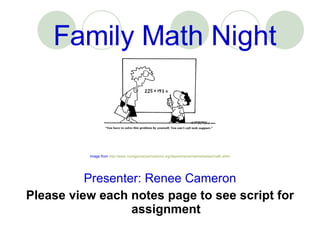
Family Math Night Image from  http://www.montgomeryschoolsmd.org/departments/hiat/websites/math.shtm Presenter: Renee Cameron Please view each notes page to see script for assignment
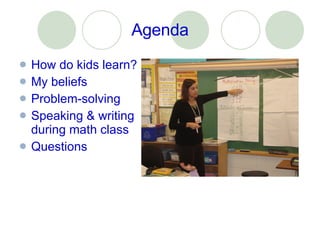
Agenda How do kids learn? My beliefs Problem-solving Speaking & writing during math class Questions
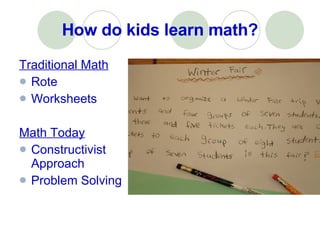
How do kids learn math? Traditional Math Rote Worksheets Math Today Constructivist Approach Problem Solving
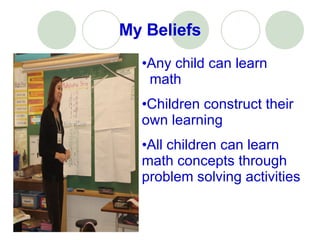
My Beliefs Any child can learn  math Children construct their own learning All children can learn math concepts through problem solving activities
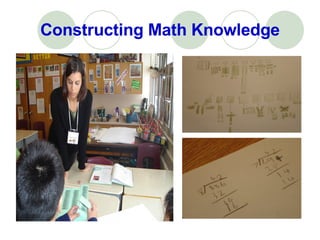
Constructing Math Knowledge
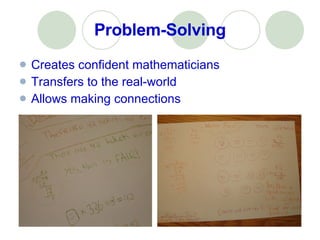
Problem-Solving Creates confident mathematicians Transfers to the real-world  Allows making connections
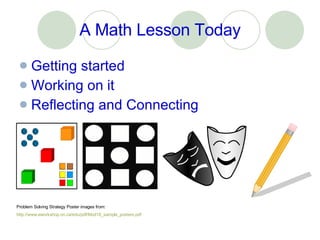
A Math Lesson Today Getting started Working on it Reflecting and Connecting Problem Solving Strategy Poster images from: http://www.eworkshop.on.ca/edu/pdf/Mod18_sample_posters.pdf
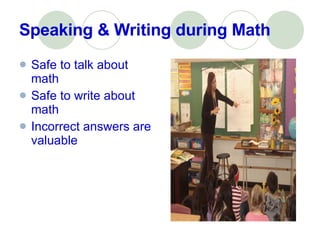
Speaking & Writing during Math Safe to talk about math Safe to write about math Incorrect answers are valuable
Questions How will my child memorize the basic facts? How will this help them in high school? How can I help my child when I wasn’t taught math this way? How do you use the text book?
Bibliography A Guide to Effective Instruction in Math, K-6, Vol. 2. Problem Solving and Communication  Burns, Marilyn (2007).  About Teaching Mathematics: A K-8 Resource: Math Solutions : Pearson Publishers. Funderstanding theories. Retrieved October 19, 2008 from http://www.funderstanding.com/about_learning.cfm  eWorkshop –Online Teaching Resource. (2008) Retrieved October 19, 2008 from http://www.eworkshop.on.ca/edu/pdf/Mod18_sample_posters.pdf  McIntosh, Margaret E.; Draper, Roni Jo. (2001). Using learning logs in mathematics: writing to learn. Mathematics teacher. v. 94 no. 7 p. 544-547. Tolliver, K. Math and Communication. Retrieved October 19, 2008 from http://www.fasenet.org/store/kay_toliver/math_and_communication.htm  Murphy, E. (1997).  Constructivism from philosophy to practice  Retrieved October 19, 2008, from http://www.cdli.ca/~elmurphy/emurphy/cle.html  Southwest Educational Development t Laboratory: Classroom Compass Winter 1994 v. 1 no. 3 Retrieved October 19, 2008 from http://www.sedl.org/scimath/compass/v01n03/welcome.html  Photographs taken with the permission of classroom teachers that Renee Cameron worked with as a Math Coach, 2007-2008

Renee Family Night Presentation

  • 1.
    Family Math NightImage from http://www.montgomeryschoolsmd.org/departments/hiat/websites/math.shtm Presenter: Renee Cameron Please view each notes page to see script for assignment
  • 2.
    Agenda How dokids learn? My beliefs Problem-solving Speaking & writing during math class Questions
  • 3.
    How do kidslearn math? Traditional Math Rote Worksheets Math Today Constructivist Approach Problem Solving
  • 4.
    My Beliefs Anychild can learn math Children construct their own learning All children can learn math concepts through problem solving activities
  • 5.
  • 6.
    Problem-Solving Creates confidentmathematicians Transfers to the real-world Allows making connections
  • 7.
    A Math LessonToday Getting started Working on it Reflecting and Connecting Problem Solving Strategy Poster images from: http://www.eworkshop.on.ca/edu/pdf/Mod18_sample_posters.pdf
  • 8.
    Speaking & Writingduring Math Safe to talk about math Safe to write about math Incorrect answers are valuable
  • 9.
    Questions How willmy child memorize the basic facts? How will this help them in high school? How can I help my child when I wasn’t taught math this way? How do you use the text book?
  • 10.
    Bibliography A Guideto Effective Instruction in Math, K-6, Vol. 2. Problem Solving and Communication Burns, Marilyn (2007). About Teaching Mathematics: A K-8 Resource: Math Solutions : Pearson Publishers. Funderstanding theories. Retrieved October 19, 2008 from http://www.funderstanding.com/about_learning.cfm eWorkshop –Online Teaching Resource. (2008) Retrieved October 19, 2008 from http://www.eworkshop.on.ca/edu/pdf/Mod18_sample_posters.pdf McIntosh, Margaret E.; Draper, Roni Jo. (2001). Using learning logs in mathematics: writing to learn. Mathematics teacher. v. 94 no. 7 p. 544-547. Tolliver, K. Math and Communication. Retrieved October 19, 2008 from http://www.fasenet.org/store/kay_toliver/math_and_communication.htm Murphy, E. (1997). Constructivism from philosophy to practice Retrieved October 19, 2008, from http://www.cdli.ca/~elmurphy/emurphy/cle.html Southwest Educational Development t Laboratory: Classroom Compass Winter 1994 v. 1 no. 3 Retrieved October 19, 2008 from http://www.sedl.org/scimath/compass/v01n03/welcome.html Photographs taken with the permission of classroom teachers that Renee Cameron worked with as a Math Coach, 2007-2008

Editor's Notes

  • #2 Math Part 2 Assignment: Prepare a family night presentation explaining how mathematics is changing. Give specific examples based on your reading and WebCT discussion as it relates to your math program and this assignment in particular. What are your beliefs about teaching elementary mathematics? Prepare a one-page handout for parents with the key points highlighted. Include 3 - 4 potential questions you might receive from parents/guardians, and write responses to those questions. Include a bibliography of online and offline resources that you used.