Doing More Isn’t Doing Better
How to Be an English Teacher and Have a Life
Lindsay Grady
@LMGrady
Fenton, Michigan
Dave Stuart Jr.
@davestuartjr
Cedar Springs, Michigan
Beth Shaum
@BethShaum
Allen Park, Michigan
Join the conversation on our Google Doc
http://bit.ly/ncte15j03
The Teacher Bag
What’s in your bag?
tasks,
deadlines,
responsibilities,
expectations,
etc.
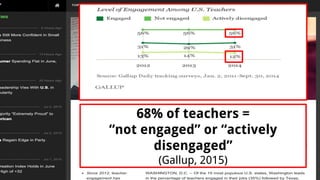
68% of teachers =
“not engaged” or “actively
disengaged”
(Gallup, 2015)
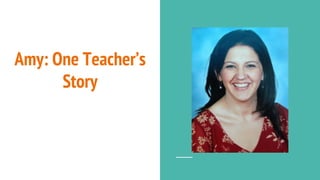
Amy: One Teacher’s
Story
the INTERNAL
WORK
ConcentrateConcentrate
Poll Ed and Tenzing -- mosaic of lots of faces
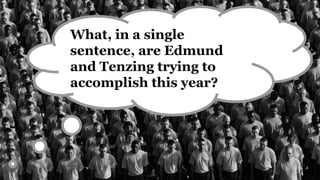
What, in a single
sentence, are Edmund
and Tenzing trying to
accomplish this year?
Poll Ed and Tenzing -- mosaic of lots of faces
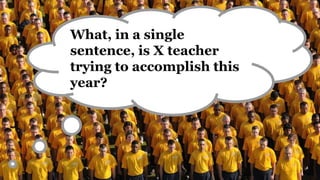
What, in a single
sentence, is X teacher
trying to accomplish this
year?
MARTIN LUTHER
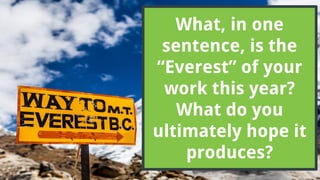
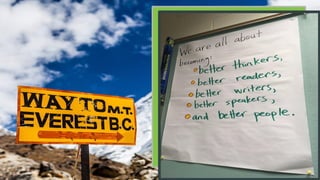
What, in one
sentence, is the
“Everest” of your
work this year?
What do you
ultimately hope it
produces?
All of us work
to promote the
long-term
flourishing of
students.
ConstrainConstrain
What’s the
most pointless
thing that you
do as a teacher?
What’s the
most pointless
thing that you
do as a teacher?
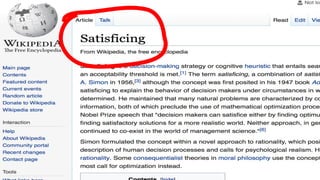
SATISFICE
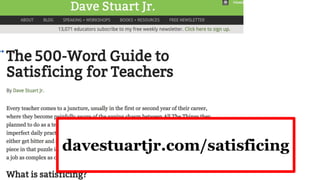
davestuartjr.com/satisficing
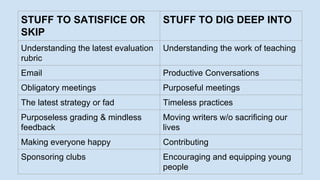
STUFF TO SATISFICE OR
SKIP
STUFF TO DIG DEEP INTO
Understanding the latest evaluation
rubric
Understanding the work of teaching
Email Productive Conversations
Obligatory meetings Purposeful meetings
The latest strategy or fad Timeless practices
Purposeless grading & mindless
feedback
Moving writers w/o sacrificing our
lives
Making everyone happy Contributing
Sponsoring clubs Encouraging and equipping young
people
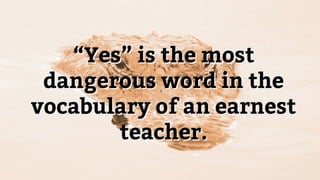
“Yes” is the most
dangerous word in the
vocabulary of an earnest
teacher.
“Yes” is the most
dangerous word in the
vocabulary of an earnest
teacher.
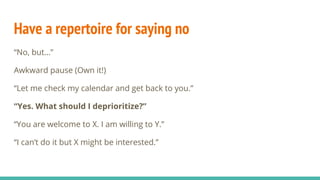
Have a repertoire for saying no
“No, but…”
Awkward pause (Own it!)
“Let me check my calendar and get back to you.”
“Yes. What should I deprioritize?”
“You are welcome to X. I am willing to Y.”
“I can’t do it but X might be interested.”
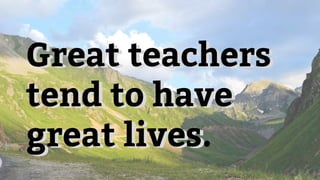
Great teachers
tend to have
great lives
Great teachers
tend to have
great lives.
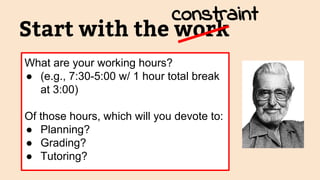
Start with the work
What are your working hours?
● (e.g., 7:30-5:00 w/ 1 hour total break
at 3:00)
Of those hours, which will you devote to:
● Planning?
● Grading?
● Tutoring?
constraint
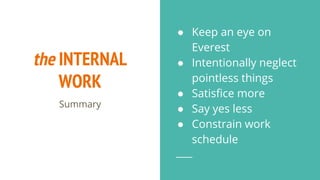
the INTERNAL
WORK
Summary
● Keep an eye on
Everest
● Intentionally neglect
pointless things
● Satisfice more
● Say yes less
● Constrain work
schedule
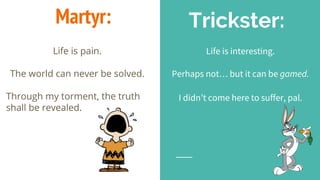
Are you a martyr?
Or a
trickster?
Martyr:
Life is pain.
The world can never be solved.
Through my torment, the truth
shall be revealed.
Life is interesting.
Perhaps not… but it can be gamed.
I didn’t come here to suffer, pal.
Trickster:
Aspects of Technology
● Google
● Apps & Add-ons
● Social Media
● Cell phones/tablets
● Setting limits
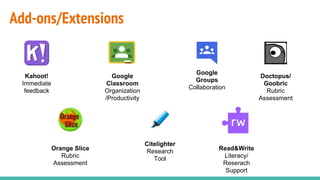
Add-ons/Extensions
Kahoot!
Immediate
feedback
Google
Classroom
Organization
/Productivity
Google
Groups
Collaboration
Doctopus/
Goobric
Rubric
Assessment
Orange Slice
Rubric
Assessment
Citelighter
Research
Tool
Read&Write
Literacy/
Reserach
Support
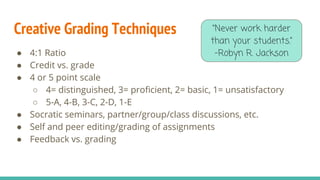
Creative Grading Techniques
● 4:1 Ratio
● Credit vs. grade
● 4 or 5 point scale
○ 4= distinguished, 3= proficient, 2= basic, 1= unsatisfactory
○ 5-A, 4-B, 3-C, 2-D, 1-E
● Socratic seminars, partner/group/class discussions, etc.
● Self and peer editing/grading of assignments
● Feedback vs. grading
“Never work harder
than your students.”
-Robyn R. Jackson
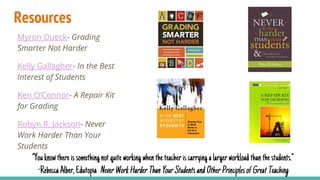
Resources
Myron Dueck- Grading
Smarter Not Harder
Kelly Gallagher- In the Best
Interest of Students
Ken O’Connor- A Repair Kit
for Grading
Robyn R. Jackson- Never
Work Harder Than Your
Students
“Youknowthereissomethingnotquiteworkingwhentheteacheriscarryingalargerworkloadthanthestudents.”
-RebeccaAlber,Edutopia NeverWorkHarderThanYourStudentsandOtherPrinciplesofGreatTeaching
From Short Term Solutions to
Long Term Goals
How to think beyond just survival
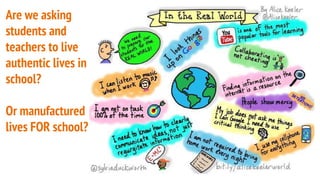
Are we asking
students and
teachers to live
authentic lives in
school?
Or manufactured
lives FOR school?
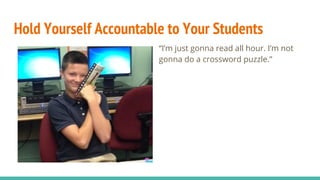
Hold Yourself Accountable to Your Students
“I’m just gonna read all hour. I’m not
gonna do a crossword puzzle.”
What does an authentic reading and writing life look
like?
● Write Beside Them
● Read beside them
● Student input
● No more language arts and crafts
● Real-World Writing Purposes -Kelly Gallagher
● Less busywork, more REAL work
● Remind ourselves what we are asking students to do all day
Arm Yourself with Research
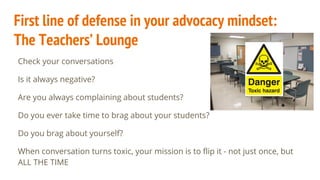
First line of defense in your advocacy mindset:
The Teachers’ Lounge
Check your conversations
Is it always negative?
Are you always complaining about students?
Do you ever take time to brag about your students?
Do you brag about yourself?
When conversation turns toxic, your mission is to flip it - not just once, but
ALL THE TIME
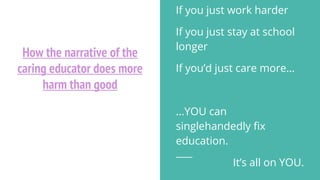
How the narrative of the
caring educator does more
harm than good
If you just work harder
If you just stay at school
longer
If you’d just care more…
...YOU can
singlehandedly fix
education.
It’s all on YOU.
The time is NOW to advocate for our profession
“It's not about making the case for advocacy.
It's about making the case for you as
advocates.” - Ernest Morrell
When Legislators Attempt to Stifle Teacher Voice
Did you know...
Since 1960 NCTE has formally advocated
for teachers to have no more than 100
students per day?
Since 1960 NCTE has formally advocated for
teachers to have no more than 100 students
per day?
Resolution on Teaching Loads of English and Language Arts Teachers
Inform and empower yourself
● NCTE Position Statements
● Know the people on your school board - and develop relationships
with them
● Go to school board meetings
● Invite stakeholders into your schools and classrooms
● Vote at the local level where change is more immediate
● Find ways to build collegial relationships with your administrators
and not just see them as your evaluator
● Parents can be your biggest allies!
● NCTE Advocacy Day and Month
● Program lawmakers’ numbers into your phones and make your voice
heard
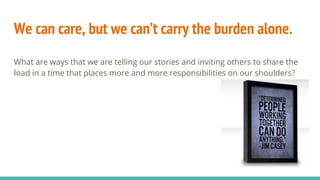
We can care, but we can’t carry the burden alone.
What are ways that we are telling our stories and inviting others to share the
load in a time that places more and more responsibilities on our shoulders?
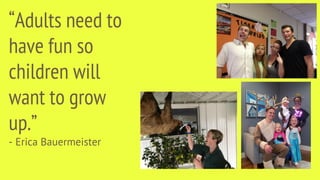
“Adults need to
have fun so
children will
want to grow
up.”
- Erica Bauermeister
Continue the
conversation on our
Google Doc
View our
presentation on
Slideshare
bit.ly/ncte15j03 www.slideshare.net/beths0103

#NCTE17 doing more isn't doing better 3.0

  • 1.
    Doing More Isn’tDoing Better How to Be an English Teacher and Have a Life Lindsay Grady @LMGrady Fenton, Michigan Dave Stuart Jr. @davestuartjr Cedar Springs, Michigan Beth Shaum @BethShaum Allen Park, Michigan
  • 2.
    Join the conversationon our Google Doc http://bit.ly/ncte15j03
  • 3.
  • 4.
    What’s in yourbag? tasks, deadlines, responsibilities, expectations, etc.
  • 8.
    68% of teachers= “not engaged” or “actively disengaged” (Gallup, 2015)
  • 9.
  • 10.
  • 11.
  • 13.
    Poll Ed andTenzing -- mosaic of lots of faces What, in a single sentence, are Edmund and Tenzing trying to accomplish this year?
  • 14.
    Poll Ed andTenzing -- mosaic of lots of faces What, in a single sentence, is X teacher trying to accomplish this year?
  • 15.
  • 16.
    What, in one sentence,is the “Everest” of your work this year? What do you ultimately hope it produces?
  • 18.
    All of uswork to promote the long-term flourishing of students.
  • 19.
  • 20.
    What’s the most pointless thingthat you do as a teacher? What’s the most pointless thing that you do as a teacher?
  • 21.
  • 22.
  • 23.
    STUFF TO SATISFICEOR SKIP STUFF TO DIG DEEP INTO Understanding the latest evaluation rubric Understanding the work of teaching Email Productive Conversations Obligatory meetings Purposeful meetings The latest strategy or fad Timeless practices Purposeless grading & mindless feedback Moving writers w/o sacrificing our lives Making everyone happy Contributing Sponsoring clubs Encouraging and equipping young people
  • 24.
    “Yes” is themost dangerous word in the vocabulary of an earnest teacher. “Yes” is the most dangerous word in the vocabulary of an earnest teacher.
  • 25.
    Have a repertoirefor saying no “No, but…” Awkward pause (Own it!) “Let me check my calendar and get back to you.” “Yes. What should I deprioritize?” “You are welcome to X. I am willing to Y.” “I can’t do it but X might be interested.”
  • 26.
    Great teachers tend tohave great lives Great teachers tend to have great lives.
  • 27.
    Start with thework What are your working hours? ● (e.g., 7:30-5:00 w/ 1 hour total break at 3:00) Of those hours, which will you devote to: ● Planning? ● Grading? ● Tutoring? constraint
  • 28.
    the INTERNAL WORK Summary ● Keepan eye on Everest ● Intentionally neglect pointless things ● Satisfice more ● Say yes less ● Constrain work schedule
  • 29.
    Are you amartyr? Or a trickster?
  • 30.
    Martyr: Life is pain. Theworld can never be solved. Through my torment, the truth shall be revealed. Life is interesting. Perhaps not… but it can be gamed. I didn’t come here to suffer, pal. Trickster:
  • 32.
    Aspects of Technology ●Google ● Apps & Add-ons ● Social Media ● Cell phones/tablets ● Setting limits
  • 33.
  • 34.
    Creative Grading Techniques ●4:1 Ratio ● Credit vs. grade ● 4 or 5 point scale ○ 4= distinguished, 3= proficient, 2= basic, 1= unsatisfactory ○ 5-A, 4-B, 3-C, 2-D, 1-E ● Socratic seminars, partner/group/class discussions, etc. ● Self and peer editing/grading of assignments ● Feedback vs. grading “Never work harder than your students.” -Robyn R. Jackson
  • 35.
    Resources Myron Dueck- Grading SmarterNot Harder Kelly Gallagher- In the Best Interest of Students Ken O’Connor- A Repair Kit for Grading Robyn R. Jackson- Never Work Harder Than Your Students “Youknowthereissomethingnotquiteworkingwhentheteacheriscarryingalargerworkloadthanthestudents.” -RebeccaAlber,Edutopia NeverWorkHarderThanYourStudentsandOtherPrinciplesofGreatTeaching
  • 36.
    From Short TermSolutions to Long Term Goals How to think beyond just survival
  • 37.
    Are we asking studentsand teachers to live authentic lives in school? Or manufactured lives FOR school?
  • 38.
    Hold Yourself Accountableto Your Students “I’m just gonna read all hour. I’m not gonna do a crossword puzzle.”
  • 39.
    What does anauthentic reading and writing life look like? ● Write Beside Them ● Read beside them ● Student input ● No more language arts and crafts ● Real-World Writing Purposes -Kelly Gallagher ● Less busywork, more REAL work ● Remind ourselves what we are asking students to do all day
  • 42.
  • 43.
    First line ofdefense in your advocacy mindset: The Teachers’ Lounge Check your conversations Is it always negative? Are you always complaining about students? Do you ever take time to brag about your students? Do you brag about yourself? When conversation turns toxic, your mission is to flip it - not just once, but ALL THE TIME
  • 44.
    How the narrativeof the caring educator does more harm than good If you just work harder If you just stay at school longer If you’d just care more… ...YOU can singlehandedly fix education. It’s all on YOU.
  • 45.
    The time isNOW to advocate for our profession “It's not about making the case for advocacy. It's about making the case for you as advocates.” - Ernest Morrell When Legislators Attempt to Stifle Teacher Voice
  • 46.
    Did you know... Since1960 NCTE has formally advocated for teachers to have no more than 100 students per day? Since 1960 NCTE has formally advocated for teachers to have no more than 100 students per day? Resolution on Teaching Loads of English and Language Arts Teachers
  • 47.
    Inform and empoweryourself ● NCTE Position Statements ● Know the people on your school board - and develop relationships with them ● Go to school board meetings ● Invite stakeholders into your schools and classrooms ● Vote at the local level where change is more immediate ● Find ways to build collegial relationships with your administrators and not just see them as your evaluator ● Parents can be your biggest allies! ● NCTE Advocacy Day and Month ● Program lawmakers’ numbers into your phones and make your voice heard
  • 48.
    We can care,but we can’t carry the burden alone. What are ways that we are telling our stories and inviting others to share the load in a time that places more and more responsibilities on our shoulders?
  • 49.
    “Adults need to havefun so children will want to grow up.” - Erica Bauermeister
  • 50.
    Continue the conversation onour Google Doc View our presentation on Slideshare bit.ly/ncte15j03 www.slideshare.net/beths0103