University of Trinidad and Tobago- Corinth Campus
Year 2 Semester 1
Course: Mathematics 1
Lecturer: Dr. Lal Beharry

              Group: Hard-Math-erz
                 • Stephen Cato-52006
                    • Leigh Robinson
                • Stacia Thomas-52996
                     • Shenelle Noel
                   • Cathyann Martin
              • Christina Sookdeo-52927
               • Candace Roberts-52992
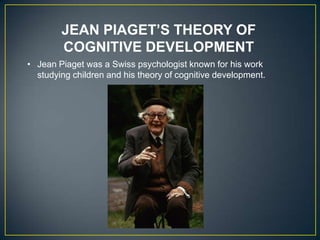
JEAN PIAGET’S THEORY OF
        COGNITIVE DEVELOPMENT
• Jean Piaget was a Swiss psychologist known for his work
  studying children and his theory of cognitive development.
PIAGET’S THEORY OF COGNITIVE
             DEVELOPMENT
•   Piaget’s theory of cognitive development suggests
    that children’s thinking does not go entirely ‘smooth’.
•   There are certain points where the child’s
    development transitions into new areas and
    capabilities.

•   These transitions take place at 18 months, 7
    years and 11 or 12 years.

•   Piaget’s view is also constructivist.
The Four Stages of
    Intellectual
  Development
THE SENSORIMOTOR STAGE

-Takes place from Birth to 2 years
    -The child , through physical
      interaction with his or her
     environment builds a set of
 concepts about reality and how it
                 works.
  - this is the stage where a child
  does not know that the physical
 objects remain in existence even
           when out of sight.
THE PREOPERATIONAL STAGE

 -Takes place from 2 to 7 years
   -The child is not yet able to
  conceptualize abstractly and
 needs more concrete physical
            situations
THE CONCRETE
    OPERATIONAL STAGE

   -Takes place from 7 to 11/12
               years
At this stage physical experience
accumulates and the child starts
 to conceptualize creating logical
structures that explains his or her
  physical experiences. Abstract
 problem solving is also possible
THE FORMAL OPERATIONAL
         STAGE

-Takes place from 11/12 years to
             an adult
-By this point the child's cognitive
  structures are like those of an
  adult and include conceptual
            reasoning.
KEY CONCEPTS

Several key concepts are mentioned in this theory:

• Schemas

• Assimilation

• Accommodation

• Equilibrium

• Adaptation
CLASSROOM IMPLICATIONS FOR PIAGET’S
     THEORY OF COGNITIVE DEVELOPMENT


• Teachers should carefully assess current stage of
  development and set tasks that the child is ready for.

• Learning opportunities must be provided in order for
  the child to advance. This is achieved by
  disequilibrium.

• Children should learn from each other, there should be
  pairing and group work.

• Teachers should act as guides in children's discovery
  learning and the curriculum should be adapted to
  individual needs and intellectual levels.
• CURRICULUM: Educators must plan
  a developmentally appropriate
  curriculum that enhances their
  students logical and conceptual
  growth.

• INSTRUCTION: Teachers must
  emphasize the critical role that
  experiences or interactions with the
  surrounding environment play in
  student learning.

Math presentation on Piaget's theory of cognitive development

  • 1.
    University of Trinidadand Tobago- Corinth Campus Year 2 Semester 1 Course: Mathematics 1 Lecturer: Dr. Lal Beharry Group: Hard-Math-erz • Stephen Cato-52006 • Leigh Robinson • Stacia Thomas-52996 • Shenelle Noel • Cathyann Martin • Christina Sookdeo-52927 • Candace Roberts-52992
  • 2.
    JEAN PIAGET’S THEORYOF COGNITIVE DEVELOPMENT • Jean Piaget was a Swiss psychologist known for his work studying children and his theory of cognitive development.
  • 3.
    PIAGET’S THEORY OFCOGNITIVE DEVELOPMENT • Piaget’s theory of cognitive development suggests that children’s thinking does not go entirely ‘smooth’. • There are certain points where the child’s development transitions into new areas and capabilities. • These transitions take place at 18 months, 7 years and 11 or 12 years. • Piaget’s view is also constructivist.
  • 4.
    The Four Stagesof Intellectual Development
  • 5.
    THE SENSORIMOTOR STAGE -Takesplace from Birth to 2 years -The child , through physical interaction with his or her environment builds a set of concepts about reality and how it works. - this is the stage where a child does not know that the physical objects remain in existence even when out of sight.
  • 6.
    THE PREOPERATIONAL STAGE -Takes place from 2 to 7 years -The child is not yet able to conceptualize abstractly and needs more concrete physical situations
  • 7.
    THE CONCRETE OPERATIONAL STAGE -Takes place from 7 to 11/12 years At this stage physical experience accumulates and the child starts to conceptualize creating logical structures that explains his or her physical experiences. Abstract problem solving is also possible
  • 8.
    THE FORMAL OPERATIONAL STAGE -Takes place from 11/12 years to an adult -By this point the child's cognitive structures are like those of an adult and include conceptual reasoning.
  • 9.
    KEY CONCEPTS Several keyconcepts are mentioned in this theory: • Schemas • Assimilation • Accommodation • Equilibrium • Adaptation
  • 10.
    CLASSROOM IMPLICATIONS FORPIAGET’S THEORY OF COGNITIVE DEVELOPMENT • Teachers should carefully assess current stage of development and set tasks that the child is ready for. • Learning opportunities must be provided in order for the child to advance. This is achieved by disequilibrium. • Children should learn from each other, there should be pairing and group work. • Teachers should act as guides in children's discovery learning and the curriculum should be adapted to individual needs and intellectual levels.
  • 11.
    • CURRICULUM: Educatorsmust plan a developmentally appropriate curriculum that enhances their students logical and conceptual growth. • INSTRUCTION: Teachers must emphasize the critical role that experiences or interactions with the surrounding environment play in student learning.