Materials Info : Your partners for
Processes
Areas :
Lean Manufacturing, Six sigma, Change
management, business excellence,
Process improvement from customer
perception, TQM, TPM, Quality systems
and materials/processes
Raghvendra Gopal
CEO, Materials-info.com
materials-info 1
Materials Info : Your partners for
Processes
We address your processes to increase
efficiency, reduce rejections and improve
overall Quality and reliability
•Lean manufacturing
•Six Sigma
•Kan Ban
•Kaizen
•SMED and others
materials-info 2
Materials Info : Your partners for
Processes
• Structured problem solving methods like
8D, QC story
• TQM
• ISO9000, ISOTS and OSHAS
• Process capability
• Toyota production system
• Your materials and manufacturing
processes
materials-info 3
Lean Manufacturing DefinitionLean Manufacturing Definition
Lean has been defined in many different ways.Lean has been defined in many different ways.
““A systematic approach toA systematic approach to identifying and eliminatingidentifying and eliminating
wastewaste(non-value-added activities) through(non-value-added activities) through continuouscontinuous
improvementimprovement by flowing the product at theby flowing the product at the pullpull of theof the
customer in pursuit of perfection.”customer in pursuit of perfection.”
materials-infomaterials-info 44
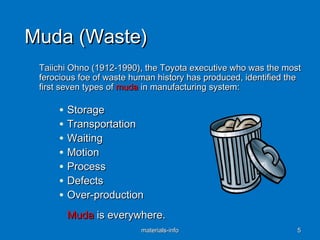
Muda (Waste)Muda (Waste)
Taiichi Ohno (1912-1990), the Toyota executive who was the mostTaiichi Ohno (1912-1990), the Toyota executive who was the most
ferocious foe of waste human history has produced, identified theferocious foe of waste human history has produced, identified the
first seven types offirst seven types of mudamuda in manufacturing system:in manufacturing system:
• StorageStorage
• TransportationTransportation
• WaitingWaiting
• MotionMotion
• ProcessProcess
• DefectsDefects
• Over-productionOver-production
MudaMuda is everywhere.is everywhere.
materials-infomaterials-info 55
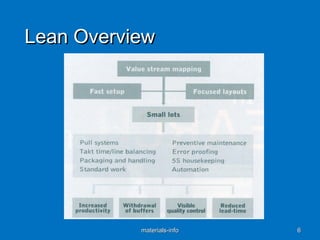
Lean OverviewLean Overview
materials-infomaterials-info 66
Lean Manufacturing ToolsLean Manufacturing Tools
 5S5S
 Value Stream MappingValue Stream Mapping
 Standardized WorkStandardized Work
 Load LevelingLoad Leveling
 KaizenKaizen
 KanbanKanban
 Visual WorkplaceVisual Workplace
 Quick ChangeoverQuick Changeover
 AndonAndon
 Poka-yokePoka-yoke
One-piece flowOne-piece flow
Cellular ManufacturingCellular Manufacturing
materials-infomaterials-info 77
SIX SIGMA PHASES
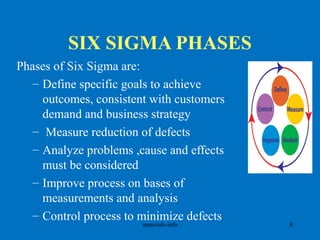
Phases of Six Sigma are:
– Define specific goals to achieve
outcomes, consistent with customers
demand and business strategy
– Measure reduction of defects
– Analyze problems ,cause and effects
must be considered
– Improve process on bases of
measurements and analysis
– Control process to minimize defects
materials-info 8
WHAT IS DMADV?
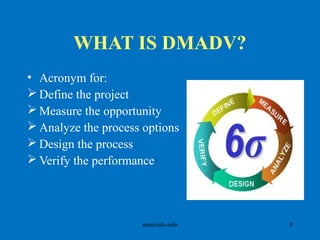
• Acronym for:
 Define the project
 Measure the opportunity
 Analyze the process options
 Design the process
 Verify the performance
materials-info 9
WHEN SHOULD SIX SIGMA
BE USED?
Its usage depends on the type of business. In general,
“If there are processes that generate a lot of
negative customer feedback, whether that
customer is internal or external, the components
of Six Sigma should be considered as a means to
study and rectify the problem.”
materials-info 10
BENEFITS OF SIX SIGMA
• Generates sustained success
• Sets performance goal for everyone
• Enhances value for customers
• Accelerates rate of improvement
• Promotes learning across boundaries
• Executes strategic change
materials-info 11
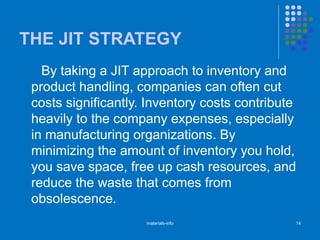
USAGE OF SIX SIGMA
materials-info 12
SIX SIGMA MANAGEMENT
When practiced as a management system, Six Sigma
is a high performance system for executing
business strategy.
Six Sigma is a top down solution to help
organizations:
• Align their business strategy to critical
improvement efforts
• Mobilize teams to attack high impact projects
• Accelerate improved business results
• Govern efforts to ensure improvements are
sustained materials-info 13
THE JIT STRATEGY
By taking a JIT approach to inventory and
product handling, companies can often cut
costs significantly. Inventory costs contribute
heavily to the company expenses, especially
in manufacturing organizations. By
minimizing the amount of inventory you hold,
you save space, free up cash resources, and
reduce the waste that comes from
obsolescence.
materials-info 14
JIT SYSTEMS
To facilitate a JIT approach, you need a
variety of systems in place. The most
notable is a kanban. This is a Japanese
approach to ensuring a continuous supply
of inventory or product. Kanbans were
designed to support the JIT philosophy.
materials-info 15
10 Basic Rules of Kaizen
Discard conventional fixed ideas for
production.
Think of how to do it, not why it cannot be
done.
Do not make excuses ... question current
practices.
Do not wait for perfection ... do it right
away.
Correct mistakes at once ... DO NOT
HURT THE CUSTOMERmaterials-info 16
10 Basic Rules of Kaizen
Optimize current equipment and
resources. Do not plan on spending big
money.
Wisdom is brought about when faced with
hardship, and when all can see and feel
the ‘waste’.
Ask ‘why’ five times and seek root causes.
Seek the wisdom of 10 rather than the
knowledge of 1.
Kaizen never stops.
materials-info 17
SMED ( TPM)
» A quick way of changing the “setup”
from one “thing” to another.
» Also known as Quick Changeover,
reducing the time it takes to setup for the
next “kind of thing”
» Examples of “setups”
• Welding Steel, then welding
Aluminum
SMED ( TPM)
• Changing from Accounts Payable to
Receivable
• Changing from one size drill bit to
another
» It Helps to:
• Reduce the need for large
batches/inventory
• Reduce Handling waste (transportation)
Smaller batch sizes help align output with
the needs and requests of the
customer
» Less inventory means defects will be
easier to find and resolve
» Less inventory means raw materials
will wait less
» Modifies the “economic lot size”
calculation
» Increases uptime of ……. equip, people,
systems
SMED ( TPM)
OTHER AREAS
Demonstrating structured problem solving
method and driving the same throughout the
organization
7 steps of Quality management right from
Quality planning to handing over to
manufacturing
Support to establish and implement Quality
systems
Driving the production system in Toyota way
of efficient manufacturing systemmaterials-info 21
Materials Info : Your partners for
Processes
Your Pain Areas
1. Receipt stage:
•Material not to spec
•Process related issues
•Surface protection
•Other issues
materials-info 22
Materials Info : Your partners for
Processes
Our solutions :
Working with your suppliers to reduce
rejections in the incoming stage for
materials/processes, Thus increasing your
response time for new developments.
2. Field failure i.e IPTV
Our solutions:
Working closely on your field failure/IPTV
materials-info 23
Materials Info : Your partners for
Processes
Data and carry out root cause analysis to
bring down IPTV, thus improving reliability of
the product and improving brand image
3. In process rejections:
Our solutions :
1.Working through your complete process
flow
2.Finding out the specific root cause for the
materials-info 24
Materials Info : Your partners for
Processes
Rejection to bring down , thus resulting in
improved productivity, reduction in cost
associated with the rejections.
4. Low Process yield :
Our solutions :
1.Study of the complete manufacturing
process at all stages
2.Optimizing the process to improve yield.
materials-info 25
Materials Info : Your partners for
Processes
5. High development time for new products:
Our solutions :
1.Study of the complete process for new
project introduction.
2.Working on all stages of new product
development
3.Finding out the bottleneck areas
4.Plugging the same to reduce the
materials-info 26
Materials Info : Your partners for
Processes
Development time and thus increasing
response for new developments
6. High DMC ( Direct material cost) :
Our solutions :
1. Study of the complete design stages
2. Study the application of the part and
associated load/working
stresses/environment
materials-info 27
Materials Info : Your partners for
Processes
3. Suggest optimization of part and alternate
grade /type materials to reduce cost.
7.High cost of Imported Raw
material/steel/components:
Our solutions:
1. Study the application in detail
2. Work with the steel mills/raw material
source/component manufacturer
materials-info 28
Materials Info : Your partners for
Processes
8. Delay in response/developing export
applications:
Our solutions:
1.Study of the raw material , standards and
equivalent
2.Study of the whole manufacturing process
spec and sequence
materials-info 29
Materials Info : Your partners for
Processes
9. Delay in taking up projects intensive to
new materials/processes/surface protection
adding value to customer :
Our solutions:
1.Benchmarking for various materials and
processes
2.Trend analysis for new developments in
materials and processes
materials-info 30
Materials Info : Your partners for
Processes
3. Start pilot study /trials for the same
4. Project introduction
10.Lack of Early Vendor involvement:
Our solutions:
1. Involving your vendors in early stage of
development.
2. Working with them continuously to bring
down process and material costs
materials-info 31

materials info

  • 1.
    Materials Info :Your partners for Processes Areas : Lean Manufacturing, Six sigma, Change management, business excellence, Process improvement from customer perception, TQM, TPM, Quality systems and materials/processes Raghvendra Gopal CEO, Materials-info.com materials-info 1
  • 2.
    Materials Info :Your partners for Processes We address your processes to increase efficiency, reduce rejections and improve overall Quality and reliability •Lean manufacturing •Six Sigma •Kan Ban •Kaizen •SMED and others materials-info 2
  • 3.
    Materials Info :Your partners for Processes • Structured problem solving methods like 8D, QC story • TQM • ISO9000, ISOTS and OSHAS • Process capability • Toyota production system • Your materials and manufacturing processes materials-info 3
  • 4.
    Lean Manufacturing DefinitionLeanManufacturing Definition Lean has been defined in many different ways.Lean has been defined in many different ways. ““A systematic approach toA systematic approach to identifying and eliminatingidentifying and eliminating wastewaste(non-value-added activities) through(non-value-added activities) through continuouscontinuous improvementimprovement by flowing the product at theby flowing the product at the pullpull of theof the customer in pursuit of perfection.”customer in pursuit of perfection.” materials-infomaterials-info 44
  • 5.
    Muda (Waste)Muda (Waste) TaiichiOhno (1912-1990), the Toyota executive who was the mostTaiichi Ohno (1912-1990), the Toyota executive who was the most ferocious foe of waste human history has produced, identified theferocious foe of waste human history has produced, identified the first seven types offirst seven types of mudamuda in manufacturing system:in manufacturing system: • StorageStorage • TransportationTransportation • WaitingWaiting • MotionMotion • ProcessProcess • DefectsDefects • Over-productionOver-production MudaMuda is everywhere.is everywhere. materials-infomaterials-info 55
  • 6.
  • 7.
    Lean Manufacturing ToolsLeanManufacturing Tools  5S5S  Value Stream MappingValue Stream Mapping  Standardized WorkStandardized Work  Load LevelingLoad Leveling  KaizenKaizen  KanbanKanban  Visual WorkplaceVisual Workplace  Quick ChangeoverQuick Changeover  AndonAndon  Poka-yokePoka-yoke One-piece flowOne-piece flow Cellular ManufacturingCellular Manufacturing materials-infomaterials-info 77
  • 8.
    SIX SIGMA PHASES Phasesof Six Sigma are: – Define specific goals to achieve outcomes, consistent with customers demand and business strategy – Measure reduction of defects – Analyze problems ,cause and effects must be considered – Improve process on bases of measurements and analysis – Control process to minimize defects materials-info 8
  • 9.
    WHAT IS DMADV? •Acronym for:  Define the project  Measure the opportunity  Analyze the process options  Design the process  Verify the performance materials-info 9
  • 10.
    WHEN SHOULD SIXSIGMA BE USED? Its usage depends on the type of business. In general, “If there are processes that generate a lot of negative customer feedback, whether that customer is internal or external, the components of Six Sigma should be considered as a means to study and rectify the problem.” materials-info 10
  • 11.
    BENEFITS OF SIXSIGMA • Generates sustained success • Sets performance goal for everyone • Enhances value for customers • Accelerates rate of improvement • Promotes learning across boundaries • Executes strategic change materials-info 11
  • 12.
    USAGE OF SIXSIGMA materials-info 12
  • 13.
    SIX SIGMA MANAGEMENT Whenpracticed as a management system, Six Sigma is a high performance system for executing business strategy. Six Sigma is a top down solution to help organizations: • Align their business strategy to critical improvement efforts • Mobilize teams to attack high impact projects • Accelerate improved business results • Govern efforts to ensure improvements are sustained materials-info 13
  • 14.
    THE JIT STRATEGY Bytaking a JIT approach to inventory and product handling, companies can often cut costs significantly. Inventory costs contribute heavily to the company expenses, especially in manufacturing organizations. By minimizing the amount of inventory you hold, you save space, free up cash resources, and reduce the waste that comes from obsolescence. materials-info 14
  • 15.
    JIT SYSTEMS To facilitatea JIT approach, you need a variety of systems in place. The most notable is a kanban. This is a Japanese approach to ensuring a continuous supply of inventory or product. Kanbans were designed to support the JIT philosophy. materials-info 15
  • 16.
    10 Basic Rulesof Kaizen Discard conventional fixed ideas for production. Think of how to do it, not why it cannot be done. Do not make excuses ... question current practices. Do not wait for perfection ... do it right away. Correct mistakes at once ... DO NOT HURT THE CUSTOMERmaterials-info 16
  • 17.
    10 Basic Rulesof Kaizen Optimize current equipment and resources. Do not plan on spending big money. Wisdom is brought about when faced with hardship, and when all can see and feel the ‘waste’. Ask ‘why’ five times and seek root causes. Seek the wisdom of 10 rather than the knowledge of 1. Kaizen never stops. materials-info 17
  • 18.
    SMED ( TPM) »A quick way of changing the “setup” from one “thing” to another. » Also known as Quick Changeover, reducing the time it takes to setup for the next “kind of thing” » Examples of “setups” • Welding Steel, then welding Aluminum
  • 19.
    SMED ( TPM) •Changing from Accounts Payable to Receivable • Changing from one size drill bit to another » It Helps to: • Reduce the need for large batches/inventory • Reduce Handling waste (transportation)
  • 20.
    Smaller batch sizeshelp align output with the needs and requests of the customer » Less inventory means defects will be easier to find and resolve » Less inventory means raw materials will wait less » Modifies the “economic lot size” calculation » Increases uptime of ……. equip, people, systems SMED ( TPM)
  • 21.
    OTHER AREAS Demonstrating structuredproblem solving method and driving the same throughout the organization 7 steps of Quality management right from Quality planning to handing over to manufacturing Support to establish and implement Quality systems Driving the production system in Toyota way of efficient manufacturing systemmaterials-info 21
  • 22.
    Materials Info :Your partners for Processes Your Pain Areas 1. Receipt stage: •Material not to spec •Process related issues •Surface protection •Other issues materials-info 22
  • 23.
    Materials Info :Your partners for Processes Our solutions : Working with your suppliers to reduce rejections in the incoming stage for materials/processes, Thus increasing your response time for new developments. 2. Field failure i.e IPTV Our solutions: Working closely on your field failure/IPTV materials-info 23
  • 24.
    Materials Info :Your partners for Processes Data and carry out root cause analysis to bring down IPTV, thus improving reliability of the product and improving brand image 3. In process rejections: Our solutions : 1.Working through your complete process flow 2.Finding out the specific root cause for the materials-info 24
  • 25.
    Materials Info :Your partners for Processes Rejection to bring down , thus resulting in improved productivity, reduction in cost associated with the rejections. 4. Low Process yield : Our solutions : 1.Study of the complete manufacturing process at all stages 2.Optimizing the process to improve yield. materials-info 25
  • 26.
    Materials Info :Your partners for Processes 5. High development time for new products: Our solutions : 1.Study of the complete process for new project introduction. 2.Working on all stages of new product development 3.Finding out the bottleneck areas 4.Plugging the same to reduce the materials-info 26
  • 27.
    Materials Info :Your partners for Processes Development time and thus increasing response for new developments 6. High DMC ( Direct material cost) : Our solutions : 1. Study of the complete design stages 2. Study the application of the part and associated load/working stresses/environment materials-info 27
  • 28.
    Materials Info :Your partners for Processes 3. Suggest optimization of part and alternate grade /type materials to reduce cost. 7.High cost of Imported Raw material/steel/components: Our solutions: 1. Study the application in detail 2. Work with the steel mills/raw material source/component manufacturer materials-info 28
  • 29.
    Materials Info :Your partners for Processes 8. Delay in response/developing export applications: Our solutions: 1.Study of the raw material , standards and equivalent 2.Study of the whole manufacturing process spec and sequence materials-info 29
  • 30.
    Materials Info :Your partners for Processes 9. Delay in taking up projects intensive to new materials/processes/surface protection adding value to customer : Our solutions: 1.Benchmarking for various materials and processes 2.Trend analysis for new developments in materials and processes materials-info 30
  • 31.
    Materials Info :Your partners for Processes 3. Start pilot study /trials for the same 4. Project introduction 10.Lack of Early Vendor involvement: Our solutions: 1. Involving your vendors in early stage of development. 2. Working with them continuously to bring down process and material costs materials-info 31

Editor's Notes

  • #9 Define: Define is the first step in the process. In this step, it is important to define specific goals in achieving outcomes that are consistent with both your customer’s demands and your own business’s strategy. In essence, you are laying down a road map for accomplishment. Measure: In order to determine whether or not defects have been reduced, you need a base measurement. In this step, accurate measurements must be made and relevant data must be collected so that future comparisons can be measured to determine whether or not defects have been reduced. Analyze: Analysis is extremely important to determine relationships and the factors of causality. If you are trying to understand how to fix a problem, cause and effect is extremely necessary and must be considered. Improve: Making improvements or optimizing your processes based on measurements and analysis can ensure that defects are lowered and processes are streamlined. Control: This is the last step in the DMAIC methodology. Control ensures that any variances stand out and are corrected before they can influence a process negatively causing defects. Controls can be in the form of pilot runs to determine if the processes are capable and then once data is collected, a process can transition into standard production. However, continued measurement and analysis must ensue to keep processes on track and free of defects below the Six Sigma limit.