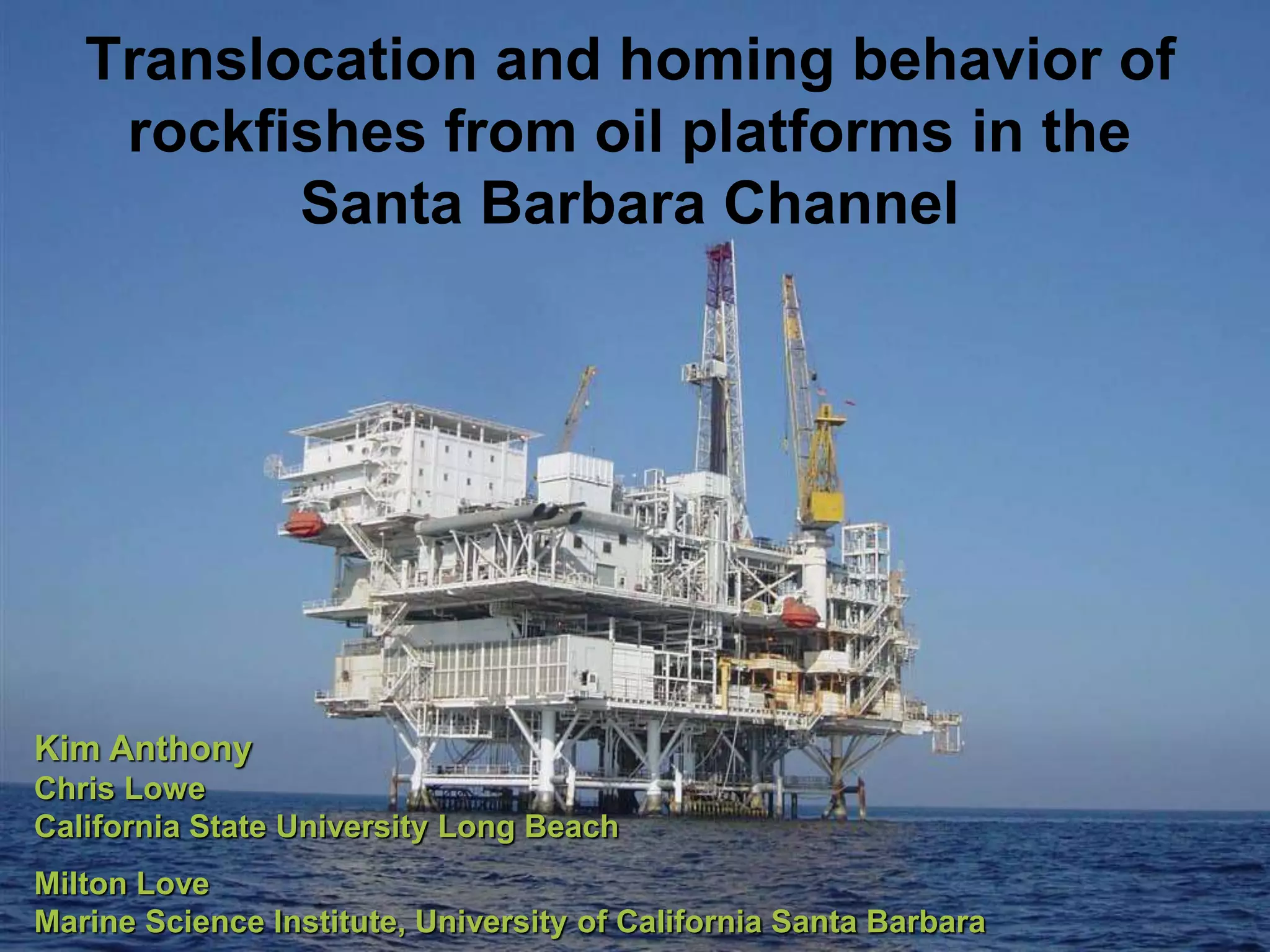
Translocation and homing behavior of
rockfishes from oil platforms in the
Santa Barbara Channel
Kim Anthony
Chris Lowe
California State University Long Beach
Milton Love
Marine Science Institute, University of California Santa Barbara
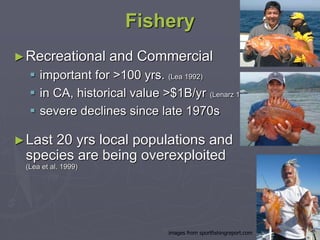
►Last 20 yrs local populations and
species are being overexploited
(Lea et al. 1999)
Fishery
►Recreational and Commercial
 important for >100 yrs. (Lea 1992)
 in CA, historical value >$1B/yr (Lenarz 1986)
 severe declines since late 1970s
images from sportfishingreport.com
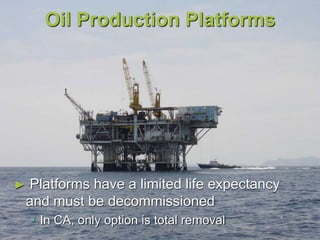
Oil Production Platforms
► Platforms have a limited life expectancy
and must be decommissioned
 In CA, only option is total removal
Delta Sub Surveys
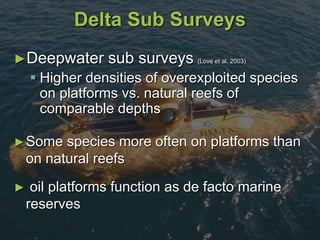
►Deepwater sub surveys (Love et al. 2003)
 Higher densities of overexploited species
on platforms vs. natural reefs of
comparable depths
►Some species more often on platforms than
on natural reefs
► oil platforms function as de facto marine
reserves
Decommissioning & Mitigation
►Explosives fatally concuss all fish with swim
bladder around platform (Bull & Kendall 1992)
►Decommissioning process removes habitat
►Mitigate effects of decommissioning in CA
 translocate fish from platform
 salvage platform-associated rockfish/groundfish
 seed nearby natural reefs
 implications to resource management decisions
Rockfish Movement
► Previous displacement experiments
 Yellowtail: 22.5 km (Carlson & Haight 1972)
 Copper, quillback, brown: 3.2 – 8.0 km
(Matthews 1990)
 Lingcod / 2.8 km (Matthews 1992)
► Site fidelity study 2004-2006 (Lowe et al. in review)
 Fidelity to platforms highly variable across
species and among individuals
 Movement between platforms (5-6 km)
Goals
► Tag 80 platform-associated groundfishes
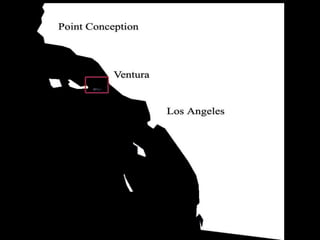
► Translocate them to Anacapa Island Marine
Reserve
► Determine homing events and differences
among species
► Assess movement patterns
► HA: Translocated fish will home back to oil
platforms from Anacapa even if provided
with suitable habitat of comparable depth
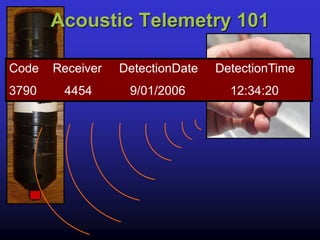
Acoustic Telemetry 101
Code Receiver DetectionDate DetectionTime
3790 4454 9/01/2006 12:34:20
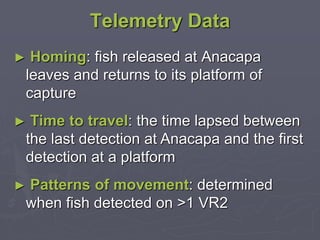
Telemetry Data
► Homing: fish released at Anacapa
leaves and returns to its platform of
capture
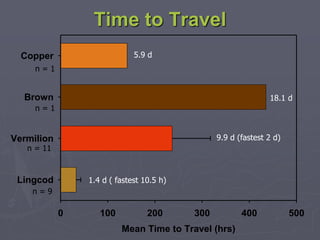
► Time to travel: the time lapsed between
the last detection at Anacapa and the first
detection at a platform
► Patterns of movement: determined
when fish detected on >1 VR2
225 m
64 m
90 m
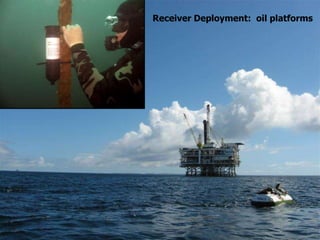
Receiver Deployment: oil platforms
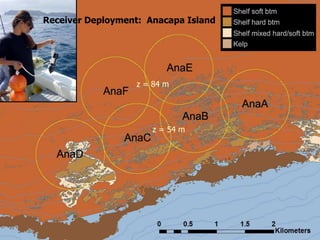
z = 84 m
z = 54 m
Receiver Deployment: Anacapa Island
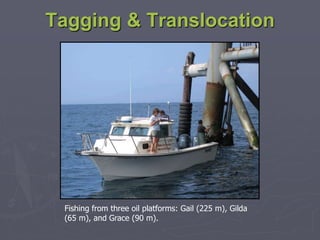
Tagging & Translocation
Fishing from three oil platforms: Gail (225 m), Gilda
(65 m), and Grace (90 m).
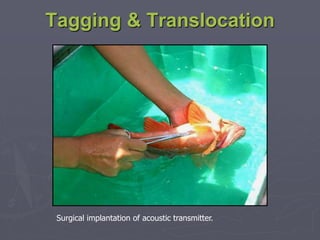
Tagging & Translocation
Surgical implantation of acoustic transmitter.
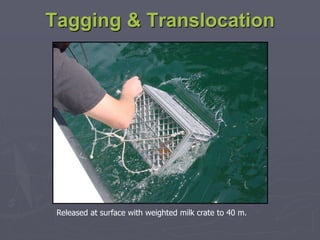
Tagging & Translocation
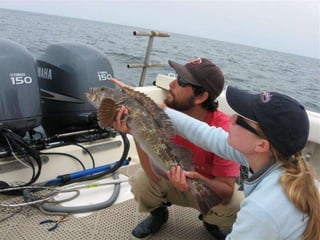
Released at surface with weighted milk crate to 40 m.
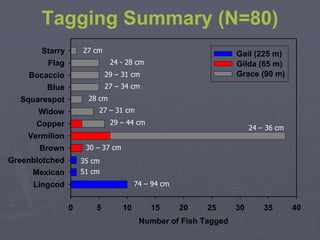
Tagging Summary (N=80)
Number of Fish Tagged
0 5 10 15 20 25 30 35 40
Lingcod
Mexican
Greenblotched
Brown
Vermilion
Copper
Widow
Squarespot
Blue
Bocaccio
Flag
Starry Gail (225 m)
Gilda (65 m)
Grace (90 m)
27 cm
29 – 31 cm
24 - 28 cm
28 cm
27 – 34 cm
27 – 31 cm
29 – 44 cm
24 – 36 cm
35 cm
30 – 37 cm
51 cm
74 – 94 cm
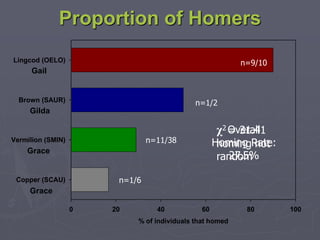
Lingcod (OELO)
Vermilion (SMIN)
Copper (SCAU)
Brown (SAUR)
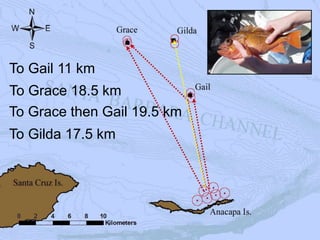
To Gail 11 km
To Grace 18.5 km
To Grace then Gail 19.5 km
To Gilda 17.5 km
% of individuals that homed
0 20 40 60 80 100
Copper (SCAU)
Vermilion (SMIN)
Brown (SAUR)
Lingcod (OELO)
Proportion of Homers
n=9/10
n=1/2
n=11/38
n=1/6
Gail
Gilda
Grace
Grace
χ2 = 31.41
homing not
random
Overall
Homing Rate:
27.5%
Mean Time to Travel (hrs)
0 100 200 300 400 500
Lingcod
Vermilion
Brown
Copper
Time to Travel
5.9 d
18.1 d
9.9 d (fastest 2 d)
1.4 d ( fastest 10.5 h)
n = 1
n = 1
n = 11
n = 9
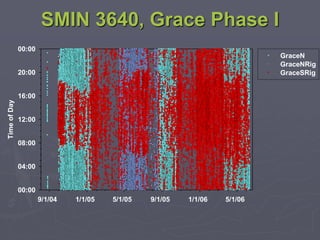
SMIN 3640, Grace Phase I
9/1/04 1/1/05 5/1/05 9/1/05 1/1/06 5/1/06
TimeofDay
00:00
04:00
08:00
12:00
16:00
20:00
00:00
GraceN
GraceNRig
GraceSRig
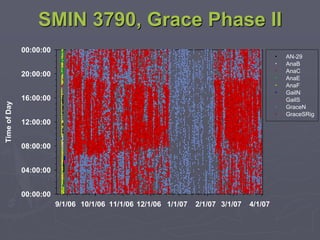
SMIN 3790, Grace Phase II
9/1/06 10/1/06 11/1/06 12/1/06 1/1/07 2/1/07 3/1/07 4/1/07
TimeofDay
00:00:00
04:00:00
08:00:00
12:00:00
16:00:00
20:00:00
00:00:00
AN-29
AnaB
AnaC
AnaE
AnaF
GailN
GailS
GraceN
GraceSRig
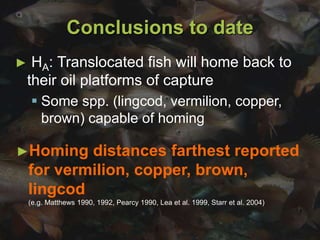
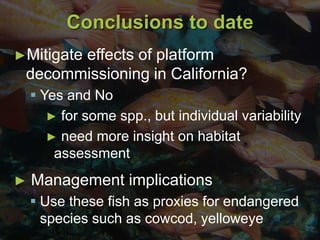
Conclusions to date
► HA: Translocated fish will home back to
their oil platforms of capture
 Some spp. (lingcod, vermilion, copper,
brown) capable of homing
►Homing distances farthest reported
for vermilion, copper, brown,
lingcod
(e.g. Matthews 1990, 1992, Pearcy 1990, Lea et al. 1999, Starr et al. 2004)
Conclusions to date
► Management implications
 Use these fish as proxies for endangered
species such as cowcod, yelloweye
►Mitigate effects of platform
decommissioning in California?
 Yes and No
► for some spp., but individual variability
► need more insight on habitat
assessment
Minerals Management Service
SCTC Marine Biology Foundation
Donald J. Reish Student Grant for Marine Bio Rsch
Richard B. Loomis Research Award
Bonnie “Jig” Rogers, Ann Bull, Merit McCrea, Jeff Barr, Carlos Mireles, Kerri Loke, Scott
Meckstroth, Gary Hurd, Corey Mead, Erica Jarvis, Tom Mason, Lewis Barnett, Chris Mull,
Heather Gliniak, John de la Cuesta, Adel Rajab, Mike Sundberg
Southern California Marine Institute
Alvaro Monge, Computer Science & Engineering for database support
Pfleger Institute for Environmental Research (James Lindholm, Ashley Knight)
Venoco Inc. (Joe Hollis, Jim Rickman, Tony Martinez, Vanita Menapace, Larry Mancini)
DCOR LLC (Scott Robertson, Raoul Pena, Doug Archer, Jim Schulte)
Ventura Harbor Master & Patrol (Scott Miller, Bobby Crane,
Tim Burrows, George Kabris, Jon Freeman,
John Higgins, Chris Emery)
Dave’s Fuel Dock (Mark)
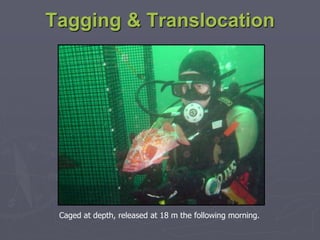
Tagging & Translocation
Caged at depth, released at 18 m the following morning.

Anthony WSN 2007 Honorable Mention

  • 1.
    Translocation and homingbehavior of rockfishes from oil platforms in the Santa Barbara Channel Kim Anthony Chris Lowe California State University Long Beach Milton Love Marine Science Institute, University of California Santa Barbara
  • 2.
    ►Last 20 yrslocal populations and species are being overexploited (Lea et al. 1999) Fishery ►Recreational and Commercial  important for >100 yrs. (Lea 1992)  in CA, historical value >$1B/yr (Lenarz 1986)  severe declines since late 1970s images from sportfishingreport.com
  • 3.
    Oil Production Platforms ►Platforms have a limited life expectancy and must be decommissioned  In CA, only option is total removal
  • 4.
    Delta Sub Surveys ►Deepwatersub surveys (Love et al. 2003)  Higher densities of overexploited species on platforms vs. natural reefs of comparable depths ►Some species more often on platforms than on natural reefs ► oil platforms function as de facto marine reserves
  • 5.
    Decommissioning & Mitigation ►Explosivesfatally concuss all fish with swim bladder around platform (Bull & Kendall 1992) ►Decommissioning process removes habitat ►Mitigate effects of decommissioning in CA  translocate fish from platform  salvage platform-associated rockfish/groundfish  seed nearby natural reefs  implications to resource management decisions
  • 6.
    Rockfish Movement ► Previousdisplacement experiments  Yellowtail: 22.5 km (Carlson & Haight 1972)  Copper, quillback, brown: 3.2 – 8.0 km (Matthews 1990)  Lingcod / 2.8 km (Matthews 1992) ► Site fidelity study 2004-2006 (Lowe et al. in review)  Fidelity to platforms highly variable across species and among individuals  Movement between platforms (5-6 km)
  • 7.
    Goals ► Tag 80platform-associated groundfishes ► Translocate them to Anacapa Island Marine Reserve ► Determine homing events and differences among species ► Assess movement patterns ► HA: Translocated fish will home back to oil platforms from Anacapa even if provided with suitable habitat of comparable depth
  • 8.
    Acoustic Telemetry 101 CodeReceiver DetectionDate DetectionTime 3790 4454 9/01/2006 12:34:20
  • 9.
    Telemetry Data ► Homing:fish released at Anacapa leaves and returns to its platform of capture ► Time to travel: the time lapsed between the last detection at Anacapa and the first detection at a platform ► Patterns of movement: determined when fish detected on >1 VR2
  • 10.
  • 11.
  • 12.
    z = 84m z = 54 m Receiver Deployment: Anacapa Island
  • 13.
    Tagging & Translocation Fishingfrom three oil platforms: Gail (225 m), Gilda (65 m), and Grace (90 m).
  • 14.
    Tagging & Translocation Surgicalimplantation of acoustic transmitter.
  • 15.
    Tagging & Translocation Releasedat surface with weighted milk crate to 40 m.
  • 16.
    Tagging Summary (N=80) Numberof Fish Tagged 0 5 10 15 20 25 30 35 40 Lingcod Mexican Greenblotched Brown Vermilion Copper Widow Squarespot Blue Bocaccio Flag Starry Gail (225 m) Gilda (65 m) Grace (90 m) 27 cm 29 – 31 cm 24 - 28 cm 28 cm 27 – 34 cm 27 – 31 cm 29 – 44 cm 24 – 36 cm 35 cm 30 – 37 cm 51 cm 74 – 94 cm
  • 17.
    Lingcod (OELO) Vermilion (SMIN) Copper(SCAU) Brown (SAUR) To Gail 11 km To Grace 18.5 km To Grace then Gail 19.5 km To Gilda 17.5 km
  • 19.
    % of individualsthat homed 0 20 40 60 80 100 Copper (SCAU) Vermilion (SMIN) Brown (SAUR) Lingcod (OELO) Proportion of Homers n=9/10 n=1/2 n=11/38 n=1/6 Gail Gilda Grace Grace χ2 = 31.41 homing not random Overall Homing Rate: 27.5%
  • 20.
    Mean Time toTravel (hrs) 0 100 200 300 400 500 Lingcod Vermilion Brown Copper Time to Travel 5.9 d 18.1 d 9.9 d (fastest 2 d) 1.4 d ( fastest 10.5 h) n = 1 n = 1 n = 11 n = 9
  • 21.
    SMIN 3640, GracePhase I 9/1/04 1/1/05 5/1/05 9/1/05 1/1/06 5/1/06 TimeofDay 00:00 04:00 08:00 12:00 16:00 20:00 00:00 GraceN GraceNRig GraceSRig
  • 22.
    SMIN 3790, GracePhase II 9/1/06 10/1/06 11/1/06 12/1/06 1/1/07 2/1/07 3/1/07 4/1/07 TimeofDay 00:00:00 04:00:00 08:00:00 12:00:00 16:00:00 20:00:00 00:00:00 AN-29 AnaB AnaC AnaE AnaF GailN GailS GraceN GraceSRig
  • 23.
    Conclusions to date ►HA: Translocated fish will home back to their oil platforms of capture  Some spp. (lingcod, vermilion, copper, brown) capable of homing ►Homing distances farthest reported for vermilion, copper, brown, lingcod (e.g. Matthews 1990, 1992, Pearcy 1990, Lea et al. 1999, Starr et al. 2004)
  • 24.
    Conclusions to date ►Management implications  Use these fish as proxies for endangered species such as cowcod, yelloweye ►Mitigate effects of platform decommissioning in California?  Yes and No ► for some spp., but individual variability ► need more insight on habitat assessment
  • 25.
    Minerals Management Service SCTCMarine Biology Foundation Donald J. Reish Student Grant for Marine Bio Rsch Richard B. Loomis Research Award Bonnie “Jig” Rogers, Ann Bull, Merit McCrea, Jeff Barr, Carlos Mireles, Kerri Loke, Scott Meckstroth, Gary Hurd, Corey Mead, Erica Jarvis, Tom Mason, Lewis Barnett, Chris Mull, Heather Gliniak, John de la Cuesta, Adel Rajab, Mike Sundberg Southern California Marine Institute Alvaro Monge, Computer Science & Engineering for database support Pfleger Institute for Environmental Research (James Lindholm, Ashley Knight) Venoco Inc. (Joe Hollis, Jim Rickman, Tony Martinez, Vanita Menapace, Larry Mancini) DCOR LLC (Scott Robertson, Raoul Pena, Doug Archer, Jim Schulte) Ventura Harbor Master & Patrol (Scott Miller, Bobby Crane, Tim Burrows, George Kabris, Jon Freeman, John Higgins, Chris Emery) Dave’s Fuel Dock (Mark)
  • 26.
    Tagging & Translocation Cagedat depth, released at 18 m the following morning.