Inventory
Definition
“The term inventoryinclude materials- raw, in
progress, finished packaging, spares, and
other stock in order to meet an un
expected demand or distribution in the
future.”
3.
Inventory management &control
Inventory management involves the:
“Development and administration of
policies systems and procedures, which
will minimize total cost related to
inventory decisions and related functions
such as production scheduling, purchasing
and traffic”.
4.
What is EOQ?
Economic order quantity is one of the
techniques of inventory control which
minimizes total holding and ordering costs
for the year.
The economic order quantity is the
technique which solves the problem of the
materials manager.
5.
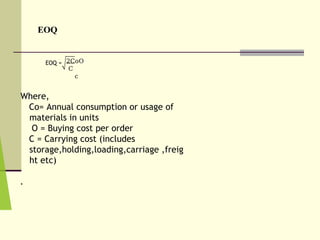
EOQ
EOQ = 2CoO
C
c
Where,
Co=Annual consumption or usage of
materials in units
O = Buying cost per order
C = Carrying cost (includes
storage,holding,loading,carriage ,freig
ht etc)
.
6.
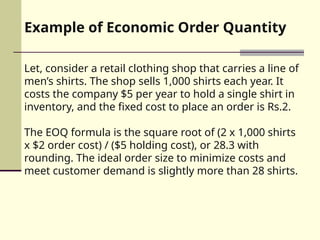
Example of EconomicOrder Quantity
Let, consider a retail clothing shop that carries a line of
men’s shirts. The shop sells 1,000 shirts each year. It
costs the company $5 per year to hold a single shirt in
inventory, and the fixed cost to place an order is Rs.2.
The EOQ formula is the square root of (2 x 1,000 shirts
x $2 order cost) / ($5 holding cost), or 28.3 with
rounding. The ideal order size to minimize costs and
meet customer demand is slightly more than 28 shirts.
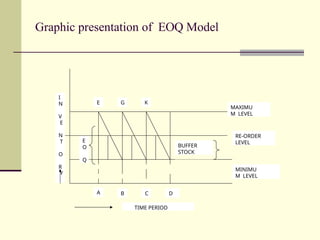
Graphic presentation ofEOQ Model
E
O
Q
RE-ORDER
LEVEL
BUFFER
STOCK
MAXIMU
M LEVEL
MINIMU
M LEVEL
E G
I
N
V
E
N
T
O
R
Y
TIME PERIOD
K
A B C D
9.
Advantages and limitationsof EOQ
• EOQ assumes that demand, ordering, and holding costs all
remain constant over time.
• The basis for the EOQ formula assumes that consumer
demand is constant. The calculation also assumes that both
ordering and holding costs remain constant.
• These assumptions make it difficult, if not impossible, to
account for unpredictable business events, such as changing
consumer demand, seasonal changes in inventory costs, lost
sales revenue due to inventory shortages, or purchase
discounts a company might get for buying inventory in larger
quantities.
10.
Limitations of EOQmodels
• Erratic Usages
• Faulty basic Information
• Costly Calculations
• No formula Substitute for Commonsense
• EOQ Ordering must be
tempered Judgment
with
11.
DETERMINATION OF MATERIAL
LEVELSAND STOCK LEVELS:
▶ Proper maintenance of stock items of each type of material is the main
function of stores department. Maintenance of large quantity of stock leads to
huge investment in materials, large space usage, dangers of deterioration in
the quality and obsolescence of materials .On the other hand, less stock may
result in frequent purchase ,higher costs, work stoppages, loss in production,
etc. Inorder to avoid overstocking and understocking od materials in the
storeroom, different levels of stocks are fixed.
They are:
1.Re-order level
2.Maximum level
3.Minimum level
4.Average level
5.Danger level
12.
RE-ORDER LEVEL
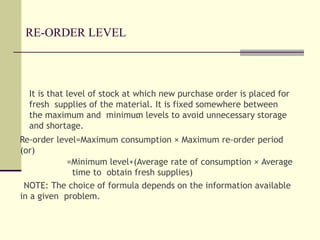
It isthat level of stock at which new purchase order is placed for
fresh supplies of the material. It is fixed somewhere between
the maximum and minimum levels to avoid unnecessary storage
and shortage.
Re-order level=Maximum consumption × Maximum re-order period
(or)
=Minimum level+(Average rate of consumption × Average
time to obtain fresh supplies)
NOTE: The choice of formula depends on the information available
in a given problem.
13.
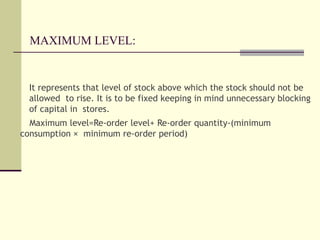
MAXIMUM LEVEL:
It representsthat level of stock above which the stock should not be
allowed to rise. It is to be fixed keeping in mind unnecessary blocking
of capital in stores.
Maximum level=Re-order level+ Re-order quantity-(minimum
consumption × minimum re-order period)
14.
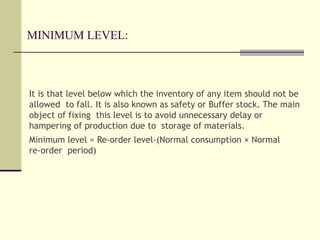
MINIMUM LEVEL:
It isthat level below which the inventory of any item should not be
allowed to fall. It is also known as safety or Buffer stock. The main
object of fixing this level is to avoid unnecessary delay or
hampering of production due to storage of materials.
Minimum level = Re-order level-(Normal consumption × Normal
re-order period)
15.
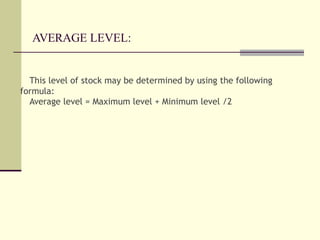
AVERAGE LEVEL:
This levelof stock may be determined by using the following
formula:
Average level = Maximum level + Minimum level /2