The document examines various career opportunities in the ICT sector, including roles in programming, graphic design, cybersecurity, and telecommunications. It emphasizes the importance of understanding these sectors and highlights the growing demand for ICT skills combined with communication abilities. Learners are encouraged to reflect on their interests and aspirations within the ICT field.
1.What are theICT sector and career opportunities
you were able to find?
2. Are you familiar with those sectors?
3. What aspects are they common with?
4. Among these ICT career opportunities, what
career do you want to pursue? Note and assess the
learners’ responses.
3.
Why is itimportant to understand the
different sectors of ICT and the career
opportunities they offer?
4.
• Animation Aseries of pictures or frames created to simulate
movement.
• ICT sectors combine manufacturing and services industries whose
products primarily fulfil or enable the function of information processing
and communication by electronic means, including transmission and
display.
• Graphic designers create visual concepts, using computer software
or by hand, to communicate ideas that inspire, inform, and captivate
consumers.
• Computer security, cybersecurity, digital security, or information
technology security is the protection of computer systems and networks
from attacks by malicious actors that may result in unauthorized access.
• Computer Systems Servicing refers to the process of providing
maintenance and support for computer systems. It involves tasks such as
installing, configuring, troubleshooting, and maintaining computer systems
and networks.
5.
ICT plays asignificant role nowadays. ICT or Information and
Communications Technology stresses the role of unified
communications and the integration of telecommunications
(telephone lines and wireless signals) and computers, as well as
necessary enterprise software, middleware, storage, and
audiovisual, that enable users to access, store, transmit,
understand, and manipulate information. The creation,
production, commercialization, and widespread use of new
technology are the major operations carried out by the
manufacturing and service sectors that comprise the ICT sector.
ICT skills are becoming more in demand, and organizations might
benefit from combining these with
6.
communication abilities inPublic Relations,
advertising, and media communications.
Here are the different preferences when it
comes to choosing career paths. It covers
career opportunities in ICT sectors such as
Programming, Visual Arts, Computer
System Servicing, and
Telecommunications.
7.
Computer Programming- Programmingskills are
essential for many technology disciplines but are
in especially high demand for software and web
development roles.
Programmer - professionals who write and test
code to enable applications and software
programs to run successfully on a computer in
order to create instructions for the machine to
follow.
Source:
9.
What do computerprogrammers do?
Writing and testing code for new programs. Computer programmers
work closely with web and software developers to write code for new
mobile applications or computer programs.
Updating existing programs. Programmers also create and install updates
for existing software programs. An update might include a bug fix, or
enhanced functionality to improve the user experience.
Identifying and correcting coding errors. On a daily basis, computer
programmers might assist in troubleshooting parts of a website or
computer program that are not functioning correctly.
Rewriting programs for different operating systems. Often, programmers
have to rewrite code in different languages, so that programs and
applications can be compatible with different operating systems.
10.
Secure programs againstcybersecurity
threats. Many computer programmers
work in the cybersecurity field, helping to
identify malicious software and fix
software that could be vulnerable to
potential hacks.
11.
Web and gamedeveloper - Making
interactive, eye-catching experiences is
what game development is all about, so
maybe that fits you better.
However, web development can be a
fantastic option if you're passionate about
creating websites and web applications as
well as working with various
technologies.
13.
Visual Arts
Animator/Illustrator -plan, create,
develop, and prepare images and diagrams
using traditional and digital media, such as
drawing, painting, drafting, collage,
models, photography, and image capture
and manipulation, to convey ideas, make
meaning clear, support presentations, and
illustrate stories.
15.
Graphic Designer -using computer
software or by hand, graphic designers
develop visual concepts that convey
concepts to audiences in a way that
enthralls, inspires, and informs them. They
create the overall production design and
layout for things like reports, brochures,
magazines, and ads.
17.
Computer System Servicing
Theprocess of maintaining
and supporting computer
systems is referred to as
computer systems servicing.
It includes setting up,
adjusting, debugging, and
maintaining networks and
computer systems.
18.
Computer/Network technician -examine,
test, diagnose, and assess current network
systems, including servers, cloud networks,
wide area networks (WAN), local area
networks (LAN), and other data
communications networks. To guarantee
that networks run properly and with the
least amount of disruption, perform
network maintenance.
20.
Call center agents/outboundand inbound
agents /contact center services- calls from
clients arrive at an inbound call center. As
incoming calls are usually from current
clients who have problems or inquiries,
support teams usually keep an eye on
inbound centers. On the other hand, an
outbound call center calls
customers on their behalf.
22.
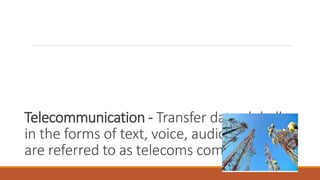
Telecommunication - Transferdata globally
in the forms of text, voice, audio, or video
are referred to as telecoms companies.
23.
"Think about theICT sector that interests
you the most. Why do you like this sector?
What career opportunities do you want to
pursue?"
 Most read
 Most read


 Most read