MODULE 1
INFORMATION
COMMUNICATIONS
TECHNOLOGIES (ICT)
Presented by : Dr. Reena George
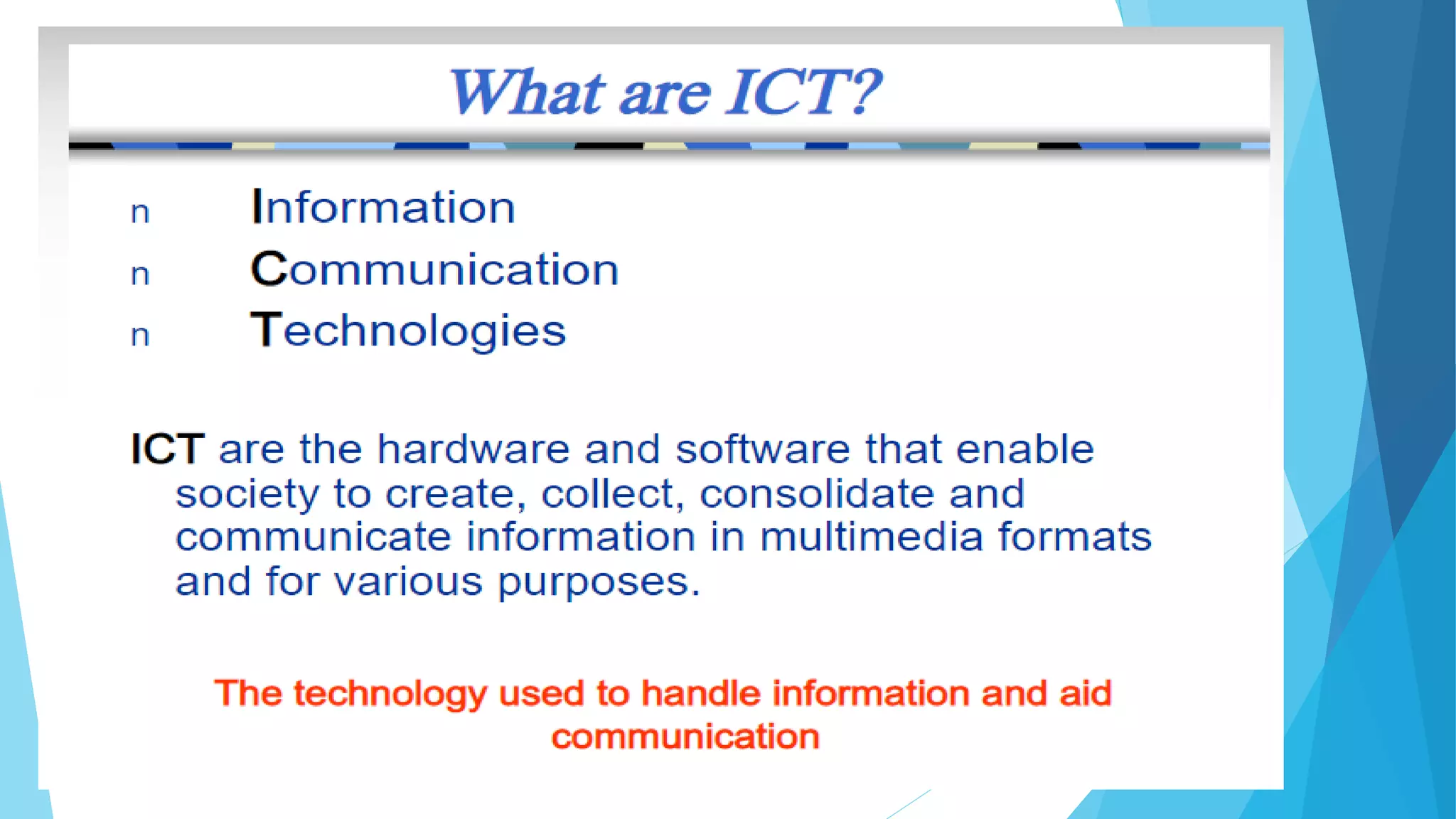
Information Communications Technologies (ICT) is a generic term used to refer
technologies that enable society to create, collect, consolidate, communicate,
manage and process information in multimedia and various digital formats for
different purposes
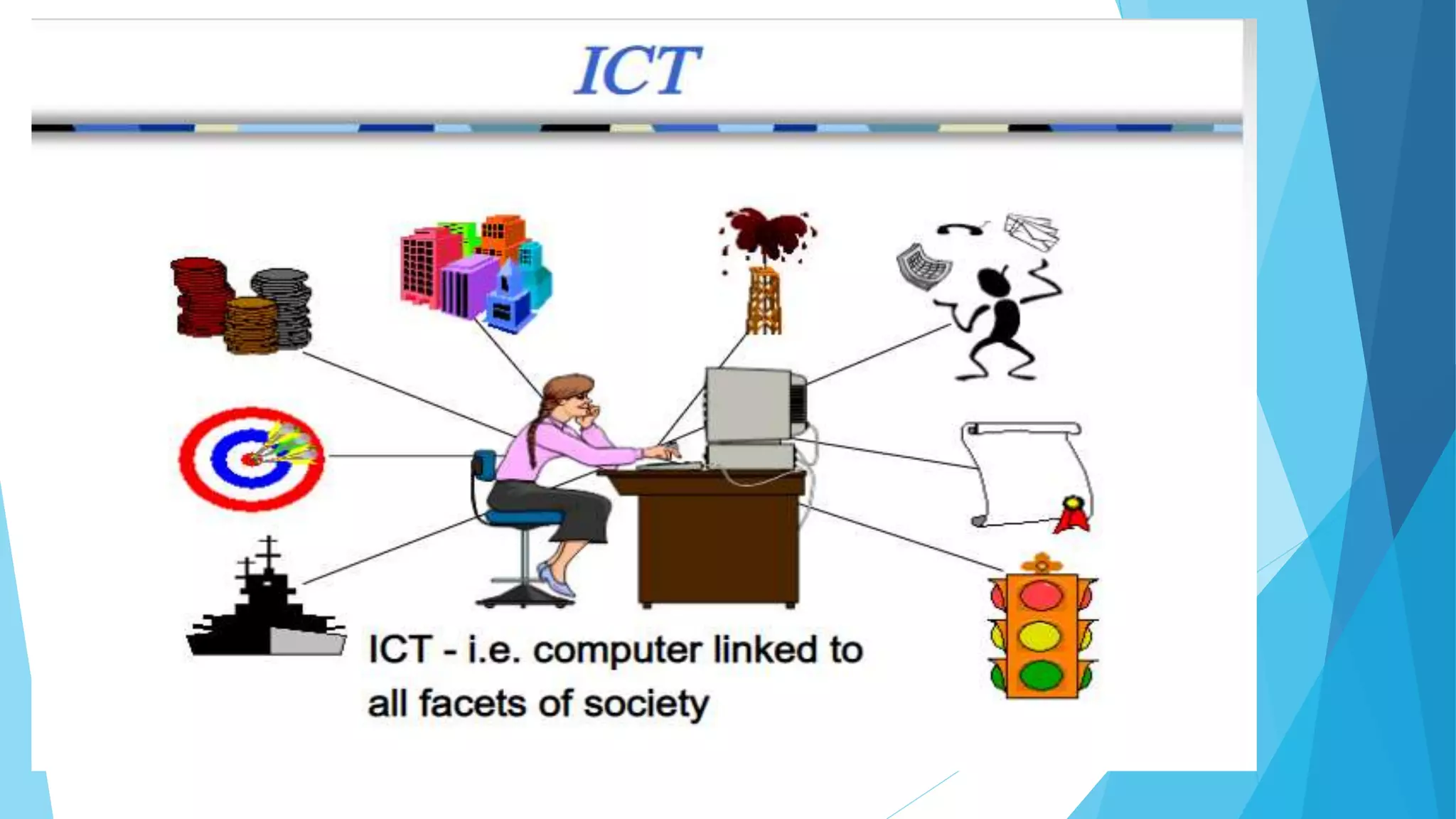
The most popular types ICT gadgets include computers, TV, Radio, cellular
phones, Projectors, CD ROM and the Internet
ICTs are making dynamic changes in society They are influencing all aspects of
our life including education ICT is revolutionizing the education sector as it
provides both students and teachers with more opportunities in adapting
learning and teaching to individual needs
ICTs greatly facilitate the acquisition and absorption of knowledge, offering
extraordinary opportunities to enhance educational systems
 The use of ICT in teaching learning is very important for it provides
opportunities for teachers and students to operate,
 store, manipulate, and retrieve information,
 encourage independent and active learning,
 and self responsibility for learning such as distance learning,
motivate teachers and students to continue using learning outside
school hours,
 plan and prepare lessons and design materials such as course
content delivery and facilitate sharing of resources,
 expertise and advice
ICT enabled education is a broader concept covering a wide variety of tools,
techniques, strategies and methods aiming the speedy and effective acquisition
and dissemination of knowledge, both in and outside classroom
It may vary from comparatively simple way of employing certain digital tools such
as computers and projectors aimed to make the conventional class room
teaching much more effective, to conducting highly complex scientific experiments
in virtual laboratories
It could be used in both formal and non formal streams of education
ICT could invariably be applied in the conventional chalk and talk mode of
teaching as well as in several kinds of web based self learning modules that are
functioning without the presence of a teacher or facilitator
This variedness indispensably demands the labeling of ICT enabled
learning into the following three major categories
1)E learning; E learning or electronic learning encompasses
learning at all levels, both formal and non formal that uses an
information network the Internet, an intranet ( or extranet ( whether
wholly or in part, for course delivery, interaction and/or facilitation
Some prefers to call it online learning .
Web based learning is a subset of e learning Generally speaking, e
learning is more suited for higher and advanced learning in a teacher
less environment
2)
Blended Learning ; Blended learning refers to learning models that combine
traditional classroom practice with ICT solutions
For example, a teacher can make use of certain digital tools like laptops and projectors
to supplement his lecture. In another, a little more advanced case the students in a
traditional class can be assigned both print and online materials, have online
mentoring sessions with their teacher through chat and are subscribed to a class email
list .
In yet another instances, a Web based training course can be enhanced by periodic face
to face instruction ..“ was prompted by the recognition that not all learning is best
achieved in an electronically mediated environment, particularly one that dispenses
with a live instructor altogether
3)
Open and Distance Learning; Open and distance learning is defined
by the Commonwealth of Learning as “a way of providing learning
opportunities that is characterized by the separation of teacher and
learner in time or place, or both time and place learning that is certified
in some way by an institution or agency the use of a variety of media,
including print and electronic two way communications that allow
learners and tutors to interact the possibility of occasional face to face
meetings and a specialized division of labour in the production and
delivery of courses Open and distance learning is an ideal way of
learning designed to meet the educational needs of those
underprivileged lots such as the dropouts and individuals from
marginalized groups and is functioning with the motto learning while
earning.
USE OF ICT IN HISTORY CLASSROOMS
Until recently, there is a misconception that the tools and techniques of ICT are of no
use in history classes and many would suggest pure lecturing as the best suitable method
for narrating historical incidents .
These advocates of traditional chalk and talk method were perhaps driven by the
overwhelming influence previously enjoyed by political history that depends more upon
the oratory skill of the teacher to provide a detailed narration of events and happenings
of the past Moreover many senior teachers might have thought that the modern tools of
ICT are not only unnecessary but also unfit for explaining the events relating to a remote
past
But all these things changed dramatically in accordance with the changing
perception of history as a discipline and also because of the unprecedented
advancements in the field of technology Now, the study of history is more
analytical rather than rendering a detailed narration of events and
happenings of the past Analytical history gives too much importance to the
concept of causality in the study of history .This involves the generation and
testing of hypotheses, somewhat akin to what one does in science and in other
fields of inquiry .This changing approach towards the subject definitely
provides more room for using the tools and techniques of ICT in teaching
learning process.
We all know that learning history includes learning some facts ( dates,
places, etc . Students find it very difficult to remember all these names and
dates.
Traditionally, history teachers used to make extensive use of blackboards
and paper charts to explain these names and dates effectively. Very often,
time charts were also prepared manually to impart a sense of chronology.
To create a sense of location and space in students’ minds, history teachers
used to depend on drawing maps. But, all this would require a high level of
artistry, expertness and hard work from the part of teachers stealing
considerable time and money.
But today a history teacher can make the maximum use of ICT for displaying
the names, events, chronological charts and maps
Attractive power point presentations containing facts, dates, timeline,
charts and maps could be prepared in a few simple steps either by scanning
from a text books or downloading from the net, so as to facilitate its displaying
by using a projector
Going by the paradigm seeing is believing displaying the larger and clearer
pictures of microliths and Mughal monuments by using LCD Projector is
apt and more effective rather than spending two or three hours in explaining
the peculiarities, features and dimensions of these objects
Moreover ,displaying pictures and graphs in appropriate places and in a
judicious manner is the best possible tactic to escape from the dullness of long
lectures and to increase the effectiveness of teaching by stimulating the
inquisitiveness among students
A teacher having a through awareness about the possibilities of
ICT in teaching history could make the effective use of audio and
video clippings so as to make his classes much more attractive,
interesting and effective
For instance, in classroom sessions dealing with India s heroic
struggle for independence, the teacher can make effective use of
audio clippings of the speeches made by national leaders such
as Mahatma Gandhi, Jawaharlal Nehru, Patel, and Subhash
Chandra Bose .
This would make the students really interested in the topic and
also helps to stimulate their enthusiasm for learning
Similarly, in learning sessions on our great national leaders, the teacher can
make maximum use of feature films and documentaries based on their
lives and activities like Richard Attenborough’s Gandhi and Shyam
Benegal’s The Making of Mahatma
Using films and documentaries could offer an added impetus in classroom
sessions dealing with almost all aspects of modern and contemporary history
like the world wars, cold war, national movements occurred in different
nations, social and environmental movements, etc.
Even more important is the fact that ICT will always encourage self
learning
Conventional method of teaching like lecturing, generally promotes passive
learning characterized by the overemphasis given to memorizing and
retention capabilities
On the other hand, ICT enabled learning especially
online learning motivates students to pose
historical problems, develop hypotheses, find
evidence and develop logical arguments to
support these hypotheses, and so on Effective use of
ICT would always help to generate a sense of
inquiry and enthusiasm for learning.
This in turn will ensure self learning by students
through different methods such as project
method, brain storming and problem solving.
The more advanced form of ICT supported history learning is the adaptation of
virtual reality environment
Virtual reality is an artificial environment that is created by using certain software
and presented to the user in such a way that the user began to accept it as a real
environment
Virtual reality is primarily experienced on a computer through two of the five senses
sight and sound. It is the computer generated recreation of a three dimensional image or
environment The user ( starts interacting with this simulated environment in a seemingly
real or physical way with the help some specifically designed electronic equipment, such
as a helmet with a screen inside or gloves fitted with sensors .This virtual reality
environment is particularly effective for teaching ancient history as it helps to create
a feeling in the minds of the students that they are walking through the streets of
Ancient Greece or sitting in front of a pyramid in Egypt
Another instance of using ICT in history classroom is the employing of mapping and
location services such as Google Maps and Google Earth .This would definitely help
a lot in providing a more accurate and effective sense of space and location in
classes related to history, geography and environmental studies. In addition to this
the teacher can also make use of presentations and talks by renowned historians and
scholars and documentaries such as BBC India and Travels of Ibn Batuta readily
available in social networking sites like YouTube and Ted com
Further teachers can motivate their students to make the maximum use of worldwide
class rooms, online discussion groups online course materials and information
databases like Geographic Information Systems (GIS)so as to ensure the active
involvement of learners in teaching learning process.
Apart from the aforesaid tactics to be incorporated in class room teaching, ICT is also
offering a major advantage as it provides anytime anywhere access to rich volumes of
knowledge repositories stored in digital format
The traditional textbooks available to students studying history are severely limited in
their usefulness in generating and disseminating knowledge
The conventional libraries in schools and colleges should face the constraints of lack of
storage space and restricted access
It is not possible for an educational institution, to maintain a library with all the books
catering to the needs of each and every students studying in different classes or courses
In contrast, the rapidly growing collection of digital resources CD ROMs and a host
of online resources ranging from Wikipedia to online libraries and e books is
actually revolutionizing the teaching and learning of history
Now both primary and secondary sources that could be utilized for reconstituting the
past are readily available in the net in digital format
The Web is now a global library that contains a large number of primary source
documents in the form of archives and e books. Thus, students can now obtain
information from primary sources rather than relying upon information filtered through
the minds of their textbook authors.
module 1 ICT information technology.pptx

module 1 ICT information technology.pptx

  • 1.
  • 3.
    Information Communications Technologies(ICT) is a generic term used to refer technologies that enable society to create, collect, consolidate, communicate, manage and process information in multimedia and various digital formats for different purposes The most popular types ICT gadgets include computers, TV, Radio, cellular phones, Projectors, CD ROM and the Internet ICTs are making dynamic changes in society They are influencing all aspects of our life including education ICT is revolutionizing the education sector as it provides both students and teachers with more opportunities in adapting learning and teaching to individual needs ICTs greatly facilitate the acquisition and absorption of knowledge, offering extraordinary opportunities to enhance educational systems
  • 4.
     The useof ICT in teaching learning is very important for it provides opportunities for teachers and students to operate,  store, manipulate, and retrieve information,  encourage independent and active learning,  and self responsibility for learning such as distance learning, motivate teachers and students to continue using learning outside school hours,  plan and prepare lessons and design materials such as course content delivery and facilitate sharing of resources,  expertise and advice
  • 5.
    ICT enabled educationis a broader concept covering a wide variety of tools, techniques, strategies and methods aiming the speedy and effective acquisition and dissemination of knowledge, both in and outside classroom It may vary from comparatively simple way of employing certain digital tools such as computers and projectors aimed to make the conventional class room teaching much more effective, to conducting highly complex scientific experiments in virtual laboratories It could be used in both formal and non formal streams of education ICT could invariably be applied in the conventional chalk and talk mode of teaching as well as in several kinds of web based self learning modules that are functioning without the presence of a teacher or facilitator
  • 6.
    This variedness indispensablydemands the labeling of ICT enabled learning into the following three major categories 1)E learning; E learning or electronic learning encompasses learning at all levels, both formal and non formal that uses an information network the Internet, an intranet ( or extranet ( whether wholly or in part, for course delivery, interaction and/or facilitation Some prefers to call it online learning . Web based learning is a subset of e learning Generally speaking, e learning is more suited for higher and advanced learning in a teacher less environment
  • 7.
    2) Blended Learning ;Blended learning refers to learning models that combine traditional classroom practice with ICT solutions For example, a teacher can make use of certain digital tools like laptops and projectors to supplement his lecture. In another, a little more advanced case the students in a traditional class can be assigned both print and online materials, have online mentoring sessions with their teacher through chat and are subscribed to a class email list . In yet another instances, a Web based training course can be enhanced by periodic face to face instruction ..“ was prompted by the recognition that not all learning is best achieved in an electronically mediated environment, particularly one that dispenses with a live instructor altogether
  • 8.
    3) Open and DistanceLearning; Open and distance learning is defined by the Commonwealth of Learning as “a way of providing learning opportunities that is characterized by the separation of teacher and learner in time or place, or both time and place learning that is certified in some way by an institution or agency the use of a variety of media, including print and electronic two way communications that allow learners and tutors to interact the possibility of occasional face to face meetings and a specialized division of labour in the production and delivery of courses Open and distance learning is an ideal way of learning designed to meet the educational needs of those underprivileged lots such as the dropouts and individuals from marginalized groups and is functioning with the motto learning while earning.
  • 9.
    USE OF ICTIN HISTORY CLASSROOMS Until recently, there is a misconception that the tools and techniques of ICT are of no use in history classes and many would suggest pure lecturing as the best suitable method for narrating historical incidents . These advocates of traditional chalk and talk method were perhaps driven by the overwhelming influence previously enjoyed by political history that depends more upon the oratory skill of the teacher to provide a detailed narration of events and happenings of the past Moreover many senior teachers might have thought that the modern tools of ICT are not only unnecessary but also unfit for explaining the events relating to a remote past
  • 10.
    But all thesethings changed dramatically in accordance with the changing perception of history as a discipline and also because of the unprecedented advancements in the field of technology Now, the study of history is more analytical rather than rendering a detailed narration of events and happenings of the past Analytical history gives too much importance to the concept of causality in the study of history .This involves the generation and testing of hypotheses, somewhat akin to what one does in science and in other fields of inquiry .This changing approach towards the subject definitely provides more room for using the tools and techniques of ICT in teaching learning process.
  • 11.
    We all knowthat learning history includes learning some facts ( dates, places, etc . Students find it very difficult to remember all these names and dates. Traditionally, history teachers used to make extensive use of blackboards and paper charts to explain these names and dates effectively. Very often, time charts were also prepared manually to impart a sense of chronology. To create a sense of location and space in students’ minds, history teachers used to depend on drawing maps. But, all this would require a high level of artistry, expertness and hard work from the part of teachers stealing considerable time and money.
  • 12.
    But today ahistory teacher can make the maximum use of ICT for displaying the names, events, chronological charts and maps Attractive power point presentations containing facts, dates, timeline, charts and maps could be prepared in a few simple steps either by scanning from a text books or downloading from the net, so as to facilitate its displaying by using a projector Going by the paradigm seeing is believing displaying the larger and clearer pictures of microliths and Mughal monuments by using LCD Projector is apt and more effective rather than spending two or three hours in explaining the peculiarities, features and dimensions of these objects Moreover ,displaying pictures and graphs in appropriate places and in a judicious manner is the best possible tactic to escape from the dullness of long lectures and to increase the effectiveness of teaching by stimulating the inquisitiveness among students
  • 13.
    A teacher havinga through awareness about the possibilities of ICT in teaching history could make the effective use of audio and video clippings so as to make his classes much more attractive, interesting and effective For instance, in classroom sessions dealing with India s heroic struggle for independence, the teacher can make effective use of audio clippings of the speeches made by national leaders such as Mahatma Gandhi, Jawaharlal Nehru, Patel, and Subhash Chandra Bose . This would make the students really interested in the topic and also helps to stimulate their enthusiasm for learning
  • 14.
    Similarly, in learningsessions on our great national leaders, the teacher can make maximum use of feature films and documentaries based on their lives and activities like Richard Attenborough’s Gandhi and Shyam Benegal’s The Making of Mahatma Using films and documentaries could offer an added impetus in classroom sessions dealing with almost all aspects of modern and contemporary history like the world wars, cold war, national movements occurred in different nations, social and environmental movements, etc. Even more important is the fact that ICT will always encourage self learning Conventional method of teaching like lecturing, generally promotes passive learning characterized by the overemphasis given to memorizing and retention capabilities
  • 15.
    On the otherhand, ICT enabled learning especially online learning motivates students to pose historical problems, develop hypotheses, find evidence and develop logical arguments to support these hypotheses, and so on Effective use of ICT would always help to generate a sense of inquiry and enthusiasm for learning. This in turn will ensure self learning by students through different methods such as project method, brain storming and problem solving.
  • 16.
    The more advancedform of ICT supported history learning is the adaptation of virtual reality environment Virtual reality is an artificial environment that is created by using certain software and presented to the user in such a way that the user began to accept it as a real environment Virtual reality is primarily experienced on a computer through two of the five senses sight and sound. It is the computer generated recreation of a three dimensional image or environment The user ( starts interacting with this simulated environment in a seemingly real or physical way with the help some specifically designed electronic equipment, such as a helmet with a screen inside or gloves fitted with sensors .This virtual reality environment is particularly effective for teaching ancient history as it helps to create a feeling in the minds of the students that they are walking through the streets of Ancient Greece or sitting in front of a pyramid in Egypt
  • 17.
    Another instance ofusing ICT in history classroom is the employing of mapping and location services such as Google Maps and Google Earth .This would definitely help a lot in providing a more accurate and effective sense of space and location in classes related to history, geography and environmental studies. In addition to this the teacher can also make use of presentations and talks by renowned historians and scholars and documentaries such as BBC India and Travels of Ibn Batuta readily available in social networking sites like YouTube and Ted com Further teachers can motivate their students to make the maximum use of worldwide class rooms, online discussion groups online course materials and information databases like Geographic Information Systems (GIS)so as to ensure the active involvement of learners in teaching learning process.
  • 18.
    Apart from theaforesaid tactics to be incorporated in class room teaching, ICT is also offering a major advantage as it provides anytime anywhere access to rich volumes of knowledge repositories stored in digital format The traditional textbooks available to students studying history are severely limited in their usefulness in generating and disseminating knowledge The conventional libraries in schools and colleges should face the constraints of lack of storage space and restricted access It is not possible for an educational institution, to maintain a library with all the books catering to the needs of each and every students studying in different classes or courses
  • 19.
    In contrast, therapidly growing collection of digital resources CD ROMs and a host of online resources ranging from Wikipedia to online libraries and e books is actually revolutionizing the teaching and learning of history Now both primary and secondary sources that could be utilized for reconstituting the past are readily available in the net in digital format The Web is now a global library that contains a large number of primary source documents in the form of archives and e books. Thus, students can now obtain information from primary sources rather than relying upon information filtered through the minds of their textbook authors.