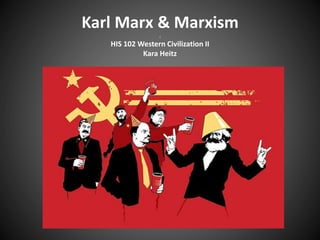
Karl Marx & Marxism
.
HIS 102 Western Civilization II
Kara Heitz
Marx in Historical Context
• Karl Marx
(1818 -1883)
• Friedrich Engels
(1820-1895)
• Communist Manifesto (1848)
What is Capitalism?
• Capital accumulation
• What is capital?
• Private ownership of means of production
• Wage labor
• Free markets?
“The history of all hitherto existing society is
the history of class struggles. Freeman and
slave, patrician and plebeian, lord and serf,
guild-master and journeyman, in a word,
oppressor and oppressed, stood in constant
opposition to one another, carried on an
uninterrupted, now hidden, now open fight, a
fight that each time ended, either in a
revolutionary re-constitution of society at
large, or in the common ruin of the
contending classes …The modern bourgeois
society that has sprouted from the ruins of
feudal society has not done away with clash
antagonisms. It has but established new
classes, new conditions of oppression, new
forms of struggle in place of the old ones …
Society as a whole is more and more splitting
up into two great hostile camps, into two
great classes, directly facing each other:
Bourgeoisie and Proletariat …”
- Marx & Engels,
Communist Manifesto
Marx and Class Struggle
• History defined by class struggle
– Masters v. Slaves
– Aristocrats v. Peasants
– Bourgeoisie v. Proletariat
• Oppressor/Oppressed relationship
• Who are the proletariat?
From Industrial Workers of
the World (IWW)
publication , 1911
Marx’s “Science” of History
• Marx’s “laws of history”
– Class conflict inevitable
– Conflict leads to next stage
Slave society ↓
Feudalism ↓
Capitalism ↓
Socialism ↓
Communism
Bourgeoisie & Capitalism as Good?
“The bourgeoisie, wherever it has got the upper hand, has put an end to all
feudal, patriarchal, idyllic relations. It has pitilessly torn asunder the
motley feudal ties that bound man to his "natural superiors," and has left
remaining no other nexus between man and man than naked self-interest,
than callous "cash payment." It has drowned the most heavenly ecstasies
of religious fervor, of chivalrous enthusiasm, of philistine sentimentalism,
in the icy water of egotistical calculation …” (Communist Manifesto)
• Demolished old feudal order
– Social relationships not based on supposedly
“natural” divisions or religion anymore
– Now differences based only on money
Bourgeoisie & Capitalism as Good?
“The bourgeoisie, during its rule of scarce one hundred years, has created
more massive and more colossal productive forces than have all preceding
generations together. Subjection of Nature's forces to man, machinery,
application of chemistry to industry and agriculture, steam-navigation,
railways, electric telegraphs, clearing of whole continents for cultivation,
canalization of rivers, whole populations conjured out of the ground--what
earlier century had even a presentiment that such productive forces
slumbered in the lap of social labor?” (Communist Manifesto)
• Industrialization
– Productive forces, wealth creation
– Science and technology
Bourgeoisie & Capitalism as Good?
“The bourgeoisie, by the rapid improvement of all instruments of production,
by the immensely facilitated means of communication, draws all, even the
most barbarian, nations into civilization. The cheap prices of its
commodities are the heavy artillery with which it batters down all Chinese
walls, with which it forces the barbarians' intensely obstinate hatred of
foreigners to capitulate. It compels all nations, on pain of extinction, to
adopt the bourgeois mode of production; it compels them to introduce
what it calls civilization into their midst, i.e., to become bourgeois
themselves. In one word, it creates a world after its own image”
(Communist Manifesto).
• Globalization
– Imperialism
Marx: Why Capitalism is Bad - Alienation
Marx: Why capitalism is bad
• Increasing income inequalities
–“Immiseration of the Proletariat”
–Did this happen historically?
Marx: Why capitalism is bad
• Capitalism as crisis prone
– Boom and bust cycles
– Ex. Overproduction crisis
• Crises get so big & frequent = capitalist system
eventually fails
Major Financial Crises of the Modern Capitalist Era (1800-Present)
19th century
• 1813 - Danish state bankruptcy
• Panic of 1819 – pervasive USA economic recession w/ bank
failures
• Panic of 1825 – pervasive British economic recession in
which many British banks failed
• Panic of 1837 – pervasive USA economic recession w/ bank
failures; a 5 year depression ensued
• Panic of 1847 – collapse of British financial markets
associated with the end of the 1840s railroad boom
• Panic of 1857 – pervasive USA economic recession w/ bank
failures
• Panic of 1866 – the Overend Gurney crisis (primarily
British)
• Panic of 1873 – pervasive USA economic recession w/ bank
failures, a 5 year depression ensued
• Panic of 1884
• Panic of 1890
• Panic of 1893 –collapse of railroad financing in USA which
set off a series of bank failures
• 1893 - Australian banking crisis
• Panic of 1896 – an acute economic depression in the
United States
20th century
• Panic of 1901 – crashing of the New York Stock Exchange
• Panic of 1907 – pervasive USA economic recession w/ bank
failures
• Panic of 1910–1911
• 1910 – Shanghai rubber stock market crisis
• 1929 – 1940 - Wall Street Crash of 1929, followed by the
global Great Depression
• 1973 oil crisis – oil prices soared, causing the 1973–1974
stock market crash
• 1973–1975 – United Kingdom banking crisis
• 1980s – Latin American debt crisis – beginning in Mexico in
1982
• 1987 – Black Monday, the largest one-day percentage decline
in stock market history
• 1989–91 – United States Savings & Loan crisis
• 1990 – Japanese asset price bubble collapsed
• Early 1990s – Scandinavian banking crisis: Swedish banking
crisis, Finnish banking crisis of 1990s
• Early 1990s recession
• 1992–93 – Black Wednesday, speculative attacks on
European currencies
• 1994–95 – economic crisis in Mexico, speculative attack and
default on Mexican debt
• 1997–98 – Asian Financial Crisis, devaluations and banking
crises across Asia
• 1998 Russian financial crisis
21st century
• Early 2000s recession - Dot-com bubble
• Late-2000s - US subprime mortgage crisis & housing bubble
• 2008–2012 Icelandic financial crisis
• 2008–2010 Irish banking crisis
• 2008–2009 - Russian financial crisis
• 2008–2010 - European sovereign debt crisis
• 2009-2015 - Greek government-debt crisis
• 2014 - Russian financial crisis
• 2015 Chinese stock market crash
Marx: Why capitalism is bad
“The state abolishes … the distinctions established by birth, social
rank, education, occupation, when it decrees that birth, rank,
education, occupation are non-political distinctions; when it proclaims,
without regard to these distinctions, that every member of society is
an equal partner in popular sovereignty … But the state, none the less,
allows private property, education, occupation, to act after their own
fashion … and to manifest their particular nature. Far from abolishing
these effective differences, it only exists so far as they are
presupposed
…
Political emancipation certainly represents great progress. It is not,
indeed, the final form of human emancipation, but it is the final forms
of human emancipation within the framework of the prevailing social
order” (Marx, On the Jewish Question)
• Legal & political equality masks other
inequalities
Discussion:
• Human nature: Capitalism v. Marx
• Revolutionary v. evolutionary socialism
• Why was there no socialist revolution in Western
Europe or the US?
• Relevance of Marx today?

Marx & Marxism

  • 1.
    Karl Marx &Marxism . HIS 102 Western Civilization II Kara Heitz
  • 2.
    Marx in HistoricalContext • Karl Marx (1818 -1883) • Friedrich Engels (1820-1895) • Communist Manifesto (1848)
  • 3.
    What is Capitalism? •Capital accumulation • What is capital? • Private ownership of means of production • Wage labor • Free markets?
  • 4.
    “The history ofall hitherto existing society is the history of class struggles. Freeman and slave, patrician and plebeian, lord and serf, guild-master and journeyman, in a word, oppressor and oppressed, stood in constant opposition to one another, carried on an uninterrupted, now hidden, now open fight, a fight that each time ended, either in a revolutionary re-constitution of society at large, or in the common ruin of the contending classes …The modern bourgeois society that has sprouted from the ruins of feudal society has not done away with clash antagonisms. It has but established new classes, new conditions of oppression, new forms of struggle in place of the old ones … Society as a whole is more and more splitting up into two great hostile camps, into two great classes, directly facing each other: Bourgeoisie and Proletariat …” - Marx & Engels, Communist Manifesto
  • 5.
    Marx and ClassStruggle • History defined by class struggle – Masters v. Slaves – Aristocrats v. Peasants – Bourgeoisie v. Proletariat • Oppressor/Oppressed relationship • Who are the proletariat?
  • 6.
    From Industrial Workersof the World (IWW) publication , 1911
  • 7.
    Marx’s “Science” ofHistory • Marx’s “laws of history” – Class conflict inevitable – Conflict leads to next stage Slave society ↓ Feudalism ↓ Capitalism ↓ Socialism ↓ Communism
  • 9.
    Bourgeoisie & Capitalismas Good? “The bourgeoisie, wherever it has got the upper hand, has put an end to all feudal, patriarchal, idyllic relations. It has pitilessly torn asunder the motley feudal ties that bound man to his "natural superiors," and has left remaining no other nexus between man and man than naked self-interest, than callous "cash payment." It has drowned the most heavenly ecstasies of religious fervor, of chivalrous enthusiasm, of philistine sentimentalism, in the icy water of egotistical calculation …” (Communist Manifesto) • Demolished old feudal order – Social relationships not based on supposedly “natural” divisions or religion anymore – Now differences based only on money
  • 10.
    Bourgeoisie & Capitalismas Good? “The bourgeoisie, during its rule of scarce one hundred years, has created more massive and more colossal productive forces than have all preceding generations together. Subjection of Nature's forces to man, machinery, application of chemistry to industry and agriculture, steam-navigation, railways, electric telegraphs, clearing of whole continents for cultivation, canalization of rivers, whole populations conjured out of the ground--what earlier century had even a presentiment that such productive forces slumbered in the lap of social labor?” (Communist Manifesto) • Industrialization – Productive forces, wealth creation – Science and technology
  • 11.
    Bourgeoisie & Capitalismas Good? “The bourgeoisie, by the rapid improvement of all instruments of production, by the immensely facilitated means of communication, draws all, even the most barbarian, nations into civilization. The cheap prices of its commodities are the heavy artillery with which it batters down all Chinese walls, with which it forces the barbarians' intensely obstinate hatred of foreigners to capitulate. It compels all nations, on pain of extinction, to adopt the bourgeois mode of production; it compels them to introduce what it calls civilization into their midst, i.e., to become bourgeois themselves. In one word, it creates a world after its own image” (Communist Manifesto). • Globalization – Imperialism
  • 12.
    Marx: Why Capitalismis Bad - Alienation
  • 14.
    Marx: Why capitalismis bad • Increasing income inequalities –“Immiseration of the Proletariat” –Did this happen historically?
  • 21.
    Marx: Why capitalismis bad • Capitalism as crisis prone – Boom and bust cycles – Ex. Overproduction crisis • Crises get so big & frequent = capitalist system eventually fails
  • 22.
    Major Financial Crisesof the Modern Capitalist Era (1800-Present) 19th century • 1813 - Danish state bankruptcy • Panic of 1819 – pervasive USA economic recession w/ bank failures • Panic of 1825 – pervasive British economic recession in which many British banks failed • Panic of 1837 – pervasive USA economic recession w/ bank failures; a 5 year depression ensued • Panic of 1847 – collapse of British financial markets associated with the end of the 1840s railroad boom • Panic of 1857 – pervasive USA economic recession w/ bank failures • Panic of 1866 – the Overend Gurney crisis (primarily British) • Panic of 1873 – pervasive USA economic recession w/ bank failures, a 5 year depression ensued • Panic of 1884 • Panic of 1890 • Panic of 1893 –collapse of railroad financing in USA which set off a series of bank failures • 1893 - Australian banking crisis • Panic of 1896 – an acute economic depression in the United States 20th century • Panic of 1901 – crashing of the New York Stock Exchange • Panic of 1907 – pervasive USA economic recession w/ bank failures • Panic of 1910–1911 • 1910 – Shanghai rubber stock market crisis • 1929 – 1940 - Wall Street Crash of 1929, followed by the global Great Depression • 1973 oil crisis – oil prices soared, causing the 1973–1974 stock market crash • 1973–1975 – United Kingdom banking crisis • 1980s – Latin American debt crisis – beginning in Mexico in 1982 • 1987 – Black Monday, the largest one-day percentage decline in stock market history • 1989–91 – United States Savings & Loan crisis • 1990 – Japanese asset price bubble collapsed • Early 1990s – Scandinavian banking crisis: Swedish banking crisis, Finnish banking crisis of 1990s • Early 1990s recession • 1992–93 – Black Wednesday, speculative attacks on European currencies • 1994–95 – economic crisis in Mexico, speculative attack and default on Mexican debt • 1997–98 – Asian Financial Crisis, devaluations and banking crises across Asia • 1998 Russian financial crisis 21st century • Early 2000s recession - Dot-com bubble • Late-2000s - US subprime mortgage crisis & housing bubble • 2008–2012 Icelandic financial crisis • 2008–2010 Irish banking crisis • 2008–2009 - Russian financial crisis • 2008–2010 - European sovereign debt crisis • 2009-2015 - Greek government-debt crisis • 2014 - Russian financial crisis • 2015 Chinese stock market crash
  • 24.
    Marx: Why capitalismis bad “The state abolishes … the distinctions established by birth, social rank, education, occupation, when it decrees that birth, rank, education, occupation are non-political distinctions; when it proclaims, without regard to these distinctions, that every member of society is an equal partner in popular sovereignty … But the state, none the less, allows private property, education, occupation, to act after their own fashion … and to manifest their particular nature. Far from abolishing these effective differences, it only exists so far as they are presupposed … Political emancipation certainly represents great progress. It is not, indeed, the final form of human emancipation, but it is the final forms of human emancipation within the framework of the prevailing social order” (Marx, On the Jewish Question) • Legal & political equality masks other inequalities
  • 25.
    Discussion: • Human nature:Capitalism v. Marx • Revolutionary v. evolutionary socialism • Why was there no socialist revolution in Western Europe or the US? • Relevance of Marx today?